V IN WINTER QUARTERS WITH CAPTAIN SCOTT (continued 2)
Reading edition
Dr. Wilson raised a question as to the meaning of the word “glaciated.” “Is Erebus glaciated?” he asked. I said “No, not in the strict sense”—for the word applies to regions laid bare after a glacier has retreated. Scott thereupon said that a new name is needed for glacier-covered lands. (I think the word “glacierized” is permissible for this type of country.)
The Owner and I had a great cag as to the shape of the ice at the mouth of the Ferrar Glacier, which he had explored in 1903. I said in 1911 it had a tongue jutting out to the 258south-east; he thought there was a bay here! “This is very queer,” said Scott. “Well, I can’t make it out! I expect I shall continue to believe I’m right, and you will believe you’re right.” I said, “I can do better than that. I believe we are both right, and it’s these incomprehensible glaciers that are wrong!”
It was late when I turned in and most of the others were asleep. Some were dreaming, for Cherry cried out suddenly, “But look here, those horses are quite unloosed!”
Titus Oates was awakened in the next bunk and inquired anxiously, “What’s that about the horses?”
It will have been gathered that there was some touch of the navy about our life in the Hut. I may, without breach of confidence, say that I had been warned by a former explorer against the “side” of the naval men. This advice seems most amusing on looking back at our experiences. Apart from Scott the naval men were younger than the scientists, and their attitude may be gathered from their nickname—which they bore with considerable complacency—of the “pseudo-scientists”! But it was a case of give and take. A naval man would wish to learn some branch of science, and one of the most amusing evenings was when one naval student underwent an examination by one of the geologists and successfully attained honours, through the whispered promptings of the other geologist.
The account of the lectures will show how catholic were our interests. Practical meteorology and navigation are two subjects in which I received kindly assistance from the respective experts. Dr. Bill, as I have shown, was willing to devote hours to any of us who wished to learn to sketch. Ponting was always ready to train the southern party so that they might obtain a satisfactory photographic record of the Polar dash. And so on right through the community, including the seamen and others in the mess deck. I am sure the latter enjoyed the free life. It must have been a topsy-turvey experience for them to see the weary watchman—who was always one of the officers during 1911—nodding or shivering over the stove, while they snugly slept through the night.
Occasionally, if the unfortunate officer fell over the fire-irons, or otherwise disturbed the “mess deck,” the sailor-men 259would permit themselves the luxury of caustic remarks behind their curtains—well knowing that the chance of scoring off a member of the “afterguard” would not occur in a less socialistic community. I remember playing off a game of bezique with Taff Evans, who rather prided himself on the game. At first, to my amazement, he was beaten, and the mess deck crowded into our cubicle to jibe at Taff! However, he soon got “topsides” of a mere geologist. Dr. Atkinson was keen to learn Russian, and we used to hear him chanting vocabularies with the two Russians in the mess deck.
If we wanted any repairs done, it was always easy, with a little blarney, to get round Evans, or Crean, or Lashley, or one or other of the petty officers, and all the scientists learnt something of many handicrafts through contact with the stalwarts of the navy.
Debenham and Gran went off to visit Hut Point, and bring back the specimens we had left there in April, so that I had the Ubdug cubicle to myself. The enemy took advantage of my lonely condition, and just as I had got off to sleep a great beam of wood, six feet long, was pushed into my bunk by some base villain. I arose in my wrath, and seeing that “Marie” Nelson seemed somewhat conscious in his bunk, I pushed it on to him, and added a chair or two, and various other movables. He fell upon me, and we rolled about over the main table until I skilfully deposited him up against the Owner’s cubicle, when he had to desist for fear of wrecking it. Birdie Bowers, Meares, and Oates were hugely delighted, the more so because Birdie had done the foul deed!
Such were the cowardly tactics of the Bunderlohg. I was too tired to attempt to chastise Birdie, and turned in again, merely remarking that he would not have dared to do this if my honourable colleagues had been present.
It was quite an accident, but almost all the scientists and non-naval men were on the port side of the hut, while the naval men and “Teamsters” were on the starboard side. Dr. Wilson was out of place in the ranks of conservatism; but as he used jovially to egg on both sides, we rarely knew his opinion on the burning questions of the day!
Curiously enough, the right arm of the conservatives (“reactionaries” we called them) was our biologist Nelson. He and Bowers argued largely, until Birdie became too deeply 260immersed in the question of stores to attend to much else. But I was credited with a nimble tongue, and Simpson was always crushing, with his inside knowledge of social problems, so that the Progressive Party was by no means unrepresented. We could always rally a strong colonial contingent in the persons of Debenham (Australia) and Wright (Canada); and never have I had such amusing arguments (cags we called them) as during the Antarctic night. Woman’s Suffrage I have known argued ad nauseam from dinner-time (7 p.m.) till midnight, when Nelson and myself were left still opposed, and still full of argument. Prayers for peace never deterred Nelson from preaching women’s inferiority. Boots were the arguments that usually drove him to seek his cubicle and sink to rest.
In mid-June there was bright moonlight, so Wright and I decided to visit Cape Royds, and get a few things from Shackleton’s hut. I started with balaclava and wind helmet, and two pairs of gloves. As there was no wind, and only −8° temperature, I shed first the helmet, then the balaclava, and then the thick and thin pairs of gloves! It was about six miles only, and of course much easier by the sea-ice than viâ the crevassed Barne Glacier (our route in January). We got some gas tubing, which Day wanted, some ginger for Atkinson, tracing paper and a chisel for Charles, and I bagged a carpenter’s rasp. It reminded me of Crusoe’s visits to his old ship, for it was great fun poking about in cupboards, not knowing what treasures might turn up.
We soon turned south to our own hut, meeting Birdie and Cherry also off to Cape Royds. On our left Erebus looked like a great cone of white sugar against the blue-black sky, where the moon shone resplendent. Charles rudely scoffed at my poetic wish that Luna were a mirror and would show us how the world were progressing!
Debenham and Gran returned next day after an absence of six days at the Discovery Hut. On arrival they found one of our dogs (Macaca) lying in the porch. He had been lost for a month, and was naturally pretty thin! They fed him on some biscuits, and then got the blubber stove going. In the whole time they had only had three hours decent weather! In the same time we had only experienced three hours bad weather. But every day was showing us more and more 261clearly that the weather conditions were extraordinarily localized in the Ross Island area.
They had started back on Sunday, but were caught in a snowstorm when about two miles off, and so took their bags off the sledge and bolted back for safety! Monday was very thick; and later Debenham woke, and his watch said 2. The only clue as to whether this was 2 a.m. or 2 p.m. was that the dog seemed very hungry, which made them think it was morning. So they rushed off without breakfast, and expected to arrive in time to have it with us; to find us just getting ready for supper! It was a quaint coincidence that Birdie and Cherry had also lost count of time, and came in expecting breakfast at 7 p.m. Such is the pernicious effect of the sun’s absence for four months!
For some weeks I had been helping Simpson in the magnetic hut. Each Thursday he secluded himself in the little asbestos hut, and proceeded to obtain absolute measurements of the magnetic field. He had a small stove to warm the hut, and kept the temperature at +65°, so we were comfortable enough, except that a wind of sixty degrees of frost sailed in through the hole in the wall by which he viewed his stadium.
At Cape Evans the magnetic variation was about 150° E., which means that the north-seeking end of the magnet pointed to the south-east! In other words, we were far to the southward of the south magnetic pole. In fact, when we were at Knob Head Mountain, up the Ferrar Glacier, the variation was nearly 180°, and we were close to the line joining the south magnetic pole to the end of the earth’s axis—which is the real South Pole.
The procedure in the magnetic work was too technical to be inserted here. However, Simpson estimated the dip of the needle by accurate measurement of the angle of rest of a magnet swung on a horizontal axis. Then he got the horizontal factor. This controls the position of an ordinary magnet, as usually swung on a vertical axis.
The results were used as a check on the continuous record obtained from the magnetometers in the ice grotto. At certain fixed dates Simpson and Wright carried out “quick runs.” All the chief observatories in the world were doing the same work at the same instant, and Simpson’s work, so 262near the magnetic “hub of the universe,” was obviously of prime importance in this connection.
The Cape Crozier party were now busily engaged with their preparations for the midwinter journey to the haunt of the Emperor penguins. For some weeks Cherry had been practising hut-building near Skua Lake. He used the kenyte boulders, which lay scattered around the hut. It was roofed with sealskin, and in one corner he managed to maintain a blubber stove.
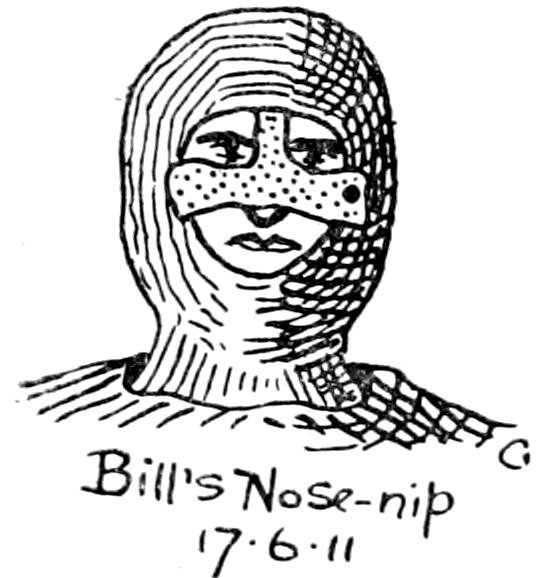
Uncle Bill was busy making a patent nose-guard to withstand the blizzards of the Barrier.
“Extraordinary the affection a fellow gets for a pair of old pants!” says Birdie, who has spent all morning darning a pair for the midwinter journey. Dr. Bill glances at them, and says drily, “Most extraordinary!”
Some one else chimed in, “It’s queer the way your clothes vanish in this hut, even if they are marked!” We all agreed that the only safe way was to wear them. Gran pathetically remarked, “And dey do seem to go den too!”
Said Meares caustically, “Never mind, you’ll find them when you have your next bath” (which sounds unkind, if you don’t understand the difficulties of bathing in the hut; for Gran melted down bits of glacier for a wash as often as most of us!).
I went out to South Bay to see how Nelson’s biological station was progressing, and carried a thermos flask with me. The moon gave a little light. His semicircular wall (called the “Igloo”; quite wrongly) was built of mush ice from the hole, and was now six feet high, opening to the north. It was curious how the blizzard drifts rebounded from the wall and left a windward trench all round the latter, though a great pile of drift extended many yards north (to leeward).
He picked at the new ice with a crowbar and ladled it out with a sort of net. Then he pulled up his nets, which phosphoresced beautifully from transparent Siphonophora. It must be understood that though our air temperature in winter was below −30°; yet the salt water was always +29° (or 59° warmer!). So that a sound scheme would have been to have 263had a diving-bell retreat and go down under the sea-ice, out of the blizzards at minus thirty. This was, of course, just what the seals did!
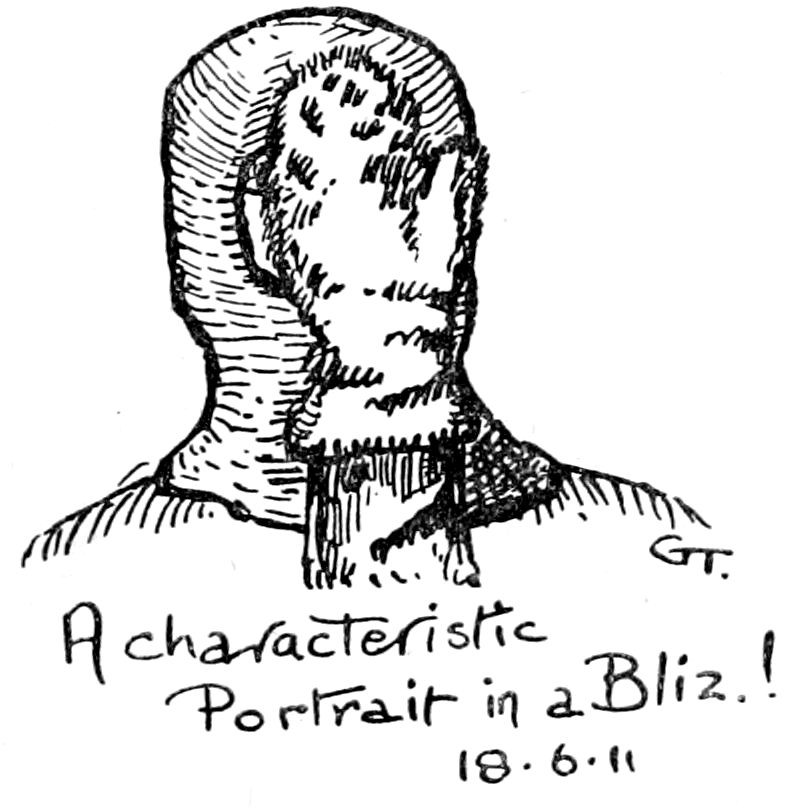
He emptied the animals into the thermos flasks (which were intended for our comfort), and so got them back to the hut without their being damaged by freezing.
Then we returned to the hut, facing the keen north wind; so that a characteristic photograph of any explorer under such conditions is shown in the annexed sketch!
Debenham and I had some arguments as to the temperatures in the hut. I felt cold in my bunk, whereas he said he was always warm in his. However, we got a thermometer and tested the temperature at various levels.
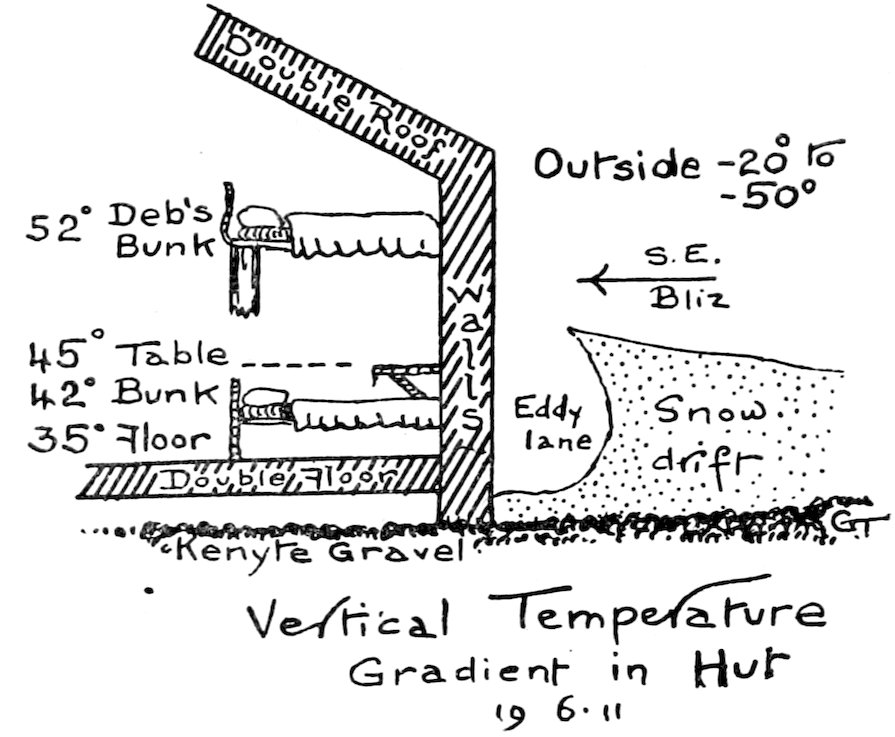
Near the stove it was 55°, but on the floor in our cubicle it was 35°, only a degree or two above freezing. No wonder our toes got cold. My bunk was 42°, the table was 45°, and his bunk (six feet above the floor) was 52°. So that naturally he was warmer in the belt of ascending air. However, the 264elevated bunks were (like the “gods” at a theatre) not specially well ventilated, so that I preferred my cooler sleeping-place.
Next day Simpson and I went off again to look at the Igloo. There was only a faint starlight, and we could neither find the Igloo nor the Cape when we turned back! However, we steered by a star and got back to the hut by a longer route, during which I fell three feet into the tide crack between the sea-ice and the hut.
That evening Day lectured on “Motor Sledges.” It was good to hear him so optimistic. Scott told us of his experiences at Lauteret in France with the “Antarcticker” Charcot. (Quite recently a statue to Captain Scott has been erected by the French in this region.)
I had agreed to sketch the movements of the steam cloud from Erebus during the winter, but I note on the 20th June, that it was about the first time for a month that I had been able to see the top of Erebus. Ponting reported that it was glowing strongly during the day; but no colour was visible when I went out to look at it, while Debenham spent a long while outside on the off chance of an eruption. But −35° cooled him off, and he came in unsuccessful.
“Midwinter Day, June 22, 1911.—Here it is Midwinter Day, and except in my sleeping-bag sledging, I have not felt specially cold down here, sixty below freezing without wind is perfectly comfortable. But this morning a nippy north wind made my thumbs ache while cutting out the fish trap, and Atch’s and my noses are getting red-tipped and sore. Still, I’ve known that happen elsewhere! One never gets ‘chaps’ here; I wonder why? However, August is the coldest month and the stormiest, but it will be lighter then.
“This afternoon, at 3 p.m. (Greenwich) there was a strong twilight to north. Light red (a clear non-yellow colour) along the horizon. Then indigo—probably a cloud—then clear pale blue, and above this slate-blue merging into the star area. No moon or sun. But an hour later all this had vanished.
“I am on night duty. Dr. Bill was up till 1 a.m. He heard me cursing because I couldn’t find my towel after my usual bath, and came to help me. Bathing at 6° above freezing-point, you don’t care to wait about much! I have 265on my Jaeger coat, felt boots, two pairs of wool socks, wool helmet, two jerseys, thin flannel shirt, and thick singlet, thick underpants and thick corduroy trousers. By keeping my feet up on a chair out of the cold ‘floor air’ I keep comfortably warm, but will probably go into the kitchen galley.
“2.30 a.m. Just been putting in half an hour with the confounded stove. I added compressed fuel at midnight, but later found it nearly out. I’ve devoted one of my two weekly candles to it, but it only flamed weakly. So I waked Clissold. He says it’s due to the cold ice I’ve just put in; but adds, ‘Let her rip!’ So I don’t care. The porridge won’t be properly cooked, but most of them like it so!
“I suppose the gramophone will be celebrating to-day. They are fine records. I like the opening chorus to the ‘Dollar Princess’ best, though I can only hear the words ‘across the water,’ but the minor key is O.K. Margaret Cooper’s ‘’Tis folly to run away from love’ is the only clear girl’s voice. Robey on ‘Golf’ and ‘Prehistoric Man’ are very popular. Oates always calls for ‘The Sergeant of the Line’ and ‘Why should I marry at all?’ Both are good bass songs. The Anona-Banjo dance is fine. Meares likes ‘We all walked into the Shop,’ while Gran prefers a Creole wail, ‘Ma Honey’ and ‘Madam Butterfly,’ which I can’t stick! We have a few hymns, and the ‘Night Hymn at Sea’ is grand.
“Debenham, Ponting, and Cherry (especially the latter) are good at the pianola. It works usually from 5 to 6 and 12.30 to 1.30, while the gramophone runs from 8 to 9 if there’s no lecture. We don’t have any sing-songs, and they are really not needed with the three or four hundred tunes on the two instruments.
“I snoozed peacefully after my night-watch till noon on the 22nd. Then we had lunch, and Cherry produced the first number of the South Polar Times and handed it to Captain Scott.
“He had typed all the prose, and (cutting out alternate pages from a day-book) had pasted the sheets in the book between clean pages. There were fifty pages of typescript. Then Day had bound it splendidly in Venesta board. It was edged with sealskin, and he had cut a cameo monogram, S.P.T., through the outer layer of venesta into the dark middle layer of the three-ply boards.
266“There were about ten full-page illustrations, and many drawn by Bill in spaces left in the text when typed.
“The guessing at authors was very funny. Gran was rabidly curious. I fear no one thought I had done ‘Valhalla,’ which is a mixed pleasure—for all seem to enjoy it; while Nelson put down the ‘Protoplasmic Cycle’ to Debenham, though he had actually read the verse in the Pack in my diary! Bill’s illustrations are tiptop, especially the three Egyptian tablets. The latter are frightfully clever apart from the draughtsmanship. Every line is a history in itself.
“The first sketch shows three of the debris cones on the Ramp. One is labelled—in honour of our cubicle—the Ubdugs, while Birdie, in his green hat, crowns another.
“The second shows Keohane painting (he did the yellow funnel on the ship). He stands on Forde. ‘Chippy’ carries the hut, and Abbott (with frosted hair) helps him. Day on his motor has his long legs and arms disposed in true hieroglyphic attitudes. Meteorological signs for thunder and lightning surround the engine.
“In the bottom corner is the western party sledging. Three men pulling hard, while one lanky individual provided with a long beard is sketching instead of working! This is a foul and funny libel on myself!
“The third represents Birdie, Crean, and Cherry (with spectacles) adrift on the floe. This is labelled with the sign * (for ice) to prevent any mistake. The killer-whales are going for Birdie’s fat legs. Then there’s the 1902 Hut bulging out with ice, with drip-pots to catch the thaw, and ‘Hoosh’ labelled in Beaufort scale letters.
“In the other corner a screaming drawing of the ‘Little Perisher’ (Atkinson) caressing a frostbitten ear and nose which is labelled with the ‘glazed frost’ sign. They are the funniest pictures I have ever seen, and beat Hogarth into a cocked hat for detail.”
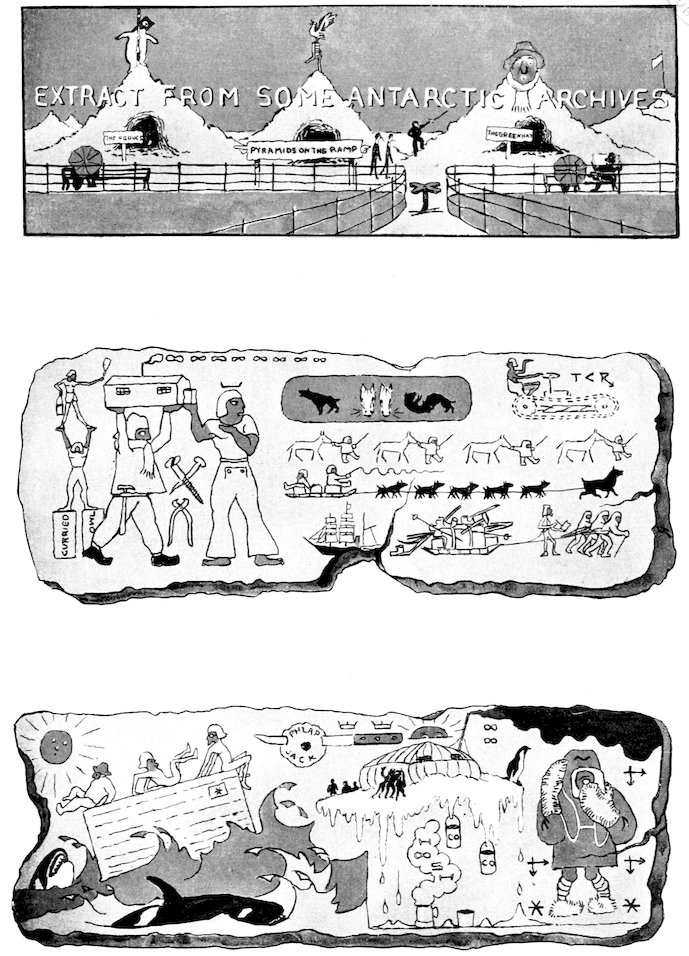
“SOME ANTARCTIC ARCHIVES.”
EXTRACT FROM SOME ANTARCTIC ARCHIVES.
1.
And it came to pass that in the month of January,
2.
Scothe-Ohnah took up wintak-watahs on Ros-is-land.
3.
And there was great barkinofdogs and neighinofhorses
4.
With phufphuf of motahs. 267
5.
The Hut was raised by chypechap, fordandkohane.
6.
Abbottelped.
7.
All said “Itwa s’dam cold”.
8.
After Three Weeks (E’Linag Lyn) it was done.
9.
Then twelve under Scothe-Ohnah started South,
10.
Fourundah Sharn-Gatch for the West.
11.
Theship departed.
12.
The Cobbos parted, Kreen-an-Ephans.
13.
Birdibow-Ahs of the mighticaluph reached the furthest.
14.
Withim Soljah-an-gran.
15.
Bur-de-Cherry and Crean “chaunst their arm”.
16.
Olswell.
17.
Allah-ad-diris.
18.
Sharn-ledwel and kambaque.
19.
Theoldh-utwas full. Itliqued. Itwa-so-dakh.
20.
Soljah-fash-son-ed a stove.
21.
It burned with blubber and did nearly all the cooking.
22.
Hu Ra. Hoosh. Hush. Hoosh.
23.
Thesephroze.
24.
Scothe-Ohnah and with him eight others left for Kapevans. Thalef thejonah.
25.
Theice bluout.
26.
Phrostbit nosears and phace.
27.
Thisis thethir tieth.
28.
Garnfroste phace!
29.
Daian Marie came sledging.
30.
They got phrostbit. Algot phrostbit.
31.
Bill Esau sumemp-Rahs.
32.
Enuphsasgudas-a-phest.
“Gran is very funny about Valhalla! He has been sounding Birdie and Ponting as to the home of the northern gods! Marie Nelson had never heard of Valhalla, but was going to work to find out who coined the word ‘pont.’ The Owner read the greater part to us. He can make a good speech and write well, but he’s no reader, as he confessed! Ponting’s plates are splendid. Gran thinks he did the ‘Sleeping Bag Medley’; but I doubt it strongly. However, probably my guesses are as wild as any one’s and the whole thing is very good fun.
“After lunch I went out for a stroll to see the Antarctic in darkest night. No one else seemed keen. I walked to South Bay over Island Lake and back over Skua Lake.
“There was a twilight, grey-blue to the north—an arc extending from about Granite Harbour to Cape Royds, and this gave some light. I wore my felt boots, which are warm 268though slippery. I came one cropper through not seeing a drop of two feet down a snow ridge. As I walked up the next snow slope, it gave out an octave—the notes descending the scale! I could just see Tent Island, but could not make out the edge of the cliff close by. It was so calm that I walked part way back without a helmet. I came another cropper, hurting my shin and elbow and so to the hut.
“On my return, I found them draping the hut with sledge flags. My ‘blood-stained banner’ and Debenham’s (both made by my sister) were hung over the table. Atkinson and Birdie made their own flags. (Atch has a black tree on a white silk flag.) Ponting and Gates have none.
“Then we had dinner, while Ponting manœuvred the cameras to get a photo. He moved away all nearer than I was, so I was left in the foreground, and unfortunately practically spoilt the picture! For I meekly cast my eyes down as the flash went off, and am obviously blind drunk! They don’t know that I only had a quarter-glass of awful lime-juice, while the others had champagne!
“Then speeches began. The Owner made a ripping speech, pointing out that we’d done half the time, and must realize that we could only do about as much more. Dr. Simpson wished health to the southern party, and we who were going west drank it with him. I arose with an apology for saying, ‘Captain Scott, Gentlemen, and Non-scientists.’ This dig at Oates, Birdie, and Co. brought down the house, for they have occasionally opened by saying, ‘Captain Scott, Scientists, and Gentlemen.’ Atkinson and Wright failed lamentably, except that Charles said (à la the discussions), ‘I have no remarks to make, sir, in addition to those stated,’ while Atch said, ‘I endorse that.’ Debenham discussed the colonial representation on the expedition. Cherry reminded us of the home folks drinking our healths.
“Birdie had moved off to the foot of the table, and said he couldn’t make a funny speech, so he was going to show us something funny. Therewith entered four of the seamen with a unique Christmas tree.
“It was built of a ski-stick draped with bunting, with penguin feather foliage, hung over with candles and candied fruit. The gifts were from Mrs. Wilson’s sister, and were perfect. Birdie’s distribution was magnificent.
269“Every second present or so was a necklace or earrings for ‘Miss Jessie’ Debenham. Meares got many wedding-rings in memory of his refrain, ‘Ting! Ting! You buy the ring.’ ‘Marie’ Nelson had a huge fan, while Dr. Bill got a book of drawing copies. Titus got a popgun, and ‘Silas’ Wright an envelope marked ‘In memory of my native land,’ containing the Stars and Stripes! This, as a loyal Canadian, he threw away with contumely.
“I got a ‘Physiographic outfit’ of shovel, axe, and pick for ‘our Griff,’ and a packet of shaving paper for ‘the Lord High Physiographer,’ and (I blush to state) a trumpet with a note which I scorn to set down!
“Then the table was cleared away, after we had pulled crackers, and we sat down to look at Ponting’s slides of events to date. They were admirable, especially the Ice-foot and Pancake ice. I was exhibited rather frequently, and the incipient beard excited much hilarity.”
A few of the seamen became rather merry by this time, and a set of lancers was not a great success, my partner finding the floor unsteady. We all turned in before 2 a.m. (except Dr. Bill, who was on watch), and so ended our Midwinter Feast.
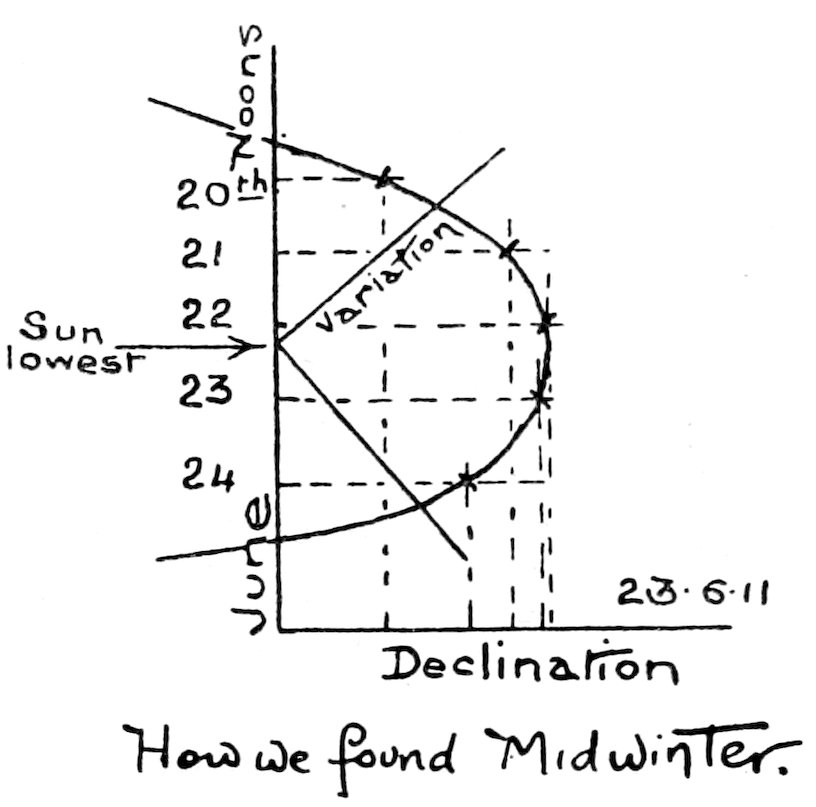
On the next day I spent some hours trying to find the exact time when the sun was lowest. As we had not seen him for two months, this may seem difficult! But from the Nautical Almanac it was possible to plot the sun’s position (declination) for three or four days each side of the 22nd. This came out a parabola, of which we could not find the exact apex (or date of lowest sun). However, by adding the curve of the variation (as suggested by Wright), the date came out readily enough at the intersection of two straight lines.
270“The result at Greenwich was ⅒ of 24 hours after the noon of June 22 = 2h. 24m. p.m. Our clock[8] keeps Greenwich time (though we are not quite on 180° meridian), so that this time by our clock was the critical instant of midwinter. Hence Dr. Bill was the only one awake at that interesting moment!
“However, Thursday’s dinner on the 22nd was the nearest to the exact time of lowest sun, so we were en règle. Meares insisted that I was thus particular because I wanted another feed on the 23rd! This to me, who ate nothing and drank less!”
Gran and I had a competition, as to who could guess the most authors in the current volume of S. P. T., the loser to give a dinner on our return. I stipulated “no alcohol,” but, on Gran’s remonstrances, agreed to “Australian wines.” I thought I should win, for he hadn’t contributed, and I knew three of the thirteen with some certainty! I wrote out a list, and so did he, and we asked Cherry to referee. He was not to be drawn from the silence of the editorial chair. Finally he said our bet was off, because we were equal. Teddy Evans, however, declared that he knew most of them, as they’d been discussed by Bill and Cherry in his cubicle. He said I got ten right and Gran nine. At any rate, the first suitable place for a dinner was my own town (Sydney), where, of course, I was host, so that Gran came off best ultimately.
Late in June I gave a lecture on the “Physiography of the Western Mountains.” Ponting kindly made two dozen slides for me, and he put these through the lantern, with the addition of some maps I drew on glass, and one extra (by Gran), which was a libel on the physiographer! The problems discussed in this lecture have already been described in my sledge narrative.
On the 27th June the gallant midwinter expedition started. Dr. Wilson was in charge, and was accompanied by Bowers and Cherry-Garrard. Their object was to visit the Cape 271Crozier Rookery, and to study the habits of the Emperor penguins during the nesting season. No one had ever seen them nesting, nor had any eggs, except long-abandoned specimens, ever been found. Wilson hoped to get embryo chicks, and thus study the early stages of these birds, which in some ways are the most primitive existing, and which therefore exhibit features linking them to the reptiles.
They took two sledges, pulling a heavy load of 253·3 lbs. per man. Numerous bamboos, specimen bottles, penguin-nets, special clothing, etc., accounted for the load; but they proposed to be absent five weeks and would need extra provisions in view of the extremely low temperatures. No such trip had ever been made before. No one realized what they would have to encounter, and I hope no one will ever again attempt to do anything so close to the confines of human endurance.
Nelson, Gran, and I accompanied them nearly to Glacier Tongue. We could just make out the black crags against the white snow. I had a bet with Bill that we could see Little Razorback Isle. I lost, for it was the 500-foot cliff of Turk’s Head, and this was a pity. I was so sure, that I bet him the small amount of £40,000,000!
“When we stopped I called for three cheers for the Cheery Winter Knight, the Short Winter Knight, and the Long Winter Knight. When they saw that I meant ‘Knight’ (and not the surrounding gloom!) they laughed muchly, and we left them cheery.”
In the evenings we went in for games of various sorts—though never cards, for some unknown reason. Captain Scott and Atkinson used to play a couple of games of chess each evening. Nelson was our “star performer” at any game of skill, and could beat any of the others at chess. I should think Debenham and I probably played most chess. Wright and Simpson occasionally indulged, and were of about the same class. Gates and Debenham were fond of backgammon. Evans, Gran, and I played Matador a great deal, until I found myself getting beaten with monotonous regularity, when I decided that dominoes wasn’t an intellectual game, and stuck to chess!
“We have just been discussing Jules Verne on the shooting of bears with mercury bullets! The temperature is now 272−40° F. (seventy degrees of frost), and the feat would be possible, at any rate, as far as loading went!”
Outside “Silas” Wright is busy getting “time” from star occultations with a patent telescope. His station is near the rubbish-heap, and is connected by telephone to the hut. It is a cold game, as may be imagined, and to manœuvre in light gloves with delicate screws would try the patience of a saint. I never heard of a Saint Silas, and when Wright’s light blows out, the gentleman inside the hut (with the chronometers) blushes at the language carried by the telephone wire. There was a yarn (which it is not necessary to believe) that the said wire had to be drenched with water at regular intervals to prevent the heated remarks from fusing it!
Wright had one of Colonel Sterneck’s gravity pendulum equipments, and for this he needed to know times to 0·000001 part of a second! Thus he could tell whether his pendulums swung quicker or slower in Antarctica than in New Zealand. If they swung quicker, then they were nearer the centre of the earth “down south.” Thus the good old simile in which the shape of the earth is compared to a flat-ended orange is deduced scientifically by a frostbitten scientist at “seventy below freezing”!
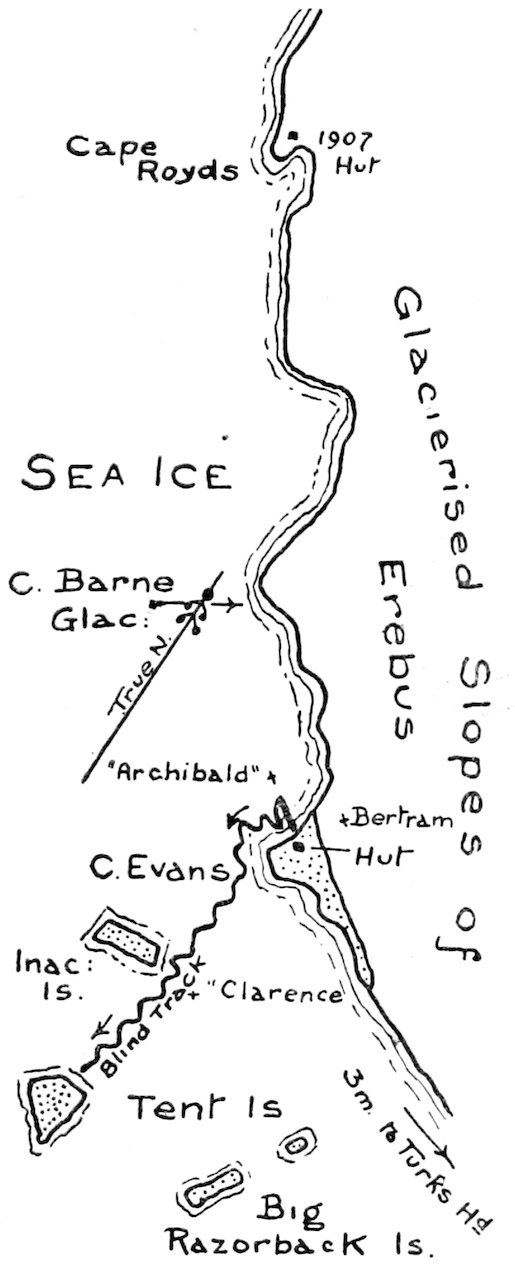
As soon as Simpson had equipped his main station he fitted up a thermometer screen above the Ramp on the icy slopes of Erebus. Later two more were placed on the sea-ice —one towards Tent Island and the other in North Bay. These were labelled A, B, and C at first, but these seemed prosaic names when one had literally a chance of losing one’s life when one paid them a visit during disturbed weather in the long winter night. So that the screen in North Bay was dignified into “Archibald,” “Bertram” lived above the Ramp, and “Clarence” was “way out in the country” to the south.
Ponting and I introduced ourselves to Bertram on the last day in June. He lived beyond the rough moraines, so we had to put on leather boots. One of the dogs (Tsigane) accompanied us. We could just see, and managed to climb up the 150-foot Ramp, with some diminution of wind, and in half an hour had reached Bertram, 250 feet up.
There were two thermometers—one registering maximum temperatures, one giving present reading and also (the most interesting reading) the minimum temperature. On this 273occasion the coloured alcohol showed −20° F., −27°F., and −37° F., respectively. In calm weather it was usually from five to ten degrees colder at the Hut than at Bertram, for the cold air sank to sea-level. But in rough weather all the air was churned up, and the temperatures were much the same at all four stations.
We read the thermometers by a candle, for it was a calm day; but my toes began to go, and so we hurried back to the Hut, when I decided to go in for more socks.
After this I read Bertram fairly regularly when the weather seemed promising. Scott definitely ordered that no one should visit the screens if there seemed risk involved, for the Hut thermometer recorded continuously and the others were only for comparison, and got less important as we noted the regularity of their characteristic differences. After a few visits I used to glissade down the icy Ramp, though I could never see when I had reached the bottom, for in the dark you cannot distinguish a vertical from a horizontal plane of ice.
“We had service on the 2nd of July. With our three chief songsters Crozierwards, there is less harmony. I followed Day in the hymns, and he afterwards confessed that he had forgotten the tune; so my help was not valuable! Meantime Simpson had a duet in the corner with Wright. ‘Twenty-one, twenty-two, twenty-three’ ... etc.; he counted the seconds through the ’phone to Wright, who was cussing the stars outside. The only accompaniment we had now that Cherry was away was the telephone bell.
“The combination would have been ludicrous if it hadn’t been necessary, for Wright had to abide by the transits of the stars, and they occurred service or no service.”
The most noteworthy feature in the Hut was a strong propensity to argument. I think Nelson and myself were the chief offenders, as we disagreed on every topic under the sun, and let each other (and also the rest of the Hut) know the reasons! I remember one cag resulted from a night-watch supper. About this time I used to watch from 8 p.m. till 2 a.m., and “Marie” Nelson from 2 till 8 a.m. We went shares in the supper.
Here follows a verbatim report of an argument whose only merit is its accuracy and representativeness.
274Scene: Breakfast in the Hut, July 3, 1911.
G. T. (grabbing a fragment). “This isn’t your bread, Teddy?”
Teddy Evans. “Yes, it is.”
G. T. “Chuck over a bit in your lily-white fingers, Marie!”
Marie. “Now that’s what I call a well-cut piece of bread. It’s symmetrical about its axis.”
G. T. “Why don’t you call it by its crystallographic name? It’s an enantiomorph!”
Marie (mentally broken up, but stubborn!). “You’re taking refuge as usual in long, meaningless words; anyhow, that’s a rotten word; ante is Latin and morph is Greek. You don’t know how to cut bread.” (Then he proceeded to explain how I maltreated the loaf of our combined night-watch supper.)
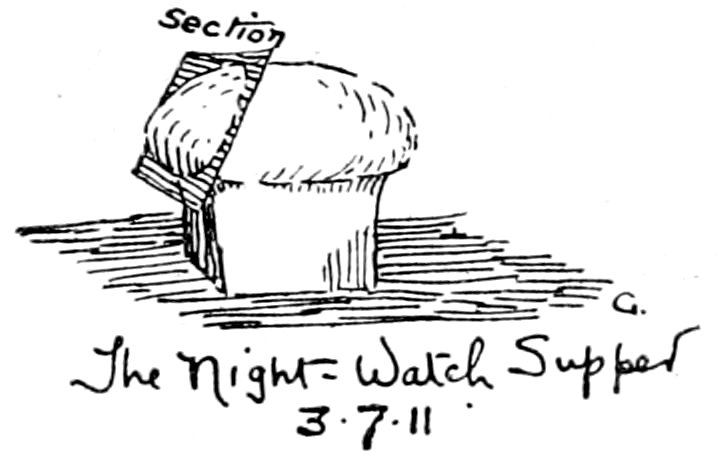
G. T. “I know no one else is interested, but I don’t see why I shouldn’t bore them also! (Loud cheers.) That bread crust projected six inches, and I only ate the overlap. You’ve had all your own suppers, and mine too, all the winter, you miserable, cynical reactionary. Anyhow, enantiomorph is all Greek, and means ‘mirror-reflection.’ So it just suits the case.”
(Marie subsides, the Owner pushes off to his cubicle, and I proceed to tease Ponting. Then the cag is continued in my bunk by Marie solus, until I cry pax.)
And that’s how the long winter night passes!
“July 4.—Have just been ragging ‘Silas’ Wright as an American (?) on this auspicious day. Whereupon he fell upon me and succeeded in tearing my pocket. It is a snorting day. Wind fifty miles per hour and temperature −29° F. I went out for a few minutes with bare hands, and it took me about five minutes in the Hut to get them right. Yet it is warmer than yesterday, when bare hands were possible. The wind does it.”
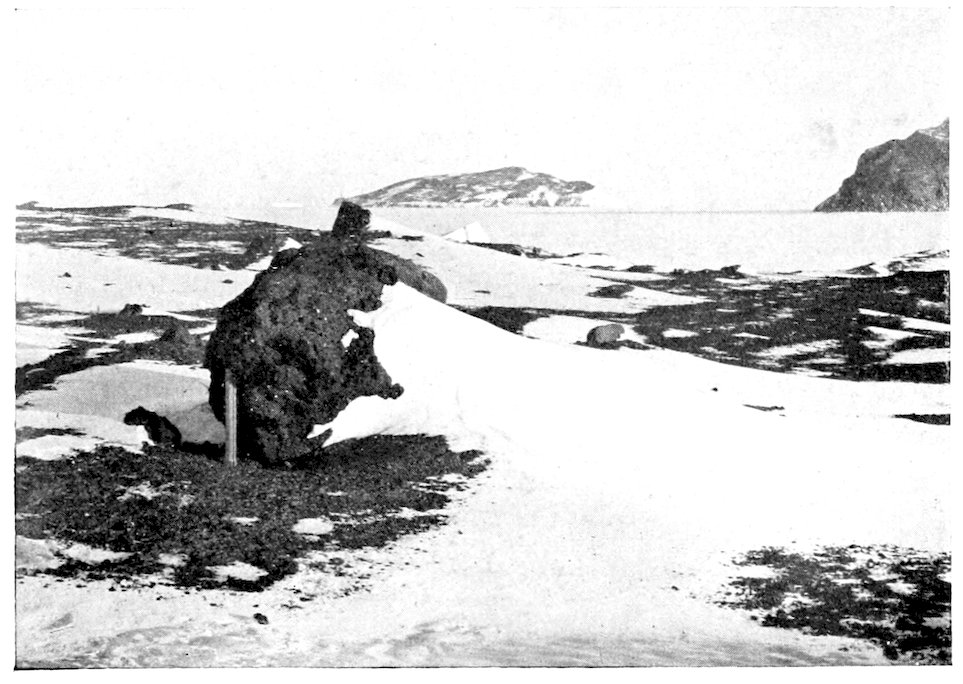
SNOWDRIFT ON CAPE EVANS SHOWING THE DEEP EDDY ON THE WINDWARD SIDE, Sept. 9, 1911. The drifts all lie on the south sides of the kenyte boulders. Four miles to the south appears Tent Island.
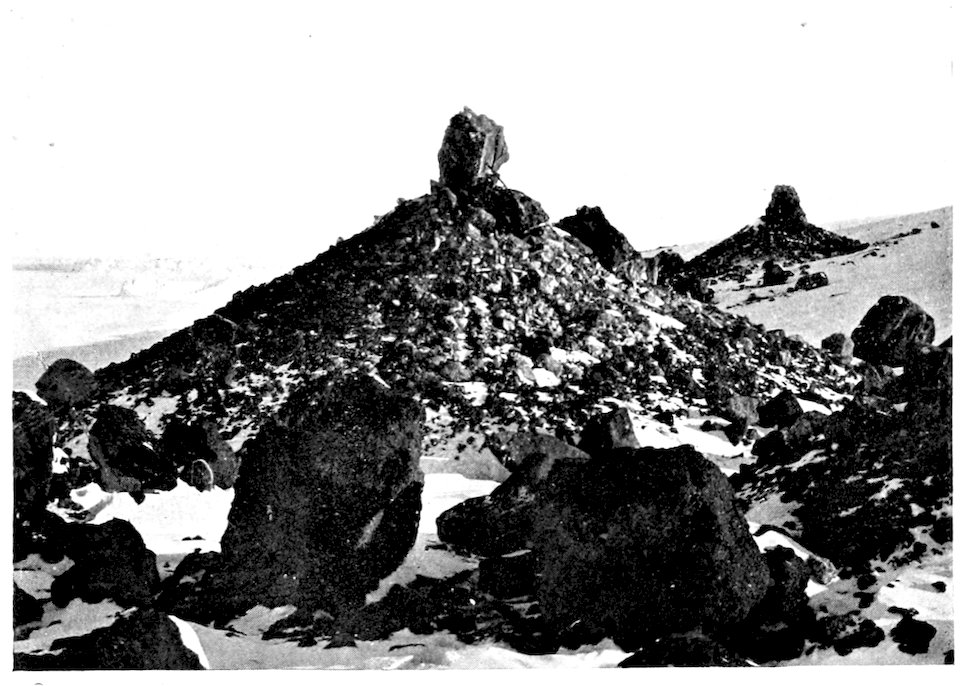
DEBRIS CONES ON LAND’S END (ONE MILE SOUTH OF THE HUT), Sept. 9, 1911. Each is 30 feet high and due to the weathering of a huge boulder of kenyte. In these two specimens the process is only half complete, the core of the erratic still remaining. Erebus Glacier on right. [See p. 291.
We finished the day with the most exciting experience of the winter. Life in the Hut, as will have been gathered, was comfortable enough, and with such splendid mates, I felt it so 275pleasant that I had to keep on reminding myself that I was in Antarctica in the middle of the long night. Yet occasionally, as on this day, Nature warned us that she was not to be trifled with.
Atkinson and I went off to read Bertram, leaving about 4 p.m. There was quite a lot of drift, and we soon lost sight of the Hut, but luckily there was no mistaking the Ramp. The end of my nose was nipped with −25° F. and the gale of wind. (You can apparently feel something “go with a ping,” just as if the blood froze in the end of your nose.) Anyhow, it soon got warm again when covered by my mit. It was worse on top, and we soon lost sight of all rocks and cones. The wind kept fairly steady and we steered by that. After about half an hour I counselled return, and we turned back to regain our bearings, and after being out an hour and a half we found Bertram. The fusees which we carried just burned long enough to read the temperatures (minimum, −38°, maximum, −25°).
We reached the Hut about 6 p.m., and my task was over. Atkinson was so pleased with our success that he decided to go off 800 yards to Archibald. I tried to dissuade him, but he said he’d be back in twenty minutes, and would just return against the blizzard, and so couldn’t miss the Hut—or at any rate Cape Evans, which extended a quarter of a mile each side of the Hut.
Gran also started to go to “Clarence” about the same time, but realized it was impossible, and managed to find Cape Evans again, though quite at the wrong place.
About 7 p.m. Nelson and I went out to have a look round for Atkinson. It was very thick but not blowing so hard. We informed Scott of his absence, and he immediately organized search parties, realizing better than we could the seriousness of the event. Atkinson had been out an hour, and we could not imagine what had happened. Day took up tins of oil to the top of Cape Evans, and burnt great flares every few minutes for hours. Debenham, Gran, and I walked along the top of the low cliffs on the Cape with candle lamps.
276
Lost in the blizzard, July 4, 1911.
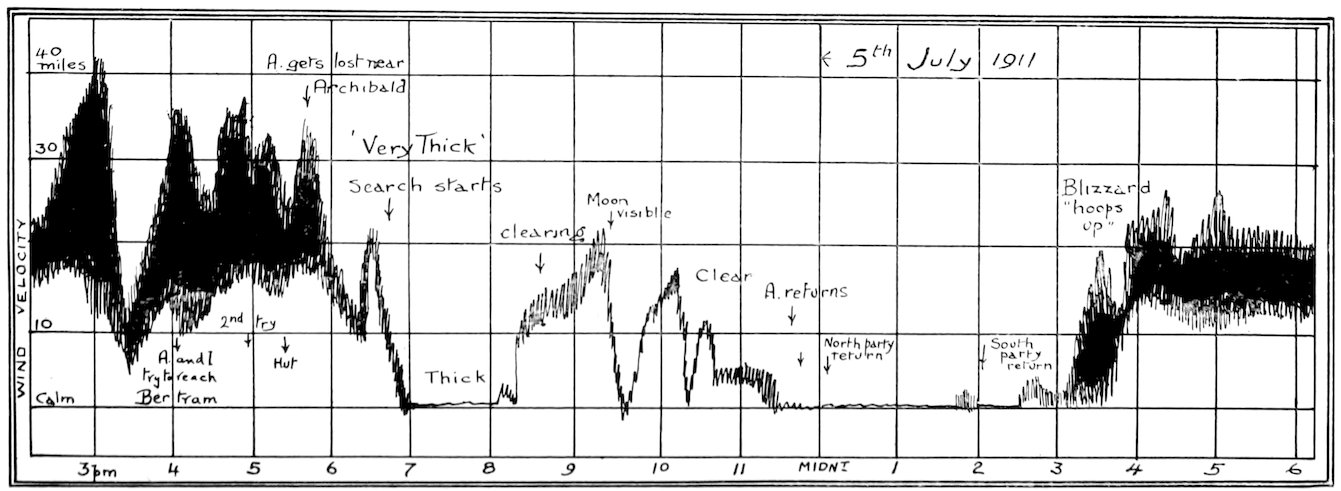
We felt sure that he must have got to the coast, for it stretches for thirty miles along the east, and that he was perhaps sheltering in some cranny. We formed a long chain from Cape Evans to Inaccessible Isle, and it was only by marking an arrow in the snow that I could remember which way safety lay. For the wind had died down, but the thick drift and the benumbing cold made us more and more anxious as no news came in. From 8.30 till 10 p.m. the blizzard was blowing again, and we began to feel hopeless. Captain Scott arranged for two sledge parties: one, under Lieutenant Evans, went south along the Glacier cliffs for six miles; the other, with Seaman Evans, went north to Shackleton’s Hut. They carried tents and sleeping-bags. Wright went round the cliffs of Inaccessible Island. Ponting and I searched the Cape Barne glacier. We thought he must have fallen into a tide crack or sprained his ankle, for now the moon began to show a bit, and at 11 p.m. it was clearing somewhat. We could see Day’s huge flares on the cape from a distance of several miles. Just as we reached the big cliff of Barne Glacier two rockets went up, and we knew that he was found. We learned that Atkinson was quite dazed, though he had got back entirely unassisted, and had not seen any one until he reached the Cape Evans cliffs and saw Debenham above him. His right hand was badly frostbitten, with huge blisters on each finger—just like a condor’s crest.
“BLIZZOMETER RECORD” DURING THE SEARCH FOR ATKINSON, July 4, 1911.
He had walked off towards Archibald with the blizzard, but halfway there turned back, feeling it foolish to persist. 277He got back quite safely to the tide gauge, which was only a stone’s throw from the hut. Then he was completely lost. The wind had dropped somewhat. He tried to keep it full in his face; and, perhaps, owing to eddies around the cape, he must have wandered due west away from the hut and towards the open sea. After some hours of helpless wandering, where he had to keep moving to prevent his freezing to death, he came to some high cliffs. He thought these might be the walls of Inaccessible Island, but there is little doubt that he had wandered south now, and was skirting Tent Island. He tried to burrow into the snowdrifts here, and so got his hand badly frostbitten. Then the moon showed faintly, and he owed his life to the fact that he remembered to have seen the moon over Erebus (and therefore east) on the preceding night. So he staggered towards the moon, and after about an hour and a half he reached Cape Evans, and was safe. We had imagined that the blizzard, constantly blowing from the south, would have enabled him to steer east to the coast; but, owing to lulls and to eddies, and finally to his dazed condition, he lost all sense of direction, and would have undoubtedly perished but for the moon. The search parties got in by 2 a.m., and then the blizzard fury increased nearly to gale strength, and continued all next day. It was only during the six hours while Atkinson was lost that it lulled sufficiently to permit of any one venturing away from land. If it had kept up to its original or final strength, we might easily have had other casualties in the search parties.
The recital of dreams, as furnishing outside interests of a sort, was occasionally tolerated in the hut. I wonder if most people go through my dream evolution? As a child, a feeling of terror, often that primitive idea of falling and never hitting anything, which is a survival of tree life. Later, the growth of a belief that the dreamer himself never gets hurt. And then in the late ’teens the comfortable realization that it’s only a dream, to be followed by “dreams within dreams”; and, finally, at the age of thirty by logical reasoning while dreaming.
I noted that we had been south six months before I began to dream of snow and ice, and this perhaps is of psychological interest. In one dream “I was climbing up above Grindelwald, aided by a New Zealand guide, in company with Dr. 278Bill. We got ‘bushed’ on a high peak near a hay-stack. I had a talk with Dr. Bill, in which I said that I had dreamt that the guide was going to take us down an easy way, which he wanted to keep dark, as he’d discovered it and wanted to keep it for rich tourists. We both smiled at this fool dream. Then I really awoke, and I suppose my sub-conscious self is still smiling on ‘Haystack Mountain’ in the Grindelwald!”
The ponies were snugly housed in the stable along the lee side of the hut. Their stable was built of the blocks of compressed fuel, and was quite a snug abode. They were rather vicious little beggars, and a walk down the narrow “aisle” meant a risk of a bite or a kick. Oates and Meares spent a lot of time in the stable making blubber and seal pemmican for the dogs. The western party had nothing to do with the ponies, for only those who were leading the ponies south were responsible for exercising them. In midwinter some “fearful wild fowl” took cover in their shaggy coats, and occasioned Captain Oates much trouble.
I noted this in my journal as follows—
“Baron Bernard du Day, Messenger from Captain Titos Oates.
“Greetings to Debenham.
“Wilt thou peril thyself so far as to visit the stable, and for payment of one straight-cut cigarette an hour, comb the manes of ye Siberian ponies to catch ye intrepid and adventurous louse?
“Debenham meekly leaves his rock sections, and hies him hence!”
Some of the game from the Pony Coverts was exhibited by Atkinson under his microscope. They resembled white ants in wind-helmets! No legs appeared in the specimen, so I asked if they had been worn off in the chase, but the indignant exhibitor was silent.
During the autumn another grotto had been added to our outlying villas. This had been cut out in the glacieret to house Wright’s pendulums. We called it the “Cave of Pendullum.” It was usually drifted up, and we had to cut down to the sacking door, being careful not to chop the telephone 279wires. Inside, in one corner, was the telephone box, well crusted with ice, through which he could hear the ticking of the sidereal clock in the hut. There was also a delicate apparatus from the Cavendish Laboratory at Cambridge to register the “ionization of the air,” and a microscope and micro-camera. On an ice bench was the chief instrument, a stand carrying four short pendulums. Each was mounted on an agate knife-edge, and was surmounted by a mirror. The time of swing of these pendulums was very delicately measured, and gave the pull of gravity at Cape Evans, thus leading to an estimate of the shape of the earth.
This account is somewhat brief, and this is explained in my journal as follows: “This description has been greatly interrupted by the irruptions and incursions of the Anti-Feminist, who will pour out his antiquated views on ‘Woman’s Mission in Life’ into the unwilling ears of Debenham and myself. His only semi-sane argument is, that as all laws rest on an appeal to force, and as men are physically stronger than women, therefore men must protect, must rule, and (apparently) therefore must control and administer all the laws! The rest is pure selfishness.”
Tuesday (11th July) was Jam Day, as I write with glee. There are two articles of diet to which I am not particularly addicted, and they are cheese and sardines. We got cheese solus for four lunches a week, and sardines every night-watch. So that I used to reckon by Tuesdays! I proceeded to translate German glaciology as usual, but unfortunately Debenham and Nelson started a cag on the merits or demerits of Australian tennis champions; and when that was over we had another as to which was the worst storm in the Terra Nova. Nelson said it took place off Cape Town, Wright said off St. Paul, Atkinson said south of New Zealand. All this talk occurred in our cubicle, and as Debenham and I had not experienced the two earlier excitements, we were not violently interested, and tried to push the debaters out, with complete lack of success. I did very little German!
On the 12th of July we had a record blizzard. For over twelve hours its mean velocity was above forty miles per hour, and it rose above seventy miles per hour at 9.15, 11.15, and 5.30. At 9.15 p.m. it fairly boomed over the hut. Luckily the hut is so surrounded by “lean-tos” and great snowdrifts 280that the wind is led gradually on to the Hut, else it would surely have blown us into the sea.
This blizzard was accompanied by relatively high temperatures. It roared all that day, but after lunch, on 13th, I write: “... it is getting cooler; none of that oppressive heat of +8° F. (24 degrees of frost), and is now much nicer (-7°); so that the leaks have stopped, after damping Gran’s mattress considerably.” The lunch was evidently cheese, so that I confined my attention to brown bread, dripping, and cocoa. We were able to leave the Hut in the afternoon, and walked up to Bertram. Skua Lake was so brilliant, I thought at first it had melted, but it was merely polished like plate-glass by the furious drift.
The Twin Glaciers (copied from diary, July 15, 1911).
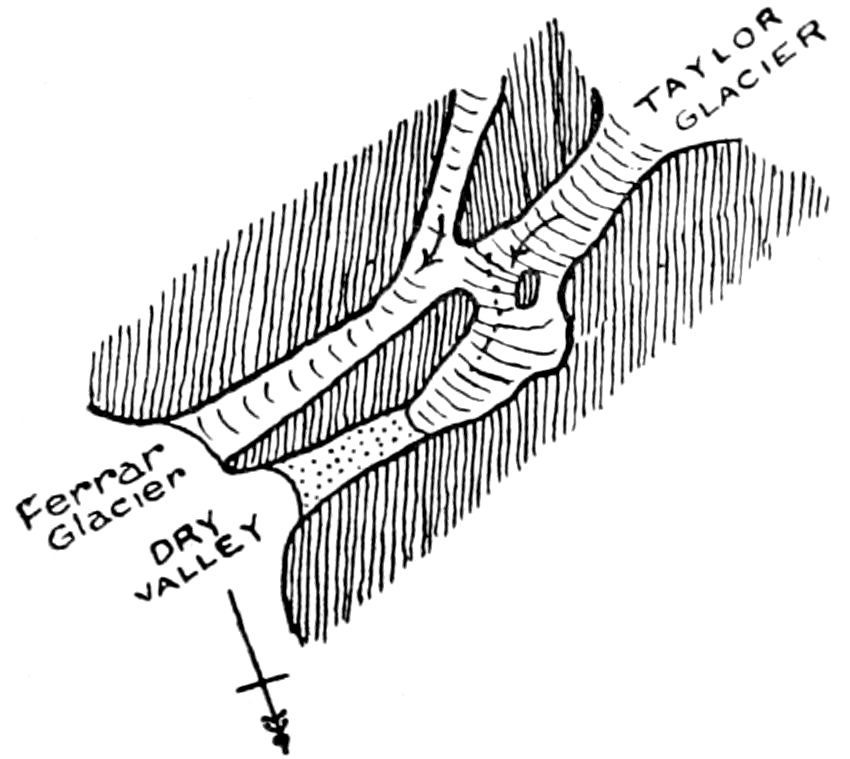
Teddie Evans had been engaged for some days on plotting the chart of Dry Valley on the first western journey. He made a fine drawing, with “form-lines” inserted, so that the shape of the glacial valley showed up splendidly. Captain Scott, Evans, and myself discussed the naming of the new glaciers, etc., now first charted. We had given some of them provisional names on our journey, and the Owner chaffed me somewhat, but said he didn’t mind a bit. There were two distinct glaciers included in the Ferrar Glacier, which Scott had named in 1903. He asked me if the one entering Dry Valley was going to be described as a type; and I said that its exposed bed was probably unique in Antarctica. Then he said, “We’ll call it the Taylor Glacier.” So that on 15th July I became a cartographic entity!
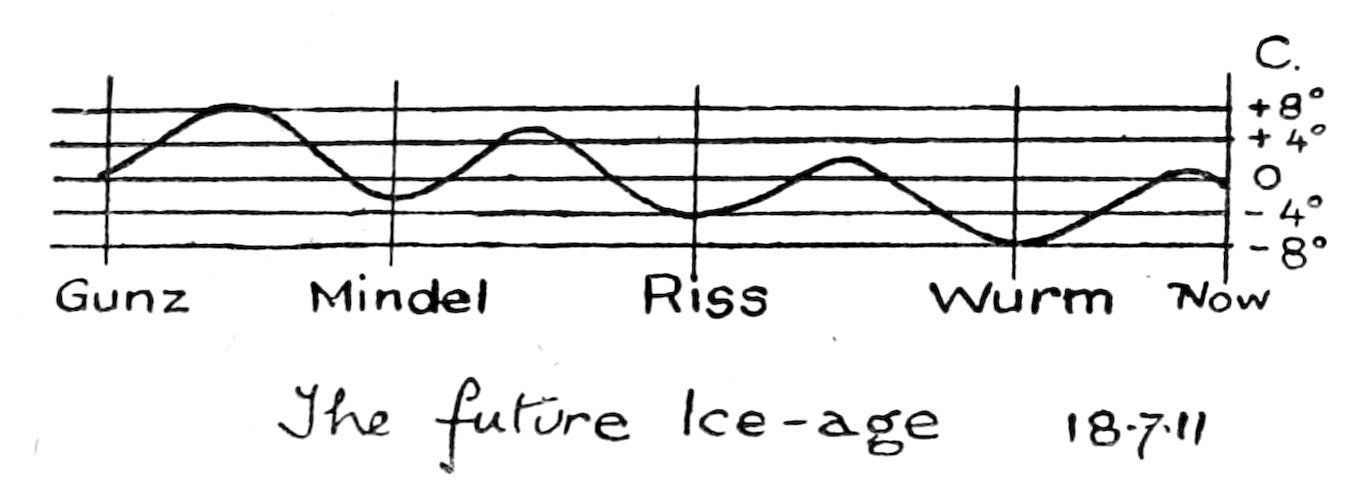
One of the most interesting paragraphs in the German tome through which I was laboriously wading tended to show that the world was approaching another Ice Age rather than leaving it behind.
In the Swiss Alps the Germans have shown that there were no less than four Ice Ages included under the last glacial 281epoch, separated into three inter-glacial periods. The general temperatures can be obtained by studying the depression in the snowline and the position of the moraines in these four Ice Ages. It really looks as if we were now in an inter-glacial period, rather than permanently free from glacial conditions. However, the next Ice Age is seventeen thousand years off, even by the lowest computation.
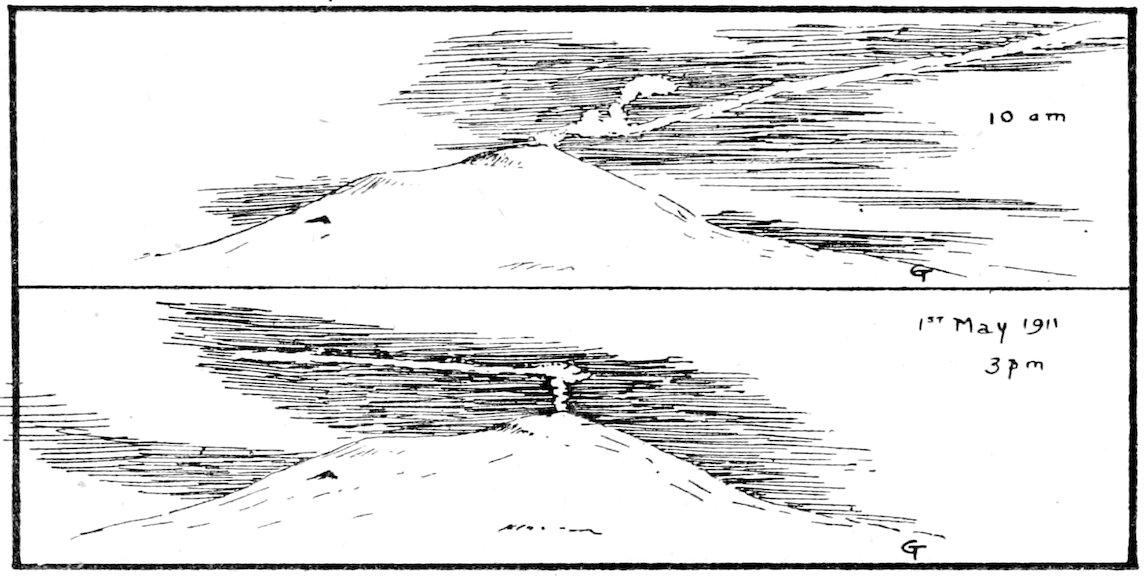
Similar reversal of the steam banner of Erebus at noon, May 1, 1911.
I was able to make a characteristic sketch of Erebus on the 18th July. The steam cloud extended across an arc of 90°, and appeared to be drifting to the south. The banner was possibly a hundred miles long. On the surface there was a cool southerly wind, in just the opposite direction. Several fine undulations showed in this banner, and at times a hummock of steam over the crater pointed to extensive outbursts of vapour. Far to the south the banner was very faint, and reminded one of the Milky Way.
The dawn colours were very beautiful. We were not to 282see the sun for over a month, but over his position were belts of crimson lake, dull red and green, with pale blue above.
Sometimes the dogs would accompany us up the Ramp. Atkinson and I went up to read Bertram on the 21st, while Stareek and Tsigane trotted alongside. The latter is quite sociable, while Stareek, one of the leaders, is one of the most imperturbable. According to Atch, he has been seen admonishing Tsigane for his undignified behaviour!
These walks were good exercise, but the weather was getting colder (though midwinter was past) and −35° was quite common. My first occupation on reaching the Hut was to go and hold my head over the stove. After some minutes the lumps of frozen breath which surrounded my mouth would melt somewhat, and I was able to free my beard from the flannel of my helmet!
After Church service on the following Sunday (23rd), Ponting gave an exhibition of cinema pictures in his dark room. It was a very select show, as there was only room for an audience of four! His films were negatives, so that the black and white were reversed. Under these circumstances the seals appeared white and more slug-like than ever, while the white shadows following the penguins were most uncanny. While we were in the dark room Simpson called out that the wind was still rising. It reached eighty-four miles per hour at 8 p.m., which was the record during the first winter, though this was easily beaten in 1912.
The 26th of July was a splendid day, and without doubt marked the return of daylight. Simpson and I visited Bertram and were able to read the thermometers without recourse to fusees. We marched on the Erebus Glacier some distance, and found numerous pot-holes in it, due to stones sinking therein. On our return I continued plotting the chart of the Koettlitz Glacier. Wright is obtaining interesting results from his ice sections by “rubbings” of the ice striæ with a soft pencil. These photograph quite well.
We were well stocked with books in the Hut. Almost every officer had taken down some standard novels in addition to a few text-books, and curiously enough there was very little overlapping. For instance Cherry had a row of Kipling’s works which almost all of us appreciated, Day had Dickens, Debenham had four or five poets, and more popular still—a 283collection of thirty “paper-back sixpennies,” which every one was always borrowing. He kept them in a box under his elevated bunk, and I remember one evening after we had turned in, some one came into our cubicle and started burrowing about. Debenham said, “Now then, what are you after down there?” A voice replied, “Where do you keep those sixpenny novels, Debenham?” It was Scott, who couldn’t sleep, and wanted some light literature!
I had two or three of Wells, Browning, Tennyson, and “Martin Chuzzlewit.” However, though my library was small, I used the official library more than any one! I have mentioned elsewhere the splendid little library of standard fiction presented largely by Mr. Reginald Smith. This consisted of about 250 portable volumes published by Smith, Elder and Co., and by Nelsons. There were Merriman’s, Brontë’s, and Conan Doyle’s, and all the shilling editions of noteworthy books by authors like Gosse and Belloc. Mr. Mackellar gave us many other volumes, especially some small art books. These lived in Day’s bunk. Then Admirals Markham and Beaumont presented us with many rare copies of books on Polar Exploration. These were constantly being read, especially by Bowers, whose lectures on sledging rations and polar clothing led him to read every word. Candidly I must admit that it was not cheering—when the blizzards were booming over the hut and all was dark around us—to read of Greeley’s awful suffering in the Arctic, where forty out of fifty men perished; or of the loss of the Jeannette and her crew in Siberia; but still the volumes were always being referred to by one or other of the officers.
We had several larger books, Haydn’s “Dictionary of Dates,” which didn’t seem to be much troubled, and Harmsworth’s Encyclopedia, which was always in demand. Cherry had the large Times Atlas, and we had Paul’s “History of the 19th Century,” and Harmsworth’s “History of the World.” Oates brought along Napier’s “Peninsular War,” and rarely seemed to read or need aught else. I had a bet with him that I would finish Paul’s six volumes before he had read through Napier. However, neither was completed, though Oates was a long way ahead! Scott had a shelf of poets and a number of foreign novelists, chiefly Russian and Polish.
I had finished all the lighter literature in about three 284months, and thereafter was able to advise some of the others as to works meriting their fleeting attention! It occurred to me that it would be amusing to try and discover the tastes of the fifteen officers of the hut. Books were naturally often discussed. Oates must have been reading some of Merriman, for I find that Simpson took exception to his praise of the latter’s works on meteorological grounds! This seems rough on Merriman; but Simpson said it was not possible to see the midnight sun at Tver, and he also objected to the wrong use of the word parhelion. I’m afraid I’d missed these “professional errors,” but I remember what seemed a serious flaw to me in Davis’ “Soldiers of Fortune” (otherwise a rattling yarn), was the author’s weird geological description in the first chapter! Similarly we expected Captain Scott and Seaman Evans to revel in Kipling’s sea yarns, whereas they were not enthusiastic. Both made the same criticism; Evans saying that there seemed to be a lot made about a little, and that, “anyway things isn’t so concentrated-like in the Navy!”
I hope living authors, if they ever read this, will rise superior to our criticism! Debenham didn’t like “Kipps”; in fact, except for Wright I couldn’t get a word in favour of Wells. Even Nelson, who liked reading “Anne Veronica,” declared it was a piece of satire from beginning to end, in which Wells was obviously gibing at his readers! The only book Nelson and I liked in common was Gissing’s “Born in Exile,” and I grieve to state that the “Owner” characterized this as “Tosh!” “Richard Yea and Nay” is loved by Debenham. I couldn’t read it, and declared it was not free from gross errors. (Pace Hewlett!) Challenged thereon, I said I had visited the castle at Gisors, and that it was still a well-preserved ruin, whereas in the novel it is “razed to the ground.” This, of course, led to a cag on the meaning of the word razed, in which all the hut took part, and I’ve no recollection as to who was supposed to have won! Any Canadian novel that was appreciated by one man, would be caustically slated by Wright. I think we were all better at criticism than appreciation. Chambers’ “Fighting Chance” was damned “because the hero kisses a girl under water”!
However, as a result we began to get some idea as to each other’s tastes in literature. I was a sort of referee, in that Ponting, Day, Debenham, Wright, and Simpson, would sometimes 285read a book on my recommendation, while Meares, Oates, and Nelson, always went for what I didn’t like!
We had very strong winds about this time, and were very anxious to know how the Cape Crozier party were progressing. They were due back, and had had awful weather judging by our experience. On the 29th Atkinson and I made our usual excursion up the Ramp to “Bertram.” There was no drift, but the wind rose to fifty miles per hour at times. We could hardly keep up on the ice, and I was actually blown bodily off the little cone on which Bertram was erected. Later we went out to “Archibald,” letting the wind blow us there. Scott said he saw us start, and when he looked again in a few minutes we “were mere dots on the horizon!”
But it was not so easy getting back, and I only managed it by bending double and watching our outward tracks.
On the 1st of August I went on night-watch at 8 p.m. Most of the men were turning in, when Hooper called out, “Here’s the Cape Crozier party.” So we all rushed out and there were the three of them. Cherry staggered in looking like nothing human. “He had on a big nose-guard covering all but his eyes, and huge icicles and frost stuck out like duck’s bills from his lips! They had been away five weeks and a day, and it had been hell all the time practically. After leaving Meares and Sunny Jim, they had pushed on and camped four miles this side of the 1902 Hut. The next day they camped on the Barrier. There had been but little snow on the sea-ice, though a snowdrift led them up on to Barrier. Here awful soft snow began, and it was very cold. They had to relay most of the way, and sometimes even with one sledge they could hardly get a move on. It was like pulling in soft sand, and often they only seemed to be marking time.
“It took them three weeks to get to Cape Crozier, and they remained there ten days. They were unable to get any blubber and had to return when only one tin of oil was left. Blizzards held them up off Mount Terror, and here Birdie is credited with sleeping three days and nights (bar meals). The other two didn’t! They spent three days building a stone igloo, and pitched the tent to leeward. A tremendous blizzard came up and blew their tent away! They had now a poor chance of getting back, and proposed to dig snow holes 286each night and cover themselves over with the floor cloth. Luckily they found the tent a quarter of a mile away, just on top of the sea cliff! They had camped just south of the big cliff under which we had rowed in January, 1911.
“All the ice blew off the Ross Sea with the force of the blizzard. They were only able to get down to the Emperor penguins on one day. These were nesting—if such it can be called—on a piece of old sea-ice between the cliffs of Cape Crozier and the high Barrier Ice. They had to crawl down between the Barrier and the Rock Cliffs, and here Birdie stuck as his clothes had frozen so stiff! There were only a hundred penguins there, instead of 1000 as they had expected. They spent two hours getting down and could only carry away six eggs, of which three broke. Cherry says his mits were made warmer thereby! The temperature was down to −77° F. (a sledging record) and often below −60° F. Their sleeping-bags froze stiff, and they couldn’t roll them up, while Cherry’s was too big and never thawed except where he touched it; moreover, they tore badly when they were getting into them.
“On their return they could only make one mile on the first day, and Birdie went down a crevasse to the length of his harness. They managed to get him up by a bowline on the alpine rope. On the last three nights Cherry said that no one slept. They used to doze on the march and over their meals, but were too cold in the bags. On emerging from their tents they had to be careful to hold their heads as they would bear them later, for their clothes froze and held them like a coat of mail!”
About three miles to the south lay Tent Island; so called because in 1904 the men cutting a canal through the ice had their tent there. Atkinson and I walked over there early in August, to see if we could find his belt, which he had lost on July 4th. I carried a plane-table to continue my survey of these islands. It was extraordinary to see footprints in the gravel, which must have been made by Priestley in 1907, though they looked as fresh as my own.
We visited Clarence on our return, and found it to be much less imposing than Archibald or Bertram. Merely a little box at sea-level, containing two thermometers, but no stand or cairn. It was getting gloomy and we just returned 287in time, for Atkinson’s feet were pretty well gone in his old finnesko.
It is a queer fact that both Atkinson and myself dreamed that the Cape Crozier party were returning on the night before they arrived. In my dream I modestly went out and pulled their sledge back. However, I don’t think we published their approach on the strength of these dreams, else we might have claimed some credit for our superior intelligence!
When there was no wind it was quite pleasant strolling about by the light of the moon. In the long winter night it was cheering to realize that we could tell where the sun was even if we hadn’t seen him for over three months, for the moon’s brighter face of course points to the sun. This comforting deduction led to the following astronomical effusion in S.P.T.:—
THE ERRANT SUN.
Throughout the night,
Nor life nor light,
E’er chases gloom away;
But still the moon
Foretells full soon,
Arrival of the day.
For each bright ray
Shot to the day,
By Luna’s silver bow,
Transfixes straight
Her lucent mate,
The errant sun below.
I wrote at the foot for Dr. Bill’s edification—
“If your artist can rise to the occasion will he please illustrate this poem (sic) with a sketch?” and to this note there hangs a tale as shall appear later.
Wright and I went off for a tramp towards Inaccessible Island. We came across some of the queer snow stalactites which I called “Cold Feet.” They were due to snow collecting on the ends of icicles where they were somewhat sticky. The snow built out a “foot” to windward, and they looked exactly like long white stockings.
Near the big icebergs Gran pointed out to us an Emperor penguin and yelled to us to kill it. On approaching it, 288however, it objected strongly, having legs and arms and answering to the name of Lieutenant Evans!
The pressure of the sea-ice had raised great ridges of ice around Inaccessible Island. Some cakes of ice were most precariously perched on the top of these six-foot hummocks. The queer structures resulting from the buckling and cracking of this six-foot thick sheet of ice reminded the geologists very strongly of the type diagrams used to illustrate the major folds and earthquake cracks in the earth’s crust.
On the 4th of August we made a real start for the summer campaign by taking the two motor sledges out of their winter quarters. “It was frightfully heavy work and took about twenty of us to move one a foot. I wouldn’t care to go over a snow-lidded crevasse in one.”
Simpson gave us a good lecture on General Meteorology in the Antarctic.
I thought Simpson didn’t lay enough stress on the purely local character of our storms. I said that he reminded me of a minnow living behind a stone in a big river, wildly excited over every eddy and paying more attention to them than to the river as a whole. This “cag” between the scientists greatly delighted certain of the ribald, and Simpson was referred to as the “minnow in the eddy” for some time thereafter.
The usual occupations filled our time during the first fortnight of August. I was busy mapping the vicinity, translating German geology, calculating sledge stores, and writing a long article on the Inmates of the Hut for S.P.T. On the 14th I wrote, “To-day is a beautiful day, with a temperature of −38° F.; but with no wind, so that one can stay out quite comfortably. It is very light now, for the sun is due in five or six days. Erebus is very active, and is puffing up big gouts of steam. Debenham measured one which rose 4000 feet in ten seconds! The banner then sweeps south and east. It is lit up by the hidden sun in a most beautiful manner. I say the colour is tawny, Atch says russet, Birdie burnt sienna, while Bill says it’s a mixture of vermilion and yellow ochre! Anyway it is very pretty, and Debenham says he can see inside the crater.”
289
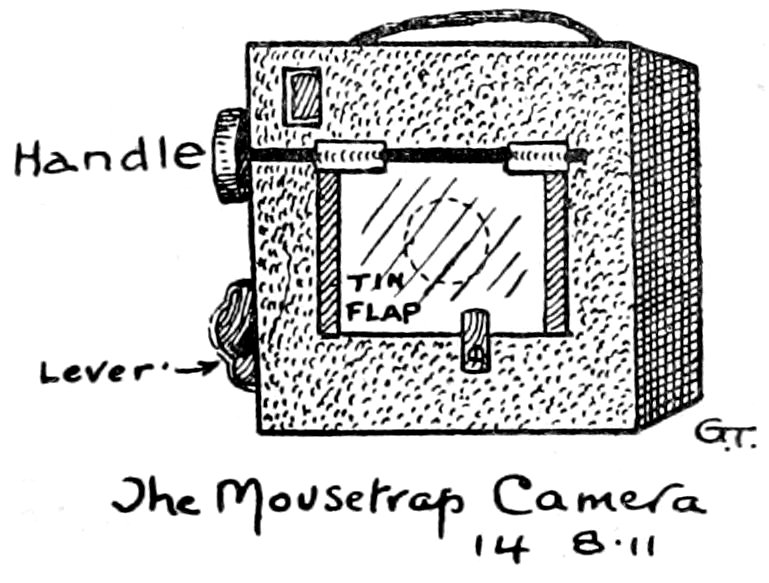
Through falling into a small crevasse I found some beautiful ice crystals above the Ramp. Later I turned up some slabs of ice which had covered old water channels and their lower surfaces were sparkling with beautiful basket crystals half an inch across. In some cases these were branched like candelabra. Wright managed to photo some of them satisfactorily, for unlike our rock collections, his specimens were extremely fragile and hard to preserve. I renovated my smaller camera which had suffered so in the gale. After I fitted it with a simple “flip-flap” tin shutter, this piece of apparatus was always called the mousetrap.
By this time most of the diarists had lost their early enthusiasm. The Owner wrote an hour or two each day. Gran and myself were probably the most voluminous writers. Debenham, Cherry, Wilson, and Simpson also kept records; but most of the others affected to despise diaries. Wright would bring his along once a fortnight, sometime when I was engaged on mine, and look through it for references to himself. We often went for a walk together (invariably towards the Erebus Glacier), so his diary was often something like this—
Aug. 1.—Went up the Ramp with G. T.
„ 2.—Ditto.
„ 3.—Ditto.
„ 4.—No entry.
I suggested he should fill in his blank days with “Did not go up the Ramp with G. T.”! The “illiterate” took a great, if transitory, interest in our labours. Birdie seeing me stuck for copy on August 13 sang out, “Write—Turned in, turned out; ditto, ditto. That’ll fill your diary!” Atkinson assisted as follows: “On night-watch; slept till 10.30; woke up and was very pleased to see Atkinson, because he’s such a good fellow!” Cherry’s quota, “We have many cags on scientific subjects and so acquire much merit.” While Uncle Bill, with a merry twinkle, added, “And next week we’ll get on to some serious work!”
I think the seamen enjoyed life in the Hut as much as 290any of us. The night watches must have pleased them immensely. To see a weary officer nodding and shivering all through the night, while they were snugly rolled in blankets and enjoying an uninterrupted night’s rest, was just the state of things they would appreciate! As I have noted already, some of them unconsciously imitated Kipling’s Emanuel Pycroft in “Bonds of Discipline,” feeling they might never have the opportunity of reprimanding an officer again, they would pour out (from the shelter of a bed curtain) the vials of their wrath on any unlucky watchman who fell over the fire-irons or discomposed their slumbers! It is fair to state that in the next winter they cheerfully took on night watches, and were quite equal to reading all the meteorological instruments.
The 15th was a rather threatening morning; the wind coming from the west, which was most unusual. “Debenham says this implies a blizzard. Every one has a different theory of blizzard forecasting. Mine is simple! If you’ve had four days fine, you’re sure to get a blizzard! This works well in winter.”
“Last night we had an addition to our Antarctic family. Innumerable pups accrued to us, descendants of our long-haired collie, ‘Lady,’ and the Siberian dog, ‘Beely-glass.’ They occupy a corner of the stable, and add life to our ménage. Julik went off some time ago, and is undoubtedly lost; though it is difficult to see how, unless he got into a deep crack. The other day Peary and Cook and another dog (harnessed to the cook’s light sledge) bolted. They tipped Clissold into the tide crack, and made for Cape Royds. Luckily, Atkinson managed to catch them. Tsigane, Peary, and Cook are the only dogs I’d care to take back.” The others were too unsociable, and though by no means savage when well fed, they were little interested in their owners’ doings, and exhibited none of the so-called dog-like affection.
Wright and I walked south over Cape Evans, and above the curious belt of moraine, which we called Land’s End. It was pretty cold, for Evans found the mercury frozen that day at Clarence; but as there was no wind this did not affect us after the exercise made us warm. Sometimes one could feel one’s nose “go with a ping,” as if the blood had really solidified in one’s veins. But vigorous rubbing and nursing in 291the warm palm of one’s hand usually restored circulation. As long as one’s heat energy was abundant there was no risk; but when vitality was low, through fatigue and hunger, frostbite was certain in any cold extremity.
As we walked over the Erebus Glacier we noted numerous circular dark patches in the ice. These exhibited maze-like patterns (arabesques), and marked where stones had sunk through the ice. There were no stones visible on the surface, and no source of supply, so that either these were very ancient, or else they were due to the effect of the sun on stones deep buried in the glacier ice. The Land’s End Ridge was a mile long and only a hundred yards wide. It was most precariously placed between the glacier and the deep sea, and was perched on a line of cliffs which were just uncovered by the retreat of the glacier.
Monoliths of kenyte lava and ash (tuff) were scattered along the moraine. Great debris cones, capped by huge unweathered blocks of kenyte, rose to thirty or forty feet high. The Land’s End cliffs abutted on the crevassed piedmont glacier to the south, and from their 150 feet elevation we could see the curving crevasses crossing the glacier, and could determine that the “ice caves” were but these crevasses seen in vertical section on the ice front.
To the south extended a fine view of Turk’s Head, and the long promontory to the Hut Point. We returned towards our hut, and attempted to reach the sea-ice from the moraine. In the dim twilight we judged that there was a twenty-foot gully between us and what looked like an iceberg. When we dropped into it, it was only four feet deep! So deceptive is a snow surface in the absence of light and shade.
The next day was cold again (-35°), and Gran and I climbed Inaccessible Island. I carried a theodolite, and fixed it on the top (521 feet). It was awfully cold work. I had to remove my fur gloves, and my fingers “went” very soon, and standing still made my toes lose feeling also. By the end of an hour I could do no more, and was so numb that I could not put the theodolite back properly in its case. My fingers and toes ached badly all the way home, but had recovered on arrival.
I went out to the rubbish pile and commandeered enough material for a book-binding kit. I bound up some glacial 292pamphlets into two pieces of “venesta wood” from a packing case. The rest of the case made the sewing frame. Two iron clamps, lent me by Simpson, made the press, while I had found a queer residue in the glue pot, which I used in default of better. Towelling for head border, and tent cloth for the back completed it. Next day I wrote Hoc Pegit in what is probably the first book professionally stitched and bound in boards in Antarctica.
Atkinson gave us a clear and concise account of scurvy, from which I gather that our chances of seeing any are few.
LECTURE ON SCURVY
By Atkinson
History: Scurvy was a dread disease about the end of the 18th century. Anson lost 300 out of 500 men from scurvy in 1795, but about that time Blaine introduced the use of lime juice, and since then it is practically unknown in our navy.
Symptoms: It is a general non-febrile disease, and not contagious. It is marked by mental depression, syncope, and debility, and the morbid blood arising often causes characteristic patches on gums, thighs, etc., like bruises. Atkinson modestly ascribed the cure to the Naval Medical Corps (loud cheers!). He said that immunity was possible, and was assisted by plenty of lemons and other vegetables (sic!).
Detection: Ralph found that if you gave too much acids to animals they got scurvy, and Wright also believes it is a form of acid intoxication. Serum is obtained from the clotted blood of the patient. This should be alkaline in reaction, and its alkalinity is tested by neutralizing it with various strengths of sulphuric acid. Thus ¹⁄₃₀ or ¹⁄₅₀ normal strength of acid should be neutralized by alkaline serum. If only ¹⁄₉₀ normal acid N 90 is necessary to neutralize, then “you have your scurvy.”
Prevention: Fresh meat alone does not prevent scurvy, since they had plenty of horse in the siege of Paris, and yet suffered heavily. Possibly it is too acid. Fresh vegetables seem to contain an alkaline salt which is helpful, and possibly sodium lactate is a useful drug. Nansen, however, believed in change of diet as being very helpful.
In the discussion Uncle Bill said that many of the symptoms noticed after sledging were purely due to the lowering of tone. If one entered upon hut life gradually by living for a day in the annexe you wouldn’t feel funny feelings in your toes! “I asked if a vegetarian diet would do down here? We 293have no fresh vegetables, but we have bread, butter, cocoa, sugar, jam, porridge, tinned fruit, tinned milk and cheese. (I lived on a less varied diet in Cambridge, only I still don’t enjoy the cheese lunches where the pungent stilton stalks around, and the exclusives have to collect together and wave the phantom off.) Bowers said that Bill developed spots on his face on the Crozier journey; but Bill swore they were beard sprouts. Birdie had been nodding a bit, so I said he was evidently scorbutic, as he exhibited a tendency to syncope, deposit of fat, and an inflamed head (a cruel hit at his red hair). Ponting had been listening anxiously to the doctor’s criticisms of sausages, and various potted meats, and then read us a cable he had received in November announcing that a friend meant to send a half ton of sausages by the Relief!”
On Saturday night (19th August) we experienced the maximum wind pressure of the winter. “It rose from forty-five miles per hour to eighty-six miles in one fell shriek.” There was such heavy drift that it blew through the outer walls (of cases) and filled the annexe. The temperature had risen astonishingly, for we found “Bertram” registering +½° F., whereas a day or two before mercury was freezing! The blizzards were sometimes accompanied by a sort of “foehn” wind warming affect, and nearly always raised the temperature slightly. They swept away the stagnant heavy cold air which collected at sea-level, and which normally surrounded the Hut.
The 21st of August was a calm, clear day. The sun was due in a day or two now. Nelson was having some trouble with his soundings at the “Igloo.” So seven of us marched out to help him free his rope. It was quite a procession, Nelson going first to fix a block and tackle (pronounced taikle!) on his obdurate rope. Then Atkinson and Clissold—who worked the fish trap, and so were professionals in such jobs—walked along in a dignified way. Then long Day on ski, followed by Debenham also on ski, and causing some amusement by his “croppers.” Finally, “Trigger” Gran started long after us, and “flapping” along on his ski easily caught us up. I could easily keep up over a couple of miles without ski, but over a longer distance there is no doubt as to the advantage of the ski. We all hauled on the “taikle,” and so broke Nelson’s rope away 294from the bottom, where it seemed to have frozen in. Then dropping the “earth” wire of his telephone circuit into the water I rang up Simpson in the hut, and heard him with great ease through the bare aluminium surface wire.
Debenham and I climbed Inaccessible Isle to try and see the sun first. We went up by the usual route, but had to kick steps in the thick snow which now covered the gravel slopes. There is a magnificent windblown gravel ridge on the lee side of Inaccessible Isle. The blizzards shoot up the southern face and drop their dust contents beyond the central notch on the northern slope in the form of a long ridge about fifty feet high.
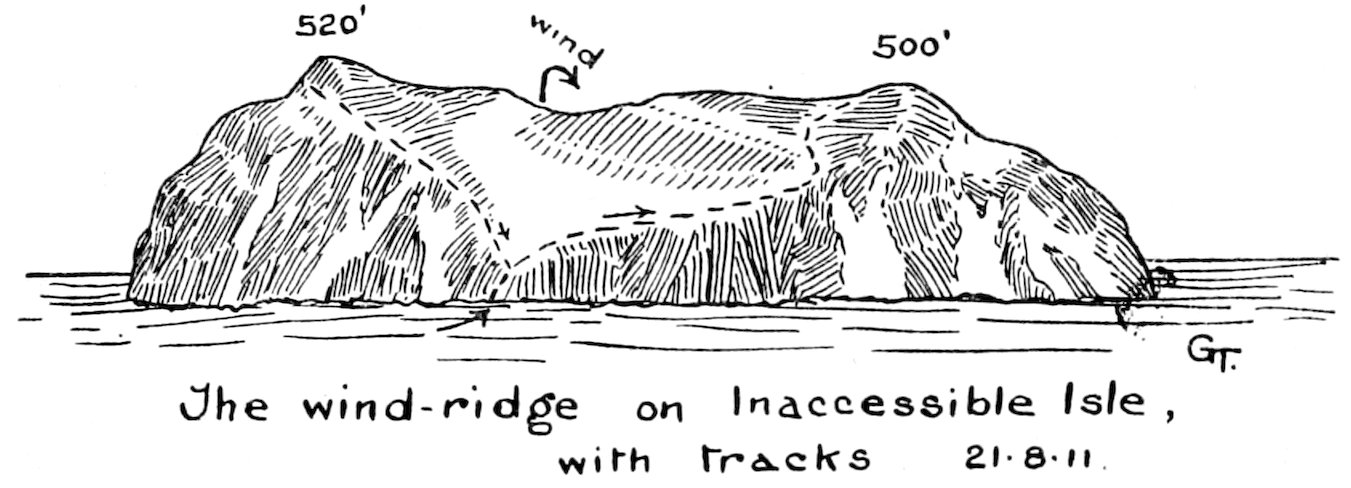
We obtained a fine view of the western cwm valleys below Mount Lister from this elevation (520 feet). To the north we could see a bright glow over the Barne Glacier and good sun shadows on Mount Lister, the first time for four months! But we did not see the sun’s disc at all.
The sun was due on August 22, so it was natural that a blizzard should spoil all chances of seeing him! We took him on trust to the extent of champagne at lunch, when Scott toasted Lieutenant Campbell’s birthday also.
“A snorting blizzard; never saw such thick drift. It wet one, so that one’s hands froze in no time. None went outside the hut.”
The table resembled a grocer’s shop from now on, for Birdie started bagging provisions for the sledge journeys. Pemmican was taken out of the tins, broken up, and bagged first, and then cocoa, butter, sugar, in fact everything but biscuit, which was left in the 40-lb. tins as sent to us.
“2.30 a.m. on the 24th.—It is now my night-watch, and 295I have finished making the slides for my next lecture; I have read M. Beaucaire, had two slices of toast, gone on the roof and cleaned out the blizzometer tubes, and washed my feet. The sooner 3.30 arrives (and Nelson with it) the better!
“In two months we shall be away on the veldt again. I have lots of prints to make, and must continue my German and physiography; but I have done about as much as I intended, and found the winter a very pleasant and busy time. It is wonderful how exhilarating a fine day is, though the last few days have been the limit.”
Next day it was still blizzing, with the temperature up to +11°! The drift was lower, and Nelson managed to get out to his igloo on the sea-ice.
Captain Scott asked Debenham and myself to map Cape Evans in considerable detail; while Lieutenant Evans carried out the coast survey and Wright obtained heights and ice-cliff data. As a result Debenham and I were out with our plane tables fairly continuously in the next few weeks and got to know almost every rock upon our little promontory.
Wright and I climbed the Ramp in our anxiety to see if the sun was still alive! but without avail. The clouds on Erebus were worthy of note. During the day huge billows collected to the south below the summit, and at 7 p.m. these disappeared, and the steam cloud (which had hardly showed before) shot up several thousand feet and then spread out as a banner to the north. This latter direction was unusual, as the upper air currents usually went due south.
On our return we found that Simpson had seen the rim of the sun about 3 p.m. from Wind Vane Hill (at noon it was hidden by the Barne Glacier), so that the meteorologist was the first to welcome His Majesty’s return.
On the 24th I gave a lantern lecture on Polar and Temperate Glaciation. As usual Ponting kindly made most of the lantern slides and operated the lantern. Afterwards he showed us some of his magnificent Swiss slides.
On the 26th I managed to improvise a satisfactory plane-table from a telescope tripod and my drawing board. We had a spare sight-ruler, and with this primitive instrument I successfully mapped my section of Cape Evans.
We could always orient on far distant peaks, such as the Matterhorn, fifty miles north-west; or Castle Rock, twelve 296miles south; and this saved a lot of trouble with the usual “three-point resection” method. I climbed up the Ramp and read “Bertram.” I could see the sun shining on Inaccessible Isle, and even on Hut Point far to the south, but it would need to get considerably higher before it illumined the Ramp. Lieut. Evans was setting up signal flags on the prominent debris cones, and we returned together viâ the “Slippery Slopes,” Evans justifying the name!
“Just before I reached the Hut I felt exactly like Peter Pan, and saw that I had regained my shadow! I walked up to Wind Vane Hill, and there was the old sun showing half his disc over Cape Barne Glacier! About 2 p.m. I went out with the ‘mousetrap’ camera, and took some photos to celebrate the event. I gave four seconds (with F. 45) on snow banks, etc., lit by the low-lying sun. This was too much, I believe, but the photos were fairly satisfactory and worth the trouble considering when they were taken.”
Wilson reported some queer algæ deposits above Gully Bay, so we went off to investigate them. There were two layers (about fifty feet above the glacieret) in the soft kenyte gravel. I had little doubt that they were lake algæ which had grown when the water was held in by a larger ancestor of the present glacieret. Just to the west were beautiful examples of these ice-dammed lakelets, with “Glenroy terraces” marking various contours on their shores, just as in the historic Glenroy region in Scotland. Only in these Antarctic specimens the ice dams are still evident, whereas their absence in Scotland made the origin of the Scotch terraces a puzzle for many years.
I have made frequent mention of the debris cones on the Ramp. Their origin was often discussed by Scott, Wilson, Debenham, Wright, and myself. Scott and Wilson believed they were dumped over at re-entrant angles in a bygone ice-barrier wall. Debenham compared them to the cones and hollows we had seen over in the western moraines and thought they were due to the melting of submarine ice. Wright and I believed them to be due to the weathering of huge erratics.
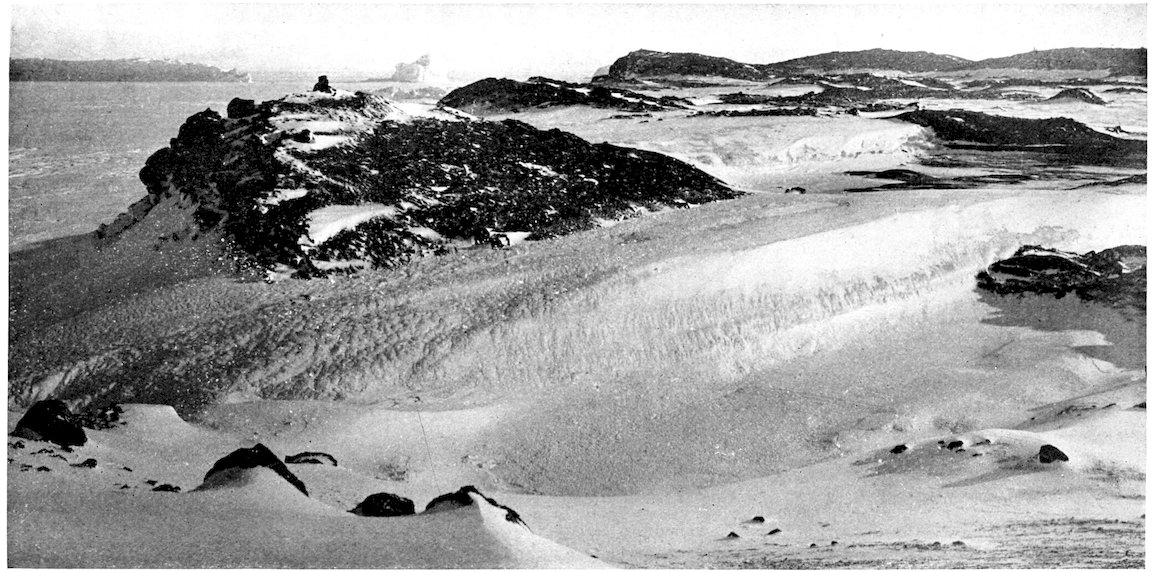
LAKELETS OF CAPE EVANS, Sept. 29, 1911. Due to glacierets of drifted snow forming across small gulleys. (The drifts are always blown to the north.) These ice dams explain the formation of Glenroy Terraces, Scotland. The rugged outcrops of Kenyte Lava run chiefly east and west. The Tunnel Berg in the sea-ice appears to the west.
On the 27th Gran and I made the rather obvious test of cutting one open. It was six feet high and lay just on the edge of the steep slope of the Ramp, whence all debris would 297slip down the Ramp and save cartage. The upper face was a friable dry gravel. We heaved out two huge blocks the size of a man’s body and found them fitting into other blocks of the same rock. We cleared away the top portion of one half, and then came to a huge block evidently extending to the foot of the cone and right through it. All this was frozen stiff into the kenyte soil of the Ramp, and it was beyond our powers to shift it. However, we had definitely proved that this symmetrical cone was solid, and was piled around a core of kenyte blocks.
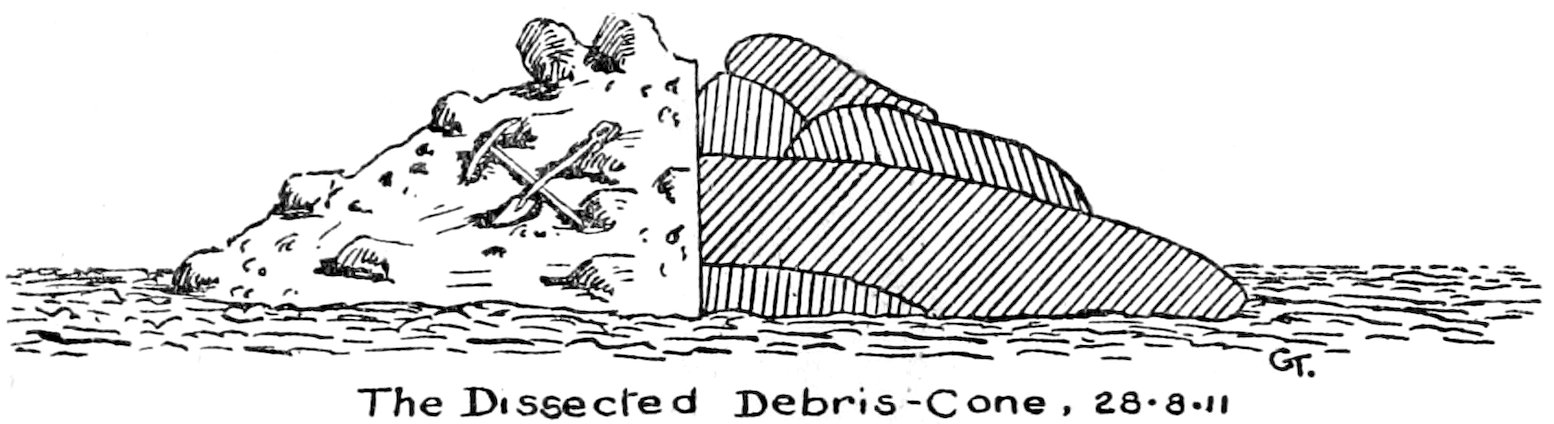
“I met the ‘Owner’ after lunch and introduced him to the ‘dissected cone.’ He seemed to think it a strong argument in favour of our long-held theory. Wilson basely hit back at me for upsetting his argument with a caricature in the South Polar Times, which is here reproduced.
“The difficulty in disposing of all the instruments needed by a geological surveyor is also hinted at in the gear encrusting the queer object on the debris cone.”
“August 30.—A cold day, −33° with wind. Natheless, Deb and I went out about noon plane-tabling. I had finished my stations and carted the table about, filling in details. But it was mostly a ‘cabman’s war dance,’ jumping and flapping one’s arms to keep warm. I found that a great deal of the ice-sheet to the north was only six inches thick over gravel, the latter appearing in the eddy gutters to the south of every big boulder.
“It got too cold to work, but I swore I would stay out as long as Debenham. Finally, at 1.15, I could stand it no longer, and made a beeline for the Hut, finding he had returned a minute or two earlier!”
The next few days were similarly occupied. I made a pantograph (to reduce or enlarge drawings), and so obtained a 298fairly accurate plot of all the sections of our map. The result is given herewith.
One can readily see some method now in the queer physiographic features of Cape Evans. It can be subdivided into several zones, which may be tabulated as follows, proceeding inland (east) towards Erebus:—
1. Kenyte cliffs and ridges, of rock in situ (about fifty feet above sea-level and chiefly to the south and west of the Cape).
2. Low-lying plains with lakes about twenty feet above sea-level, due to erosion and deposition from 1 (chiefly in the north-east of the cape).
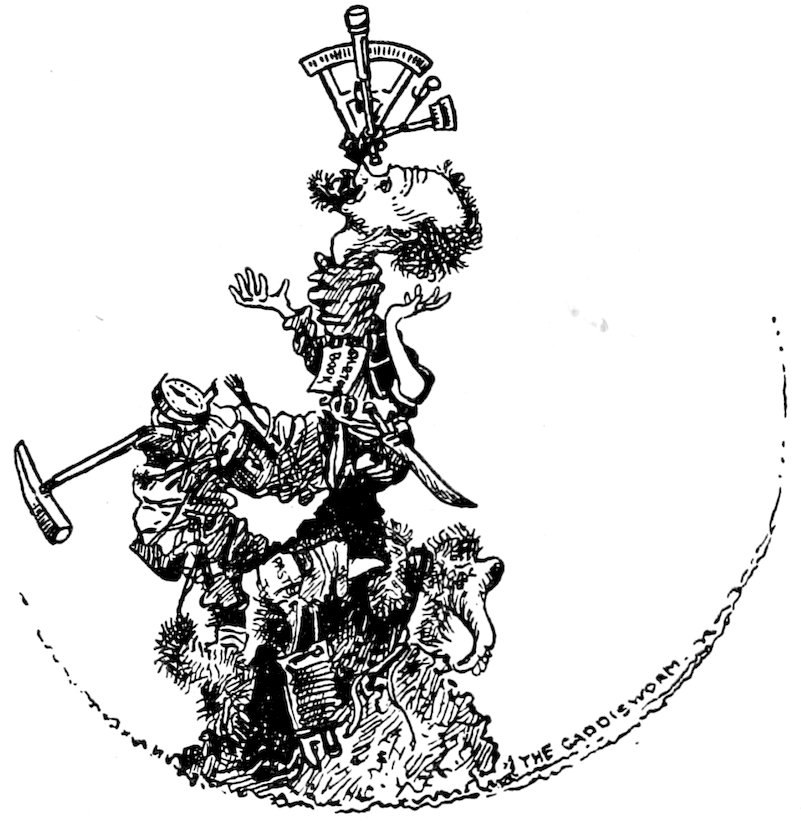
A Peculiar Animal seated on the Top of a Debris Cone.
3. Glacierets and ice dams running north and south, and due chiefly to drifts distributed by the southern blizzards. On the low cape and on the Ramp also.
4. The continuous “Ramp”; a steep slope (30°) extending from “Low Cliff” practically to Land’s End Cliff, i.e. about two miles. It varies in height from 100 to 150 feet above sea-level. Partly composed of rock in situ and partly of moraine just uncovered by the retreating glacier of Erebus.
299
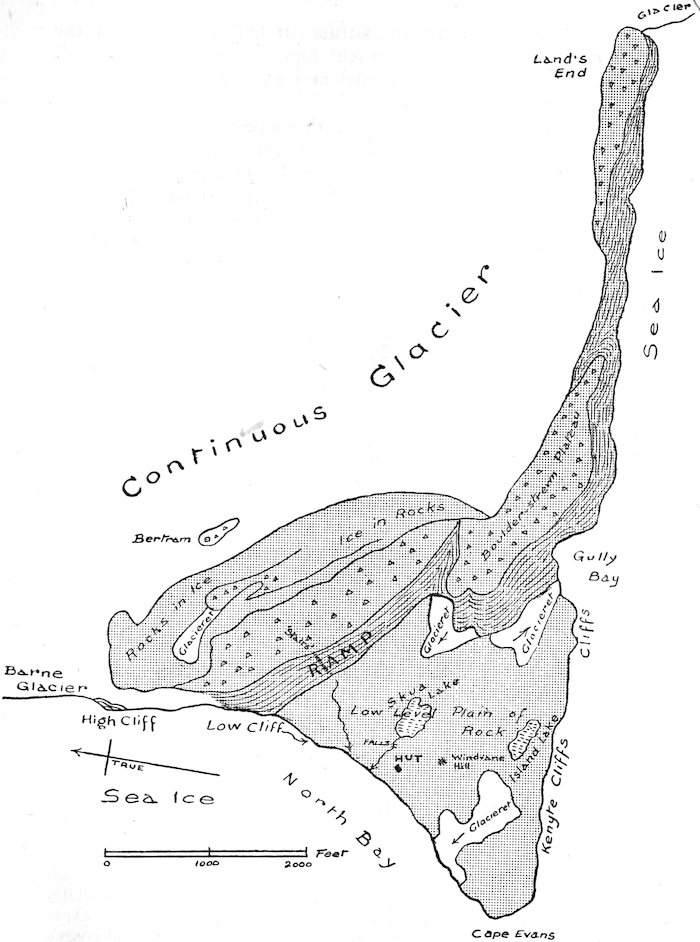
Physiographic features of Cape Evans, due largely to the retreat of the Erebus Glacier.
3005. The boulder-strewn plateau parallel to and east of the latter, and about 150 to 200 feet high. It is largely ground-moraine, but contains some ancient ice masses, and is affected by soil-creep or solifluxion.
6. A zone of large blocks (with ice between) which occurs chiefly in the north-east, and merges into the Erebus Glacier. Both 5 and 6 contain numerous debris cones, which are especially large in the south-east over Land’s End cliffs.
7. The continuous Erebus Glacier which extends uninterruptedly from Cape Barne to Turk’s Head, and walls in Cape Evans to the east. There is not much movement in it just behind the cape, for there is no ice “wall” but a gradual merging of rock and ice.
My diary proceeds as follows:—
“September 1.—I fear I must give this a miss. Titus Oates says, ‘You were probably caulking and coughing, or blatting. But if the latter you’d remember!’ (These rude words refer to a slight cough that worried me at this time. ‘Caulking’ is sleeping, and ‘blatting’ is arguing.) The Conservatives were evidently waking up, for I note one of Atkinson’s remarks. Colonials go to London and murmur ceaselessly, ‘Change and decay, in all around I see, Except in me, O Lord, except in me!’ This misquotation afforded the ‘True-Blues’ (Cherry, Birdie, Titus, and Atch) great joy about twenty times a day. We Liberals scorned to use such feeble wit in upholding our principles.”
The next lecture was one delivered by Birdie Bowers on the Evolution of Polar Clothing. I took fairly full notes of this lecture, which represented much reading on Birdie’s part in our extensive library of Polar journals.
LECTURE ON “EVOLUTION OF POLAR CLOTHING”
By Bowers.
September 1, 1911.
There are many fabrics which can be used, for instance, cotton is very satisfactory for some purposes, as we see in our windproof overalls. Fur was naturally first used, and Ross, on his magnetic pole expedition, was the first to employ fur sleeping-bags. Weddell found boots a great difficulty, and had to cut up all his gear to make new ones. Some Arctic explorers used blanket squares (sixteen inches across) instead of 301socks. One must be careful not to have boot-soles too rigid, for this induces frostbite. It is curious that the Eskimo garments leave the skin completely bare at back and knee.
A book-plate illustrating Polar clothing.
Bird-skin clothes are very warm and very light. In one expedition devices were painted on the backs of the white jackets to give the men behind something dark to look at, and so minimize snow-blindness.
With regard to mits, thumbless gloves are best for very cold weather. Greely had gloves with two thumbs, so that they could be used on either hand.
It is foolish to rub frostbites with snow, for the skin is chafed; flannel or a bare warm hand, etc., is better. Wool absorbs perspiration the best of all textures. White cotton does so to only half the amount. So the latter evaporates quicker, and soon feels chilly. Nansen says 302goat-hair socks attract the moisture. “Oh! as you were!” No, I don’t mean that! (G. T.—I find I’ve omitted the correction, however!) Personally, I think that an old sock makes an excellent nose-nip!
Sverdrup used to use a double tent for warmth with good results. I think we might modify the tent opening, and make the tent floorcloth wider. If the sleeping-bags were provided with a separate hood, they would not get so wet. On our midwinter trip we found that eiderdown inner bags were no use after fourteen days. It was best to change sides with the fur bags and scrape them. The hair inside was warmer, but held the perspiration more.
The wind helmet should certainly be made fast to the blouse; and I think lanyards fasten the bag-flaps much better than toggles. These are the only improvements I can suggest in our clothing.
The seamen played six-handed euchre most evenings, while the two Russians looked at illustrated papers and turned in somewhat early. The mess deck used to read the books in the library, and especially Debenham’s paper-backs. When I ran short I raided their small private stock. I was assured by Taff Evans that one by Hichens “is no good, for no one in the mess deck can read it!” Needless to say I did not always agree with this stalwart board of navy critics.