VII THE VOYAGE BACK
Reading edition
February–March, 1912
414
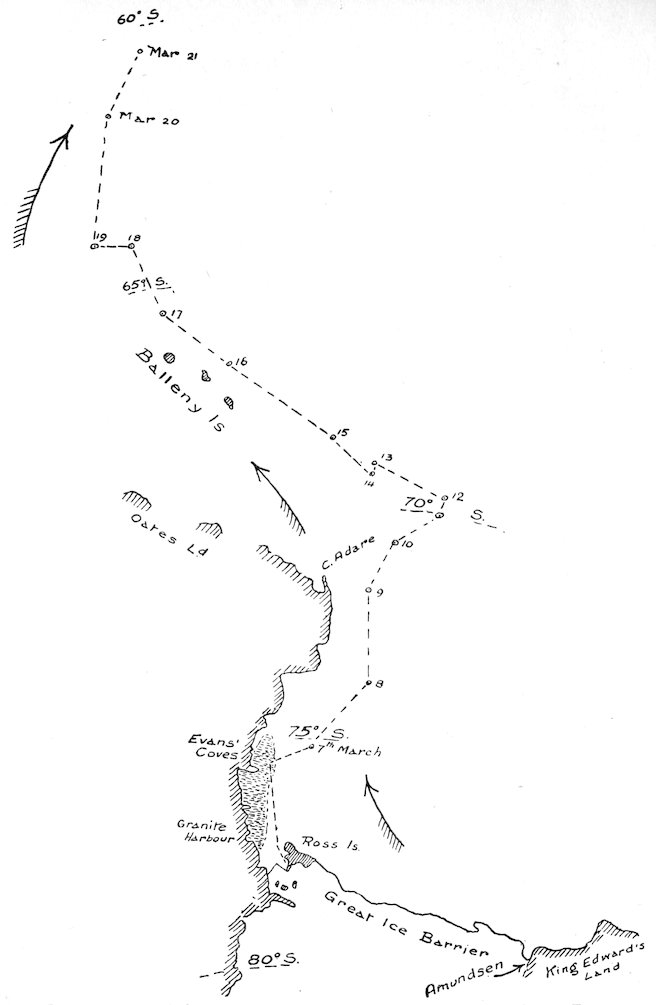
Return voyage of the Terra Nova in March, 1912, showing pack-ice off Evans Coves and Granite Harbour and the dominant winds determining the ship’s course.
415
THE VOYAGE BACK
What does it feel like to be in touch with civilization after a year’s absence? Man is an ungrateful creature, and I can remember what we missed, better than what we gained on reaching the Terra Nova. However, the letters were there. They had been put ready for us in the wardroom. No small bag would suffice, our literary matter ran to pillow-slips. I had one well filled, and Debenham, lucky beggar, had two! Poor Gran’s home mail failed to reach him, and he had only a few bills, which he could have spared. I rapidly skimmed through all the news and then opened up the packets. One young soldier friend sent along a huge gift of pipes and tobacco. Said he, “I know you didn’t smoke, but I expect you’ve learnt to! Anyhow they’ll be useful.” They truly were most acceptable, and were most prized by the party remaining. To balance this gift he sent along “The Geology of Nigeria.”
After the first glance through, however, I turned to more pressing needs. Clean clothes and a bath seemed the greatest treat one could wish to enjoy.
Two factors blocked us. All our clean clothes were on land, some in our own hut, some in the Old Discovery Hut! Moreover, Ponting came along and after complimenting us on our villainous appearance, begged us to remain picturesque until the sun showed enough light for a photograph! Luckily we had only to wait a few hours for this specimen of “ponting”; and after four months a day’s more or less grime mattered little.
One disappointment we met with. Our first cry was “Letters,” and our second “Fruit.” Drake sympathized with us and said that all fruit except apples had been landed at the hut a week ago. However a box of apples had been 416reserved for the Western Party. We rushed that box. The apples were icy cold and frozen solid. Eagerly we placed some on the top of the wardroom stove. We waited until they were well warmed and then voraciously bit into them, to encounter a stony iceberg in the middle! They took an incredible time to thaw, and then all the plant cells had burst, and the apple was a poor thing all brown and almost rotten!
In my cabin I found a small tin trunk with better fare: cakes, sweets and nuts of all descriptions, everything but chocolate. After hearing the yarns of some of Shackleton’s men, I expected to be surfeited with chocolate, and so warned my people not to send any down by the ship. However, the other luxuries were well-chosen and abundant. Every officer aboard had selections each day, and not till we reached the Circle nearly a month later was that tin box depleted. Indeed, one cake from Parramatta friends was so large that a half was sent to gratify the mess deck!
When I was free from Ponting I bolted into the engine-room and was provided with a huge bucket of scalding water. Rennick and other officers had lent me some clothes, and I can still remember that bath. The only available space was over the boilers! I was jammed into a narrow passage next the ship’s timbers. If one bare foot slipped an inch too far it touched the boiler plates; if the ship gave a lurch I cannoned against huge baulks of oak. Still, I started as a toil-worn and wild-eyed refugee and finished a semi-respectable roustabout!
Pennell soon gave up all hope of reaching Cape Evans. The blizzard which was brewing at noon, on the 14th, soon enveloped us, and we were driven far north. Under these circumstances he deemed it advisable to make the best of it, and proceed to Evans Coves to try and rescue Campbell’s party.
Among my mail I found a book sent by Professor David. This was “Queed,” by Harrison, a writer new to me. This novel fairly gripped me, and I turned into my bunk all standing, and read until I had finished it. I hope all Mr. Harrison’s readers derived as much pleasure from it.
“Jim” Dennistoun was a welcome addition to our mess. He had been eager to see Antarctica in any capacity, and so 417came along as mule-overseer. His remuneration was “all found, and one shilling a month.” We often used to discuss what he would do with the treasure accruing to him when he was paid off! An ashtray, beaten out of the four-shilling piece, was the memento he favoured.
But it was fairly uncomfortable on board. It was now very cold, and the sun rarely showed for long. Spray was driven over us, and froze where it fell, so that we spent hours chipping the decks free from some of the icy layer. The wardroom seemed all doors, and draughts assailed us everywhere. As usual, on approaching civilization, the Antarctickers contracted influenza. Debenham was really quite ill, and I had a fearful attack of neuralgia, which lasted a fortnight, due to a gaping tooth. We used to think of our snug little tent on terra firma, and after a week of storm at sea decided that we were sorry we had been picked up by the trusty whaler. Such is man’s ingratitude.
February 23rd.—We spent a most forlorn day. The ship absolutely jammed in new ice, formed of pancakes only three or four inches thick, but gummy, not brittle (so that the ship couldn’t break through). These were formed of still smaller cakes, cemented together. I was sure they had grown in situ, perhaps in the lee of a huge piece of pack which had drifted off.
This was very serious, for every hour increased the risk of our being frozen in, and this was obviously still more probable when we returned to Cape Evans than in our present position, so much further north. However, very suddenly the soggy ice was broken by long leads—lying rather far apart—and we managed to push and butt our way considerably to the east.
I was down below when I heard the ominous “three whistles,” which signifies “all hands on deck.” However, in this case it was a call to “rock ship.” We all lined up at the port bulwarks, in the waist of the ship. Then Bruce gave the word, and we “set to partners” across the hatches, and through the narrow spaces to the starboard side. The ship swung very slightly in consequence. Bruce timed its swing, and then we all ran back in unison. This time the swing was a little larger. So by degrees the ship became a self-acting pendulum, and gradually rocked herself free from the close embrace of the ice. At the same time the propeller revolved about 1½ times the normal speed, and the ship began 418to give a little, and finally went astern. Then more butting, and a jam or two, and finally we got into looser pancake, where she could do four knots.
Emperor penguins were interested spectators of our manœuvres, while the distant coast-line was really of great interest when we had time to observe it. Mount Melbourne was a finer sight than Erebus, for its cone was more symmetrical, recalling that of Etna. Mount Nansen, further south-west, was a huge, flattened scarp, resembling Mount Lister.
On the 24th we emerged again from the pack to be greeted with a pretty stiff wind. We steamed south to try and communicate with headquarters. Lillie told me of some of his results. He believed he could apply the teachings of Mendelism to the question of colour in half-caste Maoris. He had made some large collections of fossil plants in New Zealand, and had dredged up enough of the rare tunicate Cephalodiscus (a primitive sessile early vertebrate) to supply every museum in the world! I found out that my thousand insects were probably Gomphocephalus, of which previously only a few odd heads and legs had been collected in specimens of Antarctic moss.
We got back to the Sound off Cape Evans about noon on the 25th. A howling gale was blowing so much frost smoke into our teeth that we could only just see Inaccessible Isle, now covered with a pall of snow. We manœuvred in North Bay with the 120-foot wall of the Barne Glacier looming very close. There was a touch of east in the blizzard, so that the glacier was not quite on our lee. Pennell dropped anchor when the soundings showed twenty-five fathoms, but we drifted back quickly, and when we reached fifty fathoms (three hundred feet) the anchor dragged.
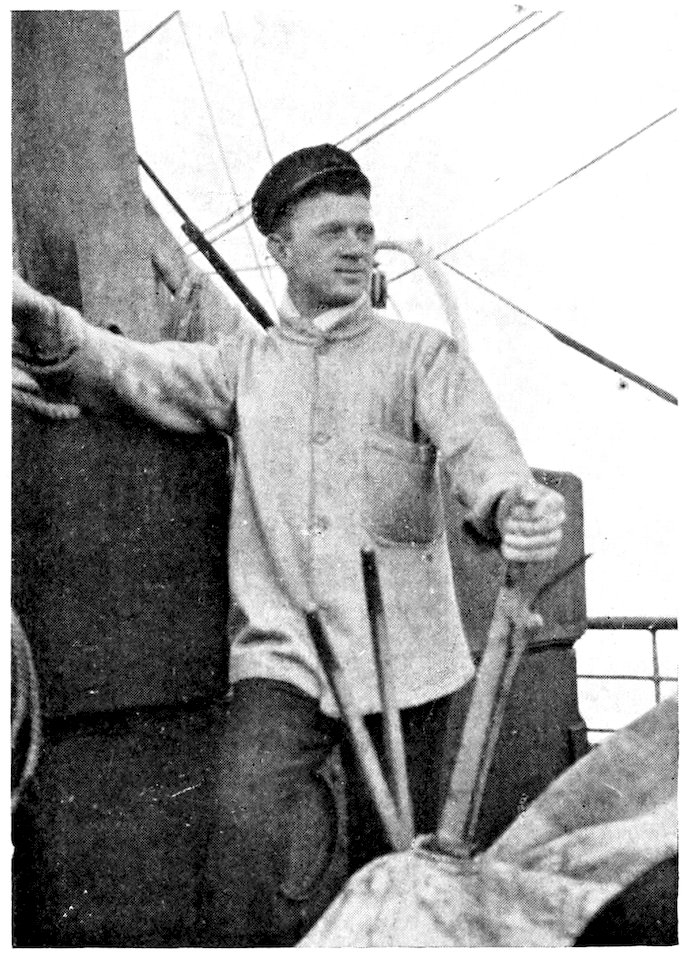
ENGINEER WILLIAMS AT THE WINCH.
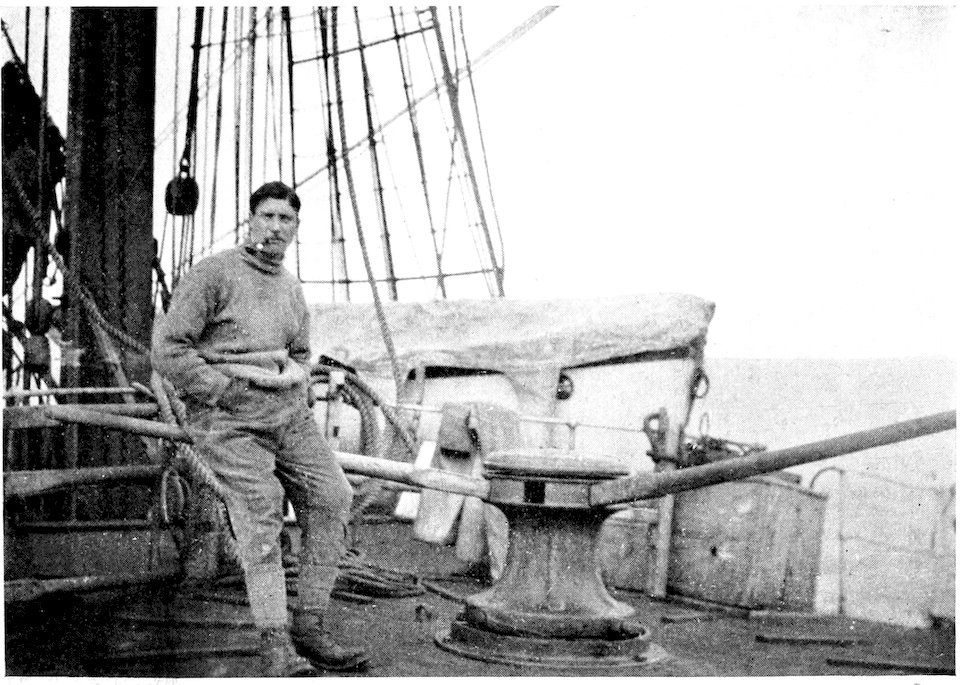
BERNARD DAY ON THE CAPSTAN.
We had an awful job hauling up the anchor! Whenever I hear the phrase “Merrily round the capstan, boys,” I think of that weary time in North Bay. Each capstan bar had two and sometimes three men pushing it round. The foc’sle deck was iced over, and even a layer of ashes afforded little grip, for the blizzard heeled the vessel over, till the deck sloped like a roof. They tried to help the capstan by a chain to the steam winch, but the latter ‘took charge’ and nearly flung Bill Heald off the foc’sle! There was precious 419little room between the capstan bars and the rails, and I got jammed, and received a nasty bruise on the leg. Awful stiff on one’s hands, and on the calf muscles—like pushing for hours in a football scrum! Pawls (or stops) prevented the capstan from releasing the chain. Clink ... clank, clink ... clank; these pawls would sound every minute or so, and then we had to rest. Each clink meant only an inch or two of cable, and we had to haul in three hundred feet! When the ship twisted, and the cable lay along the side of the vessel, it was impossible to raise the anchor an inch. Finally the anchor caught a firm hold on the third attempt, about 7 p.m., and we lay steady with ninety fathoms out. The gale increased, and we all turned in to try and get some rest, and be ready to land if it lulled. At 11 p.m. Pennell roused us, and I got into the whaleboat. Bruce was in charge, and I rowed three. We were less than half a mile from the shore, and found the lee of the cape quite calm. So I reached the hut, after five months’ absence. It was eleven days since we had been picked up, all but a few hours, and this was the first opportunity of communicating with our headquarters.
I stumbled up the shore, nearly waist-deep in snow, where in the preceding March there was hardly any! We found them all asleep, and by no means ready to come off! Simpson and Day were soon dressed. I had, luckily, left all my gear packed in November, and I hauled my boxes down to the ice-foot. Simpson, Day, Anton, and I returned, and after some bumping against the ice-ridged quarter of the Terra Nova we got safely aboard.
The gale began again, and all access to the shore was blocked. Simpson and I yarned till 5 a.m. He told me that Hooper and Day had reached the Hut on December 21st from the Barrier. They had found their four-man sledge too heavy, and having no suitable tool had burnt it in half with the Primus lamp! They had been caught in a blizzard, and had marched blindly north in the ensuing thick weather. Later, they saw their tracks led right between two parallel crevasses, either of which would have engulfed them!
Next day we could not bring off Meares, Clissold, and Forde. Archer had gone ashore, so that the ship was now without a cook! The wind was fairly shrieking, and at 10 a.m. the anchor dragged.
420We spent a most wretched day trying to get it up. Not a budge out of it, though you burst a blood-vessel! The seamen couldn’t say (as before) that this was due to work on a Sunday. We found that a cog had broken in the gears of the capstan; but when they again tried the steam winch to aid the capstan it stripped off more teeth!
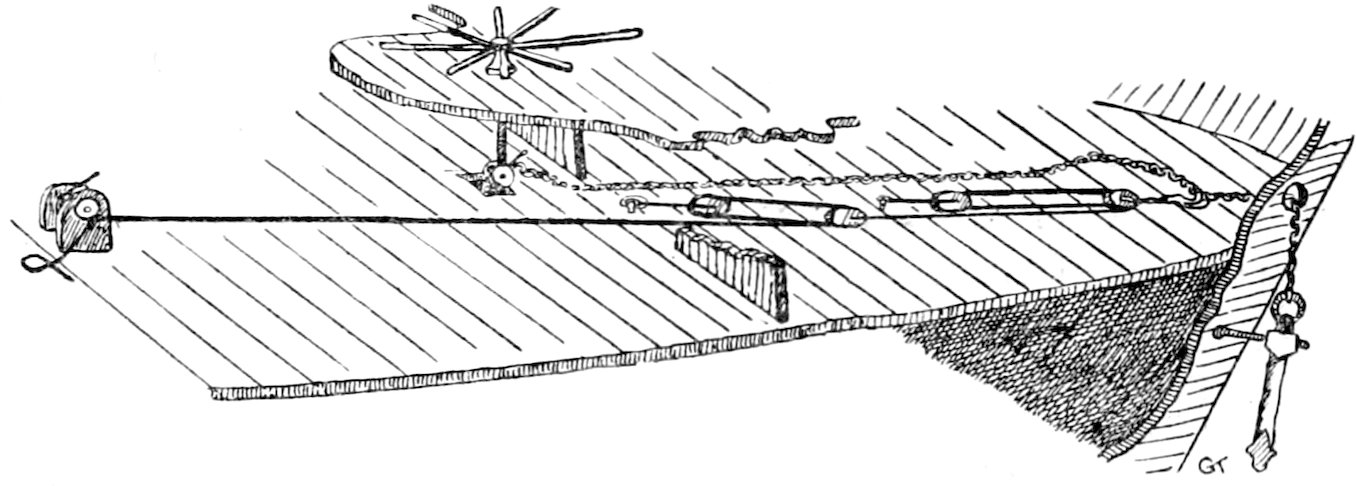
Diagram illustrating the way we managed to “raise anchor” by “luff upon luff,” February 26, 1912.
Another method was tried in the afternoon, which was very slow, but not so spendthrift of human energy. It was called “luff upon luff,” and depended purely on a series of pulleys; whereby a small amount of force at one end of the rope can slowly move a great weight at the other. The capstan was now practically useless. So the small steam winch was connected to a set of heavy pulleys (a “five-ply purchase,” I believe, is the nautical term) to which a claw hook was attached. This was hooked into the anchor chain, at the hawse hole, inside the dark foc’sle. I was halfway man, and it was my duty to yell to the engineer at the winch, as Bruce advised me he was ready. Another yell meant that the purchase had done its part, and then Rennick put the capstan brake on (which would still hold, luckily), and the claw hook was taken off, and attached some links nearer the anchor. By 6 p.m. we had raised anchor. It came up as bright as silver, and with the crossbar (stock) broken clean off!
All this time we were drifting to the north-west, and had to keep up steam to hold her from yawing, and to try and keep the cable from “binding” on the side of the ship. Throughout the 27th we were nosing up against the fixed ice off Castle Rock, trying to shelter from the blizzard. By noon, on the 28th, the blizzard dropped enough for us to lie alongside 421Glacier Tongue. At 3 p.m. the ice anchors held, and it was possible to get ashore, and start “icing ship,” for the tanks were nearly empty. We had to lie bow on, and get the ice in by a basket slung from the foreyard. A very slow and laborious business; it took us six hours to get 4½ tons of ice aboard.
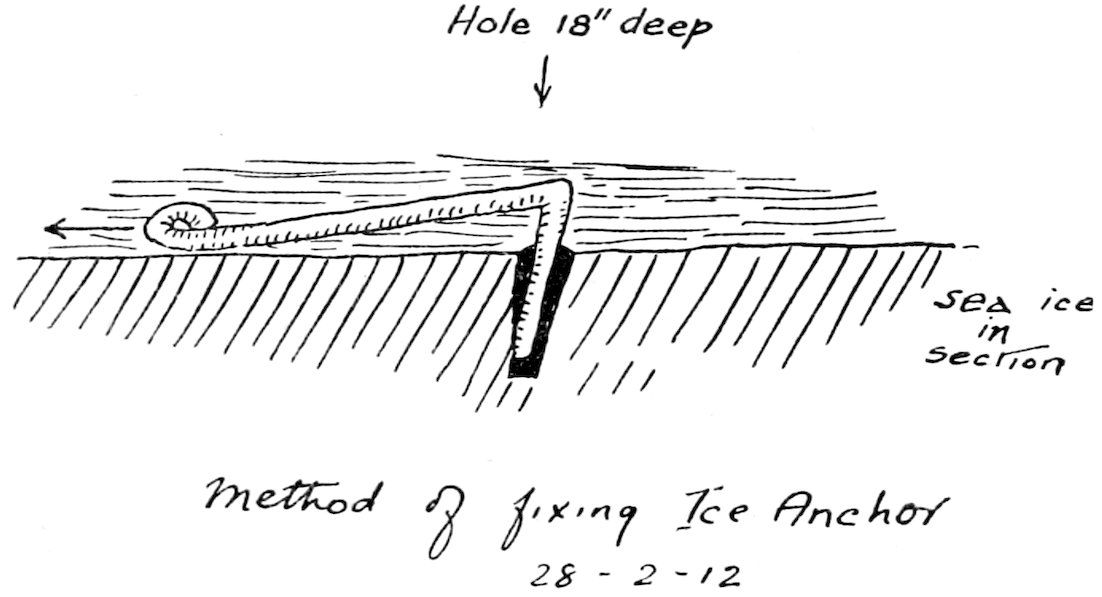
We then moved off to Hut Point, where we landed some stores and newspapers for the Pole Party if they should be isolated from Cape Evans, as we had been in April, 1911. Here I met Wright again. We learnt that Evans was very seriously ill with scurvy. They wrapped him up in his sleeping-bag and, dragging him to the ice edge, brought him aboard in the ship’s boat. We let down ropes to the seamen below, and they lashed him safely, and he was hauled up, looking more like a corpse than a live man. However, he could speak cheerfully enough, as usual!
We returned post haste to our hut to take advantage of the unusually calm weather. We unloaded more stores—chiefly fodder, coal, mutton, and dog biscuits, and then moved north immediately to make a second try for Campbell at Evans Coves (lat. 75° S.). Day, Dennistoun, and I spent the morning of the 1st of March shifting cargo. Indeed, we seemed to spend a large part of our time during the ensuing month in that abode of gloom—the empty hold of the Terra Nova!
At 10 p.m. we were about fifteen miles from Cape Washington, in very heavy pancake ice, with a slight swell. There was a thick ice-mush between the blocks, and this jammed the 422propeller. For about ten minutes the engine could not move the shaft. They managed to prise the ice away finally by poking rods down the rudder post. The grinding and bumping of the blades on the ice was physically painful. It jarred one’s whole system just like having a tooth out. The shock to the propeller, mainshaft, and engine must have been enormous. Luckily our propeller was four times the usual size for a ship of our tonnage; but Williams thinks the main shaft might go quite easily, and then we should be in a mess!
“2nd March.—During the morning we skirted the pack southward, doing a sort of ‘blanket-stitch’ course in a vain endeavour to find a passage through to Campbell.”
Dr. Atkinson was on board attending to Evans, who was unable to move from his bunk until the day we reached New Zealand (2nd April). We had again to give up hope of rescuing Campbell, and turned south to land Atkinson. At 9.30 p.m. we were about thirty miles S.E. of the Drygalski Tongue, and soon had to heave-to on account of bad weather. But in the afternoon of the 3rd the wind dropped, and in about ten minutes the sea was frozen over!
However, this time we reached the Cape fairly readily, and when I woke on the morning of the 4th I found that we were off the Hut and that a boat was going to fetch Keohane. He and Atkinson were then landed at Hut Point, and we had to ice ship again at Glacier Tongue.
Every man was busily employed. Heald, McCarthy, Parsons, and Cheetham quarried the ice at the nearest spot where it seemed solid and free from snow. They filled baskets which Dennistoun, Leese, and myself pulled to the ice edge. Here Simpson and Rennick linked the baskets on to the rope, and Lillie, Drake, and Ponting hauled it aboard. Day and Mather carried it to the tanks, and Meares and Bruce tipped the baskets into the latter. It was hard work, and kept us going from 3 p.m. till 10 p.m. Still there was some fun at times. Leese harnessed the brown sledge dog Tsigan to help him with his sledge, and Tsigan occasionally bolted over the glacier. One basket fell into the sea, and Bill Heald lowered me on a rope till I could grab it; then (as usual) he hauled up too quickly, and I was dragged through the snow cornice and pretty well filled with soft snow!
423“We shifted eleven tons, and now Pennell’s notice[10] can be withdrawn. We now have enough to get back. Thank goodness!”
We had a fairly uncomfortable time on board. The stove below was faulty, and a change of wind filled the wardroom with smoke. With a huge skylight, various hatchways and companion ladders, and numerous portholes, it was hopeless to keep out of draughts.
Early on the 7th I was awakened by the fiendish clamour which the propeller was making about a foot under my bunk! “I found that we were held up in a hole about twice the size of the ship in heavy fixed pancake. We were over two hours alternately advancing, sticking, putting on more steam, reversing, and getting out. All the time huge blocks of ice were being churned round and battered by the propeller. We had been heading about N.E. when the ship struck, and in next watch we had to turn round and retreat as we had come. We were now about forty miles east of Mount Melbourne.
“She would steam steady for about ten minutes and delude one into going on deck to see our progress, and we were still in the same ice-hole! Then we would reverse with more regular vibrations, then catch a huge bit of ice in the blades, and it would feel as if you were having three teeth out yourself!”
At noon Pennell abandoned hope of getting near Campbell. At each attempt the ice was thicker and wider. Each time we got into worse positions and spent longer in extricating ourselves. “We are later than any former ship, not allowing for the extraordinary icebound conditions, this autumn.” So we turned homeward on the 7th March, and headed for Cape Adare.
On this voyage the ship was in charge of Lieutenant Pennell, while Rennick and Bruce were the other officers, assisted by Cheetham and Engineer Williams. Lillie carried on his biological work, while Drake was busy as ever with secretarial duties, varied by readings of the meteorological instruments.
We had left the rest of the Western Party at Cape Evans, 424while Atkinson and Keohane were stationed at the Old Discovery Hut to receive the Pole Party.
The members of the headquarters staff who returned to take up other duties were Simpson, Taylor, Ponting, Meares, and Day. With the addition of Lieutenant Evans, who was at first seriously affected by scurvy, and Jim Dennistoun (of New Zealand), we formed a very happy family during the month of “wind-jamming” which now awaited us.
This was Jim Dennistoun’s birthday, and to celebrate it and our start for home, I brought out the huge cake sent down from home. Half went forward to the mess deck, and it was much appreciated. We had a sing-song with banjo accompaniment by Ponting and Bruce, both of whom could sing pleasantly. Alf Cheetham gave us some typical sailor chanties in his humorous falsetto voice. Neuralgia kept me from adding to the entertainment, and I listened from the after cabin.
During the next few days the afterguard were glad to get warm either coal-trimming or hauling sails. We would be shivering in the wardroom when Pennell would come to the “balcony” and yell, “Any volunteers to trim coal?” Dennistoun was shipped as mule-overseer for the voyage down, and there was apparently a moral obligation that he should earn his shilling a week on the return by trimming coal! So he always turned out and climbed into the bunkers. We followed suit after a few days’ rest, and worked away in the hold and in the warmer dusty “bunkers” next the boilers. Then another naval “tyrant” would look down at the coal trimmers and yell, “All hands on deck to haul mainsail!” We were true sailor-men in that a chorus of anathemas saluted our naval colleague! However, we’d go upon deck and get into oilskins and sou’-westers, and then search out the special halyard in question, usually finding that the operation had been concluded some minutes previously!
With two Liberal Socialists like Simpson and myself, it is not to be supposed that this continued long! We went on strike and delivered our ultimatum—
“Either coal-trimming or sail-hauling—but not both.” Pennell grinned cheerfully, and said we could do all the coal-trimming if we liked. Personally I felt this was more scientific, as touching the departments of statics and applied 425mechanics as well as geology! So we decided to shift all the coal and so leave the engineers and stokers free to attend to the furnaces where they were somewhat shorthanded.
Never was such an incongruous set of coal trimmers.
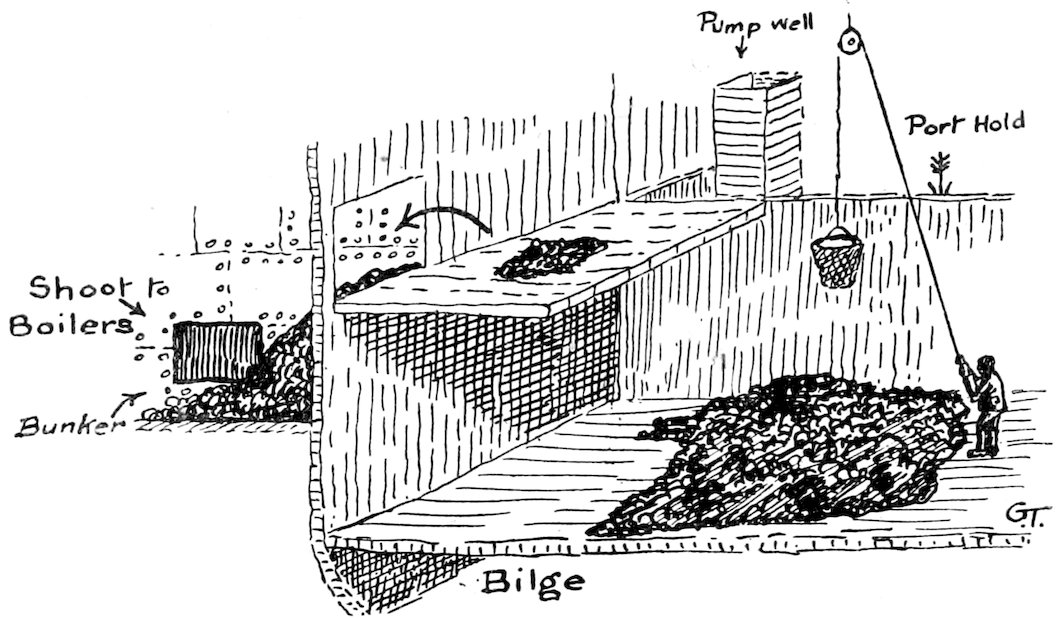
Trimming coal in the starboard main hold, March 7, 1912.
Down in the hold a high official in the Indian Weather Service shovelled the coal into baskets, assisted by our motor expert (Day). A Cambridge M.A. (and the authority on whales) hoisted the basket with the help of a well-known New Zealand climber and stockowner. Ponting bent his artistic intellect to the work of unhooking the basket and throwing the coal through a door into the bunkers, and inside a Thibetan explorer and the Physiographer to the Commonwealth “trimmed” the coal in the bunkers, packed it, and raked it level!
Simpson and I were busy comparing meteorological data before he took his notes back to India. I copied such memoranda as seemed to affect Australian weather. The “upper air” results were very interesting. The balloon ascents showed that there is a gradual decrease of temperature with elevation in summer, but that in winter it grows warmer. Thus there is a tendency to approach the same temperature in winter and summer at high elevations. He recovered one record which had ascended nearly twice as high as Erebus, or five miles.
426Priestley’s log for the Northern Party showed that we at Cape Evans had been having calms while they, at Cape Adare, had experienced a twelve-days’ hurricane!
One morning I visited the scene of the pump’s disaster of December, 1910. There is a wooden shaft enclosing the two pump tubes and just large enough to enable a man to climb down a ladder at one side. It reached the bilge, and here the pump tubes dipped into the latter. Before the gale it was only possible to get into the shaft by the main hatchway. We inspected it by a lighted matchbox, for the electric lamp was out of order. Under the main deck and at the side of the engine-room was the hole[11] cut through the iron bulkhead during the great gale February 12, 1910, and then the pump shaft was entered by tearing off the side boards at Y. For it was impossible to raise the hatches and enter in the ordinary way. Now the nozzles were made removable, and the entry from the engine-room was kept clear, so that the same danger could not recur. The sounding rod was let down a tube in one corner of this well also.
On the 7th the temperature had been +7°, and now five days later we reached freezing-point (32°). Thus the weather was about 5° warmer for each day’s run north.
“12th March.—I had a queer dream about the School of Geology at Sydney, which was quite consistent, and ended with some one going out and banging the door violently.... So violently that I awoke—to find the rudder nearly banging itself off with the heavy swell. It is funny how the sleeping mind adapts itself to real sounds!
“There was no wind, but we had most awful rolling, 41° from the vertical, so that the swinging lamp in my cabin is nearly lying on its side. My books sling off the shelves, my boxes come adrift, I was tossed across the cabin, and all the plates, etc., on the tables jump right over the fiddles! When we turned in I couldn’t keep still, though jammed by my knees, toes, back, and head. I stuck in a drawing-board to prevent my being flung out, and got no sleep, but a stiff neck through using it as a strut.”
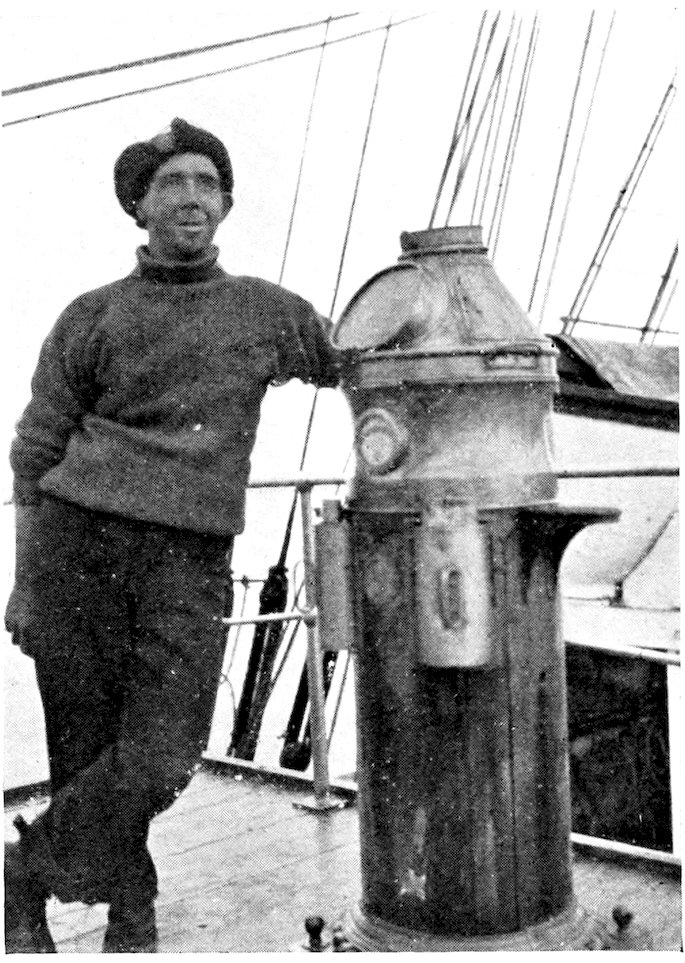
A. B. CHEETHAM, WHO HOLDS THE RECORD FOR CROSSING THE ANTARCTIC CIRCLE.
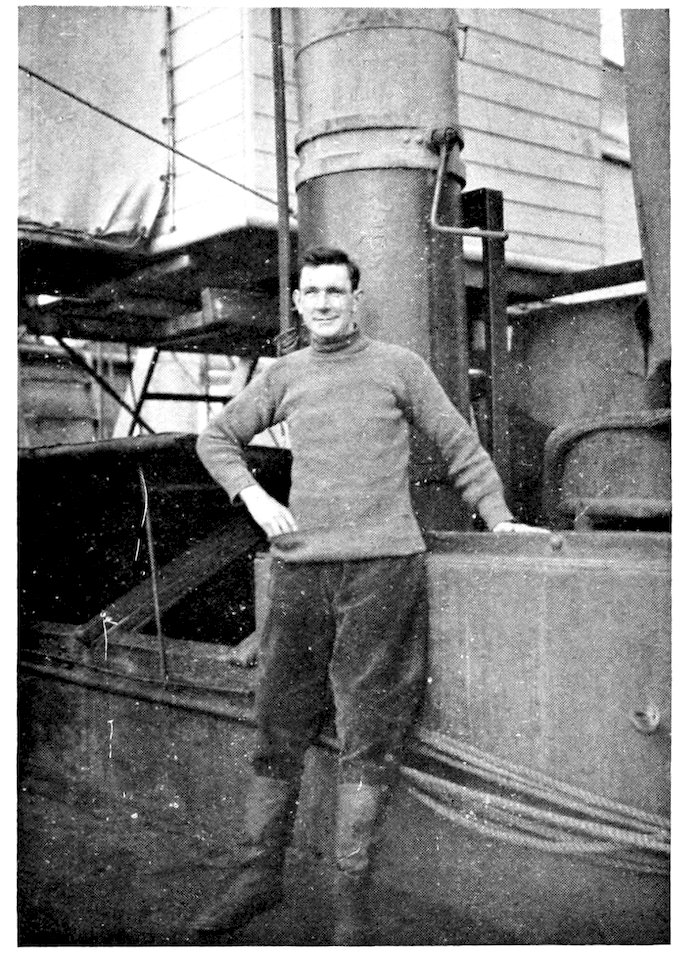
G. C. SIMPSON, March, 1902.
Simpson amused us with some early recollections of Sunday schools. “How did Absalom die?” Loud chorus from the afterguard, “Caught by his hair and hanged.” 427Simpson, “The Bible doesn’t say so!” “Who was the oldest man?” Frantic chorus by aforesaid, “Methusaleh.” Simpson, “No, Enoch, his father, because Methusaleh died before he did!” Then Simpson quoted an essay by one school. “Moses’ mother was very cruel, and she put him in the bulrushes, when she got sick of beating him.” Asked to explain this the boy said, “Well, isn’t that what the Bible says—when she could hide him no longer?”
During the next few days we were busy writing the cables for the Associated Press, and I got Drake to type a report of the last western journey for Captain Scott (which he never saw). The hard-worked afterguard were now set to wash the wardroom! On the 15th I note—
“Day, Meares, and Dennistoun are doing a bit of charing. This morning Meares dropped a rag on me as I was working below and missed. Then Dennistoun asked me to pick it up, and as I looked up, got me in the eye. So I went for him, and scrubbed his face muchly with soft soap, amid hilarity.”
At noon on the 16th we passed the Balleny Isles. We could see Buckle Island about thirty miles to the south as a snow-covered mountain occasionally showing through the clouds. Only one or two ships have been so close to these islands since they were charted by Balleny. We crossed the circle that evening, and celebrated it by another sing-song. Most of us sang something, Ponting’s contribution with its refrain of “Boil—my mother” (a study in wrong punctuation) bringing down the house!
Very early on the 17th every one on deck was busy furling sail when MacCarthy suddenly spotted an iceberg dead ahead. Luckily we just had time to steer clear. We had been having “iceberg watch” for some time now. I had been on duty from 12 to 2 a.m., though I could see nothing through the snow. The ship was going about five knots, and the white spume spreading from the bows was about all that was visible. A berg shows up merely as a greyish cloud under these circumstances.
There were many visible during daytime. At noon, for instance, we passed another much weathered, and resembling a decayed molar tooth. Possibly this resemblance is based on similar causes—a hardened outer skin cemented by spray, etc., and a softer core weathering from above.
428I went on iceberg watch again from 8 p.m. till 10. There was some snow again, and it was difficult to see anything. All this week we had been driving to the west, so as to pick up the constant west winds and sail on a slant up to New Zealand. We had only forty-seven tons of coal left now, and if we got blown past New Zealand with no coal—as was quite probable—it would take weeks for this bluff old whaler to beat back against head winds.
Poor old Nigger has gone overboard, finally we fear. We were all proud of our black Tom. He fell overboard on the last voyage, and luckily was seen manfully (or catfully?) swimming along in the wake of the ship. The crew got out a boat, saved him, and were back in twelve minutes! But no one saw the last tragedy. In the hold we found two rabbits having a thin time, and fed them on carrots and bread and milk. I don’t know their ultimate fate. (There’s a black welcome for bunnies in Australia, which I thought extended to New Zealand also.)
I can see the afterguard becoming regular sailor-men! On the 20th we had another mutiny—about food this time.
The Mutineers. “When are you going to give us a change from this everlasting mutton, Frankie?”
Store-keeper Drake. “Mutton’s very good food.”
Mutineers. “Why can’t we have ‘True-egg’ omelettes?”
Drake. “Well, perhaps we could have that as an additional dish.”
Mutineers. “Why additional, Frankie?”
Drake. “Because Frankie doesn’t like True-egg!” And he added, “If you want more mutton, just say so!”
(A very finished “cagger” is Frankie Drake.)
We had very variable weather during the last week or so of our voyage, and I give herewith the record of the worst gale ever experienced by any man on the Terra Nova. My journal suffered in consequence, but I will copy my notes written just after the gale, verbatim. First of all, here is a copy of the ship’s log for the worst days of the gale.
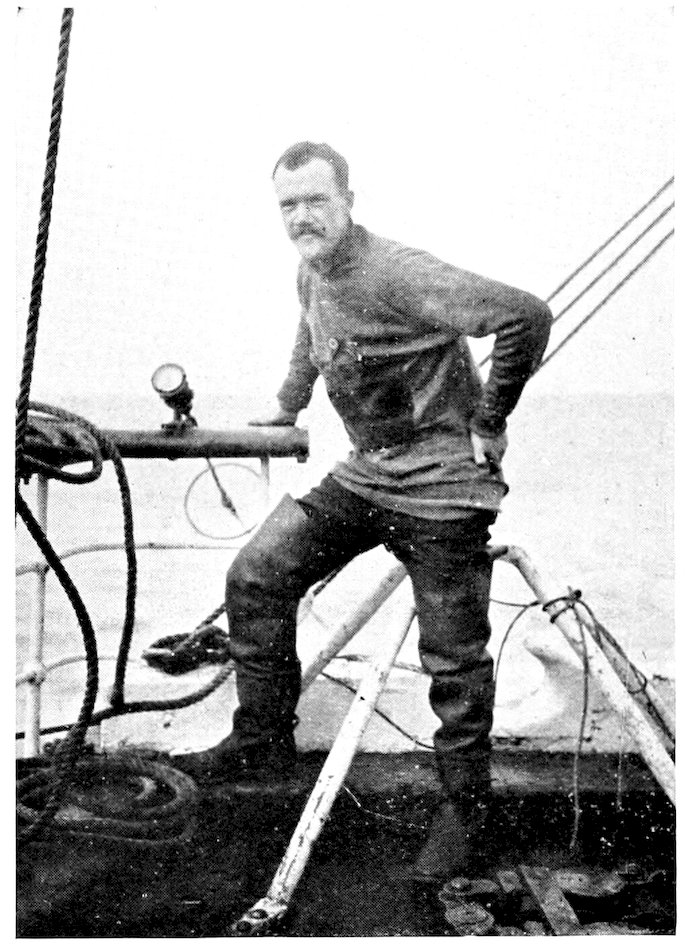
A VERY “ORDINARY SEAMAN.” (The writer.)
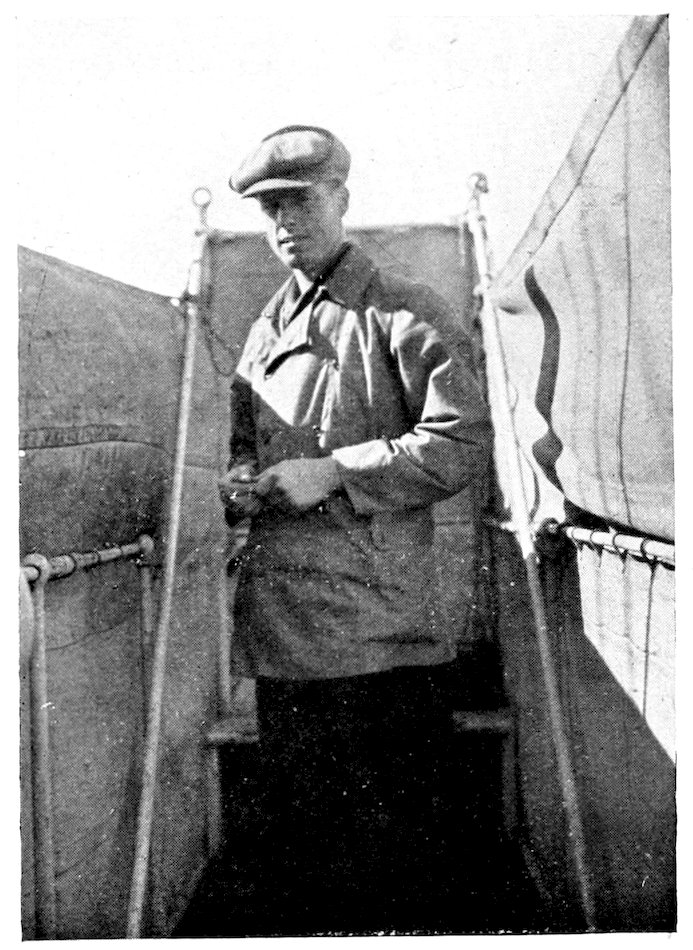
PENNELL ON BRIDGE.
429
1912. Distance. Max. speed. Course. Wind. Force. Sea. Barom. Temp.
March 22
a.m. 50 5·9 at N. 30 W. S. 7 gale 7 28·99 30·8
p.m. 59·5 7 a.m. N. 7 W. 8 8 37
March 23
a.m. 37 5·6 W.S.W. 8 gale 8 28·78 37
p.m. 48 noon 9 9
March 24
a.m. 52 5 N. S.W. 8 gale 8 28·73 40
p.m. 57 7 p.m. N.N.W. 10
March 25
a.m. 49·5 4·8 N. 22 S.S.W. 9 to 11 gale 9 29·03 37
p.m. 48·3 noon W. 8 8 43
March 26
a.m. 25·1 3·4 N. 50 S. by W. 7 7 29·66 42·2
p.m. Becalmed. 7 a.m. W. 2 5 44·5
“26th March.—It is now 12.40 p.m. We have had a satisfactory lunch of roast mutton and treacle duff (toujours mouton!). It is nearly calm, and we have all sail set, and are hurrooshing along at nearly two miles an hour!
“I am five days behind in my diary. We have had a pretty sudden gale—the worst ever felt by any one on board, I believe. It culminated about midnight on the 24th or 25th. For several days it had been blowing almost storm-force from the S.W., and so helped us along O.K., though rather too much westerly, and we could only drive along in front of it. With three stormsails (main lower topsail, fore lower topsail and inner jib) we went along for days at five miles an hour.
“On the evening of the 24th Day and I had First Watch. I was told off to assist Pennell from 10 to 11 p.m. I put on my paraphernalia and turned out on a wild stormy night, after prolonged bumping in my bunk for three or four hours. It was awful on deck, the ship mostly with her lee scuppers under water, and kept there at a constant heel, with only three small stormsails. We were running before the gale (an unusual experience nowadays, as Penelope cheerily pointed out!), luckily just on our course. To windward (in south-west) 430the sky was covered with gloomy clouds—several black bows, which always mean squall-storms, being hideously apparent! White horses raced past the bows, and were all one could see in the darkness. They looked just like detached floes! The whole time we had to clutch the bridge rails to prevent our rolling down to leeward.
“Then the sky got darker all over, the stars disappeared. A sudden squall hit us, and then the shrouds started shrilling and booming. The canvas screen on the bridge bulged in; your nose nearly blew off your face if you looked over it, while the canvas made eddies which deflected the wind into your face.
“The ship plunged forward into the black, sometimes partially righting, but mostly lying over at 30°. Then the black squall passed (in about ten minutes) and a patch of clear sky showed to windward. Another squall-bow appeared, and we were battered and driven over again. This lasted longer, about twenty minutes. Penelope asked me to go to the standard compass (near the foremast) to check the steersman. I got the electric torch and managed to crawl on to the ice-house which supports the compass. Up a silly little ladder with no grip, and in flapping oilskins to find Rennick there before me. Then I had to crawl round and see that the helmsman was keeping his course. I clutched at his screen-posts and wondered if they would blow overboard next gust. (The screen went over next day!) About 10.40 a thick black cloud enveloped the horizon to the west and gradually reached us. This accompanied a squall where nature fairly burst her bounds! The sea was blown flat, and the air filled with horizontal hurtling arrows of sleet and water. I didn’t know that wind could show such malignancy! Don’t know how the stormsails stood it, I suppose because the rigging would do for a ship about twice this size! It was a snorter. Couldn’t see more than a hundred feet, though there was no snow in the air. Just solidified wind, I guess.
“If the sails had not held it would be called force 12—the maximum, as it is they are content with force 11. Penelope said he enjoyed this sort of thing, but I can’t say I was thrilled with enthusiasm, and I preferred to be where the hurricane force was not quite so obtrusively obvious! So 431at 11 p.m. I unselfishly called Bernard Day for his share of the hell-broth, and went down below to try and forget it in sleep.”
It culminated at 3 a.m., when the starboard whaler was torn from one davit. Just as they got a rope under the loose end the other broke loose. So they cut it adrift after it had been bumping on the ship’s side for some hours a few inches from Lieutenant Evans’ sickbed!
Bernard Day was nursing Evans, who was progressing satisfactorily, though still very weak. However, by now he was nearly as cheerful as usual, and his cabin was chiefly noticeable from the amount of laughter emanating therefrom. He had onions, oranges, and beer in excess of our ration, and got up for a few moments just before the gale.
“Now that the engines are stopped (to save coal) we have to use the hand-pumps continuously—about a quarter of an hour each four hours. In the storm, owing to the rolling, it takes longer, for the well only fills slowly through its small holes, and most of the bilge lies on the lee side.
“The pump-handles (across the waist) are left on all the time now, and with ‘life-lines’ they make something to grip as you sidle along the deck. Ponting didn’t see the handle, and running to dodge a big wave he was knocked silly by a blow on the brow. Result—two lovely black eyes, and a thankful heart that his nose wasn’t broken!”
The same day a big sea pooped the ship and covered the steersman (MacCarthy) in fifteen feet of water! It broke down the canvas screen protecting him, but didn’t dismay MacCarthy. He had bad luck later, also. For climbing the ratlines to free some tackle his helmet was knocked off. It nearly came inboard on an incoming wave over the lee bulwarks, but not quite. However, all that cheery MacCarthy said was, “Maybe ’twill make the gale lessen a bit!”
There was naturally not much comfort anywhere on board, not even in the cabins. I think the following extract speaks for itself—
“My bunk is just over the counter, where the waves bump every few minutes, just over the screw; just under the chilled feet of the steersman who dances on the deck, which is like a sounding board; and just next the rudder, which has two dozen squeaks and groans of its own. Add to this rolls varying from 30° to 50° each way.
432“I have made a fine hanging candlestick from a chain of safety pins and a bent wire, and this swings out and bangs my head. I stick in my drawing-board at the side of the bunk, and so try to get some sleep in the fearful rolling.
“There I lay, throughout the day,
Lying this and then that way,
Pain and cramp from toe to shoulder;
Up and down the tempest rolled her.
Pitch and toss, athwart across—
Never worse befell old Ross.
Waves belched round, above, right over
Poor old storm-tossed Terra Nova.”
On the 26th we had discussion of Amundsen’s chances, and I got Pennell to draw a map of his winter quarters. This has some interest, as we did not know anything of his movements for over a week yet.
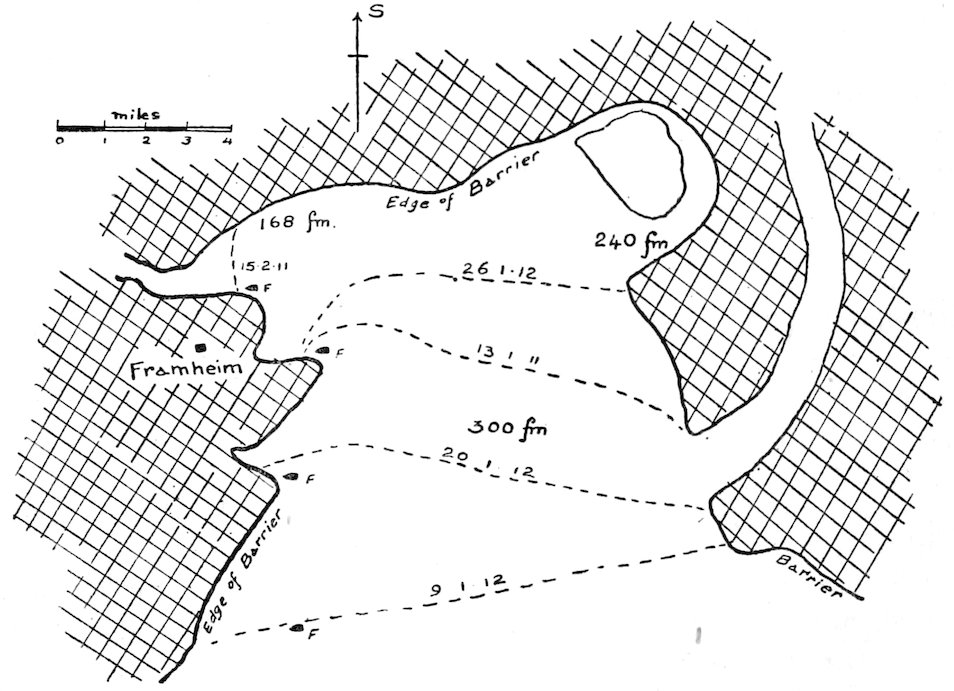
Chart of Bay of Whales, 78° S. + 164° W., after Amundsen.
“The Discovery in 1902 found several deep bays in the edge of the Ross Ice Barrier. Balloon Bight went in about ten miles. Shackleton in 1908 found that these had merged into one and he was stopped by sea-ice at the head.
433“Pennell in the Terra Nova found Amundsen’s Hut (in February, 1911) to be about two miles from the water on a ridge of old sea-ice about thirty feet high, but hidden from the ship by another ridge of the same nature.
“To the west was an indifferent lane half a mile wide which reached behind the hut. Here the sea-ice was only a few feet above the water except where pressure occurred. The ice in the west of the lane was breaking out. Behind this about four miles off was an eighty-foot cliff of Ice Barrier with a path up in the south-east. I wouldn’t like his winter, though if he lasted through the autumn he might be O.K. afterwards. Anyhow, we’ll know in about a week now. We had a great cag to-day. Some are still sure that Amundsen did nothing at the Pole. The arguments are: (a) Amundsen never liked sledging; and (b) if he meant to go up another glacier than the Beardmore, he’d have acquired merit and said so!
“Contrariwise (a) if he found going easy he might have prospected up an easy one, perhaps in 1911; and (b) if he’d gone astray, the Fram would have come to us to investigate this year.”
“On the 27th we finished off the cable. It runs to 7,500 words, of which the western party contributed 900. It is to be delivered to the agent at Akaroa on Monday (first of April). A funny day to send off a big cable, but it won’t be published till the 2nd in England, and ten hours later in Australia. Meanwhile we loaf about till Wednesday morning (minimum 36 hours), and then land at Lyttelton as soon as possible.”
On the 30th the coal gang put in about six hours filling the bunkers, so as to rest on Sunday. We shifted seven tons. The gale had rounded the large lumps of coal, the impacts turning them into egg-shaped boulders. The coal-dust was packed into a hard layer which we could hardly break out with a pick! This is what clogged the pumps in 1910, and in that gale Teddy Evans was head and shoulders under the bilge water groping for the mud clogging the pump-roses.
During Sunday we slowly cruised towards Akaroa. After lunch we sighted a school of eight sperm whales. We turned off and followed them. Mostly one saw their broad rounded brown backs. Then one would raise his head a little and blow off “steam,” not up straight but diagonally forward. 434Sometimes their large triangular tail fins showed, and once or twice the huge torpedo head appeared above water. Our harpoon gun was out of order, but they were too shy to let us approach within striking distance. Each of these whales was worth £300, so that there was a small fortune in the whole school.
Monday, April 1.—About 6 a.m. we approached Akaroa. It was a bright morning as we entered the very fine harbour, the Heads reminding me of those of Sydney. We could see the friendly light of the lighthouse twinkling a greeting to us. Then we saw ragged clumps of the first trees—two on the skyline resembling a pair of roosters fighting, and sheep, like rabbits, browsing on the steep hillsides. We lay about a mile off the little town, while Pennell and Drake went off in the cutter and were met by a launch. All communication was forbidden with the shore, but later two men in a small launch hovered around us. As they pushed off they called out—
“Why didn’t you get back sooner? Amundsen got the Pole in a sardine tin on the 14th December.”
“Pennell returned about 11 a.m. and confirmed it. Amundsen has done wonderfully. His risky hut site was not so bad as we expected. In place of howling blizzards four days in each week, he seems to have had calm weather! But his bold dash up another glacier, his getting five men there, and his nice behaviour after returning with regard to Scott and his work have changed our opinion of him in toto.
“Scott will have reached the Pole about January 16. When he sees the tent and flag there he will get a most unpleasant shock. Amundsen started eleven days before Scott and was eighty miles nearer. He got there only thirty days sooner, so that he didn’t march much quicker.
“In the west Gran and I agreed that he had a very good chance, and Gran has written down in my sledge diary the day he (Amundsen) would get there. I haven’t looked at it, but believe he was at the Pole at the day Gran said!”
This prophecy has aroused some interest among psychologists at home! So I will explain the circumstances. Gran woke up on December 20, 1911, when we were camped in the Punch Bowl and had been sledging over a month. He declared that he knew that Amundsen was turning back. As natural we pooh-poohed this. He said, “Well, I’ll write it 435down in Grif’s book here.” He did so; but in my Browning and not in the diary (as I say above).
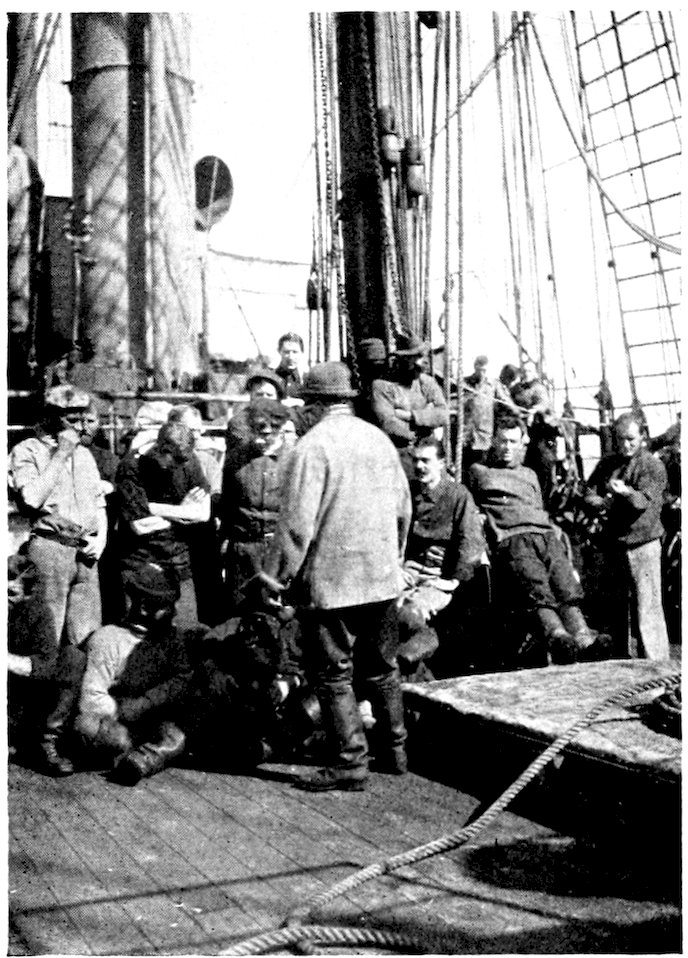
PONTING IS HERE ARRANGING THE CREW FOR A PHOTO OFF AKAROA. PROBABLY HIS LAST EFFORT AT “PONTING” ANY OF US. The dog Tsignan in the foreground.
This copy of Browning was left on Cape Roberts with all other non-essentials on February 5. It remained there until picked up by Priestley, six months after I had reached Australia. It was restored to me in Priestley’s home at Tewkesbury in 1913, nearly two years after Gran’s inscription. I looked through it and came on Gran’s note, which I here reproduce. This is one of the most extraordinary coincidences I know of, and owing to Gran’s isolation from all outside information is perhaps unique.
I am personally of opinion that coincidence and not telepathy is involved; though it is a fact that Gran never made any other attempt to get an undoubted record of a dream, and he certainly believed this to be something supernatural at the time!
During Monday we idled off Akaroa. Some fish were caught, Day hauling in a huge barracouta and Evans a rock cod, which he caught as he was sitting in a deck chair, and so celebrated his first day out of the cabin. They tasted good at lunch! We trimmed eight tons of coal during the day, so that only five were left! Then I had a huge bath, borrowed a shirt, and got into clean clothes ready for civilization!
On Tuesday I packed all my gear, which was lucky, for I only had half an hour to catch the Sydney boat finally. On Wednesday morning we entered Lyttelton Harbour early in the morning. A tug came to meet us, carrying Mrs. Wilson and Mrs. Evans. Pennell asked me to steer the ship into harbour—why, I know not; unless he thought I looked too respectable and might look more natural after a trick at the wheel. However, one of the seamen did all the heavy brain work, and I merely assisted at the tricky corners!
Simpson, Meares, and I hurried for the first train to Lyttelton. Simpson was not specially noticeable except for his ski-boots, I had on his shirt and Evans’ cap. Meares was clothed in a suit lent by Jim Dennistoun, who said it was an old one of his father’s. I think Meares’ departure was hastened by the advance of Mr. Dennistoun senior to greet his son!
I spent only one day in Christchurch, for finding that a ship left for Sydney that evening, I transhipped all my gear to the mailboat and was back in Australia on the 7th April, 1912.
437