V IN WINTER QUARTERS WITH CAPTAIN SCOTT (continued 3)
Reading edition
On the 8th of September the second volume of S. P. T. appeared. Cherry wrote the Editorial in the best style of the Times. Some eighteen pages were devoted to a skit on life in the Hut, called the “Bipes.” Its redeeming feature is a series of coloured illustrations by Uncle Bill. In it I gave a somewhat garbled but recognizable view of various personalities at headquarters. The tenants of the Diarist’s Den (i.e. our cubicle) as well as the Conservative party (the “Bunderlohg”) came in for their share of attention on the part of the inquisitive rabbit; who is here supposed to observe the habits and customs of the so-called Bipes.
Simpson contributed a gruesome account of the decline and fall of the human race in the last days of the earth’s habitation. The only panacea seemed to be certain elixirs to be obtained near Mount Erebus. There was a beautifully illustrated rhyme dealing with the midwinter party at Cape Crozier. I could never discover who was the writer unless it was the Owner himself. Simpson’s career was described in a semi-serious article, “Celebrities in Glass Houses.” There were two poems called into being by the return of the sun, 303both due to Australians. Some one, I suspect Nelson, wove Uncle Bill and myself into a “nightmare interview.” There were some beautiful photo plates by Ponting and three of Wilson’s inimitable Egyptian tablets; besides various cartoons and silhouettes by Wilson and Lillie.
Guessing at the authors furnished considerable amusement. Even the astute Nelson fell in! On p. 19 there is a plan of the hut showing inter alia the engine in one corner. Nelson made the rash statement that Uncle Bill had drawn it the wrong way round. I immediately bet him that Bill hadn’t. Nelson went over to the engine and came back ready to stake his life on it! Then I told him that I had drawn the plan; so that Bill couldn’t have made a mistake! He proceeded to say that he would have put me down as the author of the “Bipes,” only I was so unmercifully described therein; while Simpson amused me by assuring me that Scott wrote the poem, “The Errant Sun.” I gave the palm to Nelson’s poem on “Uncle Bill,” “You are old, Uncle William.”
Captain Scott was now preparing for a fortnight’s sledge-trip over to the west. He proposed to Simpson that he should take this chance of some sledging, and so the meteorology was left in my hands. Simpson kindly coached me in the special minutiæ, and I started the records on the 11th (before he left), so as to get into swing.
Nelson gave us a particularly well-illustrated lecture on the 11th on Invertebrates generally.
He told us of the pleasant habit of the hydra which turns itself inside out, and converts its skin into a stomach lining, and vice versa! He discussed the huge arthropod, remarkably like a flea (but eight inches long), which Meares declared was found in a bunk in the hut, though Ponting said he obtained it on the beach.
We envied the Pycnogonids (sea-spiders), which grow an extra pair of legs in Antarctica, though they have only eight in less strenuous latitudes. Two more limbs would help us so greatly in sledging! He called on me to lecture on the corals, and I gave a brief account of the biology of the forerunners of this family (the Archeocyathinæ), which occur fossil on the Beardmore Glacier. I discussed Darwin’s and Murray’s theories with special reference to my 304observations on the coral reefs of the Great Barrier. Debenham instanced Funafuti—that coral islet bored by Professor David to show the depth of a reef formation. Birdie wanted to know why a sea anemone wasn’t a plant? And some one thereupon asked Nelson if he could explain why a Birdie wasn’t a cabbage? But this problem proved too difficult for the lecturer.
Wilson with his usual kindness was now copying some of my western sketches and turning them into splendid pen and ink drawings. He spent many hours coaching me in drawing, but indeed he would always help any one if it lay in his power. I think what touched some of us as much as anything was his willingness to take the last and longest hour of any one’s night-watch! He used to say, “I don’t mind getting up at seven; I’ll get on with my painting. Just put a kettle on to boil, and wake me, and then you can turn in!” I’m afraid I took advantage of this, when my watch lasted through to the morning, though usually I shared it with Nelson.
About this time Scott and Bowers spent their leisure in photographic work. Ponting was untiring in coaching them, and the excellent results obtained by these absolute tyros on the southern journey speaks well for teacher and pupils. Bowers handed over the pony “Chinaman” to Wright, who “gets run away with, with great regularity.” Cherry was typing out those sections from the “Heart of the Antarctic” which would help Scott in his southern journey.
On the 15th of September Captain Scott set out for a trip to the Ferrar Glacier and thereabouts. They carried about 200 lbs. of food for us to Butter Point, where we were to pick it up later. Nelson and I helped them along for three miles, though the party, consisting of Scott, Bowers, Simpson, and Taff Evans, needed us little. It was −40° starting, but luckily there was no wind. A big shear crack about two and a half miles out marked a permanent crack in the sea-ice extending between Inaccessible Isle and Cape Royds. It had developed into a fractured wall, as much as ten feet high in places, where the floes ground together, and gave us some trouble. However, Nelson and I were able to steady the sledge and guard the sledge-meter, and so they soon negotiated it.
305On the 17th of September we actually had a “fine bright sun, so that films of snow melt on the black rock.” This is an interesting date, for though the air temperature was only +7°—that is, twenty-five degrees below freezing!—yet the radiant heat from the black rock produced a little water.
Let us accompany the meteorologist, and see how a first-class weather station is run at 77½° S. lat. The weather man has to rise about an hour before the others. (It was pleasant to see Sunny Jim lying in his bunk till 8.30 on the 14th—as he pathetically put it—for the first time since he’d landed!) I find I am dressed five minutes too soon, so I hit Wright with a book to get him up in time to check the chronometers, which is his “pigeon”!
1. When I hear the automatic signal I have to fly around and mark all the recording instruments to show exactly eight o’clock on their charts.
2. I read the large standard barometer and its attached thermometer.
3. Change the chronograph papers and put ink on the pens, for the blizzometer, thermograph, barograph, and wind velocity charts. (In all these chronograph drums the “clock” part (carrying the paper) revolves about the central axle—which is just the opposite of an ordinary clock!)
4. Wind up the various chronograph clocks (once a week, on Monday).
Then I muffle myself in wind clothes and gloves, and collect the gear for the outdoor apparatus.
A.
A clock set to nearest half-minute.
B.
Sunshine paper for the record burnt by the glass ball.
C.
Tablet and pencil.
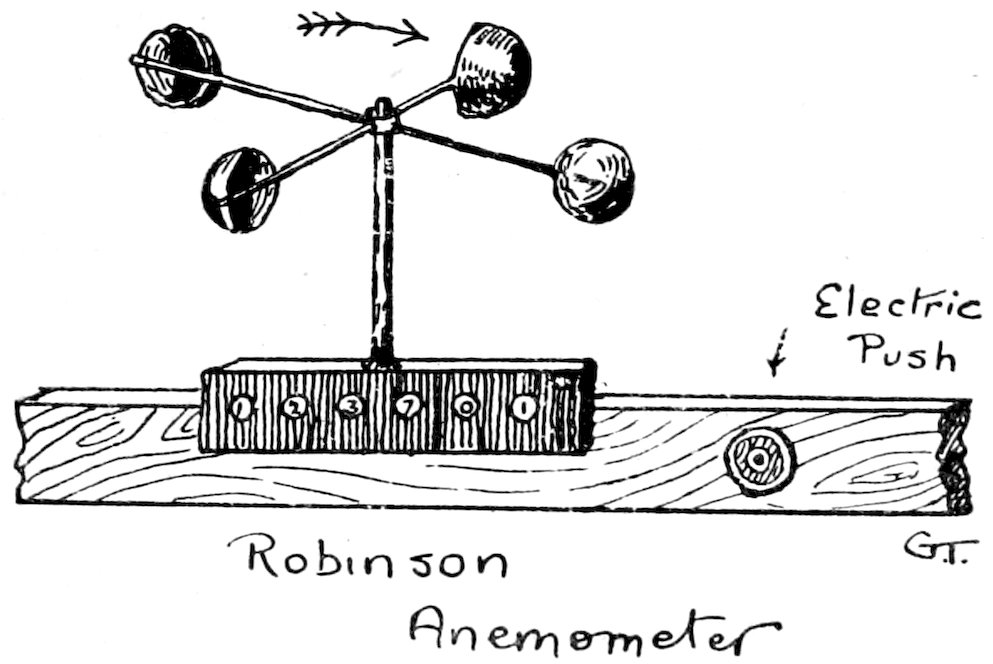
5. I stagger up to the top of Wind Vane Hill—a long operation and a cold one in September, for it is not far from August, the coldest and roughest month. At a definite minute I read the anemometer figures alongside the anemometer cups.
6. Then I press four times on a button alongside, and this is electrically transmitted to the record in the hut, and so gives a datum each day on that record.
7. I walk across to the screen and read the three 306thermometers—present, maximum, and minimum. Then I readjust the two latter and read again.
8. By this time three minutes have elapsed, and I return a few paces to the anemometer and read the latter figures again. (This gives the revolutions in three minutes, and therefore the velocity per hour at that time. This is another check on the automatic record.)
9. Read the wind direction from the arrow on the hill, and note the steam-cloud direction on Erebus.
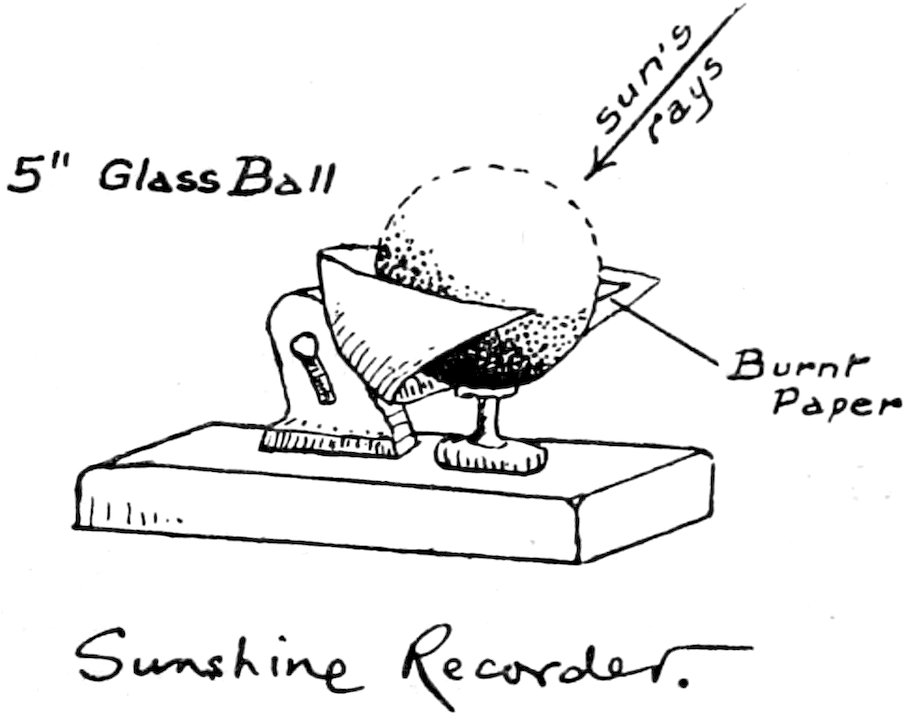
10. Change the blue paper in the sunshine recorder and clean the glass sphere. This is an awful job, for the frost crystals cling like glue to the five-inch glass ball, and have to be melted off by rubbing with the bare hands. A slow and painful job at −40°!
11. Read the outside thermometer at the south-east corner of the hut, just below the anemometer tubes.
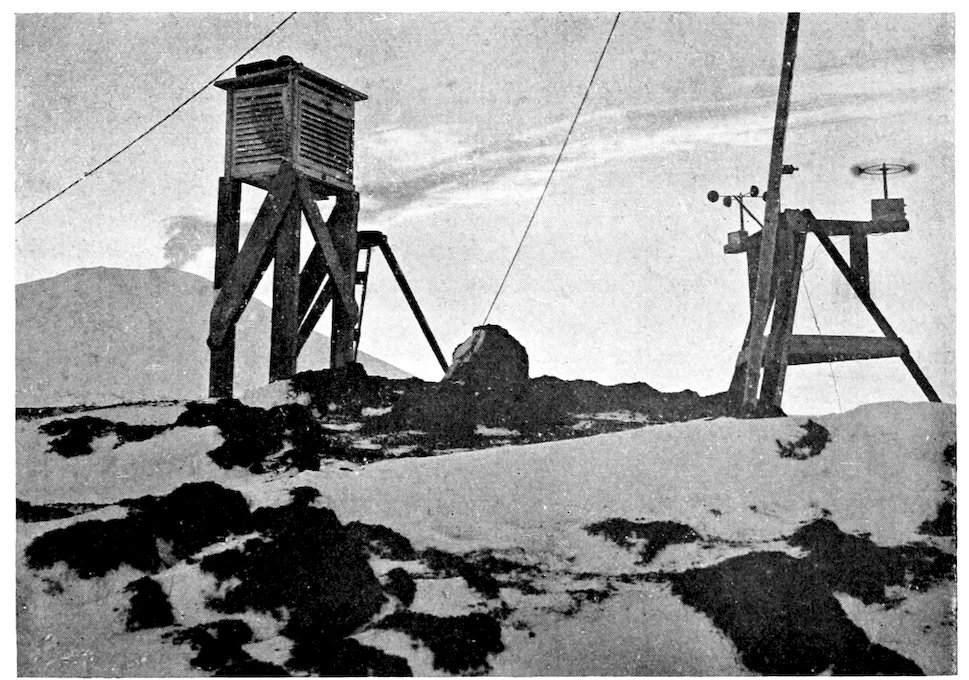
A FINE STEAM CLOUD BLOWING SOUTH FROM EREBUS, Sept. 19, 1911. The illustration shows also the station on Wind Vane Hill. The thermometer screen on the left, the flagstaff and the wind instruments on the right. One anemometer is rotating; the other is blocked (for the photo).
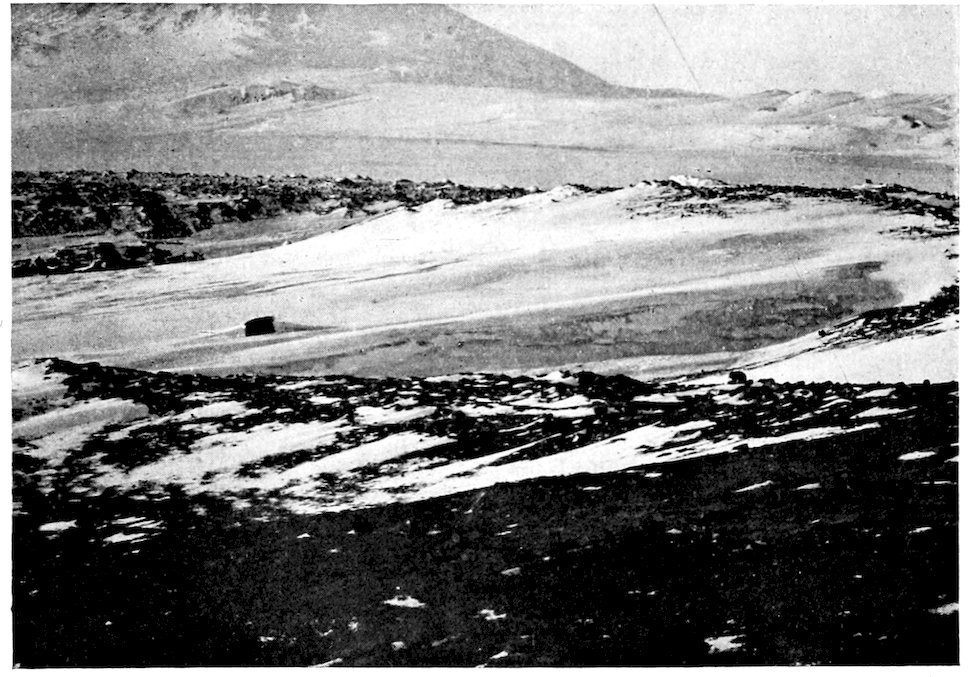
A GLACIERET NEAR ISLAND LAKE (C. EVANS) DUE TO WINDBLOWN SNOW, Sept. 23, 1911. The blizzard builds and also prunes these small glaciers. In the distance are the debris cones on the ramp and the south-west slopes of Erebus.
Each morning at 8.15 I used to predict the weather, as I went out to Wind Vane Hill. This was received with great joy by the mess deck. Crean was especially congratulatory. I have explained my method—i.e. “that after four days’ calm 307it’s certain to blizz;” and it worked as well as most weather rules. However, even when this standby failed, Crean was always consoling. At last the other seamen got nettled. “Go on, sir! he’s only kidding; he wants your long sea-boots when you return!” It was “cupboard love,” I fear!
On Thursday (21st) I believe the wind was blowing seventy miles per hour when I reached the screen. The temperature was pretty high (-7°), but a wind that nearly blew me away soon robbed one of one’s bodily heat. My fingers took about ten minutes to “come back,” and only by degrees lost their dead feeling, though they did not reach the dead white colour of bad frostbites.
The early morning sun was throwing fine earth shadows, which moved round quite rapidly. Thus on the 24th, at 8 a.m., Erebus cast a shadow right over the western mountains, while at 9 a.m. the shadow could be seen to the south-west of Erebus itself.
Debenham had been doing long-distance geology! He fixed up a telescope and trained it on the south slope of the crater of Erebus. He could see hundreds of snow structures on the side, each representing the vent of a “fumarole” from which steam was issuing. This side of Erebus must resemble a gigantic pepper-box!
Inside the hut Day was doing some ingenious turning. His lathe was certainly unique! Many of the hardwood rollers for the motor sledges needed renewal. So he attached a block of hardwood to the flywheel shaft of the oil-engine, and he sat on the floor and, using a box as a tool-rest, he turned out rollers quite successfully, if not very rapidly.
The morning of the 24th was quite clear, so I got my camera into working order, only to find the sky clouding over for a blizzard so soon as I ventured out, about noon. Ponting was lost for about two hours in the thick fog in the evening. We fired off guns, and it looked as if Atkinson’s mishap was to be repeated. However, luckily he had a compass, and so got back to the hut quite safely in the end.
The weather was hopeless, and the coast survey party very sensibly returned to await better conditions. The following scurrilous rhyme pinned to Gran’s diary affected them not a whit:—
308“Three bold explorers hied them forth
For to explore the plain;
Although so bold,
They found it cold,
So hied them home again!”
Next day was again gloomy and cold. It took me ten minutes to rub the sunshine ball clean. The record for yesterday showed clearly the sudden cessation of sunshine about noon, just when I was ready to use my camera.
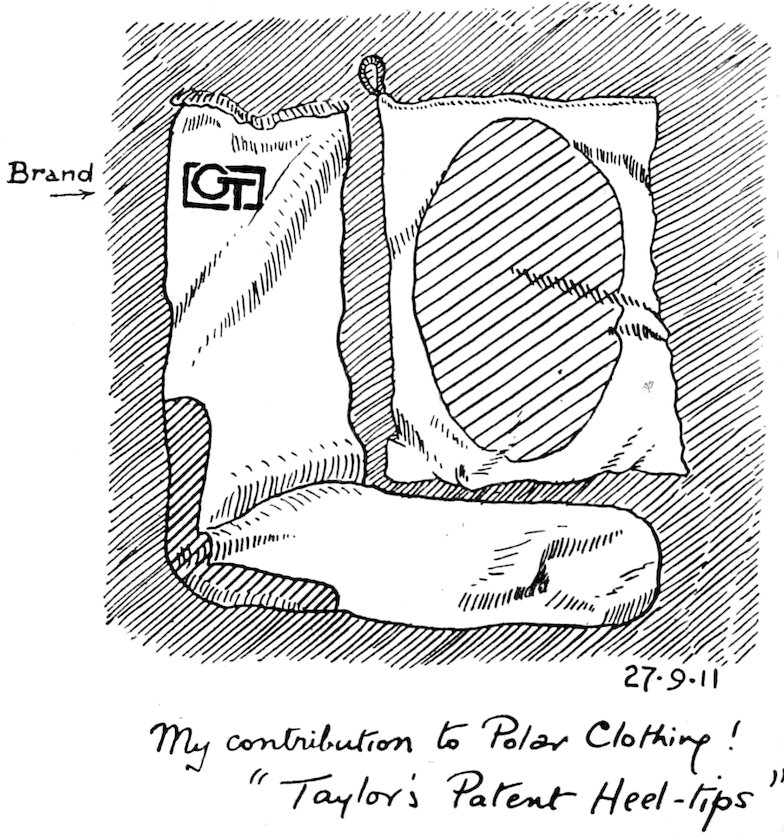
Every one was now busy with sledging outfit. Bernard Day and Cherry each gave me thin gloves for my forthcoming theodolite work; Hooper washed some of my clothes, and kindly sewed a huge pocket on the jersey. One great improvement was to my socks. I sewed canvas heel-tips to most of them, cut out of my specimen bags, of which I had more than I required.
Clissold had boiled Oates’ famous home-made canvas breeches, and scrubbed blubber out of them for an hour. 309He donned them with joy, and they now hung in graceful folds in place of being as stiff as stove-piping. Every one laughed when he was caught solemnly dancing to the pianola in them!
The one great lack on our previous journey had been strong soles to our boots. “Titus electrified us by saying that he had a stock of hobnails. I offered him five pairs of socks for them, or anything he liked. He enjoyed this hugely, and finally said, ‘Well, I’m interested in a military magazine. If you’ll write a five-page article on “Physiography for Soldiers,” you can have them!’ I agreed willingly; but my visions of a boxful were unfulfilled. There were barely enough for two soles.
“The western trippers returned early on the 29th. They had finished up with a stiff day, doing twenty miles in very bad weather. They had got across in two days and four hours. The depôt on Butter Point was invisible, bar one tin! No staff or flag. They dumped our two cases on top. (Birdie counsels taking an extra tank for biscuits.) The Owner thinks the south tongue of the Ferrar is due to a tributary glacier, but they didn’t go near it. Then up to the Cathedral Rocks. Here they found an apparent movement of a foot in C. S. W.’s stakes. Of course the glacier must move to keep the end of the tongue stationary (i.e. ablation replaced), but this is an important amount of corroboration. Then they returned and coasted round to Dry Valley. There is a huge ice-foot here, probably preserved by the sheltered position of these cliffs. They climbed up the Kukri Hills near where Evans and I put Station I., and saw the Taylor Glacier, etc., quite well. Then across to Cape Bernacchi. Here they got some kenyte and were much bucked, but we also got much of it further west in Dry Valley. They marched about twenty miles north and saw a huge berg. This had a stake on it, and ‘B. A. E. Expedition’ on a board. They found it was our glacier tongue, which had drifted across to this position, about seventy miles to the north-west! Beyond was Dunlop Island, sixty feet high and half a mile long. Many rolled pebbles on it and raised beaches. The Owner got a good specimen of granite, showing rounded erosion above and angular below, where it was bedded in the beach.
“Near here there was a cliff of schist-limestone with quartz 310veins, and here the Owner got a strong vein of copper pyrites. The adjacent limestone (or marble) they thought was quartz. This has a blackish mineral in it, perhaps copper glance. Then they returned to Marble Point and then in a beeline to the Hut. They were caught two days in a blizzard and had an awful time getting up the tent. Sunny Jim was nearly frostbitten holding up the poles.
“The Owner didn’t think we could retreat over the shore, for it consisted of ice slopes with crevasses. But there are so many bergs there that he was sure that an ice margin would form there quickly; and he thought we could count on reaching Hut Point by April 1....” (As will be seen later, the sea-ice broke up quite abnormally; and we should not have got round till next spring if we had not retreated in February over the ice slopes. Atkinson tried this journey in April, just as Scott suggested, and found it impossible! which is but one more illustration of the irrationality of Antarctic conditions.)
Now that the sun was back again, it was very enjoyable to tramp round our headquarters and “snap” pictures with the camera. I realized more than ever that a geologist is always in a position to enjoy nature. In civilized regions a botanist may run him close, but down south the former would have a poor time, whereas there are always rocks or ice, even in Antarctica. The snow ridges were most beautiful objects, all lying on the northern (lee) side of various projections. For instance, a great promontory of snow jutted out over the sea-ice from the Northern Glacieret, and clearly marked the origin of the latter, as consolidated snowdrift. A little further the sea-ice at low tide, evidently bumped on to a great boulder, and the ice was cracked and bent into a low dome, exactly as a granite boss is supposed by geologists to crack the earth’s crust. Beyond this the snow cornice due to blizzard drift was busy bridging the tide crack, and this accretion from one side, gradually extending to the other, led to a theory of crevasse-bridges, which explains the greater thickness in the centre of such bridges.
The sculpturing of the kenyte boulders was most remarkable. Just behind the hut was a quaint boulder, carved by wind and frost into something resembling a Galapagos turtle! This we called the Antarcticosaurus. On the Ramp 311to the east of this was another block shaped like the power-shears used in machine shops for cutting iron plate. In the same region were great blocks several feet across split clean in half by the action of the frost.
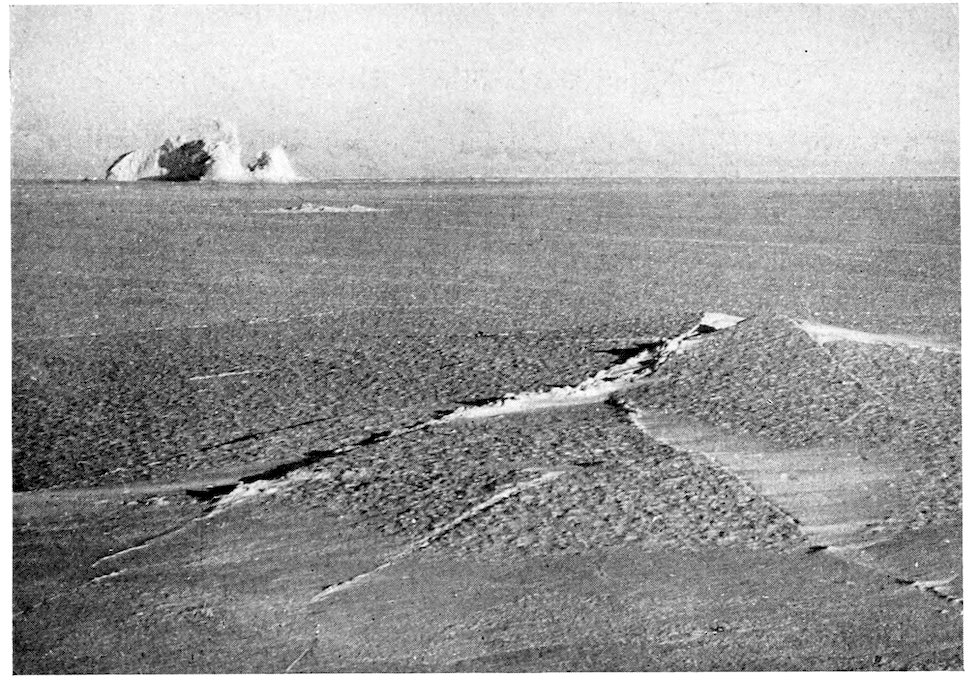
ICE-QUAKES IN THE SEA-ICE, Sept. 23, 1911. The ice has settled down with the tide on a huge boulder and so formed radiating cracks, just as has happened in the earth’s crust. The ice is six feet thick. In the distance is the fallen “Arch Berg” just west of Cape Evans.
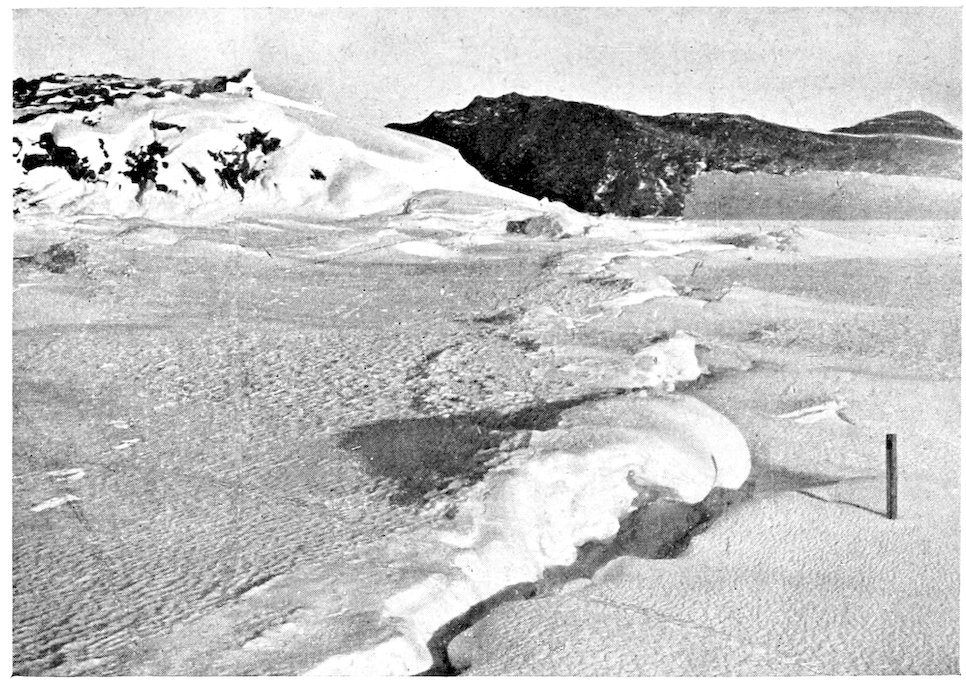
THE TIDE CRACK AT THE NORTH-WEST CORNER OF CAPE EVANS, Sept. 23, 1911. On the right is the moving sea-ice, on the left the fixed ice-foot. The blizzard “bridges” the crack by cornices built from the south. The overhanging snow fills crevasses similarly, and thus arises the wedge shape of the bridges—for these cornices are thickest in the middle. Behind is Inaccessible Island with its windblown sand ridges on the right.
Small lakes, debris cones in all stages, solifluction furrows, ice dams, kenyte columns, wind-ridges, etc., etc., there was no end to the interesting photos one could obtain now the sun was with us again. Still it took a long time for him to illuminate the southern cliffs of the Cape, for he would dip behind the mountains to the west for several weeks to come, quite early in the afternoon.
On the 29th of September I tramped across to Tent Island, which lay four miles south of Cape Evans. The island was approximately square and about 800 yards along each side. The west side was fairly steep and the island sloped gradually thence to the east. At the south was a well-marked ice-foot, just like the one on which we camped in the blizzard on Little Razorback. It is probably due to spray and snow blown on to the windward face by the southern blizzards.
There were a number of small water-cut gullies furrowing the slopes. The surface was quite peculiar. The kenyte gravel was so small and uniform that it looked like a well-raked garden, and was like velvet to walk on! I found a few small granite erratics, just as Oates had prophesied. The latter had visited the isle a few days earlier, and was delighted to hear that Debenham had missed the granite boulders which Titus had seen! The geologist had been handicapped by a bad light and some snowfall; but it may readily be imagined how little that affected the cavalryman’s pride in his discovery!
The evidence of water erosion in the Antarctic was important. One gully was quite 25 feet deep with a steep grade and was about 30 yards wide. It ended in a fan which spread out over the ice-foot. I could not climb down the latter, and so reached the sea-ice where I had climbed up, further to the north.
I had a long talk with the Owner about my plans for the forthcoming summer. He was much averse to our trying to return by the Piedmont Glacier, probably because of the greatly increased risk of falling into crevasses if your path lies along 312their length (instead of across them, as in traversing ordinary outlet glaciers). I think our party were the first to do any considerable distance over such a glacier, and I must confess that I would infinitely prefer to ascend a normal glacier for twice the distance.
In one important respect the environment of our hut was scientifically more interesting than that of 1902 or 1907. We were only a few minutes’ walk from the huge face of an important glacier. This meant that many hours could be spent studying ice conditions, without being at a dangerous distance from safety if a blizzard suddenly sprang up. Almost every day Wright and myself prowled around High Cliff and the vertical 150-foot face of the Barne Glacier.
As one walked north from the cape on to the sea-ice, the ice-covered slopes of the Ramp (which we called Slippery Slopes) merged into the ice of the Barne glacier. Just at the northern “root” of Cape Evans was Low Cliff, a mass of kenyte in situ. Further north every few hundred yards was a permanent snow ramp leading up to the glacier surface 100 feet above. At High Cliff an outcrop of kenyte was exposed below the ice mass, and a little further north was another lower outcrop at sea-level. Between these two—and about a mile from the hut—Gran worked hard to convert a snow slope into a suitable ski-run. It looked a ferocious jump to the tyro, and ended in a jumble of sea-ice blocks which usually upset even our champion ski-er! (I did not tackle this particular spot, having a desire to keep sound limbs for the ensuing summer, but nothing ever harmed Gran, as far as we could see!)
A stiff pull up the ski slope brought one to the top of the glacier. Here the edge of the latter was closely corrugated by small thaw streams, while the sun had etched out the face of the ice and left great blocks of englacial kenyte projecting like the gargoyles of Notre Dame. The silt bands and texture of the glacier hereabouts, which was unusually rich in included debris, are well shown in the accompanying photographs.
The last volume of S.P.T. for 1911 was now in preparation. The editor honoured me with an order for another skit on the lines of the Bipe research. So I wrote a second dealing with sledging trials, purporting to be love-letters 313between a McCormick Skua and a Weddell Seal. This was illustrated in similar style by Uncle Bill.
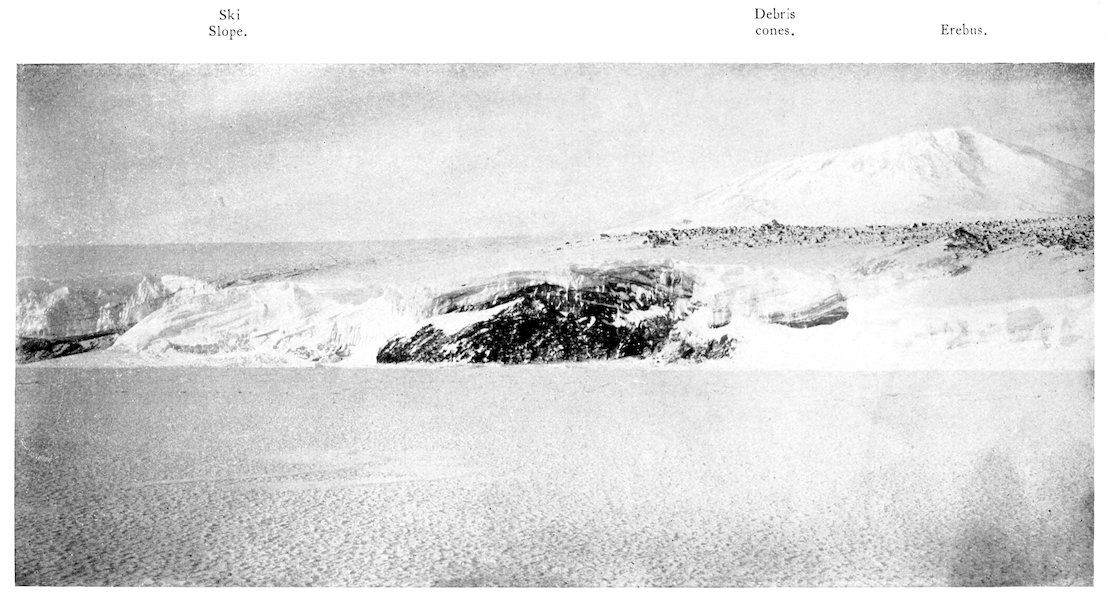
HIGH CLIFF AND THE SOUTH END OF THE BARNE GLACIER, Oct. 21, 1911. Ski Slope leads up to the glacier on the left. The debris cones show up well on the right. The banded nature of the glacier ice shows clearly to the right of High Cliff. The glacier and cliff are here about 120 feet high. Erebus is 12 miles off.
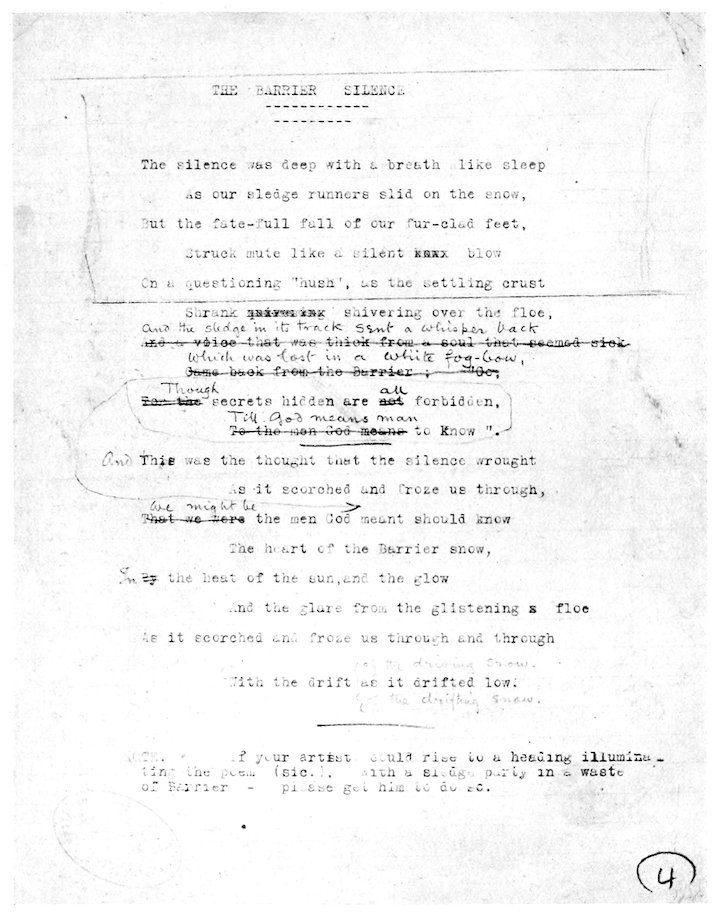
This is an original copy (reduced) of Bill’s poem showing the footnote he added (in imitation of my earlier directions). Also showing his corrections after Cherry’s criticism, thus giving the poem in its first and also its final form.
One day when I was typing this copy on Cherry’s typewriter, Bill came to me with a poem he had written. He asked me to type it so that Cherry should not recognize his writing. He wanted it to be perfectly anonymous, for he knew anything of Bill’s would go in from our admiration of the writer! I saw that he had copied my footnote (so as to puzzle Cherry further) asking that an illustration be appended by the artist on the staff!
(This poem is that forming the introduction to the second volume of Scott’s Last Expedition.) A few days later Cherry brought me all the MS. and was graciously pleased to compliment me on the lot—especially the poem “Barrier Silence”! So I had to disclaim authorship—in spite of the footnote. After some time I think he believed me, but he wanted two lines cleared up a little and asked me to do it. I declined to alter it, but said that evidently the author expected Bill (as artist) to see the poem, and that I was sure that whatever he and Bill agreed to would satisfy the author! Whereat I heard Bill chuckle, and later it was returned to me emended as shown in the annexed facsimile.
Two explanations are perhaps helpful. The surface of the Barrier over large areas often sinks suddenly to a slight degree when it is disturbed by a sledge party, and this “shudder” has a very eerie sound. The glare from the blinding surface affects the eyes much as does a hot substance, and this is independent of the temperature. Hence the remark, “Scorched and froze us through and through.”
Evans, Gran, and Forde had done a rapid and useful dash south to see if the first depôts were in good order. They experienced awfully low temperatures (below −70°!), but managed to dig out the cases at the depôt, and restore them to a more noticeable position. It must have been an awful job, and there was evidence of this after their return. Forde awoke next morning to find three of his fingers black, and one was soon attacked with gangrene! For months his right hand was bound up, and he was unable to use it fully right through our western journey next summer.
The geologists had to be very active, and make the most of the next week or two to study the numerous problems 314confronting us in the vicinity of Cape Evans. The sunlight made it possible to go longer distances, and I examined Inaccessible Island, Turk’s Head, Tent Island, Glacier Tongue, and Cape Royds in greater detail than I had been able to do before. Thus on the 4th October I tramped six miles south to join the survey party at Turk’s Head.
Captain Scott had brought down a bicycle—given by a New Zealand firm—on representations from Day and myself. I had ridden many miles over snow in France, and thought it would be useful for short trips round headquarters on the sea-ice. I got it out this day, but could not find the pump, and so did not use the bicycle.
I reached Turk’s Head about noon, and found the survey tent; but the party were four hundred feet up on top of Turk’s Head. I could just see Debenham on the summit, and got a photograph with his figure on the skyline.
It was tolerably easy to climb up the north-east gully, and so attain the cup-shaped hollow on the summit, which enclosed a small frozen tarn. Wonderful crags bounded the Bluff to the south. Great pinnacles and couloirs etched out of the basic lava cliffs, due to the biting breath of the southern blizzard. At the head of the bay, to the north, were steep ice-falls. These moulded themselves round slender jagged pinnacles of rock, which one would expect to have been eroded with great ease by almost any type of glacier.
We marched back to the survey tent in a cove two miles north, and ate the currant cake which I had provided for lunch. Great ice-falls came into the cove, and a huge cave was formed where they shot over the cliff. It was thirty feet high, and went a long way into the glacier. The sea-ice near the tent was ridged into pressure waves eight feet high by the thrust of this glacier. I heard that they had altered in shape while the party had been there. It was amazing to me to find so little trace of polishing or planation under this huge glacier. We returned close to another low outcrop called the “Slipper,” and closely examined it. There was practically no sign of glacial action on the rock surface just below the ice. Of course kenyte is somewhat friable, and we occasionally found coarse bruised grooves marked on the side of a boulder, but never any definite striæ or polishing.
Perhaps the most interesting event of the day was that we 315heard a mysterious tinkle in the corner of the hut. This was Meares ringing up headquarters from the Old Discovery Hut some fifteen miles south! He took a roll of bare aluminum wire on the dog sledge, and just unrolled it as he sped off to Hut Point—surely the most primitive and simplest method of telephone-laying extant! I rang him up and asked him to keep a look-out for my geological hammer, and then proceeded to beat Wright at chess.
On the 8th I had a very unpleasant experience, largely owing to my own foolhardiness. I obtained permission from Captain Scott to go off to Turk’s Head, and said I hoped to be back by 4 p.m. He said, “Well, you must return by dinner-time.” It was a fine, clear day; I had found the bicycle pump, and was keen to make some use of the bicycle. I set off boldly “to the admiration of those engaged in mending the tide gauge. But it went stiffly, even through fairly hard snow, and I realised it was not going to be much of a help. I had to walk half of the first two miles, and seriously thought of leaving the bicycle at east base, but hoped that the surface would improve. It was so hard that my boots hardly sank in the snow, but the wheels cut a two-inch rut, while the freewheel was of the roller type, and slipped when I put on extra pressure. I pushed on to Glacier Tongue and had to walk half the eight miles, and found it very tiring.”
The tongue was most interesting. In outline it somewhat resembled an Aztec sword, where jagged bits of obsidian are inserted fairly close together along the edge. Here the ice edge consisted of alternate promontories and bays—owing to the sea-water occupying the troughs of the undulating glacier. I thankfully left the bicycle here, and climbed into the tongue. I was very stiff, and had apparently strained my leg with unwonted exercise.
There seemed to be a very interesting cliff outcrop at the northern root of the tongue, and I decided to visit it. It looked about half a mile off, but the deceptive distances proved my undoing. After a rapid walk of half an hour I only arrived at the outer zone of pressure ice at the head of the bay. I could see that it was an interesting spot—where the glacier capped a rock outcrop—but I dared not go further. So I turned back, and was pretty done up when I reached the 316bicycle again. It was now 3.30, and I had had nothing to eat since 8.30, and had still seven miles to do. I rested for a few minutes and then began to feel anxious, for I got very cold. So I plugged on a mile or so till I couldn’t walk any further, and had to rest again. This time I felt myself chilling rapidly, and was in a quandary. I was too knocked up to walk, and it was too cold for me to stop. “Then I saw some one trying to climb up Turk’s Head about two miles away. I couldn’t make him hear, and pushed on to try and intercept his return. I didn’t get a return signal for an awful time, till he was just passing me. It was Wright, without his glasses. He hadn’t heard me at first, but was finally attracted by the motions of an apparently crazy seal!” We plodded on slowly and got within a mile of the hut when I knocked out completely. He pushed on to bring out a sledge, and found the hut in a state of excitement; for Clissold had been brought in nearly unconscious only a short time before.
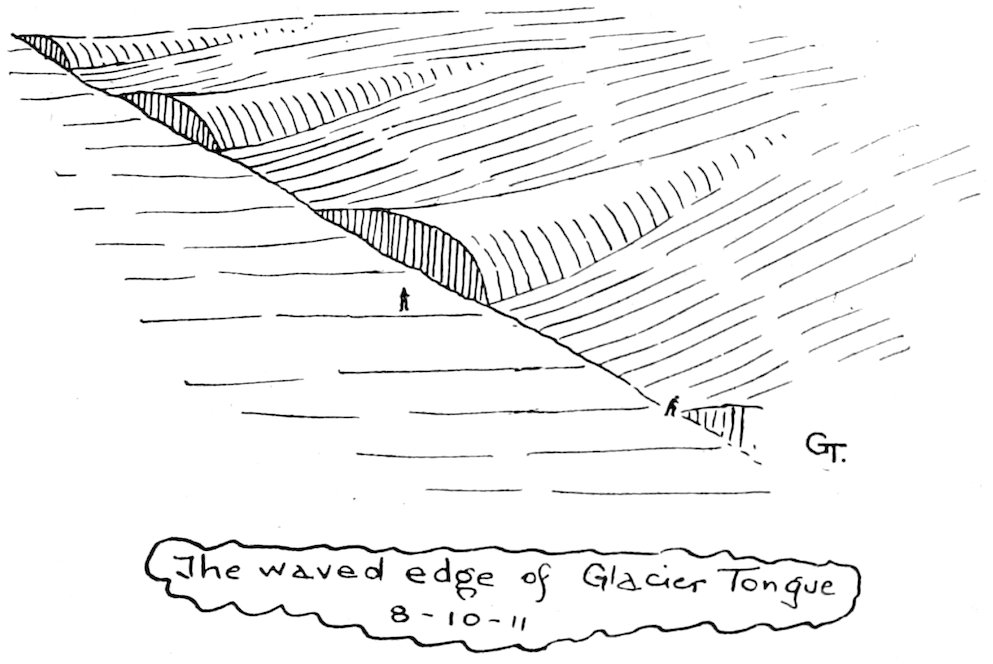
After a short rest I managed to reach the hut unassisted, and food and sleep made me practically all right. Poor Clissold had fallen thirty feet off an iceberg, and was confined to his bunk for several weeks in consequence.
I made a vow that the first bicycle ride in the Antarctic should be my last, and have every intention of keeping that vow.
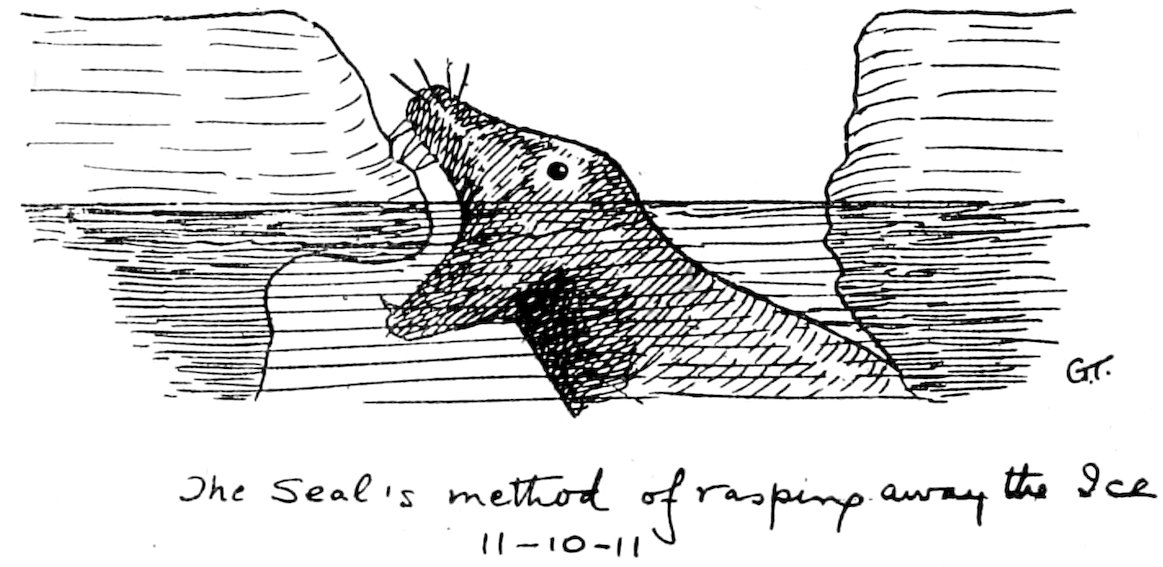
On the 11th Debenham and I explored Tent Island again. 317As I was taking a photograph at the south-east corner, I heard a queer noise which I traced to a seal hole about a yard long. Inside this was a big seal trying to get out, but with little success. I thought at first he was trying to rub away the ice with his snout bristles, but he was really rasping right and left with his upper teeth—making horizontal grooves in the ice, and gradually wearing it away. We watched him for a long time from a few feet distance, which did not seem to worry him at all. It made my teeth ache to see the energetic way he dug into the ice; but after trying unsuccessfully to photo him I left without seeing that he had made much progress. These seals were now appearing in some numbers. We counted fourteen near Tent Island, and eight just north of Inaccessible Island, as we returned to the hut.
On Sunday, 15th September, the third volume of S.P.T. was published. It was in the same style as the preceding copies. There was a dramatic account in blank verse of the Terra Nova’s visit to South Trinidad, which I attributed to Nelson (but was really by Mather). Meares wrote an ode to Ponting in which my new word “to pont” (i.e. to spend a deuce of a time posing in an uncomfortable position for a photograph) was freely used. The Eastern Party was enshrined in a “Glass House” this time, while Bill recorded on his Egyptian tablets the wanderings of the Western trippers during September.
Bill’s illustrations to “The Ladies’ Page,” a record of Antarctic fashions, were some of the best he had done; especially Madame Bowers and Miss Jessie Debenham, coyly proposing to Titus Oates!
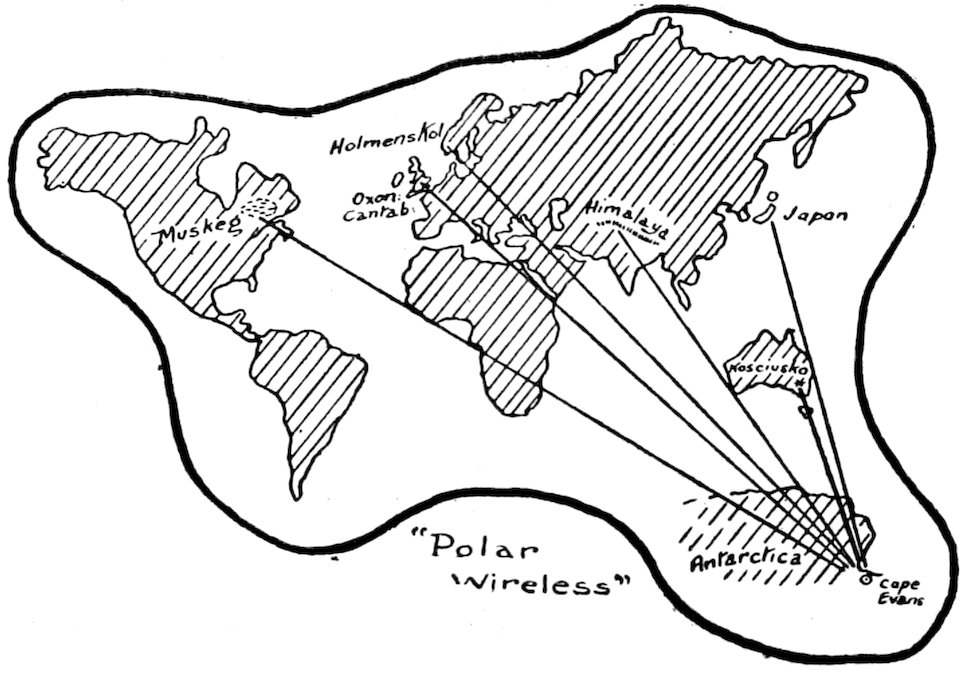
318I have given the history of Wilson’s pathetic poem previously. We used to talk a good deal about the advantages of “wireless,” and I tried to embody the idea in a poem of sorts, which here follows, in which are mentioned scenes familiar to various members, such as Oxford (Cherry); Cambridge (Wilson, Wright, Nelson, Taylor); Ski-ing in Norway (Gran); the Canadian muskeg (Wright); Australian Alps (Debenham, Taylor); Japan (Ponting, Meares); India (Simpson, Oates, Bowers).
I.
When the southern blizzard surges from the white plains of the Barrier,
Covering all with deadly snow-wreaths, blotting out both land and sea:
Can it break the magic cables linking us to every region
Where we spent our days of study, days of youth and revelry?
Half the world is our possession, nought can curb imagination,
Though we’re wrapped in folds of deerskin, camped amid a field of ice,
By the blessed help of fancy, still we’re free to wander gaily
Through the wooded lanes of England—true explorer’s paradise.
319II.
By the happy help of fancy we can leave the land of glaciers,
Hear the tolling from Tom Tower, or the chimes from Cambridge arches,
Sense the thrill of ski-ers’ prowess on the slopes of Holmens Kol;
Once again can feel the tump-line as we cross the Muskeg Marshes;
We can change the Slopes of Terror to the sward of Kosciusko,
Where a thousand steers are grazing ’mid the tarns and green moraines;
See the land of Cherry Blossom and the maidens of Japan,
Or the peaks of Himalaya hung above the Indian plains.
III.
Lightly fades the lonely igloo; merges in the college gray ...
In the firesides of Old England, thirteen thousand miles away.
Thus from Lonelands to the Homelands all our thoughts are speeding forth,
Faster far than wire or wireless—on “stretched wings towards the north.”[9]
Cape Evans, 27.10.11.
I had an interesting midnight walk early on the 15th October. “I had no gloves on, and it was light enough to photograph. There was a beautiful red sunset due south. To the north the bay ice was pea-green, while Erebus shone out with purple shadows. I laid boundary stones at the ice margins of both Skua and Island lakes, to determine how quickly the ice ablated in the spring. That evening I caused a sensation by having a shave, the first since leaving New Zealand. Birdie, Simpson, and Cherry behaved most foolishly as a result. Day did the deed!”
We found the Hut Point telephone useful for weather forecasting. For instance, on the 16th Meares rang up at 11 a.m. to say that it was blizzing (with force 9) from the south with a temperature of −16° F. At this time, though only fifteen miles away, we were experiencing a moderate north wind (force 3) with a temperature of −3° F. “As a result Titus bet Teddy Evans that the blizzard would arrive before noon. The wager was six cigarettes. No blizzard arrived at all, so that Teddy won, but as he had given up smoking for some months he only took one for Debenham!”
On the 17th Debenham and I went over to Shackleton’s 320hut to spend a few days geologizing. We took a small sledge with about 100 lbs. load. Soon we came to patches of bare sea-ice just leprous with blobs of salty snow. I was chagrined to find we could hardly drag our light sledge across. It augured badly for the 1200 lbs. we should have to pull in a week or so! We saw Emperor penguin tracks, but no birds, and reached the hut at 1 p.m. We ate some biscuits and then went out to photograph the vicinity. Here the Erebus glacier is about three miles to the east, so that Cape Royds is a very much larger area of exposed rock than Cape Evans. We walked along Black Sand Beach—almost the only beach I saw with rolled pebbles—and passed below quite a large glacier emerging from a gully. It had a 30-foot face of banded ice with fine snow cornices. I was surprised to see this, and climbed up to determine what was its source of supply. Then I found it was “all face” and no background. It was in fact merely a gigantic snowdrift plastered on the face of a 50-foot rock-cliff, and proved that many of our smaller glaciers were nothing but case-hardened snowdrifts which had solidified in situ.
We returned to Shackleton’s hut, and I had a varied lunch off mock turtle soup, mutton cutlets, and unlimited candied peel! We cleared up the hut, which was in an awful mess, Deb arranging the stores and mending the stove, while I swept up the floor.
“We made up a bit of fire with some coal we found in one corner and turned into our bags. All next day it blew frightfully hard. There was a huge iron boiler which we gradually thawed out and used for water, but we used an enamel jug as a kettle. We made porridge and ate it from huge wooden spoons. I read ‘The Truants’ (Mason) and half the ‘Botor Chaperon’ (Williamson). The hut groaned and creaked so that I thought it would blow in sunder, but we were comfortable enough. We hunted up some hypo, a large lamp, and 50 lbs. of carbide. I found a useable pair of fingered gloves, which were just what I wanted for instrument work.”
Next morning it was blowing hard, but there was less drift. We went out to try a photo, and the blizzard blew my camera down and smashed the frame. After lunch it “let up” somewhat, and we set off for Cape Evans. We saw an 321Emperor penguin crouched behind a snowdrift. It was the first of the season, and Debenham was anxious to get a photo. He stalked the penguin with great care, to my secret glee, for I had noticed before that it was stone dead!
Next day I packed my ditty bag with personal gear for the summer journey. We were allowed 12 lbs. each. My choice was as follows:—
3 pairs socks, with Taylor’s patent heel-tips!
1 hat.
1 pair finger gloves.
1 diary, 1 Browning, 1 German grammar.
This totalled 7 lbs., and I decided to omit spare underclothing and take a small eiderdown weighing 4½ lbs. It struck me that it would be as comforting as Debenham’s 3 lbs. of tobacco, and last longer!
“In the afternoon we ‘ponted’ for a game of football for the cinematograph. It was awfully good fun. The Owner was centre forward (running to the north), and he arranged that his side should win, to ensure an exciting picture! Atkinson was given space for a fine run in. Unfortunately in trying to cleverly miss a collar I slipped, and he fell over my feet. Titus was a sight, waddling after a man and then falling flat. Half the people got confused with the Owner’s yells to ‘Keep the ball in the middle and up to the goal,’ so that many of our side kicked it to their own goal! Crean truculently swore no one should get a goal if he could help it, and spoilt all Atkinson’s efforts, so that they scored nothing! Unfortunately Debenham strained his knee defending goal, and has been on his back since. We shall start west with Forde’s right arm useless and Debenham’s leg crocked!”
On the 21st Scott gave me my sledging orders. The method of our relief by the ship seemed rather comic. We were first of all to find Granite Harbour and then recognize a 500-foot bluff, photographed on page 154 in “The Voyage of the Discovery.” Here we were to await Captain Pennell in mid-January. No one on the ship had seen Granite Harbour either. As will be seen later, the harbour was a dozen miles wrong longitude, and the only bluff which at all resembled the picture was 1650 high! We rendezvoused there as required, but our letters and flag on the bluff remain undisturbed to this day!
322Gran accompanied me for a walk two miles west to the great shear crack, and there we spent some hours with pick and shovel cutting a path through the upturned blocks of sea-ice, here 5 feet high.
Day started the motor sledges on the 23rd October. The motor party consisted of Evans and Lashley with one motor sledge, and Day and Hooper with the other. There was a fearful array of cameras carried by Scott, Gran, Wright, and myself, while Ponting had a regular battery (including a cinematograph) loaded on his “pantechnicon”! Two troubles hampered the motors. The “pattens,” or wooden soles on the two tractor belts, would not grip the surface unless it consisted of hard snow. Just off the Cape was a belt of smooth sea-ice with a thin layer of snow over it, and the belts churned rapidly over this without moving the sledge forward. They got them past this by laying down sacks, etc. Then the motors were air-cooled, and apparently this was not sufficient to keep the cylinders from overheating, especially as the sledges went much slower than the ordinary motor car, and so only a small current of cold air flowed past the two front cylinders and less past the two rear cylinders. Moreover, the carburettor would not work satisfactorily when the engine was down to Antarctic temperatures, and it was necessary to warm it with a blow lamp! After some delays and readjustments they got the sledges well under weigh to Big Razorback Island.
Nelson, Wright, and I decided to traverse the Barne Glacier (to the north) and align the stakes which Nelson had planted in the preceding February. We hoped to detect enough movement to give us the velocity of the glacier.
The new canvas overshoes, with spiked aluminium soles, were a godsend for slippery ice work, and we found them a wonderful help. Wright went first, carrying a theodolite; then Nelson, with the food, and I had my camera and an ice-axe. We were roped up, for we had to cross many small crevasses. The stakes were generally made of barrel staves, and only half of them had withstood the winter.
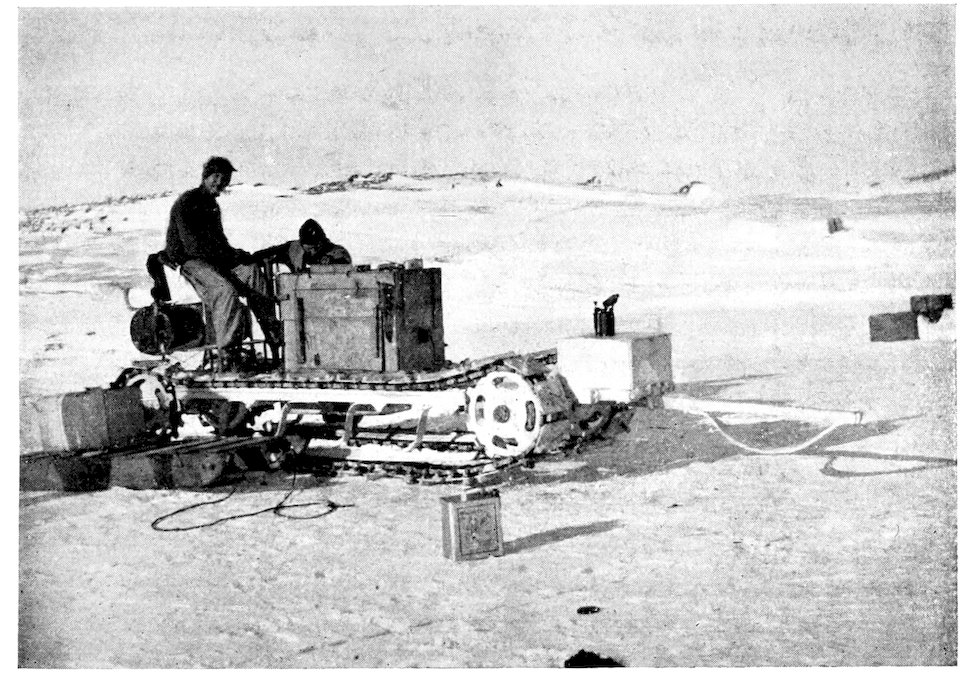
BERNARD DAY ON THE MOTOR SLEDGE JUST BEFORE HE STARTED FOR THE SOUTH, Oct. 23, 1911. The engine is enclosed in a box to keep it warm, and the blow lamp was to start the carburettor.
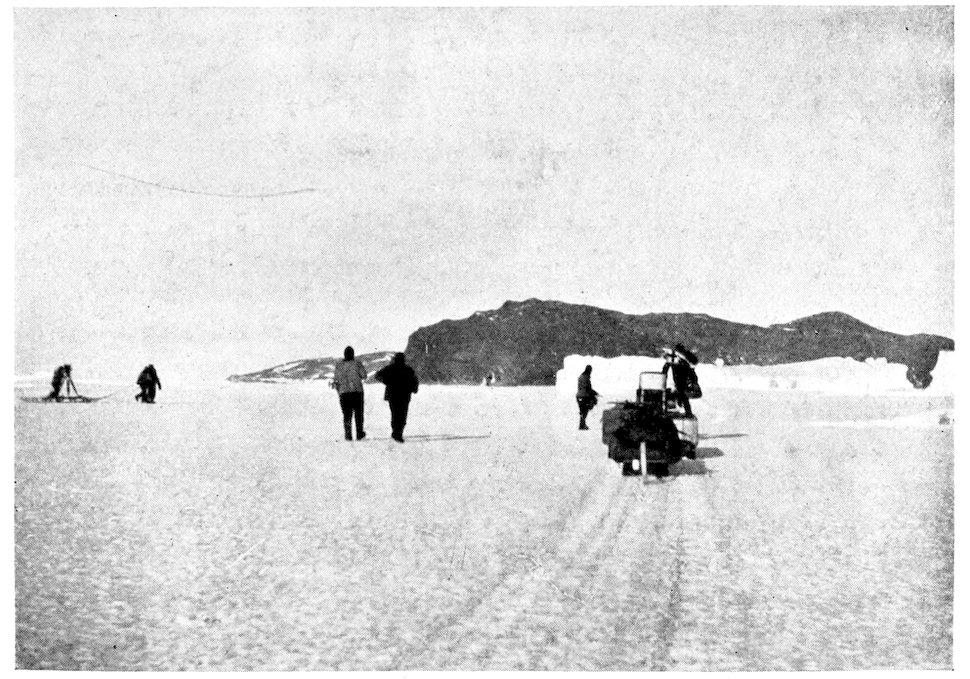
THE START OF THE MOTOR SLEDGES, Oct., 1911. Notice Evans swinging round the sledge and Day’s flag. To the left is Ponting being towed as he cinematographs.
We soon reached the “nail-stake,” which showed the safe western route to Shackleton’s Hut. The stakes here turned to the north and crossed a wide gully, and then climbed up a steep shoulder with open crevasses, which we had to negotiate 323by jumping. We reached the fixed moraines, and while Wright set up the theodolite (and anathematized his frozen fingers!) we discussed hot cocoa from a Thermos flask, and biscuits and chocolate. The end stakes did not appear to have moved much, but as we marched back on their line we found very perceptible evidence of movement to the west. Fourteen inches at first, then 7, 12, 14, 15, 15, 22, and 16 feet respectively, till we again reached the “nail-stake.” It was rather difficult aligning the stakes, owing to the crevasses, but though some were ten feet wide they were all open and so perfectly obvious and safe. “Nelson slipped in his felt boots, but we could have walked up an ice wall in our new spiked crampons!”
The largest movement was in the ice valley, and though the maximum 22 feet was not certain, yet there was no doubt about the record of 15 feet. This was not nearly so much as recorded elsewhere for other Antarctic glaciers; but it must be remembered that only the ten coldest months were involved in this test.
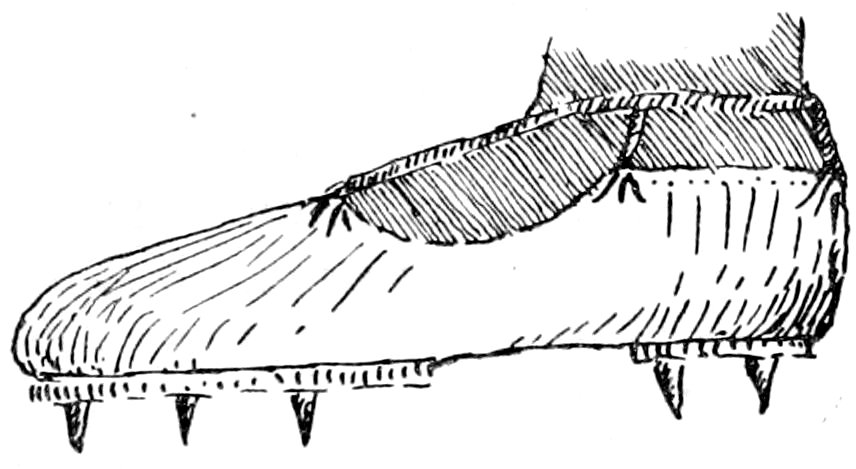
Ice crampons, devised in the winter 1911.
On the 26th Captain Scott took two parties to see if he could assist the motor party, who seemed to be held up near Glacier Tongue. We saw no trace of them till near the Tongue. Here we saw a black object, which, however, turned out to be a seal scratching himself, though I had felt able to recognize a motor and its driver!
We took a long time to catch them, which pleased us greatly, for it meant they were doing better than we had anticipated, but we caught them at Danger Cliffs. “They had just done six miles and were very bucked in consequence.”
We were of some assistance in the next few miles. We would drag the three huge trailer-sledges forward so as to relieve the motor sledge at its first plunge. Then “she’d start with a jerk, Day sitting for the moment in the chair of state and kicking up the floorboard to work the levers. Then she’d stop; then we’d curse. He would light up the petrol lamp round the carburettor to warm her, and try various 324alterations to an undercurrent of our fervid remarks. Then she’d go harder than we could walk for seven minutes. We got hot again, and would then have to wait a quarter of an hour, stamping round and freezing off, till she was affable once more.”
We slept at the 1902 Hut, and Meares and Bowers gave us a grand seal hoosh next morning, cooked on the greatly improved blubber stove.
“Lashley’s motor got under weigh after twenty minutes with the blow lamp on the carburettor, but Day’s was mulish. Gran, Evans, and I waited with him.” The huge loads dragged were mostly oil and tent gear, but their food-transporting power increases as the fuel load is used up. “However, as the day grew the motor took heart of grace and started, doing half-mile bursts, and at 12.45 we foregathered below the Barrier edge. Lashley would have been up an hour earlier, but he ran out of lubricant.” Unfortunately being on different gears they couldn’t keep together readily. “I walked up on to the Barrier very near where we crossed the big crack on March 12th. There was a beautiful snow ramp up the twelve feet above the sea-ice.
“At 1 p.m. Day moved on to tackle this. We all pushed behind, though it was not a bit necessary. She went up in great style, though I think most of us had dreaded this test considerably. At 1.5 the first motor stood on the great Barrier. Lashley’s then ran up quite easily, and after cheering them we streaked back to the 1902 Hut for lunch. Scott and Wilson ran two miles of the distance; Bowers and I walked on together until Crean and Evans passed us. I joined them, but gave them best ultimately, for they were both powerful pacemakers.”
We hit off for Cape Evans after lunch at a hot pace and didn’t stop for eight miles, when we had tea off Razorback. “All around us were seals and their young. The latter are longer in proportion, and are lighter in colour and woollier. The mothers make a noise like a dyspeptic sheep, and one big beggar would nose around the sledges until the Owner drove her away. Bill went off to get a dead young one he espied, and found it alive, but frozen fast by its umbilical cord! He freed it and left it, but Nelson saw the little idiot frozen again two days later.”
On the 28th Wilson examined the three Emperor penguin 325eggs obtained at such peril in July. To his delight they showed three different stages in development, and were much more developed than he expected. The embryos were rather long, but very like fledgling sparrows. There were little tufts on the tail already, and their long, flapper-like wings were not a bit bird-like. The shells were very thick and about the diameter of a swan’s, but somewhat elongated. They were light buff outside and bluish inside. Bill said only about fifteen shells had been obtained, and no embryos.
Household duties have been somewhat disorganized. I have laid and cleared the tables, while Atkinson has been chief cook. He succeeded splendidly for the most part. “He made excellent coffee; Deb tasted first cup, and nearly died, for it was pure cayenne!”
Erebus gave us a fine demonstration from 9 to 9.30 on the 30th of October. The steam cloud rose like a huge mushroom at first, then was branched like a yew-tree, and ultimately settled down into a huge pall.
On the 31st October the pony parties started. Two weak ponies led by Atkinson and Crean were sent off first at 4.30, and I accompanied them for about a mile. Crean’s pony rejoiced in the name of “Jimmy Pig,” and he stepped out much better than his fleeter-named mate Jehu. We heard through the telephone of their safe arrival at Hut Point.
Next morning the Southern Party finished their mail, posting it in the packing case on Atkinson’s bunk, and then at 11 a.m. the last party were ready for the Pole. They had packed the sledges overnight, and they took 20 lbs. personal baggage. The Owner had asked me what book he should take. He wanted something fairly “filling.” I recommended Tyndall’s Glaciers—if he wouldn’t find it “coolish.” He didn’t fancy this! So then I said, “Why not take Browning, as I’m doing?” And I believe that he did so.
Wright’s pony was the first harnessed to its sledge. “Chinaman” is Jehu’s rival for last place, and as some compensation is easy to harness. Seaman Evans led “Snatcher,” who used to rush ahead and take the lead as soon as he was harnessed. Cherry had “Michael,” a steady goer, and Wilson led “Nobby”—the pony rescued from the killer-whales in March. Scott led out “Snippets” to the sledges, and harnessed him to the foremost, with little Anton’s help—only it 326turned out to be Bowers’ sledge! However he transferred in a few minutes and marched off rapidly to the south. “’Christopher,’ as usual, behaved like a demon. First they had to trice his front leg up tight under his shoulder, then it took five minutes to throw him. The sledge was brought up and he was harnessed in while his head was held down on the floe. Finally he rose up, still on three legs, and started off galloping as well as he was able. After several violent kicks his foreleg was released, and after more watch-spring flicks with his hind legs he set off fairly steadily. Titus can’t stop him when once he has started, and will have to do the fifteen miles in one lap probably!”
Dear old Titus—that was my last memory of him. Imperturbable as ever; never hasty, never angry, but soothing that vicious animal, and determined to get the best out of most unpromising material in his endeavour to do his simple duty.
Bowers was last to leave. His pony, Victor, nervous but not vicious, was soon in the traces. I ran to the end of the Cape and watched the little cavalcade—already strung out into remote units—rapidly fade into the lonely white waste to southward.
That evening I had a chat with Wilson over the telephone from the Discovery Hut—my last communication with those five gallant spirits.
We settled down in the Hut, a small and rather silent party. I was now awaiting Debenham’s recovery from the injury to his knee, for our start was already overdue. Nelson was cook, though Clissold was beginning to move about more easily. As lately, I continued to lay and clear the table, while Simpson was coal-whacker. The night-watch was now unnecessary—it was too light for auroræ—and the ponies no longer inhabited the stable. Nelson used to take the 4 a.m. observations, and Simpson those at midnight.
On the 2nd of November we had some stove trials in the deserted stables. Day’s last work had been to make us a blubber stove from sheet iron, with a door grid and cover complete. We lengthened the chimney (by adding asparagus tins) and then tested it. The cooker was filled with snow, a “fid” of blubber lit on the grid, and in twenty-seven minutes the water was boiling! There was very little smoke, and it 327gave a pleasant heat all the time. Later we found that it did not work so well in a draught, and was a trouble in the open; but we cooked most of our meals on it in December and January, as will appear.
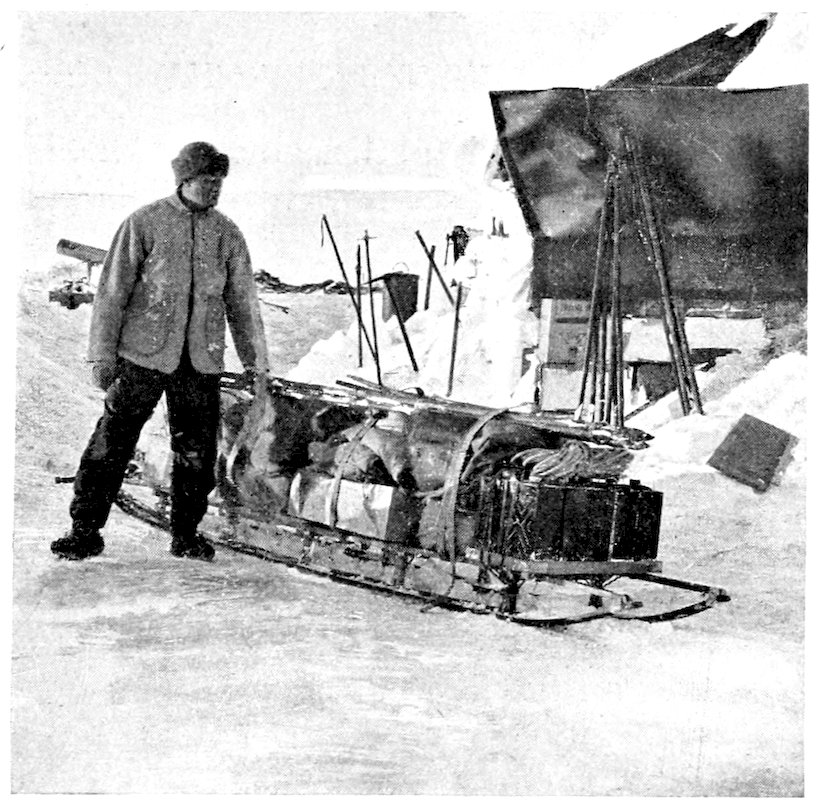
WILSON PACKING HIS PONY SLEDGE THE DAY BEFORE THE START FOR THE POLE, Oct. 31, 1911. The tins of oil, Alpine rope, large biscuit tins, sleeping-bag and tent poles show up well. Behind is the outer door of the hut looking north to the Barne Glacier.
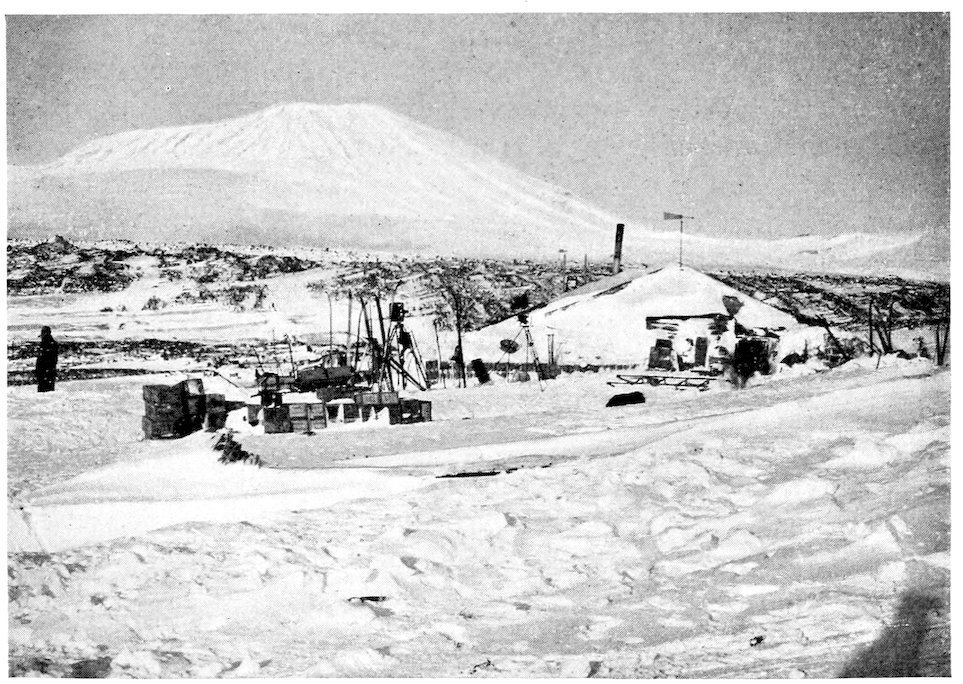
THE HUT AFTER THE WINTER, Nov. 20, 1911. Great snowdrifts cover the porch and all the gravel before the hut. At the back is the Ramp, and low-level stratus is enveloping the base of Erebus. [See p. 320.
That evening I had a walk round High Cliff and found a regular “Niagara” rushing down the face of the glacier in a tinkling stream as much as an inch deep! This was at midnight on the 2nd of November, and the temperature was seventeen degrees below freezing! It shows the strong radiant effect of the sun on black rocks even at midnight.
This event—marking the oncoming of reasonable weather—closed our sojourn at winter quarters during 1911.
329