I “GETTING TO KNOW THE MEN”
Reading edition
3
“GETTING TO KNOW THE MEN”
“Where can I find Dr. Wilson?”
I had just entered the quadrangle of the Biological Schools at Cambridge, when a door opened quickly, and a well-knit, wiry individual ran down the steps towards me.
“Which Dr. Wilson?” said he.
“Wilson of Antarctica,” I replied.
With a quizzical smile that I was soon to know well, he returned, “I am Dr. Wilson.”
It was in this way that I made the acquaintance of the Scientific Director of the expedition; and in the ensuing conversation at Christ’s College I learnt the requirements of Captain Scott. But the steps leading to this Sunday interview were rather amusing to look back on.
On a Saturday afternoon of December, 1909, I had been having tea with Wright of Caius, and we discussed many topics, such as cancer and Canada, eugenics and Shackleton. He remarked that he would like to go with Scott next August, and that he would go if I would! However, we did not discuss this topic, for I left to dress for the Philosophical Society’s Dinner at John’s. In the old Combination room were most of the scientific dons, and Dr. Marr beckoned to me.
“I wanted to see you. Would you like to go with Scott to the Antarctic as English geologist?” He was pleased to say that my glacial work and travels suited me for the post. I said I had not thought of it at all. He added that Dr. Wilson would probably call on me on Sunday, to which I replied that I had intended to be off to the Alps at 9.30!
I departed, only to fall into Professor Seward’s hands. He asked the same question; and Hutchinson of Pembroke came up a moment later and said, “Don’t you think Taylor ought to go to the Antarctic?” I suggested that I felt as if I were being pushed out into the cold!
4I postponed my trip to Grenoble for half a day, and had a long talk with Wilson. He gave me a letter to Captain Scott, which I presented after my return from France.
We had a fine trip! Four Australians cycling through the High Alps in midwinter. When it did not snow it rained—and mostly it did not snow! At the pass of Croix Haute we had to traverse thirty kilometres of heavy snow, and later in the Auvergne we found that snow formed quite a good surface for a bicycle, which discovery nearly led to a fatality in the Antarctic, as will appear later.
On my return to London a month later (8th January) I called at the Antarctic offices and had an interview with Captain Scott.
I soon gained an insight into the multifarious occupations of a Polar commander. The offices of the expedition were in Westminster, at 36, Victoria Street, halfway between the Abbey and the vast railway station at Victoria. They were situated in a district peculiarly devoted to the empire’s interests, for most of the colonies have their representatives there; and that greatest boon to travellers, the Army and Navy Stores, is just across the way.
I will try to give some idea of the appearance of the expedition’s headquarters during the busy months of preparation. In a large room occasionally sat Captain Scott, but he was usually busy with some ingenious foodstuffs or patent appliance in one of the other rooms. Adjacent was the secretary’s office, and there he was to be seen, inter alia, wading through some of the eight thousand applications from eager souls anxious to get out of the rut by joining the expedition in one capacity or another. Naturally enough, the names of naval officers were numerous, both on the staff and among those applying. In fact, the navy could beat any other team that the expedition could get together at any game whatsoever. An explorer friend of mine had no great opinion of navy men, and strongly advised me to learn boxing to uphold the dignity of science. So I started a boxing club at Cambridge among the scientists, but we did not know then that navy champions like Parny Rennick and Dr. Atkinson were to join the expedition. Here let me add that arrogance was the last attribute of my dear naval friends down South.
In a third room at headquarters were samples of patent 5foods. One open tin discloses shrivelled root-like objects about the size of lead-pencils. This was desiccated rhubarb, and it seemed merely concentrated sourness in its present state, though it furnished many dishes at headquarters later on. Cabbages and greens too much resembled coarse leaf tobacco to be eulogized by a non-smoker. A Cambridge friend—doing physiological research—was extremely pleased when he heard I was going South. “Ah,” said he, “you can try my patent food all next week; you’ll need nothing else for any of your meals, and I can give you a full supply for the Antarctic.” Owing to various contingencies, the tin remained unopened, and I left it, with my blessing, for the landlady.
In another corner of the same room an eager inventor is explaining the excellences of his patent stove, which burns almost without fuel and is guaranteed “to produce little or no carbon dioxide”!
Here I first saw Dr. Simpson, who was wrestling with this invention, which—apart from its chemical peculiarities—seemed suitable for warming his magnetic hut. The equipment of this mansion seemed to occupy all his waking thoughts, while his chief exercise seemed to be taken by whirling sling thermometers.
The other room was almost filled with a huge petty officer who was sorting gear for the sledges. I looked at his sturdy proportions with considerable respect, which would have been increased had I known how invaluable “Taff” Evans was to be on my first expedition in the Antarctic. An old 1902 sledge was lying in the passage, whose splintered runners and weather-worn appearance told graphically of the screw-pack and “bottle-glass” ice it had surmounted in the past.
Captain Scott was busy at first, but I soon had a long talk with him. In my journal I wrote as follows:—
“Scott is just what I expected, a sturdily built, clean-shaved naval officer, with plenty of humour and decision. He told me that Mawson was coming over from Australia immediately. His idea was to have two geologists on the Erebus side of the Barrier, and one on King Edward VII. land. The latter party would have wireless if possible. He drew a moving picture of me wiring signals of wind velocity, etc., to Mawson. ‘Just like old times, a friend at each end,’ said he. Scott is going to try for the Pole along the old route, I gather, and 6not viâ King Edward VII. land. The ship will leave in July and make a long trip viâ Madeira and Kerguelen to enable the men to shake together.”
Lieutenant Campbell was often in and out of the offices. His was an independent command, and he was collecting his stores and labelling them with a distinctive broad green band. The cases were made of Venesta—a patent three-ply material, extremely light and extraordinarily tough. One could hardly break into them with a pick-axe! They were bound with iron and made to contain about 40 lbs. weight, to facilitate handling.
The question of Antarctic clothing greatly interested many ladies of my acquaintance. Some of them, indeed, were so urgent that I should look into this matter, that I began to get alarmed myself. On inquiry I found that the fur boots were carefully arranged to go over four pairs of socks and a layer of senna-grass; which seemed to point to a somewhat wide margin of safety. Of the Antarctic suits—trousers, jerseys, and overalls—I was told there was a supply in two sizes—long and short! I looked at the scientific director as he smilingly gave me this information, and judged what would fit him would suit me, so that no measurement was necessary in this class of tailoring.
The first order from Captain Scott concerned the purchase of clothing for the voyage to New Zealand. For this £8 was allowed by the Expedition. I told Captain Scott that I was not making the voyage in the Terra Nova, and had a kit of tropical gear already. He remarked with a twinkle in his eye, “Never mind about that, I dare say you will be able to spend it on something useful!”
A few days later I went to the West India Dock and saw the Terra Nova for the first time. Here was Lieutenant Evans “merry and bright” from the start! He was assisting Captain Scott to chalk out cabin spaces on the deck. In a later section I describe her equipment very fully, so that there is no need to dwell on it here, save that amongst the large liners in the dock she had somewhat the appearance of a minnow among the Tritons. At any rate, the “leviathan” is half as large again as Shackleton’s Nimrod, and if Columbus could board her no doubt he would feel himself on a Lusitania.
7About this time I received a cable offering me a post on the Commonwealth staff. Through the kindness of the authorities concerned I was able to hold both positions concurrently; and I went South with a definite commission to study all the scientific factors—but especially the meteorology—which might concern Australian interests.
Early in February Mawson came up to Cambridge to stay a few days with me. We had passed through Sydney University together, and done our early geological field work under Professor David. We had kept in touch with each other and had many common friends. During my cycle trip through the Alps, Glasson (from Adelaide) told me that when any of Mawson’s acquaintance at Adelaide University wanted chocolate, the explorer would take an ice-axe and break a lump off the huge block he had looted from Shackleton’s Expedition! I felt that an expedition of this type had peculiar attractions for me, but, alas! our chocolate supply was never on such a prodigal scale.
Mawson gave us a talk at the Research Students’ Club that evening. He told us many harrowing tales, and glances of pity were bestowed on Wright and myself by the other members of the club! The next afternoon he was persuaded to give a lecture in the geological school, so that we knew a lot more of Antarctic conditions before he left. By this time he had decided not to accept Scott’s offer of a position on the staff, but he gave all of us much useful information as to equipment and research.
Two other Cambridge men—both biologists—were appointed to the staff. I had heard of Lillie’s adventures in the Atlantic, where he had carried out anatomical dissections with an axe! His subjects were whales, on which, I take it, ordinary instruments would have had but little effect.
He was a John’s man, while Nelson came from Christ’s. Nelson had been “down” for some time, working at the Plymouth biological laboratory. I had heard of him from a friend of mine who had worked there also.
Wright, of Caius, had been a mate of mine for several terms. He was a leading light in our Peripatetic Club, and was in fact the best walker among the members. Wright and I heard so much of the prowess of the naval men in every branch of athletics that we decided to show them that the scientists had 8some muscle. One morning we set off from Cambridge at 5 a.m. with some boiled eggs and chocolate and walked to London, where we reached St. Paul’s, Islington, at 5 p.m. It was a non-stop effort, and Wright came through “smiling,” but my feet were so sore that I could hardly stand next day. My chief recollection is one of loathing for hard-boiled eggs, and of the relief with which I dropped three-quarters of our provisions in a secluded corner of King’s Cross!
During the Easter vacation I planned a trip to the Engadine and Como to study glacial erosion in some detail. I had already spent some months in this part of the Alps, and wished to gain fresh data on many questions. A college friend accompanied me. Professor Bonney was kind enough to give us advice as to the best routes during March, for my previous trips had been in summer. He also discussed the questions of valley erosion at some length, and I was glad to hear that they would form the basis for his presidential address to the British Association at Sheffield. He was strongly opposed to W. M. Davis’ views on the subject, holding that water and not ice had cut out most of the Alpine valleys. I had learnt my glaciology from the eminent American while in the Swiss Alps, and was naturally Davisian in consequence. However, Antarctica led me to place more stress on frost action as an eroding agent, so that my position is now between the two schools!
We had an interesting and useful trip lasting for six weeks. This is hardly the place to discuss the results of this journey, though in some sense it belongs to the Expedition, for Captain Scott paid the bulk of my expenses. I visited for a second time the wonderful valleys north of Bellinzona, the Val Mesocco to the north-east and the Val Ticino to the north-west. At Mesocco and Faido are two of the most striking bars or “riegel” across the Alpine troughs, and later in Antarctica I was to find a third even more striking example. Thus, about twenty miles south of Saint Gothard is the basin of Piotta, a trough with vertical walls two thousand feet high and a flat valley floor. This is analogous to the Antarctic valley containing Lake Bonney (77° 30′ S.). Then at Fiesso this basin is bounded by a great bar or riegel, through which a narrow defile passes at one side; so also at the Nussbaum Riegel in Antarctica. 9Below Fiesso is the broad trough of Lavorgo closely paralleled by the broad “dry valley” in the southern continent.
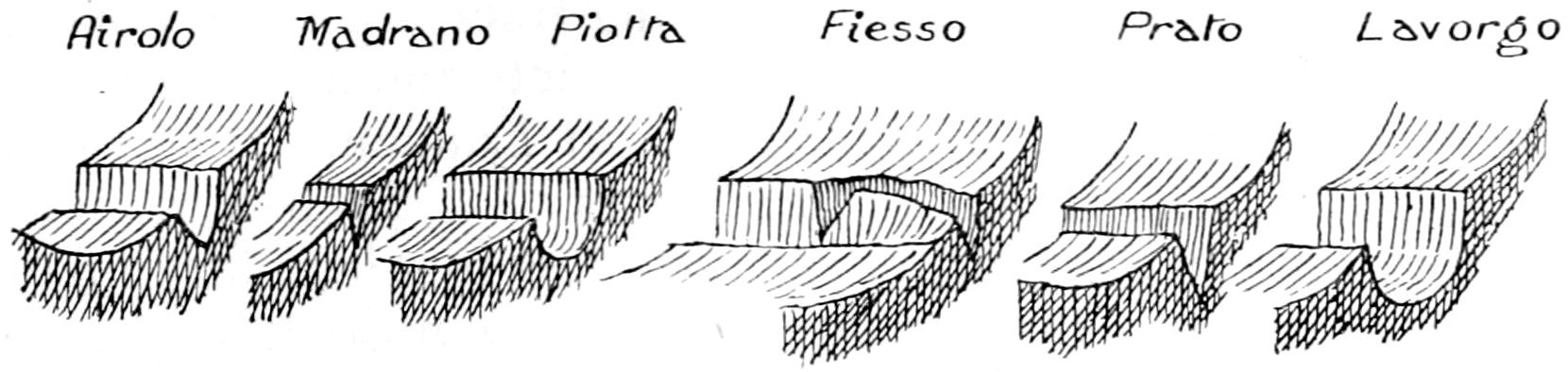
Block diagrams illustrating the basins, gorges, and riegel in the Val Ticino below Saint Gothard. (Cf. Taylor Valley, Antarctica.)
On my way back from Italy I stopped for a few days with the glaciologist Nussbaum at Bern, and explored the queer drainage in the valleys near that city. In the last Ice Age all this fertile country lay below the Rhone Glacier, and I was to find that many of the features in Antarctica reproduced, in the present, the past history of the Swiss scenery.
I reached London on the evening that Peary gave his lecture in the Albert Hall. Mawson had given me his ticket and I decided to go, though I had to appear in my touring rig of puttees and peletin. I heard that Bernard Day—our motor expert and lately with Shackleton—had the next seat. It was a tremendous crowd and a very interesting lecture. As is somewhat usual with Americans, he gesticulates more than is common among British speakers. He had just received the medal (which was designed by Lady Scott) and expressed his sense of the honour done him and the care with which he would cherish this token of the Geographical Society’s esteem, when the medal dropped violently from his hand amid audible amusement from the thousands comprising his audience. However, he picked it up and proceeded with his remarks with the greatest sang froid. Day and I were much impressed by his method of relaying with dog teams, and felt that he deserved full credit for his long-sustained attack on the North Pole. Three years later I was to be again in the Albert Hall to hear Commander Evans describe the British conquest of the Pole; but Bernard Day had now settled “on the land” near my own home in Sydney, New South Wales.
Before I left England I had met most of the officers. Bowers I first saw at dinner one evening with Captain Scott. 10Lady Scott was coming out to Australia, and was much interested in the political and social questions of the “British continent.” She had done some long tramps in Switzerland, and told us much about the Fabian Society and about her art life. She had heard of our tramp to London. “Did you really walk sixty miles in ten hours?” So had rumour reported it. It was mortifying to confess to a bare fifty miles in twelve hours! Birdie Bowers appeared in the full insignia of a Lieutenant of the Indian Marine. He was at this time so busy loading the ship at the docks that I did not see him again until I joined the Terra Nova in New Zealand.
On the 12th of May I joined the Orontes and I reached Melbourne at the end of June. For the next three months I was busy at the new Federal capital—then unnamed,—where I carried out various surveys for the Commonwealth.
In July Professor David sent me some microscope slides made from a limestone obtained by Shackleton’s party on the Beardmore Glacier. To our delight I was able to identify them as fossil “corals” of Cambrian age, of the same genus as those from South Australia on which I had been working at Cambridge. Some account of these Antarctic fossils which Wright also discovered in some of his specimens from the Beardmore is given in the account of our life at headquarters.
Professor David gave me invaluable advice on Antarctic matters. At the School of Geology at the University of Sydney is a large “Antarctic Room” filled with specimens collected on the 1907 Expedition. Here Priestley had been working out results for many months, and here he presided over informal “tea” at 4.30 every afternoon! Here I met Alan Thomson, a geological scholar from Oxford, who was to have been one of us, but that he developed lung trouble at the last moment. In consequence of Thomson’s illness, Priestley obtained Shackleton’s permission by cable, and thereupon accepted Captain Scott’s offer to join us. Many were the yarns Priestley told us of his 1908 experiences. He said that the young Eskimo dogs, born down there, never knew water, yet they held out a water-can for a drink when they saw it! More credible was the story of how they buried the water-can (containing a future drink) and were profoundly disgusted on digging it up to find that their refreshment had vanished! The yarn which I fear I completely disbelieved—anent 11killing skua gulls by throwing a slab of rock vertically upward—I proved practically a few days after landing at Cape Evans, as will appear in its own place.
Meanwhile the Terra Nova had left Cardiff and slowly sailed by the “wind-jammers’” route to New Zealand. They had an exciting time at South Trinidad—a lonely island off Brazil—swimming through shark-infested surf to the shore. Here they made some biological collections, and on the remainder of the voyage many of the land-lubbers became respectable sailor-men. I hardly knew Wright when I saw him reefing sails and running up the ratlines as if to the manner born.
The third geologist appointed on Professor David’s recommendation was Frank Debenham, scholar at my old university, and a family friend for many years. Indeed, the three sons of each family had gone to the same school, and five of us to the same university. It was extremely pleasant to be associated with men like Debenham and Wright, and I was indeed fortunate to have them as sledge mates in the difficult times to come.
By degrees all the party were assembling at the Antipodes. Meares had been collecting dogs and ponies in Manchuria. He had spent several years in this part of Asia, and was already renowned for his journeys into unknown Tibet. He passed through Sydney in October—accompanied by Lieutenant Bruce—a few days before I arrived.
Captain Scott, Wilson, and Simpson were now in Australia busy on various matters. During the voyage Simpson and Wright had carried out experiments on the electrical state of the air, and the latter was now engaged on testing and standardizing his pendulum apparatus before he left civilization.
On the 22nd of October, 1910, Debenham and I left Sydney for New Zealand. We were to join Captain Scott at Christchurch, and the Terra Nova was now lying at Lyttelton—the port of that city.
12
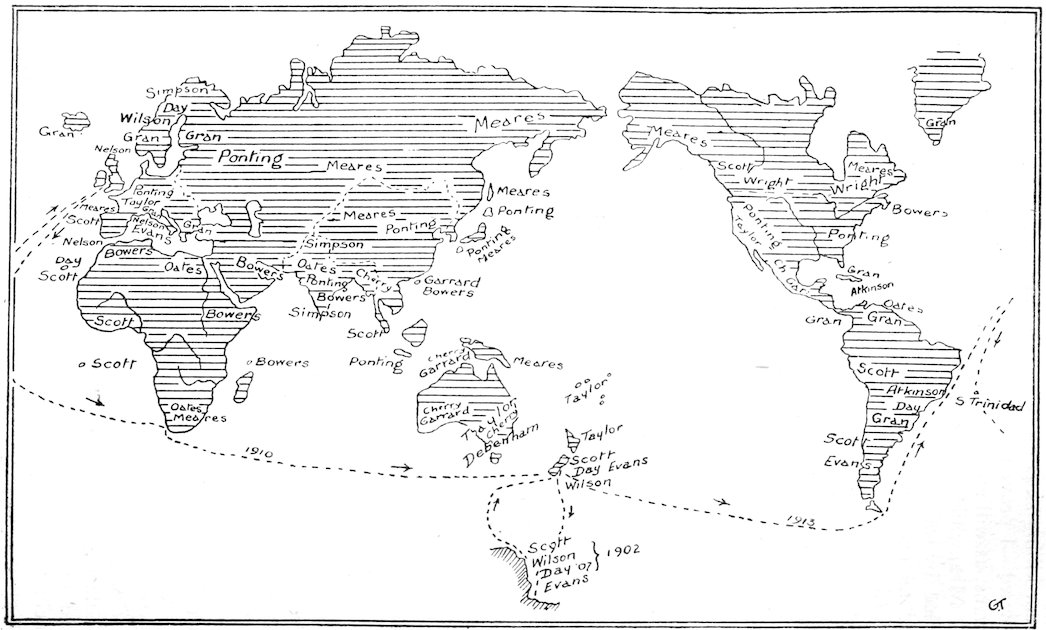
The chief travels of the sixteen officers at Headquarters, Cape Evans, 1911. (Track of Terra Nova, 1910–1913, shown also.)
Some of the officers I did not meet until I reached New Zealand. There was Ponting, whose beautiful book on Japan had just appeared. He had had a most varied experience, including mining and ranching in California, before his genius in artistic photography manifested itself. He and Meares 13were old friends, and had travelled together in many Eastern countries. Indeed, this fore-knowledge was a usual thing among members. Simpson had almost accompanied Scott in 1902. Wilson, of course, made his name on that expedition; and had been chiefly connected with the Grouse Commission since.
Cherry-Garrard was making an extended tour of the world when the expedition was started, and volunteered from Australia. He was the sole representative sent by the University of Oxford. He came out from home on the Terra Nova, and was one of the landsmen who took kindly to a sailor’s life. A characteristic of Cherry’s was his never-ending series of gifts to his mates. A most acceptable pair of huge Jaeger socks brought about our real introduction!
Captain Oates had seen service in many parts of the Empire. With difficulty one could get him to talk of his experiences in India (in the province of Indore) or in the South African war, where he served with distinction. He was very busy with the ponies during the voyage south, and I hardly spoke to him until we were marooned together in the Old Discovery Hut. One heard that he was a keen yachtsman, but his strong character and real sense of humour were hidden under a very quiet exterior. Our naval surgeon, Dr. Atkinson, and myself had no work in common until the same month of March at Hut Point brought us together when the Western and Depôt parties joined forces.
Perhaps the most interesting career among the younger officers was that of Tryggve Gran. He was only a few years over age, and yet he had seen more of the world than any member except Captain Scott. Born in Bergen, and educated in Switzerland, he had travelled all his life. He knew Europe from Turkey to Iceland, and shared with Simpson and Campbell a knowledge of Arctic life. He had fought rebels in Venezuela, tramped across South America, spent several years in the merchant service and navy of Norway, and was now a sub-lieutenant and a B.A. of Christiania. His chief record hitherto had been that of winning the Blue Ribbon of Norway, the Holman-Kol cup for ski-running. This narrative will have much to say of him, and will show that his versatility and willingness to help were remarkable even among the group of men who were my mates in Antarctica.
14People have often asked me what attraction Antarctica had for me personally. It was purely scientific at first, but now I realize that the companionship with such ideal mates was the chief joy in Antarctic life. I have not, up to the time of writing, felt any of the “call to the Antarctic” that others describe; but travel anywhere with my mates of the South would be equally attractive.
At the risk of being tedious, I will try to describe the chief problem in science which I hoped to help solve by my sojourn in Antarctica. Briefly, it is the study of the effect of ice (chiefly as glaciers) in carving out the features of the earth’s surface. It may quite legitimately be asked, “What is the value of that knowledge? What bearing has it on science and human interests?”
Most people know that Europe has passed through an Ice Age comparatively recently, but few—even among geologists—would be prepared to agree that almost every factor of human environment in Central Europe has been affected by this ancient ice-cap. All inter-communication, much of the agriculture, all the scenery; nay, even the very possibility of continuous habitation is due to the work of the ancient glaciers. The Gothard, Simplon, and Mont Cenis railways pass along deep glacier-cut gorges (see p. 9) until they reach comparatively narrow ridges which can be pierced by tunnels. The great Alpine passes are but cols due to glacial erosion. The fertile uplands (the true “Alps”), where the Swiss flocks pasture, and the extensive deep-lying plains of deep rich soil are glacial debris. The magnificent waterfalls, the tributary valleys “hanging” over the main gorge, are only found in regions where ice has played an important part in its past history. In winter it is only in these deep gorges, excavated two thousand feet below the general level in countries like Switzerland, that the inhabitants and their flocks can hibernate until the grass covers the country in the succeeding spring.
There can be no more valuable branch of geology than one which tries to chronicle the actions which have made the Alpine countries of the world so different from the more normal regions. But it is by no means universally allowed that this work is principally due to ice. One school of geologists maintains that water can carve out a land surface 15in a similar way; and in Switzerland, New Zealand, and similar regions, it is difficult to decide whether the living waters or the long-vanished glaciers have cut out a certain gorge or canyon. Where, then, is the solution to be found? We cannot observe Europe in the clutch of an Ice Age; but it is possible to find a region—once, no doubt, as warm as portions of Europe—now undergoing its period of intense cold and accompanying glacial erosion.
In almost waterless Antarctica the land is being slowly carved out into features which must be related to those obtaining in Alpine Europe and other elevated regions, if (as I believe) the Great Ice Age has left an unmistakable imprint of itself in a characteristic topography.
I may fittingly conclude the “series of introductions” by a list of the officers. This gives their positions; and, what may be found more useful to the reader, their nicknames and the personnel of the various parties into which the expedition split up on arrival in Antarctica.
LIST OF OFFICERS AND THEIR PARTIES.
Leader.—Captain Robert Falcon Scott.
Second in Command.—Lieutenant E. R. G. R. Evans.
Chief of Scientific Staff.—Dr. E. A. Wilson.
Ship.
Harry Pennell, Commander R.N.
Henry de P. Rennick, Lieutenant R.N.
Wilfred M. Bruce, Commander R.N.
Francis Drake, Assist. Paymaster R.N. (retired).
Dennis Lillie, M.A., Biologist.
James Dennistoun (1911–12 voyage).
Alfred B. Cheetham, R.N.R., Boatswain.
William Williams, Engineer.
Shore Parties.
A. Northern Party (Jan. 1911–Nov. 1912).
Victor Campbell, Lieutenant R.N.
G. Murray Levick, Surgeon R.N.
Raymond Priestley, Geologist.
(And Abbott, Dickason, Browning.)
16B. Depôt Party (Jan. 1911–April, 1911).
Robert Falcon Scott, Captain, C.V.O., R.N. (The Owner).
Edward R. A. R. Evans, Lieutenant R.N. (Teddy).
Henry R. Bowers, Lieutenant R.I.M. (Birdie).
Lawrence E. G. Oates, Captain (Titus).
Edward L. Atkinson, Surgeon R.N. (Atch).
Edward A. Wilson, B.A., M.B., Chief of Scientific Staff (Uncle Bill).
Cecil H. Meares, in charge of dogs (Mother).
Apsley Cherry-Garrard, B.A., Assistant Zoologist (Cherry).
Tryggve Gran, B.A., Sub-Lieutenant (Trigger).
(And Keohane, Crean, Forde, and Demitri.)
C. Western Party (Jan.–March, 1911).
Griffith Taylor, B.Sc., B.E., B.A., Geologist (Grif).
Frank Debenham, B.Sc., B.A., Geologist (Deb.).
Charles Wright, B.A., Physicist (Silas).
(And Edgar Evans.)
D. At Cape Evans (Jan.–April, 1911).
George C. Simpson, D.Sc., Meteorologist (Sunny Jim).
Edward W. Nelson, Biologist (Marie).
Herbert G. Ponting, Camera-artist (Ponte).
Bernard C. Day, Motor Engineer (Rivets).
(And Lashley, Hooper, Clissold and Anton.)
All those in lists B, C, and D were united under Captain Scott at Headquarters during most of 1911.
E. Midwinter Party (July, 1911).
E. A. Wilson, H. R. Bowers, A. Cherry-Garrard.
Pole Party and Supports.
A. Pole Party.
Captain Scott.
E. A. Wilson.
L. E. G. Oates.
H. R. Bowers.
Edgar Evans.
B. Last Support.
E. R. G. R. Evans.
Lashley.
Crean.
C. Summit Party.
E. L. Atkinson.
C. S. Wright.
A. Cherry-Garrard.
P. Keohane.
D. Dog Sledges.
C. H. Meares.
Demetri Gerof.
E. Motor Party.
B. C. Day.
F. J. Hooper.
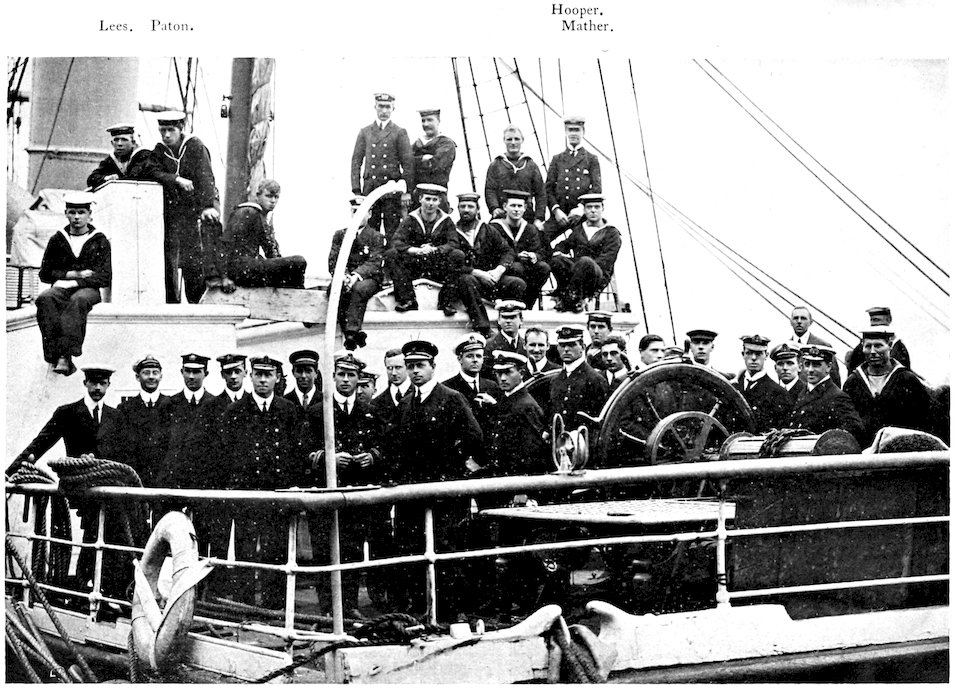
Photo by W. Hillsdon, Lyttelton, N.Z.] OFFICERS AND CREW, CAPTAIN SCOTT’S ANTARCTIC EXPEDITION, 1910. Left to right: Taylor, Wright, Simpson, Nelson, Levick, Oates, Evans, Bowers, Wilson, Scott, Campbell, Davies, Rennick, Ponting, Gran, Browning, Debenham, Day, Cherry-Garrard, Pennell, Meares, Drake, Bruce, Forde.
172nd Western Party (Nov. 1911–February, 1912).
Griffith Taylor.
Frank Debenham.
Tryggve Gran.
R. Forde.
At the Hut (Nov. 1911 to Jan. 1912).
George C. Simpson.
E. W. Nelson.
H. G. Ponting.
Clissold.
Anton.
The Hut Party during the Second Winter.
E. L. Atkinson.
E. W. Nelson.
F. Debenham.
C. S. Wright.
A. Cherry-Garrard.
T. Gran.
Crean, Forde, Lashley, Hooper, Archer, Williamson and Demetri.
They were joined by the Northern Party late in 1912.
19