V IN WINTER QUARTERS WITH CAPTAIN SCOTT
Reading edition
April–November, 1911
212
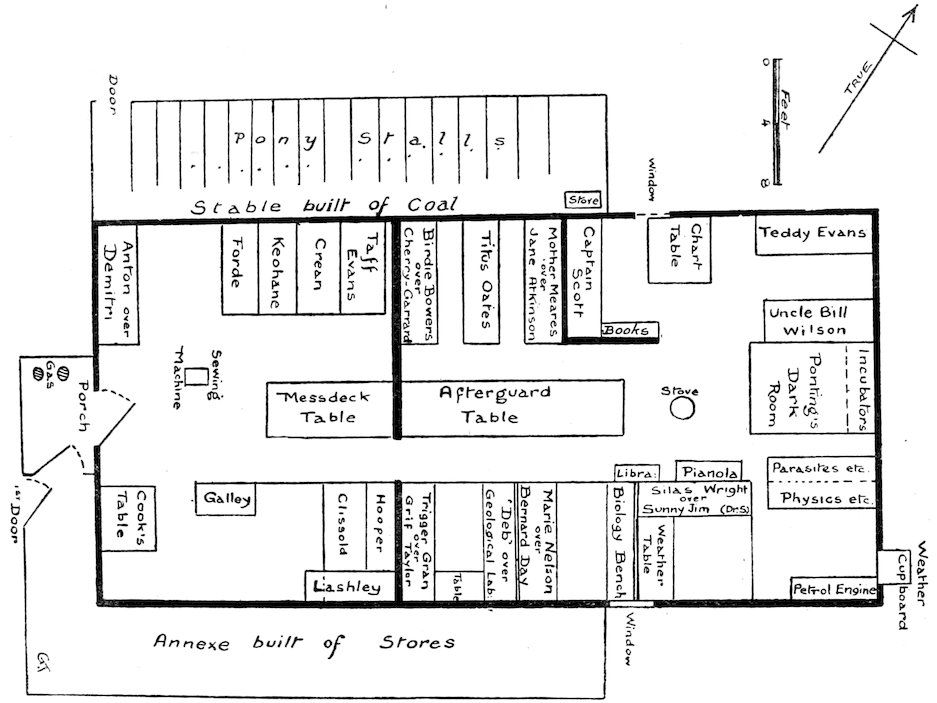
Plan of hut, 1911, showing nicknames and bunks of Explorers.
213
IN WINTER QUARTERS WITH CAPTAIN SCOTT
After our return from the summer’s sledging a new phase of Antarctic life began. For the next seven months we were practically confined to Cape Evans, and often to the hut itself.
During our “habitation enforced” it was rare for any man to be addressed by the name inherited from his parents or chosen by his godfathers and godmothers! The nicknames of the fifteen of the afterguard had by this time become standardized, and I think merit a little attention.
Captain Scott was invariably known as The Owner, a naval term always applied to the captain of a warship. Dr. Wilson (baptized Edward Adrian) was always known as Bill. Doctor Bill at first, Uncle Bill later, as one grew to rely on him more and more. Lieutenant Evans had four pre-initials, but was always called Teddy, which eminently suited his cheery frame of mind. Dr. Simpson was early caricatured as Sunny Jim by Lillie, and soon every one, including our leader, called him nothing else. Captain Oates was Titus to all of us, except to Bowers, who called him Farmer Hayseed, while Captain Scott usually referred to him as Soldier. Ponting was Ponko, and his chief aim in life (to get us to pose for him in all sorts of uncomfortable places) is perpetuated in the verb “to pont.” Nelson was Bronte naturally, and more obscurely Marie from some theatrical star met with in his varied career. Bowers was Birdie, from his outstanding features and Titian crest. Atkinson was shortened to Atch, or at times Jane. We were short of female society—which lack also accounts for Jessie Debenham as an alternative to Deb. Cherry-Garrard was always Cherry—though an affectionate variation was Cheery Blackguard, while the seamen—baulking at the hyphen—called him Mr. Gerard! Our Canadian Imperialist, Charles 214Wright, bore with equanimity the name of Cousin Silas, though perhaps Carolus and Tranter (Toronto) were more to his taste. Bernardo Day and Trigger (Tryggve) Gran were less remarkable ekenames. I gave up counting my own. McCormick (Skua—alluding to the rapid disappearance of some apricots), Keir-Hardy, Sharn-Gatch, and Old Griff were but a few.
Before we had time to change into semi-civilized garb the indefatigable Ponting had us outside to “pont” for him. Luckily there were no melting icicles available, and he was content to get us standing near the sledges. Some of the others had already shaved off their beards, much to Ponting’s disgust; but mine was so rudely criticised that I kept it most of the winter to show my opinion of it! I assisted Ponting to the best of my ability by adding a touch of verisimilitude to Debenham’s photograph, and threw some snow at him at the critical moment; but most of us looked such pirates, that there was no need for any further touch of Antarctica about us.
I spent the day sorting gear, “... and about 1 p.m. I had a gorgeous bath—the first for three months. Funny thing, no effect from no wash, no change, no hair brush, etc.”
I suppose the cold accounts for no ill consequences, but I have ever since felt more sympathy for the Southern European peasants, for their ablutions are equally simple; they also do without a lot of impedimenta, and are equally healthy!
Ponting took his plates off to the dark room, and submitted proofs next day! “Debenham says he looks just like an aboriginal—and far be it from me to contradict him.” Captain Scott and Seaman Evans seemed to develop an Irish appearance, while I scorn to repeat the comments on my portrait.
On Sunday afternoon I had a stroll with Nelson, who told me how the nine at the hut had spent the time. Dr. Simpson was in charge, and had converted the newly built hut into a palace of mystery. In his corner to the south-east a small Gardiner oil-engine was clacking away. This was used primarily, in conjunction with a dynamo, to charge accumulators for his electrical recording instruments. Mysterious clicks and gasps and ticking galore warned us that chronographs and other wild fowl, to be described later, were brooding 215over meteorology yet in ovo. Ponting had “raked in every little bit” available, including some magnificent studies of surf breaking on the ice-foot. Day and Nelson roused our envious admiration chiefly by the condition of their common cubicle. No old beams from the stable framed their bunks! They were supported by carved and polished standards, encased in veneer (of venesta casing); and below were some fine specimens of joinery in the shape of two capacious drawers!
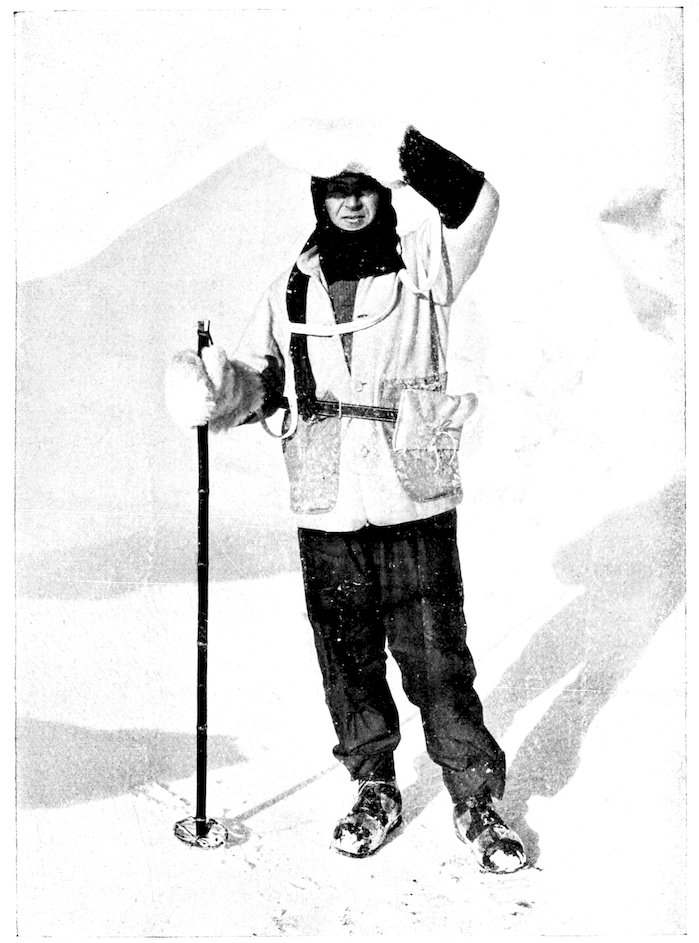
Photo by H. G. Ponting.] CAPTAIN SCOTT WEARING THE WALLET IN WHICH HE CARRIED HIS SLEDGING JOURNALS.
Day had equipped the hut with acetylene. The generator occupied a corner of the enclosed porch, where one could hear it gurgling as one entered the hut. If the outer door were not shut properly the fact was made evident by the dimming of the light! For the water in the generator soon froze if a blast of −40° struck it from the outer darkness. We were prohibited from carrying candles through the porch into the verandah storeroom for fear of explosion.
Nelson and I initiated the survey of Cape Evans on that stroll. The lakes had diminished greatly; not by ordinary evaporation, but through the removal of ice particles by the process of ablation. The margin of the lake ice was fringed by “blobs” of ice united into a lacework, and day by day one could see this fringe vanishing. It was curious that the small animalcule (Flagellata, etc.) should in some cases belong to the same genera as in English ponds!
Cape Evans is a low promontory of triangular shape. Its average height is only about twenty-five feet above the sea, though Windvane Hill rises to sixty-five feet. The southwestern portion consists of rocky ridges of kenyte with steep cliffs adjoining the sea, but to the north-east is a gravelly plain surrounding Skua Lake. Quite abruptly on the east and about half a mile from the western extremity, rises a steep bank of gravel (the Ramp) to a height of 150 feet. A few hundred yards of slope studded with quaint cones of rubble brought one to the edge of the great sheet of glacier ice which covers the whole western side of Mount Erebus. This was our domain, and to this cape we were practically confined during the ensuing six months (see Map No. 4).
Patches of ice covered portions of the cape, but the rest of the surface consisted for the most part of kenyte gravel with ridges and bosses of solid lava (kenyte) projecting through it, especially to the south-west. These dark lavas undoubtedly 216represented an earlier offshoot from the volcano of Erebus, probably a subterranean flow; while careful mapping later on showed us that the little sheets of ice were not haphazard, but were “glacierets” fed by blizzard snowdrifts.
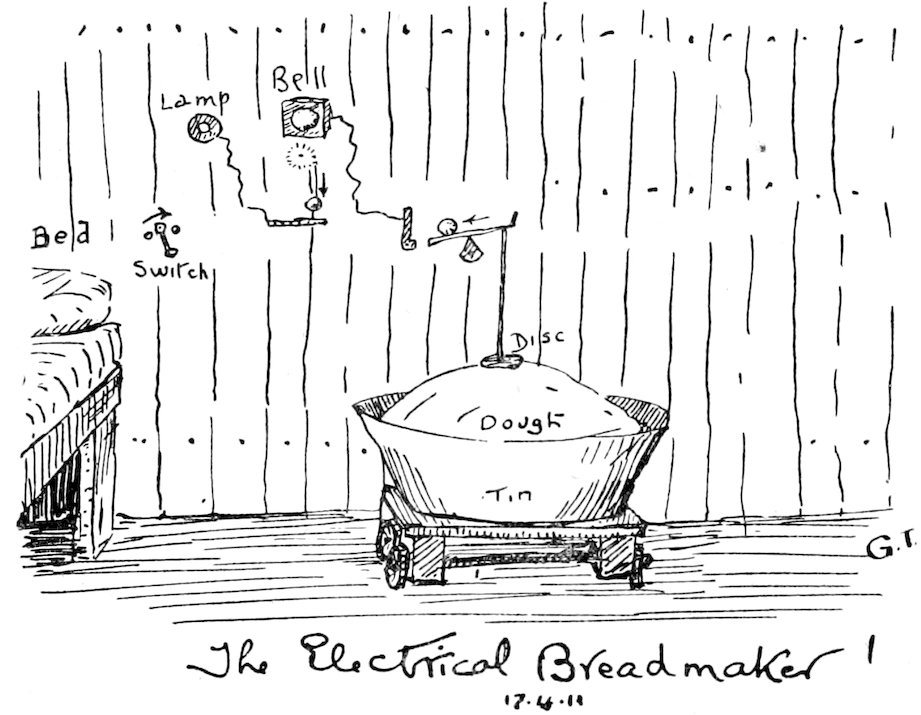
The most ingenious apparatus in the hut was due to Clissold the cook. This was an electrical device to tell him when the “bread was riz.” He used to make the dough in the galley and place it in a big pot, puncheon, or pan. This was supported on a little trolley and stood at his bedside. The dough mixed, Clissold turned into bed, and left the rest to the yeast cells.
When the dough rose sufficiently it pushed up a disc which overbalanced a gutter. Down this ran a lead ball which made contact and rang a bell! Further, the bell actuated a pulley and wire and made another contact whereby a red light appeared at intervals above his head! All this apparatus was made in the hut, and we never found out where certain of the “works” were hidden. Anyhow the bread was very satisfactory.
On the 17th April Scott took a party back by the same route to the Discovery Hut. Scott, Bowers, and Crean returned there, accompanied by Day, Nelson, Lashley, Hooper, and Demetri. Debenham and I went in charge of two ponies who were to pull the sledges as far as possible.
217There was a fine moon, so that it was quite light at 8.15 a.m. We crossed several cracks, and I tested the ice with an axe. A moderate wind was blowing from the north—always a safe direction, for the blizzards invariably came from the south. The surface had improved greatly in the last few days, and the ponies had no difficulty in pulling along at about four miles an hour.
Erebus was clouded, but occasionally we could see a red glow when the mists dispersed. Rarely was there so much sign of heat visible, though the steam banner often spread out a hundred miles.
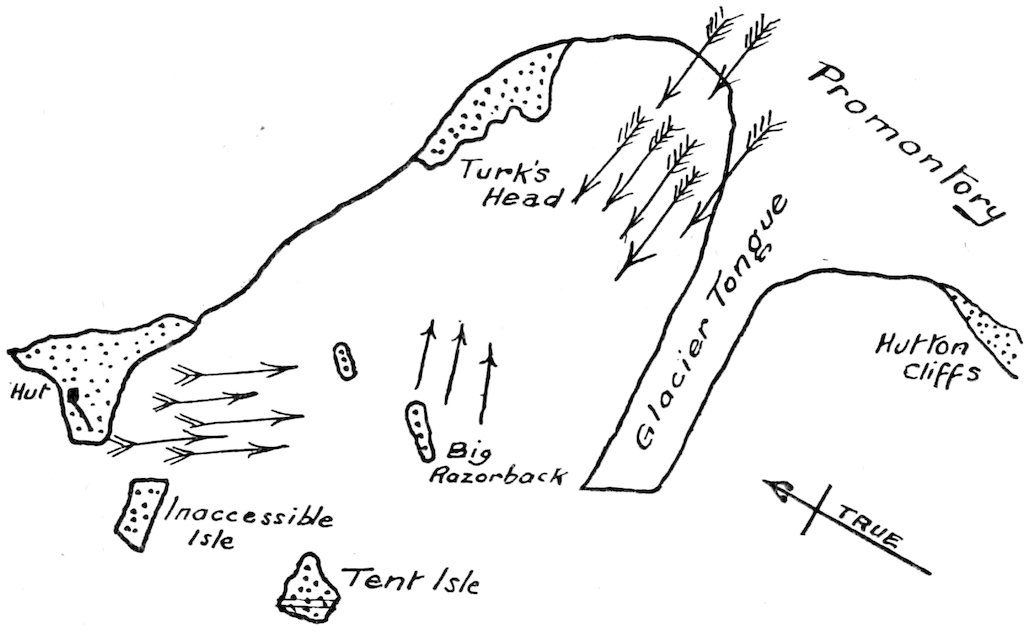
Changes in wind direction, March 17, 1911.
Opposite Turk’s Head (six miles south) the wind changed to a west breeze and then lulled, but a little further, near Glacier Tongue, there was quite a strong southerly, and we could see the drift sweeping over the promontory above Hutton Cliffs.
Here Scott sent the ponies back in our charge. The others marched on, and had a cold, rough time reaching the Discovery Hut. Their difficulties in climbing the ice rampart at Hutton Cliffs in the teeth of a smart blizzard is well shown in one of Dr. Bill’s sketches in the South Polar Times.
A small villa had been erected in our absence, to carry the magnetometers. This was built of asbestos or similar material, 218and held together by brass nails. It also formed a camera obscura for meteorological purposes. A lens in the roof projects the clouds on to a sheet of squared paper. This sheet is rotated until the clouds appear to move along a set of lines, and by comparing this with a compass the direction of their movement is obtained accurately and quickly.
That evening I helped to festoon the hut with telephone wires. While so engaged I saw my first aurora, and it did not impress me. “Like a huge broad cirrus cloud right across the sky from W.N.W. to E.S.E. No colour or movement, and it only lasted five minutes.”
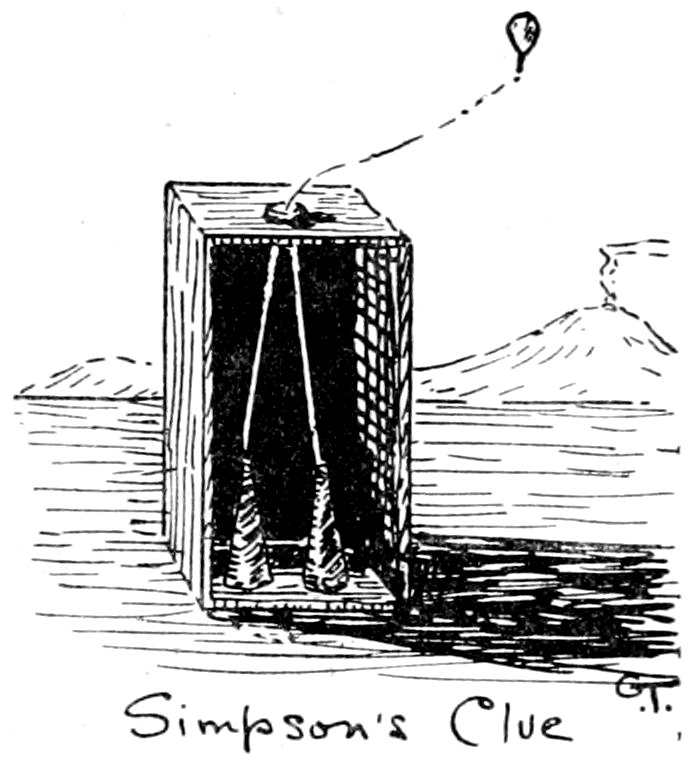
A sketch showing the balloon unwinding the black silk threads from the two conical reels.
Wright and I assisted Simpson to send up a ballon sonde. This seemed a complicated business at first. We had to carry out a queer theodolite with the eyepiece inserted at right angles to the telescope at the side; and a large tank for generating the hydrogen; and the inner tube of a bicycle tyre—and various reels of silk, etc., etc.; not to mention a small tissue-like deflated balloon of red gutta-percha.
The tank was filled from a convenient tide crack in the sea-ice, and then Charles filled the cycle-tube with calcium hydride. This compound is analogous to carbide, but gives off hydrogen instead of acetylene. He attached it to the top of the generator, and squeezed it to push the lumps of hydride into the water. The balloon was attached to an outlet pipe, and gradually lost its dejected appearance and became a red sphere of some two feet diameter.
In about ten minutes the balloon was inflated. This was merely a test, and after tying a piece of silver paper on the balloon it was set free and rose rapidly. With the theodolite the vertical and horizontal angles could be plotted, and thus the path of the balloon charted approximately.
The sun was setting (at 3 p.m.) while we were doing this, and gave a yellow glow to the steam-cloud on Erebus, which was drifting to the south-east. When the balloon was about 2194000 feet up we could follow the flashing paper, and saw that here the air currents were opposed to the direction of the steam-cloud at 13,000 feet elevation.
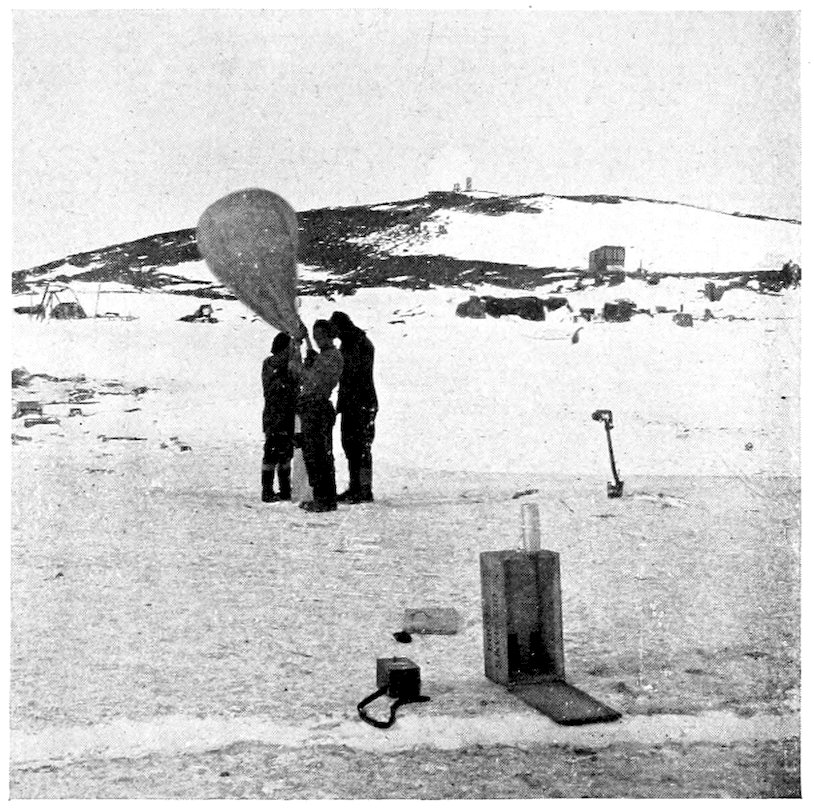
SIMPSON SENDING UP A “BALLON SONDE,” Nov. 12, 1911. The meteorograph stands on the box. Inside the latter are the two conical reels of silk. In the background is the magnetic hut, the Grotto Glacier and Vane Hill.
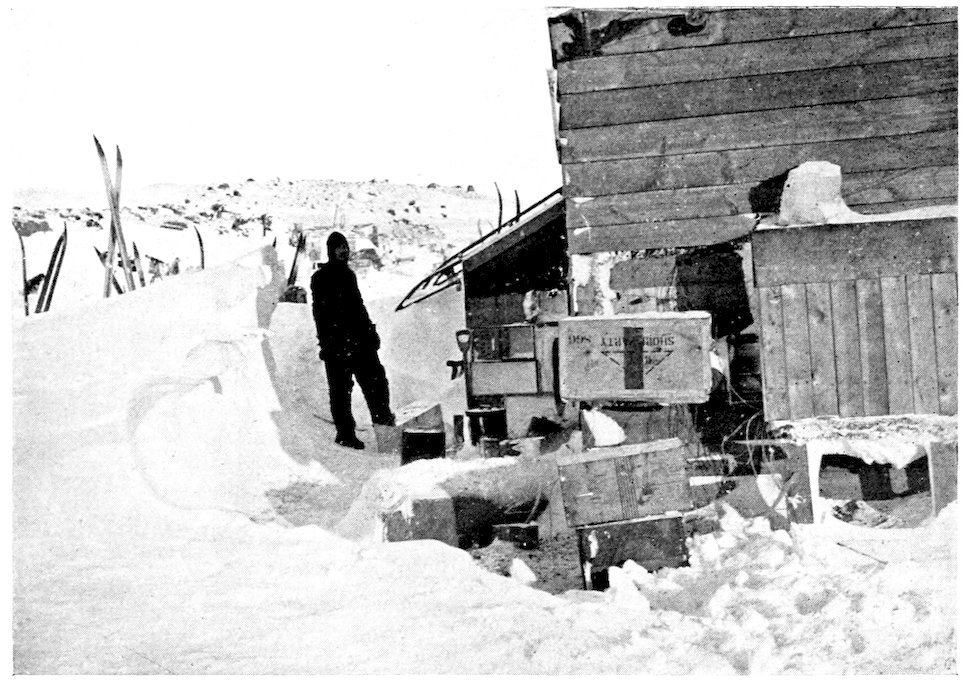
THE EAST CORNER OF THE HUT SHOWING THE EDDY TRENCH SCOOPED OUT BY BLIZZARDS ON THE WINDWARD SIDE OF THE HUT, Sept. 14, 1911. The stores annexe appears just on Clissold’s right, and the “weather cupboard” on the right of the picture.
The next afternoon there was a furious blizzard of fifty miles an hour, and a temperature of −7°. We kept to the hut, and made a start at winter occupations. I was busy writing a narrative of the western journey for Captain Scott. In this I proposed to discuss the physiography in some detail. When I had written twenty pages on the first day and a half, I wondered if the “Owner” would live through a report 840 pages long! Luckily the rule of three responsible for this forecast did not hold throughout!
Inside the hut the temperature was +47°. This was not exactly hot, and poor Ponting was delighted when some of the new-comers advocated lighting the small stove near his dark room. He said that developing photographs with water down to 47° was not the pleasantest job on earth. The blizzards hit his side of the hut, so that the inside of the dark room was festooned with icicles, giving it a most picturesque but uncomfortable appearance.
Things were getting straight in our cubicle. Our floor space was about eight feet by eight. We built a small table opposite the door and put shelves over this. Gran occupied a bunk over mine, and the legs of his wire bedstead hung over my head and feet, and caused many bruises at first. Debenham’s bunk was raised six feet off the ground, and was supported on two stout wooden cylinders, on which the linoleum had been rolled. He climbed into it by a primitive ladder. His sea-chest was under the table, while mine half blocked the doorway.
On the rubbish-heap outside I found a small tin which served as my wash-basin. In this I kept a sponge, and normally it stood on my chest below Debenham’s bunk. We were able to get about half a tea-cup of water if we found the cook in a good humour, so that it was rather a dry rub.
Secretly I was rather proud of my morning wash, but it did not seem to improve my appearance. I soon discovered the reason. Watching Debenham one morning before I arose, I saw him finish his ante-breakfast pipe and casually knock it on the edge of his bunk. The ash obeyed the laws of gravity, 220and fell into my sponge with great accuracy, and as if it were accustomed to do so!
When the chest was thereafter freed from my ablutions, it was seized by Debenham as a petrological laboratory. For hours he might be observed rubbing down fragments of rocks on a glass plate with carborundum powder.
He had a microscope, and was able to examine the many thin sections thus produced without awaiting his return to civilization. It is most interesting to see a dark rock gradually becoming transparent as the section gets thinner. First the quartz and felspar show up like clear and milky glass respectively. Then the green or brown colours of the mica hornblende or augite appear, while the characteristic green fringes to the clear olivine crystals or the absolute opacity of magnetite define those minerals. And then under the polarized light of the microscope even the colourless minerals show wonderful colours—from the pale greys and yellows of quartz and felspar to the vivid blue and purple of the olivine and pink and neutral tints of white mica.
Thus Debenham classified the numerous rocks from the western mountains. Kenytes rich in lozenge crystals of a beautifully banded felspar; granites showing brown cleaved crystals of hornblende and mica among the quartz grains and simple felspars; basalts with numerous crystals of olivine and magnetite in a felted mass of little felspar laths—gneisses, granulites, etc., etc., each and all can be pigeon-holed by picking out the relative proportions of the few minerals specified above.
By far the most interesting instrument in the hut—consulted by scientist and layman alike—was the “blizzometer.” Such was the name we used for “Dines Pressure-tube Anemometer.” We could all see a roll of paper on a rotating drum, on which a pen was always scratching lines giving wind velocity. But the expert could tell lots more. He could say not only how heavy each individual gust had been during the past twenty-four hours, but he could tell from the character of the graph whether the wind were from the north or south, and, more awkward still, he could tell when the night watchman had neglected his duty and let the inlet become choked with drift!
221
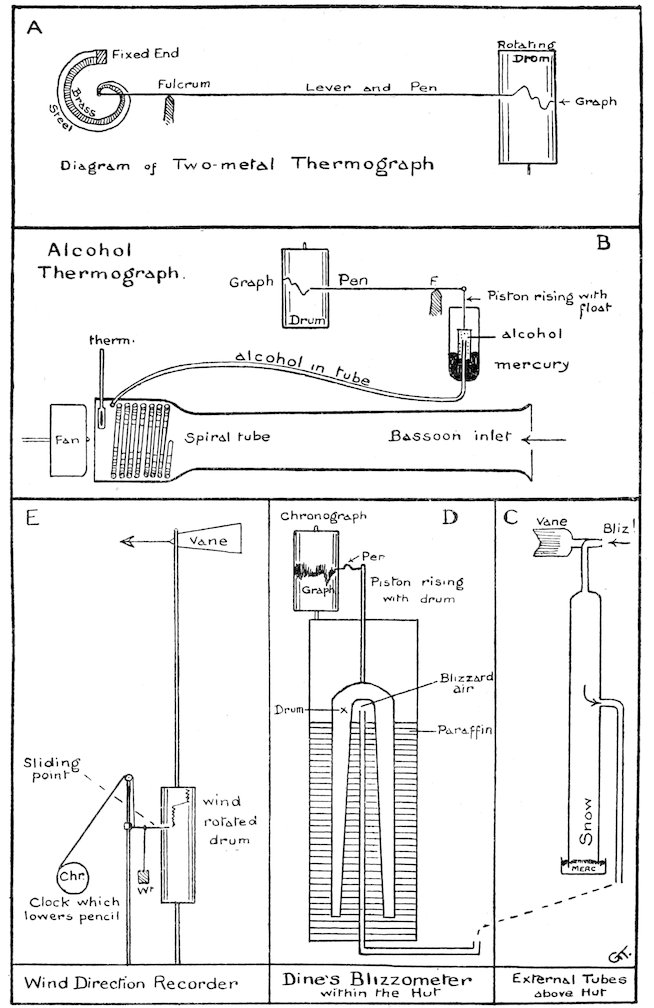
Copied from Simpson’s diagrams at his lecture in the hut, June 3, 1911.
You could not bluff Simpson or the blizzometer. The 222blizzard gave a thick series of vertical lines, so close together that a broad ribbon almost resulted. The north wind was never so strong, and the lines were shorter and less close together.
To understand the working of the blizzometer, let us accompany the night watchman. He has been engaged on his diary, maybe, till nearly midnight, when a complete set of observations are to be taken. He goes to the blizzometer to see what particular virulence of blizzard he has to face, and sees that the pen is motionless at the bottom of the paper—having dropped down after tracing gusts of sixty miles an hour. The night watchman feels depressed. He has to go and inspect thermometers and barometers and various other -ometers, but had hoped he would be spared “clearing the head” of the blizzometer. However, he wraps up well, and, carrying an electric lamp, ventures out round the south of the hut. He reads the thermometer at the most exposed corner, and then glances up to the roof ridge and wonders whether he’ll be blown off or not. In a sheltered nook he finds a brush of wires, and clutching this he climbs up a ladder to the roof. He feels the hut vibrating under the blizzard, and the drift shoots past him to the north. He clutches a metal tube projecting two feet above the ridge, and proceeds to prod the wires into its orifice, which faces the blizzard. A plug of drift snow breaks loose, and the wind once more drives freely into the nozzle of the blizzometer. It rushes down the tube into the hut and enters the base of the instrument. Here it passes under and into a metal bell floating in paraffin. The pressure raises this float, and of course raises a piston attached to it above. The piston passes through a gland to the outside and carries the pen at its upper end. Thus with every gust the piston (and pen) rises and falls, and a record is made directly on the rotating drum. The watchman warms his hands inside his jacket, and when feeling has returned to them he trudges into the hut, and devoutly prays the “head” will remain unchoked all night.
At this period our hut interior looked neat but not gaudy. Later, the continual tramping in of boots carrying snow and gravel, somewhat detracted from the neatness; but luckily, in the absence of brilliant illumination, no one was perturbed by the accumulation of “matter in the wrong place” which soon 223collected in the corners. But one object in the hut looked rather incongruous, and that was the Broadwood Pianola, lent us by the Broadwood Company. It was intended to keep this on the ship, but our unloading was done so successfully that some time could be devoted to transhipping the pianola. By dint of dismantling the wardroom—removing the stairs bodily—Rennick and his assistants managed to hoist the pianola on deck, and so got it eventually into the hut.
We were a strikingly unmusical crew. Ponting on the banjo and Nelson on the mandolin were the best. No one but myself ever used the piano. I had three pieces of music and speedily lost one—it was found under the pianola buried in grime six months later,—so that there was rather a sameness about my performance. I grieve to state that my two pieces became less rather than more popular as winter advanced!
However, I rather thought I might shine as a pianola player, and started to practise as early as April. After listening for some time, my scientific colleagues, who occupied bunks immediately back of the pianola, were moved to remark, “For Heaven’s sake, Griff, give that a miss, and let some one play who can keep time!” Perhaps I should have persevered, but they could throw too straight, and I never attempted pianola-playing again.
On the 21st Scott returned from Hut Point, leaving Meares, Nelson, Day, Forde, Keohane, Lashley, and Demetri in the 1902 hut with the ponies.
They had had bad weather going—as I expected. Very thick drift hampered them, and the new chums, especially Hooper, had been severely frostbitten. The latter had two angry red sores on his neck where the blizzard had caught him between his helmet and jersey. To climb the cliff at Hutton Cliffs they had to empty a sledge. Crean and Lashley held it up at arms’ length like a ladder, and Scott managed to climb up it, and cut steps over the cornice. They reported that the others expected to stay a fortnight more, and they augured badly for the commissariat under Meares, because “he’s so very sparing with the butter!”
Ponting kindly developed my western negatives in his dark room. They were no worse than I expected, being, however, all rather thin. Half a dozen were broken, and I had 224improved on a common error by putting three on one plate. We had such a rush before starting our journey that neither Debenham nor myself could test a single plate under Antarctic conditions. It seems simple now, but we had many failures before we gauged the best method. Previous Antarctickers had recommended plates and not films. I now disagree with this advice in toto, at any rate for sledging. We broke the plates. They scratched easily. Changing them in our bags was an unmitigated nuisance and filled the dark slides with hairs. Lastly, the glass plates weighed so much that they were always left behind when we had to cut down weights.
We had an idea that the quickest exposures would be advisable with snowscapes. Ultimately we took most of them at half a second or thereabouts!
A typical scene would largely consist of a skyline of snow mountain backed by a blue sky more or less covered by grey or white clouds. The foreground was usually also snow with bluish shadows. Everything was blue or white. There was little contrast, and owing to the photographic value of blue being almost the same as that of white, the resulting photograph was of a dismal flatness and one could not distinguish land from sky.
Of course this pointed to yellow screens to cut out all blue and give it the effect of black. We had much better success thereafter, but this necessitated the slow exposures I have mentioned previously.
My chief camera was a Zeiss Minimum Palmos equipped with all modern features, taking telephoto pictures, stereoscopic, ¼ plate or panorams (7½ inches long). It had a focal plane shutter calculated to give ¹⁄₁₅₀₀ of a second; but the rubber shutter froze stiff, and my exposures were largely made with a red handkerchief presented to me by Wright.
At the east end of the hut Ponting was busy at a huge instrument which looked like a cross between a barrel organ and a butter churn. It was really a “washer” for cinema films. The films were wound on a cylinder, placed in the washer, covered with a lid, and then rotated by a handle. When this operation was finished we all admired Ponting’s ingenuity, for he emptied out the water and placing a rug inside the hybrid, converted it into a most comfortable lounge chair.
The 23rd was Sunday, and Scott held Church service as 225usual. He and Dr. Bill would consult as to the hymns, and Bill acted as choir-master. He and Scott would test the key by striking several notes on the pianola before service. Then just before we started the hymns Bill would sound the note again and Scott would lead off with the first line. He had a tenor voice and could sing much higher notes than most of us, and made no ado about remarking, “We’ll have this a few notes higher,” between the first and second verses.
Early in the winter Dr. Atkinson started physical measurements, which were always the source of much interest and amusement. They were taken every alternate Sunday or Monday, and a list of the figures for those present on the 24th April may be of interest.
In addition to ordinary measurements, tests of the grip by the dynamometer and breathing power by the spirometer were also recorded. In the former an oval spring-frame is compressed and a rachet and cog actuates a finger which indicates the grip. The spirometer consists of a small enclosed vane which is blown round by the pressure due to one expiration.
I got the heights of the officers and recorded them on the wall of the “owner’s” cubicle. The other measurements are given in the table herewith.
April 24, 1911.
Name. Height. Weight. Dynr. Waist. Arm. Chest. Spirr. Calf.
Ft. in. Stone lbs. Ins. Ins. Ins. Ins.
Captain Scott 5 9·05 11 6½ 320 30½ 14¼ 39¼ 294·5 15½
Dr. Wilson 5 10·5 11 0 275 29 13 36 287·3 15¾
Lieut. Bowers 5 4 12 0 280 32¾ 13⅛ 40 230 16⅛
Cherry-Garrard 5 9½ 11 6 300 30 13¼ 36¾ 267 15
Atkinson 5 6·75 11 0½ 270 30 13⅚ 36¾ 265 15¼
Debenham 5 8·4 11 0½ 305 29½ 12½ 38¼ 261 13¾
Taylor 5 10·6 11 7 350 33¾[7] 13 36½ 307 14¼
Ponting 5 7·5 11 2½ 275 30¾ 14¼ 37 238·5 14¼
Oates 5 9·35 12 4¾ 270 31½ 13½ 40 266 15¼
Evans 5 6·85 11 13 350 34[7] 14 40½ 270 15¼
Gran 5 11·05 13 3¾ 300 31½ 12¾ 40 335 15½
Wright 5 10·8 11 12 345 30½ 12¾ 38 329 14¾
Simpson 5 10·95 11 2¾ 260 30 13 37 308 13¼
Day Nelson Mears absent at Hut Point.
226Wilson, Bowers, Taylor, Ponting, Gran, and Meares were non-smokers, and Wilson, Bowers, Taylor, and Simpson were teetotalers, though several of the others swore off alcohol except on high days.
At noon the northern and western sky was very beautiful, and I made an effort to record the colours by means of chalks in my diary. The dominant note was yellow shading to lemon-green in the west. Over the western mountains was a rose-pink flush verging into lilac-grey through salmon-red. To the north the band of salmon-red flanking the yellow changed into slate-blue and pale blue overhead. The sun’s rays shone gold through clouds over the Barne glacier, which exhibited magnificent purple and blue shadows.
It is sad to think that Bowers’ sailor-like criticism of the magnificent study in reds and yellows was that it reminded him “of a mess of eggs that had carried away,” meaning thereby a dish of fried eggs which had been upset.
Captain Scott instituted an aurora watch on this date. It was desirable to discover if periods of great magnetic disturbance (as shown by the magnetometers in the ice grotto) were accompanied by striking displays of auroræ. There were fifteen officers in the hut, so that each man’s turn came along about once a fortnight. He was to go out at every hour and sketch the aurora if present, and of course attend to the meteorological instruments, inspect the ponies, keep up the fire, and generally mount guard from 8 p.m. to 8 a.m. A feast of sardines heated on a bunsen burner was promised to the gallant watchman.
The most imposing objects near the cape were the stranded icebergs. Ponting and I walked across to them in the afternoon. First we reached the Arch Berg just before it fell in and became the Castle Berg, the Arch Berg, in which the major portion of the arch had fallen, leaving only a narrow elevated strip uniting the two moieties of the berg. There was a magnificent view, looking back at Erebus through this white 227arch, and Ponting promised himself some particularly pleasing views when the sun returned.
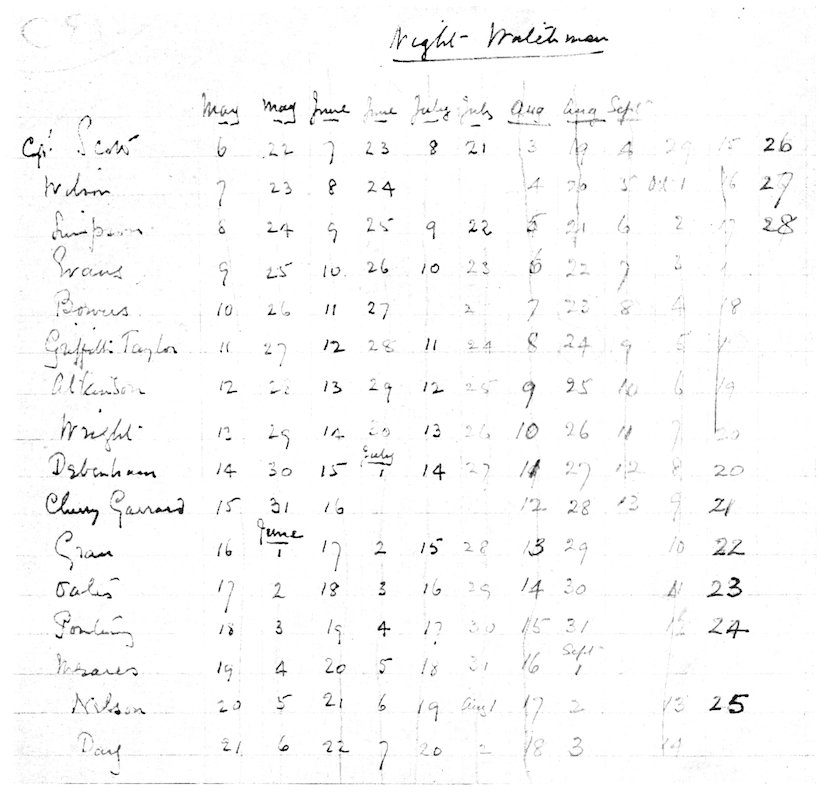
CAPTAIN SCOTT’S AUTOGRAPH LIST FOR THE AURORA WATCH.
Later we went over to the tunnel berg, which Wright and I surveyed in January. It had also broken up, and had tilted up some twenty feet on the southern side, owing to readjustments in the equilibrium. The once vertical tunnel was now only half its length, and lying at an angle of 45° (see Fig. p. 97).
Two seals were lying in the lee of a small berg near by. As we approached they took to the mushy water immediately surrounding the berg. They lay there on the sea-ice submerged by the pressure of the berg above it, being just under water, and not worrying to get through the ice into the Sound beneath.
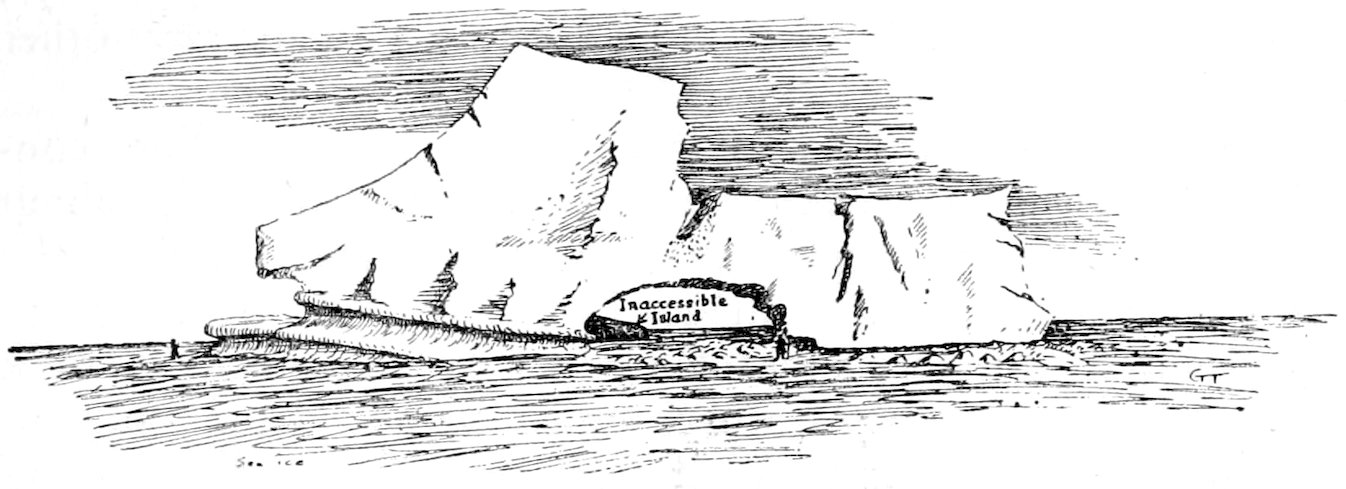
The Arch Berg just before it fell in and became the Castle Berg, April 27, 1911.
Later in the day a wandering Emperor was led in by a strap round his neck, and I held his wings while Dr. Bill pithed him by a lancet in the brain.
“The last bunk has been added by Oates. He brought in some boards from the stables—not needed now owing to the decease of the six ponies—and has built an erection which presumably satisfies him. We all remark that it is only held up by a small plank nailed to Bowers’ bunk; but Oates is quite imperturbable as usual, and no whit disturbed by ribald remarks as to a ‘deadfall’ trap baited with oats.”
I had been reading Cherry’s set of Kipling, and there was such a clatter of talk from our rivals across the hut that I publicly christened them the Banderlog. Birdie retaliated by criticizing my pronunciation; but I said I had no objection 228to calling them the “Bunderlohg,” and did so for the rest of the winter.
Debenham fixed up a terra-cotta curtain across our entrance which had been presented by Ponting, and now we were hidden from the vulgar gaze, though one frank critic said our sanctum looked like nothing so much as an opium den. Day had run in a branch acetylene light, and Debenham had stained everything stainable a dull red-brown with that beauteous dye, “Condy’s Fluid.” Not to be outdone, Gran fixed red linen borders on the shelves made from photographic “window” material, while I draped my bunk with a deep blue hanging, which had originally formed part of the Sunday tablecloth. We put down all captious remarks to jealousy; and the “Ubdugs” were more secluded than any other coterie in the hut.
Immediately north of Cape Evans the coast-line consisted of alternating rocky crags and snowdrifts, but about half a mile away this gave place to the vertical wall of the Barne Glacier. In places this ice barrier rose to 180 feet, and was fissured with crevasses from which frequent falls took place. These varying features were named later on, and Wright, Debenham, and myself were never tired of examining the silt bands, and included blocks, crevasses, debris slopes, etc., which characterized the vicinity of High Cliff.
The summer sun acting on some of the dark boulders included in the ice face had etched them out until they appeared like giant gargoyles projecting three or four feet beyond the general plane of the ice wall. I made a rough pencil sketch of these “gargoyles,” and on my return to the hut asked Dr. Bill to show me how to improve on this attempt.
On the 27th an important institution was inaugurated, which was afterwards called Universitas Antarctica. Captain Scott had sounded Wilson, and then he called up Simpson and myself and asked us if we would be willing to help carry out a scheme of winter lectures which he had drawn out.
We had a notice board on the side of the “Owner’s” cubicle, and on this he appended the following notice:—
229
WINTER LECTURES.
Some members of the community have very kindly consented to give a series of lectures during the forthcoming winter, the programme of which is attached hereto.
These lectures are arranged for each week, to be given on Mondays, Wednesdays, and Fridays, after the evening meal.
It is proposed that each lecture should be followed by a discussion, conducted on ordinary debating lines, and regulated by myself as chairman. The time occupied by the lecturer will be about one hour. It is not thought advisable to attempt to impose a time limit on the subsequent discussion. Attendance at lectures is purely voluntary, and neither the lecturer nor the chairman will feel aggrieved if any person prefers to read a novel or otherwise employ his time.
WINTER LECTURES AND DISCUSSIONS.
Subject. Lecturer.
Monday, May 1. Antarctic Birds E. A. Wilson.
Wednesday, „ 3. Halos and Auroras G. C. Simpson.
Friday, „ 5. Physiography G. Taylor.
Monday, „ 8. Future Plans of the Expedition R. F. Scott.
Wednesday, „ 10. Illustrated Lecture H. G. Ponting.
Friday, „ 12. Mineralogy F. Debenham.
Monday, „ 15. Penguins E. A. Wilson.
Wednesday, „ 17. Management of Horses L. E. G. Oates.
Friday, „ 19. Ice Problems C. Wright.
Monday, „ 22. Evolution of Sledge Rations H. Bowers.
Wednesday, „ 24. Parasitology E. L. Atkinson.
Friday, „ 26. Biological Problems, I. E. Nelson.
Monday, „ 29. Illustrated Lecture H. G. Ponting.
Wednesday, „ 31. Tips on Sketching E. A. Wilson.
Friday, June 2. Meteorological Instruments G. C. Simpson.
Monday, „ 12. Surveying E. R. G. R. Evans.
Wednesday, „ 14. Volcanoes F. Debenham.
Friday, „ 16. Biology II. E. Nelson.
Also Motor Sledging (Day); Whales (Wilson); Midwinter Illustrated Lecture (Ponting); Physiography II. (Taylor); Horses II. (Oates); General Meteorology (Simpson); Beardmore Glacier (Taylor); Radioactivity (Wright); Scurvy (Atkinson); Lantern Lecture (Ponting).
The Cape Crozier sledging party probably leaves on July 1. The programme for the remainder of the winter will probably be regulated according to this and other circumstances. It is hoped that the lectures 230named below can be duly arranged, so that every one may have an opportunity of hearing and discussing them.
Central Asia (Meares); Magnetism (Simpson); Constitution of Matter (Wright); Mineralogy II. (Debenham); Physiography III. (Taylor); Biology III. (Nelson); Bacteriology (Atkinson); Evolution of Polar Clothing (Bowers); Seals (E. A. Wilson); ending on September 1st.
(Signed) R. F. Scott.
Three lectures a week rather terrified some of the party, and it must be admitted that when a lecture was “on,” there was not much room for private reading! Anyhow, none of the officers ever absented themselves. The seamen attended the first two, but most of them “gave it a miss” thereafter, being probably intimidated by the title and probable aridity of the third lecture, “Physiography, by Griffith Taylor.”
To the south of Cape Evans extended a long and narrow belt of cliff hemmed in “betwixt the glacier and the deep sea,” which we called Land’s End. This extended about a mile; and thereafter was a face of glacier ice for four more miles similar to, but not so imposing as the Barne Glacier face.
Gran reported marvellous ice caves beyond Land’s End, so Ponting, he and I went off to investigate them. When we reached the crevassed face we found that the caves were really the exposed ends of crevasses. However, this seemed much the best way of entering a crevasse, so we crossed the mushy tide crack and passed through the narrow entrance which was half blocked by a tree-like mass of ice. At the back a huge Stonehenge pillar supported the roof, and outgrowths from the walls were connected to the flat floor by huge stalactites. Sticking promiscuously to the central column was a slender slab of ice, which seemed to indicate that there had been no movement of late, or it would have fallen. This was comforting, for Ponting made me “pont” in the interior for several minutes while he tried a flashlight. Near by I spotted a crack in the ice face covered by ice stalactites cemented together. I chipped out an entrance till it resembled what cave-explorers call a “fat man’s misery,” and then squeezed inside. It was another pretty little cavern, and the colouring was very striking. “The most magnificent 231blue light filtered in through the outer wall, as vivid and glowing as it is possible to imagine.”
Cherry-Garrard now began his most arduous winter employment as Editor of the South Polar Times. He had brought down a typewriter, and proposed to continue the Antarctic publication, of which two volumes had already appeared in 1903–4, in Scott’s First Expedition. His notice read as follows:—
Notice.
South Polar Times.
The first number of the South Polar Times will be published on Midwinter Day.
All are asked to send in contributions signed anonymously, and to place these contributions in the box under the looking-glass as soon as possible. No contributions will be accepted for this number after May 31st.
A selection of these will be made for publication.
It is not intended that the paper shall be too scientific. Contributions may take the form of prose, poetry, or drawings. Contributors whose writings lend themselves to illustration are asked to consult with the Editor as soon as possible.
The Editor,
S.P.T.
A tin receptacle was nailed under the notice board, and labelled the Editor’s Box, and Cherry set to work on his editorial pending the avalanche of contributions. Three issues appeared in 1911, and one other in 1912, but I shall describe S.P.T., as it was familiarly termed, in greater detail later in the narrative.
I commenced duty as night watchman on the 28th. I used to spend some of the long hours in writing my journal, so that there is never any dearth of notes of what happened about that period!
I wrote on this occasion, “It is not the sinecure that I imagined. Primarily I have to go out every hour and observe the auroræ. If they are really on tap, I have to stay on Wind Vane Hill (a quarter of a mile off) till they’re over! (I hope it stays overcast!) There was a fine display at 9 p.m. Sunny Jim had taken me out to see the spectroscope test. Behind Erebus it was going strong, and I could see a bar in 232the yellow-green of the spectrum which is particular to auroræ. I wrote the following in the log-book:—
“’At 21.10 (= ten past nine) a fine display along the whole sky behind the Erebus mass. At first isolated greyish streamers reached over 8°; they had a reddish tinge, but were not bright enough to give a bright line in the spectroscope. The whole brightened until almost a continuous band of (almost yellowish) light. It concentrated with a movement to the north, reminding one of a caterpillar’s motion as the more vivid mass of light undulated towards Erebus. At one moment it clotted into a globule of light not unlike a meteor, pointing to the crater with a streamer extending up, and slightly to the south. There was a tendency for the more northern streamers to point the same way. At 21.16 the display was over. There was perceptible orange and traces of purple (fide E. A. Wilson) in the borders. During the maximum, the streamers were over 20° from the horizon.’
“Clissold and Birdie retain me to keep the fire going in the galley. I put coal on twice (say at 2 and 4 a.m.) and rake out the ashes at 6 a.m. Wake the cook (Clissold) at 6.30. Wright says look to the acetylene apparatus. If it gets below 32° F. in the porch, open the inner door and let in a whiff to the mess deck! If the drum rises three feet and there’s risk of explosion, pump out the water, if vice versa dump in some water, for the bell won’t work. Teddy Evans is to be waked at 7 and Sunny Jim at 4 and 7.30.
“I intend to have a bath when Scott and Evans turn in. The former is reading and the latter plotting Inaccessible Island—a scandalous proceeding at 12.30 a.m.! For my bath I have to get ice from the old tin bath outside and replenish the galley boiler. I tried to get tinned fruit for my 4 a.m. repast instead of sardines, but it was no go! I can boil water on the little acetylene bunsen, if it’s worth doing.”
Later.—“I have sketched the N.E. corner of the hut, and tried to write a poem and failed. Been out five times and seen no auroræ. Had a hot bath and filled the boiler with ice. Stoked up the fire and examined the acetylene plant. 233Sunny Jim awoke at four. Finds something wrong with the ice grotto lamp, but has gone off to sleep. The temperature in here is +49° F. There is bread and butter, sardines, and possibly cocoa awaiting me. Clocks tick everywhere, and wriggles and snores are universal. I am yawning my head off.”
Later.—“I turned in at 7 a.m., so ending my first watch, and stayed till 11 a.m. cutting breakfast.”
I helped Cherry to build a stone hut on the beach before lunch. The weather was quite calm, and yet before we had finished the meal there was a furious blizzard blowing up to fifty-six miles an hour—gale strength being thirty-eight miles. It lasted just twelve hours, but the sudden rise was very characteristic.
One morning Captain Scott summoned a council of Dr. Bill, Teddy Evans, and myself to christen officially the main features of our winter quarters. The officers who had spent the summer on the Cape had already named some of the beaches and lakes. Teddy Evans had started surveying, and fixed stations on outlying points, while the geologists had cruised about the moraines to the east and so had some knowledge of the topography there. Land’s End and Seal Rock for southern features were agreed to. The two lakes kept Nelson’s names of Skua Lake and Island Lake. The hill where the screens stood was changed from Vane Hill to Windvane Hill. North Bay and South Bay were obvious, if not novel. Oates’s pursuits were considered in the names of the lowlands near the hut, for these were named The Paddock and The Course. I begged that the rugged crest across the S.W. be called the “Backbone,” but I never heard any one use the term! Finally the steep scarp 150 feet high and continuous from High Cliff to Gully Bay came up for discussion. Scott said, “Now this is why I summoned you, Taylor. What do they call this in Physiography?” I could think of nothing but “scarp”; but Scott gave it the euphonious name of the Ramp. “Going up the Ramp” was one of the commonest remarks during the succeeding months. Part of the Ramp to the north was a sheet of snow and ice, and for this I suggested Slippery Slope; while, later, a series of steps I cut up the face was known as the Golden Stairs!
Later in the day Wright and I filled a balloon which 234Simpson and Bowers let off. The procedure was now more elaborate, and in place of merely testing wind direction the balloons carried up a meteorograph and miles of fine silk thread.
In a small aluminium cylinder about eight inches long is contained a small aneroid (for pressure and height) and a small two-metal thermometer. Levers attached to these scratch two fine lines on a copper plate, and by suitable enlargement these lines give the temperatures at varying heights. The black silk unwinds like a Penelope thread and trails after the balloon. After some minutes a fuse burns through and liberates the balloon. The meteorograph falls to the ground with its record.
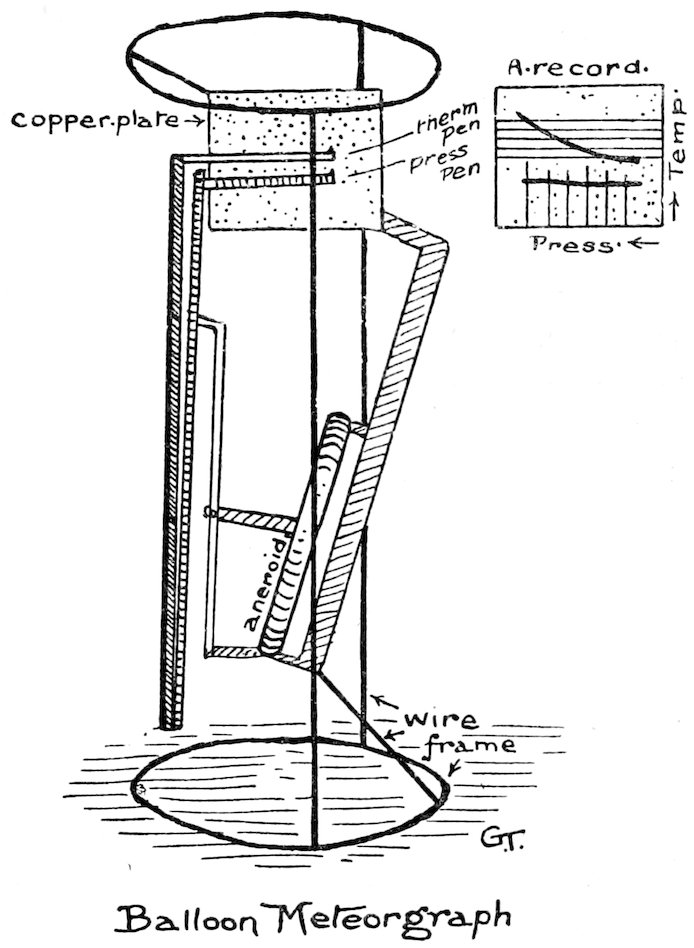
Theoretically all one had to do was to follow the silk and pick up the instrument. Actually it led one to the water’s edge and there vanished, or crossed the seracs and crevasses 235of the Barne Glacier and vanished again; or, worse still, started southward, and broke in the first quarter-mile on the rugged blocks of kenyte on the Cape! Simpson and Bowers were indefatigable in searching for the graphs, and recovered about half of them, often walking ten miles to get a record. A notice that any one finding a meteorograph would be presented with a box of chocolates resulted in no great diminution of our store of that attractive comestible!
It was good fun sending up the meteorographs in the earlier months, and the vagaries of the balloon gave rise to much chaff among the operators which in naval parlance is called “hot air.” It was an excellent school for “rounding off rough corners,” for each member had his mannerisms so dinned into him that he could not be said to err in ignorance.
On the 1st May Dr. Bill gave the first lecture on Flying Birds of the Antarctic. It was postponed from 8 p.m. till 8.15, while the sailors (in the “mess deck”) washed up! The ribald youth spent the quarter-hour drawing “dicky birds,” which we passed along to Dr. Bill to keep his mind occupied, and so save him from stage fright.
Dr. Bill shut off suddenly at 8.45, to the Owner’s pretended amazement. The discussion lasted till nearly ten, each man being called on by Scott in the order in which he happened to sit at the table.
As the birds have no enemies down south their white colour did not seem necessary for protection. I suggested that it was because white plumage would radiate out less heat than black (which seemed to recall some old physical experiment I had done!). Oates said, “Talking about birds, why were all Shackleton’s ponies grey?” Bowers wanted to know how the second skua chick was killed in its first week. Did its brother gobble it up? Ponting instanced an example of more than two in a clutch. He had photoed a chicken and two eggs in a nest near the hut last January! I inquired into this phenomenon which interested Dr. Bill much, and after some minutes broke it to Ponting that I had done the deed, taking pity on a motherless chicken and placing it in a warm nest near by! A yarn that amused them was an experience in the islands off South Australia. Here 5000 young cormorants were slain by an adjoining colony of terns in a few hours. Where were the parent cormorants? asked 236some one. They had all abandoned their offspring at sight of the visiting members of the Australasian Association!
On the 2nd May we held our first football match. The game was “Soccer,” and curious was the composition of the teams. There was little five-foot Anton, our Russian groom, who knew no English and probably had never seen a football. Somewhat of a contrast were Crean and Taff Evans, about six feet high, and two of the biggest men in the navy. Moreover, Evans was a noted Welsh player. Wright’s knowledge was based on ice hockey. I had played rugger in 1905, and now found that the rules differed considerably. Atkinson was our star player, though Gran had played football for Norway.
We played on the sea-ice in North Bay, which was still badly cracked, and not very thick, so that there was a chance of our game being a moving one in several senses!
I dare not give my opinion of the game. Every one seemed to be offside; the more so the better. I followed hard on the ball, which later I was told was inadvisable. Anton got one idea into his head, and merrily kicked the ball to the middle of the field wherever he happened to be. At halftime a blizzard started, and helped our side materially. I had on windproof jersey and singlet, but as there was forty degrees of frost I did not get particularly hot. In fact, I could feel my arm “going” every time I stopped running, which was unfortunate, for I had a collision with Crean which took the last of my wind. Scott was playing just behind me, and was very urgent that I should follow him up, but grinned cheerfully when I said I was too winded! The blizzard nearly blew the ball off the ice. It rose to forty miles per hour, but there was little drift, and it stopped when it couldn’t help our side, so naturally we won by three goals to nil!
Lectures alternated with football, so that next day we heard a very interesting lecture from Dr. Simpson.
LECTURE ON METEOROLOGICAL INSTRUMENTS.
By Dr. Simpson.
June 3, 1911.
On the 3rd June Simpson described very clearly the various meteorological instruments in use at Cape Evans. He illustrated his 237lecture with simple diagrams, which are reproduced in the figures on p. 221.
He started with an amusing instance of error in measurement. It is an obvious principle that the measurement itself must not alter the condition of the experiment. Thus, if you want to know the length of your own trousers, you introduce an error if you bend down to measure them!
There are three methods of measurement in general use—by photography, by moving a lens, and by various mechanical methods. Lastly, the time must be accurately recorded, and this is usually done by a chart carried on a rotating drum, which is clock-driven. The whole apparatus being called a chronograph.
In determining temperatures we need that of the air itself, and we must eliminate the direct effect of radiant heat. Thus a thermometer placed near a newly kindled fire records the access of heat long before the surrounding air is warmed by the fire. Hence we must bring a large quantity of air into contact with the thermometer. The method while sledging is to use a “sling-thermometer.” Here the thermometer is enclosed in an aluminium case of which the opened lid forms a handle, by which the thermometer can be swung rapidly for some minutes in the air.
In self-recording thermometers it is more usual to suck a large quantity of air past the thermometer by means of a little fan, as shown in Fig. B.
If, however, a check is kept by frequent comparisons with standard thermometers at the same place, this is not necessary. Thus the thermograph at Wind Vane Hill consists of a bimetallic coil fixed at one end, as shown in Fig. A. The inner strip is of brass, the outer of steel. When the temperature rises the brass expands most and straightens the coil, thereby deflecting the lever and pen, and so marking a graph on the rotating drum.
Another form of thermograph is shown in B, which was placed just at “Simpson’s corner.” The large brass bassoon and copper coil were outside the hut in the “weather cupboard,” while the small float and drum were inside the hut. The air drawn into the bassoon by the fan affected the volume of the alcohol in the copper tube, and so raised or lowered the little float, and so actuated the pen. It needed to be checked also by frequent comparisons.
To determine wind velocity we had several instruments. On the hill were the Robinson Cups, which whirled round merrily and were registered by clockwork. Every six miles there was a signal sent electrically to a chronograph inside the hut. Here we had a more unusual instrument, called in full the Dines Pressure Tube Anemometer, but early named the Blizzometer. Its records, owing to its more sheltered position, were one quarter lower than those on Wind Vane Hill.
On the roof two vertical tubes were visible. One pointed into 238the wind, and another (not shown) pointed away from wind, and was worked by its suction effect. The outer tube is sketched in Fig. C, and the lower end of this long pipe communicated with the blizzometer inside the hut. A practical experience with the blizzometer in a blizzard is given in another paragraph (p. 222). Since the resulting pressure varies as the square of the velocity, it is necessary to arrange the inner capacity of the drum to suit. It has, therefore, a paraboloid vertical section (being wider lower down), so that the heaviest gusts do not raise the piston (and pen) disproportionately high on the graph. The essential details of the apparatus are shown in Fig. D, the instrument being about a yard long. In Fig. E is shown the ingenious method for obtaining a continuous record of wind direction. The wind vane on the roof as it swings twists a cylinder on the same axis. This cylinder was situated in the porch in close proximity to the acetylene plant, over which we had to climb to regulate the instrument. On this cylinder was wound a sheet of metallic paper. At the side was a sliding point which made a mark when pressed on this paper. It was actuated by a clockwork which gradually lowered the point to the bottom during a period of seven days. With a steady wind a vertical ribbon was marked on the chart, and in our case nearly all the marks were confined to the south-east or north quadrants.
Simpson next proceeded to explain the instruments for detecting the electrical condition of the air. This was merely a variant of the quadrant electrometer, which is rather too technical an instrument for the layman. The magnetic measurements are also open to the same objection. The Dine’s Meteorograph is, however, a very ingenious instrument, and I have given an account of it in a preceding section (p. 234).
There was a crowded and enthusiastic audience, and the experiments were most striking in view of Simpson’s limited material. As a preliminary Ponting nearly blew us up with his acetylene lantern, and canny Dr. Bill sought shelter under the table!
In the second football match, I tried the effect of wearing light American shoes in place of heavy ski-boots. I don’t think it improved my speed much, though I managed to give Crean two “busters,” which pleased me greatly. Simpson did not appear, and later we found that Wright had seen the door of the magnetic hut unfastened, and had locked it while Simpson was within! My tight thin shoes naturally made my toes “go,” but by diligent rubbing and gradual warming before I entered the hut I managed to bring them back without any great pain.
239My first lecture was on the principles of physiography. Dr. Bill assisted me to draw some sketches on large sheets of paper, which I pinned on the pudding-board. This rested against a chair on the table, and was lighted by our acetylene branch! Cherry drew a sketch of the author and pinned it on the gas-jet as a screen. I discussed the evolution of a land surface from an “infantile” plain, such as that of Red River, Canada, through various stages of uplift to the “senile” condition of a peneplain.
I had made several small models in plasticene, and believe the lecture was fairly successful; for Simpson said he started sleepy and ended wide awake!
I based most of my lecture on my recent work on the geology of the Federal Capital Territory in Australia, and the substance thereof is given in the following paragraphs. This region (about 100 miles each way) illustrates almost all the new concepts in the evolution of a land surface.
Before the faulting the rivers flowed over fairly open country as the Upper Yass River does now. The Murrumbidgee River rose on the north of the Tindery Range and the Snowy River on the south. An ancient fault plane assisted the Murrumbidgee to capture the snowy tributaries at Tharwa. The country was broken by two main north-south faults. Thus the head of Yass River was cut off to make Lake George. Molonglo River managed to saw its way down through the scarp (as it rose) and so formed the Molonglo Defile. All the old snowy tributaries (Upper Murrumbidgee, Gudgenby, etc.) preserved their southward direction as they cut deep gorges in their uplifted beds. These tributaries form “boat-hook” bends where they join the big river. The present divide at Cooma is an insignificant wind-gap.
The old river-bed draining the Lake George area (which is seventeen miles long) is preserved as a deposit of huge quartz boulders two hundred feet above the lake at Geary’s Gap. This may be termed a “dead river.” The silts of Lake George are still being added to, and hence this country is below base level, and may be described as embryo topography. The narrow gorge of the Molonglo and those of the Cotter and Gudgenby exhibit infantile erosion features. The lower Molonglo River flows through a deep but wider valley with 240a youthful facies. The Yass River is flowing through undulating or mature country. The Upper Molonglo, winding over a dead-flat plain of silt (held back by the rock bar at the defile) is meandering over senile topography. In every case the cross section of the valley gives the key to the method of its formation and date of its present form.
After the lecture Captain Scott’s attitude was rather amusing. He said physiography was too novel to accept at once, and he would like to hear if it agreed with the teaching of older geology? Dr. Bill was very cordial, and said the onus lay on the geologist to disprove the tilting and faulting which I had instanced in the Australian federal territory.
It is a point of some interest as illustrating the growth of a special physiographic outlook, that I had quite forgotten to mention the geological deposits above Lake George, which corroborated the evolution of the surface as deduced by pure physiographic reasoning!
Simpson discussed the question of the rain factor in physiography, so I told them about our gigantic rain gauge in Lake George, near Canberra. This is about twenty miles long and five miles wide. At some periods it is thirty feet deep, and contains murray cod several feet long. Again—as at present—it is covered with grass, and inhabited by sheep and less desirable immigrants in the shape of rabbits and foxes.
Next morning I was very pleased at a kindly remark of Scott’s: “Taylor, I dreamt of your lecture last night. How could I live so long in the world and not know something of so fascinating a subject!”
Atkinson had been having successes with the fish trap, and I went out with him to see the sport. We tramped about half a mile over the ice to the north-west. Here was a hole in the ice three feet across. It was filled with new mushy ice, but we soon chipped this out and flung it to one side. Then we hauled at the rope and pulled up the trap. It was a cylinder of wire netting about three feet long with re-entrant ends, so that the fish could enter at the centre, but (nosing along the walls) had not sense enough to get out again. It showed beautiful phosphorescence as it rose out of the water, for the days were, of course, quite dark now.
241There were twenty-one victims this time. Atkinson had caught two batches of forty-one and forty previously. We put them in a bucket, where they froze immediately. The change from +29° (in the water) to −20° outside was too much for them, and in their last gasps their gills swelled out to an enormous extent. These fish were about eight inches long, the same Notothenia we had met with before. In shape they resembled “Miller’s Thumbs.”
Atkinson found some parasitic grubs in some of these fish, and took them over to Dr. Bill. The latter was engaged on some wonderful sunset sketches, but abandoned this task and nonchalantly proceeded to make a lifelike water-colour of pink parasitic grubs on a purple background of liver and gall!
I received a commission from Ye Editor to write the introductory article for the South Polar Times. “On Ross Island and the Ice Barrier. What it was like, is like, and what it’s going to be like!” I started seriously with petrology and volcanics, etc., and then gave up and went in for romance out of my head. Cherry seemed very satisfied with it, and authorized me to write as much as six pages of print—illustrations to be contributed by Bill!
Captain Scott gave his first lecture on the 8th of May on the “Plans of the Expedition.” He had thought out all possible details, and ultimately carried out his plans exactly, so that I do not need to give full notes. He relied on the ponies essentially, and frankly confessed that he was disappointed with the dogs, though he added that this may have been due to their food.
With regard to the motors, he hoped they would help; but he was not using their loads in his calculations. He realized that he was here carrying out an experiment to benefit future expeditions.
He felt it best to adhere to his original plan and proceed as if Amundsen were not in the field.
He said the great difficulty would be on the plateau. “Shackleton was five weeks there, and was nearly done, while the Pole party will have to spend ten weeks on the plateau. If we have bad weather,” he added, “no one can stick it. One last point: you will see that this will take 144 days. If we start on November 3rd—and earlier will kill the ponies—we 242can’t get back till March 27th. Now, no ship can remain in the Sound as late as this, so that inevitably the Pole party must stay another year; and if a small party stays, there might as well be a large party to carry out further explorations.”
There was a long discussion on the possibility of getting ponies up the great Beardmore Glacier. It turned largely on the character of the glacier—so Dr. Bill came out with a base suggestion that the physiographer be deputed to read up all the available information, and give a lecture thereon!
Ponting asked if the pony food could not be in part edible by men. He was questioning our cavalry captain, and boldly suggested that oats should be eaten—which double entendre amused the House.
Simpson has been wandering around disconsolately getting people to smell a liquid in a bottle. Something is wrong with the petrol engine, and all the engineering talent, including the cook’s, is at fault. Finally it was decided that this doubtful liquid from the tank was kerosene, and not petrol, and that perhaps a fresh supply of more suitable diet would remedy matters.
Ponting gave a lantern lecture on Burmah, which was interesting to all of us. However, it had no bearing on Antarctic topics, so that I made no notes thereon.
I had been busy for some time on a series of maps, which I proposed to send in to the editor of the South Polar Times. It was evident that among the fifteen officers in the hut there were many travellers, and it occurred to me that we had practically covered the world. So I drew three maps, and in place of the geographical names I inserted the names of the travellers. Finally, I made a table of countries visited, and those who were near the head of this table were quite keen to see who was the greatest traveller—in this limited sense. It was soon evident that the contest lay between Captain Scott, the oldest, and Gran the youngest of the party! The “Owner” called out several times after I’d got his list, “Did you put me down for Peru ... and Azores, etc.?”
The final results were—
243
Chief areas.
Captain Scott, 59 mentions First in Africa and America.
Gran, 53 „ Second in Europe.
Lieutenant Evans, 42 „ First in Europe and America.
Meares, 39 „ First in Asia.
Taylor, 33 „ First in Australasia.
Ponting, 32 „ Second in Asia.
Bowers, 31 „ Second in Africa.
Garrard, 27 „ Second in Australia.
There was then a considerable drop to the remaining seven men. We had about two hours’ violent discussion when I read out the list. Simpson objected to the sailor-men being placed so high, for obviously in most cases they merely touched at the seaports, and saw little of the country proper. He said he would arrange them as follows: Meares, Taylor, Ponting, Scott, Garrard. At any rate, Simpson could claim the widest polar experience, for he had spent a year within the Arctic circle studying the meteorology of Lapland! Scott, Wilson, and Day had been many months in Antarctica before; but unfortunately this is no-man’s land, and I only allotted each of them two marks for all this!
My second night-watch occurred on the 11th. It was blizzing outside at forty miles per hour. Hooper provided me with a fine repast, which I sketched to fill in time! There was cocoa and bread and butter—a sort of currant-pudding (euphoniously termed “Bugs in Bolster”), jam, honey, and milk. No sardines, so that it was evident that I had got on the blind side of the commissariat.
Cherry yells out, “Didn’t you get it away from the cliffs, Sunny Jim!” which indicates that he’s dreaming of tracking balloons.
In the wee smaa’ hours I wrote “Valhalla, a celestial medley,” for the South Polar Times. This skit on the manners and customs of the Antarctickers met with undeserved favour in Scott’s eyes.
On the 15th Dr. Bill gave his second lecture, of which I took full notes, and give them herewith.
244LECTURE ON PENGUINS.
By Dr. Wilson.
May 15, 1911.
There are many varieties of penguins, but they are all restricted to the Southern Hemisphere. Although a number of fossil forms have been found, they are also not known north of the Equator. With the exception of the Galapagos Islands and the southern shores of the continents, they are chiefly found on the sub-antarctic islands.
Fossils occur in South America, where many genera have been identified. For instance, six come from Seymour Island (Graham Land) and five from Patagonia. In New Zealand there are fossil skeletons six feet high, which were first described by Huxley. They occur in Eocene limestones.
The origin of the penguins is obscure. They began to specialize very early in the history of birds, and all relationship to other families is obscured. Probably they could fly once, but now the wing-feathers are not of the type used for flight. The requisite muscles are degenerate and the tendons have become ligamentous. Its feather tracts are distributed like a lizard’s scales, and the arrangement is in no way so advanced as in that of a domestic fowl.
The earliest bird, the Archæopteryx, had teeth, and one or two modern birds (e.g. the goosander) have makeshift teeth to grip slippery fish. One hopes to find real teeth in the embryo of the emperor penguin, though none are present in the adult bird.
Some of these early Cretaceous birds were divers, and so had adopted aquatic habits. Their shankbones were formed of three parallel parts, and this structure is exhibited in the emperor, though in all other birds the shankbone is solid.
Probably New Zealand was the original home of this type of bird. Their nearest allies are the petrels and divers, but the relationship is doubtful.
Groups.—There are three main groups of penguins—
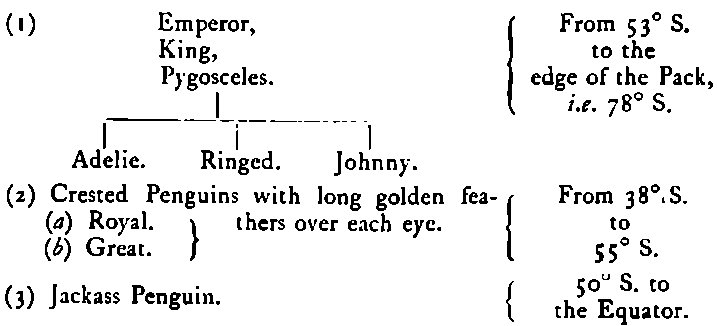
245Breeding.—The Emperor lays one egg and incubates it between the feet and the breast-flap. The Johnny penguin seems to have the same habit. The Adelie scratches a bare hole in gravel. The Crested penguin makes a grass nest, while the Jackass burrows.
Migration.—The Antarctic penguins spend about eight months on shore and four on the pack-ice. They usually remain within fifty miles of land.
The Adelies arrive in Ross Island in mid-October, the scouts preceding the main army by some ten days. After about ten days choosing nests the first egg is laid, and then the second soon after. They are hatched in a month.
Feathers.—The Emperor chick has two sets of down feathers. The earliest is pushed off at the end of the new feather in a few days. And then the final feather forms the base of the down feather.
The Adelie moults at the end of February.
Food.—The Adelie gathers a crop full of shrimps, and then has to run the gauntlet of all the chicks to reach his own nest. You can see his terror that none will be left for his own, for they are meanwhile digesting! The young birds remain on land until starvation drives them to the water. It is inexplicable how they know where to go!
The Emperor lives on fish, and so has a different-shaped beak. They obtain their food by diving down through cracks in the Barrier ice. For one adult hatching an egg there are a dozen unoccupied. And there is such a rush to claim a lonely chicken that the latter simply hates the whole proceeding!
Three-quarters of the chicks have died by the end of October.
From our visit to Cape Crozier in 1911 we know that the young do not shed their down till January. The bay ice is moving out all summer. By January most of it has gone north, and the penguins have gone with it. The chickens are not fit to enter the water in their down feathers, and after their free ride north they live on the pack-ice for some weeks before commencing to swim.
Penguins swim under water, and breathe with open beaks as they make their frequent “dolphin” leaps.
The dogs and ponies turned up from Hut Point on the 13th—just a month after we left them there. Meares arrived first. He had been lost in the drift, but had wisely coasted along by Turk’s Head and got through all right. We welcomed them with their favourite gramophone records. “They all went into the Shop” to cheer Meares, and then “Prehistoric Man” to see how exactly Huntley’s voice agreed with Nelson’s!
Dr. Atkinson started testing us for scurvy. We submitted our first fingers, and he jabbed them with a pointed glass tube till the blood flowed. I grieve to state my thick 246skin or sluggish blood necessitated five pricks. This blood, if healthy, should be quite alkaline, and its alkalinity is tested by neutralizing the blood with dilute sulphuric acid. Anyway, I didn’t think much of it! For if most of the fellows were extra good—I was medium only, while Scott and Wright (two of the toughest specimens) were the worst!
Several of the officers were recalcitrant, and refused all the Owner’s cajoling to lecture! Oates only gave in after much importunity, for he hated public speaking in any form. However, his lecture on “Horse Training” was awaited with much interest. He solemnly arose and commenced lugubriously with the words, “I have been fortunate in having another date set apart for me for a second lecture,” which raised a shout of laughter.
LECTURE ON HORSES.
By Oates.
May 17, 1911.
In feeding the ponies during the winter we must run no risks. The pony’s stomach is very small, and he stores water in a cæcum between the guts. In a natural state he grazes 20 hours out of the 24, hence it is advisable to divide up the meals as much as possible and give it them five times a day. This is inconvenient here, but we feed them three times a day.
Compressed chaff made from young hay would be very good, but our Australian hay was not likely to be cut very young. (“Oh!” from Debenham.) Bran tends to dry the mouth; oats are good, because he must chew them; and oilcake is very nutritious.
The pony meals are as follows:—
Morning: Chaff.
Noon: Snow, chaff, oilcake, or oats. Always give them water on an empty stomach.
Evening: Snow at 5 p.m.; branmash with boiled oilcake or boiled oats and chaff.
With regard to the famous continental training, our English polo teams can beat the foreigners, as was shown by Colonel de Lisle. It is a Munchausen tale to speak of “lifting” a horse over a fence with the bridle.
Here are two horses, drawn by Uncle Bill for me. One is “balanced,” the other not. The better horse puts most weight on the hind legs, which are the propelling members. One should make them walk fast. If necessary, dig them under the ribs! (Birdie plaintively 247interjected, “Where is a man to walk to be ‘in command of a pony’s head and ribs’ if he’s short in the arm?” And Titus solemnly answered, “Midway.”) Cherry’s and Birdie’s ponies are balanced, but it would take a giant to train “Weary Willie.” If you want to back a horse touch him on the front shin. The French school of haute école is rather in the nature of trick riding.
In his second lecture (August 10, 1911) Oates discussed pony psychology. Said he, “Consider the thing a horse has in place of a mind. He has no reasoning powers but has a very strong memory. Their vision is not strong, but they do all by hearing. If they hear a shout they connect it with some excitement. To shout ‘Woh!’ when a horse is backing is both ludicrous and useless—I’ve done it!
“It might be a good thing to dye the forelock to prevent snow-blindness. As to whether they should be groomed here, I think not. The grease in the coat protects the body. It is best to cut it once and then it will grow thick later. Litter might be an advantage, but they don’t lie down much.”
Atkinson came in and reported having seen a meteor fall just beyond Erebus. Simpson’s precise mind led him to ask, “Did it really fall?” Wherefore Day interjected, “You mean, was it pushed!” Thus do the “pseudo-scientists” hold their own.
On the 18th we played our penultimate game of football. The sun had vanished, but there was a little light at midday. It was, however, so dark that on our return I chaffed Nelson for funking it, and he retorted that he’d been playing just behind me the whole game!
Our routine was now much the same each day. I will quote my diary for May 19.
“A calm morning, but snowing. Wakened by Hooper at 8.15. ‘Rouse and shine, Mr. Taylor, sir.’ All, however, lie low, except Birdie Bowers, Evans, and Sunny Jim. Then Birdie starts chirruping and keeps it up solid, chiefly directed at the opposite diarists’ den. This is inhabited, according to him, by the ‘Rubbly Ubdugs.’ I go out to breakfast and find penguin feather flavour in the water, tea, and milk. (This is due to a layer of feathers in our glacier supply.) So I make a repast on porridge and marmalade. Nelson and Captain Scott arrive later. I retreat to my bunk and read Edmund Gosse; Debenham starts rock sections; Gran peruses maps to decide where he will go next.
“Our den is invaded by ‘Titus’ Oates, ‘Mother’ Meares, ‘Birdie’ Bowers, ‘Sunny’ Jim, Bernard Day, and ‘Silas’ 248Wright, from which they are with difficulty ejected, and then I start ye eternal narrative of the Western Journey.”
The next lecture was on Ice Problems, by Wright. He showed fifteen slides, including some made from views on our western journey.
We had a long discussion on the flow of glaciers, which lasted till 11 p.m. Discussions were in the air nowadays, and no one had a greater belief in them than Captain Scott. He was quicker to see the weak link in a chain of argument than any man I have ever met. In my own special study of the glacial geology of Antarctica, his practical knowledge quite balanced what I had gained from books or travels among glaciers of the temperate zone, so that I had many talks with him, and owe him much scientifically for his help in criticizing and so strengthening my main conclusions.
Physical measurements took place again on the 21st. There were loud cheers when Atkinson announced my waist as 35 inches. I had “gone steady” on food during the past few weeks and knew this was another libel, and when he corrected his statement I was proud to rank with Dr. Bill with a waist of 29½ inches!
“May 25.—It has been blizzing all day, and I will describe the doings in the hut. I am sitting on my bunk in the pose photoed by Ponting, using my little drawing-board as a table. Gran is writing one of his six diaries with Deb’s nib, which he blunts. He has a patent plasticene pen rack, which doesn’t improve the handle. I told him to learn Russian, or write an Antarctic novel in Norwegian, for he will be at a loose end until ski-ing is possible.
“Debenham is painting his third masterpiece. He uses my plane-table sheet on which to paste down his papers. His little terra-cotta water-pots (shrimp paste!) are much admired. He is rather fed up, because he has just found that he is painting on the wrong side of his drawing. I tell him that won’t make any difference! Day also is busy elaborating his sketches. Marie Nelson is writing a voluminous lecture, and making certain of all future arguments by questioning Atkinson, Bill, and Titus (re horses, etc.) beforehand. Dr. Atkinson is groping among encysted ‘mully-grubs’ at his half of the table, while Silas Wright wrestles with pendulum details on the other side.
249“Simpson is writing up weather for S. P. T.; while, I believe, Dr. Bill has finished the ‘hot-stuff’ sketches of geology, etc., for my S. P. T. article. He has copied most of them from my rough sketches, photos, or specimens. Cherry is flapping away at S. P. T. on the typewriter and chortling muchly.
“Teddy Evans is plotting a graticule for the southern survey, while Ponting has just perpetuated the ‘Teamsters’ in the stable where Titus entertained Meares to tea. Birdie Bowers is writing reams for his lecture on sledge-foods—guess it will make a book! The ‘Owner’ is reading in his cubicle as usual.”
On the 23rd Nelson and I started off for his biological station about a mile to the south on the sea-ice. I carried a plane-table, for I wanted to plot the four islands off the Cape. It was a fine clear morning, with tints of yellow, pale grey-blue, and deep blue enriching the sky. Nelson had a special sledge equipped with a winding drum and various boxes of “gadgets,” as he called his instruments. With this apparatus he was surveying the depth of the sound, and found that it varied very abruptly from place to place. Next day we went off again, and I obtained further angles from different stations, being unable to find the flag at east base. Finally, I found it beaten flat by the blizzards, the 1½-inch thick standard of solid male bamboo being snapped to splinters.
On Queen’s birthday Captain Scott informed me that he was afraid I should be able to do very little science on the southern trip. “You would only be able to go up the Beardmore and down again, so your time would practically be wasted.” So that he decided that I should go west to Granite Harbour, at which I was very pleased, though it was rather rough on Debenham, who was to have had charge of a party in that region. Dr. Bill pointed out that Debenham and I were fully occupied with different aspects of geology, so that there was room for both of us, and Scott arranged that I was to take Gran and Forde as the other members of the party.
My report of the western journey was approaching completion, and I devoted some time to making a portfolio out of purely local ingredients. From the rubbish-heap I got me a Venesta box, built of tough 3-ply wood. I brought this into the hut, and with much labour pulled off the galvanized 250binding strips. Then I cut out suitable portions, leaving thereon the stencil of Beach’s jams. I scrubbed them free of strawberry jam, and then worried Day to give me a nice piece of sealskin. This I pared down thin and soaked it in alum overnight. Later I riveted it with bifurcated rivets from Shackleton’s hut, and the net result was interesting, if not aesthetic!
“It is really the ‘long winter night’ now. I should say the real darkness began about the 20th, but you can still see to read outside at midday! I nearly got frostbitten paring that sealskin by candlelight in the outer storeroom. Only I kept my fingers in the candle flame fairly frequently!”
Birdie Bowers’ lecture on Sledge Foods was very good.
He poked fun at the “medical faculty” on every possible occasion. I deplored the inability to speak with authority on sledging rations, for in the west I had permitted our butter to be eaten instead of leaving it in a depôt, as the southern party had done! But the chief event was the appearance of Debenham as an advocate for an official tobacco ration while sledging, and when this was settled by the Owner, a fresh argument on the relative values of tea and cocoa between Birdie and Seaman Evans made more merriment.
Late in May Ponting made some of his most picturesque studies. On one occasion we marched out to the west over the sea-ice to photo the icebergs. We carried a lantern, and were thus able to cross the numerous cracks in the sea-ice safely. There had been rather high tides lately, and these had surged through the cracks and deposited a mushy layer, which was apparently very salty and did not freeze very hard. We could hear the shish, shish of Debenham’s ski, but were unable to see him. Ponting had two huge cameras, and had just set up his apparatus when Captain Scott, Gran, and Bowers arrived. The Arch berg had weathered greatly, and the top of the arch had caved in on the fifth with the noise of an avalanche. The berg was rising out of the water and had tilted up great cakes of sea-ice. Ponting wanted a figure in the picture, but one wondered if the berg would choose that moment to overturn! When the flash went off, however, I had moved over too far, and so no scale appeared to give an idea of the gigantic mass of ice.
The last day in May was characterized by a sharp blizzard. 251It had been quite calm all the afternoon, and Atkinson went off to catch fish. We caught a whole one, and the weather was so warm (only 18° of frost) that he was still moving when we reached the hut! This weather lasted till 5.15 p.m. Then in two minutes the wind rose from calm to forty-five miles per hour with snowdrifts like driving rain.
Next day we went out to a new hole cut in the 3 feet ice. There was a forty-mile blizzard, but as there was no drift we got out to the hole easily enough, though as it was drifted over we had to be careful not to fall in. Our huge hopes from the new ground resulted in three fish! We had much more rope to haul in and found it rather hard work. Atkinson was much amused by the old yarn of the Irishman’s remark while hauling up his mate: “Hold on, Mike, while I spit on my hands!” This was apropos of my having to stop hauling to warm my nose. Atch’s went further, and he had to stay outside the hut until the pringling subsided!
Dr. Bill gave us a fine lecture on sketching, illustrated by numerous samples of his own and by copious allusions to the trials of the budding artists in the hut! He pointed out that one aspirant had done a fine sketch of an iceberg with a splendid reflection showing in stormy water. I backed up my unfortunate colleague by showing Bill a portrait I had made of himself, which turned out “handsome” instead of “lifelike.”
LECTURE ON SKETCHING.
By Dr. Wilson.
May 31, 1911.
Sketching down here is very different from this class of work elsewhere. We are limited in our tools, being confined to pencil and chalks; and even with these we can only finish a sketch on the field in midsummer.
Accuracy rather than the making of pictures should be our aim in Antarctica, especially as our sketches are largely connected with scientific work. Nothing can be done with colour, though on the 1902 expedition I carried forty coloured crayons and tried to use them out of doors. Nansen, however, managed to do some useful crayon drawings in the Arctic.
My method is to make pencil drawings in as great detail as the 252temperature will allow, and to scribble over a sort of artist’s shorthand. I use very few colours, and can indicate Prussian blue, for instance, by pr. b., etc. Even in temperate regions you have to use somewhat similar shifts, for you can’t sit down to paint a brilliant sunset. This “shorthand” I practised largely in Norway in 1897. One gets into the habit of realizing quickly what colours will mix to give the required shade.
In Antarctica every topic requires a different method of treatment, and all require accuracy. Now here are some tips that you may find useful.
Every line is to be criticised as a part of the whole lot, which means you musn’t scribble haphazard. It is a good test if you can discover something in your sketch which you did not realize when you drew it. Always try to analyze the gradations and colours; this power is largely a matter of habit. You can’t overdo the exercise of your power of “seeing,” and down here the shades are so subtle that you get very good practice.
No coarse methods will reproduce snow, ice, or distant mountains. All these take time, and I notice that surveyors and physiographers fail here!
Now I will try to point out why some sketches fail.
There is a promising art student present who drew an iceberg. He had not attempted one before, and so did it carefully and successfully. But beyond this are waves and sky, and he thinks he knows them. So we find him showing the berg reflected in waves! He should have roughed in bits of the waves and sky and made notes. Here we see the necessity of a first sketch which shows you bits of every feature of the whole.
The pencil is the only thing to use here, though in other regions you would also make a rapid sketch to show colour contrasts. Don’t try to draw with a brush.
To reproduce your sketches, you use H and F pencils. It is very difficult to grade snow and sky with ink. It is best to use a hard pencil so that you don’t get into a smudging way, but make each line distinct.
Do your outlines in very faint lines so that they will disappear when shaded, and without the use of rubber. If you want a straight line or circle use a rule or a compass. Be careful to get the horizon level or you will spoil the whole sketch. Remember that nature relieves everything by shadow and colour, but not by lines.
Principles of Sketching.
You will find Ruskin’s book very helpful. One should have them instinctively, as in the case of so many Japanese and all good artists. The rest must acquire them.
1. Accuracy, by attention to small details and differences.
2532. Methods. Pen and ink is difficult for snow and sky, and soft pencil is easier.
3. Outlines are the edges of shadows.
4. Perspective is not of much use in Antarctica.
5. Use an empty picture frame to gauge size and position.
6. Colours are mostly snow-white or blue-grey, but occasionally even shadows may be orange or the brightest blue.
7. In shading, first practise with a square on white paper and hatch it. Be careful never to go over the edge.
8. To test the inaccuracy of your eye carefully copy a maple leaf and then superpose it on the original.
9. If using pen and ink outlines only, never thicken a line. Use even lines, and remember that it is imperfect because there are no outlines in nature.
10. There is no royal way to do trees or clouds, etc. Be careful not to adopt mannerisms.
11. Clouds are solids with a light side and a shaded side; and also with perspective.
And he ended up with a sly reference to myself. “In drawing land forms you tend to become a physiographer”!
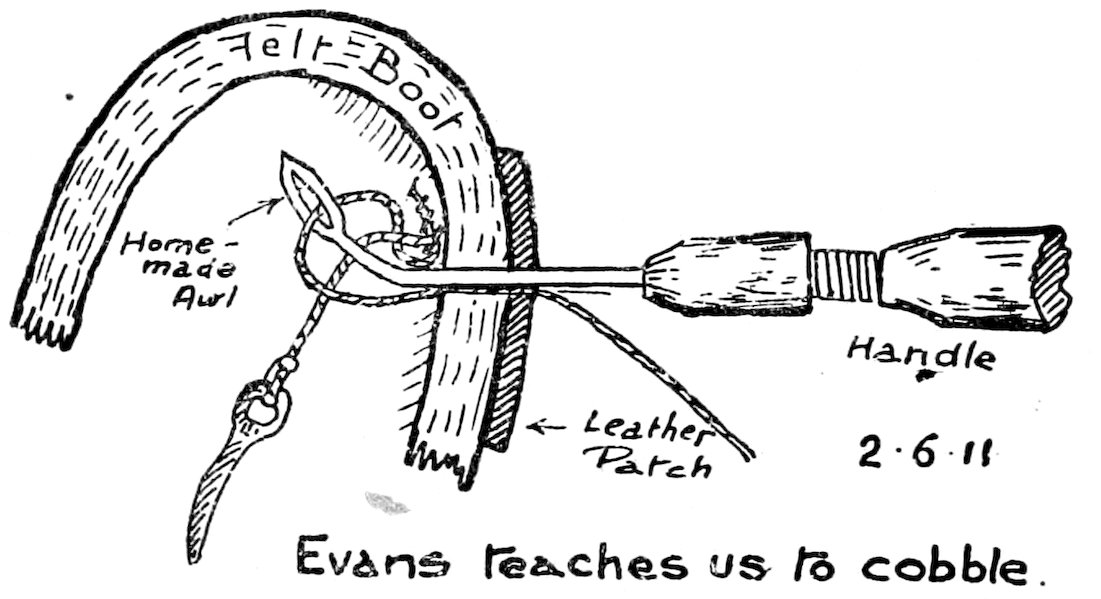
I spent the next morning on a “make and mend.” My Russian felt boots were wearing out from the usual cause: not through rough surfaces, but from scorching when drying near the stove! So I borrowed Wright’s sewing awl, and Taff Evans coached me with this weapon. It always used to worry me how cobblers sewed a boot when they couldn’t see the inside thereof! Anyhow I made a sketch of the method, and afterwards sewed boots, bags, camera cases, and all sorts of gear with complete success.
Procedure.—(A)
Push threaded awl through first hole and pull one end of thread out on inside of 254boot. To this attach a stiff point, i.e. a nail.
(B)
Pull back awl and push through next hole.
(C)
Make two loops of the awl thread (see sketch) inside the boot, and put the nail through the loop, whose end is attached to the boot (the other loop is in the supply thread), and so on.
Then I darned four socks, using string instead of wool, for with four pairs on, and with our hardened skin, the roughness was immaterial.
Whit-Sunday came along in due course, and we had Church service. This consisted of the usual Morning Prayer with the special Antarctic Collect and two hymns. Absolutely the chief lack in the hut was a hymnal with tunes! We had a Broadwood piano and a dozen hymn books, but no music except three or four songs, such as “Asleep in the Deep,” “Old Madrid,” and “Alcala.”
Captain Scott asked me to vamp some tunes for the hymns. I could really have risen to hymn music, but was unable to vamp, and told him so. I tried to invent an accompaniment or two but failed dismally. Cherry next negotiated it, and managed one or two quite successfully; but each fresh tune needed such a lot of practice that he gave it up after a few Sundays.
However, there seemed no end to the tunes known to Scott and Bowers, and these with Wilson, Debenham, and Lashley formed quite a respectable choir.
The Owner was very keen on the hymns. On one occasion he gave out “Onward, Christian soldiers,” and was so dissatisfied with the result, that he specially repeated the same hymn next Sunday till we were more in unison.
The South Polar Times was now finished as far as the letterpress, and was in the hands of the binder. The whole production was supposed to be a secret, but it was necessarily a very open one! We could all see Day manipulating sealskin and Venesta board—in his bunk; though I don’t think that any one expected he would make such a really artistic job of it as he did. Ponting printed four of his finest photographs on very large sheets and then moulded them and 255trimmed them as plates, and they added greatly to the beauty of the resulting volume.
I had handed in my official report on the first western journey to Captain Scott, and now busied myself with a comparison of the meteorological results of the 1902 and 1910 expeditions.
The temperature curves are very interesting and are shown in the annexed figure.
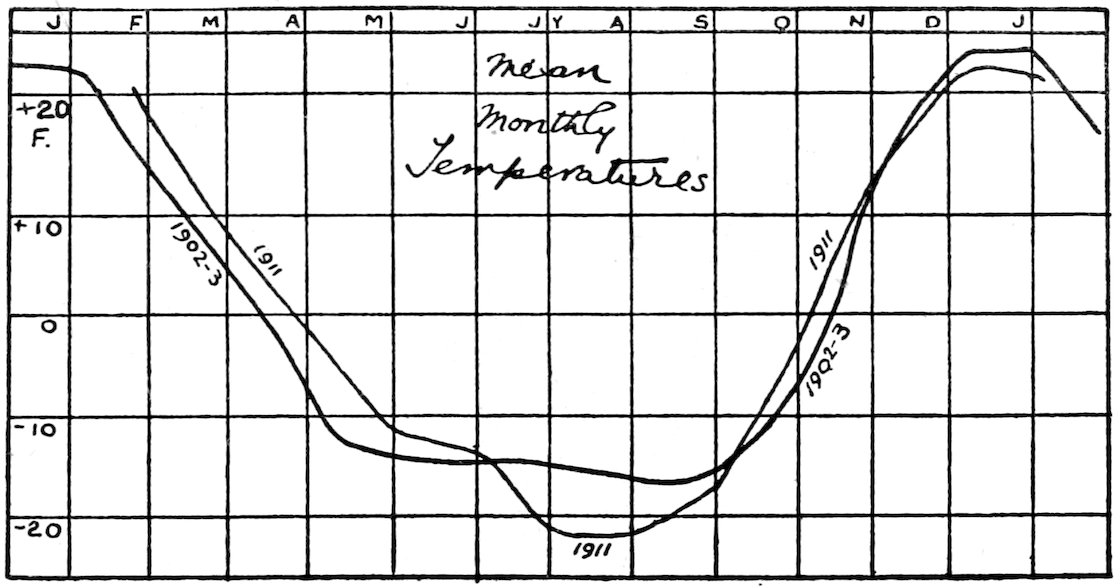
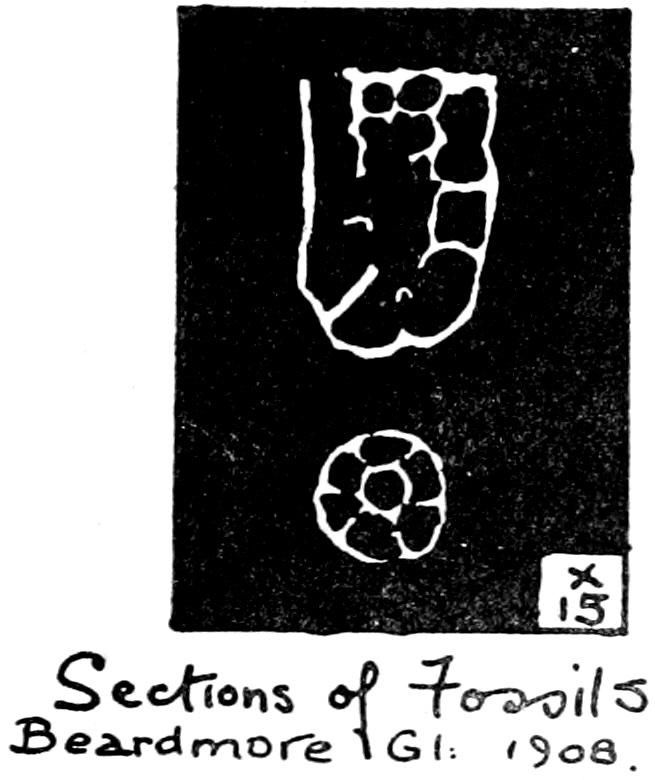
On the 5th of June, I gave a lecture on a place I had never seen and probably will never see—the Beardmore Glacier. I had to spend a considerable amount of time in reading it up in Shackleton’s book. Scott had lent his copy to Campbell, so that mine was the only copy in the hut, and was naturally consulted by everybody. It is a unique copy, for all the expedition signed it, so that it forms the last collection of such autographs; and later Sir Ernest was good enough to write a brief letter therein on the opposite page.
Curiously enough there was one aspect of the Beardmore on which I could speak with some authority. I had spent two years in Cambridge doing 256paleontological research on some Cambrian corals from Central Australia. Among the specimens which Shackleton had brought back from the farthest south rock was a small pebble of green marble. In this were some minute fossils, and they turned out to be the same “ancient-cups” (Archeocyathinæ) as I had described in Cambridge. So this unique specimen was handed over to me for description, and I was able to tell our fellows the “habits” of the Beardmore corals.
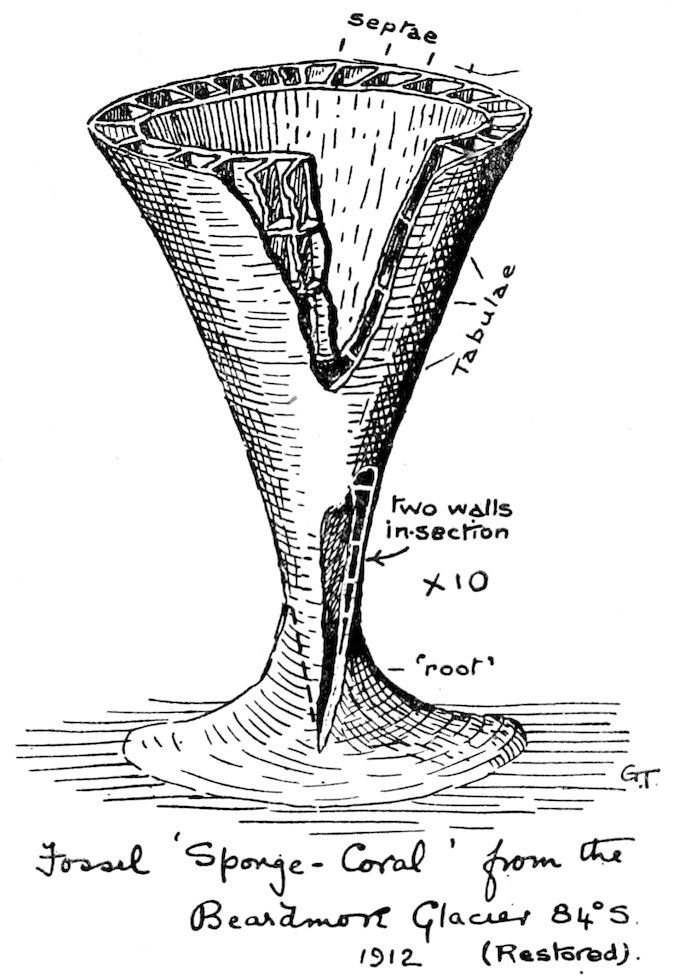
These queer fossils seem to unite the characters of the two great families of sponges and corals. They died out in the Cambrian age, but are of world-wide distribution in deposits of that period.
I had drawn an enlarged map of the Beardmore, and I read extracts from “The Heart of the Antarctic,” describing the position of the crevassed areas, etc. My next “old master” was a fine effort—a sort of panorama of what you 257would see looking back down the Beardmore. I had commandeered it from the Sphere; but it seemed unnecessary to say so!
Then from some notes given me by Professor David, I was able to describe the geology of the rocks fairly fully.
Two contrasted longitudinal sections of the Ferrar and Beardmore glaciers showed the immensity of the latter and its comparatively slight slope. I even had a specimen to exhibit! a small piece of the original fossil-bearing green marble hung as a pendant on my watch-chain. This was examined by all present, and the southern party swore to pick up all the green marble they could carry, on the off chance of it containing my pet fossils! I may be allowed to mention that this specimen now adorns a lady’s ring, and is mounted after a design which I owe to Lady Scott.
The most southern fossils: archeocyathinac marble set in a ring.
The question of collecting specimens was important, especially as no geologist was going south. However, I asked them to collect fresh pieces (which need not be large), and from rock in situ if possible. A description of the physiographic data most required finished the lecture.