VI THE GRANITE HARBOUR EXPEDITION SECOND WESTERN EXPEDITION (continued 2)
Reading edition
We had some difficulty crossing the shear cracks near the camp, for the snow had covered everything. I prodded cautiously ahead when we seemed near the largest, and, stepping on, went right in. I had been standing on the exact edge and tested too far off! However, I escaped with a slight wetting, which is the proud privilege of the leader, and we crossed without difficulty.
We reached our front door at 6.30, finding that the ice had buckled in our absence, but had not cut us off from shore. Dodging between two pressure ridges we reached the ice-foot amid the huge storm-blocks of ice and unloaded with great joy. Everything was buried in snow.
The 40-lb. biscuit tin was hurled six feet off a rock, and Granite Hut was half filled with snow. We cleared the gravel patch and soon pitched our tent, and had a good hoosh inside us.
Shortly after we turned in it began to blow from the west, a most unusual quarter. This cold plateau wind increased very rapidly, and by 2 a.m. was blowing as hard as any wind I ever felt in a tent. It bent in the stout poles of the tent like whale-bone, and covered the sledge with a huge ridge of hard snow. The door flapped so violently that some of us 370could get no sleep. The wind died down about 5 a.m., and the 10th turned out to be a beautiful day. We spent an hour clearing the huge drifts off our sledges, which were completely lost to sight.
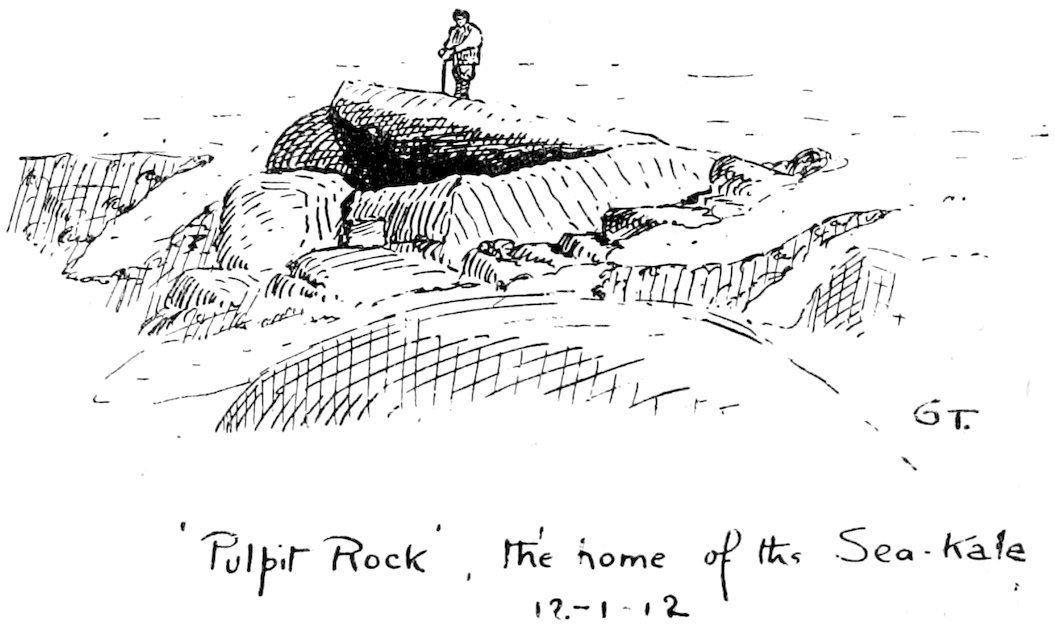
As this was Sunday, I decided we would spend it in tidying up our camp. Gran and I planted his sea-kale seed in the evening. He said the Norwegians in Graham Land (West Antarctica) got large crops of this succulent vegetable! I had my doubts, but it seemed worth trying. Behind our camp was a huge cluster of granite rocks enclosing a small cave. We collected some mossy soil and placed it in this hollow, facing the noon sun. It seemed a bit wet and soggy, but Gran swore the seedlings would be up in a week and edible in a month.
“The skuas are squawking like fussy ducks all round us, sometimes cheeping like young chicks; but they don’t lay eggs, which is their main duty now.”
All the moss, which formed a regular peaty layer an inch thick in some of the gulleys, implied plenty of soakage. But it was a cold summer, and we never found any drainage when we dug into the hollows. Moreover, the blackened appearance of the moss made me sure that we were not seeing it under favourable or even normal conditions.
A small discomfort, which was to bulk largely in the next few weeks, began to trouble me. During the seal-killing and 371flensing I managed to inflict eight cuts on my hands, all of which healed up in the pure Polar air, with one exception. It was on the forefinger of my right hand, and was beginning to fester badly. Gran was our self-constituted doctor, though I’m bound to say that the stories he told of deathbeds which he had attended on Norwegian ships were not at all reassuring. Gravely he felt my pulse and armpit, and then said, “Do you feel pain here?” I truthfully said “No!” “No blood-poisoning in that finger,” said he. At any rate it rapidly became worse, and for days I could not write, sketch, or photograph, while the pain prevented my sleeping at night.
The first duty before us was to replace the flag on the rendezvous. Gran decided it should be of a bolder pattern, and so he inserted a white specimen bag in the middle of a black depôt flag, which made a very showy standard indeed.
After lunch we marched across the bay just east of our camp. This washed the beach where the moss grew, and in our exiled position it was natural that Debenham and myself felt that there could be no better name than Botany Bay for this inlet! The ice surface was in a peculiarly unpleasant condition. A frozen layer of snow over a foot of soft snow made walking exceptionally tiring. Flanking the Discovery Bluff—as we called our rendezvous—was a tumbled scree of granite blocks mingled with smaller talus and snow. Here, moreover, numerous little rivulets were rushing down the chimneys scored in the face of the bluff, so that there was plenty of variety about our walk.
We reached our flag sooner than I expected; in fact, we climbed up right above it to nine hundred feet; and had to get down somewhat circuitously, when a hurtling granite block warned us of precipitous cliffs directly beneath. I found that our bamboo was as firm fixed as ever, but it had snapped through like matchwood just at the surface. The wind seemed to have blown down the face of the Bluff, which was a most unexpected direction. We mounted it again, after hacking off four feet waste at the bottom. This fragment was to prove very useful to us, for I carried it back to camp.
From this height we could still see nothing but solid ice. By means of the formula—
Distance in miles = √Height in feet
372it was possible to get some idea of the distance of the horizon. In this case
D = √500 = 23 miles,
so that the break up of the ice seemed far enough off. To the north by Point Disappointment I could see the ugly patch of snow-slush which had nearly engulfed Gran and myself.
We had a merry meal that evening, at which we decided to have a sweepstake on the day of the arrival of the ship. But we could not decide on the prize. We wanted lots of things at the moment, but they would all be plentiful when we got aboard, and money was obviously of no value. Finally Gran had a brilliant idea, and suggested that the winner should have the first bath! Even this suggestion met with disapproval, for some one pointed out that we should have no clean things on board, and would be sledging for weeks after at Evans Coves, and so might as well not have a bath at all!
Debenham and I continued our discussions on Tennyson and Browning. We both preferred the latter, but Debenham used to try to prove that Tennyson was the better poet. Gran would join in occasionally, and was always ready to give an opinion on some debated stanza of Browning’s. “What porridge had John Keats,” according to our Norwegian critic, contained an abstruse reference to the gentleman’s brains! Poor Forde was out of it in these discussions, and we used to discuss naval matters as a change, for his benefit. But our Irish mate was essentially a man of action, and was as far removed from a facile speaker as any man I’ve met. “The Bishop orders his Tomb” was a poem which had a fascination for me. Many a weary mile has passed unnoticed, while I have memorized line after line of that somewhat lugubrious poem.
On the 12th Gran found two skua eggs. The poor mothers seemed wet and miserable, and Gran affirmed that the second was sitting in a nest full of water, and seemed relieved to be free of her charge. We collected a few every day from now onward. They are smaller than a hen’s egg, and of a brown colour, with irregular black, tawny and buff flecks irregularly scattered over the shell.
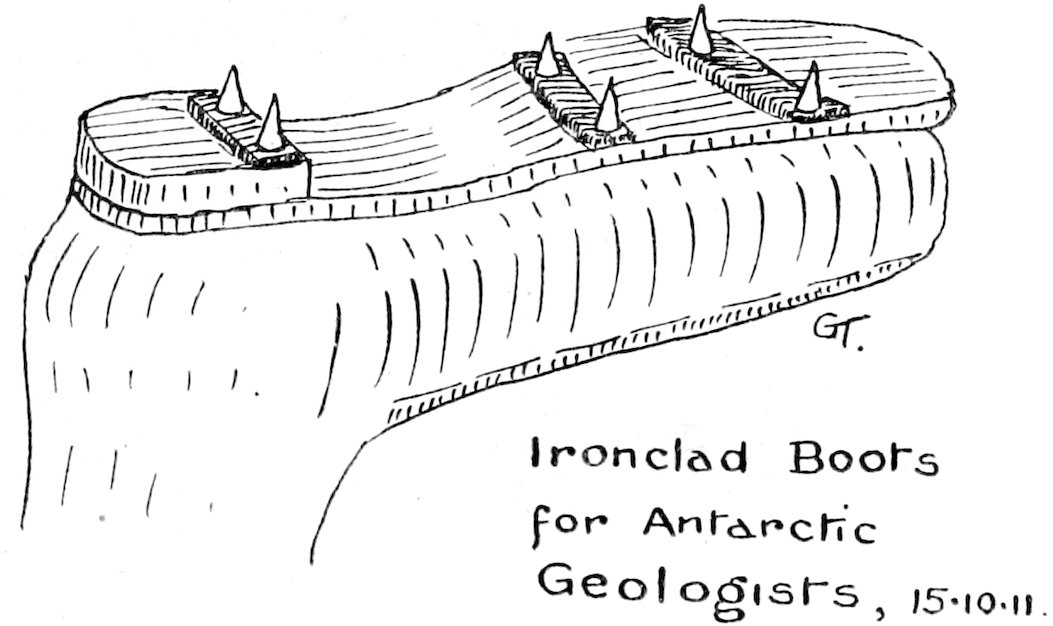
373On this expedition we had more of the trouble with boots which we had experienced early in the year. My “ironclads” had lasted splendidly. The steel spikes and bars had protected the leather completely, and only on the 14th did the first bar break off. For future work of this description I should certainly use the heaviest and largest Alpine boots, and that is the most valuable advice as to equipment that I can offer to future Antarctic geologists.
I had been busy planning how to measure the velocity of the Mackay Tongue. This flowed eastward between us and the Kar Plateau, so that by sighting from our granite cape to a fixed point on the Kar Plateau cliffs, I could fix very accurately a datum line. It only remained to plant a mark on the moving glacier somewhere on this line, and our investigation would be well started. Unfortunately we had nothing for a mark. I thought of placing a seal carcase on the glacier; for stones would sink into the ice in a very short time. Finally I used the butt end of the flag pole from the Discovery Bluff. Here at last we found the blubber-soot useful, for I used it as a paint to increase the visibility of a swab of sealskin which I bound on the bamboo stake. Gran and I marched across to the Tongue carrying the stake and the theodolite. I never remember any hotter walk than that two miles. The sun simply made the perspiration pour off us! However, one could always sit down and have glace au naturel to cool one. Personally, I never felt any ill result from eating snow in the Antarctic, and all our party quenched their thirst in this way.
374
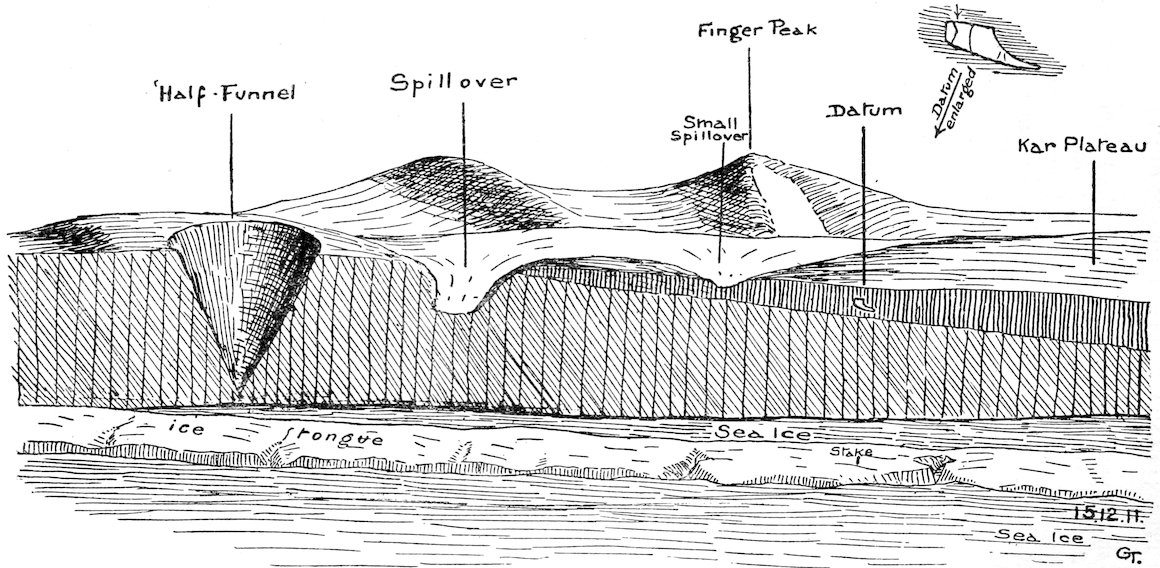
Looking north-west from Cape Geology, showing the granite cliffs of the Kar Plateau (1000 feet) capped by dolerite. The latter enclosed the granite “datum” whereby the movement of the Mackay Tongue was measured.
375We climbed up the Tongue without difficulty, but soon entered into a region riddled with crevasses. They were parallel to the edge of the tongue, and looked like relics of old lateral pressure rather than crevasses due to present movement. They were difficult to cross, especially as Gran’s boots were so slippery. We had to make a big detour to get on to the transit line. Finally, I got the theodolite set up, and sighted “fore and back,” until I got the cape and a crack in the Kar Cliffs in transit with my station. Here we planted the stake, and then returned viâ the maze of crevasses to the camp.
At first I could hardly see the stake from Cape Geology. The cold air close to the ice surface is always flickering on a warm day and mirages all objects; but soon I made it out at two miles through the telescope, and I could see that we could readily measure a movement of one foot a day.
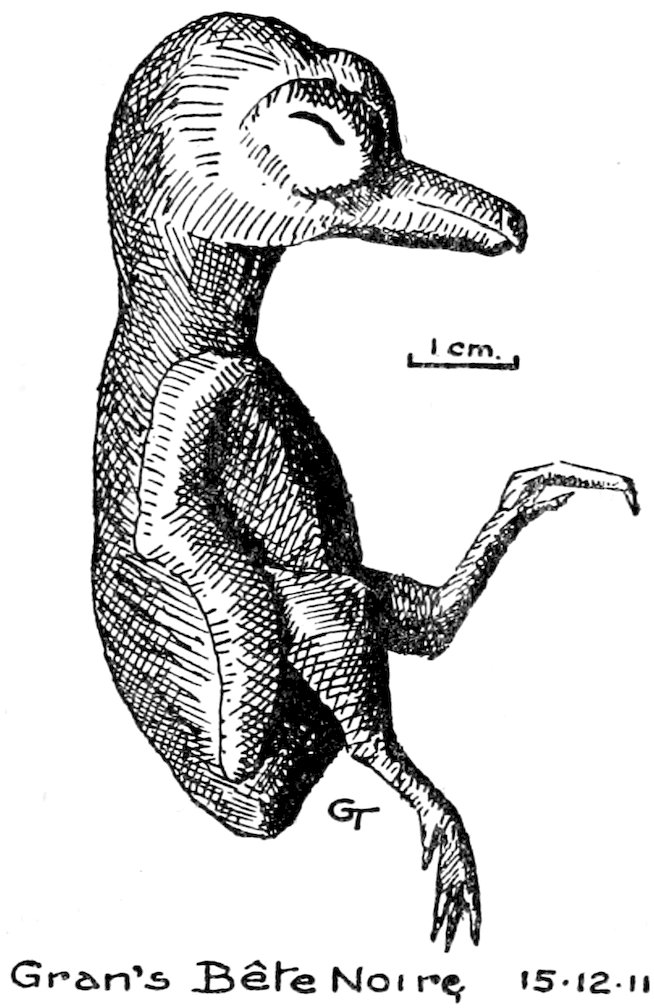
By this time we had collected enough eggs to have a feast. We took the precaution of frying them, and Forde and I tested them before cooking. The whites are translucent and faintly bluish, and have very little taste, but I don’t think we had much fault to find with them. It was amusing to see Gran’s horror when a twelve-day chicken appeared in one of the eggs. It was really an interesting discovery, for it showed that the skuas commenced laying about the 4th of December. We could not preserve the specimen, but I knew Dr. “Bill” would be interested, and so I made a sketch of Gran’s bête noire. We had a splendid seal-hoosh, tender, and flavoured with onion powder, and on top of this was a fried egg for each of us. It was Forde’s chef d’œuvre, and celebrated the close of his week of cooking.
376For the purpose of my survey I laid out a base-line about a mile long on the bay ice. From the known length of this, as measured by the sledge-meter, and angles from the two ends it was, of course, possible to determine the distance of any visible point. Each of these three points forms a station to which others may be linked; and indeed, in exactly this manner is a “triangulation” carried out.
On the 16th we started off to examine and survey the western coast of the harbour. Here the Mackay Glacier entered the sea, chiefly by the great tongue, but also by huge ice cliffs to the south, and by the new glacier in the south-west corner. We headed for a striking cape which projected from the glacier like a black hand stretched forth from a snowy cuff of glacier. We called this promontory Cuff Cape.
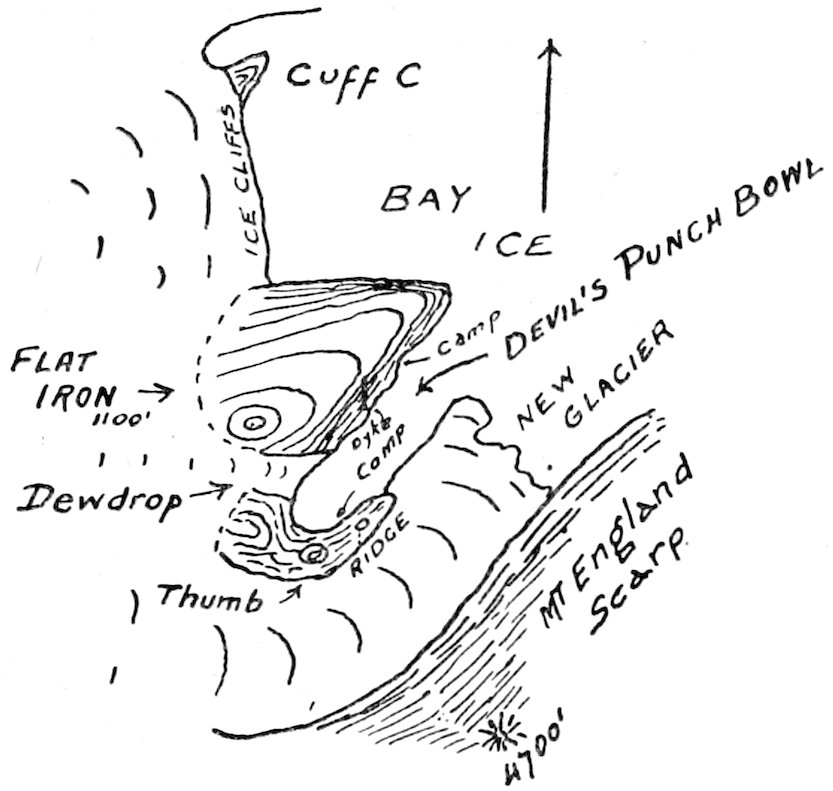
Sketch-map of region near the Devil’s Punch Bowl, December, 1911.
My finger was very painful, and the swelling now extended right through my right hand. Luckily I could pull in harness as well as ever, but for many nights I had no sleep, and I could do little or nothing in the way of making records during the day.
However, I became a fairly expert writer with my left hand in the course of time, but it was very galling to be incapacitated in almost the most interesting part of our journey.
377We camped on the ice-foot at Cuff Cape and scrambled up to see the glacier behind. Like all the land hereabouts the rock was covered with a layer of jumbled blocks of granite mixed up with gravel and clay. The ice cliff was fifty feet high, and almost free from silt or rock. Hence the debris on the cape surely marks the condition of the land prior to the last advance of the glaciers. It is not rock crumbled in situ, for I am sure that would be more in the form of a gravel—moreover, erratics were common.
There was, of course, some moraine material, and a few perched blocks especially along the north shore. In the bay near the Tongue the latter had broken the bay ice into square cakes, evidently by the pressure of the glacier; and the movement of the Tongue along the stagnant ice of Cuff Cape had piled a rampart of ice on top of the latter.
The hot sun acting on the ebony front of my camera had actually split it! Luckily I discovered it in time, and no damage was done to my photographs. Gran was very pleased at finding an insect on this cape, and while we were examining this wild animal, he also discovered “gold.” This latter, however, was only golden mica, though it quite resembled the precious metal.
On the 18th we moved across to the next cape. This stood out boldly with nearly vertical crags a thousand feet high bounding it on two sides. It closely resembled in shape the sky-scraper called the “Flat Iron,” and as it also had a flat top we gave it that name. We camped on the south-east side at the foot of a chimney which led up to a pretty little tarn. The summit was 1200 feet above the sea and was covered with a wonderful variety of rocks.
Looking up the glacier to the west we could see a plateau of dead ice. The moving glacier split on Mount Suess, and the greater part of the ice entered the sea as the Mackay Tongue. A small amount flowed down just south of the Flat Iron forming the “New Glacier” (see map, p. 376). In my opinion there is a tendency for greater erosion at the edge of the ice, for here the sapping action in the “lateral moat” is very active. In the centre of a glacier the only erosion is that due to glacier planation, and as I have explained, very little of this is taking place in Antarctica at present.
There was a marked descent from the top of the Flat 378Iron to the snow plateau, and then a steep drop into the “Devil’s Punchbowl.” The latter was a fascinating spot, and on the 20th we shifted camp so as to examine it more closely.
We were encamped on a small beach beneath the rocky wall of the new glacier, which we called the “Devil’s Ridge.” Probably the state of my finger accounted for His Satanic Majesty’s frequent presence on the map hereabouts. The Punch Bowl was an empty cwm or bowl-valley, which had been eaten into the steep southern edge of the Flat Iron. Its floor was below sea-level, and it would thus appear to indicate subsidence, for we have no idea how the accepted methods of eroding cwms (by “thaw and freeze” chiefly) could act under water. The New Glacier had very lately ceased to fall over the Devil’s Ridge into the cwm. It is only six feet below the ridge, and there is a drop of five hundred feet to the floor of the latter. In fact, thaw waters still cross the ridge and flow through the debris and down into the cwm. It is perfectly obvious that very little power is exercised by the “New Glacier,” or it would have swept the Punch Bowl out of existence.
There was a little tarn held back by a large bank of snow near the top of the ridge, and here Gran celebrated midsummer by a bathe! I envied him, but could not follow suit owing to my disabled hand.
Across the bowl a small hanging glacier entered the cwm but did not reach the sea-ice below. We called this the Dewdrop Glacier. It terminated in a rhomb-shaped face which was three hundred feet above the bay. In the bay itself was a great thickness of ice, and Debenham and myself had many arguments as to its origin. He believed it was an ancient relic of the Dewdrop Glacier; but I inclined to the belief that it represented old floe ice jammed up the narrow bowl by sea-ice from without. Gran and I ran a line of levels across it with the theodolite, which showed that it was still afloat although in places it rose many feet above the bay level.
We were running short of stores, so Gran and I marched back to our headquarters. While I collected the stores he looked around for skua eggs and soon found eight. The sea-kale did not show that verdant growth which Gran had 379anticipated. However, he dug up one corner of the “garden” and proudly showed me that one of the seeds was sprouting!
Gran put the eggs in a tin to carry them to the Punch Bowl. For security he carefully packed them; but as the tin was black and the sun was hot his packing, consisting of snow, soon vanished! However, we got the eggs safely to the others. Unfortunately five were bad, but the others assisted the menu at our midsummer feast.
On the 22nd Gran and I explored the ridge and examined the Devil’s Thumb. This knob is eight hundred feet above the bowl and is composed of granite stiffened by porphyry dykes. Next day we spent some time examining a huge enclosure of limestone caught up in the rocks forming the Flat Iron. The crumpling and heat had turned the limestone into marble, and along the junction with the granite many unusual minerals had been formed. There were huge brown augites several inches long, and large masses of natrolite, tremolite, and other similar minerals, which filled Debenham’s petrological soul with joy.
We returned to Cape Geology on the 23rd of December. In our absence the tide crack and pressure ridges had been torn wider by the pressure of the Mackay Tongue on the sea-ice. However, we got ashore without much difficulty by zigzagging along the torn edges of the crack (see p. 369).
We found the floor of the hut inches deep in ice, which Forde cleared out with the ice-axe. Meanwhile Gran was busy at the medical chest, where the long names rather confused him. However, he seemed to remember “aspirin” as a useful friend, and said it was suited to my case. I swallowed some of the tabloids. Then he came across “salicylate,” and apologetically remarked that the latter was what he had been thinking of. So I tried them also. I was of the opinion myself that my trouble was a combination of frostbite, blood-poisoning and rheumatism, due primarily to an infected cut, and later to cold and a diet of seal meat. However, on return to civilization I was assured that I ought to have had my finger cut off, and that the bone had been affected. Gran very willingly started operating on it with a lancet; but I am thankful to say that I distrusted his powers as a surgeon, with the result that now all is well.
On Christmas Day we roamed about Cape Geology 380collecting specimens and skua eggs. I was pleased to see signs of intellect in two of the skuas, for my observations of seals, penguins, and skuas left me convinced of their stupidity. However, in one nest the bird had dragged some moss from a patch a foot distant, and in another case some quill feathers were arranged around the nest. All the other birds nested anyhow and anywhere. A gully, where water often trickled down on a specially hot day, was a favoured spot!
For lunch we cracked twenty-seven eggs, of which eight were edible. Then we opened the Christmas bag and we found therein a small pudding ready cooked and some caramels and ginger. Forde had rigged up the flap again, and had raised the Irish flag on his own behalf. He cut out a white harp from a linen specimen bag and sewed it on to a piece of green burberry. The result was patriotic and striking. Gran’s sledge flag was a beautiful piece of embroidery presented by Queen Maud, and contained the Norwegian arms. Debenham’s and mine bore the arms of our universities.
I had carved a spoon out of a piece of bamboo from the broken end of our depôt flag, and Debenham used this as a lever to photograph our group. This primitive arrangement took a lot of fixing, but he obtained quite a successful picture finally.
A heavy sea fog rolled up that evening, and most of us suffered from rheumatic pains. As a rule, we never caught cold while sledging, though I remember a touch of influenza on one occasion. This freedom from some of the minor ills of life speaks well for the purity of the air in the Antarctic.
Debenham’s birthday is the 26th of December, and Gran had remembered this fact and carried a packet of cigarettes from Cape Evans as a present to him.
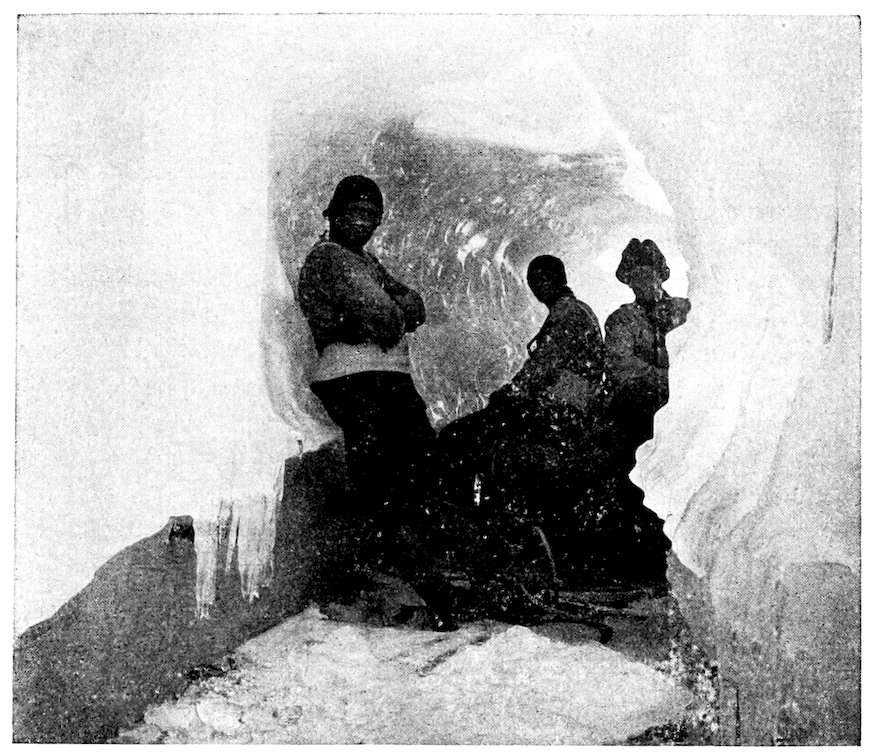
THE FIRST WESTERN PARTY IN A NATURAL ICE-TUNNEL AMID THE PINNACLES OF THE KOETTLITZ GLACIER. Edgar Evans standing.
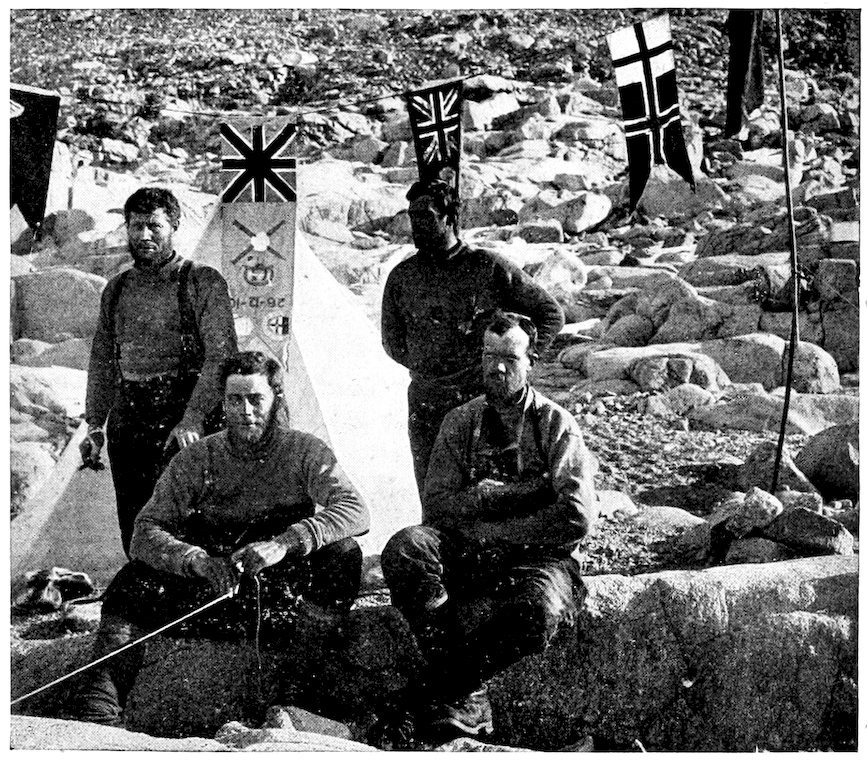
THE SECOND WESTERN PARTY AT CAPE GEOLOGY, GRANITE HARBOUR, ON CHRISTMAS DAY, 1911. Forde and Gran standing, Debenham and Taylor sitting.
We walked along the flank of Mount England to explore the New Glacier and to find a track to the Upper Mackay. Numerous couloirs or chimneys grooved the steep face, and Gran and I climbed four hundred feet up one of them. The snowline was about eight hundred feet up, and below this was a tumbled pile of debris and granite blocks with a little water running between. It was obvious that frost action was now leading to a great deal of erosion; while at the head of the couloir where the snow lay, less action was taking 381place. In short, true glacier erosion (planation) was absent, and yet all round were specimens of cwms in all stages of their evolution. Here a gully, there a couloir somewhat deeper, on the Kar Cliffs a couloir cut into a “half funnel” (p. 374); at the “Spillover” near by, a small bowl at the back of the eroded notch, and along the mountain ridge (named later after Gonville and Caius College), a series of giant cwms which, in my opinion, originated in some small gully such as that I had just climbed. At the foot of each of these deep couloirs was a delta or debris fan.
We climbed up the steep face of the New Glacier just where it joined the talus of the mountain slope. Higher up was a deep lateral gully which had been dammed by debris, and contained a lake about a quarter of a mile long. This was bounded by steep granite cliffs on the south, which showed no sign of grooving by the glacier, but was breaking off in “shells” owing to frost action.
We could see up the New Glacier, which was badly crevassed in many places. I came round to the opinion of Debenham and Gran, that it would be wiser to portage all our gear up the 1000 feet cliffs of the Flat Iron, and so gain the quiet area behind the latter. We returned to Cape Geology, and packed a fortnight’s provisions and gear for our journey up the Mackay Glacier.
I caught many of the insects I had discovered on arriving at Cape Geology. Indeed, later Debenham found them under most of the stones, clustering among the whitish roots or hyphæ of the moss. They would be frozen stiff in a thin film of ice until one turned the stone into the sun. Then the ice would melt, and they would move sluggishly about until the sun left them, when their damp habitation froze again! I cannot imagine a finer example of hibernation, for it looked as if they pursued an active life only when a beneficent explorer let in a little sunlight on them! Debenham detected a little red species which was much more nimble than the millimetre-long blue ones, and I had much trouble in catching six of them; but the others were more easily managed. I smeared a piece of paper with seccotine, and then, taking a small brush from the medical outfit, I brushed them by hundreds on to the paper. “Seccotine sticks everything,” and the aptera were no exception. In a few moments they 382were securely embalmed like the flies in amber, and so we safely carried a thousand of these unknown insects back to civilization.
At noon on the 27th we arrived at the foot of the Flat Iron again, and started our big task. Like most premeditated ills, it was not so difficult as anticipated. First we had some tea on a little gravelly ledge about a hundred feet up, and then packed the gear for transport up the mile of angular granite blocks which lay between us and the top of the Flat Iron. Forde and Gran carried the sledge on their shoulders, and, as may be imagined, had a most uncomfortable journey with this “old man of the ice” to handicap their scramble. Debenham and I carried food and gear, and in about a dozen journeys everything was perched high up on the Flat Iron’s summit. Open water was visible from five hundred feet, so that it was still about twenty-five miles away. Pennell had not much chance of reaching the rendezvous unless the ice went out at a mile a day.
We left our snug gravel island next day, and knotted ourselves well to the sledge. We were now to journey for some days over the Mackay Glacier, and though we naturally chose the smoothest and least disturbed ice for our route, yet we had to pass near areas full of huge crevasses. I had less anxiety than ever to fall into one, for I could not use my right hand at all yet. However, the other three were almost too prompt to pull me out, as I realized a week or two later.
We zigzagged down on the snow plateau. This is about ten miles wide, and seven miles from east to west. It is bounded by the New Glacier crevasses on the south, and by rock islands which we called Redcliff and Mount Suess on the west, by the chaos of the Mackay Skauk on the north, and by the Flat Iron and Cuff Cape Glaciers to the east, where there is a 1000 feet drop into Granite Harbour.
“The surface was covered with deep snow; we don’t know what is beneath. There are many indications of east-west depressions in the snow into which we fell occasionally, but I am not sure if they were crevasses. The surface often fell in with a widespread sigh, which was eerie but harmless.
“To the south is a wonderful series of peaks about five thousand feet high, forming a wall of giant cwms. Probably they form the divide from the next great valley (of the 383Debenham Glacier). Quite a number of these peaks show a recurved spine on the summit, which is probably due to the weathering of dolerite crags. To the north-west is a mountain approaching seven thousand feet, which is capped by dolerite lava.” (We called it Black-cap at first, but it is now officially known as Mount Tryggve Gran, after our ever-cheerful comrade.) “In the face of this mountain are faulted white bands which are probably Beacon Sandstone.”
That evening we camped on Redcliff Nunakol. This latter term I invented with Gran’s assistance to describe a rock island resembling a nunatak, but rounded by previous glacial erosion. The nunatak has properly never been below the ice; hence its name, from the Icelandic nuna, lonely, and tak, a jagged peak. Nunakol is from nuna, lonely, and kol, a rounded ridge.
Mount Suess Nunatak, looking west from Redcliff, December 29, 1912.
We placed the tent on a patch of gravel near to a little waterfall. I followed up this stream, and found that it rose in some swampy ground where a little moss was growing. Next morning we all explored the Nunakol, which was 1080 feet above the glacier. The top was more or less flat, and as usual consisted of granite covered with much debris. I managed to do some sketching, and was especially interested in the numerous pot-holes cut out in granite by the wind. They were about a foot in diameter and eight inches deep, and each contained some pebbles by which they had been scoured out.
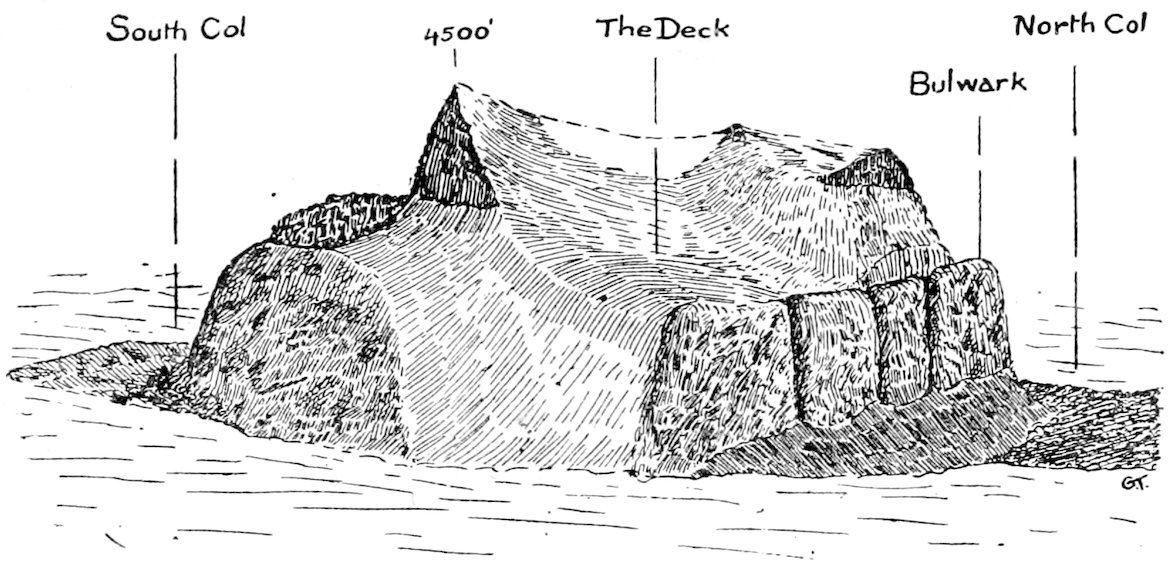
384To assist our survey we named many of the peaks and glaciers around us. The sharp peak to the north (which I usually made the datum for the theodolite angles) we called the “Referring Facet.” A large tributary glacier to the east of this was named the Cleveland Glacier by Debenham. He explained that it was after a large family, and so required a correspondingly large natural feature! Red Ridge was to the south, and formed of red granite. Killer Ridge had the shape of an orca, Sperm Bluff was a black headland like the blunt head of the sperm whale. Pegtop and Dome nunataks are self-explanatory. We were quite close to Mount Suess, and obtained a fine view of this nunatak. Its three dolerite peaks, the armchair hollow, and the bulwark on the north-east, supported by huge granite cliffs, made it a very striking object.
On the 30th the day was overcast, and it snowed most of the time. We could not leave the tent, and lay snug in our bags and mended gear. I did some useful darning, using seaming twine to repair my socks. They were lasting splendidly. “I mended them with my left hand; so far I am still wearing the same socks for eight weeks. If I could darn easily, I’d keep to them for our whole fourteen weeks....” Such was the practical value of my patent canvas heel-tips!
Debenham and I made a set of chess pieces from cardboard, and we played on his survey plane-table. It took a week or two to get used to the men, but we had many games later while we were marooned on Cape Roberts.
On the last day of the year we pulled westward to Gondola Ridge. “All was snow-covered, and we sank four inches into it, but the sledge pulled pretty well. There was no sun, but I got in a cold sweat with the work. Now and again our feet would sink a foot or two. There must be plenty of crevasses round this corner of the nunakol, but we trusted the fates and plugged on. The snow was so deep that we did not break through the bridges anywhere. The sun came out to cheer us, and soon we heard the old creaking due to ‘bottle-glass’ ice and ‘glass-house’ ice....” I knew this meant an ancient undisturbed glacier from our experience up the Koettlitz Glacier, and felt that we were safely past the crevasses.
About noon we had approached close to Gondola Ridge, which extends northward from Mount Suess. Here we came to a sudden ice cliff, but the slope was not too steep for us to 385toboggan down it on to a lake surface fringing the moraines. I expect thaw waters had cut out the cliff. Here were fine debris cones just like those of Cape Evans, but larger, and formed not only of dolerite, but of granite and Beacon Sandstone.
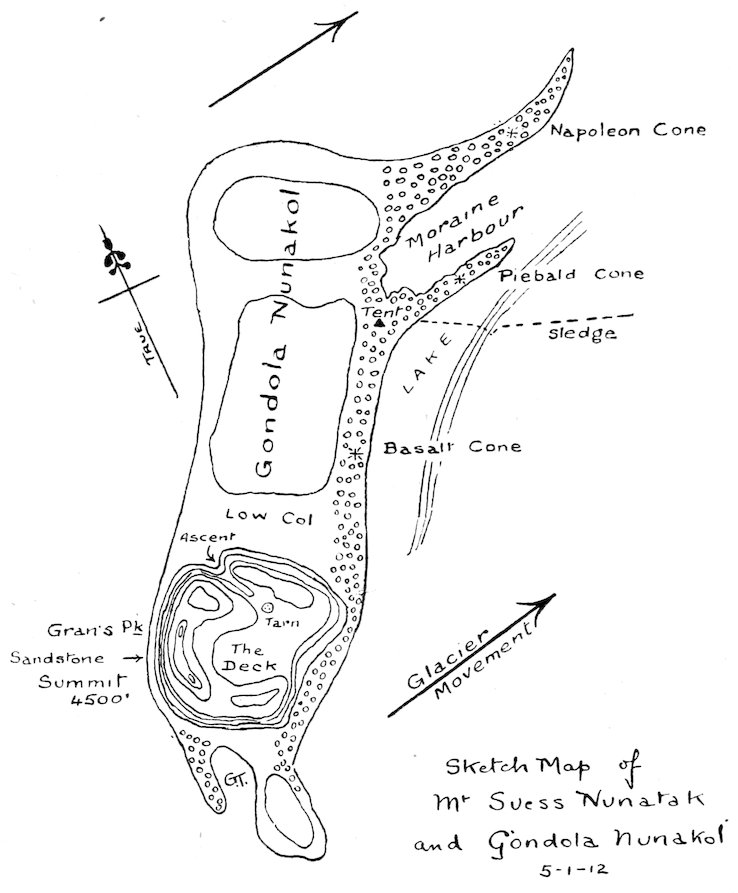
“We pushed on for a whitish silt-bank, and then left the sledge near it among the black and white rocks composing the moraine. The silt-bank was a huge heap like a railway embankment. It was twenty feet high, and composed of 386Beacon Sandstone debris. A little lake lay at the foot, and its flat top made a splendid camp site. ‘Here, on soil formed of real sand, like that near Sydney, we pitched our tent:’—probably the first time such a thing had been done in Victoria Land. We found a bounteous water supply by cutting through the ice of the little lake, for alongside a big black boulder the radiation of the sun’s heat had melted the ice. This was a great saving, for none of our precious oil was now wasted in melting the ice.”
There was an extraordinary mixture of dolerite and sandstone all over the Gondola Ridge. The sandstone was characterized by blebs, which in Germany would be called “Knoten.” We called it briefly “smallpoxy,” and it did not look hopeful for fossils. However, there was some shale near the tent, which looked more hopeful. We did not find much beyond worm-casts and ripple-marks at first.
The discovery of fossils was of especial importance to Australia, because the central Antarctic area had served as a distributing base for Australian animals and plants. The marsupials are represented by a few forms in South America and New Guinea, and there seems little doubt that land extended more or less continuously between these limits. Earlier still South Africa was joined to this Antarctic world, for land-worms allied to those in the other southern continents are now known from Cape Colony.
When Gran and I returned from our first survey of the ridge we found that Debenham had already been successful in the shales. He had found some vesicular horny plates. I turned to, and soon obtained two large pieces like the red tiles capping a roof-ridge. They were nearly two inches long, and had a well-marked keel. There were also smaller complete plates. On our return to Europe these were identified as the armour-plate of primitive fish, and probably of Devonian age. So that our find on Gondola Ridge added a new epoch to Antarctic fossils, for Cambrian limestones were known, and Permian coal-measures were indicated by Shackleton’s specimens. These fish plates identified another set of sediments midway between them.
The moraines near our camp, though by no means so abundant as on a smaller European glacier, were the most important which I saw actually on a glacier in the Antarctic. 387To the north-east two medial moraines stretched out from the ridge and enclosed an area which we called the Harbour (see p. 391). In a warm summer this is probably a lake. One striking “piebald” debris cone was half white and half black. It was twenty-five feet high, and the eastern portion had resulted from the weathering of a huge “erratic” of sandstone, while a similar mass of dolerite had broken up to form the western half of the heap.
Even so far up and away from the sea we found some lichens. These diminutive plants were busily etching the surface of the granite just as in more clement climes. Beautiful rounded and polished platforms were quite abundant on the ridge. Occasionally a hard band of porphyry would project and show almost a glaze where the coarser granite had been weathered and dulled.
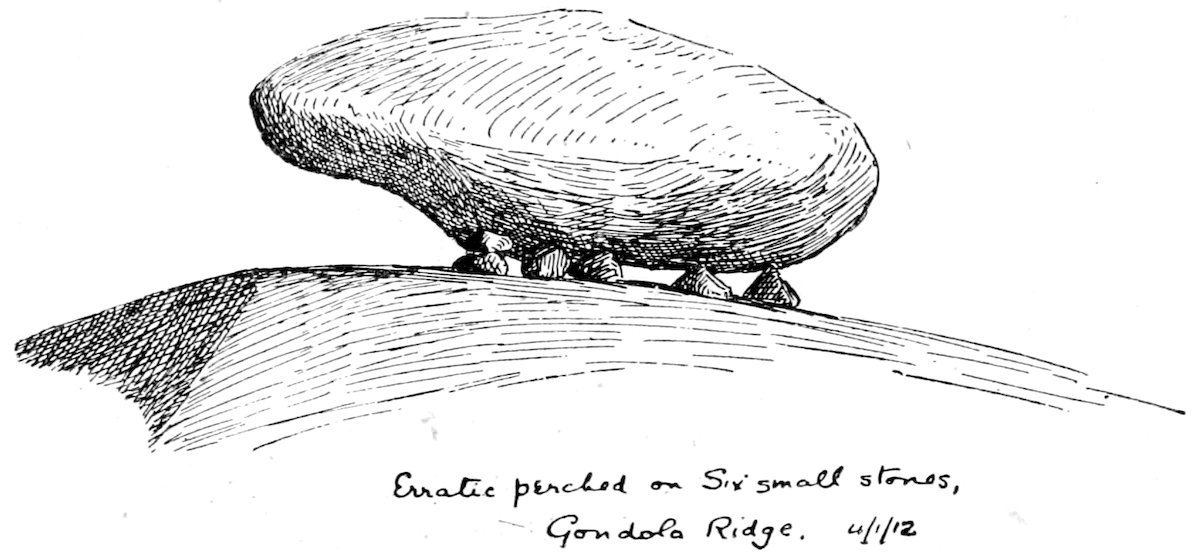
We could now see uninterruptedly to the great ice plateau. Only one nunatak lay between us and the outlet ice-falls near Mount Gran. We saw many examples of perched blocks, some being deposited on top of polished faces of granite. One huge block, which I sketched, had been lowered gently by the ice on to four “legs,” at one corner composed of two small stones. Between Mount Suess and Gondola Ridge was a definite “col” or low pass containing small tarns and covered with debris. We returned to the camp by this route, and had no difficulty in clambering down its eastern outlet.
The 2nd of January was a cold gloomy morning. The clouds settled down and swathed everything in a clammy 388mantle. I dared not move far from the tent, and so we broke up shales and collected more of what Evans called “sarpent critters.” I found a few brilliant blue plates with a lustre like that on the elytræ of beetles! I walked over the north end of the ridge where the solid granite was broken into large “bricks” separated by several inches. These blocks seemed to have moved to the east, and this movement may be due to glacier “plucking”; but I think it is merely the result of frost cleavage followed later by rock “creep.” At any rate it was very common on the “floors” left by the recession of the ice-sheet.
Debenham in his prowl for specimens had discovered a coal-mine! In this case it was not a large one, and consisted of a fine lump of brown coal about four inches across.
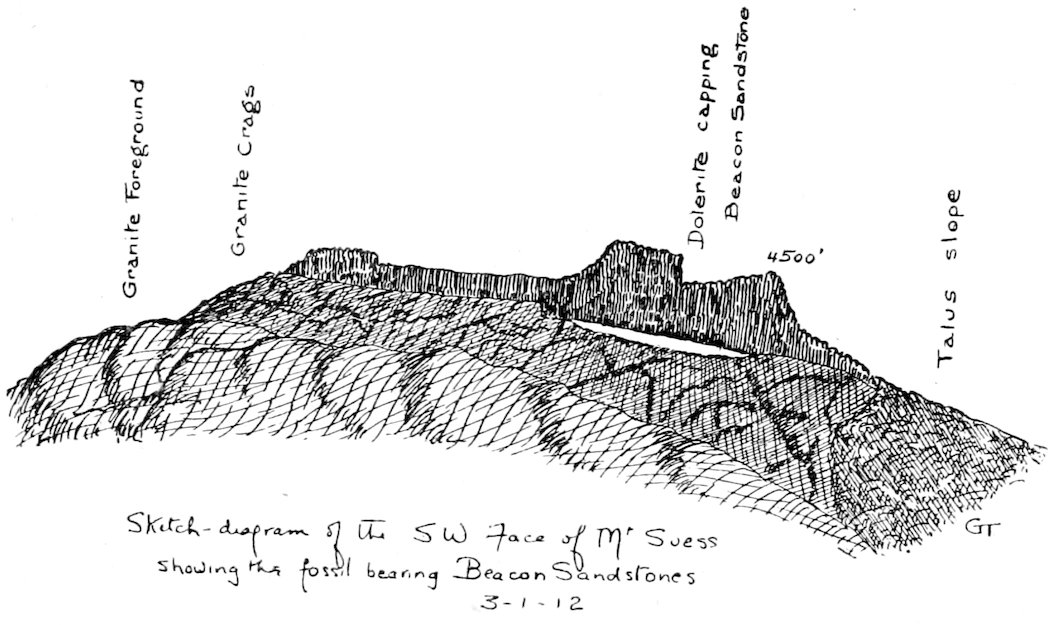
On the 3rd Gran and I determined to circumnavigate Mount Suess. This most striking mountain lay about one mile south of us. It towered 3000 feet above Gondola ridge and was a most impressive sight. The upper layer consisted of black dolerite, largely showing columnar structure. The main mass was formed of reddish granite. It stood out foursquare like some gigantic castle keep (see Fig., p. 383). The centre was hollowed out and three cusps or peaks rose at the north, west, and south angles respectively. In fact, it resembled more than anything an ancient molar tooth, though this parallel libels its rugged grandeur.
As we marched round its east face we came on more and more dolerite in the moraine. This had evidently been swept round the south of the mount, and as this moraine contained the sandstone fossils it was very important to see where the moraine originated. Between the mount and the glacier to the south was a low col of granite from which talus debris reached upwards almost to the dolerite cap. The mount itself looked yellow, but I found this was due to a yellow tint in the granite.
The sky was clouding, and we had still a long way to go. So we hurried round to the west side of the mount, and here I saw what I had expected, that between the granite base and the dolerite capping there was a long “lenticle” of yellow sediments. It was, however, quite inaccessible from below, and after making a sketch we marched on the north. On this side there was very little talus. We clambered along over 389granite terraces some 300 feet above the glacier. We crossed the top of the north col without difficulty and proceeded over Gondola Ridge to the tent. Later, Debenham and Forde appeared. They had found an easy route to the central hollow of the mount, which we called “The Deck,” but had not had time to ascend one of the peaks.
On the 4th the morning was clear, and I felt that we could not do better than get the theodolite on the top of Mount Suess, and so connect up many of the distant peaks with our survey.
Debenham decided to stay below and continue his plane-table survey. Gran took his camera, and Forde and I carried the theodolite, etc. We climbed up the gap at the north corner, and then scrambled along a slope full of snow-covered boulders which lay between the main peaks and the 1800 feet Rampart. This latter feature seemed as if pierced for guns also! Possibly the gap and the “ports” were due to the weathering away of volcanic dykes in the granite. They did not look as if ice had cut them out. Where the gap emerged on the “Deck” were two little tarns at about 1200 feet above the tent.
Gran proceeded to climb the central-west cusp of the mount, thinking it the highest. Forde and I attacked the south-west peak. The slope was very steep and covered at first with grey granite, black dolerite, and yellow sandstone 390blocks. At 2000 feet only the dolerite blocks were seen, so that I feel sure that the sandstone crops out inside the hollow of the mount (between the granite and dolerite) as well as on its western face.
At 1.40 I reached the top and found that it was 3000 feet above the tent. I set up the theodolite and obtained a fine series of angles. Sighting on Gran’s peak, which he had just surmounted, I found it was two degrees lower, which I estimated at about a hundred feet, whereat he was somewhat crestfallen. However, he walked across after obtaining a splendid set of photos of the landscape spread out before us. The actual summit was fairly flat for a few yards, with a thousand feet precipice on the south and west. Far out to sea we could see miles of open water, especially to the south, with floes drifting in it, but it did not seem much nearer than a month ago.
To the south a deep fiord-like valley seemed to pierce right through the Gonville Range. It was of course filled with ice, and was, I think, what the Americans call a transection glacier. Probably it connected the Mackay Glacier with the Debenham Glacier. The cliffs at its west portal were cut into giant “forts,” and bands of beacon sandstone showed clearly enough above the granite.
To the south lay the Sperm nunakol. It was only a mile away, and we seemed to be right over it. It showed a flat surface covered with debris much like the Flat Iron. The Peg Top nunakol seemed to have lost its knob-like appearance. It was somewhat Ꭲ-shaped, the front bar rising like a crocodile’s head from the covering of ice. To the south of this rock island there seemed an easy route up to the Plateau—good enough for ponies, if the first step up to the “Flat Iron” could be negotiated.
A very high mountain, possibly 10,000 feet, showed to the west. We could not estimate its distance properly, for all our survey angles to it were so acute.
After spending two and a half hours on the summit we hurried back to the camp, and found that Debenham had passed a useful if uneventful day.
391
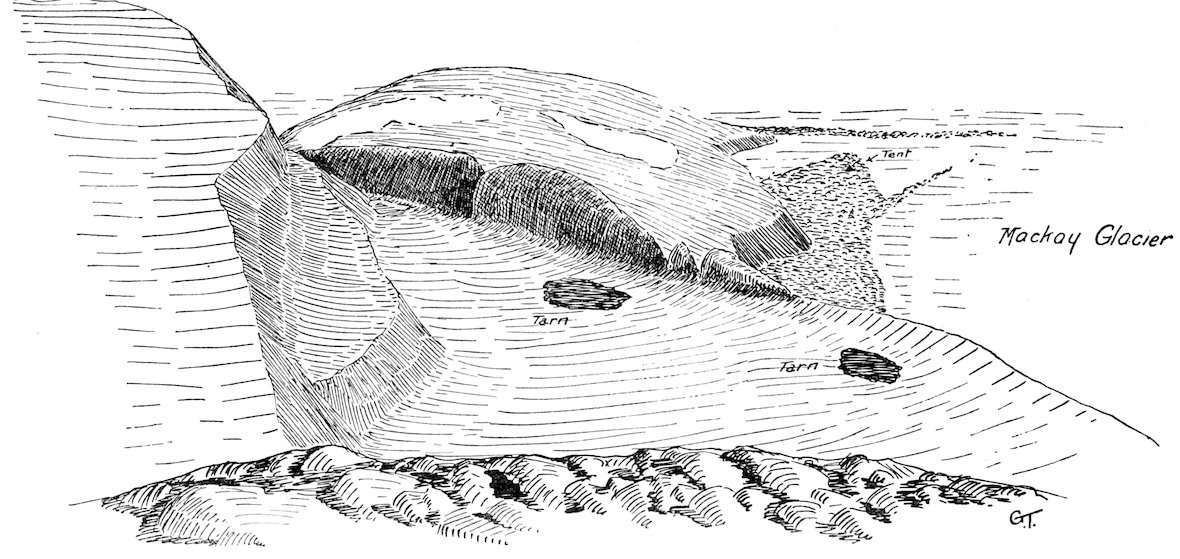
Gondola Ridge from the top of Mount Suess, looking north-east, January 4, 1912, showing the “deck,” ramparts, and medial moraines.
On the 6th of January we took down the tent and transported our gear across the rugged moraines to the sledge. While I was packing the fish scales in cotton-wool, the other 392three had found more coal near the sledge, and they soon collected five specimen bags full. It was undoubtedly derived from Beacon Sandstone beds close to our camp, and possibly from the outcrop we had seen on Mount Suess.
We marched straight back to the Flat Iron, camping for lunch about halfway. It was interesting to note the way the snow lay in various regions. Small cwm valleys at low levels were filled with snow and ice, while large plains at higher elevations to the west were seen to be almost bare. Perhaps the snowfall varies with height, while the ablation (evaporation) may depend largely on the wind direction.
Next day we devoted to a survey of the Flat Iron. I went to the northern face to see if we could drag or lower the sledge down the glacier without unloading it. I had a light camera and was able to take a few interesting photographs. The first looking over Cuff Cape to the north illustrated the following physiographic features: the ice face, crevasses, skauk, young calf-bergs, moraines, retreating glacier, granite pavements, shear cracks in bay ice, the ice tongue, facets on the cliffs, cwms, overflows, hog-bag ridges, the junction of the granite and dolerite, and the Kar Plateau—all on one quarter-plate negative!
To the south was the small tarn I have mentioned earlier. The furrowed face of Mount England was reflected in its still water, and a solitary skua gull was preening his feathers on a boulder in the lake. I managed to get a successful photo here also.
Meanwhile a sea fog was rolling in from the east. Gradually it blotted out all the features below us. I had just time to hurry back to the tent before everything around us vanished. Debenham turned up a minute or two later, but I was getting anxious when Forde and Gran returned. It is impossible to find one’s way in these fogs, and exposure to Antarctic weather is a thing to be dreaded even in summer.
Next morning we started transporting our gear down to the bay ice. We followed our former route, which certainly seemed to have been the best. We had now to carry down many specimens, for the Flat Iron was a wonderful collecting ground. The main mass is grey granite, but it includes many varieties of schist and bands of altered limestone; gabbros, amphibolites, quartz porphyries, marble, mica-schists, felsites 393and rhyolites were mostly in situ, while erratics of basalt and sandstone were common.
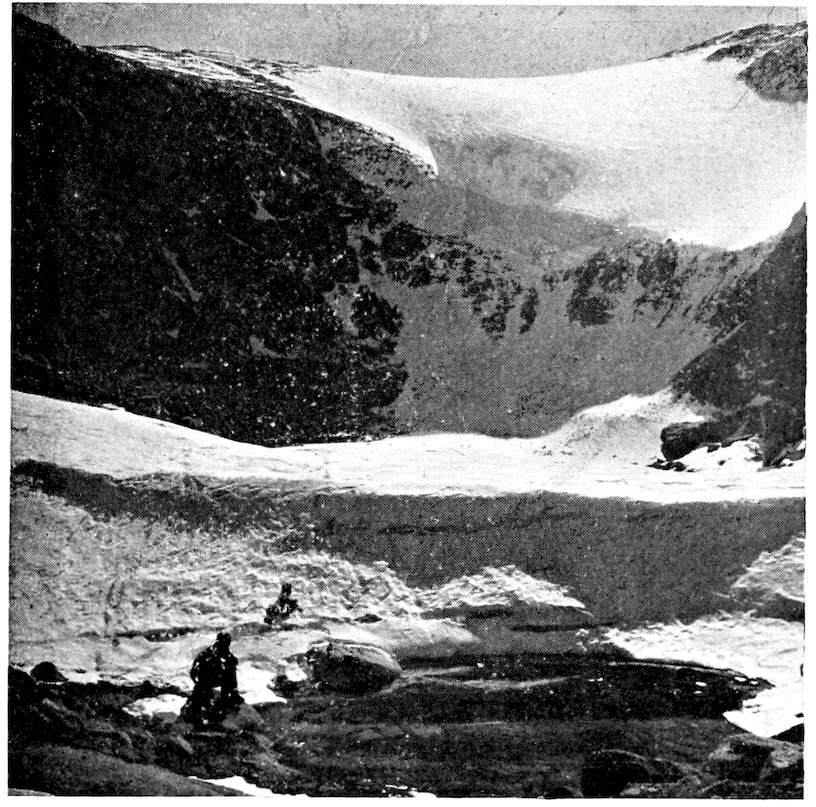
GRAN’S MIDSUMMER BATH, DEC. 21, 1911. A small tarn of the Devil’s Ridge overlooking the Punchbowl (300 feet below). Across the latter appears the Dewdrop Glacier. The tarn is held back by a snowdrift glacieret. [See p. 378.
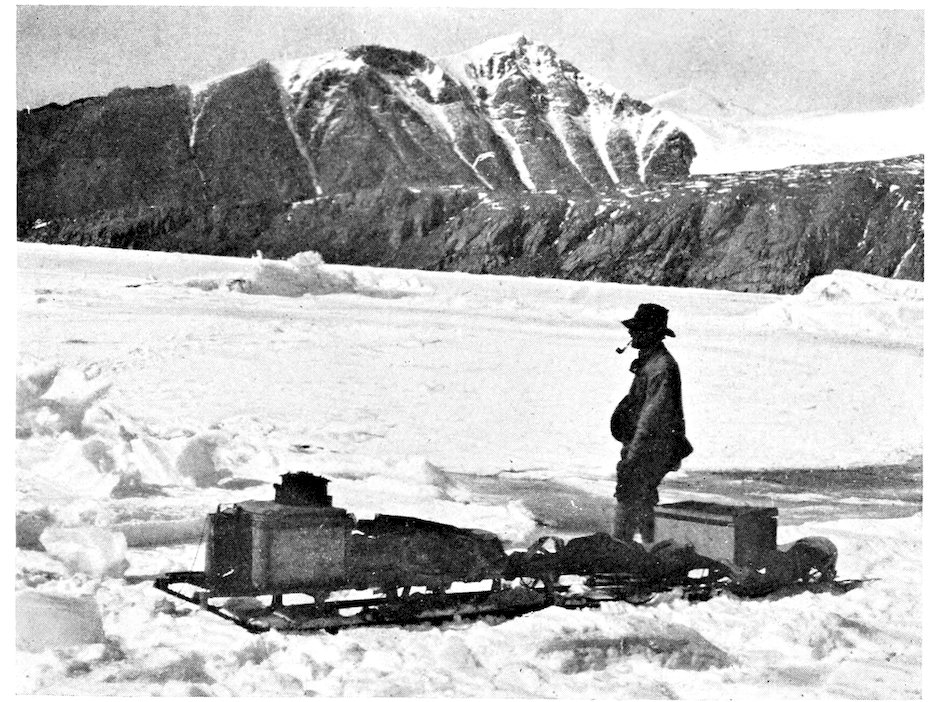
Photo by Gran.] THE COULOIRS OF MOUNT ENGLAND (WHICH DEVELOP INTO CWMS LATER). The Flat Iron hides the base of the mountains. In the foreground the ice-foot of Cuff Cape.
The rough shaking to which our gear was subjected resulted in our losing the top of the theodolite tripod, the pump-knob on the Primus, and the sight-ruler! Debenham found the latter, but we had to use makeshifts for the other lost articles.
At 7 p.m. we were back at Cape Geology. Each time we returned we found the pressure ridges and tide crack off the cape had altered in shape and made our approach more difficult. The skua gulls had found our blubber store and were gobbling it up as rapidly as they were able. Our hut floor was inches thick in ice, but we gave up trying to make the hut comfortable, and the cook shivered out there at the stove, and then brought the food down to the tent, where we ate it in comfort.
At this time we were devoutedly hoping for wind, so that some of the sea-ice should blow away and permit the ship to reach us. Captain Pennell was due any day now, but the bay ice looked as solid as when we had entered in November.
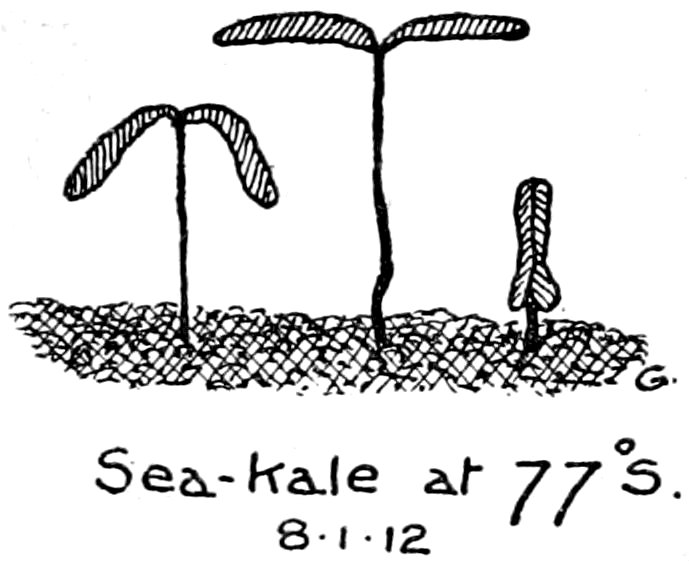
We inspected the “vegetable garden” and found that twelve dicotyledons had sprouted! I imagine these are the first grown in the open air within the Antarctic circle! They seemed thirsty, so I gave them some water. But, alas! the weather rapidly grew colder. Every day a few were blighted, and, finally, I carefully gathered the remnants and placed them in my pocket-book as a record of Gran’s well-meant experiment.
I was much disappointed with the moss. It lay in peaty clods between the boulders, usually in lumps about the size of a large bath bun, and had formed a considerable amount of humus. But it remained almost black and dead all this summer. Usually January 15th is the warmest day, but this season December was much warmer than January, and I think the backward condition of the moss showed that it was an exceptionally severe summer.
I was now cook again, and will copy some of my cooking 394notes. “At 4.30 I dug up the seal meat cache, and found a whole liver buried deep under a layer of ice. It all seemed fresh, and Forde helped me to cut it up on a board outside the hut. Then I got the stove lighted by blubbery paper pretty easily, and the cooker full of water. I heated this for cocoa till it began to sing, and then put on the frying-tray. This latter was the base of our cooker, but served excellently as a pan; except that it was so large that one part of the meat would freeze while the rest was frying! I put in some fat, and tipped in four mugs of cut up seal and liver. It took about three-quarters of an hour to cook, being stirred continuously. I fear me I used my dagger as poker, cutter of blubber, as scraper of soot, stirrer and taster, all indiscriminately! However, with onion powder and salt it doesn’t taste badly, though it makes my teeth ache chewing it. The cooker of warmed water boiled in no time, though it had been cooling for three-quarters of an hour, and we had hot cocoa to time. I had only one biscuit, so that it was a cheap indigenous meal.”
The weather had been rather disagreeable during the last month, about four days fine alternating with five days overcast. This is not usual in midsummer, but we chiefly required strong winds to blow away the sea-ice, so that Pennell could reach us. With a sailor’s superstition Gran hung up his most dilapidated headgear “for a favouring wind.” He said it always took effect in twenty-four hours. However, as was often the case with our sanguine prophet, nothing came of his forecast, and his stock was flat again.
On the 11th Debenham swore that he saw the Terra Nova. Gran confirmed this, and said the sails were set. I got hold of the binoculars, and alas! I saw three Terra Novas. They were miraged bergs, I fear. I thought it would be a good plan to have a signal on top of Discovery Bluff, and so Gran and I carried paper, blubber, and dried moss, to the summit, and left them there in readiness for a flare, if the ship approached. I carried up the theodolite, but did not take many angles, for it began to snow. When I returned, I found that Forde had kindly done my cooking—or rather greatly improved on it. He made some excellent chupatties from “thickers” and raisins, of which we had a small surplus.
That evening we had a great argument about the possibility of a German invasion, Gran versus Debenham, in 395which Forde and I took sides to keep things lively. “We agreed that Germany could not conquer a colony, even if it were handed over to them; that the Kaiser’s aspirations ought to be humbled, and that the British officers were not so highly educated as the German.” Gran had many tales of the vast amount of linguistic and mathematical knowledge which they amassed.
Friday the 12th.—No sign of the ship! This is the day I backed for our meeting. However, my cookery is over for a time.
Gran and I walked over to the Tongue to measure the movement of the ice. On the 26th of December I had sighted on to the stake with the theodolite, and obtained a movement of thirty feet in twelve days. “She is fairly galloping to sea.” On this occasion we both wore spiked boots, and so had little difficulty on the glacier, though the recent snow had hidden all but the largest crevasses. On arrival at the stake—which had not suffered from the blizzards—Gran lay on the snow with the field glasses, and observed Debenham, who was posted with the theodolite at the camp station. Meanwhile I moved east or west, and Debenham signalled to Gran until I stood on the transit with the crack in the Kar Cliffs. Now I made a direct measurement from this line to the stake, and found a movement to the east of eighty-two feet. Therefore the glacier has a velocity of almost a yard a day. The sketch (Fig., p. 374) shows exactly how this determination—which I believe to be the most accurate in Victoria Land—was made.
Gran suggested trying another route back, so we moved into one of the huge gullies (which nearly dissect the Tongue every half-mile) and we found it remarkably easy. There were three little lakelets between thirty feet walls, showing there was no drainage into crevasses here, and we reached the bay ice with great ease.
I discussed pushing off for Cape Roberts instead of waiting close to the Bluff. There was no possibility of the ship coming in to us, and we could meet them as easily from the entrance. On the other hand, there seemed no way out of the cul-de-sac at Cape Geology if the ship did not arrive, and the sea-ice broke away. So, after talking it over, I decided to leave our headquarters on the 14th.
On the 13th Debenham and Gran went to the Bluff, and 396Gran climbed to the top to scan the ice in Ross Sea. Debenham visited the flag, and made a chart of the great shear cracks in the bay ice, due to the Mackay Ice Tongue.
Forde and I packed everything which we should need for sledging at Evans Coves on the good sledge. We packed the specimens, and some articles not now necessary on the “roof-tree” sledge. This necessitated dismantling Granite Hut, and very woe-begone it looked, with the sealskins flapping dismally on its walls. They had turned into fine black fur now, but were not beautiful enough to warrant transport on our heavily laden sledge. The skuas enjoyed our removal. They pounced eagerly on our specimen bags, and flew off some distance with several, in the hopes of finding a dainty morsel.
I was much amazed at the unusual sight of two skua gulls amicably tearing a piece of blubber up between them, and bolting half each. I never saw another instance of so much sociability.
“On Sunday, January 14, I woke the others at 6 a.m., having had to keep awake an hour or so to do it. We had food quickly, packed up, and were ready to start about twenty to eight. I should think our sledge had 900 lbs. on it, which is about a record down here. We got over our ‘Pressure Pier’ to the bay ice without much difficulty, though it is very narrow now. Later parties will have to find a new route.
“We found the sledge pretty hard to pull, and it took us over an hour to do the first mile. When you are going slowly it is always twice as hard, and lasts twice as long! This looked bad with nine miles to do. We got over the first tide crack, near the signal flag, by means of an island. Then we halted for a rest, and marched along the front of the Bluff towards the Piedmont Ice Tongue. The east was very gloomy now, and it started to snow. When you are pulling half a ton, and know that the ice you are on was breaking up in January, 1903, this is not cheerful. However, I turned in nearer the land, so as to reach Avalanche Bay, where it was possible to ascend the cliffs. The snow got no worse, and the surface improved slightly. We could see two seals far ahead on the next big crack, and we found thirty feet of wet, mushy snow at the first spot.”
A little searching showed us a possible track. Debenham and I, tied together, crossed first, and then the others, and 397then we judged the sledge might do it. I expect it would have sunk like a stone if the ice had given way; but we had to get over here, or nowhere.
The snow came down thickly now, and we plugged ahead by compass for the small Piedmont Tongue, where we had been held up two days on our arrival. Suddenly we seemed to run into a snow slope, and by a mighty expenditure of energy we got the sledge up on to the tongue, and were safely on fixed ice for the time.
We soon got the tent pitched, for there was not much wind, and had some tea. I will quote my diary.
“We were all in a cold sweat, for the work is very hard, and yet you don’t keep warm. However, we got into our bags, and were soon warm, if damp. The blizzard was but temporary, and about 4 p.m. it blew over to the west. I crossed the Tongue to see the descent on the other side. It was about five feet down a steep snow slope. Beyond was a narrow shear crack with two seals; but the big crack at the end of the tongue went further east. We pulled over the glacier and down the slope past the seals without difficulty. Then on a little further, and saw a crack to our right.
“It seemed only about a foot wide, and I was testing this weak spot with the ski-stick, when the foot of soft snow on which I was standing collapsed, and I went into the water. Luckily I grabbed Deb’s hand, and Forde and Gran got my harness. I was jerked out like a cork from a bottle, and was never so near flying. None saw the others pull, and they thought I felt very light. We plugged on to the east, and came to the main wavy crack, an ugly thing, thirty feet across, of mushy water. Luckily this also narrowed at the bend, and after some searching we pulled over him also.”
I was getting thoroughly tired here. However, we could see our destination at last, and so pushed on. A keen wind came up from the south-west, and swept over the one hundred feet glacier wall to the south, driving snow across our course. We crossed a little crack which Debenham thought was new since the snowfall. To our left were many birds, about a mile away, and black patches of ominous appearance were showing. Debenham climbed on the sledge, and was sure it was open water, and I agreed; but we couldn’t do anything, and pushed on. “I got some relief for my tired legs by 398marching a longer stride, and we plugged on, hoping it would hold firm another hour. However, at long length we began to see details in the never-ending glacier wall on our left—icicles, crevasses, and snowdrifts,—and at last could make out a feasible slope up on to the Cape, and felt safe. I had cramp from the pulling, and couldn’t move for a time.” Then it was a distinct anticlimax, when we got to the top of the Cape, to see that we had been misled by some queer shadows, that there was firm ice for at least seven miles, and no sign of water anywhere! However, our experience at New Harbour made both Debenham and myself realize the risk we were running if the break up of the ice, now long overdue, had eventuated.
“Monday, the 15th January, 1912; the day on which we were to be relieved. ’Nary a relief, nor any sign of it, and skuas squawking round us!
“We surveyed our cape expecting to find pools of water in plenty, but there is none anywhere. Everything is covered with snow except the big boulders and two or three patches of gravel, of which we have annexed the largest. When we arrived each gravel patch was inhabited by a pair of skua gulls, which we may call White, Black, and Gray respectively.”
We dispossessed the Blacks, and I put young “Blackie” in a new nest—just as well made as his own—a little distance away. Meanwhile Debenham set up the blubber stove on a rock ledge near by, to get to which he crossed the Grays’ nest rather frequently.
The chronicle of these three families have been done into rhyme by the “Sledge Poet,” and will be found to be pathetic in the extreme.
A TRUE ANTARCTIC TRAGEDY
On the Cape by Granite Harbour, where the Glacier shrinks away,
Happy dwelt three pairs of Skuas, fighting gaily night and day.
Skua-White possessed but one egg. Young Skua-Black to walk begins;
Skua-Gray was just expecting the arrival of some Twins!
To that Cape by Granite Harbour stagger in at bright midnight,
Blizzard-blown and Ice-tormented, Four exhausted men of might.
Boulders carpeted their refuge, each within a snowfield set,
Only three inviting tent-sites crowned the Cape ... and they were LET.
399Operates the law primeval, “Shove the weaker to the floe.”
Fix the tent there in the middle, Skua Black has got to go.
With a shriek of rage and anguish fled the parents of S. B.
Little cared the callous leader; “Hurry up, and boil the tea.”
By the nest of Skuas grayish, quick was placed the Blubber Stove,
And the incense thence proceeding made the skuas murmur “Jove!”
They had to seek another refuge. Bitter feelings filled their cup.
It tore their hearts to leave their offspring, so they sighed—and ate them up.
Very loudly yelled young Blackie, crawling round the tent all night,
So that kind and humane leader took him off to Skua White.
“Lo! a miracle hath happened,” said returning Skua White;
“Here’s our nest just full of chicken, full of howling appetite.”
Said Skua White, “It would be best, for fear this should become a habit,
To feed ourselves upon our egg.” (Besides, you may be sure he’d grab it.)
So little Blackie reigned supreme
Until one day when he was fed
(By that kind and humane leader
Foster-father, foster-feeder)
On rich and tasty lumps of blubber,
His little tummy stretched like rubber,
Stretched too much——
and now HE’s dead!
The skuas are the most quarrelsome birds I know. They would fight for hours over the carcase of a freshly-killed seal until they realized there was enough food for ten times as many skuas—and by this time the flesh would be frozen so hard they could make no impression on it. The penguins have their own peculiar propensities, while the seals used to amaze us by their callousness. The day after we reached Cape Roberts we killed a large seal and cut it up, while another twenty yards away watched us quite casually, and did not budge for hours.
There was nothing much to do on the Cape. It was triangular in shape, rising about fifty feet above the sea-ice. The broad base of the triangle was covered with snow, which gradually merged into the Piedmont Glacier. There was no ice wall here, so that the glacier was presumably stagnant at this corner. The great granite tors of the Cape were all flattened, showing that they had been planed off by a former 400extension of the ice-sheet. Debenham spent some time making a detailed plane-table survey. I fixed several theodolite stations, but as the days went by our life settled into a monotonous round.
I cut the meals down to two a day. We had plenty of seal meat and biscuit, but all the other stores were approaching their last week.
We used to have a meal about 7 p.m. every other day, a half ration of pemmican; for although seal meat is not so black as it’s painted (and it’s very black indeed), yet we had eaten little else for a month, and were all heartily sick of it. Then we turned in, and used to yarn or read till about 3 a.m., when we managed to get to sleep. We turned out at noon, and had a biscuit and seal lunch. During the afternoon we used to walk over the cape and inspect the cracks in the sea-ice. One man was kept fairly busy cutting up seal meat, and the cook coaxed the stove to cook the fry.
Debenham was our only smoker, and certainly found tobacco a great solace. I had brought socks instead of tobacco, and had looked forward to jeering at him when his tobacco and socks gave out. Unfortunately our socks lasted much better this trip, as our boots were stronger, and I never used my spare socks!
Gran started a drama—a great nature play full of storms and wrecks, with a strong substratum of melodrama. It was called “Tangholman Lighthouse,” and we used to urge him to fill it full of incident, and cut out the “nature” part of it. I read “Martin Chuzzlewit” for the ninth time and found it, as always, very interesting; while Forde tackled “Incomparable Bellairs”—a book which charmed Gran—but luckily Forde made it last a very long time.
We played chess with our cardboard pieces. I think we were fairly even, though Debenham tried risky openings to my advantage. The place of Evans as Society Entertainer was taken by Gran. His varied adventures in Arctic seas, among the Andes, in Turkey, Venezuela, and others of the less-known regions of the earth interested us much. He was, I remember, very anxious to experience the delights of station life as pourtrayed by Debenham.
The 20th of January was Gran’s birthday. I was sorry I couldn’t return his kindly present (of Savoy sauce, etc.), 401but I told him I would give him a ship during the day. The Sledge Poet contributed the following Birthday Ode, dealing with Gran’s Nietzschian principles; which is here published with Gran’s gracious permission.
ODE TO TRYGGVE
On his 23rd Birthday, Cape Roberts.
(Chanted at ye Full Pemmican Feast.)
O Trygge Gran, O Trygge Gran,
I would thou wert a moral man,
And yet since we
(The other three)
Are just as moral as can be,
A “soupçon de diablerie”
Improves our little company.
O Tryggve Gran, a holy calm
Is most essential in a psalm.
But prose should be a thought less calmer
When elevated into drama.
And yet though we
(The other three)
Are critical to a degree,
We wish success some future day
To the first Polar “Nature Play.”
O Tryggve Gran, thou art a man
Who hath compressed within a span
Of three and twenty years, such deeds
That hearing which, each man’s heart bleeds
Among us three.
And yet though we
Are kind to every girl we see,
I have no doubt each lovely creature
Would rather help you follow Nietzsche!
Oh, Tryggve Gran, you should be dead
A-many years ago—instead
Of which, he saves you oft,
That “Little Cherub up Aloft.”
And therefore we
(The other three)
In this new principle agree,
(As with your luck no man can quarrel)
’Twill serve us best to be un-moral!!!
402I was just writing the last line of the poem when Gran yelled out “Ship ho!” We had seen ships many times already, but he was certain of this, so we turned out, and there, under the fang of Erebus, we could see some topmasts. Later we could make out three masts and black smoke, so we knew it was the good old Terra Nova, and not the Fram, which burned smokeless oil fuel.
We set about elevating our flags further up the glacier. We took them up a long way, nearly to the top, as we thought. On our return we saw they were only one quarter of the way up, a good example of the trickiness of snow slopes in this respect. I arranged night watches to observe any signals or sledge parties, and we turned in hoping to be aboard in twenty-four hours.
[Nay, gentle reader, you are not at the end of my narrative; it was just twenty-four days before we were relieved.]
Next day she was in much the same position, about twenty miles away across the screw-pack and broken floes. About two miles away a great crack stretched from north and south. It was fully eight miles long, and seemed to presage the breaking up of the sea-ice.
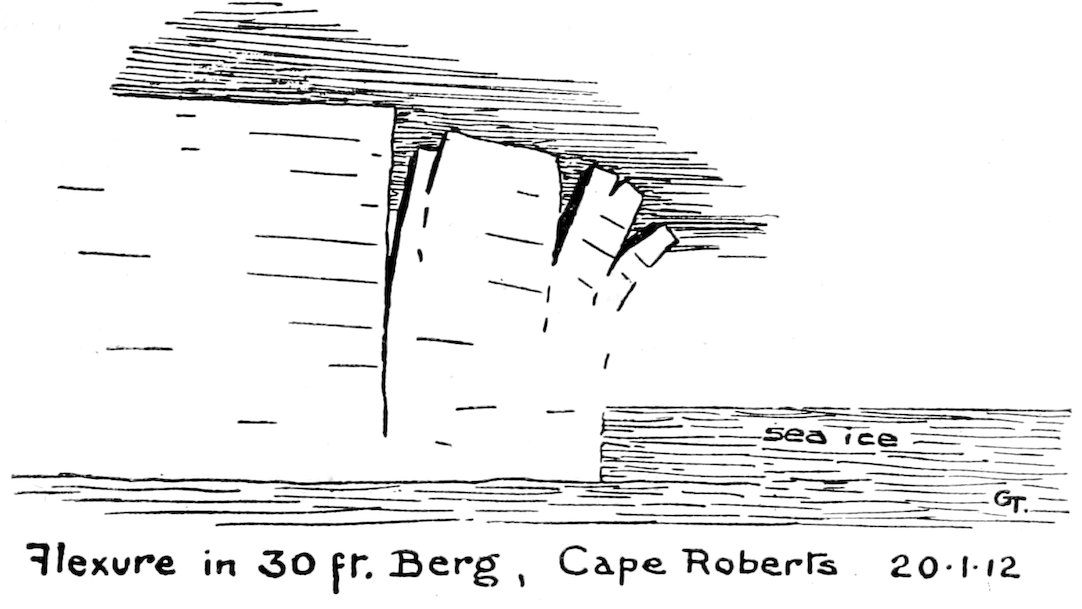
On the 22nd we could not see the ship. A strong south wind sprang up, and the gradually clouding sky seemed to portend a blizzard. “The stronger the better,” I write, “if it will only drive out this blessed floe.” We took a few photographs. There were two Emperor penguins moulting on each side of our Cape, but Debenham reported that they were too frightful to photo! Forde and I had a day with my stereo-camera, taking various interesting details around the Cape—planed granite blocks, pressure ice in the bay, and then the Emperors, awful as they were, several seal and berg pictures, etc.; but sad to relate all these negatives were smashed when the sledge fell over the glacier cliff. However, I made sketches of the most interesting features; for instance, one corner of a berg showed very well how flexible are large masses of ice.
I did not entertain the idea of trying to reach Pennell across the screw-pack. We should get into more precarious regions each mile, and we could not communicate with the ship to ensure her awaiting us. Pennell could send a party 403with safety at either end if he desired. I was, however, very glad later to find that Pennell also considered the pack absolutely impossible for sledging from the ship.
We saw her during the next few days, and then she never showed up again.
On the 27th a blizzard started, which we hoped would move out the ice. It tore our sledge flags badly, so that we brought them down from our distress signal 350 feet up the glacier, leaving the big depôt flag there.
It was very trying work with the blubber stove, for there was no shelter on the Cape. When there was any wind the flames would blow out of the door and gave no heat at all. The water did not get tepid in half an hour, whereas on a calm day it would boil in twenty minutes. I spent an hour trying to cook the fry, and barely succeeded in melting the fat. We decided that the stove could not be used in high winds, even though it was in a sort of ice cave and the cook sat in the door to keep the wind out!
Our rations had been cut down by half for a fortnight. We now had three or four biscuits a day; butter, every other day; chocolate, one stick; pemmican, one-eighth; sugar and tea, two-thirds a day. However, we had plenty of seal meat, and as we were not working we required much less food.
So passed several days. The tide crack was groaning all round the Cape, large pieces of floes floating loose in it, and jostling each other as the swell came in from the open water 404twenty miles away. Gran spent all one afternoon making chupatties. The lid of the camera box was his pudding-board. He used the wheatmeal thickers for dough, and commandeered our allowance of raisins. The cakes were cut out with the rim of a cup, and then fried in a mixture of butter, fat, blubber, and soot. Anyhow, the result was highly successful, though the inside was somewhat wet, and the whole, I should now consider, distinctly heavy.
Each day we started the last bag of something precious. First the pemmican, then the chocolate, then the butter. Only one seal had been visible for some days, and I decreed his doom. He lay on a large piece of ice which was rising and falling with the swell. We reached this across an ice island, surging about in a large pool. In spite of all this movement no more of the ice moved north, as far as we could judge.
On the evening of the 1st of February I held a council. Captain Scott’s instructions read, “I am of the opinion that the retreat should not be commenced until the bays have refrozen, probably towards the end of March. An attempt to retreat overland might involve you in difficulties, whereas you could build a stone hut, provision it with seal meat, and remain in safety in any convenient station on the coast.”
However, he gave me permission to begin the retreat if we were not relieved in January, and I began to prepare for this event.
Cracks seemed to be spreading in the sea-ice even while one was watching it. The surging ice in the tide crack, now twenty feet wide, rose several feet. Now and again a huge shock-groan, like a big rock bumping on another, announced a new crack, while a constant roar, like that of a distant lion, announced the periods of maximum of the swell rolling in from twenty miles away.
On the 3rd of February Debenham, Gran, and I climbed the glacier slope behind our camp to prospect for a path. We roped up and proceeded about three miles southward, keeping well behind the crevasses. These are numerous on the steep seaward slope, but we met with none on the fairly level ground, though we could see them just below us. The surface was fair, usually two inches deep in snow and occasionally a foot deep. This did not promise easy sledging; 405but the snow was dry now, and I was going to cut down the weights to a minimum.
We could see open water about twenty miles off, but a huge mass of ice-pack was apparent as far north as we could see. There seemed to be a broad belt at least sixty miles long, which was quite absent in January, 1902.
Obviously our exploration of Terra Nova Bay was impossible now, and it looked as if the ship would never reach us at Cape Roberts. With good luck we might cross the Piedmont Glacier to Cape Bernacchi in a few days, and Pennell might find it easier to reach us there, while we should at any rate be nearer to Headquarters. There was also a week’s food there, and we had now only a fortnight’s sledging stores left.
On February 4th Gran and I explored the sea-ice below the Piedmont for about four miles to the southward. We passed through the fifteen bergs in the little bay and then got among the screw-pack. This was covered with snow and afforded extremely heavy going, as may be imagined. Near the shore was a perfect network of new cracks with the ice “working” all the time. Below the glacier wall was a deep tide crack four feet wide, but where the ice had fallen in we managed to get across to fixed ice. As a result of this journey I decided to march first along the sea-ice and then climb up the Piedmont at this point.
Next morning I wrote a long letter to Pennell, which we all signed. We made a depôt on the highest point of the Cape and fixed a flag alongside, with the letter in a little matchbox. The journal for Captain Scott I left in my ditty bag. I remorselessly weeded out every one’s gear. We took nothing but what we stood up in, and our notes and the instruments. Luckily, most of Debenham’s and all Gran’s negatives were films, but I had to leave nearly all my plates and my cherished Browning. I knew we had some bad crevassed country to traverse—thirty miles of this, and then I expected thirty miles of coast work largely over moraine and rock, where we should have to portage the sledge and all our gear on our backs. With a light sledge it was just possible we might be able to raise it if it slipped down a crevasse; and this was quite a probable event, for in traversing along a piedmont glacier the party moves parallel to the crevasses. It thus reaches them imperceptibly, and the whole outfit may be over 406a crevasse together, whereas in crossing them at right angles this is rarely the case.
We turned our backs finally on Cape Roberts at 11 a.m. on the 5th. Our flag waved bravely, and below was the cairn of stones covering the food left there by Scott’s orders. If we had to return it would give us a breathing space, but I never saw the Cape again. For many months the flag was left in solitude. The screw-pack never broke adrift that winter. In the next spring, six desperate men sledging southward, as they thought, to more endurable though no less solitary quarters, here found the first news of the main party. Our depôt possibly saved Browning’s life. It certainly gave the Northern party their first bearable day for many months. Brave old flag! it hangs in Tewkesbury in Priestley’s home, and there my old Browning was restored to me after many months!
So we marched on; we were all stiff and out of training, and the sledge did not pull easily, but we reached the tide crack and crossed it much more easily than I expected. After lunch we pulled up the steep slope of the glacier, and to our delight found the surface grow harder almost every hour. But other troubles were upon us. For three days I felt it would not benefit any one to write my diary. However, on the evening of the 8th I wrote up the 5th, 6th, 7th, and 8th of February as follows:—
“Then quite suddenly we came on huge crevasses all round; some open, which I took care not to keep too close to, and others bridged. They seemed too wide to do anything with; but after cautioning the others to tread quietly, I prodded across safely, though the ice-axe pushed in all its length easily. Then the others followed, and the sledge after. Gran fell in at the near edge and saw the straight wall. Several of these were over twenty feet wide, but we had to chance them, and tested them all before the sledge started. Then we marched along between two fairly visible ones, and luckily they didn’t join. The surface got flatter and they died out gradually so that we made fair progress. We came to another enclosed snow basin, and I felt sure the seaward slope would be safer. So it was, though Forde went down a small crevasse. We pulled along this up to a sort of col—about eight miles from Cape Roberts,—and here, as we were well beyond the mouth of the Big Valley, we camped.
407“My only fear now was that bad weather might cover the glacier with soft snow, for I felt that all the big crevasses would be lidded, and the little ones could hardly swallow the lot of us.”
Next morning we made the harness traces longer, so that only one man at a time need cross even a wide crevasse. We had to traverse the mouth of another large valley glacier. Three of these debouched on the Piedmont Glacier from the western mountains, and the pressure from the northernmost (the Debenham Glacier) was responsible for the crevasses of the 5th of March. The second valley glacier was not so large, but we anticipated trouble. We had a stiff pull uphill for three-quarters of a mile, but some of the snow was so hard that the sledge runners made no mark. This was an ideal surface, for one’s feet did not slip on it, though occasionally the sledge skidded. We were about seven hundred feet above the sea here, and entered a col just below a huge snow hill.
“Afterwards we were cutting around the hill aforesaid, when suddenly appeared many crevasses. So we deviated abruptly and ascended sharply. We encountered three, into one of which I fell, but they were not very wide. The moral of this is—Don’t go for the break of a hill facing and near the sea, but stick to humdrum grades if possible; if not, still don’t go for the break of a hill!”
The somewhat frivolous tone of the above note is evidence that it was written when we had traversed the worst of the Piedmont. It was always the case “down South.” One never got photographs or “instantaneous pen-pictures” of anything really exciting. It was always a case of “Get a move on, and get out of this good and quick,” so that one’s diary lost most where it would have been most interesting.
We were now behind Dunlop Island, and about 1250 feet up the Piedmont. We were astonished to find that the floe had all broken up to south’ard. Long curved cracks parallel to the coast marked where pieces were continually floating off. We congratulated ourselves on our safe position on the Piedmont, for we should have sledged into this without knowing it had we continued much further on the sea-ice. Small bergs looking just like white yachts dotted the open water, which seemed to extend south to Castle Rock. There was no sign of the Terra Nova. We began to think she had come to 408grief, for Pennell knew we were free to move off on the 1st of February.
After supper Debenham got out his plane-table and continued his survey. He was much puzzled by the position of his station on the stranded Glacier Tongue to the south-east. He realized soon, however, that it had twisted round, and was even now preparing to continue its journey to the Nirvana of warm northern waters.
We had been blessed with sunshine the last few days. I don’t believe we should have managed to dodge the crevasses otherwise, for in dull weather you cannot tell any difference between a ten-foot hollow or a ten-foot hummock when it is only a yard or two away. However, as a result, Forde got a bad touch of snow-blindness. Debenham got out the medical chest. He ground up some ZnSO4, picked it up on a paintbrush, and dropped it in the corner of Forde’s eye. Later in the night I gave Forde another dose, for the pain is pretty considerable.
The next day my right eye was sore and watering, in spite of the amber glasses, and I feared I was to become a patient also. We plugged along over an absolutely level snow-plain, when Debenham dropped into a crevasse, over which I had crossed without puncturing the lid.
In the afternoon my eyes gave out, and I put on bandages on the right eye, and gave up the lead to Debenham. It was an astonishing relief to cease from staring at the glaring surface, and either pull along with shut eyes or keep one eye on the gratefully dirty back of Debenham’s jacket.
Debenham led us safely past three huge crevasses, and we halted for a spell among a cluster of smaller ones. That evening we climbed up the snow hill behind Gneiss Point, about 1350 feet above the sea; and as we had now passed the third valley glacier, I felt we had finished with the crevasses for the time being. We camped on hard snow, and Debenham treated me for snow-blindness. The zinc sulphate may truthfully be described as an eye-opener, but later the cocaine in the mixture calms things down. You are advised “to keep your face cool.” But I had to keep my head in the bag to get warm. However, Forde was pretty right next day, and mine had stopped aching, though everything appeared double for many hours!
409On the 8th we reached the land near Cape Bernacchi. There was a steep ice slope two hundred feet high, at an angle of 30°. Luckily it was much honeycombed and sun-eaten. We put grummets (rope brakes) on the sledge, and managed to get it down about 130 feet. We had a very cheerful lunch, for we knew the depôt was only a few miles south. Then we found an ice-foot all the way along the edge of the rocks and moraine which led us right to the Bernacchi cairn. This was a regular ice pathway about twenty yards wide. It was due to sea-ice which had become cemented to the shore, the tide crack being further away from the rocks, and defining that part of the floe which had lately drifted away to sea.
No one had visited our depôt. New Harbour was full of new broken floe, but a fine ice-foot seemed to promise well for our next march.
We stayed a day at Cape Bernacchi, for I wished to get a good station for the triangulation of this coast. Gran and I took the theodolite to the top of a hill 2900 feet high, at the north-east end of Dry Valley. We named this Hjort’s Hill, in honour of the maker of our trusty Primus lamp. As we were climbing this hill, Gran swore he could see the ship off Cape Evans through the binoculars. It seemed clear to me also—smoke, crosstrees, hull, and three masts; but after an hour or so we decided it was only a mirage crack in the Barne Glacier. The disappointment was rather keen, though I am now not so sure that we did not really see the ship, some forty miles away. We could see the forty-foot debris cones behind the hut quite easily on a clear day.
I wrote the usual letter to Pennell. I had left two in Granite Harbour and two on the Piedmont now, and it did not look as if any would ever be read.
All through the 10th we skirted New Harbour, finding a fairly feasible ice-foot between the granite-strewn slopes and the open water. We came across a Spratt’s biscuit box here, which was evidently left by the 1902 expedition. We saved a considerable detour by crossing the head of the harbour on the sea-ice, and camped below the Kukri Hills, where I halted rather early to get a round of angles. We were held up here all next day by the snow, which we spent reading and sewing.
On the 12th we rounded the Kukri Hills, and when the 410ice-foot petered out we were luckily able to continue on the sea-ice. We had lunch amid a colony of over forty seals, and then reached the southern side of the Ferrar Glacier, where we camped on a rather wet and muddy heap of “road metal” moraine.
We were now safely round New Harbour, and, curiously enough, crossed the sea-ice at the mouth of the Ferrar on the same day of the year as when we nearly went out to sea on our first sledge journey. Henceforward we knew our route. We had plenty of food at the Butter Point depôt, which we reached that evening, and knew we could reach the old Discovery hut before the end of the month.
The depôt had been blown over and wrecked generally. We took some pemmican, butter, and chocolate, and next day proceeded south along the Butter Point Piedmont. The surface was much better than the preceding year, but, curiously enough, we found quite a number of small crevasses. Debenham and Forde fell in together in one of these, and the burly Irishman jammed so tightly it was quite a business pulling him out of it. In the evening we reached the Strand Moraines. These are great piles of ancient silt, gravel, and erratic blocks, which were dropped here by the ancestor of the present Koettlitz Glacier.
At the southern end of these moraines, which were several miles long, was quite a large lake. We tobogganed down to this and across to a nice little gravelly delta just made for the tent. We found that the open water reached just to this point, the sound still being frozen to south’ard, though obviously breaking away in great sheets. I wrote that night, “No Terra Nova. We should be picked up at Evans Coves (Terra Nova Bay) to-morrow!” We had the choice of two routes now: either to cross the snout of the Blue Glacier, or to take to the sea-ice and coast round the latter. We had done the former and knew it would only take a day. The latter might be quicker, though a great calved berg blocked the route about two miles ahead. Debenham preferred the glacier, the other two the sea-ice. I considered it unsafe to march on the sea-ice if it could possibly be avoided. I made a bet with Gran that we couldn’t get the sledge between the calved berg and the glacier without unloading it. This had a rather interesting outcome. I decided to 411keep to land ice, on the principle of the “Devil you know being preferable to the Devil you don’t.”
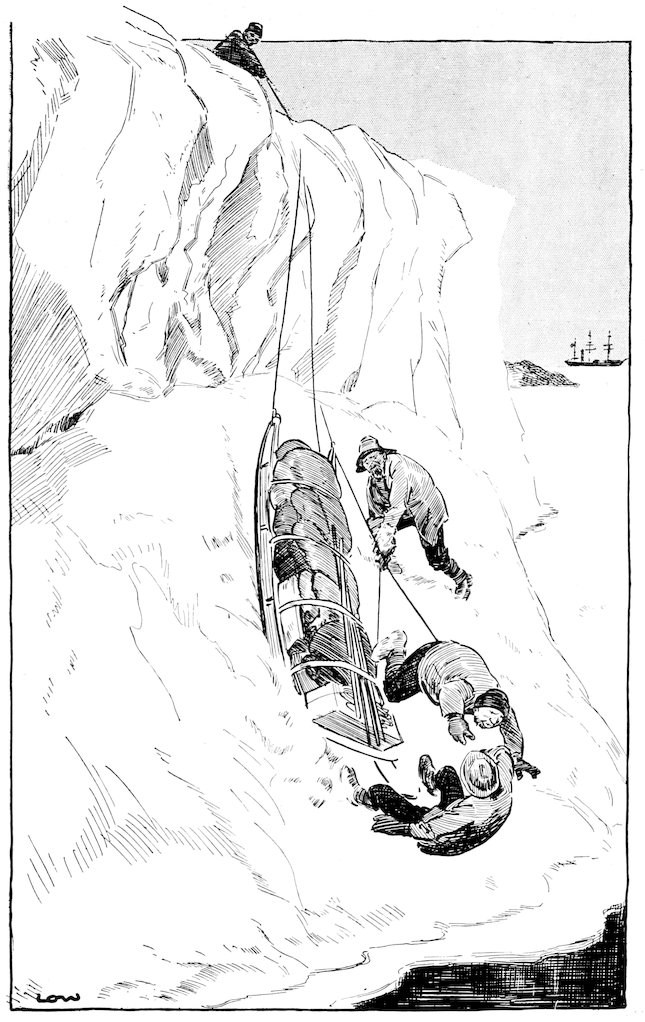
THE RUSH TO SAFETY: OVER THE EDGE OF THE BLUE GLACIER. From a drawing by D. Low.
It was annoying to find that the Blue Glacier had so completely changed its complexion in the twelve months. In place of clear blue ice where one could see every crevasse, it was one uniform sheet of smooth snow, and we soon began to fall into the crevasses. In a very short time we had all been in a couple of times, and it was evidently an unpropitious region for sledging. I deviated to the edge of the glacier to try and lower the sledge on to the sea-ice, for we were now abreast of the calved berg, where we halted a few minutes.
Away to the south-east we could see a blizzard brewing, and I wanted to get a snug camp in the gullies south of the Blue Glacier. We had an argument as to who had won the bet, for there was a jumble of ice where the calf jammed the parent glacier. The other two decided in my favour, and so we pushed off on the top of the glacier edge to the wished-for camp. Gran was dissatisfied with the court’s decision, and kept glancing back to the scene under discussion. Just as we were dipping down the slope he yelled out “Ship ho!” and there she was over the top of the black moraines.
We turned back at full speed to retraverse the crevasses, for she was four miles off and we were afraid might miss us, as a snowstorm was brewing in the east. She steamed along past the berg and out along the floe. We pulled back hard, crossing crevasses carelessly, but not falling in much, and finally could make out that she had a flag on the gaff, apparently recognizing us. We kept along the edge of the glacier till we could find a place to get down. Here was a drop of thirty feet almost vertical with a big tide crack and a tide-pool at the bottom! Gran went down first, and then I got down halfway. Unluckily as we were lowering the sledge Forde was pulled over by his harness and fell right on to Gran, who was pressed into the snow while the sledge came down on top of us. It nearly broke in the middle; however, we lugged it over to the ice and set off hot-foot over the two miles of ice. The ship now anchored near the floe and four men came to meet us. They harnessed up and told us the news. We heard that the Southern party were going very well, that there were no signs of Amundsen, and that there had been no accidents of importance. Also that 412they had not been able to communicate with Cape Evans until a week before, and had been unloading stores every available moment before they came over to search for us. And then the world’s news made us feel safer in the Antarctic at first hearing: the disruption of China, the Franco-German-English trouble in Morocco, the Italians and Turks in Tripoli, and the great strikes in England. We had missed an eventful year during our sojourn in the peaceful regions of the South.
413