IV A MONTH IN THE OLD DISCOVERY HUT
Reading edition
March–April, 1911
188
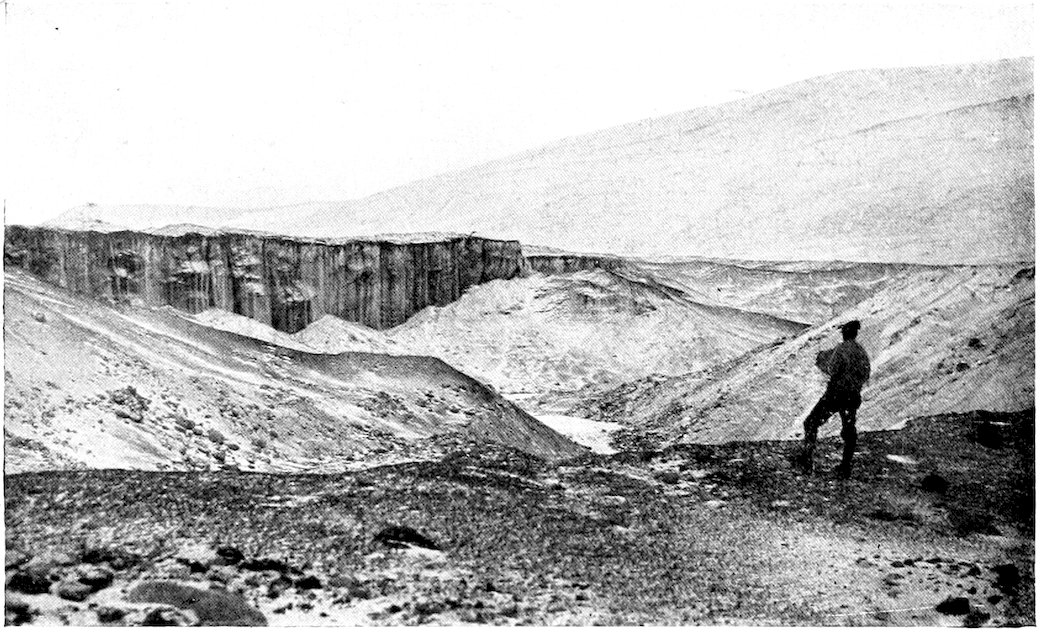
ALPH RIVER CUTTING THROUGH THE MORAINES AND ANCIENT ICE. [See p. 170.
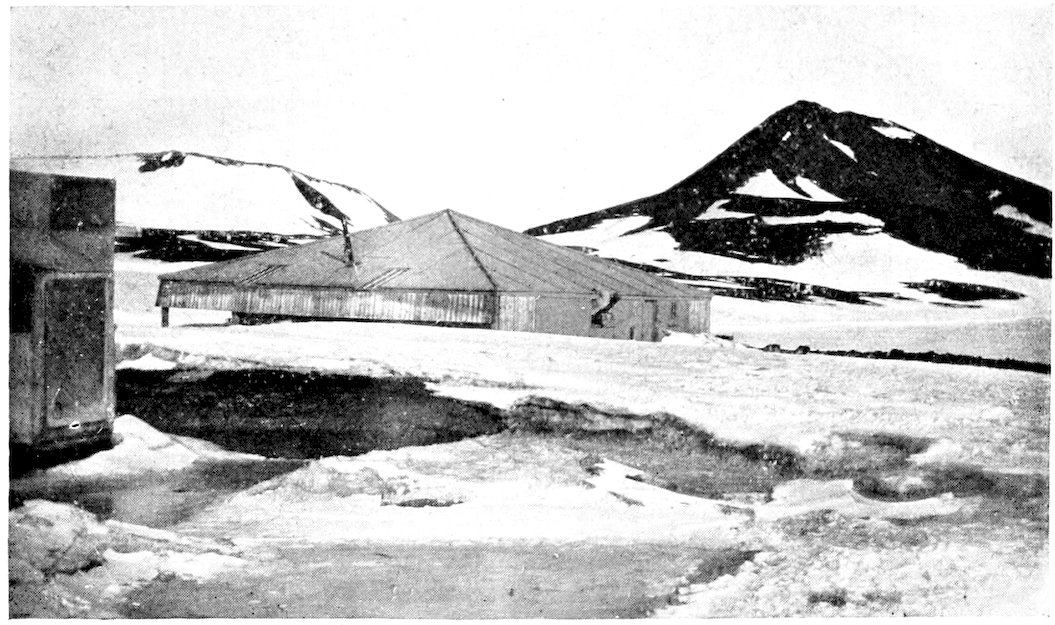
“DISCOVERY” HUT, Jan. 25, 1911. Showing the ice slope above the bay leading from the Gap to the Hut. Note the eaves of the hut on left.
189
A MONTH IN THE OLD DISCOVERY HUT
While we had been engaged on the western journey, Scott had made his depôt at One Ton Camp, and had returned north to Ross Island, a fortnight before we arrived. During February the sea-ice had broken away far to the south of Glacier Tongue—which marked the water’s edge in January—and it was now impossible to return to Cape Evans by the route they had marched south.
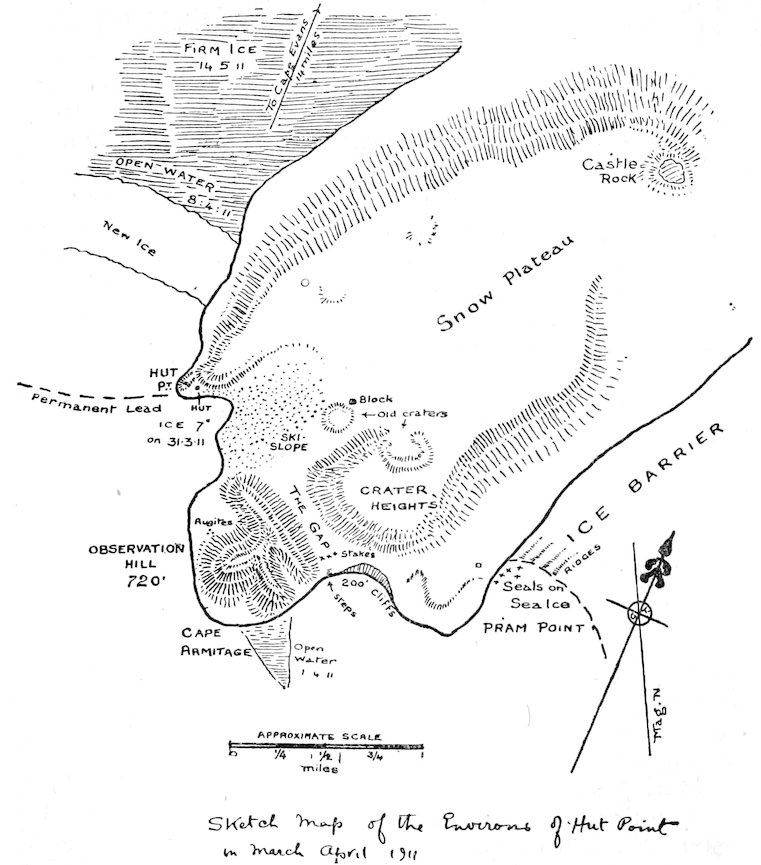
Moreover, the icy slopes of Erebus were seamed with crevasses, and many ice-falls lay at the root of Glacier Tongue, so that an overland journey was out of the question also. Luckily the old Discovery Hut had been placed on the long rocky southern promontory of Ross Island named Cape Armitage, and even under present conditions, with the water reaching to Pram Point, it was possible to get to this hut from the Barrier surface—as, indeed, the last chapter has shown.
A queer little hut indeed is this, compared with our palace on Cape Evans! It is square in plan, and rises to a central peak. All around is a sort of verandah, with outer walls reaching halfway to the ground. This was designed to hold stores and protect them from the blizzard snows. But the hut was hardly used at all by the 1902 expedition. When we first saw it in January, 1911, it was filled with snow and ice to within a few feet of the ceiling, and did not look by any means an attractive place of abode.
During February, Dr. Atkinson and Crean had spent a large portion of their time excavating the hut, and had ultimately cleared it completely of ice. A great heap of ice blocks and chips marked the extent of their labours. They had piled up the boxes of captain biscuits into a barrier enclosing the north portion of the hut, and in this dark retreat the western party found the depôt party on the 15th March.
We reached our refuge about 7 p.m. It was almost dark 190outside and quite so inside. An acrid atmosphere of blubber, smoke, and soot enveloped us as we occupied the rough planks grouped around the heart of the hut. Here was built up a primitive blubber stove, crowned by a chimney whose vagaries formed the chief topic of conversation among the inmates. Only one dim candle in a sooty lantern illumined the scene. The windows were deeply frosted, and it was getting on towards winter now, so that only in the middle of the day could they give much light.
As will be seen by the plan attached, our dining-room was 191at the north, furthest from the blizzard winds. There were two bedchambers. One on the west side, where six of our sleeping-bags were disposed like sardines in a tin; and another central boudoir, rigged up out of antique canvas left in 1902. This the occupants called—as it seemed to us west-enders on a lucus a non lucendo principle—Virtue Villa!
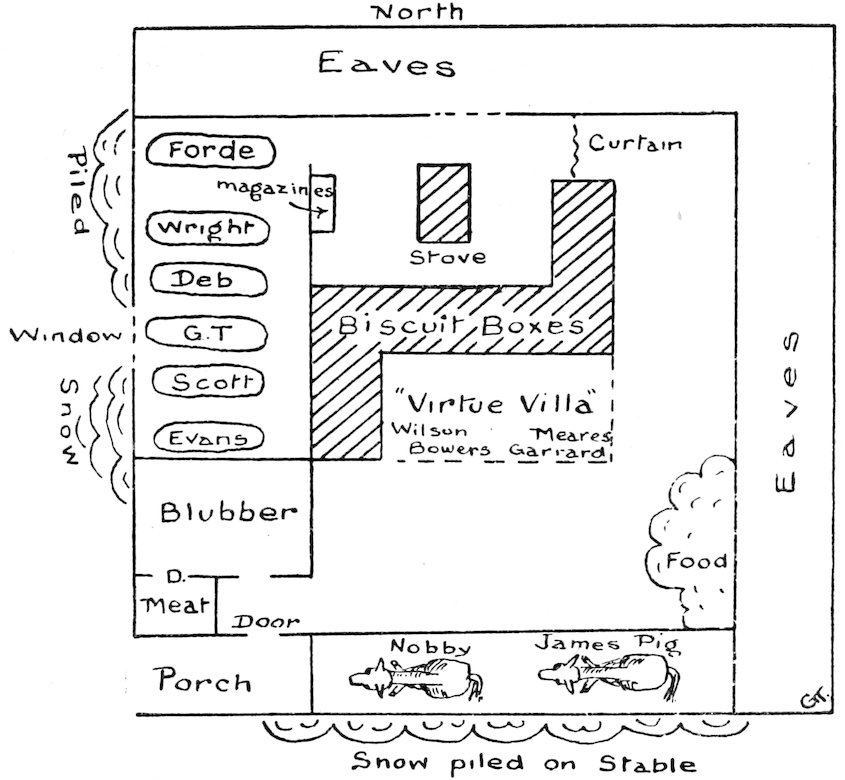
Plan of the rejuvenated Discovery Hut, March, 1911.
In the semi-gloom of the hut it took me some days to find out my direction, for inside one seemed to be twisting as if one were in a maze. In fact, to reach Teddy Evans’ quarters one had to return practically to the door, having circumnavigated Virtue Villa.
That first evening we sat round the reeking stove and thankfully ate seal hoosh out of the tin mugs, helped down—though little it needed it—by unlimited captain’s biscuit nearly ten years old. Captain Scott allotted the new-comers quarters in the west end, and we turned into our soaking bags and 192slept fairly well in spite of the drips from the roof. Each sleeper unconsciously rolled away from the drops, and many were the territorial arguments caused by the drips from the ice-covered roof.
Next day at 6 a.m. the cooks (Meares and Keohane) turned out to prepare the breakfast. The others got up an hour later, to find a thick pemmican of seal meat and curry awaiting their attack. Thereafter we each had a mug of cocoa. Work starts immediately, for we are literally living from hand to mouth. So Wilson and most of the men go off to Pram Point to kill our dinner. Teddy Evans with two mates puts in the morning cutting up seal meat, while the western party set off to fetch in our second sledge from the slopes below Castle Rock.
From the top of the promontory by Castle Rock we got a good view northwards to Cape Evans, distance about twelve miles. There was open water this side of the Tongue, but ice was forming on it. Further north it looked more solid, and I lugubriously wrote, “It will be a fortnight before we get off, I fear.”
The worst feature about Hut Point was the approach thereto. It was about twenty-five feet above the waterline, which here was bounded by an ice cliff twelve feet high at the foot of a quite steep icy slope. This slippery route fringed the bay, and was of necessity traversed by any one approaching from the north or east. As there was usually a blizzard blowing directly down this slope to the water, it took us some days to traverse “ski slope” with equanimity. We put rope grommets (brakes) on the sledge runners, or the whole outfit would have sidled over the edge into the water. By 5 p.m. we had brought all our specimens and instruments safely to Discovery Hut.
The other party had killed eleven seals, and returned two hours later. We had a grand feed of seal-liver seasoned with peas. A box of dried peas was one of the relics of the 1902 expedition, which was dug up from the snow; and though the outside was black and mouldy, the heart of the box furnished us with magnificent dishes of “pea-doo.”
The blubber stove worked better every day. One “fid” (or slab) of seal blubber would soon make the iron top red-hot. So we were actually able to wash the pannikins! Only 193those who have drunk cocoa and tea for months out of mugs, used also for pemmican and blubber fry, can understand the luxury of a clean drink.
Never shall I forget my feeling of comfort that night. We had managed to dry our bags in the midday sun, and I can still recall the springy warmth of the reindeer bags, after so many days of what at best was clammy discomfort.
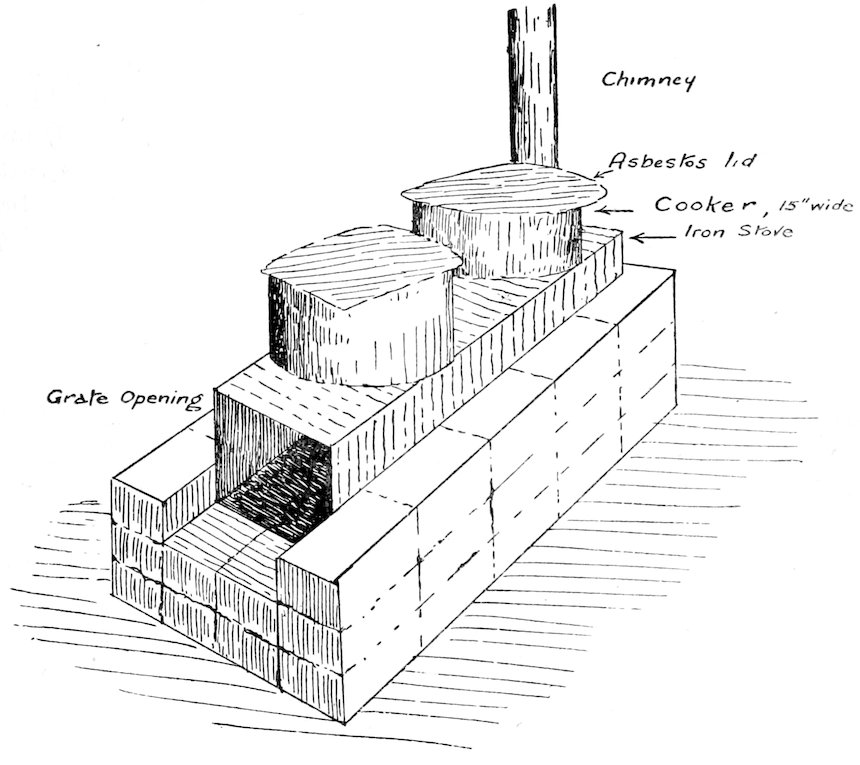
The blubber stove in the old Discovery hut, March, 1911.
On the 16th Evans led a party to Corner Camp, about thirty-five miles to the south, to get some fodder for our two ponies, and also some stores for the sixteen men in our little community. He asked Wright to join him, so that our mate was soon in the thick of the blizzards again.
Just outside the door were the dog-lines. The dogs lay in “rifle-pits” dug out of the icy slopes above the bay. Poor fellows, their fur was clogged with ice, and their short commons on the Barrier made them woefully thin. Very miserable did 194they look for some days, for their hair is normally so thick that it lends them a fictitious size. I assisted Meares to dig the holes deeper, and build up barriers to the south. It was pleasant to see how the rest and abundance of seal meat soon improved them out of all recognition. Many of them were loosed when we went for a walk. They would start out with us, and lend a touch of home to the dour landscape, but they were not very companionable, and, except for brown Tsigan, they always left us behind as too slow, and later bolted for the hut.
In a day or two our party swung into routine in the old hut. We could not move more than a mile or so from Hut Point. We had nothing here but fragments left over from 1902, and some sledging rations, and yet the time passed not unpleasantly, for there were a thousand and one jobs to be done. I will quote my diary fairly fully for 17th March, for it was typical of the next few weeks.
“We got up rather late, so that I read the thermometer at 9 a.m. instead of 8 a.m. After that had breakfast of porridge and a ripping ‘hoosh’ of liver. Then a cup of cocoa, to which three pills of Gran’s saccharine gave a sweet inky taste. I next sewed up a six-inch tear in my sleeping-bag. I did not sleep well last night, nor did Scott, who was next; I will try fur inside to-night. It is blizzing again, and I am glad I am not on the Barrier with Evans, Wright, and the rest.
“Then I pared some sealskin soles thin (the fresh skin is just like soft leather) and sewed them into the old finnesko presented to me by Gran. We played “shut-eye” for a tin of marmalade. [I ladled out a spoonful, and Scott, with shut eyes, said whose it was; and so on.] We had two and a half spoons each, and as it was Keohane’s birthday I gave him the tin to scrape out.
“At lunch we had a great discussion on Browning and Tennyson. My simile comparing them to a rough rare mineral and polished rubbish was not accepted! Scott preferred Keats. Meares opened tins with my dagger in military fashion, as he had learnt in South Africa [i.e. he made a fulcrum of a bar of wood beneath the blade]. Scott tried to improve the lighting by smearing blubber on the windows, which at any rate made it easier to flake the fresh ice off each 195day. Dr. Bill is mending gloves with pared sealskin. Gran is making a ski-stick from a piece of bamboo he’s found. Debenham is tidying the kitchen, and puts up racks to hold the ‘spirtles’ (i.e. porridge-stirrers). I rifled the 1902 magnetic huts, and cut out lids for the porridge-pans from sheets of asbestos. Our literature consists of Contemporary Reviews, Eclectic Magazines, Girls’ Own, and the Family Herald.”
We spent some time trying to make the hut snugger. We piled heaps of snow and ice against the walls to keep off the blizzards. Among the debris I found ancient dog biscuits which reverted to their original purpose, and an old bag of oatmeal which went into our menu. A great discovery was a torn copy of “My Lady Rotha.” The first and last chapters were missing, but I gathered the loose pages and dried them, and enjoyed reading it again. Curiously no one else in the hut had read it, and as we had only about three books, every one read Weyman’s novel. I couldn’t remember quite how it ended, for the plot is very concentrated to the end; the elderly hero not having found a son or a second wife; and the lady debating between the ancient count and the lunatic lover. I am afraid I finished it off in several ways to various applicants, none of which would have pleased the author!
There was another book which Gran had taken sledging and had torn off the first few pages for pipe lights. This was “Springtime,” a romance of medieval Italy. A good yarn, and Scott guessed it was by Hewlett. I disagreed, but couldn’t remember the writer—who is H. C. Bailey, I believe.
It was very curious how useful were the 1902 remains. That expedition wintered on the ship, but some articles had been left ashore, and the hut had only been used as a hospital.
However, we found old awnings, which Taff Evans used as arras (or is it arrases?) for our bed-chamber! There were asbestos sheets with which we levelled the floor, and made pan lids; brass nails, also from the magnetic hut, which had not rusted of course; long stove pipes and asbestos cement, with which we ultimately made a smoke-free blubber stove. A dubious mass of brownish glue turned up under some snow. Bowers tested this, and ultimately we had bovril 196flavouring in all our hooshes! And there was of course the definite depôt of captain’s biscuits left in 1903, and also a few wholemeal biscuits which Shackleton had depôted in 1908. The latter swelled like muffins on the red-hot stove, and we used to have one with butter as a special luxury. Those Shackleton biscuits were a dream!
On the 20th seals were reported just under Hut Point, and of course were much handier than the rookery at Pram Point. So Scott and four of us went off to get them. We lowered Keohane and Evans down the steep cliff below Vince’s Cross on to a piece of fixed floe, and the two seals were killed with a few blows on the nose with a pick handle. Dr. Bill and Meares went down to help cut them up, and Scott and I hoisted the flesh up by the ropes. Just as we were finishing three more seals appeared, and one crawled right up to the shambles. He stayed there all the time, and only left when the carcases were thrown overboard.
That night there was a wild storm. Spray was blown up over the cape and over the hut, where it instantly froze. It cemented the snow heaps, and would have encased some of the dogs if they had not been freed from their chains. Next morning I had to chip my way down to the shelf where I had left the thermometers. We had to cut out fresh holes for the dogs, during which operation one aggressive fellow got hold of another by the neck, and the combined efforts of the sapping party could not drag him off.
When the weather permitted we went off to get seals or to have some exercise. A strong wind used to blow almost constantly towards the hut through the “Gap.”
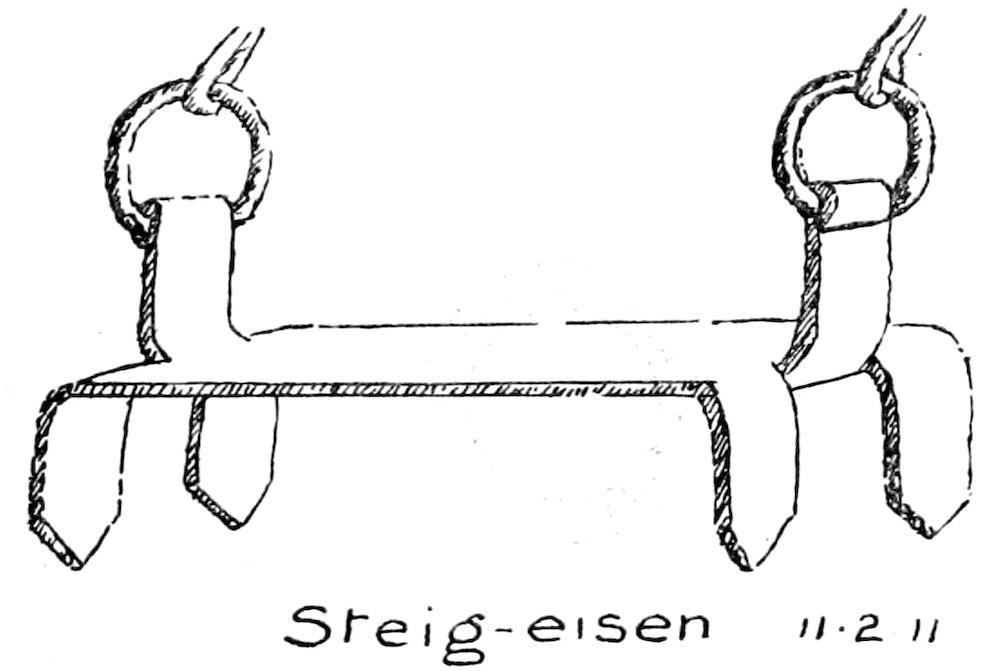
Often when one was loaded with seal blubber, or camping material, the icy slope between the gap and the hut was dangerous work. By this time our crampons (spiked overshoes) were useless, for the spikes had worn quite blunt. The wind would catch us, and irresistibly slant us down the ice slope to the sea. On several occasions, when one of the Western Party was wearing his iron steig-eisen, an unfortunate crampon-wearer would clutch hold of him and accept escort over this giant “slide.”
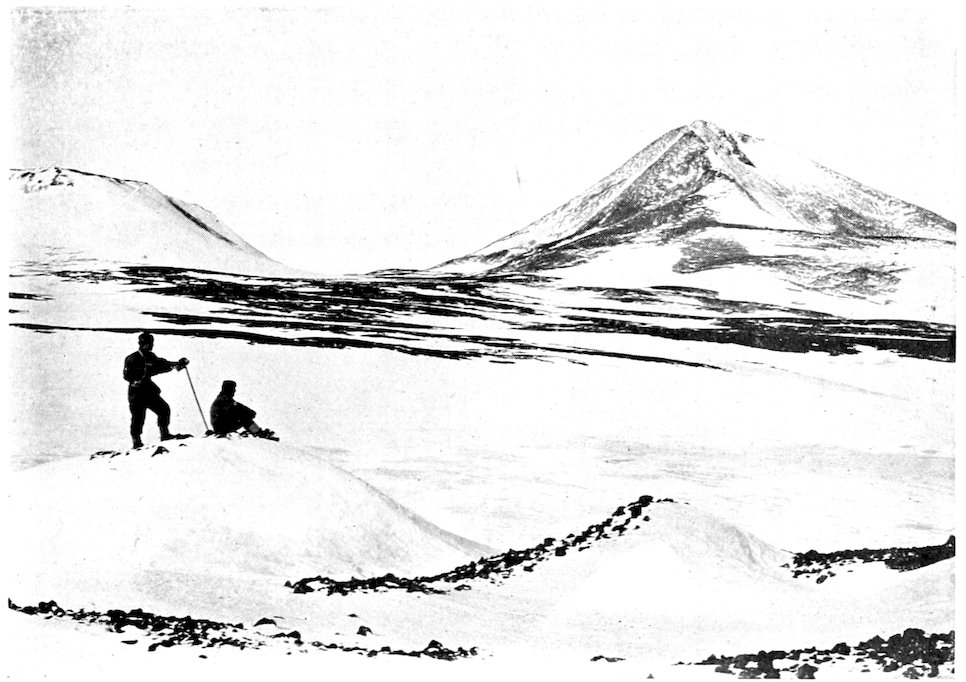
Photo by H. G. Ponting.] CRATER HEIGHTS, THE GAP AND OBSERVATION HILL AS VIEWED FROM THE OLD “DISCOVERY” HUT. The catenary curve of the Gap, due to glaciation, is well shown. In the foreground is the icy slope which ended (abruptly on the right) in open water.
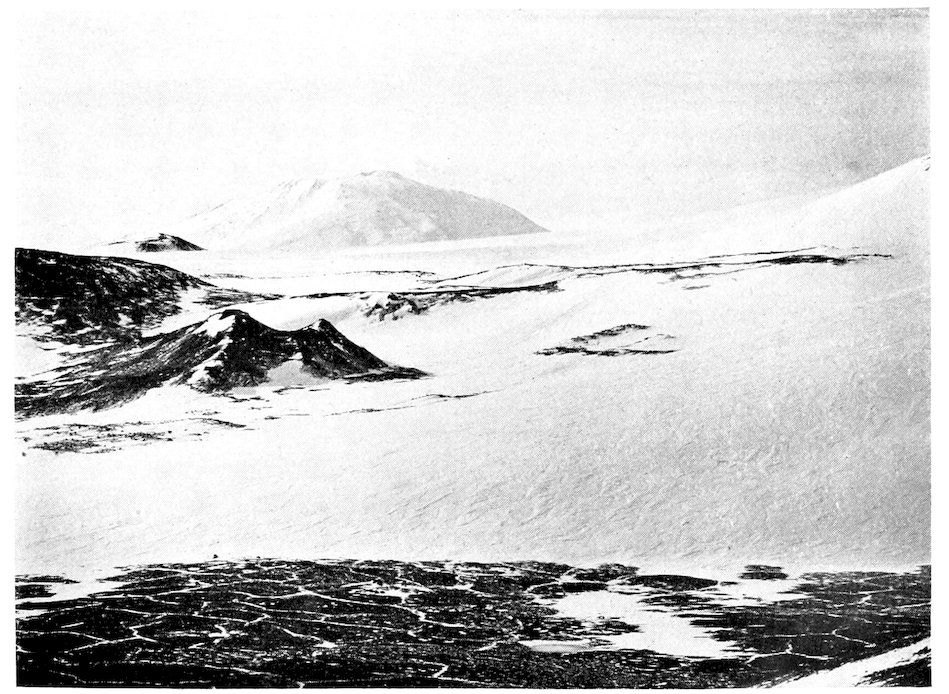
Photo by H. G. Ponting.] MOUNT EREBUS FROM THE OLD “DISCOVERY” HUT. The steam cloud is blowing to the south-east against the prevailing surface winds. The small craters of Cape Armitage are shown on the left as stumps of lava. A series of false moraines crosses the picture (due to rock fall). In the foreground are the “tesselations” due to soil-creep.
What long discussions we had! Scott was interested in everything, and I note that one evening we discussed 197Mormonism, the medieval ramparts of Aigues Mortes, and the pronunciation of ancient Greek!
On the 23rd March the Barrier party returned. They had experienced temperatures of −42° F. Wright told me that it used to take three hours to get warm—after they had thawed the ice out of their bags. On leaving the tent in the morning in a clammy wet state, the instantaneous freezing of their clothes felt like an electric shock!
I made a tour to inspect the “moraines” on Crater Heights, accompanied by Dr. Wilson. I believe they are due to differential erosion of lavas of varying resistance, and have not been left there by an upward extension of the Barrier Ice Sheet.
Dr. Bill told me of the loss of the ponies. He and Meares with the dog teams made straight across to the hut over the sea-ice from the Barrier camp. They noticed cracks every thirty feet or so, and so deviated sharply to the east, and reached terra firma at Pram Point. They then started cutting a track up the ice slope for the ponies. Meanwhile Bowers, Garrard, and Crean had not noticed the dog teams swerving, but had turned back later. They had to camp on the sea-ice, because the ponies were too “done” to get back two miles to the Barrier ice. They woke in the small hours of 1st March to find that one pony had vanished, and they were adrift on a broken floe. They drifted about all night and next day, while Wilson could do nothing but watch them from the top of Observation Hill. Wilson went off and met Scott, who had come to the open water, and was able to tell him that there was a chance yet.
198The pony party spent four hours or more trying to get to a large piece of ice to the south, which seemed to be separated from the firm barrier by a narrow crevasse. They left the ponies and went off to prospect, and found the space was sixty feet wide and full of grinding floes! There was a big swell all around, but Bowers gave Crean permission to try to cross the gap. He managed to do so by some amazing jumps, and with the aid of two ice-axes he climbed the edge of the Ice Barrier, and so informed Scott of their danger.
Meanwhile Cherry and Birdie took things philosophically. I heard how Birdie took angles with the theodolite to determine the position of their floating island. A skua gull settled near them, and Cherry thought it well to annex this food supply, and did so. I was told that Crean made some stiff cocoa for them while they were trying to rescue the sledges. In the dark he mixed the food bags and a strong decoction of curry resulted. Nothing daunted, the Irish sailor declared it was as warming as the other, and drank it off.
On the afternoon of the 1st the rescue party managed to communicate with them, and Bowers and Cherry and most of the sledge stores were saved. But the ponies had to be left that night with feed bags to comfort them. Next day the three ponies had drifted to a more favourable spot farther to the south-west. Here the rescue party busily set to work and cut out a path up the face of the Barrier. Nobby was jumped from floe to floe, and at length reached the firm ice of the Barrier. But the other two ponies were weaker. The second jumped short, and though he managed to scramble on to the floe again, he was too cold and weak to stand, and fell into the water again. So, too, the third pony. All round were eighteen killer-whales waiting for the end. To save them from a worse death their owners pole-axed them as they feebly struggled in the icy waters of the Sound.
[The tracks on the breaking edge of the Barrier were seen by us on the 11th March, just before the blizzard caught us and held us up two days.]
There were now again sixteen men in the old hut, and sleeping quarters were arranged as follows. Scott, Evans, Taylor, Debenham, Wright, and Forde slept in the West End; Wilson, Meares, Bowers, and Garrard in Virtue Villa; 199while Gran, Taff Evans, Keohane, and Crean lay around the stove.
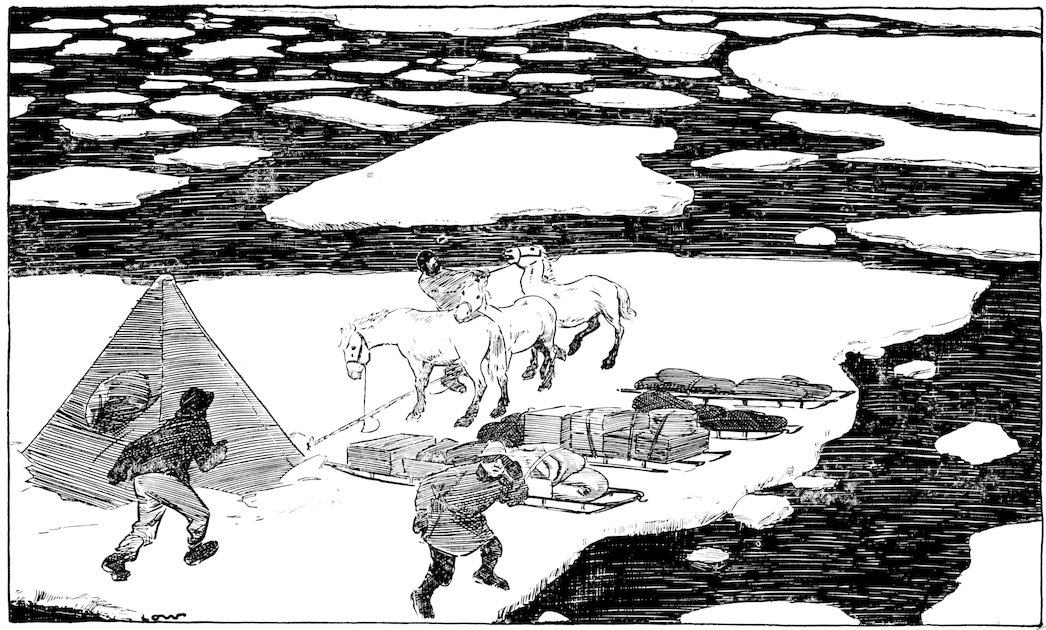
BOWERS’ PARTY ADRIFT ON THE SEA-ICE. From a drawing by D. Low.
With so many human furnaces at work, the temperature inside the hut rose to 46° F. on one occasion. As a natural result, our ceiling dripped abominably. We laid hands on all the empty tins about, and tied them on strings to the ceiling under the more obnoxious drops! Very skilfully we each tried to lie between two small cataracts, with the result that boundary commissions were frequently necessary to decide on encroachment into foreign territory!
The activities of the geologists incited all the other officers to emulation. Bowers was the most indefatigable of these “pseudo-scientists,” and was always bringing some huge specimen along to Debenham or myself. “Here you are,” Birdie would say of a particularly uninteresting block, “here’s a gabbroid nodule impaled in basalt with felspar and olivine rampant.”
The sun was giving us his farewell before winter. Very beautiful were the sunset tints; and on the 25th I wrote: “Over Mt. Discovery are bands of stratus, across a black sky, while in the foreground are pools in thin ice looking like bog lands. To the south the sky shows orange-yellow to white tints; to the north, beautiful lemon-green verging into grey and yellow on the east. To the west, grey-green, with a bright orange band against which stands the purple line of Mount Lister. D—— fine, only I’d rather have two feet of solid sea-ice, and no lemon-green reflections in the pools!”
Later in the day, Wilson gave Oates and myself a talk on tone-values. At 6 p.m. the landscape was rosy pink everywhere where the sun glanced on the snow-fields, salmon to buff colour on the open water, and on the newly freezing sea iridescent like tar. The shadow of Brown Island was lemon-green, changing to purple on Mount Discovery—while for a few minutes our own shadows were the most vivid bright blue!
It is impossible to imagine how striking if evanescent these colours were, and as possibly some critics believe that Wilson’s sketches erred on the bright side, I have here copied my notes made on the spot, while Dr. Bill was drawing his sketches.
200Next morning I was cook with Wright and Titus Oates. I lit the blubber lamp and a candle while Oates set the fire going. Some chips and a page or two of the Quiver rubbed in blubber started it that morning. It was then only necessary to put on a fid of fresh blubber from the tin alongside, about the size of a bath bun. The blubber sizzled merrily on the grid, a big hot flame sprang up and licked the blubber and melted fresh supplies, and soon the stove was going strong. The hoosh was a porridge-biscuit dish with a few bits of seal in for luck. After breakfast I washed up the pots and cleaned the cookers.
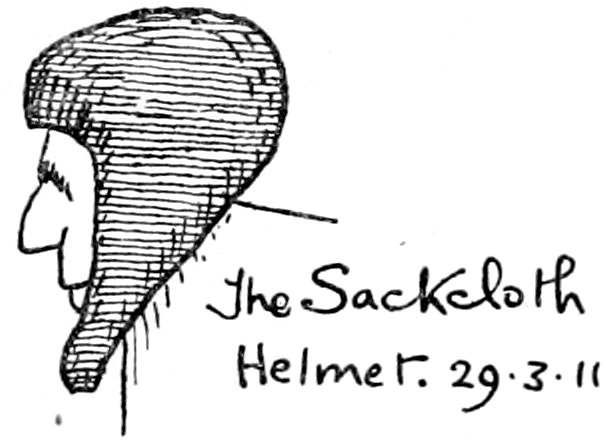
Captain Oates apparently had a Spartan objection to our comfortable clothing. I shall have something to say about his canvas trousers, but his objection to our helmets resulted in a Dutch sackcloth affair which was designed and made in the old Discovery Hut.
About this time Debenham was discovered to be an expert cook, and thenceforward presided over the culinary mysteries. His speciality was a confection known as “chupatties.” These were a kind of unleavened currant scone, made of flour and biscuit-dust and some cornflour. We used to have about four to a man, so that sixty-four of these took some making.
Some of our fireside arguments were quite lengthy. I raised the question of city design, advocating the cobweb pattern. I found that Wilson agreed with me, while Scott and Wright took the opposite view. Belfast and American cities, Paris, Melbourne, London, and even unborn Canberra (the Australian capital) were dragged into the debate. After it was well started we drew back and enjoyed the “cag” between Dr. Bill and the Owner, each backing his own views with great pertinacity! On another evening we had the oft-arising problem as to whether Lord Kelvin was a Thompson or a Thomson, and I won a stick of chocolate through chancing on the right spelling.
Towards the end of March the ice in the bay by the hut commenced to freeze. On the 28th Wright was lowered on to the Bay and found the ice three to four inches thick, so 201that we began to have hopes of getting to our own headquarters in a week. Dr. Bill and Birdie made a remarkable feast which they called seal-rissole. We indulged largely and—probably in consequence—vivid dreams were retailed next morning.
There is nothing so boring as dreams, I am aware, but I am going to quote my diary! “I was back in a suburb of Sydney, and in the distance saw an acquaintance of mine (H——). He moved away hurriedly. I caught him up, and told him I was really in Antarctica, but wanted him to note the time when I astrally visited Sydney. I remembered his name was Rupert. Guess this was the effect of the rissoles.”
Every evening before sleeping, Scott, Wilson, Debenham, and I had some sort of a scientific discussion, usually on a local geological problem—such as the origin of Castle Rock—for many such confronted us.
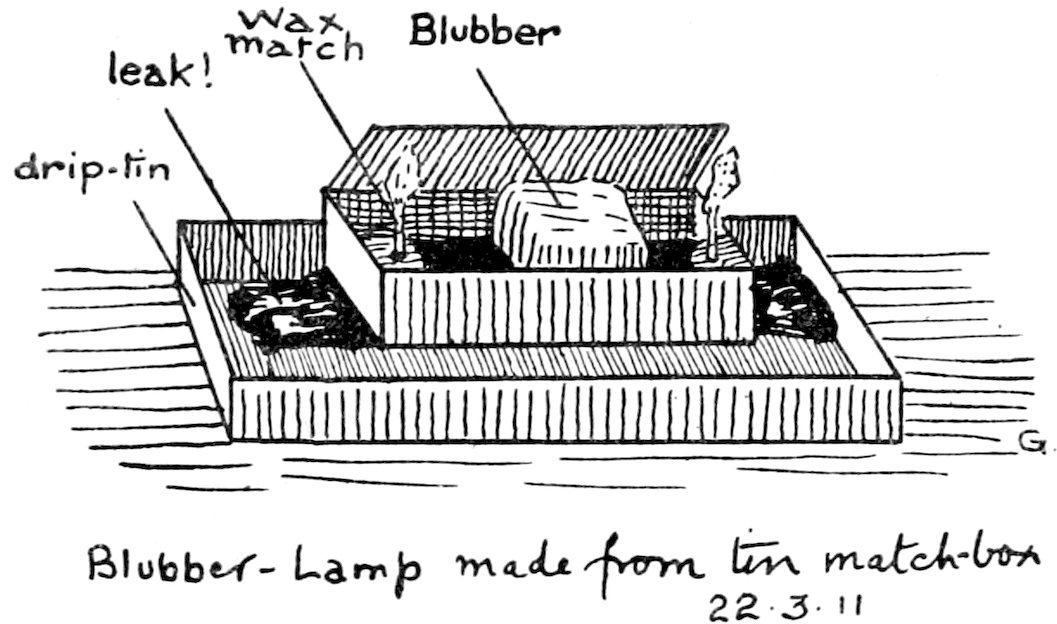
For these evening occupations we used home-made blubber lamps. A favourite make was based on a tin matchbox. Two ordinary wax matches served as wicks. As usual with blubber, the black oil leaked everywhere.
On the 31st Wright and I found that Discovery Harbour had 7½ inches of ice over its surface. The ice looked just like cocoanut ice and was no harder, but was very elastic and supported us safely. We walked across to Observation Hill, and saw a seal near the shore. I wrote, “Charles smiled at him, and as he fainted I pole-axed him. He wriggled twice or so and then died.” We climbed up and over the Gap, and got down on the east side. Then we walked two miles to Pram 202Point. Here the ice varied somewhat. In places huge splashes of slush had frozen; in others ribbons eight inches thick had overridden each other. All seemed bumped up by swinging against the fixed ice-foot. Black wedges of clear ice grew out into the water channels, and the edges of the latter were often warped and twisted. In Pram Bay there were numerous seals; one barked or growled, another opened his jaws nearly 180°, and his tongue shivered at us. A third gurgled musically, but only on one note. Later I saw one menacing his neighbour and barking at him.
About 200 yards inland was a cache where we had seven seal carcases ready for consumption.
As we returned I found some small fish, about eight inches long (Notothenia) buried in the ice, and three smaller fry lying on the surface. The stakes left by Ferrar in the ice across the Gap still seemed to be in line, so that there had been no movement of the ice since 1903. On reaching the hut we reprimanded Dr. Bill and Bowers for collecting “gabbroid nodules,” etc., when their zoological tastes should have sent them fishing. After which we exhibited the frozen sprats.
I began the month of April by helping Bowers as cook. I write: “At 7.15 threw back sleeping-bag after uncoiling my jersey from my neck. Put on coat and finnesko, and was fully dressed. Curious that one feels no worse for lack of a wash, bath or change, for over two months.”
We had a tasty bovril hoosh, flavoured by some of the treasure trove. Debenham and Wright dived deeply into their pots and brought up chaff. (Birdie’s joke for April 1st!) The seal we had killed was declared to be suffering from liver complaint, and weak heart. Hence his susceptibility to sudden shock! Anyhow the dogs ate all but the flippers and seemed none the worse.
Wright and I went further south on our next walk, right beyond Cape Armitage. I took to finnesko finally, for conduction along a big nail in the leather boots had frostbitten my toe, and for months afterwards I had little sensation in it.
“We saw an emperor penguin walking towards us with a rolling gait. He retreated as we individually surrounded him, then bolted on his belly with snaky neck vibrating amid squawks. He turned on Wright, who killed him with two whacks on the neck and two picks in the brain. I pithed him 203with my penknife. Unfortunately he bled muchly and spoiled his yellow tie, so we dug a little pit and laid his head therein, to save the plumage.”
Off the end of the Cape were many open pools of water, but I crossed between easily enough. The water was washing across, and had perhaps thickened the band of ice. Here I found many of the fish on the ice surface. Probably they were chased into the mushy ice by seals, and froze fast. I proceeded round to the east, and then climbed Observation Hill, finding Dr. Bill on the top busily sketching.
As the sun sank below the stratus cloud the golden beams shone past the Hut and showed up beautifully on the snowy surface of the Sound. We saw this tawny area gradually advance to the fixed ice and give it a rose-pink flush. The deep purplish shadow from Hut Point enchanted Dr. Bill, who made a complete sketch in about ten minutes. The sun’s low shadows on the slight corrugations of the ice and the elongated shadows of Wright with the sledge were very striking.
Later Scott returned and complimented us on getting round the Cape safely; in fact, he said that he was glad there were pioneers ahead when he tackled it!
On the 2nd Scott reported the first aurora at 3 a.m. He said it extended to within ten degrees of the zenith from the south, was of a reddish hue and like a curtain with two folds. Birdie saw it later and said he thought it was a peculiar cirrus cloud! So I felt that the colours could not have been very brilliant.
Scott, Oates, and myself never aspired to be considered cooks, but it was pleasing to see the anxiety of the others to earn a cordon bleu! But I was quite willing to help if others shouldered the ensuing blame! For instance, at lunch on this particular day Wright and I made what he christened a “cheese sponge.” “We stirred it about an hour in hopes of getting it to ‘jell,’ but it remained obdurately granular. However, by carving off lumps of our butter it went down O.K. But a quarter of a pound of butter for sixteen men is little enough!”
Lieutenant Evans started to cut a road down to the bay ice through the twelve-foot ice cliff. We dumped the ice from the excavation on to the bay ice, hoping to build up a 204ramp. The ice was in layers alternating with snow, the former probably representing spray-cemented snow. Soon the sea-ice cracked under the weight of our delta, and the latter sank more and more. It was like filling the ocean, and at 7 p.m. only a few jagged blocks showed where we had piled all our excavated material.
We had some of our penguin for supper. He weighed 92 lbs., and was about a record.
The “pseudo-scientists” were keen collectors. Some augite crystals being found on the side of Observation Hill—we geologists did not strain our consciences much by assuring them that they were gems! As a matter of fact, I once wore an augite as a stud; but it would only appeal to a geologist. However, Birdie and Cherry spent several hours crawling up the slopes of the hill. The augites took much finding, for they were rarely half an inch long. “Dry-blowing” and scraping in the snow and ashy rock with frozen fingers and colder toes was the method of work. Some of the specimens picked out of a red tuff showed very pretty crystal faces. But the mineral is nearly black and rather brittle, so that their value is purely scientific.
One morning we were promised a new dish of “whales on toast” by the indefatigable chefs. These were biscuits fried in butter and crowned with two sardines. Unfortunately they all got burnt, and the many requests for biscuits au naturel disconcerted Birdie! In the evening Evans and Wright laboured long at a dish which they finally labelled “glue” in disgust, though they had hoped it would turn out a stew. So Meares enlivened the gloom by a yarn. “A man went into a shop in our town and took off an article on approval. Unfortunately he left no name. The assistant said, ‘Whom shall we charge it to?’ The proprietor said, ‘Put it down on every one’s bill, and we’ll soon find out who didn’t take it.’” Meares stopped, and we asked, “Well, how did it work?” “Oh, the last I heard, forty of them had paid for it!”
On the 7th, Scott asked if any one wanted a walk round the sea-ice to Castle Rock. Atkinson and I volunteered, and we got on our crampons and steig-eisen, and I took an ice-axe. We went down to the sea-ice over the ice cliff, using the old hawser left there in 1903. The ice was about four and a half 205inches thick, and Scott tested its bearing strength by the simple method of jumping on it hard. It bent considerably, and water gurgled up through the holes, but this new ice is fairly tough.
The surface was mottled, due to its being largely composed of cemented pancake ice. The ice was mushy, and overriding was very common. Occasional retreats and breaks led to leads of open water. Scott pointed out to us where Vince was lost in 1903 on the icy slopes to the south of Castle Rock. We discussed what a man should do if he fell into the sea and was rescued, and Scott said the only thing was to keep on the move.
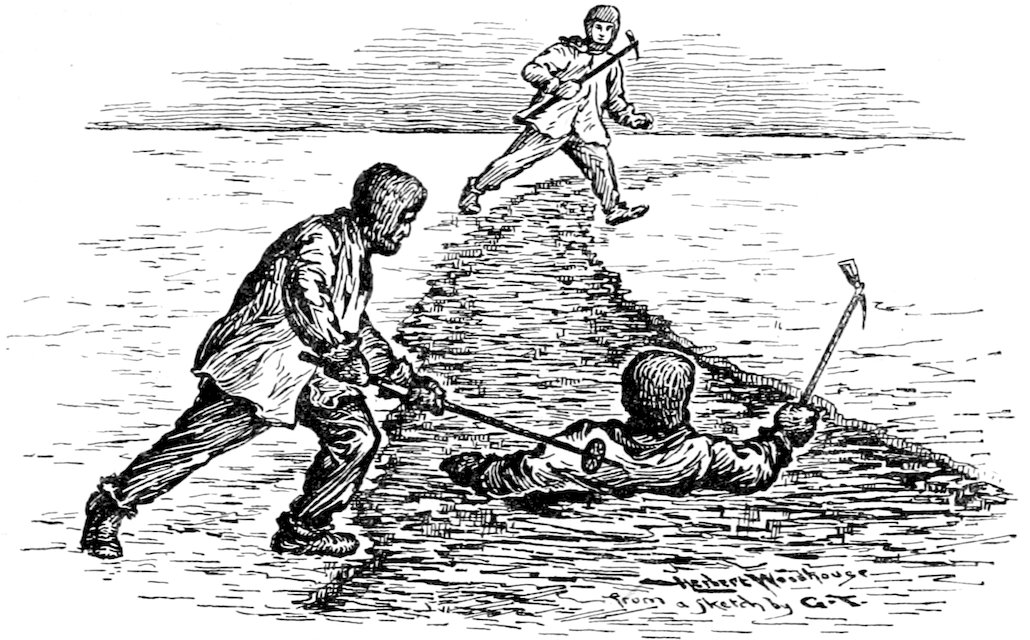
Testing the sea-ice off Castle Rock, April 7, 1911. Atkinson, Scott, and Taylor.
We crossed several “leads” of black ice, which I tested first with the ice-axe. “I chipped at the next and saw that the ice was more than an inch thick, so I boldly ambled across. I made a long step and one leg gaily went through and the other followed, but I hung by my arms fairly comfortably. Luckily I had an ice-axe. Atkinson stretched out his ski-stick, but I drove the pick in and pulled over to the further firm ice and managed to slide out, while Scott was getting over further to the north. The water was not cold, and I didn’t feel excited at all. I went in up to the 206armpits and was dripping, but only my toes were cold. Scott said he was just going to tell me not to try there; and I told him the practical experience should balance the foolishness!” Cherry returned with me to the Hut about two miles south. Luckily there was no wind, or twenty-four degrees of frost would have been serious. My notebook was well inside my wind clothes, and the chronometer was not hurt at all.
That evening there was a strong blizzard, and every vestige of ice blew out to the Ross Sea. It was lucky that the wind did not spring up six hours later, for Scott had decided to start off this very morning for Cape Evans viâ the sea-ice. As a result he determined to try a land route along the promontory to Hutton Cliffs, and so reach sea-ice where it was more land-locked and protected by Glacier Tongue.
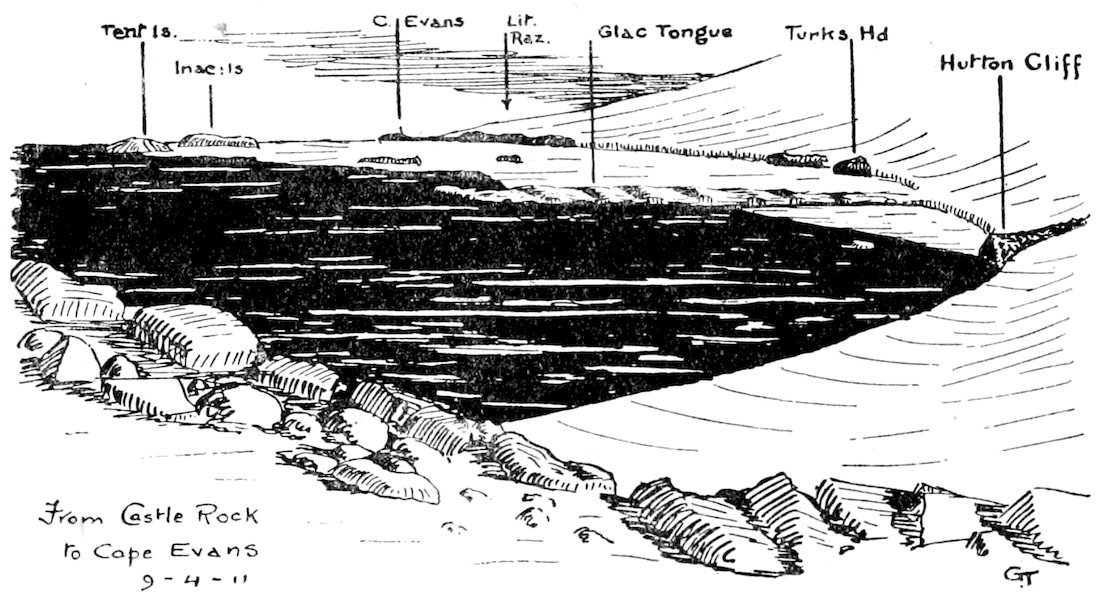
Gran and I went off to Castle Rock to see what the ice looked like in the bays to the north. We arrived at the base of this 200 feet crag about 1 p.m., and decided to climb it. Gran was wearing boots and so could get a grip, but I had on fur finnesko and found it a tough job. In fact, Gran had to spread-eagle himself on the face of the cliff, and I got up by climbing up him, like a human ladder.
This old landmark is 1340 feet high, and is built up of volcanic agglomerate. There is an almost sheer drop of 1200 feet on the west; but the top is nearly flat and offers a fine view. I could see a little patch of sea-ice in the bay 207near Hutton Cliffs, but north of Glacier Tongue the sun was in our eyes and we could not see if ice or water lay between the Tongue and Cape Evans.
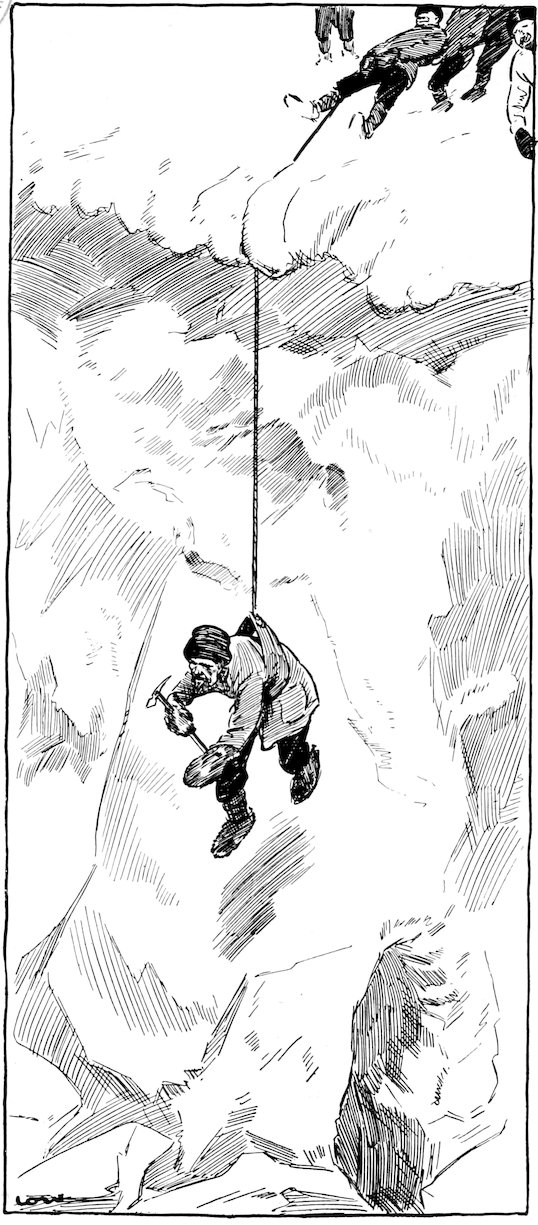
OVER THE HUTTON CLIFFS TO TEST THE SEA-ICE. From a drawing by D. Low.
On the 11th of April nine of us started for our own headquarters, leaving Wilson in charge of a party to bring over the dogs and two ponies. [The track is shown on the map, p. 88.]
“The ‘relics’ helped us up the two snow slopes. Birdie and Bill arranged signals with fireballs at 10 p.m. on the first clear night in the next three. Dr. Bill had an understanding with Scott that he should not move with the ponies and dogs until the sea-ice had stood a blizzard. We passed Castle Rock and were going strong at noon. I had been leading, giving Scott my shoulder, but here he shortened my rope and I pulled just behind him. Beyond Castle Rock all the land is untraversed. We kept for one mile along a steep snow slope, seeing no crevasses, and easily reached the flat top of the promontory. After about four miles we approached Hutton Cliffs and could see patches of blue ice on the slopes ahead. Soon we met some crevasses, and both of us fell into small ones. We got to a ridge of boulders which showed where we were to get down to the bay ice, if anywhere.
“Quite suddenly it began to drift heavily from the south, and we had to put up the tents and camp. We had some tea and then prospected for a route to the cliff edge. There were huge crevasses zigzagging across the blue ice below us, but when the drift stopped we found a good track and soon reached the cliff edge. Here it was thirty feet high with snow whirling over on to the bay ice. Further south it was a little lower, and here Scott lowered me on to some fallen blocks on the sea-ice. Then Evans, Wright, and Bowers followed, and we guided the sledge down, fully loaded, without difficulty. Two bamboos were stuck in and the rope passed round. Crean arranged this, and Scott came last, being lowered from below.
“We left the Hutton Cliffs about 5 p.m. and pulled north over two miles of soft sea-ice to Glacier Tongue. We anticipated trouble climbing the Tongue, but found a spot where its edge was only ten feet high. Evans and I were lifted up, and in ten minutes both sledges and men were on 208the Tongue. It was good fun crossing the Tongue, for there were numerous crevasses to jump, none of which was particularly risky, though Evans fell into one. We camped on the north side about 6.45. It was pretty dark, but after some tea Scott decided to push on for the remaining five miles.
“We had to steer across the bay ice by observing a star, for it began to grow thick near the surface. I tested the ice with my axe fairly frequently. We pulled all we knew, for occasionally our only beacon (the star) was almost obscured. About 10 p.m. a black patch showed up, which we guessed must be Little Razorback Island. Here Scott decided to camp. We had a difficult job gathering mushy ice to weigh the tent-flaps, but all turned in on the wet ice before midnight.”
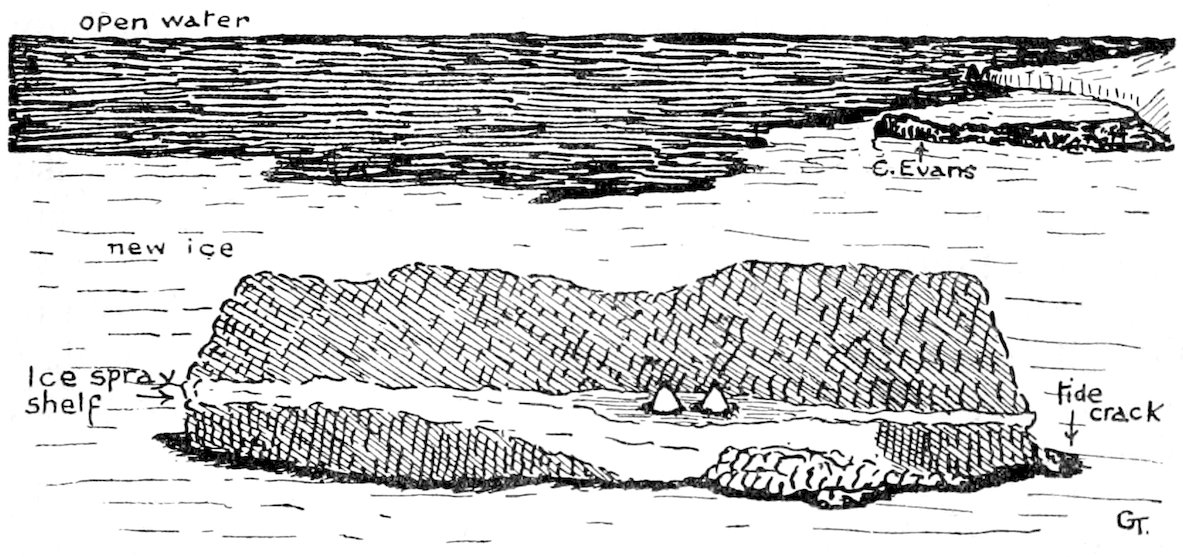
The two tents on the ice-shelf at Little Razorback Isle, April 12, 1911 (looking south).
I don’t think many of us enjoyed the situation. We were camped on new ice and had not the faintest idea how far off the open water lay, and we had practically no food with us. Next morning, before it was properly light, a blizzard came up to add to our discomfort. We could not see Cape Evans or tell whether there was ice or sea in the intervening two miles.
I climbed up the Razorback, cutting steps up the soft ashy rock with my bowie knife. Bowers and I explored an ice-ledge on the south side of this little islet. On reporting to 209Scott he inspected it, and in the afternoon we shifted camp up on to the ledge, whence we could not drift out to sea if the blizzard increased.
“I snoozed about an hour during the night, pulled the flaps of my bag tight, and apart from frozen toes—partly owing to my home-made sealskin finnesko being too tight—and shivers in the back, and the soppy nature of all my clothing, I was pretty comfortable!
“We roused at 7 a.m., and I had to wait half an hour before my fur mits thawed out enough to be wearable. We finished up our pemmican and biscuits. Birdie was cook, and as usual took too little for himself, and made a fuss about filling up his own pot.
“We packed up at 8.15, and found that the wind helped us materially. The ice seemed firmer here, and near Inaccessible Island we crossed tracks and a silk line, evidently due to Simpson’s balloon experiments. We rounded Cape Evans and saw the open water less than a mile off, so that we were pretty close to it at Razorback.
“Another hundred yards and we saw the hut with two men moving about. We went on silently (by order), and saw Lashley stand up, look our way and stand rigid. Then he spoke to Anton (who phlegmatically took no notice) and bolted into the hut. Soon they came streaming out in all sorts of overcoats, etc., Demetri and Lashley leading, Day next, Ponting, Anton, Simpson, and Hooper!”
Nelson was asleep, and Clissold too interested in some cooking!
We learnt that all had gone well except that one pony (Hackenschmidt) had died of inanition and a bullet!
We pulled on, and Birdie fell into the broad tide crack. I got across safely with the ice-axe and so to the hut.
I noticed the fine door-knobs, and the wooden number on our front door. The kitchen looked O.K. with bright tins and acetylene lighting, and all else was much about the same.
Postscript (that evening).
“Here am I in the hut, using my fountain-pen again after twelve weeks without refilling—only it’s made a blob! 210It is midnight and I lie in my bunk. ‘Marie’ Nelson is taking meteorological readings, and remarks that the Skua Gull (i.e. G.T.) has resumed his predatory habits. The others are sleeping except Ponting, from whom I got my candle. But everything feels too warm and clean for sleep! Clocks are ticking everywhere!”
211