VI THE GRANITE HARBOUR EXPEDITION SECOND WESTERN EXPEDITION
Reading edition
November 1911–February 1912
330
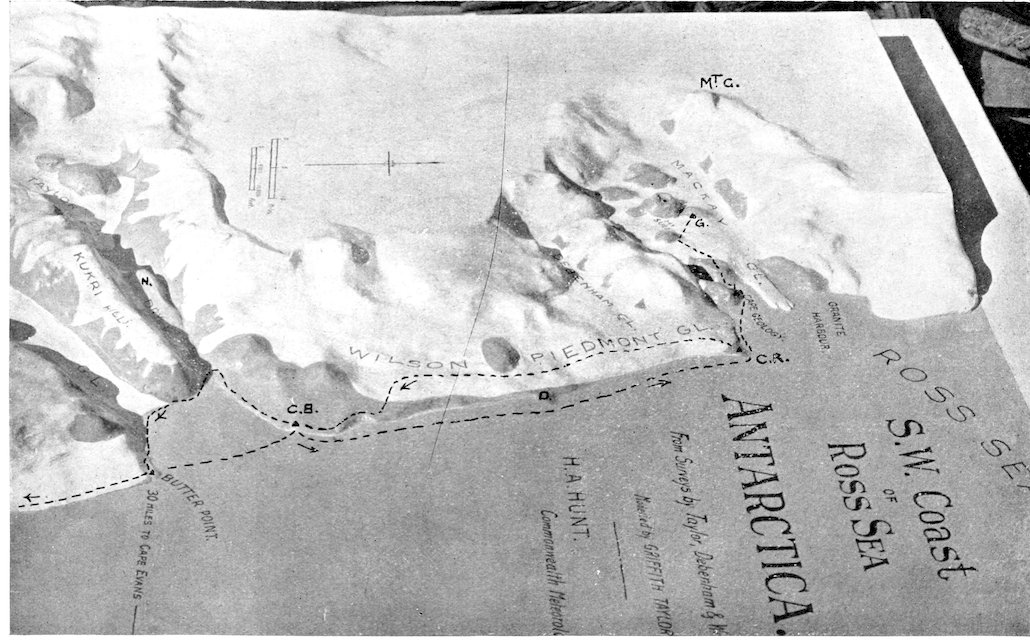
RELIEF MODEL OF THE REGION TRAVERSED IN THE SECOND SUMMER. C.B. = Cape Bernacchi. Mt. G. = Mount Gran. G. = Gondola Ridge. C.R. = Cape Roberts. D. = Cape Dunlop. N. = Nussbaum Riegel (across Taylor Valley).
331
THE GRANITE HARBOUR EXPEDITION
(Vide large folding map at end.)
During the winter the four members of the western party often used to gaze to the north-west across McMurdo Sound and wonder what adventures we should meet in the coming summer. We could make out the hills behind Cape Bernacchi fairly well, some fifty miles off; but beyond that was a greyish mass of land which, north of our horizon, was broken by the large inlet of Granite Harbour just about latitude 77°. We read up what little was known of it, and Wilson told us his memories—of a sort of bluff-ended peninsula where we could reach terra firma, of ice-falls filled with crevasses, and not very promising as a route to the interior.
We expected to get away by October 22nd, but Debenham, as has been told, injured his knee a day or two before, and spent most of the next three weeks in his bunk trying to reduce the inflammation sufficiently for him to walk.
The western party were unfortunate in having another cripple. Forde’s right hand was still in bandages from his severe frostbites, but they were progressing favourably, and though he never was able to use it for delicate operations, it did not handicap him greatly.
On the 5th of November we packed the sledges. Our delay had one advantage—we needed less food, and so our load was lighter. In fact, I don’t know how we could have managed much more than our “half ton.” I omitted three weeks’ supplies, but packed all the remainder on to the sledges. In the huge canvas bag—called a tank by the seamen—were put the weekly bags of stores. Here a little pile of butter, there smaller bags of tea, etc. A few small bags of pepper, salt, etc., were placed in the “Ready-Bag.” This latter was a smaller canvas bag which held just a week’s food, and was kept separate from the main “tank,” so that 332the latter was only opened once a week when the cooks changed duty.
A document which was consulted more frequently than any other which we carried was Bowers’ list of our stores. It was headed, in a last flash of his humorous verbosity, “The Western Physiphogeopetrovulcanological Party,” and gave me careful notes as to the stores at Butter Point, and tips as to taking tin-openers, and bags for the cocoa and pemmican tins we should find there. It got very frayed with continual use, and this led to some anxiety later. All the items were entered like this:—
“Biscuit for 20 weeks at 24·5 lbs. = 490 lbs.” The entry for tea I read as—
“Tea for 20 weeks at 1·75 lbs.,” but it was nearly illegible, and later, after wondering why the tea was so rapidly diminishing, I saw that his note really read 1·75 for ten days (instead of “per week”). This was one of the most welcome discoveries on our journey, for I thought I had lost some bags of the precious beverage, and we soon evened matters by greater economy.
On the Sunday afternoon (5th November) Gran, Forde, and I pulled the big sledge over the sea-ice to the west. We had very heavy work dragging it over the snow near Cape Evans, but owing to the track we had cut through the walls at the great shear crack we crossed this quite easily. We came on some mirror ice, where the runners positively flew along, but a film of snowdrift about a quarter of an inch deep made us nearly lie down in our traces. We took the sledge about three miles out and then returned to the hut. En route our collie bitch worried a seal almost to death, and though Gran gave her a tremendous beating, I doubt if that even made the dogs refrain from tormenting the helpless animals.
Perhaps they felt that the seals were fair game, as they were so much bigger than themselves!
On Monday a blizzard came up, in which superstitious little Anton had a wild time reaching the hut. He had left Ponting encamped at Little Razorback, and much preferred to find his way back, rather than spend a night among the howling demons of the Antarctic!
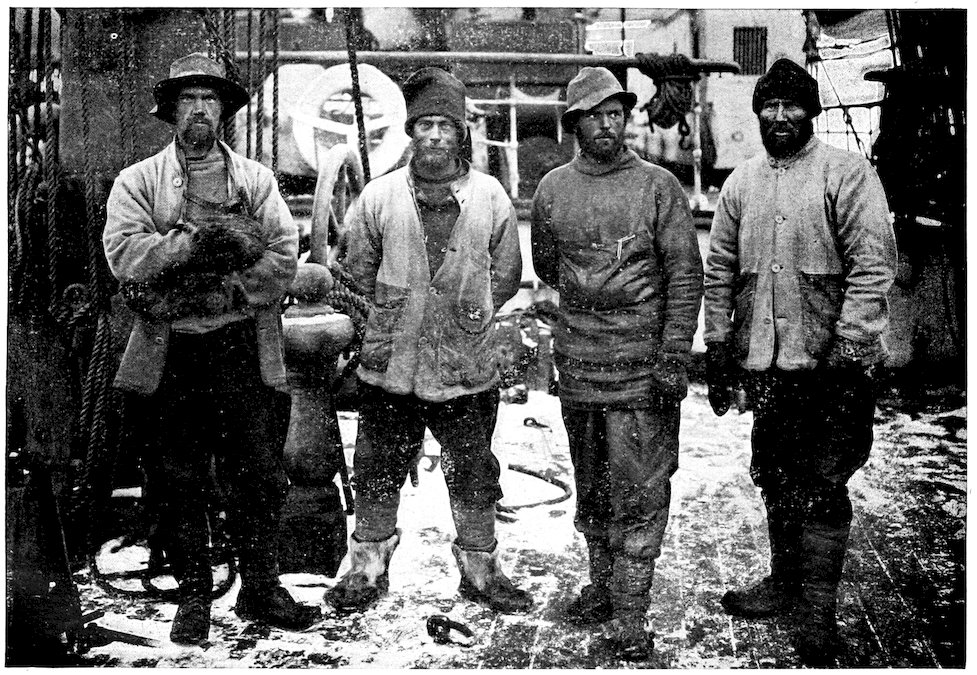
THE SECOND WESTERN PARTY THE DAY THEY WERE PICKED UP BY THE SHIP. Taylor, Debenham, Gran, and Forde.
We had a council in the hut with Simpson and Nelson. The latter very kindly volunteered to take Debenham’s place 333and help my party across to Butter Point with most of our gear. Then we could rapidly return and pick up Debenham if the rest had sufficiently cured his disabled leg.
On the 7th of November we started off on our first relay. We left about ten o’clock, taking a small sledge from the hut with our sledging gear. We soon picked up our main load on the big sledge, and then began really heavy work. One is always soft and out of condition after the winter, and it takes about a week to get into sledging trim again. It was not very cheering to find we could only get along at the rate of about one mile an hour, for a large part of the gear to be dragged to Granite Harbour, lay thirty miles west at Butter Point! In fact, even with this light load, the surfaces made us relay at times, and the effect on one’s body muscles seemed at first almost unbearable. By lunch-time we had only left the hut about four and a half miles behind.
It was blowing strongly from the south-east, and I saw a snowdrift rushing along the ice. When we reached a patch of snow suitable for a camp site, I pitched our tent, and this halt for lunch unfortunately served for supper and breakfast also. It was blizzing hard in ten minutes, and we were only just able to get the tent up in time. Forde was able to help greatly, though his hand was still in a sling.
We were now no longer new chums, and it was pleasant to find that sledging was so much more comfortable than on our first expedition. We now realized that if we could keep out the snow, we should help the human furnace enormously. For every snowflake in or on one’s garments, first melted and then turned to ice, and all this had to be thawed each night before one could get warm enough to sleep. So this trip we carried a shilling scrubbing brush, and every one was most assiduous in its use.
It was amusing how little trouble we had in donning our frozen boots now. Some one had hung his on the peak of the tent, while the cooker was going for breakfast, and now they were almost too pliant when we needed to put them on. It was a greater comfort to have a wider floorcloth. Now the outside men were not pushed into the snow, and our instruments and notes were kept much more securely than on the former journey.
As the blizzard increased it drove snow on to the 334windward side of the tent, and the lee sides flapped violently so that the “stocking” door vibrated incessantly. The snow piled higher and higher, and under the ventilator collected a great ball of ice.
We were pretty comfortable very soon in spite of the snow, which covered the sledges a foot deep. A rapid journey to Butter Point was out of the question, and we turned in hoping for better weather in the morning. The temperature was +23° as I ascertained by swinging the sledge thermometer. My last camp in April on Little Razorback had been in −23°, some 45° lower!
Nelson read Poe for awhile in his bag; I read Browning. We were rather jammed together in the drifted tent, and poor Forde next morning said he had been too crushed to sleep! For myself I had never before slept so well at the start of a trip.
At 6 a.m. on the 8th it was still very thick to westward. However, at 7.30 we turned out for breakfast, and after digging up the sledges we got away about 9.40. It is curious how long it took to start off every morning. With no dressing or washing and a simple breakfast of two pots of food, one would have expected a party to be ready in an hour; but two hours was by no means unusual after a blizzard.
The heavy winds had compacted the snow, and also, I believe, covered some of the sticky salty surface. At any rate, we went along better than I had dared to hope, and could do more than a mile an hour.
I soon learnt that it was better to go a long way round rather than cross new snow, and at lunch-time we had done over three miles. Very stiff it made us! The sky cleared, and seemingly a short way ahead lay Butter Point, a face of ice about 50 feet high in which small crevasses showed quite clearly. Yet it was still 20 miles away! To the south-west was a group of dark castles. These were the little volcanic Dailey Isles, which were miraged up into huge squat keeps, very different from their true conical shape.
Far to the north we could see the locale of one of the wildest Antarctic exploits—the mighty crevasses near Mount Bird. Macintosh and a mate managed to cross these during Shackleton’s expedition in 1908, after abandoning their tent and losing their food in a crevasse.
335How anxiously we watched the little dial of the sledge-meter. Very slowly the miles rolled away, and when we had done four more stages I stopped for a cup of tea and some block chocolate. These short halts did not make one stiff like a longer wait. Finally, we halted at 8.30 after eleven hours on the move. We had sledged eight miles as the result of the day’s work, and were already feeling fitter and enjoying our pemmican. How greasy and thick it tastes at first! and yet how soon it seems to vanish almost at sight!
The sun came out and there was a tremendous glare from the snow. Goggles were donned and were not an unmixed blessing. The hot glare disappeared, but sweat rolled down one’s forehead and fogged the glasses so that it was impossible to see through them.
On the 8th we continued our “trek” towards Butter Point. There is very little variety on these journeys; you pull till you are tired—not talking much, for that uses too much breath, but thinking of all sorts of topics. As long as one leans forward in the belt and keeps time there is not much else to engage one’s attention. Even the leader merely notes some object in his line of march and plugs steadily on until it is time to halt for the five minutes’ spell!
At 4 o’clock we were nearly 20 miles from the hut, and therefore, as we halted for tea, still ten miles from Butter Point. It was gloomy and soon started drifting again, always from the south-east and always giving but a short warning of low driving snow before the full blast struck us.
This blizzard lasted thirty-six hours. We lay in our bags and slept most of the time. It is wonderful how one’s appetite decreases during these enforced waits. The normal amount of thirty-three ounces of dried food per day would be enormous in ordinary life; when lying snug in one’s bag, no energy is used in work and little in heat, so that about twenty ounces seems sufficient, and one of the meals can be cut out with ease.
On Saturday morning I turned out at 3 a.m., and a little later it was obviously clearing. The drift was deep over the sledges and nearly over the door. We had been delayed so much that I felt we must now turn back, so we packed the tent and one meal on the small sledge and left a large flag on a bamboo by the larger sledge.
336We had only about 100 lbs. to pull and yet the twenty miles (twenty-three statute) was a hard journey. I hoped to be in by noon, but the surface was very bad. We had tea and a biscuit at six and another short meal at noon. We could see the four isles off Cape Evans all the time, and I think our chief occupation while sledging was in watching them take up various angles in front of the Cape as we gradually got nearer the hut. We crossed some landmarks in the shape of the huge shear cracks. One at nine miles, one at four and a half, and a small one two and a half miles from the hut. The last six miles were awful, for the erstwhile mirror-like ice near the Cape was now covered with a sticky film of snow over which we could hardly pull the empty sledge.
However we began to see dead penguins, and then we knew we were within a “dog’s walk” of the hut—for these were relics of their occupation. Next we reached the triangular area to leeward (north) of the hut, which viewed from the Ramp was of a yellow tinge from the straw and other debris blown there by the blizzards. And so at 4.30 p.m., just twelve hours after starting we arrived. I immediately rushed Clissold the cook for tinned pears, and found none left. So I started on three rounds of toast. We then had soup, rissoles, and fruit tart. I had three helps of the former and two of the latter and still felt hungry. Debenham’s leg had not been going on very well, but was better than on Wednesday. They had had no drift at the hut on Tuesday!
After another council I decided to take advantage of Nelson’s kind offer. He would accompany us with the little Russian groom Anton. If all went well they could return; if Debenham were too lame to proceed they could bring him back, and Gran, Forde, and myself would push on to Granite Harbour as a three-man party.
Sunday and Monday passed quietly in the hut though the weather was bad outside. On Tuesday it was very unpromising until 3 p.m., when we could just make out the Western Mountains. At 3.20 we made our final start with Nelson and Anton as a convoy. Debenham hobbled alongside, and as the surface was better than previously and the wind blew to the west we made fair progress. This time we took on our cameras and Day’s blubber stove. At six miles we pitched camp and were starting supper when I discovered 337that we had left the can of spirits behind. This fluid was necessary to start the primus stove in low temperatures, so Gran and I tramped back to the hut for it. It was a stiff walk, for we were afraid of thick black clouds to the south and the wind rose to sixty miles an hour, luckily without drift. After some supper I turned into my bunk for the last time that year. Gran slept in the bunk above, and as the result of some salmon and a recent perusal of Jules Verne’s “Mysterious Island,” suffered from nightmare. He explained next morning that he thought Erebus had overwhelmed the Cape with red-hot lava, wherein Simpson had been engulfed, but the geologists had calmly climbed up to the crater! Was this a forecast of his own escape on the summit a year later, when Gran was nearly choked by the fumes?
We found the spirits where we had been packing the sledges, and trudged out to the tents to find the others having breakfast. However, we started at 10 a.m. and did nine miles by 5.30. I camped early to prevent Debenham overstraining his leg.
On the 16th we awoke to find snow falling, though there was not much wind. We had been so much delayed that I determined to try marching through the thick weather lying ahead of us. Although we were fairly close to the magnetic pole, and the compass consequently had very little “horizontal pull,” yet I determined to try steering by it, especially as we had a spare man to steer us. We wanted to go almost due west, but the compass direction, owing to the variation, was S. 65° E.! So Debenham marched some fifty yards behind us, and signalled to Nelson, who repeatedly turned to observe him. Meanwhile I tried to steer a course by any object which I could see looming up through the mist ahead. We serpentined considerably at first, but moved steadily westward. Our surprise and gratification may be imagined when we suddenly saw footprints ahead of us, and realized that we had exactly hit on our route of the week before. We had not seen any trace of our track since leaving the hut, and this encounter was as marvellous as finding a needle in the proverbial bottle of hay. On we went into the thick of it till 1 p.m. My eyes soon tired with looking at huge crags, which turned out to be ice splinters twenty yards away. Finally the western hills appeared, and we were all on the qui vive to be 338the first to spot the depôt flag. Nelson offered his raisins as a reward, and then won them himself! We reached our depôt at 2 p.m.
The sledge was not buried, though a great lee had been built by the blizzards. We had a merry lunch, all six sitting in one tent. Anton’s plans caused much amusement. We gathered that he was going back to Russia to marry a rich wife, and so long as she were wealthy we understood that he had no objection even to a wooden leg!
The clouds began to roll away en masse, leaving behind a magnificent Italian blue sky, as if the blizzard had purged it of all impurity. The resulting contrast with the dazzling white mountains had something of a Japanese effect, and the afternoon was one of the finest I saw in the Antarctic.
We camped within seven miles of Butter Point. I was delighted to catch Debenham surreptitiously helping with the back sledge, for he found that his leg was certainly no worse for the rough work he was giving it.
On the 17th we moved on with another sledge added. They pulled stiffly, and we met with soft snow every few yards. Moreover, we encountered some “screw-pack,” which is a very formidable obstacle, and of which we met more than enough in the next week or so. I suppose that here the sea-ice had been broken up and jammed together before finally freezing into a continuous sheet. However, by zigzagging we made steady progress, and reached Butter Point about 5 p.m.
We pitched the two tents first thing, on the thick snowdrifts near the tide crack. Then we walked up to the depôt, where our boxes stood out boldly, some three hundred yards away.
We dragged up the small sledge and loaded it with cocoa, sugar, pemmican, etc., and then a second time took down 330 lbs. of biscuits. The floor on which the stores had been laid in January was now over two feet down. This gives some indication of the change in the surface of the piedmont ice in nine months. Probably drift accounted for most of the deposit.
The two tents now resembled grocers’ shops. In one Nelson and Forde were bagging the cocoa, in the other Gran and I opened tins of pemmican and placed them in weekly 339bags also. Meanwhile Debenham prepared a fine hoosh, and Anton conducted a lively class in Russian. In the depôt were some soft captain’s biscuits left by Shackleton’s party. Forde and Debenham preferred them to our official ration of hard sledging biscuit, and so we made an exchange, for I knew we could always make up deficit by seal meat.
On the 18th we started off with six men to pull the three sledges; but we found it impossible, and had to relay all the time. We were now crossing the mouth of New Harbour, making for Cape Bernacchi, at its north-east corner.
At lunch we finished off Nelson’s contribution of Tru milk, and Debenham took a photo of the combined parties. Then the “Convoy Commando” left us, and we saw them for an hour or so plugging steadily towards Cape Royds. Here Nelson intended to get some penguin eggs before going to Cape Evans.
Now we were left to our own resources, with 1350 lbs. to drag along. I distributed the weight more evenly on the two sledges, putting the heavy biscuit-boxes on one, and the tents and sledging gear on the other.
After lunch we pulled off, Debenham and myself in front, and Forde and Gran near the sledge. The sun was hot, but as usual, when we anticipated trouble, it was not forthcoming, for Debenham was able to help us very materially, and the surface was rippled and harder than we had seen hitherto.
Soon we were hotter than we liked, and our headgear was modified to suit the climate. Forde appeared in a huge panama. Debenham and Gran had felt hats with ear-flaps, and I wore an ordinary colonial felt, which I tied down like a coal-scuttle when the wind was too keen. This day it was warm enough to wear no hat at all, so I walked bareheaded with goggles, “and would have liked to pull off my vest also”!
The screw-pack was low hereabouts, only projecting two or three feet; but the hollows were masked by snow, which made the walking difficult and even dangerous for Debenham. We took the “biscuit” sledge on first for about a mile and flagged it; then trudged back for the “tent” sledge. Debenham met us soon, and pulled with us for the same weary mile. It took about forty minutes to do this, and about twenty to walk back, so that transporting the half ton over a mile meant 340a hundred minutes of very hard labour, which with a light load we could cover in twenty-five minutes.
Well, we had some weeks of it, and by the time five miles comes to be accounted a good day’s journey, progress does not seem so slow as it did at first. We used to leave Debenham ahead with the first sledge at our evening stage, and when we three brought up the biscuit sledge we would find that he had nearly got the “hoosh” ready. There was no mention of “too much pemmican” nowadays!
We were now crossing New Harbour. It was interesting to see so clearly the old landmarks of Dry Valley, and amusing to think of our bet with Taff Evans as to the identity of the valley we were now passing. He was convinced that we could not see Dry Valley from Butter Point, and we had had a hot discussion in the previous February on the point.
From this point we saw a most wonderful array of cwm valleys. On the flanks of Mount Lister they were clustered thickly like thumbmarks in a piece of putty. On the slopes of the Kukri Hills we could see steep gullies, as it were, growing into “chimneys,” and these into deeper valleys, and so into veritable cwms or cirques. They illustrate an interesting scientific principle. It is naturally impossible to see the stages of valley erosion evolving before one’s eyes—as impossible as to see a barrier reef changing into a coral atoll—and yet one cannot doubt that this evolution occurs when we have all the intermediate stages confronting us.
We intended to carry out a very complete survey on this journey. We had two separate instruments, a theodolite and a plane-table. With the former I was able to fix far distant peaks with considerable accuracy, and also by observations on the sun to determine the latitude and longitude of the main stations of our survey. With the plane-table Debenham carried out a unique detailed survey of the coast-line, not only showing the outlines of the land but also all the physiographic features. By means of the theodolite we were also able to plot the elevations fairly accurately, and when these were added to the plane-table charts I think we brought back from our sledging trip an Antarctic survey unique for its completeness in the field.
The surface for the next few miles was very bad. I wished Wright were with us, not only to lend us his sturdy muscles, 341but to study the queer morass we encountered. We were sinking nearly to the knee in snow crystals. These were not wet, but so incoherent that they clogged the sledge-meter, and for the remainder of our journey we had to remember the miles missed from our reckoning before reaching Cape Bernacchi.
The yellow goggles gave rise to a queer illusion. It was just as if we were pulling through heavy sand at the mouth of a river, and owing to some wind and water action, there were the same ripples and channels as are to be seen in an estuary.
Captain Scott had ordered us to leave a week’s provisions at Cape Bernacchi, for we should need this if the bay ice went out, and we had to return overland. So we carried up a half-tin of biscuit, and filled it with butter, pemmican, and chocolate. This was reared on end, and protected by a cairn of granite. We surmounted it with one of our precious bamboos carrying a flag. I left a note informing the finder as to our progress, and immediate plans. This was the first of our post offices, of which we established four more during the summer.
Though all this took time, we also made a collection of rocks for Debenham. The loose snow had wrenched his knee badly, so that much as he would have liked to explore our first new land, he was unable to move many yards from the sledge. Marble, granite, tourmaline gneiss, basalts and schists, and a few mineral veins gave us quite a fine collection—though most of them were moraine specimens.
I sketched the coast to northward, observing with great satisfaction that there was no open water in sight. Numerous seals were basking in the next bay, which augured well for our future food supply. Less welcome was the rugged area of screw-pack which filled the bay, and which we should have to traverse on our next stage.
Debenham had packed the sledge, and we moved off in the afternoon, winding in and out between jagged lumps of ice, sometimes eight feet high. There was interesting spoor here; an Emperor penguin had evidently passed by, and his sturdy tread had hardened the snow somewhat. Ensuing blizzards swept away the softer snow, and left his imperial footprints standing in relief.
We camped in the screw-pack, and passed a peaceful night. 342Next morning the narration of a dream caused some amusement. “I had invited Professor David to dine, and arrived two hours late; as I had no money to pay for the meal I calmly decided to wake, and did so!” We often discussed dreams, especially after my repeating what I could remember of an article in a magazine I had read in the Old Discovery Hut. It pointed out that one’s own personality was often revealed in the clearest fashion. I hope the above sample was not of this type.
We reached Marble Cape at noon, and from the top we could see our wandering friend from Ross Island—the three-mile fragment of Glacier Tongue. There was Oates’ depôt as clear as ever, and the huge field of ice had almost filled the bay between this cape and one to the north. Its sides projected thirty feet above the sea-ice, and we could see that it was largely built of snow, which was folded in a very complex manner, and probably originated largely as snow cornices, just as current-bedding in rocks is formed from steep delta deposits.
To the west, behind the cape, was the sheer front of the Piedmont Glacier. It ended in a face about thirty feet high, and evidently was for the most part moulded over the hills, though a few nunakoller projected through it.
We reached a high cape built of gneiss, and camped there for the night, among a colony of seals. We were doubtful as to whether this, or the previous headland, was David’s “Marble Cape”; in fact, as some one said, it was a “nice point.” At any rate this pun led to the name Gneiss Point, by which we knew it.
Next morning it was a blow to our pride to drag the sledge through the numerous seals, and to find that they evidently despised us too much to move out of our way. It was a favourite basking ground, and many square yards of snow were rolled flat and hard by the sleeping seals, while canoe-shaped hollows showed where some unsociable beast had lain at a distance from his fellows.
We started off relaying as usual, but as I was returning I felt this was just the time to test our outfit as an ice yacht! A steady south wind was blowing almost directly behind us, and the next few miles showed a reasonably good surface.
The six heavy bamboo poles, on which the tent is hung, 343were so arranged that two could be taken out of the leather bucket uniting them at the top. The remaining two pairs were fixed vertically above the front sledge to form a double mast. We lashed them to the stanchions with lamp-wick. The other two bamboos were used as yards for the floorcloth. This sail was held up by a rope—actually off Forde’s sleeping-bag—which passed over the top of the “bucket” on the mast, and the pull of the wind kept it taut. Two “main sheets” helped to secure things, and passed from the yards to the rear of the sledge. Forde was bo’sun, and made a good job of it. Meanwhile, the delay had frozen the sledges to the sea-ice, but after “breaking” them out, we managed to start the yacht and its tender, and to our delight we could just move the half ton along! It was frightfully hard work, especially the start; but we could do a mile in forty-five minutes, whereas formerly relays and halts made this a two-hour job. Luckily, Debenham’s leg was now much better, and the miles piled up splendidly. We did 6½ geographic miles by 7 p.m., instead of 4½ by 9 p.m. as heretofore.
In gratitude we called this bay the Bay of Sails; a variation from Shackleton’s famous inlet, the Bay of Whales. The coast was fringed by Piedmont Glacier, but a little rock showed at the water’s edge. We indulged in extra raisins for lunch, and camped at night near a large cape, which reminded Forde of Spike Island, near Cork.
The ice was evidently affected by the summer breaks, for we had to cross a crack two feet wide, where the water was surging continuously. A young seal here caused us some amusement, its heart-rending “baa-aas” and strenuous efforts to climb a gigantic ridge eight inches high being very comic.
“November 23, 10.15 p.m.—The sun is shining brightly for the first time to-day. The tent is flapping gaily, partly owing to the two poles being a bit loose, and partly to the keen southerly wind which is driving over the shore glacier. I am as snug as possible in my bag since I sewed the new left-hand flap thereon. I shall patent this! for a man can lie left or right, fur in or out now. The temperature is +14° F., and the barometer has risen rapidly to 30.14. This change probably means something unpleasant, but Erebus is very clear and the steam going south!”
344In spite of hurrying, putting the sail together inside the tent took time, so that it was 10.45 before we started with sail set and a fair wind for the next headland. This looked like a dented door-knob, and we reached it by lunch with the mast bending and the sail bulging in true nautical style.
As we passed it I saw that we had reached Dunlop Island, which had been hidden from us by a line of icebergs. It is separated from Dunlop Cape by a strait about one-third of a mile wide. We hailed this with joy, for it seemed to be pure blue ice; but over this blizzards had blown low parallel ridges of snow which were about 20 feet apart. The snow was sticky with salt, and the alternation of clear ice with sticky snow was almost impassable. For we could not stand on the ice and the sledge would not move over the snow, and when we could pull from the snow, the sledges were on clear ice and the wind drove them along unassisted! I don’t know how Debenham managed, but I wrenched my leg, and for days afterwards had cause to remember Dunlop Strait.
Dunlop Island is a mere ridge of shingle about 60 feet high. There was a fierce wind blowing which prevented my taking any photographs, but I managed to get a round of angles with the theodolite before my hands were numbed. There seemed to be four ancient beach-levels marked by well-rounded boulders which point to elevation in this region. Looking to the north we could see nothing but a great barrier wall of ice along the coast. The trend of the latter was almost continuous from Cape Bernacchi, and we could see no foundation for the sharp turn to the north-west charted on the existing maps.
We pushed on for the north along this forbidding wall of ice. It was almost December now, and the sea-ice might break up any day, so that our next few days were anxious ones. We had great difficulty from the sticky surface, and the wind changed direction, nearly blowing the sledge over, so I decided to “down sail” and steer nearer the land. We could only with difficulty pull one sledge, and had to relay till we reached the face of the glacier, where we camped. While Debenham cooked the hoosh—an excellent one, of which I had one and a half pots!—Gran and I managed to climb 200 feet up the glacier front. The ice was much broken and recemented with some deep crevasses and queer puckered 345ridges. After making a sketch and searching for signs of open water, luckily without result, we turned in and spent a comfortable night.
We awoke to a comparatively hot day! I decided to try one sledge first, and if all went well to tack on the other. But to our chagrin we found that we could not manage one sledge. By one o’clock we had managed to struggle along for one mile, in the course of which Debenham had badly twisted his knee.
“I decided to go in for night marching, and we pitched the tent, hung out our wet clothes in the hot sun, and had lunch. Then we turned in and tried to sleep without success. I read through one year of Horsfield’s German Grammar, and put a chinstrap on my hat, while Forde darned socks. It was too hot to keep in the sleeping-bags, and so I lay outside without a coat!
“At 7 p.m. it is distinctly cooler, so that ice does not melt now if you touch it.”
These abnormal conditions were due to the bright sun, for the air temperature was below freezing. But the solar rays striking the tent melted any snow thereon until there were pools on the flounce, while water inside the aluminium cooker remained unfrozen for hours.
Night marching commenced about 9 p.m. The surface was much harder, and we just managed two sledges for a short distance, but we had to relay most of the way.
To the west is the great Piedmont Glacier, thirty miles wide, and covering a ten-mile belt between the mountains and the sea. The nearer mountains were all rounded and smoothed by glacial erosion, while the higher peaks behind rose into jagged summits, pitted by numerous cwm valleys, which showed that they had never been beneath a thick ice mantle.
To the east appeared a brown island about 100 feet high and a quarter of a mile long. It had a well-defined ice-foot, and I hoped that we were to chart a new island. Gran and Forde were eager to examine this, and while we were surveying the coast they marched a mile or so towards it. But our “island” was merely a stranded berg coloured brown by the large amount of silt included in the ice. In some such way numerous “islands,” such as the Nimrod group, have crept 346on to the chart, for no one has been able to sight them since their discovery.
We camped just after midnight for lunch, at which I presided. As usual, it consisted of tea, biscuits (hard sledging tack for Gran and me, and soft “Shackleton” biscuits for Debenham and Forde), raisins, butter, and chocolate.
The Discovery map was obviously quite incorrect here, and our chief guide was Professor David’s account. From the times of his daily marches we expected to reach Granite Harbour earlier than the rough chart indicated, for he speaks of the harbour as being twenty miles out of position! The only place for a bay “five miles wide” seemed to be about ten miles ahead, so that I hoped that a few more days would settle the question.
We got a fine view of Erebus, especially of the old crater whose wall sticks up like a gigantic black fang on the northern slope. Mount Terror was also visible now round the hump of Erebus. The steam banner from the latter was very striking, stretching far to the south, and then, at 8 p.m., shifting to the north after some big puffs. This usually indicated a strong change in the weather—which was the last thing we desired in our present position off the inhospitable face of the Piedmont Glacier!
We camped on rather thin snow and weighted the tent flounce with the biscuit boxes. It was very warm inside the tent, and though the outer air was 14° below freezing, small pools of water lay on the tent flounces in the full heat of the sun. “I made the dinner. The pemmican was not bad, though not so creamy as Deb’s, which has a reputation. It is a month to Christmas, and we have been sledging three weeks. I find it much more pleasant than last February, even with our abnormal loads. I plan out things while pulling automatically, and the miles pass along somehow. Camps are much more comfortable, and of course it is warmer now!
“It is very confusing having breakfast at 7.30 p.m., and sleeping or trying to sleep through the day. I find it rather hot, and generally only sleep four hours and think away the other four. However, there is no comparison between the surface by night and by day, for though the sun is bright at midnight he is not nearly so high or warm and does not melt the ice 347surface. We camped about half a mile from the huge Piedmont, and set out next day for a remarkable line of icebergs. On our left was the great glacier, the cliff edge dropping to sea-level at a brownish boss which I thought might show some rock. But it was merely stained ice badly crevassed and stepped like a land-slip. I expected to reach this the same night, but luckily our sledge-meter is a better guide as to when we’ve done enough. Four and a half miles, if we have been relaying, takes eleven hours hard work (less lunch-time). Anyhow, the brown boss was still three miles beyond our camp, as we found later. (I expect that the pseudo-island was derived from this breaking ice-cape, for there was a huge group of bergs just ahead of us.)
“I don’t take very full geological notes for obvious reasons. We see a piece of rock about every three days!”
There was in fact no leisure for any scientific work. We were too dog-tired to stir far from the tent. Even the ice was unusually uninteresting from a scientific point of view. We watched it with very particular care nevertheless. Hereabouts a rather low screw-pack had been covered by recent snows, and the alternation of hard blocks and trenches filled with snow made a surface calculated to keep us all on the qui vive. I took Gran abreast of me in the harness, and so we explored most of the pitfalls, thereby saving Debenham’s lame leg from the worst surfaces.
We did some wonderful wriggles, and if the ice ridges were fairly frequent—say every five feet—the sledges revelled in the track. For the runners only touched at these points, and the weight was supported above the soft fields of snow.
It was a wonderful field of bergs among which we now encamped. There were fifteen in all shapes and sizes. Several were low and tabular, while two were higher and cubic in shape. One was a dirty brown, and was possibly a brother of the pseudo-island. Two others were shaped like newts, with a sharp jagged crest. They were, I suppose, overturned bergs.
At 9.30 on the evening of the 26th we left our camp among the bergs, and dodged in and out among them towards the low rocky cape just to the north of us. Huge granite tors crowned it, and great blocks of ice six feet across had been hurled many feet on to the cape by the gales of the 348preceding season. I halted to photograph these, and Debenham and Gran climbed on to the granite tors. To my amazement Gran called out that Granite Harbour was in sight. I hastily climbed up and found we were right at it! This small cape was actually the southern portal, and the entrance looked about ten miles across.
As in New Harbour there seemed to be two chief arms, the larger southern portion receiving the Mackay Glacier, and the other being almost completely bounded by smaller inflowing glaciers.
On the cape were numerous skuas, looking very cold, and dancing about on chilly feet. They squawked loudly and flapped their wings at us, but had not laid any eggs as yet, for Forde gave this matter his particular attention! He reported a feasible track across the cape which would save a difficult journey through the screw-pack. I agreed to try the overland journey, and we got across the wide tide crack and up fifteen feet on to the icy col with much less trouble than I had expected. “This col rose to about thirty feet on the north side, and evidently water is driven on to it by gales, for the ice was quite glassy at first. We relayed across, to the astonishment of the skua gulls. We passed a fine little polished platform of granite, and then sharply descended to the sea-ice, and by 1 a.m. were within the harbour.”
This was very gratifying, and our early arrival was due to several pieces of good luck. Debenham’s leg had continued to improve in spite of the gallant way in which he insisted on doing as much work as any of us; we had met with splendid weather since leaving Butter Point; the two days’ sail had helped us materially, and finally we found that the harbour was twelve miles nearer than we had reason to expect.
About 4 a.m. on the 27th November we trekked west up the harbour. Far away was a high dolerite cliff with a small glacier just notching its edge. To this we gave the name of “Spillover,” and we made for it as a prominent landmark.
We were now naturally very anxious to identify the bluff which Captain Scott had arranged as our rendezvous with Pennell. We were told that it was about five hundred feet high, and Ferrar had described it as resembling a cabbage! 349We could see nothing remotely approaching this description, nor indeed anything very like a photograph of it, which appeared in the Discovery volume.
We were so interested in this unexplored region that we pulled the front sledge along till the second sledge seemed a mere speck to the eastward. In fact, we failed to notice that the weather was growing very thick to southward, while a threatening tablecloth was covering Erebus. We hurried back. The stage was nearly three times the normal distance. I know it seemed such an interminable distance that I wondered if the sea-ice were carrying the sledge away!
We got back to our first sledge just in time and pulled in to a little crag of granite which projected below the frowning cliffs of ice. This we called First View Point, for from it we could see a bold promontory which was possibly our rendezvous. Indeed, the error in the map had made me doubtful if we were in Granite Harbour at all!
View Point was not an ideal camp site. There was no snow, and really no room for the tent. But we managed to get it spread loosely in a little alcove, and though it flapped wildly all night, yet we were very thankful to be on terra firma in the blizzard, even if it were only a yard or two wide.
Outside the drift blew in great sheets off the glacier sixty feet above us. The temperature was twenty below freezing, but we were very snug in the tent, and I slept for nine solid hours.
We left View Point next day, as the blizzard was only a brief one, and pushed west. Soon we had to cross a giant shear crack some forty feet wide. Luckily the main channel was frozen in places, and we got across without difficulty, and then reached a small glacier tongue which drained the Piedmont. Very heavy clouds again obscured the south, and I felt it wise to take advantage of this good camping site and sit out the impending blizzard. So we pitched the tent off the end of the tongue near a splendid snowdrift which afforded us perfect blocks for securing the tent. Soon beautiful flakes of snow were falling. Some were delicate crystal bundles like a pine branch, others were like little cog wheels with six teeth. It continued to snow most of the day, and as night marching was not advisable 350for survey work, I felt that we could now take a little more time and return to day-sledging. We cut out breakfast and kept comfortably to our bags all the morning, having lunch at 1.30. Our last meal had been lunch also! Gran caused some amusement by demanding two cakes of chocolate, as due from the missed meal.
Cooking was a great responsibility, and one that I was never anxious to undertake. Still, even an indifferent cook like myself could not go far wrong with such simple foods as we had at our disposal. Debenham “had a light hand with the pastry,” as I have recorded previously, and I used to watch his methods closely. The only “variable factor” was the “thickers” in the hoosh. This ingredient varied a little, from peaflour to wheatmeal or crushed biscuit: but the pemmican was (like the butter at Cambridge) cut to measure! The cook would take out the greasy lumps from the weekly bag and loosely fill an aluminium mug with them. Then he would drop this measure in among the ice and half-melted snow in the cooker and leave it there to boil. Apparently the chief art with the thicker consisted in mixing it to a smooth paste first with a little water—laboriously ladled out of the outer cooker—and then pour it into the “hoosh” just as the mixture boiled up.
It was good stuff! It had a rich taste, especially when solid with ground biscuit after Gran’s famous recipe. Months later, when tasting a rich Melton Mowbray pie, a memory of the Antarctic rose before me. There were the four of us; Forde phlegmatically breaking biscuit into his pot; Debenham blowing lustily into his, and finally spoiling it by cooling it in the snow-floor; Gran swallowing it piping hot so that tears came to his eyes, and he fairly wriggled on his sleeping-bag; and lastly, the anxious cook not daring to taste his, but manipulating pots and spoons in the effort to produce steaming cocoa before all the “hoosh” was finished.
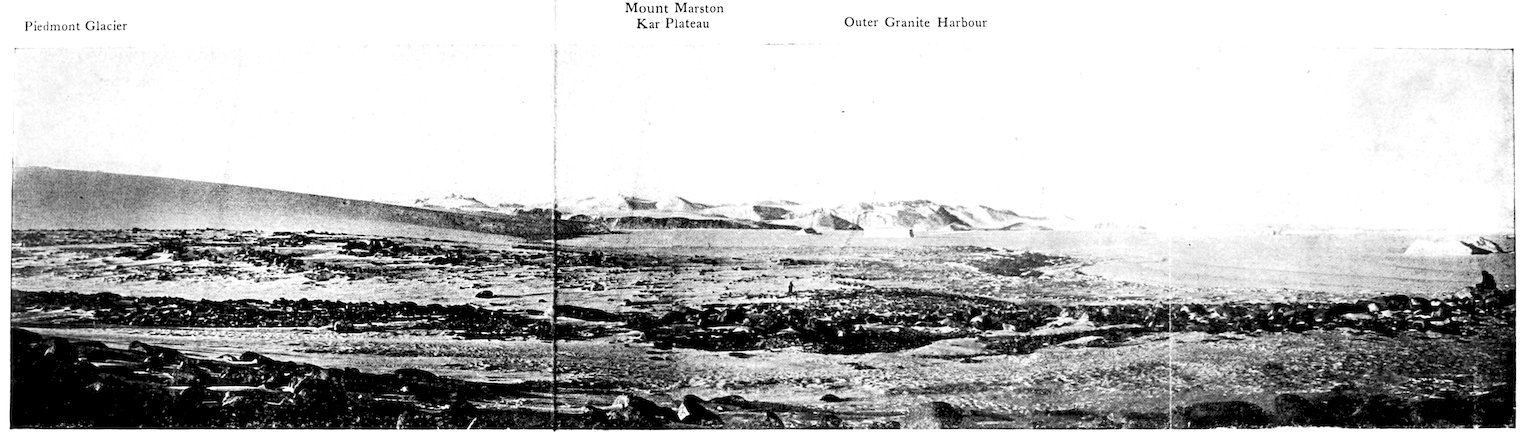
A PANORAMA OF CAPE ROBERTS, WHERE THE WESTERN PARTY WAS ISOLATED FOR THREE WEEKS. LOOKING NORTH.
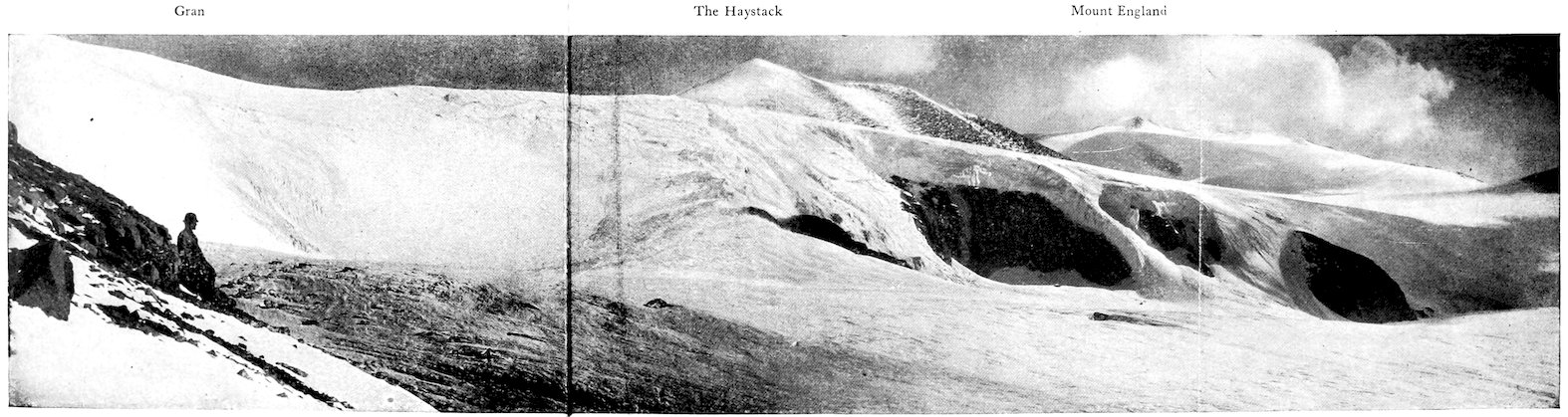
AVALANCHE CLIFFS ON THE SOUTH SIDE OF GRANITE HARBOUR.
I started sledging an ardent cocoa-drinker, but soon realized that there was much to be said for tea at midday. We had a belief that it refreshed one quicker than cocoa, and so we used to have it at breakfast also quite frequently. Upon this journey we did not bring cheese, and I certainly never missed it after the superfluity in the hut. Raisins were allotted to us, but I think “stoned dates” would have been 351better, for one never seemed to have enough to taste in a spoonful of raisins! The butter was fine! Sometimes I would save some of the precious lumps of sugar; and an original sweetmeat resulted if one bit alternately into the frozen butter and the sugar! The chocolate we usually nibbled at the four o’clock halt; while any biscuit left over would be dumped into the hold-all pocket on one’s jersey and eaten at the same time. Debenham never could eat all his biscuit at the meals, and somehow often had a bit to spare which we couldn’t resist.
I used to save some of my evening butter in my pot for the morning. Occasionally hoosh would be poured on it by a hasty cook, and then my biscuit had to be eaten dry; a small matter, for the hoosh was the richer. Once or twice on our trek we came to pools of water, and then Forde would polish up the pots; but thereafter queer mixtures would gradually swamp the true flavours of our foods. The beverage would be “co-tea,” or “tea-co,” according to circumstances, while suspicions of many of our past menus would persist until another scouring day arrived.
There were some compensations, however, in Polar sledging. One could obtain water by merely digging a cup into the floor, and the absence of flies and of rain were blessings indeed. However, the air was not quite aseptic. Many of the carcases of sheep went bad, and one of our party was very sick from the butter before we finished our journey.
The snow ceased about 4 p.m., and Gran and I walked to the root of the ice tongue to examine it. It was a mile and a half long and was fed by a well-defined overflow from the Wilson Piedmont, which had cut its way through granite cliffs some 200 feet high. There were several “chimneys” offering tracks up the cliffs. One had a rough rock figure at its base, and led Gran to remark, “This is an ome.” I realized he meant “good omen,” and accordingly we tackled the chimney indicated. Lichen and mosses welcomed us on the flat summit, where some hundred yards of granite-strewn platform marked where the piedmont had retreated from the edge. We investigated the gully between the tongue and the cliffs, here almost vertical. As usual there was no sign of grooves or striation, though the ice was much disturbed at the base of the cliff, and we had to cross many small crevasses.
352Early on the 29th I waked the others, hoping to make an early start. Unfortunately something went wrong with the primus; I am afraid some spirit was mixed with the paraffin. At any rate we had an anxious hour testing the apparatus, which formed our only source of heat while sledging, but found nothing out of order except the fuel.
We had been looking forward to sledging over the vast sheet of clear ice within Granite Harbour. But the late snowfall had ruined our chances, and we had practically no easy sledging during the whole of the journey. Personally I was so pleased that we had safely reached the Harbour, that a day or two more or less now did not worry me.
At the end of the second stage Forde discovered a cave in the granite cliffs. It was about fifty feet high and twenty feet wide. I think it was due to the sea tearing out the loosened blocks along a large fracture in the granite, though such an occurrence is necessarily rare on icebound coasts.
I was very anxious to find a suitable spot for a headquarters camp, and so far not a single spot was large enough to pitch the tent upon. In the bay just east of the huge bluff there seemed to be some rock slopes. Most picturesque at the head of the bay was a great granite cliff festooned with narrow glaciers hanging over like ribbons. We heard several avalanches here, and so called the place Avalanche Bay. In the corner was a steep slope of glacial debris—partly mud and partly gravel and boulders. We climbed up this for two hundred and fifty feet, and so could look down on a small glacier which occupied a bowl-shaped hollow in the coast-line. This would appear to be a cwm valley into which the Piedmont Glacier has flowed.
“After supper it cooled somewhat, and we started out for some relay work. We could see the Bluff quite close, and after half a mile I judged we were halfway and went back for the second sledge. Then on again, and we never seemed to get any nearer. It was nearly two miles off and we were all tired on arrival. However, we plugged back for the second sledge, and it was a weary grind! As Debenham remarked: ‘We were too tired to think!’ We got in about 11.30 and pitched camp on poor snow, fetching blocks of ice from the wide tide crack to weight the flaps.
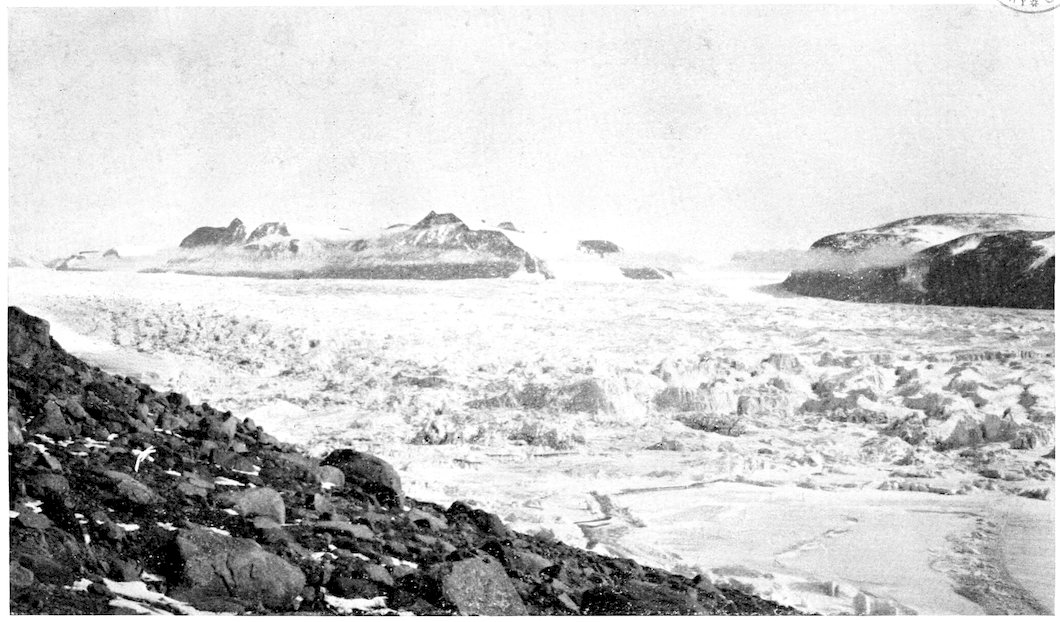
Photo by Gran.] THE FIELD OF CREVASSES (SKAUK) AT THE ROOT OF MACKAY TONGUE, Jan. 6, 1912. Behind are the faceted slopes of Mount Allan Thomson. Photo from the Flat Iron looking N.W.
“We were much amused by the laments of a young seal 353(still in its woolly coat) for its mother. ‘Baa-aa!’ he said, quite plainly, like a cross between a lamb and a vigorous young bull. This resounded from the five-hundred-foot granite cliff above, and occasionally the mother re-echoed it from the tide crack where she wisely kept! I was glad to see about eight seals here. I expect we shall kill most of them! Trigger caught the young one by the tail, and it bellowed and tried to get away. It took to water readily. There was a well-defined margin of level fixed ice, ten yards wide, following the coast all along. We turned in at midnight tired out and not much worried by the baa-ing of the seals.”
Before turning in we saw a most remarkable sight to the east. Sailing over the Ross Sea towards the south was a fleet of cloud galleons. The hulls appeared as bright white glares separated from each other by dark nimbus. The lower sails were sheets of stratus, and beautiful cumulus floated over each. At the front of each the advancing vapours were curved to form the galleon’s bows.
On the 30th we relayed round the face of Discovery Bluff, leaving one sledge on the firm ice-foot beyond the seals’ pool while we marched on with the other to try and find our summer headquarters. The Bay ice was torn every half-mile by huge shear cracks, but luckily they were still narrow and we crossed them readily enough.
We now opened up a small bay, and I could see a fine camp site just ahead. I made straight for a rough beach which was covered with granite blocks. I was glad to see that lichens and moss were growing here in some abundance, for it indicated that this was a sheltered, sunny spot.
Behind the beach was a steep slope leading to a little plain about four hundred feet up. I climbed up to this while the others explored the beach and the small cape to westward. Soon I reached the further edge of the plain, and from here I had a magnificent view up the great Mackay Glacier. There was a well-defined glacier entering the bay in the south-west corner, which had a fairly gentle slope. Up this I hoped to find a route to the interior, for the other outlets of the glaciers were crevassed to a greater extent than in any of the other regions. In fact, the ice river resembled a great ploughed field where every furrow was a huge crevasse. Gran said such an area would be called Skauk in Norway. He said 354they used Icelandic terms for their new words, much as we do Greek. I think this term might be introduced into our nomenclature, at any rate we used it thereafter.
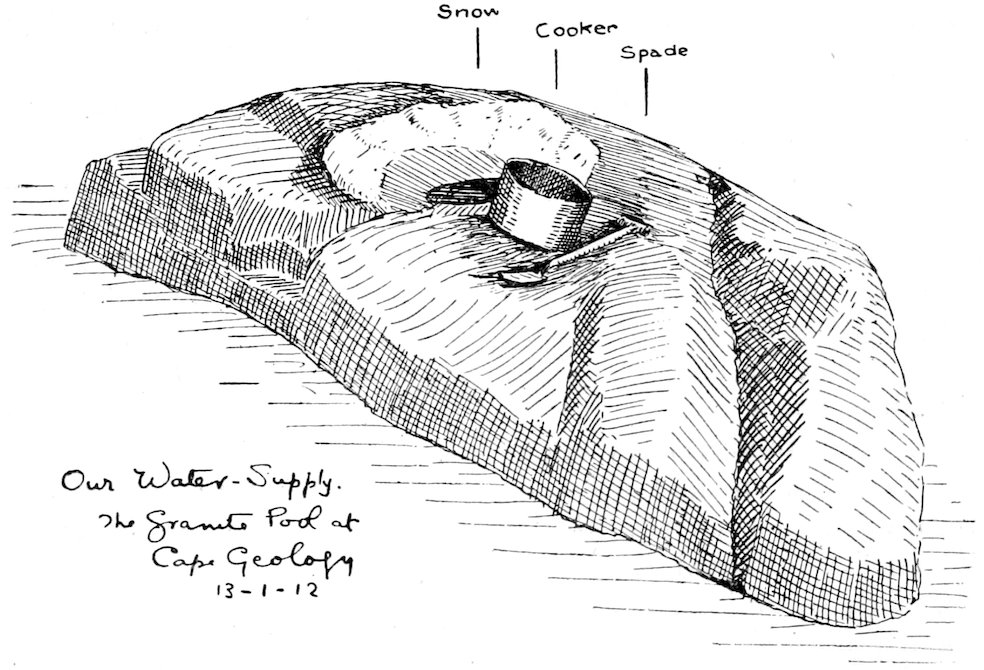
Meanwhile Debenham had found an excellent spot for our permanent camp. We were very satisfied with the outlook. One reads of the advantage of a “gravel subsoil.” Here between some large boulders was a patch of gravel. To be sure it was full of irregular blocks of granite and half covered with snow; but by hand-picking it and raking it over and over we rid ourselves of the “feathers in the bed,” and also got our tent-site ultimately fairly dry. The small elevated plain was going to give us a bountiful water supply when the weather got warmer. In fact, Debenham entered into a disquisition on “hydraulic grades” and the “origin of springs,” to show that we should have water laid on past our tent! The snow never melted sufficiently for running water, but Forde evolved a fine reservoir in a few days. He cleaned out a hollow in a huge granite tor, and the sun’s heat acting on a snow dam at one side usually gave us a sufficient supply. Great blocks of bay ice driven up in a previous summer formed our cool storage. Just off the Bluff was fuel and food in the shape of seals. Buttresses of 355granite crossed the beach, and between two of these was an area where our kitchen was almost half built. Surrounded on three sides by solid granite walls three feet high was an enclosure which we managed to roof in well enough to hold the blubber stove. Forde and Gran were especially keen on this edifice, which they called Granite House from Verne’s “Mysterious Island.”
It was a day or two before the house was finished. Forde was master mason and Gran chief labourer. He used to delight in bringing to the site great cubes of granite which we others could hardly move. There was a most uncomfortable block of granite projecting into the hut, but by the repeated dropping of huge blocks on to it, Gran finally managed to remove this excrescence.
After lunch on the 30th Gran and I went off to obtain the wherewithal for our first seal hoosh. Luckily there was a seal a quarter of a mile from the camp, and we soon slew him in the usual manner. Gran would attract the doomed animal’s attention, while I stole alongside from behind and stunned him with a blow on the nose. This was almost the chief use I made of the geological hammer, for Debenham was making the rock collections while I studied glacial topography chiefly.
Forde gave us a lesson in butchering. Most people do not realize that a seal is not far removed from an otter. Anyhow, his anatomy is near enough to that of a sheep for one to know where the choicest meat lies. In fact, a seal’s skeleton is just like a sheep’s, in which the two hind legs have been folded together close to the tail and converted into swimming flappers.
We cut off two wide strips of blubber first from the belly; then rolled the seal over—an operation of great difficulty—and obtained two more from the back. Beneath these strips of blubber were the best portions of the flesh, except the liver, which needed especial anatomizing. Around the neck I cut off odd bits of blubber, and one of these served to cook a meal on the stove, so that there was plenty of fuel on a seal to cook the meat it provided.
We staggered back laden with spoil, leaving the carcase to a multitude of skuas. How they quarrelled and fought over the pieces! Every skua seemed to prefer to grab a piece already selected by another. I suppose they were not used 356to tearing fragments off such a superfluity of carcase! We welcomed these visitors, for we had in mind future tasty dishes based on skua eggs.
It snowed during the night, about one inch falling, chiefly as needles and fluff-balls. All this spoiled future sledging, but we watched it philosophically now that we had got our main supply to its destination.
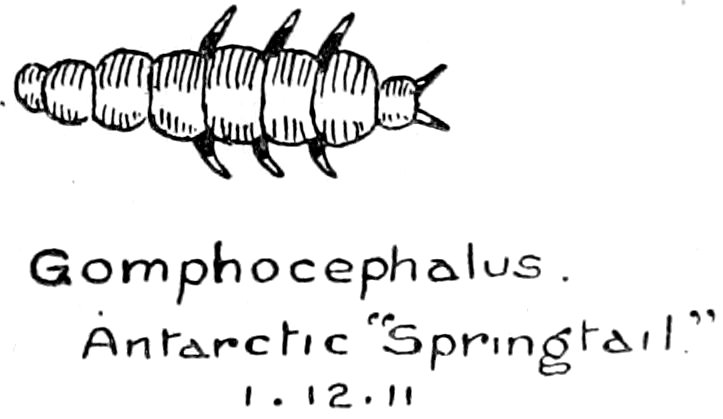
I turned in later than the others, and, on having a last look round, I noticed some dark specks floating on a little pool. With no organic matter in the air, this seemed unusual, and on closer examination I found that these were the long-desired insects! They were little bluish fellows shaped like a cigar, with six legs and no wings. I was very pleased, and rushed to inform my sleeping mates. I am sorry to record that they did not seem to think the discovery worth the loss of their first sleep! Each insect was about one millimetre long, so that twenty-five only measure an inch, and they clustered together like aphides.
Next morning I received congratulations, as it was my birthday. The sledge flags were hoisted on a line between two depôt poles. We hung up the red-and-black depôt bunting also in honour of the occasion. Debenham said he had no present for me, but he could not allow me to cook my birthday dinner. I noticed that the others seemed overjoyed that I should be relieved of my cooking duties for one meal!
“However, I did breakfast, and made a fine hoosh. The great secret is to mix the wheatmeal, pepper, salt, etc., well, and pour it in just before the pemmican boils, giving it only five minutes. It is much more slippery and soothing than if you cook the ‘thickers’ longer. I shall be quite an accomplished cook later on!”
About 11 a.m. Gran, Forde, and I brought the other sledge in from the Bluff. After lunch we unloaded the stores, mustered them, and placed them under a big rock until the hut should be ready to receive them.
“We seem to be especially rich in raisins. I fear I forgot 357to take out a bag at Cape Evans. Gran is going to sow sea-kale here, so that our vegetables and fruits should be plentiful!
”About 5.30 a long streamer of smoke announced that the famous stove was going, and Debenham made a splendid liver-fry, followed by cocoa in very quick time. Gran produced a bottle of Savoy sauce, which he had carried as part of his personal gear, and presented it to me. No present could possibly have been more acceptable, as any one who has lived on one dish for a month will realize. I could have eaten two whacks of the fry easily! We decided to use the bottle at one meal instead of spinning it out, but (as Wendell Holmes remarked about the honeypot) you can’t pour out the last dregs from a sauce-bottle. Some one suggested we should draw lots for these precious dregs. (Privately I thought they belonged to me, but I nobly agreed!) So, in the way they have in the navy, I thought of a word of five letters, and I said that the last alphabetical letter should win the prize (as a matter of fact I had thought of ‘Savoy’). Gran gave me the third letter (v), and he took the first. Debenham took the fourth, and then I felt safe. But Forde took the last (y), and so won the sauce. A very sorrowful moment! This ingenuous game always entranced me; it trusted so implicitly in the leader’s lack of American ‘smartness,’ for the word was not divulged until the numbers were out!
The method bewildered me when I first heard it, but I hope the above account is lucid.
The next day Gran became cook, and gave us a fine hoosh, after which I started trying to get the astronomical position of our headquarters. Gran explained the way the Norwegian fishermen obtain latitude and longitude by very simple yet sufficiently accurate methods. They observe the sun at 11.30, again near noon, and at 12.30. By this means they get the local time of noon by calculating halfway between the other two observations, which should be nearly the same reading. The noon reading is a check.
Unfortunately in 77° S. the sun pursued a placid path which was nearly horizontal, and it was very difficult to find the “keystone” of such a flat “arch” as he described!
We had unloaded one sledge and converted it into the roof-tree of our granite hut. It was necessary to collect 358sealskins to cover our house, and as the walls were now high enough, Gran and I went off on a fur-hunting trip. About half a mile away was a big seal, and I determined to secure him.
“It was extraordinary how long the muscular action lasted, for this animal was stabbed three times in the heart and pithed three times in the brain. We had great difficulty in turning him over; there is nothing so slimy, heavy, and sloppy as a huge sheet of blubber and skin. We managed to roll the heavy hide on to the sledge, but it would not stay there. Just like a slow moving glacier it slipped off everywhere. ‘Trigger’ took off his belt and lashed it on, and we managed to start by sticking the ice-axes in to keep some from dragging in the snow. We had to cross an ugly shear crack about four feet wide, regularly torn in the floe by the pressure of the glacier, but it was no trouble by using the interlocking promontories. We cooked tea on the blubber stove, whose white smoke lends homeliness to our headquarters.... We named the latter Cape Geology, in memory of the chief object of our journey, though we had been able to do very little scientific work so far.
“After lunch Debenham and I proceeded to flense the blubber off, laying the hide on a rounded boss of ice. It was slow work, for the sun warmed the blubber so that it was as easy to cut as flannel two inches thick. We dug out a cache between two blocks of ice and put the meat and blubber therein, covering them with smaller blocks of ice, and this storehouse served well after we had taken the precaution to mark it with a bamboo, so that it was not lost in the snow.
“I made a granite seat in the hut, and will have a fur carpet, for it is cold for the toes on the snowy floor. The stove smokes badly, but gives off enormous flames and heat, only burning 10″ × 3″ × 10″ of blubber per meal....” Soon, however, the soot and oil filled the bottom of the stove, and then it ran out over the rocks and spread all over the snowy floor. We had to stand in this fearful mixture, which is dirtier than the grease in a foul motor engine, and much more ubiquitous. The smoke made one gasp as eddies drove it into the face, and we never managed a door for the hut to keep out the icy winds blowing down from Mount England.
The sledge ran along the centre of the roof, and the chimney projected through it. Biscuit-boxes helped to form 359the roof, but sealskins enough to cover it were gradually collected. Forde said it was as good as many an Irish shebeen, which made me pity the Irish more than anything I had yet heard of them! However, it saved our fuel, and kept our field notes and sketches cleaner than if we were cooking in the tent, so that we feel that this sample of Antarctic architecture fulfilled a worthy purpose.
“I cut up the seal meat and insisted on adding meat to the liver, for we should need to kill a seal every other day at the rate the cook wants liver! I’m bound to say that I am the biggest eater. Gran had a reputation that way, but he has not eaten as much, and Debenham and Forde are very poor eaters.” It was very cold in the granite hut. I sat in the doorway to try and keep out the draught, and was very glad to trot out and warm my toes after cocoa. “The skuas don’t show any particular inclination to lay yet. Perhaps they see it won’t be worth their while. Nor do they seem at all anxious to clean the blubber from the sealskin we left for them.”
Our tent was in the shadow of the Bluff all night, and so it was quite cold in spite of the midnight sun. Gran and I set out next day to put up the rendezvous flag, and to kill a seal, while Forde and Debenham finished the hut.
We climbed up one of the chimneys or steep gullies which scored the front of the Bluff for several hundred feet, and then got out on to a knob, where we raised a red flag on a stout bamboo pole. I found a fine deep crack, and Gran wedged it in very solidly with blocks of granite. From this view point I made a great discovery, that there is an ice tongue about one mile wide and five miles long, projecting from the skauk of the Mackay Glacier. Bay ice fringes the cliffs beyond it, and as the map shows, the tongue extends almost down the middle of Granite Harbour.
We had many arguments about this tongue. The Discovery must have been close to it in 1902. Debenham was inclined to think that it had grown since that date; but later we saw a photo from the Discovery which showed that it was in existence then.
I wrote a note to Pennell, and lashed it to the mast, telling him we were going inland till January the 8th. We then hurried down the screes, and went out on the bay ice to slay 360our seal. “He died rapidly, thank goodness, and we plugged through our job till about 2·15, having an awful time tying the hide and blubber on the sledge, while the liver lobes ran all over it. Gran swears they worked their way uphill, and came out of the folds of skin! I threw some bits into the shear crack, while washing the liver, and the hole was soon full of amphipods, which are cousins of the shrimps. Gran says he is going to fish hereabouts if he can get a hook.”
On the 4th December we began to collect gear for our next trip. Forde spent a lot of time at the blubber stove, where he was the most expert cook. He cut up large lumps of seal, and fried enough for eight meals. This was mixed with pepper and salt, and about half cooked. He then filled a large tin with this rough substitute for pemmican, and lashed it on to the sledge. I used to enjoy a snack of this half-cooked seal between meals, for there was now no doubt that our appetites were of the true Antarctic variety.
We had cleaned several skins now, and we fixed them over the roof-tree of our hut. I sewed up the flipper holes, and each skin was about eight feet by six. We lashed them to the sledge, in the middle, and then hung huge stones from the outer margins, which drew them taut, and held the skins close to the walls. They soon became very sooty, but were always translucent, for the hairs are large and coarse, and not at all closely set. We could just stand up under our sledge roof-tree. Forde spread gravel over the blubber-ice composition on the floor, and I gathered some moss and tried to stuff up the crevices therewith. When the cold wind blew down the hills it invaded our hut, and made us glad as soon as the sooty meal was over, and we could take refuge in our snug little tent below.
That evening Gran and I climbed up to the top of the bluff, above the flag. The sides were covered with granite debris; some colossal blocks were twenty feet across. In the clay beneath them were mosses and lichens, one of the latter being of a fine frondose shape, with root-like attachments. I collected this specimen, and boxed it on my return; but the skuas had scattered our specimens when the ship’s party finally arrived in 1913.
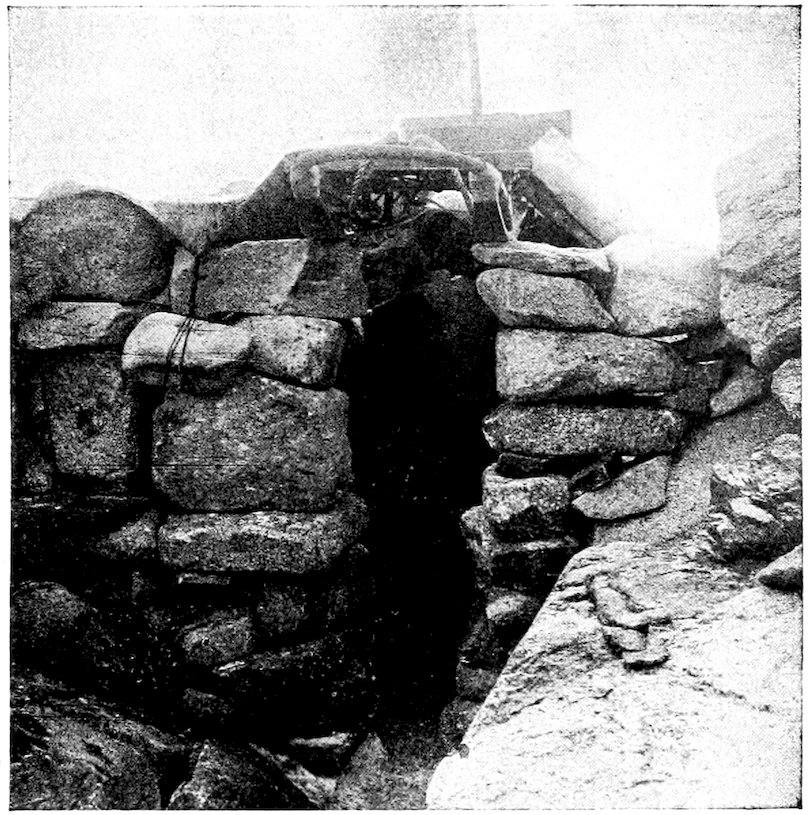
GRANITE HUT, CAPE GEOLOGY. Forde and Gran are cooking at the blubber stove, whose chimney projects behind the “sledge” roof-tree.
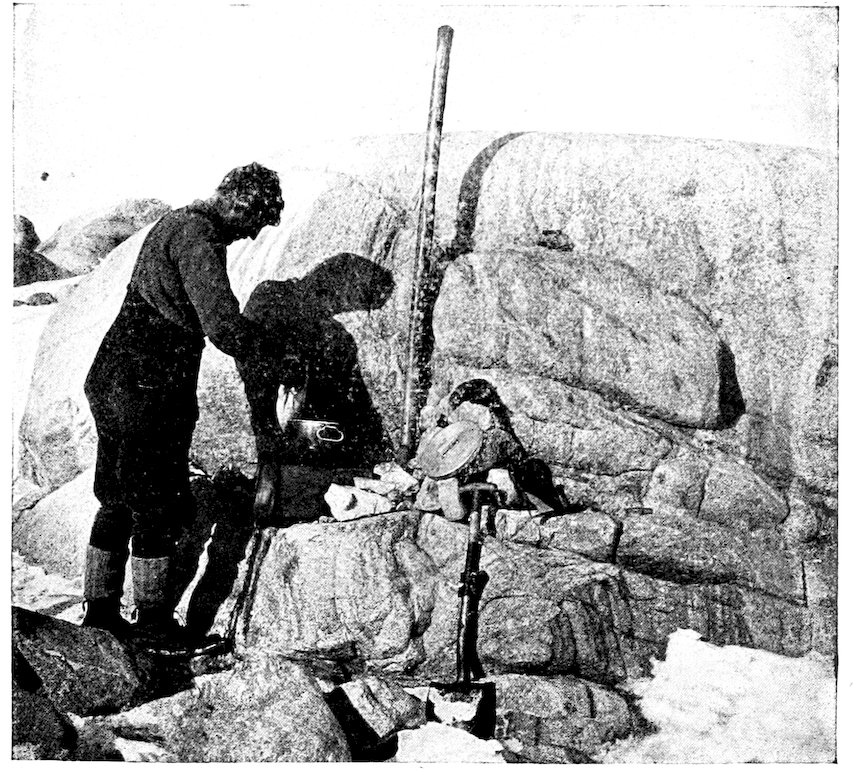
FORDE COOKING SEAL-FRY ON THE BLUBBER STOVE AT CAPE ROBERTS.
We got up in about one hour, and I began to have my doubts about the five-hundred-feet height mentioned in the 1902 361record! Luckily, I had an aneroid, and this showed it to be over fifteen hundred feet high. I got a magnificent view of Granite Harbour and the Mackay Glacier. The large ice tongue ended in three splay “fingers,” and was badly crevassed, except right at the end. Far to the east I could see Mount Erebus and Beaufort Isle. Below was a regular succession of shear cracks, due to the irresistible pressure of the Mackay Tongue pushing out the bay ice. Great pressure ridges, six, ten, and fifteen feet high marked where the bay ice was being jammed on to the Bluff. These were very prominent near Cape Geology also, and pools of water collected in the hollows between the ridges.
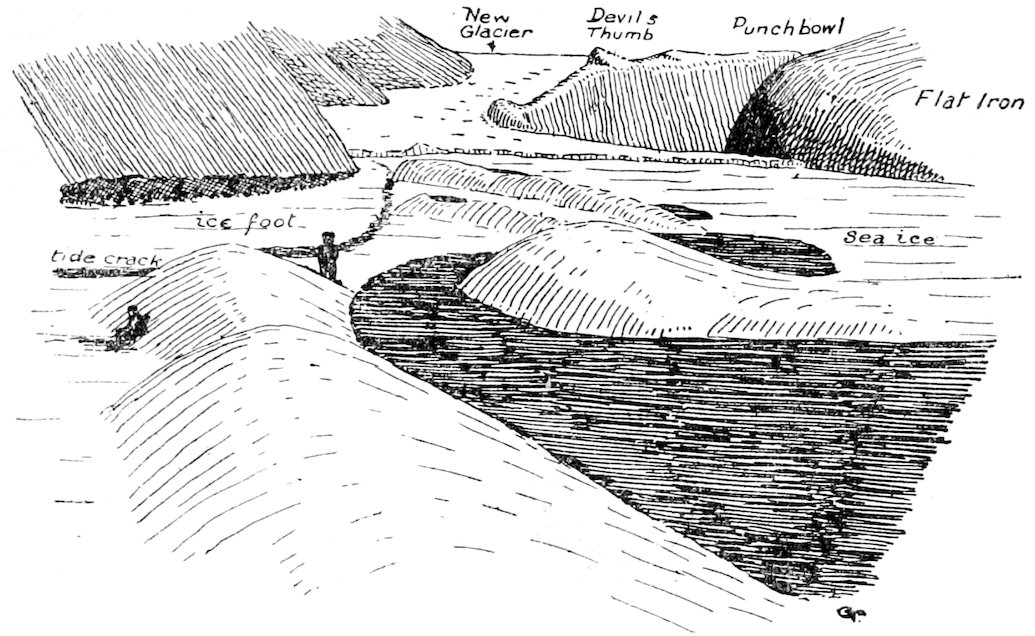
Pressure-ridges in the sea-ice, looking west from Cape Geology to the Punch Bowl cwm, January 13, 1912.
On the afternoon of the 5th we started to the north, to march around the end of the Mackay Tongue, which lay about five miles off. We were now crossing ice covered with nearly a foot of snow; but with only one sledge and ten days’ food, we got along in fine style. We could easily see our signal flag flying on the Bluff, and the red showed quite clearly when the wind blew it out. We reached one of the “fingers” at the end of the ice tongue about 6.30, and here I decided to camp, so as not to lose sight of our survey stations.
“There seems to be no large tide crack here, which means 362that the tongue is floating. It is broken into deep lateral bays, and consists of regular rolls and hollows. I don’t believe that storms affect this harbour much, or it would have gone out long ago. We pitched the tent on soft snow, just off the end. I got ice from the glacier for the cooker, which Forde declared was salty from old sea spray. Anyhow, the hoosh was very good.”
Far to the west we could see a huge black mountain projecting through the Mackay Glacier. It was formed of black dolerite capping granite, and reminded me of a three-cornered Chinese junk. Debenham objected to this name as being unworthy of such a fine nunatak, and proposed Gondola Mountain. We knew it by this name during our expedition, but on my return to Sydney I discovered that Professor David had seen it from the coast, and had called it Mount Suess. So Mount Suess displaces Debenham’s euphonious title.
“The sky looked very ugly—the sun dimly glaring through gloomy clouds—a low, thick, dark bank on the eastern horizon, and the barometer falling half an inch in the twelve hours. So far nothing has happened, but now (10.30 p.m.) snow has just begun, and may keep on some time; for I see, from the log, that we had similar conditions at Harbour Tongue on the 28th. The temperature is +23°, and we are very comfortable; for though we are on sea-ice, yet we can reach the glacier in twenty yards, and there is twenty miles of ice between us and the open water.”
I am going to copy my notes, for the next few days, verbatim, for they give a fairly complete account of a typical summer blizzard in Antarctica. If the language seems a trifle strong, the circumstances should be considered.
“Wednesday, December 6, 1911.—10 a.m. We are held up in our first violent blizzard, and it is just a month since we started. We have had snow blizzards, but this has wind force about 7 as well, and the drift is thick and wetting.
“We have a pretty snug camp on snow, one foot thick, which you can accommodate to your hip-bone, but which it is difficult to stand the Primus upon (especially as the cooker base, on which it usually rests, is full of fat, and is now our frying pan at the hut). It started snowing about midnight, and clothed the tent by 3 a.m. I woke to hear the tent 363flapping, and shaking down young avalanches, and it has been going strong ever since.
“There is always a strong bulge in on the windward (S.E.) side, and slighter bulges at the two lateral tent segments. Then the door, if properly placed, tends to blow out, and the laterals next to it do most of the flapping, and make a deuce of a row.
“2 p.m. Still blizzing strongly; there have been one or two lulls of a few minutes; but they don’t seem to mean much. It is snowing furiously, too; pattering on the tent like rain on wooden shingles. If you budge from the tent (Debenham had to get a notebook) you get very cold, because the drift melts and wets you at this temperature (+23° F.). We had a meal about 11 a.m., Gran cooking a good bovril-pemmican, with a large supply of broken biscuit therein. This strong south-east wind blows practically direct from Cape Roberts on to the tongue on our lee, and so I do not much fear it will shift out any ice. Anyhow, we can’t move, and I am learning to take these blizzes philosophically. Besides, the bags are dry and warm, and when I tire of writing the diary I snooze a bit, and then read Harker’s ‘Petrology’ (Deb’s), and then snooze, and then read ‘Poe’s Tales’ (too fantastic and oriental to please me are most of them), or ‘Martin Chuzzlewit,’ or do some German grammar. Forde is actually reading something. He has tackled ‘The Mysterious Island’ which Gran has nearly finished at last. Deb started to work out a latitude, but is now wrapped in ‘Morfus.’ Last night’s hoosh was an enormous success, 2½ pots of Forde’s concentrated seal hoosh, mixed with water and meal, made a top-hole hoosh—very tasty, and all indigenous.
“6 p.m. The tent is beastly sloppy. We have just finished our lunch at 6 p.m., and if we can’t get away, that is our last meal to-day! To-day is a queer camp, the first down here where the tent has dripped on us, when no Primus is going. We have put the cooker under the tied-up door, and it is filling, I see! Forde is dressing his finger with a penknife, and Deb keeping warm very sensibly in his bag.
“December 7, 1911.—Slept pretty well. Dreams, as usual, furnished some conversation ’twixt Gran and me, and occasionally Deb. I had a very vivid one (or two) after two pots of seal fry the other night.
364“I was walking to Sheffield and got lost, and couldn’t get any one to tell me the way. I asked a man and couldn’t get any great satisfaction out of him. He saw some of my Antarctic gear in my bag, and said I looked as if I was going to the Pole, but would not believe me when I said I’d been there! I then told him my name (to impress him, no doubt!), and he was not a bit concerned, but said his name was Taylor also! Then I switched off home, where everybody was much concerned about the end of the world, or something equally cheerful. There was an awful red sky to the south which caused great perturbation, until finally some one called out, ‘It’s the return of the mail-clad “goater”-cars from the Pole!’ These were a sort of red motors assisted by goats, and were quite the latest thing in transport evidently, and I was much pitied because I didn’t know all about them. But a bad pun in a dream seems to denote too much fry!
“It is now noon, and we are still snowed up off the end of Mackay Tongue (43 hours now and we have not got away). It dripped most of the night, for the temperature was +27° outside and warmer inside. There was a puddle by the door, but Gran and my bags have absorbed most of that, and Deb’s is wetter. So far the inside of mine is still O.K., and I have fur inside always now. It is much warmer, and as soft and comfortable as anything I’ve slept in as far as I remember. We have been trekking over a month, and though we’ve had almost unique hard relaying for two weeks—330 per man—yet I enjoyed it much more than the Ferrar trip under better conditions.
“We got up at 8, and Gran made a biscuit-bovril-pemhoosh, which was very good. We had only two meals yesterday, so went a full whack this morning. I put on my boots and wind-coat and puttees, and dug out the thermometer. The sledge is buried two feet in snow. Deb’s big camera tripod shows above the snow, and a bamboo pole—also the top of the shovel,—but the rest is clean buried. The first fall of snow was consolidated by the blizzard; the last fall, since 2 p.m. yesterday, is fluffy light stuff and quite different in texture. I dug down to the biscuits and got Deb’s notebook, and then came in and scraped off the snow and had breakfast. I have finished ‘Martin Chuzzlewit’ this morning and puzzled over German declensions, and still we can’t see more 365than a hundred yards, and it is snowing still. We got a watery glimpse of the sun about 9; but he’s gone, though, as the north side of the tent is dripping most, I suppose he’s still about. There’s a constant rainy patter on the tent, but the snow is so slight it would not matter if we could see where to steer! However, it’s not hard work lying still here, and Scott did it seven days; we’ve only had two.
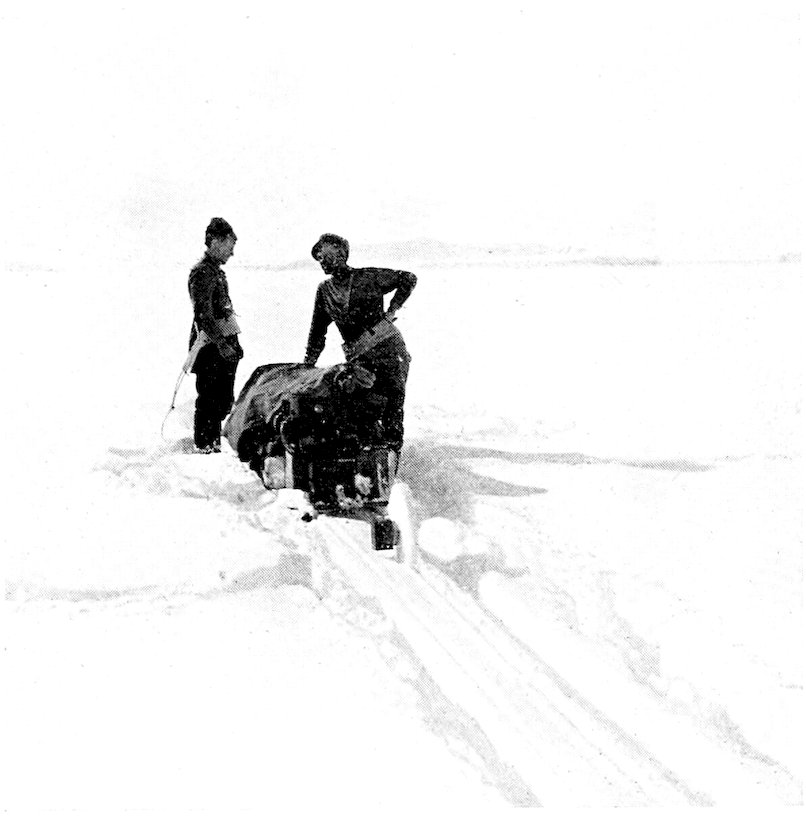
HEAVY SLEDGING OFF MACKAY TONGUE, JUST WHERE WE TRIED TO PACK TO LAND, Dec. 8, 1911. Note the great furrows due to the sledge dragging bodily on the snow.
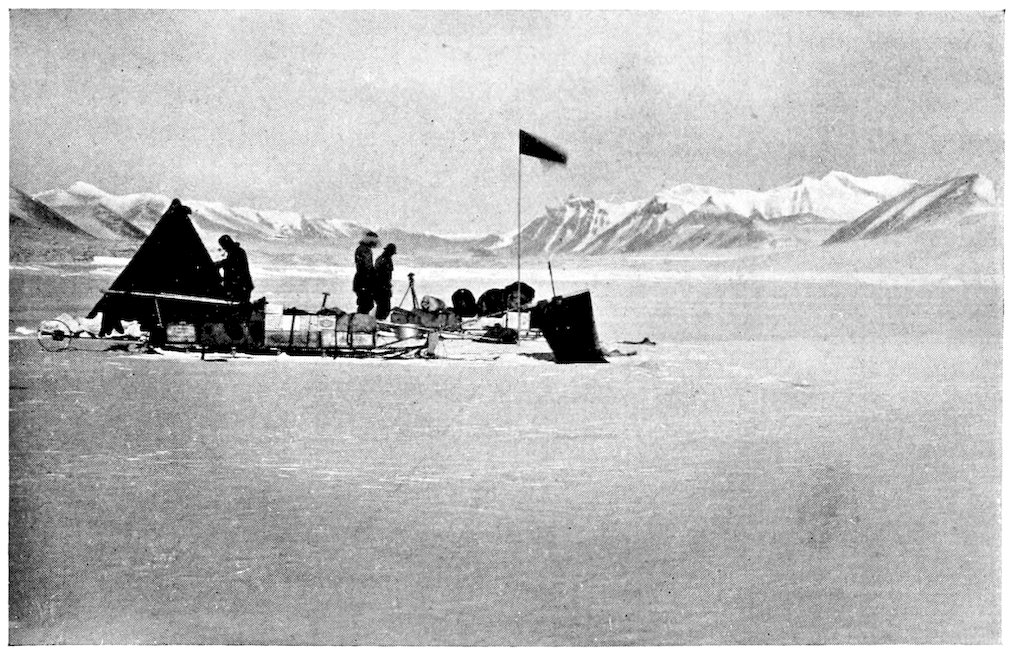
THE “HALF-TON” AFTER NELSON LEFT US, OFF THE MOUTH OF DRY VALLEY, Nov. 18, 1911. Notice the ice-free character of the valley and its faceted walls. Beneath the flag appears distant “Matterhorn.” The sledge-meter shows to the left of the tent. [See p. 339.
“The barometer (29.45) is rising steadily, which denotes, I think, no more strong wind at present. Our short, sharp blizz was correlated with a very low barometer of 29.18, whereas 29.80 is about the mean hereabouts.
“There is no tide crack off the Tongue, which is five miles from its parent glacier, and therefore must be floating. Also, as it projects a hundred feet above sea-level, it must be 500 feet thick, which is comforting.
“We had lunch about two and saw blue sky to the east, Erebus showing partly; gradually the whole snow cloud blew over en masse to the west, leaving blue sky and a bright sun. We dug out the sledge, nothing of which showed, and got off after Deb had taken a photo.
“We could hardly get a move-out of the sledge and finally harnessed so as to beat out a bit of a track. The going was awful. Never had such hard work, and with only one fairly light sledge! It pulled me flat on my face in the soft mushy snow, and wet me half up to the waist tramping through it. We managed to get around to the end of the Tongue and one mile to the north, and then it was after 7 p.m., and I could not stick it, nor could the others. We pitched camp in the middle of North Bay. But our floorcloth and tent are dry, which is a great comfort, and we had a fine seal-hoosh. The trouble is that all our survey work will be blocked; for two miles’ progress in three hours is deadly, and this snow is universal. However, I’d rather have it now than earlier, when we had two heavy sledges, for we couldn’t possibly have moved either! Perhaps it will cement by to-morrow a bit. The temperature is down to +13½° (after 27° or so) and the barometer is still rising steadily. I feel a bit wet and will turn in early.
“The Tongue is very imposing from this (north) side, being cut up by bays so deep that they seem to separate it into islands. We hope to make the end of the Kar Plateau—a 366long 800-foot flat-topped shelf—which seemed to show a bit of beach. We had to camp at what seems one and a half to two miles away in soft snow, which we kicked away and shovelled off so as to get a fair spread for the floorcloth.
“Friday, December 8, 1911.—I doffed some of my clothes and hung them up inside the tent, if so be they might dry a little. Result, like a board, for the temperature was only +13. However, I used my eiderdown, and was jolly snug and warm and slept quite well.
“My bag is wet outside and it wet the floorcloth. Trigger’s you can squeeze water out of. We must get a drying spot on the coast. It is a fair morning with a gusty, cold, plateau wind (W.). The sun is shining low down in the east through cirrus; but it does not look snowy or blizzy.
“(Written Saturday 8 a.m.) We were about two miles from the coast, the nearest being the end of the Kar Plateau. We loaded up the sledge and gaily proceeded in that direction, anticipating arrival about noon. But we found we could not pull the sledge, though I doubt if there is 400 lbs. on it. It just stuck, with the prow covered with soft snow. Forde gave words to ‘pull all together’ (for he could see better than I, being at the back), but it was no good. So we stuck up the flag pole and packed all we could carry on our backs. Gran went first with his very heavy bag (half water) and the tent poles. He plugged away in great style, but made rather a devious track as different parts of the coast appealed to him! Deb followed with a rucksack on his back and his bag also (and the plane-table halfway). Forde took the tent and cloth, but didn’t wrap them up carefully, so that they rather impeded his movements. I came last with a proper swag—rucksack in front and bag behind, hung over my shoulders on my belt. There we were trekking for the land to dry our things a bit and do some geology. Gran got rather far ahead, and by the time we arrived near the rocks he was manœuvring with the tent poles near the tide crack.
“This was most unsatisfactory; a high ice-foot about two feet or more, separated by one or two feet space of open water, was bad enough, but nearly forty feet of the floe was soft and mushy, and through the thick snow you could not tell which was hard ice and which was open water.
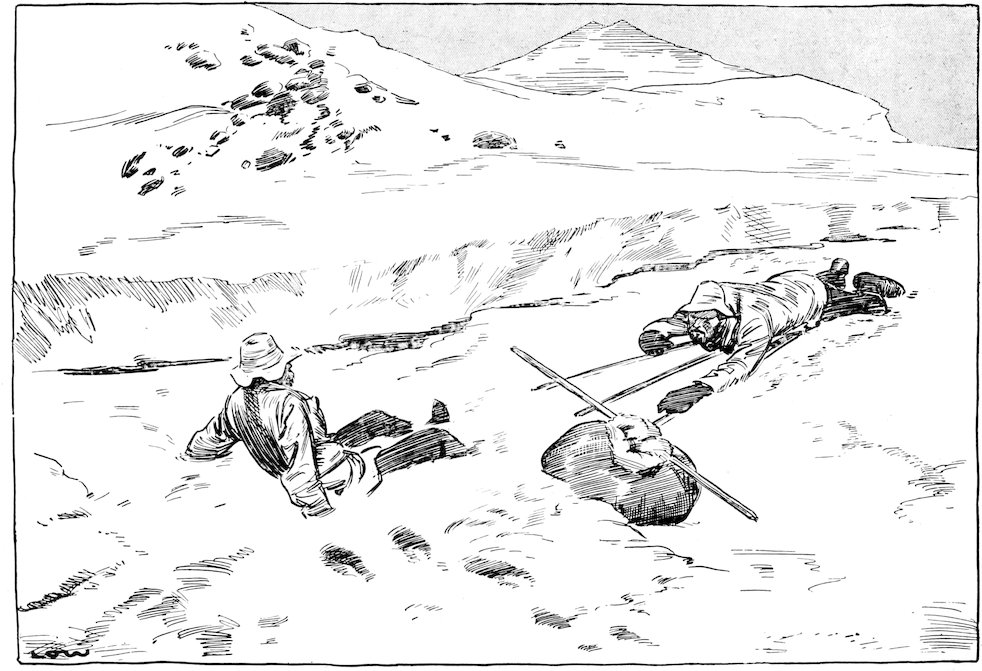
A TIGHT CORNER! CROSSING THE FORTY-FOOT TIDE CRACK OFF POINT DISAPPOINTMENT, GRANITE HARBOUR. From a drawing by D. Low.
“There were seals all over this mushy stuff, and one came 367unexpectedly on their holes nearly buried in snow. Deb and Forde were looking down one to see the thickness of the mushy ice when one leaped out three feet and, as Forde said, ‘It nearly frightened a life out of me!’
“Gran had laid the poles up against the floe and left his bag just behind, when the mush gave way and in he went to his waist. He rescued his bag clinging to the pole, and somehow managed to crawl up the ice-foot, but he was pretty wet and soon very cold.
“Deb and Forde sat on their packs by the firmer ice, and I walked along the sea-ice (while Gran went along the ice-foot) to the north. We found it all just the same. At every footstep water oozed up, and evidently the floe was melting top and bottom and had never been thick. This doubtful area was forty feet wide. At the north, a quarter of a mile from our track, I managed to get on the ice-foot over three visible cracks, and I don’t know how many buried in snow. We returned to the others to find Deb had had one foot through. Having regard to the difficulty of the surface all the way to our camp—eight miles of two-foot soft snow, through which we could only pull the sledge at half a mile an hour with every muscle taut,—I decided it was not safe to stay over on this shore; for a few days’ sun would probably convert this mushy belt into open water, and we should have no ready line of retreat at all. So in view of the Owner’s lectures on caution and my sledging instructions, I abandoned the idea of camping two or three days on this north side, and we lugubriously determined to push back with our packs to the sledge two miles away. First, however, we had to get Trigger off the ice-foot. I went forward to pick up his bag, and suddenly went through halfway up to my thigh. Luckily the other foot kept firm, and I leant backwards and sat back on the less tricky mush. Then we lashed bag ropes and threw them towards him. He threw the tent poles on to the mush and then launched himself full length on the stuff, gripping the poles. The whole floe rocked up and down like jelly, but the poles kept him up, and he got across to us without further mishap. It would have been impossible to scramble out if we had gone through, for there was nothing firm to grip.
“Forde also volunteered that he thought ‘You done a wise thing to give that place a miss.’
368“On our way back Deb stopped to take some angles with the plane-table, but found that he’d forgotten his sight-rule, so that even that weight was uselessly lugged forward. We camped for lunch at our night camp, and then the sun was so hot that it dried our bags nicely. My feet were very cold and wet, and so were Gran’s. I took a complete round of angles both vertical and horizontal, and with the necessary sketching this occupied about two hours.
“Then about four we pulled off for Camp Blizzard and had a diabolical time over the two and a quarter miles of soft snow. The old track was nearly all filled up by a drift from the west, and, though the snow had compacted a little, it was frightfully heavy work. The marks of the bamboos on the sledge floor showed that the whole sledge was resting on the snow. Only off the point of the Tongue did a little of the old track show and helped us somewhat. My sledge belt began to feel as if it was being pulled out through my back, and I had to pull with my hands. We camped about 8 p.m. just near our old Blizzard Camp, where we had to sweep off a foot of soft snow. I went up the Glacier Tongue to get ice, but could not reach real ice and had to go over to a cornice to get air-filled ice. We had an excellent hoosh, four cups of ‘Forde’s concentrated’ with water added. It made a sort of liver jelly when boiled a little more, and I had two cups and a glorious cup of cocoa, cooled so that you could get a good long drink!
“... And then I gave the diary a miss, hung socks and wet breeches outside the tent, and slept right through till 8 a.m.!”
We pushed off for our headquarters next morning and found we could hardly move the sledge. After struggling a few hundred yards I decided to see how the runners looked. We unpacked everything, and found an irregular lamina of ice about a quarter of an inch thick had coated the runners. This we scraped off with a tin matchbox and then turned the sledge to face the sun, and in about half an hour they were clean and dry. The improvement was most marked, and made our light sledge now only as difficult as the two heavy sledges we had dragged to headquarters! We read in Arctic books that ice is purposely moulded on the sledges, but I expect the temperatures are lower, when that method is useful.
369At lunch we had dragged it about a mile and a half, and we dried the runners again. I noted that my amber-coloured glasses had a very pleasing effect; they turned the most gloomy clouds into a beautiful Italian sky. Everything in the heavens is turned into blue and white, which is a great change from the dismal views seen through the green goggles of last year! The relief through using them and the help they give in picking out hollows in the surface is enormous, but they fog up somewhat, of course, with perspiration after a short time.
As we were nearing our headquarters we had a great discussion as to what had happened to the signal flag. Debenham has excellent sight, and with the aid of the glasses he swore that he could see the bamboo lying, broken down. This seemed impossible to me, and I bet him one of our usual 1s. 3d. dinners that it had not broken! However, after a time I saw myself that the thick and solid bamboo pole had snapped. It was some consolation that his cairn and flag at headquarters had blown down also!