APPENDIX RECENT AND FUTURE EXPLORATION
Reading edition
450
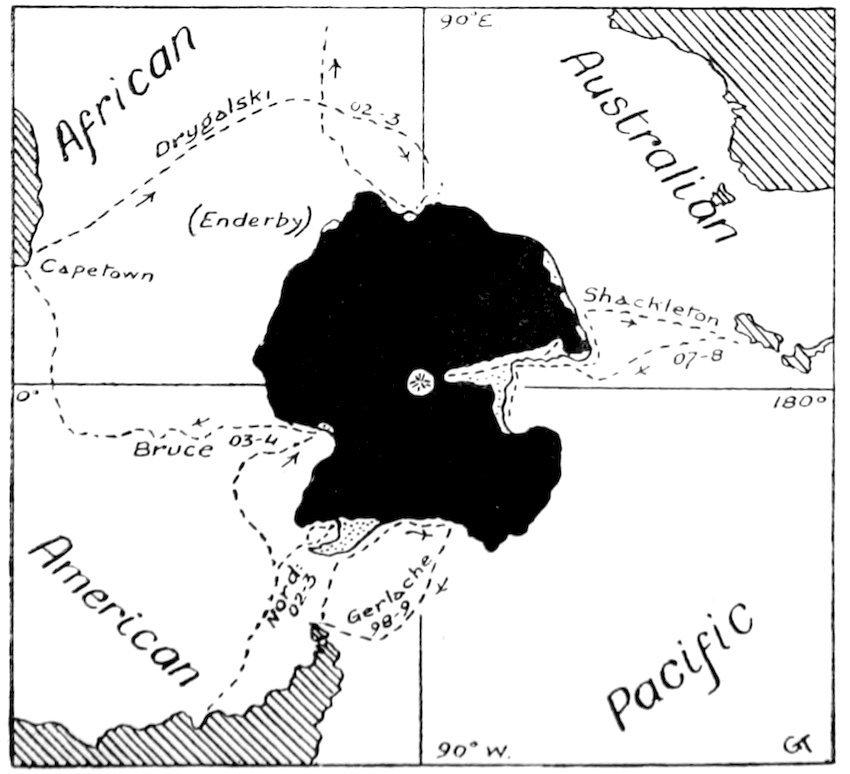
Period 1898–1908 (based on H. R. Mill).
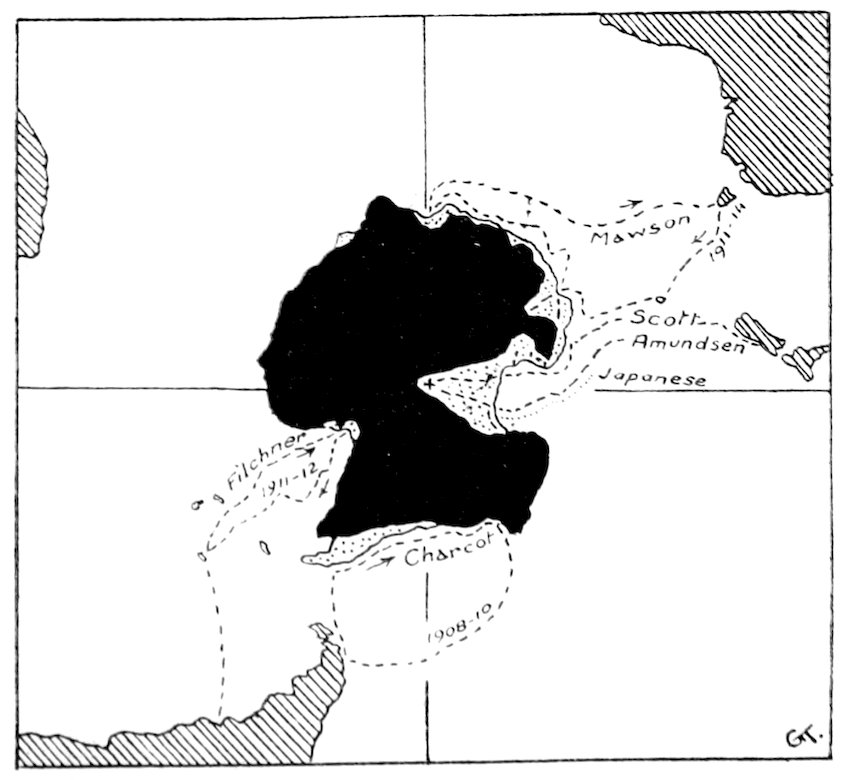
Period 1908–1914
Recent and future exploration.
451
APPENDIX
RECENT AND FUTURE EXPLORATION
Hugh Robert Mill has given a masterly account of Antarctic Exploration in his work “The Siege of the South Pole.” He deals fully with the voyages which took place before Shackleton’s great exploit. I have found it so difficult myself to get a comprehensive idea of the later expeditions that I have drawn the two charts shown herewith. If we divide Antarctica into four quadrants (as shown in Fig. A) we see that no expedition among the eleven charted has attacked the African quadrant, and only two (Amundsen and Charcot) have explored the Pacific quadrant. A survey of these maps shows that two great problems as regards the sixth continent are still unsolved. First, Is there a low-level, ice-covered strait connecting the floating Barrier seen by Filchner in the Weddell Sea with that crossed by Amundsen south of the Ross Sea?
In a paper published by the Royal Geographical Society in October, 1914, I have advanced arguments in support of this possibility. We hope that Shackleton, in his forthcoming journey between Filchner’s and Scott’s bases, will answer the question.
The other problem deals with the character of Antarctica to the west of Enderby Land, for the whole coast-line south of Africa is unknown. One can only hope that some future leader following Mawson’s example will set aside all idea of transcontinental journeys, and devote his energies to detailed coastal surveys, which are infinitely more profitable from the purely scientific standpoint. However, under present political conditions there is little chance of any extensive work succeeding Shackleton’s present enterprise until several years have elapsed.
I have, however, felt that it would be useful to collect the results of my experiences in the Antarctic in so far as they touch details of scientific equipment. These may be grouped under the following heads: (1) Personnel; (2) Tents and Sledging Stoves; (3) Notebooks; (4) Instruments; (5) Cameras; (6) Clothing; (7) Food.
Personnel.—It may be that I am prejudiced by training, but to my mind these coastal parties should consist essentially of geologists, who must be capable of using theodolite and plane-table. The refined knowledge of an expert navigator or surveyor is wasted in such a 452journey, where only the lunch hour or evening halt is available for a hurried “round of angles.” The recognition of topographic forms should be a specialty of modern geologists, if they have had an adequate physiographic training, and (again, me judice) this is more probably found in the geologist than in the naval officer or professional surveyor.
It is unnecessary to point out that a biologist—whether botanist or zoologist—would be wasted on such a journey. Most geologists, however, have studied some botany and zoology, and are capable of collecting such mosses and lichens, etc., as they may come across, and with a little advice can make useful notes on the types and habits of the fauna encountered.
(I am not here referring to the Plateau or Inland journeys, where the main essentials in an explorer are a knowledge of navigation on trackless plains, such as naval men obviously possess to a high degree, coupled with indomitable pluck and endurance, in which they also have an unrivalled record.)
Too little stress has been laid on ability to take successful photographs and to make numerous sketches. The latter is all-important. With practice quite valuable sketches can be made in quarter of an hour, which are far ahead of any verbal description.
Outside these qualifications nothing is so essential as a cheery temperament. It is worth more than strong biceps, for the latter develops en route, while humour has a tendency to become diluted after four months’ stiff sledging. Certainly the latter is not an ideal environment for its birth and growth.
Equipment for Scientific Coastal Exploration.—So far as the sledging outfit is concerned, it would be difficult to improve on that provided on Captain Scott’s Expedition. But I am sure that a dog team would have enabled us to do twice as much work while along the coast. They could, I feel sure, be left tethered at the coast for a week or so, while inland journeys were made, with some provision of seal meat. Probably they would eat all the food in the first few days, but in the warmer summer months they could (and have been known to) exist without food for many days after such a gorge. Seals are very abundant in December, January, and February. For instance, in New Harbour we saw two herds totalling about a hundred individuals.
Iron Runners were undoubtedly of immense assistance to the Northern party on sticky sea-ice. We tried them on rugged glacier ice and they were useless, for they had no “grip” at all, and on any sort of slope would not follow the traces, but simply slid down the “dip” of the ice.
Tents.—The larger floorcloth was much preferable where many instruments were carried. I should make it the full size of the tentfloor and shut out all snow. In the ordinary pattern there was over a foot margin inside the tent. A small tomahawk would be very useful for cutting up seal meat. We had none. Also one of Priestley’s small ice-picks would be well worth carrying if there were the slightest risk 453of being abandoned, even for a month. The ice-axes were not often used for their legitimate purpose of chipping steps. They were certainly valuable as supports on the slippery glaciers, but should have been stronger, even if it added a few pounds to the load.
The Blubber Stove was worth its weight in gold. It was made by Day, of sheet iron, and was simply a rectangular box, 18 inches long, and about 10 by 10 inches in cross section. A round hole (about 8 inches in diameter) was cut in the top. A chimney of sheet iron, about 3 inches diameter, was riveted in one end, and was about 4 feet high; but we found that the length was not essential, as there was always sufficient wind to make about 18 inches of chimney act.
The only objection to Day’s pattern was the door, which occupied the other end of the oven and was hinged at the top. It would have been better if the opening had been stiffened and the door also, so that it would shut readily, even when the oven was warped and dinted.
More important still, there should have been a “sill” at least one inch high to keep the blubber oil from all escaping from the floor of the oven. We took a grid to carry the “fids” of blubber and asbestos wicks, but they were unnecessary; the ashes from the burnt skin or bits of bone acted as a suitable burning surface. We never needed to “render” the blubber, but just fed it in its native state. This stove must be completely sheltered from strong winds, and we built a granite hut for its use. It cannot be used in the tent, for in spite of all precautions it evolves the filthiest oily soot that ever disfigured scientific notebooks.
Note-Books.—Plain good paper with linen-covered cardboard backs, opening sideways, with a loop and pencil and rubber tied on with string. Take four thin books (8 × 5 or so) rather than one thick one.
For long panoramic sketches, fold down one inch of the right-hand page and sketch over this fold, then the panorama can be sketched continuously and to scale on the next pair of pages, and so on.
An ordinary geological hammer of medium weight, a small cold chisel (wrapped in canvas to prevent it sticking to you), and a stout rucksack are essential.
Instruments.—The prismatic compass is almost useless for accurate work in the magnetic area. Wright and I used two independently, and found we differed about three or four degrees. This would not perhaps matter for a very small area. The needle is extremely sluggish; but we found them useful for route marching with thick snow falling, and one should certainly be taken.
The plane-table is the instrument par excellence. Debenham deserves great credit for taking one south, for Captain Scott was extremely sceptical as to their value on sledge journeys. In open country with a prominent peak (as a referring object) in the line of traverse—conditions such as one always gets in coastal work—the plane-table was extremely rapid and enabled Debenham to do excellent work 454each day. For details of the geology of a cape or cliff area the plane-table is simply magnificent.
A light theodolite (4-inch) was carried, of course, to tie on to prominent distant peaks and for elevation and base-line measurements. Latitude and longitude and sun azimuths were taken as checks on the triangulation, which later in our journeys was tied on to Mount Erebus.
Cameras.—We had large experience with these, Debenham taking Ponting’s place when the latter returned. We carried Zeiss and Goerz panorama-stereoscope cameras. They had two grave faults for southern work. The rubber focal plane shutters froze stiff, and used to crawl down and then stop halfway, when one wished to give ¹⁄₅₀ a second!
Secondly, they were arranged for glass plates. In spite of advice given me by Mawson and other photographers in the South, I am convinced that a hundred films would give one ten times as many good photos as ten plates, for plates get scratched and broken, and the weight (the only important factor) is the same. When we went a long side-tramp we always relied on the two film cameras, and they succeeded in producing many splendid photos, while the trouble of changing plates at −20° F. (with your head inside a moulting fur sleeping-bag) can be imagined by any one. For geologists I would recommend the Goerz outfit with front shutters and a film-pack attachment. As it was, my exposures in a very expensive camera of this type (guaranteed to give ¹⁄₁₅₀₀ of a second) were made by means of a red cotton handkerchief presented to me by Charles Wright!
For physiographic details, a stereoscopic camera is sine qua non; for topographic work a panorama camera is essential; for lantern slides a ¼ plate is advisable. The two cameras I have specified fulfil all these conditions, and both have, of course, magnificent lenses.
Clothing.—No one altered the regulation rig very materially. The geologists had to wear the strong corduroy trousers, which were hot for sledging, because the rocks tore windproof to pieces. As it was, mine were darned in fifty places with strong twine, and even so were disintegrating when we were picked up. I did not carry my notebooks in a case as Wilson preferred, for they slipped easily into the huge pockets on the Wolsey knitted jacket. Aesthetics are perhaps out of place when sledging, but some grey or brown colour would have been an improvement on the white of these otherwise excellent jackets. The white jackets soon gave us an even more filthy appearance than necessary, and one sees too much snow and ice to appreciate white clothing. A neutral colour would really have been a welcome object in the view when sledging over the Barrier.
Boots were, however, the one article in which the expedition was weak. We had all sorts of ski-boots made of fine supple leather, but nothing shod with nails to resist the granite moraines of the western area. When damp, the nails which we inserted soon pulled 455out of the soft leather. Real workmen’s Bluchers—size 12 to accommodate four pairs of socks—are advisable. The uppers might be made less stiff; but one’s legs are swathed in putties, so that matters little. Perhaps professional Alpine boots of the right size might suffice; but plenty of spare spikes and nails should be taken.
Socks.—We took spare socks in our personal gear, but on the first journey, owing to bad boots, we were always darning. On the second I reinforced the heels of my outer socks with an oval patch of canvas (about three inches long), and I never had to darn a pair.
These trivialities bulk extremely large on a sledging trip, so that I make no apology for mentioning them.
Crampons are illustrated in “Scott’s Last Expedition.” The canvas tops acted admirably over the fur “finnesko.” I should prefer the steel spikes to be even longer, and I should think they might be screwed into the aluminium sole so that new spikes could be inserted. They did not make the feet cold to any marked degree.
For use with the leather boots I liked the 1902 type of Steig-eisen. These were strapped under the instep, and enabled me to walk with great ease on slippery glacier ice, though some of the men found they hurt the feet considerably, and so preferred to risk numerous tumbles.
Food.—The regular ration of pemmican, biscuit and butter was grand, and suited all our party. Chocolate, some flour for “thickers,” sugar, tea and cocoa cannot be surpassed as the less important staples. I should be inclined to issue a regular ration of simple condiments or flavourings, especially if the party is going to live largely on seal meat. Onion powder was worth its weight in gold, for we became very tired of seal meat after several months. The latter is practically tasteless (if it is not fishy!), but with onion powder, one did not need a strong imagination to conjure up “steak and onions.” The meal is often the only comfort when sledging, and these condiments weigh so little that I think they might be issued.
The Primus and cookers worked very well indeed. We had no trouble in six months, part of which consisted of extremely rough glacier work, which was calculated to jolt to pieces the anatomy of anything less staunchly built than a Hjorth primus.
456