Sub-Class BASIDIOMYCETES
Reading edition
Cohort HYMENOMYCETES. Gr.—a membrane, a fruit-bearing surface; Gr.—a mushroom. (So called from the hymenium or fruit-bearing surface.)
Fungi composed of membranes, fleshy, woody or gelatinous, growing on wood or on the ground. The hymenium or spore-bearing surface exposed at an early stage. The spores are borne on basidia, spread over the surface. The common mushroom is typical of the family. All the members resemble it, more or less, in organization and reproductive organs. These latter, in the mushroom, are spread over lamellæ or gills. The spores, after ripening and dissemination, germinate and produce a mycelium or thread-like vine, which in turn develops the spore-producing part of the plant. Hymenomycetes is divided into the following six Families:—
a. HYMENIUM FIGURATE.
I. Spread over the surface of lamellæ or gills. Agaricaceæ.
II. Lining the interior of tubes or pores. Polyporaceæ.
III. Clothing the surface of spines or protuberances of various forms. Hydnaceæ.
b. HYMENIUM EVEN.
IV. Horizontal and mostly on the under surface. Thelephoraceæ.
V. Vertical and produced all over the surface. Clavariaceæ.
VI. Superior, gelatinous fungi. Tremellaceæ.
FAMILY I.—AGARICACEÆ.
In the Agaricaceæ the hymenium is spread over lamellæ or gills which radiate from a center or stem. The gills are composed of a double membrane, and are simple or branched.
The parts of an Agaric may all be present as in Amanitæ, or severally absent in other genera. When the young fungus is entirely enclosed in a wrapper or case, this case is called the universal veil. When this veil is ruptured by the growth of the stem, that part which remains 2attached to the base is called the volva. The membrane reaching from the stem to the margin of the cap is the partial veil; when it ruptures by the expansion of the cap and all or a portion adheres to and about the stem it forms the annulus or ring. In some species one or both veils may be present, or one or both may be absent.
The stem is central when supporting the cap at its center; excentric when at one side of the center; lateral when it supports the cap from the side. If the stem is absent, the cap is said to be sessile; if the cap is horizontal and supported by a broad base it is dimidiate; if attached to its place of growth by its back it is resupinate.
Genera are largely distinguished by the manner in which the gills are attached to the stem. These distinguishing attachments are shown in the plates illustrating genera and in Plate IV. Gill-shapes.
For convenience Agaricaceæ is divided by the color of the spores into five series: white, pink, brown, purple, black. The last two, owing to the similarity of hue, are by some writers (preferably) included in the black-spored series. Spore color is a valuable assistant in determining species.
Series I. LEUCOSPORÆ. Gr.—white; Gr.—seed.
Spores white, rarely dingy or inclining to reddish. In the genus Russula the spores of some species are white, in some cream-color, and in several pale ochraceous. Variations from pure white are found in the spores of Tricholoma personatum and a few other species. Gill-color is not a guide to spore-color. Purple, yellow, brown, pinkish gills may produce white spores.
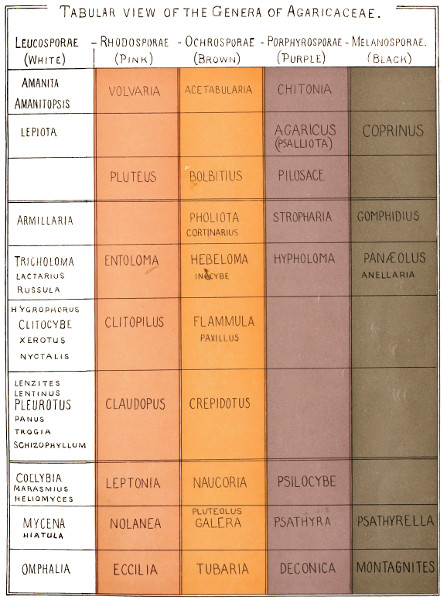
Plate I.
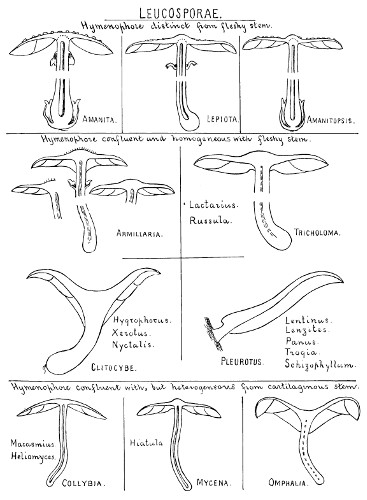
Plate II.
AMANITA.
(A name given to some esculent fungi by Galen, perhaps from
Mount Amanus.)
Universal veil (volva), which is at first continuous (completely enveloping the young plant), distinct from the skin of the cap. Hymenophore or cap, the part which bears the spore-bearing surface, distinct and easily separable from the stem, which leaves a socket in the flesh when it is removed. All growing upon the ground. Fries.
(Plate VII.)
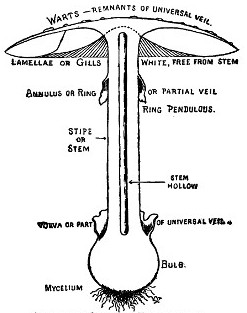
Section of Amanita Phalloides.
Pileus somewhat fleshy, convex then expanded. Gills free. Universal veil at first enclosing the entire plant, which as it grows bursts 3through, generally carrying the upper part on the pileus, where it appears as patches or scales, the remainder enclosing the stem at the base as a volva, either in a cup-like form, closely adherent or friable and evanescent. The partial veil in youth extends from the stem to the margin of the pileus, enclosing the gills; when ruptured it depends from the stem as a ring. Stem furnished with a ring, and different in substance from that of the pileus. Spores white.
On the ground.
The nearest allied genus, Amanitopsis, is separated by the absence of a ring, and Lepiota by its lack of a volva; Volvaria, Acetabularia and Chitonia, possessing volvas, are distinguished by the color of their spores.
Amanitæ are the most beautiful and conspicuous of fungi. While there are comparatively few species of them, the individual members are plentiful in appearing from spring until the coming of frost. They are solitary or gregarious in growth. Occasionally two or three are found together. They frequent woods, groves, copse, margins of woods and land recently cleared of trees. They are seldom found in open fields. A careful study of all their botanic points should be the first duty of the student of fungi. Familiarity with every characteristic of the Amanitæ will insure against fatal toadstool poisoning, for it is the well-grounded belief of those who have made thorough investigation that, with the exception of Helvella esculenta, now Gyromitra esculenta, the Amanitæ, alone, contain deadly poisons.
No Amanita, or piece of one, should be eaten before its identity is fully established and its qualities ascertained by referring to the descriptions herein given or to the opinion of an expert.
They are the aristocrats of fungi. Their noble bearing, their beauty, their power for good or evil, and above all their perfect structure, have placed them first in their realm; and they proudly bear the three badges 4of their clan and rank—the volva or sheath from which they spring, the kid-like apron encircling their waists, and patch-marks of their high birth upon their caps. In their youth, when in or just appearing above the ground, they are completely invested with a membrane or universal veil, which is distinct and free from the skin of the cap. As the plant grows the membrane stretches and finally bursts. It sometimes ruptures in one place only and remains about the base of the stem as the volva. When such a rupture occurs the caps are smooth. In most species portions of the volva remain upon the cap as scruff or warts—pointed or rough—or as feathery adornment; any or all of which may in part or whole vanish with age or be washed away by rain.
Extending from the stem to the margin of the cap, and covering the gills, is the partial veil—a membranaceous, white texture of varying thickness. As the cap expands this veil tears from it. Portions frequently remain pendant from the edges, the rest contracts to the stem as a ring, or droops from it as a surrounding ruffle, or, if of slight consistency, may be fugacious and disappear, but marks, remains, or the veil itself will always be traceable upon the stem.
The Amanitæ are of all colors, from the brilliant orange of the A. Cæsarea, the rich scarlet or crimson of the A. muscaria, to the pure white of the A. phalloides in its white form.
Their stems are usually long, and taper from the base toward the top. In some forms the base is distinctly bulbous. The volva at the base is attached to the stem at its lower extremity. It may be visible as a cup or ruptured pouch with spreading mouth, or it may be of such friable texture as to appear like mealy scales. Often, when the plant is pulled from the ground, the volva remains, but the marks of its attachment will appear and should be carefully looked for. Their gills are commonly white, are of equal length and radiate from near the stem, which they do not reach, to the circumference of the cap. They are white, unless tinged with age, excepting upon A. Cæsarea and A. Frostiana where they are yellow.[B] Their caps are umbrella-shaped, flat or convex. Their flesh is white, does not change color when bruised. They are scentless and almost tasteless when fresh, when old they have a slightly offensive odor and taste.
The family is not a large one, not over thirty members complete its circle. Every feature, every part of its several members, should be thoroughly known before the intimacy of eating. While at least nine 5of the family are not only edible but delicate and sapid, far better will it be to leave all alone than to make a mistake. A piece of a poisonous variety the size of a dime will often cause serious disorders if eaten. Many persons have died from eating very small quantities.
Because of its ovate or button-like form when young, it is frequently mistaken for the common field mushroom; even experienced mycophagists have been deceived by it. No other poison has so puzzled scientists. Other varieties of fungi may interfere with digestion, but to the Amanitæ all deaths from toadstool-eating are traceable. Its subtle alkaloid is absorbed by the system, and in most cases lies unsuspected for from six to twelve hours, then its iron grip holds to the death. For centuries it has defied all remedies. The problem has been partially solved. At Shenandoah, Pa., August 31, 1885, a family of five were poisoned by toadstools; two died, three lived. Noting the sad account in the newspapers, I at once wrote to Shenandoah for specimens of the fungi eaten and a description of the treatment. I promptly received from Dr. J.E. Schadle (now Professor Schadle), the physician in charge of the cases, a box containing two harmless varieties and several fine specimens of the Amanita phalloides, all of which were gathered on the same spot and by the same person who gathered the toadstools doing the poisoning. They told the tale. A remarkably full and interesting account of the cases was sent to me by Dr. Schadle. After exhausting all other remedies, and after two of the five had died, he administered subcutaneously, by hypodermic injection, sulphate of atropine—a product of the deadly nightshade analagous to belladonna—1⁄180 to 1⁄60 of a grain at a dose. It proved to be an antidote and saved the lives of the remaining three.
The action of atropine in arresting the deadly work of poisoning by amanitine had been foreshadowed by Schmidberg and Koppe, and dwelt upon in numerous published articles by Mr. Julius A. Palmer, to whom more than any other is due the branding of the murderous members of the Amanita family; but for the first time atropine was used upon the human system to ward their blows.
All of the species herein described are found in the United States. Of the twenty-seven, nine are edible, nine are either known to be deadly or are so closely allied to deadly species that it is unsafe to class them as other than poisonous until absolute proof is obtained of their harmlessness. 6The remaining nine I have not seen, neither is there any record of their qualities.
ANALYSIS OF SPECIES.
* Volva opening at the top or splitting all around, leaving a manifest, free border at the base of the stem. Pileus naked or with broad membranaceous patches.
** Volva splitting regularly all round the lower portion, persistent, more or less closely embracing the base of the bulbous stem. The upper portion being adnate to the pileus appears on it by expansion as scattered, thick warts.
*** Volva friable, entirely broken up into wart-like scales, therefore not persistent at the base of the stem, which is at first globose-bulbous, becoming less so as it lengthens. Pileus bearing mealy patches, soon disappearing or with small, hard, pointed warts.
**** Volva rudimentary, flocculose, wholly disappearing.
* Volva bursting at top, etc.
A. viro´sa Fr.—virus, poison.
Shining white. Pileus 3–4 in. broad, fleshy, at first conical and acute, afterwards bell-shaped, then expanded, naked, viscous in wet weather, shining when dry, margin always even, but most frequently unequal, turned backward and inflexed. Flesh white, unchangeable. Stem 4–6 in. long, wholly stuffed, almost solid, split up into longitudinal fibrils, cylindrical from the bulbous base, often compressed at the apex, torn into scales on the surface, springing from a lax, wide, thick volva, which bursts open at the apex. Ring close to the top, lax, silky, splitting up into floccose fragments. Gills free, thin, narrow, narrowing at both ends, but a little broader in front, not decurrent on the stem (although the apex of the stem is often striate), crowded, somewhat floccose at the edge. Fries.
The pilei are most frequently oblique, extended and lobed on one side as in Hygrophorous conicus, scarcely ever depressed. The pileus rarely becomes yellow. The fragments of the veil often adhere to the edge of the gills.
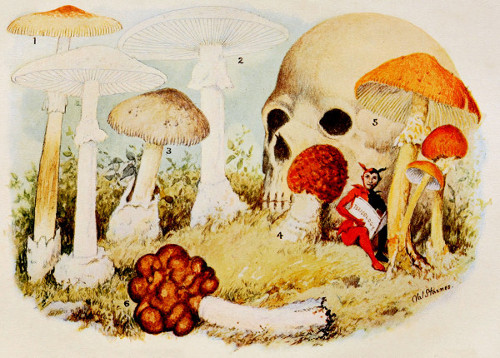
Grouped by F.D. Briscoe—Studies by C. McIlvaine. Plate VI.
Fig. Page. Fig. Page.
1. Amanita spreta, 11 4. Amanita muscaria, 14
2. Amanita phalloides (white var.), 7 5. Amanita frostiana, 16
3. Amanita phalloides (brown var.), 7 6. Gyromitra esculenta, 546
7In woods. Uncommon. August to October.
Fetid, poisonous. Stevenson.
Spores spheroid or subspheroid, 10–16µ, K.; 8µ W.P.; sub-globose, 8–10µ Massee.
POISONOUS.
I think it a variety of A. phalloides.
A. phalloi´des Fr. Gr.—phallus-like. (Plate VI, figs. 2, 3, p. 6.) Pileus 3–4 in. broad, commonly shining white or lemon-yellow, fleshy, oval bell-shaped, then expanded, obtuse, covered over with a pellicle which is viscid (not glutinous) in wet weather, naked, rarely sprinkled with one or two fragments of the volva, the regular margin even. Stem 3–5 in. long, ½ in. and more thick, solid downward, bulbous, hollow and attenuated upward, rather smooth, white. Ring superior, reflexed, slightly striate, swollen, commonly entire, white. Volva more or less buried in the soil, bulbous, semifree, bursting open in a torn manner at the apex, with a lax border. Gills free, ventricose, 4 lines broad, shining white. Fries.
Pileus very variable in color, commonly white or yellow (A. citrina Pers.), becoming green (A. viridis Pers.), olivaceous and occasionally variegated with tiger spots; in late autumn with the disk almost black but whitish round the margin. Odor somewhat fetid, but little remarkable as compared with that of A. virosa.
In woods. Frequent. August to November.
A very POISONOUS and dangerous species. Stevenson.
Spores 8–9µ W.G.S.; 8–10µ B.; 7–9µ diam. Massee; globose, 7.6×6µ Peck.
Pileus at first ovate or subcampanulate, then expanded, slightly viscid when young and moist, smooth or rarely adorned by a few fragments of the volva, even on the margin, white, yellowish-brown or blackish-brown. Lamellæ rather broad, rounded behind, free, white. Stem equal or slightly tapering upward, stuffed or hollow, smooth or slightly floccose, ringed, bulbous, the ruptured volva either appressed loose or merely forming a narrow margin to the bulb.
Plant 4–8 in. high. Pileus 2–5 in. broad. Stem 3–6 lines thick.
This species is common and variable. It occurs everywhere in woods and assumes such different colors that the inexperienced mycologist is apt to mistake its different forms for distinct species. With us the prevailing 8colors of the pileus are white, yellowish-white, grayish-brown and blackish-brown. It is remarkable that the form with a greenish pileus, which seems to be common enough in Europe, does not occur here. Fries also mentions a form having a white pileus with a black disk. A somewhat similar form occurs here, in which the pileus is grayish-brown with a black disk. Some of the variously colored forms were formerly taken to be distinct species, in consequence of which several synonyms have arisen, of which A. virescens Fl. Dan., Amanita viridis Pers., and Amanita citrina Pers., are examples. A. verna Bull. is a variety having a white pileus, a rather thick annulus and an appressed volva. It sometimes occurs early in the season; hence the specific name. It also occurs late in the season and runs into the typical form so that it is not easy to keep it distinct. The flesh and the lamellæ are white, the stem is white, pallid or brownish, and the annulus is either white or brownish. The bulb is generally very broad and abrupt or depressed, though it sometimes is small and approaches an ovate form. The large bulbs are sometimes split externally in two or three places and are, therefore, two- or three-lobed. In such cases the volva is less persistent than usual and its free portion then furnishes merely an acute edge or narrow margin to the bulb. Specimens sometimes occur in which the margin of the pileus is narrowly adorned with a slight woolly hairiness, but usually it is perfectly smooth and even. By this character, taken in connection with the membranous volva and bulbous base of the stem, the species is readily distinguished. Sometimes a strong odor is emitted by it, but usually the odor is slight. Authors generally pronounce this a poisonous and very dangerous species. Its appearance is attractive, but its use as food is to be avoided. Peck, 33d Rep. N.Y. State Bot.
Common in woods and recently cleared woodlands. Frequent over the United States. June to frost.
An exceedingly poisonous, dangerous, seductive species, responsible for most of the deaths from toadstool eating; because in its white form it is mistaken for the common mushroom—Agaricus campester. The real fault is with the collector, who should never eat any fungus found in the woods, believing it to be the mushroom. The mushroom does not grow in the woods. Neither has it white gills, nor white spores, nor a volva at the base of the stem as have Amanitæ.
The caps of A. phalloides vary in color—white, oyster-color, smoky 9brown. The color of the commonest form is from white to a light hue of greenish yellow. The center of the cap, whatever may be the prevailing color, is usually several shades darker. In shape, the cap changes from a knob in youth, through the shapes of expansion, until it becomes fully spread, when it is umbrella-shaped, or almost flat. Some forms have a slightly raised portion or umbo in the center of the cap. The gills are white, of good width, rounded next to the stem and free from it.
The stem conforms in color to the cap, but in lighter shades. White-capped varieties have white stems. The stem has a sudden broad, distinct bulb at the base. On the upper side of the bulb there is usually a margin or rim. The stem tapers more or less toward the cap, from which it is easily separable. The cup, wrapper or volva is torn or split or irregular at the upper part, and is not pressed to the stem as in some forms.
Professor Peck, in his 48th Report, gives the following excellent synopsis of differences between the poisonous Amanita and edible fungi, for which it could only by great stupidity be mistaken:
Poison amanita. Gills persistently white. Stem equal to or longer than the diameter of the cap, with a broad, distinct bulb at the base.
Common mushroom. Gills pink, becoming blackish-brown. Stem shorter than the diameter of the cap, with no bulb at the base.
From all forms of the edible Sheathed amanitopsis the Poison amanita differs in its distinctly bulbous stem, in having a collar on the stem and in the absence of striations on the margin of the cap.
From the edible Reddish amanita, it is easily separated by the entire absence of any reddish hues or stains and of warts upon its cap.
From the Smooth lepiota its distinct, abrupt and marginal bulb at once distinguishes it.
A. ver´na Bull.—vernus, of spring. A variety of A. phalloides. POISONOUS. White. Pileus ovate then expanded, somewhat depressed, viscid, margin orbicular, even. Stem stuffed then hollow, equal, floccose, closely sheathed with the free border of the volva. Ring reflexed, swollen. Gills free. Pileus glabrous, even on the margin, white, viscid when moist. Gills white. Stem ringed, white, floccose, stuffed or hollow, closely sheathed at the base by the remains of the membranous volva, bulbous. Spores globose, 8µ broad.
10In woods. Spring and summer.
The Vernal Amanita scarcely differs from white forms of the A. phalloides except in the more persistent and more closely sheathing remains of the wrapper at the base of the stem. It is probably only a variety of that species, as most mycologists now regard it, and it should be considered quite as dangerous. I have not found it earlier than in July, although in Europe it is said to appear in spring, as its name implies. Peck, 48th Rep. N.Y. State Bot.
Common over the United States. West Virginia, New Jersey, Pennsylvania, May to November. It appeared at Mt. Gretna, Pa., on May 28, 1899. McIlvaine.
The absence of a ring separates white forms of A. volvata and A. vaginata.
The virulence of its poison is the same as that of A. phalloides.
A. magnivela´ris Pk.—magnus, large; velum, veil. Pileus convex or nearly plane, glabrous, slightly viscid when moist, even on the margin, white or yellowish-white. Gills close, free, white. Stem long, nearly equal, glabrous, white, furnished with a large membranous white annulus, sheathed at the base by the appressed remains of the membranous volva, the bulbous base tapering downward and radicating. Spores broadly elliptical, 10×6–8µ.
Pileus 3–5 in. broad. Stem 5–7 in. long, 4–6 lines thick.
Solitary in woods. Port Jefferson, Suffolk county. July.
The species resembles Amanita verna, from which it is separated by its large persistent annulus, the elongated downwardly tapering bulb of its stem, and especially by its elliptical spores. Peck, 50th Rep. N.Y. State Bot.
I have not seen this species. Its resemblance to A. verna is enough to place the ban upon it until it has been tested.
A. map´pa Fr.—mappa, a napkin. From the volva. Pileus 2–3 in. broad, commonly white or becoming yellow, slightly fleshy, convexo-plane, obtuse or depressed, orbicular, dry, margin for the most part even. Stem 2–3 in. long, 3–5 lines thick, stuffed then hollow, almost equal above the bulb, rather smooth, white. Ring superior, soft, lax, here and there torn. Volva regularly circularly split, somewhat obliterated; the globoso-bulbous base united with the stem, with an acute 11and distant margin; the portion covering the pileus divided into broad, irregular, somewhat separating scales. Gills annexed, crowded, narrow, shining, white. Fries.
Odor stinking. The color is that of A. phalloides, with which A. virosa exactly agrees, more rarely straw color, lemon-yellow, becoming green.
In mixed woods. Frequent. Stevenson.
Spores spheroid, 7–10µ K.; 8–9×6–8µ B.; subglobose, 7–9µ diameter Massee.
New York woods and fields, common, September to October, Peck, 22d Rep.; North Carolina, Curtis; New England, Frost; Minnesota, Johnson; Ohio, Morgan; District Columbia, Miss Taylor.
POISONOUS.
Probably but a variety of A. phalloides.
A. spre´ta Pk.—spreta, hated. (Plate VI, fig. 1, p. 6.) Pileus subovate, then convex or expanded, smooth or adorned with a few fragments of the volva, substriate on the margin, whitish or pale-brown. Gills close, reaching the stem, white. Stem equal, smooth, annulate, stuffed or hollow, whitish, finely striate at the top from the decurrent lines of the lamellæ, not bulbous at the base, but the volva rather large, loose, subochreate. Spores elliptical, generally with a single large nucleus, 10–13×6–8µ.
Plant 4–6 in. high. Pileus 3–5 in. broad. Stem 4–6 lines thick.
Ground in open places. Sandlake and Gansevoort. August. Peck, 32d Rep. N.Y. State Bot.
This is a dangerous species, because containing a deadly poison and resembling the most common forms of Amanitopsis, therefore likely to be mistaken for them. Specimens sent by me to Professor Peck were identified as his species. I add my own description.
Pileus oval, broadly umbonate, date-brown toward and on umbo, soft, dry, smooth, more or less sulcate on edge. Flesh white, thin, except at center. Stem tapers rapidly above ring and at base, white-reddish-brown toward middle, narrows toward volva from which it is almost free at the base, hollow, furfuraceous above ring. Gills white, crowded, free. Ring white, thin, persistent, but at times hard to distinguish because clinging to stem. Volva free, fitting close, upper 12margin thin, lower part quite thick, making stem appear bulbous, which it is not. White forms occur.
Not as virulent as A. phalloides, but like it in its POISONOUS effects. It differs from Amanitopsis in having a ring.
Grows in woods and on wood-margins.
Angora woods, West Philadelphia. On ground in mixed woods, open and grassy places in wood and wood-margins. August to September. McIlvaine.
A. recuti´ta Fr.—having a fresh or new skin. Pileus convex then plane, dry, smooth, frequently bearing fragments of the volva, margin nearly even. Stem stuffed then hollow, attenuated, silky, volva circumscissile, becoming obliterated, margin closely pressed to stem; ring distant, white. Gills striate-decurrent.
In pine woods. Common.
No report upon quality.
A. Cæsa´rea Scop.—king-like. (Called by the Greeks Cibus Deorum, food of the gods.) CAUTION. Pileus 3–8 in. across, hemispherical, then expanded, free from warts, distinctly striate on the margin, red or orange becoming yellow. Gills free, yellow. Stem 4–6 in. long, up to ¾ in. thick at base, slightly tapering upward, yellowish, flocculose, stuffed with white fibrils or hollow, with a conspicuous yellowish ring or veil. Volva white, large, distinct and membranous. Spores elliptical, 8–10µ Peck.
Open woods, under pines on lawns. July to October.
Reported from North Carolina, South Carolina, Massachusetts, Maryland, New Jersey, Ohio, Alabama, Louisiana, Pennsylvania, New York. Peck, Rep. 23, 32, 33, 48.
This emperor of fungi is the most showy of its race. It grows to 10 in. in height. The cap reaches 8 in. in diameter and the stem over 1½ in. in thickness. In very much smaller specimens about the same proportions occur. The cap is at first ovate, then hemispherical, then expanded. It has no warts or scales upon it. The margin is distinctly striate. The flesh is white, yellow or reddish under the skin; next to the gills it is usually yellow.
The stem tapers upward from the socket at its base. It is yellowish and covered with loose fibrils of darker hue. The ring is white, but 13frequently tinged with yellow. In taste and smell it is mild. Open woods is its favorite habitat, yet it is found growing luxuriantly under pines, maples, elms, on lawns. It is not often found, but when it is, it is solitary, or in groups or rings. In the latitude of Philadelphia it is found from July until October 1st. Further south its stay conforms to temperature, and it is more frequent. There is no doubt of its rare edibility abroad, and of its being eaten in America.
A specimen believed to be it should never be eaten until carefully distinguished from A. muscaria and A. Frostiana, which have warts or scales on the cap (which sometimes are not discernible after rain), white gills, and a volva which soon breaks up into fragments or scabs.
Appearing like a small form of A. muscaria, to which it was formerly referred, is A. Frostiana Pk. (Frost’s Agaric). It closely resembles small A. Cæsarea, especially in the yellow tinge of stem, ring and gills. The volva and ring (persistent in A. Cæsarea) soon disappear, but are traceable by fluffy fragments, or yellow stains. It is extremely poisonous.
The differences, concisely, are these: A. Cæsarea (Orange Amanita). Cap smooth, though occasionally with a few fragments of the volva as patches upon it. Gills yellow. Stem yellow. Volva usually persistent, sometimes breaking up into soft, fluffy masses.
A. muscaria (Fly Amanita). Poisonous. Cap covered with remains of the volva as scales or wart-like patches. Gills white. Stem white or light-yellow. Volva not persistent, breaking up into fluffy fragments or scales.
A. Frostiana. Poisonous. Smaller and more delicate than the two preceding. Cap smooth or with yellow scales or wart-like patches. Gills yellow or tinged on edge with yellow. Stem white or yellow, the ring evanescent, but always leaving a yellow mark on stem. Volva yellow, breaking up into yellow fluffy fragments.
Far better for the amateur to let the A. Cæsarea, and anything resembling it, respectfully alone.
New York, Gansvoort. Circle forty feet in diameter. Peck, 32d Rep.; Maryland. There is not a doubt that this fungus can be eaten with impunity, Banning; Alabama, abundant. Edible. Alabama Bull. No. 80.
Rogues and Cordier, French writers, regard it as the finest and most delicate of fungi, the perfume and taste being exquisite.
14The writer has not had opportunity to eat A. Cæsarea. If such should occur he would go about it very cautiously. No suspicion attaches to it abroad, but evidence is accumulating in the hands of the writer (not yet convincing) that either locality may render it poisonous or that A. muscaria varies so much in appearance as to deceive even the expert into mistaking it for A. Cæsarea. It is possible that A. muscaria is, at times, in certain localities, harmless; but no such exception as this is noted in the entire fungoid realm. It is not so common that collectors should mourn its waste. It is better, far, to let it alone.
** Volva splitting regularly all around; pileus bearing thick warts, etc.
A. musca´ria Linn.—musca, a fly. (Plate VI, fig. 4, p. 6. Plate IX.) POISONOUS. Pileus 4 in. and more broad, normally at first blood-red, soon orange and becoming pale, whitening when old, globose, then convex and at length flattened, covered with a pellicle which is at first thick, and in wet weather glutinous, but which gradually disappears, and sprinkled with thick, angular, separating fragments of the volva; margin when full-grown slightly striate. Flesh not compact, white, yellow under the pellicle. Stem as much as a span long, shining white, firm, torn into scales, at first stuffed with lax, spider-web fibrils, soon hollow; the adnate base of the volva forms an ovate bulb, which is marginate with concentric scales. Ring very soft, torn, even, inserted at the apex of the stem, which is often dilated. Gills free, but reaching the stem, decurrent in the form of lines, crowded, broader in front, white, rarely becoming yellow.
Var. rega´lis, twice as large. Stem stuffed, solid when young, as much as 1–2 in. thick, becoming light-yellow within; the volva terminates in 8–10 concentric squamoso-reflexed rows of scales. Pileus very glutinous, bay-brown or the color of cooked liver. Gills yellowish.
Var. formo´sa, soft, fragile. Pileus at first lemon-yellow, with mealy, lax, yellowish, easily-separating warts, often naked. Gills often becoming yellow. A. formosa, with the warts rubbed off.
Var. umbri´na, thinner and more slender. Stem hollow, often twisted, bulb narrowed. Pileus at first umber, then livid, with the exception of the disk, which is dingy-brown. Gills at length remote. Stev.
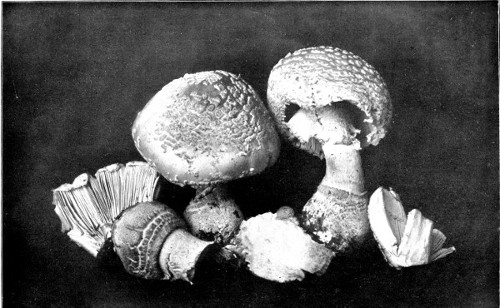
Photographed by Dr. J.R. Weist. Plate IX. AMANITA MUSCARIA.
Pileus at first ovate or hemispherical, then broadly convex or nearly plane, slightly viscid when young and moist, rough with numerous 15whitish or yellowish warts, rarely smooth, narrowly and slightly striate on the margin, white, yellow or orange-red. Gills white. Stem equal or slightly tapering upward, stuffed with webby fibrils or hollow, bearing a white ring above, ovate-bulbous at the base, white or yellowish; the volva usually breaking up into scales and adhering to the upper part of the bulb and the base of the stem. Spores elliptical, 8–10x6–8µ.
Plant 5–8 in. high. Pileus 3–6 in. broad. Peck, 33d Rep. N.Y. State Bot.
A white variety, with the pileus thickly studded with sharp warts, occurs in Albany Rural Cemetery. July. Peck, 24th Rep.
Var. al´ba Pk. It also occurs on Long Island in two forms, the normal one and a smaller one, in which the warts of the pileus are evanescent or wanting. Not unfrequently it makes a close approach to white forms of A. pantherina, in having the upper part of the bulb uniformly margined by the remains of the definitely circumscissile volva, but this margin is more acute than in that species. Peck, 46th Rep. N.Y. State Bot.
Spores spheroid-ellipsoid, 10–12x8–9µ K.; 6x9µ, W.G.S.; elliptical, 8–10x6–8µ Peck.
“At Cincinnati, yellow A. muscaria are all we find.” Lloyd.
Reported from most of the states. At Mt. Gretna I found it in great quantity, and frequently three or four tightly crowded together. Many pounds of it were sent to Professor Chittenden, Sheffield Laboratory, Yale University. Near Haddonfield, N.J., large patches annually grow under pines, gorgeous in their rich orange-red caps, usually scaly, with at times lemon-yellow in the same clusters, smooth as A. Cæsarea. It grows from July until after hard frosts.
It is undoubtedly poisonous to a high degree. Its juices in minute quantity, carefully and scientifically injected into the circulation of etherized cats, kill in less than a minute. A raw piece of the cap, the size of a hazel nut, affects me sensibly if taken on an empty stomach. Dizziness, nausea, exaggeration of vision and pallor result from it. The pulse quickens and is full, and a dreaded pressure affects the breathing. I have not noticed change in the pupil of the eye. Nicotine from smoking a pipe with me abates the symptoms, which entirely disappear in two hours, leaving as reminiscence a torturing, dull, skull-pervading headache. If, as is asserted on good authority, the Siberians use it as an intoxicant, they certainly suffer the accustomed penalty. 16It is possible that persons may, in a degree, become immune to its poison, as they do to arsenic, strychnia, opium, nicotine, or it may be that a portion of the poison is extracted by boiling. It is, however, extremely dangerous to rely upon extracting by any means the poison of the Amanita, and to eat the residue. Acetic acid or vinegar does not destroy the poison; it dissolves it to an extent and extracts it, and becomes as poisonous as the plant itself. There is no means of telling how much of the poison remains in the plant after such treatment. The safe plan is to eat, only, of toadstools which do not contain any poison to extract.
One redeeming virtue, alone, rests with A. muscaria—it kills flies.
A. Frost´iana Pk.—in honor of Charles C. Frost. POISONOUS. (Plate VI, fig. 5, p. 6.) Pileus convex or expanded, bright-orange or yellow, warty, sometimes nearly or quite smooth, striate on the margin. Gills free, white or slightly tinged with yellow. Stem white or yellow, stuffed, bearing a slight, sometimes evanescent ring, bulbous at the base, the bulb slightly margined by the volva. Spores globose, 8–10µ in diameter.
Plant 2–3 in. high. Pileus 1–2 in. broad. Stem about 2 lines thick. June to October.
This appears like a very small form of the Fly Agaric, to which, as var. minor, it was formerly referred. The only decided characters for distinguishing it are its small size and globose spores. Our plant sometimes grows in company with A. muscaria, but it seems to prefer more dense woods, especially mixed or hemlock woods. It is generally very regular and beautiful and has the stem quite often of a yellow color, and the bulb margined above with a collar-like ring. Peck, 33d Rep. N.Y. State Bot.
West Virginia, New Jersey, North Carolina, McIlvaine.
A. Frostiana is found well over the land. It is frequent in shady woods and seems to favor ground under the prevailing tree—oak, chestnut, pine, hemlock, whichever it may be. From the many hundreds I have seen, I think it more likely to be mistaken by the novice for A. Cæsarea than A. muscaria, because of its often yellow gills and stem. It is much smaller and thinner than either. In the states I have found it, it is darker than described, being a rich reddish-orange or scarlet. The partial veil or ring is very evanescent but often found upon the 17stem as a yellow, floccose remnant. The stain of the ring is always noticeable. The volva is seldom found entire. It, too, is evanescent, but, like the veil, is found yellow and fluffy, adhering to the fingers when touched.
It is probable that its highly colored cap has caused it to be gathered by the careless collector of bright-capped Russulæ, and that thus R. emetica got its bad name. Examine carefully any toadstool resembling it. The Russulæ have neither ring nor volva.
A. excel´sa Fr.—excelsus, tall. POISONOUS. Pileus 4–5 in. broad, brownish-gray, darker in the center, fleshy, soft, globose, then plane, pellicle thin, but viscous, and in reality separable in wet weather, then the surface is often wrinkled-papillose, or in a peculiar manner hollowed and pitted, sprinkled with angular, unequal, whitish-gray, easily separating warts, the remains of the friable volva; margin at first even, but when properly developed manifestly striate, even furrowed. Flesh soft, white throughout, unchangeable. Stem 4–6 in. long, 1 in. thick, at first stuffed, almost solid, but at length hollow, globose-depressed at the base, attenuated upward from the bulb, covered, sometimes as far as the ring, sometimes only on the lower part with dense, squarrose, concentric scales (from the epidermis of the stem being torn), striate at the apex. Ring superior, large, separating-free or at length torn. Gills quite free, rounded (not decurrent on the stem in the form of lines), very ventricose, ½ in. and more broad, shining white.
The bulb when young is somewhat marginate, but by no means separable, the margin proper, like that of A. muscaria, is marked with scales, buried in the soil, somewhat rooting, beneath the margin marked here and there with a concentric furrow. The shorter gills intermixed are more numerous than is usual among Amanitæ. There is a smaller variety, with the margin more frequently striate and the stem stuffed, then hollow. Fries.
Solitary, in woods, chiefly under beech. Stevenson.
Spores 6x9µ W.G.S.; 8–9×5–6µ Massee.
North Carolina, Schweinitz, Curtis; South Carolina, Ravenel; California, Harkness and Moore; Massachusetts, Frost, Andrews; Minnesota, Johnson; Rhode Island, Olney.
A. pantheri´na De C.—spotted like a panther. Doubtful. Pileus 18commonly olivaceous-umber when young, fleshy, convex then flattened or somewhat depressed, with a sticky pellicle, which is at first thick and olivaceous dingy-brown, then thinned out, almost disappearing and livid, the disk only becoming brownish; margin evidently striate; the fragments of the volva divided into small, equal, white, regularly arranged, moderately persistent warts. Flesh wholly white, never yellow beneath the pellicle. Stem 3–4 in. long, ½ in. thick, at first stuffed then hollow with spider-web fibrils within, equal or attenuated upward, slightly firm and sometimes scaly downward, greaved at the base by the separable volva which has an entire and obtuse margin. Ring more or less distant, adhering obliquely, white, rarely superior. Gills free, reaching the stem, broader in front, 3–4 lines broad, shining white.
It is readily distinguished from A. muscaria, var. umbrina, by the white flesh never becoming yellow beneath the pellicle. Variable in size and color, which, however, is never red or yellow, and in the position of the ring.
In woods and pastures. Stevenson.
Spores 7–8×4–5µ K.; 6–10µ B.; 8×4µ W.G.S.; 7.6×4.8µ Morgan.
Not poisonous, W.G.S.; not edible, Roze; poisonous, Leuba.
North Carolina, Pennsylvania, Ohio, California, Wisconsin, Minnesota, Iowa, New York. Peck.
A. Ravenel´ii B. and C.—in honor of Henry W. Ravenel. Pileus 4 in. across, convex, broken up into distinct areas, each of which is raised into an acute, rigid, pyramidal wart. Stem 3 in. high, bulbous. Volva thick, warty, somewhat lobed. Ring deflexed.
South Carolina, June, H.W. Ravenel; a very fine species allied to A. strobiliformis, Vitt. Ann. and Mag. Nat. Hist., 1859; Alabama, Atkinson (Ll. Volvæ).
Properties not stated.
A. russuloi´des Pk.—resembling a Russula. Pileus at first ovate, then expanded or convex, rough with a few superficial warts, or entirely smooth, viscid when moist, widely striate-tuberculate on the margin, pale-yellow or straw color. Gills close, free, narrowed toward the stem, white. Stem firm, smooth, stuffed, annulate, equal or slightly tapering upward, bulbous; annulus thin, soon vanishing. Volva fragile, subappressed. Spores broadly elliptical, 10×8µ.
19Plant 2–3 in. high. Pileus 1.5–2 in. broad. Stem 3–5 lines thick. Grassy ground in open woods. Greenbush. June.
This species is remarkable for the thin striate-tuberculate margin of the pileus, which causes it to resemble some species of Russula. Peck, 25th Rep. N.Y. State Bot.
Qualities not stated.
Massachusetts, Francis.
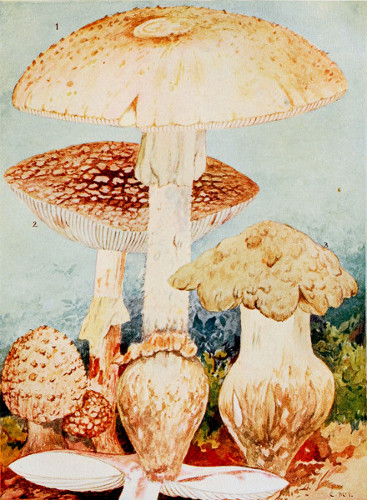
Grouped by F.D. Briscoe—Studies by C. McIlvaine. Plate VIII.
Fig. Page.
1. Amanita chlorinosma, 25
2. Amanita rubescens and section, 21
3. Amanita strobiliformis, 19
A. strobilifor´mis Vitt.—strobilis, a pine-cone, from the shape of the warts. (Plate VIII, fig. 3, p. 18.) Cap 3–10 in. across, convex or nearly plane, white or cinereous, sometimes yellow on the disk, rough with angular, mostly persistent warts which sometimes fall away and leave the pileus nearly smooth; generally whitish, sometimes tinged with brown; the margin even and extending a little beyond the lamellæ. Gills free, rounded behind. Veil large and portions sometimes adhere to margin of cap. Stem 3–8 in. long, up to 1¼ in. thick, equal or slightly tapering upward, solid, floccose-scaly, white, bulbous, the bulb very large, sometimes weighing a pound, margined above and furnished with one or two concentric furrows, somewhat pointed below, firmly and deeply imbedded in the earth, floccose-mealy when young.
Spores elliptical, 13–15×8–10µ Peck.
Open woods and borders. June to October.
Edible. W.G. Smith, Curtis, Peck.
This is among the best of species. Its size, solidity, flavor are marked. I have found specimens weighing a pound and a half. It grows singly, but when one is found several are apt to be neighbors. When young, the cap is but a small knob upon a beet or top-shaped base, which is largely under ground. It cuts like a soft turnip, and has a strong, pungent, unmistakable odor, like chloride of lime, which entirely disappears in cooking. As the plant develops the bulb decreases in size. On all the many specimens the author has seen and eaten, the scabs are light brown and reddish-brown.
A. solita´ria Bull.—growing alone. Pileus convex or plane, warty, white or whitish, even on the margin. Gills reaching the stem, white or slightly tinged with cream color. Stem at first mealy or scaly, equal, solid, white, bulbous, the bulb scaly or mealy, narrowed below into a root-like prolongation. Ring lacerated, often adhering in fragments to the margin of the pileus and gills. Spores elliptical-oblong, 8–13×6.5µ.
20Plant 4–8 in. high. Pileus 3–6 in. broad. Stem 4–6 lines thick. Peck, 33d Rep. N.Y. State Bot.
Solitary in woods and open places. July to October.
Georgia, H.N. Starnes; Indiana, H.I. Miller; West Virginia, New Jersey, Pennsylvania, McIlvaine.
Edible. Curtis, H.N. Starnes, Philadelphia Myc. Club.
In many localities I find it quite plentiful, and it is so reported from Georgia. Southern and middle New Jersey woods abound with it, and at Mt. Gretna, Pa., it is always present in its growing months.
The cap is sometimes tinged with brown as are the angular, erect warts which are generally numerous, but often falling off or few and scattered. The flesh is white and smells like chloride of lime, but not nearly so strong as A. strobiliformis. The volva is broken up into floccose scales which cling to bulb and lower part of stem. These scales may be white and mealy or brownish. The entire fungus has a fluffy exterior, which is easily removed by rubbing. The annulus is torn, a part often adhering to the margin of the pileus and the gills. This and the long, tapering, rooting bulb are marked characteristics. The bulb is brittle. It is difficult to get the fungus from the ground entire.
Stem and cap are juicy, tender, mild in flavor, wholesome. It is not equal in flavor to A. rubescens, but is more delicate.
By many its properties have been stated as poisonous, doubtful. Quantities of it have been eaten by myself and friends. Hypodermic injection of its juices into the blood circulation of live animals prove it perfectly harmless.
A. can´dida Pk.—shining white. Pileus thin, broadly convex or nearly plane, verrucose with numerous small, erect, angular or pyramidal, easily separable warts, often becoming smooth with age, white, even on the margin. Flesh white. Gills rather narrow, close, reaching to the stem, white. Stem solid, bulbous, floccose-squamose, white, the annulus attached to the top of the stem, becoming pendent and often disappearing with age, floccose-squamose on the lower surface, striate on the upper, the bulb rather large, ovate, squamose, not margined, tapering above into the stem and rounded or merely abruptly pointed below. Spores elliptical, 10–13×8µ.
Pileus 3–6 in. broad. Stem 2.5–5 in. long, 5–8 lines thick, the bulb 1–1.5 in. thick in the dried specimens.
21This is a fine large species related to A. solitaria, but differing from it in the character of its bulb and of its annulus. The bulb is not marginate nor imbricately squamose. Its scales are small and numerous. Nor is it clearly radicating, though sometimes it has a slight abrupt point or myceloid-agglomerated mass of soil at its base. The veil or annulus is large and well developed, but it is apt to fall away and disappear with age. Its attachment at the very top of the stem brings it closely in contact with the lamellæ of the young plant and the striations of its upper surface appear to be due to the pressure of the edges of these upon it. It separates readily from the margin of the pileus and is not lacerated. In the mature plant the warts have generally disappeared from the pileus and sometimes its margin is curved upward Peck, Bull. Torr. Bot. Club, Vol. 24, No. 3.
Woods. Auburn, N.Y., Alabama, U. and E.; Pennsylvania, West Virginia, New Jersey, August to October, McIlvaine.
A dozen or more specimens were found in oak woods near Philadelphia, and carefully tested. Their edible qualities were found to be precisely the same as A. solitaria.
*** Whole volva friable, etc.
A. rubes´cens Pers.—rubesco, to become red. (Plate VIII, fig. 2, p. 18. Plate XII, fig. 4, p. 32.) Pileus about 4 in. broad, dingy-reddish, becoming pale flesh-color, tan, scarcely pure, fleshy, convex, then plane, obtuse, moist but not glutinous in rainy weather and opaque when dry, covered with unequal, soft, mealy, whitish, easily-separating warts, which are smaller, harder and more closely adherent in dry weather; margin even and, when old, slightly striate only in wet weather. Flesh commonly soft, white when fresh, reddening when broken. Stem 4–5 in. long, as much as 1 in. thick, stuffed, somewhat solid, though soft within, conico-attenuated from the thickened base, reddish-scaled, becoming red-white, and without a trace of a distinct volva at the base. Ring superior, large, membranaceous, soft, striate and white within. Gills reaching the stem in an attenuated manner, forming decurrent lines upon it, thin, crowded, soft, as much as ½ in. broad, shining white.
Very changeable, but readily distinguished from all others of the same group by the flesh being reddish when broken; the stem and pileus are commonly spotted-red when wounded. In dry weather it is firmer, flesh reddening more slowly, warts minute. Odor scarcely any. There 22is a remarkable variety circinata, pileus becoming plane, umber-brown, warts adnate, crowded, roundish. A. circinatus Schum. Stevenson.
Spores spheroid-ellipsoid, 7–8×6µ K.; 8×6µ W.G.S.; 7–9×6–8µ B.; elliptical, 8–9µ long. Peck.
Not reported west of the Mississippi river.
Oak woods, borders and open places. July to September. Indiana, H.I. Miller; West Virginia, New Jersey, North Carolina, Pennsylvania, McIlvaine.
It is quite common, often growing in large patches. Recent authors agree upon the edibility and deliciousness of this species. The author knows it to be one of the most plentiful, useful and delicious, after several years of pleasant experience with it.
In July, 1899, at Mt. Gretna, I found, growing from the ground gregariously, a singular fungoid growth from 2–5 in. high; cap hemispherical, 1 in. in diameter, tightly fitting a solid stem of nearly the diameter of the cap. The whole was watery white, and evidently affected by a parasite. It was edible. September 1st Professor Peck wrote to me: “I think I have found the identity of the diseased Agaric, of which you sent me samples some time ago. I mean the one affected by Hypomyces inæqualis Pk. The host is Amanita rubescens, at least sometimes, and probably always.”
The plant is very heavy for its size. The lack of a volva, the dingy color and reddish stains distinctly separate this from any poisonous Amanita.
A. spis´sa Fr.—compact, dense;—of the warts. Pileus umber, sooty or gray, fleshy, somewhat compact, convexo-plane, obtuse, smooth, even, but marked with small, ash-colored, angular, adnate warts; margin even, but often torn into fibers. Flesh firm, white, quite unchangeable. Stem 2–3 in. long, as much as 1 in. thick, solid, turnip-shaped at the base, somewhat rooting with a globoso-depressed not marginate bulb, curt, firm, shining white, at length squamulose with concentric cracks. Ring superior, large. Gills reaching the stem, slightly striato-decurrent, broad, crowded, shining white. Fries.
Spores 14µ W.G.S.; subglobose, 8–10µ C.B.P.; 6µ W.P.; rather pear-shaped, 9–10×6µ Massee.
Cap 2–3 in. across. Stem 2½-3 in. long, up to ¾ in. thick.
New Jersey, oak woods, August and September. McIlvaine.
23A. spissa has been reported from but few localities. It is rare in the latitude of Philadelphia. Half a dozen specimens have been found in neighboring New Jersey.
Taste and smell strong, but when cooked the dish is savory and not unlike one of A. rubescens.
A. as´pera Fr.—asper, rough. Pileus 2–3 in. across. Flesh rather thick at the disk, whitish, white or reddish with tints of livid or gray, reddish or brownish under the cuticle; convex then plane, margin thin and even, rough with firmly adnate, minute, closely crowded, angular warts, reddish-brown or livid-brownish, not pure white, unchangeable. Gills free and rounded behind, not striately decurrent, ventricose, white. Stem stuffed, striate above the ring, short at first, ovate, then elongating to 2–3 in., attenuated upward from a wrinkled bulb, squamulose, white without and within. Ring superior, entire.
Spores 8×6µ Massee; 8×6–7µ W.G.S.
The flesh of stem and bulb when eaten by insects is reddish, the bulb when old is a reddish-brown. The large ring and stem become red when touched. In these particulars it resembles A. rubescens. In smell it is somewhat strong, not unlike A. strobiliformis, but not nearly so pungent.
Cooked it is of excellent quality and flavor. I have eaten it since 1885.
A. abrup´ta Pk.—abrupt, of the bulb. Pileus thin, broadly convex or nearly plane, covered with small angular or pyramidal, erect, somewhat evanescent warts, white, slightly striate on the margin. Flesh white. Gills moderately close, reaching the stem and sometimes terminating in slightly decurrent lines upon it, white. Stem slender, glabrous, solid, bulbous, white, the bulb abrupt, subglobose, often coated below by the white persistent mycelium, the ring membranous, persistent. Spores broadly elliptical or subglobose, 8–10×6–8µ.
Pileus 2–4 in. broad. Stem 2.5–4 in. long, 3–4 lines thick.
The chief distinguishing mark of this species is the abrupt, nearly globose, bulbous base of the stem. This is somewhat flattened above and is sometimes longitudinally split on the sides. The small warts of the pileus are easily separable, and in mature specimens they have often wholly or partly disappeared. The remains of the volva are not present on the bulb in mature dried specimens, which indicates that the 24species should be placed in the same group with A. rubescens, A. spissa, etc. The latter species have the bulb of the stem similar to that of our plant, but the color of the pileus and other characters easily separate it. Peck, Bull. Torr. Bot. Club, Vol. 24, No. 3.
Alabama, Underwood; New Jersey, Pennsylvania, McIlvaine. July to September.
This species is edible and quite equal in quality to A. rubescens. Great care should be exercised in distinguishing it.
A. nit´ida Fr.—niteo, to shine. Pileus when flattened 4 in. broad, whitish, fleshy, somewhat compact, at first hemispherical, wrapped up, the thick volva forming a floccose crust, then broken up into thick, remarkably angular, adhering warts, which become brownish, dry, shining, without a glutinous pellicle, margin always even. Flesh white, quite unchangeable. Stem 3 in. long, 1 in. thick, solid, firm, conico-attenuated, with a bulb-shaped base, squamulose, white. Ring superior, thin, torn, slightly striate, white, villous beneath, at length disappearing. Gills free, crowded, very broad, as much as ½ in., ventricose, shining white. Fries.
Menands. Albany county. Our plant is more slender than the typical form, and has smaller but more numerous warts, but in other respects it exhibits the characters of this species. Peck, 43d Rep. N.Y. State Bot.
California, H. and M.; Maryland. Common in nearly every woods in Maryland. Banning.
From its likeness to poisonous species it should be suspected.
A. prairiic´ola Pk—prairie, colo, to inhabit. Pileus thin, convex, slightly verrucose, white, more or less tinged with yellow, even on the margin. Flesh white. Gills rather broad, subdistant, reaching the stem, white. Stem equal or slightly tapering upward, somewhat squamose toward the base, white or whitish, the annulus persistent. Spores large, broadly elliptical, 12–14µ long, 7–9µ broad.
Pileus 1.5–3 in. broad. Stem 2–2.5 in. long, 2–4 lines thick.
Bare ground on open prairies. Kansas. September. E. Bartholomew.
This species belongs to the same tribe as A. abrupta. The only evidence of the presence of a volva shown by the dried specimens is found in a few inconspicuous, but separable warts on the pileus. There is no 25well marked bulb to the stem and no evidence remains of a volva at its base. Peck, Bull. Torr. Bot. Club, Vol. 24, No. 3.
Reported from Kansas only. Qualities unknown.
A. monticulo´sa Berk.—mountain, from the warts. Pileus 2.5–3 in. across, convex, areolate, with a wart in the center of each areola; those toward the margin consisting of soft threads meeting in a point, but sometimes simply flocculent, the central warts angular, pyramidal, truncate, discolored. Stem bulbous, scaly, flocculent, white. Veil thick, at length distant. Gills free, ventricose, remote, forming a well-defined area around the top of the stem. The warts are not hard and rigid as in A. nitida, and the free remote gills separate it from that and the neighboring species. Berk.
North Carolina, sandy woods, common. Curtis.
Properties not known.
A. dau´cipes B. and M.—daucum, a carrot; pes, a foot. Pileus 2–5 in. broad, hemispherical, globose. Flesh white, soft, warts regular, pyramidal, saffron color. Gills narrow, reaching the stem, broadest in the middle. Stem 5–6 in. high, solid, base bulbous, with a restricted cortina above, squamulose downward. Veil fibrillose, extending from the margin of the pileus to the apex of the stem, fugacious.
In cultivated fields. Ohio. Sullivant. Properties not given.
A. lenticular´is Lasch.—resembling (the stem) a lentil.
Fries places this species in Amanita, in which Stevenson follows him. Cooke and Massee place it in Lepiota, where it will be found.
**** Volva rudimentary, wholly disappearing.
A. chlorinos´ma Pk.—smelling like chlorine. (Plate VIII, fig. 1, p. 18.) Pileus convex or expanded, warty on the disk, covered on the even margin with a light powdery, at length evanescent substance, white. Gills white. Stem nearly cylindrical, stout, deeply penetrating the earth. Spores broadly elliptical, 7–10µ long. Odor distinct, chlorine-like.
Plant 6–7 in. high. Pileus 4–6 in. broad. Stem 1–2 in. thick. Peck, Bot. Gaz., Vol. 4.
26Burnt ground in woods. August. Closter, N.J., C.F. Austin; Alabama, U. and E.; West Virginia, Nuttall; New Jersey, Ellis; Mt. Gretna, Pa., July, in a cluster of a dozen individuals, and afterward until frost, strong smelling, warts brownish-white. McIlvaine.
It is edible and equal to A. strobiliformis.
A. calyptra´ta Pk. Pileus fleshy, thick, convex or nearly plane, centrally covered by a large irregular persistent grayish-white fragment of the volva, glabrous elsewhere, striate on the margin, greenish-yellow or yellowish-brown tinged with green, the margin often a little paler or more yellow than the rest. Lamellæ close, nearly free, but reaching the stem and forming slight decurrent lines or striations on it, yellowish-white tinged with green. Stem stout, rather long, equal or slightly tapering upward, surrounded at the base by the remains of the ruptured volva, white or yellowish white with a faint greenish tint. Spores broadly elliptic, 10µ long, 6µ broad, usually containing a single large nucleus.
Pileus 10–20 cm. broad. Stem 10–15 cm. long, 12–20 mm. thick.
Rich ground in fir woods or their borders. Autumn. Oregon. Dr. H. Lane.
This is a large and interesting species, well marked and easily recognized by its large size, by the greenish tint that pervades the pileus, lamellæ, annulus and stem, and especially by the large persistent patch of grayish-white felty material that covers the center of the pileus and sometimes extends nearly to the margin. This is in fact the upper part of the ruptured volva that is carried up by the growing plant, and is very suggestive of the specific name. In the young state the plant is entirely enveloped in the volva, which then is similar to a goose egg in size and shape, and its walls are one-fourth to one-half inch thick. So thick and firm are they that the young plant appears sometimes to be unable to break through and it decays in its infancy.
Dr. Lane says that, having found that the Italians made use of this mushroom for food, he began eating it and introducing it to his friends, and he learned by personal trial that it is a thoroughly good and wholesome mushroom, which, when broiled with bacon, fried, baked or stewed, may be eaten with perfect safety and that it is a nutritious food. Peck, Bull. Torrey Bot. Club, Vol. 27, January, 1900.
27A. crenula´ta Pk. Pileus thin, broadly ovate, becoming convex or nearly plane and somewhat striate on the margin, adorned with a few thin whitish floccose warts or with whitish flocculent patches, whitish or grayish, sometimes tinged with yellow. Lamellæ close, reaching the stem, and sometimes forming decurrent lines upon it, floccose crenulate on the edge, the short ones truncate at the inner extremity, white. Stem equal, bulbous, floccose mealy above, stuffed or hollow, white, the annulus slight, evanescent. Spores broadly elliptic or subglobose, 7.5–10µ long, nearly as broad, usually containing a single large nucleus.
Pileus 2.5–5 cm. broad. Stem 2.5–5 cm. long, 6–8 mm. thick.
Low ground, under trees. Eastern Massachusetts. September. Mrs. E. Blackford and George E. Morris.
The volva in this species must be very slight, as its remains quickly disappear from the bulb of the stem. The remains carried up by the pileus form slight warts or thin whitish areolate patches. The annulus is present in very young plants, but is often wanting in mature ones, in which state the plant might be mistaken for a species of Amanitopsis. Its true affinity is with the tribe to which A. rubescens belongs. As in that species, the bulb soon becomes naked and exhibits no remains of the volva. It is similar to A. farinosa also in this respect, but quite unlike it in color, in the adornments of the pileus and in the character of its margin, which is even in the young plant and but slightly striate in the mature state. Its dimensions are said sometimes to exceed those here given, and it is reported to have been eaten without harm and to be of an excellent flavor. I have had no opportunity to try. Peck, Bull. Torrey Bot. Club, Vol. 27, January, 1900.
28AMANITOP´SIS Roze.
Amanita; opsis, resembling.
Having a universal veil at first completely enveloping the young plant, which soon bursts through, carrying particles of it on the pileus, where they appear as scattered warts readily brushed off; the remainder or volva closely enwraps the base of the stem. Ring absent. Spores white. This genus was formerly included in Amanita. It differs from Amanita in the absence of a ring or collar upon the stem and in the more sheathing volva. It differs from Lepiota in having a volva.
Close observation is necessary in collecting Amanitopsis for the table. It has no trace of ring or veil upon the stem. So far as the species are known no poisonous one exists. But Amanita spreta Pk., which is deadly, so closely resembles forms of Amanitopsis that those confident of their knowledge will be deceived. The veil or traces of veil, which Amanita spreta always has, sometimes so adheres to and wraps the stem that it is not noticeable without close examination, thus giving to it every appearance of an Amanitopsis.
The volva of A. spreta is attached for a considerable distance to the base of the tapering stem, and is not readily removed. This is a guide to detect it. It is a wolf in sheep’s clothing.
Amanitopsis corresponds to Volvaria in the pink-spored series, in which, as far as known, there is no poisonous species.
All American species of Amanitopsis are given. Several have not been tested by the writer because of lack of opportunity.
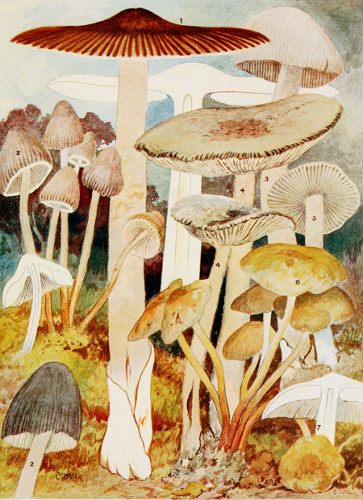
Grouped by F.D. Briscoe—Studies by C. McIlvaine. Plate X.
Fig. Page. Fig. Page.
1. Amanitopsis vaginata, 28 5. Mycena galericulata, 127
2. Amanitopsis vaginata, var. livida, 29 6. Mycena prolifera, 126
3. Amanitopsis nivalis, 29 7. Mycena prolifera (section), 126
4. Amanitopsis strangulata, 30
A. vagina´ta Roze—vagina, a sheath. (Plate X, figs. 1, 2, p: 28.) Pileus thin, fragile, glossy, smooth except in rare instances where a few fragments of the volva adhere to it for a time, deeply and distinctly striate on the margin, sometimes umbonate. Flesh white, in the dark forms grayish under the skin. Stem ringless, sometimes smooth, but generally mealy or floccose, hollow or stuffed with a cottony pith, not bulbous. Volva long, thin, fragile, closely sheathing yet free from the stem, except in the lower part, easily detachable and frequently remaining in the ground when the plant is pulled. Color variable, generally mouse-gray, sometimes livid, tawny-yellow or white, in one variety a 29rich date-brown. Spores globose, 8–10µ broad Peck; elliptical 10×7–8µ Massee.
Var. liv´ida Pers.—livid. Leaden brown, gills dingy. (Plate X, fig. 2, p. 28.)
Var. ful´va Schæff.—yellowish. Tawny-yellow or pale ochraceous.
This plant is widely dispersed, having been reported from many localities in the United States, also from Nova Scotia and Greenland.
On ground in woods and on margins of woods, under trees, in shaded grassy places. Sometimes in open stubble and pastures. June to frost. Mt. Gretna, September, 1899, found a cluster on decayed chestnut stump. Various colors abound—hazel, brown, gray, yellow, whitish. The caps and stems are tender as asparagus tips, but without much distinct flavor when cooked.
Great care must be taken to distinguish these forms from Amanita spreta Pk. which is poisonous. See heading of genus—Amanitopsis.
A. niva´lis Grev.—snowy. (Plate X, fig. 3, p. 28.) Pileus at first ovate, then convex or plane, smooth, striate on the thin margin, white, sometimes tinged with yellow or ochraceous on the disk. Flesh white. Gills subdistant, white, free. Stem equal, rather tall, nearly smooth, bulbous, stuffed, white; the volva very fragile, soon breaking up into fragments or sometimes persisting in the form of a collar-like ring at the upper part of the bulb. Spores globose, 7.5–10µ in diameter.
Plant 4–6 in. high. Pileus 2–3 in. broad. Stem 2–4 lines thick. July to October.
It approaches in some respects A. Frostiana, but its larger size, smooth pileus, lighter color and the absence of an annulus will easily distinguish it from that species. Peck, 33d Rep. N.Y. State Bot.
Specimens have been repeatedly found by the writer in open oak woods near Philadelphia.
A strong, unpleasant bitter, which appears to develop while cooking, renders it unpalatable. It is harmless, but its use is not advised.
A. velo´sa Pk.—velosus, fleecy. Pileus at first subglobose, then bell-shaped or nearly plane, generally bearing patches of the remains of the whitish felty or tomentose volva, elsewhere glabrous, becoming sulcate-striate on the margin, buff or orange-buff. Flesh compact, white. Gills close, reaching the stem, subventricose, pale cream color. Stem 30firm, at first attenuated and tomentose at the top, then nearly equal, stuffed, white or whitish, closely sheathed at the base by the thick volva. Spores globose, 10–13µ.
Pileus 2–4 in. broad. Stem 3–4 in. long, 3–4 lines thick.
Under oak trees. Pasadena, California. April. A.J. McClatchie.
This fungus is closely related to A. vaginata, from which it may be separated by the more adherent remains of the thicker volva which sometimes cover the whole surface of the pileus, and by the thicker gills which are somewhat adnate to the stem and terminate with a decurrent tooth. Bull. Torr. Bot. Club, Vol. 22, No. 12.
As it is probable this species will be found elsewhere than California, and from its close relation to A. vaginata likely to be edible, its description is here given.
A. strangula´ta (Fr.) Roze—choked, from the stuffed stem. (Plate X, fig. 4, p. 28.) Pileus at first ovate or subelliptical, then bell-shaped, convex or plane, warty, slightly viscid when moist, deeply and distinctly striate on the margin, grayish-brown. Gills free, close, white. Stem equal or tapering upward, stuffed or hollow, nearly smooth, white or whitish, the volva soon breaking up into scales or subannular fragments. Spores globose, 10–13µ.
Plant 4–6 in. high. Pileus 2–4 in. broad. Stem 3–6 lines thick. Peck, 33d Rep. N.Y. State Bot.
A. Ceciliæ B. and Br. is a synonym.
Not distinct in color and general appearance from A. vaginata, but distinctly separated by its warty pileus and evanescent mouse-colored volva which does not sheath the stem. Pileus striate when young, then sulcate. Stem mealy, especially on the upper part.
Woods, open grassy places, wheat stubble, etc. June to September. Pennsylvania, New Jersey, West Virginia, McIlvaine.
In the latitude of Philadelphia the plant is found in great abundance. Its rather early appearance, staying quality, delicate consistency and flavor make it valuable as a food supply.
Pearl color, bluish-gray and gray are the prevailing cap-coloring.
A. adna´ta (W.G.S.) Roze—adnatus, adnate, of the gills. Pileus about 3 in. across. Flesh thick, whitish, firm, convex, then expanded, rather moist, pale yellowish-buff, often furnished with irregular, woolly 31patches of volva; margin even, extending beyond the gills. Stem 2–4 in. long, ½ in. thick, cylindrical, rough, fibrillose, pale buff, flesh distinct from that of the pileus, stuffed, then hollow; base slightly swollen. Volva adnate, white, downy, margin free and lax, sometimes almost obsolete. Gills truly adnate, crowded, with many intermediate shorter ones, white. Spores subglobose, with an oblique point, 7–8µ Massee.
Tender, good flavor, yielding more substance when cooked than any other Amanitopsis.
A. volva´ta Pk.—possessing a volva. Pileus convex, then nearly plane, slightly striate on the margin, hairy or floccose-scaly, white or whitish, the disk sometimes brownish. Gills close, free, white. Stem equal or slightly tapering upward, stuffed, minutely floccose-scaly, whitish, inserted at the base in a large, firm, cup-shaped, persistent volva. Spores elliptical, 10×8µ.
Plant 2–3 in. high. Pileus 2–3 broad. Stem 3–4 lines thick. Peck, 33d Rep. N.Y. State Bot.
The plant is easily recognized by its large, cup-shaped volva and cap, which is not smooth, as is usual in a species with a persistent membranous volva, more or less scaly with minute tufts of fibrils or tomentose hairs. The gills are white in the fresh plant.
Professor Peck notes the species as quite rare. Numerous specimens occur in the sandy oak woods of New Jersey, and in oak woods near Angora, Philadelphia. July to October.
Care must be taken to determine the absence of an annulus or any trace of one. Tender, delicate, without pronounced flavor. Equal to Amanitopsis vaginata.
A. farino´sa Schw.—covered with farina, meal. Pileus nearly plane, thin, flocculent-pulverulent, widely and deeply striate on the margin, grayish-brown or livid-brown. Gills free, whitish. Stem whitish or pallid, equal, stuffed or hollow, mealy, sub-bulbous, the volva flocculent-pulverulent, evanescent. Spores variable, elliptical ovate or subglobose, 6–8µ long.
Plant about 2 in. high. Pileus 1 in. to 15 lines broad. Stem 1–3 lines thick. July to September.
This is our smallest Amanita (now Amanitopsis). It is neither very common nor very abundant when it does occur. It is described by 32Schweinitz as “solid,” but I have always found it stuffed or hollow. Peck, 33d Rep. N.Y. State Bot.
A. pusil´la Pk.—small. Pileus thin, broadly convex or nearly plane, subglabrous, slightly umbonate, even on the margin, pale brown. Gills narrow, thin, close, free, becoming brownish. Stem short, hollow, bulbous, the bulb margined by the remains of the membranous volva. Spores broadly elliptical, 5–6×4µ.
Pileus about 1 in. broad. Stem 8–12 lines long, 1–2 lines thick.
Grassy ground. Gouverneur, St. Lawrence county. September. Mrs. Anthony. Peck, 50th Rep. N.Y. State Bot.
Edibility not tested.
A. pubes´cens Schw.—downy. Pileus yellow, covered with a thin pubescence, margin involute. Stem short, about 1 in. in length, at first white becoming yellowish, bulbous, bulb thick. Volva evanescent. Gills white.
In grassy grounds. Rare.
North Carolina, Schweinitz, Curtis.
A. agglutina´ta B. and C.—viscid. Pileus 1–2 in. broad, white, hemispheric then plane, viscid, areolate-scaly from the remains of the volva, margin thin, sulcate. Stem .5–1.5 in. long, 2 lines thick, short, solid, bulbous. Volva with a free margin. Gills broad, ventricose, rotundate-free. Spores elliptic.
In pine woods.
North Carolina, Curtis.
Resembling some of the dwarf forms of A. vaginata but at once distinguished by its solid stem and decidedly viscid, areolate-squamose pileus. Am. Jour. Sci. and Arts, 1848.
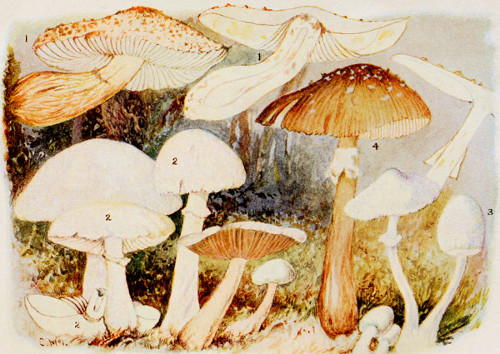
Grouped by F.D. Briscoe—Studies by C. McIlvaine. PLATE XII.
Fig. Page. Fig. Page.
1. Lepiota americana, 48 3. Lepiota Cepaestipes, 46
2. Lepiota naucinoides, 45 4. Amanita rubescens, 21
33LEPIO´TA Fr.
Lepis, a scale.
(Plate XI.)
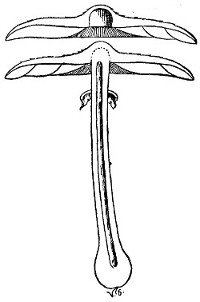
Section of Lepiota procera.
Pileus generally scaly from the breaking up of the cuticle and the adherence of the concrete veil. Gills free, often very distant from the stem and attached to a cartilaginous collar. Stem hollow or stuffed, its flesh distinct from that of the pileus. Ring at first attached to the cuticle of the pileus, often movable, sometimes evanescent.
On the ground. Several are found in hot-houses and hot-beds, and are probably introduced species.
The universal veil, covering the entire plant when very young, is closely applied to the pileus, which from the breaking up of the cuticle is generally scaly. The stem in most species differs in substance from the pileus. This is readily seen by splitting the plant in half from cap to base. It is easily separated from the cap, leaving a cup-like depression therein. Gills usually white. In some species they are yellow-tinted. In others they become a dingy red when wounded or ageing.
The veil in this genus, being concrete with the cuticle of the pileus, never appears as loose warts or patches, neither is there a volva as in Amanita and Amanitopsis. These three genera are the only ones in the white-spored series having gills free from the stem. In a few species the gills are slightly attached to the stem, but are never decurrent upon it as in Armillaria. When the plant is young it is egg-shaped. It then gradually spreads, becomes convex, and opens until it is nearly flat, with a knob in the center.
The only species in this genus known to be poisonous to some persons is L. Morgani Pk., which is distinguished by its green spores and white 34gills becoming green. L. Vittadini has also been regarded with suspicion.
ANALYSIS OF TRIBES.
A. Pileus Dry.
Proceri (L. procera). Page 35.
Ring movable. The plant is at first entirely enclosed in a universal veil, which splits around at the base, the lower part disappearing on the bulb, the upper part attached to the pileus breaking up into scales. Stem encircled at the top with a cartilaginous collar to which the free, remote gills are attached.
Clypeolarii (L. clypeolaria). Page 39.
Ring fixed, attached to the upper portion of the universal veil which sheaths the stem from the base upward, making it downy or scaly below the ring. The remainder of the veil united with the pileus breaking up and becoming downy or scaly. Collar at the apex of stem not so large as in Proceri, hence the gills are not usually so remote. Taste and smell unpleasant, resembling that of radishes.
Annulosi (annulus, a ring). Page 44.
Ring fixed, somewhat persistent, universal veil closely attached to the pileus. Collar absent or similar in texture to the stem. Stem, not sheathed.
Granulosi (L. granulosa). Page 49.
Pileus granular or warty. Universal veil sheathing the stem, at first continuous from the stem to the pileus, finally rupturing, forming a ring nearer the base. Stem not so distinctly different from the pileus as in other sections.
Mesomorphi (L. mesomorpha).
Small, slender, stem hollow. Pileus smooth, dry.
B. Pileus Viscid. Neither Scaly Nor Warty.
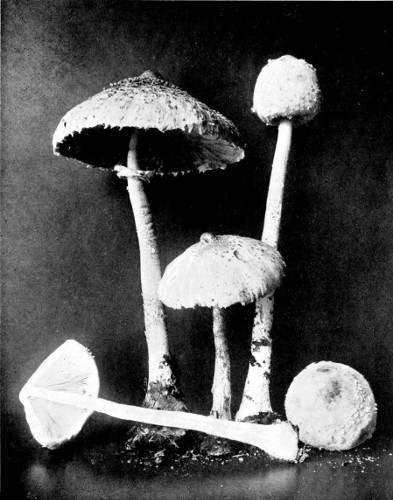
Photographed by Dr. J.R. Weist. Plate XIII. LEPIOTA PROCERA.
35A. Pileus Dry.
Proce´ri. Ring movable, etc.
L. proce´ra Scop.—procerus, tall. (Plate XIII, p. 34.) Tall Lepiota, Parasol Mushroom, in some localities Pasture Mushroom (a misleading title).
The Flesh not very thick, soft, permanently white. Pileus at first ovate, finally expanded, cuticle soon breaking up into brown scales, excepting upon the umbo, umbo smooth, dark-brown, distinct. The caps vary in shades of brown, sometimes they have a faint tinge of lavender. Gills whitish, crowded, narrowing toward the stem, and very remote from it. Stem variable in length, often very long, tubular, at first stuffed with light fibrils, quite bulbous at base, generally spotted or scaly with peculiar snake-like markings below the ring, which is thick, firm and readily movable. When the stem is removed from pileus it leaves a deep cavity extending nearly to the cuticle.
Pileus 3–6 in. broad. Stem 5–12 in. high, about ½ in. thick.
White spores elliptical, 14–18×9–11µ Peck; 12–15×8–9µ Massee; 14×10µ Lloyd.
Readily known by its extremely tall stem, shaggy cap, distinct umbo and the channel between the gills and stem. Resembles no poisonous species.
Before cooking the scurf should be rubbed from the caps, which alone should be eaten, as the stem is tough. Though the flesh is thin, the gills are meaty and have a pleasant, nutty flavor. Fried in butter it has few equals. It makes a superior catsup.
L. racho´des Vitt. Gr.—a ragged, tattered garment. Pileus very fleshy, but very soft when full grown, globose then flattened or depressed, not umbonate, at first incrusted with a thick, rigid, even, very smooth, bay-brown, wholly continuous cuticle, which remains entire at the disk but otherwise soon becomes elegantly reticulated with cracks; these very readily separate into persistent, polygonal, concentric scales, which are revolute at the margin and attached to the surface with beautifully radiating fibers, the surface remaining coarsely fibrillose-downy. Flesh 36white, immediately becoming saffron-red when broken, easily separating from the apex of the distinct stem, which is encircled with a prominent collar. Stem stout, at the first bulbous with a distinct margin upon the bulb, conical when young, then elongated, attenuated upward, as much as a span long, very robust, 1 in. thick, and more at the base, always even, and without a trace of scales or even of fibrils although the appearance is obsoletely silky, wholly whitish, hollow within, stuffed with spider-web threads, the walls remarkably and coarsely fibrous. Ring movable, adhering longer to the margin of the pileus than to the apex of the stem, hence rayed with fibers at the circumference, clothed beneath with one or two zones of scales. Gills very remote, tapering toward each end or broadest at the middle, crowded, whitish, sometimes reddening. Stevenson.
Veil remarkable in its development and thick margin.
Spores 6×8µ W.G.S.
Fort Edward, Howe; Westfield, N.Y., Miss L.M. Patchen; Pennsylvania, New Jersey, McIlvaine.
A heavier species than L. procera, of which by some writers it has been considered a variety, but it differs in the absence of umbo and flesh becoming tinged with red.
Stem is decidedly swollen downward. Veil heavy, apparently double, thickest at margin of cap to which it remains attached in heavy fragments. It tears from the stem, leaving no mark of ring.
Var. puella´ris Fr.—puella, a girl. Smaller than typical form, shining white, pileus with downy scales. Not yet reported in America.
Edible qualities similar to those of L. procera. It is sold indiscriminately with it in London markets.
L. excoria´ta Schaeff.—stripped of its skin. Flesh spongy, rather thick, white, unchangeable. Pileus at first globose, then flat, hardly umbonate, pale-fawn or whitish, disk dark; cuticle thin, silky or scaly, sometimes areolate, more or less peeled toward margin, hence its name. Gills ventricose, white, free, somewhat remote. Stem attenuated, hollow or stuffed, short, scarcely bulbous, smooth, white, not spotted, very distinct from flesh of pileus. Ring movable but not so freely as that of L. procera.
Stem 1½-2½ high, less than ½ in. thick. Pileus 2–3 in. broad.
Spores 14–15×8–9µ Massee.
37In pastures or grassy lawns. May to September.
North Carolina, edible, Curtis; Massachusetts, Frost; California, H. and M.; Ohio, Morgan; Minnesota, Johnson.
Distinguished from the preceding by its smaller size and short stem which is scarcely bulbous.
Esculent qualities good.
L. mastoi´dea Fr. Gr.—breast-shaped. Pileus rather thin, ovate, bell-shaped, then flattened, with a conspicuous acute umbo, cuticle thin, brownish, breaking up in minute scattered scales; the pileus appears whitish beneath. Stem hollow, smooth, tough, flexible, attenuated from the bulbous base to the apex. Ring entire, movable. Gills very remote, crowded, broad, tapering at both ends, white.
Pileus 1–2 in. broad. Stem 2–3 in. long, 3–4 lines thick at base, 1½-2 lines at apex.
North Carolina, edible, Curtis. It is generally eaten in Europe. In woods, especially about old stumps. October.
The entire plant is whitish and is well marked by the prominent umbo, which generally has a depression around it. It has the least substance of any in this section, and consequently not much value as food.
L. gracilen´ta Krombh.—gracilis, slender. Pileus rather fleshy, thickest at the disk, ovate then bell-shaped, finally flattened, obscurely umbonate; at first brownish from the adnate cuticle, which, breaking up into broad adpressed scales, allows the whitish pileus to be seen beneath them. Gills remote, very broad, crowded, pallid. Stem whitish, obscurely scaly, hollow or containing slight fibrils, slightly bulbous. Ring thin, floccose, vanishing.
Stem 5–6 in. long, 3–5 lines thick. In pastures, also in woods.
Spores 11×8µ W.G.S.
Almost as tall as L. procera, but slighter in stem and pileus; the ring, instead of being firm and persistent, is thin and fugacious, and the stem is hardly bulbous.
Edible, but not of the first quality.
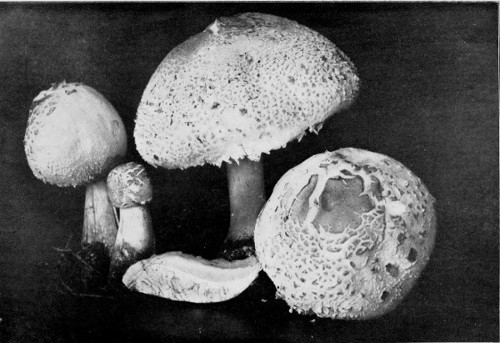
Photographed by Dr. J.R. Weist. Plate XIV. LEPIOTA MORGANI.
L. Mor´gani Pk.—in honor of Professor Morgan. (Plate XIV.) Pileus fleshy, soft, at first subglobose, then expanded or even depressed, white, the brownish or yellowish cuticle breaking up into scales except 38on the disk. Gills close, lanceolate, remote, white, then green. Stem firm, equal or tapering upward, subbulbous, smooth, webby-stuffed, whitish, tinged with brown. Ring rather large, movable. Flesh both of the pileus and stem white, changing to reddish and then to yellowish when cut or bruised. Spores ovate or subelliptical, mostly uninucleate, sordid green, 10–13×7–8µ.
Plant 6–8 in. high. Pileus 5–9 in. broad. Stem 6–12 lines thick. Peck in Bot. Gaz., March, 1879.
Open dry grassy places. Dayton, Ohio. A.P. Morgan.
This species is remarkable because of the peculiar color of the spores. No green-spored Agaric, so far as I am aware, has before been discovered, and no one of the five series, in which the very numerous species of the genus have been arranged, is characterized in such a way as to receive this species.
It seems a little hasty to found a series (Viridispori) on the strength of a single species. Until other species of such a supposed series shall be discovered it seems best to regard this as an aberrant member of the white-spored series. The same course has been taken with those Agarics which have sordid or yellowish or lilac-tinted spores.
It gives me great pleasure to dedicate this fine species to its discoverer Mr. Morgan. Peck.
Commonly 6–8 in. high, 5–9 in. diameter, though larger specimens are sometimes found. It is the most conspicuous Agaric in the meadows and pastures of the Miami valley; it appears to flourish from spring to autumn whenever there is abundance of rain.
It is heavier and stouter than L. procera and I am disposed to claim that it is the largest Agaric in the world. Spores 10–12×7–8µ. In immature specimens they are greenish-yellow. Morgan.
Kansas, Bartholomew (Peck, Rep. 50); Kansas, Cragin; Alabama, U. and E.; Georgia, Benson; Louisiana, Rev. A.B. Langlois; Michigan, C.F. Wheeler (Lloyd, Myc. Notes); Texas, Prof. W.S. Carter; Indiana, H.I. Miller.
L. Morgani is one of the largest, handsomest of the genus. It is very abundant in the western and southwestern states. Mr. H.I. Miller, Terre Haute, Ind., writes August 18, 1898: “I have recently measured several which were more than twelve inches across. At the present time this mushroom is growing in more abundance throughout Indiana than any other. It grows luxuriantly in the pastures, generally 39in grand fairy rings, five, ten, fifteen feet in diameter. We find it also in the woods. It is beautifully white and majestic, and these rings can be seen in meadows where the grass has been eaten close, for half a mile or more. The gills are white until the cap is almost opened, by which time the green spores begin to cause the gills to change to green. The meat is fine and is usually more free from worms than other mushrooms. Six families, here, have eaten heartily of them. The experience is that one or two members of each family are made sick, though in two families, who have several times eaten them, no one was made sick. I enjoy them immensely, and never feel any the worse for eating them. I doubt if we have a finer-flavored fungus. The meat is simply delicious. One fairy ring yields a bushel.”
Prof. W.S. Carter, University of Texas, Galveston, reported to me (and sent specimens of L. Morganii) the poisoning of three laboring men from eating this fungus. They were seriously sick, but recovered.
The conclusion is inevitable that this green-spored Lepiota contains a poison which violently attacks some persons, yet is harmless upon others.
I have not had opportunity to test it. It should be tested with great caution.
Clypeola´rii. Clypeus, a shield. Ring fixed; stem sheathed, etc.
L. Frie´sii Lasch.—in honor of Fries. Pileus fleshy, soft, lacerated into appressed tomentose scales. Stem hollow, with a webby pith, subbulbous, scaly. Ring superior, pendulous, equal. Gills subremote, linear, crowded, branched. Fries.
Pileus fleshy but rather thin, convex or nearly plane, clothed with a soft, tawny or brownish-tawny down, which breaks up into appressed, often subconfluent scales, the disk rough with small acute, erect scales. Flesh soft, white. Gills narrow, crowded, free, white, some of them forked. Stem equal or slightly tapering upward, subbulbous, hollow, colored like the pileus below the ring, and there clothed with tomentose fibrils which sometimes form floccose or tomentose scales, white and powdered above. Ring well developed, flabby, white above, tawny and floccose-scaly below. Spores 7–8×3–4µ.
Plant 2–5 in. high. Pileus 1–4 in. broad. Stem 2–5 lines thick.
Catskill mountains and East Worcester. July to September.
I have quoted the description of this species as it is found in Epicrisis, 40because the American plant which I have referred to it does not in all respects agree with this description, but comes so near it that it can scarcely be specifically distinct. In the American plant, so far as I have seen it, erect, acute scales are always present, especially on the disk, and the down of the pileus does not always break up into distinct areas or scales. Neither is the stem usually scaly, but rather clothed with soft tomentose or almost silky fibrils. The gills are crowded and some of them are forked. At the furcations there are slight depressions which interrupt the general level of the edges, and give them the appearance of having been eaten by insects. The plant has a slight odor, especially when cut or bruised. Peck, 35th Rep. N.Y. State Bot.
Remarks under L. acutesquamosa apply to L. Friesii, which Fries himself doubts being distinct from the first. The plants vary greatly in size, color and habitat. The name—acutesquamosa—carries a descriptive meaning with it that L. Friesii does not.
It does not appear to have been reported except by Professor Peck, but probably appears as L. acutesquamosa in other lists.
The edible qualities are excellent.
L. acutesquamo´sa Wein.—acutus, sharp; squama, a scale. Pileus fleshy, obtuse, at first hairy-floccose, then bristly with erect, acute, rough scales. Stem somewhat stuffed, stout, bulbous, powdered above the moderate-sized ring. Gills approximate, lanceolate, simple. Fries.
Pileus convex or nearly plane, obtuse or broadly subumbonate, clothed with a soft tawny or brownish-tawny tomentum, which usually breaks up into imperfect areas or squamæ, rough with erect, acute scales, which are generally larger and more numerous on the disk. Gills close, free, white or yellowish. Stem equal, hollow or stuffed with webby filaments, subbulbous. Spores about 7×3–4µ.
Woods and conservatories. Buffalo, G.W. Clinton; Albany, A.F. Chatfield; Adirondack mountains and Brewertown, Peck.
The form found in the hot-houses seems to have the tomentum of the pileus less dense and the erect scales more numerous than in the form growing in woods. The annulus is frequently lacerated. In the specimens of the woods the erect scales are sometimes blackish in color, and they then contrast quite conspicuously with the tawny or brownish-tawny tomentum beneath them. They vary in size and shape. Some resemble pointed papillæ, others, being more elongated, are almost 41spine-like. These are sometimes curved. They are generally larger and more numerous on the disk than elsewhere, and often they are wholly wanting on the margin. Peck, 35th Rep. N.Y. State Bot.
West Philadelphia, 1897, on lawn and growing from trunk of a maple tree; Mt. Gretna, Pa., mixed woods. McIlvaine.
I first saw specimens of L. acutesquamosa when sent to me by Miss Lydia M. Patchen, President Westfield Toadstool Club. It was later found by myself and tested. Specimens were sent to Professor Peck and identified as L. acutesquamosa.
Caps and stems brownish-purple. The pointed squamules or tufts have dark-brown points, shaded to a delicate purple at base. Gills light, faint flesh-color. Veil is silky, transparent, beautiful, quite tenacious—stretching until cap is well expanded, persistent, though at times fugacious. Smell like stewed mushrooms. The caps are of excellent substance and flavor.
L. his´pida Lasch.—rough. Pileus 2–3 in. across. Flesh thin, white, unchangeable; hemispherical then expanded, umbonate, tomentose or downy at first from the remains of the universal veil; during expansion the down becomes broken up into small, spreading, scaly points, which eventually disappear, umber-brown, sometimes with a tawny tinge. Gills free but near to the stem, the collar of the pileus prominent and sheathing the stem, crowded, ventricose, simple, white. Stem about 3–5 in. long, 3–5 lines thick, attenuated upward, densely squamosely-woolly up to the superior, membranaceous, reflexed ring, dingy-brown, stem tubular, but fibrillosely stuffed. Spores 6–7×4µ Massee.
In margins of and in open mixed woods, under pine trees, Haddonfield, N.J., July to September, 1892. Quite plentiful year after year in the same places. The American plant is taller than the English species, the stem reaching five inches, and the color of the cap a delicate tawny-brown. Smell slight, but pungent like radishes.
The whole fungus is tender and delicious. It is one of the few Lepiotæ that stews well.
L. feli´na Pers.—belonging to a cat. Pileus thin, bell-shaped or convex, subumbonate, adorned with numerous subtomentose or floccose blackish-brown scales. Gills close, free, white. Stem slender, rather 42long, equal or slightly tapering upward, hollow, clothed with soft, loose, floccose filaments, brown. Ring slight, evanescent. Spores elliptical, 6–8×4–5µ.
Plant 2–3.5 in. high. Pileus .5–1.5 in. broad. Stem 1–2 lines thick.
Woods. Adirondack Mountains. August and September.
It is easily distinguished from A. rubrotincta by the darker color of the scales of the pileus, by the loose floccose filaments that clothe the brown stem, by the fugacious ring and the smaller spores. Peck, 35th Rep. N.Y. State Bot.
The caps compare favorably with other Lepiotæ in substance and flavor.
L. crista´ta A. and S.—crista, a tuft, crest. Pileus thin, bell-shaped or convex, then nearly plane, obtuse, at first with an even reddish or reddish-brown surface, then white adorned with reddish or reddish-brown scales formed by the breaking up of the cuticle, the central part or disk colored like the scales. Gills close, free, white. Stem slender, hollow, equal, smooth or silky-fibrillose below the ring, whitish. Ring small, white. Spores oblong or narrowly subelliptical, 5–7×3–4µ.
Plant 1–2 in. high. Pileus .5–1.5 in. broad. Stem 1–2 lines thick.
Grassy places and borders of woods. June to September.
This species is easily known by its small size and the crested appearance of the white pileus, an appearance produced by the orbicular unruptured portion of the cuticle that remains like a colored spot on the disk. The fragments or scales are more close near this central part and more distant from each other toward the margin, where they are often wholly wanting. The scales are sometimes very small and almost granular. In very wet weather the margin of the pileus in this and some other species becomes upturned or reflexed. Peck, 35th Rep. N.Y. State Bot.
Found in Woodland Cemetery, Philadelphia. June to September, 1897. McIlvaine.
Scales were appressed and slightly tinged with brown, often very small. Caps of same, upturned and bare near margin. Taste sweet, slightly like new meal. Odor strong.
Cooked it is of good consistency and pleasing to taste.
43L. alluvi´na Pk.—alluvies, the over-flowing of a river. Pileus thin, convex or plane, reflexed on the margin, white, adorned with minute pale-yellow hairy or fibrillose scales. Gills thin, close, free, white or yellowish. Stem slender, fibrillose, whitish or pallid, slightly thickened at the base. Ring slight, subpersistent, often near the middle of the stem. Spores elliptical, 6–7×4–5µ.
Plant 1–2 in. high. Pileus .5–1 in. broad. Stem 1–1.5 lines thick. Alluvial soil, among weeds. Albany. July.
In the fresh plant the scales are of a pale yellow or lemon color, but in drying they and the whole pileus take a deeper rich yellow hue. The ring is generally remote from the pileus, sometimes even below the middle of the stem. Peck, 35th Rep. N.Y. State Bot.
In 1897, I found it growing among weeds on lot near University of Pennsylvania, Philadelphia. Seemingly it is a city resident.
The taste and smell are pleasant. Cooked it is tender and savory. Both stems and caps are good.
L. metulæ´spora B. and Br.—metula, an obelisk. Pileus thin, bell-shaped or convex, subumbonate, at first with a uniform pallid or brownish surface, which soon breaks up into small brownish scales, the margin more or less striate, often appendiculate with fragments of the veil. Gills close, free, white. Stem slender, equal or slightly tapering upward, hollow, adorned with soft floccose scales or filaments, pallid. Ring slight, evanescent. Spores long, subfusiform.
Plant 2–3.5 in. high. Pileus .5–1.5 in. broad. Stem 1–2 lines thick.
Woods. Adirondack mountains. August and September.
This species occurs with us in the same localities as L. felina, which it very much resembles in size, shape and general characters, differing only in color, the striate margin of the pileus and the character of the spores.
The species has a wide range, having been found in Ceylon, England, Alabama and Kentucky. Peck, 35th Rep. N.Y. State Bot.
This has not been elsewhere noted in the United States, probably from neglect of the spore characters, being reported as L. clypeolaria.
New Jersey and Pennsylvania. McIlvaine.
44Annulo´si. Ring large, fixed; stem not sheathed.
L. holoseri´cea Fr. Gr.—entire, silken. Pileus 3 in. and more broad, whitish or clay-white, fleshy, soft, convex then expanded, rather plane, obtuse, floccoso-silky, somewhat fibrillose, becoming even, fragile, disk by no means gibbous; and wholly of the same color; margin involute when young. Flesh soft, white. Stem 2½-4 in. long, ½ in. and more thick, solid, bulbous and not rooted at the base, soft, fragile, silky-fibrillose, whitish. Ring superior, membranaceous, large, soft, pendulous, the margin again ascending. Gills wholly free, broad, ventricose, crowded, becoming pale-white. Fries.
A species well marked from all others. Inodorous.
On soil in flower beds.
Spores elliptical, 7–8×5µ Massee; 6×9µ W.G.S.
Wisconsin, Bundy; Minnesota, Johnson.
Considered esculent in Europe.
L. Vittadi´ni Fr.—in honor of the Italian mycologist. Pileus 3–4 in. across. Flesh 4–6 lines thick at the disk, becoming very thin at the margin, white; convex then plane, obtuse or gibbous, densely covered with small, erect, wart-like scales, altogether whitish. Gills free but rather close to the stem, 3–4 lines broad, rounded in front, thickish, ventricose, with a greenish tinge. Stem 2½-3½ in. long, up to ⅔ in. thick, cylindrical, with numerous concentric rings of squarrose scales, up to the superior, large ring; whitish, or the edges of the scales often tipped with red, solid. Fries.
In pastures, etc.
Intermediate between Lepiota and Amanita.
Noted by Fries as poisonous. It may or may not be, but as a matter of precaution it is described. A large species, pure white, extremely beautiful.
Massachusetts, Farlow.
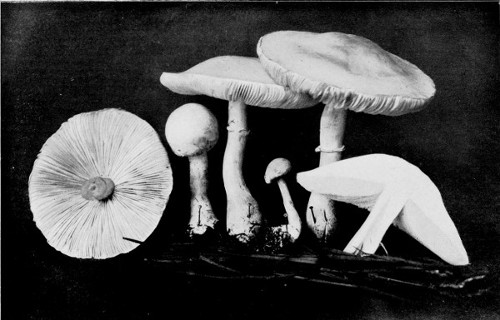
Photographed by Dr. J.R. Weist. Plate XV. LEPIOTA NAUCINOIDES.
L. nauci´na Fr. No translation applicable. Pileus 1–1½ in. broad, white, the disk of the same color, fleshy, soft, gibbous or obtusely umbonate when flattened, even, the thin cuticle splitting up into granules. Stem 1½-3 in. long, stuffed, at length somewhat hollow, but without a definite tube, attenuated upward from the thickened base, fibrillose, 45unspotted, white. Ring superior, tender, but persistent, adhering to the stem, at length reflexed. Gills free, approximate, crowded, ventricose, soft, white.
There is a prominent collar, as in the Clypeolarii, embracing the stem. Stature and appearance of L. excoriata, but commonly smaller, the superior ring adfixed, etc. Fries.
Spores subglobose, 6–7µ Massee.
L. naucina Fr. is the European species which has its American counterpart in L. naucinoides Pk. The variations in the American species are noted under L. naucinoides.
As Amanita phalloides—in its white form—the poisonous white Amanita, resembles L. naucina or L. naucinoides in some stages of its growth and may be confounded with it, careful note should be taken of their external differences. In L. naucinoides the bulb and stem are continuous, each passing into the other imperceptibly; in A. phalloides the junction of stem and bulb is abrupt and remains so, and the bulb is more or less enwrapped in the volva. The ring is also larger than in L. naucinoides and is pendulous, and the gills are permanently white. A certain means of distinguishing between them is by the application of heat as in cooking. On toasting both it will be found that the gills of the Amanita remain white, but those of the Lepiota turn quickly brown.
L. naucinoi´des Pk. No translation applicable. (Plates Plate XV, XII fig. 2, p. 32.) Pileus soft, smooth, white or snowy-white. Gills free, white, slowly changing with age to a dirty pinkish-brown or smoky-brown color. Stem ringed, slightly thickened at the base, colored like the pileus. Spores subelliptical, uninucleate, white, 8–10 long×5–8µ broad. Peck, 48th Rep. N.Y. State Bot.
Kansas, Cragin; Wisconsin, Bundy; New Jersey, Ellis; Iowa, Macbride; New York, Peck, 23d, 29th, 35th Rep.; Indiana, H.I. Miller, Dr. J.R. Weist.
L. naucinoides Pk. is the American counterpart of L. naucina Fr., a European species, excepting that the spores of the latter are described as globose. The caps are ovate when young and usually from 1½-3 in. across when expanded, but occasionally reach 4 in., smooth, but frequently rough or minutely cracked in the center, white or varying shades of white deepening in color at the summit. In a rare form var. squamo´sa, large, thick scales occur which are caused by the breaking 46up of the cap surface. When young the gills are white or faintly yellow, becoming pinkish or dull brown in age. The pinkish hue is not always apparent. The outer edge of the veil or ring is thickest; usually it is firmly attached to the stem, but movable rings are frequently noticed. When the plant ages the ring is often missing, but traces of it are always discernible. Stem rarely equal, often it is distinctly bulbous, generally tapering upward from a more or less enlarged base, hollow when fully grown, until then containing cottony fibers within the cavity or appearing solid, 2–3 in. long, ¼-½ in. thick.