Sub-Class BASIDIOMYCETES (continued 10)
Reading edition
B. Ana´nas Curt. Pileus pulvinate, thickly and rigidly floccose-verrucose, yellow, flocci white above, flesh-colored beneath, the margin thin, membranous, lacerated; hymenium plane, depressed around the stem, yellow or tawny-yellow, becoming greenish where wounded, their mouths medium size, obtusely angular. Stem even, solid, somewhat enlarged at the base, white. Spores ferruginous.
Pileus 3–4 in. broad. Stem 3–4 in. long, 6–9 lines thick.
Under prostrate trunks of pine trees.
South Carolina, Ravenel; North Carolina, Curtis.
This is said to approach S. strobilaceus in habitat, but to be otherwise very different. It is placed among the Subtomentosi in Sylloge, but from these it recedes by its floccose wart-like scales. Peck, Boleti of the U.S.
B. radico´sus Bundy. Pileus thin, wide, recurved, yellow tinged with brown, the cuticle easily removed. Flesh pale-yellowish tinged with pink, not changing color when bruised. Tubes decurrent, large, uneven-mouthed, compound, angular, tinged with brown. Stem flexuous, yellow above, whitish below, rough with dark appressed scales, fibrous-rooted.
Pileus 4 in. broad. Stem 3–4 in. long, 5 lines thick.
Wisconsin, Bundy.
The pileus is not described as viscid, but in other respects the species 474appears to belong to the Viscipelles and to be related to Boletus collinitus. Peck, Boleti of the U.S.
B. Po´cono Schw. Pileus pulvinate, cervine (dun color), minutely covered with bundles of tomentum on the closely-inflexed margin. Tubes rather large, somewhat prominently angular, concolorous. Stem subattenuated, thickened toward the base, pallid-striate at the apex, elsewhere spadiceous, subfurfuraceous.
Pileus 1 in. broad. Stem 2–3 in. long.
Beech woods. Pennsylvania, Schweinitz.
475STROBILO´MYCES Berk.
Gr—a pine cone; a fungus.
(Plate CXXIV.)
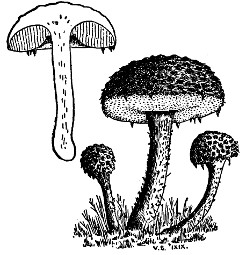
Strobilomyces strobilaceus. Two-thirds natural size.
Hymenophore even. Tubes not easily separable from it, large, equal. Pileus and stem distinctly rough-scaled, the flesh tough. Syl. Fung., Vol. VI, p. 49.
I have given Professor Saccardo’s emended diagnosis of this genus, because it expresses what appears to me to be the most important generic character, that is, tubes not easily separable from the hymenophore. By this character and by the tough substance the transition between Boletus and Polyporus is made.
Tubes nearly equal in length S. strobilaceus
Tubes shortened around the stem S. floccopus
Peck, Boleti of the U.S.
S. strobila´ceus Berk. Gr—cone-like. (Plate CXXIV.) Pileus hemispherical or convex, dry, covered with thick floccose projecting blackish or blackish-brown scales, the margin somewhat appendiculate with scales and fragments of the veil. Flesh whitish, changing to reddish and then to blackish where wounded. Tubes adnate, whitish, becoming brown or blackish with age; their mouths large, angular, changing color like the flesh. Stem equal or tapering upward, sulcate at the top, floccose-tomentose, colored like the pileus. Spores subglobose, rough, blackish-brown, 10–12.5µ.
Pileus 2–4 in. broad. Stem 3–5 in. long, 4–10 lines thick. Peck, Boleti of the U.S.
West Virginia mountains, Pennsylvania, McIlvaine; Indiana, H.I. Miller.
Common in woods and their margins, under the overhanging sods of washes and road-cuts. Often in troops, occasionally cespitose. The 476rough fuzzy cap reminds of short fur that has been wet and dried. Its appearance is unique among Boleti. Before cooking the stem and tubes should be removed, unless the latter are very firm and fresh. The squamules must be cut away or the dish will be rough.
With many this Boletus is a prime favorite. It has a strong woody taste, sometimes musky, sometimes faintly of anisette. It cooks well by any method.
S. floc´copus Vahl.—floccose-stemmed. Pileus convex, soft, covered with areas of bunched rough, scaly tomentum, cinereous, at length blackish, appendiculate with the silky, thick annular veil. Tubes shortened behind, their mouths large, whitish-gray. Stem stout, pitted above, umber-tomentose below. Spores perfectly globose, brown, 9µ broad.
Pileus 4–5 in. broad. Stem 4–5 in. long, 1 in. thick.
Woods. North Carolina and Pennsylvania, Schweinitz; Ohio, Morgan; New York, Peck.
According to Fries this is a larger and firmer species than S. strobilaceus but manifestly related to it. The New York specimens which I have referred to it differ from S. strobilaceus in no respect, except in the tubes being depressed around the stem. Unless there are other differences in the European plant, it scarcely seems to me to be worthy of specific distinction. Boletus floccopus, Rost. tab. 40, is referred to Boletus scaber, as is B. holopus, Rost. tab. 48. Peck, Boleti of the U.S.
I agree with Professor Peck that this species is not worthy of specific distinction. During 1898 I found a bunch containing eight individuals which varied through all botanic characteristics given to both species. The largest individual was 4½ in. across cap, the smallest 1½ in. On some the tubes were adnate, on others shortened behind. There was no difference in flavor excepting that due to age.
477
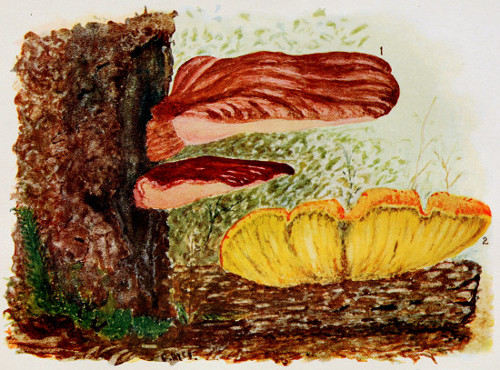
Plate CXXV.
Fig. Page. Fig. Page.
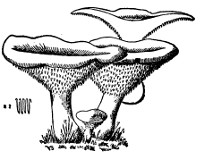
1. Fistulina hepatica, 477 2. Polyporus sulphureus, 485
FISTULI´NA Bull.
Fistula, a pipe.
Hymenium formed on the under surface of a fleshy hymenophore, at first warted, the warts developing into cylindrical tubes that remain distinct and free from each other, producing in their interior cellular processes each bearing four spores. Conidia are produced in cavities of the old hymenophore.
With the outward appearance of a Polyporus, but separated by the tubes being free from each other.
A small genus of which F. hepatica is the principal species. This is known and valued in Europe and wherever found in this country. Unfortunately it is rare or unknown in many localities. A new species has recently been found in the United States—Fistulina firma, by Mrs. A. M. Hadley, Manchester, N.H.—a white-flesh species whose edibility is not reported. Torrey Bull., 1899. F. pallida B. and Rav.; F. radicata, Schw.; F. spathulata B. and C., are reported from Alabama. Edible qualities not stated. The writer has not seen them or he surely would have tested them. The spread and cultivation of F. hepatica is possible. Experiments in this line are desirable.
F. hepat´ica (Huds.) Fr. Gr—resembling the liver. (Plate CXXV, fig. 1, p. 476.) Juicy-fleshy, not rooting. Pileus entire, blood-red. Flesh thick, soft, viscid above, transversed with tenacious fibers, hence variegated-red. Tubes at first pallid.
Changeable in form, sessile or extended into a lateral stem. Fries.
Spores salmon-color, nearly round with an oblique apiculus, 3µ W.G.S.; broadly elliptical, 5–6×3–4µ; conidia, 6–10×5µ Massee; yellowish, elliptical, 5–6.5µ long Peck.
West Virginia, New Jersey, Pennsylvania. August to frost. McIlvaine.
Small specimens may be confounded with F. pallida, which follows.
Fistulina hepatica is celebrated in most countries, and known usually as the Beefsteak fungus. It grows from decaying crevices in oak, chestnut and other trees and stumps, but those named are its favorites. July, August, September are its months, and after rains. In some localities and years it is rare. At Mt. Gretna, in 1898, a hundred pounds of it could be gathered almost any day.
478August, 1899, at Mt. Gretna, Pa., I found several specimens in vicinity which, though evidently F. hepatica, were remarkable for their structure—2–4 in. across, irregularly cylindrical, with spore surface covering the entire fungus. Stem curt, eccentric, almost central. Specimens were sent Professor Peck, who writes:
“The sample of Fistulina which you send is a singular thing. Saccardo has noted a somewhat similar form but without pore surface. Yours has pore surface, but I do not find spores developed in it. I am inclined to think it a monstrosity, as you do, but as you say you have found several of them I think it would be well to put it on record and I will enter it in my record as Fistulina hepatica monstrosa n. var. and indicate its characters.” Letter from Professor Peck, August 28, 1899.
I have partially succeeded in transplanting the mycelium of F. hepatica. Experiments in this direction, I feel confident, will introduce this valuable fungus to localities where it is not now found, or is rare. Experiments with the spores have not been as yet successful.
F. hepatica monstrosa n. var. Pk. Subglobose, supported on a short stem or stem-like base, the external surface entirely covered with tubules 2–4 mm. long.
Pennsylvania. C. McIlvaine. In color and texture resembling the common form, but Mr. McIlvaine informs me that there is nothing in the position or place of growth of the specimens to account for their peculiar character. They are 2–4 in. in diameter. Peck, Bull. Torrey Bot. Club, 27, January, 1900.
Excellent.
F. pal´lida B. and Rav.—pallidus, pale. Pileus kidney-shaped, pallid-red, pulverulent, 1–2 in. broad, about 1 in. long, margin inflexed. Tubes more or less decurrent. Stem lateral, striate, when dry, 1½ in. long, ⅓ in. thick.
Mountains of South Carolina on the ground. Ravenel. Alabama, base of stumps of white oak. Peters. Grev., Vol. 1, No. 5. New Jersey, Ellis.
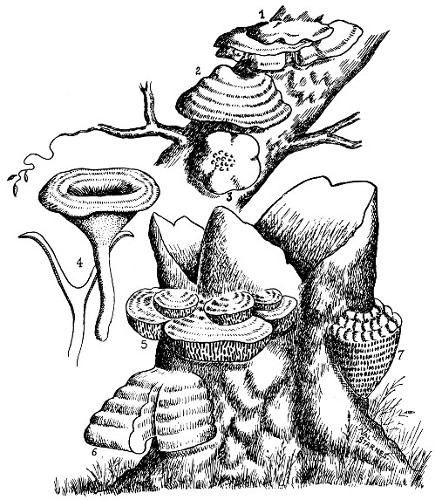
Plate CXXVI.
No. 1. Polyporus fumosus. 2. Polystictus versicolor. 3. Merulius corium. 4. Polyporus perennis and section. About natural size.

5. Dædalea quercina. 6. Fomes igniarius. 7. Trametes gibbosa. Reduced in size.
479POLY´PORUS Fr.
Gr—many; a passage, pore.
Pileus fleshy, moist, tough, becoming harder in age, internally composed of radiating fibers; the spore-bearing surface is within passages or pores which are made by the descending substance of the pileus forming the dissepiments or separating walls, hence they are not easily separable from the pileus or from one another. The pores not appearing at first, then becoming rounded, angular or torn. They form a distinct strata. Stem central, eccentric, lateral or absent.
With few exceptions growing from wood. Section Merisma contains species which are conspicuous among fungi for their size and beauty.
The majority of this genus are unedible, because of their being woody, tough or bitter. Few of the edible species are of the first class.
Excellent dishes are made by stewing the species well, serving them in patties or in croquettes. The cooking of P. intybaceus is a guide to all.
ANALYSIS OF TRIBES.
I.—Mesopus. (Gr—middle; a foot.) Page 479.
Stem single, distinct, central or eccentric; not black at the base.
II.—Pleuropus. (Gr—the side; a foot.) Page 480.
Stem single, lateral or eccentric; base black.
III.—Merisma. (Gr—to divide.) Page 482.
Divided into numerous pileoli, borne on a simple or much-branched stem, or a short, thick tubercle.
IV.—Apus. (Gr—without; a foot.) Page 488.
Stem wanting; pileus attached by the side or spread on the matrix.
V.—Resupinati. (Lying on the back.) Page 489.
The pores being placed directly upon the wood or on the mycelium, the pileus proper is absent.
I.—Me´sopus.
P. ovi´nus Schaeff.—relating to sheep. Pileus 2–4 in. broad, fleshy, thick, fragile, irregular in shape, becoming scaly, whitish. Stem short, 480thick, 1 in. or more in length, white. Pores minute, equal, round, white then citron-color.
On the ground. Autumn.
North Carolina, Curtis; Massachusetts, Frost; Ohio, Morgan; New York, ground in pine woods. Bethlehem. September, Peck, 22d Rep.
Cordier says it possesses an agreeable odor of almonds and that Fries and his companions ate it raw in their mycological excursions.
Edible. Peck, Curtis.
P. leuco´melas (Pers.) Fr.—leucos, white; melas, black. Pileus 2–4 in. broad, fleshy, somewhat fragile, irregularly-shaped, silky, sooty-black. Flesh soft, reddish when broken. Stem 1–3 in. in length, stout, unequal, somewhat tomentose, sooty-black, becoming black internally. Pileus and stem becoming black in places. Pores rather large, unequal, ashy or whitish, becoming black in drying.
Spores pale brown, 10–12×4–5µ. Massee.
North Carolina, edible, Curtis; Ohio, a curious esculent. Morgan.
P. circina´tus Fr.—round. Pileus 3–4 in. broad, compact, thick round, plane, zoneless, velvety, reddish-brown. Flesh the same color. It forms duplicate strata of pilei, the inferior contiguous with the stem and corky; the superior compact, soft, floccose. Stem 1 in. thick and high, bearing a reddish-brown tomentum. Pores decurrent, entire, dusky-gray.
In fir woods.
A noble species, memorable for the stratified duplicate pilei.
Var. prolif´erus. Like the typical form but having one or more pilei developed from the upper surface of the first one. Fulton Chain. August. Peck, 46th Rep. N.Y. State Bot.
New York. On ground in borders of woods. September. Peck, 32d, 46th Rep.
On ground in oak woods, West Philadelphia. McIlvaine.
When young the soft pilei are good.
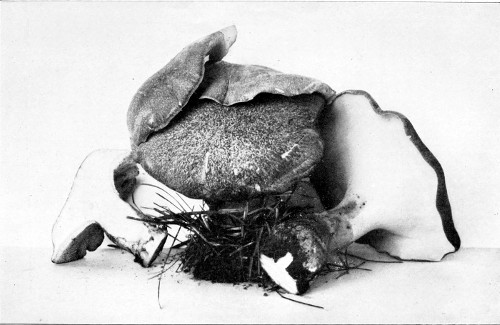
Photographed by Dr. J.R. Weist. Plate CXXX. POLYPORUS SQUAMOSUS.
II.—Pleuropus.
P. squamo´sus Fr.—squama, a scale. (Plate CXXX, p. 480.) Pileus 3 in.-1½ ft. broad, somewhat ochraceous, variegated with a broad, 481adpressed, spot-like, centrifugal, darker scales, fleshy-pliant, fan-shaped, flattened. Stem excentric and lateral, obese, reticulated at the apex, blackish at the base. Pores thin, variable (at first minute), then large, angular and torn, pallid. Fries.
Handsome, commonly very large, somewhat central and umbilicate when young, at length lateral, very variable in shape.
On trunks and stumps, chiefly ash. Common. May to November. Stevenson.
Spores oval, white, 14×6µ W.G.S.; elliptical, colorless, 12×5µ Massee.
Massachusetts, Sprague; Iowa, Macbride; New York. Trunk of elm. May. Peck, 27th Rep.; West Virginia, New Jersey, Pennsylvania. On fallen trunks and on stumps. May to November. McIlvaine.
This species does not seem to be common in America, but is found throughout Europe. It varies in size from 3 in. to over 3 feet. It has been known to attain the circumference of 7 ft. 5 in., and the weight of 40 lbs. Dr. Badham says that it can not be masticated and that its expressed juice is very disagreeable. The fact, however, remains that it is eaten, and is recorded as edible by most authors. It is undoubtedly tough, but cut fine and stewed slowly for half an hour it is quite as tender as the muscle of an oyster and has a pleasant flavor.
P. pi´cipes Fr.—pix, pitch; pes, a foot. Pallid then chestnut, commonly pale yellowish-livid, with the disk chestnut. Pileus fleshy-coriaceous, then rigid, tough, even, smooth, depressed at the disk or behind. Flesh white. Stem excentric and lateral, equal, firm, at first velvety, then naked, dotted, black up to the pores. Pores decurrent, round, very small, rather slender, white, then slightly pale yellowish. Fries.
Imbricated, odor somewhat sweet. The pileus is depressed behind, commonly emarginate, funnel-shaped with lobes all round.
On trunks, especially willow. Frequent. July to December. Stevenson.
Many young plants, in tufts upon a decaying oak log, were found by me at Mt. Gretna, August, 1899. They were oyster-color, the very thin caps translucent, 2–6 in. across, 1⁄16 in. thick; pores not visible to the naked eye. The black dots upon the stems developed some time after gathering.
482They were pleasantly crisp when stewed and of fine flavor. Older specimens were bitter and tough.
III.—Merisma.
P. umbella´tus Fr.—umbella, a sun-shade. Very much branched, fibrous-fleshy, toughish. Pileoli very numerous, ½-1½ in. broad, sooty, dull-red or pallid light-yellow, entire, umbilicate. Stems elongated, separate, united at the base, white. Pores minute, white.
The pileoli have occurred white. Fries.
Edible. Fries.
New York, Peck, Rep. 51; Richmond, Ind., Dr. J.R. Weist; Gouverneur, N.Y., Mrs. E.C. Anthony; West Virginia, New Jersey, Pennsylvania. On decaying roots in ground and on stumps. May to November. McIlvaine.
Tufts dense, branches spreading from a center. The pilei up to 2 in. across, connected at base. The dense spreading tufts, up to a foot across and half as high, are very noticeable. The flesh is soft and of good flavor. Cook like P. intybaceus.
P. a´nax Berk. Fleshy, fibrous, rather tough, dusky-gray, branching out from a thick, single stem at the base and forming a large head of branches and pileoli 10–20 lines in diameter; the branches terminate in numerous large pileoli of various forms and size, imbricating, confluent and recurved. Flesh and pores white. Stems thick, growing together, white. Pores large, unequal, angular, white. Spores white, subelliptic, 7–8µ long.
Ohio, at the base of oak trees and stumps. Autumn. Morgan.
This species has apparently been confused by some American mycologists with P. intybaceus. I have received specimens of it bearing that name. The spores of that species are described as elliptic or ovoid. The spores of Polyporus anax, as shown by our specimens, are globose. Peck, 51st Rep. N.Y. State Bot.
Ohio, Morgan; New York, Peck, 51st Rep.; New Jersey, Sterling; Angora, West Philadelphia, growing on rotting stump. September, 1897, McIlvaine.
Edible when young and fresh.
483
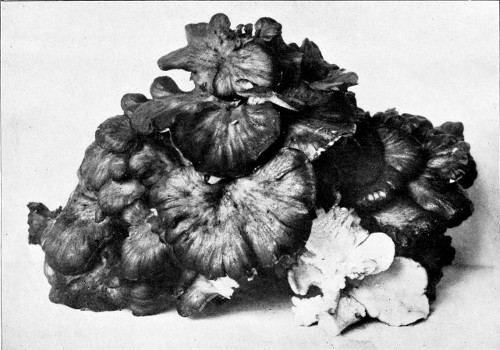
Photographed by Dr. J.R. Weist. Plate CXXVIII. POLYPORUS FRONDOSUS.
P. frondo´sus Fr.—frons, a leafy branch. (Plate CXXVIII, p. 482.) Tuft ½-1 ft. broad, very much branched, fibrous-fleshy, toughish. Pileoli very numerous, ½-2 in., sooty-gray, dimidiate, wrinkled, lobed, intricately recurved. Flesh white. Stems growing into each other, white. Pores rather tender, very small, acute, white.
Pores commonly round, but in an oblique position, gaping open and torn. Fries.
North Carolina, Curtis; Iowa, Macbride; New York, Peck, 24th Rep.; West Virginia, 1881–1885, Chester county, Angora, Philadelphia, Pa. On stumps, roots, etc. Rare. September to frost, McIlvaine.
Edible. Curtis. Sold in the Roman market.
Tufts up to 12 in. across; the branches very numerous, up to 2 in. wide. The plant is tender when young and grows tough as it matures. When young it is of good flavor and edible—older it makes a well-flavored gravy, or is edible if chopped fine and very well cooked.
(Plate CXXIX.)
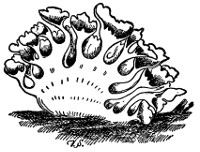
Polyporus intybaceus.
P. intyba´ceus Fr.—succory-like. Very much branched, fleshy, somewhat fragile. Pileoli very numerous, pale-yellowish inclining to fuscous, dimidiate, stretched out, sinuate, at length spathulate. Stems connate in a very short trunk. Pores firm, obtuse, white, inclining to dingy-brown. Fries.
About same size as P. frondosus and larger. Stevenson.
Spores colorless, elliptical, 7×3.5µ Massee; 6×3µ W.G.S.
Indiana, H.I. Miller. Base of living trees. Woodland Cemetery, West Philadelphia, Pa., Mt. Gretna, Pa., West Virginia, New Jersey. Large tufts growing from oak roots in ground and at base of oak trees. McIlvaine.
Edible. Stevenson. Paulet says: In place of its being heavy upon the stomach, he will feel all the lighter who sups upon it.
The people of the Vosges call it the Hen-of-the-Woods.
The words of the old song—
“So very much depends upon
The way in which it’s done,”
484apply with exceptional force to the cooking of P. intybaceus. If it is cut in thin slices across the grain and slowly stewed for half an hour it will be tender and of good flavor. It can then be served in that way, or made into patties or croquettes.
P. crista´tus Fr.—crista, a crest. Branched, firmly fleshy, fragile. Pileoli about 3 in. broad, reddish-green, entire and dimidiate, imbricated, depressed, somewhat pulverulent-villous, then cracked into scales. Stems connate, irregularly shaped, white. Pores minute, angular and torn, whitish. Fries.
Very changeable in form, sometimes simple with an undulato-lobed, central pileus.
Edible. Curtis.
Mt. Gretna, Pa., Woodland Cemetery, Philadelphia, West Virginia. On ground over roots, open woods and grassy places. September, October. McIlvaine.
Variable in form, but usually in rose-shaped clusters, which are slightly greenish at times; oftener shades of yellow. The substance is the same in texture as P. intybaceus. Cook in same manner.
P. con´fluens Fr.—stems confluent; adherent. Pilei branched, fleshy, fragile, thick, dimidiate, imbricated, confluent, smooth, fleshy-yellow becoming obscure, slightly scaly. Stem short. Pores short, minute, pallid-white.
Eaten about Nice; savor a little sharp. Cordier; North Carolina, superior eating. Curtis. Pine woods. New Scotland. September.
Our specimens are not at all squamulose, and this character is not attributed to the species by all authors. It is probable that it is not uniform in this respect. Peck, 39th Rep. N.Y. State Bot.
P. Berk´eleyi Fr. Very much branched. Pileoli very large, subzonate, finally tomentose, yellowish, fleshy, tough becoming corky and hard. Stem short or none, arising from a long and thick common base growing out of the ground usually near trees or stumps. Pores rather large, irregular, angular, pale yellowish.
A magnificent specimen found near Boston a dozen years ago and exhibited in the window of Doyle, the florist, was fully four feet high and from two to three feet broad, containing very many pileoli.
485North Carolina, edible, Curtis; Iowa, Bessey; Ohio, Morgan; Mt. Gretna, Pa., very large specimens, 20 in. across. McIlvaine.
Edible when young.
P. gigante´us Fr.—gigas, a giant. Tuft 1–2 ft. and more broad, in many imbricated layers, fleshy-pliant then somewhat coriaceous. Pilei date-brown, dimidiate, very broad, flaccid, somewhat zoned, rivulose, depressed behind. Stems connato-branched from a common tuber. Pores minute, somewhat round, pallid, at length torn.
The rigid cuticle separates into granules or fibrillose squamules. Pores becoming dark when touched. Fries.
Edible, Curtis. Esculent when young. On the continent its esculent qualities are known and appreciated. Cooke.
West Virginia, Chester county, Pa., Eagle’s Mere, Pa. On decaying stumps and roots. McIlvaine.
It is well marked by its spore-surface becoming black to the touch. When young and fresh it stews to a pleasant, edible consistency, but is tough if not well cooked or too old. The flavor of a gravy from it is at all times good.
P. sulphu´reus Fr.—sulphur, brimstone. (Plate CXXV, fig. 2, p. 476.) In many cespitose layers, 1–2 ft. and more, juicy-cheesy. Pilei 8 in. or more broad, reddish-yellow, imbricated, undulated, rather smooth. Flesh light yellowish, then white, splitting open and not hardened when old. Pores minute, plane, sulphur-yellow. Fries.
Soon becoming pale. Commonly sessile, but varying with a stem, lateral on standing trees, but expanded on all sides on fallen ones; also club-shaped, porous throughout. Sow. In its fullest vigor it is filled with sulphur-yellow milk.
On living trees and stumps. Frequent. August to October. Stevenson.
Spores oval, white, minutely papillose, 8×5µ W.G.S.; elliptical, hyaline, slightly papillose, 7–8×4–5µ Massee.
Edible. Stevenson, Curtis.
Maryland, Miss Banning; Indiana, H.I. Miller; West Virginia, New Jersey, Pennsylvania. On willow, apple, cherry, maple, hickory, etc. Frequent. August to November. McIlvaine.
Frequently in large masses. Commonly broadly attached, but sometimes 486with a short stem. Very occasionally a single pileus will protrude from a tree like a giant yellow tongue shaded with reddish-orange. Usually the pilei are in clusters united in a solid base, white-fleshed and rich in color. I have seen clusters two feet across. On an old willow at Mt. Gretna, a cluster 18 in. across afforded a dozen meals. Whenever a meal was wanted a pound or two was broken off. It lasted until January. If P. sulphureus is cooked properly it is a delicious fungus. Cut fine, stew slowly and well, season, add butter, milk with a little thickening.
P. macula´tus Pk.—having maculæ-spots. Pileus of a cheesy consistence, broad, flattened, sometimes confluent, sessile or narrowed into a short stem, slightly uneven, white or yellowish-white, marked with darker zones and watery spots. Pores minute, subangular, short, whitish, sometimes tinged with brown. Flesh white.
Pileus 4–6 in. broad, 6–8 lines thick.
Prostrate trunks of trees in woods. Worcester. July.
In texture and shape this species is related to P. sulphureus, but the pores are smaller than in that species. The plants are sometimes cespitose, sometimes single. The spots in the dried specimens have a smooth depressed appearance. Peck, 26th Rep.
Angora, West Philadelphia. September, 1896. Mt. Gretna, Pa., September, 1897–1898. On white oak trunks. McIlvaine.
Several specimens of different ages proved good eating. Like P. sulphureus it must be well cooked.
P. hetero´clitus Fr. Gr—one of two; Gr, to lean. In many cespitose layers, coriaceous. Pilei 2½ in. broad, orange, sessile, expanded on all sides from a radical tubercle, lobed, villous, zoneless. Pores irregularly shaped and elongated, golden-yellow. Fries.
On the ground under oak. Rare.
The flat pilei extend horizontally from the tubercle. Irregular, eccentric. Stevenson.
Minnesota, Johnson.
Haddonfield, N.J., Hopkin’s woods. June to July, 1890–1896. McIlvaine.
Of all fungoid growth this is the most showy. Its clusters, often a foot and a half in diameter and spread like mammoth dahlias, are gorgeous 487in color and conspicuous in design. Resting upon the ground or reared against the base of tree or stump, they deceive by their likeness to gaudy bouquets, left by foreign picnickers. In quality it is the same as P. sulphureus. It does not, however, retain its edibility. As it ages it becomes offensive.
P. por´ipes Fr.—porous-stemmed. Pileus 1.5–3 in. broad, rather fleshy, sinuately repand, smooth, grayish-brown. Stem central or excentric, firm, smooth, 1.5–3 in. long, 4–6 lines thick, punctuated by the whitish decurrent pores.
On earth in hilly regions.
Cap 2 in. across, light drab, smooth, slightly furfuraceous toward center, broken into minute appressed squamules, zoned. Flesh fibrous, white-pliable. Tubes very shallow, round mouths with obtuse divisions, china-white, running down to base of stem. Stem eccentric, almost lateral, entirely surrounded by pores, connate at base, ½ in. thick.
Smell pleasant.
New York. Ground. August, Peck, Rep. 24; Mt. Gretna, Pa., August to November, McIlvaine. A large tufted species growing on the ground in woods, August to November, McIlvaine.
When raw tastes like the best chestnuts or filberts, but rather too dry cooked. Curtis.
It must be chopped fine and slowly cooked.
P. immi´tis Pk.—wide, rude. Pilei cespitose-imbricated, broad, slightly convex or flattened, more or less rough or uneven, radiately-wrinkled, tuberculose or fibrous-bristled, zoneless, white, becoming tinged with yellow or alutaceous in drying. Flesh white, slightly fibrous, soft and moist when fresh, cheesy when dry, with a subacid odor. Pores minute, angular or even subflexuous, about equal in length to the thickness of the pileus, the dissepiments thin, white, often at length dentate or lacerate on the edge. Spores minute, white, elliptical, 3–4×18–20µ.
Pilei 2–4 in. broad, the flesh commonly 3–4 lines thick.
Decaying ash trunks. East Berne. August.
The species is apparently related to P. cæsareus, but the character of the pores is quite different in the two species. Peck, 35th Rep. N.Y. State Bot.
Mt. Gretna, Pa. On dead black oak. August to November, 1898.
488Several clusters grew on dead black oaks. The pilei overlap and the wrinkled corrugated margins curve downward, giving them the semblance of shells. From a distance a group looks like Pleurotus ostreatus. The substance is juicy; while cooking it is at first bitter, but this disappears. It becomes tender and well flavored.
P. alliga´tus Fr.—alligo, to bind to. In many cespitose layers, fibrous-fleshy, rigid-fragile. Pilei tan-isabelline, imbricated, unequal, zoneless, villous. Pores minute, soft, white, readily becoming stopped up with flocci.
Often clavate when young. Commonly wrapping round stipules and grasses. Fries.
Spores elliptical, pale, 6×7µ Massee.
Woodland Cemetery, Philadelphia. Among oak trees on grassy ground. July, August, September. McIlvaine.
Tufts frequently weigh two pounds. When young the plant cooks well, is tender and of sweet, pleasant flavor. When old it has a sour unpleasant odor.
IV.—Apus.
P. chio´neus Fr. Gr—snow. White pileus 1 in. and more broad, fleshy, soft, becoming even, smooth, zoneless, often extended behind, margin inflexed. Pores curt, very small, round, equal, quite entire. Fries.
Always soft, fragile, hyaline-white when moist, shining white when dry. Odor acid. Without a cuticle. Stevenson.
Spores white, oval, 21×3µ W.G.S.
New York. Decaying wood of frondose trees. Peck, 33d Rep.
Angora, Philadelphia, Mt. Gretna, Pa. On standing and fallen timber. June to September. McIlvaine.
This snow-white Polyporus is too conspicuous to be passed unseen. One does not expect to find snow-balls stuck against trees in August. At a distance it resembles one. When young and fresh it is good.
P. betuli´nus Fr.—betula, birch. Pileus fleshy, then corky, hoof-shaped, obtuse, zoneless, smooth, the oblique vertex in the form of an umbo, pellicle thin, separating. Pores late of being developed, curt, minute, unequal, at length separating. Fries.
489On living and dead birch. Common. May to December.
Pileus 3–6 in. broad. The pileus is at first pale, then acquiring a brownish tinge. The edge is always very obtuse. Stevenson.
The lower surface or hymenium is frequently rough with numerous acicular projections, making the plant look like a Hydnum when viewed horizontally. Peck, 24th Rep. N.Y. State Bot.
Massachusetts, Kansas, New York. Peck, Rep. 24.
Wherever the birch grows this neat, white-fleshed Polyporus abounds.
When young it is eaten by deer. Dried it burns with a white flame, or holds fire as well as the best punk. It is a valuable fuel, already prepared for the stove. In the birch forests near Eagle’s Mere, Pa., tons of it can be seen protruding from tree and log.
When very young it is fair. Unpleasant when old.
V.—Resupinati.
P. sinuo´sus Fr.—full of folds. Broadly effused, adnate, dry, the evanescent mycelium somewhat rooting, white then yellowish. Pores large, surface flexuous, acute, lacerated. Odor of licorice.
New York. Decaying wood of maple. Peck, 40th Rep.
Mt. Gretna, Pa. McIlvaine.
Of but little food value. Collected carefully and boiled, it yields a pleasantly flavored liquor.

490MERU´LIUS Hall.
(Plate CXXVI, fig. 3, p. 478.)
Hymenophore resting on a loose mold-like mycelium, covered with the soft, waxy, continuous hymenium, having its surface variously plicate or wrinkled, the folds forming irregular pores, sometimes obsoletely toothed.
Generally on wood.
I have tasted, raw, every species I have found. They are all more or less woody in flavor, and I believe them to be edible. At the best Merulius would be an emergency genus. M. tremellosus is substantial, as is M. rubellus Pk.
M. tremello´sus Schrad.—tremellosus, trembling. Resupinate; margin becoming free and more or less reflexed, usually radiately-toothed, gelatinoso-cartilaginous; hymenium variously wrinkled and porous; whitish and subtranslucent looking, becoming tinged brown in the center. Spores cylindrical, curved, about 4×1µ.
On wood. From 1–3 in. across, remaining pale when growing in dark places. Margin sometimes tinged rose, radiating when well developed. Massee.
Spores cylindrical, curved, hyaline, 4×1µ K.
New York. Old logs, stumps, Catskill mountains. Peck, 22d Rep. N.Y. State Bot.
Mt. Gretna, Pa. Common, both rose-colored and translucent brown species, numerous on decaying wood. October to November, 1898–1899. McIlvaine.
M. tremellosus is a common species and rather attractive looking. In substance it approaches Tremella and Peziza. The spore-bearing surface is superior (turned upward) and then sometimes turned in at the margin which frequently is bright rose color, sometimes yellowish-rose. It is rather tasteless—slightly woody in flavor, rather tough. An emergency species.
M. rubel´lus Pk.—rubellus, dim. of ruber, reddish. Generally cespitose, imbricated, sessile, dimidiate, soft, tenacious, tomentose, evenly red, pale when dry; margin mostly undulately inflexed; hymenium 491white or flesh-color; folds branching, forming anastomosing pores. Spores elliptical, hyaline, minute, 4–5×2.5–3µ.
Pileus 2–3 in. long, 1.5 in. broad.
Somewhat related to M. tremellosus.
On trunks of beech in woods.
Ohio, Morgan; Indiana, Dr. J.R. Weist; Mt. Gretna, Pa., November. McIlvaine. Specimens identified by Professor Peck.
Tough, but edible.
492
FAMILY III.—HYDNA´CEÆ.
Hymenium inferior or amphigenous (not confined to one surface), from the first definitely protuberant, spread over persistent spines, bristles, teeth, tubercles or papilla. Fries.
While the highest members of this family possess the general form of the mushroom, others, lacking a stem, recline on the back (resupinate); the lowest, without even the appearance of a distinct pileus, seem to be simply spread over the supporting body (effused). In the highest class the spines or other spore-bearing surface are inferior, i. e., below the pileus; in the others they are of course superior, i. e., above the pileus.
Of the eleven genera but two contain species of food value. Hydnum, characterized by its acute spines, embraces species which are eaten as delicacies, and Irpex, distinguished by its somewhat acute teeth growing from a ridgy hymenium, contains those which may furnish sustenance in time of need. In Caldesia, bearing spines, the texture is floccose not fleshy. Sistotrema has a pileus and a central stem, but instead of spines bears irregular flattened teeth. The remaining genera are separated by the tubercles, granules, folds, etc., which take the place of spines or teeth.
Several species of Hydnum are common to earth and wood, others are distinct in their habitats.
SYNOPSIS OF THE GENERA.
Hydnum. Page 494.
Sporophore fleshy, with a central stem or entirely resupinate, texture compact, spines acute, distinct at the base.
Caldesiella.
Resupinate; texture floccose, spines acute; spores muriculate. (No edible species reported.)
493Sistotrema.
Pileate; fleshy, central-stemmed, teeth flattened, irregular, inferior. (No edible species reported.)
Irpex. Page 504.
Resupinate; teeth rather acute, springing from folds or ridges that often anastomose irregularly.
Radulum.
Resupinate; tubercles coarse, deformed, subcylindrical, obtuse. (No edible species reported.)
Phlebia.
Resupinate; hymenium covered with folds or wrinkles, having the edge entire or corrugated. (No edible species reported.)
Grandinia.
Resupinate; hymenium with crowded, globose, persistent, hemispherical, minute granules, having their apices more or less excavated. (No edible species reported.)
Porothelium.
Resupinate; hymenium with scattered wart-like granules, which become more or less elongated and excavated at the apices. (No edible species reported.)
Odontia.
Resupinate; hymenium densely covered with small granules that are divided at the apices in a penicillate manner. (No edible species reported.)
Kneiffia.
Resupinate; hymenium covered with very minute, barren, acute spinules. (No edible species reported.)
Mucronella.
Spines slender, elongated, acute, not springing from a sporophore or subiculum. (No edible species reported.)
494HYD´NUM.
Gr—name for some edible fungus.

Hymenium inferior, bearing awl-shaped Spines, distinct at the base. Fries.
In this genus the spines proceed from an even surface, not folded or wrinkled, and are covered with the spore-bearing surface.
The forms are extremely variable, the type of the first section, H. repandum, being easily mistaken for one of the Agaricaceæ until examined, the stem being nearly central and upright, while in other forms it is lateral or absent. Some are dimidiate (as if part of the pileus had been removed and the plant attached by the remaining portion); the lower forms are resupinate.
ANALYSIS OF TRIBES.
Mesopus (Gr—middle, a foot). Page 495.
Entire, simple, stem central.
On the ground, mostly in pine woods.
Pleuropus (Gr—the side; a foot).
Stem lateral.
None known to be edible.
Merisma (Gr—to divide). Page 501.
Very much branched or of an irregular form without a distinct margin.
Apus (Gr—without; a foot). Page 503.
Stemless, dimidiate, margin distinct.
Resupinati (resupino, to throw on the back).
Without stem or distinct pileus.
None known to be edible.
495Mes´opus. Gr—middle; a foot.
(Entire, simple, stem central. On the ground, mostly in pine woods.)
H. imbrica´tum L.—imbrex, a tile. Pileus about 2–5 in. broad, umber, zoneless, fleshy, rather plane, somewhat umbilicate, floccose, tessulato-scaly. Flesh dingy whitish. Stem curt, 1–3 in. long, 1–2 in. thick, even. Spines 4–6 lines long, decurrent, ashy-white.
There are two forms; one with the pileus plane and with thick persistent scales, another with the pileus somewhat infundibuliform, and with thinner, at length separating scales. Stevenson.
Spores pale yellow brown, rough, 6–7×5µ Massee; 6×5µ W.G.S.
Fleshy. The numerous scales over lapping toward the center. The surface of the cap often cracks in a tesselated manner. Flesh dingy, buffish or reddish. Spines short, blunt, grayish-white and mostly of equal length.
In pine and mixed woods. Autumn.
Of delicate taste. Cordier. Edible. Curtis.
Fine specimens grew at Mt. Gretna, Pa., from September to November. Until closely examined the cap may be mistaken for that of H. zonatum. The zones of the latter and the pervading rust-color will distinguish it. Both are edible, though H. zonatum is much tougher. H. imbricatum is slightly bitter, raw. It must be sliced thin and well cooked.
H. læviga´tum Swartz—lævis, smooth. Pileus 4–6 in. broad, umber, fleshy, compact, firm, regular, plane, even, very smooth, margin circinate (not repand). Flesh whitish, compact, but by no means fibrous, soft when fresh, pliant when dry. Stem short, thick, even, pallid-brown. Spines thin, pallid-brown.
Its size is that of H. imbricatum, but it occurs twice as large, with the pileus minutely rimuloso-rivulose, by no means scaly. The stem varies curt and unequal or longer and equal. Quite distinct from H. fragile. Stevenson.
Spores 10–15µ long, Massee; globose, warted, pale lemon-yellow, 7µ Q.
In pine woods. August to October.
Edible, Curtis; edible, Leuba. “Eaten in Alpine districts.” Barla.
496
(Plate CXXXI.)
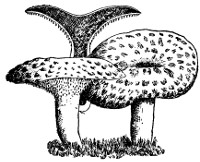
Hydnum scabrosum. Natural size.
H. scabro´sum Fr.—scabrosus, rough. Pileus about 1½-4 in. broad, brownish-yellow, compactly fleshy, at first top-shaped, then plane above, very convex beneath, at first tomentose, then rough with flocci which are fasciculate in the form of minute crowded squamules, slightly repand at the margin. Flesh very thick, white, descending into the stem. Stem very curt, 1 in. long, and equally thick, round or compressed, dotted with the rudiments of spines decurrent upon it, ash-color, attenuated downward, roundish and blackish at the base. Spines 4 lines long, equal, awl-shaped, dingy-rust color, whitish at the apex, at first sight grayish-brown. Fries.
Spores 4–5µ diameter. Massee.
Hydnum scabrosum is frequently found in Pennsylvania, among pines and in mixed woods where pines grow. It occurs at Mt. Gretna, Pa., and on Springton Hills under hemlocks.
The caps are soft, fleshy, and equal to H. repandum in quality.
H. squamo´sum Schaeff.—squama, a scale. Pileus 1½-3 in. across, reddish-brown, fleshy, irregular, depressed, smooth, breaking up into irregular scales. Flesh whitish. Stem curt, attenuated downward, white. Spines grayish-brown, whitish at the apex. Stevenson.
Spores subglobose, 5–6µ diameter. Massee.
Pileus smooth and even when young. Flesh whitish. Spores grayish-brown. Spines whitish, giving the lower surface a much lighter appearance than the upper.
Under hemlock and spruce in West Virginia, 1884. McIlvaine.
Caps are good when sliced thin and well cooked.
H. subsquamo´sum Batsch. Pileus fleshy, somewhat convex, subumbilicate, brownish-rust color, superficial scales soon dropping off; spotted with brown. Stem stout, unequal, smooth. Spines whitish, becoming brown, apex remaining whitish. 497North Carolina, Curtis; Alabama, Peters; Massachusetts, Sprague. Edible. Curtis. Edible. Cordier.
(Plate CXXXII.)
Hydnum repandum.
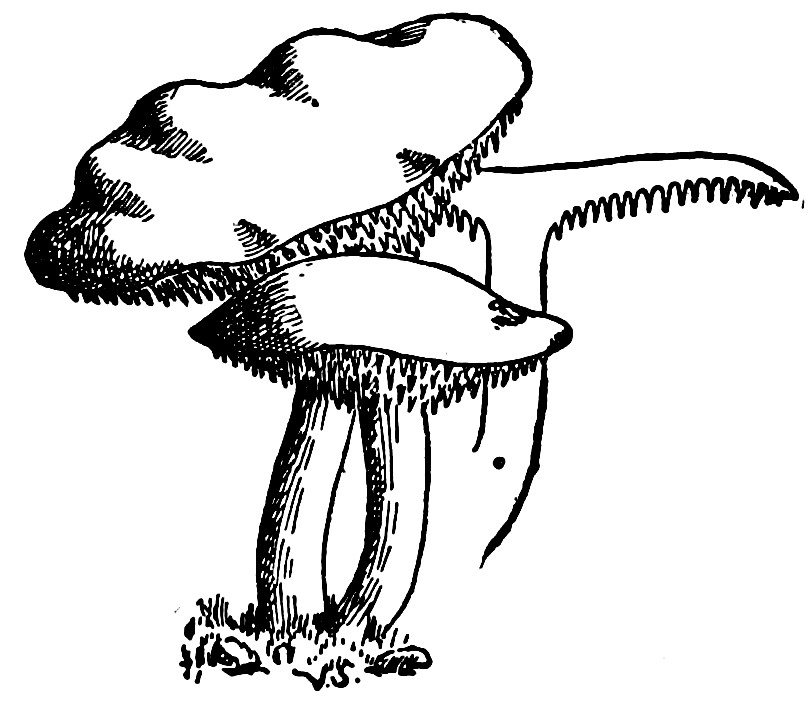
H. repan´dum L.—repandus, bent backward (of the cap, upward). Pileus 2–6 in. broad, pallid, etc., fleshy, fragile, somewhat repand, rather smooth. Stem 2–5 in. long, ½-1½ in. thick, irregularly shaped, pallid. Spines 4 lines long, unequal, of the same color. Stevenson.
Spores pointed, 5–8µ Massee.
Pileus sometimes depressed, often turned upward at margin, often waved, sometimes tomentose. Color variable—light-buff, brown, pinkish, reddish. Flesh whitish, compact, fragile. Spines conical, up to ¼ in. in length, whitish but rich creamy shades, mostly pointed, but sometimes appearing to be hollow. Stem central or eccentric, sometimes covered with white down, thick, uneven, usually crooked, solid, fleshy, light in color.
July to November.
Edible. Curtis.
Common to most countries, and, although given as a ground-growing species, it is rather indiscriminate in its habitats. Woods, fields, leaf-covered or bare places, much decayed wood and stumps are its living places. Dr. Cooke thinks it irreproachable. Popularly it goes by the name of the Hedgehog mushroom.
H. repandum varies greatly in shape, color and texture. In the open it is usually symmetrical and tough; when clustered it is irregular, often fanciful and quite brittle—tender.
When sliced thin an hour’s slow cooking is sufficient. All writers commend it, and properly.
H. rufes´cens Pers.—rufus, red. Pileus 2–3 in. across, thin, fragile, usually regular, pubescent, reddish. Spines 1–3 lines long, regular. Stem 1–3 in. long, commonly thin, nearly equal, reddish.
498The whole plant is reddish. In all other respects it resembles H. repandum. Usually more regular.
Commonly found in woods. New York, Peck; North Carolina, Curtis, Schweinitz.
Edible, Curtis. Edible, Leuba.
Fries considered H. rufescens a variety of H. repandum, and the writer agrees with him. It is given distinct place here because Massee and Stevenson—books in the hands of many students of fungi—give it importance.
It is quite as good as H. repandum.
H. ferrugi´neum Fr. Pileus 1–4 in. across, corky, soft, convex, then plane or depressed, irregularly pitted, ferruginous, at first with whitish tomentum. Flesh ferruginous. Spines thin, acute, about 2 lines long, rusty-brown. Stem firm, 2–3 in. long, unequal, rusty-brown. Spores subglobose, 4µ diameter.
In fir woods. Often gregarious; soft when young, corky and dry at maturity. Massee.
Mt. Gretna, Pa. November to December, 1898. Among pine leaves.
Taste mild, mealy. Tough, but when young it cooks tender.
H. zona´tum Batsch. Ferruginous. Pileus 1–2 in. broad, equally coriaceous, thin, expanded, somewhat infundibuliform, zoned, becoming smooth, radiately-wrinkled, the paler margin sterile beneath. Stem ½-¾ in. long, 2–3 lines thick, slender, somewhat equal, floccose, base tuberous. Spines 1–1½ lines long, slender, pallid, then rust-color. Stevenson.
Spores rough, globose, pale watery brown, 4µ diameter Massee.
New York, Peck, 24th Rep. Mt. Gretna, Pa. Abundant among hemlocks; West Virginia. McIlvaine.
Coriaceous. Edible. It will not cook tender, but yields a pleasant flavor to a gravy made of its juices.
H. albo´nigrum Pk. Pileus convex or nearly plane, broadly obconical, tough but soft and densely tomentose on the upper surface, buff-brown or smoky brown, often wholly covered with a whitish downy tomentum, sometimes on the margin only, substance within soft tomentose 499and buff-brown in the upper stratum, the lower half hard and black. Spines short, at first white, then whitish or grayish. Stem short, often irregular, compressed or growing together, blackish when moist, buff-brown when dry, covered with a thick dense tomentum, which is frequently more abundant toward the base, hard and black within. Spores white, globose, 4–5µ.
Pileus 1–3 in. broad, sometimes 2 or 3 confluent. Stem 1–2 in. long.
Ground in mixed woods. Gansevoort. August. Peck, 50th Rep. N.Y. State Bot.
Specimens from pine woods New Jersey, T.J. Collins, September, 1897. 1½ in. across. Frequent at Mt. Gretna, Pa.
Edible. Good flavor, but tough.
H. velle´reum Pk. This species appears to be very much like the preceding one (H. albonigrum Pk.) from which it is separated by its smaller size and the paler brownish or rusty-brown substance of its pileus and stem. Peck, 50th Rep. N.Y. State Bot.
At Mt. Gretna, Pa., the species grows with H. albonigrum. In quality it is the same.
(Plate CXXXIII.)
Hydnum albidum.
H. al´bidum Pk. Pileus fleshy, thin, broadly convex or nearly plane, subpruinose, white. Flesh white. Spines short, white. Stem short, solid, central or eccentric, white. Spores subglobose, 4–5µ broad.
The whitish Hydnum is uniformly colored in all parts. It grows in groups or in clusters. In the latter case the caps are sometimes irregular because of the crowded mode of growth and the stems are occasionally eccentric. It is a small species not liable to be mistaken for any other except possibly for very small pale forms of the spreading Hydnum. But wholly white examples of this species have never been seen by me.
The caps are 1–2 in. broad and the stems are generally about 1 in. long and 3–5 lines thick.
500The plants grow in thin woods or in open bushy places and appear in June and July. It is not a common species, and though well flavored it is not of very great importance as an edible mushroom, because of its scarcity and small size. Peck, 51st Rep. N.Y. State Bot.
Port Jefferson. July. This fungus has been tested and found to be edible. Peck, 50th Rep. N.Y. State Bot.
Mt. Gretna, Pa., 1897. Specimens identified by Professor Peck. McIlvaine.
The caps are edible and superior to H. repandum.
H. fen´nicum Karst. Cap fleshy, fragile, unequal, at first scaly, at length breaking up, reddish-brick color becoming darker, margin undulately lobed, 2–4 in. broad. Flesh white. Stem sufficiently stout, unequal below, attenuated, flexuous or curved, smooth, of the same color as the cap, base acute, light white tomentum outside, inside light pale-blue or dark-gray (wood-ash), 1–3 in. long, .4–1 in. thick. Teeth decurrent, equal, pointed, from white dusky, about 4 mm. long. Spores ellipso-spheroidical or sub-spheroidical, rough, dusky, 4–6µ long, 3–5µ broad.
Found in gravelly or sandy soil in woods.
Found at Angora near Philadelphia. Top cracked. Identified by Professor Peck.
Occurs frequently at Mt. Gretna, Pa., ground in mixed woods. August to September. The taste and smell are at first inviting, but the extreme bitter which develops destroys all desire to eat it.
H. spongio´sipes Pk. Pileus convex, soft, spongy-tomentose, but tough in texture, rusty-brown, the lower stratum more firm and fibrous. but concolorous. Spines slender, 1–2 lines long, rusty-brown, becoming darker with age. Stem hard and corky within, externally spongy-tomentose, colored like the pileus, the central substance often transversely zoned especially near the top. Spores subglobose, nodulose, purplish-brown, 4–6µ broad.
Pileus 1.5–4 in. broad. Stem 1.5–3 in. long, 4–8 lines thick.
Woods. Rensselaer and Saratoga counties. August.
This plant was formerly referred to Hydnum ferrugineum Fr. Peck, 50th Rep. N.Y. State Bot.
Found in pine woods, near Haddonfield, N.J., by T.J. Collins, 501September, 1897. Cap and stem dark brown. Spines darker. Stem swelling toward base, which then tapers in a long rooting way. Cap umbilicate. Specimens identified by Professor Peck.
Edible but tough and uninviting. Yields a good fungoid flavor to the water in which it is boiled.
H. gelatino´sum Scop. Transferred to Tremelledon as T. gelatinosum, under which heading it is described and its edible qualities noted.
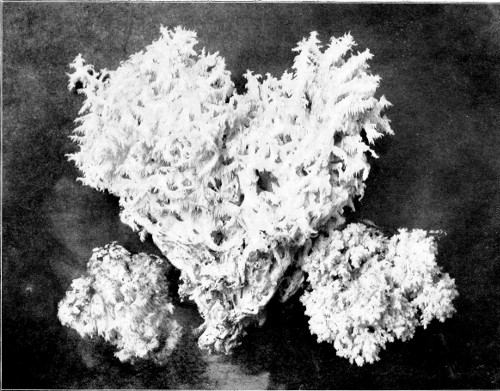
Photographed by Dr. J.R. Weist. Plate CXXXIV. HYDNUM CORALLOIDES.
Meris´ma. Gr—a division.
(Very much branched or of an irregular form without a distinct margin.)
H. coralloi´des Scop. (Plate CXXXIV.) 6–18 in. across. Tufts on wood. Pure shining white growing yellow with age, composed wholly of attenuated interlacing branches ½ in. at base, tapering to a point. Spines growing from one side of the branches, 3–4 lines in length, awl-shaped.
Spores globose, 4–6µ diameter Massee.
Peck, Rep. 22; Indiana, H.I. Miller; Massachusetts, Sprague; California; West Virginia, New Jersey, Pennsylvania, McIlvaine.
Edible. Curtis.
Grows upon standing and fallen timber which is attacked by decay. Fir, oak, beech, ash, birch, hickory and other trees are inhabited by it. August to frost.
This beautiful species can not be mistaken for any other. Its name is the best guide to its identification. Dame Nature has made many exquisite decorations for herself and this is one of them.
It is generally eaten, but is rare. Professor Peck speaks affectionately of it as a gratuitous adjunct to his bill of fare when on botanical tramps in the Adirondacks.
H. caput-ur´si Fr.—bear-head. 6–8 in. high, 6–8 in. across. Tufts usually pendulous, compact, white, becoming yellow and brownish. Spines up to 1 in. long, round, pointed. Branches in every direction, short.
Closely resembling H. coralloides and in small forms with shorter spines easily mistaken for it. Position of growth has much to do with 502its shape and appearance. On fallen timber the branchlets and spines may be erect.
New York, Peck, 44th Rep.; North Carolina, Curtis; West Virginia, New Jersey, Pennsylvania, McIlvaine.
Edible. Curtis. Edible. Peck.
Hydnum caput-ursi is common in West Virginia forests. It is conspicuous on standing oaks, and at a distance a puzzling object to one not familiar with such excrescences. It grows on standing oaks near Haddonfield, N.J., and sparsely at Mt. Gretna, Pa.
It is more compact, and is tougher than H. coralloides and H. Medusæ, but cooks tender and is very good.
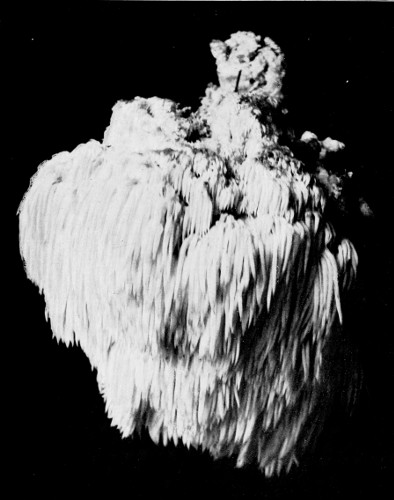
Photographed by Dr. J.R. Weist. Plate CXXXV. HYDNUM CAPUT-MEDUSÆ.
H. caput-Medu´sæ Bull.—head of Medusæ. (Plate CXXXV.) 3–18 in. across, 2–8 in. high. Tufts pendulous. White then grayish. Body compact, tapering to a solid base, more or less stem-like. Spines covering entire surface. Those upon top are long, thin, straight or distorted, growing shorter around and to the under side where they are short and straight. The wavy appearance of the slender spines remind of the snaky locks of Medusa, hence the name.
Edible. Curtis. Edible. Leuba.
On elms at Haddonfield, N.J.; on oaks at Mt. Gretna, Pa., and in Woodland Cemetery, and on elms in Washington Square, Philadelphia, Pa. McIlvaine.
Commonly eaten in Italy and parts of Austria; rare elsewhere in Europe. Occurring over the United States. Specimens eighteen inches across were seen by the writer in the West Virginia mountains.
Mr. H.I. Miller, Terre Haute, Ind., sent me a fine specimen weighing 10½ pounds.
The American species, as far as seen by the writer, changes to a light yellow when ageing. The entire fungus is edible and excellent, but the tender spines and more delicate parts make a dish equaled by few fungi.
H. erina´ceum Bull.—erinaceus, a hedgehog. 2–8 in. and more across. Tufts pendulous. White and yellowish-white becoming yellow-brownish, fleshy, elastic, tough, sometimes emarginate (broadly attached as if tuft was cut in two, sliced off where attached), a mass of latticed branches and fibrils. Spines 1½-4 in. long, crowded, straight, equal, pendulous. Stem sometimes rudimentary.
503On trunks of oak, beech, etc. July to October.
Spores subglobose, 5–6µ diameter Massee; white, plain, 5×6µ W.G.S.
Alabama, Miss K. Skehan; Pennsylvania, McIlvaine; Massachusetts, Sprague; New York, Peck, Rep. 22.
Eaten in Germany and France. Cooke.
A dead beech trunk at Eagle’s Mere, Pa., in August, 1898, bore at least fifty pounds of it. It draped one side of the tree from root to top with yellowish, pendulous tufts, with spines up to 3 in. long, which waved in the wind. The spines and tender parts were stewed, and enjoyed by many. It shrinks very much in drying, becoming sour.
A´pus. Gr—without; a foot.
(Stemless, dimidiate, margin distinct.)
H. septentriona´le Fr.—Northern. Fleshy-fibrous, becoming pale, imbricated. Pilei not numerous, growing one above the other, plane, behind thick, consolidated, margin straight, whole. Spines very crowded, slender, equal.
The largest known Hydnum.
Received from E.B. Sterling, Trenton, N.J., September, 1897. The specimens formed part of a dense fasciculate mass weighing over 20 pounds, growing on a beech stump. Edges of the young plant are edible, but have little taste.
504IR´PEX Fr.
A harrow.
Hymenium inferior, toothed from the first. Teeth firm, somewhat coriaceous, acute, concrete with the pileus, arranged in rows or like network, connected at the base by folds, which are gill-like (in sessile species) or resemble honeycomb (in resupinate ones). Sporophores 4-spored. Growing on wood, somewhat growing from the side or upon the back, approaching Lenzites and Dædaleæ.
Irpex differs from Hydnum in having the spines connected at the base, and in their being less awl-shaped and pointed.
It is reported as found well up in the northern States, but its species prefer warm climates. Irpex contains no choice species, but all I have tested can be eaten.
I. obli´quus Fr.—oblique. White, inclining to pale, effused (spread), forming an adnate crust, circumference flaxy. Teeth extended from a base resembling honeycomb, compressed, unequal, incised, oblique, 2–3 lines long.
At first abundantly porous, but toothed from the first, at length quite as in Hydna.
On stumps and dead branches. November to February. Stevenson.
This spreads in irregular patches on the surface of decaying wood. The pores for a small space round the margin are round and distinct, but toward the center are greatly lengthened out, lying one upon another in an imbricated manner. The color is white at first, when old it changes to a yellow-brown, and at last to a dirty fuscous black. Bolton.
At first it looks more like a small white orbicular resupinate Polyporus than an Irpex. Peck.
The species is common and can be collected at most times of the year. When fresh and moist it can be shaved from its host plant. Goodly quantities can thus be obtained. It stews to a firm gelatinous mass of pleasant flavor. The lost hunter need not die of starvation in any woods if he will but study the tree-growing fungi, and especially the small species, hitherto insignificant in food circles.
I. car´neus Fr.—resembling the color of flesh. Reddish, effused, 1–3 505in. long, cartilaginous-gelatinous, membranaceous, adnate. Teeth obtuse and awl-shaped, entire, united at the base.
It inclines to Radula and Phlebia. Stevenson.
On tulip poplar, Haddonfield, N.J., September, 1892; on hickory, Angora, Philadelphia, September, 1897. McIlvaine.
The entire fungus is good, cooking like a Hydnum.
I. defor´mis Fr.—deformed. White, effused, crustaceous, thin, circumference pubescent, somewhat flaxy. Teeth extended in awl-shape from a minutely porous base, thin, somewhat digitato-incised (cut in finger-shape), 1–2 lines long. Fries.
It approaches the Polypori. Grows on wood. Stevenson.
North Carolina, Schweinitz, Curtis; Massachusetts, Frost.
Common on stumps and trees. The awl-shaped teeth, which have the appearance of shreds, can be scraped from the fresh plant, or if dried plants are moistened, the teeth are detachable, and are food-giving.
I. fusco-vioia´ceus Fr.—fuscus, brown; violaceous, violet. Pileus 2 in. long, more than 1 in. broad, white inclining to hoary, effuso-reflexed, coriaceous, silky, zoned. Teeth in rows in the form of plates, brownish-violet, incised at the apex. Fries.
On pine trunks. Stevenson.
Decaying trunks of spruce, abies nigra. Adirondack mountains. July.
Our specimens are not “silky,” as required by the description, but villose or tomentose-villose as in Polyporus hirsutus and P. abietinus, the latter of which this species closely resembles. The hymenium, however, is coarser, more highly colored and lamellated to such an extent that young specimens might easily be taken for a Lenzites. Peck, 30th Rep. N.Y. State Bot.
Found in West Virginia, New Jersey, Pennsylvania, and elsewhere. McIlvaine.
Very common on logs of coniferous trees. It is difficult to collect it entirely free from resin, which as a seasoning is not recommended.
506
FAMILY IV.—THELEPHORA´CEÆ Fr.
Gr—a teat; Gr—to bear.
Sporophore erect and stipitate, with a central stem, effused, with the upper portion free and bent backward, or entirely resupinate. Hymenium perfectly even or radiately wrinkled, glabrous or minutely bristled with projecting cystidia; basidia normally 4-spored. Spores without a division, colorless or colored. Massee.
In Thelephoraceæ are shapes closely resembling those found in Hydnaceæ, Polyporaceæ and Agaricaceæ. The genus Craterellus is closely allied to Cantharellus, and, though the spore surface is much less wrinkled or veined, resembles it in several of its species. Other types show likeness to Merulius in Polyporaceæ; others to Tremellineæ and Clavariaceæ. Many puzzles are presented by its species, but the solving is interesting.
Though populous it contains but few edibles. The best of them is Craterellus cornucopoides.
SYNOPSIS OF GENERA.
A. Spores Colored.
Spores smooth.
Coniophora.
Resupinate, dry and pulverulent. (No edible species reported.)
Aldridgea.
Resupinate, soft and subgelatinous. (No edible species reported.)
Spores warted or echinulate.
Thelephora.
Dry and fibrous, hymenium rugulose. (No edible species reported.)
Soppittella.
Subgelatinous, effused or variously incrusting, hymenium even. (No edible species reported.)
507B. Spores Colorless.
Parasitic on living leaves or stems.
Exobasidium.
Saprophytes growing on dead wood, branches, etc. Hymenium minutely setulose with projecting cystidia.
Peniophora.
Cystidia colorless, rough at the tip with particles of lime. (No edible species reported.)
Hymenochæte.
Cystidia brown, smooth. (No edible species reported.)
Hymenium glabrous.
Corticium.
Entirely resupinate, hymenium usually cracked when dry. (No edible species reported.)
Stereum.
Effuso-reflexed, pileus silky or strigose, hymenium even. (No edible species reported.)
Cladoderris.
Horizontal and attached by a narrow point behind, hymenium radiato-rugulose. (No edible species reported.)
Craterellus. Page 508.
Large, erect, funnel-shaped.
Cyphella.
Minute, cup-shaped, mouth open. (No edible species reported.)
Solenia.
Minute, cylindrical, gregarious or crowded, tubular, mouth contracted. (No edible species reported.)
508CRATEREL´LUS Fr.
Crater, a bowl.
Hymenium waxy-membranaceous, distinct but adnate to the hymenophore, inferior, continuous, smooth, even or wrinkled. Spores white. Fries.
This, the only genus of Thelephoraceæ containing edible fungi, has the form and general appearance of Cantharellus to which it is allied, but it is distinguished by its nearly even hymenium, which in Cantharellus has the form of gills, fold-like and thick but still distinctly gills. The species vary from fleshy to membranaceous, all having a funnel-shaped pileus and stem merging into it. On the ground. Autumn. The slightly veined surface where the spores are borne, and the spores themselves, when a microscope is brought to bear upon them, distinguish this genus from Cantharellus; and its thin flesh and funnel-shape from the large forms of Pistillaria. Several of the species are edible. It is probable that all are.
Toadstools, despite their name, are more popularly associated with fairies than with toads. “Fairy rings,” “Fairy Bread” and “Fairy Clubs” are titles belonging to them, and these link us to the pretty belief of childhood—a belief we often do not outgrow. A group of C. lutescens or C. cornucopoides may well be likened to fairy trumpets, or to a tiny orchestrion thrusting its horns through wood earth where roots of stumps abound.
C. cantharel´lus Schw. (Plate XLVI, fig. 3.) Capn. across, convex, often becoming depressed and funnel-shaped, glabrous, yellowish or pinkish-yellow. Flesh white, tough, elastic. Hymenium slightly wrinkled, yellow or faint salmon color. Stem 1–3 in. high, 3–5 lines thick, glabrous, solid, yellow. Spores on white paper yellowish or pale salmon.
Spores 7.5–10×5–6µ Peck.
West Virginia, McIlvaine.
No one not looking for minute botanic details would separate this species from Cantharellus cibarius, especially if found growing near or with it. The pinkish tinge sometimes present in C. cantharellus I have never observed in C. cibarius. The present species is of equal excellence.
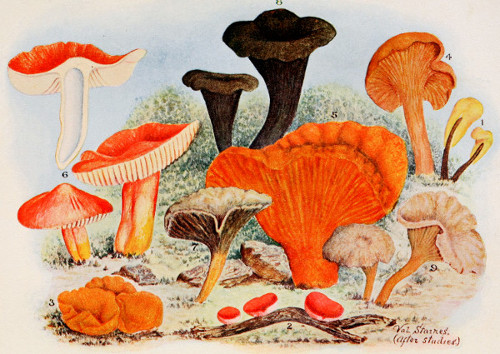
Grouped by Val Starnes—Studies by C. McIlvaine. Plate CXXXVI.
Fig. Page. Fig. Page.
1. Spathularia clavata, 549 6. Hygrophorus coccineus, 156
2. Peziza coccinea, 559 7. Craterellus sinuosus, var. crispus, 510
3. Peziza aurantia, 557 8. Craterellus cornucopoides, 509
4. Cantharellus aurantiacus, 216 9. Cantharellus lutescens, 218
5. Hypomyces lactifluorum, 562
509C. cornucopoi´des Pers.—cornu and copiæ, horn of plenty. (Plate CXXXVI, fig. 8, p. 508.) Cap dark sooty shades of gray or brown—shades of well-worn velveteen—1–2 in. across, whole plant from 2–4 in. high, trumpet-shaped, or like a funnel with its open mouth, plane, wavy, split or in folds. Substance very thin and either brittle or tough. The inside is sometimes minutely scaly, the opening extending to the base; outside, where the spores are borne, it has neither gills, pores nor protuberances, but a slightly uneven surface varying little in color. Stem obsolete or seldom noticeable. Odor slight.
Spores pointed, 11–12×7–8µ Massee.
Grows single, clustered or in troops along shaded roads, or from leaf mold and ground in woods. July to frost.
Large patches, clustered, grow near stumps in moist places on Botanic Creek, West Philadelphia. It is plentiful near Haddonfield, N. J., at Mt. Gretna, Pa., and many other places in the United States.
It is not pleasant to look upon, because of its peculiar color, but when one gets used to it it has an attractiveness of its own. Its graceful shape, even its funereal hue and name—Trompet du Morte—are alluring.
It dries well, and when moistened expands to its normal size. It is a first-class edible fungus. It should be stewed slowly until tender.
C. clava´tus Fr.—clava, a club. Pileus 2 in. broad, somewhat light-yellowish, fleshy, top-shape, truncate or depressed, flexuous, unpolished, attenuated into the solid stem. Flesh thick, white. Hymenium even, then corrugated, purplish then changing color. Fries.
Spores elliptical, pale-yellow, 10–12×4–5µ Massee.
Professor Peck notes that the species so closely resembles Cantharellus cibarius that it might easily be mistaken for a deformed condition of it.
The resemblance to the yellow forms of Clavaria pistillaria is marked.
Massachusetts, Sprague, Farlow; New York, Peck, Rep. 32; West Virginia, Pennsylvania, McIlvaine.
An excellent species. Its scarcity is regrettable.
C. du´bius Pk. Pileus infundibuliform, subfibrillose, lurid-brown, pervious to the base, the margin generally wavy and lobed. Hymenium dark cinereous, rugose when moist, the minute crowded irregular folds abundantly anastomosing, nearly even when dry. Stem short. Spores broadly elliptical or subglobose, 6–7.5µ long.
510Plant simple or cespitose, 2–3 in. high. Pileus 1–2 in. broad.
Ground under spruce trees. Adirondack mountains. August.
In color this species bears some resemblance to Cantharellus cinereus. From Craterellus sinuosus it is separated by its pervious stem, and from C. cornucopoides by its more cespitose habit, paler color and smaller spores. Peck, 31st Rep. N.Y. State Bot.
West Virginia, Pennsylvania, McIlvaine.
Its edible qualities are in every way equal to those of C. cornucopoides.
C. sinuo´sus Fr.—sinus, a curve. Strong scented. Pileus funnel-shaped, downy, grayish-brown, margin undulated. Stem pale yellow, elongated, stuffed. Hymenium with anastomosing ribs, grayish. Spores elliptical, pale yellow, 8–9×5µ.
In woods. Pileus ½-1 in. high and broad. Stem about 1 in. high, sometimes very short. Smell strong, musky. Hymenium becoming tan-color when dry. Pileus more or less villose. Massee.
The above description is given so that Var. crispus which follows may be compared with it. Fries considered var. crispus a good species.
Var. cris´pus—crispus, curled. (Plate CXXXVI, fig. 7, p. 508.) Margin of hymenium sinuous and crisped. Pileus pervious. Stem stuffed at base only. Hymenium almost even. Massee.
Solitary and cespitose in mixed woods.
Found by Dr. S.C. Schmucker near West Chester, Pa., 1896; Wm. H. Rorer, Mt. Gretna, Pa., August, 1897.
Cap varies in color from dark to light brownish-gray. Gills brownish-gray, almost even. Stem hollow, dark yellow. Smell strong, musky, much like A. silvicola.
Substance tender and of markedly high and pleasant flavor.
511
FAMILY V.—CLAVARIA´CEÆ.
Hymenium not distinct from the hymenophore, covering entire outer surface. Somewhat fleshy, not coriaceous, vertical, simple or branched. Fries.
For the most part growing upon the ground.
In this family there is no separation into stem and pileus, with the spore-bearing surface restricted to gills or tubes, but the substance of the plant is continuous, and the spores are produced on the clubs or branches.
But three genera—Clavaria, Sparassis and Pistillaria—include species of food value. They are easily recognized.
The genus Calcocera resembles Clavaria in form, but is very different in material, being a jelly-like viscid, cartilaginous substance, horny when dry, resembling that of Tremella.
SYNOPSIS OF GENERA.
Sparassis. Page 512.
Very much branched, branches compressed, plate-like, crisped.
Typhula.
Simple or club-shaped, with a thread-like stem.
Clavaria. Page 513.
Fleshy, simple or branched, branches typically round, some forms club-shaped.
Pistillaria.
Club-shaped, simple, rigid when dry; usually minute.
Pterula.
Branches numerous, slender, forming a tuft, or single, leathery, round or compressed.
512SPARAS´SIS Fr.
Gr—to tear in pieces.
Fleshy, branched, with flat leaf-like branches, composed of two plates, fertile on both sides, with four-spored sporophores. Fries.
Very beautiful plants of striking appearance.
Unfortunately they are not common, although they generally occur yearly in the same locality.
S. Herb´stii Pk. Plants much branched, forming tufts 4–5 in. high and 5–6 in. broad, whitish, inclining to creamy-yellow, tough, moist, the branches numerous, thin, flattened, concrescent, dilated above and spatulate or fan-shaped, often somewhat longitudinally curved or wavy, mostly uniformly colored, rarely with a few indistinct, nearly concolorous, transverse zones near the broad, entire apices.
Spores subglobose or broadly elliptical, 5–6×4–5µ.
Trexlertown. August.
Closely allied to S. spathulata Schw., but differs in its paler color with no rufescent hues, more branching habit and absence of any distinct zones.
Four specimens were found at Mt. Gretna, Pa., during August, 1898. These were not as symmetrical as S. crispa, which they closely resembled in fold and texture. They were of equal excellence cooked.
S. lamino´sa Fr.—a thin plate. Base branching, straw-color. Branches erect, crowded, growing together, straight at the top, zoneless, entire.
North Carolina, Curtis. On oak log.
Edible, Curtis. “Deliciosa,” Fries.
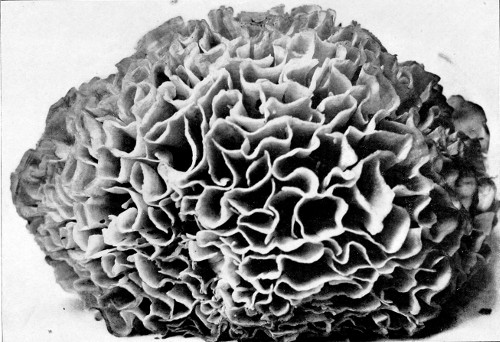
Photographed by Luther G. Harpel, Lebanon, Pa. Plate CXXXVII. SPARASSIS CRISPA.
S. cris´pa Fr.—crispus, curly. (Plate CXXXVII.) Height 3–12 in., width 4–24 in. Tufts very handsome, whitish, oyster color or pale-yellow, very much branched. Branches flat, leaf-like. Spore surface on both sides, sometimes crimped on edges. Compacted into a round mass, ending below in a solid rooting base.
Spores pale-ochraceous, 5–6×3–4µ Massee.
Very variable in size. On ground in woods and grassy places in open woods. Summer, autumn. 513North Carolina, Curtis; West Virginia, New Jersey, Pennsylvania, McIlvaine.
Have seen it 2 ft. across. “Delicosissima.” Fries.
A perfect specimen of S. crispa resembles a huge rosette, round and many-folded in tortuous design. The folds are wide, flattened branches springing from a common base, thin, semi-transparent, not unlike damp sheets of gelatine although thicker. Surfaces of the leaves are dull, like the flattened seaweeds and the light-colored sea-rock mosses. S. crispa may be easily dried, and though shrinking much in size, retains its shape, forming a very pretty ornament for the desk of the mycologist. It is not common. Where it has chosen a habitat several tufts may be found during the moderate season. The writer found three specimens ranging from 6–12 in. in diameter near Haddonfield, N.J., others, not as large, in West Virginia and in Chester county, Pa.
It has long been known as edible. It makes an ever-to-be-remembered dish.
CLAVA´RIA L.
Clava, a club.
Fleshy, branched or simple, somewhat round, without a distinct stem. Hymenium continuous, dry, homogeneous. For the most part growing on ground. Fries.
The members of this genus vary greatly in form, which in some is that of a club growing singly or cespitose, while others present a more or less bush-like appearance, being slightly or excessively branched.
The color of the plant covers a wide range, as it may be white, red, yellow, violet or their various shades, and to be in harmony the spores do not confine themselves to one color, but are white, ochraceous or cinnamon. In cases where the plant is not otherwise well defined the spore colors will be found a valuable aid in placing it.
ANALYSIS OF TRIBES.
Ramaria (ramus, a branch). Page 514.
Branched, branches attenuated upward.
A. Spores White or Pallid.
* Plant, color bright, red, yellow or violet.
** Plant white, gray or yellowish.
514B. Spores Ochraceous or Cinnamon.
* Plant yellow or dingy ochraceous.
** Growing on wood.
Syncoryne (Gr—together; a club). Page 523.
Clubs almost simple, tufted at the base.
Holocoryne (Gr—entire; a club). Page 524.
Clubs almost simple, distinct at the base.
Excepting to toadstool hunters the Clavaria, though numerous, are not known to those who “Know a toadstool when they see it.” They bear no semblance to the stereotyped toadstool. They seem to possess an imitative faculty. Those growing among grasses harmonize with the faded stalks under debris or the bleached surfaces of blades famishing for sunlight; those of the woods take on the color of the leaf mat or of the lichens, and shapes of club and deer-horn mosses, or assemble in groves as pigmy trees, boled and sturdy-branched in mimicry of their giant protectors towering above them. In their forms many are delicate, graceful, beautiful, others are intricate. There is fascination for eye and brain in looking through the vistas and labyrinths of their branches.
A few species are tough as shoe-strings; a few bitter; one, C. dichotoma, on the authority of Leuba, contains a minor poison. The genus is plentiful and reliable. Many individuals are of marked excellence. In soups, stews, patties, they remind one of noodles; sometimes of macaroni. The hard parts of the stem should be removed, the branches broken or cut in ½ in. lengths. If stewed, they require time and slow cooking; if fried in butter they are crisp, choice bits.
Rama´ria—ramus, a branch.
Branched, branches attenuated upward.
A. Spores White or Pallid.
* Plant, color bright, red, yellow or violet.
C. fla´va Schaeff.—yellow. Fragile, trunk thick, fleshy, white, very much branched. Branches even, round, fastigiate, obtuse, yellow. Fries.
515Height 2–4 in., 2–4 in. across; pale-yellow, dingy-yellow. Stem or trunk short, robust, whitish. Branches very numerous, dense, fragile, erect, straight, lighter than the yellow tips (fading with age) which are toothed. Flesh white. Spores white. Taste and odor pleasant.
Woods and open places. June to frost.
Indiana, H.I. Miller; West Virginia, New Jersey, Pennsylvania, McIlvaine.
The C. flava and C. botrytes have long been noted edible species, liberally commended abroad and in the United States. Variations in their structure are interchangeable; variations in their quality are due to environment. There is a slight difference in the measurement of their spores, but the difference is not so great as between spores of the same specimen. Specific differences may exhibit themselves in young plants, yet disappear with age.
Plants for the table should be young and fresh. When aged or when the ravages of insects appear, they should not be used, as they then have an unpleasant taste which will effect a whole dish.
They should be cut into small pieces and stewed slowly for fully thirty minutes. They can be seasoned and eaten as a stew or made into patties.
C. botry´tes Pers. Gr—a cluster of grapes (from shape). Height 3–4 in., 3–6 in. across, white, yellow, pinkish, dingy in shades of these colors. Base thick, short, fleshy, unequal. Branches many, swollen, thick, crowded, unequal, enlarged at the ends and divided into several small branchlets which are sometimes reddish at tips. Flesh white.
Spores ellipsoid, sub-transparent, white, 8×5µ Massee.
On wood earth. Common.
New York, Peck, Rep. 24; West Virginia, New Jersey, McIlvaine.
A general favorite and highly esteemed in Europe. Edible. Curtis.
“When old the branches both of this species and of C. flava become elongated, obtuse, very fragile, and of a uniform color. The yellow tips of the latter and the red ones of the former species wholly disappear.” Peck, 32d Rep.
Excepting when young (not always then) the red tips to the branchlets can not be relied upon as distinctive features of this species. The place of its growth and the character of the soil have very much to do 516with its size, and the color and quality of its flesh. A well-shaded thin-soiled spot will, after a rain, grow pale, spindling, tender bunches, having but a tinge of red upon the points; perhaps not any. A rich, better lighted spot will produce more robust and highly colored plants. The same can be said of C. flava. C. botrytes is plentiful in Pennsylvania, New Jersey, West Virginia and like latitudes. It must be well cooked.
C. amethys´tina Bull.—amethyst in color. (Plate CXXXIX, fig. 1, p. 516.) Height ½-3 in. Color violet, very much branched or almost simple. Branches round, even, fragile, smooth, obtuse, known by its color.
Spores elliptical, pale ochraceous, sub-transparent, 10–12×6–7µ Massee.
Common in open woods and grassy places.
New York, Peck 30th Rep.; West Virginia, Pennsylvania, New Jersey, McIlvaine. August, September.
Eaten in Europe, and by some preferred to any other.
A handsome species, very brittle, and though large, delicate.
C. fastigia´ta—fastigium, the top. Height 1–2 in., tufted, yellow. Branches numerous, flexible, tough, equal, fastigiate (branches pointing upward), sometimes short and simple, when higher very much branched.
Spores white, irregularly globose, 4–6µ Massee.
In pastures and grassy places, during warm months.
North Carolina, Curtis; California, West Virginia, New Jersey, Pennsylvania, McIlvaine.
Commonly eaten throughout Europe. In Germany they call it Ziegenbart—goat’s beard.
This is one of the species that has to be looked for. Grass tufts hide it. Its yellowish stools are not unlike them in color. It is freely found, and, though not of the best, well rewards the seeker.
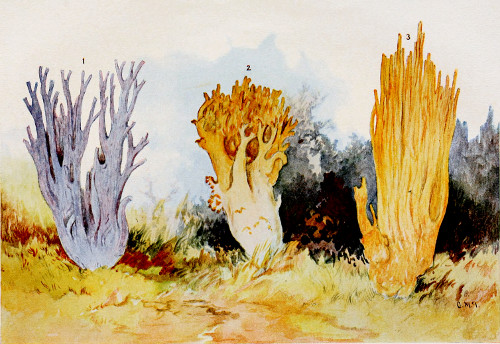
Grouped by F.D. Briscoe—Studies by C. McIlvaine Plate CXXXIX.
Fig. Page. Fig. Page.
1. Clavaria amethystina, 516 3. Clavaria formosa, 520
2. Clavaria aurea, 520
C. muscoi´des—muscus, moss. Height 1–1½ in., slightly tufted, yellow. Stem slender, tomentose at base, becoming two or three times forked. Branchlets thin, tapering, crescent-shaped, acute.
Spores white, subglobose, 5–6µ Massee.
In pastures.
517North Carolina, Schweinitz, Curtis; Ohio; New York, Peck, 47th Rep.
Edible. Curtis.
C. Her´veyi Pk. Gregarious or subcespitose, simple or with a few branches, often compressed or irregular, scarcely 1 in. high, golden-yellow, sometimes brownish at the apex. Flesh white. Branches when present, short, simple or terminating in few or many more or less acute denticles. Spores globose, 7.5µ broad, minutely roughened; mycelium white.
Ground under hemlock trees. Orono, Me. September. F.L. Hervey.
Allied to C. fastigiata and C. muscoides, but distinct from both by its more irregular and less branching character and by its larger spores. Peck, 45th Rep. N.Y. State Bot.
Near Haddonfield, N.J., August, 1890, among scrub pines and spruce. A pretty species of medium flavor.
** Plant white, gray or yellowish.
C. coralloi´des Linn. Height 2–4 in., usually tufted, growing into each other, white. Trunk thick, short, much branched. Branches repeatedly forked, compressed, hollow within, fragile, dilated upward, tips crowded acute.
Occasionally the branches do not develop entirely and are obtuse; they then somewhat resemble in shape C. rugosa, but are not wrinkled.
Spores pale-ochraceous, pointed, 10×8µ Massee.
Indiana, H.I. Miller; West Virginia, New Jersey, Pennsylvania, McIlvaine.
A common edible species in Europe. Common in United States.
The writer has eaten it for many years. It is not always tender. It should be young, fresh, and the branches alone cooked. It requires slow, patient cooking if at all old. It does dry well, as stated by some writers, but it does not wet well again.
(Plate CXL.)
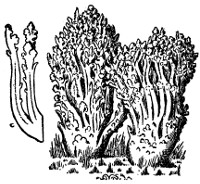
Clavaria cinerea. Two-thirds natural size.
C. cine´rea Bull.—cinis, ashes. (Plate CXL.) Height 1–3 in., gregarious or tufted, sometimes in rows. Gray. Stem either thin or thick, short, lighter than branches. Branches very numerous compressed, 518wrinkled, irregular, somewhat obtuse or flattened and divided into slender points.
Its gray color easily distinguishes it from others. It is variable in its mode of growth and in its shape.
On ground in woods. Common. June to frost.
Eatable, but injurious in quantities. Cordier. Edible, but provokes indigestion in delicate stomachs. Leuba.
Eaten generally in Europe. In France it is called pied de coq.
Plentiful in United States, in mixed woods. June to frost.
The writer and his friends have eaten it for fifteen years, and know of no Clavaria equalling it.
C. tetrago´na Schw.—Four-angled. Very fragile, deep orange-yellow, twice forked. Stem and branches quadrangular, 1–1½ in. tall.
Moist shady places.
New York. Ground in shaded places. August and September. Poughkeepsie, Gerard, Peck, 24th Rep.; North Carolina, Schweinitz, Curtis; Pennsylvania, Schweinitz.
Edible. Curtis.
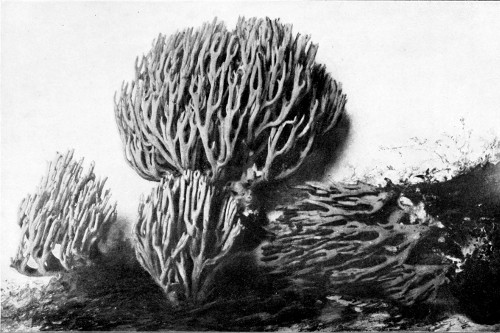
Photographed by Dr. J.R. Weist. Plate CXLI. CLAVARIA CRISTATA.
C. crista´ta Pers.—crista, a crest. (Plate CXLI, p. 518.) Height 1–5 in., whitish, tufts of broad flattened branches cut on margins or crested. Base short, stout. Branches numerous, irregular, flattened upward and divided like moose horns, tough, stuffed, dingy. This peculiarity distinguishes it and separates it from C. coralloides.
Spores pale ochraceous, pointed, 10×8µ Massee.
Woods. Common. Summer and autumn. Indiana, H.I. Miller; West Virginia, Pennsylvania, New Jersey, McIlvaine.
Edible. Curtis.
After a summer rain the crested Clavaria is usually abundant where there is good encouragement of mossy beds or mats of rich wood-soil in woods where leaves and mold accumulate. It is not as tender as 519many other species, but chopped fine and stewed slowly for an hour it will be eaten with enjoyment.
C. rugo´sa Bull.—ruga, a wrinkle. White or dingy, simple or tufted, 2–4 in. high, branched from the base with irregular blunt branches wrinkled lengthwise, sometimes thickened upward.
Distinguished by the distinct, irregular, longitudinal wrinkles.
Spores white, irregularly globose, 8–10µ Massee.
In woods, solitary or gregarious. August to November.
North Carolina, Schweinitz, Curtis. Pennsylvania, Ohio.
It is reported edible by Dr. Curtis, M.C. Cooke and Dr. Badham.
C. pyxida´ta Pers.—pyxis, a small box. Tufted, light tan-color, shaded with red, 1–3 in. high. Stem or trunk thin, smooth, variable in length, dividing into many erect forked branches, which are cup-shaped at the tips. The margins of these tips have slender branchlets issuing from them (proliforme).
Distinguished by the cup-like tips. Spores white, 4×3µ Massee.
On rotten wood, on rotten roots in ground. June and into the autumn.
North Carolina, Schweinitz, Curtis; Pennsylvania, McIlvaine.
Specimen sent by writer to Prof. Peck, June, 1897, and identified by him. Not tested by writer, but is in Dr. Curtis' list of edible species.
C. subtil´is Pers. Scattered, slender, subtenaceous, pallid-white, bases smooth and of equal thickness, branches few, forked, subfastigiate.
North Carolina, Schweinitz, Curtis; Pennsylvania.
Edible. Curtis.
C. den´sa Pk. Tufts 2–4 in. high, nearly as broad, whitish or creamy-yellow, branching from the base. Branches very numerous, nearly parallel, crowded, terete, somewhat wrinkled when dry, the tips dentate, concolorous. Spores slightly colored, elliptical, 7.5–10×5–8.5µ.
Ground in woods. Selkirk. August.
Apparently closely allied to C. condensata, but differing decidedly in color. Peck, 41st Rep. N.Y. State Bot.
Specimens identified by Professor Peck.
520Large masses of it grew at Mt. Gretna, Pa., July, August and September, 1898, in mixed woods.
Brittle; when young it is very compact. It is without much flavor, but stews tender and makes a good dish.
B. Spores Ochraceous or Cinnamon.
** Plant yellow or dingy ochraceous.
C. au´rea Schaeff.—aurum, gold. (Plate CXXXIX, fig. 2, p. 516.) Trunk thick, elastic, pallid. Flesh white, dividing into numerous thick branches that become repeatedly divided in a dichotomous manner upward, and terminate in slender, erect, round, yellow branchlets. Spores pale ochraceous, elliptical, 10–11×5–6µ.
In woods. Forming large tufts 2–3 in. high, colorless or almost so below, tips yellow. Massee.
North Carolina, Curtis; Ohio, Alabama. Found in West Virginia, 1882; Devon, Angora, Eagle’s Mere, Mt. Gretna, Pa.; Haddonfield, N.J. August and September. McIlvaine.
Eaten in Europe. Edible. Curtis.
In structure it reminds one of a miniature cropped Lombardy poplar. The color is not bright, but dingy-yellow. Resembles C. flava; distinguished by different color of spores. The branches (not stem) are tender and good.
Var. rufes´cens Schaeff.
This plant occurs after heavy rains. It sometimes grows in continuous rows several feet in extent. The pinkish-red tips of the branches fade with age. The axils are rounded and the plant is quite fragile. Fries considers it a variety of C. aurea. Peck, 25th Rep. N.Y. State Bot.
Found at Springton, Chester county, Pa., August, 1887. It is edible and good. The plant is tender and easily cooked.
C. formo´sa Pers.—formosus, finely formed. (Plate CXXXIX, fig. 3, p. 416.) Height 2–4 in. Trunk 1 in. and more thick, whitish or yellowish, elastic. Branches numerous, crowded, elongated, divided at ends into yellow branchlets which are thin, straight, obtuse or toothed.
Spores ochraceous 9×3–4µ Massee; elongated, oval, rough, 16×8µ W.G.S.
521On ground in woods, in large tufts, frequently in rows several feet long.
North Carolina, Schweinitz, Curtis; Pennsylvania, New Jersey, McIlvaine.
Esteemed in Europe. Edible. Dr. Curtis.
Common in the United States in woods. Variable. An orange-rose color is sometimes prominent on the tips. The tenderer portions of the plant are excellent, but must be well cooked.
C. spinulo´sa Pers.—spined. Height 2–3 in. high. Stem ½-1 in. thick. Trunk stout, short, whitish. Branches numerous, crowded, erect, tense, elongated, tapering upward. Color cinnamon-brown or darker.
Spores ochraceous, elliptical, 11–13×5–6µ Massee.
On ground in pine woods. August to October.
New York, Peck, 24th Rep.; New Jersey, Sterling; Pennsylvania, McIlvaine.
Of same edible quality as C. aurea, which it resembles, excepting that it is darker and less abrupt in the ending of its clusters.
C. flac´cida Fr.—flaccidus, flaccid. Height 1–3 in., bright ochraceous, slender. Stem short, smooth, sometimes wanting, thin, 1–2 lines thick, repeatedly branched. Branches crowded, unequal, flaccid, upper ones forcep-shaped, pointed. Does not turn green when bruised like C. abietina. The whitish mycelium creeps over the leaves on which it grows. Brittle, tender, flesh white.
Spores ochraceous, broadly elliptical 4–5×3µ K.
Received from E.B. Sterling, Trenton, N.J.
Two specimens eaten. These were quite dry. After soaking they were tender and had good flavor.
(Plate CXLII.)
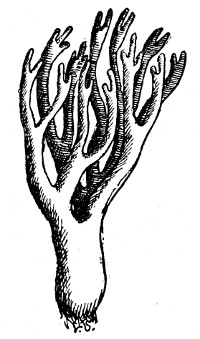
Clavaria circinans. (After Peck.)
C. cir´cinans Pk.—circino, to make round. (Plate CXLII.) Stem short, solid, dichotomously or subverticillately branched. Branches slightly diverging or nearly parallel, nearly equal in length, the ultimate ones terminating in two or more short acute concolorous ramuli. Spores ochraceous.
Plant 1–2 in. high, obconic in outline, flat-topped, appearing almost 522as if truncated, pallid or almost whitish in color, generally growing in imperfect circles or curved lines.
Under spruce and balsam trees. Adirondack mountains. August. Peck, 39th Rep. N.Y. State Bot.
Where pines have grown, but where now oak and chestnut trees make rather open woods, it grows at Mt. Gretna, Pa. A stumpy fungus impressing one as stunted. Its texture is solid. It does not cook tender, but yields a fungus flavor to the cooking medium.
** Growing on wood.
C. stric´ta Pers.—stringo, to draw tight. Height 2–3 in. Color pale dull-yellow becoming brown when bruised. Stem distinct, thick, short. Branches numerous, repeatedly forked, straight, closely pressed, tips pointed.
Spores dark cinnamon, Fries; creamy yellow 4×6µ W.G.S.
Var. fu´mida. The whole plant is a dingy, smoky-brownish hue, otherwise of the typical form. Catskill mountains. September. In the fresh state the specimens appear very unlike the ordinary form, but in the dried state they are scarcely to be distinguished. Peck, 41st Rep. N.Y. State Bot.
Eaten in Germany.
This form occurs in West Virginia mountains and at Mt. Gretna, Pa., Trenton, N.J., in August and September, among leaves in mixed woods. It compares favorably with the ordinary run of Clavaria.
C. dicho´toma God.—dividing by pairs. Cespitose, white; branches regularly dividing by pairs, elongated, flexuous, diverging, somewhat compressed, extremities obtuse, rounded at or just below the apex broadly compressed.
On the ground, under beeches.
“Notwithstanding its beauty this is dangerous. In 1883, when it was very plentiful, I saw entire families sick from it and in 1888 there was a repetition with new victims. 523“It produces nausea, vertigo and violent diarrhea.” Leuba.
I have not seen the plant.
Synco´ryne. Gr—together, a club.
Clubs almost simple, tufted at the base.
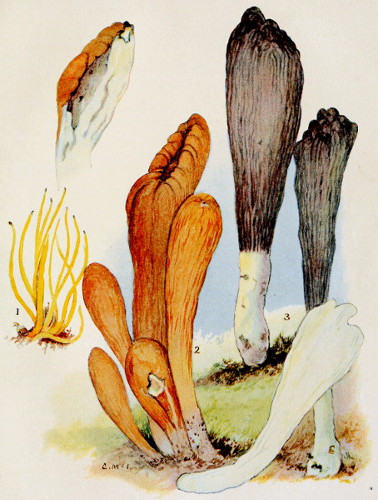
Grouped by F.D. Briscoe—Studies by C. McIlvaine. Plate CXXXVIII.
Fig. Page. Fig. Page.
1. Clavaria fusiformis, 523 3. Clavaria pistillaris (dark var.), 524
2. Clavaria pistillaris (yellow var.), 524
C. fusifor´mis Sow.—fusus, a spindle. (Plate CXXXVIII, fig. 1, p. 522.) Yellow, cespitoso-connate, slightly firm, soon hollow. Clubs somewhat fusiform, simple and toothed, even, attenuated to the base which is of the same color. Stevenson.
Spores pale yellow, globose, 4–5µ Massee.
Closely resembles C. inæqualis Fl. Dan.
Woods and pastures. August to November.
Received from E.B. Sterling, Trenton, N.J., August, 1897.
The clubs are 1⁄16 in. through, 4 in. high, light clear yellow, translucent, clustered in groups of four or five united at the base.
Tender, well flavored, cooks easily.
C. auran´tio-cinnabari´no Schw.—aurantius, orange; cinnabaris, vermilion. Orange-red; base white with a sub-hairy powder; clubs simple, flexuous, fleshy, somewhat tenacious, fasciculate, thickened in the middle and attenuated toward either end, at first cylindrical then compressed, 6–7 mm. thick, 2–4 in. high.
Pennsylvania. On the ground among rhododendrons.
Received from E.B. Sterling, Trenton, N.J.
The plant when fresh is a beautiful rose color, inclining to orange at the tips. It reminds one of the peach-blow vase color in some of its shades. The single clubs, growing in cluster, to the height of four inches, graceful in outline, exquisitely shaded, are a sight one lingers over. While they invite the mycophagist to eat them, his voracity is checked by their beauty. They are tender and delicious. It is regrettable that thus far it has not been reported in quantity.
C. inæqual´is Fl. Dan.—unequal. Height 2–3 in. club-shaped, yellow, gregarious, single or in loose tufts, fragile, stuffed. Clubs club-shaped or almost equal, simple, sometimes forked or variously cut at tip, one color.
Spores colorless, elliptical, 9–10×5µ Massee.
524Woods and pastures. August to October.
Distinguished from C. fusiformis by the tips not being sharp-pointed and colored.
North Carolina, Schweinitz; New Jersey, Sterling.
This Clavaria is quite common in New Jersey. Its clusters are clear bright yellow and conspicuously pretty. The clubs are translucent and smooth. Excepting in color it resembles C. aurantio-cinnabarino. In the many specimens seen there was nothing to suggest the propriety of the name, excepting height of clubs.
A dish of it is a delicacy.
C. vermicula´ris Scop.—vermis, a worm. Height 1–2½ in., white, tufted. Clubs simple, quill-shaped, stuffed, awl-shaped, brittle, pointed.
Spores white, elliptical, 4×3µ Massee.
New York, North Carolina, Pennsylvania, Ohio. Thin grassy woods and among grass. July to October.
Edible. Cordier.
Common in southern New Jersey, and in warm soils from June to frost. When growing among grass it is not conspicuous and is often missed unless specially sought for. Its purity, its choice of refreshing abode, its excellent qualities, make it select among Clavaria.
Holoco´ryne. Gr—entire; Gr—a club.
Clubs almost simple, distinct at the base.
C. pistillar´is L.—pistillum, a pestle. (Plate CXXXVIII, figs. 2, 3, p. 522.) Height 2–12 in., up to 1 in. and more thick, color light yellow, ochraceous, brownish, chocolate. Clubs Indian-club shape, ovate-rounded, puckered at top, simple, fleshy, white within, spongy, exterior smooth or more or less wrinkled, usually with smooth base.
Spores white, 10×5µ W.G.S.; 9–11×5–6µ Massee.
Mixed woods, moss and grassy places. August until November.
North Carolina, Pennsylvania, California, Alabama.
Eaten in Poland, Russia and Germany.
The writer first found this truly club-like species in West Virginia in 1882, and ate it. But few specimens were found, and those of a dark chocolate color. At Mount Gretna in 1897 and 1898 the yellow variety 525grew in considerable quantity from July until after frost. The largest specimen found measured 5½ in. and was 1 in. in diameter at its thickest part. The average height is 2½ in. Both varieties grew in mixed woods from the leaf-covered ground. They are often clustered, four or five together, and of different sizes. The surface, especially of the dark variety, is regularly, vertically wrinkled, truncated in few places, very much resembling that of the Craterellus cantharellus. The stems of both are white. The apex of the clubs is folded inward as though pulled by drawing-strings.
The flesh is soft, white, fine grained. A slight bitter is present in the dark variety, when raw, which entirely disappears upon cooking. This is one of the best of Clavariæ.
C. clava´ta Pk. Simple, straight, clavate, obtuse, smooth, not hollow, yellow when fresh, rugose-wrinkled and orange-colored when dry, 4–6 lines high.
Damp shaded banks by road-sides. Sandlake. June. Peck, 25th Rep. N.Y. State Bot.
Patches of it are conspicuous—golden-hued upon somber background. They are seen at Eagle’s Mere, Mt. Gretna, and on the Springton Hills, Pa., along wooded road-sides. Raw, they have a mild, pleasant flavor, and have the same when cooked. A small species seldom found in sufficient quantity to make a comforting dish.
526
FAMILY VI.—TREMELLA´CEÆ Fr.
Whole fungus homogeneous, gelatinous, shrivelling when dry, reviving when moistened, pervaded internally with branched filaments, terminating toward the surface all round in sporophores. Spores transparent, from globose to sausage-shape and curved, sometimes septate. Fries.
The Tremellaceæ, as their name signifies, tremble, because jelly-like when moist. They are hard, tough, horny when dry, but swell and become gelatinous when wet. In the typical genus, Tremella, there is often but little consistency. Whoever has climbed an old rail fence on a rainy day has had the doubtful pleasure of acquaintance with some of them. Sections for the microscope are obtainable by hardening them in alcohol.
There are several edible species in the family. They are good in soups, giving them flavor and body, and some are excellent when stewed.
SYNOPSIS OF GENERA.
Sub-Family—Auricularieæ. Page 528.
Auricularia.
Broadly attached, margin free and reflexed. (No edible species reported.)
Hirneola. Page 528.
Cartilaginous, ear-shaped, attached by a point.
Sub-Family—Tremellineæ. Page 529.
Exidia.
Cup-shaped, truncate, or irregularly lobed; spores reniform, producing curved sporidiola on germination. (No edible species reported.)
Ulocolla.
Pulvinate and gyrose; spores reniform, producing rod-shaped sporidiola on germination. (No edible species reported.)
527Tremella. Page 529.
Brain-like or lobed; spores globose or ovoid.
Næmatelia.
Firm, convex, with a central hard nucleus. (No edible species reported.)
Gyrocephalus.
Erect, spathulate. (No edible species reported.)
Tremelledon. Page 533.
Gelatinous, tremelloid, fan-shaped, fleshy; hymenium with distinct spines.
Sub-Family—Dacryomyceteæ.
Dacryomyces.
Small, pulvinate and gyrose. (No edible species reported.)
Guepinia.
Irregularly cup-shaped, hymenium on one surface only. (No edible species reported.)
Dacryopsis.
Hymenium at the apex of a short stem, bearing conidia and spores. (No edible species reported.)
Ditiola.
Stem distinct, bearing the hymenium at its expanded apex. (No edible species reported.)
Apyrenium.
Subglobose or lobed, hollow. (No edible species reported.)
Calocera.
Subcylindrical and erect, simple or branched (No edible species reported.)
528Sub-Family—Auricularieæ.
HIRNE´OLA Fr.
Hirnea, a small jug.
Gelatinous, rather cartilaginous, soft and tremulous when moist, but not distended with jelly, horny when dry, becoming somewhat cartilaginous when moistened. The hard skin forming the hymenium, which covers the cup-shaped cavity and is of a different color, can be separated entire after a thorough soaking in water. Sporophores (spore-bearing processes) not involved in jelly. Spores oblong, curved. Fries.
A very peculiar and distinct genus separated from the neighboring genera by its disk-like, somewhat cup-shaped cavity and by its not being distended with jelly.
(Plate CXLIII.)
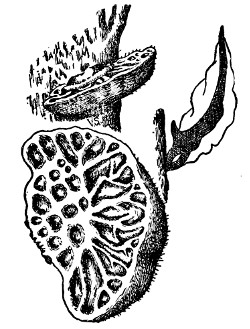
Hirneola auricula-Judea. About two-thirds nat. size.
H. auri´cula—Jude´a (Linn.) Berk.—Jew’s ear. 1–4 in. across, thin, and flexible when moist, hard when dry, date-brown or blackish. Hymenium venoso-plicate (vein-plaited), forming irregular depressions such as are in the ear, yellowish-gray or grayish beneath and hairy. The large depressions or corrugations branch from smaller ones near the center of the plant.
Spores 20–25×7–9µ Massee.
H. auricula-Judea is not very particular in the trees it patronizes. Elm, maple, hickory, balsam-fir, spruce, alder bear it. When the plant grows on upright timber it usually turns upward. It is not generally reported in the United States.
Ohio, Maryland, Miss Banning; Indiana, H.I. Miller; New York, Peck; New Jersey, Pennsylvania, West Virginia, McIlvaine. Extensively used in China, where eating it probably antedates all European records by several thousand years. It is brought there dried from Tahiti in great quantities and made into soup.
The writer has found and eaten several specimens of it. It is not as tender as other gelatinous species, but it is an oddity that pleases.
529Sub-Family—Tremellineæ.
TREMEL´LA Dill.
Tremo—to tremble.
Distended with jelly when moist, tremulous, without a defined margin and without nipple-like elevations. Spore-bearing processes globose, becoming divided into four parts, each division producing an elongated free point terminating in a simple spore. Fries.
Distinguished by its peculiarly convoluted habit and jelly-like substance, which is more or less inclined to be cartilaginous.
Exidia, similar in form, is separated by possessing minute nipple-like elevations and Hirneola by its distinct difference in form.
Generally growing on dead wood; some species are found on trees and others on the ground, etc.
Old tradition, in many countries, attests that the Tremellas are Fairy bread, and T. albida the choicest baking. Pretty, indeed, must have been the feasts when piles of such purity filled the board, and the brilliant Pezizae were wassail cups.
They are better suited to Fairy appetites than to those of mortals; being watery their nutritive value is small. Nevertheless they have dainty flavor.
So far as tested no suspicion rests upon Tremellæ.
ANALYSIS OF TRIBES.
Mesenterifor´mes (Gr—the mesentery). Page 530.
Gelatinous inclining to cartilaginous, foliaceous, naked.
Cerebrinæ (cerebrum, the brain). Page 530.
Firm, then pulpy, somewhat pruinose with the spores.
Crusta´ceæ (crusta, a crust).
Diffused, becoming plane.
Tuberculifor´mes (tuberculum, a little tuber).
Small, somewhat erumpent.
530I.—Mesenterifor´mes. Gelatinous, inclining to cartilaginous.
T. fimbria´ta Pers.—fimbriæ, fringe. Olivaceous inclining to black, cespitose, clusters 2–3 in. high and even broader, erect, corrugated; lobes flaccid, incised at the margin, undulately fringed.
When soaked with water it has a dark tawny tinge. Stevenson.
Spores subpyriform.
On roots, dead branches, stumps, rails, etc.
From July to December, 1898, tufts five inches in diameter grew from an oak stump close by the writer’s cottage at Mt. Gretna, Pa. These tufts dried, and revived after rain into a gelatinous condition. They were nibbled at raw, and several were cooked. Tufts were found elsewhere in the same woods and eaten by others. They were unanimously approved. The species dries hard, like thin glue, but is darker. A dried piece swells in the mouth, grows tough, and has but little taste. Flavor develops in cooking.
T. lutes´cens Pers.—luteus, yellow. Yellowish, cespitose, small, cluster ½-1 in. broad, very soft, circling in wavy, undulating folds; lobes entire, naked.
Inclining to be fluid. Whitish when young. Stevenson.
Spores subglobose, 12–16µ diameter Massee.
North Carolina, common. Curtis. On decaying branches, stumps, etc. July to February.
It dries and revives, or swells with moisture, very soft and tremulous.
Edible. Leuba.
II.—Cerebrinæ. Firm then pulpy, etc.
(Plate CXLIV.)
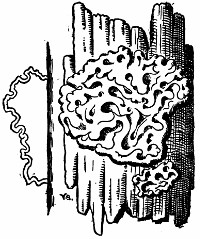
Tremella mesenterica. Natural size.
T. mesenter´ica Retz. Gr—the mesentary. Gelatinous but firm, bright orange-yellow, variously contorted; lobes short, smooth, pruinose with the white spores at maturity. Spores broadly elliptical, 6–9µ diameter; conidia 1–1.5µ diameter.
On dead branches. Very variable in 531form but known by the bright orange color. From ½-2 in. across. Massee.
North Carolina. Common, edible. Curtis; California, Ohio, West Virginia, New Jersey, Pennsylvania. McIlvaine. Dr. J.R. Weist, Richmond, Ind., November, 1898, sent me fine specimens.
Very common as an apparent exudation from sticks, branches and rails. It can usually be collected in quantity from June until far into the winter. It can be found in every month in the year.
During the civil war the writer’s first attempt at making a dish of cornstarch resulted in getting it into knots. T. mesenterica, when stewed, very much resembles these same knots. It has a mild, woody flavor, slightly sweet, and is good.
(Plate CXLIVa.)
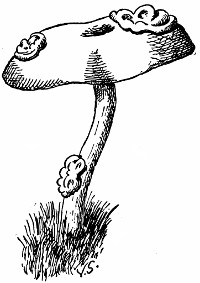
Tremella mycetophila on Collybia dryophila. (After Peck.)
T. myceto´phila Pk. (Plate CXLIVa.) Suborbicular, depressed, circling in folds, tremelloid-fleshy, slightly pruinose, yellowish or pallid, 4–8 lines broad. Peck, 28th Rep. N.Y. State Bot.
Haddonfield, N.J., August, 1895. McIlvaine.
Professor Peck notes it as found parasitic upon Collybia dryophila.
I found T. mycetophila growing parasitic upon Marasmius oreades, August, 1894. The mass was 2 in. in diameter. Separating them was taking the host from the parasite. Cooked it is glutinous, tender—like calf’s head. Rather tasteless.
T. al´bida Huds.—albidus, whitish. Whitish, becoming dingy-brown when dry, 1 in. broad, ascending, tough, expanded, undulated, somewhat circling in folds, powdered. Stevenson.
Spores oblong, obtuse, curved, 2-guttate, subhyaline, 12–14×4–5µ K.
Where birch, sugar-maple, hickory are in abundance the T. albida will be found. At Eagle’s Mere and Springton, Pa., and other wooded places, it is common during the warm months. It has slight taste, sweet, woody, but makes a pleasant dish.
532T. intumes´cens Eng. Bot.—intumesco, to swell up. Gelatinous; subcespitose, rounded, broken up into numerous tortuous lobes, brown, shining, obscurely dotted, becoming darker when dry. Spores oblong, slightly curved, 12–14×3–4µ.
From 1–2 in. across. Massee.
Entire year, but dried or frozen during winter, swelling in wet weather.
North Carolina. Common. Curtis. West Virginia, Pennsylvania, New Jersey, McIlvaine.
T. intumescens is not rare in West Virginia, or where beech logs are in plenty, though it does not confine itself to beech. It occurs on maples and some other woods.
It resembles the T. mesenterica in taste, but is sweeter. It is not as large, but is equally good.
533TREMEL´LODON Pers.
Tremo, to tremble.
Gelatinous, pileate, prickly below, spines awl-shaped, equal. Fries.
The members of this genus resemble in form the section Mesopus of Hydnum and have the same awl-shaped spines, but differ in their gelatinous consistency and fructification.
(Plate CXLV.)
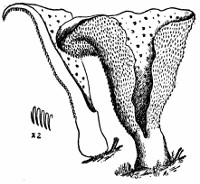
Tremellodon gelatinosum.
T. gelatino´sum Pers.—gelatina, jelly. Pileus covered with a greenish-brown bloom, gelatinous, tremulous, dimidiate, somewhat stipitate, covered with small pimples. Spines soft, glaucous.
On fir, trunks and sawdust. September to October. Stevenson.
Of singular beauty, almost translucent with steel-blue tints shading into violet, while the spines are of a pure soft white.
Spores round, somewhat irregular, white, 2µ W.G.S.
Can not be confounded with any. The only gelatinous spiny fungus.
North Carolina, Schweinitz, Curtis; Pennsylvania, Massachusetts, Farlow, Frost; New York, Peck, Rep. 22. T. gelatinosum is well distributed over the United States but is not reported in quantity. It is an autumnal grower, lasting well into the winter. The writer found specimens near Haddonfield, N.J., in February, 1894, and sent them to Professor Peck. It is delicious when slowly stewed.
534