Sub-Class BASIDIOMYCETES (continued 6)
Reading edition
Stew. It is one of the very best in patties, croquettes, etc.
(Plate LXV.)
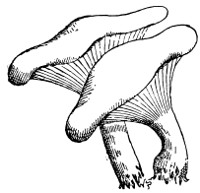
Clitopilus orcella. Two-thirds natural size.
C. Orcel´la Bull.—Pileus fleshy, soft, plane or slightly depressed, often irregular, even when young, slightly silky, somewhat viscid when moist, white or yellowish-white. Flesh white, taste and odor farinaceous. Gills deeply decurrent, close, whitish then flesh-colored. Stem short, solid, flocculose, often eccentric, thickened above, white. Spores elliptical, 9–10×5µ.
Generally a little smaller than the preceding species, softer and more irregular, but so closely allied that by some it is considered a mere variety of it. It is said to be edible and of delicate flavor. It occurs in wet weather in pastures and open places. Peck, 42d Rep. N.Y. State Bot.
Grows in oak woods, Angora, West Philadelphia; Mt. Gretna, Pa.
Qualities same as C. prunulus. Delicious.
C. pascuen´sis Pk.—pasture. Pileus fleshy, compact, centrally depressed, glabrous, reddish or pale yellowish, the cuticle of the disk cracking into minute areas. Gills rather narrow, close, decurrent, 257whitish, becoming flesh-colored. Stem short, equal or tapering downward, solid, glabrous, colored like the pileus. Spores subelliptical, pale incarnate, 7.5–10×5–6µ.
Pileus 2–3 in. broad. Stem 8–18 lines long, 4–6 lines thick.
Pastures. Saratoga county.
The species is related to C. prunulus from which it is distinct by its shorter, paler spores, its glabrous pileus cracked in areas on the disk and tinged with red or yellowish and by its paler gills. From C. pseudo-orcella it differs in its glabrous pileus with no silky luster and in its closer gills. Its odor is obsolete but it has a farinaceous flavor. It is probably esculent, but has not been found in sufficient quantity to afford a test of qualities. Peck, 42d Rep. N.Y. State Bot.
C. unitinct´us Pk.—one-colored. Pileus thin, submembranaceous, flexible, convex or nearly plane, centrally depressed or umbilicate, glabrous, subshining, often concentrically rivulose, grayish or grayish-brown. Flesh whitish or grayish-white, odor obsolete, taste mild. Gills narrow, moderately close, adnate or slightly decurrent, colored like the pileus. Stem slender, straight or flexuous, subtenacious, equal, slightly pruinose, grayish-brown, with a close white myceloid tomentum at the base and white root-like fibers of mycelium permeating the soil. Spores elliptical, 7.5×5µ.
Var. al´bidus. Whitish or grayish-white, not rivulose. Gills broader. Spores brownish flesh-color.
Pileus 6–16 lines broad. Stem about 1 in. long, 1 line thick.
Woods of pine or balsam. Albany and Essex counties. Autumn.
The variety is a little paler than the typical form, with gills a little broader, but is probably not specifically distinct. Peck, 42d Rep. N.Y. State Bot.
I have not seen this species. Edibility not reported.
B. Spores Angular or Irregular.
1. Pileus not hygrophanous.
C. aborti´vus B. and C.—abortive. (Plate LXIII, fig. 1, 2, 3, p. 254.) Pileus fleshy, firm, convex or nearly plane, regular or irregular, dry, clothed with a minute silky tomentum, becoming smooth with age, gray or grayish-brown. Flesh white, taste and odor subfarinaceous. 258Gills thin, close, slightly or deeply decurrent, at first whitish or pale gray, then flesh-colored. Stem nearly equal, solid, minutely flocculose, sometimes fibrous-striated, colored like or paler than the pileus. Spores irregular, 7.5–10×6.5µ.
Pileus 2–4 in. broad. Stem 1.5–3 in. long, 3–6 lines thick.
Ground and old prostrate trunks of trees in woods and open places. August and September.
Our species has been found to be edible, but its flavor is scarcely as agreeable as that of some other species. Peck, 42d Rep. N.Y. State Bot.
It requires longer cooking than C. prunulus, and is then quite equal in excellence.
The fungus is so named because of the abortive form of it frequently found associated with it. This is faithfully portrayed on Plate LXIII. This is in every way similar to the aborted forms of C. prunulus and Armillaria mellea.
Both forms plentiful near Philadelphia. The undeveloped masses are also similar to those of C. prunulus.
The abortive form is a superior edible to the original.
C. popina´lis Fr.—popina, a cook-shop. Pileus 1–2 in. across, flesh thin, flaccid, convex then depressed, somewhat wavy, glabrous, opaque, gray, spotted and marbled. Flesh grayish-white, unchangeable. Gills very decurrent, broader than the thickness of the flesh of the pileus, lanceolate, crowded, dark-gray, at length reddish from the spores. Stem stuffed, 1–2 in. long, 2 lines thick, equal, often flexuous, naked, paler than the pileus. Spores subglobose, slightly angular, 4–5µ Massee.
Solitary or gregarious, smell pleasant like new meal, entirely gray. Fries.
Woods. Gansevoort. July. The whole plant is of a grayish color except the mature gills, which have a flesh-colored hue, and the base of the stem, which is clothed with a white tomentum. It has a farinaceous odor. Peck, 51st Rep. N.Y. State Bot.
Scattered. Mt. Gretna, Pa. September to November. McIlvaine.
Edible, pleasant.
C. carneo-al´bus Wither.—light flesh color. Pileus up to 1 in. 259across, convex then expanded, center becoming depressed and the margin drooping, even, polished, white, the disk becoming usually tinged with red. Flesh thin. Gills slightly decurrent, 1 line broad, crowded, salmon color. Stem 1–1½ in. long, 1 line thick, about equal, solid, white. Spores globose, nodulose, 7–8µ diameter.
Inodorous; gregarious.
In the section given in Cke. Illustr., the stem is represented as being distinctly hollow. Massee.
New York, shaded ground. June. Peck, 45th Rep.
C. al´bogri´seus Pk.—pale-gray. Pileus firm, convex or slightly depressed, glabrous, pale-gray, odor farinaceous. Gills moderately close, adnate or slightly decurrent, grayish then flesh-colored. Stem solid, colored like the pileus. Spores angular or irregular, 10–11×7.5µ.
Pileus 6–12 lines broad. Stem 1.5–2.5 in. long, 1–2 lines thick.
Woods. Adirondack mountains. August. Peck, 42d Rep. N.Y. State Bot.
Scattered. Mt. Gretna, Pa., woods. August to October. McIlvaine.
Edible, pleasant.
C. mi´cropus Pk.—short-stemmed. Pileus thin, fragile, convex or centrally depressed, umbilicate, silky, gray, usually with one or two narrow zones on the margin, odor farinaceous. Gills narrow, close, adnate or slightly decurrent, gray, becoming flesh-colored. Stem short, solid, slightly thickened at the top, pruinose, gray with a white mycelium at the base. Spores angular or irregular, 10×6µ.
Pileus 6–12 lines broad. Stem 8–10 lines long, 1 line thick.
Thin woods. Essex and Rensselaer counties. August.
This species is closely allied to the preceding one, but may be separated from it by its short stem and silky umbilicate subzonate pileus. Both species are rare and have been observed only in wet, rainy weather. Peck, 42d Rep. N.Y. State Bot.
Scattered markedly umbilicate. Mt. Gretna, Pa., woods. August, September. McIlvaine.
Edible, pleasant.
2602. Pileus hygrophanous.
C. subvi´lis Pk.—small value. Pileus thin, centrally depressed or umbilicate, with the margin decurved, hygrophanous, dark-brown and striatulate on the margin when moist, grayish-brown and silky shining when dry, taste farinaceous. Gills subdistant, adnate or slightly decurrent, whitish when young, then flesh-colored. Stem slender, brittle, rather long, stuffed or hollow, glabrous, colored like the pileus or a little paler. Spores angular, 7.5–10µ.
Pileus 8–15 lines broad. Stem 1.5–3 in. long, 1–2 lines thick.
Damp soil in thin woods. Albany county. October.
The species is allied to C. vilis, from which it is separated by its silky-shining pileus, subdistant gills and farinaceous taste. Peck, 42d Rep. N.Y. State Bot.
Scattered. Mt. Gretna, Pa. September to November. McIlvaine.
Edible, pleasant.
C. Wood´ianus Pk. Pileus thin, convex or nearly plane, umbilicate or centrally depressed, hygrophanous, striatulate on the margin when moist, whitish or yellowish-white and shining when dry, the margin often wavy or flexuous. Gills close, adnate or slightly decurrent, whitish, then flesh-colored. Stem equal, flexuous, shining, solid, colored like the pileus. Spores subglobose, angular, 6–7.5µ.
Pileus 1–2 in. broad. Stem 2–3 in. long, 2 lines thick.
Ground and decayed prostrate trunks in woods. Lewis county. September.
This species is perhaps too closely allied to the preceding, but it may easily be separated by its paler color, closer gills and solid stem, though this is sometimes hollow from the erosion of insects. Peck, 42d Rep. N.Y. State Bot.
C. Un´derwoodii Pk.—in honor of L.M. Underwood. Pileus rather thin but fleshy, nearly plane or slightly depressed in the center, even, whitish. Gills narrow, close, slightly decurrent, pale flesh-colored. Stem rather short, equal or slightly tapering upward, solid, whitish. Spores subglobose, 4–5µ long.
Pileus 6–18 lines broad. Stem about 1 in. long and 2 lines thick.
261Syracuse and Jamesville. September and October. L.M. Underwood. Peck, 49th Rep. N.Y. State Bot.
Spores Rosy-red.
C. erythro´sporus Pk. Gr—red-spored. Pileus thin, hemispherical or strongly convex, glabrous or merely pruinose, pinkish-gray. Flesh whitish tinged with pink, taste farinaceous. Gills narrow, crowded, arcuate, deeply decurrent, colored like the pileus. Stem equal or slightly tapering upward, hollow, slightly pruinose at the top, colored like the pileus. Spores elliptical, 5×3–4µ.
Pileus 1–2 in. broad. Stem 1–1.5 in. long, 2–3 lines thick.
Decayed wood and among fallen leaves in woods. Albany and Ulster counties. September and October.
The species is easily recognized by its peculiar uniform color, its narrow, crowded and generally very decurrent gills and by its bright rosy-red spores. Sometimes individuals occur in which the gills are less decurrent. Peck, 42d Rep. N.Y. State Bot.
Mt. Gretna, Pa., among fallen leaves. Sparsely gregarious. September to November. McIlvaine.
Edible, good.
C. conis´sans Pk.—dusted. Pileus thin, convex, glabrous, pale alutaceous, often dusted by the copious spores. Gills close, adnate, reddish-brown. Stem slender, brittle, hollow, cespitose, white. Spores narrowly elliptical, 7.5×4µ.
Pileus 1–1.5 in. broad. Stem 1–2 in. long, 1–2 lines thick.
Base of an apple tree. Catskill mountains. September.
Remarkable for the bright rosy-red spores which are sometimes so thickly dusted over the lower pilei of a tuft as to conceal their real color. The species is very rare. Peck, 42d Rep. N.Y. State Bot.
Spores Very Pale Flesh-Colored, Merely Tinted.
C. cæspito´sus Pk.—tufted. Pileus at first convex, firm, nearly regular, shining, white, then nearly plane, fragile, often irregular or eccentric, glabrous but with a slight silky luster, even, whitish. Flesh white, taste mild. Gills narrow, thin, crowded, often forked, adnate or slightly 262decurrent, whitish, becoming dingy or brownish-pink. Stems cespitose, solid, silky-fibrillose, slightly mealy at the top, white. Spores 5×4µ.
Pileus 2–4 in. broad. Stem 1.5–3 in. long, 2–4 lines thick.
Thin woods and pastures. Ulster county. September.
This is a large, fine species, very distinct by its cespitose habit, white color and very pale sordid-tinted spores. But for the color of these the plant might easily be taken for a species of Clitocybe. The tufts sometimes form long rows. Peck, 42d Rep. N.Y. State Bot.
Mt. Gretna, Pa. October. McIlvaine.
Tender, not much flavor.
C. Noveboracen´sis Pk.—New York Clitopilus. Pileus thin, convex, then expanded or slightly depressed, dingy white, cracked in areas or concentrically rivulose, sometimes obscurely zonate, odor farinaceous, taste bitter. Gills narrow, close, deeply decurrent, some of them forked, white, becoming dingy, tinged with yellow or flesh-color. Stem equal, solid, colored like the pileus, the mycelium white, often forming white branching root-like fibers. Spores globose, 4–5µ broad.
Var. brevis. Margin of the pileus, in the moist plant, pure white. Gills adnate or slightly decurrent. Stem short.
Pileus 1–2 in. broad. Stem 1–2 in. long, 1–3 lines thick.
Woods and pastures. Adirondack mountains, Albany and Rensselaer counties. August to October.
The plant is gregarious or cespitose. Sometimes, especially in the variety, it grows in lines or arcs of circles. The margin is often undulated, and in the variety it is, when fresh and moist, clothed with a film of interwoven webby white fibrils which give it a peculiar appearance, and if the spore characters are neglected it might be mistaken for Clitocybe phyllophila. The disk is often tinged with reddish-yellow or rusty hues when moist, and its rivulose character is then more distinct. A farinaceous odor is generally present, especially in the broken or bruised plant, but its taste is bitter and unpleasant. Sometimes bruises of the fresh plant manifest a tendency to assume a smoky-brown or blackish color. The base of the stem is sometimes clothed with a white mycelioid tomentum. Peck, 42d Rep. N.Y. State Bot.
C. Sey´mourianus Pk.—Pileus fleshy, thin, broadly convex or slightly depressed, even, pruinose, whitish with a dark lilac tinge, sometimes 263lobed and eccentric. Gills narrow, crowded, decurrent, some of them forked at the base, whitish with a pale flesh-colored tint. Stem equal, silky-fibrillose, hollow. Spores minute, globose or nearly so, 3.5–4µ long.
Pileus 1–2.5 in. broad. Stem 1.5–2.5 in. long, 3–4 lines thick.
Woods. Lewis county. September. Peck, 42d Rep. N.Y. State Bot.
LEPTO´NIA Fr.
Gr—slender.
(Plate LXVI.)
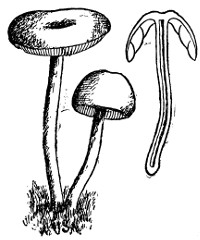
Leptonia.
Rosy-spored. Stem cartilaginous, tubular (the tube stuffed or hollow), polished, somewhat shining. Pileus thin, umbilicate or with a darker disk, cuticle fibrillose or separating into darker scales, margin at first incurved. Gills at first adnexed or adnate but readily separating. Fries.
The Leptoniæ are related to the Clitopili as the Collybiæ are to the Clitocybæ. The species are small, elegant, brightly colored, inodorous (except A. incanus), and abound in rainy weather. Gregarious or growing in troops; on the ground, commonly on dry mossy pastures, but also in marshy places. Stevenson.
Six American species reported. I have not seen any.
264NOLA´NEA Fr.
Nola, a little bell.
(Plate LXVII.)
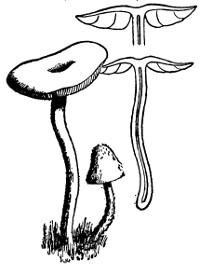
Nolanea pascua. About natural size.
Rosy-spored. Stem tubed, the tube more rarely stuffed with a pith, cartilaginous. Pileus somewhat membranaceous, bell-shaped, somewhat papillate, striate and sometimes even, sometimes also clothed with flocci, margin straight and at the first pressed to the stem, and not involute. Gills free or adfixed, and not decurrent. Fries.
Nolanea agrees with Leptonia and Eccilia among the pink-spored species. It corresponds with Mycena, Galera and Psathyra. Several Entolomata are nearly allied. The species are thin and slender, commonly inodorous and fragile, though some of them are tough. Growing on the ground in summer and autumn. Stevenson.
Seven American species reported. None seen by writer. Peck, Rep. 24, 26, 35, 39, 50.
265ECCI´LIA Fr.
Gr—I hollow out.
(Plate LXVIII.)
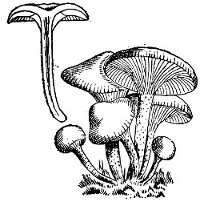
Eccilia atropuncta. Two-thirds natural size.
Stem cartilaginous, tubular (the tube hollow or stuffed), expanded upward into the pileus, which is somewhat membranaceous and at the first turned inward at the margin. Gills attenuated behind, truly decurrent, becoming more so when the pileus is depressed, and not separating as those of Nolanea.
Corresponding in structure with Omphalia of the white-spored and Tubaria of the brown-spored series. Allied to Clitopilus in the decurrent gills, but separated by the cartilaginous, smooth stem.
(Plate LXIX.)
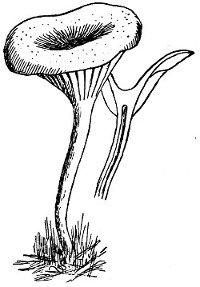
Eccilia carneo-grisea. Natural size. Eccilia atropuncta.
E. car´neo-gri´sea B. and Br.—caro, flesh; griseus, gray. Pileus about 1 in. broad, gray flesh-color, umbilicate, striate, delicately dotted, margin slightly glittering with dark particles. Stem about 1½ in. long, slender, fibrous-hollow upward, wavy, of the same color as the pileus, shining, smooth, white-downy at the base. Gills adnato-decurrent, somewhat undulated, distant, rosy, the irregular margin darker. Stevenson.
Spores irregularly oblong, rough, 7×5µ Massee.
Nova Scotia, Dr. Somers.
New Jersey, E.B. Sterling, August, 1897; Eagle’s Mere, Pa., common under pines, McIlvaine.
266This neat little species is sweet and pleasant raw, and when cooked makes an agreeable dish. European authorities give the taste as unpleasant, but there is nothing of the sort about the American representative.
CLAU´DOPUS Smith.
Claudus—lame; pous—a foot.
(Plate LXX.)
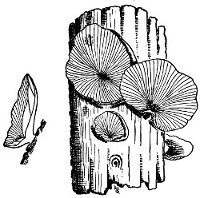
Claudopus variabilis. Natural size.
Pileus eccentric, lateral or resupinate. Spores pinkish.
The species of this genus were formerly distributed among the Pleuroti and Crepidoti, which they resemble in all respects except the color of the spores. The genus at first was made to include species with lilac-colored as well as pink spores, but Professor Fries limited it to species with pink spores. In this sense we have taken it. The spores in some species are even, in others rough or angulated. The stem is either entirely wanting or is very short and inconspicuous, a character indicated by the generic name. The pileus often rests upon its back and is attached by a point when young, but it becomes turned backward with age. The species are few and infrequent. All inhabit decaying wood.
SYNOPSIS OF THE SPECIES.
Pileus yellow C. nidulans
Pileus white or whitish 1
1. Spores even C. variabilis
1. Spores angulated. C. depluens
Pileus gray or brown 2
2. Pileus striatulate when moist C. Greigensis
2. Pileus not striatulate C. byssisedus
Peck, 39th Rep. N.Y. State Bot.
267C. ni´dulans Pers.—nidus, a nest. Pileus 1–3 in. broad, stemless, attached by the pileus or rarely narrowed behind into a short stem-like base, caps often overlapping one another, suborbicular or kidney-shaped, downy, somewhat pointed-hairy or scaly-hairy toward the margin, yellow or buff color, the margin at first turned inward. Lamellæ rather broad, moderately close or subdistant, orange-yellow. Spores even, slightly curved, 6–8µ long, about half as broad, delicate pink.
Decaying wood. Sandlake. Catskill and Adirondack mountains. Autumn.
This fungus was placed by Fries among the Pleuroti, and in this he has been followed by most authors. But the spores have a delicate pink color closely resembling that of the young lamellæ of the common mushroom, Agaricus campestris. We have, therefore, placed it among the Claudopodes, where Fries himself has suggested it should be placed if removed at all from Pleurotus. Our plant has sometimes been referred to Panus dorsalis Bosc., but with the description of that species it does not well agree. The tawny-color, spoon-shaped pileus, pale floccose scales, short lateral stem and decurrent lamellæ ascribed to that species are not well shown by our plant. The substance of the pileus, though rather tenacious and persistent, can scarcely be called leathery. The flesh is white or pale yellow. The hairy down of the pileus is often matted in small tufts and intermingled with coarse hairs, especially toward the margin. This gives a scaly or pointed-hairy appearance. The color of the pileus is often paler toward the base than it is on the margin. Peck, 39th Rep. N.Y. State Bot.
Mt. Gretna, Pa., November, 1898, decaying stumps. McIlvaine.
An autumnal species growing upon wood. Not common.
The light yellow tomentosity of the cap arranges itself into shapes as fascinating as crystals of snow.
Taste pleasant, mild. Texture more solid than P. ostreatus, consequently tougher. It is edible but not desirable. Must be chopped fine and cooked well. 268
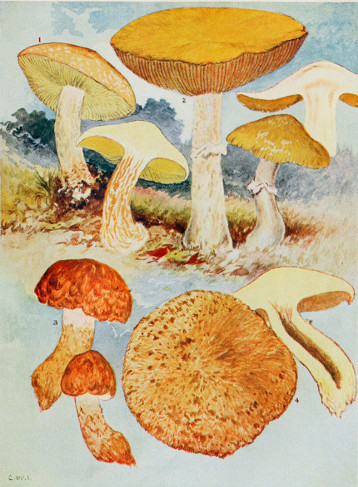
Grouped by F.D. Briscoe—Studies by C. McIlvaine. Plate LXXI.
Fig. Page. Fig. Page.
1. Hebeloma glutinosum, 283 3. Pholiota squarrosa, 273
2. Pholiota caperata, 270 4. Pholiota subsquarrosa, 275
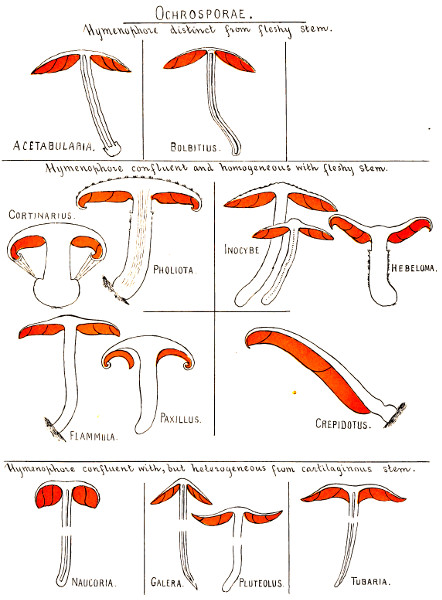
Plate LXXIa. Chart of genera in brown-spored series—Ochrosporae.
Series III. OCHRO´SPORÆ (Dermini). Spores brown.
Ochrosporæ, third in color series, ranges in spore color from dull ochraceous, through bright ocher, to rusty orange and ferruginous or iron-rust. The various shades will tax even a color expert.
There are no species in the series corresponding to Amanitæ. In Acetabularia there is a cup-like volva; in Pholiota there is a distinct interwoven ring on the stem; in Cortinarius the secondary veil is like a cobweb, and may form an imperfect zone around the stem, or hang as fibers from the margin of the cap; Pluteolus exactly resembles Pluteus.
There are many edible species of good quality in the series. None are known to be poisonous. The substance, as a rule, is tougher than in most of the preceding genera, and in many instances has a strong woody flavor. Several species are late growers, and are among the best of fungi. Notably in Pholiota.
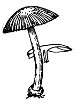
ACETABULA´RIA Berk.
Acetabulum, a vinegar-cup. From the cup-like volva.
Universal veil distinct from the pileus; hymenophore distinct; gills free; spores pallid, tawny or brown.
Analogous to Volvaria and Chitonia.
No American species reported.
269PHOLIO´TA Fr.
Gr—a scale.
Pileus more or less fleshy. Gills adnate, with or without a decurrent tooth, tawny or rust colored at maturity from the spores. Flesh of stem continuous with that of the pileus. Ring distinct, interwoven. Spores sepia-brown, bright yellowish-brown or light red.
Generally on wood, sometimes on the ground in damp moss, frequently densely cespitose. Some of the species are large and bright colored. Distinguished from all other genera of the brown-spored series by the possession of a distinct ring. In Cortinarius the veil and ring are web-like.
Stevenson notes in his description of the genus: “None are to be commended as edible.” My investigation shows that there are several delicious species, notably P. squarrosa and subsquarrosa. Their lateness and plentifulness make them valuable food fungi. I have nothing but praise for the entire genus.
ANALYSIS OF TRIBES.
A. Humigeni (humus, ground; gigno, to bear). Page 270.
On the ground, rarely cespitose.
* Eudermini. Gr—well; dermini, the brown-spored series.
Spores ferruginous.
** Phæoti. Gr—dusky.
Spores dusky rust-colored.
B. Truncigeni (truncus, a trunk; gigno, to bear). Page 273.
On wood; subcespitose.
* Ægeritini. P. ægerita, the type of the section.
Pileus naked, not scaly, sometimes cracked. Gills pallid, then reddish or dusky. None known to be edible.
** Squamosi—squama, a scale.
Pileus scaly, not hygrophanous. Gills becoming discolored.
* Gills not becoming purely rust-colored.
** Gills yellow, then rust-color or tawny.
*** Hygrophani. Gr—moist; to appear.
Gills cinnamon, not at first yellow.
270C. Muscigeni (muscus, moss; gigno, to bear).
Hygrophanous. Like Galera with a ring.
A. Humigeni. On ground.
* Eudermini. Spores ferruginous.
P. capera´ta Pers.—capero, to wrinkle. (Plate LXXI, fig. 2, page 268.) Pileus 3–5 in. broad, more or less intensely yellow, fleshy, but thin in proportion to its size and robust stem, ovate then expanded, obtuse, viscid only when moist and not truly so, even at the disk, wrinkled in pits at the sides, incrusted with white superficial flocci. Stem 4–6 in. long, more than 1 in. thick, solid, stout, cylindrical with exception of the base which is often tuberous, shining white, scaly above the ring, which is membranaceous, reflexo-pendulous, and broken into squamules at the apex. Gills adnate, crowded, thin, somewhat serrated, clay-cinnamon.
When young the pileus is incrusted with the veil or with white mealy-floccose soft, hairy down, which is crowded on the even disk and scaly towards the thin pitted-furrowed margin; and as this separates the pileus is naked. Veil universal, floccoso-mealy, at the first cohering in the form of a volva but not continuous; in rainy weather remaining in the form of a volva at the base. Spores dark ferruginous on a white ground, paler on a black ground. There is a smaller form (A. macropus Pers.) in pine woods, pileus even and paler. Stem 3 in. long, and without a tuberous base. Ring oblique and often incomplete. Stev.
Spores 10µ B. and Br.; 12×4µ W.P.; spheroid-ellipsoid, uniguttate, 11–12×8–9µ K.; 12×4.5µ Massee.
Not previously reported.
This fungus occurs sparingly in rich woods near Boston. It is much esteemed in Germany, and eagerly sought by the common people, who call it familiarly the “Zigeuner” (Gypsy). Boston Myc. Club Bull. 1896.
I have found this species in but one place—on the south hill of the great Chester valley, Pa., where it grows plentifully in woods. The taste raw was slightly acrid, but when cooked this disappeared. Many ate of the species and enjoyed it.
271P. togula´ris Bull.—togula, a little cloak. From the ample ring. Pileus 1½ in. broad, pallid ochraceous, fleshy, soft, bell-shaped then expanded, obtuse, orbicular, without striæ, smooth. Flesh thin, soft, becoming yellow. Stem 3–4 in. long, 2 lines thick, tubed, rigid, equal, cylindrical, rough with stiff fibers, naked and becoming yellow at the apex, becoming dingy brown downward. Ring medial, more than 1 in. distant, entire, spreading-reflexed. Gills adnato-separating, ventricose, crowded, narrowed in front, becoming yellow, at length pale rust-color, never becoming dingy brown.
Protean, slender, very variable in stature, growing in troops. b. More slender, but densely gregarious, with the wholly pallid smooth stem thinner, often flexuous. This form is exactly A. mesodactylus Berk. c. Very small. Pileus 1 in. Stem 1 in. or a little more, scarcely 1 line thick, very flexuous, becoming rust-color. Stevenson.
Spores elliptical, 8×3.5µ Massee.
New Jersey, on decayed chips mixed with dirt. May, 1898. E.B. Sterling.
Not previously reported.
The specimens sent were tested and found to be of good quality.
** Phæ´oti. Spores fuscous—ferruginous (dingy rust-color).
P. du´ra Bolt.—durus, hard. Pileus 3 in. and more broad, tawny, tan-color, becoming dingy brown, fleshy, somewhat compact, convexo-plane, obtuse, smooth, then cracked into patches, margin even. Stem commonly curt, 2 in. long, about ½ in. thick, stuffed, even solid, hard, becoming silky-even, then longitudinally cracked when dry, thickened at the apex, mealy and more than usually widened into the pileus, varying ventricose and irregularly-shaped. Ring torn. Gills adnate, striato-decurrent with a tooth, ventricose, ½ in. broad, livid then dingy rust-color.
The stem is abundantly furnished with fibrillose rootlets at the base. Although very closely allied to A. præcox, it is readily distinguished by its rust-color or brown-rust spores. Stevenson.
Spores 9×5µ W.G.S.; 8–9×5–6µ Massee.
Haddonfield, N.J. June to October. Florist’s garden, McIlvaine.
After rains P. dura appears, solitary, from spring to autumn. The 272cracked cap, in mature specimens, distinguishes it from other species found on its habitat. It varies in size from 1½ in. up to 4 in. across. The caps are excellent.
(Plate LXXII.)
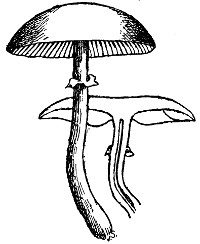
Pholiota præcox. After Peck.
P. præ´cox Pers.—præcox, early. Pileus 1–2 in. broad, convex or nearly plane, soft, nearly or quite glabrous, whitish, more or less tinged with yellow or tan-color. Gills close, adnexed, at first whitish, then brownish or rusty-brownish. Stem 1.5–3 in. long, 2–2.5 lines thick, rather slender, mealy or glabrous, stuffed or hollow, whitish. Spores elliptical, rusty-brown, 10–13×6–8µ.
The Early Pholiota is a small but variable species. From other similarly colored species that appear in grassy ground early in the season, the collar on the stem will generally distinguish it. Its cap is usually convex when young but nearly flat in the mature plant. It is rather pale in color but not a clear white, being tinted with yellow or pale tan-colored hues. The gills are whitish when the cap first opens, but they soon change to a rusty-brown hue in consequence of the ripening of the spores. They are excavated at the inner extremity and slightly attached to the stem. They are ventricose when the cap is fully expanded. The stem is rather slender, nearly or quite straight and soon smooth and hollow. It is pale or whitish, and usually furnished with a small collar. Sometimes the collar is slight and disappears with age and sometimes the fragments of the veil remain attached to the margin of the cap leaving nothing for a collar.
The plants usually grow in grassy ground, lawns and gardens, and appear from May to July.
Var. minor Batt. is a small form having the cap only about 1 in. broad and the remnants of the veil adherent to the margin of the cap. It is represented by figures 6 to 12.
Var. sylvestris Pk. has the center of the cap brownish or rusty-brown, and grows in thin woods. Peck, 49th Rep. N.Y. State Bot.
273Spores inclining to fuscous, spheroid-ellipsoid, 8–13×5–7µ K.; 8×6µ W.G.S.; 8–13×6–7µ Massee.
West Virginia, New Jersey, North Carolina, Pennsylvania, May to August. On rich ground, lawns, gardens, etc. McIlvaine.
Coming as it does in early spring, it is a prized species wherever found.
The caps only are good.
B. Truncigeni. On wood.
** Squamosi. Scaly.
(Plate LXXIII.)
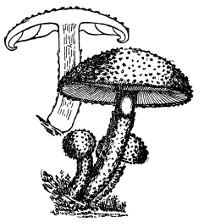
Pholiota squarrosa. One-half natural size.
P. squarro´sa Mull.—squarrosus, scurfy. (Plate LXXI, fig. 3, page 268.) Pileus 3–5 in. broad, saffron-rust-color, scaly with innate, crowded, revolute, darker (becoming dingy brown), persistent scales, fleshy, convex bell-shaped then flattened, commonly obtusely umbonate or gibbous, dry. Flesh light-yellow, compact when young, sometimes thin. Stems curt when young, as much as 8 in. long when full-grown, as much as 1 in. thick at the apex, remarkably attenuated downwards, stuffed, scaly as far as the ring with crowded, revolute, darker scales. Ring only slightly distant from the apex, rarely membranaceous, entire or often slashed, generally floccoso-radiate, of the same color as the scales. Gills adnate with a decurrent tooth, crowded, narrow, pallid-olivaceous then rust-color.
Spores ferruginous. Very cespitose, forming large heaps. Stems commonly cohering at the base, varying very much in stature in the 274same cluster; varying also much thinner, scarcely ever curved-ascending. Odor heavy, stinking; sometimes, however, obsolete. Stevenson.
Spores ellipsoid, 7–8x4–5µ K.; 4x5µ W.G.S.; 8x4µ Massee.
On trunks of trees, on and near stumps, etc. Common. August to December.
West Virginia, 1881–1885, New Jersey, Pennsylvania. On rotten wood and stumps. August to long after frost. McIlvaine.
Edible. Curtis.
The American species, as I have repeatedly found it, is not so large as given in the European description, and the habitat is more closely confined to the trunks of standing trees and stumps not much decayed. It is a showy species, to be seen from afar off, especially after the leaves fall. Taste when young, raw, is sweet, mealy; when mature, like stale lard.
Cooked, the caps are of good substance and flavor. One of the very best.
P. squarrosoi´des Pk.—squarrosus, scurfy; eidos, form. Pileus firm, convex, viscid when moist, at first densely covered by erect papillose or subspinose tawny scales, which soon separate from each other, revealing the whitish color and viscid character of the pileus. Lamellæ close, emarginate, at first whitish, then pallid or dull cinnamon color. Stem equal, firm, stuffed, rough with thick squarrose scales, white above the thick floccose ring, pallid or tawny below. Spores minute, elliptical, 5×4µ.
Densely cespitose, 3–6 in. high. Pileus 2–4 in. broad. Stem 3–5 lines thick.
Dead trunks and old stumps of maple. Adirondack and Catskill mountains. Autumn.
This is evidently closely related to A. squarrosus, with which it has, perhaps, been confused, but its different colors and viscid pileus appear to warrant its separation. Peck, 31st Rep. N.Y. State Bot.
Occurred in large clusters on sugar maples at Eagle’s Mere in October, and on stumps at Mt. Gretna. It very closely resembles P. squarrosa. Its caps are of the very best.
275P. subsquarro´sa Fr.—sub, under; squarrosus, scurfy. (Plate LXXI, fig. 4, p. 268.) Pileus 2 in. and more broad, brown rust-color, with darker, adpressed, floccose scales, fleshy, convex, obtuse or gibbous, viscid. Stem 3 in. long, 4–5 lines thick, stuffed (often hollow when old), equal, yellow-rust-color, clothed with darker scales which are adpressed, or spreading only at the apex, not rough, furnished with an annular zone at the apex, becoming yellow-rust-color within. Gills deeply sinuate, emarginate, almost free, arcuate, crowded, at first pale then dingy yellow.
Spores rust-color. The pileus is viscid, but not glutinous like that of A. adiposus. It holds a doubtful place between A. aurivellus and A. squarrosus, departing from both, however, in the gills being at the first yellow; and from A. squarrosus, to which it is more like, in the gills being emarginato-free, not decurrent. Somewhat cespitose. Almost inodorous. Fries.
Spores ferruginous, size not stated.
West Philadelphia, Mt. Gretna, Pa., Haddonfield, N.J. September until after frosts. McIlvaine.
Not previously reported.
The maple trees in West Philadelphia frequently show large clusters of it up to twenty feet from ground; to be seen from afar after the leaves have fallen. Our American species differs somewhat from the European. American species:
Pileus 1–3 in. across, fleshy, convex, very viscid, rich brownish-yellow, covered with darker adpressed floccose scales. Flesh slightly yellow. Gills white when very young slightly emarginate, adnexed, crowded, ¼ in. broad, brown. Stem 2–3 in. long, ½ in. thick, equal or tapering toward base, stuffed, then hollow, covered with squamose scales as far up as the slight ring, smooth above ring. Ring membranaceous, slight.
Spores rust-color.
The species is variable and differs greatly in youth and maturity.
The caps, fried in hot buttered pan, are unexcelled.
Equally fine in croquettes and patties.
276** Gills yellow, then rust-color.
(Plate LXXIV.)
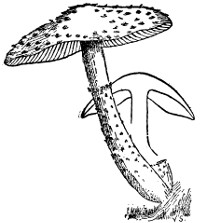
Pholiota adiposa. About natural size.
P. adipo´sa Fr.—adeps, fat. Pileus fleshy, firm, at first hemispherical or subconical, then convex, very viscid or glutinous when moist, scaly, yellow. Flesh whitish. Gills close, adnate, yellowish becoming rust-color with age. Stem equal or slightly thickened at the base, scaly below the slight radiating floccose ring, solid or stuffed, yellow, generally rust-color at the base. Spores elliptical, 7.6×5µ.
The Fat pholiota is a showy species. Its tufted mode of growth, rather large size, yellow color and rusty-brown scales make it a noticeable object. The stem is somewhat and the cap very viscid when moist, and this viscidity when dry gives it a shining appearance. The scales of the cap become erect or reflexed and sometimes appear blackish at the tips. They sometimes disappear with age. The flesh is firm and white or whitish. The gills when young are yellow or pale-yellow, but when mature they assume a ferruginous or rusty color like that of the spores. The stem is similar in color to the cap, but paler or nearly white at the top and usually reddish-brown or rusty-brown at the base. The collar is slight and often scarcely noticeable in mature specimens.
The Cap is 2–4 in. broad, the Stem 2–4 in. long and 4–6 lines thick. The plants commonly grow in tufts on stumps or dead trunks of deciduous trees in or near woods. They may be found from September to November. It is well to peel the caps before cooking. This species is not classed as edible by European authors, but I find its flavor agreeable and its substance digestible and harmless. Peck, 49th Rep. N.Y. State Bot.
Spores 8×5µ W.G.S.; elliptical, ferruginous, 7×3µ Massee.
Mt. Gretna, Pa. October until after frost. About trees and stumps and on logs. McIlvaine.
P. adiposa yields a substantial substance of good flavor.
277P. flam´mans Fr.—flamma, flame. Pileus 2–4 in. broad, yellow-tawny, fleshy, convex then plane, somewhat umbonate, absolutely dry, sprinkled with superficial, pilose, somewhat concentric, paler or sulphur-yellow, rough or curly scales; margin at first inflexed, then spread when larger. Flesh thin, light yellow. Stem 3 in. long, 2–3 lines thick, stuffed then hollow, equal, most frequently flexuous, very light yellow as are also the crowded rough scales. Ring membranaceous, entire, not far removed from the pileus, of the same color. Gills adnate and without a tooth, somewhat thin, crowded, at the first bright sulphur-yellow, at length rust-color, edge quite entire.
Pileus by no means hygrophanous. It is distinguished from all others by the sulphur-yellow scales on the tawny pileus. Forming small clusters. Inodorous. The ring is sometimes only indicated by an annular zone. Fries.
Spores ellipsoid, 4×2µ K.; ellipsoid, 3–4×2–2.5µ C.B.P.; 4×2µ W.P.; 8×4µ Massee.
Quite plentiful in the New Jersey pines, from October until after heavy frosts. Caps seldom over 3 in. across. Solitary, and in clusters of not over half a dozen.
The caps fried are delicious.
P. luteofo´lia Pk.—luteus, yellow; folium, a leaf. Pileus firm, convex, dry, scaly, fibrillose on the margin, pale-red or yellowish. Lamellæ broad, subdistant, emarginate, serrate on the edge, yellow, becoming bright rust-color. Stem firm, fibrillose, solid, colored like the pileus, often curved from the place of growth. Ring obsolete. Spores bright rust-color, 7×4µ.
Plant subcespitose, 2–3 in. high. Pileus 1–2 in. broad. Stem 3–5 lines thick.
Trunks of birch trees. Forestburgh. September.
The general appearance of this plant is like A. variegatus or reddish forms of A. multipunctus. The reddish color appears sometimes to fade with age. Peck, 27th Rep. N.Y. State Bot.
Eagle’s Mere, Pa. In clusters, on birch trees. August, 1898. McIlvaine.
Grows in quantity in the birch forests. The caps are delicious.
278P. ornel´la Pk. (Agaricus ornellus Pk., 34 Rep., p. 42.) Pileus convex or nearly plane, slightly squamose, reddish-brown tinged with purple, the margin paler, floccose-appendiculate. Gills moderately close, yellowish or pallid, becoming brown. Stem equal or slightly thickened upward, solid, squamulose, pale-yellow, sometimes expanded at the base into a brownish disk margined with yellowish filaments. Spores brown, elliptical, 6–7.5×4–5µ.
Plant 1–2 in. high. Pileus about 1 in. broad. Stem 1 line to 1.5 lines thick.
Decaying wood. South Ballston, Saratoga county. October.
The scales of the pileus are sometimes arranged in concentric circles. The purplish tint is not always uniform, but in some instances forms spots or patches. Peck, 34th Rep. N.Y. State Bot.
Specimens, clustered, found by me on railroad ties at Haddonfield, N.J., September, 1897, had caps 1–1½ in. broad, of a dull green without tinge of purple; skin minutely cracked, showing the white flesh in the interstices; stem 1–2 in. long, 3–4 lines thick, slightly thickened upward, pale orange, solid, squamulose; ring floccose; taste when raw, slightly bitter. These were sent to Professor Peck who wrote: “Appears to be a form of P. ornella Pk., but it differs some in color, being more of a green hue than of purple or olivaceous. It is pretty and I would like to know more about it before deciding on it fully.”
I have not since found it. Very palatable when cooked.
*** Hygrophani. Gills cinnamon, etc.
P. muta´bilis Schaeff.—changeable. Pileus about 2 in. broad, cinnamon when moist, becoming pale when dry, hygrophanous, slightly fleshy, convex then flattened, commonly obtusely umbonate, sometimes depressed, even and smooth, but when young occasionally scaly throughout. Stem about 2–3 in. long, 2 lines and more thick, rigid, stuffed then hollow, equal or attenuated downward, scaly-rough as far as the ring, rust-color, blackish or umber downward, often ascending or twisted. Ring membranaceous, externally scaly. Gills adnato-decurrent, crowded, rather broad, pallid then cinnamon. Stevenson.
Densely cespitose, variable in stature.
Spores ellipsoid-obovate, 6×11µ W.G.S.; 7×4µ W.P; 9–11×5–6µ Massee; 11×7µ Morgan.
Edible. Curtis. Considered excellent in Europe.
279P. margina´ta Batsch.—marginatus, margined. Pileus 1 in. and more broad, honey-colored when moist, tan when dry, hygrophanous, slightly fleshy, convex then expanded, obtuse, even, smooth, margin striate. Stem about 2 in. long, 1–2 lines thick, tubed, equal, fibrillose or slightly striate, not scaly, of the same color as the pileus, but becoming dingy-brown, and commonly white velvety at the base. Ring 1–2 lines distant from the apex, often in the form of a cortina and fugacious. Gills adnate, crowded, thin, narrow, at first pallid, then darker cinnamon.
It varies much, and is deceptive on account of the vanishing veil. In hedges there is a very small cespitose form with the pileus only ½ in. broad, and the stem tough and smooth, with exception of the remains of the fugacious cortina. There also occur on the ground among mosses smaller and paler forms, which must be carefully distinguished from A. unicolor, etc. Stevenson.
Spores 7–8×4µ Massee.
Haddonfield, N.J., November, December, 1896. In pine woods. McIlvaine.
The caps of this small Pholiota, seldom over 1 ½ in. across, can be gathered in goodly numbers where it frequents. They are of excellent quality.
P. dis´color Pk.—changing color. Pileus thin, convex, then expanded or slightly depressed, smooth, viscid, hygrophanous, watery-cinnamon and striatulate on the margin when moist; bright ochraceous-yellow when dry. Lamellæ close, narrow, pallid then pale rust-color. Stem equal, hollow, fibrillose-striate, pallid. Ring distinct, persistent. Spores elliptical, 7×5µ.
Plant subcespitose, 2–3 in. high. Pileus 8–16 lines broad. Stem 1 line thick.
Old logs in woods. Greig. September.
The change of color from the moist to the dry state is very marked. This species resembles Agaricus autumnalis, in which the annulus is fugacious and the spores are longer. The edge of the gills in both is white-flocculose. Peck, 25th Rep. N.Y. State Bot.
Two forms of this species are found. One has a scattered form of growth, the other found on decaying wood of birch is cespitose. The 280species is allied to P. marginata, from which it is readily distinguished by its viscid pileus. Peck, Rep. 44.
Var. discolor minor Pk. Small. Pileus 6–10 lines broad, chestnut color when young or moist. Stem about 1 line thick, at first clothed with whitish fibrils.
Among mosses about or on the base of stumps. September. Peck, Rep. 46.
West Virginia. Eagle’s Mere, Mt. Gretna, Pa. August to frost. On decaying wood. McIlvaine.
This little Pholiota is abundant where it does grow. In the West Virginia forests I have seen logs with many tufts of it upon each. The caps are fairly good.

281INO´CYBE Fr.
Gr—fiber; Gr—head.
(Plate LXXV.)
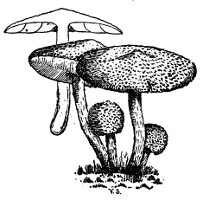
Inocybe lanuginosa. One-fourth natural size.
Universal veil somewhat fibrillose, concrete with the cuticle of the pileus, often free at the margin, in the form of a cortina. Gills somewhat sinuate (but they occur also adnate and in two species decurrent), changing color, but not powdered with cinnamon. Spores often rough, but in others even, more or less brownish-rust color.
Inocybe (with Hebeloma) corresponds with Tricholoma. Inocybe and Hebeloma have some common features, but they are really very distinct. Inocybe is readily distinguished by the fibrillose covering of the pileus, which never has a distinct pellicle, by the veil which is continuous and homogeneous with the fibrils of the pileus, and by the rusty-brown spores. All grow on the ground. They are (mostly) strong-smelling (commonly nauseous). None are edible. Stevenson.
None reported as either edible or poisonous. Those I have tested are not pleasant.

282PLUTE´OLUS Fr.
Dim. of pluteus, a shed.
Pileus conical or bell-shaped, then expanded, rather fleshy, viscid, margin at first straight and pressed to the stem. Gills free, rounded behind. Stem somewhat cartilaginous, its substance different from that of the pileus.
Growing on wood.
Spores rust or saffron color. Pluteus, the only genus having the same structure, is separated by its salmon-colored spores.
(Plate LXXVI.)
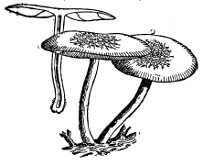
Pluteolus reticulatus. About natural size.
P. reticula´tus Pers.—rete, a net. From the net-work of veins on the pileus. Pileus slightly fleshy, bell-shaped, then expanded, sticky, reticulate with anastomosing veins, pale violaceous, striate on the margin. Lamellæ free, ventricose, crowded, rusty-saffron. Stem hollow, fragile, fibrillose, mealy at the top, white. Spores elliptical, ferruginous, 10–13×5–6.5µ.
Pileus 1–2 in. broad. Stem 1–2 in. long, 1–2 lines thick.
Decaying wood. Cattaraugus county. September.
The specimens which I have referred to this species appear to be a small form with the pileus scarcely more than an inch broad and merely wrinkled on the disk, not distinctly reticulate as in the type. In the dried specimens the pileus has assumed a dark violaceous color. The dimensions of the spores have been taken from the American plant. I do not find them given by any European author. Peck, 46th Rep. N.Y. State Bot.
In October, 1897, P. reticulatus grew in large quantities on a fallow lot close by the University of Pennsylvania, Philadelphia. The lot was thickly covered with tall heavy-stemmed weeds, a mat of which, from the year before was present. The reticulations upon the cap are intricate and distinct. I have not seen it since.
The whole plant is tender and of fine flavor.
283HEBELO´MA Fr.
Hebe, youth; loma, fringe.
Partial veil fibrillose or absent. Pileus smooth, continuous, somewhat viscid, margin at first incurved. Flesh of stem continuous with that of the pileus; fleshy, fibrous, clothed, top rather mealy. Gills attached, notched at the stem, edge inclined to be pale. Spores clay-colored.
On the ground.
Closely allied to Inocybe, formerly included in Hebeloma, but differing in the character of the cuticle of the pileus which in Inocybe is scaly or fibrillose. Many of the species are strong in smell and taste. None have hitherto been considered edible and some have been regarded as poisonous.
ANALYSIS OF TRIBES.
Indusiati (indusium, a garment). Page 283.
Furnished with a ring from the manifest veil, which often makes the margin of the pileus superficially silky.
Denudati (denudo, to lay bare). Page 286.
Pileus smooth. Veil absent. None known to be edible.
Pusillus (pusus, a little boy).
Pileus scarcely an inch broad. None known to be edible.
The writer has not as yet investigated the edible qualities of this genus to his satisfaction. Much work remains to be done. But two species of Hebeloma are given as edible. They are good, but do not rank above second-class. Several others have been tested, but not in sufficient quantity to report upon their quality with perfect safety. So far as tested the species have been harmless.
Indusia´ti. With a ring, etc.
H. mus´sivum Fr.—mussivus, undecided. (Uncertain in generic place.) Pileus 2–4 in. broad, either of one color, yellow or darker at the disk which is like a smooth sugar-cake, fleshy, compact, firm, convex 284then plane, unequal, very obtuse, viscid, at first smooth and even, margin bent inward, even, then commonly turning upward and broken up into scales. Flesh thick, becoming yellow. Stem 4 in. long, commonly 1 in. thick, very fleshy, sometimes stuffed, sometimes hollow at the top, equal or broad in the middle, wholly fibrillose and powdered at the top, light yellow. Veil fibrillose, very evanescent. Gills emarginate, somewhat crowded, 3 lines broad, dry (not distilling drops), at first light yellow, then together with the spores somewhat rust-colored.
Odor weak, not unpleasant. Very distinct. It departs widely from all the following species in its habit and bright colors. The habit is that of a Flammula or Cortinarius, but the gills are emarginate and not powdered; from the turned up pileus and from the stem being powdered at the top, and from other marks it is to be referred to Hebeloma. Fries.
Spores elliptical, 12×6µ Massee.
New Jersey, Haddonfield. Under pine trees. Solitary. Frequent. September, 1896. McIlvaine.
Not previously reported.
Taste, even raw, is pleasant. It is meaty and the meat is good. It requires slow cooking and is best chopped fine and served in patties or croquettes.
(Plate LXXVIa.)
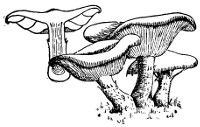
Hebeloma fastibile. One-fourth natural size.
H. fasti´bile Fr.—fastidibilis, loathsome. From the smell. Pileus 2 in. and more broad, pale yellowish, tan or becoming pale, compactly fleshy, convexo-plane, obtuse, somewhat wavy, even, smooth, the turned-in margin downy. Stem 2–3 in. long, ½ in. thick, solid, wholly fleshy-fibrous, stout, somewhat bulbous, often twisted, everywhere white-silky and fibrillose, white, but varying pallid, white-scaly upward. Cortina remarkable, white, occasionally in the form of a ring. Gills remarkably emarginate, somewhat distant, rather broad, at first becoming pale-white, then dingy clay-color, edge whitish, distilling drops in rainy weather.
Somewhat cespitose. Odor and taste of radish, bitterish. Like A. 285crustiliniformis; the odor is the same except that it is stronger, but it differs conspicuously in the manifest veil and somewhat distant gills.
Var. al´ba, stem longer, equal, somewhat hollow, fibrous-scaly at the apex, gills distant. A. spiloleucus Krombh., A. sulcatus Lindgr. is an elegant form with the margin of the pileus sulcate or rugoso-plicate.
In mixed woods. Common. July to October. Stevenson.
Spores 11×8µ W.G.S.; elliptical, pointed, 10×8µ Morgan.
Var. elegans. Pileus purple-brown.
This sometimes appears on disused mushroom beds in large quantities, but the method by which the spores gain access is involved in darkness.
“A very suspicious species and has the reputation of being noxious.” Cooke.
“There is considerable external resemblance between this and A. campestris. No fungus is so often mistaken for A. campestris as this dangerous plant.” W.G. Smith.
This species is considered noxious abroad. No test is reported of its qualities here.
I have not seen it.
H. glutino´sum Lind.—gluten, glue. (Plate LXXI, fig. 1, p. 268.) Pileus about 3 in. broad, yellow-white, the disk darker, fleshy, convex then plane, regular, obtuse, with a tenacious viscous gluten, and slimy in wet weather, sprinkled with white superficial scales. Flesh whitish, becoming light-yellow. Stem 3 in. long, stuffed, firm, somewhat bulbous, white-scaly and fibrillose, and white-mealy at the top, often rough with bundles of hairs at the base, at length rust-color within. Partial thread-like veil manifest, in the form of a cortina. Gills sinuato-adnate, somewhat decurrent, crowded, broad, pallid then light-yellowish, at length clay-cinnamon. Odor peculiar, mild.
On branches and among leaves, oak and beech. Frequent. September to December. Stevenson.
Spores 5×4µ W.P.; plum-shaped, 7µ Q.; elliptical, 10–12×5µ Massee; ellipsoid, 6–7×3–4µ K.
New York. Among fallen leaves and half-buried decaying wood, in thin woods. Conklingville. September. In wet weather the gluten is sufficiently copious to drop from the pileus. Peck, Rep. 40.
Haddonfield, N.J., among leaves in mixed woods. Frequent. 1896. 286Mt. Gretna, Pa., among leaves under oaks. Frequent. September to November. McIlvaine.
Caps 1½-3 in. across. Remarkably glutinous, shining as if varnished when wet. Partial veil not always noticeable.
The odor and taste are pleasant. The caps when well cooked are meaty, good, but of second quality.
Denuda´ti. Pileus smooth, etc.
H. crustulinifor´me Bull.—crustulum, a small pie; forma, form. Pileus pale-whitish tan, most frequently pale-yellowish or brick-color at the disk, fleshy, convexo-plane, obtuse or slightly gibbous with an obtuse umbo, somewhat spreading with an uneven margin, even, smooth, at first slightly viscid, not zoned. Flesh transparent when moist. Stem stuffed then hollow, stout, somewhat bulbous, white, naked, white-scaly at the top. Gills rounded-adnexed, crowded, narrowed, 1 line broad and linear, thin, whitish then clay-color, at length date-brown, the unequal edge distilling watery drops in wet weather, spotted when dry.
Veil quite wanting. Odor strong, fetid, of radish. Very variable in stature; the stem, however, is never elongated as in A. elatus, etc.; in smaller specimens equal, pileus regular, gills almost adnate.
In mixed woods. Common. August to November. Stevenson.
Spores ellipsoid, 10–12×5–7µ K.; 9×5µ W.G.S.
Var. mi´nor Cke. Smaller than the type.
Minnesota, common in woods, Johnson; California, H. and M.; Wisconsin, Bundy; New Jersey, Ellis; Vermont, Burt (Lloyd); New York, Peck, 41st Rep.; Mt. Gretna, Pa., November, 1898. In woods. McIlvaine.
But one specimen found and that was sent to Professor Peck. Taste bitter.
Regarded as poisonous by European writers. It is not reported as tested in America.

287FLAM´MULA Fr.
Flamma, a flame.
(In reference to the bright colors of many of the species.)
Pileus fleshy, margin at first turned inward. Veil fibrillose or none. Stem fleshy-fibrous, not mealy at the top. Gills decurrent or attached without a tooth. Spores mostly pure rust color; some brownish-rust, others tawny-ochraceous.
A few species grow on the ground, the majority on wood.
ANALYSIS OF TRIBES.
Gymnoti (naked). Page 288.
Pileus dry, generally scaly. Spores not yellowish.
Lubrici (lubricus, slimy). Page 289.
Pileus covered with a continuous, viscid, smooth, partly separable cuticle. Veil fibrillose. Spores not yellowish. Gregarious, on the ground, rarely on wood. Distinguished from Hebeloma by the gills not being sinuate and the top of the stem not mealy.
Udi (udus, moist). Page 290.
Veil slight, generally hanging in fragments. Cuticle of the pileus continuous, not separable, smooth, in places superficially downy, moist or slightly viscid in rainy weather. Spores not yellowish. Cespitose, growing on wood.
Sapinei (sapinus, pine). Page 291.
Veil silky, very slight, adpressed to the stem or forming a silky ring on it. Cuticle of pileus thin, the flesh splitting at the surface into scales, not viscid. Distinguished by the gills and spores being light yellow or tawny. Somewhat cespitose; always on pine or on the ground among pine branches.
Sericelli (sericeus, silky).
Cuticle of the pileus slightly silky, dry or at the first viscid.
None known to be edible.
288The genus Flammula is not represented in our territory by a large number of species. It is, nevertheless, not very sharply distinct from the allied genera, Pholiota, Hebeloma and Naucoria. From Pholiota it is especially separated by the slight development of the veil which is merely fibrillose or entirely wanting. It never forms a persistent membranous collar on the stem. From Hebeloma it may be distinguished by the absence of a sinus at or near the inner extremity of the gills, by the absence of white particles or mealiness from the upper part of the stem and by the brighter or more distinctly rusty or ochraceous color of the spores. From Naucoria the fleshy or fibrously fleshy stem affords the most available distinguishing character. The genus belongs to the Ochrosporæ or ochraceous-spored series, but the spores of its species vary in color from ochraceous or tawny-ochraceous to rust-color or brownish-rust color. The three things to be especially kept in mind in order to recognize the species are the color of the spores, the adnate or decurrent but not clearly sinuate gills and the fleshy or fibrously fleshy stem without a membranous ring.
Our species are mostly of medium size, none being very small and one only meriting the appellation large. They appear chiefly in late summer or in autumn and grow in woods or in wooded regions either on the ground or more often on decaying wood. Many are gregarious or cespitose in their mode of growth. Some have a bitterish or unpleasant flavor and none of our species has yet been classed as edible. Fries arranged the species in five groups, of which the names and more prominent characters are here given. Peck, 50th Rep. N.Y. State Bot.
The few species which the writer has found to be edible, and the two new species found by him, were tested after the publication of the above. Several of the species found are not mentioned herein for the reason that a sufficient quantity was not obtained to make certain their quality as a food. The bitterness, as far as observed, with which most of the species are tainted disappears in cooking.
Gymno´ti. Veil absent, pileus dry, etc.
F. alie´na Pk. Pileus thin, flexible, broadly convex, umbilicate, dry, bare, slightly striate on the margin when old, grayish or pale grayish-brown. Flesh white, fibrous. Gills thin, subdistant, bow-shaped, decurrent, ochraceous-brown. Stem firm, fibrous-striate, solid, 289slightly tapering upward, colored like the pileus, covered at the base with a dense white tomentum. Spores rusty-brown, globose, 5µ broad.
Pileus 3–5 cm. broad. Stem 5 cm. long, 4–6 mm. thick.
Gregarious on partly burned anthracite coal, Mt. Gretna, Pa. September. C. McIlvaine.
The species is peculiar in its color and habitat. In the dried specimen the gills have assumed a brown color with no ochraceous tint. Mr. McIlvaine remarks that it is an edible species, dries well, and is excellent when cooked. Its relationship is with F. anomala Pk., but it is a larger plant with darker color and a different habitat. Peck, Bull. Torr. Bot. Club, Vol. 26, F. 1899.
It grows on partly burned anthracite coal, not buried, as printed in the Torrey Bulletin. The mycelium completely involves the pieces of coal, holding them tightly in its meshes. Patches of it were strictly limited to the size of the ash-pile containing the partly burned coal. Quite fifty were found.
As stated, it is edible, and it is of remarkably fine substance for a Flammula.
Lu´brici. Pileus viscid, etc.
F. edu´lis Pk.—eatable. Pileus fleshy, convex, obtuse, glabrous, moist, brown, grayish-brown or yellowish-brown, sometimes rimose. Flesh whitish. Lamellæ rather broad, close, decurrent, bright tan color, becoming brownish-rusty. Stems cespitose, equal, stuffed or hollow, brown. Spores subelliptical, 13×5–6µ.
Pileus 2–3 in. broad. Stem 2–3 in. long, 3–6 lines thick.
Grassy ground, along pavements, in gutters and by the side of wooden frames of hotbeds. Haddonfield, N.J. October. C. McIlvaine.
The collector of this species informs me that the flavor of the fresh plant is slightly bitter, but that this disappears in cooking and the fungus furnishes a very good and tender article of food. Successive crops continued to appear for a month. In the dried specimens the stem is striate. Peck, Bull. Torr. Bot. Club, Vol. 24, No. 3.
This new species appears annually in the same place. I have not found it elsewhere. It is meaty and excellent.
290Udi. Pileus smooth, not viscid; veil fragmentary, etc.
(Plate LXXVIb.
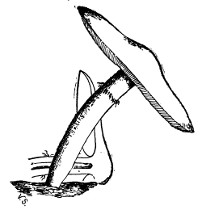
Flammula alnicola. Two-thirds natural size.
F. alni´cola Fr.—alnus, alder; colo, to inhabit. Pileus 2–3 in. broad, yellow, at length becoming rust-color and sometimes green, fleshy, convex then flattened, obtuse, slimy when moist, but not truly viscous, at the first superficially fibrillose toward the margin. Flesh not very compact, of the same color as the pileus. Stem 2–3 in. and more long, ½ in. thick, stuffed then hollow, attenuato-rooted, commonly curved-flexuous, fibrillose, at first yellow, then becoming rust-color. Veil manifest, sometimes fibrillose, sometimes woven into a spider-web veil. Gills somewhat adnate, broad, plane, at first dingy-pallid or yellowish-pallid, at length together with the plentiful spores rust-colored.
The gills vary decurrent and rounded according to situation. Odor and taste bitter. There are two forms: a. Pileus irregular, fibrillose round the margin; gills at first dingy-pallid. b. Salicicola, pileus somewhat convex, smooth, rarely at the first downy-scaly; gills at first yellowish-pallid. Fries.
Spores subelliptical, 8×5µ K.; 8–10×5–6µ Peck.
New York, swampy woods about base of alders, October, Peck, Rep. 35; at base of alders, with adnate gills, and on birch stumps, with the gills rounded behind, Rep. 39. Mt. Gretna, Pa., New Jersey, mixed woods, August to November, 1898, McIlvaine.
Gregarious and in loose tufts, not plentiful. It is a pretty plant, usually of a bright yellow, sometimes darker at the center of cap. Traces of an evanescent fibrillose ring are occasionally found or the fibrils adorn the margin of the cap. The gills next to the stem are either rounded, attached or slightly decurrent.
Raw the taste is slightly bitter. This disappears in long cooking.
291F. fla´vida Schaeff. (Pers.)—flavidus, light yellow. Pileus fleshy, thin, broadly convex or nearly plane, glabrous, moist, pale yellow. Flesh whitish or pale yellow, taste bitter. Lamellæ moderately close, adnate, pale or yellowish becoming rust-color. Stem equal, often more or less curved, hollow, fibrillose, whitish or pale yellow, with a white mycelium at the base. Spores 8×5µ.
Pileus 1–2 in. broad. Stem 1–3 in. long, 1–3 lines thick.
Decaying wood of various trees. Commonly in wooded or mountainous districts. Summer and autumn.
Our specimens were found on wood of both coniferous and deciduous trees. The plants are sometimes cespitose. The pileus becomes more highly colored in drying. The spores are pale rust-colored approaching ochraceous. In Sylloge the spores of this species are described as pale yellowish. Peck, 50th Rep. N.Y. State Bot.
Spores broadly elliptical, 6–8×5µ Massee.
New York, decaying wood, Peck, Rep. 32, 50; Mrs. E.C. Anthony, August. West Virginia, 1881–1885; Mt. Gretna, Pa. August to October. McIlvaine.
F. flavida is a frequent species, gregarious and tufted on decaying wood, either standing, fallen, or as roots in the ground. The texture and substance are good. The slight bitter when raw disappears in cooking. The caps, only, are tender.
Sapin´ei. Gills and spores yellowish, etc.
F. hy´brida Fr.—hybrida, a hybrid. Pileus about 2 in. broad, at first tawny-cinnamon, then tawny-orange, fleshy, hemispherical with the margin involute, then expanded, obtuse, regular and well formed, even, smooth, moist. Flesh moderately compact, pallid. Stem 2–3 in. long, 4–5 lines thick, at first stuffed with a soft pith, then hollow, attenuated (almost conico-attenuated) upward, whitish with adpressed silky-hairy down (becoming tawny when the down is rubbed off) slightly striate, with white hairs at the base, and somewhat mealy at the apex. Veil manifest in the form of an annular zone at the apex of the stem, white or at length colored with the spores. Gills adnate, somewhat crowded, light yellow then tawny, not spotted. Fries.
Spores elliptical, tawny-ochraceous, 7–8×4–5µ Massee; 6×4µ W.P.
292Mt. Gretna, Pa., August, September, 1898. On ground under pine trees. Gregarious. W.H. Rorer. Not elsewhere reported.
This is a handsome plant, quite prolific in the large pine groves at Mt. Gretna, Pa. The caps are of good flavor.
F. mag´na Pk.—magnus, large. Pileus fleshy, broadly convex, soft, dry, fibrillose and somewhat streaked, pale yellow or buff, the margin commonly becoming revolute with age. Flesh whitish or yellowish. Gills close, adnate or slightly decurrent, often crisped or wavy toward the stem, about three lines wide, ochraceous. Stem equal or thickened toward the base, fleshy-fibrous, solid, elastic, fibrillose, colored like the pileus, brighter yellow within. Spores subelliptical, ochraceous, 10×6µ.
Cespitose. Pileus 4–6 in. broad. Stem 3–4 in. long, 8–12 lines thick.
About the base of trees. Westchester county. October.
This is a large and showy species. The stems are sometimes united at the base into a solid mass. The young gills are probably yellow, but I have seen only mature specimens. Peck, 50th Rep. N.Y. State Bot.
New Jersey, Trenton, ground in clearing, in pairs and singly. November, E.B. Sterling; Mt. Gretna, Pa. Mixed thin woods. October to November. Near trees. Cespitose, McIlvaine.
Individuals of all ages were found and eaten. The young gills are very light yellow, darkening to a deep, rich yellow.
The caps are of good substance and flavor. When very young the stems are edible.

293TUBA´RIA W.G.S.
Tuba, a trumpet.
(Plate LXXVII.)
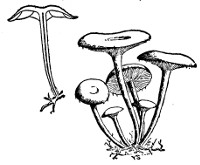
Tubaria furfuracea. Natural size.
Stem somewhat cartilaginous, fistulose. Pileus somewhat membranaceous, often clothed with the universal floccose veil. Gills somewhat decurrent. Spores rust-color or (in Phæoti) brownish-rust color.
The species referred to this subgenus were taken from Naucoria and Galera because they correspond with Omphalia and Eccilia. The pileus is, however, distinctly umbilicate or depressed in only a few of them; the others are placed here on account of their somewhat decurrent gills, which are broadest behind and triangular. Fries.
Small and unimportant.
294NAUCO´RIA Fr.
Naucum, a nut-shell.
(Plate LXXVIII.)
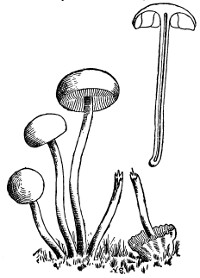
Naucoria semi-orbicularis. Natural size.
Pileus more or less fleshy, conical or convex, then expanded, margin at first incurved. Gills free or adnate, not decurrent. Veil fugacious or absent, sometimes attached in minute flakes to the edge of the young pileus. Stem cartilaginous, hollow or with a spongy stuffing. Growing on wood or on the ground, sometimes rooted. Spores various shades of brown, dull or bright.
Naucoria corresponds with Collybia, Leptonia and Psilocybe; from the latter it is distinguished by the spore colors and from Galera in the brown-spored series by the margin of the pileus being at first incurved.
“The spores are rust-color, or brownish rust-color. The color of the pileus is some shade of yellow. The stem is not distinctly ringed, but sometimes a slight spore-stained band marks the place of the obsolete ring.” Peck, 23d Rep. N.Y. State Bot.
The members of this genus are with two or three exceptions very common, and common over the land. The greater number grow on the ground among grass; a few grow upon decaying wood. The stems are not of the same texture as the cap and frequently will not cook tender. The caps, however, are, of all species tested, tender and of good flavor. Species of the genus are among the first to appear in spring, and well reward the enterprising mycophagist for his early tramps.
ANALYSIS OF TRIBES.
Gymnoti (Gr—naked). Page 295.
Pileus smooth. Veil absent. Spores rust-color, not becoming dusky-rust-color.
295Phæoti (Gr—dusky). Page 296.
Pileus smooth. Gills and spores dusky rust-color. Veil rarely manifest.
Lepidoti (lepis, a scale).
Pileus flocculose or squamulose. Veil manifest.
None known to be edible.
I.—Gymno´ti.
N. hama´dryas Fr.—Gr, a nymph attached to her tree. Pileus 1½-2 in. broad, bay-brown-ferruginous when young and moist, pale yellowish when old and becoming pale, slightly fleshy, convex then expanded, gibbous, even, smooth. Stem 2–3 in. long, 3 lines thick, somewhat fragile, hollow, equal, naked, smooth, pallid. Gills attenuato-adnexed, somewhat free, slightly ventricose, almost 2 lines broad, crowded, rust-color, opaque. Veil none. Widely removed from neighboring species. Pileus somewhat separate as in Plutei. Fries.
Spores elliptical, rust-color, 13–14×7µ Massee.
Haddonfield, N.J. Frequent. Solitary. On ground along pavements, under trees, in woods. Spring to autumn. McIlvaine.
Massee gives it as hygrophanous. I have not found it so. It is moist after rain and dew.
The caps and upper part of the stem are tender, easily cooked and of good flavor.
N. cero´des Fr. Gr—wax. Pileus ½-1 in. broad, watery cinnamon when moist, tan-color when dry, somewhat membranaceous, convex bell-shape and flattened, at length depressed, obtuse, when moist smooth, pellucid-striate at the circumference, when dry even, slightly silky-atomate. Stem 2–3 in. long, 1–2 lines thick, slightly firm, tubed, equal, somewhat flexuous, fibrilloso-striate under a lens, becoming dingy bay-brown sometimes for the most part, sometimes only at the base, pallid upward, mealy at the apex. Gills adnate, separating, very broad behind, hence almost triangular, somewhat distant, broad, plane, soft, distinct, pallid then cinnamon very finely fimbriated at the edge under a lens. Fries.
The typical form, growing among damp mosses, is quite early, gregarious, with the colors almost those of Galera hypnorum, but otherwise 296very different. b. Another form occurs on naked, commonly burnt soil, in late autumn, with almost the habit of N. pediades, but with a different color of gills and spores; this form is firmer. Stem 1 in. long, tense and straight, and color more ochraceous. Stevenson.
Spores 9µ B. and Br.; smooth, 6×3µ Massee.
West Virginia, New Jersey, Pennsylvania, in grass and moss, along damp wood margins. August to October. McIlvaine.
N. cerodes is not plentiful where I have found it. Enough has been collected at a time to prove it esculent. It is tender, but has not much flavor.
(Plate LXXVIIIa.)
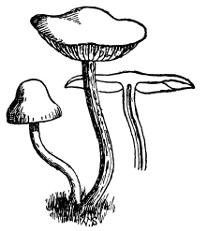
Naucoria striapes.
N. stri´apes Cke.—stria, a line; pes, a foot. Pileus 1–1½ in. broad, ochraceous, bell-shaped, obtuse, then expanded, smooth, even. Stem 2–3 in. long, 2 lines thick, hollow, equal, erect or flexuous, white, longitudinally striate. Gills slightly adnate behind, rather distant, tawny rust-color.
Cespitose or gregarious. Among grass on lawn. Stevenson.
Spores narrowly elliptical, 10–12×4µ Massee.
New Jersey, Trenton. Growing among leaves near dump. May to November. E.B. Sterling.
The few specimens tested were delicate and of slight flavor.
II.—Phæ´oti.
N. pedi´ades Fr.—Gr, a plain. Pileus 1–2 in. broad, yellow or pale yellowish-ochraceous then becoming pale, slightly fleshy, convex then plane, obtuse, even, dry, smooth, at length crookedly cracked, but always without striæ. Flesh white. Stem 2–3 in. long, 1–2 lines thick, stuffed with a pith, somewhat flexuous, tough, equal, but with a small bulb at the base, slightly silky becoming even, yellowish. Gills adnexed, 2 lines broad, at first crowded, at length somewhat distant, somewhat dingy-brown, then dingy cinnamon.
297Spores brownish-rust-color. The small bulb at the base is formed by the mycelium being rolled together. Stature variable. Fries.
Spores dingy rust-color, elliptical, 10–12×4–5µ Massee.
West Virginia, New Jersey, Pennsylvania, in grassy places, pastures and along pavements. Common. May to November. McIlvaine.
In 1897 Fairmount Park, Philadelphia, abounded with N. pediades, which were collected and eaten by many. The caps are tender and of a mushroom flavor.
N. semi-orbicula´ris Bull.—semi, half; orbicularis, round. (Plate LXXVIII, p. 294.) Pileus 1–2 in. broad, tawny rust-color then ochraceous, slightly fleshy, convexo-expanded, obtuse, dry, even, smooth, corrugated when dry. Stem 3–4 in. long, scarcely beyond 1 line thick, cartilaginous, tough, slender, tense and straight, equal, even, smooth, becoming pallid rust-color, shining, often darker at the base, internally containing a separate narrow tube which is easily broken up into fibrils. Gills adnate, rarely sinuate behind, almost 3 lines broad, and many times broader than the flesh of the pileus, crowded, pallid then rust-color.
The pileus is slightly viscid when fresh and moist. Easily distinguished from S. semi-globatus, with which it has been confounded, by the stem. Stevenson.
Spores 14×8µ W.G.S.; 10×5–6µ Massee.
Allied to N. pediades, distinguished by its viscid cap when moist, and dark stem.
Common over the states. Washington, D.C., Mrs. Mary Fuller.
West Virginia, Pennsylvania, North Carolina, New Jersey. Solitary, sometimes cespitose, very common on lawns, rich pastures, etc. April until frost. McIlvaine.
This is one of our first appearing toadstools, coming up when the grass shows its full spring hue. It is found after rains until the coming of frost. Its hemispherical caps, precise, neat, dark gills and brown spores readily distinguish it. While usually small, patience and picking will soon gather quarts. The caps cook easily and are of excellent flavor.
N. platysper´ma Pk.—platys, broad; sperma, seed. Pileus convex, becoming nearly plane, glabrous, slightly tinged with ochraceous or reddish-yellow when young, soon whitish, the margin at first adorned with 298vestiges of a white flocculent veil. Flesh white. Lamellæ moderately close, slightly rounded behind, pallid, becoming brownish. Stem equal, stuffed with a white pith, slightly flocculent or furfuraceous above when young, whitish, the mycelium sometimes forming white thread-like strands. Spores broadly elliptical, 15µ long, 12.5µ broad.
Pileus 1–1.5 in. broad. Stem 3–5.5 in. long, 1.5–2 in. thick.
On the ground. Compton, Cal. Prof. A.J. McClatchie.
This species differs from N. pediades and N. semi-orbicularis, to which it is related, by its larger, broader spores and paler color. Peck, Bull. Torr. Bot. Club, Vol. 25, No. 6.
This new species reported from California is so closely allied to N. semi-orbicularis and N. pediades, both of which are edible, that it is here given, that it may be recognized by students on the Pacific coast or wherever it occurs.
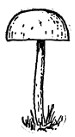
299GALE´RA Fr.
Galerus, a cap.
Pileus more or less membranaceous, conical or oval, then expanded, striate, margin at the first straight, then adpressed to the stem. Gills not decurrent. Stem somewhat cartilaginous, continuous with the pileus, but differing in texture, tubular. Veil none or fibrillose. Spores tawny-ochraceous.
Slender, fragile, generally growing on the ground.
Galera corresponds with Mycena, Nolanea, Psathyra and Psathyrella, which are distinguished by their spore colors. In the brown-spored series Naucoria is separated by the margin of the pileus being at first incurved, and Tubaria by the decurrent gills.
The genus is composed of small species, but many grow in clusters, and are of a consistency which decreases but little in quick cooking. Those tested are delicate in texture and flavor.
G. lateri´tia Fr.—later, a brick. Pileus 1 in. high, pale yellowish when moist, ochraceous when dry, hygrophanous, membranaceous, acorn-shaped then bell-shaped, obtuse, even, smooth, slightly and densely striate at the margin when moist. Stem 3 in. and more long, 1 line thick, tubular, attenuated upward, tense and straight, even, but white-pruinose, whitish. Gills adnexed in the top of the cone, hence appearing as if free, ascending, very narrow, crowded, cinnamon.
Gills almost adpressed to the stem, almost pendulous. Remarkably analogous with A. ovalis, but easily distinguished by the linear gills and the absence of a veil; very fragile. Fries.
Spores 11×5µ W.P.; 11–12×5–6µ Massee.
West Virginia, New Jersey, North Carolina, Pennsylvania. On dung and rich pastures. June to frost. McIlvaine.
The narrow conical cap, distinctly striate, distinguishes this species from G. tenera. In quality there is no difference. It is a well-flavored, delicate species.
300
(Plate LXXIX.)
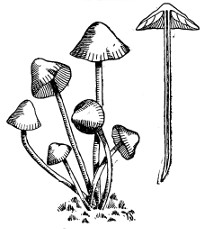
Galera tenera. Two-thirds natural size.
G. te´nera Schaeff.—tener, tender. Pileus ½ in. and more high, of one color, pallid rust-color when damp, becoming pale when dry, hygrophanous, somewhat membranaceous, conico-bell-shaped, commonly smooth, slightly striate when moist, wholly even when dry, opaque, somewhat atomate. Stem commonly 3–4 in. long, 1 line thick, tubular, fragile, equal or when larger thickened downward, tense and straight, somewhat shining, striate upward, of the same color as the pileus when moist, and like it becoming pale when dry. Gills adnate in the top of the cone, appearing as if free, ascending, somewhat crowded, linear, cinnamon.
Pastures and grassy places in woods. Common. May to November. Stevenson.
Spores ellipsoid, 14–21×8–12µ K.; 14–8µ W.G.S.; 14×7µ W.P.; 12–13×7µ Massee; elliptical, dark rust-color, almost rubiginous, 13–16.5×8–10µ Peck.
Var. pilosella (Agaricus pilosellus Pers.), has both pileus and stem clothed with a minute erect pubescence when moist. A form is sometimes found in which the center of the pileus is brown or blackish-brown. Peck, 46th Rep. N.Y. State Bot.
Var. obscu´rior Pk. A notable form of this species was found growing in an old stable of an abandoned lumber camp. The plants were large, the pileus in some being more than an inch broad, the stems were 3–6 in. long and the color was rust-colored as in G. ovalis, to which the plants might be referred but for the large spores. Essex county. July. I have labeled the specimens variety obscurior. Peck, 50th Rep.
Haddonfield, N.J.; Chester county; West Philadelphia, Pa.; West Virginia. In rich pastures, on lawns, dung in woods. Common. June to October. McIlvaine.
Very variable in size and in color when wet and dry. The color of gills and spores readily distinguishes it in its habitats. From spring to 301frost it can usually be gathered in quantity. It is small, tender, shrivels in cooking, but makes a savory, excellent dish.
Var. obscurior found cespitose on very old manure at a ruined stable, Mt. Gretna, Pa., August. McIlvaine.
G. fla´va Pk.—flavus, yellow. Pileus membranous, ovate or bell shaped, moist or subhygrophanous, obtuse, plicate striate on the margin, yellow. Lamellæ thin, narrow, crowded, adnate, at first whitish, then yellowish-cinnamon. Stem equal or slightly tapering upward, hollow, slightly striate at the top, sprinkled with white mealy particles, white or yellowish. Spores ovate or subelliptical, brownish-rust-color, 13×8µ.
Pileus 6–12 lines broad. Stem 2–3 in. long, 1–1.5 lines thick.
Damp vegetable mold in woods. Tompkins county. July.
This species is well marked by the pale-yellow color of the pileus and its plicate striations which are very distinct even in the dried specimens. They extend half way to the disk or more. When dry the pileus is seen to be sprinkled with shining atoms as in some other species of the same genus. Occasionally the yellow cuticle cracks into squamules or small scales. Peck, 46th Rep.
Trenton, N.J., Sterling; Haddonfield, N.J.; Pennsylvania. Among chips in woods and on woods ground. McIlvaine.
This species is frequent, and when plentiful well worth gathering. It has a more woody flavor than other Galera, but is tasty.
G. vittæfor´mis Fr.—vitta, a chaplet; forma, form. Pileus ½-1 in. broad, date-brown when moist, membranaceous, conical then hemispherical, obtuse, even at the disk, striate toward the margin, smooth. Stem 1½-3 in. long, ½-1 line thick, tubular, equal, somewhat straight, but not tense and straight, smooth or sometimes pubescent, slightly striate under a lens, opaque, rust-color. Veil scarcely conspicuous. Gills adnate, broader at the middle, in the form of a segment when larger, somewhat ascending, somewhat distant, at first watery-cinnamon, at length rust-color. Fries.
Spores elliptical, 12×6µ Massee.
Haddonfield, N.J.; Mt. Gretna, Pa. On pastures, lawns, etc. June to September. McIlvaine.
Not previously reported.
302Though small it makes up in quantity when found. The stems are not as tender as the caps. Quality good.
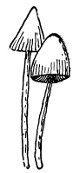
BOLBITIUS Fr.
Gr—cow’s dung.
Pileus membranaceous. Gills adnexed or free, membranaceous, soft, salmon-color or rusty, dissolving (not dripping as in Coprinus), powdered with the rusty spores. Stem central; universal veil absent, partial veil often obsolete.
Very delicate and fragile, remarkable among the Ochrosporæ for the gills dissolving into mucus, and in this respect analogous with Coprinus among the Melanosporæ, and Hiatula amongst the Leucosporæ. Growing on dung or amongst grass where dung abounds.
A small but very natural genus, with the vegetative portion like Coprinus and the fructification resembling Cortinarius, hence occupying an intermediate position between these two genera. Fries.
B. Bol´toni Fr.—after Bolton. Pileus rather fleshy, viscid, at first even, then with the membranaceous margin sulcate, disk darker, subdepressed. Stem attenuated, yellowish, at first floccose from the remains of the fugacious veil. Gills subadnate, yellow then livid-brown. Fries.
Haddonfield, N.J., cespitose among manure on sawdust.
Of small substance but good consistency and flavor.
303
(Plate LXXX.)
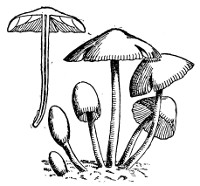
Bolbitius fragilis. Two-thirds natural size.
B. fra´gilis Fr. Pileus 2 in. broad, light yellow, then becoming pale, somewhat membranaceous, almost pellucid, conical then expanded, somewhat umbonate, smooth, viscous, striate round the margin (which is often crenulated). Stem 3 in. long, 1 line or little more thick, fistulose, attenuated upward, naked, smooth (and without a manifest veil), yellow. Gills attenuato-adnexed, almost free, ventricose, yellow then pale cinnamon. Spores rust-colored. Fries.
Thinner than B. Boltoni, etc., very fragile, rapidly withering.
On dung. Common. June to October. Stevenson.
Spores subspheroid-ellipsoid, elliptical, 7×3–5µ Massee.
West Virginia; Pennsylvania. June to frost. On rich grass and dung.
Pileus usually not over 1.5 in. across. Often in plenty. Its substance does not cook away as with C. micaceus. It amply repays gathering, being highly flavored.
(Plate LXXXa.)
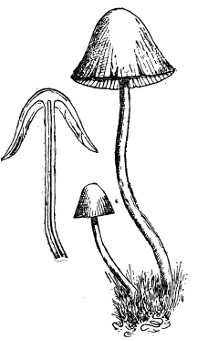
Bolbitius nobilis. About two-thirds natural size.
B. no´bilis Pk.—noble. Pileus thin, fleshy on the disk, ovate then bell-shaped, smooth, plicate-striate, pale-yellow, the disk tinged with red, the margin at length recurved and splitting. Gills subdistant, tapering outwardly, attached, the alternate ones 304more narrow, pale-yellow with a darker edge. Stem long, equal, smooth, striate at the top, hollow, white.
Plant cespitose, 3–5 in. high. Pileus 1 in. broad. Stem 1 line thick. Ground in woods. Greig. September.
A fine large species, but probably rare. Peck, 24th Rep. N.Y. State Bot.
I have not seen this species. Figure after Professor Peck.
CREPIDO´TUS Fr.
Gr—a slipper.
(Plate LXXXI.)
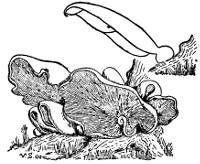
Crepidotus mollis. Natural size.
Veil wanting or not manifest. Pileus eccentric, lateral or resupinate. Spores rust-color.
The Crepidoti correspond in shape and habit to the smaller Pleuroti and the Claudopodes, but they are distinguished from both by the rust-color of their spores. These are globose in several species, in others they are elliptical. In some there is a depression on one side which gives them a naviculoid character and causes the spore to appear slightly curved when viewed in a certain position. In consequence of the similarity of several of our species, the character of the spores is of much importance in their identification, and it is unfortunate that European mycologists have so generally neglected to give the spore characters in their descriptions of these fungi. In most of the species the pileus is at first resupinate, but it generally becomes reflexed as it enlarges. It is generally sessile or attached by a mass of white fibrils or tomentum. For this reason it is usually somewhat tomentose or villose about the point of attachment, even in species that are otherwise glabrous. In several species the pileus is moist or hygrophanous and then the thin margin is commonly striatulate. This character is attributed to but one of the 305dozen or more European species. Their mode of growth is usually gregarious or somewhat loosely imbricated, in consequence of which the pileus, which in most species is white or yellowish, is often stained by the spores, and then it has a rusty, stained or squalid appearance. The species occur especially on old stumps, prostrate trunks and soft much decayed wood in damp, shaded places. Peck, 39th Rep. N.Y. State Bot.
C. ful´vo-tomento´sus Pk.—tawny-tomentose. Pileus ¾-2 in. broad, scattered or gregarious, suborbicular, kidney-shaped or dimidiate, sessile or attached by a short, white-villose tubercle or rudimentary stem, hygrophanous, watery-brown and sometimes striatulate on the margin when moist, whitish, yellowish or pale ochraceous when dry, adorned with small, tawny, hairy or tomentose scales. Lamellæ broad, subventricose, moderately close, rounded behind, radiating from a lateral or eccentric white villose spot, whitish becoming brownish-ferruginous. Spores elliptical often uninucleate, 8–10×5–6µ.
Decaying wood of poplar, maple, etc. Common. June to October.
A pretty species, corresponding in some respects to the European C. calolepis, but much larger and with tawny, instead of reddish scales. The cuticle is separable and is tenacious, though it has a hyaline gelatinous appearance. The pileus is subpersistent, and specimens dried in their place of growth are not rare. Peck, 39th Rep. N.Y. State Bot.
Haddonfield, N.J.; Angora, West Philadelphia. On decaying hickory. McIlvaine.
Substance fair. Taste strong but pleasant.
306
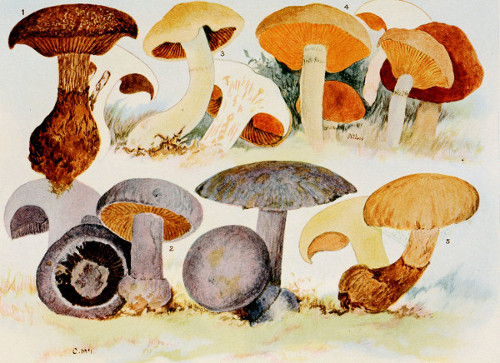
Grouped by F.D. Briscoe—Studies by C. McIlvaine. Plate LXXXII.
Fig. Page. Fig. Page.
1. Cortinarius squamulosus, 318 4. Cortinarius turmalis, 309
2. Cortinarius violaceus, 314 5. Cortinarius armillatus, 323
3. Cortinarius ochraceus, 319
CORTINA´RIUS Fr.
Cortina, a veil or curtain.
Veil resembling the consistency of a cob-web, superficial, distinct from the cuticle of the pileus. Flesh of pileus and stem continuous. Gills persistent, dry, changing color, powdered with the spores. Trama fibrillose. Spores globose or oblong, somewhat ochraceous on white paper. Fries.
This genus is not easily confounded with any other, the cob-webby veil stretched from stem to pileus in the young plant not being found in other fungi. This must be looked for only in youth, as from its tender character it soon breaks and often appears only as a very indistinct collar on the stem, colored from catching the falling spores. The colors are generally pronounced and often extremely bright, there being very few prettier toadstools than those inclined to the blue or purple shades, which are not uncommon in the immature form. The color of the spores is also a marked feature, being rusty or brownish-ochraceous, turning the gills to the same color at maturity. On account of this change it is generally necessary to have specimens at both stages of growth to accurately determine the species. The gills are thin, attached to the stem in various manners, rarely slightly decurrent.
Cortinarius is distinguished from Flammula by growing on the ground and by the bright ferruginous color of its spores.
Cortinarius is a sturdy, hardy genus preferring northern latitudes and autumnal months, though several of its species grow as far south as Alabama, and one, a new species described by Professor Peck, is found on the Helderberg mountains in May. The genus contains many species, most of which produce in great numbers, yet being woods-growing, and coming as they do when leaves are falling, they are often missed because of their similarity to their surroundings.
Heretofore, less than a dozen species have been reported as eaten. This number is now doubled. While several species are bitter and others equally unpleasant, not one has been accused of harm. It is highly probable that other varieties than those herein given will prove equally acceptable as food. I have tested all I have found in sufficient quantity to warrant passing judgment upon them.
The genus does not contain as many species of superior excellence as other fleshy genera of like numbers. The flesh is frequently dry and of 307a strong woody or musky flavor, which it does not lose in cooking. The stems are seldom cookable. All can be fried in butter, but cut in small pieces and well stewed, or stewed and served in patties, or made into croquettes are certain ways of keeping them in palate memory.
ANALYSIS OF TRIBES.
Phlegmacium (Gr—shiny or clammy moisture). Page 308.
Pileus viscid. Stem firm, dry. Veil partial, cobweb-like.
A. Cliduchii (Gr—holding the keys—the typical subdivision). Page 308.
Partial veil as a ring on the upper part of the stem which is equal or slightly expanded above. Not distinctly bulbous.
* Gills pallid then clay-colored.
** Gills purplish then clay-colored.
B. Scauri (Gr—club-footed). Page 310.
Bulbous. Bulb depressed or top-shaped, with a distinct margin caused by the pressure of the pileus before expansion. Veil generally ascending from the margin of the bulb. Gills somewhat sinuate.
* Gills whitish then cinnamon.
** Gills blue then cinnamon.
*** Gills brownish-white then cinnamon.
Myxacium (Gr—mucus). Page 313.
Universal veil glutinous. Pileus and stem viscid. Stem slightly bulbous. Gills adnate.
Inoloma (Gr—a fibrous fringe). Page 314.
Pileus dry, not hygrophanous or viscid, covered at first with innate silky scales or fibrils, becoming smooth. Veil simple. Pileus and stem fleshy, rather bulbous.
* Gills violaceous, then cinnamon.
** Gills pinkish-brown, then cinnamon.
*** Gills yellow, then cinnamon.
308Dermocybe. Page 320.
Pileus thin, equally fleshy, at first silky with a fine down, becoming smooth when adult. Not hygrophanous, but flesh watery when moist or colored. Stem equal or larger above, externally rigid, elastic or brittle, internally stuffed or hollow. Veil single, thread-like.
Telamonia. Page 323.
Pileus moist, hygrophanous, at first smooth or sprinkled with the whitish superficial evanescent fibrils of the veil. Flesh thin, or when thick it becomes abruptly thin toward the margin, scissile. Stem ringed below or coated from the universal veil, slightly veiled at the apex, hence with almost a double veil.
Hygrocybe. Page 325.
Pileus hygrophanous, smooth or covered with superficial white fibrils, not viscid, moist when fresh, becoming discolored when dry. Flesh very thin or scissile, rarely more compact at the center. Stem rather rigid, bare. Veil thin, rarely collapsing and forming an irregular ring on the stem.
Phlegma´cium. (Gr—clammy moisture.)
A. Cliduchii.
* Gills pallid, then clay-colored.
C. seba´ceus Fr.—sebum, tallow. Pileus 2½-5 in. broad, unicolorous, pale, of the color of tallow, equally fleshy, convex then rather plane, commonly very repand, viscid, smooth, but at the first covered over with a whitish pruinose luster. Flesh white. Stem 3–4 in. long, ½-1 in. thick, solid, stout, compact, never bulbous, often twisted and compressed, slightly fibrillose, pale white. Cortina delicate, fugacious, adhering only to the margin of the pileus. Gills emarginate, not crowded, connected by veins, 4 lines broad, clay-color or pallid-cinnamon, paler at the sides. Fries.
The flesh of the pileus is not compact at the disk and abruptly thin at the circumference, but equally attenuated toward the margin. The flesh of the stem is white. The gills never turn bluish-gray. Taste mild. Stevenson.
309Spores pip-shaped, 9×7µ Cooke.
A very common and prolific species in West Virginia, New Jersey, Pennsylvania, North Carolina. McIlvaine.
Pushing from the earth in great clusters it raises the mat of leaves above it into hut-like mounds through which it seldom bursts. Yet side openings to its huts show its coziness, and reveal the ground thickly dusted with its spores. Detecting these mounds is part of the woodcraft of a toad-stool hunter.
Where clusters are not dense, or the fungus is solitary, the stem is frequently swollen at the base, even bulbous.
Both caps and stems are edible, but the stems are not equal to the caps. It is a valuable food species, because of its lateness and quantity. It is not of best quality.
C. tur´malis Fr.—turma, a troop. (Plate LXXXII, fig. 4, p. 306.) Pileus yellow-tan, most frequently darker at the disk, not changeable, compact, convex then plane, very obtuse, even, smooth (sometimes obsoletely piloso-virgate), when young veiled with pruinate but very fugacious villous down, soon naked, viscid. Flesh white. Stem sometimes 3 in., sometimes 6 in. long, 1 in. thick, solid, very hard, rigid, cylindrical, here and there attenuated at the base, shining white when dry, when young sheathed with a white woolly veil, naked when full grown. Cortina entirely fibrillose, superior and persistent in the form of a ring, at length ferruginous with the spores. Gills variously adnexed, rounded or emarginate, even decurrent with a tooth, crowded, serrated, white then clay-color. Fries.
I find it edible and of great value, being plentiful in pine woods, Maryland. I have collected a bushel in less than an hour in October. Under pine needles forming mounds. Taylor.
The localities and the habit of C. turmalis are very like that of C. sebaceus. The leaf mat broods the clusters.
C. turmalis is on a par with C. sebaceus. Personally I prefer the latter.
** Gills purplish, then clay-colored.
C. va´rius (Schaeff.) Fr.—varius, changeable. Pileus 2 in. and more broad, bright ferruginous-tawny, compact, hemispherico-flattened, very 310obtuse, regular, slightly viscid, even, smooth, the thin margin at first incurved, appendiculate with the cortina. Flesh firm, white. Stem curt, 1½-2½ in. long, 1 in. and more thick, bulbous, absolutely immarginate, compact, shining white, adpressedly flocculose, the superior veil pendulous. Gills emarginate, thin, somewhat crowded, at first narrow, violaceous-purplish, then broader and ochraceous-cinnamon, always quite entire.
Variable in stature, but the habit and colors are always unchangeable. It varies with the stem taller and somewhat equal, the pileus yellow-tawny, and the gills dark blue. Fries.
In woods. Uncommon. September to November. Stevenson.
Minnesota; Ohio.
Edible. Cooke, 1891.
B. Scau´ri.
* Gills whitish then cinnamon.
C. intru´sus Pk. Pileus fleshy, rather thin, convex, then expanded, glabrous, somewhat viscid when moist, even or radiately wrinkled on the margin, yellowish or buff, sometimes with a reddish tint. Flesh white. Lamellæ thin, close, rounded behind, at first whitish or creamy-white, then cinnamon, often uneven on the edge. Stem equal or slightly tapering either upward or downward, stuffed or hollow, sometimes beautifully striate at the top only or nearly to the base, minutely floccose when young, soon glabrous, white. Spores broadly elliptical, brownish-cinnamon, 6–8×4–5µ.
Pileus 1–2.5 in. broad. Stem 1–3 in. long, 3–6 lines thick.
Mushroom beds, manured soil in conservatories or in plant pots. Boston, Mass. R.K. Macadam. Haddonfield, N.J. C. McIlvaine.
This interesting species is closely allied to Cortinarius multiformis and belongs to the Section Phlegmacium. It has a slight odor of radishes and is pronounced edible by Mr. McIlvaine. Its habitat is peculiar, but it possibly finds its way into conservatories and mushroom beds through the introduction of manure or soil, or leaf mold from the woods. It seems strange, however, that it has not yet been detected growing in the woods or fields. Hebeloma fastibile is said sometimes to invade mushroom beds, and our plant resembles it in so many particulars that it is with some hesitation I separate it. The chief differences are in the stem and spores. The former, in Hebeloma fastibile, is described 311as solid and fibrous-squamose and the latter as 10×6 micromillimeters in size. The brighter color of the smaller spores and the stuffed or hollow smooth stem of our plant will separate it from this species. Peck, Bull. of the Torrey Bot. Club, October, 1896.
Cortinarius intrusus was a happy find. Several pints of it were collected by the author in February—usually a famine month for the mycophagist. They grew on the ground, in beds among plants, and with potted plants in a hot-house in Haddonfield, N.J. The crop continued well into the spring. The species is delicate, savory, and a most accommodating renegade from its kind. I have never found it elsewhere.
** Gills blue, then cinnamon.
C. cærules´cens Fr. Pileus 2–3 in. across, equally fleshy, convex then plane, obtuse, regular, even, almost glabrous, but often fibrilloso-streaked; viscid, when dry shining or opaque, dingy yellow, almost tan-colored, varying to yellowish-brown, etc. Gills slightly rounded behind, adnexed, thin, closely crowded, 2 lines broad, at first clear intense blue then becoming purplish, at length dingy cinnamon. Stem about 2 in. long, ½ in. thick (bulb more than an inch), firm, equally attenuated upward, at first fibrillose, bright violet, then becoming pale and whitish, naked, bulb often disappearing with age; veil fibrillose, fugacious. Spores elliptical, 9–10×5µ.
Amongst moss in woods, etc.
Neither the gills nor the flesh change color when broken, a point which distinguishes the present from C. purpurascens. When young every part is generally blue. Smell scarcely any. Fries.
Spores 10–12×5µ Cooke.
Haddonfield; West Virginia; Mt. Gretna, Pa. In woods September to frost. McIlvaine.
The American species seldom entirely loses the bluish-purple color of its cap. The beautiful color fades somewhat or becomes splotched with yellow. Neither does the bulb ordinarily disappear with age. It is common. Taste of cap is mild, somewhat woody. They require long, slow stewing, and are better made into patties and croquettes.
C. purpuras´cens Fr.—gills becoming purple when bruised. Pileus 4–5 in. across, fleshy, disk compact, obtuse, wavy, variable, 312covered with a dense layer of gluten, but opaque when dry, bay or reddish then tawny-olivaceous, spotted; often depressed round the margin, which is at first incurved then wavy, marked with a raised brown line. Flesh entirely clear blue. Gills broadly emarginate, 3 lines and more broad, crowded, bluish-tan, then cinnamon, violet-purple when bruised. Stem about 3 in. long, ⅔ in. and more thick, solid, bulbous, everywhere fibrillose, intensely pallid clear blue, very compact, juicy, becoming purplish-blue when touched, bulb submarginate. Spores elliptical, 10–12×5–6µ Fries.
Var. subpurpuras´cens. Massachusetts. Frost.
Plentiful in West Virginia mountains in mixed woods, 1882. On South Valley Hill, near Downington, Pa., October, 1887. Haddonfield, N.J., 1892. In woods. September to frost. McIlvaine.
Both stems and caps are juicy when young and of agreeable flavor. It is among the best edible species of Cortinarius.
*** Gills brownish-white, then ferruginous.
C. turbina´tus Fr.—turbo, a top. Pileus unicolorous, dingy-yellow or green, becoming pale, hygrophanous, opaque when dry, fleshy, convex then flattened, obtuse, at length depressed, orbicular, even, smooth, viscid. Flesh soft, white. Stem commonly curt, 2 in., but varying elongated, yellowish, springing from a globoso-depressed distinctly marginate bulb, otherwise equal, cylindrical, stuffed then hollow. Gills attenuato-adnate, thin, crowded, broad, quite entire, at first pallid light-yellowish, at length somewhat ferruginous.
The typical form is regular, distinct from its allies in the hygrophanous pileus, in the gills being isabelline-ferruginous and quite entire, and in being without any dark-purple or purple color. Easily distinguished by its turbinate bulb. Fries.
In woods. Uncommon. Stevenson.
Spores rough, 14–16×7µ; rough, Cooke.
Cap 2–4 in. across. Stem commonly about 2 in. long, sometimes longer. Massee.
North Carolina, Schweinitz; Pennsylvania, Schweinitz; Massachusetts, Frost; Minnesota; Nova Scotia.
Edible. Cooke.
313Myxa´cium. (Gr—mucus.)
(Plate LXXXIII.)
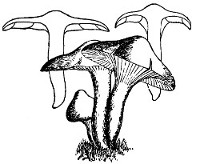
Cortinarius collinitus. About natural size.
C. collin´itus Fr.—collino, to besmear. Pileus convex, obtuse, glabrous, glutinous when moist, shining when dry. Gills rather broad, dingy-white or grayish when young. Stem cylindrical, solid, viscid or glutinous when moist, transversely cracking when dry, whitish or paler than the pileus. Spores subelliptical, 13–15µ.
The Smeared cortinarius is much more common than the Violet cortinarius and has a much wider range. Both the cap and stem are covered with a viscid substance or gluten which makes it unpleasant to handle. The cap varies in color from yellow to golden or tawny-yellow and when the gluten on it has dried it is very smooth and shining. The flesh is white or whitish. The young gills have a peculiar bluish-white or dingy-white color which might be called grayish or clay color, but when mature they assume the color of the spores. They are sometimes minutely uneven on the edge.
The stem is straight, solid, cylindrical and usually paler than the cap. When the gluten on it dries it cracks transversely, giving to the stem a peculiar scaly appearance.
The cap is 1½-3 in. broad, and the stem 2–4 in. long, and ¼-½ in. thick.
The plant grows in thin woods, copses and partly cleared lands and may be found from August to September.
It is well to peel the caps before cooking, since the gluten causes dirt and rubbish to adhere tenaciously to them. Peck, 48th Rep. N.Y. State Bot.
In 41st Rep. N.Y. State Mus. Nat. Hist., p. 71, Professor Peck describes a closely allied species, C. muscigenus, n. sp., “separated by its more highly-colored pileus, striate margin and even, not diffracted-squamose stem.”
314Prof. L.B. Mendel gives the following analysis: “Young specimens gathered in New Haven early in November, 1897, gave:
Water 91.13%
Total solids 8.87
Total nitrogen of dry substance 3.63”
Edible. Cooke.
In appearance the Smeared cortinarius does not appeal to be eaten. Neither does an eel. But peeled both are inviting. Raw, the caps of this fungus have a strong woody smell and taste. This is somewhat subdued by cooking.
I have found the plant in West Virginia, Pennsylvania and North Carolina, often among the leaves in mixed woods, but it prefers a goodly supply of light and the freedom of open places. It is often gregarious, sometimes tufted.
C. io´des B. and C. Pileus 1½-2 in., convex, at length plane, viscid, firm, violet-purple. Flesh white, thick. Veil fugacious, spider-web. Stem 2–3 in. long, 1½ in. thick, solid, thickened below. Gills violet, at length cinnamon, ventricose, adnate, sub-emarginate, irregular, sometimes forked. B. and C.
This is a small but beautiful species, the pileus, lamellæ and stem being of a bright-violet or purplish-violet hue. The spores are subelliptical, generally uninucleate, 10×6µ. Peck, 32d Rep. N.Y. State Bot.
The pileus in this species is sometimes spotted with white. The bulbous white stem is adorned with lilac-colored fibrils. Peck, 35th Rep. N.Y. State Bot.
Sparingly found among roots at Mt. Gretna, Pa., September, 1897–1898.
The caps are fairly good.
Inolo´ma. (Gr—fiber; Gr—a fringe.)
* Gills violaceous then cinnamon.
C. viola´ceus Fr. (Plate LXXXII, fig. 2, page 306.) One of our most plentiful and beautiful autumnal fungi. As the American plant differs somewhat from the European, Professor Peck’s description is given.
Pileus convex, becoming nearly plane, dry, adorned with numerous 315persistent hairy tufts or scales, dark violet. Lamellæ rather thick, distant, rounded or deeply notched at the inner extremity, colored like the pileus in the young plant, brownish-cinnamon in the mature plant. Stem solid, fibrillose, bulbous, colored like the pileus. Spores subelliptical, 12.5µ long.
The Violet cortinarius is a very beautiful mushroom and one easy of recognition. At first the whole plant is uniformly colored, but with age the gills assume a dingy ochraceous or brownish-cinnamon hue. The cap is generally well formed and regular and is beautifully adorned with little hairy scales or tufts. These are rarely shown in figures of the European plant, but they are quite noticeable in the American plant and should not be overlooked. The flesh is more or less tinged with violet.
The gills when young are colored like the cap. They are rather broad, notched at the inner extremity and narrowed toward the margin of the cap. When mature they become dusted with the spores whose color they take.
The stem also is colored like the cap. It is swollen into a bulb at the base and sometimes a faint ochraceous band may be seen near the top. This is due to the falling spores which lodge on the webby filaments of the veil remaining attached to the stem.
Cap 2–4 in. broad. Stem 3–5 in. long, about ½ in. thick. Peck, 48th Rep. N.Y. State Bot.
Minerva, Essex county. A form of this species occurs here, having the pileus merely downy or punctate-hairy under a lens, no squamules being distinguishable by the naked eye. July. Peck, 50th Rep. N.Y. State Bot.