Sub-Class BASIDIOMYCETES (continued 5)
Reading edition
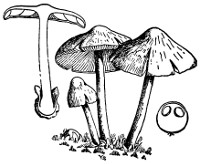
Height 2–4 in.; breadth of pileus 2–3 in. Stipe 4–6 lines thick.
Pine woods. West Albany. October.
Taste mild at first, then slightly disagreeable. Peck, 23d Rep. N.Y. State Bot.
Spores minute, echinulate, almost globular, 8µ W.G.S.; 8–10µ Massee.
In woods. Common. July to October.
Var. granula´ta has the pileus rough with small granular scales. Peck, Rep. 39.
A very coarse and easily recognized species. Reckoned poisonous, though eaten by slugs. W.G.S.
The verdict is against it. Both smell and taste are usually unpleasant. Cooked it retains its flavor, more closely resembling wild cherry bark than anything else. On two occasions I ate enough to convince me that it was not poisonous.
R. el´egans Bresad.—elegans, pretty. Mild at first, becoming acrid with age. Pileus 2–3 in. across. Flesh rather thick; convex then depressed; margin tuberculose and striate when old, viscid, bright rosy flesh-color, soon ochraceous at the circumference, everywhere densely 201granulated. Gills adnexed or slightly rounded, narrow behind, very much crowded, equal, rarely forked, whitish, becoming either entirely or here and there ochraceous-orange. Stem 1½-2 in. long, 5–7 lines thick, a little thickened at the base, rather rugulose, white, base ochraceous. Flesh white, turning ochraceous and acrid when old.
Spores 8–10µ diameter Massee.
Allied to R. vesca. Known by the bright rose-colored, densely granular pileus and tuberculose margin. When old the pileus is almost entirely ochraceous. Massee.
Frequent in the West Virginia forests, 1881–1885. Chester county, Pa., 1887–1890. In mixed woods. July to September. McIlvaine.
It differs from R. vesca in its cap being minutely granulated instead of streaked, and in becoming acrid with age.
The caps are of good quality, needing to be well cooked.
Fra´giles.
* Gills and spores white.
R. eme´tica Fr.—an emetic. (Plate XLIV, fig. 2, p. 184.) Pileus 3–4 in. broad, at first rosy then blood-color, tawny when old, sometimes becoming yellow and at length (in moist places) white, at first bell-shaped then flattened or depressed, polished, margin at length furrowed and tubercular. Flesh white, reddish under the separable pellicle. Stem spongy-stuffed, stout, elastic when young, fragile when older, even, white or reddish. Gills somewhat free, broad, somewhat distant, shining white.
Handsome, regular, moderately firm, but fragile when full grown, taste very acrid. Fries.
Spores shining white, Fries; spheroid, echinulate, 8–10µ K.; 7µ W.G.S.
Maryland, Miss Banning; New York, Peck, Rep. 22; Indiana, Illinois, H.I. Miller.
Said to act as its name implies as an emetic. Certainly poisonous. Stevenson.
Krapp says he has himself experienced rare inconveniences from eating it. Preferred to others in Indiana and Illinois. H.I. Miller, 1898.
The varying reports upon R. emetica are quoted above. In 1881, in 202the West Virginia mountains, I began testing this Russula and soon found that it was harmless. At least twenty persons ate it in quantity, during its season, for four years. Yet, in my many published articles, I continued, out of regard for the opinions of others and in excess of caution, to warn against all bitter and peppery fungi. But from that time until the present I have eaten it, and I have made special effort to establish its innocence by getting numbers of my friendly helpers to eat it.
It was suggested by one of its prosecutors that perhaps I was mistaking another fungus for it. In October, 1898, I sent to Professor Peck a lot of the Russula I was eating. He wrote: “It seems to be R. emetica as you state. It certainly is hot enough for it.”
R. pectina´ta Fr.—pecten, a comb. Pileus 3 in. broad, at first gluey, toast-brown, then dry, becoming pale, tan, with the disk always darker, fleshy, rigid, convex then flattened and depressed or concavo-infundibuliform (basin-shaped); margin thin, pectinato-sulcate (deeply ribbed), here and there irregularly shaped. Flesh white, light yellowish under the pellicle, which is not easily separable. Stem curt, 3 in. long, ¾–1 in. thick, rigid, spongy-stuffed, longitudinally slightly striate, shining white, often attenuated at the base. Gills attenuato-free behind, broader toward the margin, somewhat crowded, equal, simple, white.
Odor weak, but nauseous, approaching that of R. fœtens. Fries.
Spores 8–9µ diameter Massee.
New York, Peck, 43d Rep. West Virginia, Pennsylvania, New Jersey. Common in woods, grassy, mossy places. July to frost. McIlvaine.
Named from the furrows of the margin being like the teeth of a comb.
Both the appearance and smell of this Russula will detect it. The peculiar comb-like furrows of its margin, viscid or varnished-looking cap, and strong but more spicy smell than cherry-bark are noticeable.
It is edible, but so strong in flavor that a piece of one will spoil a dish if cooked with other kinds.
R. ochroleu´ca Fr. Gr—pale yellow; Gr—white. Pileus yellow, becoming pale, fleshy, flattened or depressed, polished, with an adnate pellicle, the spreading margin becoming even. Stem spongy, stuffed, firm, slightly reticulato-wrinkled, white, becoming cinereous. Gills rounded behind, united, broad, somewhat equal, white becoming pale.
Odor obsolete, but pleasant. The pileus is never reddish. It agrees 203wholly with R. emetica in structure and stature, as well as in the acrid taste; it differs however in the stem being slightly recticulato-wrinkled, white becoming cinereous, in the adnate pellicle of the pileus, in the margin remaining for a long time even (remotely striate, but not tubercular, only when old), and in the gills being rounded behind and becoming pale. The color of the pileus is constant. The gills remain free and do not exude drops. Fries.
Cap 2–4 in. across. Stem 2–3 in. long, up to ¾ in. thick.
Spores papillose, 7µ W.G.S., 8×9µ Massee.
Frequent in woods. July to October.
Not as common as R. emetica, yet frequently found, usually solitary, at times gregarious. It is quite peppery, but loses pepperiness in cooking. Myself and others have frequently eaten it.
R. ci´trina Gillet—citrina, citron colored. Mild. Pileus 2–3 in. across, slightly fleshy at the disk, margin thin; convex then more or less expanded and slightly depressed, rather viscid when moist, smooth, slightly wrinkled at the margin when old, bright lemon-yellow, color usually uniform, sometimes paler at the margin, occasionally with a greenish tint, center of pileus at length becoming pale-ochraceous; pellicle separable. Gills slightly decurrent, broadest a short distance from the margin, and gradually becoming narrower towards the base, forked at the base and also sometimes near the middle, white, 1½ lines deep at broadest part. Stem 2–3 in. long, about 4 lines thick, equal or slightly narrowed at the base, slightly wrinkled, straight or very slightly waved, solid.
Spores subglobose, echinulate, 8µ diameter.
In woods.
Known by the clear lemon-yellow or citron-colored pileus and the persistently white gills and stem. The taste is mild at first, but becomes slightly acrid if kept in the mouth for a short time. Massee.
R. citrina can hardly be classed among the acrid species. The taste is slightly of cherry-bark and disappears in cooking. It is usually found in patches which contain ten to twenty individuals. It is a species of fair quality.
R. fra´gilis Fr.—fragile. Pileus 1–1½ in. broad, rarely more, flesh-color, changing color, very thin, fleshy only at the disk, at the first convex 204and often umbonate, then plane and depressed, pellicle thin, becoming pale, slightly viscid in wet weather; margin very thin, tuberculoso-striate. Stem 1½-2 in. long, spongy within, soon hollow, often slightly striate, white. Gills slightly adnexed, very thin, crowded, broad, ventricose, all equal, shining white. Fries.
Very acrid. Smaller and more fragile than the rest of the group, directly changing color. The color is variable, often opaque, typically flesh-color, when changed in color white externally and internally, often with reddish spots. Among varieties of color is to be noted a livid flesh-colored form, with the disk becoming fuscous.
It is not easy to define it from fragile forms of R. emetica, but the gills are much more crowded, thinner, and often slightly eroded at the edge, ventricose; the pileus thinner and more lax, etc. Stevenson.
Var. nivea Fr.—nivea, snowy. Whole plant white.
Spores minutely echinulate 8–10×8µ Massee.
Though one of the peppery kind, I have not, after fifteen years of eating it, had reason to question its edibility. The caps are not meaty, but what there is of them is good.
R. puncta´ta Gillet—punctata, dotted. Mild. Pileus 1½-2½ in. across. Flesh thin, white, reddish under the cuticle; convex then flattened, viscid, rosy, disk darkest, punctate with dark reddish point-like warts, pale when old; margin striate. Gills slightly adnexed, 2 lines broad, white then yellowish, edge often reddish. Stem about 1 in. long, 4–5 lines thick, attenuated and whitish at the base, remainder colored like the pileus, stuffed.
Spores 8–9µ diameter Massee.
Among grass.
Edible. Boston Myc. Club Bull. 1896.
** Gills and spores white then yellowish or bright lemon.
R. in´tegra Fr.—integer, entire, whole. Pileus 4–5 in. across, typically red, changing color, fleshy, campanulato-convex then expanded and depressed, fragile when full-grown, with a gluey pellicle, at length furrowed and somewhat tubercular at the margin. Flesh white, sometimes yellowish above. Stem at first short, conical, then club-shaped 205or ventricose, as much as 3 in. long, up to 1 in. thick, spongy-stuffed, commonly stout, even, shining white. Gills somewhat free, very broad, up to ¾ in., equal or bifid at the stem, somewhat distant, connected by veins, pallid-white, at length light yellow, somewhat powdered yellow with the spores.
Taste mild, often astringent. The most changeable of all species, especially in the color of the pileus which is typically red, but at the same time inclining to azure-blue, bay-brown, olivaceous, etc. Sometimes the gills are sterile and remain white. Fries.
Spores ellipsoid-spheroid or spheroid echinulate, globose, rough, 8–9µ C.B.P.; 9–10µ diameter, pale ochraceous. Massee.
It is difficult to separate R. integra from R. alutacea. The spores usually show upon the gills as pale dull yellow powder. It is of equal excellence.
R. decolo´rans Fr.—de and coloro, to color. Pileus 3–5 in. broad, color various, at first orange-red, then light yellow and becoming pale, fleshy, spherical then expanded and depressed, remarkably regular, viscid when moist, thin and at length striate at the margin. Flesh white, but becoming somewhat cinereous when broken, and more or less variegated with black spots when old. Stem elongated, 3–5 in., cylindrical, solid, but spongy within, often wrinkled-striate, white then becoming cinereous especially within. Gills adnexed, often in pairs, thin, crowded, fragile, white then yellowish.
Taste mild. Colors changeable according to a fixed rule, but not variable. The gills are not ochraceous-pulverulent as in R. integra, nor shining and pure yellow as in R. aurata, etc. Fries.
Spores yellow, 8.3µ Morgan.
New York, Peck, 23d Rep. Angora, West Philadelphia, Pa., 1897, in mixed woods. August to October. McIlvaine.
Esculent and of good quality. Morgan.
Meals of it make one regret its scarcity.
R. basifurca´ta Pk.—forked near stem. Pileus 2–3 in. broad, firm, convex, umbilicate, becoming somewhat funnel form, glabrous, slightly viscid when moist, the thin pellicle scarcely separable except on the margin, dingy-white, sometimes tinged with yellow or reddish-yellow, the margin nearly even. Lamellæ rather close, narrowed toward the 206base, adnate or slightly emarginate, many of them forked near the base, a few short ones intermingled, white becoming yellowish. Stem 8–12 lines long, 5–6 lines thick, firm, solid, becoming spongy within, white.
Spores elliptical, pale yellow, uninucleate or shining, 9×6.5µ. Flesh white, taste mild, then bitterish.
Dry hard ground in paths and wood roads. Canoga, N.Y. July.
This species closely resembles pale forms of R. furcata, from which it is separated by the absence of any silky micor and by the yellowish color and elliptical shape of the spores and by the yellowish hue of the lamellæ. Peck, 38th Rep. N.Y. State Bot.
Mt. Gretna, Pa., September, 1898, to frost. Gravelly ground. Solitary. Gills adnate. Identified as his species by Professor Peck.
The slight bitterish taste disappears in cooking. It is edible and of fair quality.
R. aura´ta Fr.—aurum, gold. Pileus 2–3 in. broad, varying lemon-yellow, orange and red, disk darker, fleshy, rigid, brittle however, hemispherical then plane, disk not depressed, pellicle thin, adnate, viscid in wet weather, margin even, and slightly striate only when old, but sometimes wrinkled. Flesh lemon-yellow under the pellicle, white below. Stem 2–3 in. long, solid, firm, but spongy within, cylindrical, obsoletely striate, white or lemon-yellow. Gills rounded free, connected by veins, broad, equal, shining, never pulverulent, whitish inclining to light yellow, but vivid lemon-yellow at the edge. Fries.
West Virginia, 1881–1885; Pennsylvania, 1887–1898. In woods under pines. July to October. McIlvaine.
Pileus sometimes depressed in center, very viscid when wet.
A troop of this Russula upon brown wood mat is a pretty sight. Its rich and brightly-colored cap attracts the eye from a distance. The yellow edge of its gills is the distinctive mark of the species.
The smell is pleasant, the taste slightly of cherry bark.
Cooked it is one of the best Russulæ.
R. atropurpu´rea Pk.—atre, black; purpureus, purple. Dark purple Russula. Pileus 3–4 in. broad, at first convex, then centrally depressed, glabrous, dark purple, blackish in the center, the margin even or slightly striate. Flesh white, grayish or grayish-purple under the separable pellicle, taste mild, odor of the drying plant fetid, very unpleasant. 207Lamellæ nearly equal, subdistant, sometimes forked near the stem, at first white, then yellowish, becoming brownish where bruised. Stem 2–3 in. long, 5–8 lines thick, equal, glabrous, spongy within, white, brownish where bruised. Spores subglobose, minutely rough, pale ochraceous with a salmon tint, 8–10µ.
Open woods. Gansevoort. July.
In color this species resembles R. variata, but in other respects it is very different. It is very distinct in the peculiar color of its spores, and in the brownish hue assumed by wounds. Peck, 41st Rep. N.Y. State Bot.
West Philadelphia, Pa. July, 1897. Open woods. Solitary. Philadelphia Myc. Center.
Many were eaten and enjoyed. Only fresh plants are acceptable, and they should be cooked as soon as gathered. Even in wilting they become unpleasant.
*** Gills and spores ochraceous.
R. aluta´cea Fr.—aluta, tanned leather. Pileus 2–4 in. broad, commonly bright blood-color or red, even black-purple, but becoming pale, especially at the disk, fleshy, bell-shaped then convex, flattened and somewhat umbilicate, even, with a remarkably sticky pellicle, margin thin, at length striate, tubercular. Flesh snow-white. Stem 2 in. long, solid, stout, equal, even, white, most frequently variegated-reddish, even purple. Gills at first free, thick, very broad, connected by veins, all equal, somewhat distant, at first pallid light yellow, then bright ochraceous, not pulverulent.
It is distinguished from R. integra by its gills not being pulverulent. Fries.
Spores yellow 7–9µ Massee; 11–14×8–10µ Sacc., Syll.
July to frost. McIlvaine.
R. alutacea is easily recognized among Russulæ by its mild taste and broad yellow gills. In young specimens one sometimes has to look at the gills at an angle to detect the yellow. It is quite common but a solitary grower. It is everywhere eaten as a favorite. Only fresh plants yield a good flavor. When the stem is soft, it should be thrown away.
208R. puella´ris Fr. (Plate XLIV, fig. 7, p. 184.) Mild. Pileus 1–1½ in. across, flesh almost membranaceous except the disk; conico-convex then expanded, at first rather gibbous, then slightly depressed, scarcely viscid, color peculiar, purplish-livid then yellowish, disk always darker and brownish; tuberculosely striate, often to the middle. Gills adnate but very much narrowed behind, thin, crowded, white then pale-yellow, not shining nor powdered with the spores. Stem 1–1½ in. long, 2–4 lines thick, equal, soft, fragile, wrinkled under a lens, white or yellowish; stuffed, soon hollow; taste mild.
Spores subglobose, pale-yellow, echinulate, 10×8–9µ Massee.
In woods.
Among the most frequent and readily recognized of species, occurring in troops. Always small, thin, taste mild. Allied to R. nitida, but more slender; color paler, and not shining. Fries.
Distinguished from R. nitida and R. nauseosa by the absence of smell. Massee.
Var. inten´sior Cke. Nearly the same size as the typical form; pileus deep purple, nearly black at the disk.
The stem has a tendency to become thickened at the base, and turns yellowish when touched.
Var. rose´ipes Sec., given by Massee, has been retained as a distinct species by Professor Peck, Rep. 51, and is described in place. R. pusilla Pk., 50th Rep., is closely allied to it.
West Virginia, Pennsylvania, New Jersey, North Carolina. Common in woods and under trees in short grass. July to September. McIlvaine.
This little Russula is ubiquitous. It does not amount to much when other fungi are plenty, because of its very thin cap, but it thrives in all sorts of summer weather. When its companions are scarce or parched R. puellaris is gladly gathered by the mycophagist, its numbers making up for its lightness and lack of flavor.
R. pusil´la Pk.—little. Pileus very thin, nearly plane or slightly and umbilicately depressed in the center, glabrous, slightly striate on the margin, red, sometimes a little darker in the center, the thin pellicle separable. Flesh white, taste mild. Lamellæ broad for the size of the plant, subventricose, subdistant, adnate or slightly rounded behind, white, becoming yellowish-ochraceous in drying. Stem short, soft, solid or spongy within, white.
209Spores faintly tinged with yellow, 7.6µ broad.
Pileus scarcely 1 in. broad. Stem 6–12 lines long, 2–3 lines thick.
Bare ground in thin woods. Port Jefferson. July.
The coloring matter of the pileus may be rubbed upon paper and produce on it red stains if the surface is previously moistened with water or dilute alcohol. This is one of the smallest Russulas known to me. The pileus was less than an inch broad and the stem less than an inch long in all the specimens seen by me. The species is closely allied to R. puellaris, and especially resembles the variety intensior in color. It differs in its smaller size, even or but slightly striate margin, broad lamellæ and in the stem or flesh not becoming yellowish spotted where touched. Peck, 50th Rep. N.Y. State Bot.
West Virginia, 1881–1885. Pennsylvania, 1896–1897. July to September. McIlvaine.
It makes up in quality what it lacks in quantity.
R. rose´ipes (Secr.) Bres.—rosa, a rose; pes, a foot. (Plate XLIV, fig. 5, p. 184.) Pileus 1–2 in. broad, convex becoming nearly plane or slightly depressed, at first viscid, soon dry, becoming slightly striate on the thin margin, rosy-red variously modified by pink orange or ochraceous hues, sometimes becoming paler with age, taste mild. Gills moderately close, nearly entire, rounded behind and slightly adnexed, ventricose, whitish becoming yellow. Stem 1½-3 in. long, 3–4 lines thick, slightly tapering upward, stuffed or somewhat cavernous, white tinged with red.
Spores yellow, globose or subglobose.
The plants grow in woods of pine and hemlock and have been collected in July and August. The flesh is tender and agreeable in flavor. Peck, 51st Rep. N.Y. State Bot.
Spores globose, minutely echinulate, pale ochraceous, 8–10µ diameter Massee.
R. roseipes is common in West Virginia under hemlocks and spruces. At Mt. Gretna, Pa., it grew sparingly under pines. It is excellent.
R. Ma´riæ Pk. Pileus fleshy, convex, subumbilicate, at length expanded and centrally depressed, minutely pulverulent, bright pink-red (crimson lake), the disk a little darker, margin even. Lamellæ rather 210close, reaching the stem, some of them forked, venose-connected, white, then yellowish. Stem equal, solid, colored like the pileus except the extremities which are usually white. Spores globose, nearly smooth, 7.6µ in diameter; flesh of the pileus white, red under the cuticle, taste mild.
Plant 2 in. high. Pileus 1.5–2 in. broad. Stem 3–6 lines thick. Dry ground in woods. Catskill mountains. July.
The minute colored granules, which give the pileus a soft pruinose appearance, are easily rubbed off on paper, and water put upon the fresh specimens is colored by them. Peck, 24th Rep. N.Y. State Bot.
New York, Peck, 24th and 50th Rep.; West Virginia, 1882–1885; Mt. Gretna, Pa., solitary in mixed woods. July to September. 1897–1898. McIlvaine.
It is on a par with most Russulæ.
R. ochra´cea Fr.—ochra, a yellow earth. Mild. Pileus about 3 in. across. Flesh rather thick at the center, becoming thin toward the margin, pale ochraceous, soft; convex then expanded and depressed, margin coarsely striate, pellicle thin, viscid, ochraceous with a tinge of yellow, disk usually becoming darker. Gills slightly adnexed, broad, scarcely crowded, ochraceous. Stem about 1½ in. long, 5–7 lines thick, slightly wrinkled longitudinally, ochraceous, stuffed, soft.
Spores globose, echinulate, ochraceous, 10–12µ diameter.
In pine and mixed woods.
The mild taste and ochraceous color of every part, including the flesh, separate the present from every other species.
Commonly confounded with Russula fellea, but known at once by its mild taste. Agreeing most nearly with R. lutea in color, but differing in the softer flesh, which becomes ochraceous upward; sulcate margin of the pileus, and broader, less crowded gills. Pileus persistently ochraceous, disk usually darker. Stem sometimes yellow, sometimes white. Fries.
North Carolina, borders of woods, Curtis; California, Harkness and Moore.
Fries says that the flavor is mild, but Roze places it in the list of suspected species, although he notes it as not acrid; it may be inferred that he considers the flavor unpleasant. Macadam.
“Like chicken,” not common. Boston Myc. Club Bull. 1896.
211R. lu´tea (Huds.) Fr.—luteus, yellow. Pileus 1–2 in. broad, yellow, at length becoming pale, and occasionally wholly white, thinly fleshy, soon convexo-plane or plano-depressed, sticky when moist, even or when old obsoletely striate at the margin. Flesh white. Stem ½ in. long, 3–4 lines thick, stuffed then hollow, soft, fragile, equal, even, white, never reddish. Gills somewhat free, connected by veins, crowded, narrow, all equal, ochraceous-egg-yellow.
Always small, very regular, taste mild. When young the pileus is always of a beautiful yellow. Fries.
Spores yellow, echinulate, 8µ W.G.S.; globose, rough, 6–7µ C.B.P.; 8–10×7–8µ Massee.
Allied to R. vitellina, but differs in having the margin of the cap even, and but little odor.
The plant I have so referred has the gills at first white and the stem yellow like the pileus; it may be a new species. In beech woods, Morgan; West Virginia, Pennsylvania, New Jersey, in mixed woods, often under beeches, August to November, McIlvaine.
The plants I have found have white gills when young (few species have not), but rapidly become yellow. The stem is usually white when young, and sometimes remains so, but often becomes more or less yellow.
It is a pretty species. The flavor is not as strong as in some species, but is delicate.
R. nauseo´sa Fr. Pileus variable in color, typically purplish at the disk, then livid, but becoming pale and often whitish, laxly fleshy, thin, at first plano-gibbous, then depressed, viscid in wet weather, furrowed and somewhat tubercular at the somewhat membranaceous margin. Flesh soft, white. Stem short, about 1 in. long, 4 lines thick, spongy-stuffed, slightly striate, white. Gills adnexed, ventricose, somewhat distant, here and there with a few shorter ones intermixed, light yellow then dingy ochraceous.
The taste is mild, but also nauseous, as the odor often is. The habit is that of R. nitida, of the same color of pileus, but differing in the color of the gills. Fries.
Cap about 2 in. across. Stem 1–2 in. long, ¼-½ in. thick.
Spores dingy yellow, 8–9µ diameter. Massee.
North Carolina and Pennsylvania, Schweinitz; West Virginia, Pennsylvania, 212New Jersey, in pine and mixed woods. August to October. McIlvaine.
The odor and taste of R. nauseosa are misnamed, therefore the plant. They are heavy at times, when the plant is wet or old, as is the case with R. fœtens, but they are always of cherry bark. Both odor and taste disappear in cooking. The species is as good as any Russula of its texture.
R. vitelli´na Fr.—vitellus, yolk of egg. Pileus 1 in. broad, uni-colorous, light yellow then wholly pallid, somewhat membranaceous, at length tuberculoso-striate, somewhat dry, disk very small, slightly fleshy. Stem thin, scarcely exceeding 1 in. long, 2 lines thick, equal. Gills separating-free, equal, distant, rather thick, connected by veins, saffron-yellow.
Pretty, very fragile, strong-smelling, mild. Fries.
Spores 7–8µ diameter Massee.
West Virginia, New Jersey, Pennsylvania, August to October. In pine and mixed woods, July to October. Not common in number.
This pretty species has a cherry-bark taste and smell like R. fœtens, though not so offensively heavy. It is not poisonous. A small piece of it will affect a whole dish of other Russulæ.
R. chamæleonti´na Fr.—changing color like a chamæleon. Pileus 1–2 in. broad, thinly fleshy, soon flattened, sometimes oblique with a thin, separable, viscid pellicle, which is at first flesh-color, then presently changing color, becoming yellow at the disk and at length wholly yellow, margin even, then slightly striate. Stem as much as 3 in. long, but thin, somewhat hollow, slightly striate, white. Gills more or less adnexed, thin, crowded, equal, narrow, somewhat forked, light-yellow-ochraceous.
Mild, inodorous, very fragile. Pileus rosy blood-red, purplish lilac, etc. Sometimes even at the first yellowish at the disk. Fries.
Spores globose, ochraceous, 7–8µ diameter Massee.
In pine and in mixed woods. August to October. McIlvaine.
The change in color of the cap which gives name to this species is not remarkable. Most species of Russulæ are sensitive to light. An otherwise highly colored cap will be almost white when a leaf adheres to it. If in youth it grows under dense shade it will be very much 213lighter than if where light is generous, and will remain so. If in growing it thrusts itself out of shadow, its color will change and it will deepen. The apparent rarity of R. chamæleontina I think due to the close observation necessary to detect its changes in color, which, as I have found it, are by no means constant. It is quite plentiful in the pines of southern New Jersey, and at Mt. Gretna, Pa., it is frequently found.
It is a good esculent species.

214CANTHAREL´LUS Adans.
Gr—a vase, a cup.
Hymenophore continuous with the stem, descending unchanged into the trama. Gills thick, fleshy, waxy, fold-like, somewhat branched, obtuse at the edge. Spores white. Fleshy, putrescent fungi, without a veil. Fries.
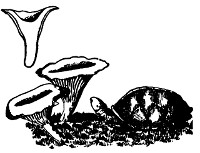
Cantharellus Cibarius.
In Cantharellus the gills—vein-like and generally thick with an obtuse edge—are entirely different from those of all the preceding genera. In those they are thin, and distinct from the pileus and from each other. In Hygrophorus the gills are frequently thick, but the edge is always sharp. The species of Craterellus are funnel-shaped, resembling some of those in Cantharellus, but are distinguished by their lack of evident gills.
Monograph New York Species of Cantharellus, Peck, Bull. 1887.
The members of this genus are few, but they are choice. Of them is the Cantharellus cibarius, of which Trattinik quaintly says: “Not only this same fungus never did any one harm, but might even restore the dead.”
The writer first made its acquaintance when among the West Virginia mountains in 1881. The golden patches of single and clustered cibarius, fragrant as ripened apricots, tufting the short grass or mossy ground under beeches, oaks and like-growing trees, through which the sunlight filtered generously, were so tempting, that he determined there must be luxury, even in death, from such toadstools.
Experiments made by the writer in West Virginia where the species grows luxuriantly and is of much higher flavor than any he has found elsewhere, prove that it is easy to transplant within congenial habitats, either by the mycelium or spores. Nature, there, resorts to washing masses of leaves containing the propagating parts of the fungus along the depressions of the water-sheds, and it is found growing plentifully where the wind has drifted forest leaves against trees, brush, and fence-corners.
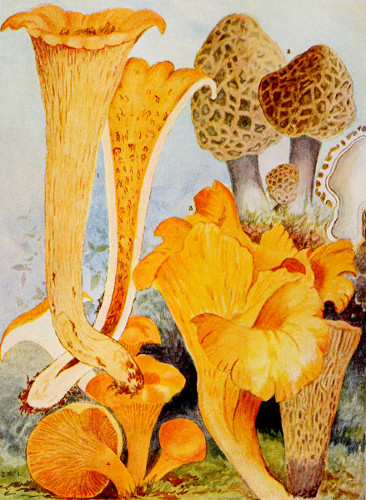
Grouped by F.D. Briscoe—Studies by C. McIlvaine. Plate XLVI.
Fig. Page. Fig. Page.
1. Cantharellus floccosus, 218 4. Cantharellus cibarius, 215
2. Morchella esculenta, 542 5. Cantharellus brevipes, 219
3. Craterellus cantharellus, 508
Other species of the genus do not, as a rule, grow so plentifully, neither are they of equal excellence, but several of them are equal to 215any other species. Suspicion has been thrown upon C. aurantiacus. There is such a marked difference between the excellence of the genus in West Virginia and other localities, that it is possible C. aurantiacus may be noxious elsewhere, but the writer has not found it so; and it would be an astonishing contradiction of Nature’s ways if it was.
Stevenson says: “It (C. cibarius) must have four hours slow cooking.” The writer has found thirty minutes to be sufficient; and it will fry in butter as quickly as any other fungus.
ANALYSIS OF TRIBES.
Mesopus (mesos, middle; pous, a foot). Page 215.
Stem central.
* Stem solid.
** Stem tubular.
Pleuropus (pleura, the side; pous, a foot).
Stem lateral.
Resupinatus (resupinatus, lying on the back).
Stem absent.
All the species known to be edible belong to Mesopus.
Me´sopus.
* Stem solid.
C. ciba´rius Fr.—cibaria, food. (Plate XLVI, fig. 4, p. 214. Plate XLVII.) Pileus fleshy, obconic, smooth, egg-yellow, slightly depressed. Gills thick, distant, more or less branching and anastomosing, concolorous. Stem firm, solid, often tapering downward, concolorous. Flesh white.
Height 2–4 in., breadth of pileus 2–3 in. Stem 3–6 lines thick.
In open woods and grassy places. Common. July and August.
Edible. The smell of apricots is not always clearly perceptible in American specimens. Peck, Monograph New York Species of Cantharellus, Rep. 23.
216Spores 6×8µ W.G.S.; 7.6×5µ Morgan; spheroid-ellipsoid, 8–9×5–6µ K.; 11µ Q.
Reported from the Atlantic to the Pacific and from Columbia river to Louisiana. June to September.
Wherever grown C. cibarius is one of the best. In European countries it is highly rated, and is expensive. Its mode of growth varies with its plentifulness. In the West Virginia mountains large patches of it closely cover the ground. Clusters weighing ½ pound are frequent.
(Plate XLVII.)
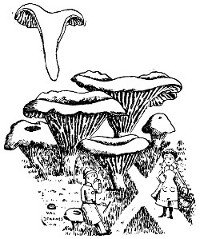
Cantharellus cibarius.
When shredded, or cut across the fibers, slow cooking for half an hour is sufficient, if the plants are fresh. If gathered for some hours, they should be soaked for a time.
C. mi´nor Pk. Pileus fleshy, thin, convex then expanded and depressed, egg-yellow. Gills very narrow, distant, sparingly branched, yellowish. Stem slender, subflexuous, equal, smooth, hollow or stuffed, concolorous.
Height 1–2 in., breadth of pileus 6–12 lines.
In open woods. July. Peck, 23d Rep. N.Y. State Bot.
Spores 6.4–7.6×4–5µ Peck.
West Virginia, New York, Pennsylvania. McIlvaine.
Grows in the West Virginia mountains, along with C. cibarius, and separate from it. It is more tender than C. cibarius, and not equal in flavor to those found there. I usually cooked them together and thus got quantity well flavored.
C. auranti´acus Fr.—orange-yellow. (Plate CXXXVI, fig. 4, p. 508.) Pileus fleshy, obconic, nearly plane above, smooth or minutely tomentose, dull orange with the disk usually brownish, the margin decurved 217and sometimes yellowish. Gills narrow, close, repeatedly forked, orange, sometimes yellowish. Stem inequal, generally tapering upward, colored like the pileus. Flesh yellowish, taste mild.
Height 2–3 in., breadth of Pileus 1–3 in. Stem 2–4 lines thick.
Ground and very rotten logs in woods or in fields. Common. Peck, 23d Rep. N.Y. State Bot.
Spores 6.4–7.6×4–5µ Peck, 10×5µ Massee.
Var. pallidus Pk. Pileus and gills pale yellow or whitish yellow.
Stevenson says of the English species, “Unpleasant, reckoned poisonous.” The writer’s acquaintance with C. aurantiacus has been principally confined to West Virginia. There its taste is mild, scent but little, flavor not distinguishable from eastern C. Cibarius. There it is perfectly safe and wholesome; neither have the writer and his friends any reason for condemning it.
C. umbona´tus Fr.—having an umbo. Pileus 1 in. and more broad, ashy-blackish, slightly fleshy, convex when young, umbonate, at length depressed, even, dry, flocculoso-silky on the surface, shining brightly especially under a lens. Flesh soft, white, often becoming red when wounded. Stem 3 in. long, about 4 lines thick, stuffed, equal, elastic, villous at the base, ash-colored, but paler than the pileus. Gills decurrent, thin, tense and straight, crowded, repeatedly divided by pairs, shining-white.
Odor and taste scarcely notable. Gregarious. Among the taller mosses the stem is longer. Often overlooked from its habit being that of an agaric. It varies with the pileus squamulose and blackish.
In woods. April to August. Fries.
The rather prominent gills of this small species are likely to confuse those not familiar with its variance from the genuine type. Reddish tinge to flesh not noticed in the American species. The writer has gathered it in several states and enjoyed it for many years.
(Plate XLVIII.)
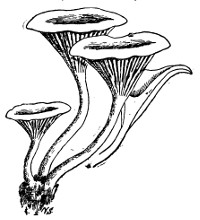
Cantharellus rosellus. Natural size.
C. rosel´lus Pk.—rosy. Pileus thin, funnel-shaped, regular, glabrous, pale pinkish-red. Flesh white. Gills narrow, close, dichotomous, deeply decurrent, whitish, tinged with pink. Stem equal, slender, solid, subglabrous, often flexuous, colored like the pileus. Spores minute, broadly elliptical, 3.5×2.5µ.
Pileus 4–8 lines broad. Stem about 1 in. long, scarcely 1 line thick.
218Mossy ground in groves of balsam. North Elba. September. This small species belongs to the section Agaricoides, and is apparently closely allied to C. albidus, from which its smaller size and different color distinguish it. The pileus is sometimes deeply umbilicate. Peck, 42d Rep. N.Y. State Bot.
Frequent in pine woods of New Jersey, near Haddonfield, where the plant is sturdier than described. Though small it grows gregarious and in troops from which appetizing quantities can be gathered.
It makes a pretty dish of pinkish hue and one of rare excellence.
C. lutes´cens Bull.—yellowish. (Plate CXXXVI, fig. 9, p. 508.) Pileus thin, fleshy, convex, umbilicate, brownish-floccose, yellowish. Gills very distant, sparingly branched, arcuate-decurrent, pale ochraceous. Stem slender, slightly tapering downward, smooth, shining, bright orange-tinted yellow, stuffed or hollow.
Height 2–3 in., breadth of Pileus 8–15 lines.
Mossy ground in woods. Catskill and Adirondack mountains, also Sandlake. August to October.
This is regarded by some as a variety of A. tubæformis. Peck, 23d Rep. N.Y. State Bot.
In mixed and scrub-pine woods near Haddonfield, N.J.; mixed woods Angora and Kingsessing, Philadelphia.
Perhaps constancy to C. cibarius has influenced the writer in favor of members of its family, and accounts for the gusto in “Fine” set opposite his notes to the present species. Nevertheless such is his opinion.
** Stem tubular.
C. flocco´sus Schw.—woolly. (Plate XLVI, fig. 1, p. 214.) Pileus fleshy, elongated funnel-form or trumpet shape, floccose-squamose, 219ochraceous-yellow. Gills vein-like, close, much anastomosing above, long decurrent and subparallel below, concolorous. Stem very short, thick, rarely deeply rooting.
Height 2–4 in., breadth of Pileus at the top 1–3 in.
Woods and their borders. Not rare. Utica, Johnson. Albany and Sandlake. July and August. Peck, 23d Rep. N.Y. State Bot.
Spores 12.5–15×7.6µ Peck.
New York, Peck, Rep. 23; Maine, Mrs. Stella F. Fairbanks; West Virginia, McIlvaine.
A beautiful species of good quality.
(Plate XLIX.)
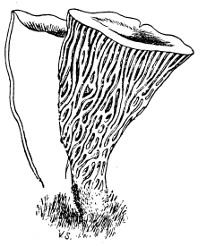
Cantharellus brevipes. Small plant, two-thirds natural size.
C. bre´vipes Pk.—brevis, short; pes, a foot. (Plate XLVI, fig. 5, p. 214.) Pileus fleshy, obconic, glabrous, alutaceous or dingy cream-color, the thin margin erect, often irregular and lobed, tinged with lilac in the young plant; folds numerous, nearly straight on the margin, abundantly anastomosing below, pale umber tinged with lilac. Stem short, tomentose-pubescent, ash-colored, solid, often tapering downward. Spores yellowish, oblong-elliptical, uninucleate, 10–12µ×5µ.
Plant 3–4 in. high. Pileus 2–3 in. broad. Stem 4–6 lines thick.
Woods. Ballston, Saratoga county. July.
This interesting species is related to the C. floccosus, both by its short stem and its abundantly anastomosing folds. The two species should be separated from the others and constitute a distinct section. The flesh in C. brevipes is soft and whitish, and the folds are generally thinner than in C. floccosus. Peck, 23d Rep. N.Y. State Bot.
Plentiful in West Virginia mountains in 1884, growing in patches. Found in mixed woods near Cheltenham, Pa., and at Springton, Pa., 1887.
220In West Virginia it is prolific and rivals the C. cibarius in excellence. The flesh is softer, not so fibrous, and cooks more readily.
In that locality there is a marked difference between C. brevipes and C. floccosus. The latter is much longer, and markedly resembles the large end of a gold lined cornet. Like the C. cibarius it is not of as good quality in eastern states.
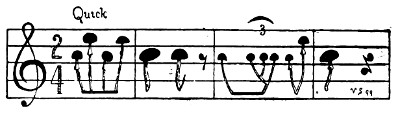
NYC´TALIS Fr.
Gr—night. From inhabiting dark places.
(Plate L.)
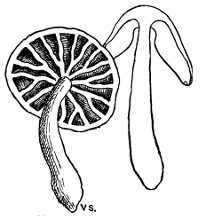
Nyctalis parasiticus.
Hymenophore continuous with the stem. Gills fleshy, thick, juicy, obtuse at the edge, not decurrent on the stem nor fold-like. Veil (in species which have been fully observed) floccoso-pruinose.
Fleshy fungi, not reviving, of uncertain and irregular occurrence, differing in many respects from one another and from the rest of the Agaricini. Fries.
The typical species are saprophytic on decaying fungi. But one species, Nyctalis asterophora, reported in America. See Peck, 26th Rep. N.Y. State Bot.
221MARAS´MIUS Fr.
Gr—to wither or shrivel.
(Plate LI.)
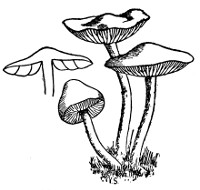
Marasmius oreades. About one-half natural size.
Pileus regular, thin, tough and pliant. Gills pliant, rather tough, somewhat distant, variously attached or free, with an acute entire edge. Stem cartilaginous or horny, continuous with the pileus but of different texture. Not putrescent but drying up with lack of moisture, reviving and assuming the original form with the advent of rain. This character distinguishes Marasmius from all other genera of Agaricaceæ.
Its nearer relations are Collybia and Mycena.
Fries says that all Agaricaceæ having the smell of garlic are found in this genus. On the ground, but generally on wood or leaves.
Professor Peck reports over forty species of this genus found in New York state. Several not found in New York are reported from other states. The writer has found a few such species in Pennsylvania and West Virginia. Many untried species will probably prove to be edible; the majority are too small to be of food value. M. urens, reported poisonous, and M. peronatus, heretofore considered poisonous, have been found by the writer to be edible. Several species not described herein have been tested for edibility to a limited extent only.
In this genus occurs the famed M. oreades, the Mousseron of France, the Champignon and Scotch bonnet of England, the Fairy-ring mushroom of America.
ANALYSIS OF TRIBES.
Collybia (inclining to Collybia). Page 223.
Flesh of pileus pliant, at length rather leathery, grooved or wrinkled, margin incurved at first. Stem somewhat cartilaginous; mycelium woolly, absent in some species.
222A. Scortei (scorteus, leathery). Page 223.
Stem solid or stuffed, then hollow, fibrous within, outside covered with down. Gills separating from the stem, free.
* Base of stem woolly or strigose.
** Stem naked at the base, often interwoven with twisted fibers.
B. Tergini (terginus, leathery). Page 225.
Stem rooting, distinctly tubular, not fibrous, distinctly cartilaginous. Gills receding then free. Pileus thinner than in the preceding group, hygrophanous, even or with the margin striate.
* Stem woolly below, smooth above.
** Stem when dry covered with velvety down.
C. Calopodes (Gr—beautiful; Gr—a foot). Page 226.
Stem short, not rooting, often with a floccose or downy, tubercular base. Pileus convex, involute, then plane and more or less depressed, in which state the gills typically adnate are subdecurrent. On twigs, branches, etc. Gregarious.
* Stem quite smooth above, shining, base not swollen.
** Stem covered with velvety down, rather swollen at the base.
Mycena (inclining to Mycena). Page 227.
Stem horny, hollow, often filled with pith, tough, dry. Mycelium rooting, not floccose. Pileus somewhat membranaceous, bell-shaped, then expaned, margin at first straight and pressed to the stem.
A. Chordales (chorda, a gut). Page 227.
Stem rigid, rooting or dilated at the base. Pileus bell-shaped or convex. Type manifestly that of Mycena.
B. Rotulæ (rotula, a little wheel).
Stem thread-like, flaccid, base not dilated or floccose but appearing to enter the matrix abruptly. Pileus soon becoming plane or umbilicate. On leaves.
* Stem quite smooth, shining.
** Stem minutely velvety or hairy.
Apus (a, without; pous, a foot).
Pileus sessile, resupinate.
223I.—Colly´bia.
A. Scortei.
* Stem woolly or strigose at base.
M. u´rens Fr.—uro, to burn. Pileus 2–3 in. broad, unicolorous, pale yellowish, becoming pale, slightly fleshy, moderately compact at the disk, even, but here and there scaly or cracked in wavy lines when dry, smooth, the thin margin involute. Stem 2–3 in. long, 3 lines thick, solid, composed of crisp tough fibers, rigid, equal, sometimes however ventricose, ½ in. thick, everywhere clothed with white flocci, pale, white-downy at the base. Gills free, united behind, at length remote from the stem, distant, tough, at first pale-wood-color, then brown.
Gregarious, somewhat cespitose. Taste very stinging. The stem is not strigosely sheathed at the base. Fries.
In mixed woods. Frequent. June to September.
A curious form occurred with the pileus turning very dark when full-grown. B. and Br. POISONOUS. Worthington Smith has tested it by accident. It produced headache, swimming of brain, burning in throat and stomach, followed by severe purging and vomiting. Stevenson.
Gregarious or cespitose. Taste very pungent, a feature which separates the present from M. oreades. Not coarsely tomentose at the base, as in M. peronatus, but only downy. Massee.
Spores 3×4µ W.G.S.; elliptical, 8×4µ Massee.
Pennsylvania, New Jersey, West Virginia. McIlvaine.
I have not known it to disagree with myself or friends. That it may not agree with some persons is unquestioned. Collectors should carefully test it upon themselves.
M. perona´tus Fr.—pero, a kind of boot. Pileus 1–2 in. and more broad, light yellowish or pallid brick-red, then becoming pale, wood-color or tan, at first fleshy-pliant, then coriaceo-membranaceous, convex then plane, obtuse, flaccid, slightly wrinkled, even at the disk, at length pitted, striate at the margin. Flesh white. Stem 2–3 in. long, 1–2 lines thick, stuffed, fibrous, tough, attenuated upward, at length hollow and compressed, furnished with a bark, light yellow then pallid, cuticle villous but separating and reddish when rubbed, somewhat incurved at the base, where it is clothed with dense, somewhat strigose, yellowish or 224white villous down. Gills adnexed, then separating, free, moderately thin, and crowded, when young whitish, pallid wood-color, at length somewhat remote, reddish.
B. Woolly sheathed at the base. Taste acrid like that of M. urens, odor none. Fries.
In woods. Common. Stevenson.
Spores pip-shaped, 7×4µ W.G.S.; 10×6–7µ Massee.
New York. Thin woods. North Elba. August. September. Peck, 42d Rep.; West Virginia, June to December, West Philadelphia and Mt. Gretna, Chester county, Pa. McIlvaine.
M. peronatus is the wood-cousin of M. oreades. It is still reputed poisonous by all writers upon the subject, though M.C. Cooke gives it the benefit of a doubt. The name is given because of the base of the stem being densely covered with short hairs or a woolly down, and is thus easily recognized. It is common in woods, among decaying leaves, especially of the oak, from May until after frosts. It is usually solitary, but a few individuals are sometimes clustered. It is quite peppery to the taste, but pleasantly so. I have repeatedly eaten it, as have my friends. It loses its acridity in cooking, and though the caps are tougher than M. oreades, they make a highly flavored and delicious dish. Collectors should carefully test it for themselves.
** Stem naked at the base, etc.
M. ore´ades Fr. Gr—mountain-nymphs. Scotch bonnet. Champignon. Mousseron. (Plate LI, p. 221.) Pileus 1–2 in. broad, reddish then becoming pale, absorbing moisture, whitish when dry, fleshy, pliant, convex then plane, somewhat umbonate, even, smooth, slightly striate at the margin when moist. Stem 2–3 in. long, 1½ lines thick, solid, very tough, equal, tense and straight, everywhere clothed with a villous-woven cuticle which can be rubbed off, pallid; bluntly rooted at the base, naked, not villous or tomentose. Gills free, broad, distant, the alternate ones shorter, at first soft, then firmer, pallid-white.
Odor weak, but pleasant, stronger when dried, taste mild. Commonly growing in circles or rows. Fries.
Spores 6–7×5–6µ K.; elliptical, 8×5µ Massee; nearly elliptical, white, 7.6–9µ long Peck.
Common throughout the states during the summer months after rains, 225and in rings, but can be found from May until after frost. If one knows where the rings are to be found M. oreades can be gathered when shriveled, and are quite as good, after soaking, as when fresh.
M. oreades must be sought for where the grass is luxuriant. It hides among it. It is well worthy of the search. Raw, fresh or shriveled, it is sweet, nutty, succulent when eaten; stewed well it is delicious. Though tough its consistency is agreeable. The most delicate stomachs can digest it. The writer saved the life of a lovely woman by feeding her upon it when nothing else could be retained; and of another, by feeding Coprinus micaceus, after a dangerous operation. He introduced these species, together with a few others, into a large hospital in Philadelphia, where they were used with marked beneficial effect, and such use is now widespread.
When dried, by exposure to the air or sun, it can be kept indefinitely, neither losing its aroma or flavor, which it graciously imparts to soups or any other dish.
Collybia dryophila, Stropharia semi-globata, and Naucoria semi-orbicularis are sometimes found growing with it. These species are delicious and harmless.
Lafayette B. Mendel in the Am. Jour. of Physiology, March, 1898, gives the following analysis:
Twenty freshly gathered specimens (from New Haven) weighed 9 grams, an average weight of 0.45 grams each. The analysis gave:
Water 74.96%
Total solids 25.04
Total nitrogen of dry substance 5.97
Ash of dry substance 7.23
B. Tergini.
** Stem downy when dry, etc.
M. Wyn´nei B. and Br. Pileus 1–1½ in. broad, lilac-brown, tardily changing color, fleshy, convexo-plane, somewhat umbonate. Stem 2 in. long, 1½ line thick, tubed, furfuraceous, somewhat of the same color as the pileus. Gills adnexed, thick, distant, bright-colored, beautifully tinged with lilac; interstices even.
Inodorous. Gregarious or cespitose. The stem springs from a white mycelium, but is by no means strigose or tawny at the base. Quite distinct from M. fusco-purpureus. Fries.
226Among leaves, twigs, etc. Stevenson.
Spores elliptical, 7–8×4µ Massee.
Kingsessing, West Philadelphia. Gregarious and cespitose, among leaves, etc., in oak woods. September to October, 1885.
This very pretty fungus very much resembles at first sight the small purplish Clitocybes, but is readily distinguished on examination. I ate the caps and enjoyed them during the seasons of 1885 and 1887, but have not seen the plant since.
The caps are equal to M. oreades.
C. Calopodes.
* Stem smooth, etc.
M. scorodo´nius Fr. Gr—a plant that smells like garlic. Pileus ½ in. and more broad, rufous when young, but soon becoming pale, whitish (not hygrophanous), slightly fleshy, pliant, convex then soon plane, obtuse, always arid; even when young, at length wrinkled and crisped. Stem 1 in. long, scarcely 1 line thick, horny, tough, tubed, equal, very smooth throughout, shining, reddish, inserted and naked at the base. Gills adnate, often separating, connected by veins, at length crisped in drying, whitish.
Commonly gregarious. Readily distinguished from neighboring species by its strong odor of garlic. Fries.
Heaths and dry pastures on twigs, etc. Rare.
Edible. Esteemed for flavoring. Stevenson.
Spores elliptical, 6×4µ Massee.
North Carolina, Schweinitz, Curtis; New England, Frost; New Jersey, Ellis; New York, August, Peck, 23d Rep.
M. ca´lopes Fr. Gr—beautiful; a foot. Pileus about 4 lines broad, whitish, slightly fleshy, tough, convex then flattened, obtuse, rarely depressed, even, smooth, slightly wrinkled when dried. Stem 1 in. long, 1 line thick, tubed, slightly attenuated upward, even, smooth, tough, dull-red or bay-brown-red, shining, somewhat rooted. Gills slightly emarginate, in groups of 2–4, thin, white.
Inodorous. Almost smaller than M. scorodonius, but the stem is longer, otherwise very like it. Fries.
Spores elliptical, 7×4µ Massee.
227Twigs and stems among fallen leaves in woods. Ticonderoga. August.
This might easily be mistaken for M. scorodonius, but it is without odor, and has a different insertion of the lamellæ. It is sometimes cespitose. The pileus in our specimens is whitish. Peck, 31st Rep. N.Y. State Bot.
Because of its similarity to M. scorodonius, which is edible, it is given here.
II.—Mycena.
A. Chordales.
M. allia´ceus Fr.—allium, garlic. Pileus 1–1½ in. broad, whitish inclining to fuscous, often milk-white when young, somewhat membranaceous, campanulate then expanded, somewhat umbonate, even, at length striate and sulcate, smooth, dry. Stem as much as 8 in. long, horny, rigid, fistulose, attenuated upward, pruinato-velvety, blackish, rooted at the base where it is somewhat incurved and naked. Gills adnexed in the form of a ring, then free, slightly ventricose, arid, slightly distant, fuscous-whitish, crisped when dry.
Odor strong, of garlic, persistent. There is nothing of a reddish tinge in the whole plant. The stem is not tomentose at the base as in the Tergini. Fries.
Among leaves and on rotten wood. Frequent. August to October. Stevenson.
Spores 14–16×8µ. Massee.
North Carolina, Schweinitz, Curtis; Pennsylvania, Schweinitz; Minnesota, Johnson; Novia Scotia, Somers.
Edible. Bull. Boston Myc. Club.

228HELIOMYCES Lev.
Helios, the sun; myces, a fungus.
Pileus membranaceous, between leathery and gelatinous, radiately sulcate. Gills equal, edge acute. Stem somewhat woody, cylindrical, central.
Allied to Marasmius, but differing in its sub-gelatinous substance.
None reported edible.
LENTI´NUS Fr.
Lentus, tough or pliant.
(Plate LII.)
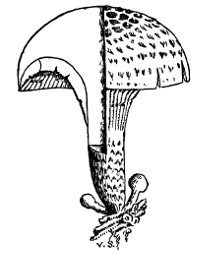
Section of Lentinus.
Pileus fleshy-coriaceous, pliant, tough and hard when old, persistent. Gills becoming dry, tough, simple, unequal, thin, margin acute, toothed, more or less decurrent. Stem when present central, excentric or lateral, hard and firm, continuous with the flesh of the pileus.
Growing on wood.
Spores somewhat round, even, white.
Distinguished from other coriaceous genera by its serrated and torn gills.
“The genera Lentinus and Lenzites are found in every region of the world; their principal center, however, is in hot countries, where they attain a splendid development. On the contrary, toward the north they rapidly decrease in number.” Fungi. Cooke and Berkeley.
In habitat and mode of growth Lentinus closely resembles Pleurotus, and parallel genera with colored spores. When young the species are inviting, and when well cooked are meal-giving. They are not delicacies, but substantials. They dry well. Grated they make soups, and give their pleasant flavor to any dish.
229ANALYSIS OF TRIBES.
Mesopodes (mesos, middle; pous, a foot). Page 229.
Stem distinct.
Pleuroti (pleura, a side; ous, an ear).
Stem lateral or absent. None known to be edible
I.—Meso´podes (center-stemmed).
L. Lecom´tei Fr. Pileus coriaceous, funnel-shaped, regularly reflexed, hairy, tawny. Gills crowded, pallid. Stem short, hairy, tawny.
Common to the states.
Professor Peck writes to me: “This plant, by reason of its rather tough substance, has commonly been referred to Lentinus, under the name L. Lecomtei Schw., but this reference is scarcely satisfactory to me, since the edge of the lamellæ is scarcely at all serrate as required by that genus. It seems to me it would go better under the genus Panus. It is variable—sometimes eccentric or even lateral. It is sometimes called Lentinus strigosus, but I do not think the two are distinct species, however distinct they may be in form.” February 26, 1894.
Like all Lentinus the present species is rather tough, yet chopped into small pieces, well cooked and seasoned, it is quite equal to P. ostreatus and many others of high renown.
(Plate LIII.)
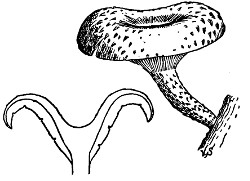
Lentinus tigrinus. About one-half natural size.
L. tigri´nus Fr.—tigris, a tiger. From the markings. Pileus commonly 2 in. broad, white, variegated with somewhat adpressed, blackish, hairy squamules, fleshy-coriaceous, thin, commonly orbicular and central, at first convexo-plane, umbilicate, at length funnel-shaped, often split at the margin when dry. Stem about 2 in. long, thin, solid, very hard, commonly attenuated downward, minutely squamulose, whitish, often ascending and becoming dingy-brown at the base, at first furnished at the apex with an entire reflexed ring, which soon falls off. Gills decurrent 230(by no means sinuate), narrow, crowded, unequal, toothed like a saw, white.
Somewhat gregarious, even cespitose, thinner and more coriaceous and regular than L. lepideus B., wholly blackish with squamules. Fries.
On old stumps. Rare. Stevenson.
When fresh very tender and easily torn, when dry coriaceous. Sow. Smell strong, acrid, like that of some Lactarii. M.J.B.
Spores 6.6×3.3µ Morgan; elliptical, smooth, 7×3.5µ Massee.
Agreeable taste and odor, eaten in Europe. Roques.
Edible, tough when old and never very delicate or digestible.—M. C. Cooke.
Not found in sufficient quantity to test.
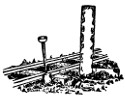
L. lepi´deus Fr. Gr—scaly. (Plate XVI, fig. 3, 4, p. 52.) Pileus 2–4 in. broad, pallid-ochraceous, variegated with adpressed, darker, spot-like scales, fleshy, very compact and firm, irregular, commonly excentric, convex then depressed, but not truly umbilicate, sometimes broken up into cracks. Flesh pliant, white. Stem short, commonly 1 in. long, solid, stout, very irregularly formed, almost woody, tomentose-scaly, whitish, rooted at the base, at the first furnished with a veil toward the apex. Gills decurrent, but sinuate behind, crowded broad, transversely striate, whitish, edge torn into teeth.
Odor pleasant. Fries.
Spores 11×5µ W.G.S., 7×3µ. Massee.
Lentinus lepideus is a sort of commercial traveler. It is common wherever railroads are. It is partial to oak ties and its mycelium is injurious to them. It is found upon pine and other timbers. The writer has collected large clusters of it from oak sawdust. The European plant is noted as “almost always solitary.” In the United States it is seldom so. It is noted as growing in damp, dark places, but it loves the sun.
As a food it is about on a par with P. ulmarius, not as tough, but harder when old. It is a reliable species from spring until late autumn, is persistent and dries well. It is neat, handsome, prolific. When young it makes a good dish, and when old can be used to advantage in soups.
231L. cochlea´tus Fr.—cochlea, a snail. Pileus 2–3 in. broad, flesh-color, but becoming pale, somewhat tan, fleshy-pliant, thin, commonly excentric, imbricated, very unequal, somewhat lobed or contorted, sometimes plane, sometimes funnel-shaped-umbilicate, but not pervious, smooth. Stem solid, firm, sometimes central, most frequently excentric, sometimes wholly lateral, always sulcate, smooth, flesh-colored upward, reddish-brown downward. Gills decurrent, crowded, serrated, white-flesh-color. Fries.
Pliant, tough, flaccid, very changeable in form, sometimes solitary, sometimes cespitose, imbricated, growing into each other. From very small forms which are commonly solitary, with the stem and pileus scarcely 1 in. it ranges to 3 in.
On stumps. Frequent. August to October.
According to Fries the odor is weak, of anise; but it is generally strong and very pleasant. Stevenson.
Spores nearly globular, 4µ diameter Morgan; spheroid or ellipsoid-spheroid, uniguttate, 4–6µ K.; almost globular, 4µ W.G.S.
The dense clusters of all sized members are usually plenty in favored localities. It is inviting in appearance, taste and spicy odor. It retains a suspicion of the latter when cooked which gives the dish a flavor pleasant to many. It must be young to be tender. When dry—like others of its kind—it can be grated and used in many ways.
L. Un´derwoodii Pk. Pileus fleshy, tough, convex or nearly plane, the glabrous surface cracking into areola-like scales which are indistinct or wanting toward the margin, whitish or slightly tinged with buff or pale ochraceous. Flesh white. Gills moderately close, decurrent, slightly connecting or anastomosing at the base, somewhat notched on the edge, whitish, becoming discolored in drying. Stem stout, hard, solid, eccentric, squamose, colored like the pileus. Spores oblong, 13–15×5–6.5µ.
Plant cespitose. Pileus 3–6 in. broad. Stem 1.5–3 in. long, about 1 in. thick.
This differs from L. magnus in its cespitose habit, eccentric stem, longer spores, less distinctly areolate-squamose pileus and in its habitat. The gills are connected at the base very much like those of Pleurotus ostreatus. Peck, Torr. Bull. Vol. 23, No. 10.
North Carolina, Pennsylvania, McIlvaine.
232The writer first met with it in North Carolina, near Washington, on oaks and railroad timbers, and in Fairmount Park, Philadelphia. It attains quite a size, grows singly and in clusters. Its clean, cake-like appearance is attractive. Cooked it ranks with P. ulmarius, L. lepideus, and Panus strigosus.

PA´NUS Fr.
A name given to a tree-growing fungus by Pliny.
(Plate LIV.)
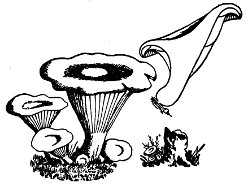
Panus torulosus. About one-fourth natural size.
Whole fungus between fleshy and leathery, tough, not woody, texture fibrous. Gills unequal, tough, becoming leathery, edge acute and unbroken. Stem present or absent.
Growing on wood. Various in form, lasting long. Allied to Lentinus but differing in the tough and very entire gills.
Spores even, white.
ANALYSIS OF SPECIES.
* Stem excentric.
** Stem lateral.
*** Stem absent. Pileus resupinate or dimidiate.
Species of this genus are among our most observable fungi. Their settlements are frequent on decaying trees, stumps, branches, on fences, cut timber, etc. Most of them are small, but their coriaceous build prevents their shrinking in cooking. Most species have a pleasant farinaceous taste and odor, which they yield, together with a gummy substance, to soups and gravies.
Tasting a small piece will immediately tell, if the species is not known, whether it is edible or of the styptic kind.
* Stem excentric.
P. concha´tus Fr.—Formed like concha, a shell-fish. Pileus about 2333 in. across, tough and flexible, unequal, excentric or dimidiate, margin often lobed, cinnamon-color becoming pale, at length more or less scaly. Flesh thin. Gills narrow, forming decurrent lines on the stem, somewhat branched; pinkish-white then pale-ochraceous. Stem about ⅔ in. long, 3–4 lines thick, solid, unequal, pale, base downy. Massee.
On trunks of beech, poplar, etc.
Often imbricated and more or less grown together. Allied to Panus torulosus, but distinguished by the much thinner pileus, more expanded and excentric, also dimidiate, flaccid, cinnamon becoming pale, but the form not constant. Stem about ½ in. long, 4 lines thick, often compressed, downy at the base. Pileus 2–4 in. broad, scaly when old. Gills decurrent in long, parallel lines, not at all resembling those of Pleurotus ostreatus, which anastomose behind, but frequently unequally branched, at first whitish or pale flesh-color, then wood-color, crisped when dry. Fries.
Always known by its shell-like form and its tough substance.
Sent to the writer by Mr. E.B. Sterling, Trenton, N.J. September, 1898.
The appearance of scales upon the pileus was scarcely noticeable. Taste pleasant. The fungus is tough when old, but yields an excellent gravy.
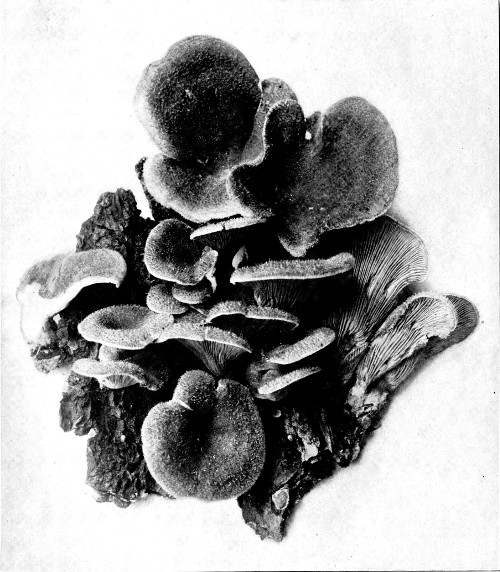
Photographed by Dr. J.R. Weist. Plate LV. PANUS STRIGOSUS.
P. torulo´sus Fr.—a tuft of hair. (Plate LIV, p. 232.) Pileus 2–3 in. broad, somewhat flesh-color, but varying reddish-livid and becoming violet, entire, but very excentric, fleshy, somewhat compact when young, plano-infundibuliform, even, smooth. Flesh pallid. Stem short, commonly 1 in., solid, oblique, tough, firm, commonly with gray, but often violaceous down. Gills decurrent, somewhat distant, simple, separate behind, reddish then tan-color.
Very changeable in form, at first fleshy-pliant, at length coriaceous. In the covering of the stem it approaches Paxillus atro-tomentosus, but there is no affinity between them. Fries.
On old stumps.
Spores 6×3µ W.G.S.
North Carolina, Curtis; Massachusetts, Frost; Minnesota, Johnson; Kansas, Cragin; New York, Peck, Rep. 30.
Much esteemed in France, W.D.H. Edible, but tough. M.C.C.
234P. lævis B. and C.—light. Pileus 3 in. broad, orbicular, slightly depressed, white, clothed in the center with long, intricate, rather delicate hairs, which are shorter and more matted toward the inflected margin; substance rather thin. Stem 3 in. high, ½ in. thick, attenuated upward, generally excentric, sometimes lateral, not rooting, solid, hairy below like the margin of the pileus. Gills rather broad, entire, decurrent, but not to a great degree, the interstices even above, behind clothed with the same coat as the top of the stem. Spores white.
On oak and hickory trunks.
A most distinct species, remarkable for its great lightness when dry and the long villous but not compressed or compound flocci of the pileus. Sometimes the center of the pileus becomes quite smooth when old.
One of the prettiest of fungi. The markings upon the white margin are more precise than those of the finest bee comb. One does not tire looking at the work of Nature’s geometrician. It is not plentiful, but is of useful size. It has good flavor and cooks quite tender.
(Plate LVa.)
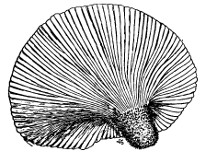
Panus Strigosus. One-third natural size.
P. strigo´sus B. and C.—covered with stiff hairs. Pileus white, excentric, clothed with coarse strigose pubescence, margin thin. Stem strigose like the pileus. Gills broad, distant, decurrent. Allied to P. lævis.
Pileus 8 in. broad. Stem 2–3 in. long, 1 in. or more thick.
On oak stumps.
Decaying wood of deciduous trees. September.
It is remarkable for its large size and the dense hairy covering of the pileus and stem. Peck, 26th Rep. N.Y. State Bot.
A remarkably handsome fungus. A specimen taken from a cluster growing upon an apple tree measured 10 in. across. Its creamy whiteness, and short hairy stem make it unmistakable among other tree-fungi.
When very young it is edible, but soon becomes woody. Even when aged it yields a well flavored gravy.
235** Stem lateral.
P. farina´ceus Schum.—farina, meal. From the scurf on the pileus. Pileus cinnamon-umber, somewhat coriaceous, flexuous, cuticle separating into whitish-bluish-gray scurf. Stem short, lateral, of the same color as the pileus. Gills determinately free, distinct, paler.
The habit is that of P. stipticus. Stevenson.
Pennsylvania, A. pleurotus f., Schweinitz; Ohio, Morgan.
Var. albido-tomentosus. See Panus albido-tomentosus.
P. al´bido-tomento´sus Cke. Mass.—albidus, white; tomentum, down. Pileus about ⅔ in. long, ½ in. broad, horizontal, sometimes imbricated, semi-circular, subcoriaceous, flexuous or regular, pale umber, densely clothed with a short, whitish, velvety down, which seems to be persistent, but thinner and shorter toward the shortly incurved margin. Stem lateral, very short, or entirely absent, and attached by a downy base. Gills radiating from the point of attachment; narrowed behind, lanceolate, honey-colored, margin entire, rigid, scarcely crowded, shorter ones intermixed. Spores subglobose, smooth, 5µ diameter.
On trunks and branches.
Pileus about 1 in. broad, often in imbricated tufts. It is doubtful whether this is not a distinct species from the type described by Fries. Cooke and Massee.
Panus albido-tomentosus is given by Cooke and Massee as a variety of Panus farinaceus. The writer decides to give it place as a species.
It has been sent to me by Mr. H.I. Miller, from Terre Haute, Ind., by Dr. E.L. Cushing, Albion, N.Y., Miss Madeleine Le Moyne, Washington, Pa. I have found it in West Virginia, New Jersey and many parts of Pennsylvania. It is plentiful in patches upon branches and boles of deciduous trees. Long, slow cooking makes it tender. It makes a luscious gravy after thirty minutes' stewing.
*** Stem absent, pileus resupinate or dimidiate.
P. betuli´nus Pk.—betula, birch. Pileus thin, suborbicular or dimidiate, nearly plane, glabrous, prolonged behind into a short stem, grayish-brown, darker or blackish toward the stem. Gills narrow, close, decurrent, 236whitish. Stem adorned with a slight tawny hairiness which is more fully developed toward the base. Spores minute, 4–5×1.5–2µ.
Decaying wood of birch. Newfoundland. October, Rev. A.C. Waghorne. Peck, Bull. Torrey Bot. Club, Vol. 23, No. 10.
Common in West Virginia mountains on birches, 1882; found at Eagle’s Mere, Pa., August, 1898. Quite plentiful on decaying birch trees, which abound there. Size from ½-1½ in. across.
Eaten raw it has a gummy quality and very pleasant nutty flavor. I did not have opportunity to cook it, but regard it as a species well worth trying.
P. stip´ticus Fr.—stypticus, astringent. Pileus ½-1 in. broad, cinnamon becoming pale, arid, thin, but not membranaceous, kidney-shaped, pruinose, the cuticle separating into furfuraceous scales. Stem not reaching 1 in. long, solid, definitely lateral, compressed, dilated upward, ascending, pruinose, paler than the gills. Gills ending determinately (not decurrent), thin, very narrow, crowded, elegantly connected by veins, cinnamon. Fries.
Gregarious, cespitose, remarkable for its astringent taste. The pileus sometimes has a funnel-shaped appearance with lobes all around.
On stumps, etc. Common. August to February.
Reckoned poisonous. Stevenson.
Spores obovoid-spheroid, 2–3×1–2µ K.; 3×4µ W.G.S.
Plentiful and general. The markings upon the cap in moist weather are sometimes exquisitely regular.
The immediate and lasting unpleasantness of this fungus to mouth and throat, whether cooked or raw, will cancel all desire to eat of it forevermore. A nibble will detect it. It is reckoned poisonous, and may be. No one but a determined suicide would resort to it. Dr. Lambotte asserts that it is a violent purgative.

237XER´OTUS Fr.
Gr—dry; Gr—an ear.
(Plate LVI.)
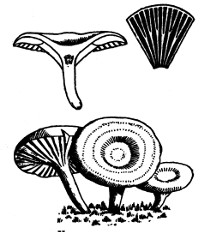
Xerotus degener.
Hymenophore continuous with the stem, descending into the trama which is homogeneous with the coriaceous pileus. Gills coriaceous, broadly plicæform, dichotomous, edge quite entire, obtuse. Rigid, persistent, analogous with the Cantharelli, but differing in the whole structure. Fries. The gills are more distant than in any species of Agaricaccæ.
None edible.
TRO´GIA Fr.
After Trog, a Swiss botanist.
(Plate LVIII.)
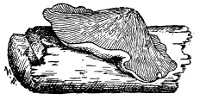
Trogia crispa. Natural size.
Gills fold-like, edge longitudinally channelled (in the single European species only crisped). In other respects agreeing with Xerotus. Soft, flaccid, but arid and persistent, texture fibrillose. Fries.
Reviving when wet. Spores white. Stevenson.
Spores elongated or cylindrical.
American representative, Trogia crispa, var. variegata.
Pileus and gills variegated with bluish or greenish-blue stains. Sandlake. September. Peck, 38th Rep. N.Y. State Bot.
Not edible.
238SCHIZOPHYL´LUM Fr.
Gr—to split; Gr—a leaf.
(Plate LVIIIa.)
Schizophyllum commune.
Pileus fleshless, arid. Gills coriaceous, fan-wise branched, united above by the tomentose pellicle, bifid, split longitudinally at the edge. Spores somewhat round, white. Fries.
The two lips of the split edge of the gills are commonly revolute. The farthest removed of all the Agaricini from the type.
Growing on wood. Stevenson.
Common on decaying wood. Tough.
LENZITES Fr.
After Lenz, a German botanist.
Pileus corky or coriaceous, texture arid and floccose. Gills coriaceous, firm, sometimes simple and unequal, sometimes anastomosing and forming pores behind, trama floccose and similar to the pileus, edge somewhat acute. The European species are dimidiate, sessile, persistent, growing on wood, quite resembling Dædalea. Fries.
Allied most nearly to Trametes and Dædalea and forming as it were the transition from Agaricaceæ to Polyporaceæ. In tropical countries they are more woody in texture. Stevenson.
Very common. None edible.
(Plate LVII.)
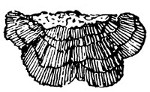
239
Rhodosporae.
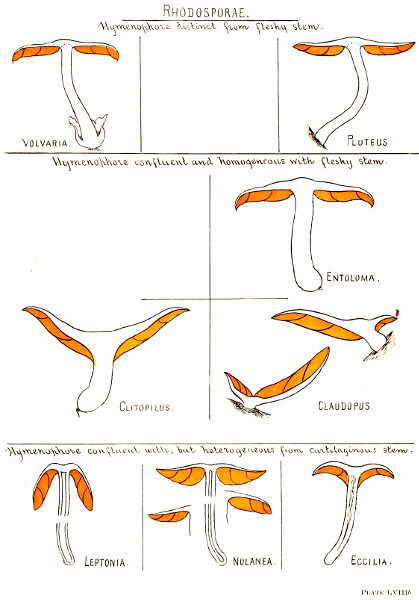
Plate LVIIIb.
Chart of genera in pink-spored series—Rhodosporae. Page 239.
Series II. RHODOSPORÆ. Gr—rose; Gr—seed. Or HYPORHO´DII—hypo,
under; rhodon, rose.
Spores pink or salmon-color.
In Volvaria, Pluteus and most of Clitopilus, the spores are regular in shape, as in the white-spored series, in the rest of the subgenera they are generally angular and irregular.
Though European writers, generally, condemn the rosy-spored series as inedible, a few of our best American edibles are found in it—notably Pluteus cervinus.
VOLVA´RIA Fr.
Volva, a wrapper.
Spores regular, oval, pink, or salmon. Veil universal, forming a perfect volva, distinct from the cuticle of the pileus. Stem separating easily from the pileus. Gills free, rounded behind, at the very first white then pinkish, soft. Analogous with Amanita.
Growing in woods and on rich mold, rotten wood and damp ground, hence often found in hot-houses and gardens. V. Loveiana Berk. is parasitic on Clitocybe nebularis.
There are thirteen species reported from different parts of the United States. Most of them grow upon wood. Two species have previously been reported as edible, to which I have added V. Taylori, tested by myself.
One species, V. gloiocephala, is upon the authority of Letellier, given as poisonous. It is found in several parts of the United States, but no comment has been made upon its edibility. I have not seen it. A careful study of its botanic characters is urged. It should be regarded as poisonous until its reputation is cleared up, as it probably will be.
ANALYSIS OF SPECIES.
* Pileus dry, silky or fibrillose.
** Pileus more or less viscid, smooth.
240
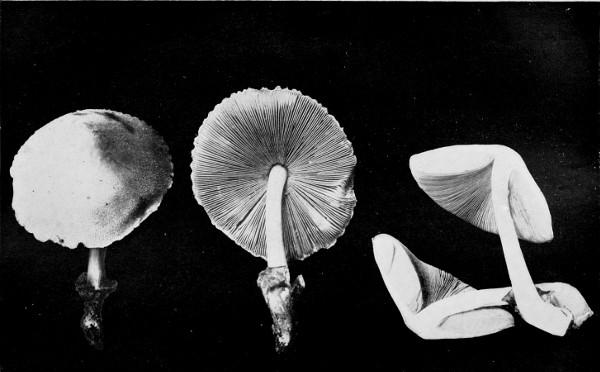
Photographed by Dr. J.R. Weist. Plate LIX. VOLVARIA BOMBYCINA.
* Pileus dry, silky or fibrillose.
(Plate LIXa.)
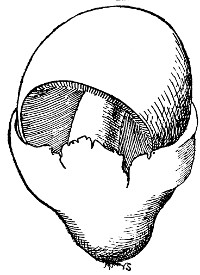
Volvaria bombycina. Natural size.
V. bombyci´na Schaeff.—bombyx, silk. Pileus 3–8 in. broad, wholly white, fleshy, soft, at first globose, soon bell-shaped, at length convex, somewhat umbonate, everywhere silky or, when older, hairy-scaled, more rarely becoming smooth at the vertex. Flesh not thick, white. Stem 3–6 in. long, ½ in. thick or more at the base, solid, equally attenuated from the base to the apex, even, smooth, white. Volva, soon torn asunder, ample, 2–3 in. broad, membranaceous, lax, slashed, somewhat viscid, persistent. Gills free, very crowded when young, almost cohering, ventricose, in groups of 2–4, then toothed, flesh-colored.
Ovate when young. According to some becoming brownish. The stem is curved-ascending on vertical trunks and straight on prostrate ones. Commonly solitary, sometimes however cespitose. Stevenson.
Spores elliptic, smooth, 6–7×4µ Massee; 6–8µ Lloyd.
Considered edible. Stevenson. Edible. Curtis.
Very general but not common over the United States. It is a large plant, from 3 in. upward across cap. Growing from wood, oaks, maples, beech, etc.
The writer has not been successful in finding it. Drawing, spore-print and description received from H.I. Miller, Terre Haute, Ind.
Upon such an authority as the late Dr. Curtis there is no doubt of its edibility.
(Plate LX.)
Volvaria volvacea. Two-fifths natural size.
V. volva´cea Bull.—volva, a wrapper. Pileus 2–3 in. across. Flesh white, thick at the disk, very thin elsewhere, soft, bell-shaped then expanded, obtuse, grayish-yellow, virgate or streaked with adpressed blackish fibrils. Gills free, about 2 lines broad, pale flesh-color. Stem 2–4 in. long, about 4 lines thick, almost equal, white, solid. 241Volva large, loose, whitish. Spores smooth, elliptical, 6–8×3.5–4µ; no cystidia. Massee.
On the ground by roadsides, etc., also in stoves.
Allied to V. bombycina, but constantly different in the less ample and less persistent, brownish volva. Pileus 3 in. across, rarely more, gray, elegantly virgate with blackish fibrils; flesh-color of the gills not so pure. Fries.
Once found in woods at roots of a tree. It occurs every year in the cellar of our drug store. Lloyd “Volvæ.”
North Carolina, Schweinitz; Minnesota, Johnson; Ohio, Morgan.
Probably edible, should be carefully tested.
V. Tay´lori Berk. Pileus 1¾ in. high and broad, livid, conico-campanulate, obtuse, striately cracked from the apex, thin, margin lobed and sinuated. Stem 2½ in. long, ¼ in. thick, pallid, solid, nearly equal, slightly bulbous at the base. Volva date-brown, lobed, somewhat lax, small. Gills uneven, broad in front, very much attenuated behind, rose-color.
Pileus beautifully penciled and cracked. The dark volva, bell-shaped pileus, and uneven, attenuated gills are marked characters. The habit is rather that of some Entoloma than of its more immediate allies. Fries.
Spores 6×9µ W.G.S.; broadly elliptical, smooth, 5×3.5–4µ Massee.
Indiana, Mrs. L.H. Cox; West Philadelphia, in much decayed stump of maple. McIlvaine.
Caps 1½-2 in. across and beautifully penciled and cracked. Stem 1½-3 in. long. Gills up to ⅓ in. wide. The spores when shed in body are a beautiful maroon. Resembling V. volvacea, but lighter in color, and having a brown volva. Specimens sent me by J.J. Newbaker, Steelton, Pa., had snow-white caps and when young were velvety to the touch. Gills tinged with pink; volva dark brown.
The few specimens eaten were of good flavor, somewhat resembling Pluteus cervinus.
242**Pileus more or less viscid, smooth.
V. specio´sa Fr.—speciosus, handsome. Pileus 3–5 in. broad, whitish, gray or umber at the disk, fleshy, globose when young, then bell-shaped, at length plane and somewhat umbonate, even, smooth, gluey. Flesh soft, floccose, white. Stem 4–8 in. long, as much as 1 in. thick, solid, firm, slightly attenuated from the base as far as the apex, when young, white-villous and tomentose at the base, then becoming smooth, white. Volva bulbous rather than lax, free however, variously torn into loops, membranaceous, ½-1 in. broad, externally tomentose, white. Gills free, flesh-colored.
The gills are wholly the same as those of A. bombycinus. It occurs also thinner, with the pileus wholly gray. Fries.
Spores 12–18×8–10µ K.; elliptical or subglobose, smooth, 14–16×8µ Massee.
Distinguished by the whitish, viscid pileus, and the downy volva and stem. Massee.
“Common in cultivated soil, especially grain fields and along roads. A fine edible agaric and our most abundant one in California.” McClatchie. Volvæ, U.S., Lloyd.
V. gloioceph´ala Dec. Fl. Gr—sticking; head. Pileus dark opaque brown, fleshy, bell-shaped then expanded, umbonate, smooth, glutinous, striate at the margin. Stem solid, smooth, becoming brownish or tawny; the volva, which is circularly split, pressed close. Gills free, reddish.
Fragments of the volva are sometimes seen on the pileus. The stem is commonly more slender than that of A. speciosus. Fries.
On the ground. Uncommon. June to October. Stevenson.
Pileus about 3 in. across, with a strong regular, obtuse umbo in the center, of a delicate mouse-gray, viscid when moist, but when dry shining, quite smooth, margin striate in consequence of the thinness of the flesh. Stem 6 in. or more high, about ½ in. thick in the center, attenuated upward, bulbous at the base, clothed with a few slight fibers, easily splitting, solid, rather dingy, ringless. Volva loose, villous like the base of the stem, splitting into several unequal lobes; the gills are broad, especially in front, narrower behind and quite free, so as to leave a space round the top of the stem, white, tinged with grayish-pink; 243margin slightly toothed. Smell strong and unpleasant, and taste disagreeable. M.J.B. Very poisonous according to Letellier. Stevenson.
Spores 19×9µ W.G.S.; elliptical, smooth, 10–12×6–7µ Massee.
Distinguished by the smoky, glutinous pileus. The measurement of the spores as given by Saccardo (19×9µ) is certainly too large, and is probably an uncorrected error. Massee.
North Carolina, Curtis; South Carolina, Ravenel; Ontario, Dearness; California, Harkness and Moore; Ohio, Morgan; Mississippi, Minnesota, Johnson.
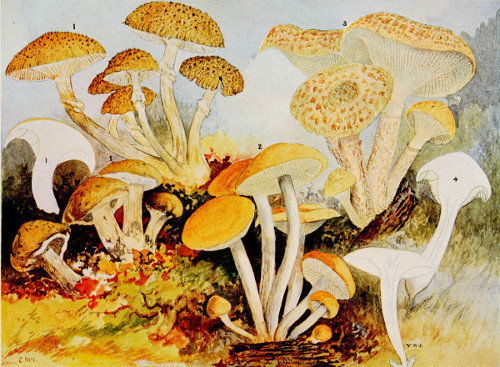
Grouped by F.D. Briscoe—Studies by C. McIlvaine. Plate LXI.
Fig. Page. Fig. Page.
1. Pluteus cervinus, 243 2. Pluteus cervinus, var., 245
PLU´TEUS Fr.
(Pluteus, a shed. From the conical shape of the pileus.)
Stem fleshy, distinct from the pileus. Gills free, rounded behind (never emarginate), at first cohering, white, then colored by the spores.
Generally growing on or near trunks of trees.
Resembling Volvaria in all respects but the volva. Spores rosy.
Several of the genus are edible. Pluteus cervinus is one of our earliest, persistent, plentiful, delicious food species. The caps of those tested are tender, easily cooked and best fried.
ANALYSIS OF SPECIES.
* Cuticle of the pileus separating into fibrils or down, which at length disappear.
** Pileus frosted with atoms, somewhat powdery.
*** Pileus naked, smooth.
* Cuticle of pileus fibrillose, etc.
P. cervi´nus Schaeff.—cervus, a deer. (Plate LXI, fig. 1, p. 242.) Pileus fleshy, at first campanulate, then convex or expanded, even, glabrous, generally becoming fibrillose or slightly floccose-villose on the disk, occasionally cracked, variable in color. Lamellæ broad, somewhat ventricose, at first whitish, then flesh-colored. Stem equal or slightly tapering upward, firm, solid, fibrillose or subglabrous, variable in color. Spores broadly elliptical, 6.5–8×5–6.5µ.
244Plant 2–6 in. high. Pileus 2–4 in. broad. Stem 3–6 lines thick.
The typical form has the pileus and stem of a dingy or brown color and adorned with blackish fibrils, but specimens occur with the pileus white, yellowish, cinereous, grayish-brown or blackish-brown. I have never seen it of a true cervine color. It is sometimes quite glabrous and smooth to the touch and in wet weather it is even slightly viscid. It also occurs somewhat floccose-villose on the disk, and the disk, though usually plane or obtuse, is occasionally slightly prominent or subumbonate. The form with the surface of the pileus longitudinally rimose or chinky is probably due to meteorological conditions. The gills, though at first crowded, become more lax with the expansion of the pileus. They are generally a little broader toward the marginal than toward the inner extremity. Their tendency to deliquesce is often shown by their wetting the paper on which the pileus has been placed for the purpose of catching the spores. The stem is usually somewhat fibrous and striated but forms occur in which it is even and glabrous. When growing from the sides of stumps and prostrate trunks it is apt to be curved. Two forms deserve varietal distinction.
Var. al´bus. Pileus and stem white or whitish.
Var. al´bipes. Pileus cinereous yellowish or brown. Stem white or whitish, destitute of blackish fibrils.
In Europe there are three or four forms which have been designated as species under the names of A. rigens, A. patricius, A. eximius and A. petasatus, but Fries gives them as varieties or subspecies of A. cervinus, though admitting that they are easily distinguished. None of these have occurred in our state. Peck, 38th Rep. N.Y. State Bot.
Var. visco´sus. The normal character of the cuticle of the species is slightly viscid in wet weather, but the specimens we collected and photographed were exceedingly viscid. They also differed from the normal form in their lighter color, flesh much thicker at the disk and thin at the margins, and cuticle not appearing fibrillose. It is close to petasatus, but differs, however, in its narrower gills and in having no striæ. It is a good variety if it is not a good species. Lloyd, Myc. Notes.
Spores 7–8×5–6µ K.; 6–8×4–5µ B.; 4×5µ W.G.S.; 5.8×4.6µ Morgan.
Frequent on decaying stumps, roots and wood, May to frost. McIlvaine.
Its free gills should distinguish it from any Entoloma, though both have pink spores and eventually pink gills. Among the earliest of 245large species. The sight of it is stimulating to the mycophagist. He then knows the toadstool season to be truly opened.
Caps only are tender. The stems are edible, but they are not of the same consistency as the caps, therefore will not cook with them. Fried in a buttered pan or broiled, they are exceedingly toothsome.
In October, 1898, a beautiful variety (see Plate LXI, fig. 2, p.—), occurred which I had not previously seen. It was sent by me to Professor Peck. The plants grew in large clusters from rotting, refuse straw in the ruin of a stable; the white, cottony mycelium running upon and through the straw. The solid stems of some were straight, others curved, ranging from 2–6 in. long, the taller ones tapering from base to spindling apex, the shorter ones decidedly bulbous and ending abruptly. They were twisted and delicately marked. These markings break up into dark thread-like fibrils, leaving the stem striate and satin-glossy. Pileus from 2–4 in. across, dark Vandyke-brown when young, lighter in age, streaked, glossy. Gills at first white, tardily changing to light salmon color, broad, ventricose, free.
Taste and smell pleasant of almonds. Good, delicious.
Professor Peck wrote of it: “It has the general appearance of Pluteus cervinus, but these specimens seem to depart from the usual form of growing in clusters from the ground, and in having an almond flavor. Without knowing more about it I would scarcely feel justified in separating it from such a variable species. As Fries sometimes remarks concerning variable species: Perhaps several species are concealed under the one name, but a pretty full and accurate knowledge of them is desirable if one is to split them up.”
This is excellent judgment. While I believe the above to be a distinct species, the disposition to make new species of varieties is regrettable in many botanists.
Var. Bul´lii Berk., MS. Pileus 4–6 in. across, flesh thick, convex then expanded, smooth, even, pallid, the disk darker. Gills free, rounded behind, rather distant from the stem, crowded, ½ in. broad, pale salmon-color. Stem 3–4 in. long, 1 in. and more thick, slightly swollen at the base, fibrillose, pale brown, darkest at the base, solid. Massee.
Pileus 6 in. across, expanded from bell-shape, ashy-white (oyster color), glossy, like floss silk, silky fibrillose, irregularly corrugated. Skin separable. Flesh spongy, pure white, like shreds of cotton, separable 246into plates, very brittle, ½ in. thick at stem, immediately thinning to ⅛ in., very thin toward margin. Gills thin, elastic, rounded behind, close to stem, free, ½ in. wide, close, alternate short and long, white, then tinged and spotted pink with spores which when cast in mass are a pinkish-brown with slight lavender shade. Stem 5 in. long, ½-¾ in. thick, subequal, spreading at top, white, silky-fibrillose, changing to very light yellowish brown from center to base, exterior hard, skin thin, tough, interior filled with continuous, cottony fibers, snow-white, brittle, watery, slightly swollen at base. Taste pleasant.
Mt. Gretna, Pa., July, 1898, on chestnut stump and in woods on ground among leaves. Leaves adhere to base of stem which is powdery-white. McIlvaine.
Cooked, it is as good as P. cervinus.
Var. petasa´tus Fr. Pileus 3–4 in. across, flesh rather thick, campanulate then expanded, umbonate, grayish-white, very smooth, with a viscid cuticle, at length striate to the middle. Gills free, ½ in. and more broad, crowded, becoming dry, white then reddish. Stem 4–5 in. long, ½-⅔ in. thick, rigid, very slightly and equally attenuated from the base, whitish, fibrillosely striate, solid.
On heaps of straw and dung, sawdust, etc.
Color verging on bay when old. Stem and margin of gills at length with a tawny tinge. Fries.
Haddonfield, New Jersey, Bell’s Mill, sawdust, 1890; Mt. Gretna, Pa., August, 1898, among sawdust from ice-house. Caps 6 in. across. Stem easily split, exterior hard, fibrillose, streaked, whitish, shining, stuffed with cottony fibers. Spores dark pink. McIlvaine.
Equal to P. cervinus.
P. umbro´sus Pers.—shady, from its dark color. Pileus fleshy, at first bell-shaped, then convex or expanded, roughly wrinkled and more or less villose on the disk, fimbriate on the margin, blackish-brown. Gills broad, somewhat ventricose, at first whitish, then flesh-colored, blackish-brown and fringed or toothed on the edge. Stem solid, colored like or paler than the pileus, fibrillose or villose-squamose. Spores elliptical, 8×5µ.
Decaying woods and swamps, especially of pine, both in shaded and open places. Not rare. Peck, 38th Rep. N.Y. State Bot.
247Spores broadly elliptical, smooth, 6–7×5µ; cystidia ventricose, 65–75×18–20µ Massee.
New York, Peck, Rep. 32, 38; West Virginia, Pennsylvania, North Carolina, New Jersey, frequent on decaying logs, stumps, pine and other woods. McIlvaine.
At times the caps are a deep sepia-brown. It is readily distinguished from P. cervinus by the wrinkled, downy disk of the cap and the gills having dark-brown edges. Smell rather strong. Professor Peck says he has not seen it with the margin fimbriate. Neither have I, though this is prominent in the European species.
P. umbrosus is a fine species, equal in every way to P. cervinus, which is seldom excelled. Caps only are tender.
P. pelli´tus Fr. Pileus 1–2 in. across. Flesh thin, soft, white, convex then plane, somewhat umbonate, regular, silky-fibrous, dry, white. Gills free, rounded behind, crowded, 1½ line broad, ventricose, white then flesh-color, margin slightly toothed. Stem about 2 in. long, 2–3 lines thick, slightly thickened at the base, even, glabrous, shining, white, stuffed. Spores elliptical, smooth, 10×6µ.
Among grass at the roots of trees, etc.
Our only Pluteus with a pure white, even pileus and stem. Superficially resembling Entoloma prunuloides, which differs in the broadly emarginate—not free—gills, and in the strong smell of new meal. Massee.
Mt. Gretna, Pa., October, 1898. McIlvaine.
Pileus up to 3 in. across. Gills ¼ in. broad, free, moist, imbricated. Stem up to 5 in. long, easily detachable from cap, solid, juicy, solitary and cespitose. On very old sawdust, upon which grass was growing.
Tender, excellent.
** Pileus frosted, etc.
P. granula´ris Pk.—sprinkled with grains. Pileus convex or nearly plane, subumbonate, rugose-wrinkled, granulose or granulose-villose, varying in color from yellow to brown. Lamellæ rather broad, crowded, ventricose, whitish, then flesh colored. Stem equal, solid, colored like the pileus, often paler at the top, velvety-pubescent, rarely scaly. Spores subglobose or broadly elliptical, 6.5–8×5–6.5µ.
248Plant 1.5–3 in. high. Pileus 1–2 in. broad. Stem 1–2 lines thick.
Decaying wood and prostrate trunks in woods. Hilly and mountainous districts. June to September.
The species is closely related to P. cervinus and P. umbrosus, but is readily distinguished from them by the peculiar vesture of the pileus and stem. The granules are so minute and so close that they form a sort of plush on the pileus, more dense on the disk and radiating wrinkles than elsewhere. The clothing of the stem is finer, and has a velvety-pubescent appearance, but in some instances it breaks up into small scales or squamules. The color of the pileus and stem is usually some shade of yellow or brown, but occasionally a grayish hue predominates. The darker color of the granules imparts a dingy or smoky tinge to the general color. The disk is often darker than the rest of the pileus. Peck, 38th Rep. N.Y. State Bot.
West Virginia mountains. Eagle’s Mere and Springton Hills, Pa.
Frequent. July to October, on decaying wood. McIlvaine.
P. granularis is a much smaller species than P. cervinus and its allies. At Eagle’s Mere, Pa., August, 1898, it was quite plentiful in mixed woods. Its caps are excellent.
*** Pileus naked.
P. admira´bilis Pk.—admirable. Pileus thin, convex or expanded, generally broadly umbonate, glabrous, rugose-reticulated, moist or hygrophanous, striatulate on the margin when moist, often obscurely striate when dry, yellow or brown. Lamellæ close, broad, rounded behind, ventricose, whitish or yellowish, then flesh-colored. Stem slender, glabrous, hollow, equal or slightly thickened at the base, yellow or yellowish white, with a white mycelium. Spores subglobose or broadly elliptical, 6.5–8×6.5µ.
Var. fus´cus. Pileus brown or yellowish-brown.
Plant 1–2 in. high. Pileus 6–10 lines broad. Stem .5–1 line thick.
Decaying wood and prostrate trunks in forests. Common in hilly and mountainous districts. July to September.
This beautiful Pluteus is closely related to P. chrysophlebius B. and R., a southern species, which, according to the description, has the veins of the pileus darker colored than the rest of the surface and the 249stem enlarged above and hairy at the base, characters not shown by our plant.
In our plant small young specimens sometimes have the stem solid, but when fully developed it is hollow, though the cavity is small. This character, with its small size, distinguishes it from P. leoninus. Peck, 38th Rep. N.Y. State Bot.
Springton Hills, Chester county, Pa., Mt. Gretna, Pa. Frequent. June to frost. McIlvaine.
Possesses the same rare edible qualities as P. cervinus, P. umbrosus. The caps, only, are tender.
P. chrysophæ´us Schaeff. Gr—gold. Pileus 1–2½ in. across. Flesh very thin except at the disk, bell-shaped then expanded, glabrous, naked, slightly wrinkled, margin striate, cinnamon-color. Gills free, 2–3 lines broad, whitish then pale salmon-color. Stem 2–3 in. long, 2–3 lines thick, whitish, glabrous, equal, more or less hollow.
On beech trunks, etc.
Resembling P. leoninus in size, but differing in the cinnamon color of the pileus, which is often obtusely umbonate. Massee.
Spores 5µ W.P.
Haddonfield, N.J. June to October, beech roots and trunks. McIlvaine.
Excellent.
250ENTOLO´MA Fr.
Gr—within; Gr—a fringe.
(Probably referring to the innate character of the pseudo veil.)
Pileus rather fleshy, margin incurved, without a distinct veil. Stem fleshy or fibrous, soft, sometimes waxy, continuous with the flesh of the pileus. Gills sinuate, adnexed, often separating from the stem. Spores rosy, elliptical, smooth or subglobose and coarsely warted.
Corresponding in structure with Tricholoma, Hebeloma and Hypholoma; separated from other rosy-spored genera by the sinuate gills.
About twenty species of Entoloma are given in the states; of them seventeen are described by Professor Peck, as found in New York. I have not found a single species in sufficient quantity to test its edibility.
Two of the European species, E. sinuata Fr. and E. livida Bull., are reputed to be very poisonous, producing headache, dizziness, vomiting, etc. Worthington Smith ate ¼ oz., which nearly proved fatal.
Professor Peck reports a species, E. grande Pk., which he considers suspicious.
Even the reported poisonous species have a pleasant odor corresponding to those of the esculent species. This makes them the more deceptive and dangerous. The pinkish or flesh-colored spores and gills distinguish Entoloma from Hebeloma, which has brown spores, and Tricholoma, which has white. Pluteus, which has pink spores and gills, is readily separated from it.
Great caution should be observed. Entolomas should be thrown away or carefully tested.
ANALYSIS OF TRIBES.
Genui´ni (genuine, typical species). Page 251.
Pileus smooth, moist or viscid; not hygrophanous.
Leptoni´dei (inclining to Leptonia).
Pileus flocculose or squamulose; absolutely dry.
Nolani´dei (inclining to Nolanea). Page 252.
Pileus thin, hygrophanous, somewhat silky when dry.
251I.—Genui´ni.
E. gran´de Pk.—Pileus fleshy, thin toward the margin, glabrous, nearly plane when mature, commonly broadly umbonate and rugosely wrinkled about the umbo, moist in wet weather, dingy yellowish-white verging to brownish or grayish-brown. Flesh white, odor and flavor farinaceous. Lamellæ broad, subdistant, slightly adnexed, becoming free or nearly so, often wavy or uneven on the edge, whitish becoming flesh-colored with maturity. Stem equal or nearly so, solid, somewhat fibrous externally, mealy at the top, white. Spores angular, 3–10µ.
Pileus 4–6 in. broad. Stem 4–6 in. long, 8–12 lines thick.
Thin mixed woods. Menands. August.
The flavor of this mushroom is not at first disagreeable, but an unpleasant burning sensation is left in the mouth for a considerable time after tasting. It is therefore to be regarded with suspicion. Peck, 50th Rep. N.Y. State Bot.
SUSPICIOUS. I have not seen this species. It is given that it may be guarded against until tested for edibility.
(Plate LXII.)
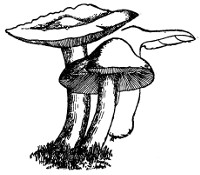
Entoloma sinuatum. About one-fourth natural size.
E. sinua´tum Fr.—waved. Pileus 6 in. broad, becoming yellow-white, very fleshy, convex then expanded, at first gibbous, at length depressed, repand and sinuate at the margin. Stem 3–6 in. long, 1 in. thick, solid, firm, stout, equal, compact, at first fibrillose, then smooth, naked, shining white. Gills emarginate, slightly adnexed, ½-¾ in. broad, crowded, distinct, pale yellowish-red. Fries.
Gregarious, compact, handsome.
Odor strong, pleasant, almost like that of burnt sugar, not of new meal. The pileus becomes broken into squamules when dry. There is a variety with a shorter stem.
In mixed woods. Uncommon. July to October.
The gills are often irregular in their attachment. Very poisonous; producing headache, swimming of the brain, stomach pains, vomiting, 252etc. Worthington Smith, who first experimented with it, ate about ¼ oz., which very nearly proved fatal. Stevenson.
Spores 9µ W.G.S.
Rhode Island, Olney (Curtis Am. Jour.); Massachusetts, Sprague; Connecticut, Wright; Minnesota, Johnson; New York, Peck, Rep. 35.
“This and E. fertilis, which are closely allied, are deserving of more than suspicion, for they are veritably dangerous.” Cooke.
“Wholesome and very good to eat.” Cordier.
In the presence of such opposite opinions it is better to choose the safer. Do not eat it.
E. prunulo´ides Fr.—prunus, a plum. Pileus 2 in. and more broad, whitish, becoming yellow or livid, fleshy, bell-shaped then convex, at length flattened, somewhat umbonate, unequal (but not repand), even, viscid, smooth, at length longitudinally cracked, at length slightly striate at margin. Stem 3 in. long, 3–4 lines thick, fibrous-fleshy, solid, equal, even or slightly striate, smooth, naked, white. Gills somewhat free, emarginate, rarely rounded, at first only slightly adnexed, 3–4 lines broad, crowded, ventricose, white then flesh-color. Fries.
Odor strong of new meal, wholly that of A. prunulus. Very scattered in growth. Like A. lividus, but very different, thrice as small. It differs entirely from A. cervinus.
On the ground in woods. Autumn. Spores subglobose, coarsely warted, 10µ Massee; regularly six-angled or one angle more marked, 8µ B.; 9µ W.P.
North Carolina, dry swamps, Curtis; Minnesota, Johnson.
POISONOUS. Roze.
I have not seen this species. Do not eat it before carefully testing.
III.—Nolani´dei.
Pileus thin, hygrophanous, repand, etc.
E. clypea´tum Linn.—resembling a shield. Pileus as much as 3 in. broad, lurid when moist, when dry gray and variegated or streaked with darker spots or lines, fleshy, bell-shaped then flattened, umbonate, smooth, fragile. Flesh thin, white when dry. Stem almost 3 in. long, 3–4 lines and more thick, stuffed, at length hollow, wholly fibrous, equal, round, fragile, longitudinally fibrillose, becoming ash-colored, pulverulent 253at the very apex. Gills rounded-adnexed, separating-free, 3–4 lines broad, ventricose, somewhat distant, dingy, then red-pulverulent with the spores, serrulated at the edge chiefly behind.
It has occurred in May cespitose; better developed and solitary in the end of August.
In woods, gardens and waste places. Frequent. Spring, autumn. Stevenson.
North Carolina, Schweinitz, Curtis; Ohio, Morgan; New England, Frost; California, H. and M.; Rhode Island, Bennett; New York, Peck, Rep. 23.
POISONOUS. Leuba.
I have not seen this species. It should not be eaten before careful testing.
E. rhodopo´lium Fr. Gr—rose; Gr—gray. Pileus 2–5 in. broad, hygrophanous, when moist dingy-brown (young) or livid, becoming pale (when full grown), when dry isabelline-livid, silky-shining, slightly-fleshy, bell-shaped when young, then expanded and somewhat umbonate or gibbous, at length rather plane and sometimes depressed, fibrillose when young, smooth when full grown, margin at the first bent inwards and when larger undulated. Flesh white. Stem 2–4 in. long, 3–5 lines thick, hollow, equal when smaller, when larger attenuated upwards and white-pruinate at the apex, otherwise smooth, slightly striate, white. Gills adnate then separating, somewhat sinuate, slightly distant, 2–4 lines broad, white then rose-color. Fries.
Fragile, commonly large and often handsome, almost inodorous.
In mixed woods. Frequent. August to October.
Spores pretty regular, 8–10×6–8µ B.; 7µ W.G.S.
New England, Frost; Minnesota, Johnson; Iowa, Brœndle; Rhode Island, Bennett; Ohio, Morgan; New York, Peck, Rep. 23d, 38th, A. rhodopolius, var. umbilicatus Pk., the same as Clitopilus subvilis Pk., Rep. 40.
Edible. Paulet. Edible. Cooke.
254
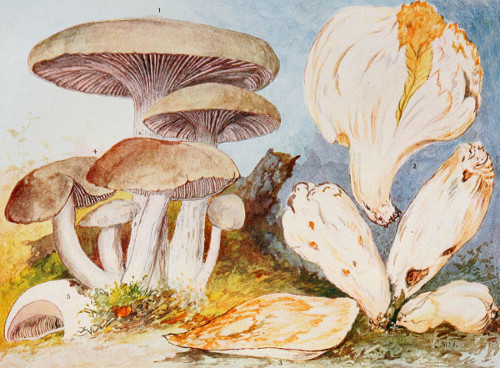
Grouped by F.D. Briscoe—Studies by C. McIlvaine. Plate LXIII.
Fig. Page. Fig. Page.
1. Clitopilus abortivus, 257 4. Clitopilus prunulus, 255
2. Clitopilus abortivus (aborted), 256 5. Clitopilus prunulus (section), 255
3. Clitopilus abortivus (aborted) (section), 258
CLITOPI´LUS Fr.
Gr—a declivity; Gr—a cap.
(Plate LXIV.)
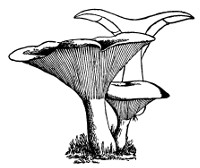
Clitopilus prunulus. One-third natural size.
Pileus more or less excentric or regular, margin at first involute. Gills more or less decurrent, never sinuate nor seceding from the stem, salmon-color. Stem fleshy or fibrous, not polished and cartilaginous externally, central, expanded upward into the flesh of the pileus. Spores smooth or warted.
Closely resembling Eccilia, differing mostly in the stem not being cartilaginous at the surface. Distinguished from Entoloma by the gills not being sinuate.
Agrees in structure with Clitocybe in the Leucosporæ. Massee.
Growing on the ground, often strong smelling. Caps usually depressed or umbilicate and waved on margin.
Some of the best of edible kinds are within this genus; a few are unpleasant raw, none poisonous.
Most authors follow Fries in the arrangement of the species, dividing them into two groups, the Orcelli, distinguished by deeply decurrent gills and an irregular, scarcely hygrophanous pileus, with the margin at first flocculose; and Sericelli, distinguished by adnate or slightly decurrent gills and a regular silky or hygrophanous-silky pileus with a naked margin. This arrangement is not strictly applicable to some of our species. C. abortivus, C. erythrosporus and C. Noveaboracensis have the gills deeply decurrent in some individuals, adnate or slightly decurrent in others, and therefore the same species might be sought in both groups. For this reason the primary grouping of our species has been made to depend upon the variation in the spore colors. By far the greater number of our species appear to be peculiar to this country, only two of them occurring also in Europe.
255ANALYSIS OF SPECIES.
Spores and mature gills flesh-colored 1
Spores and mature gills rosy-red 9
Spores very pale flesh-colored 10
1. Pileus hygrophanous 8
1. Pileus not hygrophanous 2
2. Pileus gray or grayish-brown 5
2. Pileus some other color 3
3. Pileus white or whitish 4
3. Pileus pale tan-color C. pascuensis
4. Pileus firm, dry, pruinate C. prunulus
4. Pileus soft, slightly viscid when moist C. Orcella
5. Pileus large, more than 1.5 in. broad C. abortivus
5. Pileus small, less than 1.5 in. broad 6
6. Spores even C. unitinctus
6. Spores angular 7
7. Stem longer than the width of the zoneless pileus C. albogriseus
7. Stem shorter than the width of the commonly zonate pileus C. micropus
8. Pileus brown or grayish-brown C. subvilis
8. Pileus white or yellowish-white C. Woodianus
9. Stem colored like the pileus C. erythrosporus
9. Stem white, paler than the pileus C. conissans
10. Pileus even 11
10. Pileus rivulose C. Noveboracensis
11. Stems cespitose, solid C. cæspitosus
11. Stems not cespitose, hollow C. Seymourianus
Peck, 42d Rep. N.Y. State Bot.
Spores Flesh-Color.
A. Spores Even.
C. pru´nulus Scop.—prunus, plum. (Plate LXIII, fig. 4, 5, p. 254.) Pileus fleshy, compact, at first convex and regular, then repand, dry, pruinate, white or ashy-white. Flesh white, unchangeable, with a pleasant farinaceous odor. Gills deeply decurrent, subdistant, flesh-colored. 256Stem solid, naked, striate, white. Spores subelliptical, pointed at each end, 10–11×5–6µ.
Pileus 1.5–3 in. broad. Stem 1–2 in. long, 3–4 lines thick.
Woods.
Not abundant, but edible, and said to be delicious and one of the best of the esculent species. Peck, 42d Rep. N.Y. State Bot.
June to October. Most plentiful in August and September.
Very plentiful in oak woods at Angora, West Philadelphia, moderate crops at Mt. Gretna, Pa.
An abortive form (see Plate LXIII, fig. 2, 3, p. 254) occurs not distinguishable from that of Armillaria mellea. It grows singly and in tufts, very variable in shape, white, tinged with brown on ruptured surfaces. This form equals its original.
C. prunulus has a strong smell of fresh meal. It is a delicious species.