Sub-Class BASIDIOMYCETES (continued 2)
Reading edition
Its habitat is similar to that of the common mushroom—lawns, pastures, grassy places—though unlike the latter it is found in woods. Until thoroughly acquainted with it, specimens found in woods and supposed to be L. naucinoides should not be eaten. An Amanita might be mistaken for it. It is readily distinguishable from the common mushroom and its allies by the color of the gills and spores which are white, and differences in stem and veil.
It is found from July until after hard frosts. It was first reported edible by Professor Peck in 1875, under the name of Agaricus naucinus.
The L. naucinoides is rewarding the favor with which it has been received as an esculent, it being equal to the common mushroom and quite free from insects. Large crops of it are reported from all over the country, and from many sections it is told of as a stranger. During 1897–98 the author has found it in plenty upon ground familiar to him for years, upon which it had not previously shown itself. The common mushroom must look to its laurels.
Its cultivation as a marketable crop is possible and probable.
L. cepæsti´pes Sow.—cepa, an onion; stipes, stem. (Plate XII, fig. 3, p. 32.) Pileus thin, at first ovate, then bell-shaped or expanded, umbonate, soon adorned with numerous minute brownish scales, which are often granular or mealy, folded into lines on the margin, white or yellow, the umbo darker. Gills thin, close, free, white, becoming dingy with age or in drying. Stem rather long, tapering toward the apex, generally enlarged in the middle or near the base, hollow. Ring thin, subpersistent. Spores subelliptical, with a single nucleus, 8–10×5–8µ.
Plant often cespitose, 2–4 in. high. Pileus 1–2 in. broad. Stem 2–3 lines thick.
47Rich ground and decomposing vegetable matter. Also in graperies and conservatories. Buffalo, G.W. Clinton; Albany, A.F. Chatfield. Peck, 35th Rep. N.Y. State Bot.
Spores elliptical, 7–8×4µ Massee; 8×4µ W.G.S.; 8–10×5–8µ Peck.
Haddonfield, N.J., Pennsylvania, McIlvaine; New York, Mrs. E. C. Anthony; Indiana, H.I. Miller. July to October.
Whoever has seen the seed-stalks of an onion knows the shape from which this fungus takes its name. The dense clusters are graceful, dainty, and contain many individuals of all ages—from the very young with egg-shaped heads, like pigmy C. comatus, to the fluff-capped eldest, willowy and fair to look upon. The out-door kind soon droops when matured; the young plants of a cluster will remain fresh for several days after taken from their habitat. Stems in these tufts are often quill-shaped, and the striations on the cap margins are shorter than those on their indoor cousins. These grow in hot-houses and stables. One of the two forms has a yellow cap, the other is white and fair.
These forms have often come to my table as a pleasant winter surprise. Children in the hot-houses of Haddonfield, N.J., watched for its appearance among the bedded plants, sure of a present when they brought me a meal of it. Both the white and yellow varieties were equally enjoyed.
The entire fungus is tender and delicious cooked in any way.
L. farino´sa Pk.—farina, meal. Pileus thin, rather tough, flexible, at first globose or ovate, then bell-shaped or convex, covered with a soft, dense, white veil of mealy down, which soon ruptures, forming irregular, easily-detersible scales, more persistent and sometimes brownish on the disk. Flesh white, unchangeable. Gills close, free, white, minutely downy on the edge. Stem equal or slightly tapering upward, somewhat thickened at the base, slightly mealy, often becoming glabrous, hollow or with a cottony pith above, solid at the base, white, pallid or straw-colored, the ring lacerated, somewhat appendiculate on the margin of the pileus, evanescent. Spores subovate, 10–13×8µ.
Pileus 1.5–2.5 in. broad. Stem 2–3 in. long, 2–4 lines thick.
Mushroom beds in a conservatory, Boston, Mass. March. Communicated by E.J. Forster.
This species is related to L. cepæstipes, from which it may be distinguished 48by its pileus, which is not folded on the margin, and by its larger spores. It is edible. It is very distinct from Amanita farinosa. Peck, 43d Rep. N.Y. State Bot.
Ohio, Lloyd, Prof. William Miller (Lloyd Myc. Notes).
L. America´na Pk. (Plate XII, fig. 1, p. 32. Plate XVa.) Pileus at first ovate, then convex or expanded, umbonate, scaly, white, the umbo and scales reddish or reddish-brown. Gills close, free, white. Stem somewhat thickened at or a little above the base, hollow, bearing a ring, white. Spores subelliptical, uninucleate, 8–10×5–8µ.
The American lepiota belongs to the same genus as the parasol mushroom and the Smooth lepiota. It has one character in which it differs from all other species of Lepiota. The whole plant when fresh is white, except the umbo and the scales of the cap, but in drying it assumes a dull reddish or smoky-red color. By this character it is easily recognized.
In the very young plant the cap is somewhat egg-shaped and nearly covered by the thin reddish-brown cuticle, but as the plant enlarges the cuticle separates and forms the scales that adorn the cap. On the central prominence or umbo, however, it usually remains entire. The margin of the cap is thin and is generally marked with short radiating lines or striations. The gills do not quite reach the stem and are, therefore, free from it. Sometimes they are connected with each other at or near their inner extremity by transverse branches. They are a little broader near the margin of the cap than at their inner extremity. The stem affords a peculiar feature. It is often enlarged towards the base and then abruptly narrowed below the enlargement, as in the Onion-stemmed lepiota. In some instances, however, the enlargement is not contracted below and then the stem gradually tapers from the base upward. The stem is hollow and usually furnished with a collar, but sometimes this is thin and may disappear with advancing age. Wounds or bruises are apt to assume brownish-red hues.
The caps vary in width from 1–4 in.; the stems are from 3–5 in. long, and 2–5 lines thick. Sometimes plants attain even larger dimensions than these. The plants grow singly or in tufts in grassy ground or on old stumps. They may be found from July to October.
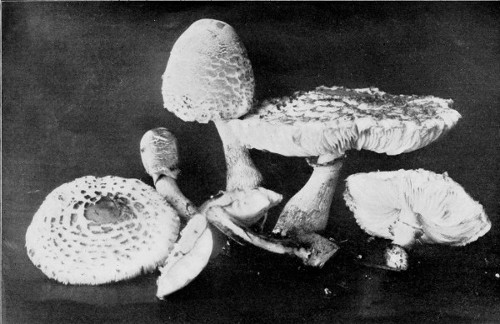
Photographed by Dr. J.R. Weist. Plate XVa. LEPIOTA AMERICANA.
In flavor this species is not much inferior to the parasol mushroom, but when cooked in milk or cream it imparts its own reddish color to 49the material in which it is cooked. It is, however, a fine addition to our list of esculent species. Peck, 49th Rep. N.Y. State Bot.
I found several on a decaying willow trunk, and on the ground beside it, in Philadelphia. In July, 1898, large quantities, often clustered, grew under the great, open auditorium of the Pennsylvania Chautauqua, at Mt. Gretna, Pa., from ground covered with crushed limestone.
The caps are meaty and excellent in flavor. They should be broiled or fried.
Granulosi. Pileus granular or warty. Stem sheathed, etc.
L. granulo´sa Batsch.—granosus, full of grains. Pileus thin, convex or nearly plane, sometimes almost umbonate, rough, with numerous granular or branny scales, often radiately wrinkled, rusty-yellow or reddish-yellow, often growing paler with age. Flesh white or reddish-tinged. Gills close, rounded behind and usually slightly adnexed, white. Stem equal or slightly thickened at the base, stuffed or hollow, white above the ring, colored and adorned like the pileus below it. Ring slight, evanescent. Spores elliptical 4–5×3–4µ.
Plant 1–2.5 in. high. Pileus 1–2.5 in. broad. Stem 1–3 lines thick. Woods, copses and waste places. Common. August to October.
This is a small species with a short stem and granular reddish-yellow pileus, and gills slightly attached to the stem, a character by which it differs from all the preceding. The ring is very small and fugacious, being little more than the abrupt termination to the coating of the stem. Peck, 35th Rep. N.Y. State Bot.
Spores 5–6×3µ B.; 3×4µ W.G.S.; elliptical, 4–5×3–4µ Peck.
Var. rufes´cens B. and Br. Pure white at first, then partially turning red and in drying acquiring everywhere a reddish tint.
Var. al´bida Pk. Persistently white.
Though small many plants grow neighboring. Being fleshy for their size, and of pleasing quality, they well repay gathering. Remove stems.
Open woods, Angora, West Philadelphia; Haddonfield, New Jersey, McIlvaine.
A. Cuticle Viscid. Neither Scaly nor Warty.
L. delica´ta Fr.—delicatus, delicate. Up to 1½ in. across, reddish, becoming yellowish toward margin. Flesh well proportioned to cap, 50convex, obscurely umbonate, glabrous, slightly viscid. Stem 1½-2 in. long, very thin, but covered with dense downy scales, equal, lighter than cap. Ring usually entire, membranaceous, fluffy from scales. Gills free, crowded, ventricose, white.
Haddonfield, N.J., January, 1896–97, in hot-houses. McIlvaine.
A delicate, delicious Lepiota. Though small, it is meaty. Its appearance in hot-houses (it is found in woods) insures a crop at a time of year when other species are not plentiful, and when anything edible in the toadstool line is most welcome to their lovers.
L. lenticula´ris Lasch.—lenticula, a lentil. Pileus at first globose, then convex, even, naked, pinkish-tan color. Flesh thick, spongy, white. Gills close to stem, but free from it, ventricose, crowded, whitish. Stem 4–6 in. high, thick, equal or swollen at base, solid but spongy, more or less covered with scales; above the ring it is frequently covered with drops of water more or less green, which leave spots when they dry. Veil superior and very large.
Pileus 3–4 in. across. Stem 4–6 in. long, ½ in. and more thick. In damp woods.
Redman’s Woods, Haddonfield, N.J. September, 1894. McIlvaine.
This species is included in Amanita by Fries and Stevenson. Massee places it in Lepiota. In the dozen or more specimens I have found, there was no trace of a volva, even when very young. I tested it carefully and at one time ate three good-sized caps without experiencing any indications of poison. I have seen it during but one season and not then (at one time) in sufficient quantity to make a meal off it. Cooked it has a slight cheesy flavor which is pleasant.
L. illi´nita Fr.—illino, to smear over. Pileus rather thin, soft, at first ovate, then campanulate or expanded, subumbonate, smooth, white, very viscid or glutinous, even or striate on the margin. Gills close, free, white. Stem equal or slightly tapering upward, stuffed or hollow, viscid, white. Spores broadly elliptical, 5×4µ broad.
Plant 2–4 in. high. Pileus 1–2.5 in. broad. Stem 2–3 lines thick.
Thin or open woods. Adirondack mountains. July to September.
This is a smooth white species with the stem and pileus clothed with a clear viscid or glutinous veil. The margin of the pileus is often even, but the typical form of the species has it striate. The flesh is soft and 51white. The species may be distinguished from the viscid white species of Hygrophorus by the free, not adnate nor decurrent lamellæ. Peck, 35th Rep. N.Y. State Bot.
Springton and Mt. Gretna, Pa., 1887–1897. McIlvaine.
Not yet found by me in quantity. Several specimens eaten were of good flavor.
L. rugulo´sa Pk. Pileus thin, submembranaceous, broadly convex or nearly plane, umbonate, rugulose, widely striate on the margin, whitish. Lamellæ thin, narrow, close, free, whitish. Stem short, equal, slightly silky, whitish, the annulus thin, persistent, white. Spores elliptic, 7.5µ long, 4µ broad.
Pileus 12–20 mm. broad. Stem about 2.5 cm. long, 2 mm. thick.
Moist grassy places under trees. Washington, D.C. July. Mrs. E.M. Williams. Perhaps in the fresh state the pileus is not as distinctly rugulose as when dry. Peck, Bull. Torrey Bot. Club, Vol. 27, January, 1900.
52ARMILLA´RIA Fr.
Armilla, a ring.
(Plate XVII.)
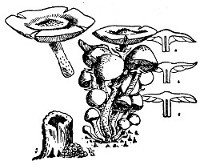
Armillaria mellea.
Pileus and Stem continuous. Veil partial, sometimes only indicated by the scales which clothe the stem terminating in the form of a ring. Spores white. On the ground or on stumps.
In the young plant the veil extends from the stem to the pileus, sometimes forming scaly patches upon it; below the ring it is attached to the stem often in scales.
But for the presence of the ring the species of this genus could be distributed in Tricholoma, Clitocybe and Collybia, with which they agree in all other characters.
In Amanita and Lepiota, the other ringed genera of the white-spored series, the flesh of the stem and pileus is not continuous; and their stems are therefore easily separated. Amanita is also distinguished by its volva.
ANALYSIS OF TRIBES.
Tricholomata. Page 52.
Gills sinuately adnexed, stem fleshy, ring often evanescent. (Like Tricholoma.)
Clitocybæ. Page 55.
Gills not sinuate, more or less decurrent, narrowed behind; ring permanent. (Resembling Clitocybe.)
Collyblæ. Page 58.
Gills adnate, equal behind; stem somewhat cartilaginous outside; ring permanent. (Resembling Collybia.)
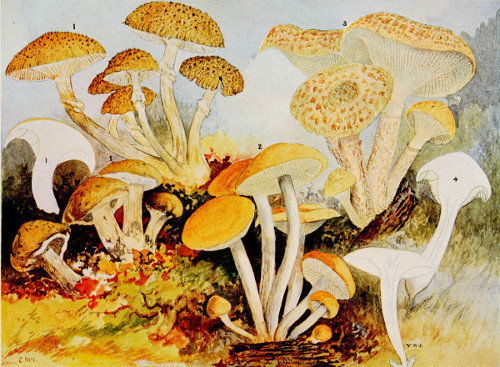
Grouped by F.D. Briscoe—Studies by C. McIlvaine and Val Starnes. Plate XVI.
Fig. Page. Fig. Page.
1. Armillaria mellea, 55 3–4. Lentinus lepideus, 230
2. Armillaria mellea var. exannulata, 56
I.—Tricholomata. Gills sinuately adnexed, etc.
A. robus´ta A. and S.—robustus, robust, sturdy. Substance of entire plant compact. Pileus 2–3 in. across, varying in shades of gray and 53brown, scaly, fibrillose on margin, decreasing toward center or smooth, convex or top-shaped and margin involute at first, expanding. Flesh firm, very thick. Gills broad, emarginate, nearly free, crowded, whitish, up to ½ in. broad. Veil large, membranaceous, sometimes floccose, remaining adherent to the stem. Stem 1–2 in. long, obese, solid, tapering at the base, brownish-white and fibrillose below veil, white and flocculose above, flesh of stem continuous with that of the cap.
Stevenson gives var. minor with even cap with both gills and ring very narrow.
Spores ovoid-spherical. 7µ. Q.
Edible, Curtis; District Columbia, Mrs. M. Fuller.
In mixed woods. Pennsylvania, West Virginia, New Jersey, McIlvaine.
The substance of A. robusta differs from all other Armillaria in being very compact. It is not acrid but has a marked flavor. Cut into small pieces and well cooked it makes an acceptable dish. It is best in croquettes and patties, or served with meats.
A. viscid´ipes Pk.—viscidus, sticky; pes, a foot. Pileus fleshy, compact, convex or nearly plane, glabrous, whitish with a slight yellowish or reddish-yellow tint. Flesh white, odor peculiar, penetrating, sub-alkaline. Gills narrow, crowded, sinuate or subdecurrent, whitish. Stem equal, solid, viscid and slightly tinged with yellow below the narrow membranous ring, whitish above. Spores elliptical, 8×5µ.
Pileus 3–6 in. broad. Stem 3–4 in. long, 6–12 lines thick.
In mixed woods. Rock City, Dutchess county. October.
It is a large fine fungus, easily known by its white and yellowish hues, its crowded gills, viscid stem and peculiar penetrating almost alkaline odor. The cuticle of the pileus is thin and soft to the touch, but it sometimes cracks longitudinally and is sometimes slightly adorned with innate fibrils. A. dehiscens is said to have a viscid stem, but it is also squamose and the pileus is yellowish-ochraceous. Peck, 44th Rep N.Y. State Bot.
Quite common in Pennsylvania and New Jersey. McIlvaine.
It loses its strong odor when cooked and is equal to other Armillaria in edibility. Unless well cooked it has a slight saponaceous flavor. This is easily overcome by a few drops of lemon juice or sherry.
54A. appendicula´ta Pk.—bearing an appendicula or small appendage. Pileus broadly convex, glabrous, whitish, often tinged with rust color or brownish rust color on the disk. Flesh white or whitish. Gills close, rounded behind, whitish. Stem equal or slightly tapering upward, solid, bulbous, whitish, the veil either membranous or webby, white, commonly adhering in fragments to the margin of the pileus. Spores subelliptical, 8×5µ.
Pileus 2–4 in. broad. Stem 1.5–3.5 in. long; 5–10 lines thick.
Auburn, Ala. October. C.F. Baker.
The general appearance of this species is suggestive of Tricholoma album, but the presence of a veil separates it from that fungus and places it in the genus Armillaria. The veil, however, is often slightly lacerated or webby and adherent to the margin of the pileus. Peck, Bull. Torrey Bot. Club, Vol. 24.
Mt. Gretna, Pa., Angora, Pa. On decaying roots in ground. August to November. Found plentifully in resorts of other Armillaria. Edibility the same. McIlvaine.
A. pondero´sa Pk.—ponderosus, weighty, ponderous. Pileus thick, compact, convex or subcampanulate, smooth, white or yellowish, the naked margin strongly involute beneath the slightly viscid, persistent veil. Gills crowded, narrow, slightly emarginate, white inclining to cream color. Stem stout, subequal, firm, solid, coated by the veil, colored like the pileus, white and furfuraceous above the ring. Flesh white. Spores nearly globose, 4µ in diameter.
Plant 4–6 in. high. Pileus 4–6 in. broad. Stem about 1 in. thick.
Ground in woods. Copake, Columbia county. October.
The veil for a long time conceals the gills, and finally becomes lacerated and adheres in shreds or fragments to the stem and margin of the pileus. Peck, 26th Rep. N.Y. State Bot.
New England, Frost; New York, Peck, Repts. 26, 29, 41. West Virginia and Pennsylvania. Ground in woods. September to November. McIlvaine.
Professor Peck says in 26th Report: “This species has not been found since its discovery in 1872.”
Where the Armillaria mellea frequents I have often found A. ponderosa. It was plentiful at Mt. Gretna, Pa., in September, 1898. 55Young specimens are quite as edible as A. mellea, and rather more juicy.
II.—Clitocybæ. Gills not sinuate, etc.
A. mel´lea Vahl.—melleus, of the color of honey. (Plate XVI, fig. 1, p. 52.) Pileus adorned with minute tufts of brown or blackish hairs, sometimes glabrous, even or when old slightly striate on the margin. Gills adnate or slightly decurrent, white or whitish, becoming sordid with age and sometimes variegated with reddish-brown spots. Stem ringed, at length brownish toward the base. Spores elliptical, white, 8–10µ long. Peck, 48th Rep. N.Y. State Bot.
Spores 9×5–6µ W.G.S.; 10×8µ B.; 8–10µ Peck.
The A. mellea is unusually prolific and is common over the United States and Europe. Specimens may be found in the spring-time, but in middle latitudes it is common from August until after light frosts. It is usually in tufts, some of which contain scores of plants and are showy over ground filled with roots, or on stumps or boles of decaying trees. It frequents dense woods and open clearings. I have seen acres of dense woodland at Mt. Gretna, Pa., so covered with it and its varieties that but few square yards were unoccupied.
A description of the typical A. mellea will rarely apply to any one plant. A combination of its variable features in one description would include something of nearly every white-spored Agaric under the sun. Yet there is something indescribable about it which once learned will unerringly betray it.
Its Caps vary from perfectly smooth, through tufts of scales and hairs, more or less dense, to matted woolliness. It may show any one of these conditions in youth and be bald in age. Some shade of yellow is the prevailing color, but this will vary from whitish to dark-purplish or reddish-brown. When water-soaked it is one color, when dry, another. Commonly the margins of the Caps are striated, sometimes they are smooth as a cymbal, and not unlike one, have a raised place or umbo in the center. Flesh white or whitish. Gills when young are white or creamy, usually running down the stem, sometimes slightly notched at attachment. They freckle in age and lose their fair complexion. The Veil or collar about the stem is as variable as fashion—thick and closely woven or flimsy as gossamer, or vanishing as the plant grows old. The 56Stems may be even as a lead pencil, or swollen like a pen-holder, or bulbous toward the base, or distorted by pressure in the tufts. It is as variable in color as the cap, usually darkening downward in hues of brown. The outside is firm and fibrous, sometimes furrowed, inside soft or hollow.
Cap 1–6 in. across. Stem 1–6 in. long, ¼-¾ in. thick.
Var. obscu´ra has the cap covered with numerous small blackish scales.
Var. fla´va has the cap yellow or reddish-yellow, but in other respects it is like the type.
Var. gla´bra has the cap smooth, otherwise like the type.
Var. radica´ta has a tapering, root-like prolongation of the stem, which penetrates the earth deeply.
Var. bulbo´sa has a distinctly bulbous base to the stem, and in this respect is the reverse of var. radicata.
Professor Peck writes: “Var. exannulata (Plate XVI, fig. 2, p. 52) has the cap smooth and even on the margin, and the stem tapering at the base. The annulus is very slight and evanescent or wholly wanting. The cap is usually about an inch broad, or a little more, and the plants grow in clusters, which sometimes contain forty or fifty individuals. It is more common farther south than it is in our state (N.Y.), and is reported to be the most common form in Maryland. This I call var. exannulata.” From Dr. Taylor, Washington, D.C.; Indiana, H.I. Miller.
To these may be added also var. al´bida Pk. in which the pileus is white or whitish.
A variety, perhaps a variation of var. bulbosa was sent to me by E. B. Sterling, Trenton, N.J., and afterward found by myself at Mt. Gretna, Pa. The Cap purplish-brown, convex, striate and light on margin, edge irregular with parts of veil attached. Flesh white, very thin. Gills decurrent, arcuate, pinkish-gray. Stem stuffed, fibrous, white above, dense floccose veil, same color as cap below, swollen toward base which is pointed, sulcate, white inside, closely clustered and some of the stems distinctly bulbous. Taste decidedly unpleasant. An intense acridity develops and increases when the juices of raw pieces are swallowed, and the salivary glands are much excited. The acridity is not lost in cooking. It simply can not be eaten. Specimens were sent by me to Professor Peck who referred it to A. mellea.
I have never seen the abortive form of Clitopilus abortivus, though 57found in many places and in great quantity, showing any part or trace of the original plant. But that a similar monstrosity occurs upon A. mellea is shown by individuals and parts of individuals of a cluster being aborted. Without such positive proof, no one would suspect either of these odd formations to be abortive of either C. abortivus or A. mellea, or any other fungus. I consider the abortive form of A. mellea far superior in substance and flavor to it or any of its varieties.
The Armillaria can not be ranked among the tender or high-flavored toadstools, yet their abundance, meaty caps and nourishing qualities place them among our most valuable food species.
The caps when chopped into small pieces make good patties and croquettes. They have an impressive flavor of their own, and offer an esculent medium for seasoning and the gravies of various meats.
A. nardos´mia Ellis—nardosmius, of the odor of nardus. (A name applied by the ancients to several plants, especially spica nardi—spikenard.) Pileus fleshy, firm, thick and compact on the disk, thin toward the margin, whitish, variegated with brown spots, with a thick, tough and separable cuticle. Flesh white. Gills crowded, subventricose, slightly emarginate, whitish. Stem solid, fibrous, not bulbous, sheathed below by the brown velvety veil, the ring narrow, spreading, uneven on the edge. Spores subglobose, 6µ in diameter.
Pileus about 3 in. broad. Stem 1.5–3 in. long, 4–6 lines thick.
Ground in woods, Suffolk county. September. Peck, 43d Rep. N.Y. State Bot.
Several specimens from sandy grounds in pine woods, Haddonfield, N.J., were sent by me to Professor Peck and were identified by him. Plentiful at Mt. Gretna, Pa., September to frost, 1898. In mixed woods, on gravelly ground. Eaten in quantity by several persons. McIlvaine.
Cuticle of caps when dry breaking up into brownish, squamulose scales, margin involute. Gills subdecurrent. Veil thick, persistent. Stem short, subbulbous, solid. Flesh white. Very much resembles a short-stemmed Lepiota. Smell and taste strong, like almonds. Disappears in cooking.
58III.—Collybiæ. Gills adnate, stem somewhat cartilaginous.
A. mu´cida Schrad.—mucidus, slimy. Pileus commonly shining white, thin, almost transparent, hemispherical then expanded, obtuse, more or less radiato-wrinkled, smeared over with a thick tenacious gluten; margin striate when thinner. Stem 1½-3 in. long, 1–2 lines thick at the apex, thickened at the base, stuffed, thin, rigid, curved ascending, smooth, white, but sooty scaly at the base when most perfectly developed. Ring inserted at the apex of the stem, bent downward and glued close to the stem, furrowed, the white border again erect, with a swollen and entire margin, which sometimes becomes dingy brown. Gills rounded behind, obtuse, adhering to the stem and striato-decurrent, distant, broad, lax, mucid, always shining white.
Very variable in stature, from 1 in. (when of this size the stem is almost equal) to as much as 6 in. broad. The color of the pileus varies gray, fuliginous, olivaceous. The gills sometimes become yellow, but only from disease. Sometimes solitary, sometimes a few are joined in a cespitose manner at the base. Stevenson.
Spores elliptical, 15–16×8–9µ Massee; 17×14µ W.G.S.
North Carolina, Schweinitz, Curtis; Pennsylvania, Schweinitz; Maryland, Miss Banning.
West Virginia mountains, 1882, Haddonfield, N.J., 1891–94, on beech trees and roots. McIlvaine.
Commonly considered esculent in Europe.
Dirt adheres so tenaciously to it that it is difficult to clean. This, however, occurs only when the fungus grows from roots and pushes its way up through covering earth. When growing from trees it is attractive and of good quality.
Should be chopped fine and well cooked.
59TRICHOLO´MA Fr.
Gr.—a hair, a fringe.
(Plate XIX.)
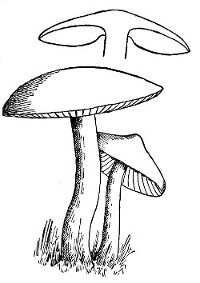
Section of tricholoma.
Pileus symmetrical, generally fleshy, never truly umbilicate, seldom umbonate. Veil absent or appearing only as fibrils or down on the margin of the pileus. Gills sinuate (the small sudden curve near the stem always apparent in the young plant), sometimes with a slightly decurrent tooth. Stem central, usually stout, fleshy-fibrous, without a bark-like skin. Flesh continuous with that of the pileus. Ring and Volva absent. Spores white or dingy.
But one is known to be poisonous. Some are acrid or unpleasant in flavor. With one exception all grow on the ground in pastures and woods, appearing from May to late in the autumn.
Gills generally white or dingy, frequently spotted or stained. The pileus may be smooth or adorned with fibrous or downy scales, dry, moist, viscid or water-soaked.
The distinguishing feature of Tricholoma is the sinuate gills. In Collybia the stem bears a distinct bark-like skin; in Clitocybe the gills are never sinuate; species of Pleurotus are distinguished by growing on wood only, and Paxillus by their strongly-incurved margin and anastomosing gills.
In cooking Tricholoma consistency must be the guide to plan and time. The tougher varieties require to be cut into small pieces and to be well cooked, while the brittle and delicate varieties will cook quickly. Many of them make excellent soups.
ANALYSIS OF TRIBES.
A. Pileus Viscid, Fibrillose, Scaly Or Downy, Not Water-Soaked.
Stem fibrillose from the remains of the adnate universal veil.
60Limacina (limas, a slug or snail, slimy). Page 61.
Cuticle of pileus viscid when moist, innately fibrillose or scaly, but not lacerated; flesh of pileus thick, firm; margin almost naked.
* Gills not discolored, nor becoming reddish.
** Gills discolored, usually spotted with reddish-brown.
Genuina. Page 67.
Cuticle of the pileus never moist or viscid; torn into downy or floccose scales. Flesh soft, not water-soaked; margin involute and slightly downy at first.
* Gills not changing color, nor spotted with red or black.
** Gills becoming reddish or gray, the edge at last generally with reddish or black spots.
Rigida (rigeo, to be stiff). Page 74.
Pileus rigid, hard, somewhat cartilaginous when fleshy, very fragile when thin, cuticle rigid, granulated or broken up when dry into smooth scales, not torn into fibrils. Young specimens occur which are fibrillose from the veil, not from laceration of the cuticle.
* Gills white or pallid, not becoming spotted with red or gray.
** Gills becoming reddish, grayish or spotted.
Sericella (sericeus, silky). Page 74.
Pileus first slightly silky, soon becoming smooth, very dry, neither moist, viscid, water-soaked, nor distinctly scaly; rather thin, opaque, absorbing moisture, but is the same color as the gills. Stem fibrous, by which the smaller species resembling Collybia may be distinguished.
* Gills broad, rather thick, somewhat distant.
**:sericella2 Gills narrow, thin, crowded.
B. Pileus Even, Smooth, Not Downy Nor Scaly, Not Viscid.
In rainy weather moist; when very young pruinose (but rarely conspicuously) from the universal veil. Flesh soft and spongy or very thin when it is water-soaked.
Guttata (gutta, a drop). Page 76.
Pileus fleshy, soft, fragile, marked with drop-like spots or rivulose. Appearing in spring, rarely in autumn.
61Cespitose, in troops or often in rings.
* Gills whitish.
** Gills becoming reddish or smoky-gray.
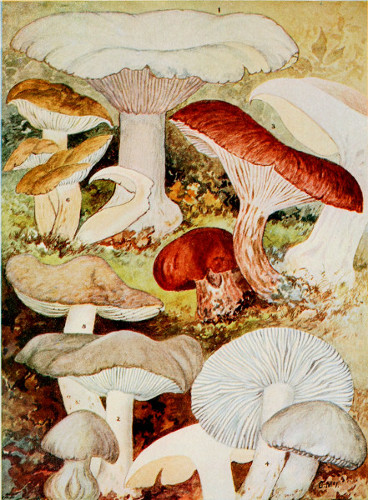
Grouped by F.D. Briscoe—Studies by C. McIlvaine. Plate XVIII.
Fig. Page. Fig. Page.
1–2. Tricholoma personatum, 79 5. Tricholoma columbetta, 68
3. Tricholoma russula, 65 6. Tricholoma humile, 81
4. Tricholoma terreum, 71
Spongiosa (spongia, a sponge). Page 78.
Pileus compact, then spongy, obtuse, even, smooth, moist but not hygrophanous; firm, growing in troops late in the autumn. Stem stout, base usually thickened, spongy fibrous. Gills at length decurrent but sinuate, by which character they are distinguished from Clitocybe.
* Gills not discolored.
** Gills discolored.
Hygrophana (Gr., wet; to appear). Page 80.
Pileus thin, somewhat umbonate; flesh at length soft, watery. Stem rootless, containing a pith, entirely fibrous.
Flesh not exceeding in depth the width of the not broad, thin gills; thinnest toward the margin, hence somewhat umbonate. Color of the pileus either moist or dry, very variable in the same species. Pileus sometimes pulverulent from the persistence of the veil in dry weather.
* Gills whitish, not spotted.
** Gills more or less violet, gray or smoky. Not represented.
Series A.
Pileus Viscid or Fibrillose, Downy Or Scaly.
I.—Lima´cina. Viscous when moist.
* Gills not becoming discolored, nor becoming reddish.
T. eques´tre Linn.—equestre, belonging to a horseman or knight, from distinguished appearance. Pileus fleshy, compact, convex becoming expanded, obtuse, pale-yellowish, more or less reddish tinged, the disk and central scales often darker, the margin naked, often wavy. Flesh white or tinged with yellow. Gills rounded behind, close, nearly free, sulphur-yellow. Stem stout, solid, pale-yellow or white, white within. Spores 6.5–8×4–5µ.
Pileus 3–5 in. broad. Stem 1–2 in. long, 6–10 lines thick.
62Pine woods, especially in sandy soil. Albany county. September to November.
This is a noble species but not plentiful in our state (N.Y.). The pileus is said to become greenish very late in the season. The stem, in the typical form, is described as sulphur-yellow in color, but with us it is more often white. The scales of the disk are sometimes wanting. In our plant the taste is slightly farinaceous at first, but it is soon unpleasant.
Var. pinastreti A. and S. is a slender form having a thin, even pileus, thinner and more narrow gills and a more slender stem. A. crassus Scop., A. aureus Schaeff., and A. flavovirens Pers. are recorded as synonyms of this species. Peck, 44th Rep. N.Y. State Bot.
Professor Peck later says in “Mushrooms and Their Use,” p. 52: “I confidently add it to the list of edible species.”
New Jersey, Pennsylvania and West Virginia. In pine forests and groves. September to frost. McIlvaine.
I have eaten it since 1883. All disagreeable odor about T. equestre (which I have seldom noticed) disappears upon cooking. The substance is rather tough, but good.
T. coryphæ´um Fr.—chief, leader. From its distinguished appearance. Pileus very fleshy but not compact, convex then plane, obtuse, viscid, yellowish, streaked with small brownish scales. Stem solid, attenuated upward. Gills emarginate, crowded, white, edge yellow.
Large and of striking appearance. In shady beech woods.
Pronounced a good edible by the Boston Myc. Club.
The color of the plants is given as greenish-yellow. Bull. Boston Myc. Club, 1896.
T. ustale Fr.—uro, to burn. Pileus fleshy, convex, then plane, obtuse, even, smooth, viscid, bay-brownish. Stem stuffed, equal, dry, rufo-fibrillose, apex naked, silky, nearly smooth. Gills emarginate, crowded, white, at length with reddish spots. Cooke.
Chiefly in pine woods.
Pileus 3 in. Stem 2–3 in. long, about ½ in. thick.
Spores 5×8µ W.G.S.; 7–8×5µ Massee.
North Carolina, Curtis, pine woods, Schweinitz; Kansas, Cragin. Massachusetts. Edible. Boston Myc. Club, Bull. No. 5.
63T. resplen´dens Fr.—shining brightly. Pileus fleshy, convex then nearly plane, even, bare, viscid, white, sometimes hyaline-spotted or yellowish on the disk, shining when dry, the margin straight. Flesh white, taste mild, odor pleasant. Gills nearly free when young, then emarginate, somewhat crowded, rather thick, entire, white. Stem solid, bare, subbulbous, even, dry, white. Spores 8×4µ.
Pileus 2–4 in. broad. Stem 2–3 in. long, 4–8 lines thick.
Thin woods. Catskill mountains. September. Peck, 44th Rep. N.Y. State Bot.
Mt. Gretna, Pa., in mixed woods. October and November. McIlvaine.
It is of excellent flavor, consistency and food value.
T. transmu´tans Pk.—changing. Pileus convex, nearly bare, viscid when moist, brownish, reddish-brown or tawny-red, usually paler on the margin. Flesh white, taste and odor farinaceous. Gills narrow, close, sometimes branched, whitish or pale yellowish, becoming dingy or reddish-spotted when old. Stem equal or slightly tapering upward, bare or slightly silky-fibrillose, stuffed or hollow, whitish, often marked with reddish stains or becoming reddish-brown toward the base, white within. Spores subglobose, 5µ.
Pileus 2–4 in. broad. Stem 3–4 in. long, 3–6 lines thick.
Woods. The plants are often cespitose.
I suspect that Agaricus frumentaceus of Curtis’s catalogue belongs to this species. Both the pileus and stem, as well as the gills, are apt to assume darker hues with age or in drying, and this character suggested the specific name. The species is classed as edible. Peck, 44th Rep. N.Y. State Bot.
Curtis catalogues T. frumentaceum as edible.
T. transmutans is reported from many states. It has a mealy taste and odor. Wherever it is found it is a valuable food species.
T. sejunc´tum Sow.—separated; from the peculiar manner in which the gills separate from the stem. Pileus fleshy, convex then expanded, umbonate, slightly viscid, streaked with innate brown or blackish fibrils, whitish or yellowish, sometimes greenish-yellow. Flesh white, fragile. Gills broad, subdistant, rounded behind or emarginate, white. Stem solid, stout, often irregular, white. Spores subglobose, 6.5µ.
Pileus 1–3 in. broad. Stem 1–3 in. long, 4–8 lines thick.
64Mixed woods. Suffolk county, N.Y. September.
The plants referred to this species are not uncommon on Long Island, growing on sandy soil in woods of oak and pine. They are usually more or less irregular and the pileus becomes fragile. It is quite variable in color, sometimes approaching a smoky-brown hue, again being nearly white. The taste of the typical form is said to be bitter, but the flavor of our plant is scarcely bitter. In other respects, however, it agrees well with the description of the species. Peck, 44th Rep. N.Y. State Bot.
Spores 6µ. W.G.S.
Flesh is tender. Cooked, of good body and peculiar but pleasant flavor. A valuable species, baked, scalloped, fried.
T. terri´ferum Pk.—terra, earth; fero, to bear. Pileus broadly convex or nearly plane, irregular, often wavy on the margin, glabrous, viscid, pale-yellow, generally soiled with adhering particles of earth carried up in its growth. Flesh white, with no decided odor. Gills thin, crowded, slightly adnexed, white, not spotted or changeable. Stem equal, short, solid, white, floccose-squamulose at the apex. Spores minute, subglobose, 3µ.
Pileus 3–4 in. broad. Stem 1–1.5 in. long, 6–8 lines thick.
Woods. Catskill mountains. September. Peck, 44th Rep. N.Y. State Bot.
Found in West Virginia, Pennsylvania, New Jersey. August to frost. McIlvaine.
Not inviting, hard to clean, nevertheless edible and good.
T. portento´sum Fr.—portentosus, strange, monstrous. Pileus 3–5 in. broad, sooty, livid, sometimes violaceous, fleshy, but thin in comparison with the stoutness of the stem, convexo-plane, somewhat umbonate, unequal and turned up, viscid, streaked with black lines (innate fibrils), but otherwise even and smooth, the very thin margin naked. Flesh not compact, white, fragile. Stem commonly 3 in. often 4–6 in. long, 1 in. thick, stout, solid, the whole remarkably fibrous-fleshy, somewhat equal, naked, but fibrilloso-striate, white; the base, which is occasionally attenuato-rooted, villous. Gills rounded, almost free, 3–4 lines to as much as 1 in. broad, distant, white, but varying, becoming pale-gray or yellow. Fries.
65Spores 4–5×4µ K.; 5×4µ W.G.S
West Virginia, 1882; New Jersey, Pennsylvania, in woods and open places. May to November. McIlvaine.
It is one of the first toadstools I experimented upon. I have been constant to it. Its caps fried in butter are unsurpassed.
** Gills discolored, usually spotted with reddish-brown.
T. fla´vo-brun´neum Fr.—flavus, yellow; brunneus, brown. Pileus fleshy, conical, then convex, at length expanded, subumbonate, viscid, clothed with streak-like scales. Stem hollow, somewhat ventricose, fibrillose, at first viscid, yellowish within, tip naked. Gills emarginate, decurrent, crowded, yellowish, then reddish. Fries.
Odor that of new meal. Stem 3–5 in. long, ½ in. thick, dull-reddish or brownish. Pileus 3–6 in. broad, disk darker, dingy dull-red or reddish-brown.
North Carolina, Curtis; damp woods, A. fulvus, Schweinitz.
Edible, Cooke, 1891.
T. rus´sula Schaeff.—reddish. (Plate XVIII, fig. 3, p. 60.) Pileus fleshy, convex, becoming plane or centrally depressed, obtuse, viscid, even or dotted with granular squamules on the disk, red or incarnate, the margin usually paler, involute and minutely downy in the young plant. Flesh white, sometimes tinged with red, taste mild. Gills sub-distant, rounded behind or subdecurrent, white, often becoming red-spotted with age. Stem solid, firm, whitish or rose-red, squamulose at the apex. Spores elliptical, 7×4µ.
Pileus 3–5 in. broad. Stem 1–2 in. long, 6–8 lines thick.
Mixed woods. Albany. Cattaraugus and Steuben counties. September and October.
According to the description the typical plant has the pileus incarnate and the stem rosy-red, but in the American plant the pileus is generally more clearly red and the stem white, though this is often varied by reddish stains. Peck, 44th Rep. N.Y. State Bot.
Mixed woods. August until after frost. At Mt. Gretna, Pa. 1897–1898 the patches were large, generous yielders.
Edible, Cooke; edible, Cordier, Roques.
T. russula is a dressy fungus and has a fashion of its own. The mottlings 66upon its cap, gill and stem, in shades of red, subdued though they be, give it a handsome personality distinct from any other.
The species is a variable one in its minor markings. When moisture is prevalent the caps of all are viscid. Both young and old are often cracked. Stems frequently not squamulose at apex, frequently rosy when young, often flattened. The fibrous interior of the stem and its fibrous connection with the flesh of the cap are very marked. Gills emarginate in youth as well as in age. It is solitary, gregarious, occasionally bunched.
An excellent fungus, a free late grower, meaty, easily cooked, and of fine flavor.
T. frumenta´ceum Bull.—frumentum, made of corn. Pileus 2–3 in. broad, whitish or clay-color and variegated dull red, truly fleshy, convex then plane, obtuse, viscous, dry in fine weather, even, smooth. Flesh white. Stem 3 in. long, ½ in. thick, solid, equal, fibrillose when dry, whitish. Gills rounded, somewhat crowded, rather broad, white, at length spotted-red.
Wholly becoming pale white, but the stem and pileus are alike marked-red, and the gills are at length reddish, wherefore, as well as for the strong smell of new meal, it is undoubtedly nearest to A. pessundatus. When full grown it has all the appearance of Entoloma. On the ground. Stevenson.
Spores 6µ W.G.S.
North Carolina, Curtis. Edible. Porcher says Dr. Curtis was the first to declare it edible.
T. pessunda´tum Fr.—pessum dare, bent downward. Pileus fleshy, compact, convex, very obtuse, repand, viscid, granulose or spotted. Stem solid, firm, at first ovato-bulbous, everywhere villose with whitish scales. Gills emarginate, nearly free, crowded, white, at length spotted with red.
In pine woods. Odor and taste mealy.
Pileus bay, reddish, paler at the margin. Stature of Ag. equestris. Fries.
Spores 5×2.5µ Massee; very minute, globose, 2–3µ C.B.P.
Reckoned edible, but very rare. Stevenson.
California, H. and M.
67II.—Genui´na. Cuticle of pileus torn into downy or fibrillose scales.
* Gills not changing color nor becoming spotted.
(Plate XX.)
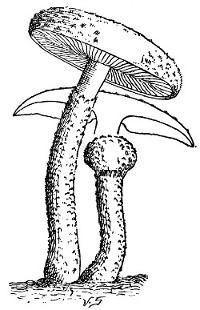
Tricholoma decorosum. Two-thirds natural size.
T. decoro´sum Pk.—decorus, decorous. Pileus firm, at first hemispherical, then convex or nearly plane, adorned with numerous brownish sub-squarrose tomentose scales, dull ochraceous or tawny. Flesh white. Gills close, rounded and slightly emarginate behind, the edge slightly scalloped. Stem solid, equal or slightly tapering upward, white and smooth at the top, elsewhere tomentose-scaly and colored like the pileus. Spores broadly elliptical, 5×4µ.
Pileus 1–2 in. broad. Stem 2–4 in. long, 2–4 lines thick.
Decaying trunks of trees. Catskill mountains and Alleghany county. September and October.
A rare but beautiful species. It is often cespitose. It departs from the character of the genus in growing on decaying wood. Peck, 44th Rep. N.Y. State Bot.
Tricholoma decorosum is not rare in Pennsylvania. I have found it at Angora, Philadelphia and in Chester county, Pa., growing in clusters and singly. At first sight one might take it for one of the many forms of Armillaria, but even cursory examination shows the difference.
It is of good consistency and flavor, having a decided mushroom taste.
T. flaves´cens Pk.—pale yellow. Pileus convex, firm, often irregular, dry, slightly silky becoming bare, sometimes cracking into minute scales on the disk, whitish or pale yellow. Flesh whitish or yellowish. Gills close, white or pale-yellow, emarginate, floccose on the edge. Stems firm, solid, often unequal, central or sometimes eccentric, single or cespitose, colored like the pileus. Spores subglobose, 5µ in diameter.
68Pileus 2–3 in. broad. Stem 1–2.5 in. long, 4–6 lines thick.
Pine stumps. Albany and Rensselaer counties. October.
The species seems to be related to T. rutilans but has not the red or purplish tomentum of that fungus. It, like T. decorosum, is always lignicolous. T. rutilans is sometimes so. Peck, 44th Rep. N.Y. State Bot.
Frequently found in New Jersey, Pennsylvania and West Virginia. Pine stumps. September to frost. McIlvaine.
The flesh compares with that of T. rutilans, and makes an equally good dish.
T. gran´de Pk. Pileus thick, firm, hemispherical, becoming convex, often irregular, dry, scaly, somewhat silky-fibrillose toward the margin, white, the margin at first involute. Flesh grayish-white, taste farinaceous. Gills close, rounded behind, adnexed, white. Stem stout, solid, fibrillose, at first tapering upward, then equal or but slightly thickened at the base, pure white. Spores elliptical, 9–11×6µ.
Pileus 4–5 in. broad. Stem 2–4 in. long, 1–1.5 in. thick.
Among fallen leaves in woods. Cattaraugus county. September.
The plants are often cespitose, and then the pileus is more or less irregular and the gills somewhat lacerated. The species is related to T. columbetta, from which its larger size, constantly scaly pileus, more cespitose mode of growth, larger spores and farinaceous taste separate it. The scales of the pileus are brownish, and the pileus itself is sometimes slightly dingy on the disk. The young margin is pure white like the stem, and both it and the upper part of the stem are sometimes studded with drops of moisture.
The plant was found on trial to be edible, but not of first quality. The flesh is not very tender, nor the flavor captivating even in young specimens. Peck, 44th Rep. N.Y. State Bot.
Mt. Gretna, Pa. Mixed woods. August to frost. McIlvaine.
Gross when old. Young specimens of medium quality and flavor.
T. columbet´ta Fr.—columba, a pigeon. (Plate XVIII, fig. 5, p. 60.) Pileus convex, then nearly plane, fleshy, obtuse, rigid, somewhat flexuous, dry, at first bare, then silky-fibrillose, becoming even or scaly, white, the margin at first involute, more or less tomentose. Flesh white, 69taste mild. Gills close, emarginate, thin, white. Stem stout, solid, unequal, nearly bare, white. Spores 7–8×4.5µ.
The species is very variable and the following varieties have been described:
Var. A. Pileus nearly always repand or lobed, at first bare, even, at length cracked-scaly, often reddish spotted, the margin when young inflexed, tomentose. Stem obese, even, unequal, swollen, an inch thick. The typical form.
Birch wood among mosses.
Var. B. Pileus subflexuous, silky-fibrillose, at length scaly, sometimes dingy-brown spotted, the margin scarcely tomentose. Stem longer, equal or slightly narrowed at the base.
Bushy places. Intermediate between A and C.
Var. C. Pileus regular, flattened, evidently fibrillose, sometimes spotted with blue, four inches broad. Stem equal, cylindrical, fibrillose-striate, four inches long.
Beech woods. A showy variety so diverse from variety A that it might be regarded as a distinct species, did not variety B connect them, and so much resemble both that it might with equal propriety be referred to either.
Pileus 2–4 in. broad. Stem 1–4 in. long, 3–12 lines thick.
Woods and pastures. Albany county, N.Y.
It may be distinguished from T. album by its mild taste. It is recorded as edible. Peck, 44th Rep. N.Y. State Bot.
Edible, Curtis, Cooke, Stevenson.
This much varied Tricholoma is as varied in its habitat. I have found it on vacant lots in Philadelphia, in mixed woods at Devon, Pa., and in the forests of the West Virginia mountains, and eaten it since 1881.
It cooks readily and is of mild, agreeable flavor.
T. ru´tilans Schaeff.—rutilo, to be reddish. Pileus fleshy, campanulate becoming plane, dry, at first covered with a dark-red or purplish tomentum then somewhat scaly, the margin thin, at first involute. Flesh yellow. Gills crowded, rounded, yellow, thickened and downy on the edge. Stem somewhat hollow, nearly equal or slightly thickened or bulbous at the base, soft, pale-yellow variegated with red or purplish floccose scales. Spores 6.5–8×6.5µ.
70
(Plate XXI.)
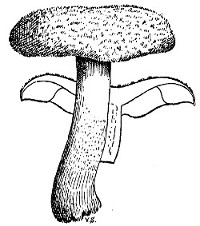
Tricholoma rutilans. About three-eights natural size.
Pileus 2–4 in. broad. Stem 2–4 in. long, 5–8 lines thick.
On or about pine stumps, rarely on hemlock trunks. July to November. Peck, 44th Rep. N.Y. State Bot.
Spores subglobose, 5–6µ diameter Massee; 6–8×6µ B.; 6×9µ W.G.S.
West Virginia, Pennsylvania, New Jersey. May to November. McIlvaine.
Quite common in West Virginia mountains and in pine woods of New Jersey. The Boston Mycological Club reports it found in quantity in Massachusetts. The flesh when cooked is gummy, like the marshmallow confection. It is excellent.
** Gills becoming reddish or gray, etc.
T. vacci´num Pers.—vacca, a cow. Pileus fleshy, convex or campanulate, becoming nearly plane, umbonate, dry, floccose-scaly, reddish-brown, the margin involute, tomentose. Flesh white. Gills adnexed, subdistant, whitish, then reddish or reddish-spotted. Stem equal, hollow, covered with a fibrillose bark, naked at the apex, pale reddish.
Spores subglobose, 6µ.
Pileus 1–3 in. broad. Stem 2–3 in. long, 4–6 lines thick.
Under or near coniferous trees. Greene and Essex counties. September and October. Peck, 44th Rep. N.Y. State Bot.
Recorded as edible by Gillet.
Plentiful in New Jersey, Pennsylvania, West Virginia. Have eaten it since 1885. Fair.
T. fuligi´neum Pk.—fuligineus, resembling soot. Pileus convex or nearly plane, obtuse, often irregular, dry, minutely scaly, sooty-brown. Flesh grayish, odor and taste farinaceous. Gills subdistant, uneven on the edge, ash-colored becoming blackish in drying. Stem short, solid, equal, bare, ash-colored. Spores oblong-elliptical, 8×4µ.
71Pileus 1–2.5 in. broad. Stem 1–1.5 in. long, 3–5 lines thick.
Among mosses in open places. Greene county. September. Rare. Peck, 44th Rep. N.Y. State Bot.
Quite common in Pennsylvania and New Jersey on mossy wood margins. It is of fair quality and flavor.
(Plate XXII.)
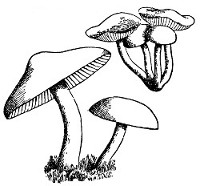
Tricholoma terreum. One-half natural size.
T. ter´reum Schaeff.—the earth. (Plate XVIII, fig. 4, p. 60.) Pileus fleshy, thin, soft, convex, campanulate or nearly plane, obtuse or umbonate, innately fibrillose or floccose-scaly, ashy-brown, grayish-brown or mouse color. Flesh white or whitish. Gills adnexed, subdistant, more or less eroded on the edge, white becoming ash-colored. Stem equal, varying from solid to stuffed or hollow, fibrillose, white or whitish. Spores broadly elliptical, 6–7×4–5µ.
Pileus 1–3 in. broad. Stem 1–2 in. long, 2–4 lines thick.
Woods. Albany, Rensselaer and Cattaraugus counties. September to November. Peck, 44th Rep. N.Y. State Bot.
Spores 7×5.5µ Morgan; 5–6µ, Massee; 6–7×4µ K.; 6µ W.G.S.
Eaten by Professor Peck. Eaten by McIlvaine. Quality fair.
T. ter´reum Schaeff.—var. fra´grans Pk. Pileus convex or nearly plane, dry, innately-fibrillose or minutely floccose-scaly, grayish-brown or blackish-brown. Gills rather broad, adnexed, whitish or ash-colored. Stem equal, solid or stuffed, rarely hollow, whitish. Spores broadly elliptical, 6–7×4–5µ.
The Fragrant tricholoma has a distinct farinaceous odor and flavor. In other respects it closely resembles the Earth-colored tricholoma of which it is considered a mere variety. The typical European plant is said to be without odor or nearly so and has not been classed among the edible species by European writers. But our variety, though not high-flavored, is fairly good and entirely harmless. Its cap varies considerably in color but is some shade of gray or brown. Its center is without any prominence or very bluntly prominent, and its surface is 72commonly very obscurely marked with innate fibrils or in small plants may have very small flocculose tufts or scales. The flesh is whitish as also are the gills, though these sometimes assume a more decided grayish hue. They are rather broad and loose and sometimes uneven on the edge or even split transversely. They are usually deeply excavated next the stem and attached to it by a narrow part. The stem is whitish or slightly shaded with the color of the cap. It often has a few longitudinal fibrils, but never any collar. It may be either solid, stuffed or spongy within, or in large specimens, hollow.
The plants grow gregariously or sometimes in tufts on the ground under or near trees or in thin woods, especially of pine, or in mixed woods. The caps vary from 1–4 in. broad, and the stems from 1–3 in. long and from 2–6 lines thick. The plants occur in autumn. In Europe there is a variety of this species which also has a farinaceous odor, but it differs from our plant in having reddish edges to the gills. It is called variety orirubens. Peck, 49th Rep. N.Y. State Bot.
Var. fragrans is plentiful and gregarious among New Jersey pines, October to frost. Other varieties are often found. Specimens found by me at Mt. Gretna, Pa., and sent to Professor Peck who identified them as var. fragrans Pk., were decidedly umbonate. Gills were easily separable from cap.
Var. fragrans is a favorite. It is pleasant to many, even raw. Plentiful salting while cooking develops a high and exquisite flavor.
T. fumes´cens Pk.—smoky. Pileus convex or expanded, dry, clothed with a very minute appressed tomentum, whitish. Gills narrow, crowded, rounded behind, whitish or pale cream color, changing to smoky-blue or blackish where bruised. Stem short, cylindrical, whitish. Spores oblong-elliptical, 5–6.5µ.
Pileus 1 in. broad. Stem 1–1.5 in. high, 2–3 lines thick.
Woods. Columbia county. October. Rare.
The species is remarkable for the smoky or blackish hue assumed by the gills when bruised and also in drying. It is apparently related to T. immundum Berk., but in that species the whole plant becomes blackish when bruised, and the gills are marked with transverse lines and tinged with pink. Peck, 44th Rep. N.Y. State Bot.
Mt. Gretna, Pa. September to November, 1898. McIlvaine.
The size of cap sometimes attains to 3 in and stem to ½ in. in thickness. 73Taste at first farinaceous then sweetish. The caps are of excellent quality and flavor.
(Plate XXIII.)
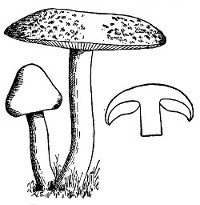
Tricholoma imbricatum. One-half natural size.
T. imbrica´tum Fr.—covered with tiles. Pileus fleshy, compact, convex or nearly plane, obtuse, dry, innately scaly, fibrillose toward the margin, brown or reddish-brown, the margin thin, at first slightly inflexed and pubescent then naked. Flesh firm, thick, white. Gills slightly emarginate, almost adnate, rather close, white when young, becoming reddish or spotted. Stem solid, firm, nearly equal, fibrillose, white and mealy or pulverulent at the top, elsewhere colored like the pileus. Spores 6.5 × 4–5µ.
Pileus 2–4 in. broad. Stem 2–3 in. long, 4–10 lines thick. Under or near coniferous trees. Greene and Essex counties. September and October.
This is an edible species. It has a farinaceous odor and taste when fresh. Peck, 44th Rep. N.Y. State Bot.
Closely resembles T. transmutans in size, color and taste. It is, however, easily separated by its dry cap and solid stem. Peck.
Plentiful in pine woods of New Jersey, and among hemlocks in West Virginia. Mt. Gretna, Pa., under pines. October and November, 1898. McIlvaine.
Specimens found at Mt. Gretna had caps dark umber when young, and margin incurved to stem. Gills yellowish. Stem up to 4 in. long, stout, solid, swollen at base, and having a short pointed ending, firm, fibrillose, white. Flavor farinaceous.
Flesh of good texture and taste.
74III.—Rig´ida. Pileus rigid, cuticle broken up into smooth scales, etc.
* Gills white or pallid, not becoming spotted with red or gray.
Not represented.
** Gills becoming reddish or grayish, spotted, etc.
T. sapona´ceum Fr.—sapo, soap. Strong, smelling of an undefinable soap. Cap 2–4 in. across, involute at first, convex then flattened, dry, glabrous, moist in wet weather, never viscid, brownish, more or less spotted or having the skin cracked into scales, occasionally covered with dark fibrils. Flesh firm, whitish becoming reddish when wounded. Gills emarginate, with a hooked tooth (uncinate) thin, distant, pale white. Stem 2–4 in. long, about ½ in. thick, often unequal, base sometimes long and rooting, usually smooth, at times reticulated with black fibrils, or is scaly. Distasteful.
The species is variable in size and color. Stevenson remarks: “Scarcely any species has been more confounded with others.” It may always be safely distinguished by its odor, by its distant gills, by the smooth cuticle of the cap cracking into scales, and by the change of color to reddish when bruised.
West Virginia mountains. August to frost. 1881–85. New Jersey, Pennsylvania. McIlvaine.
This fungus is not extremely unpleasant when eaten—like T. sulphureum, but no one will care to eat it. There is nothing in the flavor to recommend it or to inspire a cultivation of taste for it.
IV.—Sericel´la. Pileus slightly silky, soon smooth, etc.
* Gills broad, rather thick, somewhat distant.
T. sulphu´reum Bull.—sulphur, brimstone. Odor strong, fetid or like gas tar. Cap 1–4 in. across, subglobose, then convex and plane, slightly umbonate, sometimes depressed, fleshy, margin at first involute. Color dingy or reddish sulphur-yellow, at first silky, becoming smooth or minutely tomentose. Flesh thick, yellow. Gills rather thick, narrowed behind, emarginate or acutely adnate, sometimes appearing arcuate from shape of cap. Stem 2–4 in. long, 3–5 lines thick, equal or 75slightly bulbous, often curved, smooth striate, sulphur-yellow, stuffed, fibrous or hollow, yellow within, at times having yellow fibrous roots.
Spores 9–10×5µ Massee.
Very variable in size. Gregarious, common in mixed woods.
West Virginia, 1881. West Philadelphia, 1886. McIlvaine.
When quite young T. sulphureum is showy and inviting. Its smell is discouraging, its taste forbidding. No amount of cooking removes its unpleasant flavor. I have tried to eat enough of it to test its qualities, but was satisfied after strenuous efforts to mark it INEDIBLE.
T. chrysenteroi´des Pk.—like gold. Pileus fleshy, convex or plane, not at all umbonate, firm, dry, glabrous or slightly silky, pale-yellow or buff, becoming dingy with age, the margin sometimes reflexed, flesh pale-yellow, taste and odor farinaceous. Gills rather close, emarginate, yellowish, becoming dingy or pallid with age, marked with transverse veinlets along the upper edge, the interspaces veined. Stem equal, firm, solid, bare, fibrous-striate, yellowish without and within. Spores elliptical, 8–10×5–6µ.
Pileus 1–2 in. broad. Stem 2–3 in. long, 3–4 lines thick.
Woods. Lewis and Cattaraugus counties. September.
Nearly allied to T. chrysenterum, but separable by the gills, which are somewhat veiny and not free, by the entire absence of an umbo and by its farinaceous odor and taste. Peck, 44th Rep. N.Y. State Bot.
Frequently found at Angora, and in Woodland Cemetery, West Philadelphia.
Edible. Fair flavor and good quality.
T. o´picum Fr.—uncouth. Pileus 1–1½ in. across. Flesh rather thin, becoming grayish; convex, then expanded, obtusely-umbonate, at length usually upturned and split, very dry, even at first, then minutely scaly, gray. Gills broadly emarginate, ventricose, rather thick, scarcely distant, hoary. Stem 2–3 in. long, 2–3 lines thick, equal, fibrillose, becoming almost glabrous, pallid then grayish, stuffed. Massee.
Among moss, in pine woods, etc.
Inodorous. Somewhat resembling T. saponaceum, but distinguished by the absence of smell.
Waretown, N.J. Under pines and open places in pine woods. August to September, 1889. McIlvaine.
76When wet the caps become darker and have a mottled appearance. They are tender, but rather tasteless. The species serves to make quantity when cooked with others of higher flavor.
T. pipera´tum Pk.—piper, pepper. Pileus rather thin, firm, dry, convex, obtuse or subumbonate, virgate with innate brownish fibrils, varying in color from grayish-brown to blackish-brown, sometimes with greenish or yellowish tints. Flesh white or whitish, taste acrid. Gills broad, close, rounded behind, adnexed, whitish or yellowish. Stem generally short, equal, solid, silky, slightly mealy or pruinose at the top, white or slightly tinged with yellow. Spores elliptic, 6–7µ long, 5µ broad. Pileus 4–7 cm. broad. Stem 5–7 cm. long, 6–12 mm. thick.
The central part of the pileus is sometimes a little darker than the rest. The peppery or acrid taste is very distinct and remains in the mouth many minutes. This and the innately fibrillose character of the pileus are distinguishing characters of the species. The plants appear from September to November. Peck, Torr. Bull., Vol. 26.
Mt. Gretna, Pa. October to November, 1898, on damp ground among moss. McIlvaine.
Cap up to 3 in. across, bell-shaped, then convex, depressed in center and undulate, light-brown, darker toward center, dry, minutely fibrillose. Flesh thick, white, thin toward margin. Gills emarginate, unequal, not forked. Stem 1½-2 in. long, hard, equal or enlarging toward base, white, silky, striate.
Though peppery raw, this Tricholoma is of good substance and flavor when cooked.
B. Pileus Even, Smooth, Not Downy, Scaly, Nor Viscid, Etc.
V.—Gutta´ta. Pileus marked with drop-like spots or rivulose.
* Gills whitish.
T. gambo´sum Fr.—gambosus, swelling near the hoof. Pileus 3–4 in. and more broad, becoming pale-tan, fleshy, hemispherico-convex, then flattened, obtuse, undulated and bent backward, even, smooth, but spotted as with drops, at length widely cracked (not, however, torn into squamules), the margin at the first involute and tomentose. Flesh thick, soft, fragile, white. Stem 2 in. and more long, ½-1 in. thick, solid, fleshy-firm, almost equal, often curved-ascending at the base, white, 77downy at the apex. Gills rounded or emarginato-adnexed, with a somewhat decurrent tooth and when old sinuato-decurrent, crowded, ventricose, 2–3 lines broad, whitish. Fries.
Odor pleasant, of new meal. Often forming large rings or clusters. A whitish form must not be confounded with T. albellus.
Spores 13×11µ W.G.S.; 13–14×8–9µ Massee; 13×10µ Cooke.
Angora, Philadelphia. Chester and Lebanon county, Pa. McIlvaine. Fair.
** Gills becoming reddish or smoky-gray.
T. tigri´num Schaeff.—spotted like a tiger. Pileus 2 in. broad, pallid-brown, variegated with crowded and darker dingy-brown spots, compactly fleshy, convex then expanded, obtuse, repand. Flesh thick, firm, white, unchangeable, but thin at the involute margin. Stem 1 in. long and thick, very compact, solid, pruinate, white. Gills rounded behind, at length decurrent with a tooth, crowded, narrow, white, at length darker.
Solitary or cespitose. Very distinguished, obese, and without any marked smell of new meal. In fir woods and open grassy ground. Rare. June to July. Stevenson.
Edible, Cooke, Fries.
T. albel´lum Fr.—albus, white. Pileus about 3 in. broad, becoming pale-white, passing into gray when dry, fleshy, thick at the disk, thinner at the sides, conical then convex, gibbous when expanded, when in vigor moist on the surface, spotted (mottled) as with scales, the thin margin naked. Flesh soft, floccose, white, unchangeable. Stem curt, 1½-2 in. long, 1 in. thick at the base, reaching ½ in. toward the apex, solid, fleshy-compact, ovato-bulbous (conical to the middle, cylindrical above the middle), fibrillose-striate, white. Gills very much attenuated behind, not emarginate, becoming broad in front, very crowded, quite entire, white. Fries.
Spores elliptical, 6–7×4µ Massee; ovoid, 3µ W.G.S.; ovoid, 3µ Cooke.
Pileus not becoming yellow. Odor weak when fresh, taste pleasant, almost that of cooked flesh. There are two forms: one larger, solitary, another smaller, connato-cespitose, quite as in A. albellus Sow. It is often confounded with smaller forms of A. gambosus. Stevenson.
North Carolina, Curtis. Damp woods. Edible.
78VI.—SPONGIO´SA. Pileus compact then spongy, smooth, moist.
* Gills not discolored.
T. vires´cens Pk.—viresco, to grow green. Pileus convex or nearly plane, sometimes centrally depressed, moist, bare, dingy-green, the margin sometimes wavy or lobed. Gills close, gradually narrowed toward the outer extremity, rounded or slightly emarginate at the inner, white. Stem subequal, stuffed or hollow, thick but brittle, whitish, sometimes tinged with green. Spores broadly elliptical, 5×4µ.
Pileus 3–5 in. broad. Stem 3–4 in. long, 6–12 lines thick.
Thin woods. Essex county. July.
The dull smoky-green hue of the pileus is the distinguishing feature of this species. Peck, 44th Rep. N.Y. State Bot.
Quite common in West Virginia, New Jersey and Pennsylvania. July to October. McIlvaine.
Edible. Tastes somewhat like many Russulæ, when cooked. Flavor good.
T. fumidel´lum Pk.—smoky. Pileus convex, then expanded, subumbonate, bare, moist, dingy-white or clay-color clouded with brown, the disk or umbo generally smoky-brown. Gills crowded, subventricose, whitish. Stem equal, bare, solid, whitish. Spores minute, subglobose, 4.5×4µ.
Pileus 1–2 in. broad. Stem 1.5–2.5 in. long, 2–3 lines thick.
Woods. Albany county and Catskill mountains. September and October.
The stem splits easily and the pileus becomes paler in drying. It sometimes becomes cracked in areas. Peck, 44th Rep. N.Y. State Bot.
On ground. Mt. Gretna. October and November. 1897. McIlvaine.
The species was plentiful among the leaf mold, growing from the ground in mixed woods.
The caps are delicate in substance and flavor.
T. leucoceph´alum Fr. Gr.—white; head. Pileus 1½-2 in. across, convex then plane, even, moist, smooth, but when young covered with a satiny down; water-soaked after rain. Flesh thin, tough, white. Gills rounded behind and almost free, white. Stem up to 2 in. long, ¼ in. 79thick, exterior hard, shining, fibrous; interior hollow but solid at base which is attenuated and rooting, twisted. Smell strong of new meal. Taste pleasant.
Spores 9–10×7–8µ.
Mt. Gretna, Pa. Grassy woods and borders. October to November, 1898. McIlvaine.
Quite common. The caps are excellent.
T. al´bum Schaeff.—albus, white. Pileus fleshy, tough, convex, becoming plane or depressed, obtuse, very dry, even, glabrous, white, sometimes yellowish on the disk, rarely wholly yellowish, the margin at first involute. Flesh white, taste acrid or bitter. Gills emarginate, somewhat crowded, distinct, white. Stem solid, elastic, equal or tapering upward, externally fibrous, obsoletely frosted at the apex, white. Spores elliptical, 5–6µ, long.
Pileus 2–4 in. broad. Stem 2–4 in. long, 4–6 lines thick.
Woods. Common. August to October. This species is variable in color and in size, being sometimes robust, sometimes slender. It grows singly, in troops or in tufts. It has no decided odor, but a bitter unpleasant taste. Peck, 44th Rep. N.Y. State Bot.
Cooked, tender and of fair flavor.
** Gills becoming discolored.
T. persona´tum Fr.—wearing a mask (from its many varieties of colors). (Plate XVIII, p. 60.) Pileus compact, becoming soft, thick, convex or plane, obtuse, regular, moist, bare, variable in color, generally pallid or ashy tinged with violet or lilac, the margin at first involute and frosted with fine hairs. Flesh whitish. Gills broad, crowded, rounded behind, free, violaceous becoming sordid-whitish or dingy-brown. Stem generally thick, subbulbous, solid, fibrillose or frosted with fine hairs, whitish or colored like the pileus. Spores dingy white, subelliptical, 8–9×4–5µ. On white paper the spores have a slight salmon tint, but they are regular in shape, not angular as in Entoloma.
Pileus 2–5 in. broad. Stem 1–3 in. long, 6–12 lines thick. Peck, 44th Rep. N.Y. State Bot.
Woods and open places, and growing from old, matted stable straw. Common over the United States.
80When T. personatum becomes known to the collector, either in the field or on the table, it is sure to become a favorite. It is fleshy, rotund, stocky, moist and smooth, with a tendency in its cap to be wavy-rimmed and jauntily cocked in wet weather. It grows singly or in troops, occasionally in tufts of from five to six individuals. A patch of it is valuable and worth husbanding with covering of fine straw. Cortinarius violaceus resembles it somewhat in color and shape, but it shows a spidery veil, and has brown spores. It is edible.
The common name of T. personatum in England is Blewits, which translated into understandable English is believed to be “blue-hats.” It is everywhere eaten, being of substantial substance, good flavor and cookable in any way. It is especially fine in patties, stews and croquettes.
T. nu´dum Bull.—naked. Pileus about 3 in. broad, becoming purple-violaceous then changing color, reddish, fleshy, comparatively thin, convexo-plane then depressed, obtuse, even, smooth, with a pellicle which is moist and manifest in rainy weather; margin inflexed, thin, naked. Flesh thin, pliant, colored. Stem about 3 in. long, ½ in. thick, stuffed, elastic, equal, almost naked, mealy at the apex, violaceous then becoming pale. Gills rounded then decurrent (on account of the depressed pileus), crowded, narrow, of the same color as the pileus or deeper violaceous, but soon changing color, at length reddish without the least tinge of violet. Stevenson.
Spores 7×3.5µ Massee; 6–8×4µ B.; 6×3µ W.G.S. On ground among leaves. Esculent, very good and delicate. Cordier. Edible. Roze. Edible, all American authorities.
VII.—Hygroph´ana. Pileus thin, water-soaked, etc.
* Gills whitish, not spotted.
T. grammopo´dium Bull. Gr.—a line; Gr.—a foot. Pileus 3–6 in. broad, pallid-livid or brownish-red when moist, whitish when dry, fleshy, very thin toward the margin, campanulate then convex, and at length flattened, obtusely umbonate, even, smooth, pellicle moist in rainy weather, not viscous, separating, flesh-colored when moist, white when dry, soft, fragile. Stem tall, about 3–4 in. long, ½ in. and more 81thick, solid, elastic, equal with exception of the thickened base, cylindrical, firm, smooth, evidently longitudinally sulcate, whitish. Gills arcuato-adnate or broadly horizontally emarginate, acute at both ends, very crowded, quite entire, very many shorter, somewhat branched behind, white.
Odor moldy. Striking in appearance; the chief of this group. There is a variety wholly white. In pastures and grassy woods. Stevenson.
Spores 5–6µ Massee.
Distinguished by the grooved stem and crowded gills, which are adnate when the pileus is expanded. Often growing in rings.
North Carolina, Curtis. Not reported elsewhere. Esculent. Cooke. Much eaten in Europe.
T. bre´vipes Bull.—brevis, short; pes, a foot. Pileus about 2 in. broad, umber then becoming pale, fleshy, soft, convex then becoming plane, even, smooth, moist (opaque when dry); flesh of the pileus becoming brownish when moist, becoming white when dry. Stem solid, very rigid, at length fibrous, pruinate at the apex, externally and internally fuscous; otherwise very variable, sometimes very short, 2–3 lines only long and thick, attenuated downward; commonly 1 in., sometimes bulbous, sometimes equal, more slender. Gills emarginato-free, crowded, ventricose, disappearing short of the margin, quite entire, becoming fuscous then whitish. Solitary. Inodorous. The pileus is often stained with soil. Stevenson.
Spores elliptical, 7.5×5µ Peck; 7–4µ Massee.
Esculent and very delicate. Paulet. Esculent. Cooke.
T. hu´mile Pers.—low, small. (Plate XVIII, fig. 6, p. 60.) Very variable in form and color. Cap 2–3 in. across, convex then expanded, wavy, flattened, sometimes umbonate, sometimes depressed, glabrous, occasionally powdered with thin white dust, fragments of veil, sometimes viscid. Color changes with moisture, blackish, grayish, and having somewhat the appearance of an oyster. Gills rounded-adnexed, with a slight tooth, arcuately decurrent, crowded, 2–3 lines broad, whitish. Flesh soft, whitish or grayish. Stem 1–2 in. long, up to ½ in. thick, equal (misshapen by pressure when tufted), light gray, covered 82with fine down, stuffed, becoming hollow, soft, fragile. Gregarious, usually tufted.
Spores 7–8×5–6µ K.
Open woods, in gardens, among cinders, grass, etc., September to frost.
Woodland Cemetery, Philadelphia, 1897. McIlvaine.
Its tufted habit and fair size, fleshy cap of good flavor, make it a desirable species. It cooks readily and the caps are of fine flavor.
T. pæ´didum Fr.—pædidus, nasty. Pileus about 1-½ in. across. Flesh very thin, tough, becoming whitish; bell-shaped then convex, at length expanded, umbonate, at length depressed round the conical, prominent umbo, moist, virgate or streaked with innate fibrils radiating from the center, otherwise almost even, smoky-mouse color, opaque, margin naked. Gills adnexed with a slight decurrent tooth, slightly sinuate, crowded, narrow, white then gray. Stem about 1 in. long and 2 lines thick, base slightly bulbous, tough, slightly striate, naked, dingy-gray. Spores elliptic-fusiform, 10–11×5–6µ.
In gardens, on dung-hills, etc. Small, tough, color dingy, without a trace of violet tinge. Massee.
Edible. Cooks tender, and is of good flavor, notwithstanding its name, which in no way applies.
T. subpulverulen´tum Pers.—slightly dusty. Pileus 1–2½ in. across, convex then plane or depressed in center, even, innately pruinose, hoary, white, whitish, grayish, margin extending as a slight rim incurved beyond gills. Flesh white, thick, firm, hygrophanous. Gills rounded without a tooth, close, narrow, white. Stem 2–3 in. long, 3–5 lines thick, equal, solid, somewhat striate, whitish.
Spores 5×3µ Massee; 4×3µ W.G.S.
Biological grounds, University of Pennsylvania. Philadelphia. May to November, 1898. McIlvaine.
A species one is glad to find. It has a healthy substantial presence full of promise. It is a solitary grower among grass on lawns and pastures, but its individuals are neighborly. Caps and stems are excellent.
83
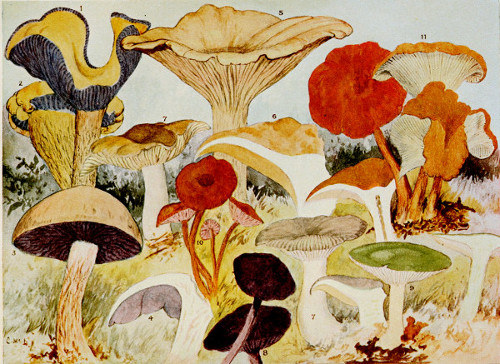
Grouped by F.D. Briscoe—Studies by C. McIlvaine. Plate XXIV.
Fig. Page. Fig. Page.
1–2–3. Clitocybe ochropurpurea, 108 8. Clitocybe amethystina, 107
4. Clitocybe ochropurpurea (section), 108 9. Clitocybe odora, 90
5. Clitocybe maxima, 99 10. Clitocybe laccata, 107
6. Clitocybe maxima (section), 99 11. Clitocybe infundibuliformis, 100
7. Clitocybe nebularis, 85
CLITO´CYBE Fr.
Gr.—sloping. (From the depression of the pileus.)
Pileus generally fleshy, becoming thin toward the margin, flexible or tough, plane or depressed, margin involute. Gills adnate or decurrent, never sinuate. Stem confluent and homogeneous with flesh of pileus, somewhat elastic, with a spongy stuffing, frequently becoming hollow, externally fibrous. Universal veil when present conspicuous on the pileus like frost or silky dew, but commonly wanting.
Growing on the ground, frequently in groups. The thinner and hygrophanous species appear late in autumn. Some are quite fragrant. Collybia, Mycena and Omphalia are separated by their stems being cartilaginous, not externally fibrous as in Clitocybe. Tricholoma by its sinuate gills.
Variations in species of Clitocybe are great. A few are easily fixed in the genus, but many of them will puzzle the amateur and perplex the expert. The gills are always attached to the stem, and usually run down it. They are not notched next to the stem as in Tricholoma.
Like Tricholoma, Clitocybe has many species, most of which are common, and are probably edible. I therefore give Professor Peck’s description of all Clitocybes thus far submitted to him.
I know of but one species which is injurious to some persons—Clitocybe illudens. Many eat and enjoy it. It does not agree with others. A few untried species are suspicious to a like extent. Clitocybe illudens possesses the property of phosphorescence.
Several species of Clitocybe have not been seen or tested by me, nor have I information that these have been tested.
ANALYSIS OF TRIBES.
A. Pileus Fleshy, Often Pallid When Dry, not hygrophanous.
Flesh firm, not watery, nor splitting into plates. Those which turn pale in drying differ from Series B by their silky luster.
Disciformes (disk-shaped). Page 85.
Pileus somewhat equally fleshy; convex then plane or depressed, obtuse, regular; gills at first adnate or regularly adnato-decurrent. Normally solitary.
84* Pileus gray or brownish.
** Pileus violet or reddish.
*** Pileus becoming yellowish.
**** Pileus greenish, becoming pale.
***** Pileus white, becoming shining white.
Distinguished from white hygrophanous species and white species of Paxillus.
Difformes (irregularly shaped). Page 94.
Pileus fleshy in the center, thin at the margin, at first umbonate, then expanded and depressed, irregular. Gills unequally decurrent, longer in some places than in others, sometimes rounded on one side of the stem or only reaching it as in Tricholoma. Stem somewhat cartilaginous externally, but fibrous.
Cespitose, often grown together at base, variable in form, sometimes solitary.
Infundibuliformes (funnel-shaped). Page 98.
Pileus becoming thin from the fleshy center to the margin, at length funnel-shaped or deeply umbilicately depressed in the center. Stem spongy, externally fibrous. Gills deeply and equally decurrent from the first. Pileus often becoming discolored or pallid, not hygrophanous.
* Pileus colored or becoming pale, the surface (at least under a lens) innately flocculose or silky, bibulous, not moist.
** Pileus colored or pallid, smooth, moist in rainy weather.
*** Pileus shining whitish, with scattered superficial flocci or becoming smooth.
B. Pileus Fleshy-Membranaceous.
Flesh thin, soft, watery, hygrophanous.
Cyathiformes (cup-shaped). Page 104.
Flesh of pileus thin, consisting of two separable plates, disk not compact, hygrophanous, depressed then cup-shaped; gills at first adnate then decurrent, descending, straight. Color dingy when moist.
Orbiformes (round-shaped). Page 109.
Pileus somewhat fleshy, hygrophanous, convex then flattened or depressed, 85polished, not squamulose nor mealy; gills plane, horizontal, thin, crowded, adnate or decurrent with a small tooth. Color dingy or becoming watery pale.
* Gills becoming ash-colored. Pileus at first dark.
** Gills whitish. Pileus becoming pale.
Versiformes (variable in shape). Page 106.
Pileus thin, convex then deformed, tough, more or less squamulose or furfuraceous; gills adnate, broad, rather thick, generally distant. Color hygrophanous.
* Pileus squalid or brownish with dark squamules. None known to be edible.
** Pileus bright, of one color.
Series A.
I.—Discifor´mes.
* Pileus gray or brownish.
C. nebula´ris Batsch.—nebula, a cloud. (Plate XXIV, fig. 7, p. 82.) The Clouded clitocybe, Clitocybe nebularis, takes its name from the clouded-gray appearance of its thick cap, which is at first convex, but when mature, either flat or a little depressed. Its flesh is white, thickest in the middle, and in a vertical section is seen to taper rapidly downward into the stem. The gills are close together and rather narrow for the size of the plant. They are white or yellowish-white. The stout solid stem usually tapers upward from the base and is whitish.
The cap is two to four inches or more broad, the stem one to two inches long and about half an inch thick. The Clouded mushroom grows in woods, and sometimes forms large tufts or clusters among fallen leaves. It is found in autumn, but is not very common in this country. Authors differ in their estimate of the edible qualities of this mushroom, but the more recent ones generally agree in classing it as edible. “Mushrooms and Their Use,” C.H. Peck.
Spores 4.5×3µ Cooke; elliptical 6×3.5µ Massee; 3×4µ W.G.S.
There has been great diversity of opinion as to the edibility of this species on the continent. Cordier and a friend suffered from it. Paulet counseled mistrust.
86This fungus is quite common in the West Virginia mountains and in some parts of Pennsylvania and New Jersey, where I have found it. It is, however, limited to localities. It is one of my favorites, being of marked flavor and agreeable consistency. I have not known it to harm anyone.
(Plate XXV.)
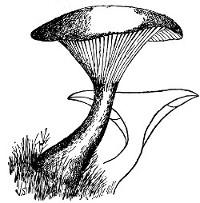
Clitocybe clavipes. About two-thirds natural size.
C. cla´vipes Pers.—clava, a club; pes, a foot. Pileus 1½-2½ in. across, rather convex at first, soon plane, at length almost obconical, very obtuse, even, glabrous, dry, sometimes all one color, brown, sooty, livid-gray, etc., sometimes whitish towards the margin, very rarely entirely white. Flesh loose in texture, white, thin at the margin. Gills deeply decurrent, continued down the stem as straight lines, rather distant, flaccid, quite entire, broad, entirely and persistently white. Stem 2 in. long, base ½ in. and more thick, conically attenuated upward, rather fibrillose, livid, sooty, solid, spongy within. Spores elliptical, 6–7×4µ.
In woods, especially pine. Resembling C. nebularis in color, but quite distinct. Smell pleasant, entire substance soft and elastic. Fries.
Spores elliptical, 6–7×4µ Massee; sub-ellipsoid, 5–7×3–4µ K.; 6×8µ W.G.S.
Found in pine woods of New Jersey, and under spruce in West Virginia. Its substance is spongy, therefore does not stew well. Cooked in any other way it is delicate and of excellent flavor.
C. gangræno´sa Fr.—gangræna, gangrene. Pileus fleshy, convex then plane, obtuse, whitish, at first sprinkled with white powder, then naked, variegated, streaked. Gills slightly decurrent, arcuate, crowded, dingy-white. Stem somewhat bulbous, soft, striate, spongy, solid.
Stinking; large, flesh becoming blackish and variegated with black. Stem curved, sometimes excentric. Pileus whitish, here and there greenish, livid, etc. Fries.
87Var. nigres´cens Lasch. Whitish; pileus thin, soft, at first convex, obtuse then plane, somewhat umbonate, and somewhat depressed; gills decurrent, very much crowded, narrow, stem solid, downy.
Pileus 2–3 in. broad. Stem 1¼-1½ in. long, 2–3 lines thick.
Odor rather sweet, taste unpleasant. Cooke.
New Jersey, Haddonfield, pine woods. July to August. McIlvaine.
This Clitocybe is in every way unattractive. It is not poisonous, but no one would care to eat it.
(Plate XXVI.)
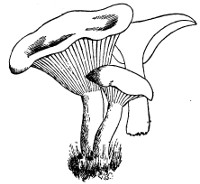
Clitocybe media. One-half natural size.
C. me´dia Pk.—medius, middle. Because intermediate between C. nebularis and C. clavipes. Pileus fleshy, convex, becoming plane or slightly depressed, dry, dark grayish-brown, the margin often wavy or irregular, flesh white, taste mild. Gills broad, subdistant, adnate or decurrent, whitish, the interspaces somewhat venose. Stem equal or but slightly thickened at the base, solid, elastic, not polished, colored like or a little paler than the pileus. Spores elliptical, 8×5µ.
Pileus 2–4 in. broad. Stem 1–2 in. long, 4–8 lines thick. Mossy ground in deep woods. North Elba. September.
This species is intermediate between C. nebularis and C. clavipes. In its general appearance, and in the character of the pileus and stem, it resembles C. nebularis, but in the character of the more distant gills and in the size of the spores it is nearer C. clavipes, of which it might perhaps be regarded as a variety. Two forms are distinguishable. In one the gills are more distant, slightly rounded behind, and adnate or abruptly terminated; in the other they are closer and more distinctly decurrent. The plant is edible. Peck, 42d Rep. N.Y. State Bot.
I have known this fungus very favorably since 1883, and regard it as one of the best. I have seen it in the West Virginia mountains only, but it will probably be found in cool, shaded, high localities all over the country. Both it and the C. nebularis are well worthy of search.
88C. viles´cens Pk.—vilesco, of little value. Pileus convex, then plane or depressed, often irregular, glabrous, slightly pruinose on the involute margin, brown or grayish-brown, becoming paler with age, often concentrically rivulose. Gills close, adnate or decurrent, cinereous, sometimes tinged with dingy-yellow. Stem short, solid, sometimes compressed, grayish-brown, with a whitish tomentum at the base. Spores subglobose or broadly elliptical, 5–6.5µ; flesh whitish-gray, odor slight.
Plant gregarious, 1–2 in. high. Pileus 1–1.5 in. broad. Stem 1–2 lines thick. Grassy pastures. Jamesville, August. Peck, 33d Rep. N.Y. State Bot.
A pale form of this species grows on sandy soil, in which the pileus is smoky white, but it becomes grayish-brown in drying. The mycelium binds together a mass of sand, so that when the plant is taken up carefully a little ball of sandy soil adheres to the base of the stem. The stem is sometimes pruinose. The flavor is mild and agreeable. Peck, 50th Rep. N.Y. State Bot.
Sometimes plentiful about Philadelphia. Edible. Caps tender, slight flavor.
C. comitia´lis Fr.—belonging to an assembly. Pileus about 1½ in. across, fleshy, convex, then plane, obtuse, even, glabrous, rather moist but not hygrophanous, every part colored alike, sooty-umber, almost black. Flesh firm, white. Gills very slightly decurrent, horizontal, plane, thin, crowded, white. Stem 2–3 in. long, 3–4 lines thick, equally attenuated upward from the base, glabrous, sooty, elastic, stuffed. Spores elliptical, 7–8×4µ.
Damp places among mosses in pine woods, etc. Distinguished by the blackish color of the almost flat pileus, and the very slightly decurrent gills. Somewhat allied to C. clavipes, but firmer, smaller and inodorous. Massee.
Rather rare. Found in New Jersey among pines; in Pennsylvania in mixed woods.
Edible. Good texture and flavor.
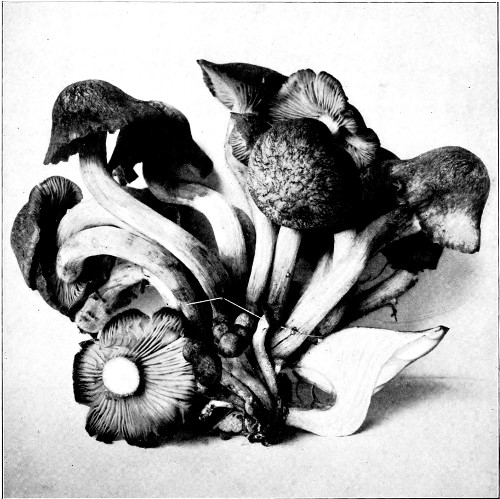
Photographed by Dr. J.R. Weist. Plate XXVII. CLITOCYBE MONADELPHA.
** Violet or reddish.
C. cyanophæ´a Fr. Gr.—blue. Pileus 3–4 in. broad, becoming bluish-dusky-brown, compact, convex then plane, obtuse, smooth. 89Stem 3 in. long, 1 in. thick at the base, attenuated upward, robust, solid, smooth, becoming azure-blue when young, abruptly white at the apex. Gills deeply decurrent, crowded, violaceous, then becoming pale.
New York, Albion. In woods. October. Edible. Dr. E.L. Cushing.
Specimens sent to me by Dr. Cushing are the first and only ones of the species I have seen. The description is accurate. The spores were cream color.
C. monadel´pha Morg.—monas, single; adelphos, a brother. From its cespitose habit. (Plate XXVII.) Densely cespitose. Pileus fleshy, convex then depressed, at first glabrous, then scaly, honey color, varying to pallid-brownish or reddish. Stem elongated, solid, crooked, twisted, fibrous, tapering at the base, pallid-brownish or flesh color. Gills short, decurrent, not crowded, pallid flesh color. Spores white, a little irregular, 7.5×5.5µ.
On the ground in wet woods, spring to late autumn. Pileus 1–3 in. Stem 3–7 in. Morgan.
Grassy places. Menands. Albany county. September. Edible. Resembling Armillaria mellea, but distinguished from it by the absence of a collar from the stem, by the more decidedly decurrent lamellæ and by the solid stem. It is also more agreeable in flavor. It is related to C. illudens in habit and manner of growth. Peck, 51st Rep. N.Y. State Bot.
Spores 8×5µ Peck.
October 15, 1898. Identified by Professor Peck. September until frost.
Grows in great clusters about roots, etc., at Mt. Gretna. Frequently much water-soaked and uninviting. Taste variable, sometimes strong, woody.
It is edible, but care should be exercised in collecting to get young, fresh groups.
C. socia´lis Fr.—socius, a companion. Pileus about 1 in. broad, pale-yellowish with a reddish tinge, fleshy, convex then expanded, acutely umbonate especially when young, even, smooth, dry. Flesh moderately thin, white. Stem 1 in. long, 2 lines or a little more thick, 90solid, fibrous, commonly ascending, smooth, reddish, the rooting base hairy. Gills plano-decurrent, scarcely crowded, becoming yellow. Fries.
A very pretty species, densely gregarious, inodorous. The stem is sheathed-hairy at the base like Marasmius peronatus. Its greatest affinity is with A. vernicosus, of which it is perhaps a variety. Stevenson.
Quite common in pine woods of New Jersey. Though small, goodly messes of it may be gathered from its patches. The caps make a pleasing dish.
*** Pileus becoming yellow.
None reported as tested for edibility.
**** Pileus greenish or becoming pallid.
C. odo´ra Bull.—odorus, fragrant. (Plate XXIV, fig. 9, p. 82.) Fragrant. Pileus about 2 in. across, flesh rather thick, tough; soon plane and wavy, even, smooth, pale dingy green, silky when dry. Gills adnate, rather close, broad, greenish or pallid. Stem about 1–1½ in. long, 2 lines thick, base incrassated, elastic, stuffed. Spores elliptical, 6–8×4–5µ. In woods. Massee.
Readily distinguished by the strong, aniseed smell, dingy bluish-green pileus, and the pallid or greenish gills.
Sometimes somewhat cespitose. Tough; size variable, color varies between pale green and greenish-gray, usually all colored alike, but the gills are sometimes white; smell pleasant, spicy, especially when dry. Fries.
Spores 6×5µ K.; 8×4µ B.
A rather delicate, even exquisite dish. Cooke.
Edible. Exceedingly spicy. The flavor is pleasant, but rather strong. A few specimens mixed with others of like texture but less flavor make a tasty dish.
C. rivulo´sa Pers.—rivus, a stream. (Named from rivulet-like streaks on pileus.) Pileus 1–3 in. across, flesh thin, convex then plane and depressed, obtuse, often undulately lobed, dingy flesh-color or reddish, becoming pale, glabrous, then covered with a whitish down. Gills slightly decurrent, broad, rather crowded, pinkish-white. Stem about 2 in. long, 3–4 lines thick, rather fibrillose, tough, elastic, whitish, stuffed. Spores elliptical, 6×3.5µ. Massee.
91Among grass by road-sides, etc.
Not common, but when found it is basket-filling. I have found it in Pennsylvania, New Jersey and West Virginia.
Edible. The caps are rather tough but become glutinous and tender when well cooked. Flavor fine.
***** Pileus white, shining when dry.
C. cerussa´ta Fr.—cerussa, white lead. Pileus 1½-3 in. across, flesh thick at the disk, becoming thin toward the margin; convex then almost plane, obtuse, even, minutely floccose then almost glabrous, white. Gills adnate, then decurrent, very much crowded, thin, permanently white. Stem about 2 in. long, 3–5 lines thick, smooth, tough, elastic, naked, spongy and solid, white. Among dead leaves, etc.
Taste mild, smell almost obsolete. Stem rather thickened at the base and often tomentose. Pileus said to be gibbous, but not umbonate nor becoming rufescent. Gills not changing to yellowish. Fries.
Spores 3µ W.G.S.
Edible. Good.
C. phylloph´ila Fr. Gr.—leaf-loving. Whitish-tan. Pileus 1–3 in. across, rather fleshy, convex then plane, becoming umbilicate and depressed, sometimes wavy, smooth and even. Gills thin, subdistant, white then tinged with ocher, rather broad, very slightly decurrent. Stem 2–3 in. long, equal, stuffed then hollow, whitish, tough, silky-fibrillose. Spores 6×4µ.
Among leaves in woods, etc.
Spores 6×4µ Massee; 6×3µ W.G.S.; 5.5×2.8µ Morgan.
Found at Devon, Pa., 1888; Angora, West Philadelphia, 1897. It is equal to the Pleurotus ostreatus (oyster mushroom) in texture, but not so high in flavor. Well cooked it is an agreeable and valuable food.
C. pithyoph´ila Secr. Gr.—pine-loving. Pileus 2–3 in. broad, dead-white when moist, shining whitish when dry, fleshy but thin, rather plane, umbilicate, at length irregularly shaped, repand and undulato-lobed, even, smooth, flaccid, the margin slightly striate when old. Stem somewhat hollow, rounded then compressed, equal, even, smooth, obsoletely or scarcely pruinose at the apex, white tomentose at the (not 92bulbous) base. Gills adnate, somewhat decurrent, very crowded, plane, 2–3 lines broad, distinct, quite entire, white.
Odor not remarkable, but pleasant. Gregarious, somewhat cespitose; white indeed, but when moist watery and somewhat hygrophanous, in which it evidently differs from A. phyllophila. A. tuba, which appears in the same places, is very like it. Stevenson.
Spores 6–7×4µ B.
Massachusetts, Sprague; New York, Peck, Bull. 1887.
Albion, Orleans county, N.Y., October, 1898, Dr. Cushing.
Several specimens received were clearly referable to C. pithyophila, though varying in having caps deeply depressed but not umbilicate. The white tomentosity at base was present but indistinct.
Four specimens were eaten and found good. Eaten enjoyably by Dr. Cushing.
C. fus´cipes Pk.—fuscus, dirty; pes, a foot. Pileus thin, broadly convex or plane, umbilicate, glabrous, whitish and striatulate when moist, pure white when dry, odor and taste farinaceous. Gills nearly plane, subdistant, adnate or slightly decurrent, white. Stem equal, glabrous or slightly mealy at the top, hollow, dingy brown when moist, paler when dry. Spores globose, 5–6µ.
Pileus 4–8 lines broad. Stem about 1 in. long. Under pine trees. Carrollton. September. Peck, 44th Rep. N.Y. State Bot.
Edible. Its small size gives it minor importance, but a quantity of it makes an excellent meal.
C. can´dicans Pers.—candico, to be shining white. Entirely white. Pileus about 1 in. across, flesh thin, convex then plane or slightly depressed, umbilicate, regular or slightly excentric, even, with an adpressed silkiness, shining, shining white when dry. Gills adnate then slightly decurrent, crowded, very thin, narrow, straight. Stem 1–2 in. long, 1–2 lines thick, even, glabrous, cartilaginous, polished, equal, hollow, base incurved, rooting, downy. Spores broadly elliptical or subglobose, 5–6×4µ. Massee.
Among damp fallen leaves, etc.
Entirely white, small, rather tough; approaching Omphalia in the structure of the stem. The following form is described by Fries as occurring in pine woods: Stem thin, flexuous, base glabrous; pileus 93plane, not umbilicate, naked (without silky down). Gills scarcely decurrent.
A remarkable form but scarcely to be separated as a species. Fries.
Quite common in West Virginia, Pennsylvania, New Jersey. The caps are excellent when well cooked.
C. dealba´ta Sow.—dealbo, to whitewash. Pileus about 1 in. or a little more broad, white, slightly fleshy, tough, convex then plane and at length revolute and undulated, always dry (not watery in rainy weather), even, smooth, somewhat shining, but as if innately pruinose under a lens. Flesh thin, arid, white. Stem 1 in. long, 2 lines thick, stuffed, wholly fibrous, at length also tubed, equal, but often ascending, whitish, mealy at the apex. Gills adnate, scarcely decurrent, thin, crowded, white.
Pileus sometimes orbicular, sometimes upturned and wavy. Odor weak, pleasant, but not very remarkable. Most distinct from A. candicans in the nature of the stem.
Edible. Its top is exceedingly like ivory. Its charming flavor is exceeded by very few other fungi. Stevenson.
Among leaves and grass. Woodland Cemetery, Philadelphia.
This charming fungus is common over the land. I have known it since 1881, and found it from North Carolina to West Virginia.
C. robus´ta Pk.—robustus, stout. Pileus thick, firm, at first convex, soon plane or slightly depressed in the center, glabrous, white, the margin at first involute or decurved, naked. Flesh white. Gills narrow, close, decurrent, whitish. Stem stout, rather short, solid, glabrous, equal or slightly tapering upward, often with a bulbous base, white. Spores elliptical, 8×4–5µ.
Pileus 3–4 in. broad. Stem 1–2 in. long, 8–12 lines thick.
Woods among fallen leaves. Catskill mountains. September to November.
This large and robust fungus is closely allied to C. candida Bres., from which it differs in the naked margin of the pileus, the absence of any marked odor and especially in the more elliptical shape of its spores. The same plant has been collected in Maryland by Mr. L.J. Atwater, who considers it edible, having eaten it with satisfaction and safety. Peck, 49th Rep. N.Y. State Bot.
94This fungus is quite plentiful in Pennsylvania and in open oak woods in New Jersey. Its size and sometimes gregarious growth give it a permanent food value. Its texture is coarse, but when cooked it is highly satisfactory.
C. gallina´cea Scop.—gallina, a hen. Application not apparent. White; acrid. Pileus 1–1½ in. across, rather fleshy at the disk, margin thin; convex then depressed, but not funnel-shaped, even, dry, opaque. Gills slightly decurrent, narrow, crowded, thin. Stem about 1½ in. long, 2 lines thick, equal, even, solid. Among grass, moss, etc.
Resembling C. dealbata in form, but smaller, opaque, dingy-white, taste somewhat acrid. Stem solid, but not cartilaginous, about 2 in. long, equal, ascending or flexuous, excentric, at first floccosely mealy, always opaque, white. Pileus slightly fleshy, convex then plane, not depressed, obtuse, ½-1 in. broad, unequal, dry, pruinosely hoary; flesh white, compact, but thin. Gills adnato-decurrent, thin, crowded, plane. Fries.
It loses its acridity in cooking and is quite equal to C. dealbata.
C. trunci´cola Pk.—truncus, trunk of a tree. Pileus thin, firm, expanded or slightly depressed in the center, smooth, dry, white. Gills narrow, thin, crowded, adnate-decurrent. Stem equal, stuffed, smooth, often excentric and curved, whitish.
Plant 1 in. high. Pileus 1 in. broad. Stem 1 line thick.
Trunks of frondose trees, especially maples. Croghan. September. Peck, 26th Rep. N.Y. State Bot.
Spores 5×3.5µ Morgan.
Found on maple trees in West Philadelphia, Pa. Edible. Good quality.
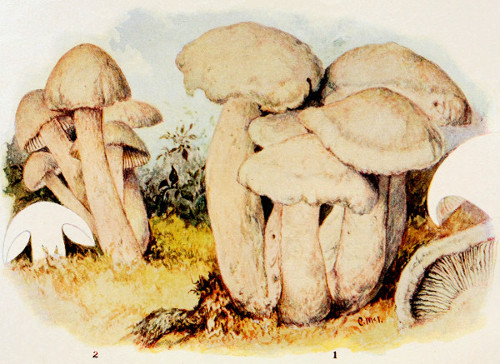
Grouped by F.D. Briscoe—Studies by C. McIlvaine. Plate XXVIIa.
Fig. Page. Fig. Page.
1. Clitocybe multiceps, 95 2. Clitocybe multiceps, var. 95
II.—Diffor´mes.
C. decas´tes Fr. Gr.—a decade; a number of ten. From the stems being often joined in bundles of about ten. Densely cespitose. Pileus 5–12 in. across, soon almost plane, disk gibbous or obtuse; margin at first shortly incurved, then expanded, very much waved and often lobed, even, glabrous, dingy-brown or livid when moist, pale clay-color when dry. Flesh exceedingly thin except at the disk, whitish. Stem 4–7 in. long, ½-1½ in. thick, usually slightly thinner upward, rather soft, 95entirely fibrous, solid, white, usually curved and ascending, coalescent into a solid mass at the base. Gills adnato-decurrent, or often more or less adnexed, up to ½ in. broad, rather narrowed towards the margin, often wavy. Spores globose, smooth, 4µ diameter.
On the ground and on sawdust.
Albion, Orleans county, N.Y., Dr. Cushing. October, 1898.
On ground in grassy places (Woodland Cemetery, May 22, 1897). McIlvaine.
Particularly welcome to toadstool lovers are the early comers. The present species is among the first. It is rich in quantity, substance and flavor.
C. mul´ticeps Pk.—multus, many; caput, a head. (Plate XXVIIa, p. 94.) Pileus fleshy, thin except on the disk, firm, convex, slightly moist in wet weather, whitish, grayish or yellowish-gray. Flesh white, taste mild. Gills close, adnate and slightly decurrent, whitish. Stems densely cespitose, equal or slightly thickened at the base, solid or stuffed, firm, elastic, slightly pruinose at the apex, whitish. Spores globose, 5–8µ.
Pileus 1–3 in. broad. Stem 2–4 in. long, 3–6 lines thick.
Open places, grassy ground, etc. Albany and Sandlake. June and October. This species forms dense tufts, often composed of many individuals. In this respect it is related to such species as C. tumulosa, C. aggregata and C. illudens. From the crowding together of many individuals the pileus is often irregular. Sometimes the disk is brownish and occasionally slightly silky. The gills are sometimes slightly sinuate, thus indicating a relationship to the species of Tricholoma. The taste, though mild, is somewhat oily and unpleasant. The plants appear in wet, rainy weather, either early in the season or in autumn. Specimens have been sent to me from Massachusetts by R.K. Macadam and Professor Farlow, and from Pennsylvania by Dr. W. Herbst. Peck, 43d Rep. N.Y. State Bot.
West Virginia, New Jersey, Mt. Gretna, Pa. In May, and in autumn months. Very variable in size, color, shape of gills, texture and taste. McIlvaine.
The early spring clusters are remarkable for their tenderness and excellence. Clusters of hundreds of individuals grew abundantly at Mt. Gretna in May, 1899. When the fungus was young the gills were 96sometimes adnate, almost free, often decurrent. The varying color of oysters is well seen in C. multiceps.
Edible. They should be well cooked. The addition of a little lemon juice or sherry conceals a slight raw taste sometimes present.
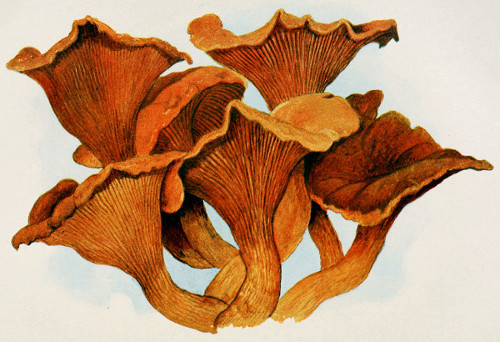
Photographed by Dr. J.R. Weist—Painted by C. McIlvaine. Plate XXIXa.
Page.
Clitocybe illudens 96
C. illu´dens Schw.—mocking, deceiving. (Plate XXIXa, p. 96.) Pileus fleshy, convex or expanded, smooth, generally with a small umbo. Gills not crowded, unequally decurrent, some of them branched, narrowed toward each end, the edge, in dry specimens, discolored. Stem firm, solid, long, smooth, tapering at the base.
Height 5–8 in., breadth of pileus 4–6 in. Stem 6–8 lines thick.
Spores 4–5µ Peck.
Grows in clumps or large masses about stumps or decaying trees from August to October. Its bright, deep yellow is attractive from a distance. As many as fifty plants may form a cluster. Cap from 2–6 in., fleshy, convex or expanded, often with a raised center directly over the stem; flesh juicy and yellow; gills yellow, widely separated, running down stem unequally; stem long, firm, solid, smooth, tapering toward base. When cooked the taste is rather saponaceous. Strong stomachs can retain a meal of them, but the fungus generally sickens the eater. Many testings show it to contain a minor poison. It is not deadly, but should not be eaten. Bull. No. 2, Phila. Myc. Center.
New York, Peck, Rep. 23–49. Well known in southern states. Indiana, H.I. Miller.
The mysterious property of phosphorescence is possessed by this fungus. As heat is known to develop in masses of the fungus it is of interest to know whether it is from the phosphorescence or a ferment. Its radiance by night surpasses its splendor by day. Mr. H.I. Miller, of Terre Haute, Ind., first drew the writer’s attention to this quality. A large box of specimens sent by him retained their luminous quality after three days of travel to such an extent that the print of a newspaper could be read when held close to the mass.
Mr. Miller writes: “There is something about this fungus which generates heat. When I bring in a basketful of it, for the pleasure its phosphorescence affords my friends, I find that after having been in the basket for two or three hours, and while piled one bunch upon top of another, that to insert one’s hand among the different clusters is like putting it close to a hot stove.”
97This fungus is so inviting in quantity and beauty that one turns from it with a regret that lingers. Eaten in quantity it acts upon some persons as an emetic. I have several times eaten of it without other than pleasurable sensations, but persons partaking of the same cooking have been sickened.
C. fumo´sa Pers.—fumus, smoke. Pileus 1–3 in. across, fleshy, margin thin; convex, often gibbous when young, regular or wavy, even, pellicle not separable, glabrous, sooty-brown, soon livid or gray when dry. Gills adnate in regular forms, but often decurrent when the pileus is irregular, crowded, distinct, grayish-white from the first. Stem 2–3 in. long, 3–6 lines thick, almost equal, often twisted or curved, glabrous, dingy-white, apex mealy, solid, fibrous. Spores subglobose, 5–6µ diam.