Sub-Class BASIDIOMYCETES (continued 3)
Reading edition
In woods. Autumn.
Gregarious, somewhat cespitose, tough, rather cartilaginous. Pileus truly obtuse, never streaked, often regular. Smell none. Fries.
Var. po´lius. Densely and connately cespitose. Pileus convex, then plane, obtuse, smooth, gray. Stem flexuous, smooth. Gills crowded, whitish. Edible. Cooke, 1891.
Var. polius found growing in large quantities in Boston navy yard in stone barn. Determined by Professor Peck. A fair edible. R.K. Macadam.
This woods-growing Clitocybe has been many times found by me in a hot-house in Haddonfield, N.J. Professor Peck confirmed my identification. Either its spores or mycelium had evidently been carried thither in the wood-earth used by florists. The hot-house crops appeared in March, and continued until June.
Several of the plants showed an effort to comply with some condition unusual to them, by producing gills upon the upper side of the pileus. Those below were venose and crisped.
This wild species had thus been brought into cultivation. The cultivated plants were much more tender than the wild. Both are excellent.
C. connex´a Pk.—connexus, joined. From its relation to Tricholoma. Pileus thin, convex or expanded, subumbonate, clothed with a minute appressed silkiness, white, the margin sometimes faintly tinged with 98blue. Gills crowded, narrow, white inclining to yellowish. Stem equal or tapering downward, solid, whitish.
Plant 2–3 in. high. Pileus 2–3 in. broad. Stem 2 lines thick.
Ground in woods. Croghan. September.
The gills sometimes terminate rather abruptly and are not strongly decurrent, hence it might easily be mistaken for a Tricholoma. The margin of the pileus is sometimes marked with slight ridges as in Ag. laterarius. The odor is weak but aromatic and agreeable. Peck, 26th Rep. N.Y. State Bot.
Found in plenty in oak woods near Philadelphia, and in West Virginia; a few specimens in southern New Jersey. Autumn.
Edible, and quite equal to most of the Clitocybes.
C. tumulo´sa Kalchbr.—tumulus, a mound. Cespitose. Pileus 1–2 in. across, disk fleshy, margin thin; conico-convex then expanded, obtusely umbonate or obtuse, even, glabrous, brownish-umber, becoming pale, margin drooping. Gills more or less decurrent or slightly emarginate, crowded narrow, white, then grayish. Stem 3–5 in. long, unequal, usually thicker below, minutely downy, pallid, solid.
On the ground in woods. Spring and autumnal months. Readily distinguished by the densely clustered habit, and the umber pileus. The gills are very variable, sometimes distinctly decurrent, at others rounded behind, and almost resembling a Tricholoma. Spores subglobose, 5–6µ. Massee.
California, H. and M.; New York, Peck, Rep. 42.
Sent to me by Mrs. Mary Fuller, Washington, D.C. The specimens eaten were of good consistency and flavor.
III.—Infundibulfor´mes.
* Pileus colored or becoming pale, etc., surface innately flocculose or
silky; not moist.
C. gigante´a Sow.—giganteus, of gigantic size. Pileus 6–10 in. across. Flesh rather thin in proportion to the size of the fungus, white, or tinged with tan, glabrous when moist, slightly flocculose when dry; margin involute then spreading, glabrous, rather coarsely grooved. Gills slightly decurrent, broad, very much crowded, branched and connected 99by veins, whitish then pale tan-color, not separating spontaneously from the hymenophore. Stem 1–2 in. long and nearly the same in thickness, equal, pallid, solid. Spores white, 5×3µ.
In woods, etc.
A very distinct species, very showy, large, subcespitose, entirely whitish tan-color; without close affinities. Stem solid, compact, and firm inside and outside, 2½ in. long, ½ in. thick, equal, even, glabrous. Pileus depressed from the first, then broadly, i. e., plano-infundibuliform, thin but equally fleshy, soft, not flaccid, but easily splitting from the margin toward the center (almost papery and involute when old), upward of a foot broad, often excentric and generally sinuately lobed, moist and adpressedly downy when growing, slightly flocculose and cracked into scales when dry; margin at first very thin, involute, pubescent, soon spreading, glabrous, at length revolute, coarsely furrowed or radiately wrinkled. Gills slightly decurrent, closely crowded, almost 3 lines broad (2–3 times as broad as thickness of flesh of pileus), connected by veins, thin, fragile, straight, but sometimes varying to crisped and anastomosing, whitish then yellowish or tinged with rufous, smell weak. Fries.
This species was placed in Clitocybe in Syst. Myc. and Epicrisis, but in Hym. Europ. Fries removed it to Paxillus in which he is followed by Stevenson. Cooke and Massee continue it in Clitocybe. Dr. Somers found one measuring over 15 inches in diameter. R.K.M.
North Carolina, Schweinitz. Edible, Curtis; Wisconsin, Bundy; California, H. and M.; Nova Scotia, Dr. Somers.
Large quantities of Clitocybe gigantea grow in the West Virginia mountains, and in woods around Philadelphia. July to November.
Its substance is coarse, but of good flavor. It should be chopped fine.
C. max´ima Gärtn and Meyer. (Fl. Wett.)—greatest. (Plate XXIV, fig. 5, page 82.) Pileus as much as 1 foot broad, becoming pale-tan or whitish, fleshy, compact at the disk, otherwise thin, somewhat flaccid (not capable of being split), broadly funnel-shaped, gibbous with a central umbo, always very dry, the surface becoming silky-even or squamulose; margin involute, pubescent, always even. Flesh white, at length soft. Stem as much as 4 in. long, 1 in. thick, solid, compact, but internally spongy, elastic, attenuated upward, fibrillosestriate, 100whitish. Gills deeply decurrent, pointed at both ends, somewhat crowded, soft, simple, whitish, not changeable.
The pileus is always very dry because the surface absorbs moisture. Odor weak, pleasant, almost that of A. infundibuliformis. On account of its gigantic stature and color, it has often been interchanged with A. gigantea Sow.; it is in no wise, however, allied to that species, but is so closely allied to A. infundibuliformis that it might be taken for a very luxuriant form of it. Stevenson.
Spores 6×4µ Massee; 5×3µ, W.G.S.
New England, Frost; California, H. and M.
Common in the West Virginia mountains, mixed woods in New Jersey and Pennsylvania. June to November. McIlvaine.
It is coarse, dry, hard, but chopped fine and cooked in various ways, either by itself or with meats, it is a good food.
C. infundibulifor´mis Schaeff.—infundibulum, a funnel; forma, form. (Plate XXIV, fig. 11, p. 82.) The Funnel-form clitocybe, Clitocybe infundibuliformis, is a neat and pretty species easily recognized by the funnel shape of its mature cap and by its pale red color. When very young the cap is slightly convex and often adorned with a slight umbo in its center. As it matures the margin becomes elevated so that the cap assumes a shape somewhat resembling that of a wine glass. The margin is sometimes wavy. The flesh is thin and white. The gills are close, thin, white or whitish and decurrent. The stem is smooth, colored like or a little paler than the cap and mostly tapering from the base upward.
The cap is 2–3 in. broad, the stem 1½-3 in. long and ¼-½ in. thick.
The funnel-shaped mushroom grows in woods or copses in summer and autumn, especially in wet seasons. It is somewhat variable in color, but is usually a pale-red, tinged with buff, and sometimes becoming more pale with age. It delights to grow among fallen leaves, and often there is an abundant white cottony mycelium at the base of the stem. When it grows in clusters the caps are apt to be irregular because of mutual pressure. “Mushrooms and Their Use.” Peck.
Spores 5–6×3–4µ B.
Very common and in plenty after rains, when large patches of it may be found. I have usually found the light pinkish-buff color to abound, 101and the stem thinner than described by Prof. Peck. Size of cap from 1–3 in.
It is a good, reliable food species. The stem should be removed, and the caps well cooked.
** Pileus colored or pallid, smooth, moist in wet weather.
C. subzonal´is Pk.—sub, under; zonalis, pertaining to a zone. Pileus thin, centrally depressed or subinfundibuliform, marked with two or three obscure zones, with a slight appressed silkiness, pale yellow. Gills close, narrow, equally decurrent, some of them forked, pallid or yellowish. Stem equal, slightly fibrillose, stuffed, pale yellow.
Plant 2 in. high. Pileus 2–3 in. broad. Stem 2–3 lines thick.
Ground in woods. Croghan. September. Peck, 26th Rep. N.Y. State Bot.
Found in oak woods, Angora, West Philadelphia, growing singly. Specimens few. Edible; pleasant.
C. gil´va Pers.—gilvus, pale brownish-yellow. Pileus 2–4 in. broad, pale yellowish, fleshy, compact, convex then depressed, very obtuse, even, smooth, dampish when fresh, polished and shining when dry, here and there spotted as with drops, the margin remaining long involute. Flesh compact, not laxly floccose, but at length fragile, somewhat of the same color as the pileus. Stem 1–2 in. and more long, ½ in. and more thick, solid, fleshy, stout, not elastic, somewhat equal, smooth, paler than the pileus, villous at the base. Gills decurrent, thin, very much crowded, often branched, arcuate, narrow, pallid then ochraceous.
Odor not remarkable. The stem has been noticed at length also hollow, perhaps eroded by larvæ. It corresponds with the Paxilli. The primary form, which is very different from all the rest, is curt, obese, robust, scarcely ever infundibuliform. Stevenson.
Spores 4–5×5µ K.; 4–5µ Massee.
North Carolina, Schweinitz, Curtis; Pennsylvania, Schweinitz; New York, Peck, R. 51, under pines. July to September.
Mt. Gretna, Pa. July, 1898, ground, mixed woods. McIlvaine.
Pileus 1–2½ in. across, depressed, almost infundibuliform, smooth. Color varied lemon to bright orange. Flesh lemon color throughout. Gills varying in color, usually same color as pileus. Stem all of one 102color, same as pileus, stuffed, sometimes short, and pointed, sometimes thickened at base. Taste and smell pleasant. Edible; good.
C. subinvolu´ta Batsch.—turned under at the margin. Pileus brick color, convex, depressed, smooth, margin closely involute. Flesh pallid. Stem paler, stout, straight, somewhat equal, veined on the lower part with oblique coalescing slightly elevated wrinkles, tomentose and inclining to flesh color above toward the gills, base obtuse. Gills decurrent, rather broad, of the same color as the pileus.
The stem is rough on the surface and destitute of luster. It resembles Paxillus involutus in size and habit, in the crenate and involute margin of the pileus, and in the stem being obsoletely veined at the base and tomentose toward the gills. Stevenson.
New England, Frost; New York, Peck, Rep. 22.
Edible, Cooke.
C. geo´tropa Bull. Gr.—the earth; Gr.—to turn. From the turned down margin. Pileus 2–5 in. across. Flesh thick, white convex, then plane and finally more or less depressed, obtusely umbonate, the prominence remaining after the pileus becomes depressed, very smooth, even, margin thin, incurved, downy, pale pinkish-tan or buff. Gills decurrent, crowded, narrow, simple, white, then colored like the pileus. Stem 3–5 in. long, 1 in. or more thick at the base, slightly attenuated upward, compact, fibrillose, colored like the pileus or paler, solid. Spores elliptical, 6–7×4–5µ. Massee.
In woods and on their borders. Often in rings or troops.
Differs from C. maxima in being firmer, glabrous, and color much more variable; from C. gilva in the thinner pileus, less crowded gills, and white flesh.
Spores 5–7µ W.G.S.
In England and on the continent it is considered excellent and superior to most edible fungi.
Found in West Virginia, 1881; Haddonfield, N J., 1891. Spring and autumn. McIlvaine.
Edible, coarse, dry. In stews and mixed to form croquettes or patties, it is a desirable species, owing to its plentifulness.
C. splen´dens Pers.—splendens, shining. Solitary. Pileus 2–3 in. across, flesh rather thick, white, plane then depressed or funnel-shaped, 103glabrous, shining, yellowish. Gills deeply decurrent, narrow, crowded, simple, white. Stem about 1 in. long, 3 lines thick, glabrous, colored like the pileus, solid, slightly thickened at the base or equal. Massee.
In woods, among pine leaves, etc.
Intermediate between C. gilva and C. flaccida. The typical form of C. gilva differs in the compact pileus, often with drop-like markings, the very much crowded, somewhat branched, pale ochraceous gills and flesh. Fries.
Sent to me from Trenton, N.J., by E.B. Sterling.
Edible; quality good, deficient in flavor.
C. inver´sus Scop.—inverto, inverted. Pileus 2–3 in. across. Flesh thin, fragile; convex, soon funnel-shaped, margin involute, glabrous, even, reddish or dull brownish-orange. Gills decurrent, simple, pallid then reddish. Stem about 1½ in. long, 2 lines thick, glabrous, rather rigid, paler than the pileus, stuffed, soon hollow. Spores subglobose, 4µ diameter. Massee.
Among leaves, etc.
Gregarious, subcespitose, forming very large tufts, especially late in the autumn, deformed. Smell peculiar, slightly acid. Stem sometimes stuffed, usually hollow, hence compressed, rather rigid and corticated outside, not elastic, without a bulb, glabrous, whitish; the somewhat rooting base with white down, and often growing together in tufts, variously deformed, curved, ascending, etc. Fries.
Spores subglobose, 4µ Massee; 3µ W.G.S.
Closely resembles C. infundibuliformis, but differs from it in the color of gills and flesh. The entire plant is dark in color. Solitary; in troops; cespitose.
Found in mixed woods. Haddonfield, N.J. Summer and autumn.
That part of the plant which readily breaks away from the stem is tender and of good flavor. The remainder is tough.
C. flac´cida Sow.—flaccidus, limp. Pileus 2–3 in. across, flaccid, orbicular, umbilicate, umbo persistently absent, margin spreading, arched, glabrous, even, rarely cracking into minute squamules, tawny-rust colored, shining, not becoming pale. Flesh thin, pallid, rather fragile when fresh, but quite flaccid when dry. Gills deeply decurrent, 104arcuate, crowded, narrow, about 1 line broad, white, then tinged yellowish. Stem imperfectly hollow, elastic, tough, 1–2 in. long, 2–3 lines thick somewhat equal, polished, naked, reddish-rust color, base thickened, downy. Spores subglobose, 4–5×3–4µ.
Among leaves, etc. Gregarious, stems often grown together at the base. Sometimes solitary and regular. Summer and autumn. Massee.
Spores subglobose, 4–5×3–4µ.
Found in 1886 in West Philadelphia—oak woods. Since in New Jersey, North Carolina, and interior of Pennsylvania.
Edible. Well cooked it compares favorably with C. infundibuliformis and others of like texture.
*** Pileus shining white.
C. cati´na Fr.—catinus, a bowl. Pileus 2 in. broad, at first white, in no wise hygrophanous, then passing into pale flesh-color during rain, and into tan-color in dry weather, fleshy, moderately thin, plane then funnel-shaped, always obtuse, even, smooth. Flesh thin, flaccid, white. Stem 3 in. long, 1½ in. thick, stuffed, internally spongy, elastic, tough, thickened and tomentose at the base. Gills decurrent, straight, descending, not horizontal, broad, not much crowded, persistently white. Fries.
Ray Brook, Adirondack mountains. August. The pileus is at first white, but in wet weather it becomes pallid or discolored with age. The plants were found growing among pieces of bark of arbor vitæ lying on the ground. Peck, 43d Rep. N.Y. State Bot.
Quite common in West Virginia, Pennsylvania, New Jersey. Woods among dead leaves. August until frost.
Edible. Excellent in flavor and quality.
Series B.
IV.—Cyathifor´mes.
C. cyathifor´mis Bull.—cyathus, a cup; formis, form. Pileus 1½-3 in. across, flesh thin, plano-depressed when young, then infundibuliform, even, glabrous, hygrophanous, rather slimy and usually dark brown when moist, becoming pale and opaque when dry, undulate in 105large specimens, the margin remains involute for a long time. Flesh watery, similar in color to the pileus, splitting. Gills adnate, becoming decurrent with the depression of the pileus, joined behind, distant, grayish-brown, sometimes branched. Stem spongy and stuffed inside, elastic, at length often hollow, 2–4 in. long, 3–4 lines thick, attenuated upward, brownish-fibrillose, fibrils forming an imperfect reticulation, colored like the pileus or a little paler, apex naked (not mealy), base villous. Massee.
On the ground in pastures and woods, rarely on rotten wood.
Usually blackish-umber, but varies to paler grayish-brown, pinky-tan, pale cinnamon or brownish; then dingy-ochraceous or tan-color. Margin expanded when old, and also indistinctly striate. Fries.
Var. cineras´cens Fr. Pileus up to 1 in. across, thin, infundibuliform, pale smoky-brown. Gills decurrent, yellowish-white. Stem 1–2 in. long, 1½ line thick, grayish, reticulately fibrillose, hollow.
Spores 8×5µ W.G.S.; 10–12×5–6µ, B.; 9×6µ Morgan.
Mt. Gretna, Pa. Among leaves in woods. September to October. Gregarious. McIlvaine.
Fair in quality.
C. bruma´lis Fr.—bruma, winter. From its late appearance. Pileus about 1 in. across. Flesh thin, expanded, umbilicate then infundibuliform and usually variously waved and lobed, glabrous, flaccid, hygrophanous, livid, whitish or yellowish when dry, disk often darker. Gills decurrent, about 1 line broad, crowded, pallid. Stem up to 2 in. long and about 2 lines thick, nearly equal, slightly curved, glabrous, whitish, often compressed, imperfectly hollow. Spores 4–5×3–4µ.
In woods, etc.
Truly autumnal, being most abundant in November. There are two forms: (a) on pine leaves in pine woods; (b) among heather. (a) Stem rather firm, hollow, about 2 in. long, 2 lines thick, equal or slightly thickened at the apex, at length compressed, somewhat incurved, glabrous, naked, becoming livid, white when dry, base white and downy. Flesh of pileus membranaceous, at first convex, umbilicate, margin reflexed, about 1 in. across, then funnel-shaped, often irregular and undulate, up to 2 in. broad, glabrous, even, livid when moist, whitish then becoming yellowish when dry, disk at first usually darker. Gills decurrent, at first arcuate, then descending, 1 line broad, crowded, 106distinct, livid then yellowish-white, smell weak, not unpleasant. (b) Entirely watery white; stem hollow, somewhat striate, base glabrous; pileus infundibuliform, margin deflexed, milky-white when dry. Gills less crowded, but rather broader, whitish. Fries.
Spores 3µ W.G.S.; 4–5×3–4µ Massee.
Edible. Cooke.
C. morbi´fera Pk.—morbus, disease; fero, to bear. Pileus thin, fragile, glabrous, convex, becoming plane or centrally depressed, slightly hygrophanous, grayish-brown when moist, whitish or cinereous when dry, sometimes slightly umbonate. Gills narrow, close, adnate or slightly decurrent, whitish or pallid. Stem short, equal, hollow, colored like the pileus or a little paler. Spores minute, broadly elliptical, 4µ long, almost as broad.
Pileus .5–1.5 in. broad. Stem about 1 in. long, ⅙–¼ in. thick. Grassy ground and lawns. November. Washington, D.C. F.J. Braendle.
The species seems related to C. expallens, but the margin of the pileus is not striate as in that fungus. The taste is very disagreeable and remains in the mouth a long time. Two persons were made ill by eating it, but their sickness lasted only about three hours. Peck.
I have not seen this species. Its reputation is bad. Caution should be observed.
V.—Versifor´mes.
Pileus bright, of one color.
C. trullisa´ta Ellis. Pileus fleshy, plano-convex, at length depressed in the center, innate fibrous-scaly, becoming smoother on the disk, margin thin. Gills unequal, not crowded, coarse and thick, adnate with a decurrent tooth, at length white pulverulent, purple-violet at first, becoming dark brick-red. Stem stuffed, fibrillose, with a long club-shaped base penetrating deeply into the sand. Spores large, cylindric-oblong, 15–20µ.
In old sandy fields. September to October.
The interior of the stem in the young plant is like the gills, violet-purple, and the club-shaped base is covered with a tomentose coat, to which the sand adheres tenaciously.
107Related to A. laccatus and A. ochropurpureus B.
Resembles the larger forms of A. laccatus, but it has a stouter habit, the pileus is more squamulose, the stem is bulbous or thickened at the base, the mycelium is violet-colored and the spores are oblong. Bull. Torrey Bot. Club, November, 1874.
New Jersey, Ellis; New York, Peck, Rep. 33.
Haddonfield, Watertown, N.J. Sandy soil in pine woods. McIlvaine.
Densely cespitose. Caps and stems brown, glutinous and so incrusted with sand that it is almost impossible to clean them. Edible, but not desirable.
C. lacca´ta Scop.—made of lac. (Plate XXIV, fig. 10, p. 82.) Pileus thin, fleshy, convex, sometimes expanded, even or slightly umbilicate, smooth or minutely tomentose-scaly, hygrophanous when moist, dull reddish-yellow or reddish flesh-colored, sometimes striatulate when dry, pallid or pale dull ochraceous. Gills broad, rather thick and distant, attached, not decurrent, flesh-colored. Stem slender, firm, fibrous, stuffed, equal, concolorous.
Height 1–6 in., breadth of pileus 6 lines to 2 in. Common. June to October.
An extremely variable and abundant species occurring almost everywhere throughout the season. Peck, 23d Rep. N.Y. State Bot.
Spores 8–9µ Massee; 8–10µ B.
Var. pallidifo´lia Pk.—pallidus, pale; foliumaf. Gills whitish or pallid, decurrent.
Var. stria´tula Pk.—stria, a furrow. Pileus moist, smooth, thin, showing shading radiating lines, extending from near the center to the margin. In wet or damp places.
A form occurs with a decidedly bulbous base. Gills appearing emarginate with a decurrent tooth.
Clitocybe laccata is made the type of a new genus by Berkeley and Broome. Massee accepts the genus but it is not generally accepted by the standard authors. It is a well defined genus, and a fitting place for C. laccata, C. amethystina, C. ochropurpurea, C. tortilis, which it puzzles anyone to identify as Clitocybe.
C. amethys´tina Bolt.—amethystinus, color of an amethyst. (Plate 108XXIV, fig. 8, p. 82.) Pileus 1–2½ in. across, dark-purple, umbilicate, smooth, minutely tomentose, involute. Gills dark-purple, decurrent, broad. Stem 2–3 in. high, fibrillose, purple, streaked with white fibrils, equal, densely covered with white tomentum at base.
Also written Clitocybe laccata amethystina Sacc.
“In my opinion it is a good species and should be kept distinct as Bolton gave it, and not be tacked on to C. laccata as a variety. I should write it Clitocybe amethystina Bolt.” Peck, letter September 17, 1897.
New York, Peck, Rep. 41; New Jersey, Sterling; Mt. Gretna, Pa., on wood soil, June to frost, 1897–1898, McIlvaine.
Generally included in C. laccata as a variety, and has therefore been reported under that name.
Great quantities of C. amethystina grew in troops on beds made up of wood earth about the cottages at Mt. Gretna, Pa. The woods over them is dense.
The caps are tough, but they cook readily and make a pleasing dish.
C. tor´tilis Bolt.—tortilis, twisted. Pileus membranaceous, convexo-plane then depressed, obscurely marked with radiating striæ. Stem hollow, twisted, fragile. Gills adnate, thick, distant, fleshy-rose, cespitose, small, irregular, pileus and stem rusty in color.
Hard ground in an old road. Sandlake. August. A species closely allied to C. laccata and appearing like an irregular dwarf form of that species. Sometimes cespitose. Peck, 41st Rep. N.Y. State Bot.
Excepting that this fungus is frequently found with C. laccata, and might be taken for a new species if not here described, it would not be separated from C. laccata.
Its edible qualities are similar.
C. ochropurpu´rea Berk.—ochra, ocher; purpureus, purple. (Plate XXIV, figs. 1, 2, 3, 4, p. 82.) Pileus subhemispherical, at length depressed, fleshy, compact, tough, pale yellow, slightly changing to purplish, cuticle easily separable; margin inflexed, at first tomentose. Stem paler, here and there becoming purplish, solid, swollen in the middle, occasionally equal. Gills thick, purple, broader behind, decurrent. Spores white or pale yellow.
Pileus 2 in. broad. Stem 2½ in. high, ¾ in. thick in the center.
August. On clayey soil in woodlands.
109Its spores darken when shed in quantity, have a granulated and light-lilac appearance. It is a solitary grower, sometimes reaching the height of six inches. The upturned, wavy pileus, showing the purple gills in contrast with the pale Naples-yellow of the cap is markedly attractive. The stem is often rough with fibers, hard and tough. The caps are tough. It grows in grassy woods and open places. The novice, even the expert, will be puzzled to place it in its genus.
Specimens were sent to me by Miss Lydia M. Patchen, Westfield, N.Y., and E.B. Sterling, Trenton, N.J. I afterward found many at Mt. Gretna, Pa. I reported their edible qualities to Prof. Peck who wrote, September 3, 1897: “I have often wished it was edible, but it has such a disagreeable flavor when fresh that I have never ventured to eat it. I have known it to be mistaken for the common mushroom, but not eaten.”
Though tough it cooks tender and is excellent. Stew and put in patties or croquettes.
VI.—Orbifor´mes.
* Gills becoming ash-colored.
C. di´topa Fr. Gr.—twofold; Gr.—a foot. Probably from stems growing two together. Pileus thin, submembranaceous, convex, rarely with a small umbo, smooth, hygrophanous, brown when young and moist, grayish-white when dry. Gills grayish, close, thin, attached, not decurrent. Stem slender, equal, smooth, hollow.
Height 1–2 in., breadth of pileus 6–18 lines. Stem 1–2 lines thick.
Pine woods. West Albany. October.
The plant has the odor and taste of new meal. I have seen no specimens with the pileus depressed. Peck, 23d Rep. N.Y. State Bot.
C. meta´chroa Fr. Gr.—changing color. Separated from C. ditopa by its thicker, depressed pileus, its thicker, less close gills, and the absence of odor.
Pine woods. West Albany. October. Peck, 23d Rep. N.Y. State Bot.
Moderately plentiful in New Jersey pines. September to October.
Edible, tough; when well stewed of good flavor.
110** Gills whitish.
C. compres´sipes Pk.—compressus, pressed together; pes, a foot. Pileus thin, convex or expanded, umbilicate, glabrous, hygrophanous, brownish when moist, whitish or pale yellow when dry, margin thin. Gills close, subarcuate or horizontal, adnate or subdecurrent, whitish. Stem firm, hollow, generally compressed, slightly pruinose. Spores elliptical, 5–6.5×4–4.5µ. Flesh white when dry, odor slight, farinaceous.
Plant gregarious, 1–1.5 in. high. Pileus 6–16 lines broad. Stem 1–2 lines thick.
Grassy places. Albany. July.
The moist pileus is sometimes obscurely zonate. The odor is not always perceptible unless the pileus is moist or broken. The stem is sometimes compressed at the top only, sometimes at the base only, and rarely it is wholly top-shaped. Peck, 33d Rep. N.Y. State Bot.
Found on open lots in West Philadelphia. Though small it usually grows in troops which yield fair quantity. The caps are tender and of good flavor.
C. fra´grans Sow.—fragrans, fragrant. Smell strong, spicy. Pileus about 1 in. across. Flesh rather thick; convex, soon expanded and slightly depressed or umbilicate, even, glabrous, hygrophanous, uniform watery-white, disk not darker, whitish when dry. Gills slightly decurrent, rather crowded, 1 line broad, distinct, whitish. Stem about 2 in. long, equal, slightly curved, elastic, glabrous, whitish, stuffed then hollow.
In woods among moss, etc.
Distinguished from other species resembling it in color and size, by the fragrant smell resembling aniseed. Massee.
Spores 6×4µ. W.G.S.
Found in West Virginia, New Jersey, Pennsylvania. July to severe frosts. McIlvaine.
Edible. The strong taste of anise is not lost in cooking.
C. pino´phila—pine loving. Pileus thin, convex, umbilicate or centrally depressed, glabrous, moist, pale tan-color, paler or alutaceous when dry. Gills moderately close, subarcuate, adnate or slightly decurrent, whitish. Stem equal, stuffed or hollow, glabrous or subpruinose, 111colored like the pileus. Spores nearly elliptical, 4–6µ long; odor and taste resembling that of fresh meal.
Plant 1–2 in. high. Pileus about 1 in. broad. Stem 1–2 lines thick.
Ground under pine trees. Albany and Ticonderoga. July and August. Peck, 31st Rep. N.Y. State Bot.
Quite plentiful in pine woods of New Jersey. Edible; pleasant.

112COLLY´BIA Fr.
Gr.—a small coin.
Pileus fleshy, usually thin, margin incurved at first, not corrugated. Stem different in substance from the pileus, but confluent with it; hollow, with a cartilaginous bark, internally cartilaginous or soft, often rooting. Gills free or obtusely adnexed, membranaceous, soft.
Growing on the ground, wood, leaves and decaying fungi.
In Clitocybe and Tricholoma the substance of the stem and pileus is alike; they differ in the character of the stem. Tricholoma has no distinct bark-like coat, and in Clitocybe the stem is covered with minute fibers. In Mycena as in Collybia the stem is different in substance from the pileus, but is distinguished by the margin of the pileus being straight. It is most closely allied to Marasmius, which is characterized by its tough coriaceous substance, which when dried fully revives and expands on being moistened. The line between them can not always be closely drawn, and there are numerous species which it is difficult to place with certainty in either genus. This does not apply to the fleshy edible species of this genus as they are quite distinct from Marasmius.
Peck’s 49th Report contains a monograph of the New York species of Collybia, supplemented by one of those found in other states.
Several common, prolific, long-season, delicious fungi occur in this genus. They vary in size from “a small coin” to five inches across. They grow in woods, on wood, on ground, on leaves, on lawns and among moss and grass in shaded places. The writer has tested many species raw, and eaten small quantities cooked, which are not herein described for the reason that not enough of a species was found to test to full extent. So far as is reported and as his experience goes, there is not a poisonous species in Collybia. Many of them are strong in odor.
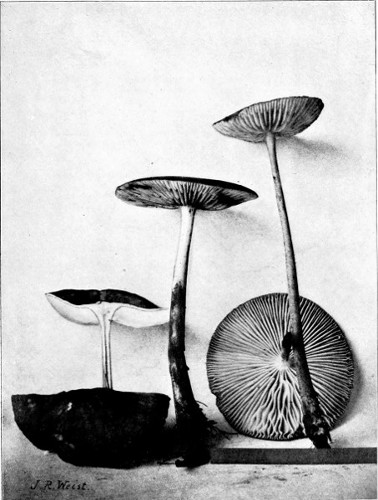
Photographed by Dr. J.R. Weist. Plate XXIX. COLLYBIA RADICATA.
ANALYSIS OF TRIBES.
Series A. Gills White or Brightly Colored, Not Gray. Flesh White.
Striæpedes (striate-stemmed). Page 113.
Stem stout, hollow or imperfectly filled with a spongy pith; grooved or striate with fibers.
113* Gills broad, rather distant.
** Gills narrow, crowded.
Vestipedes (clothed-stemmed). Page 118.
Stem thin, equal, hollow or with a pith, even, velvety, downy or covered with a bloom.
* Gills broad, rather distant.
** Gills very narrow, closely crowded.
Lævipedes (even-stemmed). Page 120.
Stem thin, equal, hollow, naked, smooth—except the base—apparently not striate, but some species are minutely striate under a lens.
* Gills broad, lax, usually more or less distant.
** Gills narrow, crowded.
Series B. Gills Becoming Gray. Hygrophanous.
Tephrophanæ. Page —-.
Color brownish becoming gray. Allied to the last section of Tricholoma and Clitocybe, but distinguished from them by the cartilaginous stem.
Some are strong scented. None known to be edible.
Striæ´pedes.
* Gills broad, rather distant.
C. radica´ta Relh.—radix, a root. (Plate XXIX, p. 112.) Pileus 1½-4 in. across, from convex to nearly plane, broadly umbonate, frequently wrinkled toward and at the umbo, glutinous when moist. Color variable, usually brown in grayish shades, from dark to almost white. Flesh thin, white, elastic. Gills white, thick, tough, distant, ventricose, adnexed, rounded or notched behind like Tricholoma, sometimes with a decurrent tooth. Stem 4–8 in. long, 3–5 lines thick, smooth, firm, same color as pileus, tapering upward, becoming vertically striate or grooved, often twisted, ending in a long, tapering, pointed root deeply planted in the earth.
Spores elliptical, 14–15×8–9µ Massee; 11×17µ W.G.S.; 11×9µ W.P.; 16–17×10–11µ B.
114Often sombre, but erect, neat and handsome. Growing solitary and in troops in woods, usually near stumps, if much decayed, sometimes on them, or on shaded lawns and grassy places. June to October.
Var. furfu´racea Pk. Stem furfuraceous, less distinctly striate.
Var. pusil´la Pk. Plant small. Pileus about 1 in. broad, passing gradually into the typical form. Stem slender.
Professor Peck says: “The variety furfuracea is common and connects this species with C. longipes, which has a villose stem and dry velvety pileus.” 49th Rep.
Common to the United States. Edible. Curtis, according to Dr. F. Peyre Porcher of Charleston, S.C., was the first to declare this edible.
A very attractive species. The purity of its gills is especially noticeable. I began eating it in 1881, and it has continued to be a favorite. The caps should be broiled or fried. They are sweet, pleasing in texture, and delicately flavored.
C. platyphyl´la Fr. Gr.—broad; a leaf. (Plate XXVIII, fig. 1, p. 114.) Pileus 3–4 in. broad, dusky and gray then whitish, fleshy-membranaceous, thin, fragile, soon flattened, obtuse, watery when moist, streaked with fibrils. Stem 3–4 in. long, ½ in. thick, stuffed, soft, equal, fibrilloso-striate, otherwise smooth, naked or obsoletely powdered at the apex, whitish, shortly and bluntly rooted at the base. Gills obliquely cut off behind, slightly adnexed, ½ in. and more broad, distant, soft, white.
Odor not remarkable. It inclines toward the Tricholomata in the somewhat membranaceous cuticle of the soft stem. Fries. Spores 13×19µ W.G.S.
Solitary, gregarious, rarely clustered. On rotten wood, roots, ground near stumps, among leaves, etc. June to October.
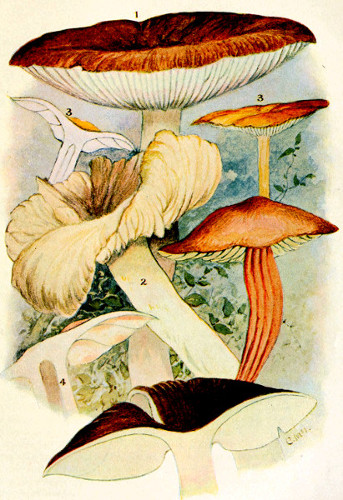
Grouped by F.D. Briscoe—Studies by C. McIlvaine. Plate XXVIII.
Fig. Page. Fig. Page.
1. Collybia platyphylla, 114 3. Collybia dryophila, 120
2. Collybia platyphylla (after rain), 114 4. Collybia fusipes, 116
Distinguished by the very broad and deeply emarginate gills, which frequently slope up behind to near the cap then with a short turn downward connect with the stem which is either stuffed or hollow, and by the abundant, cord-like rooting mycelium. The gills are very broad. Professor Peck says: “The species is quite variable. The pileus is sometimes irregular and even eccentric, the thin margin may be slightly striate, is often split and in wet weather may be upturned or revolute. The lamellæ are sometimes ½ in. broad or more and transversely split. They may be obscurely striated transversely and even veiny above with 115venose interspaces. Occasionally a slight anise-like odor is perceptible, but in decay the plants have a very disagreeable odor and disgusting appearance.” 49th Rep. N.Y. State Bot.
West Virginia, 1880–1885; Haddonfield, N.J., 1896. Gregarious, and in large bunches. Mt. Gretna and Eagle’s Mere, Pa., 1897, McIlvaine.
When fresh, in good condition, the caps are good, but they are not nearly equal in substance or flavor to C. radicata and C. longipes. They are best broiled or fried.
Var. re´pens Fr. Pileus more fleshy, depressed. Stem hollow, compressed, pruinate at the apex, with a creeping, string-like mycelium.
It is best distinguished by its white, villous, anastomosing, very much branched mycelium which creeps a long distance in a rooting string-like manner. The so-called roots are quite different from the stem, not a prolongation of the stem itself. Fries.
Clearly a variety of C. platyphylla. C. platyphylla is quite variable, even puzzling. Edible qualities the same.
C. long´ipes Bull.—longus, long; pes, a foot. Pileus 1–2 in. across, conical then expanded, umbonate, dry, minutely, beautifully velvety. Color from pale to date-brown, sometimes umber. Flesh white, thin, elastic. Gills white, broad, tough, thick, adnexed, distant, ventricose, rounded behind, emarginate. Stem 4–6 in. long, 2–4 lines thick, tapering upward, usually densely and minutely velvety like the cap, nearly same color, with a long, tapering root.
On much decayed stumps and logs. July to October. Closely resembles C. radicata. It is readily distinguished by its velvety cap and stem. It is more glutinous.
Spores spheroid, 12µ Q.
California. Edible. H. and M.
West Virginia mountains, 1880–1885; Cheltenham, Pa., 1889. McIlvaine.
Excepting from California, C. longipes has not previously been reported as found in the United States. It is not plentiful in the forests of West Virginia, yet I often found it upon rotting stumps and logs, solitary, but up to a dozen in the same vicinity. It is unmistakable. Its rich yet dull velvety cap and stem and the purity of its gills hold the finder’s admiration.
116The caps fried or broiled are delicious, resembling in every way those of C. radicata.
C. fu´sipes Bull.—fusus, a spindle; pes, a foot. (Plate XXVIII, fig. 4, p. 112.) Pileus 1–3 in. broad, reddish-brown, becoming pale and also dingy-tan, fleshy, convex then flattened, umbonate (the umbo at length vanishing), even, smooth, dry, here and there broken up in cracks when dry. Stem 3 in. and more long, commonly ½ in., but here and there as much as 1 in. broad, fibrous-stuffed then hollow, remarkably cartilaginous externally, swollen, ventricose in the middle, attenuated at both ends, often twisted, longitudinally furrowed, red or reddish-brown, rooted in a spindle-shaped manner at the base. Gills annulato-adnexed (joined into a ring), soon separating, free, broad, distant, firm, connected by veins, crisped, white then becoming somewhat of the same color as the pileus, often spotted. Stevenson.
Spores 6×3µ W.G.S.; 4–5×2–4µ B.
Solitary, gregarious, usually densely clustered on decaying wood, roots, etc. August until after heavy frosts.
West Virginia, 1882, McIlvaine.
In the West Virginia mountains C. fusipes is frequent. Caps in the clusters rarely exceed 1½ in. across. They show an auburn or burgundy shade of brown in their color. When young they are smooth and appear to remain so unless rained upon or moistened, when they crack more or less finely in drying. At first the connection of the gills with the stem is peculiar—they join in a collar-like ring at the top of the stem. As the cap expands the gills part more or less and separate from the stem. The stem is markedly spindle-shaped, though variously flattened by compression in dense clusters; the outside often splitting, breaking and turning out from the stem.
The caps, alone, are good, the stem being hard and refractory. The caps are very fine, cooked in any way.
The caps dry well, and are a pleasant addition to gravies, soups and other dishes. They make a choice pickle.
** Gills narrow, crowded.
C. macula´ta A. and S.—macula, a spot. Pileus fleshy, firm, convex or nearly plane, even, glabrous, white or whitish, sometimes varied 117with reddish spots or stains. Flesh white. Gills narrow, crowded, adnexed, sometimes nearly or quite free, white or whitish. Stem generally stout, firm, equal or slightly swollen in the middle, striate, white, stuffed or sometimes hollow, commonly narrowed at the base, rooting, often curved at the base, rarely slightly thickened and blunt. Spores subglobose, 4–6µ broad, sometimes showing a slight point at one end.
Pileus 2–4 in. broad. Stem 2–4 in. long, 3–6 lines thick.
Var. immacula´ta Cke. This differs from the type in having no reddish spots or stains.
This species is easily recognized by its large size, firm or compact substance and white color. It grows in soil filled with decaying vegetable matter or on much decayed wood. Peck, 49th Rep. N.Y. State Bot.
West Philadelphia, Pa. Weed grown lot near University of Pennsylvania. September to frost. Grew gregariously over a large lot. The plants varied greatly in size and appearance. The gills of most were crenulate (scalloped). Assorted specimens were sent Professor Peck who wrote: “They are all forms of C. maculata.”
The caps were stewed and eaten in abundance by many, and pronounced “Fine.”
(Plate XXX.)
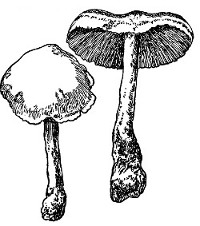
Collybia butyracea.
C. butyra´cea Bull.—butyrum, butter; buttery to the touch. Pileus 2–3 in. broad, normally reddish-brown, but becoming pale, fleshy, convex then expanded, more or less umbonate, dry, even, smooth. Flesh buttery, soft, somewhat hygrophanous, flesh-color then white. Stem 2–3 in. long, attenuated upward from the thickened white downy base, hence much thinner at the apex, 2–3 lines only, but at the base ½-1 in. thick, externally covered over with a rigid cartilaginous cuticle, internally stuffed with soft spongy pith, or hollow only when old, striate, reddish, commonly smooth, but varying with white deciduous scales, and occasionally wholly downy with soft hairs. 118Gills slightly adnexed, somewhat free, thin, crowded, notched at the edge, white, never spotted-reddish. Stevenson.
Spores 6–10×3–5µ B.; elliptical, 7–9×4–5µ.
Cap greasy looking. Umbo dark.
The color of the cap is variable. The species differs from C. dryophila in having an umbonate pileus, slightly uneven gill-edges and stem which tapers upward.
Solitary and in troops under coniferous trees. Spring, autumn.
West Virginia, Chester county and Eagle’s Mere, Pa., McIlvaine.
The caps cook quickly, are tender and have a good flavor.
Vesti´pedes.
* Gills broad, rather distant.
(Plate XXIXb.)
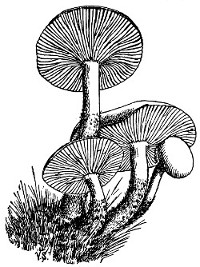
Collybia velutipes. Natural size.
C. velu´tipes Curt.—velutum, velvet; pes, a foot. Pileus 1–4 in. broad in the same cluster, tawny, sometimes paler at the margin, moderately fleshy at the disk, but thin at the circumference, convex then soon becoming plane, often eccentric, irregular and bent backward, smooth, viscous; margin spreading and at length slightly striate. Flesh watery, soft, slightly tawny-hyaline. Stem 1–3 in. long, 1–4 lines thick, tough, externally cartilaginous, umber then becoming black, densely, minutely velvety, commonly ascending or twisted, commonly equal, even, internally fibrous-stuffed and hollow. Gills broader and rounded behind, slightly adnexed, so as at first sight to appear free, somewhat distant, very unequal, becoming pallid-yellow or tawny. Fr.
Spores ellipsoid, 7µ W.G.S.; 6×4µ B.; elliptical, 7×3–3.5µ Massee.
Our American plant, common to the states, is rarely found attaining such dimensions. Its usual size is from 1–2 in. across, more frequently 119at 1–1¼. It is generally found in clusters more or less dense. The color varies from yellowish to a dark yellowish-brown. The center is darker than the margin. The cap viscid when moist, often irregular from crowding. Gills may be rounded or notched at their attachment to the stem, whitish or yellowish. Stem usually hollow, 1–4 in. long, 1–3 lines thick, whitish when young becoming colored with the dense brownish velvety hairs.
It grows on stumps, roots in the ground, trunks and earth heavily charged with wood matter. I have found it in every month of the year. The heavier crop appears in September, October and November, and lasts until long after heavy frosts. Then sporadic clusters spring up wherever the winter sun gives them encouragement.
It sometimes does considerable damage to the tree so unfortunate as to be its host. It begins its growth upon some injured or decayed spot and by continually insinuating itself under the surrounding bark it, by its mycelium and growth, pries the bark away from the wood until the tree is entirely denuded.
It is a valuable species, not only on account of its continuous growth, but because of its plentifulness and excellent substance.
** Gills very narrow, closely crowded.
C. con´fluens Pers.—Pileus ¾-1½ in. broad, thin, tough, flaccid, convex or nearly plane, obtuse, rarely somewhat umbonate, glabrous, hygrophanous, reddish grayish-red or reddish-brown and often striatulate on the margin when moist, pallid, whitish or grayish when dry. Lamellæ narrow, crowded, free, whitish or yellowish-gray. Stem 2–5 in. long, 1–2 lines thick, equal, cartilaginous, hollow, clothed with a short dense somewhat pulverulent whitish pubescence or down. Spores minute ovate or subelliptical, slightly pointed at one end, 5–6×3–4µ.
Among fallen leaves in woods. Common. July to October.
The plants commonly grow in tufts, but sometimes in lines or arcs of circles or scattered. They revive under the influence of moisture and thereby indicate an intimate relationship to the genus Marasmius. The pileus varies much in color, but commonly has a dull reddish or russety tinge when moist, sometimes approaching bay-red. It fades in drying and becomes almost white or grayish-white, but sometimes the center remains more deeply colored than the margin. The stem is commonly 120rather long in proportion to the width of the pileus. Occasionally it is somewhat flattened either at the top or throughout its entire length. Sometimes the stems become united at the base which union is suggestive of the specific name. Peck, 49th Rep.
West Virginia, New Jersey, Pennsylvania, McIlvaine. July to frost.
The caps of C. confluens are of excellent substance and flavor. Their quantity makes up for their small size. I have gathered them 2 in. across, but their average size is about 1 in. They dry well.
Lævi´pedes.
* Gills broad, more or less distant.
C. esculen´ta Wulf.—esculent. Pileus ½ in. and more broad, ochraceous-clay, often becoming dusky, slightly fleshy, convex then plane, orbicular, obtuse, smooth, even or when old slightly striate. Flesh tough, white, savory. Stem 1 in. and more long, scarcely 1 line thick, or thread-like and wholly equal, obsoletely tubed, tough, stiff and straight, even, smooth, slightly shining, clay-yellow, with a long perpendicular, commonly smooth, tail-like root. Gills adnexed, even decurrent with a very thin small tooth, then separating, very broad, limber, somewhat distant, whitish, sometimes clay-color.
Gregarious but never cespitose. The tube of the stem is very narrow. Stevenson.
The smallest edible Collybia. Cooke. Edible. In dense woods. Curtis. It is dried and preserved. Cordier.
In pastures and grassy places. Spring and early summer.
Edible, but rather bitter flavor. In Austria, where it is in great plenty in April, large baskets are brought to market under the name of Nagelschwämme—nail mushrooms.
Professor Peck describes C. esculentoides Pk., 49th Rep. N.Y. State Bot., which he states: “Differs from the type in its paler and more ochraceous color and in its farinaceous flavor, and is related to the European C. esculenta from which it differs essentially in the umbilicate pileus and in the absence of any radicating base to the stem.”
** Gills narrow, crowded.
C. dryophil´a Bull. Gr.—oak-loving. (Plate XXVIII, fig. 3, p. 112.) Pileus 1–3 in. across, bay-brown-rufous, etc., becoming pale, but not 121hygrophanous, slightly fleshy, tough, convexo-plane, obtuse, commonly depressed in the center, even, smooth; margin at first inflexed then flattened. Flesh thin, white. Stem 1–3 in. long, 1–3 lines thick, cartilaginous, remarkably tubed, thin, even, smooth, somewhat rooting, commonly becoming yellow or reddish. Gills somewhat free, with a small decurrent tooth, but appearing adnexed when the pileus is depressed, crowded, narrow, distinct, plane, white or becoming pale.
There are numerous monstrous forms which are very deceiving: a. Stem elongated, waved, decumbent, inflated at the base; pileus broader, lobed; gills white. b. Funicularis, larger, cespitose, the lax and decumbent stem equal and hairy at the base, gills sulphur-yellow. These forms, analagous with A. repens Bull., occur on heaps of leaves. c. Countless specimens growing together in a large cluster; stems thick, inflated, irregularly shaped, sulcate, brown, the mycelium collecting the soil in the form of a ball; pileus very irregularly shaped, full of angles, undulated, blackish then bay-brown. In gardens. Stevenson.
Spores elliptic-fusiform, 7–8×4µ; 6µ W.G.S.
Professor Peck, 49th Rep. N.Y. State Bot., gives the following: Pileus thin, convex or nearly plane, sometimes with the margin elevated, irregular, obtuse, glabrous, varying in color, commonly some shade of bay-red or tan-color. Flesh white. Lamellæ narrow, crowded, adnexed or almost free, white or whitish, rarely yellowish. Stem equal or sometimes thickened at the base, cartilaginous, glabrous, hollow, yellowish or rufescent, commonly similar in color to the pileus. Spores, 6–8×3–4µ.
Pileus 1–2 in. broad. Stem 1–2 in. long, 1–2 lines thick.
Woods, groves and open places. Common. June to October.
West Virginia, North Carolina, New Jersey, Pennsylvania. McIlvaine.
C. dryophila is so common and variable that descriptions would fail to cover it in its eccentricities. The writer has eaten it in all the forms obtained since 1881. A very pretty form grew in large quantities among pine needles at Eagle’s Mere, Pa., in August, 1897. It was cooked and served at the hotel table. Many ate it and were delighted.
Dr. Badham refers to a case in which illness was caused by eating it. In my eighteen years' experience with it, knowing it to have been enjoyably eaten by scores of persons, I have not heard of the slightest discomfort from it.
122C. spinulif´era Pk.—spinula, a little thorn. Pileus fleshy, thin, convex or nearly plane, glabrous, hygrophanous reddish tan-color tinged with pink and slightly striatulate on the margin when moist, paler when dry, adorned with minute colored spinules or setæ. Gills narrow, close, rounded behind and free, pale cinnamon-color, becoming somewhat darker with age, spinuliferous. Stem slender, tough, glabrous, shining, hollow, reddish-brown, often paler or whitish at the top, especially in young plants, with a whitish myceloid tomentum at the base. Spores elliptical or nearly so, 4µ.
Plant cespitose. Pileus 8–16 lines broad. Stem 2–3 in. long, about 1 line thick.
Prostrate trunks and ground among leaves in woods. Lewis county. September.
In this species the lamellæ, under a lens, appear to be minutely pubescent or velvety. This is due to the colored spinules or setæ which clothe them. Peck, 49th Rep. N.Y. State Bot.
Angora, Pa. September, 1897. Among moss in mixed woods. September to frost. McIlvaine.
Specimens identified by Professor Peck. Stems of some tapered at base.
Excepting the extreme base of stems the whole plant is tender and of good flavor.
(Plate XXXI.)
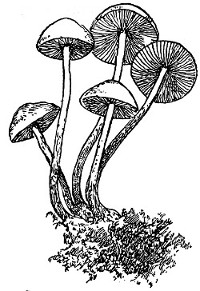
Collybia Acervata (young).
C. acerva´ta Fr.—acervus, a heap. Pileus fleshy but thin, convex or nearly plane, obtuse, glabrous, hygrophanous, pale tan-color or dingy pinkish-red and commonly striatulate on the margin when moist, paler or whitish when dry. Gills narrow, close, adnexed or free, whitish or tinged with flesh-color. Stem slender, rigid, hollow, glabrous, reddish, reddish-brown or brown, often whitish at the top, especially when young, commonly with a white matted down at the base. Spores elliptical, 6×3–4µ.
Plant cespitose. Pileus 1–2 in. broad. Stem 2–3 in. long, about 1 line thick.
123Decaying wood and ground among fallen leaves in woods. Adirondack mountains. August and September. Peck, 49th Rep. N.Y. State Bot.
This very pretty plant resembles forms of C. dryophila. The coloring of the stems is often extremely delicate, like paintings upon rice paper.
West Virginia mountains; Eagle’s Mere, Pa. August to frost. McIlvaine.
The entire plant is tender, delicate and of fine flavor. In these qualities it is not distinguishable when cooked from the smaller forms of C. dryophila.

124MYCE´NA Fr.
Gr.—a fungus.
(Plate XXXII.)
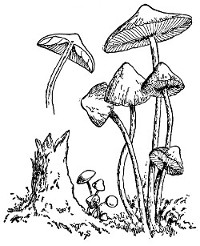
Mycena Galericulata.
Pileus regular, rarely depressed in the center, thin, usually streaked with longitudinal lines, at first conico-cylindrical, margin at the first straight, closely embracing the stem which is attenuated upward. Stem hollow, slender, cartilaginous. Gills adnate or adnexed, sometimes with a small tooth, never decurrent. Spores white.
Generally small and slender, growing on branches, twigs, heaps of leaves, sometimes on the ground, some minute species on single dead leaves. Long, rooting stems are not uncommon. Clitocybe and Omphalia are separated by their decurrent gills and in Collybia the margin is at first incurved.
In this genus the species of the various sections are not always distinguished by single sharply defined characteristics, so that it will sometimes be necessary to pay attention to all the features. Species with a thread-like stem are found in other sections than Filipedes and some of the Lactipedes are slippery when moist, but not truly viscous.
ANALYSIS OF TRIBES.
Calodontes (kalos, beautiful; odontes, teeth). Page 126.
Stem juiceless, not dilated into a disk at the base. Edges of gills darker, minutely toothed.
Adonideæ (Adonis, referring to beauty). Page 126.
Stem juiceless, not dilated at the base. Gills of one color, not changing color. Color pure-colored, bright, not becoming brownish or gray. On the ground.
125Rigipedes (rigid-stemmed). Page 126.
Stem firm, rigid, rather tough, juiceless, more or less rooting. Gills changing color, white, then gray or reddish, generally at length connected by veins.
Tough, persistent, inodorous, usually on wood, very cespitose, but individuals of the same species sometimes grow singly on the ground.
Fragilipedes (fragile-stemmed). Page 130.
Stem fragile, juiceless, fibrillose at the base, scarcely rooting. Pileus hygrophanous. Gills becoming discolored, at length somewhat connected by veins.
Thin, fragile, often soft, normally growing singly on the ground. A few strong smelling, cespitose on wood.
Filipedes (thread-stemmed). Page 130.
Stem thread-like, flaccid, somewhat tough, rooting, juiceless, generally extremely long in proportion to the pileus. Gills becoming discolored, paler at the edge.
Straight, growing singly on the ground; inodorous. Pileus dingy-brown, becoming paler.
Lactipedes (milky-stemmed). Page 130.
Gills and rooting stem milky when broken.
Glutinipedes (glutinous-stemmed). Page 131.
Stem juiceless but externally sticky with gluten. Gills at length decurrent with a tooth.
Basipedes (base-stemmed). Page 131.
Stem dry, rootless, the base naked and dilated into a disk or small hairy bulb. Growing singly, slender, soon becoming flaccid.
Insititiæ (insero, to insert or graft). Page 131.
Stem very thin, dry, growing as if inserted in the supporting surface, not downy, not disk-like at the base.
Gills adnate with a small decurrent tooth. Small, very tender, becoming flaccid with the first touch of the sun.
126Mycena is a large genus composed of small species. About sixty members have been found in America. They are from ½ to 1 in. across the cap, with thin stems and altogether delicate appearance. Yet the flesh of most of them has a gummy consistency in the mouth, and they shrink but little in stewing. Heretofore not any appear to have been reported as edible, probably because the size of the species has not attracted experimenters. While some have a strong odor and taste of radishes, and one species is bitter, it is probable that all are edible. The writer has eaten, raw and cooked, small quantities (all he has found) of many species not here reported as edible, which will, when further tested, be reported upon.
The substance and flavor of those here given is remarkably pleasant. Their late coming, hardiness and abundance are commendable qualities.
I.—Calodon´tes. Stem juiceless. Gills minutely toothed.
None tested.
II.—Adoni´deæ. Stem juiceless. Gills of one color, etc.
None tested.
III.—Rigidi´pedes. Stem rigid. Gills at first white, changing
color, etc.
M. prolif´era Sow.—proles, offspring; fero, to bear. (Plate X, figs. 6, 7, p. 28.) Pileus ⅔-1¼ in. across, slightly fleshy, expanded bell-shape, dry, the broad umbo darker (dingy-brown), slightly striate, and at length furrowed or rimosely split at the margin (pale yellowish or becoming brownish-tan). Stem 2½-3 in. long, firm, rigid, smooth, shining, slightly striate, rooted. Gills adnexed, somewhat distinct, becoming pale white.
Inodorous, only at length nauseous. Very closely allied to M. galericulata, in habit approaching nearest to M. cohærens. The stems are pallid at the apex, but slightly tawny-bay-brown below, and glued together by hairy down at the base. There is a white form with transparent stem—on trunks. Fries.
Mt. Gretna, Pa. On ground in grass. Mycelium spreading on leaves. McIlvaine.
127Found in great plenty. Base of stems is sometimes white when in dense tufts.
The whole plant is tender, cooking in fifteen minutes, and is of fine flavor. No one will want a better fungus.
M. rugo´sa Fr.—ruga, a wrinkle. Pileus ash-color but becoming pale, very tough, slightly fleshy at the disk, otherwise membranaceous, bell-shaped then expanded, at length rather plane, somewhat obtuse, more or less corrugated (unequal with elevated wrinkles), always dry, not moist even in rainy weather, striate at the circumference. Stem commonly short, remarkably cartilaginous, tubed, rigid, tough, straight, at length compressed, even, smooth, pallid, with a short oblique hairy root. Gills arcuato-adnate, with a decurrent tooth, united behind in a collar, somewhat distant, connected by veins, broad, ventricose, white then gray, edge sometimes quite entire, sometimes with saw-like teeth.
Always inodorous. Formerly connected with M. galericulata. M. rugosa is arid, very tough, more rarely cespitose, the pileus firm, somewhat obtuse, wrinkled but without striæ, the gills arcuato-adnate with a hooked tooth, white then ash-color. The genuine M. galericulata is fasciculato-cespitose, somewhat fragile, the pileus thinner, at first conical and umbonate, striate without wrinkles, the gills adnate, with a decurrent tooth, white then flesh-color. Between these there is a long series of intermediate forms. Fries.
California, H. and M.; Kansas, Cragin; Wisconsin, Bundy; New York, September, Peck, 46th Rep.; West Virginia, New Jersey, Pennsylvania. On decaying wood and ground near stumps. August to November. McIlvaine.
The tenacity frequently occurring in Mycena is well shown in this species. The caps and stem cook tender, but it is better to discard the stems, as the two do not become tender at the same time.
M. galericula´ta Scop.—galericulum, a small peaked cap. (Plate Plate X, fig. 5, p. 28.) Pileus somewhat membranaceous, conical bell-shaped then expanded, striate to the umbo, dry, smooth, becoming brownish-livid or changeable in color. Stem rigid, polished, even, smooth, with a spindle-shaped root at the base. Gills adnate, decurrent with a tooth, connected by veins, whitish and flesh-colored.
Very protean. Normally growing in bunches, the numerous stems 128(never sticky) glued together with soft hairy down at the base. But it occurs also solitary, larger, pileus as much as 2 in. broad, wrinkled-striate. The essential marks by which it is distinguished from A. rugosa are these: Stem in general thinner, less tense and straight, often curved, more fragile. Pileus membranaceous, conico bell-shaped, umbonate, striate but not corrugated, moist in rainy weather. Gills adnate, with a decurrent tooth, more crowded, whitish then flesh-colored. The color both of the pileus (normally dingy-brownish then livid) and of the stem (normally becoming livid-brownish) is much more changeable than that of A. rugosa, becoming yellow, rust colored, etc. It is not so tough and pliant as A. rugosa. Forms departing from the type are very numerous; the most beautiful is var. calopus (Gr., beautiful; Gr., a foot) with chestnut-colored stems, united in a spindle-shaped tail. Fries.
Spores spheroid or subspheroid, 9–10×6–8µ K.; 8–11×4–6µ B.; 6–7×4µ Massee.
Common. Autumnal. Very variable. On trunks, fallen leaves.
Two well-marked varieties of this very variable species were observed the past season. One grows on the ground among fallen leaves. It has a dark brown pileus, close lamellæ and a very long stem, generally of a delicate pink color toward the top. It might be called var. longipes. The other grows under pine trees, has a broadly convex or expanded grayish-brown pileus and a short stem. It might be called var. expansus. Peck, 26th Rep. N.Y. State Bot.
“M. alcalina is closely allied to it (M. galericulata), but has a stronger alkaline odor and a rather more fragile stem. In one of your specimens I detect a slight incarnate tint to the gills, and this is pretty conclusive evidence that it belongs to M. galericulata. Species of Mycena are not generally reckoned among edible fungi or even promising fungi; I suppose on account of the thin flesh of the cap, but of course it is possible to make up in numbers what is lacking in size. I am glad to know you have found this to be an esculent one.” Letter Professor Peck to C. McIlvaine, October 5, 1893.
The caps and stems when young make as good a dish as one cares to eat. The substance is pleasant, and the flavor delicate. They are best stewed slowly in their own fluids, after washing, for ten minutes and seasoned with pepper, salt and butter.
M. parabo´lica Fr.—shaped like a parabola. Pileus becoming black 129at the disk, inclining to violaceous, otherwise becoming pale, whitish, somewhat membranaceous, at first erect and oval, then parabolic, obtuse, never expanded, moist, somewhat shining when dry, smooth, even, striate toward the entire margin. Stem 2–3 in. long, 1 line thick, tubed, tense and straight but not very rigid, thickened and bearded-rooted at the base, pale below, dark violaceous above, when young white-mealy, otherwise even, smooth, dry. Gills simply adnate, ascending, somewhat distant, rarely connected by veins, quite entire, white, somewhat gray at the base.
Stem less rigid than that of A. galericulatus. Truly gregarious or cespitose. Fries.
Spores 12×6µ B.; elliptical, 11–12×6µ Massee.
Trenton, N.J. June. E.B. Sterling; West Virginia, New Jersey, Pennsylvania, on decaying stumps, trunks of oak, chestnut, poplar, pine. June until far into the winter. McIlvaine.
Plant up to 2½ in. high. Caps usually about ½ in., but reaching ¾ in.
A neat, attractive plant, whether single or in dense tufts. Its smell is strong of fresh meal, and taste of that delicate flavor one finds in the succulent base of the round, swamp rush, when pulled from its sheath—one that every country school boy and girl knows. It is pleasant raw, and delicious when cooked.
M. latifo´lia Pk.—latus, broad; folium, a leaf. Pileus convex, rarely somewhat umbonate, striatulate, grayish-brown. Gills white, broad, hooked, decurrent-toothed. Stem slender, smooth, hollow, subconcolorous, white-villous at the base.
Height 1–1.5 in., breadth of pileus 4–6 lines. Stem .5 lines thick.
Under pine trees. Center. October.
A small species with quite broad gills, growing among the fallen leaves of pine trees. Gregarious. Peck, 23d Rep. N.Y. State Bot.
Mt. Gretna, Pa. Among pine needles, scattered, sometimes four or five in a cluster. September to October. McIlvaine.
Autumnal. Not rare. The caps though small are tenacious in the mouth and lose little in cooking. The substance is agreeable and flavor fine.
130IV.— Fragili´pedes. Stem fragile, juiceless, etc. None tested.
V.—Fili´pedes. Stem thread-like, etc.
M. collaria´ta Fr.—collare, a collar. Pileus ½ in. and more broad, typically dingy-brown, but becoming pale, commonly gray-whitish, becoming brownish only at the disk, membranaceous, bell-shaped then convex, somewhat umbonate, striate, when dry rigid, smooth, not soft nor slightly silky. Stem about 2 in. long, tubed, thread-like but almost 1 line thick, tough, dry, smooth, even or slightly striate under a lens, becoming pale. Gills adnate, joined in a collar behind, thin, crowded, hoary-whitish or obsoletely flesh-colored.
The gills are somewhat distant when the pileus is expanded. There is not a separate collar as in Marasmius rotula; the gills are only joined in the form of a collar, and remain cohering when they separate from the stem. Fries.
Spores 8–10×4–6µ B.
New York. Old stumps and rotten logs. June. Peck, 23d Rep. Mt. Gretna, Pa. Cespitose on decaying wood. July, September and October. McIlvaine.
Very much like M. galericulata, but gills not connected by veins. The caps usually have a pinkish hue, often brownish. The stems are not as tender as the caps. The flavor is excellent.
VI.—Lacti´pedes. Stem and gills milky, etc.
M. hæma´topa Pers. Gr.—blood; Gr.—a foot. Pileus about 1 in. broad, white flesh-color, fleshy-membranaceous, slightly fleshy chiefly at the disk, conical then bell-shaped, obtuse, nay convex and spuriously umbonate, naked, even or slightly striate at the margin, which is at the first elegantly toothed. Stem 2–4 in. long, 1 line and more thick, remarkably tubed, rigid, normally everywhere powdered with whitish, delicate, soft hairy down, sometimes, however, denuded of it. Gills adnate, often with a small decurrent tooth, the alternate ones shorter, in front disappearing short of the slight margin of the pileus, whitish and wholly of the same color at the edge.
Cespitose (very many of the stems conjoined and hairy at the base), 131firm, stature almost that of M. galericulata, wholly abounding with dark blood-colored juice.
On stumps. Frequent. September. Stevenson.
Spores spheroid-ellipsoid, 10×6–7µ K.
I find a non-cespitose form of this species with red-margined gills. Its red juice, however, will serve to distinguish it and show its true relations. Peck, 31st Rep.
Common in tufts like M. galericulata and of about the same size, but is readily distinguished by its red juice. This pretty plant can often be gathered in considerable quantity, and well repays the collector.
VII.—Glutini´pedes. Stems gelatinous, etc.
None tested.
VIII.—Basi´pedes. Stem dilated at base, etc.
None tested.
IX.—Insiti´tiæ. Stem inserted.
None tested.

132HIA´TULA Fr.
(Plate XXXIII.)
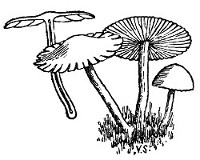
Hiatula Wynniæ.
Hio, to gape.
Pileus symmetrical, very thin, without a distinct pellicle, formed by the union of the backs of the gills, splitting when expanded. Gills almost or quite free, white. Stem central. Spores white.
Allied to Lepiota in the thin pileus and free gills, but differing in the entire absence of a ring. Not at all deliquescent as in the genus Coprinus, near to which it was at one time placed by Fries. Massee. Reported from North Carolina.
OMPHA´LIA Fr.
Gr.—belonging to an umbilicus.
(Plate XXXIV.)
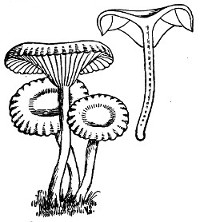
Omphalia Umbellifera. Enlarged about two sizes.
Pileus generally thin, usually umbilicate at first, then funnel-shaped, often hygrophanous, margin incurved or straight. Gills truly decurrent from the first, sometimes branched. Stem distinctly cartilaginous, polished, tubular, often stuffed when young. Flesh continuous with that of the pileus but differing in character. Spores white, somewhat elliptical, smooth.
Generally on wood, preferring hilly woods and a damp climate.
Resembling Collybia and Mycena in the flesh of stem and pileus being different in texture and in the externally cartilaginous stem. It is perfectly separated by the gills being markedly decurrent from the first.
133The American species of Omphalia number between thirty-five and forty. Many of them are common. Few woods are free from them. Several of them are beautiful. They are usually small and lacking in substance. Raw, the writer has not found one that is objectionable in any way; a few have a woody taste. But two species have been found by him in sufficient quantity to make a dish. It is probable that all are edible. At best the species of Omphalia are valuable in emergency only.
ANALYSIS OF TRIBES.
COLLYBARII.
* Pileus dilated from the first, margin incurved.
MYCENARII.
Pileus campanulate at first, margin straight and pressed to the stem.
COLLYBA´RII.
* Pileus dilated from the first; margin incurved.
O. onis´cus Fr. Gr.—a wood-louse. From the ashy color. Pileus scarcely 1 in. broad, dark ashy becoming pale, gray-hoary when dry, somewhat membranaceous, or slightly fleshy, flaccid, fragile when old, convexo-umbilicate or funnel-shaped, often irregular, undulato-flexuous, even-lobed, smooth, even, margin striate. Stem 1 in. long, 1 line and more thick, stuffed then tubed, slightly firm, moderately tough, sometimes round, curved, sometimes unequal, compressed, ascending, undulated, gray. Gills shortly decurrent, somewhat distant, quaternate, ash-color. Not cespitose. Fries.
Spores 12×7–8µ B.
Massachusetts, Sprague; California, H. and M., who record it as edible.
O. umbellif´era—umbella, a little shade; fero, to bear. From its umbrella-like shape. (Plate XXXIV, p. 132.) Pileus about ½ in. broad, commonly whitish, slightly fleshy-membranaceous, convex then plane, broadly obconic with the decurrent gills, not at all or only slightly umbilicate, hygrophanous, when moist watery, rayed with darker striæ, 134when dry even, changeable in appearance, silky, flocculose, rarely squamulose, the margin, which is at first inflexed, crenate (scalloped). Stem short, not exceeding 1 in. long, almost 1 line thick, stuffed then soon tubed, slightly firm, equal or dilated toward the apex into the pileus, of the same color as the pileus, commonly smooth, but varying pubescent, white villous at the base. Gills very broad behind, triangular, decurrent, very distant, edge of the gills straight.
Cosmopolitan. The common form is to be found everywhere from the sea level to 4,000 feet. Stevenson.
Spores 3×4µ W.G.S.; 10×4µ W.P.; green variety 10×6µ W.P.; broadly elliptical, 8–10×5–6µ Peck.
O. umbellifera is known the world over. It is very variable in size and color. With us it is seldom over ¾ in. broad. Stem ½-1 line thick. It grows on decaying wood and ground full of decaying material. There are several varieties. All are edible, but not worth describing. This description is given that the student may recognize one of our common plants, and eat it, if very hungry.
Mycena´rii.
O. campanel´la Batsch.—campana, a bell. Pileus thin, rather tough, hemispherical or convex, glabrous, umbilicate, hygrophanous, rusty yellow-color and striatulate when moist, paler when dry. Gills moderately close, arcuate, decurrent, yellowish, the interspaces venose. Stem firm, rigid, hollow, brown, often paler at the top, tawny-strigose at the base. Spores elliptical, 6–7×3–4µ.
Pileus 4–8 lines broad. Stem about 1 in. long, scarcely 1 line thick.
Much decayed wood of coniferous trees. Very common. May to November. Peck, 45th Rep. N.Y. State Bot.
Spores ellipsoid, 6–8×3–4µ C.B.P.; 7×3µ W.P.; 6–9×3–4µ B.
The quantity alone, in which this small species can be found, makes it worth mentioning as an edible species. It is common over the United States where coniferous trees abound. Its favorite habitat is upon the rotting debris of these trees. Occasionally it grows from the ground, but only from that which is heavily charged with woody material. It is social in troops, or affectionate in clusters, or maintains a single existence.
It is edible, of good substance when stewed, tender and of fair flavor.
135
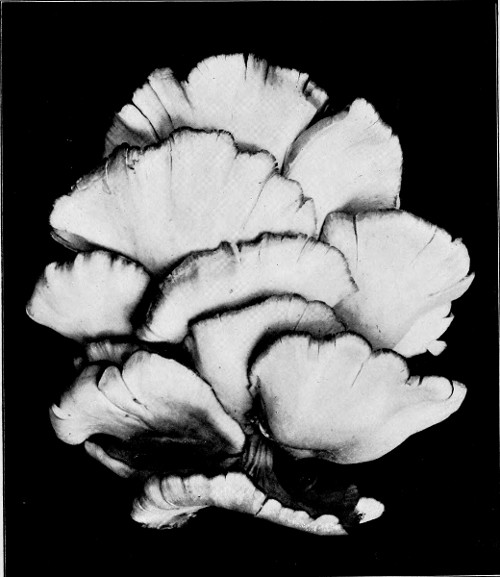
Photographed by Dr. J.R. Weist. Plate XXXV. PLEUROTUS OSTREATUS.
PLEURO´TUS.
Gr.—a side; Gr.—an ear.
Stem excentric, lateral or none. Epiphytal (very rarely growing on the ground), irregular, fleshy or membranaceous. Fries.
The excentric, generally lateral stem, absent in some of the species, separates this from other genera of the white-spored series.
Pileus varying from fleshy in the larger to membranaceous in the smaller forms, but never becoming woody. Veil generally wanting, when present its remains sometimes appear on the margin of the pileus, or as an evanescent ring on the stem. Gills, edge acute, generally decurrent, in some species with a well-marked tooth, rarely simply adnate. Stem fleshy, confluent and homogeneous with the pileus.
Wood, dead or alive; a few species appear on the ground.
P. ulmarius and others of the larger forms, when growing in an upright position, may have the stem central and the pileus horizontal. The stems of some species of Clitocybe and Omphalia if growing laterally are sometimes excentric and oblique.
This genus is analogous to Claudopus, pink-spored, and Crepidotus, brown-spored.
Spores white, but those of P. sapidus are faintly tinged with lilac, and of P. ostreatus, var. euosmus, with purple.
ANALYSIS OF TRIBES.
Excentrici. Page 137.
Pileus entire, laterally extended, excentric, not truly lateral.
* Veil fugacious, fragments adhering to stem or margin of pileus.
** Veil none, gills sinuate or obtusely adnate.
*** Veil none, gills very decurrent, stem distinct, almost vertical.
**** Veil none, gills very decurrent, stem proper absent, pileus lateral, extended behind into a short, stem-like oblique base.
Dimidiati. Page 144.
Pileus not at first resupinate, lateral, prolonged without a definite margin behind, into a very short lateral, stem-like base.
136Resupinati. Page 146.
Pileus resupinate from the first, then reflexed.
If any odium attaches to the word toadstool, it should be forgotten and forever banished in presence of this cleanly, neat, handsome genus, choice in its growing places from lichen-covered stumps, or bark-clad boles, or highly perched limbs, or the scented surfaces of decaying wood. Several of its species perfume themselves throughout with pleasant spicy odors. Many are most accommodating in their constant coming.
Mr. H.I. Miller, superintendent Terre Haute and Indianapolis Railroad, writes: “Most of the mushroom books give greatest space to the A. campester. For some parts of the country this may be desirable, but for Indiana and Ohio, considering the food value, the P. ostreatus is the best fungus we have in these states, from the fact that anybody wanting a mess can nearly always obtain a basketful of this variety, whereas the others depend upon a good many weather conditions. Having located a few logs and stumps in the spring, where the P. ostreatus grows, these same stumps and logs can be used all season. The crops are successive, and while some of the spots seem to be barren for a few days at a time, the others will be bearing. It does not make much difference what the kind of log or stump, whether it be beech, oak or elm, or what the species of tree. I think I have found them on all our forest trees, and it is not necessary for the tree to be dead. If there is a decaying portion, the spores seem to be carried by the little black beetle that infests the ostreatus, from one place to another, and wherever a small spot of dead wood is found we are likely to find the P. ostreatus. This being the only edible mushroom that we can find in large quantities all through the season in this neck of the woods, it seems to me that a general knowledge of it will serve the economic purpose more than any other fungi.”
The presence of the P. ostreatus and its esculent companions is noted from our northern boundary to the gulf. Poplar, maple, birch, hickory, ash, apple, laburnum and oak trees are its favored residences. Deer feed upon it, and kine are attracted by its scent even when deep under snow. When properly selected and slowly cooked, the Pleuroti are toothsome.
From the fact that the spores of this fleshy and valuable genus find 137fostering lodgment in many trees when in decay, it is more than probable that the several species can be propagated by planting their spores upon such decaying woods, or by transplanting the mycelium.
Growths of P. ostreatus, P. sapidus, P. salignus, and probably other species of Pleurotus, can be forced, by watering the spots upon which they are known to grow. Dr. Kalchbrenner mentions that the P. sapidus is in this way cultivated in Hungary. Acting upon this mention the writer had good success with P. ostreatus. Experiments in this direction are likely to be interesting and rewarding.
No species is suspected of being noxious.
An analysis of P. ostreatus is given by Lafayette B. Mendel, Sheffield Laboratory of Physiological Chemistry, Yale University, as follows:
Water 73.70%
Total solids 26.30
The dry substance contained:
Total nitrogen 2.40
Extractive nitrogen 1.27
Protein nitrogen 1.13
Ether extract 1.6
Crude fiber 7.5
Ash 6.1
Material soluble in 85% alcohol 31.5
American Journal of Physiology, Vol. 1, No. 11, March 1, 1898.
I.—Excen´trici.
*Veil fugacious, etc.
P. dry´inus Pers. Gr.—oak. Pileus 2 in. broad, whitish, variegated with spot-like scales which become dingy-brown, lateral, oblique, rather plane. Flesh thick. Stem very curt and obese, commonly 1 in. long and thick, somewhat lateral, somewhat woody, squamulose, white, with a short, blunt root. Veil scarcely conspicuous on the stem, but appendiculate round the margin of the pileus when young. Gills not very decurrent, somewhat simple, not anastomosing behind, narrow, white, becoming yellow when old.
On trunks, oak, ash, willow, etc. Stevenson.
Spores 10×4µ Massee.
Edible. Cordier, Cooke.
When young the caps are tender; of the consistency, when cooked, of 138Polyporus sulphureus. In taste and smell the species varies from other Pleuroti, in having a distinct musk-like flavor. This is agreeable, reminding one of the common mushroom—A. campester.
**Veil none, gills sinuate, etc.
P. ulma´rius Bull.—ulmus, an elm. Pileus 3–5 in. and more broad, becoming pale-livid, often marbled with round spots, fleshy, compact, horizontal, moderately regular although more or less excentric, convex then plane, disk-shaped, even, smooth. Flesh white, tough. Stem 2–3 in. long, 1 in. thick, solid, firm, elastic, somewhat excentric, curved-ascending, thickened and tomentose at the base, not rarely villous throughout, white. Gills horizontal, emarginate or rounded behind, slightly adnexed, broad (broader in the middle), somewhat crowded, whitish.
The pileus is sometimes cracked in a tessellated manner. Stevenson.
Spores nearly globose, 5µ long Morgan; 5–6.5µ broad Peck; 6µ W.G.S.
Var. aceri´cola—acer, maple; colo, to inhabit. Plant smaller, cespitose.
Trunks and roots of maple trees. Adirondack mountains. September.
Var. populi´cola—populus, poplar; colo, to inhabit. Plant subcespitose, stem wholly tomentose. West Albany. Peck, Monograph, N.Y. Species of Pleurotus, Rep. 39.
The gills are sometimes torn across like those of Lentinus.
The historic elms of Boston Common have borne copious crops of this well-known and easily distinguished species from time immemorial. Every fall, about the first of September, if the season is favorable, later if not, copious crops appear decorating the trunks, and branches, sometimes at a height of thirty or forty feet. Growth takes place where branches have broken off or the trees have been wounded from other causes. They occur very generally on elms in the outlying districts of the city, but are rare in the country, seeming to be distinctly urban in their tastes. No damage is apparent from their growth.
Immediately in the rear of Independence Hall, Philadelphia, a fine cluster appears with equal autumnal regularity.
Though the elm tree is the chosen habitat of this fungus, it is little less select in its choice than other members of its genus.
139When young and small P. ulmarius is tender and of acceptable flavor. The stems and centers of older specimens should be cut away, and the tender parts of the caps, only, used.
P. tessula´tus Bull.—tessela, a small cube for pavement. Pileus becoming pale-tawny, horizontal, compactly fleshy, convex then plane, and in a form which is somewhat lateral depressed behind, irregular, even, smooth, variegated with round and hexagonal paler spots. Flesh thick, white. Stem short, 1 in. or little more long, solid, compact, equal or attenuated at the base, very excentric, curved-ascending, even, smooth, white. Gills sinuate behind, uncinato-adnate, thin, crowded, white or becoming yellow.
Solitary; according to some cespitose. The pileus is not cracked in a tessellated manner, as one might easily imagine from the name, but variegated with spots. Smaller than A. ulmarius (to which it is too closely allied), but almost more compact, with a smell of new meal.
On trunks. Stevenson.
North Carolina, Schweinitz. Edible. Curtis. Edible. Cordier.
On specimens growing cespitose and singly, found at Haddonfield, N.J. September, 1895, on trunk of apple tree, and at Eagle’s Mere, Pa., singly on sugar maple, August, 1898, the margin of caps were beautifully marked, but not cracked.
In quality it is better than P. ulmarius.
P. subpalma´tus Fr.—sub and palma, a palm. Pileus 3–5 in. across. Flesh thick, soft, variegated; convex then more or less flattened, irregularly circular, obtuse, wrinkled, smooth, with a gelatinous cuticle, rufescent. Stem excentric or almost lateral, but the pileus is always marginate behind, fibrillose, short, equal, flesh fibrous, soft. Gills adnate, 3–4 lines broad, crowded, joined behind, dingy. Massee.
On old trunks, squared timber, etc.
Very remarkable for having the flesh variegated as in Fistulina hepatica. Pileus, especially when young, covered with a viscid pellicle. Fr.
Spores minutely echinulate, nearly globose, 5.6×7µ Morgan.
Ohio, Morgan; Wisconsin, Bundy.
I frequently found this species in North Carolina, growing from oak ties and standing oak timber. I did not notice distillation of rufescent drops from the cap. The soft flesh had good flavor. The gelatinous 140cuticle imparts its character to the dish. Mixed with Lentinus lepideus, a much tougher plant, which grows in great abundance in the same localities, it makes toothsome food.
P. lignati´lis Fr.—lignum, wood. Dingy whitish. Pileus 1–4 in. broad, rarely central, commonly more or less excentric, occasionally wholly lateral, often kidney-shaped, fleshy, thin, but compact and tough, fissile, convex then plane, obtuse and often umbilicate, flocculoso-pruinate, at length denuded with rain, repand, margin at first involute then expanded, undulato-lobed when luxuriant. Stem sometimes 2–3 in., sometimes 3–4 lines long (even obliterated), stuffed then hollow, always thin, unequal, curved, curved or flexuous, tough and flexile, whitish, everywhere pruinato-villous, rooting and somewhat tomentose at the base. Gills adnate, very crowded and narrow, unequal, divergent in the lobes, shining white. Fries.
Exceedingly variable, wholly inconstant in form; substance thin and pliant; commonly densely cespitose, but also single. Odor strong of new meal.
On wood, beech, etc. Stevenson.
Parasitic on a rotten plant of Polyporus annosus on elm. W.G.S.
White and grayish-white, margin faintly striate; white-spotted, odor distinctly farinaceous. C.M.
Spores 3–4µ long, Morgan, Cooke, W.G.S.; 4–5µ K.
Var. abscon´dens Pk.—obscure. New York, Peck, Rep. 31, 39.
On trunks, scattered, sometimes loosely clustered. Griffins, Delaware county, N.Y. September. New York, Peck, Rep. 31, 39.
Kingsessing, near Philadelphia; Mt. Gretna, Pa. McIlvaine.
This is a good species in every way. I have not found it in extended quantity, but it is probable that it will be found in plenty when closer observed and better known.
P. circina´tus Fr.—to make round. Wholly white, not hygrophanous. Pileus about 3 in. broad, orbicular, horizontal, fleshy, tough, convex then plano-disk-shaped, obtuse, even, but covered over with a shining whitish slightly silky luster. Stem 1–2 in. long, 3–4 lines thick, stuffed, elastic, equal, central or slightly excentric, commonly straight, smooth, bluntly rooted at the base. Gills adnate, slightly decurrent, crowded, broad (as much as 3 lines), white. Fries.
141An exceedingly distinct species. Regular, solitary, with a weak, pleasant, not mealy odor. The pileus is a little thicker than that of A. lignatilis, but less compact; the gills are twice as broad. As A. lignatilis is changeable, this is always constant in form.
On rotting birch stump. Stevenson.
California, H. and M.
Found at Eagle’s Mere, Pa., August, 1898, on birch trees. Generally solitary; sometimes six or eight on one tree, beautifully shining white, at a distance resembling young Polyporus betulinus. Large quantities of it grow in the extensive birch forests at Eagle’s Mere, yielding a ready food supply. Its flavor is pleasant, and texture, when cooked, quite tender.
P. pubes´cens Pk.—pubes, down or soft hair. Pileus fleshy, convex, suborbicular, pubescent, yellowish. Gills broad, subdistant, rounded behind, sinuate, pallid tinged with red. Stem short, firm, curved, eccentric, colored like the pileus. Spores globose, 8µ broad.
Pileus about 2 in. broad. Stem scarcely 1 in. long.
Trunks of trees. Lyndonville. C.E. Fairman. Peck, 44th Rep. N.Y. State Bot.
West Virginia, on oak trunks. McIlvaine.
High, agreeable flavor; texture about as in P. ostreatus.
*** Gills decurrent; stem distinct, etc.
(Plate XXXVI.)
Section of Pleurotus sapidus. One-half natural size.
P. sa´pidus Kalchb.—savory. Cespitose, or several pilei appearing to spring from a common branched stem. Pileus 1–3 in. across. Flesh thick, excentric, regular, convex or obtusely gibbous then depressed, glabrous, white or brownish. Stem stout, solid, several usually springing from a thickened knob, whitish, 1–2 in. long, expanding upward into the pileus. Gills decurrent, rather distant, narrow, whitish. Spores elliptical, 10–11×4–5µ.
On elm trunks.
A very variable species; according 142to Kalchbrenner, the spores have a faint tinge of lilac, and the pileus is white, tawny, brownish, or umber on the same trunk. The white form only has been met with in this country. Massee.
Spores with a lilac tinge, oblong or a little curved and pointed, 8.3×3.7µ Morgan; oblong, 9–11.5×4–5µ Peck; 10–11×4–5µ Massee.
Not observed in England until 1887.
Quite common throughout the United States, growing upon decaying wood, whether above or under ground. It has few distinct features. The only positive one distinguishing it from P. ostreatus is its lilac-tinted spores. The tint is faint but noticeable upon white background. Excepting for purposes of the student, its separation, as a species, from P. ostreatus is not necessary. When old it has more body than the latter, but is equally superior as a food fungus.
Professor Peck remarks of it: “A stew made of it is a very good substitute for an oyster stew.”
It can be cultivated by watering the places upon which it is known to appear.
P. pome´ti Fr.—pometum, an orchard. Pileus white, fleshy, soft, sub-flaccid, irregular, involute, convex, even, smooth, disk depressed. Gills decurrent, crowded, separate behind. Stem 2–3 in. high, 3–4 lines thick, excentric, solid, tough, ascending, rooting.
On trunks of pear and apple trees.
Especially distinguished by the rooting stem.
North Carolina, edible, Curtis; California, H. and M.
**** Gills decurrent. Stem lateral, etc.
P. ostrea´tus Jacq.—ostrea, an oyster. (Plate XXXV, p. 134, XXXVa, p. 142.) Pileus 3–5 in. broad, when young almost becoming black, soon becoming pale, brownish-ash color, passing into yellow when old, fleshy, soft, shell-shaped, somewhat dimidiate, ascending, smooth, moist, even, but sometimes with the cuticle torn into squamules. Stem shortened or obliterated, firm, elastic, ascending obliquely, thickening upward, white, strigoso-villous at the base. Gills decurrent, anastomosing behind, somewhat distant, broad, white, sometimes turning light yellow, and without glandules.
For the most part cespitose, imbricated, very variable, sometimes 143almost central. The pileus is at first convex and horizontal, then expanded and ascending. Stevenson.
Spores 10–12×4–5µ Massee; 7.5–10×4µ Peck.
General over the United States.
Var. glandulo´sus Ag. g. Bull.—With the habit of the typical form, but larger. Pileus dark brown, becoming pale. Gills white, with scattered small wart-like or glandular bodies.
On trunks. A very constant but somewhat rare variety; easily known by the dark-brown pileus. The gland-like bodies on the gills are due to the outward growth of the hyphæ of the trama in minute patches here and there. Massee.
Var. euos´mus Berk.—strong-smelling. Strong scented, imbricate. Pileus fleshy, depressed, shining, silky when dry, at first white with a tinge of blue, then brownish. Stem short or obsolete. Gills decurrent, ventricose, dingy, white. Spores 12–14×5µ, pale pinkish-lilac.
On elm trunks. Pilei very much crowded, 2 in. or more across, deeply depressed, unequal, at first white, invested with a slight blue varnish, at length of a pale brown. Stems distinct above, connate below. Gills rather broad; running down to the bottom of the free portion of the stem. Spores oblong, narrow, oblique, white, tinged with purple. The whole plant smells, when first gathered, strongly of tarragon. B. and Br.
Found at Richmond, Ind., Dr. J.R. Weist. On hickory stump at Mt. Gretna, Pa., McIlvaine; Haddonfield, N.J., T.J. Collins.
This esculent fungus closely allied to P. ostreatus, and differing only in having lilac spores, has been followed from book to book by a bad reputation, probably because of its “rosy” or lilac spores—all fungi having pink spores having been, until recently, ignorantly branded by authors as poisonous. The writer has eaten meals of it many times, as have his friends. It is in every way equal to P. ostreatus.
The rare qualities of this species are stated in the descriptive heading of the genus. Its very name implies excellence. The camel is gratefully called the ship of the desert; the oyster mushroom is the shellfish of the forest. When the tender parts are dipped in egg, rolled in bread crumbs, and fried as an oyster they are not excelled by any vegetable, and are worthy of place in the daintiest menu.
P. salig´nus Schwam.—salix, willow. Pileus 2–3 in. broad, sooty 144ash-color or ochraceous, fleshy, compact, spongy, somewhat dimidiate, horizontal, at first pulvinate, even, at length depressed behind and here and there strigose, the incurved margin entire. Stem always short, firm, more or less tomentose. Gills horizontal, hence less manifestly decurrent, separate behind, but branched in the middle, crowded, dingy, often eroded at the edge, not glandular.
Among the larger and firmer species. Solitary, scarcely ever cespitose. It is commonly confounded with A. ostreatus, but is certainly a different species. Although the stature is in general the same, it is easily distinguished by the pileus being more compact, and more pulverulent when young, then depressed, by the gills being thinner, more crowded, somewhat branched, but not anastomosing behind, and dingy soot-color; the spores also are dingy. Stevenson.
Spores oblong or cylindrical-oblong, 8×4µ W.G.S.; 8–10×3–4µ B.
Dr. Curtis wrote of this: “Indeed I have found several persons who class this among the most palatable species. To such persons a dish of fresh mushrooms need seldom be wanting, as this one can be had every month of the year in this latitude.”
In New Jersey, in the vicinity of Philadelphia, Pa., I have found P. salignus in quantity. It has been sent to me by Dr. J.R. Weist, of Richmond, Ind., who writes, “I have eaten it with great enjoyment.”
In 1881 I found it frequently on water beeches and willows, and thoroughly tested its edible qualities. R.K. Macadam, Boston.
When young or fresh, it is quite equal to any Pleurotus. When old, as with others of the Pleuroti, it is tough. Nevertheless their margins are always edible unless decaying.
II.—Dimidia´ti.
P. petaloi´des Bull.—petal of a flower. Pileus 1–2 in. long, dingy-brown, becoming pale, dimidiate, fleshy, but in no wise compact, rather plane, somewhat spathulate, continuous with the stem and depressed behind, hence the villous down of the stem ascends to this point (the disk) of the pileus, otherwise smooth, even, margin at first involute then expanded. Stem about ½ in. long, sometimes however very short, solid, firm, compressed, channeled when larger, more or less villous, whitish. Gills decurrent, very crowded, very narrow (scarcely beyond 2 mm. broad), linear, very unequal, white then ash-color.
145Taste bitter. The form on wood is somewhat horizontal, gregarious here and there imbricated. Stevenson.
Spores 9–10×4µ Massee; 8×4µ W.G.S.; minutely globose, 3–4µ Peck.
Edible. Cooke, Cordier.
P. spathula´tus Pers.—shaped like a spathula. Pileus rather thin, 1–2 in. broad, ascending, spathulate, tapering behind into the stem, glabrous, convex or depressed on the disk and there sometimes pubescent, alutaceous or brownish tinged with gray, red or yellow. Gills crowded, linear, decurrent, whitish or yellowish. Stem compressed, sometimes channeled above, grayish-tomentose. Spores elliptical, 7.6×4–5µ broad; odor and taste farinaceous.
Ground. Sandlake. June. Edible.
It grows singly or in tufts and is an inch or more in height. The margin is thin and sometimes striatulate and reflexed. Toward the base the flesh is thicker than the breadth of the gills. The cuticle is tough and separable. The flesh is said by Gillet to be tender and delicate. Persoon describes the disk as spongy-squamulose, but in our specimens it is merely pubescent or tomentose. Peck, 39th Rep. N.Y. State Bot.
Recorded as edible by Professor Peck. At Eagle’s Mere, Pa., I found many specimens agreeing with this description. They grew from decaying wood under ground, yet had the appearance of growing from the earth. It is probable that others have been deceived. In quality I found this to be one of the best.
P. sero´tinus Fr.—late. Pileus fleshy, 1–3 in. broad, compact, convex or nearly plane, viscid when young and moist, dimidiate kidney-shaped or suborbicular, solitary or cespitose and imbricated, variously colored, dingy-yellow, reddish-brown, greenish-brown or olivaceous, the margin at first involute. Gills close, determinate, whitish or yellowish. Stem very short, lateral, thick, yellowish beneath and minutely tomentose or squamulose with blackish points. Spores minute, elliptical, 5µ long, 2.5µ broad.
Dead trunks of deciduous trees. Peck, 39th Rep. N.Y. State Bot.
Mt. Gretna, Pa., 1887, and at Mt. Moriah, near Philadelphia, from August until November, 1898. Upon these findings the pileus was tomentose at base, as was the short stem.
146The species is not noticeably viscid after its youth. The viscidity can be detected in old specimens by moistening the pileus. Its flavor is not marked, nor is its texture as pleasing as most others of its genus, but being a late species it satisfies the longing of the mycophagist for his accustomed food.
P. pulmona´rius Fr.—pulmo, lung, from texture. Pileus 2–3 in. broad, ash-colored, continuous with the stem, fleshy, soft, but tough, flaccid, obovate or kidney-shaped, plane or reflexo-conchate at the margin, even, smooth. Flesh thin, soft, white. Stem very short, solid, exactly lateral, horizontal or ascending, round, villous, expanded into the pileus. Gills decurrent but ending determinately, moderately broad, distinct, not branched or anastomosing at the base, livid or ash-color.
The primary form is solitary. The pileus is ashy-tan when dried. It differs from A. salignus alike in the definitely lateral stem and in the thin flaccid pileus. Fries.
Not previously reported.
Found by Miss Madeleine Le Moyne, Washington, Pa., September, 1898, and sent to writer. Gills 3 lines broad, not narrow in proportion to flesh.
Taste and smell similar to P. ostreatus. Cooked it is tender, and more succulent than P. ostreatus.
III.—Resupina´ti.
P. mastruca´tus Fr.—mastruca, a sheepskin. Pileus up to 2 in. long and 1 in. broad, sessile, at first resupinate then expanded and horizontal, often lobed, upper stratum of pileus gelatinous, brown, bristling with squarrose or erect squamules. Flesh thickish. Gills radiating from the point of attachment, broad, rather distant, grayish-white.
On old trunks. Imbricated. Readily distinguished by the brown, squarrosely scaly pileus. Massee.
Spores oblong, oblique, 8×5µ Morgan.
In June, 1886, the writer found this species in oak woods near Philadelphia. It grew on fallen trunks and on decaying spots of living timber.
It is edible, and of good flavor, but is rough in the mouth. If found in quantity, the extract of it would make a delicate soup.
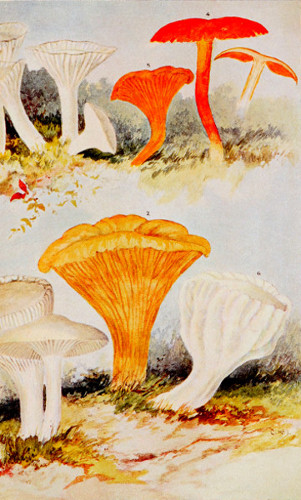
Grouped by F.D. Briscoe—Studies by C. McIlvaine. Plate XXXVII.
Fig. Page. Fig. Page.
1. Hygrophorus pratensis (white var.), 152 5. Hygrophorus cantharellus, 156
2. Hygrophorus pratensis (colored var.), 152 6. Hygrophorus virgineus, 153
3. Hygrophorus pratensis (after rain), 152 7. Hygrophorus niveus, 153
4. Hygrophorus miniatus, 159
147HYGROPH´ORUS Fr.
Gr.—moist; Gr.—to bear.
(Plate XXXVIII.)
Hygrophorus pratensis.
Pileus regular or undulated and wavy, often viscid or moist. Flesh of the pileus continuous with that of the stem and descending as a trama into the gills. Gills adnate or adnexed, more or less decurrent, waxy, often thick and forked, edge always thin and sharp, often branched.
On the ground. Many species are brightly colored. Spores white.
This genus differs from the preceding genera in the manifest trama, the substance of which is similar to that of the pileus; from Lactarius and Russula by the trama not being vesicular, but somewhat floccose with granules intermixed; from Cantharellus, its nearest ally, by the sharp edge of the gills. The Cortinarii, Paxilli and Gomphidii are at once distinguished from it by their colored spores and the changing color of their gills, as well as by other marks. From all the other genera of Agaricini it is distinguished by a mark peculiar to itself, viz., by the hymeneal stratum of the gills changing into a waxy mass, which is at length removable from the trama. This altogether singular character is specially remarkable in H. caprinus, coccineus, murinaceus, etc. Hence the gills seem full of watery juice, but they do not become milky like those of the Lactarii. Fries.
From the description by Fries, the author of the genus, it is manifest that one has to wait the ripening of the fungus before the peculiar characteristic mark of the genus, i. e.—gills turning into a waxy mass, easily removable from the cap—can be observed. Many of the species are difficult to determine when fresh. Nevertheless, there is an indescribable, watery, waxy, translucent appearance about the gills which catches the eye of the expert, and is soon learned by the novice. The white spores readily separate the genus from kindred shapes in the colored-spored genera.
So far as tested none of the species is poisonous. One English species 148is fetid. It is probable that they are all edible, varying in quality only. Fries well, and is superior in croquettes and patties.
ANALYSIS OF TRIBES.
Limacium (limax, a slug). Page 148.
Universal veil viscid, with occasionally a floccose partial one, which is annular or marginal.
* White or becoming yellowish.
** Reddish.
*** Tawny or yellow.
**** Olivaceous-umber.
***** Dingy cinereous or livid.
None known to be edible.
Camarophyllus (Gr.—a vault; a leaf). Page 152.
(From the arched shape of the gills.)
Veil none. Stem even, smooth or fibrillose, not rough with points. Pileus firm, opaque, moist after rain, not viscid. Gills distant, arcuate.
* Gills deeply and at length obconically decurrent.
** Gills ventricose, sinuately arcuate or plano-adnate.
Hygrocybe (Gr—moist; Gr—the head). Page 155.
Veil none. Whole fungus thin, watery, succulent, fragile. Pileus when moist viscid, shining when dry, rarely floccoso-scaly. Stem hollow, soft, without dots. Gills soft. Most of the species are brightly colored and shining. This tribe is the type of the genus.
* Gills decurrent.
** Gills adnexed, somewhat separating.
Lima´cium.
* White or yellowish-white.
H. chry´sodon Fr. Gr—gold; a tooth. From tooth-like squamules. Pileus 2–3 in. broad, white, shining when dry, but commonly yellowish with minute adpressed squamules at the disk, light yellow-flocculose at the involute margin, fleshy, convex then plane, obtuse, viscid. Flesh 149white, sometimes reddish. Stem 2–3 in. long, about ½ in. thick, stuffed, soft, somewhat equal (sometimes, however, irregularly shaped or thickened at the base), white, with minute light yellow squamules, which are more crowded and arranged in the form of a ring toward the apex. Gills decurrent, distant, 3 lines broad, thin, white, somewhat yellowish at the edge, sometimes crisped.
Odor not unpleasant. There is a manifest veil, not woven into a continuous ring, but collected in the form of floccose squamules at the apex of the stem and the margin of the pileus. Var. leucodon with white squamules. Fries.
In woods.
The lamellæ are said to be crisped, and when young, to have the edge yellow-floccose; but I have seen no such specimens. Peck, 23d Rep. N.Y. State Bot.
Spores 8×4µ Cooke.
West Virginia, New Jersey, Pennsylvania. McIlvaine.
A pleasant, excellent species, whose rarity is regrettable.
H. ebur´neus Bull. Fr.—ebur, ivory. Wholly shining white. Pileus fleshy, sometimes thin, sometimes somewhat compact, convexo-plane, somewhat repand, even, very glutinous in rainy weather, margin soon naked. Stem sometimes short, sometimes elongated, stuffed then hollow, unequal, glutinous like the pileus, rough at the apex with dots in the form of squamules. Gills decurrent, distant, veined at the base, 3–4 lines broad, tense and straight, quite entire. Fries.
Odor mild, not unpleasant. Very changeable. The veil is absent, unless the very plentiful gluten which envelops the stem be regarded as a universal veil; margin of the young pileus involute, only at the first pubescent, soon naked. The stem is soft internally, at length hollow, attenuated toward the base.
In woods and pastures. Frequent. September to October. Stevenson.
The whole plant is pure white when fresh, but in drying the gills assume a cinnamon-brown hue. Peck, Rep. 26.
Spores 6×5µ Cooke; 4×5µ W.G.S.; 5–6µ K.; 6×4µ C.B.P.
A common and wide-spread species frequenting woods and pastures.
Edible. Curtis.
The author ate it in West Virginia, in 1882; at Devon, Pa., 1887; 150Haddonfield, N.J., 1890. It is well flavored but in texture is not of first quality.
H. pena´rius Fr.—penus, food. Pileus tan-color, opaque, fleshy, especially when young, at first umbonate, then very obtuse, hemispherical then flattened, even, smooth, commonly dry, margin at first involute, exceeding the gills, undulated when flattened. Flesh thick, hard, whitish, unchangeable. Stem curt, 1½ in. or more long, about ½ in. thick at the apex, solid, compact, hard, attenuated at the base into a spindle-shaped root, ventricose to the neck, again attenuated upward or wholly fusiform-attenuated, pale-white, smeared with tenacious, easily dried slime, warty. Flesh firm, but externally more rigid, cuticle somewhat fragile. Veil not conspicuous. Gills adnato-decurrent, acute behind, distant, thick, 3–4 lines broad, veined, tan inclining to pale. Fries.
Odor pleasant, taste sweet. The fusiform root is as long as the stem.
In mixed woods. Stevenson.
Spores 7–8×4–5µ.
Edible. Cooke.
Large specimens occurred in mixed woods, in November, 1898, at Mt. Gretna. The caps varied from 1½-5 in. across. The color was white, tinged with yellow, much lighter than described. The caps look coarse and the stems are not inviting; but the caps have a pleasant odor. When stewed for twenty minutes they are meaty and tasty.
** Reddish.
H. erubes´cens Fr.—erubesco, to become red. Pileus 2–4 in. and more broad, white becoming everywhere red, fleshy, gibbous then convexo-plane, viscid, adpressedly dotted with squamules or becoming smooth, sometimes wholly compact, sometimes thin towards the margin which is at the first naked. Flesh firm, white. Stem sometimes short, robust, 2 in. long, 1 in. thick and attenuated upward, sometimes elongated, 4 in. long, equal or attenuated at the base, solid, flexuous, with red fibrils, dotted with red upward. Gills decurrent, distant, soft, white, with red spots. Fries.