Sub-Class BASIDIOMYCETES (continued 7)
Reading edition
Spores 12–14×10µ Cooke.
The spider web veil is exquisitely displayed in this species. This, with its strongly bulbous base and violet tinge throughout, easily mark it. Though usually solitary great numbers of it are found in its settlements. The mixed woods of central New Jersey abound with it in July, August and September. Throughout Pennsylvania and West Virginia it is common, and is reported from several other states. In Redman’s woods, near Haddonfield, N.J., a densely clustered form of singular beauty occurs. A dozen individuals of various forms and sizes with swollen stems form a compact mass, rich in color, and cutting crisp and juicy as an apple. They are far better than other Cortinarii I have eaten. I have not seen it elsewhere.
316C. violaceus is everywhere eaten, and is in my opinion the best of its genus. The American plant is not inodorous, but has a decided mushroom smell and taste.
(Plate LXXXIV.)
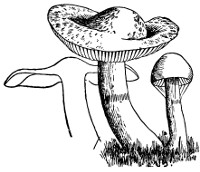
Cortinarius albo-violaceus. One-half natural size.
C. albo-viola´ceus Pers. Pileus fleshy, rather thin, convex, then expanded, sometimes broadly subumbonate, smooth, silky, whitish, tinged with lilac or pale violet. Lamellæ generally serrulate, whitish-violet, then cinnamon-color. Stem equal or a little tapering upward, solid, silky, white, stained with violet, especially at the top, slightly bulbous, the bulb gradually tapering into the stipe.
Height, 3–4 in.; breadth of pileus, 2–3 in.; stipe, 3–6 lines thick.
Ground in thin woods, more frequently under poplars. Center. October.
The stem is sometimes subannulate, and being violet above and white below the obscure ring, it appears as if sheathed with a silky-white covering. Inodorous. Sometimes the stem gradually tapers from the base to the top, so that it can scarcely be called bulbous. Peck, 23d Rep. N.Y. State Bot.
Spores 12×5–6µ Cooke; 6–9×4–5µ K.; pruniform, 10µ Q.
An allied species C. (Inoloma) lilacinus, Peck, with the stem and bulbous part much broader than the cap, is not as common, but of far better flavor.
Common in West Virginia, Pennsylvania, New Jersey, in mixed woods. September to frost. McIlvaine.
A mushroom flavor develops in cooking. The consistency of the flesh is good. It is of medium grade.
C. lilaci´nus Pk. Pileus firm, hemispherical, then convex, minutely silky, lilac-color. Lamellæ close, lilac, then cinnamon. Stem stout, bulbous, silky-fibrillose, solid, whitish, tinged with lilac. Spores nucleate, 10×6µ.
317Plant 4–5 in. high. Pileus 3 in. broad. Stem 4–6 lines thick. Low mossy ground in woods. Croghan. September. This is a rare but beautiful plant, allied to C. alboviolaceus, from which it may be distinguished by its stouter habit, deeper color and bulbous stem. In the young plant the bulb is much broader than the undeveloped pileus that surmounts it. Peck, 26th Rep. N.Y. State Bot.
Massachusetts, Frost; Minnesota, Nova Scotia.
I have found a few specimens in several places: West Virginia, Redman’s woods, Haddonfield, N.J., in which place it is more plentiful than in any locality I have noted. Near lake at Eagle’s Mere, Pa., August, and at Springton, Pa. Excellent.
(Plate LXXXV.)
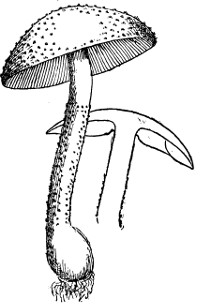
Cortinarius asper. About two-thirds natural size.
C. as´per Pk.—rough. Pileus fleshy, firm, hemispherical, then convex, rough with minute, erect, brown scales, ochraceous. Gills close, rounded behind and slightly emarginate, dull violaceous, then pale cinnamon. Stem equal, bulbous, solid, fibrillose-scaly, colored like the pileus but smooth and violaceous at the top, the bulb white with an abundant mycelium. Spores broadly elliptical, with a pellucid nucleus, 8µ long.
Plant 3–4 in. high. Pileus 2–3 in. broad. Stem 3–5 lines thick. Ground in cleared places. Greig. September.
A fine species. The flesh of the stem is violaceous. Peck, 24th Rep. N.Y. State Bot.
This plant sometimes grows in tufts or clusters and bears a very close resemblance to Armillaria mellea, both in color and in the character of the scales of the pileus. Peck, 27th Rep.
In thin woods and clearings, West Virginia, New Jersey, Pennsylvania. The whole fungus is edible when young, and ranks high in Cortinarii. When full grown the stem is hard. Cut in thin, transverse slices it 318cooks tender, but does not equal the cap. Like most of the Cortinarii it is found in the autumn until frost kills it.
** Gills pinkish-brown then cinnamon.
(Plate LXXXVI.)
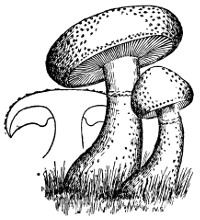
Cortinarius squamulosus.
C. squamulo´sus Pk. (Plate LXXXII, fig. 1, p. 306). Pileus thick, fleshy, convex, densely fibrillose-squamulose, cinnamon-brown, the scales darker. Lamellæ not crowded, deeply emarginate, pale pinkish-brown, then cinnamon-colored. Stipe thick, solid, shreddy, subsquamulose, concolorous, swollen at the base into a very large tapering or subventricose bulb.
Height 4–6 in., breadth of pileus 2–4 in., stipe 6–9 lines thick at the top, 12–18 lines at the bottom.
Borders of swamps in woods. Sandlake. August.
Related to C. pholideus and C. arenatus, but distinct by the deep emargination of the lamellæ. It gives out a strong odor while drying. The color of the flesh is pinkish-white. Peck, 23d Rep. N.Y.
This species was discovered in 1869, and had not since been observed by the writer until the past season. It is manifestly a species of rare occurrence. Peck, 28th Rep.
Massachusetts, Frost; Wisconsin, Minnesota. Ranges from New England to Kentucky unchanged. Morgan.
Specimens from E.B. Sterling, Trenton, N.J., September, 1897. Asylum grounds. Several found at Mt. Gretna, August and September, 1897. Solitary in oak woods, gravelly soil. McIlvaine. Sent to Professor Peck and identified. Specimens were much darker than Professor Peck’s plates.
C. squamulosus is not attractive in appearance. The caps, only, are edible. Their consistency is very pleasant and flavor fairly good.
319
(Plate LXXXVIa.)
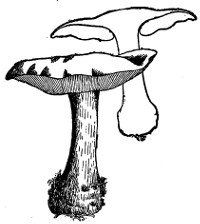
Cortinarius autumnalis.
C. autumna´lis Pk. Pileus fleshy, convex or expanded, dull rusty-yellow, variegated or streaked with innate rust-colored fibrils. Gills rather broad, with a wide shallow emargination. Stem equal, solid, firm, bulbous, a little paler than the pileus.
Height 3–4 in., breadth of pileus 2–4 in. Stem 6 lines thick.
Pine woods. Bethlehem. November. The plant is sometimes cespitose. The flesh is white. Peck, 23d Rep. N.Y. State Bot.
Mt. Gretna, Pa., 1899. McIlvaine.
Quality fair. Caps meaty.
C. ochra´ceus Pk. (Plate LXXXII, fig. 3, p. 306.) Pileus fleshy, convex, at length broadly subumbonate or gibbous, smooth, even or obscurely wrinkled, pale ochraceous. Stem solid, fibrillose, ochraceous at the top, white below, gradually enlarged into a thick bulbous base.
Height 2–4 in., breadth of pileus 2–3 in. Stem 4–6 lines thick at the top, 12–18 lines at the base.
Under balsam trees in open places. Catskill mountains. October.
The stem appears as if sheathed. In some specimens the stem is short and rapidly tapers from the base to the top. Peck, 23d Rep. N.Y. State Bot.
Many of the species were found by the writer in mixed woods among leaves at Mt. Gretna, Pa., September, 1898. Specimens were identified by Professor Peck.
The gills are bright yellow when young. Cap smooth, innately fibrillose, not viscid. Spores light brown.
Tasteless; smell faint. Good consistency. A fair flavor develops in cooking.
*** Gills yellow.
(Plate LXXXVIb.)
Cortinarius annulatus. Natural size.
C. (Inoloma) annula´tus Pk. Pileus broadly convex, dry, villose-squamulose, yellow. Flesh yellowish. Lamellæ rather broad, subdistant, adnexed, yellow. Stem solid, bulbous, somewhat peronate by the 320yellow fibrillose annular-terminated veil. Spores broadly elliptical or subglobose, 8µ long.
Pileus 1–3 in. broad. Stem 1.5–3 in. long, 3–6 lines thick.
Thin woods. Whitehall. August.
The whole plant is yellow inclining to ochraceous. It has the odor of radishes. The squamules of the pileus are pointed and erect on the disk, and often darker-colored there. The species is allied to C. tophaceus and C. callisteus, from which it is separated by its persistently annulate stem and more yellow color. Peck, 43d Rep.
Specimens received from E.B. Sterling, Trenton, N.J., September 5, 1897. Identified by Professor Peck. Mixed woods Kingsessing, near Bartram’s Garden, Philadelphia, September, 1897.
Solitary among grass and leaves. The permanent marking of the veil is conspicuous. Eight specimens were found and eaten. The caps cook tender, and have a decided but not unpleasant flavor.
Dermo´cybe. (Gr—skin; Gr—a head.)
C. cinnabari´nus Fr.—cinnabaris, dragon’s blood. Pileus 2–3 in. broad, scarlet-red, truly fleshy, campanulate, then flattened, obtuse or very obtusely umbonate, silky, then becoming smooth and shining, or obsoletely scaly; the firm flesh paler. Stem 1½-2 in. long, 3–4 lines and more thick, solid, equal, sometimes however bulbous, fibrillose or striate, scarlet-red, reddish brick-color internally. Cortina fibrillose, lax, cinnabar. Gills wholly adnate, somewhat decurrent, 3 lines broad, somewhat distant, connected by veins, unequal and darker at the edge, dark blood-color when bruised.
Odor of radish. Readily distinguished from all others by its splendid scarlet color, and from C. sanguineus by its short solid and firm 321stem, its broad pileus and somewhat distant gills. Stem never becoming yellow. Fries.
Spores 7–8×4µ Cooke.
It is a variable species with us.
Cap 1½ in. across, convex, broadly umbonate, margin involute, yellowish-brown, silky, innately fibrillose, shining, when young the cap is round, margin involute. Veil white, fibrillose, fugacious, leaving no trace on stem. Flesh thick in center, solid, close-grained, white, tinged with brown. Tastes strongly as radishes. Skin partially detachable.
Gills exceedingly beautiful in their deep claret-color, which is permanent, decurrent.
Stem 3 in. long, shining, smooth, white near top, brownish below, equal, fibrous, stuffed, skin removable.
On ground among pines, near station, Mt. Gretna, Pa. August to frost. Solitary, gregarious and cespitose.
Taste and smell like radishes. The caps cook well and are of fair flavor. Makes good patties and croquettes.
C. cinnabarinus, Var. 1. Mt. Gretna, Pa., August to frost. On decaying chestnut stumps.
Cap 1 in. across, shining, convex, orange-brown, white on margin and under minute appressed squamules, but few on margin; apparent remnant of a veil on cap, as a viscid skin.
Gills rounded behind, slightly emarginate, like Tricholoma, grayish-brown when young, becoming a brilliant scarlet, unequal.
Stem 2 in. high, over ¼ in. thick, white, covered with brownish-orange appressed squamules, often with stained marking of veil or fragments of veil as ring. Cespitose, connate.
Taste and smell strong like radishes. Flavor in dish is decided but pleasant. Makes good patties and croquettes.
Specimens were identified by Professor Peck as C. cinnabarinus, as were those of the preceding. The variations are so great that I give this place as a variety.
C. sanguin´eus Fr.—sanguis, blood. Pileus 1–1½ in. broad, blood-color, becoming slightly pale when dry, fleshy, thin, convex then plane, obtuse, occasionally depressed, silky or squamulose. Flesh reddish, paler. Stem 2–3 in. long, 2–3 lines thick, stuffed then hollow, equal (rather attenuated than thickened at the base), here and there 322flexuous, with fibrils of the same color, almost darker than the pileus. Cortina arachnoid, fugacious, red blood-color. Gills adnate, crowded, 2–3 lines broad, quite entire, dark blood-color.
Wholly dark blood-color, the stem when compressed pouring forth bloody juice. Odor of radish. Thinner than species nearest to it. The spores are ochraceous on a white ground, somewhat ferruginous on a black ground. Fries.
Spores 6×4µ W.G.S.
North Carolina, Curtis; Massachusetts, Sprague, Farlow, Frost; Connecticut, Wright; New York, Peck, 23d Rep.
Edible. Leuba.
(Plate LXXXVII.)
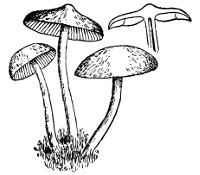
Cortinarius cinnamomeus. Natural size.
C. cinnamo´meus Fr. Pileus 1–2½ in. across. Flesh thin, convexo-campanulate, umbonate, somewhat cinnamon color, silky squamulose with yellowish innate fibrils, becoming almost glabrous. Gills adnate, broad, crowded, shining, yellowish, then tawny-yellow. Stem 2–4 in. long, equal, yellow, as is also the flesh and the veil, hollow. Spores 7–8×4–5µ.
A very common species, especially in mossy places in pine woods, occurring under many well defined forms, which can not be separated as species. Essential points common to all. (1) Stem everywhere equal, stuffed, then hollow, yellowish, fibrillose from the similarly colored veil. (2) Pileus thin, flattened and obtusely umbonate, silky with yellowish down, often glabrous when adult, and then bright cinnamon, but the color is variable. (3) Flesh splitting, yellowish. (4) Gills adnate, crowded, thin, broad, always shining. (5) Spores dark ochraceous, size and color very variable; pileus from ½-3–4 in. across; color of pileus changeable, depending on the more or less persistence of the down (fundamental color and veil constant in this species and its allies); gills varying through blood-red, reddish cinnamon, tawny saffron, golden and yellow. Fries.
323Pileus thin, convex, obtuse or umbonate, dry, fibrillose at least when young. Flesh yellowish. Lamellæ thin, close, adnate. Stem slender, equal, stuffed or hollow. Spores elliptical, 8µ long. Peck, 48th Rep. N.Y. State Bot.
Spores 7–8×4µ Cooke.
The Germans are said to be very fond of this species, which is generally stewed in butter and served with sauce for vegetables.
Catalogued by Dr. M.A. Curtis, North Carolina, as edible. Edible. Cooke.
Var. semi-sanguin´eus received from E.B. Sterling, Trenton, N.J., August, 1897. Juicy and good.
The species is common over the United States and plentiful in its numerous varieties from August to frost. It frequents mixed woods, borders and open and mossy places. The pine woods of New Jersey yield it in quantity, as do the hemlock forests of Eagle’s Mere, Pa., and oak woods of West Virginia.
It has a smell and taste—mildly of radishes. Its flavor when cooked is decided but pleasant.
Telamo´nia. (Gr—lint.)
(Plate LXXXVIII.)
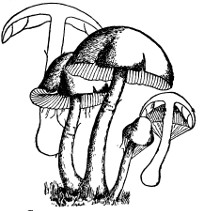
Cortinarius armillatus.
C. armilla´tus Fr.—armilla, a ring. (Plate LXXXII, fig. 5, p. 306.) Pileus 3–5 in. broad, red-brick color, truly fleshy, but not very compact, at first cylindrical, soon campanulate, at length flattened, dry, at first smooth, soon innately fibrillose or squamulose, flesh dingy pallid. Stem 3–6 in. long, ½ in. thick, solid, firm, remarkably bulbous (bulb 1 in. thick, villous, whitish) and fibrillose at the base, when old striate and reddish-pallid, internally dirty yellow. Exterior veil woven, red, arranged in 2–4 distant cinnabar zones encircling the stem; partial veil continuous with the upper zone, arachnoid, reddish-white. Gills adnate, slightly rounded, distant, at first pallid cinnamon, at length very broad (½ in.), dark ferruginous, almost bay-brown.
324Odor of radish. A very striking species. From the pileus not being hygrophanous, at the first smooth and at length torn into fibrils or squamulose, it might easily be taken for a species of Inoloma. The cortina itself is paler than the zones. It differs from all others in these zones. The rings are usually somewhat oblique. Fries.
Professor Peck in the 23d Rep. N.Y. State Cab. Nat. Hist., describes the American species as follows:
“Pileus fleshy, thick, convex or subcampanulate, then expanded, minutely squamulose, yellowish-red. Lamellæ not close, broad, slightly emarginate, whitish-ochraceous, then cinnamon. Stipe stout, solid, fibrillose, whitish, girt with one to four red bands, bulbous.
“Height 4–6 in., breadth of pileus 2–4 in., stipe 4–8 in. thick.
“Woods. North Elba. August.
“A large and noble species. The margin of the pileus is thin and sometimes uneven; the upper band on the stem is usually the brightest and most regular. The pileus is not distinctly hygrophanous.”
Spores 10×6µ Cooke.
Edible. Cooke.
September 8, 1897, Mr. E.B. Sterling, Trenton, N.J., sent me several specimens new to me and remarkable in having two well-defined veils, the lower and thicker one of which left a dark zone upon the stem, the upper, fibrillose, was more persistent, but left a fainter impression. These veils are not mentioned in Professor Peck’s description of the American species, but are prominently noted in that of Fries, as above. In a very young specimen both veils were present. Cap light brown, minutely squamulose, with a few small red spots; margin thin, involute, flesh thick, yellowish, firm; gills distant, rounded behind, slightly emarginate, alternate ones short, light brown inclined to cinereous on edge.
Spores brown. Small young specimens did not show bulbous stem as distinct as larger and older ones.
I afterward found several specimens at Mt. Gretna, Pa., September and October, 1897.
The flesh is excellent, closely resembling Pholiota subsquarrosa. The species seems to be rare. If found in quantity it will prove one of our very best edibles.
325C. dis´tans Pk. Pileus thin except the disk, convex, squamulose, bay-brown when moist, tawny when dry. Lamellæ broad, distant, thick, dark cinnamon-color. Stipe subequal, often a little tapering upward, solid, slightly fibrillose-scaly, concolorous.
Height 2–3 in., breadth of pileus 1–2 in., stipe 4–6 in. thick.
Grassy ground in pine woods. Greenbush. June.
The flesh is dull-yellowish. The pileus, when drying, has for a time a brown-marginal zone. Peck, 23d Rep. N.Y. State Bot.
New Jersey pines. Eagle’s Mere, Pa., coniferous woods. August. Mt. Gretna, Pa., pines. August, September. McIlvaine.
Like most of the hygrophanous Cortinarii, the taste is more or less that of rotten wood. The flavor is flat and undesirable.
C. furfurel´lus Pk. Pileus thin, convex, furfuraceous with minute squamules, hygrophanous, watery-tawny when moist, pale ochraceous when dry. Lamellæ broad, thick, distant, adnate or slightly emarginate, tawny-yellow, then cinnamon. Stem equal, peronate, colored like the pileus, with a slight annulus near the top. Spores subelliptical, minutely rough, 8–10×6µ.
Plant 1–2 in. high. Pileus 1–2 in. broad. Stem 2–4 lines thick.
Moist ground in open places. Gansevoort. August. Peck, 32d Rep. N.Y. State Bot.
Haddonfield, N.J., Mt. Gretna, Pa. McIlvaine.
Strong woody flavor—like rotten wood. Not poisonous, but not desirable.
Hygrocybe.
C. casta´neus Bull.—chestnut. Pileus fleshy, thin, campanulate or convex, then expanded, dark chestnut-color when moist, paler when dry. Lamellæ rather broad, violet-tinged, then cinnamon. Stipe fibrillose, stuffed or hollow, lilac tinged at the top, white below.
Height 2–3 in., breadth of pileus 1–2 in., stipe 3–4 lines thick.
Ground under spruce or balsam trees. Catskill mountains. October. Edible. Peck, 23d Rep. N.Y. State Bot.
Spores 8×5µ.
It is certainly a wholesome, esculent species, but a great number would be required to make a good dish. M.C. Cooke.
Catalogued by Rev. M.A. Curtis, North Carolina, as edible.
326Eaten in Italy. Inodorous, edible and agreeable. Cordier. More than fair. I have often eaten it. R.K. Macadam.

PAXIL´LUS Fr.
Paxillus, a small stake.
Hymenophore continuous with the stem, decurrent. Gills membranaceous, somewhat branched, frequently anastomosing behind, distinct from the hymenophore and easily separable from it. Spores dingy-white or ferruginous.
Fleshy putrescent fungi, margin of pileus at first involute, then continually and gradually unfolding and expanding. Fries.
Pileus symmetrical or eccentric. Stem central, eccentric or wanting. Edge of gills entire, sharp.
The marked features of this genus are the strongly involute margin, the soft, tough, decurrent gills, separating readily from the flesh, and the color of the spores.
The members of this genus possess some of the characters of Boletus. The gills separate easily from the hymenophore as do the tubes of the latter, and their anastomosing tendency is in P. porosus so marked that the hymenium consists of large angular tubes. The gills of P. solidus B. and C. form pores at the base, and its spores are elongated, both features indicating an affinity with Boletus.
ANALYSIS OF TRIBES.
Lepista (a pan). Page 327.
Pileus entire, central. Spores dingy-white, in P. panæolus somewhat rust-color. On the ground.
327Tapinia (to depress). Page —--.
Pileus generally eccentric or resupinate. Spores rust-color. On the ground or on stumps.
So far as known the species of this genus are harmless. Many of them are large, fleshy and inviting in appearance, but their flesh is usually dry and coarse, and, though absorbent, is hard to cook tender. P. atrotomentosus, which seems to be rare, is an exception. The flesh of this species being firm in texture and readily made into a first-class dish.
Lepis´ta.
P. lepis´ta Fr.—lepista, a pan. Pileus 2–4 in. broad, flat or depressed, dirty-white, smooth, sometimes minutely cracked near the margin which is thin, involute and often undulate. Stem very variable in length, 1–4 in., ½-¾ in. thick, dingy white or cream, solid, white inside, equal, with a cartilaginous cuticle passing between the gills and the flesh of the pileus, base blunt, villous, white. Gills very decurrent, crowded, 2–3 lines broad, slightly branched but not at the base, dingy-white becoming darker.
Spores reddish, becoming dingy brown. Broadly pyriforme 6×8µ Massee.
Pennsylvania. September, 1894. McIlvaine. Albion, N.Y., Dr. Cushing, 1898.
On ground in woods and margins of woods.
Flesh white. Gills narrow, crowded, brittle, decurrent, dingy-white or pale-buff, easily separating from cap. Stem solid, elastic, at length hollow, often short, an inch long, tapering downward, frequently up to four inches in length and equal, base villose.
Resembling Lactarius piperatus and some forms of Clitocybe. It is separated from the former by the absence of milk and from the latter by its involute margin. The Clitocybe resembling it are all edible.
Smell strong, like old oily nuts. Edible but coarse.
P. li´vidus Cke. Pileus 1–2 in. across, convex, at length slightly depressed at the disk, margin slightly arched and incurved, dingy-white, or livid ochraceous, opaque. Gills decurrent, arcuate, almost 328crowded, 1½ line broad, white. Stem 3–4 in. long, ½ in. thick at the apex, attenuated downward, white, fibrillose, stuffed then hollow, usually rather flexuous. Flesh nearly white. Spores globose, 3–3.5µ diameter, nearly white.
In woods. Usually in small clusters. Closely allied to Paxillus revolutus, but distinguished by the absence of any tinge of violet on the pileus or stem, and by the persistently white gills. Massee.
Received from Katherine A. Hall, Danville, N.Y. October, 1898.
Raw it tastes like a drug-store smell. Edible, pleasant.
Tapi´nia.
(Plate XC.)
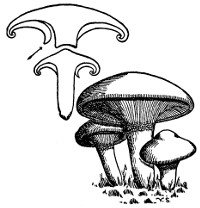
Paxillus involutus. One-half natural size.
P. involu´tus (Batsch) Fr.—involutus, rolled inward. Pileus 2–5 in. broad, fleshy, compact, convexo-plane then depressed, smooth, viscid when moist, shining when dry, yellowish or tawny-ochraceous, strongly involute, margin densely downy, flesh pallid. Stem 2–4 in. high, about ½ in. thick, solid, firm, paler than the pileus, central or eccentric. Gills 2–3 lines broad, crowded, branched, anastomosing, forming pores behind, whitish then yellowish or rusty, spotting when bruised.
Spores rust-color, ellipsoid or oblong-ellipsoid 8–16×6µ K.; 5×6µ W.G.S. Elliptical, 8–10µ Peck.
It grows singly or in groups and likes damp mossy soil. Common in cool hemlock or spruce woods in the Adirondack mountains; not rare in the mixed woods of all our hilly districts. When growing on decayed stumps the stem is sometimes eccentric. August, November. C.H. Peck.
In open woods near Haddonfield, N.J., it grows to a large size and in quantity. In Angora woods near Philadelphia a complete ring of it 20 ft. in diameter was seen.
329Considered edible throughout Europe and said to be highly esteemed in Russia. The flesh of the American plant is dry and coarse, does not cook tender and is rather tasteless.
P. a´tro-tomento´sus (Batsch.) Fr.—ater, black; tomentum, down. Pileus 3–6 in. broad, rust-color or reddish-brown, compactly fleshy, eccentric, convex then plane or depressed, margin thin, frequently minutely rivulose, sometimes tomentose in the center. Flesh white. Stem 3–6 in. high, ½-1 in. thick, stout, solid, elastic, eccentric or lateral, unequal rooting, covered with dense velvety down, very dark brown. Gills adnate, 3 lines broad, close, anastomosing at the base, yellowish, interspaces venose.
Spores subhyaline 4–6×3–4µ K. Elliptical, pale-yellowish, 5×2.5–3µ Massee. Elliptical 5–6×4µ Peck.
Found near Philadelphia, gregarious in old woods. September. In New Jersey in pine woods on stumps and on the ground, probably growing from roots. McIlvaine.
Grows singly or cespitose, sometimes in large tufts, when the pileus is frequently irregular from compression. In wet weather the pileus is moist and sometimes obscurely mottled with dark spots. Occasionally it has an unpleasant dirt-like odor. Peck.
Cordier considers this species suspicious and Paulet inutile on account of its bad taste.
The flesh differs from most Paxilli in being very fine grained and cooked is of the consistency of a marshmallow. The taste is marked but pleasant.
330Series IV. PORPHYRO´SPORÆ (Pratelli). Gr—purple.
Spores typically black-purple or brownish-purple, more rarely dusky brown. (It is to be observed that the spores vary in color according to the color of the ground on which they are deposited.) There are sterile forms with the gills persistently white (A. obturatus, A. udus). Those species are more deceptive in which the gills continue for a long time white, and even begin to decay before they are discolored by the spores; these may be easily mistaken for Leucospori. Fries.
Pratelli is the name given by the early authors to this series, based upon the spore color; Porphyrosporæ is the name now used. The species within the group are closely allied to those having black spores without a tinge of purple or violet (Melanosporæ), but in none of the species do the gills deliquesce as in Coprinus, neither are there resupinate or lateral stemmed species.
There is a present tendency to do away with this series and include all dark-spored species in the Melanosporæ. Professor Atkinson and Bertha Stoneman, in their “Provisional Key to the Genera of Hymenomycetes,” omit the series and give “Melanosporæ, Gill and Butz (Pratellæ and Coprinariæ in broadest sense). Spores dark brown, purplish-brown or black.”
Porphyrosporae.
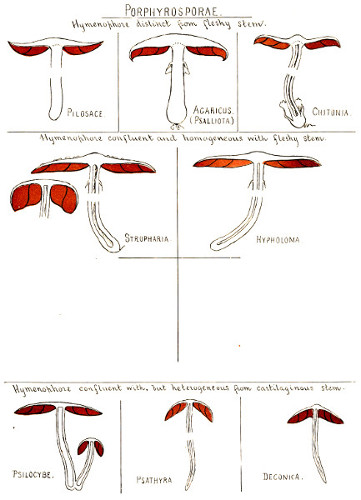
Plate XCII. Chart of genera in purple-spored series—Porphyrosporae, Page 330.
(Plate XCIII.)
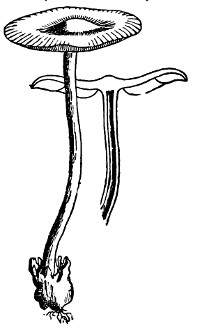
Chitonia rubriceps. Two-thirds natural size.
It is frequently difficult to determine by the spore-color of this series even to which series a specimen belongs. Many of our best edibles belong in this series. I know of none noxious.
CHITON´IA Fr.
Universal veil distinct from the pileus, at maturity forming a distinct volva round the base of the ringless central stem. Gills free from the stem. Spores brownish-purple.
Analogous in structure with Volvaria and Amanitopsis. An exotic genus imported into this country.
No American species reported. 331
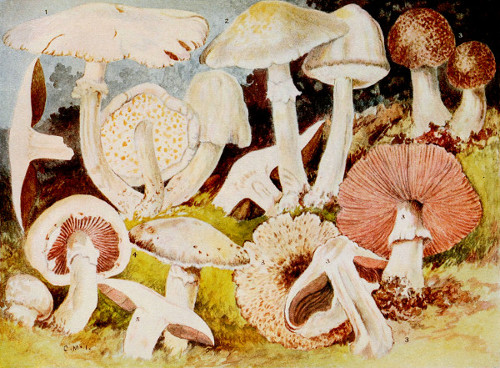
Grouped by F.D. Briscoe—Studies by C. McIlvaine. Plate XCI.
Fig. Page. Fig. Page.
1. Agaricus variabilis, 346 4. Agaricus campester, 332
2. Agaricus silvicola, 343 5. Agaricus campester (section), 332
3. Agaricus placomyces, 345
AGAR´ICUS.
Agaricon, a Greek name for fungi, said to be derived from the name of a town, Agara.
Pileus fleshy, flesh of the stem different from that of the pileus, furnished with a distinct ring. Gills at first enclosed by the veil, free, rounded behind, at first white or whitish, in some species this stage lasting but a short time, then pink or reddish, at length dark purplish-brown from the spores. Spores brown, brownish or reddish-purple.
On the ground, generally in pastures, meadows or manured ground, a few species occur in woods.
Analogous with Lepiota of the white-spored series. Stropharia also bears a ring and has similar colored spores, but is separated by the flesh of stem and pileus being continuous and the gills being more or less adnate.
Formerly in Agaricus as sub-genus Psalliota (psallion, psalion, in poetry, a ring). When Psalliota was raised to generic rank it was given the name of the great genus Agaricus as a mark of distinction on account of its including the most widely known and useful mushroom of the world—Agaricus campester. The name Psalliota is not in modern use.
Old Agaricus included many subgenera and consequently many more species. Now it contains but few. All of them are highly flavored and of marked excellence. Before the subgenera under Agaricus were promoted to full generic standing it was customary to state the name of a species thus: Agaricus (Psalliota) campester. Agaricus (Stropharia) semi-orbicularis. This was lengthy and clumsy. In the older books this form prevails. Often, however, the subgenus is omitted before the name, which compels the student to look up the subgenus to which the species belongs. The older books are therefore puzzling to modern students, who find there simply the name Agaricus to guide them. The present genus of a known species in old Agaricus can be easily found by looking in the index for its specific name. The name of the genus follows it in parentheses.
All of the genus can be cooked in any desired way.
332ANALYSIS OF SPECIES.
* Gills at first or very soon pink or rosy.
** Gills at first brownish or gray.
*** Gills at first white or whitish.
* Gills at first or very soon pink or rosy.
A. campes´ter Linn.—campus, a field. (Plate XCI, fig. 4 (3 figs.) fig. 5, section, p. 332). Pileus at first hemispherical or convex, then expanded with decurved margin or nearly plane, smooth, silky floccose or hairy squamulose, the margin extending beyond the lamellæ, the flesh rather thick, firm, white. Lamellæ free, close, ventricose, at first delicate pink or flesh color, then blackish-brown, subdeliquescent. Stem equal or slightly thickened toward the base, stuffed, white or whitish, nearly or quite smooth. Ring at or near the middle, more or less lacerated, sometimes evanescent. Spores elliptical, 6–8×4–5µ.
Plant 2–4 in. high. Pileus 1.5–4 in. or more broad. Stem 4–8 lines thick. Peck, 36th Rep. N.Y. State Bot.
Spores spheroid-ellipsoid, 9×6µ K.; 6×8µ W.G.S.
The varieties of A. campester are numerous. All of them are edible and vary but slightly in their excellence.
Var. al´bus Berk.—albus, white. A very common wild form. Cap 2–4 in. across, smooth or slightly fibrillose. Stem 1½-3 in. long, ⅓-⅔ in. thick, white or whitish. Spring to autumn, in rich grassy places. Sometimes very large. It is cultivated.
Var. gri´seus Pk.—griseus, gray. Cap grayish, silky, shining. Ring vanishing. Reported from Virginia.
Var. prati´cola Vitt.—pratum, a meadow; colo, to inhabit. Meadow variety. Cap covered with reddish scales. Flesh pinkish. Parade ground, Mt. Gretna, Pa.
Var. umbri´nus Vitt.—umber, dark brown. Cap brown, smooth. Stem short, minutely scaly.
“Var. rufes´cens Berk.—rufescens, becoming red. Pileus reddish, minutely scaly. Gills at first white. Stem elongated. Flesh turning bright red when cut or bruised. This departs so decidedly from the ordinary characters of the type, especially in the white color of the young gills, that it seems to merit separation as a distinct species.” Peck, 36th Rep.
333Var. villa´ticus Brond.—belonging to a villa. Cap scaly. Stem scaly.
Var. horten´sis Cke.—growing in gardens. Cap brownish or yellowish-brown, covered with fibrils or minute hairs. This is a cultivated species.
“Var. Bu´channi. Cap white, smooth, depressed in center, the margin naked. Stem stout. Ring thin, lacerated. A rare variety, sometimes occurring in mushroom beds.
“Var. elonga´tus—elongated. Long-stemmed variety. Pileus small, smooth, convex, the margin adorned with the adherent remains of the lacerated veil. Stem long, slender, slightly thickened toward the base. Ring slight or evanescent. This is also a variety of mushroom beds.
“Var. vapora´rius. Green-house variety (A. vaporarius Vitt.) Pileus brownish, coated with long hairs or fibrils. Stem hairy-fibrillose, becoming transversely scaly. Conservatories, cellars, etc. Not differing greatly from Var. hortensis.” Peck, 36th Rep. N.Y. State Bot.
The A. campester is known the world over as the common mushroom. It is cosmopolitan, appearing in pastures and rich places from spring and until long after severe frosts. It is the sweet morsel of gourmets. Indirectly it has done more damage than the assembled viciousness of all other toadstools. It is by mistaking the young button forms of the deadly Amanita for the button forms of the common mushroom that most cases of fatal toadstool poisoning are brought about. It is, also, usually the persons who think they know the mushroom, and can not be deceived, that get poisoned. If two rules are observed danger can be avoided. (1) Never eat a fungus gathered in the woods believing it to be the mushroom. The typical A. campester does not grow in the woods; species of Agaricus somewhat resembling it do. (2) Look at the gills; those of the mushroom are at first a light-pink which rapidly, as the plant matures, darken to a dark-brown, purplish-brown, or purplish-black. This is due to the ripening of the spores. Those of the Amanita are constantly white.
Pages could be written upon the mushroom and its culture, and recipes for the cooking of it would fill a volume. One important thing is omitted from them all—it is culinary heresy to peel a mushroom. Much of the flavor lies in the skin, as it does in that of apples, apricots, peaches, grapes, cherries and other fruits. The mushroom should be wiped with a coarse flannel or towel until the skin is clean. See chapter on cooking, etc.
334Lafayette B. Mendel, in American Journal of Physiology, March, 1898, gives the following analysis of A. campester:
Two varieties of the common mushroom were collected in New Haven. Fifteen specimens of one variety weighed 1½ ounce, an average weight of 43 grains each. The analysis gave:
a. b.
Water 87.88% 92.20%
Total solids 12.12 7.80
Total nitrogen in dry substance 4.42 4.92
Ash in dry substance 11.66 17.18
A. comp´tulus Fr.—comptus, gaily adorned. Pileus 1–1½ in. broad, yellowish-white, slightly fleshy, convex then plane, obtuse, adpressedly fibrilloso-silky, becoming even. Flesh thin, soft, of the same color as the pileus. Stem 2 in. long, 2–3 lines thick, hollow, stuffed with floccules when young, somewhat attenuated, even, smooth, white, becoming somewhat light yellow. Ring medial, torn, fugacious, of the same color. Gills rounded-free behind, crowded, soft, broader in front, flesh-color then rose, not dingy-flesh-color except when old.
Closely allied to A. campestris, but constantly distinct in its more beautifully colored gills. Fries.
Cultivated ground. Menands. August. Peck, Rep. 41.
Closely allied to A. campestris, from which it may be separated by its smaller size, the yellowish hue of the dry plant and by the smaller spores. Peck, 41st Rep. N.Y. State Bot.
Mt. Gretna, Pa. Parade ground, with A. campester; Haddonfield, N.J. August to frost. McIlvaine.
A. comptulus appears frequently in the latitude of Philadelphia. It is a neat species, but not substantial in flesh. Here it usually grows close to the ground. The ring is very evanescent.
Its edible qualities are those of A. campester.
A. silvat´icus Schaeff.—belonging to woods. Pileus thin, at first convex or bell-shaped, then expanded, gibbous or subumbonate, fibrillose or variegated with a few thin tawny brownish or reddish-brown spot-like adpressed scales, whitish, brownish or smoky-gray, the disk sometimes tinged with red or reddish-brown, the flesh white or faintly reddish. Lamellæ thin, close, free, narrowed toward each end, reddish, 335then blackish-brown. Stem rather long, equal or slightly tapering upward, hollow, whitish. Spores elliptical, 5–6.5×4–5µ.
Plant 3–5 in. high. Pileus 2–4 in. broad. Stem 4–6 lines thick.
Woods. Summer and autumn. Not common. Peck, 36th Rep. N.Y. State Bot.
Massachusetts, Farlow; Minnesota, Johnson; California—edible, H. and M.
West Virginia, 1881–1885, New Jersey, Pennsylvania. August to frost. In pine and mixed woods. McIlvaine.
Edible, Curtis. Edible, Peck.
In taste and smell A. silvaticus resembles A. silvicola, but is stronger. It is a frequent but not common species in the localities where I have found it. Quantities of it have not occurred, but myself and friends have eaten it for years, knowing no distinction in effect between it and allied species. Its strong taste requires that it be well cooked. It does not lose its high flavor, which may be objectionable to some. I prefer using its juices as a flavoring.
A. diminuti´vus Pk.—diminutive. Pileus thin, fragile, at first convex, then plane or centrally depressed, sometimes slightly umbonate, whitish or yellowish, faintly spotted with small thin silky appressed brownish scales, the disk brownish or reddish-brown. Lamellæ close, thin, free, ventricose, brownish-pink becoming brown, blackish-brown or black. Stem equal or slightly tapering upward, stuffed or hollow, smooth, pallid. Annulus thin, persistent, white. Spores elliptical 5×4µ.
Plant 1.5–2 in. high. Pileus 1–1.5 in. broad. Stem 1–2 lines thick.
Woods. Croghan and Sandlake, N.Y. August. Autumn.
This is a small but symmetrical and beautiful Agaric. It is perhaps too closely related to the preceding species (A. silvaticus), of which it may possibly prove to be a mere variety or dwarf form. Its pileus is quite thin and fragile. Usually the darker or reddish hue of the disk gradually loses itself in the paler color of the margin, but sometimes the whole surface is tinged with red. Peck, 36th Rep. N.Y. State Bot.
Chester county; West Philadelphia, Pa., September; Mt. Gretna, Eagle’s Mere, Pa., August. McIlvaine.
I have found A. diminutivus so intimately associated with A. silvaticus 336that its being a dwarf form of the latter seemed more than probable. Its edible qualities are the same.
A. Rod´mani Pk. Pileus rather thick, firm, at first convex, then nearly or quite plane, with decurved margin, smooth or rarely slightly cracked into scales on the disk, white or whitish, becoming yellowish or subochraceous on the disk, the flesh white, unchangeable. Lamellæ close, narrow, rounded behind, free, reaching nearly or quite to the stem, at first whitish then pink or reddish-pink, finally blackish-brown. Stem short, subequal, solid, whitish, smooth below the ring, often scurfy or slightly mealy-squamulose above; ring variable, thick or thin, entire or lacerated, at or below the middle of the stem. Spores broadly elliptical or subglobose, generally uninucleate, 5–6×4–5µ.
Plant 2–3 in. high. Pileus 2–4 in. broad. Stem 6–10 lines thick. Grassy ground and paved gutters. Astoria, L.I. Rev. W. Rodman. Washington Park, Albany. May to July.
This species is intermediate between A. campestris and A. arvensis, from both of which it may be distinguished by its narrow gills, solid stem and smaller, almost globose, spores. In size, shape of the pileus and general appearance it most resembles A. campestris, but in the whitish primary color of the gills and in the yellowish tints which the pileus often assumes, it approaches nearer to A. arvensis. * * * Peck, 36th Rep. N.Y. State Bot.
I can now add my own testimony to that of Mr. Rodman as to its edibility. Its flesh is firm but crisp, not tough, and its flavor, though not equal to that of the common mushroom, is nevertheless agreeable, and its use as food is perfectly safe. Peck, Rep. 49.
This species has grown freely for several years at Hull and Cohasset, Mass. It is usually found about June 1st, and is not seen again until early autumn. It is the handsomest mushroom I have seen, and its edible qualities are on a par with its appearance. Macadam.
A. hæmorrhoida´rius Shulzer. Gr—discharging blood. Pileus 4 in. across, reddish-brown, fleshy, ovate then expanded, covered with broad adpressed scales, margin at first bent inward. Flesh when broken immediately blood-red. Stem 4 in. high, 1 in. thick, soon hollow, fibrillose, the solid base somewhat bulbous. Ring superior, large. Gills free, approximate, crowded, rosy-flesh-color, at length purple-umber.
337Very striking, 3–4 in. high. The pileus and the white stem become spotted blood-red when touched. The stem when young is adpressedly squamulose below, when full grown mealy, becoming smooth. Fries.
Spores purple-brown, 7–8×5µ Massee; brown, elliptical, 5–6×4µ Peck.
A rare or overlooked plant in United States, first recorded by Professor Peck, who found it but once, growing under a hemlock tree. Rep. 45.
Nebraska, Clements; West Virginia; Eagle’s Mere and Mt. Gretna, Pa. In hemlock and mixed woods. Autumn. McIlvaine.
Cap 2–4 in. across. Stem 3–4 in. long, up to ¾ in. thick.
Every part of the plant turns red and has a congested appearance when bruised. The flesh is white but immediately becomes red when broken.
It is a frequent but not common species, growing singly, or in small clusters.
In flavor and substance it is equal to any mushroom.
A. mari´timus Pk. Pileus very fleshy, firm, at first subglobose, then broadly convex or nearly plane, glabrous, sometimes slightly squamose with appressed spot-like scales, white becoming dingy or grayish-brown when old. Flesh whitish, quickly reddening when cut, taste agreeable, odor distinct, suggestive of the odors of the seashore. Lamellæ narrow, close, free, pinkish becoming purplish-brown with age, the edge white. Stem short, stout, firm, solid, equal, sometimes bulbous, white, the annulus delicate, slight and easily obliterated. Spores broadly elliptic, purplish-brown, 7–8µ long, 5–6µ broad.
Pileus 2–8 in. broad. Stem 1–2 in. long, .6 in. thick.
Sandy soil near salt water, Lynn, Mahant and Marblehead, Mass. June to December. R.F. Dearborn.
This is a very interesting and an excellent mushroom. Dr. Dearborn writes that he has used it on the table for fourteen years and that it is the only mushroom that he has ever eaten in which the stem is as good as the cap. He considers it the most hearty and satisfying of all the numerous species that he has ever eaten. Both its taste and odor is suggestive of the sea. The latter is quite strong, and perceptible by one riding along the road by whose side the mushrooms are growing. They sometimes grow in semicircles and attain a larger size in warm weather than in the colder weather of autumn. They are most abundant in August. The flesh, when cut or broken, quickly assumes a pink 338or reddish hue on the freshly-exposed surface. This is a very distinctive character and with the maritime habitat makes the species easy to recognize. Another species, Agaricus hæmorrhoidarius Kalchb. exhibits a similar change of color in its wounded flesh, but is of very rare occurrence with us, does not, so far as ascertained, grow near the sea, has a darker cap and a long hollow stem. The stem in the maritime mushroom is short and solid. Its collar is very slight and easily destroyed. Peck, Bull. Torr. Bot. Club, Vol. 26, No. 2, F. 1899.
A. Califor´nicus Pk.—Pileus at first subconical, becoming convex, minutely silky or fibrillose, whitish, tinged with purple or brownish-purple on the disk. Flesh whitish. Gills close, free, pink becoming purplish, then blackish-brown. Stem rather long, solid or stuffed, equal or tapering upward, distinctly and rather abruptly narrowed above the entire externally silky ring, pallid or brownish. Spores broadly elliptical, 5–6×4–5µ.
Pileus 1–3 in. broad. Stem 1.5–3 in. long, 2–4 lines thick.
Under oak trees. Pasadena. January. McClatchie.
This fungus is similar in size, shape and habitat to A. hemorrhoidarius, but it is unlike that species in color, in the adornment of the pileus and in its color not changing where bruised or broken. Bull. Torr. Bot. Club, 22–5 My. 95.
A. Elven´sis B. and Br.—Name from river Elwy, Wales, where first found. Tufted. Pileus 4–6 in. or more across, subglobose then hemispherical, fibrillose, broken up into large persistent brown scales, areolate in the center, margin very obtuse, thick, covered with pyramidal warts. Stem at first nearly equal, at length swollen in the center, and attenuated at the base, 4–6 in. high, 2 in. thick in the center, fibrillose and areolate below, nearly smooth within the pileus, solid, stuffed with delicate threads. Ring thick, very large, deflexed, broken here and there, warted in areas beneath. Gills rather crowded, ¼ in. broad, free, of a brownish flesh-color. Spores elliptic oblong, 8×4µ.
Under oak trees, etc. Edible, delicious eating. Flesh of pileus ¾ in. thick, red when cut. Massee.
California, H. and M.
Edible. Cooke, 1891.
339A. fœdera´tus Berk. and Mont.—confederated. Pileus fleshy, thin, at first ovoid then bell-shaped, finally convex, somewhat umbilicate with the center slightly depressed, margin hanging down (when dry involute), fragments of the veil hanging from the margin, tawny, scaly with minute, scattered, white, persistent granules, 2–3 in. broad, ¾-1½ in. high.
Stem stout, hollow, stuffed with fibers, gradually increasing in size to the base; below the ring rough from the ruptured bark, 4 in. high. Ring superior, broad, reflexed, torn, persistent. Gills linear, medium broad, at first pinkish-lilac, when adult brownish, edge white, pulverulent, adnate, gradually attenuated toward the margin. Spores dingy-brown, ovoid oblong, 10µ long. Somewhat cespitose. Elegant.
On the ground in pastures. July. Columbus, Ohio. Sullivant, Mont. Syll., p. 121.
Edibility not reported. I have not seen this species.
A. xylo´genus Mont. Gr—produced on wood. Pileus membranaceous, at first ovoid, then conical, bell-shaped, umbonate, finally convexo-plane, smooth, pale-yellow, center brownish, margin split, striate when dry, 1½-2½ in. broad, 1¼ in. high. Stem cartilaginous, white, 3 in. high, ¼ in. thick, gradually thickened toward the base, hollow. Ring of medium size, inferior, erect or reflexed. Gills free, remote, lance-shaped, rounded behind, attenuated toward the margin, pink as in A. campester. Spores spherical, colorless, hyaline, 5–7.5µ.
On dead wood. August. Columbus, Ohio. Sullivant. Mont. Syll., p. 122.
Edibility not reported. I have not seen this species.
** Gills at first brownish or gray.
A. argen´teus Brændle—of silver. Pileus thin, convex becoming nearly plane, slightly silky or glabrous, pale grayish white or grayish brown, shining with a silvery luster when dry, the margin sometimes striate, at first incurved, often revolute when old. Flesh whitish, becoming blackish where cut. Lamellæ close, free, at first brownish becoming blackish brown or black with age. Stem short, glabrous, solid, often narrowed toward the base, the annulus slight, evanescent. Spores broadly elliptic, 7–10µ long, 6µ broad.
340Pileus 1–2 in. broad. Stem 1–1½ in. long, ¼-⅜ in. thick.
Lawns and grassy places in rich soil. Often associated with Stropharia bilamellata Pk. After rains from April to November. Washington, D.C. F.J. Brændle.
This is a small mushroom, peculiar in having the young gills of a dark color and in the absence of any pink hues. The gills sometimes become moist and manifest a tendency to deliquesce. The drying specimens emit a strong but not unpleasant odor. Mr. Brændle says that their edible quality is excellent and that it is not impaired by drying. Peck, Bull. Torr. Bot. Club, Vol. 26, F. 1899.
A. praten´sis Schaeff.—a meadow. Pileus 2–3½ in. across, ovoid then expanded, becoming smooth or sometimes broken up into scales more or less concentrically arranged, whitish, then grayish. Flesh thick in the center, thin toward the margin, white. Gills free, rounded behind, about ¼ in. broad, grayish, then brown. Stem about 2 in. long, ½-⅔ in. thick, base thickened, smooth, whitish. Ring median, simple, usually deciduous. Stem becoming more or less hollow. Spores elliptical, apiculate, 6×3.5µ.
On pastures and woods. Distinguished by the grayish gills becoming brown without any intermediate pink or fleshy tinge, and in being rounded behind, the median deciduous ring, and the more or less hollow stem. Massee.
California. Common. Edible. H. and M. Not elsewhere reported.
A. achi´menes B. and C. Gr—an amber-colored plant. Pileus 4–6 in. broad, pallid or yellowish-white, smooth like kid leather, but studded with warty excrescences especially toward the center. Stem 4–6 in. high, 3–4 lines thick, white, stuffed with floccose fibers, furnished toward the apex with a large deflexed ring. Gills broad, crowded at first, whitish then ash-colored and dingy-brown, free. Spores brownish, oval or ovate.
A splendid species allied to A. fabaceus, but differing in its paler spores, warty cap, ample ring, etc.
On the earth. Solitary. June. S.C. Ravenel. Am. Jour. Sci. and Arts, 1849.
I have not seen this species.
341A. faba´ceus Berk.—relating to beans. Pileus 4–5 in. across, thin, almost submembranaceous, umbonate, conical when young, becoming nearly plane as it expands, white, viscid when moist; epidermis smooth, tough, feeling like fine kid leather, turning yellow when bruised. Stem 3–4 in. high, ⅓ in. thick, white, smooth, with the exception of a few fibrilla, equal except at the base. Veil large, at first covering the gills and connecting the margin with the stem, white, externally floccose. Gills crowded, very thin, not ventricose, free, brown when young, then darker brown, at length almost black like the dark part of a bean flower. A fine species allied to A. arvensis. When young it has a peculiar but not unpleasant smell. On the ground, amongst dead leaves in open woods. Waynesville, September 10, 1844. Hooker’s London Jour. of Botany, 1847.
Described by Berkeley from specimens collected by Thomas G. Lea, in the vicinity of Cincinnati.
On ground among old leaves in woods. Common. Pileus 3–4 in. broad. Stem 3–4 in. high. Spores brown, nucleate on one side, small, 5.5µ long. Morgan.
This is among the most delicious species for the table. Fresh specimens have a distinct taste and odor of peach kernels or bitter almonds which is nearly lost in cooking. Am. Jour. Science and Arts, 1850. Curtis.
Ohio, Lea, Morgan; North Carolina, Curtis; South Carolina, Ravenel; Massachusetts, Sprague.
*** Gills at first whitish.
A. arven´sis Schaeff.—belonging to cultivated ground. Horse Mushroom, Plowed-Land Mushroom. (A. Georgii Sow., A. pratensis Scop., A. edulis Krombh., A. exquisitus Vitt.) Pileus at first convex or conical, bell-shaped then expanded, at first more or less floccose or mealy, then smooth white or yellowish. Flesh white. Gills close, free, generally broader toward stem, at first whitish, then pinkish, finally blackish-brown. Stem equal or slightly thickened toward the base, smooth, hollow or stuffed with a floccose pith; ring rather large, thick, the lower or exterior surface often cracked in a radiate manner.
Plant 2–5 in. high. Pileus 3–5 in. or more broad. Stem 4–10 lines thick.
342Cultivated fields and pastures. Summer and autumn.
This species is so closely related to the common mushroom that it is regarded by some authors as a mere variety of it. Even the renowned Persoon is said to have written concerning it: “It appears to be only a variety of A. campestris.” Fries also says that it is commonly not distinguished from A. campestris, but that it is diverse in some respects; its white flesh being unchangeable, its gills never deliquescing, remaining a long time pale and not becoming dark-red in middle age. Berkeley says of it: “A coarse but wholesome species, often turning yellow when bruised.” Peck, 36th Rep. N.Y. State Bot.
Spores spheroid-elliptical, 9×6µ K.; 11×6µ W.G.S.; elliptical, 8–10×5–6.5µ Peck.
Indiana, H.I. Miller; Minnesota, B.L. Taylor; West Virginia, North Carolina, New Jersey, Pennsylvania, McIlvaine.
Unless the numerical system of John Phœnix to express degrees of quality is adopted by a mycophagists' congress, and one species of fungus is chosen as the standard of excellence, the comparative excellence of species will never be settled. English epicures shun A. arvensis; the French prefer it. Berkeley says it is inferior to the common mushroom; Vittadini says it is very sapid and very nutritious. So opinion varies. Individual tastes must decide excellence. Comparison never will. Toadstools differ in substance, texture and taste as one meat or vegetable differs from another. Beef could not be chosen as the standard for meats, or cabbage as the standard for vegetables. Agaricus arvensis is good.
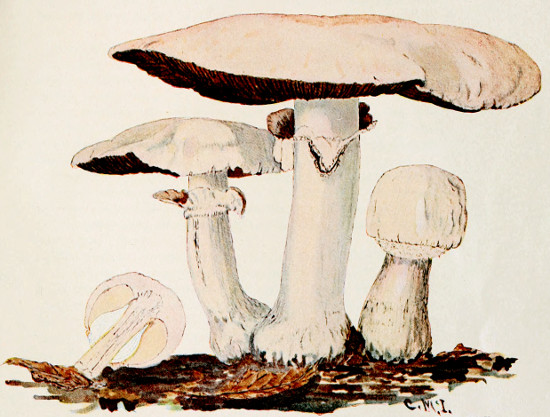
Grouped by F.D. Briscoe—Studies by C. McIlvaine. Plate XCIV.
Page.
Agaricus magnificus. Peck, 342
A new species of Agaricus.
A. magni´ficus Pk.—magnificent. (Plate XCIV.) Pileus 5–15 cm. (2–6 in.) broad, fleshy, thick, convex, becoming nearly plane or centrally depressed, bare, often wavy and split on the margin, white or whitish, often brownish in the center. Flesh 1.5–2 cm. (½ in.) thick in the center, thin on the margin, white, unchangeable. Gills numerous, rather broad, close, free, ventricose, white becoming dark purplish brown with age, never pink. Stem 10–15 cm. long (4–6 in.), about 2.5 cm. thick (1 in.), firm, stuffed with cottony pith, bulbous or thickened at the base, fibrillose, striate, minutely furfuraceous (covered with scurf) toward the base, ringed, pallid or whitish, the ring thin, persistent, white. Spores small, elliptic, 5–6µ long, 3–4µ broad.
343Gregarious or cespitose; thin woods, Mt. Gretna, Pa. August. Charles McIlvaine.
A large fine species distinguished from its near allies by the absence of pink hues from the gills. Mr. McIlvaine remarks that it has an anise-like flavor and odor and that when young the whole fungus is tender and high flavored, but when full grown the caps only are edible. Peck, Bull. Torr. Bot. Club, Vol. 26, F. 1899.
A. silvic´ola Vitt.—silva, a wood; colo, to inhabit. (Plate XCI, fig. 2, p. 332.) (A. arvensis, var. abruptus Pk.; now A. abruptus Pk.) Pileus convex or sub-bell-shaped, sometimes expanded or nearly plane, smooth, shining, white or yellowish. Gills close, thin, free, rounded behind, generally narrowed toward each end, at first whitish, then pinkish, finally blackish-brown. Stem long, cylindrical, stuffed or hollow, white, bulbous; ring either thick or thin, entire or lacerated. Spores elliptical, 6–8×4–5µ.
Plant 4–6 in. high. Pileus 3–6 in. broad. Stem 4–8 lines thick.
Woods, copses and groves or along their borders. Summer and autumn. Peck, 36th Rep. N.Y. State Bot.
Very good eating, though scarcely as highly flavored as the common mushroom. Peck.
West Virginia, Pennsylvania, New Jersey, June to frost. McIlvaine.
A. silvicola, by many authors considered a variety of A. campester, is, seemingly, becoming common. Professor Peck in 46th Rep. has made the abrupt bulb and its usual double veil distinctive marks which ally it to A. arvensis. He therefore calls it var. abruptus. As this book goes to press Professor Peck writes me that he concludes var. abruptus to be a good and distinct species. It is therefore given as such. While familiar with it since 1881, I never found it in quantity until 1898, at Mt. Gretna, Pa. There, among the straw and rubbish of abandoned camps on wood margins, it grew in great quantity; sometimes singly, at others in crowded clusters. When growing singly it exhibits all the characteristics of its description; when clustered, the stems are not always bulbous. The caps are thin but fleshy, brittle and bear a disproportionate width to the stem—like a plate on a pipe stem. The caps when mature are usually tinged with yellow and are spread flat; the ring is large, often double, yellowish, often torn, fragments of it frequently hang from the cap margin; the bulb when 344perfect is small, abrupt, as if it had once been round but the stem pushed into it. It has a strong spicy mushroom odor and taste, and makes a high-flavored dish. It is delicious with meats. It is the very best mushroom for catsup. Mixed with Russulæ or Lactarii or other species lacking in mushroom flavor, it enriches the entire dish. The stems, excepting of the very young, are tough.
Larvæ do not infest A. silvicola. Its habit of growth shows it to be cultivatable. It has but one draw-back. Growing as it does in woods and in the presence of the poisonous Amanita, it is possible for the careless collector to confound the two. The Amanitæ have larger bulbs, cups at the base, and white gills; the A. silvicola has no volva, has whitish gills when very young only, they become pinkish, then a marked blackish-brown.
A. creta´ceus Fr.—creta, chalk. Pileus 3 in. and more broad, wholly white, fleshy, lens-shaped-globose when young, then convexo-flattened, obtuse, dry, sometimes even, sometimes rivulose chiefly round the margin from the cuticle separating into squamules. Flesh thick, white, unchangeable. Stem 3 in. long, 3–6 lines and more thick, hollow, stuffed with a spider-web pith, firm, attenuated upward, even, smooth, not spotted, white. Gills free, then remote, ventricose but very much narrowed toward the stem, crowded, remaining long white, becoming dingy-brown only when old. Fries.
Spores 3×4µ W.G.S.; 5–6×3.5µ Massee.
Under certain conditions the spores are white. M.J.B.
In lawns and rich ground.
North Carolina, on earth and wood. Edible, Curtis; Minnesota, rare, Johnson; California, H. and M.; Ohio, Lloyd; Kentucky, Lloyd, Rep. 4; New York, Peck, Rep. 22.
A. subrufes´cens Pk.—sub, under; rufescens, becoming red. Pileus at first deeply hemispherical, becoming convex or broadly expanded, silky fibrillose and minutely or obscurely scaly, whitish, grayish or dull reddish-brown, usually smooth and darker on the disk. Flesh white, unchangeable. Lamellæ at first white or whitish, then pinkish, finally blackish-brown. Stem rather long, often somewhat thickened or bulbous at the base, at first stuffed, then hollow, white; the annulus flocculose or floccose-scaly on the lower surface; mycelium whitish, 345forming slender branching root-like strings. Spores elliptical, 6–7µ Peck, 48th Rep. N.Y. State Bot.
Indiana, H.I. Miller, 1898; Haddonfield, N.J., McIlvaine.
June 2, 1896, I found several specimens of a fungus new to me, and sent them to Professor Peck for identification. He pronounced it a dwarf form of his species A. subrufescens. The cluster grew on a florist’s compost pile at Haddonfield, N.J. Its flesh has a flavor like that of almonds.
This species is now cultivated and has manifest advantages over the marketed species—it is easier to cultivate, very productive, produces in less time after planting the spawn, is free from attacks of insects, carries better and keeps longer.
Amateurs are likely to succeed in growing it, and to have goodly crops of mushrooms instead of disappointments.
A. placo´myces Pk. Gr—a flat cake. (Plate XCI, fig. 3, p. 332.) Pileus thin, at first convex, becoming flat with age, whitish, brown in the center and elsewhere adorned with minute brown scales. Lamellæ close, white, then pinkish, finally blackish-brown. Stem smooth, annulate, stuffed or hollow, bulbous, white or whitish, the bulb often stained with yellow. Spores elliptical, 5–6.5µ long.
Cap 2–4 in. broad. Stem 3–5 in. long, ¼ to nearly ½ in. thick.
It grows in the borders of hemlock woods or under hemlock trees from July to September. It has been eaten by Mr. C.L. Shear, who pronounces it very good. I have not found it in sufficient quantity to give it a trial. This mushroom is very closely related to the wood mushroom or silvan mushroom, Agaricus silvaticus, a species which is also recorded as edible, but which is apparently more rare in our state (New York) than even the flat-cap mushroom. This differs from the silvan mushroom in its paler color, in having the cap more minutely, persistently and regularly scaly, and in its being destitute of a prominent center. In the silvan mushroom the scales, when present, are few, and they disappear with age. Peck, 48th Rep. N.Y. State Bot.
Mrs. E.C. Anthony, Gouverneur, N.Y., June, 1898, writes: “In great abundance on lawn, tumbling over one another in their haste to make their appearance. One of the largest, which did not have half a chance to display its proportions, would probably measure 7 in., perhaps more. When mature they crack across the top, showing the white 346flesh. The gills are pink, stem white, solid and bulbous. There is no perceptible odor when fresh.”
Indiana, H.I. Miller, edible, good.
Specimens sent to me by Mrs. Anthony, though not fresh, were eaten by me. They very much resembled the common mushroom, but probably, owing to their condition, were not so tender.
I have not found the species. The illustration is after a painting by Mrs. E.C. Anthony.
A. varia´bilis Pk.—variable. (Plate XCI, fig. 1, p. 332.) Cap 2–6 in. across, ovate, bell-shaped, irregularly convex and wavy, margin incurved but never striate, smooth, minutely fibrillose, with few remaining floccose scales; mature plant pure white, when young distinctly tinged with lilac and here and there with yellow when mature, slightly, broadly umbonate and depressed around umbo, cracks along gills. Flesh thick in center, very thin, even membranaceous toward margin, spongy, unchangeable. Gills free, close, thin, flaccid, ventricose, narrow next stem, but few short, pure-white when young, then dark-umber without purple tinge. Stem equal, tubed, white, silky, smooth above ring, rippled and minutely furfuraceous (scurfy) below, flocculose-furfuraceous when young, densely hairy at base, and occasionally slightly expanding, but not bulbous, densely cespitose with a coarse, white, root-like mycelium. Veil heavy at first, mottled with yellow scales beneath; as cap expands veil becomes thin, like tissue paper, ruptures at both stem and margin leaving torn ring on stem and appendiculate fragments on edge of cap.
Spores shed in great quantity, rich dark umber-brown without shade of purple.
Taste strong like almond. Smell slightly of musk, like the running mycelium of A. campester.
Found at Mt. Gretna, Pa. Charles McIlvaine.
I have never found worms in this species. It is very prolific and its habitat shows that it can be cultivated. Its freedom from worms and lasting carrying quality will make it commercially valuable.
It grew in an old roofless stable from September until after several frosts, in enormous quantity, 25 or 30 pounds in a patch. It differs from A. subrufescens in not having a shade of red about it, in its very distinct light-lilac cap when full grown, and in its snow-white youth. 347The young gills are pure white as are the caps. The stems sometimes taper upward, but they are usually remarkably equal.
It is delicate when cooked and of excellent flavor.
A. tabula´ris Pk.—relating to boards. Pileus 5–10 cm. broad, very thick, fleshy, firm, convex, deeply cracked in areas, whitish, flesh whitish, tinged with yellow, the areas pyramidal, truncate, the sides horizontally striate, their apices sometimes tomentose. Lamellæ narrow, close, free, blackish-brown when mature. Stem short, thick, solid. Spores broadly elliptical, 7.5–9µ long, 6–7.5µ broad, generally containing a single large nucleus.
In clay soil by roadsides. Craig, Colorado. August. E. Bethel.
This species is remarkable for the peculiar upper surface of the pileus which is broken into pyramidal areas. The sides of these are marked by parallel lines in such a way that they appear as if formed by small tablets placed one upon another, each successive tablet being a little smaller than the one immediately preceding it. Only dried and broken specimens have been seen by me and the notes of the collector do not give the color of the young lamellæ. There is a trace of a thick ring on the broken stem of one specimen. Peck, Bull. Torr. Bot. Club, Vol. 25, No. 6, 1898.
Not elsewhere reported. Edible qualities not given.

348PILOSACE Fr.
(Plate XCV.)
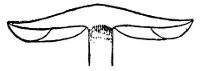
Section of Pilosace Algeriensis.
Hymenium differentiated from the stem. Gills free from the stem; general and partial veil both absent, hence there is no ring on the central stem. Spores purple-brown.
A peculiar genus, with the habit of Agaricus, but without a trace of a ring. Massee.
P. eximius Pk., 24th Rep. N.Y. State Bot., is the only species thus far reported in America. Edible qualities unknown.

STROPHA´RIA.
Gr—a sword-belt. (Referring to the ring.)
Flesh of stem and pileus continuous. Veil present, when ruptured forming a distinct ring on the stem. Gills more or less adnate.
On the ground or epiphytal.
Separated from all the genera of the purple-spored series but Agaricus by the presence of a distinct ring, and from that by the continuity of flesh in stem and pileus, and by the gills not being free. Pileus somewhat fleshy, sometimes viscid.
The species belonging to this genus are rather small, and from their habitats are frequently passed or overlooked. Yet many of them are common and plentiful. Those which have been tested are excellent and worth seeking in their season. The entire genus has been under a cloud. Writers upon it assert some of its members to be dangerously poisonous. So far as carefully tested by the writer no doubtful one has 349been encountered, and one—semiglobata—has been eaten by himself and friends since 1881, notwithstanding its dangerous reputation.
The division between this genus and Agaricus is not always sharply defined. S. æruginosa, S. semiglobata and S. stercoraria were formerly placed in Psalliota, now Agaricus.
ANALYSIS OF TRIBES.
A. Viscipelles (viscum, bird-lime; pellis, a skin). Page 349.
Pellicle of the pileus even or scaly, generally viscid.
* Mundi—mundus, clean. Not growing on dung.
** Merdarii—merda, dung. Ring often incomplete.
B. Spintrigeri (Stropharia spintriger).
Pileus without a pellicle, but fibrillose, not viscid. None known to be edible.
A. Viscipelles. Pellicle of the pileus even or scaly.
* Mun´di—not growing on dung.
(Plate XCVI.)
Stropharia æruginosa. Natural size. (After Stevenson.)
S. ærugino´sa Curt.—ærugo, verdigris. Pileus fleshy, but not compact, convex-bell-shaped then flattened, somewhat umbonate (obtuse when larger), with very viscid pellicle, the ground color yellowish but verdigris from the azure-blue slime with which it is more or less covered over, becoming pale as the slime separates. Stem hollow, soft, equal, at the first scaly or fibrillose below the ring, viscid, becoming more or less azure-blue green. Ring distant. Gills adnate, plane, 2 lines and more broad, not crowded, soft, whitish then dusky, becoming somewhat purple.
The above are the essential marks of this species. Variable in form, 350sometimes cespitose. The typical and handsomest form is gathered in soaking weather in later autumn in shaded woods; it is large (pileus and stem 3 in. and more), stem squarrose with white spreading scales, intensely verdigris or azure-blue-pelliculose and very glutinous. From this there is a long series of forms with the gluten more separating (on the separation of the gluten the pileus becomes yellow), and the scales alike of the pileus and stem rubbed off. Finally, a smaller form occurs in open meadows, stem scarcely 2 in. long, only 2 lines thick, becoming azure-blue-green and without scales, pileus 1–2 in. broad, pale verdigris soon light yellowish, less viscid. In this form the ring is incomplete, while in the typical form it is entire, spreading, and persistent.
In woods, meadows, etc. Common. July to November. Stevenson.
Spores ellipsoid or spheroid-ellipsoid, 8×4–5µ K.; 5×7µ W.G.S.; elliptical, 10×5µ Massee.
POISONOUS. Stevenson.
“There is a white variety, in which the pileus is perfectly white from the first.” Cooke.
S. æruginosa has been noted here by Schweinitz in Pennsylvania, Curtis in North and South Carolina, Frost in Vermont and Massachusetts, Harkness and Moore, California, Morgan, Ohio. The qualities of the American representatives are not reported. I have not seen the species. As it is asserted to be poisonous by European writers it may be. M.C. Cooke says: “It has the reputation, which is somewhat general on the continent, of being poisonous, but probably this is only assumed from its disagreeable taste and repulsive appearance.” Collectors are cautioned to look out for it, and not to eat of it carelessly.
I can find no case of poisoning by this species reported. It presents another case of “Not proven.”
** Merda´rii—ring often incomplete.
S. stereora´ria Fr.—stercus, dung. Pileus 1 in. broad, yellow, fleshy, but thin at the margin, hemispherical then expanded, obtuse, orbicular, with a viscid pellicle, naked, smooth, even or at length slightly striate only at the margin. Stem 3 in. and more long, 2–3 lines thick, stuffed with a separate fibrous pith, equal, clothed to the ring (which is scarcely 1 in. distant from the pileus, viscous, narrow, but somewhat spreading) with the flocculose veil which is at the same time viscous (so that it 351appears as if smooth), yellow. Gills adnate, very broad behind, 2 lines broad, somewhat crowded, dusky-umber or dusky-olivaceous, of one color, quite entire.
Stem silky-viscous when moist, when dry becoming even, shining and yellowish-white, and without a manifest veil. The gills are truncate and somewhat decurrent. Fries.
Spores 17×13µ W.G.S.; elliptical, 18–20×8–10µ Massee.
West Virginia, 1881–1885; Pennsylvania; New Jersey. June to November. McIlvaine.
I have enjoyed this species, which is common, since 1881. It is usually conspicuous upon droppings and manure piles. It also occurs on richly-manured ground, in wood and field, usually single; sometimes two or three are united.
Caps and stems are edible, but do not cook in the same time. It is better to cook the caps only. They are delicious.
(Plate XCVIa.)
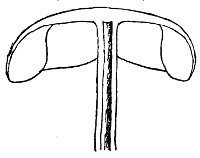
Section of Stropharia semiglobata. Natural size. (From Massee.)
S. semigloba´ta Batsch.—semi, half; globus, a ball. Pileus commonly ½ in. broad, light-yellow, slightly fleshy, hemispherical, not expanded, very obtuse, even, viscous. Stem about 3 in. long, 1 line thick, tubed, slender, firm and straight, equal, even, smooth, becoming yellow, paler at the apex, powdered with the spores, otherwise smeared with the glutinous veil which is abrupt above terminating in an incomplete (not membranaceous) viscous, distant ring. Gills adnate, very broad, plane, clouded with black.
Spores dusky-purple. Stevenson.
Spores blackish-purple, 13×8µ W.G.S.; elliptical, ends rather acute, 12×6µ Massee.
Grows on dung, rich lawns and pastures. April to November. A common, frequent, solitary species, easily recognized by its hemispherical cap, dark mottled gills. At first sight it resembles Naucoria semiorbicularis.
The caps are equal to any mushroom. I have eaten it since 1881. M.C. Cooke says: “It was Sowerby who drew attention to this species 352as dangerous, and intimated that it had been fatal. Since that period we are not aware of any further evidence against it.”
It is tender, good and harmless.
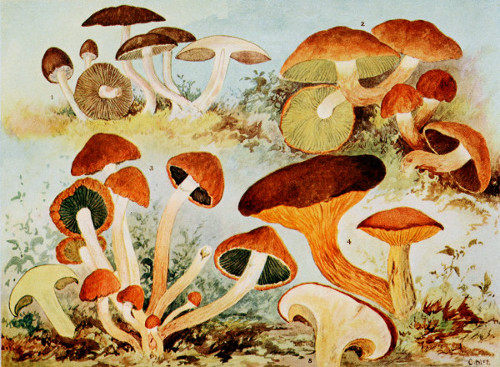
Grouped by F.D. Briscoe—Studies by C. McIlvaine. Plate XCVII.
Fig. Page. Fig. Page.
1. Hypholoma appendiculatum, 363 3. Hypholoma sublateritium, 359
2. Hypholoma perplexum, 354 4. Gomphidius rhodoxanthus, 394
HYPHOLO´MA.
Gr—a web; Gr—a fringe.
(Plate XCVIII.)
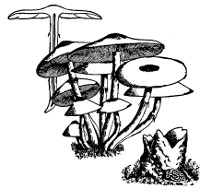
Hypholoma fascicularis. Natural size.
Pileus more or less fleshy, margin at first incurved. Veil webby, adhering in fragments to the margin of the pileus, not forming a distinct ring on the stem. Stem fleshy, similar in substance to that of the pileus with which it is continuous. Gills attached to the stem, sometimes with a notch at the juncture (emarginate), occasionally separating and then appearing to be free.
Generally cespitose, mostly growing on wood above or under the ground.
Spores brownish-purple, sometimes intense-purple, almost black.
Corresponding to Tricholoma, Entoloma and Hebeloma.
353ANALYSIS OF TRIBES.
Fasciculares (H. fascicularis). Page 354.
Pileus tough, smooth, bright colored, not hygrophanous.
Viscidi (viscidus, viscid).
Pileus naked, viscid. None known to be edible.
Velutini (H. velutinus). Page 360.
Pileus silky or streaked with small fibers.
Flocculosi (floccus, a lock of wool).
Pileus covered with superficial floccose scales, at length disappearing. (None reported edible.)
Appendiculati (H. appendiculatus). Page 362.
Pileus smooth, hygrophanous.
Members of this purple-spored genus grow upon decayed wood, either standing or as roots in the ground, or from ground heavily laden with woody material. They grow singly, in groups, or in densely-tufted or overlapping masses. The several species vary in shades of yellow, red, orange, brick-color and brown; their caps are from 1–6 in. across; their stems are short or long, as the number in the cluster permits; when growing singly the stems are short and sturdy. There is a floccose veil, or remnants of one, about the stem. The gills are yellowish, greenish, olivaceous or greenish shades of yellow, gray, purple, almost black. They are showy, easily recognized and are found from September until mid-winter. I have gathered them when frozen hard. The flesh is solid, or spongy, flexible or fragile, white or yellowish; the tastes are sweet, nutty, bitter and saponaceous. Patches of them—and they are frequent in almost every woods in the land—often yield several bushels. Tons of them annually go to waste.
Old authors and some copyists say “the species are not edible, the tough ones being bitter, the fragile ones almost void of flesh.” Eighteen years of experience with them warrants my saying that there is not a single wild genus approaching it in economic value, and when its most prominent species are properly cooked, few equal it in consistency and flavor. As a pickle the Hypholomas have no superior.
354Half a dozen or more of the species are exceedingly difficult to separate. Professor Peck has happily made a new species, H. perplexum, which is well named. For all culinary purposes these affiliated species may be gathered under that convenient name; for botanic purposes his description covers several perplexing characteristics common to what have been written as separate species, and covers a composite species.
The occasional bitter taste of some species is not constant, and can not be relied upon as a distinguishing mark. In the same tufts some individuals may be mild, others bitter; some individuals in groups are in a position and of an age to absorb water; others are not. There will be a marked difference in their taste raw. A few in the same group may have been infested by insects; others not. Those infested are often intensely bitter, while their companions are of pleasant flavor. The same remarks apply to neighboring clusters and individuals. I am of the opinion, from long observation, that the bitter is largely due to the injury and excrement of larvæ. Changes of taste occur in toadstools in a most marked and rapid manner. Apples from the same tree, chestnuts from the same tree, acorns from the same oak, radishes from the same seed, blackberries from the same bush, differ widely in taste. Why not toadstools of the same species?
I have often seen species of this genus, described as having stems up to 5 in. long, stretch and twist their stems to over a foot in order to get their caps from the inside of, or from a crack in a decaying stump, out into the light; and I have seen stems of the same species stout, solid and sturdy when individuals grew upright and singly. But wherever and however they grow, Hypholomas are safe. I have eaten them indiscriminately since 1881, and as long ago as 1885 published their edibility.
Fascicula´res. Pileus smooth, etc.
H. perplex´um Pk.—perplexus, perplexed. Perplexing Hypholoma. (Plate XCVII, fig. 2, p. 352.) Pileus convex or nearly plane, glabrous, sometimes broadly and slightly umbonate, reddish or brownish-red fading to yellow on the margin, the flesh white or whitish. Lamellæ thin, close, slightly rounded at the inner extremity, at first pale-yellow, then tinged with green, finally purplish-brown. Stem nearly equal, firm, hollow, slightly fibrillose, whitish or yellowish above, rusty-reddish or reddish-brown below. Spores elliptical, purplish-brown, 8×4µ.
355The Perplexing hypholoma has received the name because it is one of a group of five or six very closely allied species, whose separation from each other is somewhat difficult and perplexing. Of these six species three have a decidedly bitter, unpleasant flavor, and three are mild, or not decidedly bitter, if we may rely on the published descriptions of them. The three bitter ones, also, have no purplish tints to the mature gills; but two of the mild ones have. By using these and other distinguishing characters the six species may be tabulated and their several peculiarities more clearly shown.
Taste bitter 1
Taste mild, or not clearly bitter 3
1. Stem solid or stuffed, flesh whitish, gills whitish, then sooty-olive sublateritium
1. Stem hollow, flesh yellow 2
2. Cap yellow or tinged with tawny, stem yellow, gills yellow, becoming greenish fasciculare
2. Cap brick-red, stem ferruginous, gills green, becoming olive elæodes
3. Cap red or brick-red, with a yellow margin; gills yellow, then greenish, finally purplish-brown perplexum
3. Cap yellow, or slightly tawny on the disk only 4
4. Gills gray, becoming purplish-brown capnoides
4. Gills yellow, becoming gray, neither green nor purplish epixanthum
Probably in general appearance the Perplexing hypholoma most nearly resembles the brick-red Hypholoma, H. sublateritium; but it has often been mistaken for the tufted Hypholoma, H. fasciculare. From this it may be separated by the more red cap, the whitish flesh, the purplish-brown color of the mature gills, and the mild flavor. From H. sublateritium it is distinguished by its usually smaller size, more slender hollow stem, the yellow greenish and purplish tints of the gills, and the absence of a bitter flavor. Some may prefer to consider it a variety of this fungus, rather than a distinct species.
Its cap is 1–3 in. broad, its stem 2–3 in. long and 2–4 lines thick. It commonly grows in clusters, though sometimes singly, on or about old stumps or prostrate trunks of trees, in woods or open places. The caps of the lower ones in a cluster are often defiled and apparently discolored by the spores that have lodged on them from the upper ones. 356It appears in autumn, and continues until freezing weather stops its growth. It is a very common species, as well as a late one, and may often be gathered in large quantity. Its flavor is not first quality, but with good preparation it makes a very acceptable dish. It has been tested by myself and correspondents several times, and has been proved harmless. Peck, 49th Rep. N.Y. State Bot.
West Virginia, 1881–1885; New Jersey, North Carolina, Pennsylvania, October to January. On stumps, roots, ground containing decayed woody matter. McIlvaine.
H. perplexum is abundant in most if not all the states. I have eaten it and its allied species since 1881; dried them, pickled them, and fed them to many. If the collector gets puzzled, as he will, over one or all of these species, because no description fits, he can whet his patience and appetite by calling it H. perplexum and graciously eating it.
H. capnoi´des Fr. Gr—like smoke, from the color of the gills. Pileus 1 in. sometimes 3 in. broad, ochraceous-yellowish, fleshy, convex, then flattened, obtuse, dry, smooth. Flesh somewhat thin, white. Stem 2–3 in. long, 2–4 lines thick, growing together at the base, hollow, equal, often curved and flexuous, becoming silky-even, pallid, whitish at the apex, here and there striate, becoming rust-colored under the surface-covering when old. Cortina appendiculate, white, then becoming brownish-purple. Gills adnate, easily separating, somewhat crowded, rather broad, arid, at first bluish-gray then becoming brownish-purple.
Cespitose, fasciculate; odor and taste mild. On pine-stumps. Uncommon. Fries.
Spores ellipsoid-spheroid, 7×5µ K.; elliptical, brownish-purple, 8×4µ Massee.
California, H. and M.; Minnesota, not necessarily in fir-woods, Johnson; New York, on or about stumps or decaying wood of spruce. Peck, 50th Rep.
Haddonfield, N.J., 1894. Pine roots and stumps, and on ground. Cespitose. September to frost. McIlvaine.
A pretty species with caps up to 1½ in. across. Stem 2–4 in. long, ¼-⅜ in. thick, growing together (connate). The taste and smell are pleasant. The basket is soon filled from its clusters. There is not a better Hypholoma. The slightly soapy taste which attaches to most of the abundant and better known species is absent in this.
357H. fascicula´ris Huds.—fasciculus, a small bundle. (Plate XCVIII, p. 352.) Pileus about 2 in. broad, light yellow, the disk commonly darker, fleshy, thin, convex, then flattened, somewhat umbonate or obtuse, even, smooth, dry. Flesh light yellow. Stem very variable in length, hollow, thin, incurved or flexuous, fibrillose, of the same color as the pileus and flesh. Gills adnate, very crowded, linear, somewhat deliquescent, sulphur-yellow then becoming green.
It is very easily distinguished from the preceding species by its bitter odor and taste, light-yellow flesh, and somewhat deliquescent, sulphur-yellow then green gills. It forms also more crowded clusters. There are many remarkable varieties; one robustior (more robust), stem thickened at the base, another nana (dwarf), both on the ground.
Cespitose on old stumps and the ground. Extremely common. Stevenson.
Spores elliptical, 7×4µ Massee; 6–7×4µ K.; 6×4µ W.G.S.; ferruginous purple, 6×4µ Morgan.
“It is very usual to regard this as a poisonous species, but possibly it is not so in reality.” Cooke.
West Virginia, 1881, Pennsylvania, New Jersey, North Carolina, McIlvaine.
A very common species appearing in October and lasting until well into the winter, growing in large, overlapping masses or in tufts from old stumps or roots, and about trees where decay has begun. Sometimes solitary. It is then short-stemmed and sturdy. There are several closely allied species. To know the one from the other, a careful study of the group is necessary. (See introduction to genus, H. epixanthum, H. sublateritium, H. capnoides, H. elæodes, and H. perplexum.) Old authors give it as bitter and poisonous. The bitter is not always present. Any there is disappears in cooking. It is not poisonous, but one of our most valuable species. I have eaten it since 1881. A little lemon juice or sherry will cover the slightly saponaceous taste sometimes present. The caps only are good. It makes a choice pickle and a good catsup.
H. epixan´thum Fr. Gr—epixanthos, yellowish-brown. Pileus 2–3 in. broad, light-yellow or becoming pale, the disk commonly darker, fleshy, moderately thin, convexo-plane, obtuse or gibbous, even, slightly silky then becoming smooth. Flesh white, becoming light-yellow. Stem 358about 8 in. long, 3–4 lines thick, hollow, attenuated from the thickened base or equal; floccose-fibrillose, pale rust color or becoming dingy-brown below, with a frosty bloom at the apex; veil hanging from margin of pileus, white. Gills adnate, crowded, at first light yellow-white, at length becoming ash-colored, not deliquescent, and not becoming purple or green.
Strong smelling, odor acid; extremely variable in stature; not hygrophanous. Fries.
Spores elliptical, 7×4µ Massee.
West Virginia, Pennsylvania, New Jersey, North Carolina. On oak, chestnut stumps and growing from tree roots in ground. October to December. McIlvaine.
(See H. perplexum, H. sublateritium and compare descriptions.)
This species, in common with its allies, is extremely hard to determine. When growing singly from roots or from ground heavily charged with decaying wood, it is a sturdy, solid plant; when in clusters the stem is longer, more flexible and the whole character of the plant is modified. Except for botanic purposes there is no occasion to puzzle over it. It is in every way an excellent and useful fungus.
H. disper´sus Fr.—dispergo, to scatter. Pileus 1–1½ in. broad, tawny-honey-color, not hygrophanous, slightly fleshy, bell-shaped then convex, at length expanded, even, superficially silky round the margin with the veil, or squamulose, otherwise even and smooth. Flesh thin, a little paler than the pileus. Stem 2 in. or a little more long, 2 lines thick, tubed, equal, tense and straight, tough, fibrilloso-silky, somewhat rust-colored, becoming dingy-brown at the base, pale at the apex. Gills adnate, thin, ventricose, broad, 3–4 lines, crowded, at first pallid-straw color, at length crowded, obsoletely green. Fries.
Gills broader than H. fascicularis, etc. Solitary, scarcely ever cespitose. On pine stumps and the ground. April to November.
Spores elliptical, 7×3–4µ Massee.
North Carolina, in pine woods, Curtis; California, H. and M.; West Virginia, Pennsylvania, North Carolina, New Jersey, McIlvaine.
Difficult to distinguish from H. fascicularis when growing solitary. Its edible qualities are precisely the same.
H. elæo´des Fr. Gr—an olive; Gr—eidos, appearance. Pileus 359brick-red or tan, fleshy, rather plane, somewhat umbonate, dry, smooth, opaque. Flesh yellow. Stem stuffed then hollow, equal, commonly slender, incurved or flexuous, fibrillose, of the same color as the pileus, becoming rust-color. Gills adnate, crowded, thin, green then pure olivaceous.
Cespitose. Odor bitter. On trunks and on the ground. Fries.
Cap 1–2 in. across. Stem 2–4 in. long, ¼-⅜ in. thick, stuffed then hollow.
West Virginia, 1881–1885, Haddonfield, N.J.; Pennsylvania. On stumps, roots and ground in woods, etc. McIlvaine. Not reported elsewhere.
Its habit is the same as H. fascicularis, to which it is closely allied, and to me seems but a form of this very variable species. It is equally good.
H. sublateri´tium Schaeff.—sub and later, a brick. (Plate XCVII, fig. 3, p. 352.) Pileus 2–3 in. and more broad, tawny-brick-red, but paler round the margin and covered over with a superficial, somewhat silky, whitish cloudiness (arising from the veil), fleshy, convexo-plane, obtuse, discoid, dry, even, becoming smooth. Flesh compact, white, then becoming yellow. Stem 3–4 in. long, 3–5 lines thick, stuffed, stout and firm, commonly manifestly attenuated downward, rarely equal, scaly-fibrillose, fibrils pallid, rust-colored downward. Cortina superior, at first white, at length becoming black. Gills adnate, more or less crowded according to stature, narrow, at first dingy yellowish and darker at the base, then sooty, and at length inclining to olivaceous.
Spores brownish purple. Somewhat cespitose. Stem incurved from position. There are many varieties: B, somewhat solitary, the pileus and stem, which is thickened at the base, of the same color, reddish. C, smaller, pileus light yellowish, the hollow stem equal. Schaeff.
Var. squamo´sum, Cooke. Pileus convex, bright brick-red, shading to yellow at the margin, spotted with superficial scales. Flesh very thick, yellowish. Gills narrowish, adnate. Stem elongated, stout, pale above, rust-colored below, hollow, veil hanging from the margin when young.
On trunks. A very beautiful variety, larger and more robust than the typical form. Massee.
Spores 6×3µ. W.G.S.; elliptical, sooty-brown, 8×4µ Massee.
360West Virginia, 1881–1885; Pennsylvania, New Jersey, densely cespitose on stumps and roots. October to long after frosts. McIlvaine.
Edible. Dr. Taylor, 1893. Dept. of Agr. Rep. No. 5.
H. sublateritium has many forms. Both Fries and Stevenson indicate this as a variable species and my own observation confirms the truth of this.
This is a very common autumnal species, lasting into the winter. Old authors give it as bitter and very poisonous. I tested it in 1881 and have been eating it, in common with all Hypholomas I have found, ever since. At times it is bitter. I believe this to be due to the passage of larvæ through the flesh. Unattacked specimens are slightly saponaceous to the taste while others in the same bunch are bitter.
Vis´cidi. Pileus viscid, etc. (None known to be edible.)
Velutini. Pileus silky, etc.
H. veluti´nus Pers.—vellus, a fleece. Velvety. Pileus fleshy, thin, convex or expanded, brittle, minutely tomentose-scaly, becoming smooth, hygrophanous, yellow with the disk reddish. Lamellæ rather broad, attached, tapering toward the outer extremity, dark brown tinged with red, the edge whitish-beaded. Stem equal, rather slender, hollow, fibrillose, subconcolorous, white-mealy and slightly striate at the top. Spores black.
Height about 2 in., breadth of pileus 1–1.5 in.
Roadsides. Albany Cemetery. September. The pileus sometimes cracks transversely. Peck, 23d Rep. N.Y. State Bot.
Spores 6×8µ W.G.S.; elliptical, 10×5µ Massee.
Often used in catsup. Innocent and edible. Cooke.
West Virginia. 1881–1885, Pennsylvania, West Philadelphia, Bartram’s Creek, 1887, McIlvaine.
Var. leioceph´alus B. and Br. (Gr—smooth; Gr—head, from its smooth pileus). Pileus hygrophanous, rugged, smooth except at the margin, where it is fibrillose, pallid as is the stem, whose apex is mealy.
Densely cespitose, much smaller than the common form, but apparently a mere variety, though a striking one from its smooth but very rugged disk. On old stumps. Stevenson.
New York, Peck, 23d Rep.; West Virginia, West Philadelphia, Bartram’s Creek, Haddonfield, N.J., September to November. McIlvaine.
361Quantities of var. leiocephalus grow in the West Virginia forests on stumps and on the ground from decaying roots. 1½ in. is the limit of its width. Its frequent and dense clusters, its tenderness and delicacy of flavor make it a favorite.
H. aggrega´tum Pk.—aggrego, to grow together. Densely cespitose. Pileus thin, convex or subcampanulate, grayish-white, obscurely spotted with appressed brownish fibrils. Lamellæ subdistant, rounded behind, nearly free, at first whitish, then brown or blackish-brown with a whitish edge. Stem rather long, hollow, somewhat woolly or fibrillose, white. Spores brown, elliptical, 8×4–5µ.
Pileus about 1 in. broad. Stem 2–3 in. long, 1.5–2 lines thick.
At the base of trees and stumps in woods. Alcove. September.
The cespitose habit and obscurely spotted grayish-white pileus are marked features of this species. From H. silvestre the species may be distinguished by its smaller size, adnexed or nearly free lamellæ which have no rosy tint, and by its very cespitose mode of growth. Peck, 46th Rep. N.Y. State Bot.
Mt. Gretna, Pa., about trees and stumps. September to November, 1898–1899. McIlvaine. Not reported elsewhere.
The caps are oyster-color. Amateurs accustomed to the gayer colors of the autumnal Hypholomas will not suspect this of belonging to the genus, until the color of the spores is obtained.
The caps are fine.
H. lachrymabun´dum Fr.—lachryma, a tear. Pileus 2–3 in. broad, whitish when young, then dingy-brown, becoming pale around the margin, truly fleshy but not compact, convex, obtuse, scaly with hairs, the innate scales darker. Flesh white. Stem 2 in. long, 3–4 lines thick, hollow, somewhat thickened at the base, scaly with fibrils, becoming brownish-whitish. Veil separate, clothed with fibers, hanging from the pileus, white. Gills adnate, crowded, 3 lines broad, whitish then brownish-purple, edge whitish and distilling drops in wet weather.
Spores brownish-purple. From mutual pressure the caps are often irregular. Very cespitose, firm. Fries.
Spores brownish-purple, 9×4µ Massee.
On ground and on trunks. Truly cespitose. Smaller than H. velutinus, 362but firmer, truly fleshy, not hygrophanous. Bushy pastures. Bethlehem. October.
Our specimens do not agree in all respects with the published description of the species. The pileus is sometimes wholly destitute of scales and sometimes densely clothed with hairy, erect ones. The species is manifestly variable. Peck, 30th Rep. N.Y. State Bot.
“Like H. fascicularis in quality. Intensely irritant. It is bound with the weight of its own guilt.” Hay.
This is a good specimen of Hay’s comments. H. fascicularis is never irritant, is good eating, is innocent.
There is irony in the comment of Dr. Cooke: “This doubtful species is used by the smaller ketchup makers.”
I have not seen this species. When I do I shall eat it and expect to live.
Appendicula´ti. Pileus hygrophanous, smooth.
H. incer´tum Pk. (Plate XCVIIa.) Pileus fragile, convex or subcampanulate, then expanded, hygrophanous, often radiately wrinkled, whitish with the disk yellowish, the thin margin sometimes purplish-tinted, often wavy, adorned by fragments of the white flocculent fugacious veil. Lamellæ close, narrow, whitish then rosy-brown, the edge often uneven. Stem equal, straight, hollow, easily splitting, whitish with a frosty bloom or slightly scurfy at the top. Spores elliptical, purplish-brown, 8×5µ.
Plant gregarious or subcespitose, 2–3 in. high. Pileus 1–2 in. broad. Stem 1–2 lines thick.
Ground among bushes. Green Island and Sandlake. June and July.
The veil is sometimes so strongly developed as to form an imperfect ring. The color is nearly white from the first. Peck, 29th Rep. N.Y. State Bot.
As the name indicates, I was uncertain whether this was a form of H. Candolleanum, to which it is very closely related, but as Fries says of that “Gills at first violaceous,” and as our plant has them at first white or whitish, I concluded to risk the uncertainty on a new species.
I have seen Central Park, New York, well covered with it in May. It is also common in the vicinity of Boston. Of very agreeable flavor and delicate substance. The profusion of its growth compensates for its small size. Macadam.
363Indiana, H.I. Miller; Mt. Gretna, Pa., in great clusters between railroad ties and beside track, McIlvaine.
Tender. One of the best.
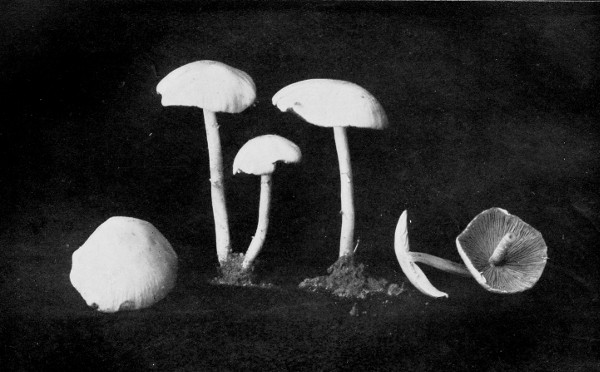
Photographed by Dr. J.R. Weist. Plate XCVIIa. HYPHOLOMA INCERTUM.
H. appendicula´tum Bull.—a small appendage. From the veil adhering to margin of pileus. (Plate XCVII, p. 352.) Pileus 2–3 in. broad, date-brown then tawny, becoming pale yellowish when dry, fleshy-membranaceous, thin, ovate then expanded, at length flattened, obtuse, smooth, when dry slightly wrinkled, somewhat sprinkled with atoms. Stem 3 in. long, 2–3 lines thick, fistulose, equal, smooth, white, pruinate at the apex; veil fringing the margin of the pileus, fugacious, white. Gills somewhat adnate, crowded, dry, white then flesh-colored, at length dingy-brown.
Densely cespitose, very fragile and hygrophanous. Much thinner and more fragile than H. Candolleanus. It may be safely distinguished from species which are nearest to it by the gills being whitish then brownish-flesh color.
Var. lana´tum. A curious form, densely woolly when young, traces of the woolly coat remaining at the apex when the pileus is fully expanded. Sibbertoft. B. and Br., 1876. Stevenson.
Spores ellipsoid, pellucid, 6–8×3–4µ K.; 4×6µ W.G.S.; elliptical, 5×2.5µ Massee.
Angora, West Philadelphia, October, November, December, 1897; Haddonfield, N.J., Mt. Gretna, Pa., cespitose and gregarious in woods about stumps. McIlvaine.
“It is very common and edible.” Farlow.
At Mt. Gretna, Pa., October, 1898, in great abundance. When found it was gregarious in large patches and cespitose on stumps. My identification was confirmed by Professor Peck.
It dries well, and retains flavor and esculent qualities. Cooked it is among the best.
H. Candol´leanum Fr.—After De Candolle. Pileus 2–4 in. broad, date-brown then becoming white, the top somewhat yellowish, somewhat fleshy, acorn-shaped then bell-shaped, soon convex and at length flattened, obtuse and unequal, smooth, even. Flesh thin, white. Stem 3 in. long, 2–4 lines thick, fistulose, solid at the base, somewhat thickened, fibrillose, white, striate at the apex; veil in the form of a cortina, 364web-like, appendiculate (depending from the margin of the pileus), white, at length becoming dingy-brown. Gills rounded-adnexed, then separating, crowded, violaceous then brownish-cinnamon, the edge at first whitish.
Readily distinguished from neighboring species by the gills being at first beautifully dark violaceous, never flesh-colored. Densely cespitose, fragile, very hygrophanous. Stevenson.
Spores elliptical, 8×4µ Massee.
Edible, often used in catsup. Cooke.
A species variable in color with the weather. Its gills are cream-colored at first, then purplish, then very dark. After rain the fragile cap often turns up at the margin and splits.
It differs somewhat in texture from other Hypholomas, being more delicate in texture and substance. It is excellent.
H. suba´quilum Banning.—aquilus, brownish, tawny. Pileus brown, convex, smooth, hygrophanous, often shaded into ocher at margin, veil delicate, silk-like, encircling and covering the marginal extremities of the lamellæ but forming no ring on the stem. Flesh white, turning umber when cut. Lamellæ adnexed or nearly free, close, forked, umber. Stem cespitose, regular, hollow, silky, white, 2–3 in. long.
Spores brown, 4×5µ. Banning MS.
Druid Hill Park, Baltimore, Miss Banning; decaying wood, Adirondack mountains. August and September. New York. Peck, 45th Rep. N.Y. State Bot.
H. subaquilum is closely allied to H. appendiculatum, but is distinguished by its darker colored cap and gills.
Its edible qualities are the same. It is among the best.

365PSILO´CYBE Fr.
Gr—naked; head.
Pileus more or less fleshy, smooth, margin at first incurved. Gills becoming brownish or purple. Stem somewhat cartilaginous, rigid or tough, tubular, hollow or stuffed, often rooting. Veil absent or rudimentary, never forming a membrane. Spores purple, purple-brown or slate-color.
Generally growing on the ground, gregarious, sometimes cespitose.
Psilocybe is analogous in form to Collybia, Leptonia and Naucoria, which are distinguished by their spore colors. Separated from Psathyra by the incurved margin of the pileus.
But one species of Psilocybe is herein given as edible. Of it, alone, the writer has had opportunity to eat meals. Several others of the species have been found by him and tested in small quantity. They are all of good texture, substance and flavor, though most are small. He is of the opinion that increased testing will prove the entire genus edible. Nothing can or should be prognosticated about a toadstool, but the indications are all in favor of Psilocybe.
(Plate XCIX.)
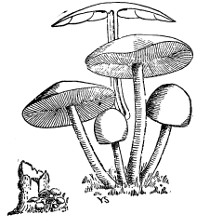
Psilocybe spadicea. Two-thirds natural size.
P. spadi´cea Schaeff.—spadiceus, date-brown. Pileus thin, submembranaceous, hemispherical, then convex or expanded, smooth, hygrophanous, pale grayish-brown and striatulate when moist, white or yellowish when dry. Gills narrow, close, attached, easily separating from the stem, at first whitish, then brown, tinged with flesh-color. Stem straight, equal, hollow, smooth, white.
Height 1–2 in., breadth of pileus 1–1.5 in. Stem 1–2 lines thick.
Grassy ground in yards and fields. Albany. June. Gregarious or cespitose. The pileus is fragile, the spores are brown. Peck, 23d Rep. N.Y. State Bot.
Spores brown, 9×4µ Massee; purplish brown, 7.6×5.1µ Morgan.
Haddonfield, N.J., October, November, December, 1896. In large patches and where stumps had been taken from the ground. McIlvaine.
366Var. hygro´philus Fr. Gr—moist; loving.
Pileus tawny, then clay-color. Stem 4–6 in. long, rather fusiform, rooting. Gills emarginate with a deeply decurrent line; at length umber-brown.
Var. polyceph´alus Fr.—polus, many; cephale, head.
Densely crowded. Stem thinner, flexuous. Gills nearly free, at length tawny-umber.
The plant is tender, cooks easily and is of fine flavor.
P. semilancea´ta Fr.—semi, half; lancea, a spear. Pileus ½ in. high, not broad, various in color, becoming yellow, green, dingy-brown, somewhat membranaceous, acutely conical, almost cuspidate, never expanded, but the margin when young at first bent inward, covered with a pellicle which is viscous and separable in wet weather, slightly striate chiefly round the margin. Stem as much as 3 in. long, scarcely 1 line thick, tubular and containing a pith, equal, more frequently flexuous, smooth, capable of being twisted round the finger, smooth, becoming pale; furnished with a veil when young. Gills ascending into the summit of the cone, adnexed, almost linear, crowded, becoming purple-black. Fries.
Gregarious, very tough. Pastures and roadsides, etc. Common. August to November. Stevenson.
Spores ellipsoid, 9–16×4–9µ K.; 14×9µ W.G.S.
New York, Peck, Rep. 23; Novia Scotia, Somers.
Var. cærules´cens Cooke—becoming blue. Base of stem turning indigo-blue.
Not common in America, but frequently found. According to M. C. Cooke—a careful authority—P. semilanceata has a dangerous reputation. It is said to have proved fatal to children when eaten raw. It is not deleterious when cooked.
367PSA´THYRA Fr.
Gr—friable.
(Plate C.)
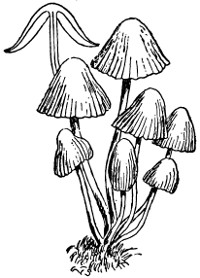
Psathyra gyroflexa. Natural size. (After Massee.) Omitted from Index to Species.
Veil none or only universal, and floccoso-fibrillose. Stem somewhat cartilaginous, fistulose with a tube, polished, fragile. Pileus conical or bell-shaped, membranaceous, the margin at the first straight and adpressed to the stem. Gills becoming purple or brownish. Slender, fragile, hygrophanous.
Some of the last species of Hypholoma and Psilocybe are very closely allied to them. The Coprinarii are readily distinguished by the gills being white or ash-color, then black, not dusky-brown nor becoming purple.
Psathyra corresponds with Mycena, Nolanea, Galera and Psathyrella. All the species grow on the ground or on trunks. Stevenson.
But four American species reported. Small and unimportant.
DECONICA.
Stem tough; margin of Pileus at first incurved. Gills subtriangularly decurrent. Corresponds with Omphalia, Eccilia, Tubaria.
Few American species. Small and unimportant.
368Series V. MELANOS´PORÆ (spores black). Gr—black; Gr—seed.
Various as are the spore colors in this series (in its broadest sense), there is an entire absence of brown and purple shades in the black spores of four of the genera belonging to this group or series. In Gomphidius the spores are dingy-olivaceous. It is an outsider affiliating with thoroughbreds because of more technical congeniality than other genera afford. Like comets in the universe, it has no home. The singular genus Montagnites (of which but one species has been found in America, and that in Texas) has the relationship of spore-color. Panæolus, Anellaria, Psathyrella, when young, have gills free from each other; Coprinus, in early life, presents them pressed tightly together; as the plants age and the spores ripen, the entire gill structure becomes black and dissolves into an inky fluid, the color of which is due to the spores.