Sub-Class BASIDIOMYCETES (continued 8)
Reading edition
The species are all of delicate body, and many of them add generously to table luxuries.
COPRI´NUS Pers.
Gr—dung.
Pileus separate from the stem. Gills membranaceous, at first closely pressed together, cohering, at length melting into a black fluid. Trama obsolete. Spores oval, even, black.
The extreme closeness of the gills and their entire deliquescence into a fluid, black from the spores, sharply define this genus and separate it from all others. At first the form is oval or cylindrical; most are furnished with a downy or scurfy veil often adhering to the pileus, sometimes forming an adhering volva at the base of the stem. Nearly all are ephemeral, many completely disappearing in a day.
Cystidia (sterile cells) of large size are frequent on the gills of many species.
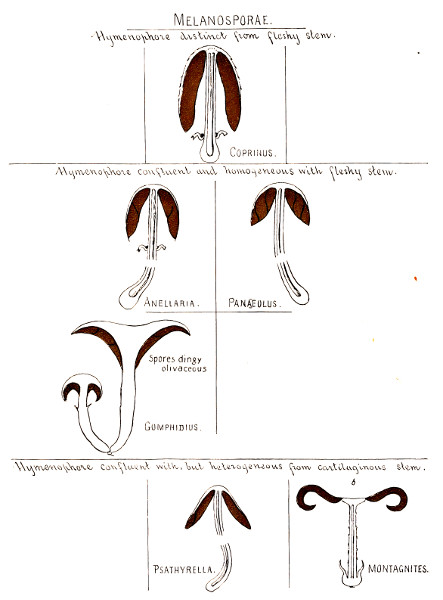
Plate CI. Chart of genera in black-spored series—Melanosporae, Page 368.
369The majority grow on richly manured ground or dung, some on rotten wood and other materials. Bolbitius, the only ally, has the same ephemeral existence, and grows in similar situations, but the gills only soften (not melting) and the spores are somewhat rust-colored.
The blackening of the gills is not a process of decay, but is due to the growth of the spores, and the plant is still (before deliquescence) perfectly edible although not so inviting in appearance as before.
Species of Coprinus are very common and are easily recognized by the deliquescent gills which, when mature, stain the fingers black.
In “Once upon a Time,” when country people made their own writing inks, the convenient Coprinus gave its juices for this purpose. A little corrosive sublimate added to the boiled and strained fluid prevented it from molding.
With few exceptions the species are small. They are tender, of real mushroom flavor and highly enjoyable. They make a thin, well flavored catsup, but are better used to give flavor to their less favored brethren.
They stew in from two to fifteen minutes, depending upon the solidity of the species.
ANALYSIS OF THE TRIBES.
A. Pelliculosi (pellicula, a thin skin). Page 370.
Gills covered above with a fleshy or membranaceous skin, hence the pileus does not split along the lines of the gills, but becomes lacerated with the edges turned upward.
* Comati—coma, hair. Furnished with a ring formed from the free margin of the volva. The skin of the pileus torn into innate scales.
** Atramentarii—atramentum, ink. Ring imperfect. Volva absent. Pileus dotted with minute innate scales.
*** Picacei—pica, a magpie. Universal veil downy, at first continuous then broken up into superficial scales forming patches on the pileus.
**** Tomentosi—tomentum, down. Pileus at first covered with a loose hairy down, becoming torn into distinct scales, at length disappearing. Ring absent.
***** Micacei—mico, to glitter. Pileus at first covered with minute glistening scales, soon disappearing. Ring none.
****** Glabrati. Pileus smooth. Veil absent.
370B. Veliformes (velum, a veil; forma, form). Page 380.
Pileus very thin without a skin, at length opening into furrows along the backs of the gills and becoming folded in furrows. Stem thin, hollow. Gills wasting away into thin lines.
* Cyclodei. Gr—a circle; appearance. Stem with a ring or volva.
** Lanatuli—lanatus, woolly. Pileus covered with superficial woolly floccules, at length disappearing. Ringless.
*** Furfurelli—furfureus, branny. Pileus mealy or scurfy. Gills generally attached to a collar at the apex of the stem. Ringless.
**** Hemerobii. Gr.—living a day. Pileus always smooth.
None known to be edible.
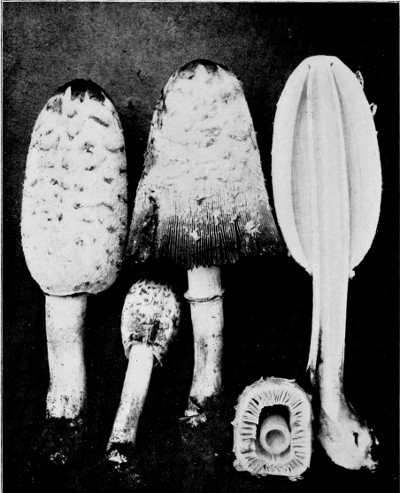
Photographed by Dr. J.R. Weist. Plate CIII. COPRINUS COMATUS.
A. Pelliculo´si. Cap becoming torn, edge turning upward, etc.
* Comati. Furnished with a ring, etc.
C. coma´tus Fr.—coma, hair. (Plate CIII.) Pileus 2–7 in. high, white, fleshy, at first oblong, becoming bell-shaped, seldom expanded, when in mature deliquescing state, splitting at the margin along the line of the gills, the cuticle, except upon the apex, separating into shaggy, often concentric scales, at times yellowish, at others tinged with purplish-black. Gills free from the stem, crowded and at first cohering, broad, white then tinged with pink or salmon color, then purple to black and dissolving into ink. Stem up to 10 in. long, up to ⅝ in. thick, attenuated upward, most part concealed within the cap, hollow, but with spider-web threads within, smooth or fibrillose, white or lilac-white, easily pulling out of cap, brittle. Ring thin, torn, sometimes entire and movable.
On rich soil, lawns, gardens, roads, dumps, especially where ashes have been placed. Solitary or in large dense clusters. August until after frost, but it is occasionally found during the spring months.
Spores elliptical, black, 13–18µ long Peck. Almost black, elliptical, 13–18×7–8µ Massee; 11–13×6–8µ K.; 15×8µ W.G.S. Var. brev´iceps Pk. Pileus before expansion subovate, shorter and broader than in the typical form, 1.5–2.5 in. high. Dumping ground. Albany. November. H. Neiman. Peck, 49th Rep.
Coprinus comatus is common to the United States. In its perfection it is a stately and beautiful plant. I have seen it with the oblong cap 371eight inches long, but its usual height is from 2–4 in. It occurs after hard rain and often in the most unexpected places. It is a rather domestic species, usually in troops, but often in clusters of from five to fifty individuals. I have seen it lift firmly sodded ground about railroad stations, and again, bulging the surface of gardens like mole-hills.
There are toadstools of higher flavor, but not one of greater delicacy. In this C. comatus is not excelled from its earliest stage until fully ripened. It is everywhere commended.
Lafayette B. Mendel, in American Journal of Physiology, gives the following analysis:
The specimens were freshly gathered and had not yet turned “inky.” They varied very widely in size, thirty-six mushrooms weighing 1485 grams, of which 980 grams belonged to the caps (pileus) and 505 grams to the stems. The average weight of a fresh specimen was thus:
Pileus 27 grams
Stem 14
—
Total weight 41
A specimen which had attained the average growth weighed:
Pileus 43 grams
Stem 25
—
Total weight 68
An analysis yielded the following results:
Water 92.19 per cent.
Total solids 7.81
The dry substance contained:
Total nitrogen 5.79 per cent.
Extractive nitrogen 3.87
Protein nitrogen 1.92
Ether extract 3.3
Crude fiber 7.3
Ash 12.5
Material soluble in 85 per cent. alcohol 56.3
C. soboli´ferus Fr. Pileus 1½-2½ in. across, subcylindrical, then oval bell-shaped, lower half of pileus usually undulate but not furrowed or striate, disk obtuse, usually depressed, distinctly scaly, dingy white, toward the apex tinged with pale brown, scales darker. Flesh very thin. Gills free, tapering toward each end, ¼ in. or more broad, crowded, pale then blackish. Stem 5–8 in. long, ¾ in. thick at the 372base, slightly attenuated upward, silky-white, stuffed; toward the base there is a depressed zone caused by the edge of the pileus when young. Ring fugacious. Spores elliptical, 15×7µ.
Amongst grass near to trunks, buried wood, etc. A very large and beautiful species, distinguished from Coprinus atramentarius, its nearest ally, by the larger size of every part, the costate (ribbed) or waved lower portion of the pileus, the truncate, depressed disk, with distinct squamules, the whitish color of the pileus, and the imperfectly hollow or stuffed stem.
Spores elliptical, 15×7µ Massee.
Almshouse grounds, Philadelphia. On maple roots in grass-grown places, May, 1897–1898. McIlvaine. Not previously noted in United States.
C. soboliferus is a substantial food-giving species, very heavy for its size. It grows singly and in clusters and will immediately attract attention, wherever found. It is of fine flavor and substance. Cook at once.
C. ova´tus (Schaeff.) Fr.—ovum, an egg. Pileus white, somewhat membranaceous, at the first egg-shaped and densely imbricated with thick spreading concentric scales, covered with an even hood at the apex, then expanded, striate. Stem 3–4 in. long, solid at the base, rooting, otherwise hollow, with spider-web threads within, attenuated upward, downy, shining white. Ring not very conspicuous and soon vanishing. Gills free, remote, slightly ventricose, at the first somewhat naked and remaining long shining white, at length umber-blackish, never becoming purple.
Smaller, thinner, less handsome than C. comatus. For the most part solitary. Fries.
Spores 11–12×7–8µ Massee.
On rich ground, dumps, etc. Same habitat as C. comatus.
West Virginia, Pennsylvania, North Carolina, New Jersey. McIlvaine.
So closely allied to C. comatus that it is with difficulty distinguished from it. However, its edible qualities are the same, and into these the name does not enter.
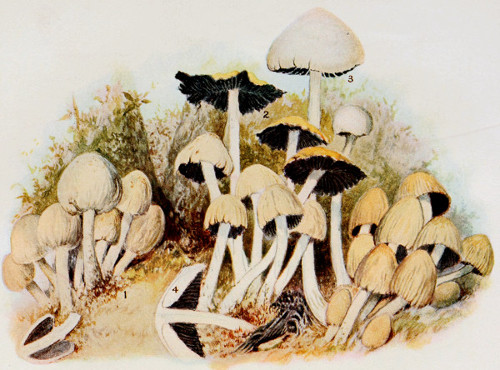
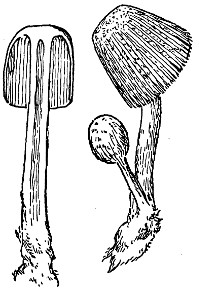
Grouped by F.D. Briscoe—Studies by C. McIlvaine. PLATE CII.
Fig. Page. Fig. Page.
1. Coprinus atramentarius, 373 3. Panaeolus solidipes, 385
2. Coprinus micaceus, 378 4. Panaeolus solidipes (section), 385
C. sterquili´nus Fr.—sterquilinium, a dunghill. Pileus about 2 in. across when expanded, conical, then expanded, sulcate more than half 373way from margin to disk, at first villous or silky, disk rather fleshy with rough scales, silvery-gray, tinged with brown at the apex. Flesh thin. Gills free, ventricose, about 2 lines broad, pale then umber-purple. Stem 4–6 in. high, slightly attenuated upward, white, fibrillose, hollow, thickened base solid, and booted for about an inch from the base, margin of sheath ending in a free border or ring.
On dung. A fine large species known by the scaly apex of the pileus, the basal portion of the stem surrounded by a volva-like, adnate structure with a free upper margin. The stem soon becomes black when bruised. Base of stem not rooting but abrupt, and furnished with a few white fibers. Massee.
Edible, Cooke, 1891; also Leuba.
Nova Scotia, Dr. Somers.
This species is not reported as found in the United States.
** Atramentarii. Ring imperfect, etc.
C. atramenta´rius (Bull.) Fr.—atramentum, ink. (Plate CII, fig. 1, p. 372.) Pileus 1½-4 in. across, ovate, expanding, grayish, lead-color or grayish-brown, with occasionally a few obscure scales on disk, often covered with bloom; margin ribbed, sometimes notched, soft, tender. Gills free, ventricose, up to ½ in. broad, crowded and at first cohering and white with white floccose edges, then becoming black and dissolving into ink. Stem up to 5 in. long, up to ½ in. thick, smooth, whitish, hollow, at first spindle-shaped, then attenuated upward, with more or less distinct ring near base.
Spores subcylindrical, large cystidia numerous, 12×6µ Massee; 9–10×6µ K.; 9×5µ W.G.S.; 8–10µ long Peck.
Indiana, H.I. Miller; Harrisburg, Pa., Dr. J.H. Fager; West Virginia, McIlvaine.
The stem is obscurely banded within, by which it may be recognized with certainty.
It grows singly or in clusters of many individuals on rich ground, whether lawns, gardens, gutter sides, or in woods, but not on dung. I know of a fine cluster growing year after year on a much-decayed pear-stump. Occasionally it appears in the spring months, but is common during the summer and autumn after rains, and from its first appearance 374it occurs in successive crops until stopped by severe frost. It is common in Europe and over the United States.
The flavor is higher than that of C. comatus. It should be cooked as soon as gathered, and kept in a cool place until needed.
Analysis shows the following:
Two separate, freshly-gathered lots of this species were examined. The one (a) contained six young small specimens weighing 5.5 grams, or .9 gram each; the other (b) contained eight mushrooms weighing 12 grams, or 1.5 grams each. An analysis gave:
a. b.
Water 92.31 per cent. 94.42 per cent.
Total solids 7.69 5.58
The dry substance contained:
Total nitrogen 4.68 4.77
Ether extract 3.1 5.7
Crude fiber 9.3 .....
Ash 16.8 20.1
Lafayette B. Mendel in American Journal of Physiology.
C. fusces´cens (Schaeff.) Fr.—fuscus, dark or swarthy. Pileus 1–1¼ in. across, submembranaceous, ovate, expanded, dull, disk rather fleshy, even or cracked into squamules, grayish-brown, disk reddish. Gills adfixed, blackish-umber. Stem 4–5 in. long, about ¼ in. thick, equal, fragile, hollow, subfibrillose. Ring indistinct or absent, whitish. Massee.
Smaller and more slender than Coprinus atramentarius. Pileus brownish-gray, disk becoming reddish, not sprinkled with micaceous particles, but at first covered with a mealy bloom. Gills adnexed, attenuated from the stem to the margin, deliquescent. Fries.
Spores elliptical, pointed at the ends, 10x6µ Massee; 10x5µ W.G.S.
Solitary and in tufts. On stumps, trunks, etc. May to October.
West Philadelphia, Pa., McIlvaine.
C. fuscescens is tender, delicate and of excellent flavor. In this it ranks with C. atramentarius.
(Plate CIV.)
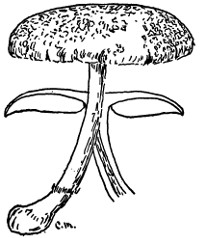
Coprinus macrosporus. Enlarged one-third.
C. macro´sporus Pk. Pileus ovate, then expanded, rimose-striate (cracked in lines), obscurely floccose-squamulose, white, the small even brownish disk scaly. Lamellæ crowded, free, white then black. Stem 375glabrous, white, with traces of an annulus (ring) near the thickened or subbulbous base.
Spores very large, elliptical, 20–20.5 long, 12–16µ broad.
Plant cespitose, 2–3 in. high. Pileus 1–2 in. broad. Stem 1 line thick.
Ground in open fields. Ticonderoga. August.
The prominent characters of this species are the cracked pileus, squamose disk, free lamellæ and large spores. In its early state it resembles some species of Lepiota. It seems to be intermediate between the sections Atramentarii and Micacei. Peck, 31st Rep. N.Y. State Bot.
Found in quantity at Mt. Gretna, Pa. August to September, 1898, growing among old stable bedding on parade ground.
C. macrosporus is an excellent species, higher in flavor than any other Coprinus.
*** Pica´cei. Universal downy veil, etc.
C. pica´ceus (Bull.) Fr. Pileus 2–2½ in. across, membranaceous, ovato-bell-shaped, striate up to the disk, smoky-black, variegated with large, irregular, superficial white patches. Gills free, ½ in. or more broad, ventricose, grayish-black. Stem 5–6 in. long, base bulbous, abrupt, otherwise equal, ¼-⅔ in. thick, white, hollow, fragile, smooth. Spores elliptical, apiculate, 14×8µ; cystidia large, numerous. Massee.
Decaying trunks or branches of trees in woods. Lyndonville. June. Fairman.
The form here referred to this species differs somewhat from the description of the type in being smaller, in having no bulb to the stem and in having smaller spores. It is probably the “smaller variety growing on rotten wood” noticed by Stevenson in his British Fungi. I 376have seen the true form of the species from Kansas. The New York plant seems to me to be worthy of distinctive designation, at least as a variety, and I call it
Var. ebulbo´sus. Plant smaller. Stem destitute of a bulb. Spores 8–10×5µ. Peck, 44th Rep. N.Y. State Bot.
Minnesota, Johnson, 1897; Kansas, Cragin, 1884; Wisconsin, Bundy, Nebraska, Clements.
Edible. Leuba.
Large quantities grew on rotting chestnut and oak rails at Mt. Gretna, Pa., from June to August, 1899. It is strong and unpleasant.
**** Tomento´si. Pileus at first veiled with a loose hairy veil.
(Plate CV.)
Coprinus fimetarius.
C. fimeta´rius Fr.—fimetum, a dunghill. Pileus 1–2 in. across, membranaceous, thin, at first cylindrical, soon conical, the edge at length revolute and torn at the margin, when young everywhere covered with floccose-squarrose white scales (from the universal veil), which separate from the vertex toward the circumference, at length naked, longitudinally cracked, but not opening into furrows, the vertex which remains entire, livid. Stem about 3 in. long, 2–3 lines and more thick, hollow, fragile, thickened and solid at the base, attenuated upward, shining white and downy with squamules of the same color. Gills free, reaching the stem, at first ventricose, then linear, flexuous, black. Stem when young curt and firmer. Fries.
Spores spheroid-ellipsoid, 15–18×9–12µ K.; 15×9µ W.G.S.; 12–14×7–8µ Massee.
Sometimes there is a root as long as the stem. M.J.B. Common on dung heaps in successive crops. Spring to autumn.
Var. pulla´tus. Pileus with adpressed scales and tomentose, soon naked, brownish, then blackish. Stem equal, becoming smooth.
On dung. Clustered. Stature of the type.
377Var. cine´reus. Pileus membranaceous, floccosely mealy, then naked, ashy-gray. Stem subequal, rootless, hollow to the base, often twisted. Spores 12–8µ.
On dung and rich soil.
Var. macrorhi´za. Pileus at first with feathery squamules. Stem short, hairy, rooting, sometimes more or less marginately subbulbous. Spores 13–14×8–9µ.
On dung. Pileus pale and smaller than in the typical form, stem shorter, with a more or less elongated rooting base. Berkeley.
Of this very variable species there is a small form growing on decayed wood in woods. It has the spores rather smaller than in the type, they being 10–11µ long, 8µ broad. It might be designated Var. silvi´cola. Peck, 43d Rep. N.Y. State Bot.
West Virginia, 1881–1885, May to October. McIlvaine.
Common to the United States. Of excellent flavor and tender. It must be cooked at once.
C. tomento´sus (Bull.) Fr.—tomentum, pubescence. Pileus very thin, at first oblong-oval and floccose-scaly, soon bell-shaped, naked, closely striate, grayish-brown or blackish-brown, often with a leaden hue, finally expanded, the disk smooth, reddish or ochraceous-brown, the margin turned upwards and much split or lacerated. Lamellæ closely crowded, narrow, free, white then pinkish, finally black. Stem white, tall, fragile, tapering upward, finely floccose-squamulose, hollow, sometimes with a large tap root. Plant gregarious or cespitose.
Height 3–6 in., breadth of pileus 6–18 lines.
Very variable in size and color. The covering of the pileus is easily rubbed off. It soon disappears and the plant quickly decays, seldom continuing through the day. Peck, 23d Rep. N.Y. State Bot.
Mt. Gretna, Pa., about old picketing places in camp grounds. Prof. M.W. Easton, July, 1898.
West Virginia, North Carolina, New Jersey, Pennsylvania, May to September, on dung, rich ground, gardens and in woods. McIlvaine.
Very delicate; of strong mushroom flavor. It is common, and can usually be collected in numbers. It is of little food value in itself, but yields an excellent flavor to anything it is cooked with. It must be cooked as soon as gathered.
378C. ni´veus Fr.—nix, snow. Pileus white, 1–2 in. across, thin, ovate then bell-shaped, margin at length turned upward, split or covered with a dense white, mealy or downy covering, slightly pink. Gills adnexed, narrow, crowded, at first cohering, white then pinkish, then black. Stem at first short, then up to 4 in., slender, attenuated upward, covered with white down, fragile, hollow.
Spores 16×11–13µ Massee; 10×12µ W.G.S.
Common on dung and dung heaps, clustered. May to frost.
West Virginia, North Carolina, Pennsylvania, New Jersey. McIlvaine.
Very variable in size, but clearly distinguished by its snow-white color and adnexed gills. Like all of the thin, delicate species of this genus there is little substance left after cooking, but the savory flavor is imparted to the cooking medium.
***** Mica´cei. Pileus at first covered with minute, glistening scales, etc.
C. mica´ceus (Bull.) Fr.—mica, grain, granular. (Plate CII, fig. 2, p. 372.) Pileus thin, ovate, then bell-shaped, with the margin more or less revolute, wavy, splitting, closely striate, with a few minute scales and sparkling atoms, or naked, varying in color from whitish-ochraceous to livid-brown, generally darker when moist or old. Gills rather narrow, crowded, white then pinkish, finally black. Stem slender, fragile, easily splitting, slightly silky, white, hollow, often twisted. Plant mostly cespitose.
Height 2–4 in., breadth of pileus, 1–2 in.
Streets, yards and fields, on or about old stumps. May to September. Peck, 23d Rep. N.Y. State Bot.
Spores elliptical, blackish, 7–8×4–5µ Massee; 7×8µ W.G.S.; 10×5µ W.P.; elliptical, brown, 6–8µ Peck.
Var. granula´ris. Pileus sprinkled with granules or furfuraceous scales. New York. August. Peck, 47th Rep.
Indiana, H.I. Miller; West Virginia, North Carolina, Pennsylvania, New Jersey. May to October. McIlvaine.
Common from spring until frost. This is the oval-capped toadstool found in clusters about trees, posts, along grassy sides of pavements, popping up, Brownie-like, from sodded places. Although small and thin, its 379clusters soon fill baskets, and its continuous growth in some places, from month to month, year to year, makes it one to be depended upon. Stewed for ten minutes it makes a rich, luscious dish. C. congregatus closely resembles it and is equally good.
****** Glabra´ti. Pileus smooth, etc.
C. deliques´cens (Bull.) Fr. Pileus 3–4 in. broad, livid-fuliginous, membranaceous, bell-shaped then expanded, smooth, but dotted with minute points on the disk, never downy or split, the edge turning upward and striate, the striæ broad but not deep. Stem 4 in. long, 2–4 lines thick, hollow, with a bark-like covering, equally attenuated upward, smooth, shining white. Gills free, at length remote from the stem, very crowded, flexuous, very narrow, only ½ line broad, lurid-blackish. Fries.
Frequent on stumps and among fallen leaves, sometimes in tufts. July to October.
Spores elliptical, obliquely apiculate, 8×5µ Massee.
Sometimes confounded with C. atramentarius.
West Virginia, Pennsylvania, New Jersey, McIlvaine.
C. deliquescens is of good size and quality. The stems do not cook well with the caps. The flavor is the same as C. atramentarius.
C. congrega´tus (Bull.) Fr. Pileus ½-¾ in. high, cylindrical, then bell-shaped, finally expanded and split at the margin, smooth, viscid, margin slightly striate, ochraceous. Gills about 1 line broad, slightly adnexed, white, finally becoming black. Stem 1½ in. high, equal, smooth, hollow, whitish.
On the ground, also in hot-houses. Massee.
Readily distinguished by the densely cespitose mode of growth, the small size, the viscid, ochraceous, glabrous pileus which remains elongato-cylindrical for some time, then becomes campanulate and finally expands and splits at the margin.
Densely cespitose, fragile, readily distinguished from C. digitalis by its much smaller size. Fries.
Spores 7×8µ W.G.S.; 10×5µ W.P.
Fries and Cooke considered this a good species.
So closely allied to neighboring species that it is difficult to determine it. Edible qualities are included in the alliance.
380B. Veliformes. Pileus very thin, etc.
* Cyclodei. Stem bearing ring, etc.
None edible.
** Lanatuli. Pileus with superficial downy covering, etc.
C. lagopus Fr.—Gr, a hare; a foot. Pileus 1 in. broad, whitish, disk livid, very tender, cylindrical then bell-shaped, when young beautifully downy then naked, flattened and split, radiately furrowed. Stem 5 in. and more long, 1 line thick, very weak, very fragile, slightly attenuated at both ends, everywhere white-woolly. Gills at length remote, narrow, black. Fries.
Fries distinguishes two forms. A, nemorum. Stem slender, 4–6 in. long. B, viarum. Stem 2–3 in. long. Pileus broader, livid. Both forms are inodorous. The pileus of the long-stemmed form is sometimes entirely clear brown, at others grayish with a brownish disk. Stem very weak, 5 in. and more in length, 1 line thick, attenuated at both ends. Pileus thin, expanded bell-shaped, about 1 in. across, when young elegantly flocculose, then furrowed, disk livid. Gills rather distant.
New York, Peck, 38th Rep.; Mt. Gretna, Pa., July, 1898, on rubbish about abandoned camp. Prof. M.W. Easton.
A strikingly beautiful species. Both forms were found in abundance, tested and eaten with enjoyment. They are extremely delicate, and of attractive but not high flavor.
C. Virgineus Banning. Pileus ovate, bell-shaped, or cylindrical, pale ocher, the margin thin, torn, downy. Lamellæ narrow, close, forked, at first white, turning dark but never black, adnexed. Stem 3½ in. long, stout, somewhat stuffed, attenuated where it meets the pileus, flattened, downy. Spores black.
Cespitose or gregarious at the roots of trees or about old stumps. Also found in Virginia.
The plant is not rapidly deliquescent, remaining perfect for some hours. Banning MS.
Maryland. Virginia. Miss M.E. Banning MS. Peck, 44th Rep.
Chester county, Pa. New Jersey, about pear trees and stumps. McIlvaine.
381This little Coprinus is a valuable species when found. A patch of it about a tree or stump is treasure trove. Patches of it appear in July and bear until October. The not-particular observer would mistake it for C. micaceus.
*** Furfurel´li. Pileus micaceous or scurfy, etc.
(Plate CVI.)
Coprinus domesticus. Natural size.
C. domes´ticus (Pers.) Fr.—domus, a house. Pileus 2 in. broad, fuliginous, disk date-brown, thin, ovate then bell-shaped, covered with small branny scales, then opening into furrows and flattened, undulately sulcate, disk obtuse, even. Stem 2–3 in. long, 2–3 lines thick, fistulose, slightly firm, attenuated upward, adpressedly silky, becoming even, white. Gills adnexed, at first crowded, distant when the pileus is split, linear, white then reddish, at length brownish-blackish.
A larger and more remarkable species than all the neighboring ones. Fries.
Spores 14–16×7–8µ Massee.
On much decayed wood, damp carpets, in cellars, etc. Often in clusters.
Mt. Gretna, Pa., Prof. M.W. Easton, July, 1898; West Virginia, New Jersey, Pennsylvania, McIlvaine.
C. domesticus is the largest of its section and is sometimes of remarkable growth. I have seen it start from under a board in a cellar and prolong its stems for over a foot to get its caps to air and light. Under such conditions the stems are twisted in a confused mass.
It is very tender with a decided mushroom flavor. Cook at once.
(Plate CVII.)
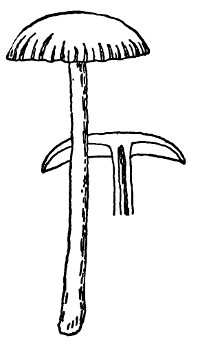
Coprinus silvaticus. Enlarged one-fourth. (After Peck.)
C. silvat´icus Pk. Pileus membranaceous, with a thin fleshy disk, convex, striate in folds on the margin, dark-brown, the depressed striæ paler. Lamellæ subdistant, narrow, attached to the stem, brownish. Stem fragile, slender, smooth, hollow, white. Spores gibbous-ovate, 12.7µ long.
382Plant 2 in. high. Pileus 6–10 lines broad. Stem .5 lines thick. Ground in woods. Greig. September.
The striæ extend about half way up the pileus. Allied to C. plicatilis and C. ephemerus Peck, 24th Rep. N.Y. State Bot.
West Virginia, Pennsylvania, New Jersey. Frequent, but not common. On ground in woods, August to October. McIlvaine.
This pretty little fungus is frequently found. I have never been able to get it in quantity, but have often eaten it. Its flavor is musky, rather strong. It is edible, but is not obtainable in sufficient numbers to make it of much food value.
C. ephem´erus Fr. Gr—lasting for a day. Pileus ½-¾ in. across, very thin, ovate, then bell-shaped, finally expanded and splitting, furrowed radiately, at first slightly scurfy, disk elevated, even, reddish. Gills slightly attached, linear, white, then brownish, at length blackish. Stem 1½-2½ in. high, 1 line or more thick, equal, glabrous, pellucid, hollow, whitish. Spores 16–17×9–10µ.
On dunghills, manured ground, etc. To the naked eye appearing almost glabrous, but under a lens seen to be distinctly scurfy. Known from Coprinus plicatilis by the disk of the pileus being prominent and not depressed. Massee.
Common dung and dung heaps. May to October. New York, Peck. 23d Rep.
Of such size and delicate substance as to be of little food value. But it has a strong mushroom flavor which is choice as a flavoring. It appears during the summer months on dung and dung heaps. It must be cooked as soon as gathered.
C. semilana´tus Pk. Pileus submembranaceous, broadly conical, then expanded and strongly revolute, and the margin sometimes split, covered with mealy atoms, finely and obscurely rimose-striate, pale grayish-brown. Lamellæ narrow, close, free. Stem elongated, fragile, hollow, slightly tapering upward, white, the lower half clothed with 383loose cottony flocci which rub off easily, the upper half smooth or slightly farinaceous. Spores broadly elliptical, 12.7µ long.
Plant very fragile, 4–6 in. high. Pileus 8–12 lines broad. Stem 1 line thick at the base. Rich ground and dung. Sandlake. August. (Plate IV, fig. 15–18.) Allied to C. coopertus. Peck, 24th Rep. N.Y. State Bot.
West Virginia. 1881–1885, Mt. Gretna, Pa. July to October. McIlvaine.
I have seldom found it, though at times it was quite common about stables in West Virginia. It has good mushroom flavor and is edible. It is stately, attracting attention by its peculiar cap.
C. plica´tilis Fr.—plico, to fold. Pileus 1 in. broad, dusky-brown then bluish-gray-cinereous, disk darker, dusky-brown or reddish, oval-cylindrical then campanulate, soon expanded, opening into furrows, sulcate-plicate, for the most part smooth, disk broad, even, at length depressed. Stem 1–3 in. long, fistulose, thin, equal, even, smooth, pallid, somewhat pellucid. Gills remote from the stem and adnate to a collar which is formed from the dilated apex of the stem, distant, gray-blackish. Fries.
Very tender and fragile, but when scorched by the sun not melting into fluid. Very variable in stature and size. Stevenson.
Spores 12–14×8–10µ Massee; broadly elliptic, 5µ long, M.J.B.; 11–13µ long, 8–10µ broad Peck, Rep. 50.
Common in rich pastures, lawns, roadsides, etc. May to October.
West Virginia, Pennsylvania, New Jersey, McIlvaine.
A neat little fungus often found in great plenty. Though small it is nevertheless edible and must be written with its edible companions.
384PANÆOLUS Fr.
Gr—all; Gr—variegated.
(Plate CVIII.)
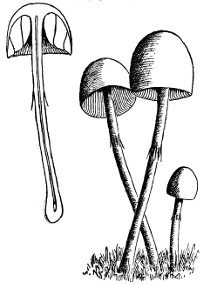
Panæolus.
Pileus slightly fleshy, not striate, margin exceeding the gills. Gills ascending in a conical manner, slate-gray, mottled with the black spores. Stem polished. Veil woven, often absent. Spores black.
On the ground in rich earth, and on dung.
In the black-spored series Psathyrella is separated by the striate pileus, not exceeding the gills, Anellaria by the ring and Coprinus by the deliquescent gills.
Panæolus, in its entirety, has a precise looking membership. If the gills were cut from cardboard and fixed by machinery, they could not be more correct. Some of the species are among the earliest arrivals at toadstool lawn parties, and some are the last to leave. Several are culinary favorites, notably Panæolus solidipes. P. papilionaceus possesses intoxicating properties. P. campanulatus is reported to be a sedative.
The edible species are easily cooked and are exceptionally delicate and well flavored.
P. retiru´gis Fr.—rete, a net; ruga, a wrinkle. Pileus about 1 in. across, at first almost globose, then hemispherical, subumbonate, minutely mealy, opaque, moist, furnished with uniting raised ribs, pinkish tan-color; margin with irregular fragments of the veil attached. Flesh rather thick. Gills adnexed, ascending, 2 lines or more broad, grayish-black. Stem 2–4 in. long, about 2 lines thick, equal, pruinose, purplish flesh-color, hollow. Fries.
Spores elliptic-fusiform, 11–13×7µ Massee.
On dung. Distinguished among the species of Panæolus by the 385raised ribs on the pileus and its appendiculate margin. The pileus is sometimes grayish. Closely resembling, superficially, Psathyra corrugis, which is, however, distinguished by the violet-black gills.
Spores elliptical, shortly fusiform, 20µ Q.; 16×11µ W.G.S.
New York, Peck, 23d Rep. West Virginia, 1881–1885. Pennsylvania, New Jersey, frequent on dung. June to frost. McIlvaine.
P. retirugis is not a common species, and is a sparse grower, but is frequently found. It is seldom that a mess can be had at one time. It is an excellent species by itself and imparts a good flavor to others.
P. fimi´cola Fr.—fimus, dung; cola, to inhabit. Pileus ½-¾ in. across and high, slightly fleshy, convex bell-shaped, obtuse, glabrous, opaque, dingy-gray when moist, paler and yellowish when dry, with a narrow brown encircling zone near the margin. Gills adnate, 2 lines or more broad, gray, variegated with smoky-black. Stem 2–4 in. high, 1 line or more thick, equal, fragile, whitish, powdered with white meal upward, hollow. Fries.
Stem soft, fragile, obsoletely silky-striatulate, 2–4 in. long. Pileus when moist commonly smoky-gray, when dry grayish clay-color, sometimes discoid. Gills semi-ovate with a minute decurrent tooth. Fries.
West Virginia, Pennsylvania, New Jersey. Frequent. On dung and richly manured places. June to September. McIlvaine.
P. fimicola is neither as large nor heavy as P. solidipes, but in other respects equals it.
P. soli´dipes Pk.—solidus, solid; pes, a foot. (Plate CII, fig. 3, 4, p. 372.) Pileus 2–3 in. across, firm, at first hemispherical, then sub-campanulate or convex, smooth, whitish, the cuticle at length breaking up into dingy-yellowish, rather large, angular scales. Gills broad, slightly attached, whitish, becoming black. Stem 2–4 lines thick, firm, smooth, white, solid, slightly striate at the top. Spores very black with a bluish tint. Height of plant 5–8 in. Dung heaps. West Albany. June.
A large species, remarkable for its solid stem. The scales on the pileus are larger on the disk, becoming smaller toward the margin. The upper part of the stipe is sometimes beaded with drops of moisture. Peck, 23d Rep. N.Y. State Bot.
386West Virginia, 1881–1885. Pennsylvania, New Jersey, frequent on dung and dung heaps. May to frost. McIlvaine.
On mature plants, or after rains, the scales are not always present.
P. solidipes is a handsome, readily recognized species of good weight and substance. It is one of the best of toadstools.
P. campanula´tus Linn.—campanula, a little bell. Pileus oval, bell-shaped or obtusely conical, sometimes umbonate, smooth, somewhat shining, brownish, with a peculiar gray or lead-colored tint, sometimes becoming reddish-tinted, the margin, often scalloped or fringed with the appendiculate veil. Lamellæ not broad, attached, becoming grayish-black. Stem long, slender, hollow, reddish, pruinose and slightly striate at the top, at length dusted with the spores.
Height 4–6 in., breadth of pileus 6–12 lines.
On horse dung and rich soil. June and July. Common.
In very wet weather the cuticle of the pileus sometimes cracks into scales or areas. Peck, 23d Rep. N.Y. State Bot.
Spores subellipsoid, 16–18×10–13µ K.; 8–9×6µ Massee.
Mr. R.K. Macadam, Boston, Mass., informs me that he has information of a case of poisoning by this fungus. “The victim experienced dizziness, dimness of vision, trembling and loss of power and memory. He recovered after simple treatment and was well inside of 24 hours.”
A full account of this case is in “The London Medical and Surgical Journal,” Vol. 36, November, 1816. The poison acts as a sedative.
I have several times eaten of this fungus in small quantities, because larger could not be obtained, and with no other than pleasant effect. There does not appear to be any case of poisoning reported by it since 1816, which, considering the inquisitiveness of man, is singular. Caution is advised.
P. papiliona´ceus Fr.—papilio, a butterfly. Pileus subhemispherical, sometimes subumbonate, smooth, or with the cuticle breaking up into scales, whitish-gray, often tinged with yellow. Lamellæ very broad, attached, becoming black. Stem slender, firm, hollow, pruinose above, whitish, sometimes tinged with red or yellow, slightly striate at the top and generally stained by the spores.
Height 3–5 in., breadth of pileus 6–18 lines.
387On dung and rich soil. Common. May and June.
A small form occurs with the pileus nearly white, scarcely half an inch in diameter, and the cuticle not cracking. Peck, 23d Rep. N.Y. State Bot.
The effects of P. papilionaceus are very uncertain. I have seen it produce hilarity in a few instances, and other mild symptoms of intoxication, which were soon over, and with little reaction. But I have seen, at table, the same effects from eating preserved peaches and preserved plums which had fermented. Many personal testings have been without effect. Testings upon others vary with the individuals. The fungus seems to contain a mild stimulant. It is not dangerous, but should be eaten with caution. Being of small size, and not a prolific species, quantities of it are difficult to obtain. Moderate quantities of it have no effect whatever.
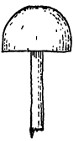
388ANELLA´RIA Karst.
Anellus, a little ring.
Pileus slightly fleshy, smooth and even. Gills adnexed, dark slate-color, variegated with the black spores. Stem central, smooth, shining, rather firm. Ring present at first, either persistent or forming a zone around the stem.
The species of this genus were formerly included in Panæolus, from which this is separated by the presence of a ring, more or less definite.
In other characters they are similar. As in Amanitopsis and Amanita.
(Plate CIX.)
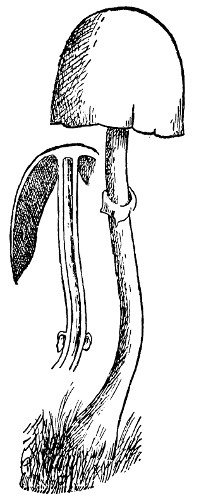
Anellaria separata. Natural size.
A. separa´ta Karst.—separatus, distinct, separate. Pileus 1–1½ in. across, height about the same, ovate, then bell-shaped, not expanding, viscid, even, ochraceous, then whitish, shining, wrinkled when old. Flesh rather thick. Gills adfixed, ascending, thin, crowded, broad, 2–3 lines, grayish-black, margin paler. Stem long, 3–5 in., straight, base thickened, attenuated upward, whitish, shining, top somewhat striate. Ring persistent, distant. Massee.
On dung. Rather variable in size.
Pileus bell-shaped, but very obtuse at the summit, ½-1¼ in. from the base to the apex, not expanding at the base without cracking.
Spores broadly elliptic-fusiform, black, opaque, 10×7µ Massee; ellipsoid, 16–22×10–12µ K.; 16×11µ W.G.S.
West Virginia, 1881–1885. New Jersey, Mt. Gretna, Pa., July, 1898, on dung. McIlvaine.
A common, frequent species from May to October. It is substantial in flesh, excellent in substance and flavor. Cook soon and not over fifteen minutes.
389PSATHYREL´LA.
Gr—fragile.
Pileus membranaceous, striate, margin straight, at first pressed to the stem, not extending beyond the gills. Veil inconspicuous. Gills sooty-black, not variegated. Spores black.
Closely resembling Psathyra in appearance, but separated by the spore color.
In the black-spored series Panæolus and Anellaria are distinguished by their pilei not being striate and Coprinus by its deliquescent gills.
The species are small and can seldom be gathered in quantity. But those tested have the full mushroom flavor and are valued for the flavor they give to less gifted species when cooked with them.
P. gra´cilis Fr.—slender. Pileus ½-1 in. broad, sooty, livid, etc., when dry, tan, rosy or whitish, hygrophanous, membranaceous, bell-shaped, obtuse, smooth, even, slightly and pellucidly-striate only round the margin. Stem 3 in. and more long, scarcely 1 line thick, tubular, remarkably tense and straight, equal, naked, smooth, whitish, not rooted, white-villous at the base. Gills wholly adnate, commonly broader behind (rarely linear), almost distant, distinct, at first whitish, then cinereous-blackish with the black spores, edge rose-colored. Fries.
When dry the pileus is soft to the touch. Gregarious, fragile. Very similar to A. corrugis, and there is a variety corrugated. Stevenson.
Spores ellipsoid, 13–14×7–8µ K.; 5×12µ W.G.S.; 7×3–3.5µ Massee; 14×8µ Morgan.
New York, Peck, Rep. 23; West Virginia, New Jersey, Pennsylvania, common, rich ground, June to October. McIlvaine.
A common and beautiful fungus, growing in patches on rich ground. It is decidedly prim. Its conical cap is regular as an extinguisher. It pays to gather it for flavoring other species. I have not seen the corrugated form mentioned by Fries. P. graciloides Pk. lacks the rosy-edged gills; gills are whitish.
390
(Plate CX.)
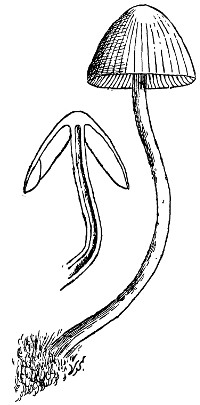
Psathyrella graciloides.
P. graciloi´des Pk.—slender. Pileus thin, conical or bell-shaped, glabrous, hygrophanous, brown and striatulate when moist, whitish and subrugulose when dry. Lamellæ ascending, rather broad, subdistant, brown, becoming blackish-brown, the edge whitish. Stem long, straight, fragile, hollow, smooth, white. Spores blackish, elliptical, 15–16.5×8–8.5µ.
Plant gregarious, 4–6 in. high. Pileus 1 in. broad. Stem 1 line thick.
Ground in an old dooryard. Maryland. September.
This is allied to A. gracilis Fr., but the edge of the gills is not rosy. When drying the moisture leaves the disk of the pileus first, the margin last. When dry the plant bears some resemblance to large forms of A. tener. Under a lens the texture of the surface of the pileus is seen to be composed of matted fibrils. Peck, 30th Rep. N.Y. State Bot.
Pennsylvania and New Jersey, on ground about houses and stables, often in barn yards, after they have been cleaned out and are empty for the summer. McIlvaine.
The whitish-edged gills with entire absence of rosiness on gill edges distinguish this species from P. gracilis Fr. It is frequent but not plentiful. Often a pint can be gathered. It has a fine mushroom flavor, resembling the delicate forms of Coprinus.
P. atoma´ta Fr.—atomatus, atomate. Pileus ½-1 in. broad, livid, when dry becoming pale tan or pale flesh-color, sometimes reddish, hygrophanous, membranaceous, bell-shaped, obtuse, slightly striate, when dry without striæ, slightly wrinkled, sprinkled with shining atoms. Stem 2 in. long, almost 1 line thick, tubular, equal, not rooted, lax, slightly bent (not tense and straight), white and white pulverulent at 391the apex. Gills adnate, broad, ventricose, slightly distinct, whitish, but cinereous-blackish with the black spores. Fries.
Solitary or gregarious. Pileus changing like A. gracilis from livid to whitish and rose-color, but more fragile. Stevenson.
Spores elliptical, 10×4µ Massee; 14×9µ W.G.S.; 11×8µ Morgan.
Chester county, Pa., June to September. McIlvaine.
Several specimens were eaten. In flavor they could not be distinguished from C. micaceus. The scarcity and small size of the species make it of little value, save as a flavoring.
(Plate CXI.)
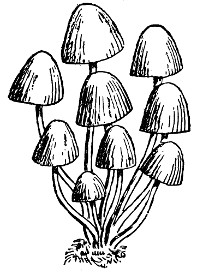
Psathyrella disseminata.
P. dissemina´ta Pers.—dissemino, to scatter. Found everywhere. Densely tufted. Pileus about ½ in. across, membranaceous, ovate, bell-shaped, at first scurfy, then naked, coarsely striate, margin entire, yellowish then gray. Gills adnate, narrow, whitish, then gray, finally blackish. Stem 1–1½ in. long, rather curved, mealy then smooth, fragile, hollow. Massee.
Crowded. Pileus ovate, conical, at length bell-shaped, ⅓-½ in. from the base to the apex, striate and plicate, membranaceous, pale buff or reddish-brown, at length gray, becoming flaccid and dissolving. Gills distant, narrow, pale brown. Stipes 1–3 in. long, slender, weak, brittle, crooked, hollow, pale yellowish, whitish or grayish. Particularly partial to old willow trees, and when growing on a stump of a felled tree often covering nearly a square yard. Grev.
Spores 8×6µ W.G.S.; 7.6×5µ Morgan.
West Virginia, New Jersey, Mt. Gretna, Pa., about abandoned camp. Densely tufted. May to frost. McIlvaine.
Patches of it are very common on old trunks, about decaying trees, on ground. The caps rarely reach 1 in. in diameter. The plants cook 392away to almost nothing, but they are of fine flavor, which they impart to the cooking medium.
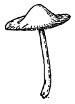
GOMPHI´DIUS Fr.
A wooden bolt or nail.
Hymenophore decurrent. Gills distant, composed of a mucilaginous membrane, which can be readily separated into two plates, continuous at the edge which is acute and powdered with the blackish fusiform spores. Veil viscoso-floccose. Fleshy, putrescent, pileus at length the shape of an inverted cone.
A small genus with great difference among the species. Intermediate in habit between Cortinarius and Hygrophorus.
Universal Veil glutinous, at first terminating on the stem in a floccose ring soon disappearing. The Gills frequently admit of being detached and stretched out into a continuous membrane. Fries.
A genus possessing several well-marked characters. The very decurrent gills differ from all others in their soft mucilaginous consistency. The spores are larger than usual in the Agaricaceæ and have the elongated spindle-shape found in Boleti. The stem and pileus are of the same substance, and the pileus and veil are both glutinous when moist. The spores have been described as greenish-gray becoming black, and as dingy-olive.
I have had opportunity to see but two species of this small genus—G. rhodoxanthus and G. viscidus. Of these the spores are decidedly olivaceous. If the six other species recorded as found in the United States are as creditable, they are well worth hunting for. G. Oregonensis Pk. is reported as edible and as a valuable food species in Oregon. 393The glutinous coatings to pileus and stem do not appear on the American form of G. rhodoxanthus in the localities I have found it in during fifteen years.
G. glutino´sus (Schaeff.) Fr.—glutin, glue. Pileus 2–5 in. broad, purple-brown, often mottled with black spots, fleshy, convex, obtuse, at length plane, even depressed, even, smooth, very glutinous. Flesh thick, about ½ in., soft, white. Stem 2–3 in. and more long, about ½ in. thick, solid, whitish, thickened and externally and internally yellow at the base, viscid with the veil, fibrillose or varying with black scales. Cortina often woven in the form of a ring, but soon fugacious. Gills deeply decurrent, distant, distinct, branched, quite entire, mucilaginous, 3–4 lines broad, at first whitish, then cinereous, clouded with the spores.
Trama none, wherefore the gills easily separate from the pileus. Taste watery, moldy. Odor not marked. Stevenson.
Spores 20µ Cooke; 18–23×6–8µ K.; 16–17×6µ W.G.S.; 18–20×6µ Massee.
Distinguished by the bright yellow base of stem.
Pine woods. July to November. Nova Scotia. Somers.
Edible. Leuba. Chiefly used for catsup. Cooke.
Var. ro´seus. Pileus rose-color. Stem white, attenuated and rosy flesh-color internally at the base. Very distinguished, always smaller.
Spores 20–22×6µ K.
Nova Scotia. Massachusetts. Frost.
I have not seen this species or its variety. Eminent authorities vouch for its edibility.
G. Oregonen´sis Pk. Pileus at first convex, becoming nearly plane or somewhat centrally depressed, viscid, brown or dark-brown, becoming black in drying, taste sweet and pleasant. Lamellæ numerous, rather close, adnate or slightly decurrent, blackish in the dried plant. Stem short, solid, equal or slightly tapering upward, colored like the pileus. Spores oblong, 10–12.5µ long, 4–5µ broad.
Pileus 5–10 cm. broad. Stem 2.5–5 cm. long, 4–10 mm. thick.
Fir woods. Oregon. September to December. Lane.
Dr. Lane writes that this species is edible and grows so abundantly in fir woods that it might be gathered by wagon loads and might be 394made a source of an abundant food supply. Peck. Torrey Bulletin, Vol. 25, No. 6, June, 1898.
(Plate CXII.)
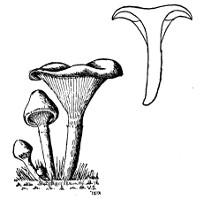
Gomphidius viscidus. One-half natural size.
G. vis´cidus Fr.—viscid. Pileus 2–3 in. and more broad, brownish-red, compact, at first bell-shaped, then expanded, umbonate, slightly viscous, shining when dry. Flesh yellowish. Stem 3–4 in. and more long, ½ in. thick, solid, equal or attenuated at the base which is rhubarb-colored internally, scaly-fibrillose, not very viscous, yellowish. Cortina very evidently floccose, not glutinous, woven in the form of a ring, but readily falling off. Gills deeply decurrent, distant, the shorter ones adnexed to the longer, not truly branched, at first paler, somewhat olive, at length brownish-purple, clouded with the spores. Fries.
Hymenophore descending between the gill plates. Odor not unpleasant. Stevenson.
Chiefly used in catsup. Cooke. Edible. Leuba. Cooke.
North Carolina, Massachusetts, Frost. Minnesota, California, Pennsylvania.
Many grew under pines at Mt. Gretna, Pa., September to November. The gills seemed branched, but were grown together. Taste and smell pleasant. The caps are good, but not equal to G. rhodoxanthus.
G. rhodoxan´thus Schw. (Plate XCVII, fig. 4, 5, p. 352.) Solitary. Pileus 1–2 in. broad, cushion-shaped, reddish-yellow, sometimes with dusky hues. Gills arched, decurrent, orange-yellow. Stem attenuated, short, firm.
Spores oblong, 10–12.5µ in length. Peck. Olivaceous. McIlvaine.
Solitary, gregarious or cespitose.
Among leaves and grass in shady places. August to October.
When the student has mastered the name and memorized the description, 395Gomphidius rhodoxanthus can not be mistaken for any other species.
It is not common in localities I have frequented, but its presence is pretty general in the United States, specimens having been sent to me from Georgia, Iowa, New York, New Jersey, etc., and I have found it in West Virginia, North Carolina, Woodland Cemetery, Philadelphia, and other places in Pennsylvania, from July to September, 1898, inclusive. Having enjoyed it in West Virginia in 1882, I was delighted to find it in generous quantity at Mt. Gretna, Pa., and to eat many meals of it. Its caps are not excelled by any edible fungus. They have solid, delicious substance and rich full flavor.
The plant is often cespitose. I have never found its cap viscid or glutinous. The cooked flesh has the latter consistency.
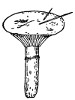
MONTAGNITES Fr.
After Montagne. (Plate CI, fig. 6, p. 368.)
The universal veil forming a volva, persistent. Stem dilated at the apex into a plane round disk, even on both sides, to the margin of which are adfixed the gills which are free, not joined by any membrane, radiating, razor-shaped, persistent, obtuse at the edge. Trama cellulose. Spores oblong, even, black fuscous. Fries.
A single species is reported from Texas.
396
FAMILY II.—POLYPORACEÆ.
Hymenophore inferior, facing the ground. Hymenium consisting of tubes with poriform mouths which are round or angular, sometimes sinuous or torn, lined with 4-spored sporophores and cystidia.
Fleshy, coriaceous or woody fungi, most abundant and luxuriant in warm countries. Intermediate between the Agaricaceæ and the Hydnaceæ, connected with the former by Dædalea and Lenzites, and with the latter by Fistulina and Irpex. Fries.
Within this large family are famed edible species, notably in Boletinus, Boletus and Fistulina. In the woody species the razor-strop man finds material for his strops (Polyporus celulinus); the surgeon styptics; the peasant punk to catch sparks from his flint, and the 4th of July urchin a fire-holder to light his pyrotechnics. The Chinese have placed some species in their fathomless materia medica, while the Polyporus of the locust tree is used in America as a medicine for horses. No fungoid growth is more universal. They are the ever active pruners of our trees and converters of forest debris. They begin the task in Nature’s laboratory of changing decaying wood into assimilable shape as food to feed the very trees that dropped it. Some are of annual growth, others add to their substance year after year, often attaining enormous size. In summer and in winter they are ever present objects for interesting study.
SYNOPSIS OF GENERA.
Boletinus. Page 398.
Hymenium composed of broader radiating gills connected by very numerous more narrow anastomosing branches or partitions and forming large angular pores. Tubes somewhat tenacious, not easily separable from the hymenophore and from each other, adnate or subdecurrent, yellowish. Peck.
Boletus. Page 404.
Stratum of tubes easily separable from the hymenophore. Stem central.
397Strobilomyces. Page 475.
Tubes like Boletus, but pileus with large scales. Stem central.
Fistulina. Page 477.
Fleshy, lateral, tubes crowded but distinct.
Polyporus. Page 479.
Stratum of tubes distinct from hymenophore, but not separable, not stratose; fleshy and tough, stipitate or sessile.
Fomes.
Tubes as in Polyporus, often stratose; woody, sessile; dimidiate. (No edible species reported.)
Polystictus.
Tubes as in Polyporus, not stratose, generally developing from the center to the margin, at first shallow and punctiform, coriaceous or membranaceous. (No edible species reported.)
Poria.
Tubes as in Polyporus, not stratose; entirely resupinate. (No edible species reported.)
Mucronoporus.
Tubes studded with reddish-brown spines, intermingled with the basidia, otherwise as in Polystictus (and also as in Polyporus and Fomes). Atkinson. (No edible species reported.)
Trametes.
Tubes immersed in flesh of pileus, of various depths, hence not forming a heterogeneous stratum, subcylindrical, not stratose; corky; sessile.
Dædalea.
Tubes as in Trametes, but sinuous and labyrinthiform; corky; not stratose; sessile. (No edible species reported.)
398Hexagonia.
Tubes from the first dilated in hexagonal channels, not stratose; plants corky, sessile. Atkinson. (No edible species reported.)
Favolus.
Tubes large at first, radiating from a central stem, or from a lateral attachment in sessile or dimidiate forms; plants tough and fleshy. Atkinson. (No edible species reported.)
Cyclomyces.
Gills or tubes in concentric circles. Stem central, subcentral or none. Atkinson. (No edible species reported.)
Merulius. Page 490.
Subgelatinous. Tubes very shallow, formed by anastomosing wrinkles; resupinate.
BOLETI´NUS Kalchb.
(Plate CXIII, p. 402.)
Hymenophore not even (as in Boletus), but extended in blunt points descending like a trama among the tubes. Tubes not easily separable from the hymenophore and from each other. Stem ringed, hollow. Spores pale yellowish. Sylloge, Vol. VI, p. 51.
Professor Peck has for excellent reasons, given in his Boleti of the United States, emended the generic diagnosis of Fries thus: Hymenium composed of broader radiating lamellæ connected by very numerous more narrow anastomosing branches or partitions and forming large angular pores. Tubes somewhat tenacious, not easily separable from the hymenophore and from each other, adnate or subdecurrent, yellowish.
Professor Peck classifies Boletinus as follows:
Stem hollow B. cavipes
Stem solid 1
1. Stem lateral or eccentric B. porosus
1. Stem central 2
2. Pileus pale yellow, silky B. decipiens
2. Pileus red or adorned with red scales 3
3993. Pileus red B. paluster
3. Pileus soon red-squamose B. pictus
Boleti of the United States, p. 76.
There are six species given as found in the United States—B. cavipes Kalchb., B. pictus Pk., B. paluster Pk., B. decipiens Pk., B. porosus Pk., B. appendiculatus Pk.—of these I have found and eaten four. B. decipiens has, at this writing, not been seen by Professor Peck, but Professor Farlow, of Harvard, has informed him of authentic specimens. There is every probability of its being as edible as the others; a description of it is, therefore, given.
In consistency Boletinus is of the best, being rather like that of marshmallows, and the same as Boletus subaureus. The flavor is mild and pleasant.
Professor Peck mentions that the smell of B. porosus is sometimes unpleasant. I have been fortunate in not having had this experience.
B. ca´vipes Kalchb. Pileus broadly convex, rather tough, flexible, soft, subumbonate, fibrillose-scaly, tawny-brown, sometimes tinged with reddish or purplish. Flesh yellowish. Tubes slightly decurrent, at first pale-yellow, then darker and tinged with green, becoming dingy-ochraceous with age. Stem equal or slightly tapering upward, somewhat fibrillose or floccose, slightly ringed, hollow, tawny-brown or yellowish-brown, yellowish at the top and marked by the decurrent dissepiments of the tubes, white within. Veil whitish, partly adhering to the margin of the pileus, soon disappearing. Spores 8–10×4µ.
Pileus 1.5–4 in. broad. Stem 1.5–3 in. long, 3–6 lines thick. Swamps and damp mossy ground under or near tamarack trees. New York, Peck; New England, Frost.
The pileus is clothed with a fibrillose tomentum which becomes more or less united into floccose tufts or scales. The umbo is not always present and is generally small. The young stem may sometimes be stuffed, but, if so, it soon becomes hollow, though the cavity is irregular. The freshly shed spores have a greenish-yellow or olivaceous hue, but in time they assume a pale or yellowish-ochraceous hue. This species is apparently northern in its range. It loves cold sphagnous swamps in mountainous regions. Peck, Boleti of the U.S.
400West Virginia mountains under spruce trees. Haddonfield, N.J., among scrub pines. Mt. Gretna, Pa., among pines.
It is of excellent consistency and of mild pleasant flavor. It is at its best in patties, croquettes and escallops.
B. appendicula´tus Pk. Pileus fleshy, convex, glabrous, ochraceous-yellow, the margin appendiculate with an incurved membranous veil. Flesh pale-yellow, unchangeable. Tubes rather small, yellow, their mouths angular, unequal, becoming darker or brownish where wounded. Stem solid, slightly thickened at the base, yellow. Spores pale-yellow, oblong, 10–12×4µ. Pileus 4–8 in. broad. Stem 2–3 in. long, 4–6 lines thick.
Under or near fir trees. Washington. September to December. Yeomans. Peck, Bull. Torrey Bot. Club, Vol. 23, No. 10.
B. pic´tus Pk. Pileus convex or nearly plane, at first covered with a red fibrillose tomentum which soon divides into small scales revealing the yellow color of the pileus beneath. Flesh yellow, often slowly changing to dull pinkish or reddish tints where wounded. Tubes tenacious, at first pale yellow, becoming darker or dingy ochraceous with age, sometimes changing to pinkish-brown where bruised, concealed in the young plant by the copious whitish webby veil. Stem equal or nearly so, solid, slightly and somewhat evanescently annulate, clothed and colored like or a little paler than the pileus, yellowish at the top. Spores ochraceous, 9–11×4–5µ.
Pileus 2–4 in. broad. Stem 1.5–3 in. long, 3–6 lines thick.
Woods and mossy swamps. New York, Peck; New England, Frost; North Carolina, Curtis. Peck, Boleti of the U.S.
West Virginia mountains, 1882. Haddonfield, N.J., Angora, West Philadelphia, Mt. Gretna, Pa. August and September. In mixed woods, principally oak. Leominster, Mass. C.F. Nixon, Ph. G.
It is sometimes found upon much decayed chestnut stumps.
The caps of some species are so cracked as to appear distinctly areolate. The white webby veil is often persistent. The fungus is one of the handsomest. Its rich variegated colors impress it upon eye-memory. It is one of the very best edible species.
401
(Plate CXIIa.)
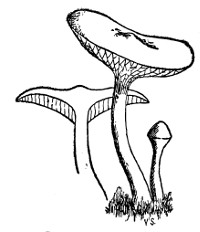
Boletinus paluster. Natural size. (After Peck.)
B. palus´ter Pk.—Pileus thin, broadly convex, plane or slightly depressed, sometimes with a small umbo, floccose-tomentose, bright red. Tubes very large, slightly decurrent, yellow, becoming ochraceous or dingy ochraceous. Stem slender, solid, subglabrous, red, yellowish at the top. Spores pinkish-brown, 8–9×4µ.
Pileus 1–2 in. broad. Stem 1–2 in. long, 2–3 lines thick.
Wet places and sphagnous mossy swamps. New York, Peck. Maine, Harvey. Peck, Boleti of the U.S.
Angora, West Philadelphia and Mt. Gretna, Pa. September. McIlvaine.
A few specimens found at Mt. Gretna had stems slightly reticulated. Its taste is sweet, smell mild, and cooked it is of excellent body and flavor.
B. deci´piens (B. and C.) Pk. Pileus dry, minutely silky, whitish-yellow or pale-buff, flesh buff, one-third in. thick; hymenium plane or somewhat concave, yellow, consisting of large, unequal, flexuous radiating tubes resembling multiseptate lamellæ. Stem equal, solid but spongy. Veil floccose, evanescent, adhering for a time to the margin of the pileus. Spores rather minute, oblong, ochraceo-ferruginous (rusty yellow), 8–10×3.5–4µ.
Pileus 2 in. broad. Stem 2–2.5 in. long, 3–4 lines thick.
Thin woods. North and South Carolina. M.A. Curtis.
Specimens of this species have not been seen by me. The authors remark that its affinities are clearly with Boletinus flavidus and its allies, from which it is distinguished by its large radiating pores. They also say that when dry it is scarcely distinguishable from Paxillus porosus Berk., except by its spores. This would imply that its stem is eccentric or lateral, and I have been informed by Mr. Ravenel that it is sometimes so. But specimens of this kind, labeled Boletinus decipiens B. and C., have been received, which show by their spores that they are Paxillus porosus. Besides, Professor Farlow informs me that authentic 402specimens of B. decipiens in the Curtisian Herbarium have only central stems, from which things I suspect that the two species have been confused. The spore dimensions here given are derived from a specimen in the Curtis Herbarium, through the kindness of Professor Farlow. Peck, Boleti of the U.S.
I have not recognized this Boletinus. Its affinities are with excellent edible species.
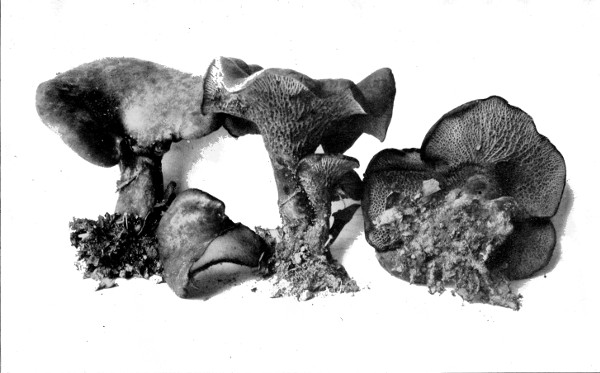
Photographed by Dr. J.R. Weist. Plate CXIII. BOLETINUS POROSUS.
B. poro´sus (Berk.) Pk. (Plate CXIII.) Pileus fleshy, viscid when moist, shining, reddish-brown. Flesh 3–9 lines thick, the margin thin and even; hymenium porous, yellow, formed by radiating lamellæ a line to half a line distant, branching and connected by numerous irregular veins of less prominence and forming large angular pores. Stem lateral, tough, diffused into the pileus, reticulated at the top by the decurrent walls of the tubes, colored like the pileus. Spores semi-ovate.
Pileus 2–5 in. broad. Stem 6–16 lines long, 4–6 lines thick.
Var. opa´cus (Paxillus porosus Berk., Bull. N.Y. State Mus. 2, p. 32). Pileus dry, glabrous or subtomentose, not shining, brown or tawny-brown. Spores brownish-ochraceous, 9–11×6–8µ.
Damp ground in woods and open places. Ohio, Lea, Morgan; North Carolina, Curtis; New England, Frost, Farlow; Wisconsin, Bundy; New York, Peck.
This species is remarkable for its lateral or eccentric stem. There is often an emargination in the pileus on the side of the stem which gives it a kidney shape. In the typical form it is described as viscid when moist, and the Wisconsin plant is also described as viscid, but in all the New York specimens that I have seen it is dry and sometimes minutely tomentose. I have, therefore, separated these as a variety. The color of the pileus varies from yellowish-brown to reddish-brown or umber. A disagreeable odor is sometimes present. The tubes are rather short and tough and do not easily separate from the hymenophore and from each other. In the young plant they are not separable. They sometimes become slightly blue where wounded. As in other species they are pale yellow when young, but become darker or dingy-ochraceous with age. The spores have been described as bright yellow, but I do not find them so in the New York plant. The plant is incongruous among the Paxilli by reason of its wholly porous hymenium, 403but in this place it seems to be among its true allies. Peck, Boleti of the U.S.
Fine specimens were sent to me by Mr. H.I. Miller, Terre Haute, and Dr. J.R. Weist, Richmond, Ind. They were in condition to be eaten and enjoyed. No disagreeable odor was perceptible.
B. borea´lis Pk. Pileus fleshy, convex, obtuse or subumbonate, brownish-yellow, obscurely and somewhat reticulately streaked with reddish-brown lines. Pores large, angular, unequal, slightly decurrent, brownish-yellow. Stem short, equal or slightly tapering upward, brownish-yellow with a whitish myceloid tomentum at the base. Spores oblong, 10–12.5×4–5µ.
Pileus 1–2 in. broad. Stem about 1 in. long.
Sandy soil. Capstan Island, Labrador. October. Waghorne.
The markings of the pileus appear as if due to the drying of a glutinous substance. The radiating lamellæ and the transverse partitions of the interspaces are very plainly shown. Described from two dried specimens. Peck, Bull. Torr. Bot. Club, Vol. 22, No. 5.
404BOLE´TUS Dill.
Gr—a clod.
The name of a fungus considered a great delicacy among the Romans, derived from bolos, a clod, probably to denote the round figure of the plant.
Hymenium wholly composed of small tubes, connected together in a stratum, the surface of which is dotted with their poriform mouths, and which is distinct from the hymenophore on account of the latter not descending into a trama. Tubes packed close together, easily separating from the hymenophore and from one another. Pores or mouths of the tubes round or angular (in the subgenus Gyrodon sinuous or gyroso-plicate). Spores normally fusiform, rarely oval or somewhat round. Growing on the ground, fleshy, putrescent, with central stems. Mostly edible, and of importance as articles of food; a few poisonous. Fries.
No American species in Gyrodon. It is therefore omitted in synopsis of tribes. C.M.
This genus abounds in species and is related to Boletinus on one hand and to Polyporus on the other. From the latter it is distinguished by the absence of a trama and from both by the tubes being easily separable from the hymenophore and from each other. Some of the species are very variable, others are so closely allied that they appear to almost run together.
The species are generally terrestrial, but B. hemichrysus is habitually wood-growing, and others are occasionally so.
The spores vary so much in color in such closely related species that this character is scarcely available for general classification, but it is valuable as a specific character and should always be noted.
SYNOPSIS OF THE TRIBES.
Pileus and stem yellow-pulverulent, stem not reticulated with veins (p. 421.) Pulverulenti
Pileus and stem not yellow-pulverulent, or if so then the stem reticulated with veins 1
1. Tubes yellowish with reddish, or reddish-brown mouths (p. 453.) Luridi
4051. Tubes of one color, or mouths not reddish. 2
2. Stem lacunose-reticulated and lacerated. (p. 436.) Laceripedes
2. Stem reticulated with veins, not lacerated. 3
2. Stem not reticulated. 5
3. Tubes white, becoming flesh-colored. (p. 466.) Hyporhodii
3. Tubes not becoming flesh-colored. 4
4. Tubes free, or if adnate then stuffed when young. (p. 444.) Edules
4. Tubes adnate, not stuffed when young. (p. 438.) Calopodes
5. Pileus viscid or glutinous when moist. 6
5. Pileus dry. 7
6. Tubes adnate. (p. 406.) Viscipelles
6. Tubes free or nearly so, yellowish. (p. 444.) Edules
6. Tubes free or nearly so, whitish. (p. 459.) Versipelles
7. Stem solid. 8
7. Stem spongy within, soon cavernous or hollow. (p. 471.) Cariosi
8. Tubes becoming flesh-colored. (p. 466.) Hyporhodii
8. Tubes not becoming flesh-colored. 9
9. Tubes adnate. 10
9. Tubes free or nearly so. 11
10. Pileus subtomentose. (p. 430.) Subtomentosi
10. Pileus glabrous or pruinose. (p. 423.) Subpruinosi
11. Tubes yellowish or stuffed when young. (p. 444.) Edules
11. Tubes whitish, not stuffed. (p. 459.) Versipelles
Peck, Boleti of the U.S.
C.H. Peck, N.Y. State Botanist, has contributed to Mycological literature his careful arrangement and analysis of species of this genus, in his “Boleti of the United States.” Species of the genus are found in every state of the Union. Several species are common to all the states. Comprehending, as do the states, all sorts of climates within their vast range of latitude, differences in appearance and structure in the same species must be expected, dependent largely, as they are in most fungi, upon habitat and environment. These variations will frequently suggest new species. Descriptions which are typical and which can be recognized as standard are most desirable. Professor Peck’s are accepted by the writer as such, that there may be uniformity, and are quoted as fully as space will permit. Such variations as are attributable to locality will be noted.
406Since 1882 the writer has given great attention to the edible qualities of the Boleti. He is convinced by many personal tests and those made by his family and friends, that much, if not all, of the suspicion thrown about Boleti is unjust and erroneous. He is able to state positively that change of color when bruised or broken; bitter and pepperiness have nothing whatever to do with the edible qualities of species exhibiting them, excepting in B. felleus, which exhibits an intense bitter, not lost in cooking. It is not poisonous.
The writer has the courage of his convictions, and has taken interest in eating species with a bad reputation whenever opportunity afforded, that their just dues might be given them. He has never experienced the slightest inconvenience. But others may not be so fortunate.
Before cooking Boleti the stem, unless crisp and tender, should be removed, as should the tubes unless young and fresh. They broil, fry, stew, make good soups and dry well. See recipes.
It is believed that all species of Boleti up to this time found in America are described in this volume. When no remarks of the writer follow the descriptions, he has not had an opportunity to test the edible quality of the species.
Viscipelles—viscum, bird lime; pellís, a skin.
Pileus covered with a viscose pellicle. Stem solid, neither bulbous, lacerated nor reticulated with veins. Tubes adnate, rarely sinuate, of one color.
The first four and several of the final species here described recede somewhat from the character of the central or typical species of the group.
Stem with an annulus 1
Stem without an annulus 9
1. Stem dotted both above and below the annulus 2
1. Stem dotted above the annulus 3
1. Stem not dotted 4
2. Tubes salmon color B. salmonicolor
2. Tubes yellowish B. subluteus
3. Annulus entirely viscose B. flavidus
3. Annulus membranous, fugacious B. elegans
3. Annulus membranous, persistent B. luteus
407 4. Pileus squamose B. spectabilis
4. Pileus not squamose 5
5. Tubes whitish or grayish 6
5. Tubes yellow or yellowish 7
6. Flesh white, unchangeable B. Elbensis
6. Flesh white, changing to bluish B. serotinus
7. Spores globose or broadly elliptical B. sphærosporus
7. Spores much longer than broad 8
8. Annulus fugacious B. flavus
8. Annulus persistent B. Clintonianus
9. Stem dotted with glandules 10
9. Stem not dotted 16
10. Pileus some shade of yellow 11
10. Pileus some other color 15
11. Stem rhubarb color B. punctipes
11. Stem some other color 12
12. Stem four lines or more thick 13
12. Stem less than four lines thick B. Americanus
13. Pileus adorned with tufts of hairs or fibrils B. hirtellus
13. Pileus glabrous 14
14. Stem yellow within B. subaureus
14. Stem whitish or yellowish-white within B. granulatus
15. Pileus white B. albus
15. Pileus not white B. granulatus
16. Stem squamulose 17
16. Stem not squamulose 18
17. Pileus dull red B. dichrous
17. Pileus some other color B. collinitus
W.G.S.us yellow 19
W.G.S.us bay-red or chestnut 20
W.G.S.us some other color 21
19. Flesh pale-yellow B. unicolor
19. Flesh white B. bovinus
20. Stem short, one inch or less B. brevipes
20. Stem longer, two inches or more B. badius
21. Tubes olivaceous or golden-yellow B. mitis
21. Tubes ferruginous 22
22. Taste mild B. rubinellus
408 22. Taste acrid or peppery B. piperatus
Peck, Boleti of the U.S., p. 83.
(Plate CXV.)
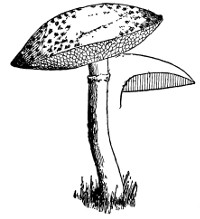
Boletus spectabilis. Natural size.
B. specta´bilis Pk.—spectabilis, distinguished. Pileus broadly convex, at first covered with a red tomentum, then scaly, viscid when moist, red, the tomentose scales becoming grayish-red, brownish or yellowish. Flesh whitish or pale-yellow. Tubes at first yellow and concealed by a reddish glutinous membrane, then ochraceous, convex, large, angular, adnate. Stem nearly equal, annulate, yellow above the annulus, red or red with yellow stains below. Spores purplish-brown, 13–15×6–7µ.
Pileus 2–5 in. broad. Stem 3–5 in. long, 4–6 lines thick.
Thin woods in swamps. New York, Peck; Wisconsin, Bundy.
This is a rare and showy species which inhabits the cold northern swamps of the country. It probably extends into Canada. When cut, the flesh emits a strong, unpleasant odor. Wounds of the flesh made by insects or other small animals have a bright-yellow color. When young, the tomentose veil covers the whole plant, but it soon parts into scales on the pileus and partly or wholly disappears from the stem. Peck, Boleti of the U.S.
London, Can., J. Dearness; Peck, Rep. 44, N.Y. State Bot.
B. Elben´sis Pk. Pileus convex, glabrous, viscid when moist, dingy gray or pinkish-gray inclining to brownish, obscurely spotted or streaked as if with patches of innate fibrils. Flesh white. Tubes at first whitish, becoming dingy or brownish-ochraceous, nearly plane, adnate or slightly decurrent, rather large, angular. Stem nearly equal, annulate, whitish above the ring, colored like the pileus below, sometimes slightly reticulated at the top. Spores ferruginous-brown, 10–12×4–5µ.
Pileus 2–4 in. broad. Stem 3–5 in. long, 4–6 lines thick. Thin woods of tamarack, spruce and balsam. New York. Peck.
409Its locality is thus far limited to the Adirondack region of this state. Peck, Boleti of the U.S.
B. sero´tinus Frost.—late. Bulletin Buffalo Soc. Nat. Sci., 1874. Pileus flat or convex, viscid, sordid brown, streaked with the remnants of the veil, especially near the margin, which is white, very thin, and when partly grown singularly pendent. Flesh white, changing to bluish. Tubes large, angular, unequal, slightly decurrent, at first sordid white or gray, sometimes tinged with green near the stem, afterward cinnamon-yellow. Stem reticulated above the ring which adheres partly to it and partly to the margin of the pileus, white but stained by the brownish spores and tinged with yellow at maturity. Spores 10×6µ.
Shaded grassy ground. New England, Frost.
Probably this is only a variety of the preceding species. Peck, Boleti of the U.S.
B. salmoni´color Frost. Bull. Buff. Soc. Nat. Sci., 1874. Pileus convex, soft, very glutinous, brownish or tawny-white with a faint tinge of red, wine-color when dry, the margin thin. Flesh tinged with red. Tubes simple, even, angular, adnate, pale salmon color. Stem small, dotted above with bright ferruginous red, sordid below, annulus dingy salmon-color. Spores 8×2.5µ.
Borders of pine woods. New England. Frost.
Apparently a distinct species. No specimens seen. Peck, Boleti of the U.S.
B. el´egans Schum. Pileus convex or plane, viscose, golden-yellow or somewhat rust-color. Flesh pale-yellow. Tubes decurrent, golden or sulphur-yellow, the mouths minute, simple. Stem unequal, firm, golden or reddish, dotted above the fugacious white or pale-yellowish annulus.
Pileus 3–4.5 in. broad. Stem 2–4 in. long.
Woods, especially under or near larch trees. North Carolina, Curtis; Wisconsin, Bundy; Minnesota, Johnson. Peck, Boleti of the U.S.
Cordier and Gillet give the species as edible though not delicate.
West Philadelphia on lawns under larches, 1887–1891. McIlvaine.
The caps are of good flavor and consistency. They are best fried or broiled.
410B. Clin´tonianus Pk. Pileus convex, very viscid or glutinous, glabrous, soft, shining, golden-yellow, reddish yellow or chestnut color, the margin thin. Flesh pale yellow, becoming less bright or dingy on exposure to the air. Tubes nearly plane, adnate or subdecurrent, small, angular or subrotund, pale-yellow, becoming dingy-ochraceous with age, changing to brown or purplish-brown where bruised. Stem equal or slightly thickened toward the base, straight or flexuous, yellow at the top, reddish or reddish-brown below the annulus, sometimes varied with yellow stains, the annulus white or yellow, persistent, forming a thick band about the stem. Spores brownish-ochraceous, 10–11×4–5µ.
Pileus 2–5 in. broad. Stem 2–5 in. long, 4–9 lines thick.
Mossy or grassy ground in woods or open places, especially under or near tamarack trees. New York, Peck; New England, Frost.
This is apparently closely related to B. elegans, from which it differs in its thick persistent ring, in its stem which is not at all dotted and in its longer and darker-colored spores. Its smaller tubes and persistent ring separate it also from B. flavus. In the typical form the pileus is bay-red or chestnut color, but plants growing in open places generally have it yellowish or reddish-yellow. It is mild to the taste and I have eaten it sparingly. It sometimes grows in tufts. Peck, Boleti of the U.S.
B. inflex´us Pk.—curving. Pileus convex, glabrous, viscid, yellow, often red or reddish on the disk, the margin thin, inflexed, concealing the marginal tubes. Flesh whitish, not changing color where wounded. Tubes rather long, adnate, yellowish, becoming dingy-yellow with age, the mouths small, dotted with reddish glandules. Stem rather slender, not ringed, solid, viscid, dotted with livid-yellow glandules. Spores yellowish, 10–12×4–5µ.
Pileus about 1 in. broad. Stem about 2 in. long, 2–4 lines thick.
Open woods. Trexlertown. September. Herbst.
This Boletus belongs to the tribe Viscipelles. It is remarkable for and easily recognized by the inflexed margin of the pileus, which imitates to some extent the appendiculate veil of Boletus versipellis. It sometimes grows in tufts. The paper in which fresh specimens were wrapped was stained yellow. Boletus Braunii Bres. has an inflexed margin, but that is a much larger plant with a yellowish-brown pileus, a fibrillose stem and much smaller spores. Peck, Bull. Torr. Bot. Club, Vol. 22, No. 5.
411B. fla´vus With. Pileus convex, compact, covered with a brownish separating gluten, pale-yellow. Flesh pale-yellow. Tubes large, angular, adnate, yellow. Stem yellow, becoming brownish, reticulated above the membranous fugacious dirty yellowish annulus. Spores 8–10×3–4µ.
Pileus 2–5 in. broad. Stem 2–3 in. long, 6–10 lines thick.
Woods. Minnesota, Johnson; Wisconsin, Bundy.
This is apparently a rare species in this country. I have not seen it. It is said to resemble B. luteus, from which it is separated by the large angular mouths of the tubes. In British Fungi the spores are described as “spindle-shaped, yellowish-brown;” in Sylloge, as “ovoid-oblong, acute at the base, granulose, pale ochraceous.” Peck, Boleti of the U.S.
B. fistulo´sus Pk. Pileus convex, viscid, glabrous, yellow, the margin at first incurved or involute. Flesh yellow. Tubes plane or subventricose, medium size, round with thin walls, adnate or sometimes depressed around the stem, yellow. Stem rather slender, subequal, viscid, glabrous, hollow, yellow, with a white mycelioid tomentum at the base. Spores elliptical, 13×6µ.
Pileus about 1 in. broad. Stem 2–4 in. long, about 3 lines thick.
Grassy woods. Auburn, Ala. July. Underwood.
A small but pretty species of a yellow color throughout. It is remarkable for its hollow stem, which is suggestive of the specific name. It is referable to the tribe Viscipelles. Peck, Bull. Torrey Bot. Club, Vol. 24, No. 3.
B. sphæros´porus Pk.—globose-spored. (Bulletin Torrey Botanical Club, Vol. XII.) Pileus at first hemispherical, then convex, glabrous, viscid, creamy-yellow, becoming reddish-brown or chestnut color with age. Flesh pale yellowish-brown. Tubes adnate or slightly decurrent, large, angular, pale-yellow, becoming brown, sometimes tinged with green. Stem stout, equal, even or slightly reticulated at the top, the membranous annulus persistent, sometimes partly adhering to the margin of the pileus. Spores globose or broadly elliptical, 8–9µ long.
Pileus 3–8 in. broad. Stem 1–3 in. long, 6–12 lines thick.
Low ravines and sandy places. Wisconsin, Trelease; Iowa, McBride.
The spores easily serve to distinguish this species from its allies. The 412European B. sphærocephalus has ovoid spores, but its tube mouths are minute and rotund and its stem is densely squamose. Peck, Boleti of the U.S.
B. lu´teus L.—yellow. Pileus gibbous or convex, covered with a brownish separating gluten, becoming yellowish-brown and virgate-spotted. Flesh white. Tubes adnate, minute, simple, yellow, becoming darker with age. Stem stout, yellowish and dotted above the large membranous brownish-white annulus, brownish-white or yellowish below. Spores fusiform, yellowish-brown, 6–7×3–4µ.
Pileus 2–5 in. broad. Stem 1–2 in. long, 6–10 lines thick.
Pine woods and groves. New York, Peck.
B. luteus has an international reputation for edibility. I have found it at Waretown and Haddonfield, N.J.; in Bartram’s Garden, West Philadelphia, always under pines. At Waretown it was gregarious. Pine needles, sand, anything through which it grows, adheres to the glutinous cap. It must be carefully cleaned before cooking. It is then of choice consistency and good flavor.
(Plate CXVa.)
Section of Boletus subluteus.
B. sublu´teus Pk.—luteus, yellow. Pileus convex or nearly plane, viscid or glutinous when moist, often obscurely virgate-spotted, dingy-yellowish, inclining to rusty-brown. Flesh whitish, varying to dull-yellowish. Tubes plane or convex, adnate, small, subrotund, yellow becoming ochraceous. Stem equal, slender, pallid or yellowish, dotted both above and below the ring with reddish or brownish glandules; ring submembranous, glutinous, at first concealing the tubes, then generally collapsing and forming a narrow whitish or brownish band around the stem. Spores subfusiform, ochraceo-ferruginous, 8–10×4–5µ. Pileus 1.5–3 in. broad. Stem 1.5–2.5 in. long, 2–4 lines thick.
413Sandy soil in pine woods. New York, Peck, Clinton; New England, Frost.
The species is closely related to B. luteus, from which it differs in its smaller size, more slender stem and glutinous collapsing veil. Peck, Boleti of the U.S.
Found at Waretown, N.J., 1887, under pines and in same locality as B. luteus, for which it can be readily mistaken. It is usually covered with adherent sand or pine needles. Its flesh is tender with a pleasant glutinosity. Flavor good.
B. fla´vidus Fr.—light yellowish. Pileus thin, gibbous, then plane, viscose, livid, yellowish. Flesh pallid. Tubes decurrent, with large angular compound mouths, dirty yellowish. Stem slender, subequal, pallid, sprinkled with fugacious glandules above the entirely viscose ring. Spores oblong-ellipsoid, straight, subhyaline, 8–10×3–4µ.
Pileus 1–2 in. broad. Stem 2–3 in. long, 2–3 lines thick.
Pine woods and swamps. Pennsylvania, Schweinitz; North Carolina, Curtis; New England, Frost; California, H. and M.; Rhode Island, Bennett.
Fries says that this species is more slender than its allies, and differs from them all in its merely glutinous veil. Peck, Boleti of the U.S.
Dr. Curtis, of North Carolina, places it among edible species.
Many specimens were found by the writer near Waretown and Haddonfield, N.J., and a few at Mt. Gretna, Pa. The stems are thin and slightly spreading at the top. They are hard. The caps are excellent.
B. America´nus Pk. Pileus thin, convex or nearly plane, sometimes umbonate, soft, very viscid or glutinous when moist, slightly tomentose on the margin when young, soon glabrous or the margin sometimes remaining scaly, rarely scale-spotted from the drying of the gluten, yellow, becoming dingy or less bright with age, sometimes vaguely dotted or streaked with bright red. Flesh pale-yellow, less clear or pinkish-gray on exposure to the air. Tubes plane or convex, adnate, rather large, angular, pale-yellow, becoming sordid-ochraceous. Stem slender, equal or slightly tapering upward, firm, not at all annulate, yellow, often pallid or brownish toward the base, marked with numerous brown or reddish-brown persistent glandular dots, yellow within. Spores oblong or subfusiform, ochraceo-ferruginous, 9–11×4–5µ.
414Pileus 1–3 in. broad. Stem 1.5–2.5 in. long, 2–4 lines thick.
Woods, swamps and open places, especially under or near pine trees. New York, Peck, Clinton; Minnesota, Arthur.
A slight subacid odor is sometimes perceptible in our plant. It sometimes grows on much decayed wood. Its mycelium is white. Peck, Boleti of the U.S.
The caps, only, are good.
B. subau´reus Pk.—sub and aureus, golden. (Plate CXIV, fig. 2, p. 414.) Pileus convex or nearly plane, viscose, pale-yellow, sometimes adorned with darker spots, the young margin slightly grayish-tomentose. Flesh pale-yellow. Tubes small or medium; somewhat angular, adnate or subdecurrent, pale-yellow becoming dingy-ochraceous. Stem equal, stout, glandular-dotted, yellow without and within. Spores oblong or subfusiform, ochraceo-ferruginous, 8–10×4µ.
Pileus 2–4 in. broad. Stem 1.5–2.5 in. long, 4–6 lines thick.
Thin woods and open places. New York, Peck; North Carolina, C.J. Curtis; Massachusetts, Mississippi, G. Survey (Rep. 51).
This plant might almost be considered a stout variety of the preceding, but in addition to its thicker pileus and stouter stem, it has smaller tubes of a clearer yellow color, and the exuding drops are yellow, not whitish, as in that species. In habit it appears more like B. granulatus, from which it is distinct in color. Peck, Boleti of the U.S.
From early October, through heavy frosts and until long after November snows I found this species at Mt. Gretna, Pa., in 1897–1898. Specimens were sent to Professor Peck and identified as this species. It grew in grass on borders of woods, or gravelly ground, sometimes among pine needles. Large troops of it were frequent, and tufts containing many individuals were common.
I regard B. subaureus as among the most valuable of our food species. Its plentifulness, lateness, excellent quality will commend it to all Mycophagists. It can be cooked in any way. The tubes need not be removed.
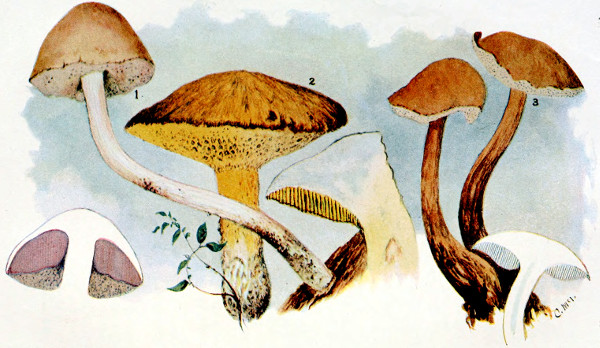
Grouped by F.D. Briscoe—Studies by C. McIlvaine. Plate CXIV.
Fig. Page. Fig. Page.
1. Boletus gracilis, 467 3. Boletus castaneus, 472
2. Boletus subaureus, 414
B. hirtel´lus Pk.—slightly hairy. Pileus broadly convex, soft, viscose, golden-yellow, adorned with small tufts of hairs or fibrils. Flesh pale-yellow. Tubes adnate, medium size, angular, becoming 415dingy-ochraceous. Stem subcespitose, equal, stout, glandular dotted, yellow. Spores pale, ochraceous-brown, 9–10×4µ.
Pileus 2–4 in. broad. Stem 2–3 in. long, 4–6 lines thick.
Sandy soil under pine trees. New York, Peck.
This species is very rare and was formerly confused with the preceding from which it is separated by the hairy adornment of the pileus and the darker, more brown color of the spores. Peck, Boleti of the U.S.
B. punc´tipes Pk.—punctum, a dot; pes, a foot. Pileus convex or nearly plane, glutinous when moist, yellow, the thin margin at first minutely grayish-pulverulent, becoming recurved with age. Tubes short, nearly plane, adnate, small, subrotund, at first brownish, then sordid-ochraceous. Stem rather long, tapering upward, grandular-dotted, rhubarb-yellow. Spores 9–10×4–5µ.
Pileus 2–3 in. broad. Stem 2–3 in. long, 3–5 lines thick. Mixed woods. New York, Peck.
The rhubarb-colored stem and the brownish color of the young hymenium are the distinguishing features of this species. The glandules occur also on the tubes. The species is rare. Peck, Boleti of the U.S.
Not seen by Professor Peck since its discovery in 1878.
Spores when first dropped are olive-green on white paper, but the green hue soon changes to brownish-ochraceous. Peck, 44th Rep. N. Y. State Bot.
Ontario, Prof. Dearness (Lloyd, R. 4).
B. al´bus Pk.—white. Pileus convex, viscid when moist, white. Flesh white or yellowish. Tubes plane, small or medium, subrotund, adnate, whitish, becoming yellow or ochraceous. Stem equal or slightly tapering downward, both it and the tubes glandular-dotted, white, sometimes tinged with pink toward the base. Spores ochraceous, subfusiform, 8–9×4µ.
Pileus 1.5–3 in. broad. Stem 1.5–3 in. long, 3–5 lines thick.
Woods, especially of pine or hemlock. New York, Peck; New England, Frost.
This species is easily known by its white pileus, but its color is lost in drying. Sometimes the fresh plant emits a peculiar fetid odor. Peck, Boleti of the U.S.
416B. granula´tus—granula, a granule. Pileus convex or nearly plane, very viscid or glutinous and rusty-brown when moist, yellowish when dry. Flesh pale-yellowish. Tubes short, adnate, yellowish, their mouths simple, granulated. Stem dotted with glandules above, pale-yellowish. Spores spindle-shaped, yellowish-orange, 7.5–10×2–3µ.
Pileus 1.5–4 in. broad. Stem 1–2 in. long, 4–6 lines thick.
Woods, especially of pine and in open places under or near pine trees. Very common.
The plant is generally gregarious and sometimes grows in circles, whence the name B. circinans Pers. Occasionally it is cespitose. The pileus is very variable in color—pinkish-gray, reddish-brown, yellowish-gray, tawny-ferruginous or brownish—and is sometimes obscurely spotted by the drying gluten. The flesh is rather thick and often almost white, except near the tubes, where it is tinged with yellow. The tubes are small, at first almost white or very pale-yellow, but they become dingy-ochraceous with age. The stem is generally short, stout and firm, whitish-pallid or yellowish, and often dotted to the base, though the glandules are more numerous and distinct on the upper part. Peck, Boleti of the U.S.
B. granulatus is of frequent and general occurrence. I have found it in the pine woods of New Jersey, North Carolina, Pennsylvania and West Virginia, and in West Virginia and Pennsylvania in mixed woods.
It is a late-growing species, appearing in September and continuing until frost.
All authors, with one exception (Gillet), give the species as edible. From frequent and copious testings, the writer vouches for its edibility and excellence. It bears favorable comparison with any of the late Boleti.
B. bre´vipes Pk.—brevis, short; pes, foot. Pileus thick, convex, covered with a thick, tough gluten when young or moist, dark chestnut color, sometimes fading to dingy-tawny, the margin inflexed. Flesh white or tinged with yellow. Tubes short, nearly plane, adnate or slightly depressed around the stem, small, subrotund, at first whitish becoming dingy-ochraceous. Stem whitish, not dotted or rarely with a few very minute inconspicuous dots at the apex, very short. Spores subfusiform, 7.5×3µ.
Pileus 1.5–2.5 in. broad. Stem .5–1 in. long, 3–5 lines thick.
417Sandy soil in pine groves and woods. New England, Frost; New York, Peck.
The species is closely related to B. granulatus, from which it differs especially in its darker colored pileus, more copious gluten, shorter stem and the almost entire absence of granules from the tube mouths and stem. In the rare instances in which these are present they are extremely minute and inconspicuous. The plant occurs very late in the season and the pileus appears as if enveloped in slime and resting stemless on the ground. Peck, Boleti of the U.S.
Specimens found in pine woods of New Jersey, identified by Professor Peck. Lambertville, N.J., C.S. Ridgway; Haddonfield, N.J., T.J. Collins; Pleasantville, Isaac F. Shaner.
B. brevipes is a disreputable, dirty, tramp-looking fungus, from which the collector would expect no good. Nevertheless, when it has had a good scrubbing it becomes respectable and is sweet, tender, good eating. When other species abound, it does not pay for the cleansing.
B. collini´tus Fr.—collino, to besmear. Pileus convex, even, becoming pale when the brown gluten separates. Flesh white. Tubes adnate, elongated, naked, the mouths two-parted, pallid, becoming yellow. Stem firm, often tapering downward, somewhat reticulate with appressed squamules, white, becoming brown.
Woods of pine or fir. North Carolina, Curtis; New England, Frost.
I have seen no specimens of this apparently rare species. It is said to be solitary in its mode of growth and to resemble B. luteus in size and color, but to be distinct from it by its ringless, dotless stem. Dr. Curtis records it as edible. Peck, Boleti of the U.S.
I found three specimens at Haddonfield, N.J., October, 1897, under scrub pines. Cap 2½ in. across, convex, gibbous; stem equal, 2½ in. long, ½ in. in diameter, slightly tapering at base. The two-parted mouths to the tubes were very distinct. The stems were tough, but the caps, washed and fried, were good.
B. di´chrous Ellis. Pileus convex, viscose, dull red. Flesh soft, dull, yellowish-white, changing to greenish-blue where wounded, finally yellow. Tubes subdepressed around the stem, large, unequal, straw-colored, changing color like the flesh where wounded. Stem thickened 418below, solid, covered with a red scaly coat, except at the yellow apex, yellow within. Spores elliptical, slightly bent at one end, 2µ long.
Pileus 2–3 in. broad. Stem 3 in. long, 6 lines thick.
Dry soil in oak and pine woods. New Jersey. Ellis.
I have seen no specimens of this species. From the description, its affinities appear to be with B. bicolor, but it is placed here because of its viscose pileus. Peck, Boleti of the U.S.
B. ba´dius Fr.—bay-brown. Pileus convex, even, soft, viscose or glutinous, shining when dry, tawny-chestnut. Flesh whitish, tinged with yellow, bluish next the tubes. Tubes large, angular, long, adnate or sinuate-depressed, whitish-yellow, becoming tinged with green. Stem subequal, even, solid, paler, brown-pruinate. Spores fusoid-oblong.
Pileus 2–3 in. broad. Stem 2–4 in. long, 3–5 lines thick.
Woods, especially of pine. New York, Peck; Minnesota, Johnson; Wisconsin, Bundy; Nova Scotia, Somers.
In the American plant the spores are 10–12×4–5µ.
Cordier classes it among the edible species. Peck, Boleti of the United States.
B. mi´tis Krombh.—mild. Pileus convex, then plane or depressed, firm, viscid, yellowish-flesh color, reddish-rust color when dry. Flesh pale, grayish-yellow. Tubes short, olivaceous or golden-yellow, their mouths compound, angular, unequal. Stem firm, short, even, narrowed toward the base, colored like the pileus. Spores 12–14×4µ.
Pileus 2–2.5 in. broad. Stem 2–2.5 in. long.
Mixed woods. New England, Frost.
This species is unknown to me and is recorded by Mr. Frost only. Peck, Boleti of the United States.
B. uni´color Frost MS. Pileus broadly convex or nearly plane, viscid when moist, even, sometimes streaked as if with minute innate brown fibrils, pale-yellow. Flesh pale-yellow. Tubes adnate or slightly decurrent, rather short, compound, lemon-yellow, becoming darker with age. Stem even, equal or narrowed toward the base, colored like the pileus. Spores reddish-yellow, 9–11×4µ.
Pileus 2–4 in. broad. Stem 2 in. long, 4–6 lines thick.
419Pine woods and open sedgy places. New England, Frost.
Specimens not seen. The species seems too near B. bovinus, of which it may possibly be a variety, but its yellow flesh and the colors ascribed to the tubes and spores require its separation. Rev. C.J. Curtis sends notes of a species found by him in North Carolina, which agree with this in its characters so far as noted. Peck, Boleti of the U.S.
B. ignora´tus Pk. Pileus convex, viscid, bright lemon-color, marked with wrinkled lines of orange color, which are distributed over the pileus, giving it a streaked appearance. Flesh white, solid, does not change color when cut or broken; taste slightly acid. Pores lemon-color, moderately large, free, connected with the stem by web-like filaments. Stem larger at the apex, somewhat tapering toward the base, yellow, smooth, solid. Spores 4.5×11µ.
This closely approaches Boletus unicolor Fr., from which it scarcely differs except in its white flesh and free tubes. Fungi of Maryland, Mary E. Banning. Peck, 44th Rep. N.Y. State Bot.
B. bovi´nus—bos, an ox. Pileus nearly plane, glabrous, viscid, pale yellow. Flesh white. Tubes very short, subdecurrent, their mouths compound, pale yellow or grayish, becoming rust-colored. Stem equal, even, colored like the pileus. Spores fusiform, dingy greenish-ocher, 7.5–10×3–4µ.
Pileus 2–3 in. broad. Stem 1.5–2 in. long, sometimes cespitose.
Pine woods. North Carolina, Schweinitz, Curtis; Pennsylvania, Schweinitz; New England, Frost, Palmer, Bennett, Sprague, Farlow; California, H. and M.
The shallow tubes, 2–3 lines long, are said to resemble the pores of Merulius lacrymans. The species is recorded edible by Curtis, Gillet and Palmer. Peck, Boleti of the U.S.
West Virginia mountains under hemlocks, 1882–1885, and near Haddonfield, N.J., under pines. McIlvaine, 1892. Gregarious and in clusters. The pore surface was in some specimens broadly wrinkled.
Smell and taste pleasant. Cooked, the quality is of the best in Boleti.
B. rubinel´lus Pk.—dim. of ruber, red. Pileus broadly conical or convex, viscid when moist, subtomentose or slightly pubescent when dry, red fading to yellow on the margin. Flesh whitish or yellowish, 420taste mild. Tubes adnate or slightly depressed around the stem, dingy-reddish, becoming subferruginous. Stem equal, slender, even, colored like the tubes, yellow within, sometimes yellow at the base. Spores oblong-fusiform, ferruginous-brown, 12.5–15×4µ.
Pileus 1–2 in. broad. Stem 1–2 in. long, 1–3 lines thick.
Mixed woods or under or near coniferous trees in open places. New York, Peck. Peck, Boleti of the U.S.
B. pipera´tus Bull.—piper, pepper. Pileus convex or nearly plane, glabrous, slightly viscid when moist, yellowish, cinnamon or subferruginous. Flesh white or yellowish, taste acrid, peppery. Tubes rather long and large, angular, often unequal, plane or convex, adnate or subdecurrent, reddish-rust color. Stem slender, subequal, tawny-yellow, bright yellow at the base. Spores subfusiform, ferruginous-brown, 9–11×4µ.
Pileus 1–3 in. broad. Stem 1.5–3 in. long, 2–4 lines thick.
Woods and open places. Common and variable.
This species may easily be recognized by its peppery flavor. The pileus sometimes appears as if slightly tomentose, and both this and the preceding species recede from the character of the tribe by the slight viscidity of the pileus. This is sometimes cracked into areas and sometimes the margin is very obtuse by the elongation of the tubes. Peck, Boleti of the U.S.
Haddonfield, N.J., 1892. McIlvaine.
This fungus is reckoned poisonous by Stevenson. Massee gives its taste as very hot. The taste of the American plant is peppery but not offensively so. This pepperiness it loses in cooking. It has been eaten by the writer and his friends with enjoyment and without any discomfort.
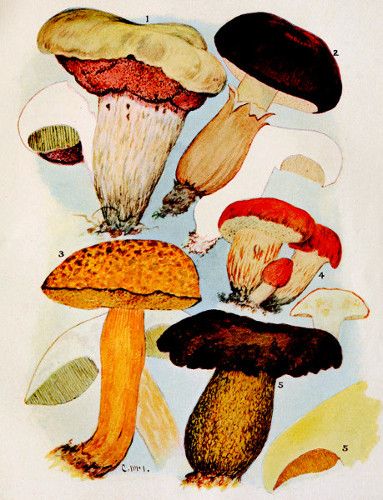
Grouped by F.D. Briscoe—Studies by C. McIlvaine New Species. Plate CXVI.
Fig. Page. Fig. Page.
1. Boletus eccentricus, 470 4. Boletus subsanguineus, 420
2. Boletus badiceps, 436 5. Boletus crassipes, 452
3. Boletus fulvus, 465
B. subsanguin´eus Pk.—sub and sanguineus, bloody. (Plate CXVI, fig. 4, p. 420.) Pileus convex or slightly depressed in the center, glabrous, viscid, bright-red or scarlet. Flesh thick, firm but flexible, white, slowly changing to a pale brownish-lilac on exposure to the air, taste slightly bitter. Tubes very short, 2–4 mm. long, adnate, but often separating from the stem with the expansion of the pileus, reddish, the mouths minute, stuffed at first, pinkish, then brownish-yellow, changing to a light-brown where wounded. Stem short, thick, uneven, often 421tapering downward, streaked with red, pale-yellow at the top, white at the base, marked at the top by the decurrent walls of the tubes.
Pileus 2.5–10 cm. broad. Stem 2.5–5 cm. long, 2–4 cm. thick.
Solitary, gregarious or cespitose. Under beech trees. West Philadelphia, Pa. August. C. McIlvaine.
This is a very showy species, easily recognized by its bright-red viscid pileus and its short, thick and uneven or somewhat lacunose stem. It is closely related to the European B. sanguineus With., from which it is separated by its minute tubes, its uneven stem and the brownish hues assumed where wounded.
The spore characters of this and the four succeeding species are unknown, but the other characters are quite distinctive and apparently sufficient for the recognition of the species. The descriptions have been derived from colored figures and other data furnished by Mr. McIlvaine, who says all are edible. Peck, Bull. Torrey Bot. Club, No. 27.
When slowly stewed for thirty minutes, there is no better Boletus.
Pulverulenti.
Pileus clothed with a yellow dust or a yellow powdery down. Stem more or less yellow powdered, neither bulbous nor distinctly reticulated.
The species which constitute this tribe are easily distinguished from all others by the sulphur-colored pulverulence which coats the pileus and stem like a universal veil. They appear thus far to be peculiar to this country. Though strongly resembling each other in the tribal character they are very diverse in other respects. One species, by its viscidity, connects with the preceding tribe; another by its differently colored tube mouths is related to the Luridi; and the third is peculiar in its ligneous habitat.
Plant growing on the ground 1
Plant growing on wood B. hemichrysus
1. Tubes adnate, of one color B. Ravenelii
1. Tubes free, with red mouths B. auriflammeus
Peck, Boleti of the U.S., p. 103.
B. hemichry´sus B. and C.—half-golden. Pileus convex, at length plane or irregularly depressed, floccose-squamulose, covered with a yellow powder, sometimes cracked, bright golden-yellow. Flesh thick, 422yellow. Tubes adnate or decurrent, yellow, becoming reddish-brown, the mouths large, angular. Stem short, irregular, narrowed below, sprinkled with a yellow dust, yellowish tinged with red; mycelium yellow. Spores oblong, minute, dingy-ochraceous.
Var. muta´bilis. Flesh slightly changing to blue where wounded. Stem reddish, yellow within, sometimes eccentric. Spores oblong-elliptical, 7.5–9×3–4µ.
Pileus 1.5–2.5 in. broad. Stem about 1 in. long, 3–6 lines thick.
Roots of pine, Pinus palustris. The variety on stumps of Pinus strobus.
South Carolina, Ravenel; North Carolina, Curtis; New York, Peck.
The species is remarkable for its habitat, which is lignicolous. The New York variety grew on a stump of white pine. By its eccentric stem it connects this genus with Boletinus, through Boletinus porosus. According to the authors of this species it resembles Boletus variegatus. Peck, Boleti of the U.S.
B. Ravenel´ii B. and C.—after Ravenel. Pileus convex or nearly plane, slightly viscid when young or moist, covered with a sulphur-yellow powdery down, becoming naked and dull-red on the disk. Flesh whitish. Tubes at first plane, adnate, pale-yellow, becoming yellowish-brown or umber, dingy-greenish where bruised, the mouths large or medium size, subrotund. Stem nearly equal, clothed and colored like the young pileus, yellow within, with a slight evanescent webby or tomentose ring. Spores ochraceous-brown, 10–12×5–6µ.
Pileus 1–3 in. broad. Stem 1.5–4 in. long, 3–6 lines thick.
Woods and copses. South Carolina, Ravenel; North Carolina, Curtis; New York, Peck; New England, Frost.
This is a very distinct and very beautiful species. Mr. Ravenel remarks in his notes that “this plant is not infested by larvæ and preserves more constant characters than any other Boletus with which I am acquainted.” The webby powdered filaments constitute a universal veil which at first covers the whole plant and conceals the young tubes. As the pileus expands this generally disappears from the disk, and, separating between the margin and the stem, a part adheres to each. The flesh is sometimes stained with yellow. The tubes in some instances become convex and slightly depressed around the stem. They are almost white when young, and often exhibit brownish hues where wounded. 423The plant is sometimes cespitose. I have observed a greenish tint to the freshly shed spores, but it soon disappears. Boletus subchromeus Frost Ms. is this species. Peck, Boleti of the U.S.
B. auriflam´meus B. and C.—flaming yellow. Pileus convex, dry, powdered, bright golden-yellow. Flesh white, unchangeable. Tubes plane or convex, free, yellow, their broad angular mouths scarlet. Stem slightly tapering upward, powdered, colored like the pileus. Spores 10–12.5×5µ.