Sub-Class BASIDIOMYCETES (continued 4)
Reading edition
Veil none. The ground color is white, as it is also internally, but it 151everywhere becomes red and the pileus often rosy blood-color. Handsome, growing in troops, commonly forming large lax circles.
In pine woods. Stevenson.
Spores ellipsoid, very obtuse at both ends, 8–10×4–5µ K.; 8×4µ Cooke.
Edible. Cooke.
*** Tawny or yellow.
H. ni´tidus B. and Rav.—shining. Pileus thin, fleshy, convex, broadly umbilicate, smooth, shining, viscid, pale yellow with the margin striatulate when moist, nearly white when dry. Gills arcuate, decurrent, yellow. Stem slender, brittle, smooth, viscid, hollow, yellow. Flesh yellow.
Height 2–4 in., breadth of Pileus 8–12 lines. Stem 1–2 lines thick.
Swamps. Sandlake. August.
The cavity of the stem is very small. Peck, 23d Rep. N.Y. State Bot.
Found in many states and places, usually on moist ground beside streams, or spring heads. It sometimes parades itself in irregular processions, at others in sparse patches. It is delicate in flavor, and tender cooked.
**** Olivaceous-umber.
H. limaci´nus Fr.—limax, a slug. Pileus 1½-2½ in. broad, disk umber then sooty, paler round the margin, fleshy, convex then flattened, obtuse, smooth, viscid. Flesh rather firm, white. Stem 2–3 in. long, ½ in. thick, solid, firm, ventricose, sticky, flocculose, fibrilloso-striate, roughened with squamules at the apex. Gills adnate, then decurrent, somewhat distant, thin, white inclining to ash-color. Fries.
Veil entirely viscous, not floccose.
In woods among damp leaves. Stevenson.
Spores 12×4µ Cooke.
New York, Peck, Rep. 34. Thin woods and open places.
Reported edible Bulletin No. 5, 1897, Boston Mycological Club.
H. hypoth´ejus Fr. Gr.—under; Gr—sulphur (under gluten). Pileus 1–2 in. broad, at first smeared with olivaceous gluten, ash-colored, when the gluten disappears, becoming pale and yellowish, orange 152or rarely (when rotting) rufescent, fleshy, thin, convex then depressed, obtuse, even, somewhat streaked. Flesh thin, white then becoming light yellow. Stem 2–4 in. long, 2–3 lines and more thick, stuffed, equal, even, viscous, but rarely spotted with the veil, at length hollow. Partial veil floccose, at the first cortinate and annular, soon fugacious. Gills decurrent, distant, distinct, at first pallid (even whitish) soon yellow, sometimes flesh-color. Fries.
Very protean, changeable in color and variable in size. Stem not scabrous. There is no trace of the veil when the plant is full grown. Appearing after the first cold autumn nights, and lasting even till snow.
In pine woods. Frequent. Stevenson.
Spores 10×6µ Cooke; 12×4µ W.G.S.
Hollis Webster, in Bulletin No. 5, 1897, Boston Mycological Club, writes: “H. hypothejus Fr., when dried, is crisp and nutty, and very good to carry in the pocket for occasional nibble.”
II.—Camarophyl´lus.
* Gills deeply decurrent, etc.
H. praten´sis Fr.—pratum, a meadow. (Plate XXXVII, figs. 1, 2, 3, p. 146. Plate XXXVIII, p. 147.) Pileus 1–2 in. and more broad, somewhat pale yellowish, compactly fleshy especially at the disk, thin toward the margin, convex then flattened, almost top-shaped from the stem being thickened upward, even, smooth, moist (but not viscous) in rainy weather, when dry often rimosely incised, here and there split regularly round. Flesh firm, white. Stem 1½-2 in. long, ½ in. and more thick, stuffed, internally spongy, externally polished-evened and firmer, attenuated downward, even, smooth, naked. Gills remarkably decurrent, at first arcuate, then extended in the form of an inverted cone, very distant, thick, firm, brittle, connected by veins at the base, very broad in the middle, of the same color as the pileus. Fries.
Very protean. Veil none. The flesh of the pileus is formed as it were of the stem dilated upward. The typical form resembles the Cantharelli. Everywhere becoming light yellow-tawny, but varying with the stem and gills pale-white.
In pastures. Common. Stevenson.
Spores 6×4µ Cooke; 6–10×4–6µ K.
153Common over the United States. West Virginia, 1881, North Carolina, 1890, Pennsylvania, 1887, Mt. Gretna, 1897–1898. McIlvaine.
Gregarious, and often in tufts, sometimes in partial rings.
An exceedingly variable species. White, buff, smoky, pinkish colors are common. The cap shapes are also diverse. The margins of some are incurved; of others repand. The weather seems to have much to do with their shapes.
M.C. Cooke says: “It requires careful cooking, as it is liable to be condemned as tough, unless treated slowly, but it is a great favorite abroad.” He calls them “Buff Caps.”
All fungi are the better for slow cooking. The H. pratensis in all its forms is excellent, but particularly so in croquettes and patés.
H. virgin´eus Fr.—virgo, a virgin. (Plate XXXVII, fig. 6, p. 146.) Wholly white. Pileus fleshy, convex then plane, obtuse, moist, at length depressed, cracked into patches, floccose when dry. Stem curt, stuffed, firm, attenuated at the base, externally becoming even and naked. Gills decurrent, distant, rather thick. Fries.
Flesh sometimes equal, sometimes abruptly thin. Commonly confounded with H. niveus, but it is more difficult to distinguish it from white forms of H. pratensis. It is distinguished chiefly by its smaller stature, by the color being constantly white, sometimes becoming pale, by the obtuse pileus being scarcely turbinate, at length cracked into patches and floccose when dry, and by the gills being thinner, etc.
In pastures. Common. Stevenson.
Spores 12×5–6µ Cooke.
Tastes like M. oreades. M.J.B. Delicious broiled or stewed. Cooke.
“Mony littles make muckle,” says the Scotch proverb. It applies well to the brave little toadstool looking through the first grass of lawns for the coming of spring, and coming again in the autumn, defiant of early frosts. Small though it be, its numbers soon fill the basket.
The “Ivory Caps” are plentiful, and extend their haunts to the woods, where thick mold or grassy places abound.
H. ni´veus Fr.—niveus, snow-white. (Plate XXXVII, fig. 7, p. 146.) Wholly white. Pileus scarcely reaching 1 in. broad, somewhat membranaceous, and without a more compact disk, hence truly umbilicate, 154bell-shaped then convex, smooth, striate and viscid when moist, not cracked when dry. Flesh thin, everywhere equal, white, hygrophanous. Stem 2 in. or a little more long, 1–2 lines thick, tubed, equal, even, smooth, tense and straight. Gills decurrent, distant, thin, scarcely connected by veins, arcuate, quite entire.
Thinner, tougher, and later than H. virgineus, etc. Being hygrophanous the pileus is shining white when dry. Very tender forms occur.
In pastures. Stevenson.
Spores 7×4µ Cooke.
The H. niveus, H. virgineus, “Ivory Caps” as M.C. Cooke calls them, are pretty and plentiful in some sections. In the West Virginia mountains, along grass-grown road-sides, their purity and exquisite perfume attracted me in 1881. I have them and a few others to thank for seducing me into becoming a mycophagist. I think of them affectionately. I have seldom met with them since. They are found on lawns and in pastures and on grassy edges of woods, early in spring and late in autumn.
H. boreal´is Pk.—northern. Pileus thin, convex or expanded, smooth, moist, white, sometimes striatulate. Gills arcuate-decurrent, distant, white. Stem smooth, equal or tapering downward, stuffed, white.
Plant 2 in. high. Pileus 8–12 lines broad. Stem 1 line thick.
Ground in woods. Croghan and Copake. September and October.
The species is related to H. niveus but the pileus is not viscid. Peck, 26th Rep. N.Y. State Bot.
Found at Mt. Gretna, Pa., October 20, 1898, ground in mixed woods. The cap is white, silky, smooth, not viscid. Stem likewise.
A neat species pleasant in every way.
** Gills ventricose, adnate, etc.
H. dis´tans Berk.—distant (of the gills). Pileus about 2 in. broad, white, with a silky luster, here and there stained with brown, somewhat fleshy, plane or depressed, viscid. Stem white above, gray below, and attenuated, not spotted. Gills decurrent, few, very distant, somewhat ventricose, pure white then tinged with ash-color, interstices obscurely wrinkled.
155Often umbilicate. Remarkable for the few and distant gills. Stevenson.
Spores 10×8µ Cooke.
Caps white, shaded to light pinkish-brown toward center. Gills very distant. Leaves adhere to cap.
Specimens tested were of mild, pleasant flavor.
H. sphæro´sporus Pk. Pileus fleshy and thick in the center, sub-obconic, convex, obtuse or slightly umbonate, whitish, inclining to reddish-brown, the margin incurved. Flesh firm, white. Gills rather broad, subdistant, adnate or slightly decurrent, white. Stems tufted, flexuous, solid, glabrous, often slightly thickened at the base, colored like the pileus. Spores globose, 6–8µ broad.
Pileus 6–12 lines broad. Stem 1–2 in. long, 2–3 lines thick.
Iowa. October. Communicated by C. McIlvaine.
The fresh plant is said to have no decided odor, but when partly dried it emits a slight but rather unpleasant odor. It belongs apparently to the section Camarophyllus, and is related to Hygrophorus Peckii. Peck, Torr. Bull., Vol. 22, No. 12.
Received by the writer from Hon. Thomas Updegraff, MacGregor, Iowa, and forwarded to Professor Peck as a new species.
The fungus has but slight taste and is without odor when fresh.
It is probably edible. Not received in sufficient quantity to test.
III.—Hygro´cybe.
* Gills decurrent.
H. cera´ceus Fr.—cera, wax. Pileus about 1 in. broad, waxy-yellow, shining, slightly fleshy, thin, but slightly firm, convexo-plane, obtuse, slightly pellucid-striate, viscid. Stem 1–2 in. and more long, about 2 lines thick, hollow, often unequal, flexuous and at length compressed, even, smooth, of the same color as the pileus, never darker at the apex. Gills adnato-decurrent, broad, almost triangular, distinct, yellow. Fries.
Fragile; easily distinguished from others by its waxy (not changeable) color. Stevenson.
Spores 8×6µ Cooke.
Eaten in Germany.
156Found at Angora and Kingsessing, Philadelphia, 1887. August to October. Open grassy places in woods, and in pastures. Scattered and in troops. Excellent. Stew slowly.
H. cantharel´lus Schw. Gr—a small vase. (Plate XXXVII, fig. 5, p. 146.) Pileus thin, convex, at length umbilicate or centrally depressed, minutely squamulose, moist, bright red, becoming orange or yellow. Gills distant, subarcuate, decurrent, yellow, sometimes tinged with vermilion. Stem smooth, equal, subsolid, sometimes becoming hollow, concolorous, whitish within.
Height 2–4 in., breadth of pileus 6–12 lines. Stem 1–2 lines thick.
Swamps and damp shaded places in fields or woods. July to September. Common. Peck, 23d Rep. N.Y. State Bot.
Var. fla´va. Pileus and stem pale yellow. Gills arcuate, strongly decurrent.
Var. fla´vipes. Pileus red or reddish. Stem yellow.
Var. fla´viceps. Pileus yellow. Stem red or reddish.
Var. Ro´sea. Has the pileus expanded and the margin wavy scalloped. Swamps. Sandlake. Peck, 23d Rep.
Common in the Adirondack region, and throughout Pennsylvania and New Jersey, in all its varieties.
The resemblance to H. miniatus in color is great, but there is a marked difference in the gills, which extend further down the thinner stem. It is tougher, and takes longer to cook. It has a flavor of its own which is enjoyed by some and condemned by others.
H. cocci´neus Schaeff.—of a scarlet color. (Plate CXXXVI, fig. 6, p. 508.) Pileus 1–2 in. and more broad, at first bright scarlet, then soon changing color and becoming pale, slightly fleshy, convex, then plane and often unequal, obtuse, at first viscid and even, smooth, not floccose-scaly. Flesh of the same color as the pileus. Stem 2 in. long, 3–4 lines thick, hollow, then compressed and rather even, not slippery, scarlet upward, always yellow at the base. Gills wholly adnate, decurrent with a tooth, plane, distant, connected by veins, watery-soft as if fatty, when full grown purplish at the base, light yellow in the middle, glaucous at the edge. Fries.
Flesh of the pileus descending into the gills and forming a trama of the same color. Fragile. Varying in stature, easily mistaken for some 157of the following species which are of the same color. Pileus at length becoming yellow. Stevenson.
Spores 10–12×6µ Cooke; 7×4µ Morgan.
Edible. Cooke, Peck.
In woods and pastures. In troops. Common in West Virginia, Pennsylvania, New Jersey. McIlvaine.
Excellent when stewed for twenty minutes.
(Plate XXXIX.)
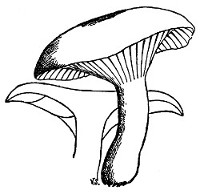
Hygrophorus flavo-discus. About two-thirds natural size.
H. fla´vo-dis´cus Frost—flavus, yellow; discus, disk. Pileus convex or plane, smooth, glutinous, white with a pale-yellow or reddish-yellow disk. Flesh white. Gills adnate or decurrent, subdistant, white, sometimes with a slight flesh-colored tint, the inter-spaces sometimes veiny. Stem subequal, solid, glutinous, white, sometimes slightly stained with yellow. Spores elliptical, 6–8×4µ.
Plant 2–3 in. high. Pileus 1–3 in. broad. Stem 2–8 lines thick.
Pine woods. West Albany. November.
This, like H. fuligineus, has a short white space at the top of the stem, free from the viscidity that exists elsewhere. It resembles in many respects Hygrophorus speciosus, which has the pileus red, fading to yellow with advancing age. Perhaps the three may yet prove to be forms of one very variable species, for the most conspicuous differences between them consist in the colors of the pileus. The constancy with which the three styles of coloration has thus far been maintained indicates a specific difference, but color alone is not generally regarded as having any specific value. Peck, 35th Rep. N.Y. State Bot.
Spores 6.4–7.6×4µ Peck.
I find this very good but its dirty pellicle should be peeled before using. Peck, in letter, 1896.
Mr. Hollis Webster writes of H. flavo-discus (Yellow Sweet Bread) in Bull. No. 45, of the Boston Mycological Club, 1897: “This is a mushroom worth going a long way to get. It is abundant in rich woods 158under pines in certain localities, and is a great favorite with those who know it. It is easily prepared and requires little cooking.”
I have eaten enjoyably of it since 1881.
Plentiful in the Jersey pines, in West Virginia and Pennsylvania, and equal to any toadstool of its size.
(Plate XL.)
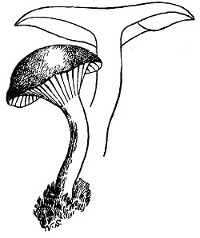
Hygrophorus fuligineus. About one-half natural size.
H. fuligi´neus Frost—resembling soot. Pileus convex or nearly plane, glabrous, very viscid or glutinous, grayish-brown or soot-color, the disk often darker or almost black. Gills subdistant, adnate or decurrent, white. Stem solid, viscid or glutinous, white or whitish. Spores elliptical, 7–9×5µ.
The Sooty hygrophorous resembles the Club-stemmed clitocybe in the color of its cap, but in nearly every other respect it is different. When moist the cap is covered with an abundant gluten which when dry gives it a shining appearance as if varnished. The color varies from grayish-brown to a very dark or sooty-brown with the central part usually still darker or almost black, but never with an umbo. The flesh and the gills are white. The stem also is white or but slightly shaded toward the base with the color of the cap. It is variable in length and shape, being long or short, straight or crooked, everywhere equal in thickness or tapering toward the base. It is glutinous and unpleasant to handle.
The cap is 1–4 in. broad, the stem 2–4 in. long, and 4–8 lines thick. The plants grow either singly or in tufts. In the latter case the caps are often irregular from mutual pressure.
The plants occur early in October and November, in pine woods or woods of pine and hemlock intermixed.
This mushroom is tender and of excellent flavor, but its sticky and often dirty covering should be peeled before cooking. Peck, 49th Rep. N.Y. State Bot.
159Found at Angora, near Philadelphia, August 1, 1897. Densely cespitose.
Raw it tastes like dead leaves. Tender and of fine flavor when cooked.
H. minia´tus Fr.—minium, red lead. (Plate XXXVII, fig. 4, p. 146.) Pileus thin, fragile, at first convex, becoming nearly plane, glabrous or minutely squamulose, often umbilicate, generally red. Gills distant, adnate, yellow, often tinged with red. Stem slender, glabrous, colored like the pileus. Spores elliptical, white, 8µ long.
Cap ½-2 in. broad. Stem 1–2 in. long, 1–2 lines thick. Peck, 48th Rep. N.Y. State Bot.
Var. lutes´cens. Pileus yellow or reddish-yellow. Stem and gills yellow. Plant often cespitose. Peck, 41st Rep. N.Y. State Bot.
Spores 10×6µ Cooke; elliptical, white.
Grows where it pleases and abundantly throughout the land. In wet weather I have found it in July and late in autumn.
Professor Peck says: It is scarcely surpassed by any mushroom in tenderness of substance and agreeableness of flavor.
The gunner for partridges will not shoot rabbits; the knowing toadstool seeker will pass all others where H. miniatus abounds.
** Gills adnexed, etc.
H. puni´ceus Fr.—blood-red. Pileus 2–4 in. broad, glittering blood-scarlet, in dry weather and when old becoming pale especially at the disk, slightly fleshy for its breadth, at first bell-shaped, obtuse, commonly repand or lobed, very irregular, even, smooth, viscid. Flesh of the same color, fragile. Stem 3 in. long, ½-1 in. thick, solid when young, at length hollow, very stout (not compressed), ventricose (attenuated at both ends), striate, and for the most part squamulose at the apex, when dry light yellowish or of the same color as the pileus, always white and often incurved at the base. Gills ascending, ventricose, 2–4 lines broad, thick, distant, white-light yellow or yellow and often reddish at the base. Fries.
The largest of the group and very handsome. It certainly differs from H. coccineus, for which it is commonly mistaken, in stature, in the adnexed gills, and in the white base of the striate stem. The attachment of the gills varies, but from the form of the pileus they ascend to the base of the cone and appear free.
160In pastures. Stevenson.
Spores 8×5µ Cooke.
Edible. Cooke. No harm would come of confusing it with the vermilion mushroom—H. miniatus Pk.
H. con´icus Fr.—conical. Pileus thin, submembranaceous, fragile, smooth, conical, generally acute, sometimes obtuse, the margin often lobed. Gills rather close and broad, subventricose, narrower toward the stem, free, terminating in an abrupt tooth at the outer extremity, scarcely reaching the margin, yellow. Stem equal, fibrous-striate, yellow, hollow.
Height 3–6 in., breadth of pileus 6–12 lines. Stem 1–2 lines thick.
Ground in woods and open places. North Elba and Center. August to October.
The color of the pileus is variable. I have taken specimens with it pale sulphur-yellow and others with it bright red or scarlet. The plant turns black in drying. Peck, Rep. 23, New York State Bot.
Spores 10×7µ Cooke; 10×6µ Morgan.
An old-time cure-all had medicinal virtues proportionate to its offensiveness. Old-time writers, contrariwise, gave every toadstool a bad name which changed color or displeased their noses. The pretty little Hygrophorus conicus, for these reasons, has, until now, been under the ban of suspicion. M.C. Cooke, in his handy book, Edible and Poisonous Mushrooms, was the first to lighten its sentence and make it a sort of ticket-of-leave culprit.
The writer has frequently eaten it, and is glad to vouch for its harmlessness and testify to its eminent respectability.
H. chloroph´anus Fr. Gr—greenish-yellow. Pileus 1 in. broad, commonly bright sulphur-yellow, sometimes, however, scarlet, not changing color, somewhat membranaceous, very fragile, at first convex, then plane, obtuse, orbicular and lobed, and at length cracked, smooth, viscid, striate. Stem 2–3 in. long, 2–3 lines thick, hollow, equal, round, rarely compressed, wholly even, smooth, viscid when moist, shining when dry, wholly unicolorous, rich light yellow. Gills emarginato-adnexed, very ventricose, with a thin decurrent tooth, thin, distant, distinct. Fries.
Very much allied to H. conicus, but never becoming black, and otherwise 161certainly distinguished by its convex, obtuse, striate pileus, by its even and viscous stem, and by its emarginato-free, thin, somewhat distant, whiter gills. Like H. ceraceus in appearance.
In grassy and mossy places. Common. August to October. Stevenson.
Spores 8×5µ Cooke; 8µ Q.
Received from E.B. Sterling, Trenton, N.J., August, 1897.
Open grassy woods.
But three specimens were tested. They were in every way agreeable.
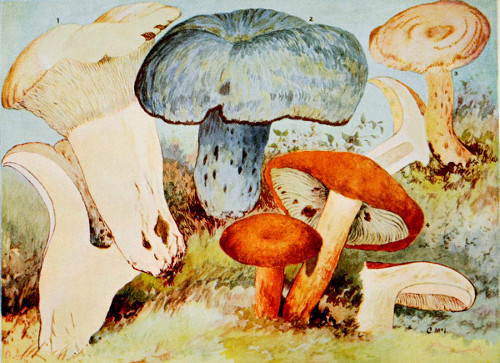
Grouped by F.D. Briscoe—Studies by C. McIlvaine. Plate XLI.
Fig. Page. Fig. Page.
1. Lactarius piperatus, 168 3. Lactarius deliciosus, 170
2. Lactarius indigo, 171 4. Lactarius volemus, 180
LACTA´RIUS Fr.
Giving lac (milk).
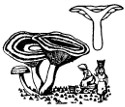
The hymenophore continuous with the stem. Pileus somewhat rigid, fleshy, becoming more or less depressed, often marked with concentric zones. Gills unequal, membranaceous-waxy, slightly rigid, milky, edge acute, decurrent or adnate and often branched. Stem stout, central, rarely excentric except in those growing on trunks. Spores globose, minutely echinulate, white, rarely yellowish.
Nearly all grow on the ground.
Distinguished from all other fungi by the presence of a granular milk which pervades every part of the plant and especially the gills; it is commonly white, sometimes changing color and in section Dapetes highly colored from the first. The nature of the milk, especially its taste, whether acrid, subacrid or mild, must be carefully noted in distinguishing species, as it is the most useful characteristic.
In Russula, the only allied genus, the milk-bearing cells are present, but their contents do not appear as milk.
Many of the species are peppery, acrid, astringent; some mildly so, others will be long remembered if tasted raw. Yet not a species is hotter than some radishes, onions, and others of our favorite vegetables. Who would condemn them because they are peppery? There is not a single species of Lactarius which retains its pepperiness after cooking. This quality has to be and is supplied by one of our favorite condiments—pepper 162itself. Simply because they are toadstools and hot, they have been condemned without trial. It is remarkable that not one of the fungi known to be deadly gives any warning by appearance or flavor of the presence of a poison. The day will probably come when it can be said that if toadstool eaters will confine themselves to hot species, otherwise attractive, they will run no risk. Panus stypticus is astringent, not hot.
ANALYSIS OF TRIBES.
Piperites (peppery, after piperitis, pepperwort). Page 163.
Stem central. Gills unchangeable, not pruinose nor becoming discolored. Milk white at first, usually acrid.
* Tricholomoidei—inclining to Tricholoma. Pileus moist, viscid, margin incurved and downy at first.
** Limacini—limax, a slug. Pileus viscid when moist, with a pellicle, margin naked.
*** Piperati. Pileus without a pellicle, hence absolutely dry, often more or less downy or unpolished.
Dapetes (daps, a feast). Page 170.
Stem central. Gills naked. Milk highly colored from the first.
Russularia (inclining to Russula). Page 173.
Stem central. Gills pallid then discolored, at length dark and powdered with the white spores. Milk at first white, mild, or from mild becoming acrid.
* Viscidi—viscidus, viscid, sticky. Pileus viscid at first.
** Impoliti—impolitus, unpolished. Pileus squamulose, downy or pruinose.
*** Glabrati—glaber, smooth. Pileus polished, smooth.
Pleuropus (pleura, side; pous, a foot).
Stem excentric or lateral. Growing on trunks. None known to be edible.
163I.—Piperi´tes.
* Tricholomoi´dei. Pileus viscid, margin incurved, etc.
L. tormino´sus Fr.—tormina, gripes. Pileus 2–4 in. broad, convex, then depressed, viscid when young or moist, yellowish-red or paleochraceous tinged with red or flesh color, often varied with zones or spots, the at first involute margin persistently tomentose-hairy. Gills thin, close, narrow, whitish, often tinged with yellow or flesh color. Stem 1.5–3 in. long, 4–8 lines thick, equal or slightly tapering downward, hollow, sometimes spotted, whitish. Spores subglobose or broadly elliptical, 9–10µ. Milk white, taste acrid.
Woods. Adirondack mountains and Sandlake. August. Peck, 38th Rep. N.Y. State Bot.
Poisonous, and Gillet declares it to be deleterious and even dangerous, and that in the raw state it is a very strong drastic purgative. On the other hand, Cordier states that almost all authors agree in stating that it is eaten with impunity, and that Letellier has eaten it more than once without inconvenience.
Cooke states: “Whether it is poison is rather uncertain, and probably assumed from its acridity.”
Bulliard says: “It is very acrid and this is changed by heat into an astringent of such power that a very little suffices to produce the most terrible accidents.” On the other hand, Boudier says that the presence of an acrid milk is an indication of no importance, that in certain parts of the country they eat such Lactaria as even L. piperatus and do not experience any trouble. Certain Russulæ as acrid as any Lactaria are known to be inoffensive.
The Russians preserve it in salt and eat it seasoned with oil and vinegar.
L. tur´pis Fr.—turpis, base, from its ugly appearance. Pileus large, as much as 3–12 in. broad, olivaceous inclining to umber, fleshy, rigid, convex becoming plane, disk-shaped or umbilicate, at length depressed, innately hairy at the circumference or wholly covered over with tenacious gluten, zoneless, sometimes tawny toward the margin, at length entirely inclining to umber; margin for a long time involute, at the first villous, olivaceous-light-yellow, then more or less flattened, at length 164often densely furrowed. Flesh compact, white, then slightly reddish. Stem 1½-3 in. long, ½-1 in. and more thick, solid, hard, equal or attenuated downward, even or pitted and uneven, but not spotted, viscid or dry, pallid or dark olivaceous, ochraceous-whitish at the apex. Gills adnato-decurrent, thin, 1–2 lines broad, much crowded, forked, white straw-color, spotted brownish when broken or bruised. Milk acrid, white, unchangeable. Fries.
Gregarious, rigidly and compactly fleshy; habit almost that of Paxillus involutus. It varies with the stem hollow, and the pileus somewhat zoned.
Spores spheroid or subspheroid, uniguttate, echinulate, 6–8µ K.; minutely spinulose, 6–8µ Massee.
New Jersey, Trenton, E.B. Sterling; North Carolina, Curtis, Schweinitz; Mt. Gretna, Pa. September, 1898. Along road in woods, moist places. McIlvaine.
The species is attractive by its very homeliness and odd individuality. It is not inviting. Cooked it is coarse and resembles L. piperatus. An emergency species.
L. controver´sus Fr.—contra, against; verto, to turn. Pileus 3 in. and more broad, fleshy, compact, rigid, at the first convex, broadly umbilicate, when fuller grown somewhat funnel-shaped, oblique, on emerging from the ground dry, flocculose, whitish, then with rain smooth, viscid, reddish, with blood-colored spots and zones (especially toward the margin), margin acute when young, closely involute, more or less villous. Flesh very firm. Stem commonly 1 in. long and thick, sometimes, however, 2 in. long and then manifestly attenuated toward the base and often excentric, solid, obese, even but pruinate and as if striate at the apex from the obsoletely decurrent tooth of the gills, wholly white, never pitted. Gills decurrent, thin, very crowded, 1–2 lines broad, with many shorter ones intermixed, but rarely branched, pallid-white-flesh-color. Milk white, unchangeable, plentiful. Fries.
Odor weak but pleasant, taste very acrid. Allied to L. piperatus.
In woods. Uncommon. August to October. Stevenson.
Spores echinulate, 8×6µ W.G.S.; globose, rough, 6–8µ Massee.
California, H. and M.
Edible, rather deficient in aroma and flavor. Cooke.
165
(Plate XLa.)
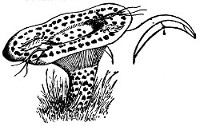
Lactarius blennius. About one-fourth natural size.
L. blen´nius Fr. Gr—slimy. Pileus 3–5 in. across. Flesh thick, firm; soon expanded and more or less depressed, glutinous, dingy greenish-gray, often more or less zoned with drop-like markings; margin at first incurved and downy. Gills slightly decurrent, crowded, narrow, whitish or with an ochraceous tinge. Stem 1–2 in. long, up to 1 in. thick at the apex, where it expands into the thick flesh of the pileus, often attenuated at the base, viscid, colored like the stem or paler, soon hollow. Milk persistently white, very acrid. Spores subglobose, 7–8×6µ.
In woods, on the ground, very rarely on trunks.
L. turpis somewhat resembles the present species but differs in the darker olive-brown pileus and the yellow down on the incurved margin, especially when young. Massee.
Pileus 2–4 in. broad, fleshy, rarely subzonate, convex, the margin generally involute and adpresso-tomentose (quite smooth, Fries); at length more or less depressed, dull cinereous-green, at first viscid, more or less pitted. Milk white, not changeable. Gills rather narrow, pale ochraceous, scarcely forked, not connected by veins. Stem 1 in. long, ¼-½ in. thick, paler than the pileus, attenuated downward, obtuse, smooth, at length hollow, sometimes pitted, very acrid. Berk.
Edible. Coarse.
** Limaci´ni. Pileus viscid, etc.
L. insul´sus Fr.—tasteless. Pileus 2–4 in. broad, convex and umbilicate, then funnel-shaped, glabrous, viscid, more or less zonate, yellowish, the margin naked. Gills thin, close, adnate or decurrent, some of them forked at the base, whitish or pallid. Stem 1–2 in. long, 4–6 lines thick, equal or slightly tapering downward, stuffed or hollow, whitish or yellowish, generally spotted. Spores 7.6–9µ. Milk white, taste acrid.
Thin woods and open, grassy places. Greenbush and Sandlake, N.Y. July and August.
166Our plant has the pileus pale yellow or straw color, and sometimes nearly white, but European forms have been described as having it orange-yellow and brick-red. It is generally, though often obscurely, zonate. The zones are ordinarily more distinct near the margin, where they are occasionally very narrow and close. The milk in the Greenbush specimens had a thin, somewhat watery appearance. Peck, 38th Rep. N.Y. State Bot.
West Virginia, Pennsylvania, New Jersey. July to September. Common in mixed woods and grassy places. McIlvaine.
Edible. Cordier, Curtis.
L. insulsus is another peppery member of Lactarius which has suffered unjustly. I have eaten it since 1881, and think it the best of the hot milk species. Its flesh is not as coarse as others, and is of better flavor. There is little difference in quality between it and L. deliciosus.
L. hys´ginus Fr. Gr—a crimson dye. Pileus 2–3 in. broad, rigid, at first convex, then nearly plane, umbilicate or slightly depressed, even, viscid, zoneless or rarely obscurely zonate, reddish-incarnate, tan-color or brownish-red, becoming paler with age, the thin margin inflexed. Gills close, adnate or subdecurrent, whitish, becoming yellowish or cream-colored. Stem 1–2 in. long, 4–8 lines thick, equal, glabrous, stuffed or hollow, colored like the pileus, or a little paler, sometimes spotted. Milk white, taste acrid.
Woods. Sandlake and Canoga, N.Y. July and August. Not common.
The reddish hue of the pileus distinguishes this species from its allies. The gluten or viscidity of the pileus in our specimens was rather tenacious and persistent. Peck, 38th Rep. N.Y. State Bot.
Spores subglobose, whitish on black paper, yellowish on white paper, 9–10µ Peck; 10×7–8µ Massee.
Mt. Gretna, Pa., 1897. Mixed woods. August, September.
Not very acrid. The entire acridity disappears in cooking. Several specimens were found and eaten, enough to prove it esculent and of good quality.
167*** Piperati. Pileus dry, etc.
L. plum´beus Fr.—like plumbum, lead. Pileus 2—5 in. broad, compact, convex, then infundibuliform, dry, unpolished sooty or brownish-black. Gills crowded, white, or yellowish. Stem 1.5–3 in. long, 3–6 lines thick, solid, equal, thick. Milk white, acrid, unchangeable. Spores 6.3–7.6µ.
The specimens which I have referred to this species were found in the Catskill mountains several years ago, growing in hemlock woods, under spruce and balsam trees. I have not met with the species since. The pileus in the larger specimens had a minutely tomentose appearance, but in the dried specimens this has disappeared. They also varied in color from blackish-brown to pinkish-brown and grayish-brown, but they can scarcely be more than a mere form or variety of the species the description of which, as given by Fries, I have quoted. In the Handbook the pileus is described as dark fuliginous-gray or brown, and Gillet describes it as black-brown, dark fuliginous or lead color, and adds that the plant is poisonous and the milk very acrid and burning. Cordier says that the flesh is white and the taste bitter and disagreeable. Peck, 38th Rep. N.Y. State Bot.
Poisonous. Gillet.
L. pergame´nus Fr.—parchment. White. Pileus fleshy, pliant, convex then plano-depressed, spread, zoneless, slightly wrinkled, smooth. Stem stuffed, smooth, changing color. Gills adnate, very narrow, horizontal, very crowded, branched, white, then straw-color. Milk white, acrid.
Very much allied to L. piperatus, but differing in the stem being stuffed, at length softer internally, elongated, 3 in., unequal, attenuated downward and here and there ascending, quite smooth; in the pileus being thinner, pliant, elastic, most frequently irregular and excentric, for the most part flexuous, at first convex (not umbilicate), then rather plane, the surface very smooth, but unpolished and wrinkled in a peculiar manner; and in the gills being adnate, not decurrent, very crowded, very narrow (scarcely 1 line broad), always straight and horizontal, not arcuate or extended upward, soon straw-color. The flesh is very milky, but the gills are sparingly so. Fries.
In woods. October.
168Spores subglobose, rather irregular, 6–8µ C.B.P.; broadly elliptical, echinulate, 7×5–6µ Massee.
Eaten on the continent and Nova Scotia. Edible. Cooke.
North Carolina, Curtis; New England, Frost; Ohio, Morgan.
L. pipera´tus Fr.—piper, pepper. (Plate XLI, fig. 1, p. 160.) Pileus 4–9 in. broad, white, fleshy, rigid, umbilicate when young, reflexed (margin at first involute) at the circumference, when full grown wholly funnel-shaped, for the most part regular, even, smooth, zoneless. Flesh white. Stem 1–2 in. long, 1–2 in. thick, solid, obese, equal or obconical, even, obsoletely pruinose, white. Gills decurrent, crowded, narrow, scarcely broader than 1 line, obtuse at the edge, dividing by pairs, arcuate then all extended upward in a straight line, white, here and there with yellow spots. Milk white, unchangeable, plentiful and very acrid.
Compact, firm, dry, inodorous. The pileus becomes obsoletely yellow when old. Although the gills are spotted with yellow, they do not change to straw color like those of L. pergamenus. Fries.
Spores white, nearly smooth, 6.3–7.6µ Peck; subglobose, 8–9µ diameter Massee; 5×6µ W.G.S.
Pennsylvania, West Virginia, 1881–1885. New Jersey, Pennsylvania in woods and on grassy places. July to October. McIlvaine.
Edible. Curtis.
L. piperatus is a readily distinguished species. It is very common. In 1881, after an extensive forest fire in the West Virginia forests, I saw miles of the blackened district made white by a growth of this fungus. It was the phenomenal growth which first attracted my attention to toadstools. I collected it then in quantity and used it, with good results, as a fertilizer on impoverished ground.
It has been eaten for many years in most countries, yet a few writers continue to warn against it. It is the representative fungus of its class—meaty, coarse, fair flavor. It is edible and is good food when one is hungry and can not get better. It is best used as an absorbent of gravies.
L. decepti´vus Pk.—deceiving. Pileus 3–5 in. broad, compact, at first convex and umbilicate, then expanded and centrally depressed or subinfundibuliform, obsoletely tomentose or glabrous except on the margin, white or whitish, often varied with yellowish or sordid stains, the 169margin at first involute and clothed with a dense, soft or cottony tomentum, then spreading or elevated and more or less fibrillose. Gills rather broad, distant or subdistant, adnate or decurrent, some of them forked, whitish, becoming cream-colored. Stem 1–3 in. long, 8–18 lines thick, equal or narrowed downward, solid, pruinose-pubescent, white. Spores white, 9–12.7µ. Milk white, taste acrid.
Woods and open places, especially under hemlock trees. Common. July to September.
Trial of its edible qualities was made without any evil consequences. The acridity was destroyed by cooking. Peck, 38th Rep. N.Y. State Bot.
Alabama, U. and E.; New York, Peck, 38th Rep.; West Virginia, 1881–1885, Pennsylvania, New Jersey. Woods and open places. July to October. McIlvaine.
In common with all peppery Lactarii the present species loses the quality in cooking. The edible qualities then depend upon texture, substance, flavor. The species is coarse but meaty and of fair flavor.
L. velle´reus Fr.—vellus, fleece. Pileus 2–5 in. broad, compact, at first convex and umbilicate, then expanded and centrally depressed or subinfundibuliform, the whole surface minutely velvety-tomentose, soft to the touch, white or whitish, the margin at first involute, then reflexed. Gills distant or subdistant, adnate or decurrent, sometimes forked, whitish becoming yellowish or cream-colored. Stem .5–2 in. long, 6–16 lines thick, firm, solid, equal or tapering downward, pruinose-pubescent, white. Milk white, taste acrid. Spores white.
Woods and open places. Common. July to September. Peck, 38th Rep. N.Y. State Bot.
Spores white, nearly smooth, 7–9µ. Peck; 4×8µ W.G.S.
West Virginia, Pennsylvania, New Jersey. Woods and open places. July to October. McIlvaine.
Poisonous according to some authors. Cordier. Edible. Leveille. Eaten it for eighteen years. McIlvaine.
This common, very acrid species is characterized by the downy covering of its cap.
It is a coarse species, but meaty. Its acridity is lost in cooking, when it makes a fair dish.
170L. involu´tus Soppitt.—involved. Every part white or with a very slight ochraceous tinge. Pileus 1–2 in. across, flesh about 1½ lines thick, equal up to the margin, compact, rigid, convex, soon becoming plane or slightly depressed, margin strongly and persistently involute, extreme edge minutely silky, remainder even and glabrous. Gills very slightly decurrent, densely crowded, not ½ line broad, sometimes forked. Stem ⅔-1 in. long, 2–3 lines thick, equal, or slightly thickened at the base, glabrous, even, solid, very firm. Milk white, unchangeable, not scanty, very hot. Spores obliquely elliptical, smooth, 5×3µ.
Very firm and rigid, resembling in habit L. vellereus in miniature. Most nearly allied to L. scoticus, but known at once by the exceedingly narrow, densely-crowded gills and the smooth, elliptical spores. Massee.
West Virginia, 1881–1885, plentiful. Angora, West Philadelphia. August, September, 1897. In mixed woods. McIlvaine.
Much smaller than L. piperatus. Pileus convex, then plane with depressions in center, margin involute. Gills slightly decurrent, densely crowded, very narrow. Stem short, firm, solid. Milk white, very hot.
L. involutus is readily mistaken for small forms of L. vellereus and L. piperatus. The extremely narrow gills, so close and firm that it takes sharp eyes to follow them, are a distinguishing mark.
Its flesh is of same consistency as L. piperatus—hard and coarse. It loses its pepperiness in cooking and is a good emergency plant, or solvent.
II.—Dapetes—daps, food. Milk highly colored, etc.
America is rich in this section. Fries records but two species, L. deliciosus and L. sanguifluus, while America has four. The edible properties of three are known to be good; L. subpurpureus has not come under observation, but is added to complete the series as it is probably edible and is well marked by its dark-red milk. McIlvaine.
L. delicio´sus Fr.—delicious. (Plate XLI, fig. 3, p. 160.) Pileus 2–6 in. broad, orange-brick-color, yellowish or grayish-orange, becoming pale, fleshy, when quite young depressed in the center, margin naked, involute, then plano-depressed or broadly funnel-shaped with the margin unfolded, smooth, slightly viscid, zoned (zones sometimes obsolete). Flesh soft, not compact, pallid, colored at the circumference 171only by the juice. Stem 1–2 in. and more long, 1 in. thick, stuffed then hollow, at length fragile, equal or attenuated at the base, spotted in a pitted manner, of the same color as the pileus or paler. Gills somewhat decurrent, crowded, narrow, arcuate, often branched, typically saffron-yellow, but becoming pale and always becoming green when wounded. Milk aromatic, from the first red-brick-saffron. Fries.
Spores white, spheroid, echinulate 7–8µ K.; 6µ W.G.S.; echinulate, 9–10×7–8µ Massee; subglobose, 7.6–10µ Peck.
In woods, under firs, etc.
Pileus dingy orange-red becoming pale, often greenish. Every part turns to a homely green when bruised. It is from 3 to 5 in. across, thick, convex, then depressed in center, margin at first curved in. Gills decurrent, narrow, saffron-color. Milk saffron-red or orange changing to green; sweet scented but slightly acrid. I have never seen but one specimen with milk distinctly orange, and changing to green. The milk in this species varies in color, much depending upon moisture. It grows in patches, sometimes in clusters.
Edible. Curtis.
There is no question of its edibility. Old and modern writers applaud it. Each cooks to his liking and thinks his own way best. It requires forty minutes' stewing or baking; less time if roasted or fried. It can be cooked in any way, but, like all Lactarii, it must be well cooked.
L. in´digo Schw.—(Plate XLI, fig. 2, p. 160.) Pileus 2–5 in. broad, at first umbilicate with the margin involute, then depressed or infundibuliform, indigo-blue with a silvery-gray luster, zonate, especially on the margin, sometimes spotted, becoming paler and less distinctly zonate with age or in drying. Gills close, indigo-blue, becoming yellowish and sometimes greenish with age. Stem 1–2 in. long, 6–10 lines thick, short nearly equal, hollow, often spotted with blue, colored like the pileus. Milk dark-blue.
Dry places, especially under or near pine trees. Not rare but seldom abundant. July to September. Peck, 38th Rep. N.Y. State Bot.
Spores subglobose, 7.6–9µ long Peck.
West Virginia, North Carolina, New Jersey, Pennsylvania. Solitary and in groups, in pine and mixed woods. July to September. McIlvaine.
The exceptional color of L. indigo will halt anyone with ordinary observing power. It is unnecessary to describe it further. Being a 172large, stout plant it frequently lifts the leaf mat as it pushes upward, making leaf-mounds under which it is hidden, as do many of the Cortinarii. But even in such instances there are usually a few solitary plants standing prominently forth as sentinels.
It is edible, but coarse. Good flavor.
L. chelido´nium Pk. Pileus 2–3 in. broad, at first convex, then nearly plane and umbilicate or centrally depressed, grayish-yellow or tawny, at length varied with bluish and greenish stains, often with a few narrow zones on the margin. Gills narrow, close, sometimes forked, anastomosing or wavy at the base, grayish-yellow. Stem 1–1.5 in. long, 4–6 lines thick, short, subequal, hollow, colored like the pileus. Spores globose, 7.5µ. Milk sparse, saffron-yellow; taste mild.
Sandy soil, under or near pine trees. Saratoga and Bethlehem.
The milk of this species resembles in color the juice of celandine, Chelidonium majus. It is paler than that of L. deliciosus. By this character and by the dull color of the pileus, the narrow lamellæ, short stem and its fondness for dry situations, it may be separated from the other species. Wounds of the flesh are at first stained with the color of the milk, then with blue, finally with green. A saffron-color is sometimes attributed to the milk of L. deliciosus, which may indicate that this species has been confused with that, or that the relationship of the two plants is a closer one than we have assigned to them. Peck, 38th Rep. N.Y. State Bot.
Mt. Gretna, Pa. In mixed woods, gravelly low ground. September, October. McIlvaine.
A score or more solitary specimens were found and eaten. The substance and flavor are not distinguishable from L. deliciosus, which is lauded to the summit of good toadstools.
L. subpurpu´reus Pk.—sub, under; purpureus, purple. Pileus at first convex, then nearly plane or subinfundibuliform, more or less spotted and zonate when young, and moist dark-red with a grayish luster. Gills close, dark-red, becoming less clear and sometimes greenish-stained with age. Stem equal or slightly tapering upward, soon hollow, often spotted with red, colored like the pileus, sometimes hairy at the base. Spores subglobose, 9–10µ. Milk dark-red.
Pileus 2–3 in. broad. Stem 1.5–3 in. long, 3–5 lines thick.
173Damp or mossy ground in woods and swamps. July and August.
At once known by the peculiar dark-red or purplish hue of the milk, which color also appears in the spots of the stem and in a more subdued tone in the whole plant. The color of the pileus, gills and stem is modified by grayish and yellowish hues. In age and dryness the zones are less clear, and dried specimens can scarcely be distinguished from L. deliciosus. Peck, 38th Rep. N.Y. State Bot.
I have not seen this species.
III.—Russularia.
* Viscidi. Pileus viscid.
L. pal´lidus Fr.—pale. Pileus 3–6 in. broad, flesh-color or clay-color to pallid, somewhat tan, fleshy, umbilicato-convex, depressed, obtuse, margin broadly and for a long time involute, smooth, gluey, zoneless. Flesh pallid. Stem 2 in. and more long, about ¾ in. thick, somewhat equal, stuffed then hollow, even, smooth, of the same color as the pileus. Gills somewhat decurrent, arcuate, rather broad, 1½-2 lines and more; somewhat thin, crowded, somewhat branched, whitish at length of the same color as the pileus. Milk white, unchangeable. Fries.
Taste somewhat mild. Stature that of L. deliciosus, but more lax in texture and always pallid. There is a variety with the pileus inclining to dingy-brown. Stevenson.
Mixed woods. September to October.
Spores echinulate, almost round, 8µ W.G.S.; 7–11µ Cooke; 9–10×7–8µ Massee.
North Carolina, Schweinitz, Curtis; Massachusetts, Frost; Minnesota, Johnson; Rhode Island, Bennett.
Edible. Cooke.
L. quie´tus Fr.—calm, mild. Pileus 3 in. broad, fleshy, depressed, obtuse, margin deflexed, smooth, at first viscid, somewhat cinnamon, flesh-color, disk darker, somewhat zoned, soon dry, somewhat silky, opaque, becoming pale. Flesh white then reddish. Stem 2–3 in. long, ½ in. and more thick, stuffed, spongy, smooth, reddish, at length beautifully rust-color. Gills adnato-decurrent, somewhat forked at the 174base, 1½-2 lines broad, white then soon brick-red. Milk white, unchangeable, sweet. Fries.
In woods. August to November. Stevenson.
Spores echinulate, 8–10×6–7µ Massee; 10–12µ Cooke.
Nova Scotia, Somers; New York, Peck, Rep. 42.
Edible. Cooke. Eaten in France and held in estimation.
L. theio´galus Fr. Gr—brimstone; milk. Pileus 2–5 in. broad, fleshy, thin, convex, then depressed, even, glabrous, viscid, tawny-reddish. Lamellæ adnate or decurrent, close, pallid or reddish. Stem 1–3 in. long, 4–10 lines thick, stuffed or hollow, even, colored like the pileus. Spores yellowish, inclining to pale flesh-color, subglobose, 7.5–9µ. Milk white, changing to sulphur-yellow, taste tardily acrid, bitterish.
Woods and groves. Common. July to October.
Our plant does not fully accord with the description of the species as given by Fries. Peck, 38th Rep. N.Y. State Bot.
Spores subglobose, 7–8µ diameter Massee; subglobose, 7.5–9µ Peck.
West Virginia, 1881–1885; Mt. Gretna, Pa. July, 1897; New Jersey, common in mixed woods. July to frost. McIlvaine.
L. theiogalus possesses all the good qualities of the hot milk species. While I ate it whenever I chose in West Virginia, I did not again eat it until 1897 at Mt. Gretna. There several partook of it and thought it rather coarse, but of good flavor. It requires long cooking.
L. fuligino´sus Fr.—fuligo, soot. Pileus 1–2.5 in. broad, firm, becoming soft, convex plane or slightly depressed, even, dry, zoneless, dingy ash-color or buff-gray, appearing as if covered with a dingy pruinosity, the margin sometimes wavy or lobed. Gills adnate or subdecurrent, subdistant, whitish then yellowish, becoming stained with pink-red or salmon-color where wounded. Stem 1–2 in. long, 3–5 lines thick, equal or slightly tapering downward, firm, stuffed, colored like the pileus. Spores globose, yellowish, 7.5–10µ. Milk white, taste tardily and sometimes slightly acrid.
Thin woods and open grassy places. Greenbush and Sandlake, N.Y. July and August. Peck, 38th Rep. N.Y. State Bot.
A form with the pileus colored like that of L. lignyotus, but with the gills much closer than in that species, was found in a swamp near Sevey. July. Peck, 43d Rep.
POISONOUS. Barla and Reveil, Cordier.
175L. fumo´sus Pk. Pileus 1.5–2.5 in. broad, firm, convex, then expanded and slightly depressed in the center, smooth, dry, smoky-brown or sordid-white. Gills close, adnate or slightly rounded behind, white, then yellowish. Stem 3–5 lines thick, firm, short, smooth, stuffed, generally tapering downward. Spores distinctly echinulate, yellow, 6µ in diameter. Flesh and Milk white; taste at first mild, then acrid.
Plant 1.5–2 in. high.
Grassy ground in open woods. Greenbush. July.
The peculiar smoky hue of the pileus and yellow spores enable this species to be easily recognized. The flesh when wounded slowly changes to a dull pinkish-color. Related to L. fuliginosus. Peck, 24th Rep. N.Y. State Bot.
** Impoliti. Pileus downy, etc.
L. ru´fus Fr.—red. Pileus 2–4 in. broad, convex and centrally depressed, then funnel-shaped, generally with a small umbo, glabrous, sometimes slightly floccose or pubescent when young, especially on the margin, zoneless, bay-red or brownish-red, shining. Gills narrow or moderately broad, sometimes forked, close, subdecurrent, yellowish or reddish. Stem 2–4 in. long, 3–5 lines thick, nearly equal, firm, stuffed, paler than or colored like the pileus. Spores white, 7.6–10µ. Milk white, taste very acrid.
Low woods and swamps. North Elba. August. Rare.
The red Lactarius is known by its rather large size, dark-red pileus and intensely acrid taste. It has been found but once in our state. The flesh is pinkish and the stem sometimes pruinose. It is designated by authors as very poisonous and extremely poisonous. Cordier even says that worms never attack it. Peck, 38th Rep. N.Y. State Bot.
Massachusetts, Frost; New York, Peck, Rep. 23, Rep. 38.
I have not recognized this species. It is given as markedly POISONOUS.
L. glycios´mus Fr. Gr—sweet; Gr—scent. Pileus ½-1½ in. broad, thin, convex nearly plane or depressed, often with a small umbo or papilla, minutely squamulose, ash-colored, grayish-brown or smoky-brown, sometimes tinged with pink, the margin even or slightly and distinctly striate. Gills narrow, close, adnate or decurrent, whitish or 176yellowish. Stem ½-1½ in. long, 1–3 lines thick, equal, glabrous or obsoletely pubescent, stuffed, rarely hollow, whitish or colored like the pileus. Milk white, taste acrid and unpleasant, sometimes bitterish, odor aromatic. Peck, 38th Rep. N.Y. State Bot.
Smell agreeable, of melilot, as that of L. camphoratus.
Spores spheroid, echinulate, 6–8µ K.; subglobose, size variable, 6–10µ Massee.
The American plant, so far as observed, does not have the red hues ascribed to the European.
Haddonfield, N.J., T.J. Collins; Scranton, Pa., Dr. J.M. Phillips; Chester county, Pa., September, 1887, on ground in woods, McIlvaine.
This small Lactarius was found on several occasions. Its odor is attractive, but its taste is not. Cooked it is of high flavor, but will not be liked by many.
L. aqui´fluus Pk.—watery. Pileus fragile, fleshy, convex or expanded, at length centrally depressed, dry, smooth, or sometimes appearing as if clothed with a minute appressed tomentum, reddish tan-colored, the decurved margin often flexuous. Gills rather narrow, close, whitish, becoming dull reddish yellow. Stem more or less elongated, equal or slightly tapering upward, colored like the pileus, smooth, hollow, the cavity irregular as if eroded. Spores subglobose, rough, 7.6µ. Flesh colored like the pileus. Milk sparse, watery.
Plant 3–8 in. high. Pileus 3–6 in. broad. Stem 5–10 lines thick.
Swamps and wet mossy places in woods. Sandlake and North Elba. August and September.
The relationship of this plant is with L. serifluus, to which it was formerly referred, but from which I am now satisfied it is distinct. The hollow stem is a constant character in our plant, and affords a ready mark of distinction. The plant, though large, is very fragile, and breaks easily. The taste is mild or but slightly acrid. Sometimes there is an obscure zonation on the pileus, which, in large specimens, is apt to be irregular and much worm-eaten. The milk looks like little drops of water when first issuing from a wound, but it becomes a little less clear on exposure to the atmosphere. The decided but agreeable odor of the dried specimens persists a long time. Peck, 28th Rep.
This plant is sometimes cespitose. The pileus when dry is tawny-gray and scaly or cracked scaly. The margin may be even or coarsely 177sulcate-striate. The flesh is grayish or reddish-gray. The color of the lamellæ varies from creamy-white to tawny-yellow. The stem often has a conspicuous white myceloid tomentum at its base. I have never found this plant with a white or milky juice, and therefore I am disposed to regard it not as a variety of L. helvus, but as a distinct species. Its mild taste and agreeable odor suggested a trial of its edible qualities. It is harmless, but the lack of flavor induces me to omit it from the list of edible species. Peck, 50th Rep. N.Y. State Bot.
Var. brevis´simus Pk. Pileus 1–1.5 in. broad, grayish-buff. Gills crowded, adnate, yellowish or cream-color. Stem very short, 6–8 lines long.
Black mucky soil in roads in woods. Township 24, Franklin county. September.
Plant fragrant; sometimes cespitose. Peck, 51st Rep. N.Y. State Bot.
Angora, West Philadelphia, in moist oak woods. August, 1897, Philadelphia Myc. Center.
Flesh rather hard when cooked, and insipid. Good as an absorbent or in emergency.
L. lignyo´tus Fr.—lignum, wood. Pileus 1–4 in. broad, broadly convex plane or slightly depressed, dry, with or without a small umbo, generally rugose-wrinkled, dark-brown, appearing subpulverulent or as if suffused with a dingy pruinosity, the margin sometimes crenately lobed and distinctly plicate. Gills moderately close or subdistant, adnate, white or yellowish, slowly changing to pinkish-red or salmon color where wounded. Stem 1–3 in. long, 2–6 lines thick, equal or abruptly narrowed at the apex, even, glabrous, stuffed, colored like the pileus, sometimes plicate at the top. Milk white, taste mild or tardily and slightly acrid.
Var. tenu´ipes. Pileus about 1 in. broad. Stem slender, 2–3 in. long and about 2 lines thick.
Wet or mossy ground in woods and swamps. Adirondack mountains and Sandlake. July and August. Not rare in hilly and mountainous districts. Peck, 38th Rep. N.Y. State Bot.
Spores globose, yellowish, 9–11.3µ Peck; pale ochraceous, subglobose, minutely echinulate, 9–10µ diameter Massee.
West Virginia mountains, 1881–1885; Eagle’s Mere; Mt. Gretna, 178Pa. Solitary and gregarious, moist woods and wooded places. July to September. McIlvaine.
In my long experience with the plant I have not seen any change of color, save that, like the white milk of other species, it darkens slightly to a cream color. I have found it distinctly umbilicate and quite umbonate in the same patch.
L. lignyotus is one of the best of Lactarii and quite equal to L. volemus.
L. corru´gis Pk.—having wrinkles or folds. Pileus 3–5 in. broad, firm, convex, then nearly plane or centrally depressed, rugose reticulated, covered with a velvety pruinosity or pubescence, dark reddish-brown or chestnut-color, fading with age to tawny-brown. Gills close, dark cream-color or subcinnamon, becoming paler when old, sordid or brownish where bruised or wounded. Stem 3–5 in. long, 6–12 lines thick, equal, solid, glabrous or merely pruinose, paler than but similar in color to the pileus. Spores subglobose, 10–13µ. Milk copious, white, taste mild.
Thin woods. Sandlake, Gansevoort and Brewerton, N.Y. August and September.
This curious Lactarius is related to L. volemus, from which it may be separated by its darker colors and its corrugated pileus. The flexuous reticulated rugæ present an appearance similar to that of the hymenium of a Merulius. The pileus is everywhere pruinose-pubescent and the gills bear numerous spine-like or acicular cystidia or spicules, 4–5µ long. These are so numerous on and near the edges of the gills that they give them a pubescent appearance. Peck, 38th Rep. N.Y. State Bot.
I found many at Mt. Gretna, Pa., up to 6½ in. in diameter. Flesh not so firm as L. volemus. Stem equal, rugulose, flattened in old specimens. Milk very slightly acrid.
Better in taste and quality than L. volemus.
L. lute´olus Pk.—yellowish. Pileus 2–3 in. broad, fleshy, rather thin, convex or nearly plane, commonly umbilicately depressed in the center and somewhat rugulose, pruinose or subglabrous, buff-color. Flesh white, taste mild. Milk copious, flowing easily, white or whitish. Gills close, nearly plane, adnate or slightly rounded behind, whitish, 179becoming brownish where wounded. Stem 1–1.5 in. long, 3–5 lines thick, short, equal or tapering downward, solid, but somewhat spongy within, colored like the pileus. Spores globose, 7.6µ broad.
Dry woods. East Milton, Mass. August. H. Webster.
This species is related to Lactarius volemus and L. hygrophoroides, but its smaller size and short stem will distinguish it from the former and its close gills from the latter. Its paler buff-color will separate it from both. Some specimens have a narrow encircling furrow or depressed zone near the margin and a slightly darker shade of color on the margin. The milk constitutes a remarkable feature of the species. According to the notes of the collector it is exceedingly copious, rather sticky, serous in character with white particles in suspension. It flows from many points as soon as the plant is disturbed and it stains the gills. It is impossible to collect an unstained specimen, so free is the flow of the milk. He, Mr. Webster, says: “I have never succeeded in picking a specimen so quietly as to prevent an instant and copious flow of its milk.” Torrey Bull., Vol. 23, No. 10, 1896.
Angora, West Philadelphia, August, 1897. In oak woods. August, September. McIlvaine.
Quite frequent there. My attention was directed to it by the “narrow encircling furrow or depressed zone near the margin.”
It is of like quality to L. volemus.
L. Gerar´dii Pk. Pileus 1.5–4 in. broad, broadly convex plane or slightly depressed, dry, generally rugose-wrinkled, with or without a small umbo or papilla, dingy-brown, the thin spreading margin sometimes flexuous lobed or irregular. Gills distant, adnate or decurrent, white or whitish, the interspaces generally uneven. Stem 1–2 in. long, 3–6 lines thick, subequal, stuffed or hollow, colored like the pileus. Spores globose, white, 9–11.3µ. Milk white, unchangeable, taste mild.
Woods and open places. Poughkeepsie, W.R. Gerard. Greenbush, Sandlake and Croghan, N.Y. July to September.
This Lactarius closely resembles the Sooty lactarius in color, but differs from it in its more distant gills, white spores and constantly mild taste. Wounds of the flesh and gills do not become pinkish-red as in that plant. From L. hygrophoroides its darker color, hollow stem and more globose rougher spores separate it. Peck, 38th Rep. N.Y. State Bot.
180In the color of the pileus and stem this species is like the larger forms of L. fuliginosus. Peck, 26th Rep.
Edible. Boston Myc. Club Bull.
*** Glabra´ti. Pileus smooth.
L. vole´mus Fr.—volema pira, a kind of large pear. (Plate XLI, fig. 4, p. 160) Pileus 2–5 in. broad, firm, convex, nearly plane or centrally depressed, rarely funnel-shaped, sometimes with a small umbo, generally even, glabrous, dry, golden-tawny or brownish-orange, sometimes darker in the center, often becoming rimose-areolate. Gills close, adnate or subdecurrent, white or yellowish, becoming sordid or brownish where bruised or wounded. Stem 1–4 in. long, 4–10 lines thick, subequal, variable in length, firm, solid, glabrous or merely pruinose, colored like the pileus, sometimes a little paler. Milk copious, white, taste mild, flat.
Var. subrugo´sus. Pileus rugose-reticulated on the margin. Peck, 38th Rep. N.Y. State Bot.
Spores globose, white, 9–11.3µ Peck; 5–6µ diameter Massee.
Very delicious raw and celebrated from early times. Fries.
Common over the United States, well known everywhere and distinguished for its edible qualities. It is crisp and unless carefully cooked is hard and granular. It should have long, slow cooking, though it may be roasted or fried.
(Plate XLII.)
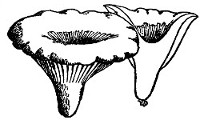
Lactarius hygrophoroides.
L. hygrophoroi´des B. and C.—resembling Hygrophorus. Pileus 1–4 in. broad, firm, convex or nearly plane, umbilicate or slightly depressed, rarely funnel-shaped, glabrous or sometimes with a minute velvety pubescence or tomentum, dry, sometimes rugose-wrinkled and often becoming cracked in areas, yellowish-tawny or brownish-orange. Gills distant, adnate or subdecurrent, white or cream-color, the interspaces uneven or venose. Stem .5–1 in. long, 4–8 lines thick, short, equal or tapering downward, solid, glabrous or merely pruinose, colored like the pileus. Spores subglobose 181or broadly elliptical, nearly smooth, 9–11.3µ. Milk white, taste mild.
Grassy ground and borders of woods. Albany, Greenbush and Sandlake. July and August.
This plant has almost exactly the color of L. volemus, but differs from it in its distant gills, short stem, less copious milk and less globose spores. Its flesh is white, with a thickness about equal to the breadth of the gills. It is probably edible, but has not yet been tested. The typical L. hygrophoroides is described as having the pileus yellowish-red and pulverulent, and the gills luteous. It is also represented as a small plant; but our specimens, while not fully agreeing with this description, approach so closely to it in some of their forms that they doubtless belong to the same species. We have therefore extended the description so that it may include our plant. In wet weather the pileus sometimes becomes funnel-form by the elevation of the margin. Peck, 38th Rep. N.Y. State Bot.
Mt. Gretna, Pa., 1897, grassy grounds and borders of woods. Mixed, moist woods and grassy borders. July to September. McIlvaine.
Pileus up to 4 in. across. Stem 1–2½ in., tapering, equal or tapering downward. When growing in woods the stem is longer than when growing on borders.
Its edible qualities are excellent.
L. mitis´simus Fr.—mitis, mild. Pileus 1–3 in. broad, golden-tawny, zoneless, fleshy, thin, somewhat rigid, convex, papillate, depressed, papilla vanishing, even, smooth, somewhat slippery when moist. Flesh pallid. Stem elongated, 1–3 in. long, ⅓-½ in. thick, stuffed, then hollow, even, smooth, of the same color as the pileus. Gills adnato-decurrent, somewhat arcuate, then tense and straight, 1–1½ lines and more broad, thin, crowded, a little paler than the pileus, most frequently stained with minute red spots. Milk white, mild, plentiful.
Thin; very much allied to L. subdulcis, but distinguished by the taste being mild, then somewhat bitterish, and especially by the bright, golden-tawny, resplendent color of the pileus and stem. Fries.
In mixed and pine woods. August to November. Stevenson.
Spores 6–8×5–6µ Massee; 10µ Cooke; spheroid, echinulate, 6–7µ C.B.P.
182California, H. and M.
Edible. Cooke. Eaten on the continent.
(Plate XLIII.)
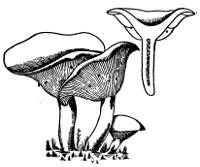
Lactarius subdulcis.
L. subdul´cis Fr.—sub; dulcis, sweet. Pileus .5–2 in. broad, thin, convex, then plane or slightly funnel-shaped, with or without a small umbo or papilla, glabrous, even, zoneless, moist or dry, tawny-red, cinnamon-red or brownish-red, the margin sometimes wavy or flexuous. Gills rather narrow, thin, close, whitish, sometimes tinged with red. Stem 1–2.5 in. long, 1–3 lines thick, equal or slightly tapering upward, slender, glabrous, sometimes villous at the base, stuffed or hollow, paler than or colored like the pileus. Spores 7.6–9µ. Milk white, taste mild or tardily and slightly acrid, sometimes woody or bitterish and unpleasant. Flesh whitish, pinkish or reddish gray, odor none.
Fields, copses, woods, swamps and wet places. July to October. Very common.
This species grows in almost every variety of soil and locality. It may be found in showery weather on dry, rocky soil, on bare ground or among mosses or fallen leaves. In drier weather it is still plentiful in swamps and wet, shaded places, and in sphagnous marshes. It sometimes grows on decaying wood. It is also as variable as it is common. Gillet has described the following varieties:
Var. cinnamo´meus. Pileus cinnamon-red, sub-shining. Stem stuffed, then hollow; taste mild, becoming slightly acrid or bitter.
Var. ru´fus. Pileus dull chestnut-red; becoming more concave. Stem spongy; taste mild.
Var. ba´dius. Pileus bay-red, shining as if varnished, with an obtuse disk and an inflexed, elegantly crenulate margin. Stem very glabrous, hollow.
The first and second varieties have occurred within our limits. The first also has the stem elastic and furnished with a whitish or grayish tomentum or strigose villosity at the base, when growing among moss in swamps. A form occurred in Sandlake, in which some of the specimens 183were proliferous. The umbo had developed into a minute pileus. With us the prevailing color of the pileus is yellowish-red or cinnamon-red. Sometimes the color is almost the same as that of L. volemus and L. hygrophoroides, and again it is a tan-color or a bay-red, as in L. camphoratus, from which such specimens are scarcely separable, except by their lack of odor. In young plants the pileus usually has a moist appearance, which is sometimes retained in maturity. Cordier pronounces the species edible, and says that he has tested it several times without inconvenience. Peck, 38th Rep. N.Y. State Bot.
Spores 10µ Cooke; 7µ W.G.S.
West Virginia mountains, 1881–1885; Pennsylvania, New Jersey, everywhere on moist ground. July to October. McIlvaine.
Edible. Curtis.
The description of Fries as enlarged and modified by Professor Peck, together with that of the varieties placed to the credit of the species by Gillet, are given above in full. The species with its ascribed varieties is common and well known. Var. ba´dius occurs in West Virginia and Pennsylvania. They are all edible and vary but little in quality. L. subdulcis requires long cooking.
L. muta´bilis Pk.—changeable. Pileus 2–4 in. broad, thin, convex or nearly plane, zonate when moist, reddish-brown, the disk and zones darker, zoneless when dry, flesh colored like the pileus. Milk sparse, white, taste mild. Gills narrow, close, adnate, whitish, with a yellowish or cream-colored tint when old. Stem 1–2 in. long, 3–5 lines thick, equal or tapering upward, stuffed or spongy within, glabrous, colored like the pileus. Spores subglobose, rough, 7.6µ broad.
Low, damp places. Selkirk and Yaphank, N.Y. June and September.
The species is allied to L. subdulcis, from which the larger size and zonate pileus separate it. The zones disappear in the dry plant, and this change in the marking of the pileus suggests the specific name. They appear to be formed by concentric series of more or less confluent spots and are suggestive of such species as L. deliciosus and L. subpurpureus. Peck, 43d Rep. N.Y. State Bot.
West Virginia, Pennsylvania. Solitary but frequent. In moist woods and margins of woods. June to October. McIlvaine.
184I have been familiar with and eaten this plant since 1882, but thought it might be a variety of L. deliciosus, with light-colored milk.
L. mutabilis is an excellent species, equal to any Lactarius.
L. camphora´tus Fr.—camphor. Pileus 1–2 in. across, brown-brick-red, somewhat zoned, sometimes zoneless, fleshy, thin, depressed, dry, smooth. Stem short, 1–2 in., stuffed, somewhat undulated, of the same color as the pileus. Gills adnate, crowded, yellowish-brick-color. Milk mild, white, odor agreeable, spicy. Fries.
Strong smelling. So like L. subdulcis that it can be distinguished safely only by its odor of melilot when dried. Stevenson.
Pileus .5–1.5 in. broad. Stem 1–2 in. long, 2–3 lines. Peck, 38th Rep. N.Y. State Bot.
Spores spherical, echinulate, 6–7µ Q.; subglobose, 8–9µ Massee; 7.6–9µ Peck.
Taste and smell not of camphor, but of melilot.
North Carolina, Curtis; South Carolina, Ravenel; Wisconsin, Bundy; New York, Peck, Rep. 23, Mon. 38th Rep.
West Virginia, Pennsylvania, July to October, in moist places. Mixed woods, etc. McIlvaine.
Edible. Gillet.
Its mild taste distinguishes it at once from L. rufus.
It has high but pleasant flavor. If the flavor is too evident to suit some tastes, it is well to mix milder species with it.
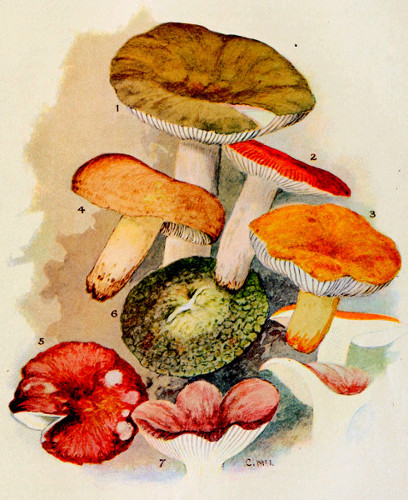
Grouped by F.D. Briscoe—Studies by C. McIlvaine. Plate XLIV.
Fig. Page. Fig. Page.
1. Russula cyanoxantha, 198 5. Russula roseipes, 209
2. Russula emetica, 201 6. Russula virescens, 194
3. Russula flavida, 197 7. Russula puellaris, 208
4. Russula sordida, 190
185RUS´SULA Pers.
Reddish.
(Plate XLV.)
Russula.
Pileus regular, rigid, usually becoming more or less depressed. Flesh of the pileus descending into the gills forming a cellular trama. Veil and consequently the ring absent. Stem smooth, stout, rigid, brittle, spongy within. Gills rigid, fragile, edge thin and acute. Spores rounded, often echinulate, white or yellowish. On the ground.
Closely allied to Lactarius but separated by the absence of milk. The gills of some species exude watery drops in moist weather. Owing to the similarity of form and the variable coloring many species are difficult to determine; all the characters should be carefully noted, not omitting that of the taste.
Russulæ are readily distinguished by the stout, short, brittle stem and the fragility of the pileus and gills. They especially love open woods and appear during the summer and fall months, some being found until sharp frosts occur.
It has been claimed by mushroom growers, until within a few years, that the spores of the mushroom have to pass through the digestive apparatus of the horse before they will germinate. It has been conclusively demonstrated that such a transmission is not a necessity. It was for a long time my opinion—following the opinion of others—that such assistance was necessary. In my many efforts to propagate valuable food species of the wild toadstools I endeavored to find the method by which the spores were disseminated, and through what digestive medium they passed—either of insect or animal—before germination. Noticing that the Russulæ were fed upon by a small black beetle, I planted in suitable places, not the toadstools, but the beetles found upon them. The result was that in several instances I grew the Russulæ. My experiments, while interesting, are not conclusive, because I later found that the same results could be obtained from the toadstool itself when 186planted under its own natural life conditions. It is certain that beetles can not be raised by planting Russulæ.
The beetles known as tumble-bugs—canthon lævis—deposit eggs in the center of balls made of animal droppings; dig a hole in the ground and drop them into it. These droppings frequently contain the spores of the meadow mushroom. Thus planted with the proper surrounding of manure, and at the proper depth, the spores germinate, spread mycelium, and a crop of mushrooms is the result. The beetle becomes a horticulturist. No wonder the Egyptians, thousands of years ago, made it—the scarabeus—their sacred emblem, and that, today, the fleur-de-lis of France, so the Rosicrucians say, perpetuates its glorious worth and calling.
Most Russulæ are sweet and nutty to the taste; some are as hot as the fiercest of cayenne, but this they lose upon cooking. To this genus authors have done especial injustice; there is not a single species among them known to be poisonous, and, where they are not too strong of cherry bark and other highly flavored substances, they are all edible; most of them are favorites. Where they present no objectionable appearance or taste, their caps make most palatable dishes when stewed, baked, roasted or escalloped. The time of cooking should be determined by the consistency of the variety; some will cook in five minutes, others not under thirty. Salt, butter and pepper are the only necessaries as seasoning.
ANALYSIS OF TRIBES.
I.—Compactæ (compingo, to put together; compact). Page 187.
Pileus fleshy throughout, hence the margin is at first bent inward and always without striæ, without a distinct gluey pellicle (in consequence of which the color is not variable, but only changes with age and the state of the atmosphere). Flesh compact, firm. Stem solid, fleshy. Gills unequal.
II.—Furcatæ (furca, a fork. With forked gills). Page 191.
Pileus compact, firm, covered with a thin, closely adnate pellicle, which at length disappears, margin abruptly thin, at first inflexed, then spreading, acute, even. Stem at first compact, at length spongy-soft within. Gills somewhat forked, with a few shorter ones intermixed, commonly attenuated at both ends, thin and normally narrow.
187III.—Rigidæ (rigidus, rigid). Page 194.
Pileus without a viscid pellicle, absolutely dry, rigid, the cuticle commonly breaking up into flocci or granules. Flesh thick, compact, firm, vanishing away short of the margin which is straight (never involute), soon spreading, and always without striæ. Stem solid, at first hard, then softer and spongy. Gills, a few dimidiate, others divided, rigid, dilated in front and running out with a very broad, rounded apex, whence the margin of the pileus becomes obtuse and is not inflexed. Exceedingly handsome, but rather rare.
IV.—Heterophyllæ (R. heterophylla, the typical species
of the section). Page 198.
Pileus fleshy, firm, with a thin margin which is at first inflexed, then expanded and striate, covered with a thin adnate pellicle. The gills consist of many shorter ones mixed with longer ones, along with others which are forked. Stem solid, stout, spongy within.
V.—Fragiles (fragilis, fragile or brittle). Page 201.
Pileus more or less fleshy, rigid-fragile, covered with a pellicle which is always continuous, and in wet weather viscid and somewhat separable; margin membranaceous, at first convergent and not involute, in full-grown plants commonly sulcate and tubercular. Flesh commonly floccose, lax, friable. Stem spongy, at length wholly soft and hollow. Gills almost all equal, simple, broadening in front, free in the pileus when closed. Several doubtful forms occur. R. integra is specially fallacious from the variety of its colors.
* Gills and spores white.
** Gills and spores white, then light-yellowish or bright lemon-yellowish.
*** Gills and spores ochraceous.
Compac´tæ.
R. ni´gricans Bull.—nigrico, to be blackish. Pileus 2–4 in. and more broad, olivaceous-fuliginous, at length black, fleshy to the margin which is at first bent inwards, convex then flattened, umbilicato-depressed, when young and moist slightly viscid and even (without a separable pellicle), at length cracked in scales. Flesh firm, white, 188when broken becoming red on exposure to the air. Stem 1 in. thick, persistently solid, equal, pallid when young, at length black. Gills rounded behind, slightly adnexed, thick, distant, unequal, paler, reddening when touched. Fries.
Compact, obese, inodorous, within and without at length wholly black, in which it differs from all others. The flesh becomes red when broken because it is saturated with red juice, although it does not exude milk. Sometimes a very few of the gills are dimidiate.
In woods. Common. June to November. Stevenson.
Var. albo´nigra Krombh.—albo, white; negro, to be black. Pileus fleshy, convexo-plane, depressed in the middle, at length funnel-shaped, viscid, whitish, smoky about the margin. Flesh white, turning black when broken. Stem solid, stout, dusky, becoming blackened. Gills decurrent, crowded, unequal, dusky-whitish. In grassy places.
Spores papillose, 8µ W.G.S.; subglobose, rough, 8–9µ Massee.
New York. Our specimens agree with the description in every respect, except that the gills are not distant. Peck, 32d Rep.
Mild when raw, but with a heavy woody taste.
Cooked it makes a good dish, but does not equal most Russulæ.
R. purpuri´na Quel. and Schulz.—purple. (Plate XLVa.) Pileus fleshy, margin acute, subglobose, then plane, at length depressed in the center, slightly viscid in very wet weather, not striate, often split, pellicle separable, rosy-pink, paling even to light yellow. Gills crowded in youth, afterward subdistant, white, in age yellowish, reaching the stem, 2–4 lines broad in front, not greatly narrowed behind, almost equal, not forked. Stem spongy, stuffed, very variable, cylindrical, attenuated above and below the middle, rosy-pink becoming paler (rarely white) toward the base, color obscure in age. Flesh fragile, white, reddish under the skin; odor slight, taste mild. Spores white, globose, sometimes sub-elliptical, 4–8µ long, minutely warted.
Pileus 1.5–2.5 in. across. Stem up to .4 in. thick, 1.2 in. long.
“This is a beautiful and very distinct species easily known by its red stem, mild taste and white spores.” Peck, 42d Rep. N.Y. State Bot.
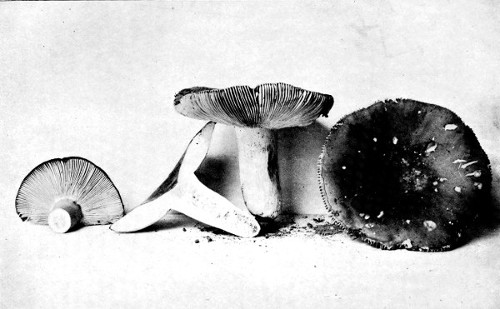
Photographed by Dr. J.R. Weist. Plate XLVa. RUSSULA PURPURINA.
R. adus´ta Fr.—aduro, to scorch. Pileus pallid or whitish, grayish-sooty, equally fleshy, compact, depressed then somewhat infundibuliform, margin at first inflexed, smooth, then erect, without striæ. Flesh 189unchangeable. Stem solid, obese, of the same color as the pileus. Gills adnate then decurrent, thin, crowded, unequal, white then dingy, not reddening when touched. Fries.
Spores subglobose, almost smooth, 8–9µ Massee.
In pine and mixed woods.
West Virginia, Pennsylvania, New Jersey, in pine woods and in mixed woods. August to frost. McIlvaine.
R. adusta is solitary but often in small troops. It is easily recognized by the brownish blotches upon its cap, and the crowding of its thin gills.
The solid flesh must be well cooked. It is then of good flavor.
(Plate XLVb.)
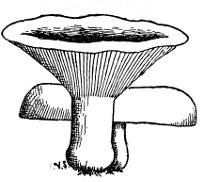
Russula brevipes. After Prof. Peck.
R. bre´vipes Pk.—brevis, short; pes, a foot. Pileus 3–5 in. broad, at first convex and umbilicate, then infundibuliform, dry, glabrous or slightly villose on the margin, white, sometimes varied with reddish-brown stains. Flesh whitish, taste mild, slowly becoming slightly acrid. Lamellæ thin, close, adnate or slightly rounded behind; white. Stem solid, white.
Spores globose, verruculose, 10–13µ.
Stem 6–10 lines long, 6–10 lines thick.
Sandy soil in pine woods. Quogue. September.
This species is related to Russula delica, but is easily distinguished by its short stem and crowded gills. The pileus also is not shining and the taste is tardily somewhat acrid. From Lactarius exsuccus it is separated by the character of the gills and the very short stem which is about as broad as it is long. The spores also are larger than in that species. The gills in the young plant are sometimes studded with drops of water. They are not clearly decurrent. Some of them are forked at the base. The pileus is but slightly raised above the surface of the ground and is generally soiled by adhering dirt and often marked by rusty or brownish stains. The plants grew in old roads in the woods where the soil had been trodden and compacted. Peck, 43d Rep. N.Y. State Bot.
190West Virginia, 1882; Pennsylvania, 1887–1894; New Jersey, 1892. Solitary in pine and hemlock woods, generally on bare, compact ground. August to October. McIlvaine.
This species is a sparse grower, but its good size and respectable numbers soon fill the basket. When fresh it is of good substance and flavor.
R. del´ica Fr.—delicus, weaned. (Milkless, juiceless in gills.) White. Pileus 3–5 in. broad, fleshy throughout, firm, umbilicate then infundibuliform, regular, everywhere even, smooth with a whitish luster, the involute margin without striæ. Flesh firm, juiceless, not very thick, white. Stem curt, 1–2 in. long, ½ in. and more thick, solid, even, smooth, white. Gills decurrent, thin, distant, very unequal, white, exuding small watery drops in wet weather. Fries.
Spores minutely echinulate, white, broadly elliptical, 8–10×6–7µ Massee.
In appearance it resembles Lactarius vellereus and L. piperatus, but its gills do not distill milk or juice. It differs, too, in its mild taste. It is related to R. brevipes Pk.
A large, coarse species, cup-shaped at maturity. I have found it in several localities in Massachusetts in July and August. It is of fair quality cooked, but much inferior to R. virescens, etc. Macadam.
West Virginia, Pennsylvania, New Jersey, in mixed woods, August to October. McIlvaine.
Edible. Taste mild. From the juiceless variety of L. vellereus its mild taste alone furnishes a separate character. Peck.
I have eaten it since 1882, but it is not a favorite. Its quality is fair.
R. sor´dida Pk.—dirty. (Plate XLIV, fig. 4, p. 184.) Pileus firm, convex, centrally depressed, dry, sordid-white, sometimes clouded with brown. Gills close, white, some of them forked. Stem equal, solid, concolorous. Spores globose, 7.5µ. Taste acrid. Flesh changing color when wounded, becoming black or bluish-black.
Plant 4–5 in. high. Pileus 3–5 in. broad. Stem 6–12 lines thick.
Ground under hemlock trees. Worcester. July.
It resembles L. piperatus in general appearance. The whole plant turns black in drying. Peck, 26th Rep. N.Y. State Bot.
Ohio, Morgan; Pennsylvania, Herbst; West Virginia, 1881–1885, 191Pennsylvania, New Jersey, pine, hemlock and mixed woods, July to September. McIlvaine.
It is of better quality than most coarse-grained Russulæ.
Furca´tæ.
R. furca´ta Fr.—furca, a fork. Pileus 3 in. broad, sometimes greenish, sometimes umber-greenish, fleshy, compact, gibbous then plano-depressed or infundibuliform, even, smooth, but often sprinkled with slightly silky luster, pellicle here and there separable, margin thin, at first inflexed, then spreading, always even. Flesh firm, somewhat cheesy, white. Stem 2 in. or a little more long, solid, firm, equal or attenuated downward, even, white. Gills adnato-decurrent, rather thick, somewhat distant but broad, attenuated at both ends, frequently forked, shining white. Fries.
Spores globose, echinulate, 6–7µ C.B.P.; 7–8×9µ Massee.
In woods, and grass under trees.
The frequently forked gills, from which the species takes its name, their being thick and slightly decurrent, help to distinguish it. It is quite common in its several varieties.
Taste mild at first. A slight bitter develops which disappears in cooking. It is then of good quality, not equal to R. virescens. Older writers marked it poisonous, doubtless for no other cause than its slight bitter. I have eaten it freely for fifteen years.
R. sangui´nea Fr.—sanguis, blood. Pileus 2–3 in. broad, blood-red or becoming pale round the even, spreading, acute margin, fleshy, firm, at first convex, obtuse, then depressed and infundibuliform and commonly gibbous in the center, polished, even, moist in damp weather. Flesh firm, cheesy, white. Stem stout, spongy-stuffed, at first contracted at the apex, then equal, slightly striate, white or reddish. Gills at first adnate, then truly decurrent, very crowded, very narrow, connected by veins, fragile, somewhat forked, shining white. Fries.
Spores 9–10µ diameter Massee.
In pine and mixed woods. July to October.
Color same as R. rubra but differs in its hard cheesy flesh, rigid, slightly yellowish gills in age. The gills of R. sanguinea are truly decurrent, and pointed in front.
192Poisonous. Stevenson. Krapp says he has experienced grave inconveniences from eating it.
Myself and very many friends eat all fresh inviting Russulæ. We do not discriminate against a single peppery or acrid species, not even the R. emetica which has been severely maligned. In fact the peppery Russulæ are usually substantial in flesh and choice in substance.
The opinion of many is that R. sanguinea is one of the best. I have eaten it for years.
R. depal´lens Pers.—palleo, to be pale. Pileus 3–4 in. across, pallid-reddish or inclining to dingy-brown, etc., fleshy, firm, convex, then plane, more rarely depressed, but commonly irregularly shaped and undulated, even, the thin, adnate pellicle presently changing color, especially at the disk, the spreading margin even, but slightly striate when old. Flesh white. Stem about 1½ in. long, solid, firm, commonly attenuated downward, white, becoming cinereous when old. Gills adnexed, broad, crowded, distinct, but commonly forked at the base, often with shorter ones intermixed. Inodorous, taste mild. The color of the pileus is at first pallid-reddish, or inclining to brownish, then whitish or yellowish, opaque in every stage of growth. It approaches nearest to the Heterophyllæ. Fries.
In beech woods, pastures, etc. August to September.
Spores subglobose, echinulate, 7–8µ Massee.
R. depallens somewhat resembles R. heterophylla. Both are edible. It is a solitary grower and not common, but when found it occurs in good quantity. It belongs to the best class of Russulæ.
R. subdepal´lens Pk.—sub, de and palleo, to be pale. Pileus fleshy, at first convex and striate on the margin, then expanded or centrally depressed and tuberculate-striate on the margin, viscid, blood-red or purplish red, mottled with yellowish spots, becoming paler or almost white with age, often irregular. Flesh fragile, white, becoming cinereous with age, reddish under the cuticle, taste mild. Lamellæ broad, subdistant, adnate, white or whitish, the interspaces venose. Stem stout, solid but spongy within, persistently white.
Spores white, globose, rough, 8µ broad.
Pileus 3–6 in. broad. Stem 1.5–3 in. long, 6–12 lines thick.
Under a hickory tree. Trexlertown, Pa. June. W. Herbst.
193Closely related to Russula depallens, from which it differs in having the margin of the pileus striate at first and more strongly so when mature, also in the pileus being spotted at first, the gills more distant, the stem persistently white and the spores white. Bull. Torrey Bot. Club. Vol. 23, No. 10. October, 1896.
I do not doubt its edibility. See R. depallens.
R. ochrophyl´la Pk.—ochra, a yellow earth; phyllon, a leaf. Pileus 2–4 in. broad, firm, convex becoming nearly plane or slightly depressed in the center, even or rarely very slightly striate on the margin when old, purple or dark purplish red. Flesh white, purplish under the adnate cuticle, taste mild. Gills entire, a few of them forked at the base, subdistant, adnate, at first yellowish, becoming bright ochraceous buff when mature, dusted by the spores, the interspaces somewhat venose. Stem equal or nearly so, solid or spongy within, reddish or rosy tinted, paler than the pileus. Spores bright ochraceous buff, globose-verruculose, 10µ broad.
The ochery-gilled Russula is a large fine species, but not a common one. It differs but little in color and size from the European pungent Russula, Russula drimeia, but it is easily distinguished from it by its mild taste.
The cap is dry, convex or a little depressed in the center, purple or purplish red, the white flesh purplish under the cuticle, which, however, is not easily separable.
The gills are nearly all entire, extending from the stem to the margin of the cap. They are therefore much closer together near the stem than at the margin. They are at first yellowish, but a bright ochraceous buff when mature. They are then dusted by the similarly colored spores.
The stem is stout, nearly cylindric, firm but spongy in the center and colored like the cap, but generally a little paler. There is a variety in which the stem is white and the cap deep red. In other respects it is like the typical form. Its name is Russula ochrophylla albipes.
The ochery-gilled Russula grows in groups under trees, especially oak trees, and should be sought in July and August. Peck, 51st Rep. N.Y. State Bot.
West Virginia, Pennsylvania, July to September, McIlvaine.
Edible. Peck, 50th Rep. N.Y. State Bot.
194Ri’gidæ.
R. lac’tea Fr.—lac, milk. Pileus 2 in. broad, at the first milk-white, then tan-white, throughout compactly fleshy, bell-shaped, then convex, often excentric, without a pellicle, always dry, at the first even, then slightly cracked when dry, margin straight, thin, obtuse, even. Flesh compact, white. Stem 1½-2 in. long, 1½ in. thick, solid, very compact, but at length spongy-soft within, equal, even, always white. Gills free, very broad, thick, distant, rigid, forked, white. Fries.
Spores subglobose, echinulate, 7–9µ Massee.
Closely allied to R. albella Pk. from which it differs in its shorter stem, and pileus cracking into areolæ, and gills not being entire.
In mixed woods, in patches, not common.
Botanic creek, West Philadelphia, Pa., patches, McIlvaine, 1887.
Edible and of good flavor. Macadam.
Raw, it has a raw, rather unpleasant taste and odor, a little like some acorns. But its firm, thick flesh, meaty gills and stem, and good flavor when well cooked, rank it equal to any.
R. albel’la Pk.—whitish. Pileus 2–3 in. broad, thin, fragile, dry, plane or slightly depressed in the center, even or obscurely striate on the margin, commonly white, sometimes tinged with pink or rosy-red, especially on the margin. Flesh white, taste mild. Lamellæ entire, white, becoming dusted by the spores. Stem 1–2 in. long, 3–4 lines thick, equal, solid or spongy within, white.
Spores white, globose, 7.6µ broad.
Dry soil of frondose woods. Port Jefferson. July.
Closely allied to R. lactea, but differing in its fragile texture, entire lamellæ, more slender stem, and in the pileus not cracking into areas. Peck, 50th Rep. N.Y. State Bot.
R. vires’cens Fr.—viresco, to be green. (Plate XLIV, fig. 6, p. 184.) Pileus green, compactly fleshy, globose then expanded, at length depressed, often unequal, always dry, not furnished with a pellicle, wherefore the flocculose cuticle is broken up into patches or warts, margin straight, obtuse, even. Flesh white, not very compact. Stem solid, internally spongy, firm, somewhat rivulose, white. Gills free, somewhat 195crowded, sometimes equal, sometimes forked, with a few shorter ones intermixed, white. Fries.
Taste mild; good, raw.
Spores scarcely echinulate, almost globular, 6µ W.G.S. Spores 8–10µ Massee; 6–7.6µ Peck.
Cap round when young, very hard, then convex or becoming dished, sometimes repand. It is without a separable skin, covered with various sized areas of mouldy looking patches which are at times distinctly cracked. The color varies from a bright bluish-green to grayish-green, such shades remind one of mouldy cheese or the shades of Roquefort; again the color may vary in shades of light leather brown, occasionally the caps are almost white, opaque in each shade of color. Flesh crisp, brittle, thick, white, mild, good raw. Gills and stem as described.
R. virescens is common in the United States but not generally plentiful. It is a solitary grower, usually but few are found in a patch. Striking in appearance when its green colors are present, and always clean looking and inviting. It sometimes attains the size of 5 in. across. It is a hot weather Russula and rarely appears before the latter part of June, then after rains.
To eat, it should be in a healthy, fresh condition. All Russulæ impart a stale flavor if any part of gills or cap is wilting, drying or decaying. It requires forty minutes' slow stewing, or it can be dressed raw as a salad. Roasted or fried crisp in a hot buttered pan it is at its best. It should be well salted.
R. lep´ida Fr.—lepidus, neat, elegant. Pileus 3 in. broad, blood-red-rose, becoming pale, whitish especially at the disk, somewhat equally fleshy, convex then expanded, scarcely depressed, obtuse, opaque, unpolished, with a silky appearance, at length often cracked scaly, margin spreading, obtuse, without striæ. Stem as much as 3 in. long, often 1 in. thick, even, white or rose-color. Gills rounded behind, rather thick, somewhat crowded, often forked, connected by veins, white, often red at the edge.
Taste mild; wholly compact and firm, but the flesh is cheesy, not somewhat clotted. The gills are often red at the edge, chiefly toward the margin, on account of the margin of the pileus being continuous with the gills. Fries.
Spores 8–10×6–8µ Syll.
196Frequent. July to October, in mixed woods.
A common and variable species in size and color, but the cap is always some shade of rose-red or lake. The flesh is compact and cheesy. The gills sometimes edged with pink as they near the margin. Taste mild.
The crisp flesh of R. lepida requires forty minutes' slow stewing, if stewed. It yields a delicate pink shade to the dish. Roasted or cooked in a hot buttered pan it is excellent.
R. ru´bra Fr.—ruber, red. Pileus unicolorous, a cinnabar-vermilion, but becoming pale (tan) when old, disk commonly darker, compact, hard but fragile, convex, then flattened, here and there depressed, absolutely dry, without a pellicle, but becoming polished-even, often sinuously cracked when old, margin spreading, obtuse, even, always persistent. Flesh white, reddish under the cuticle. Stem 2–3 in. long, about 1 in. thick, solid, even, varying white and red. Gills obtusely adnate, somewhat crowded, whitish, then yellowish, with dimidiate and forked ones intermixed.
Very acrid, very hard and rigid, most distinct from all the others of this group in the pileus becoming polished-even, although without a pellicle, in the flesh being somewhat clotted, and in the very acrid taste. Gills often red at the edge. Fries.
Spores whitish, Fries; spheroid, 8–10µ K.
Krapp says he has experienced grave inconveniences from eating it. European authorities mark “poisonous.”
I do not hesitate to cook it either by itself or with other Russulæ and serve it at my table. It is easier cooked than R. virescens and others of the crisp species, and has equal flavor.
R. Linnæ´i Fr.—in honor of Linnæus. Pileus 3–4 in. broad, unicolorous, dark purple, blood-red or bright rose, opaque, not becoming pale, everywhere fleshy, rigid, plano-depressed, sometimes spread upward, even, smooth, dry, without a separable pellicle, margin spreading, obtuse, without striæ. Flesh thick, spongy-compact, white. Stem 1½ in. and more long, 1 in. and more thick, stout, firm, but spongy-soft within, somewhat ventricose, obsoletely reticulated with fibers, intensely blood-red. Gills adnate, somewhat decurrent, rather thick, not crowded, broad (more than ½ in.), fragile, sparingly connected by veins, white, 197becoming yellow when dry, with a few dimidiate ones intermixed, somewhat anastomosing behind. Fries.
Spores wholly white, Fries; ellipsoid, spheroid, echinulate, 11µ Q.; 9–11×8–9µ Massee.
West Virginia, 1881–1885. West Philadelphia, Pa., on Bartram’s Botanic creek. McIlvaine.
R. Linnæi is one of our handsomest and best Russulæ. European authors state its habit to be exactly that of R. emetica, but though I have known it intimately for many years I have not been struck with this in the American plant. Its large size, its more or less red stem never entirely white, at times hollow, cavernous, its less solid flesh, habit of growing in troops, sometimes parts of rings, flourishing best where the leaf mat is heaviest, loving the leaf drift in fence-corners, are well marked distinctions.
When young there is no better Russula. As it ages the stem becomes soft, spongy and should be thrown away. The caps, only, eaten.
R. oliva´cea Fr.—oliva, an olive; olivaceus, the color of an olive. Pileus 2–4 in. across, dingy-purple then olivaceous or wholly brownish-olivaceous, fleshy, convexo-flattened and depressed, slightly silky and squamulose, margin spreading, even. Flesh white, becoming somewhat yellow. Stem firm, ventricose, rose-color to pallid, spongy-stuffed within. Gills adnexed, wide, yellow, with shorter and forked ones intermixed.
Mild. Near to R. rubra, but certainly distinct in the stem being definitely spongy, in the pileus being unpolished, and in the gills being soft and brightly colored; corresponding with R. alutacea. Fries.
Spores light yellow, Fries; spheroid, punctate, 10µ Q.; globose, minutely granulate, yellow, 9–10µ diameter Massee.
Mt. Gretna, Pa., 1897–1898.
Pileus 2–4 in. across, 2–3 in. long, ½-⅓ in. thick.
The caps are equally good with R. alutacea. They must be fresh, and similarly cooked.
R. fla´vida Frost—yellow. (Plate XLIV, fig. 3, p. 184.) Pileus fleshy, convex, slightly depressed, unpolished, bright yellow. Gills white, adnate, turning cinereous. Stem yellow, solid, white at the extreme apex. Frost Ms.
198Pileus fleshy, convex, slightly depressed in the center, not polished, yellow, the margin at first even, then slightly striate-tuberculate. Gills nearly entire, venose-connected, white, then cinereous or yellowish. Stem firm, solid, yellow, sometimes white at the top.
Spores yellow, subglobose, 6.5–7.6µ in diameter. Flesh white, taste mild.
Plant 2–3 in. high. Pileus 2–3 in. broad. Stem 4–6 lines thick. Frost Mss.
Ground in woods. Sandlake. August. Peck, 32d Rep. N.Y. State Bot.
R. flavida is showy, solitary and in patches. The stem when young and solid is equally good with the cap. Cooks in twenty-five minutes and is of good flavor.
Heterophyl´læ.
R. ves´ca Fr.—vesco, to feed. Pileus red-flesh-color, disk darker, fleshy, slightly firm, plano-depressed, slightly wrinkled with veins, with a viscid pellicle, margin at length spreading. Flesh cheesy, firm, shining white. Stem solid, compact, externally rigid, reticulated and wrinkled in a peculiar manner, often attenuated at the base, shining white. Gills adnate, crowded, thin, shining white, with many unequal and forked ones intermixed, but scarcely connected by veins.
Of middle stature. Taste mild, pleasant. Fries.
Spores globose, echinulate, white, 9–10µ diameter. Massee.
In mixed woods. Common. August to frost.
R. vesca is frequent in woods or margins, and under trees in the open. It is especially fond of growing in the grass under lone chestnut trees. The caps seldom exceed 2-½ in. across.
It is one of the best.
R. cyanoxan´tha (Schaeff.) Fr. Gr—blue; Gr—yellow. (From the colors.) (Plate XLIV, fig. 1, p. 184.) Pileus 2–3 in. and more broad, lilac or purplish then olivaceous-green, disk commonly becoming pale often yellowish, margin commonly becoming azure-blue or livid purple, compact, convex then plane, then depressed or infundibuliform, sometimes even, sometimes wrinkled or streaked, viscous, margin deflexed then expanded, remotely and slightly striate. Flesh firm, 199cheesy, white, commonly reddish beneath the separable pellicle. Stem 2–3 in. long, as much as 1 in. thick, spongy-stuffed, but firm, often cavernous within when old, equal, smooth, even, shining white. Gills rounded behind, connected by veins, not much crowded, broad, forked with shorter ones intermixed, shining white.
Allied to R. vesca in its mild, pleasant taste and in other respects, but constantly different in the color of the pileus, which is very variable, whereas in R. vesca it is unchangeable. The peculiar combination of colors in the pileus, though very variable, always readily distinguishes it. Fries.
Spores 8–9µ, cystidia numerous, pointed, Massee; 8–10×6–8µ Sacc.
In mixed woods. Common. August to October.
Pronounced one of the best esculent species by all authorities.
R. heterophyl´la Fr. Gr—differing; Gr—a leaf. (Gills differing in length.) Pileus very variable in color, but never becoming reddish or purple, fleshy, firm, convexo-plane then depressed, even, polished, the very thin pellicle disappearing, margin thin, even or densely but slightly striate. Flesh white. Stem solid, firm, somewhat equal, even, shining white. Gills reaching the stem in an attenuated form, very narrow, very crowded, forked and dimidiate, shining white.
Taste always mild, as in R. cyanoxantha, from which it differs in its smaller stature, in the pileus being thinner, even, never reddish or purplish, with a thin closely adnate pellicle, in the stem being firm and solid, and in the gills being thin, very narrow, very crowded, etc. The apex of the stem is occasionally dilated in the form of a cup, so that the gills appear remote. Fries.
Spores echinulate, 5×7µ W.G.S.; 7–8µ diameter Massee.
Common. Woods. July to November.
Edible, of a sweet nutty flavor. Stevenson.
R. heterophylla is very common. Its smooth, even pileus, colored in some dingy shade of green, distinguishes it. It is much infested by grubs. Specimens for the table should be young and fresh. Wilted specimens are unpleasant.
R. fœ´tens Fr.—fœtens, stinking. Pileus 4–5 in. and more broad, dingy yellow, often becoming pale, thinly fleshy, at first bullate, then expanded and depressed, covered with a pellicle which is adnate, not 200separable, and viscid in wet weather, margin broadly membranaceous, at the first bent inward with ribs which are at length tubercular. Flesh thin, rigid-fragile, pallid. Stem 2 in. and more long, ½-1 in. thick, stout, stuffed then hollow, whitish. Gills adnexed, crowded, connected by veins, with very many dimidiate and forked ones intermixed, whitish, at the first exuding watery drops.
Fetid. Taste acrid. Very rigid, most distinct from all others in its very heavy empyreumatic odor. In very dry weather the odor is often obsolete. The margin is more broadly membranaceous and hence marked with longer furrows than in any other species. It differs from all the preceding ones in the gills at the first exuding watery drops. The gills become obsoletely light yellow, and dingy when bruised. Fries.
Pileus fleshy, with a wide thin margin, hemispherical or convex, then expanded or depressed, viscid when moist, widely striate-tuberculate on the margin, dull pale yellow or straw color. Lamellæ rather broad, close, venose-connected, some of them forked, whitish. Stipe nearly cylindrical, whitish, hollow. Spores white. Plant sometimes cespitose.