Sub-Class BASIDIOMYCETES (continued 9)
Reading edition
Pileus 8–12 lines broad. Stem 1–1.5 in. long.
Woods. North Carolina, Curtis; New York, Peck.
This is evidently a rare species and as beautiful as it is rare. The whole plant is bright-yellow except the tube mouths, and is sprinkled with yellow dust or minute yellow branny particles. In the New York specimen the scarlet color is wanting in the marginal tube mouths and the stem is marked with fine subreticulating elevated lines. In other respects it agrees well with the diagnosis of the species. Peck, Boleti of the U.S.
Subpruinosi—sub, pruina, hoar frost.
Pileus glabrous, but more often pruinose. Tubes adnate, yellowish. Stem equal, even, neither bulbous nor reticulated.
The species of this tribe have the pileus neither viscid nor distinctly and permanently tomentose. Typically it is glabrous or merely pruinose, but Fries has admitted into the group one species with a pulverulent, and one with a silky pileus. The species are not sharply distinguished from those of the following tribes, and possibly some have been admitted here which might as well have been placed there. Some of the species are variable in color and their characters are not sufficiently well known.
Tubes bright-yellow, golden or subochraceous 1
1. Tubes pale or whitish-yellow 6
1. Tubes changing to blue where wounded 2
1. Tubes not changing to blue 3
2. Stem pallid, with a circumscribing red line at the top B. glabellus
2. Stem yellow, sometimes with red stains B. miniato-olivaceus
2. Stem red, yellow at the top B. bicolor
3. Stem viscid or glutinous when moist B. auriporus
4243. Stem not viscid 4
4. Plant growing on Scleroderma B. parasiticus
4. Plant terrestrial 5
5. Tubes greenish-yellow B. alutaceus
5. Tubes golden-yellow B. tenuiculus
6. Pileus reticulated with subcutaneous brown lines B. dictyocephalus
6. Pileus not reticulated 7
7. Tubes changing to blue where wounded B. pallidus
7. Tubes not changing to blue 8
8. Stem uniformly colored B. subglabripes
8. Stem yellowish, streaked with brown B. innixus
Peck, Boleti of the U.S.
B. minia´to-oliva´ceus Frost—olive-red. Pileus at first convex and firm, then nearly plane, soft and spongy, glabrous, vermilion, becoming olivaceous. Flesh pale-yellow, changing to blue where wounded. Tubes bright lemon-yellow, adnate or subdecurrent. Stem glabrous, enlarged at the top, pale-yellow, brighter within, sometimes lurid at the base. Spores 12.5×6µ.
Var. sensi´bilis (Boletus sensibilis Rep. 32, p. 33).
Pileus at first pruinose-tomentose, red, becoming glabrous and ochraceous-red with age. Tubes bright-yellow tinged with green, becoming sordid-yellow. Stem lemon-yellow with red or rhubarb stains at the base, contracted at the top when young, subcespitose. Spores 10–12.5×4–5µ.
Pileus 2–6 in. broad. Stem 3–4 in. long, 3–6 lines thick.
Woods and their borders. New England, Frost; New York, Peck.
Though the sensitive Boletus differs considerably in some respects from the olive-red Boletus, it is probably only a variety, and as such I have subjoined it here. In it every part of the plant quickly changes to blue where wounded, and even the pressure of the fingers in handling the fresh specimens is sufficient to induce this change of color. I have not found the typical plant in New York, but specimens received from Mr. Frost are not, in the dry state, distinguishable from the variety. Peck, Boleti of the U.S.
Indiana, H.I. Miller; West Virginia. Haddonfield, N.J. Cheltenham, Pa., McIlvaine.
Years ago I marked it edible and excellent when young. My friends 425have eaten it, and continue to do so. Yet Professor Peck (48th Rep., p. 202) reports a case brought to his notice of an entire family being sickened by eating B. sensibilis. All recovered. It may, therefore, be one of those species which, while disagreeing with some persons, can be eaten by the majority. Clitocybe illudens, Lepiota Morgani and others of the Agaricaceæ are such species.
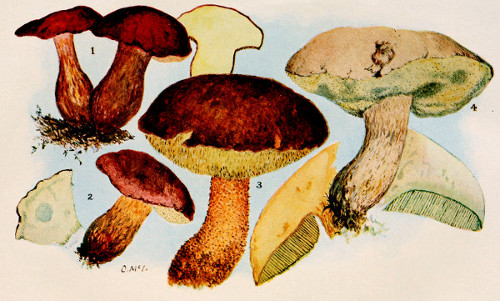
Grouped by F.D. Briscoe—Studies by C. McIlvaine. Plate CXVII.
Fig. Page. Fig. Page.
1–2. Boletus bicolor, 425 4. Boletus pallidus, 429
3. Boletus rubropunctus, 429
B. bi´color Pk.—two-color. (Plate CXVII, figs. 1, 2, p. 424.) Pileus convex, glabrous or merely pruinose-tomentose, dark-red, firm, becoming soft, paler and sometimes spotted or stained with yellow when old. Flesh yellow, not at all or but slightly and slowly changing to blue where wounded. Tubes nearly plane, adnate, bright-yellow, becoming ochraceous, slowly changing to blue where wounded, their mouths small, angular or subrotund. Stem subequal, firm, solid, red, generally yellow at the top. Spores pale, ochraceous-brown, 10–12.5×4–5µ.
Pileus 2–4 in. broad. Stem 1–3 in. long, 4–6 lines thick.
Woods and open places. New York, Peck; Wisconsin, Bundy.
The color of this plant is somewhat variable. In the typical form the pileus and stem are dark red, approaching Indian red, but when old the color of the pileus fades and is often intermingled with yellow. The surface sometimes cracks and becomes cracked in areas. From the European B. Barlæ this species is separated by its solid stem; from B. versicolor by its small tube mouths and its red stem. Peck, Boleti of the U.S.
Plentiful at Mt. Gretna, Pa., July, August, September, 1898, in mixed woods. Very variable in shape and color. Identified by Professor Peck from painting and description.
Fine eating, one of the very best.
B. glabel´lus Pk.—smooth. Pileus fleshy, thick, broadly convex or nearly plane, soft, dry, subglabrous, smoky-buff. Flesh white, both it and the tubes changing to blue where wounded. Tubes nearly plane, adnate, ochraceous, tinged with green, their mouths small, subrotund. Stem subequal, glabrous, even, reddish toward the base, pallid above, with a narrow reddish circumscribing zone or line at the top. Spores oblong, brownish-ochraceous, tinged with green when fresh, 10–12.5×4µ.
Pileus 3–5 in. broad. Stem 1–3 in. long, 5–10 lines thick.
426Grassy ground under oaks. New York, Peck.
The species is well marked by the reddish band or line on the stem just below the tubes, but this disappears in drying. Peck, Boleti of the U.S.
B. aluta´ceus Morgan—yellowish. Pileus cushion-shaped, glabrous, alutaceous with a tinge of red. Flesh white, inclining to reddish. Tubes semifree, medium in size, unequal, angular, greenish-yellow. Stem nearly equal, striate, reticulate at the apex, colored like the pileus. Spores fusiform, brownish-olive, 12.5×5µ.
Pileus 3 in. broad.
Rocky woods of oak and chestnut. Kentucky, Morgan.
The general aspect of the figure of this species recalls some of the forms of Boletus subtomentosus. The tubes are nearly equal in length to the thickness of the flesh of the pileus. Peck, Boleti of the U.S.
Quite frequent at Mt. Gretna, Pa., in mixed woods, principally oak and chestnut.
Stem should be removed, and tubes when old. It cooks well and is especially good.
B. tenui´culus Frost—thin. Pileus nearly plane, thin, lurid-red on a yellow ground. Flesh unchangeable. Tubes short, adnate, small, golden-yellow. Stem slender, equal, colored like the pileus. Spores 10×6µ.
Pileus 1–2 in. broad. Stem 4–6 in. long.
Woods. New England. Frost.
The thin pileus and long slender stem readily distinguish this species. Peck, Boleti of the U.S.
B. auri´porus Pk.—golden-pore. Pileus convex or nearly plane, glabrous or merely pruinose-tomentose, grayish-brown, yellowish-brown, or reddish-brown. Flesh white, unchangeable. Tubes plane or slightly depressed around the stem, adnate or subdecurrent, bright golden-yellow, retaining their color when dried. Stem equal or slightly thickened at the base, viscid or glutinous when moist, especially toward the base, colored like or a little paler than the pileus. Spores 7.5–10×4–5µ.
Pileus 1–3 in. broad. Stem 1–3 in. long, 2–4 lines thick.
427Thin woods and shaded banks. New York, Peck; New England, Frost.
This species is remarkable for the rich yellow color of the tubes, which is retained unchanged in the dried specimens, and for the viscid stem. This character, however, is not noticeable in dry weather and was overlooked in the original specimens.
Boletus glutinipes Frost Ms. is not distinct. Peck, Boleti of the U.S.
Hopkins' Woods, Haddonfield, N.J. Grassy oak woods. 1891–1894. McIlvaine.
The caps are delicious.
B. innix´us Frost. Pileus convex or nearly plane, glabrous, yellowish-brown, slightly cracked in areas when old, yellow in the interstices. Flesh white. Tubes adnate, lemon-yellow, unchangeable. Stem slender, short, much thickened at the base in large specimens, yellowish, streaked with brown, brownish within. Spores 10×5µ.
Grassy woods. New England. Frost.
The whole plant often reclines as if for support, Peck, Boleti of the U.S.
B. parasi´ticus Bull.—a parasite. Pileus convex or nearly plane, dry, silky, becoming glabrous, soon tessellately cracked, grayish or dingy-yellow. Tubes decurrent, medium size, golden yellow. Stem equal, rigid, incurved, yellow without and within. Spores oblong-fusiform, pale-brown, 12.5–15×4µ.
Pileus 1–2 in. broad. Stem 1–2 in. long, 2–4 lines thick.
Parasitic on species of Scleroderma. New York, Gerard; New England, Sprague, Bennett.
This species is very rare in this country. It is remarkable for its peculiar habitat. Peck, Boleti of the U.S.
New York, Lydia M. Patchen; Westfield, on Scleroderma vulgare.
I found many specimens of this rare species during August, 1897, growing on Scleroderma vulgare.
Professor Peck, to whom I sent specimens, identified them as B. parasiticus. The tubes were large, unequal, dissepiments thin, decurrent. The Sclerodermas frequently appear to be parasitic upon the Boletus. I have seen the host plant thrown entirely free from the ground by the Boletus.
428B. parasiticus is edible, but it is not of agreeable flavor.
B. dictyoceph´alus Pk.—reticulate. Pileus convex, glabrous, reticulate with brown lines beneath the thin separable cuticle, brownish-orange, darker in the center and there tinged with pink. Flesh white, unchangeable. Tubes nearly plane, slightly depressed around the stem, grayish-yellow, becoming brown where bruised. Stem equal or slightly tapering at the top, solid, rimose, dotted with scales, lemon-yellow, darker toward the base. Spores 15–20×6µ.
Pileus 2.5 in. broad. Stem 3–4 in. long, 5–6 lines thick.
Mixed woods. North Carolina. C.J. Curtis.
The description here given has been derived from a single dried specimen and from the notes kindly sent by Mr. Curtis. The species is apparently well marked and very distinct by the peculiar reticulations of the pileus. Peck, Boleti of the U.S.
B. subgla´bripes Pk.—rather smooth. Pileus convex or nearly plane, glabrous, reddish inclining to chestnut color. Flesh white, unchangeable. Tubes adnate, nearly plane in the mass, pale yellow, becoming convex and darker or greenish-yellow with age, the mouths small, subrotund. Stem equal, solid, scurfy, pale yellow. Spores oblong-fusiform, 12.5–15×4–5µ.
The smoothish-stemmed Boletus is well marked by its cylindric minutely scurfy stem which is colored like the tubes. Its cap is smooth and nearly always some shade of red or bay. Specimens occur occasionally in which it approaches grayish-brown or wood-brown. The flesh is white and unchangeable when cut or broken.
The tubes at first have a nearly plane surface, but this becomes somewhat convex with age, and slightly depressed around the stem. The tube mouths are small and nearly round. The color of the tubes is at first a beautiful pale yellow, but it becomes darker or slightly greenish-yellow with age.
The stem is colored very nearly like the tubes, but sometimes it has a slight reddish tint toward the base. Its peculiar feature consists of the minute, branny particles upon it. They are so small and pale that they are easily overlooked.
There is a variety in which the cap is corrugated or irregularly pitted and wrinkled. Its name is Boletus subglabripes corrugis Pk.
429The cap is 1½-4 in. broad, the stem is 2–3 in. long and 4–8 lines thick. The plants are found in woods in July and August. Peck, 51st Rep. N.Y. State Bot.
B. pal´lidus Frost—pale. (Plate CXVII, fig. 4, p. 424.) Pileus convex, becoming plane or centrally depressed, soft, glabrous, pallid or brownish-white, sometimes tinged with red. Flesh white. Tubes plane or slightly depressed around the stem, nearly adnate, very pale or whitish-yellow, becoming darker with age, changing to blue where wounded, the mouths small. Stem equal or slightly thickened toward the base, rather long, glabrous, often flexuous, whitish, sometimes streaked with brown, often tinged with red within. Spores pale ochraceous-brown, 10–12×5–6µ.
Pileus 2–4 in. broad. Stem 3–5 lines long, 4–8 lines thick.
Woods. New England, Frost; New York, Peck.
The species is readily recognized by its dull pale color, rather long stem, and tubes changing to blue where wounded. Peck, Boleti of the U.S.
Common in West Virginia mountains, Angora, West Philadelphia, Mt. Gretna, Pa. Solitary, on ground in mixed woods.
The caps are tender and delicately flavored.
B. rubropunc´tus Pk.—red-dotted. (Plate CXVII, fig. 3, p. 424.) Pileus convex, glabrous, reddish-brown. Flesh yellowish, unchangeable. Tubes nearly plane, depressed about the stem, their mouths small, round, bright golden-yellow, not changing color where bruised. Stem firm, solid, tapering upward, yellow, punctate with reddish dots or squamules. Spores olive-green, 12.5×4–5µ.
Pileus 1–2 in. broad. Stem 1–2 in. long, 3–6 lines thick.
Woods. Port Jefferson. July. Cold Spring Harbor, H.C. Beardslee.
This is a pretty Boletus, well marked by the red dots of the stem. It is apparently a very rare species. B. radicans is said to have the stem sprinkled with red particles, but that is a larger plant with the margin of the pileus persistently involute or incurved and with a radicating stem, characters which are not shown by our fungus. Peck, 50th Rep. N.Y. State Bot.
I found my specimens at Mt. Gretna, Pa., August-September, 1898.
430Identified for the writer by Professor Peck from painting and description.
Taste and smell slight. Cooks well and is pleasant to the taste. The tubes should be removed.
Subtomento´si—sub, tomentosus, downy.
Pileus when young villose or subtomentose, rarely becoming glabrous with age, destitute of a viscid pellicle. Tubes of one color, adnate. Stem at first extended, neither bulbous nor reticulated with veins, wrinkled or striated in some species. Flesh in some changing color where wounded.
The tubes are generally yellow or greenish-yellow. In some species they are occasionally somewhat depressed around the stem, but they do not form a rounded free stratum, nor, with the exception of B. rubeus, are they stuffed when young as in most of the Edules. The species are scarcely separable from those of the preceding tribe except by the more evidently tomentose young pileus.
Tubes brown, becoming cinnamon B. variegatus
Tubes not having these colors 1
1. Flesh or tubes changing to blue where wounded 2
1. Flesh or tubes not changing to blue 5
2. Stem glabrous 3
2. Stem not glabrous 4
3. Flesh yellow under the cuticle B. rubeus
3. Flesh red under the cuticle B. chrysenteron
4. Stem velvety at the base B. striæpes
4. Stem with a reddish bloom or scurf B. radicans
4. Stem with brown dot-like scales B. mutabilis
5. Tubes whitish, becoming yellow B Roxanæ
5. Tubes yellow 6
6. Tube mouths large and angular B. subtomentosus
6. Tube mouths minute B. spadiceus
Peck, Boleti of the U.S.
B. variega´tus Swartz. Pileus at first convex, then plane, obtuse, moist, sprinkled with superficial bundled hairy squamules, dark-yellow, the acute margin at first flocculose. Flesh yellow, here and there becoming 431blue. Tubes adnate, unequal, minute, brown then cinnamon. Stem firm, equal, even, dark-yellow, sometimes reddish. Spores oblong-ellipsoid, hyaline or very pale-yellowish, 7.5–10×3–4µ.
Pileus 2–5 in. broad. Stem 2–3 in. long, 6 lines thick.
Woods, especially of pine. North Carolina, Curtis, Schweinitz; California, Harkness, Moore; Rhode Island, Bennett. Peck, Boleti of the U.S.
West Virginia mountains, 1882–1885. Haddonfield, N.J., McIlvaine; Doylestown, Pa., Paschall. Quite common on flat benches where hemlocks and spruces have grown.
When the caps are cooked they are sweet, nutty, excellent.
B. Roxa´næ Frost. Pileus broadly convex, at first subtomentose, then covered with red hairs in bundles, yellowish-brown. Flesh yellowish-white. Tubes at first whitish, then light-yellow, arcuate-adnate or slightly depressed around the stem, the mouths small. Stem enlarged toward the base, striate at the apex, yellowish or pale-cinnamon. Spores 10×4µ.
Var. auri´color. Pileus and subequal stem bright-yellow, the tomentum of the pileus yellow.
Pileus 1.5–3 in. broad. Stem 1–2 in. long, 3–5 lines thick.
Borders of woods. New England, Frost; New York, Peck.
Peck, Boleti of the U.S.
B. striæ´pes Secr.—striate stem. Pileus convex or plane, soft, silky, olivaceous, the cuticle rust-color within. Flesh white, yellow next the tubes, sparingly changing to blue. Tubes adnate, greenish, their mouths minute, angular, yellow. Stem firm, curved, marked with brownish-black striations, yellow, velvety and brownish-rufescent at the base. Spores 10–13×4µ.
Pine and oak woods. Minnesota, Johnson.
I have seen no specimens of this species, which is recorded from but one locality in our country. The character—flesh sparingly changing to blue—is given on the authority of Rev. M.J. Berkeley. Peck, Boleti of the U.S.
B. chrysen´teron Fr.—golden within. Pileus convex or plane, soft, floccose-squamulose, often cracked in areas, brown or brick-red. Flesh yellow, red beneath the cuticle, often slightly changing to blue where 432wounded. Tubes subadnate; greenish-yellow, changing to blue where wounded; their mouths rather large, angular, unequal. Stem subequal, rigid, fibrous-striate, red or pale-yellow. Spores fusiform, pale-brown, 11–12.5×4–5µ.
Pileus 1–3 in. broad. Stem 1–3 in. long, 3–6 lines thick.
Woods and mossy banks.
The species is common and very variable. The color of the pileus may be yellowish-brown, reddish-brown, brick-red, tawny or olivaceous. The subcutaneous reddish tint and the reddish chinks of the cracked pileus are distinguishing features. Wounds of the tubes sometimes become blue then greenish. Authors disagree concerning the edible qualities of this Boletus. Stevenson gives it as edible, but Cordier and Gillet say that it is regarded with suspicion. In one strongly marked form the tubes are decidedly depressed around the stem, in another the flesh is whitish tinged with red. It may be doubted whether these are varieties or distinct species. Peck, Boleti of the U.S.
I have found, and eaten plentifully of this species in West Virginia, North Carolina, New Jersey, Pennsylvania, from July until October. I have no hesitancy in recommending it in all of its varieties. Excepting from very young specimens the tubes and stems should be removed. The flesh is sweet, delicate and toothsome.
B. fumo´sipes Pk. Pileus convex or nearly plane, minutely tomentose, sometimes minutely rivulose, dark olive-brown. Flesh whitish. Tubes at first nearly plane, becoming convex with age, their mouths whitish when young, becoming yellowish-brown, changing to bluish-black where bruised. Stem equal, solid, smoky-brown, minutely scurfy under a lens. Spores purplish-brown, 12.5–15×5–6µ.
Pileus 1–2 in. broad. Stem 1–2 in. long, 3–4 lines thick.
Woods. Port Jefferson. July.
This species resembles small dark-colored forms of B. chrysenteron, and this resemblance is still more noticeable in those specimens in which the pileus cracks in areas, for in these the chinks become red as in that species. The different color of the stem and tubes will at once separate these species. Peck, 50th Rep. N.Y. State Bot.
B. ru´beus Frost—red. Pileus broadly convex, very finely appressed subtomentose, bright brick-red when young, becoming mottled with red 433and yellow, yellow under the cuticle, the thin margin at first inflexed, then horizontal, curved upward when old. Flesh pale-yellow, changing to blue where wounded. Tubes adnate or slightly depressed around the stem, lemon-yellow and stuffed when young, becoming yellow and sometimes red at the mouths. Stem small, often flexuous, colored like the pileus, reddish within, white-tomentose at the base. Spores 9–12.5×4–5µ.
Pileus 2–4 in. broad. Stem 1–3 in. long, 3–5 lines thick.
Deep woods. Rare. New England, Frost.
This is apparently too closely related to B. chrysenteron, and it also resembles B. bicolor. Peck, Boleti of the U.S.
B. frater´nus Pk. Pileus convex, becoming plane or depressed, slightly tomentose, deep red when young, becoming dull red with age. Flesh yellow, slowly changing to greenish-blue where wounded. Tubes rather long, becoming ventricose, slightly depressed about the stem, their walls sometimes slightly decurrent, the mouths large, angular or irregular, sometimes compound, bright yellow, quickly changing to blue where wounded. Stem short, cespitose, often irregular, solid, subtomentose, slightly velvety at the base, pale reddish-yellow, paler above and below, yellow within, quickly changing to dark green where wounded. Spores 12.5×6µ.
Pileus 1–1.5 in. broad. Stem 1–1.5 in. long, 3–6 lines thick.
Shaded streets. Auburn, Alabama. July. Underwood.
The species is apparently allied to B. rubeus, but is very distinct by its small size, cespitose habit, color of the flesh of the stem and by the peculiar hues assumed where wounded. When the pileus cracks the chinks become yellow as in B. subtomentosus. The species belongs to the tribe Subtomentosi. Peck, Bull. Torrey Bot. Club, Vol. 24, No. 3.
B. subtomento´sus L.—sub; tomentosus, downy. Pileus convex or nearly plane, soft, dry, villoso-tomentose, subolivaceous, concolorous beneath the cuticle, often cracked in areas. Flesh white or pallid. Tubes adnate or somewhat depressed around the stem, yellow, their mouths large, angular. Stem stout, somewhat ribbed-sulcate, scabrous or scurfy with minute dots. Spores 10–12.5×4–5µ.
Pileus 1–4 in. broad. Stem 1–2.5 in. long, 2–5 lines thick.
Common and variable. The pileus is usually olivaceous or yellowish-brown, 434but it may be reddish-brown or tawny-red. When it cracks the chinks become yellow. The species, as I understand it, may be distinguished from its near relative, B. chrysenteron, by its paler flesh, the clearer yellow tubes not changing to blue where wounded, and by the chinks of the pileus becoming yellow. The species is recorded edible by Cordier, Curtis and Palmer. Gillet says it is only medium in quality. Peck, Boleti of the U.S.
Found and eaten in West Virginia, North Carolina, New Jersey, Pennsylvania. Specimens received from Indiana, Minnesota, Alabama. I have not seen any change of color in flesh or tubes. It is common in Woodland Cemetery and Fairmount Park, Philadelphia. If the tubes are not removed the dish is slimy. The B. chrysenteron also makes such a dish when stewed, but fried, and well done, both species are decidedly good.
B. cæspito´sus Pk.—cespitose. Pileus broadly convex or nearly plane, sometimes slightly concave by the elevation of the margin, even, brown or blackish-brown, the margin often a little paler or reddish-brown. Flesh slightly tinged with red. Tubes adnate or slightly decurrent, yellow, their mouths rather large, angular, concolorous. Stem short, even, solid, glabrous, tapering upward, brown or reddish-brown. Spores oblong-elliptic, 10µ long, 5µ broad.
Pileus 1–2.5 cm. broad. Stem 2–2.5 cm. long, 4–6 mm. thick.
Cespitose. Virginia. August. R.S. Phifer.
A small species growing in tufts and referable to the tribe Subtomentosi. The tubes retain their bright yellow color in the dried specimens. Peck, Bull. Torrey Bot. Club, January 27, 1900.
Edible qualities not stated.
B. spadi´ceus Schaeff.—nut brown. Pileus convex or plane, moderately compact, dry, tomentose, opaque, date-brown, irregularly cracked. Flesh white, unchangeable, brownish-red above. Tubes adnate, yellow, their mouths minute, subrotund. Stem firm, clavate, even, woolly-scaled, yellow or brownish, yellowish-white within. Spores 12×4µ.
Pileus 2–4 in. broad.
Woods. New England, Frost.
This species is admitted on the authority of Mr. Frost who alone has recorded it in this country. But specimens received from him under 435this name do not in my opinion belong to it, and its occurrence here is somewhat doubtful. Peck, Boleti of the U.S.
In oak woods near Bartram’s Garden, West Philadelphia, in 1887–1888, I found several Boleti answering the description, exactly, of B. spadiceus. They proved to be good eating.
B. radi´cans Pers.—radix, a root. Pileus convex, dry, subtomentose, olivaceous-cinereus, becoming pale-yellowish, the margin thin, involute. Flesh pale-yellow, instantly changing to dark blue, taste bitterish. Tubes adnate, their mouths large, unequal, lemon-yellow. Stem even, tapering downward and radicating, flocculose with a reddish bloom, pale-yellow, becoming naked and dark with a touch.
Pileus 2–3 in. broad. Stem 2 in. long, 6 lines thick.
Woods. Ohio, Morgan.
Of the American plant Mr. Morgan says that the pileus is quite firm and dry, becomes reddish or brownish-yellow and nearly glabrous, that the flesh is pale-yellow, but that he has not observed any bluish tinge, and that the spores are olive, fusiform, 10–12.5×5µ. Those of the European plant have been described as very pale ocher, almost white, 6µ long, 3µ broad. Peck, Boleti of the U.S.
Near Bryn Mawr, Pa. W.C. Alderson, 1894.
Several specimens brought to me were eaten. The change in color of flesh was instantaneous upon exposure to the air. Taste strong and raw rather than bitterish. The caps alone were cooked, and dish marked “fine.”
B. muta´bilis Morg.—changeable. Jour. Cin. Soc. Nat. Sci., Vol. VII. Pileus convex, then plane or depressed, compact, dry, subtomentose, brown. Flesh bright-yellow, promptly changing to blue where wounded. Tubes adnate or subdecurrent, their mouths large, angular, unequal, some of them compound, yellow changing to greenish yellow and quickly becoming blue where wounded. Stem stout, solid, flexuous, subsulcate, yellowish beneath the brown dot-like scales, bright yellow within. Spores olive, fusiform, 12–13×5µ.
Pileus 2.5–4 in. broad. Stem 2–3 in. long, 6 lines thick.
Thick woods. Ohio, Morgan.
A shade of yellow sometimes appears beneath the brown of the pileus, and as the plants grow old the pileus becomes blackish, glabrous and 436shining. The stem increases in thickness above and downward. Peck, Boleti of the U.S.
B. badi´ceps Pk.—badius, bay and head. (Plate CXVI, p. 420.) Pileus firm, convex or somewhat centrally depressed when mature, dry, velvety, obliquely truncate on the margin, bay-red or dark-maroon color. Flesh white unchangeable, taste and odor mild, sweet, suggestive of molasses. Tubes plane, adnate, white or whitish, becoming dingy with age, the mouths minute. Stem equal or slightly swollen in the middle, radicating, glabrous, solid, brownish.
Pileus 4–8 cm. broad. Stem 4–5 cm. long, 1.5–3 cm. thick.
Oak woods. West Philadelphia, Pa. August and September. Charles McIlvaine.
The truncate or beveled margin of the pileus is a striking feature in this species. It is about 4 mm. broad and as even as if cut with a knife. Sometimes the surface of the stem ruptures transversely just below the top, the liberated shreds above curling upward against the tubes and those below curving outward and downward. In mature plants brownish spots appear in the flesh of the pileus. “When cooked it is of high flavor and tender as kidney,” C. McIlvaine. Peck, Bull. Torrey Bot. Club, January 27, 1900.
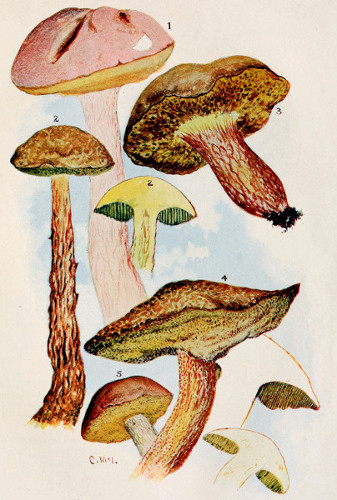
Grouped by F.D. Briscoe—Studies by C. McIlvaine. Plate CXVIII.
Fig. Page. Fig. Page.
1. Boletus separans, 445 4. Boletus scarer areolatus, 461–463
2. Boletus russelli, 436 5. Boletus edulis, 445
3. Boletus illudens, 439
Laceri´pedes—lacerated stem.
Stem elongated, coarsely pitted or deeply and lacunosely reticulated in small hollows, the ridges somewhat intumescent in wet weather and more or less lacerated, giving a rough or shaggy appearance to the stem.
The species of this tribe are few, very closely allied and so far as known are peculiar to this country.
Pileus viscid 1
Pileus dry B. Russelli
1. Stem red in the depressions, tubes tinged with green B. Morgani
1. Stem pale-yellow, tubes not greenish B. Betula
Peck, Boleti of the U.S.
B. Rus´selli Frost—Russell’s Boletus. (Plate CXVIII, fig. 2, p. 436.) Pileus thick, hemispherical or convex, dry, covered with downy scales or bundles of red hairs, yellowish beneath the tomentum, often cracked in 437areas. Flesh yellowish, unchangeable. Tubes subadnate, often depressed around the stem, rather large, dingy-yellow or yellowish-green. Stem very long, equal or tapering upward, roughened by the lacerated margins of the reticular depressions, red or brownish-red. Spores olive-brown, 18–22×8–10µ.
Pileus 1.5–4 in. broad. Stem 3–7 in. long, 3–6 lines thick.
This is distinguished from the other species by the dry squamulose pileus and the color of the stem. The latter is sometimes curved at the base. Peck, Boleti of the U.S.
B. Russelli occurs in the West Virginia mountains, where I found and ate it in August, 1883. Though solitary in its method of growth, it is frequent in many parts of Pennsylvania, among leaves in mixed woods. August to October.
Taste when raw, sweet, mild. Cooked it is rather soft, tasty. Tubes and stem should be removed.
B. Mor´gani Pk. Pileus convex, soft, glabrous viscid, red or yellow, or red fading to yellow on the margin. Flesh whitish tinged with red and yellow, unchangeable. Tubes convex, depressed around the stem, rather long and large, bright-yellow becoming greenish-yellow. Stem elongated, tapering upward, pitted with long, narrow depressions, yellow, red in the depressions, colored within like the flesh of the pileus. Spores olive-brown, 18–22µ long, about half as broad.
Pileus 1.5–2.5 in. broad. Stem 3–5 in. long, 3–6 lines thick.
Rocky hillsides in woods of deciduous trees. Kentucky, Morgan.
In wet weather the anastomosing ridges of the stem swell and become broadly winged, thereby giving the stem a peculiar lacerated appearance. The glabrous viscid pileus and the coloration of the stem distinguish the species. Peck, Boleti of the U.S.
B. Morgani is found in like localities with B. Russelli. Excepting in its smooth, viscid cap and whitish flesh, it closely resembles the latter. The ridges in the stems of both species swell when moist.
Its edible qualities are the same as B. Russelli.
B. Be´tula Schw.—birch. Pileus convex, viscose and shining in wet weather, tessellately cracked and reticulated, orange-fawn color, rather small. Flesh yellowish-white. Tubes separating, rather large, yellow, almost like those of B. subtomentosus but not greenish. Stem long, 438attenuated downward, everywhere covered with a deciduous reticulated bark two lines high and separating like the bark of birches, pale-yellow without and within.
Pileus 1.5 in. broad. Stem 5–6 in. long.
Ligneous earth. North Carolina, Schweinitz, Curtis; Pennsylvania, Schweinitz. Peck, Boleti of the U.S.
During several seasons I found B. Betula in Woodland Cemetery, Philadelphia.
Edible qualities good.
Calo´podes. Gr—beautiful; Gr—feet.
Stem stout, at first bulbous, typically venose-reticulated with veins. Tubes adnate, their mouths not reddish.
The reticulate stem and adnate tubes of one color distinguish the species of this tribe. In the Luridi the mouths of the tubes are differently colored, and in the closely related Edules the tubes are more or less depressed around the stem or sub-free, and their pores are commonly stuffed when young. Fries did not admit species with whitish tubes into this tribe, but we have done so in those cases in which this was the only character to exclude them.
Tubes yellow or yellowish 1
Tubes white or whitish, at least when young 7
1. Tubes or flesh changing to blue where wounded 2
1. Tubes or flesh not changing to blue where wounded 5
2. Pileus red, at least when young 3
2. Pileus some other color 4
3. Stem red B. Peckii
3. Stem yellow or reddish only at the base B. speciosus
4. Tubes angular, pileus olivaceous B. calopus
4. Tubes rotund, pileus not olivaceous B. pachypus
5. Pileus viscid B. Curtisii
5. Pileus pulverulent, stems cespitose B. retipes
5. Pileus neither viscid nor pulverulent 6
6. Stem yellow B. ornatipes
6. Stem brown B. modestus
6. Stem yellowish-white B. rimosellus
7. Pileus some shade of red 8
4397. Pileus some shade of brown or gray 9
8. Stem pallid or yellowish B. rubignosus
8. Stem dark-brown B. ferrugineus
9. Pileus pale-brown, stem flexuous B. flexuosipes
9. Pileus gray or grayish-black, stem straight B. griseus
Peck, Boleti of the U.S.
B. specio´sus Frost—handsome. Pileus at first very thick, subglobose, compact, then softer, convex, glabrous or nearly so, red. Flesh pale-yellow or bright lemon-yellow, changing to blue where wounded. Tubes adnate, small, subrotund, plane or but slightly depressed around the stem, bright lemon-yellow, becoming dingy-yellow with age, changing to blue where wounded. Stem stout, subequal or somewhat bulbous, reticulated, bright lemon-yellow without and within, sometimes reddish at the base. Spores oblong-fusiform, pale ochraceous-brown, 10–12.5×4–5µ.
Pileus 3–7 in. broad. Stem 2–4 in. long, 10–24 lines thick.
Thin woods. New England, Frost; New York, Peck.
This is a very beautiful Boletus. When young the whole plant except the surface of the pileus is of a vivid lemon-yellow color. Wounds quickly change to green, then to blue. The color of the pileus approaches closely to solferino. Peck, Boleti of the U.S.
Caps of specimens found in mixed woods at Mt. Gretna, Pa., were minutely areolate when old. Stems yellow at top and with purplish red over the bright yellow toward the bulbous base, solid, bright yellow within.
Stems and caps are edible and rank high in flavor and texture.
B. illu´dens Pk.—deceiving. (Plate CXVIII, fig. 3, p. 436.) Pileus convex, dry, subglabrous, yellowish-brown or grayish-brown, sometimes tinged with red, especially in the center. Flesh pallid or yellowish. Tubes bright yellow, plane or somewhat convex when old, adnate, their mouths angular or subrotund, often larger near the stem. Stem nearly equal, sometimes abruptly pointed at the base, glabrous, pallid or yellowish, coarsely reticulated either wholly or at the top only. Spores oblong or subfusiform, yellowish-brown tinged with green, 11–12.5×4–5µ.
Pileus 1.5–3 in. broad. Stem 1.5–2.5 in. long, 3–5 lines thick.
440Woods and copses. Port Jefferson. July. Peck, 50th Rep. N.Y. State Bot.
Found in plenty at Mt. Gretna, Pa., September, 1898. On ground and old stumps in mixed woods. Identified by Professor Peck.
Taste and smell pleasant. Cooked as egg-plant it is one of the best. Remove tubes.
B. Peck´ii Frost—after C.H. Peck. Pileus convex, firm, dry, subglabrous, red, fading to yellowish-red or buff-brown with age, the margin usually retaining its red color longer than the disk. Tubes adnate or slightly decurrent, nearly plane, yellow, changing to blue where wounded. Stem equal or subventricose, reticulated, red, yellow at the top. Spores oblong, pale ochraceous-brown, 9–12×4–5µ.
Var. læ´vipes. Stem reticulated above, even below.
Pileus 2–3 in. broad. Stem 2–3 in. long, 3–6 lines thick.
Woods of frondose trees. New York, Peck. Peck, Boleti of the U.S.
B. cal´opus Fr. Gr—beautiful; Gr—foot. Pileus globose, then convex, unpolished, subtomentose, olivaceous. Flesh pallid, slightly changing to blue when wounded. Tubes adnate, their mouths minute, angular, yellow. Stem firm, conical, then elongated and subequal, reticulated, wholly scarlet or at the apex only, sometimes colored like the pileus toward the base. Spores fusiform, yellowish-brown, 7–8×3–4µ.
Pileus 2–3 in. broad. Stem longer than the diameter of the pileus.
Woods. North Carolina, Schweinitz, Curtis; Pennsylvania, Schweinitz; New England, Sprague, Bennett. Peck, Boleti of the U.S.
B. orna´tipes Pk.—ornate-stem. (Boletus retipes, Rep. 23.) Pileus convex, firm, dry, glabrous or very minutely tomentose, grayish-brown or yellowish-brown. Flesh yellow or pale-yellow. Tubes adnate, plane, or concave, rarely convex, the mouths small or medium size, clear-yellow. Stem firm, subequal, distinctly and beautifully reticulated, yellow without and within. Spores oblong, ochraceous-brown, 12–16×4–5µ.
Pileus 2–5 in. broad. Stem 2–4 in. long, 4–6 lines thick.
Thin woods and open places. New York, Peck.
The color of the tubes becomes darker with age, but it does not change to blue where wounded. The species is related to the next following 441one with which it has sometimes been confused, but from which it is clearly distinct. The color of the spores is quite dark and approaches snuff-brown. Peck, Boleti of the U.S.
Edible. Good.
B. re´tipes B. and C.—reticulate stem. Pileus convex, dry, powdered with yellow, sometimes rivulose or cracked in areas. Tubes adnate, yellow. Stem subequal, cespitose, reticulate to the base, pulverulent below. Spores greenish-ochraceous, 12–15×4–5µ.
Pileus 1.5–2 in. broad. Stem 2 in. long, 3–6 lines thick.
The tufted mode of growth, pulverulent pileus and paler-colored spores separate this species from the preceding one. Peck, Boleti of the U.S.
West Virginia, 1882–1885. Mt. Gretna, Pa.; New Jersey, McIlvaine.
The caps, alone, of this species, are desirable, the stems not cooking well. Its way of bunching itself gratifies the collector, as do its flavor and quality.
B. pa´chypus Fr. Gr—thick-footed. Pileus convex, subtomentose, brownish or pale tan-color. Flesh thick, whitish, changing slightly to blue. Tubes rather long, somewhat depressed around the stem, their mouths round, pale-yellow, at length tinged with green. Stem thick, firm, reticulated, at first ovate-bulbous, then elongated, equal, variegated with red and pale-yellow. Spores large, ovate, pale yellowish-ochraceous, 12.5–14×5–6µ.
Pileus 4–8 in. broad. Stem 2–4 in. long.
Woods, either of pine or beech.
This species is noted for its thick, stout stem, which sometimes attains a diameter of more than two inches. It approaches the Edules in habit, but according to Gillet it is poisonous, or at least to be suspected, has a penetrating unpleasant odor and a somewhat nauseous flavor. He also describes the pores as at first whitish. The stem is sometimes intensely blood-red. Peck, Boleti of the U.S.
A common species in West Virginia mountains, 1881–1885, in beech groves. August to frost. It is rare in the pines of New Jersey, though I have found it there. Like B. felleus, its size and attractiveness induce the finder to over and over again try cooking it, hoping the discovery of a successful way to rid it of its unpleasantness. I have never succeeded. It is not poisonous.
442B. rimosel´lus Pk.—cracked. Pileus broadly convex, flat or irregular, glabrous, tessellately cracked, dark-brown. Flesh whitish. Tubes adnate or sinuately decurrent, somewhat depressed around the stem, pale-yellow, becoming darker or brownish with age. Stem tapering upward, broadly reticulated with brown veins, yellowish-white. Spores fusiform, 15–17.5×5–6µ.
Pileus 3–5 in. broad. Stem 3–4 in. long, 6–9 lines thick.
Mixed woods. North Carolina, C.J. Curtis.
I have described this species from the notes and a single dried specimen sent me by Mr. Curtis. More extended observation may require some modification of the description. The color of the spores is described as brown. They are remarkable for their size. Peck, Boleti of the U.S.
B. modes´tus Pk.—modest. Pileus convex or nearly plane, often irregular, firm, dry, very minutely tomentose, yellowish-brown. Flesh gray or pinkish-gray. Tubes nearly plane, adnate or subdecurrent, the mouths angular, pale-ochraceous. Stem equal, reticulated, brown. Spores elliptical, 10×5µ.
Pileus 2–3 in. broad. Stem 1–2 in. long, 2–4 lines thick.
Grassy ground in thin woods. New York, Peck.
Miss Banning finds in Maryland what appears to be a form of this species in which the part of the hymenium near the stem consists of lamellæ, the rest of tubes. The species needs further investigation. Peck, Boleti of the U.S.
B. Cur´tisii Berk.—after Dr. Curtis. Pileus hemispherical or convex, viscose, golden-yellow. Tubes depressed around the stem, nearly free, their mouths umber, at length tawny. Stem slender, attenuated upward, polished, reticulated, straw-colored. Spores ferruginous, subelliptical, slightly attenuated at each end.
Pileus 1 in. or more broad. Stem 2 in. long, 2–3 lines thick.
Pine woods. North and South Carolina, Curtis.
In the original description the stem of this species is said to be hollow. Peck, Boleti of the U.S.
B. gri´seus Frost—gray. Pileus broadly convex, firm, dry, subglabrous, gray or grayish-black. Flesh whitish or gray. Tubes adnate 443or slightly depressed around the stem, nearly plane, their mouths small, subrotund, white or whitish. Stem equal or slightly tapering upward, distinctly reticulated, whitish or yellowish, sometimes reddish toward the base. Spores ochraceous-brown, 10–14×4–5µ.
Pileus 2–4 in. broad. Stem 2–4 in. long, 3–6 lines thick.
Thin woods and open places. New York, Peck.
Peck, Boleti of the U.S.
B. flexuos´ipes Pk.—flexuous stem. Pileus convex or plane, even, subtomentose, pale-brown. Flesh white, unchangeable, the cuticle separable. Tubes long, convex, decurrent, white or whitish, becoming brownish with age. Stem flexuous, solid, reticulated, whitish or pallid, changing to brown where bruised. Spores 7.5–10×4µ.
Pileus 3–4 in. broad. Stem 4–6 in. long, 8–15 lines thick.
Mixed woods. North Carolina, C.J. Curtis. Peck, Boleti of the U.S.
B. ferrugi´neus Frost—rust color. Pileus convex, soft, subtomentose, dark reddish-brown. Flesh white, unchangeable. Tubes generally adnate, dingy-white, their mouths stained brown by the spores. Stem short, reticulated, dark-brown. Spores 10–13×6µ.
Pileus 3–6 in. broad.
Borders of woods. New England, Frost. Peck, Boleti of the U.S.
Alabama, 1897.
B. rubigino´sus Fr.—rusty. Pileus convex, soft, pubescent, soon bare, brownish-rust color. Flesh subspongy, white, unchangeable. Tubes adnate, their mouths unequal, white. Stem firm, stout, reticulated, at first whitish or pallid, then yellowish, subcinereous or yellowish-olivaceous where touched.
Pileus 2–4 in. broad. Stem 2–3 in. long, 1 in. thick.
Woods. North Carolina, Curtis.
Although apparently distinct, this and the two preceding species are not sufficiently well known. Peck, Boleti of the U.S.
B. tabaci´nus Und. Pileus fleshy, convex or nearly plane, subglabrous, often cracked in areas, tawny-brown. Flesh at maturity soft and similarly colored. Tubes concave or nearly plane, depressed around 444the stem, their mouths small, angular, colored like the pileus. Stem subequal, solid, reticulated, concolorous. Spores oblong or subfusiform, 12.5–14×5µ. Pileus 2.5–5 in. broad. Stem 1.5–3 in. long, 6–10 lines thick.
Along road-sides. Alabama. May. Underwood.
The species is referable to the section Calopodes, but the tubes are more or less depressed about the stem. Peck, Bull. Torrey Bot. Club, Vol. 23, No. 10.
Edu´les—edulis, edible.
Tubes subfree, rounded-depressed around the stem, their mouths not at first reddish, but commonly white-stuffed. Stem stout, bulbous as in the Luridi but not, with a few exceptions, reticulate nor dotted with pointed scales nor red. Flesh scarcely changeable. Taste pleasant.
This tribe is not sharply limited but partakes to some extent of the characters of Calopodes and Luridi. From the former its nearly free and at first white-stuffed tubes and its generally even stem separate it, from the latter its tubes with concolorous mouths or at least with mouths not red or reddish when young will distinguish it. The species are generally of large or medium size and noted for their esculent qualities.
Stem brownish-lilac or chocolate color 1
Stem some other color 2
1. Stem reticulated B. separans
1. Stem not reticulated, furfuraceous B. eximius
2. Pileus viscid B. limatulus
2. Pileus not viscid 3
3. Tubes yellow with no tinge of green 4
3. Tubes tinged with green or becoming green where bruised 6
4. Pileus whitish B. æstivalis
4. Pileus not whitish 5
5. Stem glabrous B. affinis
5. Stem pubescent B. impolitus
6. Pileus becoming white-spotted where bruised B. leprosus
6. Pileus not becoming spotted 7
7. Pileus glabrous B. edulis
7. Pileus not glabrous 8
8. Stem reticulated, whitish or pallid B. variipes
8. Stem even, brownish-red B. decorus
Peck, Boleti of the U.S.
445B. sep´arans Pk. (Plate CXVIII, fig. 1, p. 436.) Pileus convex, thick, glabrous, subshining, often pitted, pitted or corrugated, brownish-red or dull-lilac, sometimes fading to yellowish on the margin. Flesh white, unchangeable. Tubes at first nearly plane, adnate, white and stuffed, then convex, depressed around the stem, ochraceous-yellow or brownish-yellow and sometimes separating from the stem by the expansion of the pileus. Stem equal or slightly tapering upward, reticulated either wholly or in the upper part only, colored like the pileus or a little paler, sometimes slightly furfuraceous. Spores subfusiform, brownish-ochraceous, 12–15×5–6µ.
Pileus 3–6 in. broad. Stem 2–4 in. long, 6–12 lines thick.
Thin grassy woods. New York, Peck. Peck, Boleti of the U.S.
West Virginia. September, 1881. New Jersey and Pennsylvania. October, 1887, McIlvaine. Indiana, October, 1898. Dr. J.R. Weist, H.I. Miller.
One of the handsomest of Boleti. It varies greatly in size and color, but traces of purple or lilac are always detectable. The reticulations upon the stem are often obscure, especially in young specimens.
It is pleasant when raw, and quite equal to any Boletus when cooked.
(Plate CXIX.)
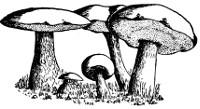
1, Boletus edulis, var. clavipes. 2, 3, Boletus edulis.
B. edu´lis Bull.—edulis, edible. (Plate CXVIII, fig. 5, p. 436.) Pileus convex or nearly plane, glabrous, moist, at first compact, then soft, variable in color, grayish-red, brownish-red or tawny-brown, often paler on the margin. Flesh white or yellowish, reddish beneath the cuticle. Tubes convex, nearly free, long, minute, round, white, then yellow and greenish. Stem short or long, straight or flexuous, subequal or bulbous, stout, more or less reticulate, especially above, whitish, pallid or brownish. Spores oblong-fusiform, 12–15×4–5µ.
Var. cla´vipes. Plate CXIX. Stem tapering upward from an enlarged base, everywhere reticulated.
Pileus 4–6 in. broad. Stem 2–6 in. long, 6–18 lines thick.
Woods and open places. Not rare. Peck, Boleti of the U.S.
446Indiana, H.I. Miller, Dr. J.R. Weist; New Jersey, Pennsylvania, West Virginia, McIlvaine.
Some species of fungi appear to have that prize of Fairyland—the Wishing Cap—and by its power be able to take on any form they please. Boletus edulis is one of them. Its variableness is puzzling. It is eaten everywhere where found and is a favorite. Carefully sliced, dried and kept where safe from mold it may be prepared for the table at any season.
B. edulis Bull.—Var. clavipes Pk. (Plate CXIX, fig. 1, p. 445.) Pileus fleshy, convex, glabrous, grayish-red, bay-red or chestnut-color. Flesh white, unchangeable. Tubes at first concave or nearly plane, white and stuffed, then convex, slightly depressed around the stem, ochraceous yellow. Stem mostly obclavate (inversely club-shaped) and reticulate to the base. Spores oblong-fusiform, 12–15×4–5µ.
The club-stemmed Boletus is so closely related to the edible Boletus and so closely connected by the intermediate forms that it seems to be only a variety of it, but one worthy of illustration. It differs in the more uniform color of the cap, in having the tubes less depressed around the stem and less tinted with green when mature, and in having the stem more club-shape and commonly reticulated to the base. The lower reticulations are usually coarser but less permanent than the upper. The cap is more highly colored when young and is apt to become paler with age, but the margin does not become paler than the central part, as it so often does in the edible Boletus. Individuals sometimes occur in which the stem is nearly cylindric and reticulated only on the upper part. These connect so closely with the edible Boletus that we have considered this to be a mere variety of it. In size and in edible qualities it is very similar to that species. Peck, 51st Rep. N.Y. State Bot.
Same in quality as B. edulis.
B. vari´ipes Pk.—variable stem. Pileus convex or nearly plane, thick, soft, dry, scaly, pointed scaly or minutely tomentose, grayish or pale grayish-brown, sometimes tinged with yellow or ochraceous. Flesh white, unchangeable. Tubes convex or nearly plane, slightly depressed around the stem, at first white, then greenish-yellow, their mouths small, subrotund, ochraceous, stuffed when young. Stem firm, reticulated, 447whitish or pallid. Spores oblong-fusiform, ochraceous-brown tinged with green, 12–15×5µ. Peck, Boleti of the U.S.
Mt. Gretna, Pa. August, 1898. Stem slightly reticulated at top, indistinctly striate below. Smell and taste strong, like B. felleus, but sweetish, not bitter. When tubes are removed and cap fried it is excellent.
Var. al´bipes. Stem whitish, wholly reticulated, the reticulations coarser near the base. Peck, Boleti of the U.S.
Mt. Gretna, Pa. August, 1898. Taste slightly acrid, smell slight. Excellent.
Var. pallid´ipes. Stem pallid, slightly furfuraceous, even or obscurely reticulated toward the base, distinctly reticulated above. Peck, Boleti of the U.S.
Satiny, shining. Taste slightly acrid, smell slight. Excellent.
Var. tenu´ipes. Stem slender, elongated. Peck, Boleti of the U.S.
Mt. Gretna, Pa. August, 1898, on decaying chestnut stump and on ground. Excellent. McIlvaine.
This species, with its varieties, grows in mixed woods, the density of which has much to do with its general appearance. Individuals growing where the sun plays upon them, show the reticulations plainer than those maturing in the shade. The tubes should be removed before cooking. The caps are best fried.
B. exi´mius Pk.—select. Pileus at first very compact, subglobose or hemispherical, subpruinose, purplish-brown or chocolate color, sometimes with a faint tinge of lilac, becoming convex, soft, smoky-red or pale-chestnut. Flesh grayish or reddish-white. Tubes at first concave or nearly plane, stuffed, colored nearly like the pileus, becoming paler with age and depressed around the stem, their mouths minute, rotund. Stem stout, generally short, equal or tapering upward, abruptly narrowed at the base, minutely branny, colored like or a little paler than the pileus, purplish-gray within. Spores subferruginous, 12.5–15×5–6µ.
Pileus 3–10 in. broad. Stem 2–4 in. long, 6–12 lines thick.
Woods and their borders. New England, Frost; New York, Peck. Peck, Boleti of the U.S.
In mixed woods and in new clearings near Bartram’s Garden, Philadelphia, Pa. McIlvaine.
448A patch of it is treasure trove.
B. lepro´sus Pk.—leprous. Pileus very convex, glabrous, soft like kid, cinereous-yellowish-drab or pale-brown, slowly changing to whitish where bruised, the cuticle separable. Flesh white, changing to yellowish. Tubes yellow or brownish-yellow, changing to greenish where wounded, plane, depressed around the stem, short, small, stuffed when young. Stem solid, enlarged at the top, lemon-yellow. Spores oblong-fusiform, 12.5–15×5µ.
Pileus 4–6 in. broad. Stem 2 in. long, 1 in. thick.
Mixed woods. North Carolina, C.J. Curtis.
This plant is remarkable for the whitish or leprous spots which the pileus assumes, even from being handled, and for the change in the color of the flesh and tubes. The stem is very thick at the top but tapers downward. Peck, Boleti of the U.S.
(Plate CXX.)
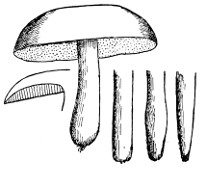
Boletus affinis.
B. affi´nis Pk.—related. Pileus convex above or nearly plane, subglabrous, reddish-brown or chestnut color fading to tawny or dingy-ochraceous with age. Flesh white. Tubes plane or convex, adnate or slightly depressed around the stem, at first white and stuffed, then glaucous-yellow or subochraceous, changing to rusty-ochraceous where wounded. Stem subequal, even, glabrous, colored like or paler than the pileus. Spores rusty-ochraceous, 9–12×4–5µ.
The Related boletus belongs to the tribe of Boleti known as Edules because of their especially esculent character, but it differs from the general character of the tribe in having its tubes not at all or but slightly shortened around the stem and in its stem not being thickened or bulbous at the base. The species is quite variable in the color of the cap, which is generally darker in young plants, paler in old ones. It may be brown, reddish-brown or blackish-brown when young, but is more or less tinged with tawny or ochraceous when old. It is smooth and even or minutely tomentose and sometimes slightly rugose. In wet weather 449the margin of the cap sometimes curves upward, giving a very convex surface to the tubes. Sometimes the wounded flesh slowly assumes a yellowish hue. The peculiar rusty-ochraceous hue of the spores is also seen sometimes in the tubes of old specimens. As in many species, the flesh of old plants is more soft than that of young ones. The stem is quite variable and is often narrowed downward. It is sometimes very obscurely reticulated at the top.
The cap is generally 2–4 in. broad, the stem 1.5–3 in. long, 4–8 lines thick. The plants are found in thin woods or in bushy places in July and August.
Var. maculo´sus Pk. differs from the type simply in having a few yellowish spots scattered over the cap.
While not as high flavored as some Boleti this is, nevertheless, a fairly good and perfectly safe one. Peck, 49th Rep. N.Y. State Bot.
Very open timber in Woodlands Cemetery, Philadelphia. August, 1898. McIlvaine.
A solitary species which does not appear to be plentiful. The whole fungus is edible, but the stems and tubes are of different texture from the caps and do not cook well with them.
B. æstiva´lis Fr.—pertaining to summer. Pileus convex or nearly plane, even, glabrous, whitish, granulose in dry weather. Flesh yellow below, white above. Tubes nearly free, the mouths minute, equal, yellow. Stem very thick, bulbous, even, glabrous, pale yellow, reddish within at the base. Spores elongated-oval, greenish-brown, rather dark, 11×4–5µ.
Pileus 4–6 in. broad. Stem 4–5 in. long.
Woods and woodland pastures. Minnesota, Johnson; California, H. and M.
A large species, recorded as edible and said to be pleasant and delicate in flavor. I have seen no specimens of this. Peck, Boleti of the United States.
West Virginia mountains, 1882, Haddonfield, N.J., 1894, McIlvaine, on grassy margin of woods.
The flesh is sweet, nutty. Remove stems and tubes when old.
B. impoli´tus Fr.—unpolished. Pileus convex, dilated, flocculose, at length grained in lines, unpolished, tawny-brown. Flesh white or 450whitish, unchangeable, yellowish under the cuticle. Tubes free, their mouths minute, yellow. Stem stout, subbulbous, even, pubescent, pale-yellow, sometimes with a reddish zone near the top. Spores oval or fusiform, pale greenish-brown, 7.5–10×5µ.
Pileus 4–6 in. broad. Stem 2 in. long.
Oak woods. California, Harkness and Moore.
This species is recorded as edible and said to be among the most delicious. It is evidently rare in this country. According to Quelet the spores are ellipsoid, papillate, 15–18µ long. Peck, Boleti of the U.S.
Near Bartram’s Garden, West Philadelphia, Pa., 1885. Thin mixed woods. McIlvaine.
That this species is edible and delicious is vouched for by many. I can add my own pleasurable experience.
B. deco´rus Frost.—decorous. Pileus convex, rather firm, tomentose, brownish tinged with red, the margin often darker colored. Flesh white, unchangeable. Tubes becoming free, yellow, changing to green where wounded. Stem bulbous, minutely branny, brownish-red, the bulb sometimes white and attenuated at the base. Spores 13×5µ.
Rich woods. New England, Frost. Peck, Boleti of the U.S.
Leominster, Mass., C.F. Nixon, August, 1897; Woodland Cemetery, Philadelphia, Pa., August, 1897, McIlvaine.
Cap 2–3 in. broad. Stem 2–2½ in. high, but variable in size. Its edible qualities are excellent.
B. lima´tulus Frost—polished. Pileus nearly flat, thin, glabrous, viscid when moist, somewhat polished and shining when dry, rich yellowish-brown. Flesh reddish in the pileus, darker in the stem. Tubes depressed around the stem, greenish-yellow, their mouths yellowish-brown. Stem small, subbulbous, colored like the pileus. Spores 12–15×4–5µ.
Pileus 1–2.5 in. broad.
Woods. New England, Frost.
By the differently-colored tube mouths, this species approaches those of the next following tribe, but it is placed here because these are not red or reddish. Peck, Boleti of the U.S.
B. au´ripes Pk.—yellow-stem. Pileus convex, subglabrous, yellowish-brown, sometimes cracking in areas when old. Flesh yellow, fading 451to whitish with age. Tubes nearly plane, their mouths small, subrotund, at first stuffed, yellow. Stem nearly equal, solid, even or slightly reticulated at the top, bright yellow, a little paler within. Spores ochraceous-brown tinged with green, 12×5µ.
Pileus 3–6 in. broad. Stem 3–5 in. long, 8–12 lines thick.
Under mountain laurel, Kalmia latifolia. Port Jefferson. July.
The whole plant, except the upper surface of the pileus, is of a beautiful yellow color. The stem is sometimes more highly colored than the tubes. The species is referable to the tribe Edules. Peck, 50th Rep. N.Y. State Bot.
Mt. Gretna, Pa. August, September, 1898. McIlvaine.
In mixed woods in which Kalmia latifolia is plentiful. The specimens found were in its vicinity. The caps are excellent.
B. leptoceph´alus Pk. Gr—thin; Gr—head. Pileus thin, broadly convex or nearly plane, dry, minutely cracked, especially near the margin, light tawny-brown, sometimes tinged with reddish-brown. Flesh yellowish-white, taste at first mild, then slightly acrid. Tubes subventricose, depressed about the stem, nearly free, dingy olive-yellow, the mouths small, subrotund. Stem nearly equal, enlarged at the top, solid, glabrous or slightly pruinose-mealy, reticulated above, colored like the pileus, white within, with a white mycelium at the base. Spores greenish-olivaceous, fusiform, 12.5–17.5µ long, 5–6µ broad.
Pileus 10–12.5 cm. broad. Stem 10–12.5 cm. long, 1.2–1.6 cm. thick.
Dry, open woods. July. Earle.
The reticulation of the upper part of the stem appears to be formed by the decurrent walls of the tubes. The species belongs to the tribe Edules. Peck, Bull. Torr. Bot. Club, Vol. 25.
Edible.
B. fra´grans Vitt.—fragrant. Fasciculate or solitary. Pileus 1–4 in. across, convex, dark-brown or umber-brown, often wavy, slightly tomentose, margin incurved. Flesh very thick, yellowish, sometimes unchangeable, at others changing to green or blue, and finally becoming reddish when broken. Tubes shortened around the stem and almost free, ½ in. or more long, openings small, roundish, yellow then greenish. Stem at first stout, ovate, usually tapering at the base, then lengthening 452and becoming thinner upward, even, variegated with yellow and red, solid. Spores pale-olive, elongato-fusiform, 10–12×4µ.
In woods, under oaks, etc. Pileus bronze-brown, sometimes with purple shades. Often grows in dense clusters, and in this particular differing from any other British species. Very good for eating. Massee.
Haddonfield, N.J. Oak woods. August to September, 1894. Mt. Gretna, Pa., 1898. McIlvaine.
Solitary. A handsome valuable species which appears to be rare in the United States. Shade a beautiful bronze. Cap 3–4 in. across. A dozen or more individuals were found and eaten. Excellent.
B. frustulo´sus Pk.—frustulum, a small bit. Pileus thick, convex or nearly plane, subglabrous, cracked in areas, white or whitish. Flesh whitish. Tubes equal to or a little longer than the thickness of the flesh of the pileus, depressed about the stem, whitish, becoming pale brown. Stem equal, solid, whitish, reticulated above. Spores 15–17×5–6µ.
Pileus 3–5 in. broad. Stem 1–2 in. long, 6–10 lines thick.
Open grounds and clay banks. Ocean Springs, Mississippi and Akron, Alabama. May and June. Underwood.
The deeply cracked surface of the pileus is the most notable feature of this species. This sometimes is seen even in quite young plants. The cracked areas are quite unequal in size. The deep chinks with sloping sides cause them to appear like frusta of polygonal pyramids. In some specimens the reticulations of the stem extend nearly or quite to its base, and make the place of the species ambiguous between the Calopodes and Edules. Peck, Bull. Torrey Bot. Club, Vol. 24, No. 3.
Mt. Gretna, Pa., September, 1898, on soil over red conglomerate and on road-sides. McIlvaine.
The deep cracks in the cap readily distinguish this species. After rains the caps are frequently slightly dished and widely cracked at margin. The exposed flesh dries with a fine silky gloss. The caps are excellent. The tubes and stem should be removed.
B. cras´sipes Pk.—thick-footed. (Plate CXVI, fig. 5, p. 420.) Pileus convex or centrally depressed, firm, dry, velvety, brown tinged with yellow, the wavy or lobed involute margin extending beyond the tubes. Flesh lemon-yellow, unchangeable, taste sweet, odor like that 453of yeast. Tubes rather short, depressed around the stem, almost free, yellowish mottled with brown, the mouths minute, stuffed when young. Stem stout, thick, sometimes swollen in the middle and sometimes bulbous, beautifully reticulated but the reticulations sometimes disappearing with age, orange-yellow tinged with brown. Flesh of a brighter yellow than that of the pileus.
Pileus 5–10 cm. broad. Stem 6–8 cm. long, 2.5–3.5 cm. thick.
Oak woods. Mt. Gretna, Pa. August and September. McIlvaine.
The thick, beautifully reticulated stem, the deep velvety brown color of the pileus and the yellow color of the flesh serve to distinguish this species. Peck, Bull. Torr. Bot. Club, Vol. 27, January, 1900.
It is one of the best edible mushrooms. I have also found it in New Jersey.
Lu´ridi.
Stratum of tubes rounded toward the stem and free, their mouths at first closed and red. Pileus compact, then soft, cushion-shaped, the flesh juicy, changeable. Stem stout, at first short, bulbiform, then elongated and subequal, subreticulated or dotted.
Growing especially in frondose woods. Very poisonous.
In this tribe the tubes and their mouths are differently colored, the latter being red or some shade of red. By this character the species are easily distinguished from those of other tribes.
Flesh distinctly changing color where wounded 1
Flesh not at all or scarcely changing color where wounded 7
1. Flesh white or whitish 2
1. Flesh yellow or yellowish 5
2. Flesh changing to red or violet B. Satanus
2. Flesh changing to blue 3
3. Stem roughened B. alveolatus
3. Stem even 4
4. Stem hairy at the base B. subvelutipes
4. Stem not hairy at the base B. vermiculosus
5. Stem red B. luridus
5. Stem yellow or reddish only at the base 6
6. Pileus purplish-red B. purpureus
6. Pileus gray B. firmus
6. Pileus yellow or yellowish B. magnisporus
4547. Pileus blood-red B. Frostii
7. Pileus reddish-tawny or brown B. Sullivantii
Peck, Boleti of the U.S.
All authors, up to this date, agree in stating that the species within this series are poisonous. Experiments made by Smiedeberg and Koppe with Boletus Satanus developed symptoms closely resembling poisoning by Amanitæ. Kobert, who made analysis of B. luridus, shows that it contains muscarine, which is one of the most deadly poisons. Such a mass of evidence commands respect. It is urged upon finders of these species to either leave them alone or test them in minute quantities until they have established their ability to eat them without injury.
I have taken special pains to establish the edibility of B. Satanus and B. luridus. For fifteen years I have eaten them in quantity when opportunity afforded, in West Virginia, New Jersey and Pennsylvania. My family, and my friends in widely separated localities, have partaken freely of them many times and without discomfort. They are remarkably fine eating. The same can be said of B. alveolatus, B. purpureus, B. subvelutipes. I have not seen the other species of this tribe.
I have determined so many of the reputed poisonous species to be edible, that unless positively authenticated, I do not accept repute as truth, but carefully test suspicious species upon myself. When sure there is no danger, I as carefully have them tested by my numerous under-tasters—male and female.
B. Sa´tanus Lenz.—Satanic. Pileus convex, glabrous, somewhat gluey, brownish-yellow or whitish. Flesh whitish, becoming reddish or violaceous where wounded. Tubes free, yellow, their mouths bright red becoming orange-colored with age. Stem thick, ovate-ventricose, marked above with red reticulations. Spores 12×5µ.
Pileus 3–8 in. broad. Stem 2–3 in. long.
Woods. Rare. North Carolina, Curtis; New York, Peck; California, H. and M., N.J. Ellis.
Though mild to the taste, this Boletus is said to be very poisonous, a character suggestive of the specific name. Fries describes the color of the spores as earthy-yellow; Smith as rich brown. Peck, Boleti of the U.S.
455West Virginia, New Jersey, Pennsylvania, McIlvaine.
Boletus Satanus is sometimes plentiful in spots. Where it luxuriates it is a rich decoration to the ground, and earth upon upturned-roots upon which it often grows. It does not live long after reaching maturity, but decomposes into a putrescent mass.
Its reputation rivals that of the original possessor of its name. But old proverb sayeth that even “The Devil is not as black as he is painted.” See remarks heading Luridi.
B. alveola´tus B. and C. Pileus convex, glabrous, shining, bright crimson or maroon-color, sometimes paler and varied with patches of yellow. Flesh firm, white, changing to blue where wounded. Tubes adnate, subdecurrent, yellow with maroon-colored mouths, the hymenial surface uneven with irregular alveolar depressions. Stem very rough with the margins of rather coarse subreticular depressions, the reticulations bright-red above with yellow stains. Spores yellowish-brown, 12.5–15×4–5µ.
Pileus 3–6 in. broad. Stem 3–4 in. long, 9 lines thick.
Damp woods. New England, Frost. Peck, Boleti of the U.S.
West Virginia mountains, New Jersey, Pennsylvania, in mixed woods and on banks of streams. McIlvaine.
B. alveolatus appears to be more generally distributed than B. Satanus. It is not as clannish, though occasionally three or four are found growing together. When growing from the banks of creeks, or between the roots of beech and other trees in low places, it is often deformed in cap and stem. The texture is firm, close and the taste is very pleasant. It botanically takes its place in this suspected series. I consider it one of the best Boleti. See remarks heading Luridi.
B. lu´ridus Schaeff.—lurid in color. Pileus convex, tomentose, brown-olivaceous, then somewhat viscose, sooty. Flesh yellow, changing to blue where wounded. Tubes free, yellow, becoming greenish, their mouths round, vermilion, becoming orange. Stem stout, vermilion, somewhat orange at the top, reticulate or punctate. Spores greenish-gray, 15×9.
Pileus 2–4 in. broad. Stem 2–3 in. long.
The lurid Boletus, though pleasant to the taste, is reputed very poisonous. Boletus rubeolarius Pers., having a short bulbous scarcely reticulated 456stem, is regarded as a variety of this species. The red-stemmed Boletus, B. erythropus Pers., is also indicated as a variety of it by Fries. It is smaller than B. luridus, has a brown or reddish-brown pileus and a slender cylindrical stem, not reticulated, but dotted with squamules. It has been reported from California by Harkness and Moore. Peck, Boleti of the U.S.
Var. erythropus received from Dr. J.W. Harshberger, Philadelphia, May, 1896.
Often shining as if varnished and very handsome. I frequently found it in West Virginia, New Jersey and Pennsylvania in mixed woods among leaves. Its reputation is bad. It is undoubtedly edible by many, and is delicious. The caution heading Luridi should be carefully observed.
B. purpu´reus Fr.—purple. Pileus convex, opaque, dry, somewhat velvety, purplish-red. Flesh in the young plant only becoming blue, then dark-yellow. Tubes nearly free, yellow or greenish-yellow, their mouths minute, purple-orange, changing to blue where wounded. Stem stout, firm, adorned with purple veins or dots, sometimes reticulated at the apex only, yellow, reddish within, especially at the base. Spores greenish-brown, 10–12×5–6µ.
Pileus 2–4 in. broad. Stem 2–4 in. long, 6–8 lines thick.
Woods. North Carolina, Curtis; New York, Peck; Minnesota, Johnson. Peck, Boleti of the U.S.
West Virginia, Mt. Gretna, Pa., McIlvaine.
At Mt. Gretna, Pa., 1897–1898, B. purpureus was common in oak and chestnut woods. It is a showy species, easily distinguished by its velvety cap. In young specimens the stem is robust, then tapering upward. When old the cap loses its rich color toward the margin, becoming yellowish. The flesh is thick, firm and of excellent flavor. It undoubtedly proved itself delicious and harmless to many eating it.
B. vermiculo´sus Pk.—wormy. Pileus broadly convex, thick, firm, dry, glabrous, or very minutely tomentose, brown, yellowish-brown or grayish-brown, sometimes tinged with red. Flesh white or whitish, quickly changing to blue where wounded. Tubes plane or slightly convex, nearly free, yellow, their mouths small, round, brownish-orange, becoming darker or blackish with age, changing promptly to blue 457where wounded. Stem subequal, firm, even, paler than the pileus. Spores ochraceous-brown, 10–12×4–5µ.
Var. Spra´guei. (Boletus Spraguei Frost, Bull. Buff. Soc., p. 102.) Stem yellow above, minutely velvety below.
Pileus 3–5 in. broad. Stem 2–4 in. long, 4–10 lines thick.
Woods. New York, Peck; Ohio, Morgan; New England, Frost.
The species is separated from B. luridus by its dry pileus, white flesh, even stem, which is neither reticulated nor dotted, and by its smaller spores. I can not distinguish specimens of B. Spraguei received from Mr. Frost, from this species. The name is scarcely appropriate, for specimens are not always infested by larvæ. Peck, Boleti of the U.S.
I have not seen this species, therefore, have not tested it. CAUTION.
B. subvelu´tipes Pk.—velvety-stem. Pileus convex, firm, subglabrous, yellowish-brown or reddish-brown. Flesh whitish, both it and the tubes changing to blue where wounded. Tubes plane or slightly convex, nearly free, yellowish, their mouths small, brownish-red. Stem equal or slightly tapering upward, firm, even, somewhat pruinose above, velvety with a hairy tomentum toward the base, yellow at the top, reddish-brown below, varied with red and yellow within. Spores 15–18×5–6µ.
Pileus 2–3 in. broad. Stem 2–3 in. long, 4–6 lines thick.
Woods. New York, Peck.
This species resembles the preceding one in general appearance, but it is very distinct by its much longer spores and by the velvety hairiness toward the base of the stem. Peck, Boleti of the U.S.
Boletus subvelutipes is common in some localities in Pennsylvania, especially on the Springton Hills, in chestnut and oak woods. I have frequently eaten it and found it excellent. Others should carefully test it.
B. fir´mus Frost—firm. Pileus convex, very firm, slightly tomentose, gray, often pitted. Flesh yellowish or deep-yellow, changing to blue where wounded. Tubes adnate, deeply arcuate, unequal, yellow, their mouths tinged with red. Stem solid, hard, very finely reticulated, yellowish, reddish at the base. Spores 13×3µ.
Pileus 2.5–4 in. broad. Stem 2–4 in. long.
Rich moist wood. New England, Frost.
458Apparently a well-marked and very distinct species. According to the author, it is readily distinguished by its tenacity and generally distorted growth. I have not seen it nor the next. Peck, Boleti of the U.S.
Professor Peck’s measurement of spores, 50th Report, New York State Botanist, is 13µ long, 6µ wide.
B. magnis´porus Frost. Pileus convex, firm, tomentose, golden-yellow; tubes scarcely adnate, even, greenish-yellow, their mouths light cinnabar-red. Stem long, slender, yellow above, red below. Spores 15–18×6µ.
Pileus 2.5 to 3.5 in. broad.
Woods and thickets. New England, Frost; Ohio, Morgan. Peck, Boleti of the U.S.
I have not recognized it. CAUTION.
B. Fros´tii Russell. Pileus convex, polished, shining, blood-red, the margin thin. Flesh scarcely changing to blue. Tubes nearly free, greenish-yellow, becoming yellowish-brown with age, their mouths blood-red or cinnabar. Stem equal or tapering upward, distinctly reticulated, firm, blood-red. Spores 12.5–15×5µ.
Pileus 3–4 in. broad. Stem 2–4 in. long, 3–6 lines thick.
Grassy places under trees or in thin woods. New England, Frost; New York, Peck; New Jersey, Ellis.
This is a highly colored, beautiful Boletus, but it is not common. The stem sometimes fades with age, and both it and the tubes are apt to lose their color in drying. Peck, Boleti of the U.S.
I have not recognized it. CAUTION.
B. Sullivan´tii B. and M. Pileus hemispherical, glabrous, reddish-tawny or brown, brownish when dry, cracked in squares. Tubes free, convex, medium size, angular, longer toward the margin, their mouths reddish. Stem solid, violaceous at the thickened base, red-reticulated at the apex, expanded into the pileus. Spores pallid ochraceous, oblong-fusiform, 10–20µ long.
Pileus 3–4 in. broad. Stem 1.5–3 in. long.
Compact soil. Ohio. Sullivant.
The species is said to be intermediate between Boletus scaber and B. edulis. 459From the former it differs in its reticulated stem, from the latter, in its larger tubes and from both in its stratum of tubes being remote from the stem. I have not seen it. Peck, Boleti of the U.S.
B. Un´derwoodii Pk. Pileus rather thin, convex, becoming nearly plane, slightly velvety, bright brownish-red, becoming paler with age. Flesh yellow, changing to greenish-blue where wounded. Tubes adnate or slightly decurrent, greenish-yellow, becoming bluish where wounded, their mouths very small, round, cinnabar red, becoming brownish-orange. Stem equal or slightly tapering upward, somewhat irregular, solid, yellow without and within. Spores 10–12 x 5µ.
Pileus 2–3 in. broad. Stem 3–4 in. long, 4–6 lines thick.
Grassy woods. Auburn, Alabama. July. Underwood.
This species is remarkable for its adnate or subdecurrent tubes, in which it departs from the character of the tribe to which it belongs according to the colors of the tubes. Peck, Bull. Torrey Bot. Club, Vol. 24, No. 3.
B. par´vus Pk.—parvus, small. Pileus convex, becoming plane, often slightly umbonate, subtomentose, reddish. Flesh yellowish-white, slowly changing to pinkish where wounded. Tubes nearly plane, adnate, their mouths rather large, angular, at first bright red, becoming reddish-brown. Stem equal or slightly thickened below, red. Spores oblong, 12.5×4µ. Pileus 1–2 in. broad. Stem 1–2 in. long, 2–3 lines thick.
Grassy woods. Auburn, Ala. July. Underwood. Peck, Bull. Torrey Bot. Club, Vol. 24, No. 3.
Versipel´les—verto, to change; pellis, a skin.
Tubes at first white or whitish, minute, round, equal, forming a convex stratum free from the stem.
Stem black B. alboater
Stem some other color 1
1. Stem yellow at the base B. chromapes
1. Stem not yellow at the base 2
2. Margin of the pileus appendiculate B. versipellis
2. Margin not appendiculate 3
4603. Stem scabrous or punctate-squamulose B. scaber
3. Stem even 4
4. Pileus white or whitish B. albellus
4. Pileus dark-brown B. sordidus
Peck, Boleti of the U.S.
B. alboa´ter Schw.—black and white. Pileus convex, subtomentose-velvety, black. Tubes free, their mouths rather small, white. Stem black.
Pileus 3 in. broad. Stem 2 in. long.
Moist woods. Frequent. North Carolina and Pennsylvania, Schweinitz.
In Epicrisis, p. 424, Fries adds to the description here quoted, that the stem is flocculose-veiled. He subjoins to this as a subspecies, Boletus floccosus Schw.; but in Syn. N.A. Fung., Schweinitz makes this a synonym of Boletus floccopus. The species does not appear to have been recognized by recent collectors, which seems strange unless there is some error concerning it. Can it be a black variety of Boletus scaber? Peck, Boleti of the U.S.
Mt. Gretna, Pa. Gravelly woods. McIlvaine.
Cap 1½-4 in. across, convex, slightly depressed, margin involute when young, black, densely velvety in youth and age—beautifully so. Flesh firm, thick, solid, white changing to grayish. Tubes white, stuffed, sometimes blackish when young, excepting a grayish-white circle around stem, becoming yellowish-white when matured, rotund, minute, up to ½ in. long, plane when young; when caps expand tubes draw away from stem leaving a deep white depression. This drawing away apparently elongates many dissepiments, creating a gill-like effect, decurrent upon stem. Stem 2–3 in. long, swollen toward base when young, equal, expanding into cap and tapering to a point at base; ¾-1 in. thick, slightly compressible, hard, sooty-black, velvety near base, satiny and glossy upward, has the appearance of having been blackened with burnt cork, usually with narrow white band next to the tubes, no trace of veil, composed of rather hard waved fibers, white when split, but changing to sooty black toward base, lighter upward.
Smell like common mushroom; taste nutty.
Gregarious in sandy-conglomerate soil in mixed woods, among moss and leaves. Mt. Gretna, Pa.
461Differs from B. alboater Schw., in having densely tomentose cap, tubes widely separated from stem in age.
A young specimen of apparently same species in same patch had very short, decurrent tubes (not over 1 line) which were sooty-black.
Delicious.
B. sor´didus Frost—sordid. Pileus convex, subtomentose, dirty dark-brown. Flesh white, slightly tinged with green. Tubes long, nearly free, at first white, changing to bluish-green. Stem smaller at the top, brownish, marked with darker streaks, generally greenish above. Spores 10–13×5µ.
Pileus about 2 in. broad.
Recent excavations in woods. New England, Frost; Ohio, Morgan.
The Ohio plant occurs in damp woods, has the flesh sometimes tinged with red and green, the tubes white, then sordid, but changing to bluish-green when bruised, their mouths large and angular, the stem somewhat flexuous and striate and the spores fusiform and dirty-brown, Peck, Boleti of the U.S.
B. versipel´lis Fr. Pileus convex, dry, at first compact and minutely tomentose, then squamose or smooth, reddish or orange-red, the margin appendiculate with the inflexed remains of the membranous veil. Flesh white or grayish. Tubes at first concave or nearly plane, almost or quite free, minute, sordid-white, their mouths gray. Stem equal or tapering upward, solid, wrinkled-scaly, whitish or pallid. Spores oblong-fusiform, 14–18×4–6µ.
Pileus 2–6 in. broad. Stem 3–5 in. long, 4–10 lines thick.
Woods and open places, especially in sandy soil. North Carolina, Curtis; New England, Frost; New York, Peck; California, H. and M. Peck, Boleti of the U.S.
West Virginia, New Jersey, Pennsylvania. McIlvaine.
The caps are good cooked in any way.
(Plate CXXI.)
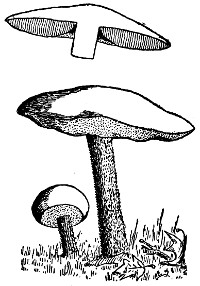
Boletus scaber. One-half natural size.
B. sca´ber Fr.—scaber, rough. (Plate CXVIII, fig. 4, p. 436.) Pileus convex, glabrous, viscid when moist, at length wrinkled or lined. Tubes free, convex, white, then sordid, their mouths minute, rotund. Stem solid, attenuated above, roughened with fibrous scales. Spores oblong-fusiform, snuff-brown, 14–18×4–6µ.
462Pileus 1–5 in. broad. Stem 3–5 in. long, 3–8 lines thick.
Woods, swamps and open places. Very common and appearing through summer and autumn.
This may fairly be called our most common and variable species. It is recorded in nearly every local list of fungi. The pileus is convex, hemispherical or even subconical. It may be glabrous, minutely tomentose, subvelvety or squamulose. The flesh is white or whitish and sometimes slightly changeable where wounded. The tubes are generally rather long and with a rounded or convex surface. The stem is distinctly scabrous or roughened with small blackish-brown or reddish dots or scales, the ground color generally being whitish, grayish or pallid. The spores have been described as pale-brown and light-yellowish. When caught in a mass on white paper they appear to me to approach snuff-brown. The viscidity of the pileus is not always clearly discernible. Indeed the pileus is often quite as dry as in B. versipellis. When moistened by heavy rains it sometimes is smooth and clammy to the touch but scarcely viscid. Several varieties have been indicated which are expressive of the variations in the color of the pileus.
Var. testa´ceus. Pileus brick-red.
Var. auranti´acus. Pileus orange or orange-red.
These appear to connect this species and B. versipellis.
Var. aluta´ceus. Pileus yellowish-tan color.
Var. fuligin´eus. Pileus fuliginous or cinereous-fuliginous.
Var. fus´cus. Pileus brown or dark-brown.
Var. oliva´ceus. Pileus olivaceous.
Var. ni´veus. Pileus white, when old sometimes stained with blue or livid-blue.
To these might be added:
463Var. areola´tus. Pileus rimose-areolate. (Plate CXVIII, fig. 4, p. 436.)
Var. mutab´ilis. Flesh changing slightly to brown or pinkish where wounded.
Var. graci´lipes. Stem very slender, 2–3 in. long, 2–3 lines thick. Pileus thin, translucent when held toward the light.
This Boletus is classed among the edible species, but it is said to be less agreeable than B. edulis. Peck, Boleti of the U.S.
West Virginia, North Carolina, New Jersey, Pennsylvania, McIlvaine.
The numerous varieties with their peculiarities here given by Professor Peck will enable the finder of a Boletus with a distinctly scabrous stem—roughened with scales, not reticulate—to select its name. For the mycophagist it is enough to know that he has Boletus scaber. In all of its varieties it is edible. The stems, often the tubes, unless young, should be discarded, as they do not cook in the same time as the caps. The comparative excellence of the species rests with the devourer. It deserves a high place.
B. scaber, var. areolatus, Plate CXVIII, fig. 4, has slight flavor, but is of pleasing consistency.
B. durius´culus Schulz—somewhat hard. Pileus 2–5 in. across, hemispherical, minutely velvety, viscid when moist, varying in color from pale-brown, through dingy-chestnut, to umber-brown, often becoming cracked in areas when dry, interstices paler. Flesh thick, white or tinged yellow, when cut becoming reddish copper-color. Tubes ½-¾ in. long, shortened round the stem and free, openings about ⅔ mm. across, often compound, irregularly angular, bright-yellow. Stem 4–7 in. long, fusiform, thickest part 1½-2 in. across, situated below the middle, yellowish, rough with blackish points, which are sometimes arranged in a subreticulate manner, apex sometimes more or less grooved, solid, flesh of upper part becoming coppery like the pileus. Spores elongato-cylindrical, pale-umber, 14–16×5–6µ.
In woods. Esculent and very delicious. Allied to Boletus scaber, but distinguished by the bright-yellow tubes and the very firm flesh, which turns coppery-red when exposed to the air; this color eventually changes to a dingy grayish-violet. Also allied to Boletus porphyrosporus. Massee.
464Snow Hill, N.J. Gravelly soil, mixed woods, 1892. McIlvaine.
The stem and tubes should be removed. The caps are very fine.
B. albel´lus Pk.—whitish. Pileus convex or gibbous, soft, glabrous, whitish. Flesh white, unchangeable. Tubes convex, free, or nearly so, small, subrotund, whitish, unchangeable. Stem glabrous or minutely branny, substriate, bulbous or thickened at the base, whitish. Spores brownish-ochraceous, 14–16×5–6µ.
Pileus 1–2 in. broad. Stem 1–2 in. long, 3–6 lines thick.
Woods. New York, Peck.
This is closely related to B. scaber, of which it may possibly prove to be a dwarf form; but it is easily distinguished by its smooth or only slightly scurfy and subbulbous stem. It presents no appearance of the colored dot-like squamules which are a constant and characteristic feature of that species. Peck, Boleti of the U.S.
West Virginia. Woodland Cemetery, Philadelphia. McIlvaine.
Specimens found at Mt. Gretna, Pa., had a satiny, glossy stem, beautifully furfuraceous, and stem not thickened at base. Professor Peck, to whom specimens were sent, writes: “Stem is a little more furfuraceous, and not thickened at the base, otherwise the agreement is very good.” It is good fried.
B. chro´mapes Frost. Pileus convex or nearly plane, slightly and sometimes fasciculately tomentose, pale-red. Flesh white, unchangeable. Tubes subadnate, more or less depressed around the stem, white or whitish, becoming brown. Stem equal or slightly tapering upward, rough-spotted, whitish or pallid, chrome-yellow at the base both without and within, sometimes reddish above. Spores oblong, 12–14×4–5µ.
Pileus 2–4 in. broad. Stem 2–4 in. long, 4–6 lines thick.
Woods. New England, Frost; New York, Peck.
The yellow base of the stem appears to be a peculiar and constant character by which the species may easily be recognized. It imitates Boletus piperatus in this respect, but in everything else it is very distinct from that plant. Sometimes the stem is so badly infested by larvæ that it is difficult to procure a sound specimen. The spores have a subferruginous color with a slight incarnate tint, but the rough-dotted stem indicates a relationship with B. scaber. Through this species, Boletus conicus and B. gracilis, the Versipelles and the Hyporhodii appear 465to run together. In the Catalogue of Plants of Amherst the specific name is “chromapus.” It would be more in accordance with present custom to write it “chromopus.” Peck, Boleti of the U.S.
A dozen or more specimens referable to this species were found by me at Mt. Gretna, Pa., August, 1897, in mixed woods. The caps were eaten and were excellent.
B. nebulo´sus Pk. Pileus convex, dry, snuff-brown or smoky-brown. Flesh white, unchangeable. Tubes convex, depressed around the stem, pallid or brownish, becoming purplish-brown where wounded, the mouths small, rotund. Stem enlarged toward the base, solid, scurfy, colored like the pileus. Spores 12.5–15×6µ.
Pileus 2–4 in. broad. Stem 3–4 in. long, 4–6 lines thick.
Shaded banks by road-side. Raybrook. August.
No young or immature specimens were seen, and the description is to that extent incomplete. Peck, 51st Rep. N.Y. State Bot.
By a painting made by the writer September, 1885, Professor Peck identified the species of which it is a picture as B. nebulosus Pk. The following notes accompany it, which have been verified many times since their writing:
Oak woods. West Philadelphia, Pa., September. Mt. Gretna, Pa., September.
Pileus chestnut-brown and darker, covered with small, low, black spots; convex, often depressed in center, sharp on margin. Flesh white, thick, solid, unchangeable. Tubes very small, and light pinkish-brown. When touched they change to a deeper hue. Stem same color as pileus, but a shade lighter, solid, scurfy, having a striate appearance, enlarging toward base.
Taste sweet and pleasant. Cooked it is juicy, meaty and very fine.
B. ful´vus Pk.—brownish-yellow. (Plate CXVI, fig. 3, p. 420.) Pileus thick, convex or subcampanulate, dry, glabrous, rimose-areolate, tawny-yellow, the extreme margin dark-brown. Flesh spongy, tough, white, slowly assuming a reddish tint upon exposure to the air. Tubes rather long, ventricose, depressed around the stem and free or nearly so, greenish-yellow, the mouths small, tawny-yellow. Stem rather long, often narrowed and striate at the top, dotted with brownish-orange granules 466or points, radicating, tough, stuffed with greenish-yellow fibers, colored like the pileus. Spores unknown.
Pileus 2–3 in. broad. Stem 4–5 in. long, 4–8 lines thick.
Cespitose on decaying stumps. West Philadelphia, Pa. August. McIlvaine.
Mr. McIlvaine says that there were between twenty and thirty specimens on and about an old stump and that they were as attractive to the eye as a cluster of Clitocybe illudens. Peck, Bull. Torrey Bot. Club, Vol. 27, January, 1900.
Excellent in flavor, rather spongy, but fine.
Hyporho´dii. Gr—somewhat rose-colored.
Tubes adnate to the stem, whitish, then white-incarnate from the rosy spores.
In this tribe the tubes are at first whitish, but with the development of the spores they usually assume a pinkish or flesh-colored hue. Wounds of the tubes in some species cause a change in color but not to blue, nor are the tube mouths differently colored as in the Luridi. The stem in some is more or less reticulated but this is scarcely a constant or reliable character in these species. Typically the spores are rosy or flesh-colored, but I have admitted species in which they incline to rust-colored, giving more weight to the color of the tubes than to that of the spores.
Pileus black or blackish B. nigrellus
Pileus some other color 1
1. Stem more than four lines thick 2
1. Stem slender, generally less than four lines thick B. gracilis
2. Stem not reticulated 3
2. Stem more or less reticulated 4
3. Tubes angular, flesh-colored B. conicus
3. Tubes round, white B. alutarius
4. Taste mild B. indecisus
4. Taste bitter B. felleus
Peck, Boleti of the U.S.
B. con´icus Rav.—conical. Pileus convex or subconical, clothed with bundled appressed yellowish flocci. Flesh white, unchangeable, 467tasteless. Tubes ventricose, flesh-colored, becoming darker from the spores, the mouths small, angular, slightly fringed. Stem glabrous, tapering upward, pale-yellow. Spores fusiform, subferruginous.
Pileus 1–2 in. broad. Stem 2 in. long, 6 lines thick.
Damp pine woods. South Carolina, Ravenel.
The species is compared to Boletus scaber, from which it differs in its smaller tubes and smooth stem, and from both this and B. albellus it differs in the color of the tubes and in the yellowish flocci of the pileus. I have seen no specimens, but on account of the color of the tubes I have placed the species with the Hyporhodii. Peck, Boleti of the U.S.
B. gra´cilis Pk.—slender. (Plate CXIV, fig. 1, p. 414.) Pileus convex, glabrous or minutely tomentose, rarely squamulose, ochraceous-brown, tawny-brown or reddish-brown. Flesh white. Tubes plane or convex, depressed around the stem, nearly free, whitish, becoming pale flesh-colored, their mouths subrotund. Stem long, slender, equal or slightly tapering upward, pruinose or minutely branny, even or marked by slender elevated anastomosing lines which form long narrow reticulations. Spores subferruginous, 12.5–17.5×5–6µ.
Var. lϫvipes. Stem even.
Pileus 1–2 in. broad. Stem 3–5 in. long, 2–4 lines thick.
Woods. New York, Peck; New England, Frost; Ohio, Morgan.
The slender habit separates this species from all the others here included in this tribe. Its spores are not a clear incarnate in color, but incline to dull-ferruginous, and by this character this and the preceding species connect this tribe with Versipelles. In color B. gracilis resembles some forms of B. felleus, but in size, habit and color of spores it is easily distinct. The tomentum of the pileus sometimes breaks into tufts or squamules. This is Boletus vinaceus, Frost MS. Peck, Boleti of the U.S.
B. gracilis, var. lævipes, was found by the writer in Woodland Cemetery, West Philadelphia, August, 1897, and at Mt. Gretna, Pa., September, 1898. The stem of some specimens spreads at the top. The pileus is often cracked on the margin, and the upturning of the margin often exposes the tubes. Painting, as of this species, identified by Professor Peck.
The taste is at first sweet, then bitter. The bitterness is lost in cooking. Edible, good.
468B. indeci´sus Pk.—undecided. (Plate CXXII, fig. 1, p. 468.) Pileus convex or nearly plane, dry, slightly tomentose, ochraceous-brown, often wavy or irregular on the margin. Flesh white, unchangeable; taste mild. Tubes nearly plane or convex, adnate, grayish becoming tinged with flesh color when mature, changing to brownish where wounded, their mouths small, subrotund. Stem minutely furfuraceous, straight, or flexuous, reticulated above, pallid without and within. Spores oblong, brownish flesh color, 12.5–15×4µ.
Pileus 3–4 in. broad. Stem 2–4 in. long, 4–6 lines thick.
Thin oak woods. New York, Peck.
The mild taste and darker colored spores will separate this Boletus from any form of B. felleus. Its stem reticulated above distinguishes it from B. alutarius. It resembles B. modestus in some respects, but its tubes are not at all yellow. Peck, Boleti of the U.S.
Kentucky, Lloyd, Rep. 4.
Woodland Cemetery, Philadelphia, July, 1897, McIlvaine; Trenton, N.J., August, 1897, Sterling. In open mixed woods.
Boletus indecisus so closely resembles B. felleus in some of its forms that until the color of the spores is ascertained, the sweet taste, without trace of bitter, is the only thing that will enable the finder to discriminate between them. Young B. felleus are at first pleasant to the taste and do not, at once, develop their intense bitter in the mouth. They may readily be taken for B. indecisus. If, by mistake, a single B. felleus is cooked with mild species, the dish will be spoiled. Specimens believed to be B. indecisus should be tested. A minute will perfectly satisfy anyone.
The B. indecisus is delicious.
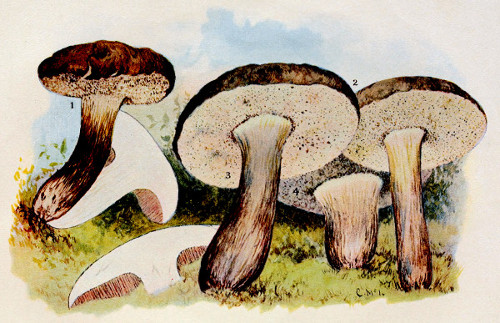
Grouped by F.D. Briscoe—Studies by C. McIlvaine. Plate CXXII.
Fig. Page. Fig. Page.
1. Boletus indecisus, 468 2–3–4. Boletus felleus, 460
B. aluta´rius Fr.—aluta, tanned leather. Pileus convex, then nearly plane, soft, velvety, becoming glabrous, brownish tan color. Flesh almost unchangeable, taste mild, watery. Tubes depressed around the stem, plane, short, round, white, becoming brownish where wounded. Stem solid, bulbous, nearly even, small, irregular prominences at the top. Spores 14×4µ.
Pileus 3–4 in. broad. Stem 4–5 in. long.
Grassy woods. Minnesota, Johnson. Peck, Boleti of the U.S.
West Virginia mountains, 1882–1885. Margins of woods. Cheltenham, 469Pa. Margins of woods, 1888–1889, grassy woods and margins. McIlvaine.
Common in West Virginia mountains where it grows with B. felleus, from which it is impossible to distinguish it without tasting. It is delicious when cooked. But I long ago ceased collecting for the table any Boletus questionable for B. felleus. I have been deceived so many times—taken the bitter for the sweet—that, preferring the sweet, I take no chances for the bitter.
B. fel´leus Bull.—fel, gall. Bitter. (Plate CXXII, fig. 2, 3, 4, p. 468.) Pileus convex or nearly plane, firm, becoming soft, glabrous, even, variable in color, pale-yellowish, grayish-brown, yellowish-brown, reddish-brown or chestnut. Flesh white, often changing to flesh color where wounded, taste bitter. Tubes adnate, long, convex, depressed around the stem, their mouths angular, white, becoming tinged with flesh-color. Stem variable, equal or tapering upward, short or long, sometimes bulbous or enlarged at the base, subglabrous, generally reticulated above, colored like or a little paler than the pileus. Spores oblong-fusiform, flesh-colored, 12.5–17.5×4–5µ.
Var. obe´sus. Pileus large. Stem thick, coarsely and distinctly reticulated nearly or quite to the base.
Pileus 3–8 in. broad. Stem 2–4 in. long, 6–12 lines thick.
The variety is large and solitary in its mode of growth. It is remarkable for the coarse reticulations of the stem which extend nearly or quite to the base. After heavy rains the pileus is viscid. It may prove to be a distinct species.
The flesh in the American plant does not always assume incarnate hues where wounded. The color of the fresh tubes often changes to a deeper tint where wounded. Peck, Boleti of the U.S.
West Virginia, Pennsylvania, New Jersey, North Carolina, McIlvaine; Indiana, H.I. Miller.
A very common species in woods and on thin margins, on open grassy places, and about decayed stumps. I saw hundreds of plants, var. obesus, some a foot in diameter, in a wheat stubble near oak woods.
One of the most attractive of Boleti. Its cap resembles a handsomely browned cake. Its solidity is inviting; its flesh, generous in quantity, excites appetite. Until one experiences its intense lasting bitter, one 470clings to it with hope. Even after tasting, it is thrown away with regret. It is not poisonous, but a small piece of one will embitter a whole dish. McIlvaine, Bull. Phila. Myc. Center. July, 1898.
B. nigrel´lus Pk.—blackish. Pileus broadly convex or nearly plane, dry, subglabrous, blackish. Flesh soft, white, unchangeable. Tubes plane or convex, adnate, sometimes slightly depressed around the stem, their mouths small, subrotund, whitish becoming flesh-colored, slowly changing to brown or blackish where wounded. Stem equal, short, even, colored like or a little paler than the pileus. Spores dull flesh-colored, 10–12×5–6µ.
Pileus 3–6 in. broad. Stem 1.5–2.5 in. long, 6–12 lines thick.
Woods and copses. New York, Peck.
The blackish color of the pileus and stem distinguishes this species. From Boletus alboater Schw., the adnate, flesh-colored tubes will separate it. The surface of the pileus sometimes becomes cracked in areas. Peck, Boleti of the U.S.
Mt. Gretna, Pa., August, 1898. McIlvaine.
Another distinguishing mark from B. alboater is the velvety pileus of the latter. B. nigrellus is mild in taste and smell and an excellent species for the table.
B. eccen´tricus Pk.—eccentric. (Plate CXVI, fig. 1, p. 420.) Pileus thick, firm, convex, irregular, glabrous, more or less lobed or wavy on the involute margin, gray or yellowish-gray. Flesh white, close-grained, elastic, unchangeable, taste and odor farinaceous. Tubes convex, depressed around the stem, not reaching the margin of the pileus, somewhat uneven and pitted on the surface, yellowish-brown, the mouths subangular, at first concolorous, becoming reddish or reddish-purple. Stem eccentric, tapering downward, solid, uneven with short irregular shallow grooves or obscure reticulations, tinged with red at the top, grayish below, tinged with red or purple within at the base.
Pileus 5–10 cm. broad. Stem 4–5 cm. long, 3–4 cm. thick at the top.
Sandy soil in grassy places in woods. Mt. Gretna, Pa. August and September.
The species is well marked by its eccentric stem, thick irregular pileus and the reddish or reddish-purple mouths of the mature tubes. Mr. 471McIlvaine remarks that when it is cooked it is delicate and savory. Peck, Bull. Torrey Bot. Club, No. 27.
In commenting upon this new species to the writer, Professor Peck says: “I suspect that the spores of this (B. eccentricus) are pinkish or rosy. If so, it belongs here (in Hyporhodii). If not, it may have to go in the Luridi, or possibly may be made the type of a new tribe.”
Cario´si—caries, rottenness.
Stem never reticulated, stuffed with a spongy pith, at length commonly excavated. Tubes at first white, then often yellowish, their mouths minute, round.
Fries adds to these characters, “spores white.” But in our species the spores are pale-yellow when shed in a mass on white paper. They are more elliptical in outline than the spores of most Boleti. The character of the stem is peculiar and easily distinguishes the tribe. The exterior is firm, the interior soft and spongy, becoming irregularly hollow or cavernous in the typical species.
Flesh unchangeable 1
Flesh quickly changing to blue where wounded B. cyanescens
1. Pileus minutely velvety-tomentose B. castaneus
1. Pileus granulated B. Murray
Peck, Boleti of the U.S.
B. cyanes´cens Bull.—cyaneus, deep-blue. Pileus convex or nearly plane, opaque, floccose-scaly or covered with an appressed tomentum, pale-buff, grayish-yellow, yellowish or somewhat brown. Flesh rigid, white, quickly changing to blue where wounded. Tubes free, white, becoming yellowish, the mouths minute, round, changing color like the flesh. Stem ventricose, hoary with fine hairs, stuffed, becoming cavernous, contracted and even at the top, colored like the pileus. Spores subelliptical, 10–12.5×6–7.5µ.
Pileus 2–5 in. broad. Stem 2–4 in. long, 8–18 lines thick.
Woods and open places. New York, Peck; New England, Frost, Bennett; Minnesota, Johnson; Wisconsin, Bundy. Peck, Boleti of the U.S.
High ground in woods. Solitary. West Virginia mountains, Springton Hills, Pa., Kingsessing, Philadelphia, Mt. Gretna, Pa., McIlvaine.
472Boletus cyanescens is a sparse grower. The quality of the juice varies. That of young specimens stains the fingers blue, that of old, brown. The caps are firm and make an excellent dish cooked in any way.
B. casta´neus Bull.—chestnut. (Plate CXIV, fig. 3, p. 414.) Pileus convex, nearly plane or depressed, firm, even, dry, minutely velvety-tomentose, cinnamon or reddish-brown. Flesh white, unchangeable. Tubes free, short, small, white becoming yellow. Stem equal or tapering upward, even, stuffed or hollow, clothed and colored like the pileus. Spores 10–12.5×6–7.5µ.
Pileus 1.5–3 in. broad. Stem 1–2.5 in. long, 3–5 lines thick.
Woods and open places. Rather common and wide spread. Peck, Boleti of the U.S.
Boletus castaneus is one of the neatest looking of fungi. The prevailing color is cinnamon, that of the tubes white or very light yellow, spotted with brown wherever insects have touched them. The pore surface of mature specimens is usually irregular. Whoever has seen the stalagmites of Luray Cave will recognize their color on the stems of B. castaneus. These are brittle, snapping like pipe stems, with a small tube in center.
The fungus is common from June until September. It is gregarious, occasionally three or four individuals form a group. Either raw or cooked the caps are edible and will become favorites.
B. Mur´rayi B. and C. Pileus hemispherical, granulated, vivid red. Flesh yellow. Tubes decurrent, about 1 line deep, yellow. Stem clavate, even, pale-yellow. Spores pale-yellow.
Pileus 2–3 in. broad, nearly 1.5 thick.
New England, Murray.
On account of the color of the spores this species has been placed with the Cariosi. The description does not mention the character of the interior of the stem, and the decurrent tubes depart from the character of the typical species so that its true position is uncertain. The species seems well marked by the character of the pileus. Peck, Boleti of the U.S.
B. isabelli´nus Pk. Pileus convex, firm, minutely tomentose, whitish, becoming darker and smoother with age. Flesh isabelline. 473Tubes adnate, minute, sometimes larger near the stem, nearly round, whitish. Stem nearly equal, subglabrous, hollow, whitish. Spores subelliptical, 7.5–9×5–6µ. Pileus 2–3 in. broad. Stem 1–2 in. long, 4–6 lines thick.
Woods. Ocean Springs, Miss. June. Underwood.
The species belongs to the Cariosi. Peck, in Bull. Torrey Bot. Club, Vol 24, No. 3.
APPENDIX (Boletus).
The descriptions of the following species are scarcely sufficient to permit of the satisfactory reference of the species to their places in the tribes. It is to be hoped that these plants may again be found and their proper relations be ascertained.