WONDERS OF ART RESUMED. (continued 3)
Reading edition
THE BRITISH MUSEUM.
This grand national collection of antiquities, books and natural curiosities, is placed in the noble house formerly belonging to the Duke of Montagu, in Great Russell street, Bloomsbury. It is a stately edifice, in the French style of the reign of Louis XIV., and on the plan of the Tuilleries. The celebrated French architect, Peter Paget, was sent over from Paris, by Ralph, first Duke of Montagu, expressly to construct this splendid mansion, which is, perhaps, better calculated for its present purpose than for a private residence.
The British museum was established by act of parliament, in 1753, in consequence of the will of Sir Hans Sloane, who left his museum to the nation, which he declared in his will, cost him upward of fifty thousand pounds, on condition that parliament should pay twenty thousand pounds to his executors, and purchase a house sufficiently commodious for it. The parliament acted with great liberality on this occasion; several other valuable collections were united to this of Sir Hans Sloane, and the whole establishment 680completed for the sum of eighty-five thousand pounds, which was raised by the way of a lottery. Parliament afterward added, at various times, to the Sloanean museum, the Cottonian library; that of Major Edwards; the Harleian collection of manuscripts; Sir William Hamilton’s invaluable collection of Greek vases; the Townleian collection of antique marbles; the manuscripts of the Marquis of Lansdowne; and, lastly, the celebrated Elgin marbles, which comprise what are considered as the finest specimens of ancient sculpture. The whole of the important library of printed books and manuscripts which had been gradually collected by the kings of England from Henry VIII. to William III., was presented to the museum by George II.; and George III. bestowed on it a numerous collection of valuable pamphlets, which had been published in the interval between 1640 and 1660. His majesty likewise contributed the two finest mummies in Europe; the sum of eleven hundred and twenty-three pounds, arising from lottery prizes, which had belonged to his royal predecessor; and, in 1772, a complete set of the journals of the lords and commons. To these contributions he afterward added a collection of natural and artificial curiosities, sent to him, in 1796, by Mr. Menzies, from the north-west coast of America, and several single books of great value and utility. The trustees have at various times added Greenwood’s collection of stuffed birds; Hatchet’s minerals; Halhed’s oriental manuscripts; Tyssen’s collection of Saxon coins; Doctor Bentley’s classics; and the Greville collection of minerals. To these may be added numerous donations from several of the sovereigns of Europe, as well as from learned bodies and private individuals, including the splendid monuments from Nineveh, and other wonderful and curious contributions that will be mentioned.
The building itself is a spacious quadrangle of some two thousand feet, or nearly two-fifths of a mile in circuit, occupying a large part of Great Russel square; and even now, greatly enlarged as it has been, it is quite inadequate for the growing demands for space in all departments. The ground-floor consists of twelve main rooms, and contains the library of printed books. The first room of the upper story contains modern works of art from all parts of the world, arranged in cases. In the one in the center are several beautiful miniatures, among which are those of Sir Thomas More, Charles I., and Oliver Cromwell, the latter having his watch placed by its side. Two curious portraits of William III. and Queen Mary, are carved on two walnut-shells. In the presses are arranged, in geographical order, some fine specimens of China, and a variety of implements of war from different quarters of the globe. Here is to be seen the rich collection of curiosities from the South Pacific ocean, brought by Captain Cook. In the left corner 681is the mourning dress of an Otaheitan lady, in which taste and barbarity are singularly blended; and opposite, are the rich cloaks and helmets of feathers from the Sandwich islands. Among these is one, which, in elegance of form, vies even with the Grecian helmets. In another case are the cava bowls, and above them battoons, and other weapons of war. The next objects of attention are the idols of the different islands, presenting in their hideous rudeness, a singular contrast with many of the works of art formed by the same people; near these are the drums and other instruments of music, and a breast-plate from the Friendly islands. The ceiling of this room, or vestibule, represents the fall of Phæton.
The second room consists of similar objects. The third is devoted to the Lansdowne collection of manuscripts, which have been handsomely bound and lettered. In the fourth are the Sloanean and Birchean collections of manuscripts. The fifth contains part of the Harleian library of manuscripts, and the sixth, the first part of the same, and additions made since the establishment of the museum. The seventh is appropriated to the royal and Cottonian library of manuscripts. On a table, in a glazed frame, is the original of the Magna Charta, belonging to the Cottonian library. Against the press, number twenty-one, of the Cottonian collection, is the original of the articles preparatory to the signing of the great charter, perfect, with the seal. The magnificent saloon is filled with the Greville collection of minerals, the finest in the world, admirably arranged, and luminously colored. The dome of this saloon merits notice. It was painted by La Fosse, and has been described as the apotheosis of Iris, or birth of Minerva. In the middle of the window stands a table, composed of a variety of lavas from Mount Vesuvius, presented by the Earl of Exeter. The eighth room contains a department of natural history, part of which is the valuable donation of Mr. Cracherode, disposed in two tables, nearly in the Linnæan order; and a much more extensive series, arranged according to the Wernerian system. The principal productions are very valuable, consisting of minerals from Derbyshire, Siberia, the South seas, volcanic and rock stones from Germany, &c. One very curious specimen of natural history is pointed out in the fifth division of the Cracherodean collection, an egg-shaped piece of chalcedony, containing water, which may be seen by gently shaking the vase. Here, also, in a glass case, is the famous fossil skeleton from Gaudaloupe, which has been the object of much interesting controversy among eminent naturalists. The ninth is appropriated to petrifactions and shells. In the first division of the cases in the middle of the room, is a valuable univalve shell, of the species called the paper nautilus, or argonaut shells, remarkable for the slightness of its fabric, and the elegance of its shape. It is inhabited 682by an animal not unlike a cuttle-fish, which by extending a pair of membranes, adhering to the top of its longest arms, has the power of sailing on the surface of the sea. Under the tables are deposited, in this and the next room, a great number of volumes and parcels, containing collections of dried plants; which, from the fragile nature of their contents, are shown only on particular leave. The tenth room is entirely filled with vegetable productions, zoöphytes, sponges, &c. The contents of the eleventh room are birds, and arranged as far as convenience would admit, according to the Linnæan system. Among the curious specimens of ornithology is a humming-bird, scarcely larger than a bee; also another beautiful little creature called the harlequin humming-bird, from the variety of its colors. In this room there is a curious picture, executed many years ago in Holland, of that extremely rare and curious bird, the dodo, belonging to the tribe gallinæ. In the table in the middle are preserved the nests of several birds, among the most curious of which are several hanging nests, chiefly formed by birds of the oriole tribe; nests of a substance resembling isinglass, which the Chinese make into a rich soup; scarce feathers, &c. In the second table are deposited a variety of eggs and nests: among the former may be noticed the eggs of the ostrich, the cassowary, the crocodile, &c. In the cases between the windows are several of the rarer quadrupeds; among these the most curious are, two orang-outangs, in a young state, a long-tailed macauco, ermine, &c.; in cases under the tables are an armadillo, or porcupine, several young sloths, and a fine specimen of the two-toed ant-eater. The twelfth room contains a general and extensive arrangement of fishes, serpents, lizards, frogs, &c.
The Townley marbles and Egyptian antiquities, are deposited in a very elegant suite of rooms built purposely for them. The first room is devoted to a collection of bass-reliefs, in terra cotta, pronounced the finest in Europe. The second is a beautiful circular room, whence you have a fine view of the whole suite of apartments, bounded at the end by an exquisitely-wrought discobolon, or ancient quoit-player. This room is devoted to Greek and Roman sculptures, among which may be pointed out a fine candelabrum, with several beautiful busts and statues. The third and fourth rooms are also filled with Greek and Roman sculptures: in the latter are several fine bass-reliefs. The fifth contains a collection of Roman sepulchral monuments, and a beautiful mosaic pavement, discovered in digging the foundations for a new building at the bank of England. The sixth exhibits a miscellaneous collection of one hundred grand pieces of Roman and Greek sculpture. The seventh is devoted to Roman antiquities, and the eighth, on the left, to Egyptian antiquities, among which are the two mummies 683before mentioned, with their coffins; a manuscript, or papyrus, taken from a mummy, &c. Among the Egyptian sculptures in the ninth room, is the celebrated sarcophagus, commonly called the tomb of Alexander the Great, an engraving and dissertation on which appeared in the Monthly Magazine for February, 1809. The tenth contains Greek and Roman sculptures of singular beauty.
Thence returning, and proceeding up stairs, the visitor is conducted to the eleventh room, containing ancient and modern coins and medals, arranged in geographical order, those of each country being kept separate. It is not shown unless by the permission of the trustees, or of the principal librarian. Not more than two persons are admitted at one time, without the presence of the principal librarian, or of some other officer. The twelfth room contains the collection of the late Sir William Hamilton, which has been removed from the saloon. It principally consists of penates, or household gods, bronze vessels, utensils, &c., specimens of ancient glass, necklaces, bullæ, fragments of relievos, and ancient armor, tripods, knives, patent lamps, seals, weights, sculpture in ivory, bracelets, bits, spurs, ancient paintings from Herculaneum, Babylonish bricks, and his unrivaled collection of Greek vases, the greater part of which were found in the sepulchers of Magna Grecia. The forms of the vases are much varied, and are equally simple and beautiful. In the thirteenth is deposited the extensive and valuable collection of prints and drawings, the most important part of which was bequeathed by the Rev. William Cracherode. The contents of this room can be seen only by a few persons at a time, by particular permission.
In addition to the various curiosities enumerated above, Professor Silliman mentions many others which have been contributed to the museum more recently; and more fully describes some already noticed. “Here,” he says, “is a rich collection of Etruscan vases, from the cemeteries of the ancient inhabitants of Italy, who preceded the Roman empire. A part of this collection was deposited by the Prince de Canino, son of Lucien Bonaparte. The Maltese are now the only people who fabricate ware like the ancient Etruscan. Through the kindness of a gentleman attached to the museum, we were permitted to see the original Portland vase. It is of moderate dimensions. The material, contrary to my former impression, is glass, and not earthen-ware. The basis was dark blue, almost black, and in the manner of the modern Bohemian glass, it appears to have been dipped into a semi-transparent white enamel, which gave it an exterior coating of that color. This was then cut away, so as to leave the exquisitely wrought figures of the human form by which it is adorned. It was successfully imitated by the late Mr. Wedgwood, in his peculiar porcelain, but it has never been 684surpassed in beauty of model, or in the perfection of its decorations. Mr. Wedgwood’s copies cost fifty pounds each, which, even with a large subscription, did not reimburse him. Mr. Webber, the artist, received fifty pounds for modeling it. The original was discovered in the tomb of Alexander Severus, who died as early as the year 235, and the Duchess of Portland paid one thousand guineas for it; hence it was called the Portland vase. It will appear incredible that any one should be willing to destroy such a gem of art; still, a few years ago, a man who was believed to be either drunk or insane, (very probably both,) hurled a stone at it, and shivered the beautiful antique into fragments. A fac-simile of the vase, as it lay in ruins, is preserved in a glazed frame in the room. But by great care and skill, the fragments have been reunited, and cemented together, so that the joinings can be perceived only by a near approach. The culprit was imprisoned for two years; and a law being afterward made to fit such cases, (ex post facto, perhaps,) he is, I believe, not yet liberated, and, certainly, ought not to be, without satisfactory evidence of a sounder state of mind. In the same room with the Portland vase is a rich collection of antique ornaments in gold. They are personal ornaments, Etruscan, Roman, British, Saxon, Norman, Scotch and Irish. Among them are elegant forms, rings, bracelets, girdles, tiaras, brooches, &c. They are in appearance as rich and bright as if made yesterday; and evince that in ages long past, both the value of gold and the manner of working it were well understood. Some of these things were found in graves, some in morasses, and, probably, some on battle-fields.
“Here, also, we saw the colossal monuments of stone, disinterred by the labors of Mr. Layard, and brought from ancient Nineveh. The bull and the lion, each with the wings of an eagle, and the face of a man, symbolical of strength, courage, speed and intelligence, are at present in the lower room, along with the two gigantic figures in human form, each being originally divided transversely above the waist. It is now intended to reunite them, when the Nineveh figures receive their final position in the museum. These stupendous pieces of primeval sculpture fill the observer with astonishment, both that they could ever have been constructed, and that they should ever have been extricated from their long-forgotten sepulchers, and transported, without the slightest injury, from a position far inland, across wide oceans, to this distant country, which did not begin to emerge from barbarism until ages after the very site of Nineveh had passed into oblivion. These colossal forms are so vast in their dimensions, that man, by the side of them, appears a pigmy; and still they were shaped by human hands, which for thousands of years have crumbled into dust, while their works remain fresh and perfect as when first finished by the chisel of the now long-forgotten artist. Our 685polite conductor also accompanied us to a lower room, in which are stored a great number of the alabaster panels of Nineveh. They are very large, and are covered by figures in relief, bold and perfect; scenes of war and of peace, figures of master and servant, of monarch and subject, of warrior and soldier, and of victor and prisoner. In fact, they are exactly such figures as are represented in the published volumes of Mr. Layard, the illustrations in which are in no degree exaggerated, but, on the contrary, the figures are copied with the most scrupulous exactness. A hall is in preparation for these precious relics of an age coeval with the dawn of art and civilization, and of which, as extended to our time, the entire Christian era forms but an integral part. At first view, it appears very surprising that they have escaped through thirty or forty centuries without injury; and this is the more remarkable, as they are composed of so soft a material as alabaster. It would certainly have been worn and corroded by the hand of time had it not been protected by the mildness of the climate, and still more by the position of these sculptures, cut off from the atmosphere, and buried in the crumbled and dry earth of the buildings when they were destroyed.”
The collection of minerals, &c., Silliman goes on to say, is arranged in sixty cases in four rooms. And here is the fossil woman of Gaudaloupe, a skeleton both headless and footless, but having ribs, spine, limbs, &c., so complete as to show beyond doubt that once it belonged to a living woman; and with it there were found numerous other human bodies as well as utensils, rude weapons, &c. Here, too, are the remains of the enormous lizards of geological antiquity. “The fossil saurians, in the collection of Mr. Hawkins,” says the writer just quoted, “purchased by the museum, were skeletons of ichthyosauri, plesiosauri, and other forms of reptilian life. There is a perfect fossil skeleton of the ichthyosaurus, which I measured. It is fully twenty feet long; and there is beneath it a series of vertebræ of another individual, doubly cup-shaped, like the vertebræ of fishes. They seem to be all present, and must have belonged to an animal still larger than the one which I have named. The figures of these ancient distinct races are now familiar in our elementary books, and I shall not enter into any minute details. Most of the fossil saurians were marine. They appeared soon after the period of the coal formation, and were continued to that of the chalk. A miniature lizard has been recently found in the old-red-sandstone.
“The collection in the British museum is appalling. It fills one with astonishment, as we here contemplate the indubitable remains of an age gone by, never to return. Still more astonishing are the reptilian remains, brought to light chiefly by the researches of Dr. Mantell, aided by Dr. Buckland and other coadjutors. But to Dr. Mantell solely belongs the 686credit of having established the existence of several families of land lizards, whose magnitude far exceeds that of the marine saurians. The bones of the iguanodon, of the hylæosaurus, and pelorosaurus, are colossal—equal to those of the largest elephants, and in some individuals even surpassing them, while their length, in some instances, was equal to that of the longest whales. The form of their teeth, and the hollow condition of their bones, with a large canal for marrow, prove that their habits were those of terrestrial animals; while the form of the teeth, and the solid condition of the bones of the saurians, before named, adapt them to a marine life; since the buoyancy derived from the sustaining power of the water would enable them to swim with this additional weight. The bones of these land lizards discovered by Dr. Mantell, and now in the museum, with those in his own house, studied and disposed of anatomically, by his skill in comparative anatomy, and in the general principles of physiology, prove the existence of these giants of antiquity, which were not carnivorous, but were vegetable eaters, in a climate capable of producing a tropical vegetation, which then existed both in England and on the European continent, and probably pervaded, more or less, the entire planet. Dr. Mantell’s original memoirs and published volumes must be consulted for the proofs of these positions, and for the details of anatomical structure. He was with me in my last visit to the museum, and gave additional explanations on the grand fossils deposited there, especially those of his own gathering, and also on those obtained by Mr. Hawkins, of Gloucester. Both collections relate chiefly to the extinct colossal lizards of the gone-by geological ages. The immense collection of fossils from the Himalaya mountains also passed under review. They have added much to our knowledge of zoölogical antiquity. Dr. Buckland discovered near Oxford the bones of a large carnivorous reptile, the megalosaurus, which approximated toward the magnitude of the lizards of Dr. Mantell.”
MADAME TUSSEAU’S MUSEUM.
This museum consists of a celebrated collection of wax figures, which “enjoys a high and deserved reputation,” says Silliman; and which, he adds, “is the only one of the kind from which I have ever received any pleasure.” “There are three successive rooms,” he continues, “in which are seen a great number of personages in costume, and in natural and characteristic positions in relation to each other. In the vestibule the visitor passes through groups of marble statues, such as may be seen in many other places. On entering the first room of the museum, exactly at the 687door, and sitting in a chair, a pleasant looking young Chinese, a door-keeper, as I supposed, almost spoke to me, and I did quite speak to him, so lifelike was he; but as he seemed not to understand English, we passed on. The next personage, in the right corner of the room, was a well dressed gentleman, whom I for the moment mistook for a living Englishman; he looked so very affable, that I took him for an official, and was about to make an inquiry of him, when I perceived that he too belonged to the deaf mutes. Next came those to whom I must not speak, the queen with Prince Albert, and four of their sweet children, mounted on an elevated platform. The likenesses are so striking, judging from pictures, statues and information, (for I have not seen them,) that the royal personages might be readily recognized by one who knew them; for, as seen here, they are all but speaking, and moving, and breathing.
“Although no figures in these rooms spoke, three gave signs of life. One, a Chinese lady in a rich oriental dress, was standing on her little feet, by her husband, while he, a Hong merchant, in splendid attire, was listening to some communication from her; and although we could not hear what she said, she gave effect to her address by an earnest look and by a gentle movement of her head. Another lady, Madame —--, afterward a victim of Robespierre’s cruelty, because she indignantly refused to become the victim of his lust, lies asleep on her couch in her day dress, probably in prison prior to her execution. She breathes, and her bust, with her dress, rises and falls so naturally with the respiration, that you instinctively move softly, lest she should be disturbed in her slumber. In these rooms are seen imposing occasions of state. The queen, in another scene than which has been named, with her family, is surrounded by her ministers, bishops, and lords and ladies, and by courtiers, and generals, and foreign embassadors; (I blend two of these scenes into one;) all are in full court-dress, in magnificent robes, and sparkling with factitious diamonds. The illusion is so complete, that were an observer introduced suddenly into the scene, without an intimation of the deception, he would be startled at finding himself in such company.
“Hundreds of the most eminent persons, both of the living and the dead, are here, and the likenesses are so good that I readily recognized several, either of those whom I had seen when living, (e. g., George III., Pitt, and Fox,) or whose pictures or busts were familiar, (Voltaire, Sir. W. Scott, and Washington.) Calvin, Luther and John Knox are in one group, and the latter is addressing Queen Mary of Scotland, on whom he seems not likely to make any more impression now than he did of yore. I might multiply these instances. Napoleon and his marshals; Louis XVI. and his children 688and sister; Louis Philippe and his family; Queen Elizabeth and her courtiers; Anne Boleyn and her bloody husband; Charles I. and II., the former listening to a talk from Cromwell; James I. and II.; the royal dukes, sons of George III.; Lord Wellington; Lord John Russell; Admiral Napier, of Acre memory; and many, many more. Pictures of eminent persons and of interesting scenes are hung all around the lofty rooms, which are gilded and adorned in the manner of a palace. A throng of visitors were in the apartments, but from their dress and appearance, it was obvious that they belonged not to the upper ten thousand, but to the lower million, and most of them were probably of that class, who, having been drawn to London by the great exhibition, take the opportunity to see other wonders of the great metropolis, and we were pleased that they could be thus gratified.
“Passing the room of horrors, (that is of murders and executions,) where an additional sixpence is demanded for the pleasure of seeing what all should desire to avoid, we entered a room called the hall of Napoleon, occupied chiefly by relics of that great captain and emperor, who made such an impression on the age in which he lived, that his name and his deeds—the deeds of more than twenty years of sanguinary conflict, with only short interludes of repose—are now enrolled in history, and will go down to the end of time. The relics here preserved are personal articles, which once belonged to him. His own hair is inclosed in the same locket with that of his son, the Duke of Reichstadt. There is the sword of the Egyptian campaign, which was waved in many a bloody battle. Here are the more harmless utensils of his table; but the most conspicuous things are his carriages, three in number. In one of these he made his excursions from Longwood, in St. Helena, to the boundaries of that small island, rough with volcanic rocks. This carriage is a plain yellow barouche, with nothing peculiar in its appearance. His common or usual traveling carriage was in the post-chaise form, with inside seats for only two persons, and there is a low division between them. His iron bedstead was folded like the legs of a grasshopper, packed in a case, and hung beneath the coachman’s seat. Inside of the carriage is a writing-desk, which can be drawn out at pleasure, to accommodate the traveler; and it still retained its connection with the front of the carriage. There is a movable board, which answered for a table; and a door opens in front, beneath the writing-desk, to afford room for the limbs when the traveler wishes to sleep. The bedstead might perhaps admit of a partial contraction, so as to be placed in the carriage, in front of the seat, as a support, or there might have been some other contrivance for this purpose. This carriage is said to be lined with concealed iron plates, to afford protection against the bullets of assassins. That found on the field of Waterloo is 689yellow, and the paint and varnish, have come off in certain places, so that it is defaced in appearance. This latter carriage is a common coach with two seats, the front seat, as usual, reversed; but there is nothing peculiar in its appearance or conveniences, and it was probably taken in haste after the return from Elba; for the hundred days included Napoleon’s hegira, his brief sway in Paris, and his downfall at Waterloo, and to that fatal field he rode in this carriage. But the most interesting relic is the bed on which the fallen emperor died. We were assured that it was the very bed and bedstead of St. Helena, and that it was the camp establishment of his campaigns.”
THE PALACE OF BLENHEIM.
The palace of the famous Duke of Marlborough, presented to him by the nation, in honor of his services, is not far from Oxford, in England. This magnificent structure has often been described, and recently by Silliman in his “Visit to Europe.” “We entered,” he says, “by the splendid portal erected to the memory of her husband by the surviving Duchess of Marlborough. The palace is situated on a plain in the midst of an extensive domain, eleven miles in circuit, laid out in the finest style of an English park. There are twenty-five hundred acres covered with the richest verdure, including a beautiful lake, from which large pike are obtained. The palace is an immense structure, and has been greatly improved by the present duke, who, it is said, has recently expended eighty thousand pounds upon the establishment. It is in vain to attempt a detailed description. The north front measures three hundred and eighty-four feet from one wing to the other. We were courteously conducted through the palace by a man of good appearance, and of civil but formal manners. He was dressed in black: you would take him for a gentleman, and feel that it would be improper to offer him money, but he took it from our party. We were taken through one splendid room after another, until it would seem as if there would be no end of them. They were generally lofty, apparently twenty to twenty-five feet high, and ornamented with rich ceilings, gilding, and fresco paintings. The principal apartments are the hall, the bow-window room, the state bedroom, the billiard-room, the breakfast-room, the grand cabinet, the small drawing-room, the great drawing-room, the dining-room, the saloon, the green drawing-room, the state drawing-room, the crimson drawing-room, the library, the chapel, and the Titian room. This palace had no appearance of being the comfortable home of the family, who, it is said, keep it up out of regard to the glory of their great ancestor; but 690that they are too poor to live in it in a style of appropriate magnificence. The gardens or pleasure grounds, and the private grounds, were not visible.
“The pictures in this palace are numerous, and many of them are admirable. Vandyke, Sir Godfrey Kneller, Rubens, Holbein, Paul Veronese, Leonardi da Vinci, Reynolds, Poussin, Carlo Dolci, Corregio, Rembrandt, Teniers, Titian, and other eminent artists, by mental creations, contributed the living glowing images of their own minds, or transferred living features to the canvas. Many very beautiful and lovely women and princely men look down upon the observer from these animated and eloquent walls; for the palace is, in fact, an immense gallery of pictures, divided among many rooms. The victories of the Duke of Marlborough are displayed in Antwerp tapestry upon the walls of several of the apartments. The tapestry pictures are of great size: a single picture covers a side, sometimes two sides of a large room; so that there is space to exhibit also the scenery of the country; there is room also for portraits of the principal officers, as large as life—of the duke himself, and even of the horses; and near or remote, the hostile armies are lingering on the fearful edge of battle, or they are actually engaged in deadly combat. How touching the reflection, how sad the remembrance, that, excepting the present duke and his family, only one individual of all the vast number of human beings represented by these pictures survives. One that appears as a little child in a large family group, is now the aged grandmother of a distinguished peer. All the rest have passed away, and the great Marlborough himself, and his proud, aspiring duchess, lie under the marble pavement of the chapel in the palace, as Louis XIV., the Grand, reposes in his own tomb, and Queen Anne in hers; and all the sanguinary conflicts of that eventful period are now to be found in history alone. War, by a spirit of chivalry, was then a kind of duel on a great scale; it is said that military courtesy sometimes offered the first fire to the enemy; and a similar offer being made in return, they thus bandied compliments as if in sport, when they knew that the first fire would lay many a gallant soldier low.
“One room is one hundred and eighty-three feet in length, and contains the ducal library, consisting of seventeen thousand volumes. They are protected by a wire netting in front. At the upper end of the library is a fine marble statue of Queen Anne, which cost five thousand guineas. This palace, like most of the ancient public structures in England constructed of oölite, is externally much corroded by time. These immense establishments are, of course, very expensive in repairs, in embellishments, in service, and in many other ways; but they bring no income; nor, in general, does the vast domain which surrounds the palace. If kept in high order, as they 691generally are, they require a great number of laborers, especially in the horticultural department; and for all this there is little or no return, unless it may be something toward supplies of food for the household. There is at Blenheim a column or obelisk to the memory of the Duke of Marlborough, which is one hundred and thirty-four feet high, crowned with a statue in Roman dress. The gallery of Titian is secluded in a separate building, and for reasons obvious to those who have seen it, is exhibited in a more reserved manner to artists and amateurs.”
THE PALACE OF VERSAILLES.
This splendid palace was founded by Louis XIV. “A building on this ground,” says a late tourist, “had been used by his immediate predecessors as a hunting-lodge; but in 1660, Louis commenced converting it into a palace, and, after many additions, it became the royal residence in 1681. For a century or more it was a favorite abode of the kings of France, and no expense was spared upon its decorations. In 1792, the palace was devastated by the revolutionists. Everything convertible into money was sold for the nation, and but for Napoleon, it would have been completely destroyed. It was said, that he would have made it his residence, had it not required fifty millions of francs to put it in order. Louis XIV. expended upon it forty millions of pounds sterling, and Louis Philippe fifteen millions of francs. The latter restored it to splendor, and labored to concentrate in it splendid illustrations of the glories of France. All the painted ceilings, gildings, &c., were restored, and new galleries and saloons were formed. An immense series of paintings, sculptures, and works of art, illustrative of every important event that has reflected honor on the annals of France, now fills the splendid halls of this noble palace, forming a historical museum that has not its parallel in Europe, or in the world. It would be a vain attempt to endeavor to describe the palace. Its buildings and grounds are of very great extent. It is said to contain one hundred and thirty-seven grand saloons and lesser apartments, which are furnished with ten thousand pictures.
“Four hours are allowed for the inspection of the rooms and of their contents: and this time we employed most industriously, passing through the apartments with painful rapidity. No sooner were we attracted by a room, or interested in a picture, than we were hurried on to another, and another, and another apartment, until our faculties were tired, and our eyes satiated with the brilliant display. Many of the pictures are very large; and it appeared, from the delineations on some of the larger ones, which were in 692an unfinished state, that the canvas was hanging on the wall where the pictures now are when they were painted. Most of the pictures are battle scenes, from Clovis, Charlemagne, and the crusaders, down to Napoleon’s wonderful career, and even to the war in Algeria. The figures are of such dimensions as generally to appear of the size of life, notwithstanding the distance and elevation from which they are seen. It is painful to observe how large a part of human effort has been expended upon war. There are, however, many pictures of quiet scenes, and an immense number of portraits. Although the productions of the French pencil are here of unequal excellence, there are certainly among them no small number of fine pictures. Here also we see a vast collection of statues in marble and of casts in plaster, and a great series of medals and coins. The pictures of royal residences represent many that no longer exist, and with them are illustrations of the costumes of past times. Some of the galleries in the palace are three hundred feet long, and are filled with statuary. In order to see all the works of art, it is necessary to walk three or four miles.
“We looked into the private theater and chapel. Prayers and divine service were held in the one, and plays acted for the royal entertainment in the other; and here members of the royal family sometimes appeared on the stage. The confessional of Louis XIV. is a small room, by the side of which is a window, where a soldier was always stationed while the king was at confession; and the very chair in which his confessor, Père la Chaise, sat, and the very cushion on which Louis XIV. kneeled, are here in their places. Strange infatuation! The confessor who urged and obtained the revocation of the edict of Nantes, which was to let loose the dogs of persecution upon the Protestants, and the pliable monarch who yielded himself to license this cruel work of death on thousands, and of banishment upon many thousands more, could here meet in a private act of devotion, while they were about to violate the first laws of humanity! The bed in which the king slept, and in which he died, is still to be seen in his bedroom, and no one has since slept in that room. The private room of Marie Antoinette, queen of Louis XVI., has a small door in the side, through which the queen escaped in October, 1789, when the palace was forced. Through this door she was compelled to fly in her night dress, while a faithful officer of her guard was killed on the spot. All these melancholy places we saw, and also the gallery in which the king and queen and their children appeared, October sixth, 1789, to appease the fury of the Parisian mob, many thousands of whom filled the immense court of the palace yard. In this gallery La Fayette also appeared with them, and in sight of the people kissed the queen’s hand, to testify his loyalty and fidelity. It required no small share of courage and firmness thus to 693appear as the friend and protector of the royal pair, and their children, in the face of an infuriated multitude. This palace is associated with many other interesting events. In the time of Louis XIV. it was the scene of more splendor than any palace in Europe. And though for a time neglected after the flight of Louis Philippe, yet more recently under the government of Louis Napoleon, it has been adorned and restored in a very lavish and expensive manner. I had no opportunity to see the splendid play of the waters: the fountains were undergoing repair; besides, they play only on Sundays, which is the great gala day of the French, and when vast numbers of people, as in past times, resort to Versailles for amusement. In the time of Louis XIV., XV., and XVI., there were here extensive military establishments, which are now in decay. There was a manufactory of arms, which produced annually fifty thousand stands; but it was plundered by the Prussians, when the allies took Paris in 1814. The court of the palace measures eight hundred feet by five hundred, and is paved, as the courts of the French palaces generally are. In this court there are statues of great men, Colbert, Turenne, and others, of ultra-colossal size. In the center of the court there is an equestrian statue of Louis XIV., also of enormous dimensions. Versailles, nourished by the power, influence and money of Louis XIV., became a splendid city of one hundred thousand people; but the population has now dwindled to thirty thousand. Louis XVI. was an excellent mechanic: happy had it been for him had a shop instead of a throne been his lot. We saw a good door-lock of his construction, which was still serviceable; and there is yet to be seen a brass meridian made by him, and inlaid in the floor. Several of the royal carriages are here in a perfect state of preservation. They are gorgeous in the extreme, being all covered massively with gilded carving, and superbly lined.”
THE PALACE OF ST. CLOUD.
“This splendid palace is close upon the Seine, at a point where that river takes a graceful curve, and, in the course of several miles, is crossed by numerous bridges of stone, elegantly arched, and of the most solid construction. The landscape is here very rich and picturesque. Barracks of superior construction, and other handsome buildings, rise on the slope of a hill from the river, and the palace crowns the summit. The palace of St. Cloud was founded in 1572, by a rich financier. In 1658, it was purchased by Louis XIV. for his brother, the Duke of Orleans, who adorned it expensively. In 1782, Louis XVI. bought it for his queen, Marie Antoinette. It was a favorite place with her, as it was subsequently with Napoleon and 694Josephine. The principal front is one hundred and forty feet long and seventy feet high. Important events have happened here. In this palace Henry III. was assassinated by Jacques Clement, in 1589, and our guide assured us, that a place in the long room, which he indicated, was the very spot where the deed was done. Henrietta, the queen of Charles I. of England, died here. Here Napoleon, November tenth, 1799, completed the subjugation of the then existing government, dispersed the members of the council of ancients, whom he had adjourned to this place from Paris, and assumed the reins himself. In this place, the capitulation of Paris was signed in 1815. Here Charles X., in 1830, was informed of the explosion of the revolution; and here Louis Philippe rested a short time, during his flight from Paris in 1848.
“We have seen nothing in Europe so delightful as this palace. Its situation is splendid; being elevated high upon the side of a hill rising from the Seine, it overlooks Paris, and all the populous and most beautiful country around; the Seine winds gracefully along through the meadows, and appears wider than at Paris, where it is narrowed by the quays and other structures of the city. The views into the park are very fine on all sides of the palace; in the interior the ground rises, and vistas open up the green slope, with a long avenue of statues standing in the open air in one direction, and a tower in the distance in another, while a noble park of old and lofty forest trees, stretches over the flat ground in front, quite to the river. In the interior of the palace, everything is in the best taste. The furniture of the rooms remains as it was left by Josephine, Maria Louisa, and the family of Louis Philippe. The Duchess of Orleans, daughter-in-law of the late king, passed much time here with her children, and their beds, as well as that of Louis Philippe and his queen, remain undisturbed, with their rich silk curtains and covers.
“The pictures at St. Cloud are very numerous, and are lovely exhibitions of that almost creative art. They are all drawn from quiet scenes, such as must ever remain grateful to the human mind. Among the hundreds of pictures by the first masters that adorn these walls, there is not a single battle-piece. In this respect, St. Cloud presents a striking and very agreeable contrast with the carnage that crimsons the long galleries of Versailles. Louis Philippe sought, in that palace, to gratify the national avidity for glory, by multiplying battle-scenes in which the arms of France had been triumphant, and by depicting the persons of her heroes, until the tired eye that gazes on them is satiated with gorgeous costume, and the mind afflicted with human suffering. At St. Cloud a more amiable feeling was cherished, as appears by the charming pictures of rural scenery, of mild and splendid 695landscapes, of peaceful buildings, abodes of happy domestic life, scenes living and real, and ever grateful. As the private rooms in which the successive royal families lived, are rich in elegant simplicity, in a style of chaste beauty, they are in strong contrast with the rooms of state, which are extremely magnificent, and adorned by a profusion of princely decorations. Their domes are all alive with the imaginary beings of fabulous antiquity. Gods and goddesses, and muses and nymphs, and a multitude of creations of poetic fancy and records of old legends, decorate the ceilings. A principal ornament of the public rooms is the Gobelin tapestry, manufactured and hung by order of Louis Philippe. All that I had seen before at Windsor castle, or at Blenheim palace, fades in comparison with the rich decorations of the Gobelin looms, which adorn the public halls of St. Cloud. These textile pictures are perfectly beautiful, and from their magnitude and the august personages of the historical dramas which they present so impressively to the eye, they are sublime. No one viewing them from the distance across the room, would even suspect that they are anything else than the most perfect productions of the pencil, and even when the observer approaches them, it is not easy to convince himself that the splendid illusion is produced by the interweaving of colored woolen and silken threads. Five of the scenes here depicted in Gobelin tapestry are copied from original paintings still existing in the Louvre, executed by Rubens, for Marie de Medicis. The first is the duke of Anjou, declared king of Spain (Philip V.) The second of these pictures, which is not less than twenty-five feet square, is the birth of Marie de Medicis; the third is the presentation of her picture to Henry V.; the fourth, his marriage with her; the fifth represents his departure from his capital, and the committing of the government to the care of the queen. We saw also most magnificent vases of Sèvres porcelain: one of them was presented to Maria Antoinette; it must have been, I believe, five feet high without the pedestal, and of the capacity of a barrel or two. We have nothing in America that can convey a full impression of these superb productions of the plastic art. They are modeled after the forms of the most beautiful Etruscan vases; the most perfect purity of the porcelain material is contrasted with the finest efforts of the pencil, in the pictures, which being incorporated by the fire, are indissolubly wedded to the basis on which they are delineated, and they are resplendent with gold and blue enamel of cobalt. One is at a loss which most to admire, the productions of the Gobelin looms or those of the Sèvres furnaces.
“The floors of the palace, according to the general custom in French houses, are made of pieces of boards. They rarely exceed six inches in 696width, and are tastefully disposed in various geometrical figures. All the floors that we have seen in Paris, except some that are covered by carpets, are kept waxed; the waxing is renewed daily, and they are so smooth as to appear hazardous to those unaccustomed to walk upon them. The floors of the palace of St. Cloud have been, heretofore, covered by Gobelin carpets, which, at the time of our visit, were rolled and put away for safe keeping. We saw the council table of Napoleon and Louis Philippe, memorable for the deliberations which have been held over its boards. St. Cloud was the favorite place of consultation on matters of peace and war; here Napoleon planned some of his campaigns; here Louis Philippe passed much time with his family, and his daughter-in-law, the Duchess of Orleans, found a quiet retreat with her little son, the Count de Paris, whom she in person presented in the legislative hall during the revolution of 1848. Her husband, the Duke of Orleans, presumptive heir to the throne, having been killed by a mysterious providence, she naturally hoped that the legislature would acknowledge the claims of her son, founded on both those of his father and his grandfather Louis Philippe; but all the world knows that she was disappointed, and was fain to retreat and seek protection for her child and herself. There was a deep feeling of pensiveness connected with our visit to St. Cloud; closed now as it is and quite solitary, without a single individual remaining of those who formerly figured there; it was to us an instructive memento of the vanity of human glory. The splendid apartments remain, with all their furniture and decorations in perfect order. The solitary chapel, chastely elegant, although grave in its architecture, seemed all ready and waiting for the arrival of worshipers; and the entire palace, with its beautiful grounds, impresses one almost with the belief, that kings and queens, and courtiers and nobles, and guests of renown, will soon return and give life and joy to those vacant scenes; but alas, except some few members of the family of Louis Philippe and of Napoleon, all are gone to the tomb. The dreaded conqueror of nations found his second prison and his grave on a bleak rock, in the ocean, and his final tomb among those invalids whom, in their youth, he led to fields of battle and victory. Josephine, once an ornament of St. Cloud, as she was of every scene in which she presided, went with a broken heart from Malmaison to her grave. An old man, our guide through the palace, said to us, ‘I have been thirty years here, and I have seen three monarchs expelled from this palace and from their thrones.’ I have omitted to mention the large library of Louis Philippe, which still remains at St. Cloud, undisturbed and in perfect order. It is my impression that the number of volumes was stated at twelve thousand.”
697
THE CRYSTAL PALACE IN NEW YORK.
Turning now from palaces constructed for the kings and monarchs of the earth, let us pass to palaces reared for the exhibition of the works of industry and art of the people. And the first of these which we will notice is the crystal palace in New York. This splendid structure, a view of which is given in the cut below, was erected for the exhibition of the industry and art of all nations. This magnificent building was erected on Reservoir square, at the northern extremity of the city of New York, from plans furnished by Messrs. Carstensen and Gildermeister. The building is now standing, and is filled with the works of industry and art from every part of the globe. Its main features are as follows. It is, with the exception of the floor, entirely constructed of iron and glass. The general idea of the edifice is that of a Greek cross, surmounted by a dome at the intersection. Each diameter of the cross is three hundred and sixty-five feet and five inches long. There are three entrances, each forty-seven feet wide, and one of which is approached by a flight of eight steps. Over each front is a large semicircular fan-light, forty-one feet wide and twenty-one feet high, answering to the arch of the nave. Each arm of the cross is on the ground-plan 698one hundred and forty-nine feet broad. This is divided into a central nave and two aisles, one on each side; the nave forty-one, each aisle fifty-four feet wide. The central portion or nave is carried up to the hight of sixty-seven feet, and the semicircular arch by which it is spanned, is forty-one feet broad. There are thus in effect two arched naves crossing each other at right angles, forty-one feet broad, sixty-seven feet high to the crown of the arch, and three hundred and sixty-five feet long; and on each side of these naves is an aisle fifty-four feet broad and forty-five feet high. The exterior of the ridgeway of the nave is seventy-one feet. Each aisle is covered by a gallery of its own width, and twenty-four feet from the floor. The central dome is one hundred feet in diameter, sixty-eight feet inside from the floor to the spring of the arch, and one hundred and eighteen feet to the crown; and on the outside, with the lantern, one hundred and forty-nine feet. The exterior angles of the building are ingeniously filled up with a triangular lean-to, twenty-four feet high, which gives the ground-plan an octagonal shape, each side or face being one hundred and forty-nine feet wide. At each angle is an octagonal tower eight feet in diameter, and seventy-five feet high.
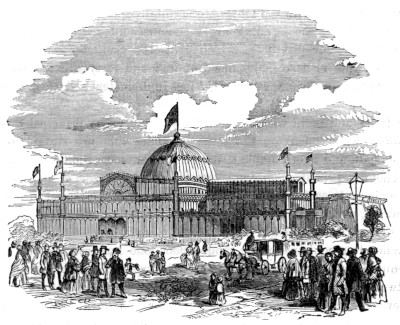
THE CRYSTAL PALACE IN NEW YORK.
Ten large and eight winding staircases connect the principal floor with the gallery, which opens on the three balconies that are situated over the entrance hall, and afford ample space for flower decorations, statues, vases, &c. The ten principal staircases consist of two flights of steps with two landing-places to each; the eight winding staircases are placed in the octagonal towers, which lead also to small balconies on the tops of the towers and to the roof of the building.
The building contains on the ground-floor, one hundred and eleven thousand square feet of space, and in its galleries, which are fifty-four feet wide, sixty-two thousand square feet more, making a total area of one hundred and seventy-three thousand square feet, for the purposes of exhibition. There are thus on the ground-floor two acres and a half, or exactly two and fifty-two hundredths; in the galleries, one acre and forty-four hundredths; total, within an inconsiderable fraction, four acres.
There are on the ground-floor one hundred and ninety octagonal cast-iron columns, twenty-one feet above the floor, and eight inches in diameter, cast hollow, of different thicknesses, from half an inch to one inch. These columns receive the cast-iron girders. These are twenty-six and one-third feet long and three feet high, and serve to sustain the galleries and the wrought-iron construction of the roof, as well as to brace the whole structure in every direction. The girders, as well as the second-story columns, are fastened to the columns in the first story, by connecting pieces of the 699same octagonal shape as the columns, three feet and four inches high, having proper flanges and lugs to fasten all pieces together by bolts. The number of lower-floor girders is two hundred and fifty-two, besides twelve wrought-iron girders of the same hight, and forty-one feet span over a part of the nave. The second story contains one hundred and forty-eight columns, of the same shape as those below, and seventeen feet and seven inches high. These receive another tier of girders, numbering one hundred and sixty, for the support of the roofs of the aisles, each nave being covered by sixteen cast-iron semicircular arches, each composed of four pieces.
The dome will strike every one as the grand architectural feature of the building. Its diameter is one hundred feet, and its hight to the springing line is nearly seventy feet, and to the crown of the arch, one hundred and twenty-three feet. It is said to be the largest, as well as almost the only dome hitherto erected in the United States. It is supported by twenty-four columns, which rise beyond the second story, and to a hight of sixty-two feet above the principal floor. The system of wrought-iron trusses which connects them together at the top, and is supported by them, forms two concentric polygons, each of sixteen sides. They receive a cast-iron bed-plate, to which the cast-iron shoes for the ribs of the dome are bolted. The latter are thirty-two in number. They are constructed of two curves of double angle iron, securely connected together by trellis-work. The requisite steadiness is secured by tie-rods, which brace them both vertically and horizontally. At the top the ribs are bolted to a horizontal ring of wrought and cast iron, which has a diameter of twenty-feet in the clear, and is surmounted by the lantern. As in the other roofs of the building, the dome is cased with matched deal and tin sheathing. Light is communicated to the interior through the lantern, and also in part from the sides, which are pierced for thirty-two ornamental windows. These are glazed with stained glass, representing the arms of the union and of its several states, and form no inconsiderable part of the interior decoration.
The external walls of the building are constructed of cast-iron framing and panel-work, into which are inserted the sashes of the windows and the louvers for ventilation. The glass is one-eighth of an inch thick, and was manufactured at the Jackson glass works, New York, and afterward enameled by Cooper & Belcher, of Camptown, N. J. The enamel, with which the whole of it is covered, is laid upon the glass with a brush, and after drying, is subjected to the intense heat of a kiln, by which the coating is vitrified, and rendered as durable as the glass itself. It produces an effect similar to that of ground glass, being translucent, but not transparent. The sun’s rays, diffused by passing through it, yield an agreeable light, and 700are deprived of that heat and glare which belong to them in this climate. In the absence of a similar precaution in the crystal palace at Hyde park, in England, (of which an account will next be given,) the roofs of which, as well as walls, were inclosed with transparent glass, it was found necessary to cover the interior of the building with canvas, to produce the required shade.
At each angle of the building there is an octagonal tower, eight feet in diameter and seventy-six feet in hight. These contain winding stairways, which lead to the galleries and roofs, and were intended for the use of the officers and employees of the association. Twelve broad staircases, one on either side of each entrance, and four beneath the dome, connect the principal floor with the gallery. The latter are circular in part, and consist of two flights of steps with two landing-places. The flooring of the galleries is made of closely matched planks, while those forming the floor of the first story are separated by narrow intervals, in the same manner and for the same purpose as in the London building. Over each of the principal entrance halls, the galleries open upon balconies, which afford ample space for placing flowers, vases and statues for decoration. Above the balconies, the ends of the naves are adorned with large fan-lights, corresponding to the semicircular arches within. On each side of the entrances there are ticket offices, and adjacent to them rooms are provided for the officers of the association, telegraph, &c.
The rapid and unexpected increase of the applications of exhibitors, induced the association to erect a large addition to the building already described. It consists of two parts, of one and two stories respectively, and occupies the entire space between the main building and the reservoir. Its length is four hundred and fifty-one feet and five inches, and its extreme width is seventy-five feet. It is designed for the reception of machinery in motion, the cabinets of mining and mineralogy, and the refreshment rooms, with their necessary offices. The second story, which is nearly four hundred and fifty feet long, twenty-one feet wide, and extends the whole length, is entirely devoted to the exhibition of pictures and statuary. It is lighted from a skylight, four hundred and nineteen feet long, and eight feet and six inches wide.
The decorations of the building were intrusted to Henry Greenough, Esq., brother of the lamented sculptor of the same name. Mr. Greenough has made art his study, and in its pursuit has resided long in Italy. The leading idea in the plan of decoration, has been to bring out the beautiful construction of the building; to decorate construction rather than to construct decoration. To do this, and at the same time to preserve a general 701harmony of effect, has given Mr. Greenough ample opportunity to display his knowledge of the resources of his art. The result is surprisingly beautiful. The colors employed on the exterior are mixed in oil, the base being the white lead manufactured by the Bellville Company. The exterior presents the appearance of a building constructed of a light-colored bronze, of which all features purely ornamental are of gold. The interior has a prevailing tone of buff, or rich cream color, which is given to all the cast-iron constructive work. This color is relieved by a moderate and judicious use of the three positive colors, red, blue and yellow, in their several tints of vermilion, garnet, sky-blue and orange, (certain parts of the ornamental work being gilt,) to accord with the arrangement of colors employed in the decoration of the ceilings. The only exceptions to the use of oil colors are the ceilings of the American lean-to and the dome; these decorations are executed on canvas. The effect of the interior of the dome, (designed by Sr. Monte Lilia,) is particularly splendid. The rays from a golden sun, at the center, descend between the latticed ribs, and arabesques of white and blue, relieved by silver stars, surround the openings.
The building is supplied with gas and water in every part. The gas was, at first, designed for the use of the police, in protecting the property by night; but was so arranged that now, when the building is opened in the evenings, it affords the most ample light throughout the entire edifice. The water is accessible at numerous points, with convenience for drinking, also for the attachment of hose, in case of fire.
The whole quantity of iron employed in the construction amounts to eighteen hundred tuns; of which three hundred tuns are wrought and fifteen hundred tuns cast iron. The quantity of glass is fifteen thousand panes, or fifty-five thousand square feet. The quantity of wood used amounts to seven hundred and fifty thousand feet, board measure.
The general mode of erection by base pieces, columns, connecting pieces and girders, is the same with that of the great Hyde park building, but the construction of the arched nave, and of the dome, is of course entirely peculiar, and the general effect of the building is completely different. The London building was certainly deficient in architectural effect. The form of the New York edifice affords the requisite scope for a pleasing variety of embellishments, by which all monotony can be avoided, and allows a very economical use of the ground. The dome, independent of its effect in the interior arrangement of the edifice, will give hight and majesty to the exterior.
To complete the explanation of the construction of the building, we recapitulate its principal dimensions.
702
Ft. In.
From principal floor to gallery floor, 24
From principal floor to top of second tier of girders, 44 4⅜
From principal floor to top of third tier of girders, 59 10
From principal floor to ridge of nave, 67 4
From principal floor to top of bed-plate, 69 11
From principal floor to top of upper ring of dome, 123 6
From Sixth avenue curb-stone to top of lantern, 151
From Sixth avenue curb-stone to top of towers, 76 9
Area of first floor, 157,195 square feet.
Area of second floor, 92,496 square feet.
Area of second floor, 92,496 square feet.
Total area, 249,692 or 5¾ acres.
The magnitude of these proportions alone, is calculated to excite feelings of profound awe in the spectator’s mind; and when we see added the gorgeous but subdued chromatic decoration with which the interior is ornamented, and the innumerable works of art and industry with which it is so richly filled, we may well be proud of an erection which is destined to confer lasting honor on the American name.
It was to be hoped that this splendid building, filled with the products of the industry and art of all nations, might have remained permanently in New York, to be an ornament to the city, and a museum for the entertainment and instruction of visitors from every part of the country and the world; but since the above was written, it has been decided that the building is to be taken down, either for removal to some other place, or for the sale of its materials.
THE CRYSTAL PALACE IN LONDON.
Having spoken of the New York crystal palace, we now pass to the crystal palace of London, which preceded the former in the order of time, and far surpassed it in size and magnificence. This splendid building, erected for the great exhibition of 1851, was located on the south side of Hyde park, near the Kensington road, in a position highly favorable in all respects to its intended objects. The construction of the edifice presented not a few difficulties. The building committee, comprising some of the leading architects and engineers of Great Britain, advertised for plans to be presented for the building; and as the result, no less than two hundred and forty designs were laid before them. A large part of these were at once put aside as utterly worthless; and then from about sixty, which were thought worthy of consideration, 703the committee proceeded to prepare a design which pleased nobody, not even themselves. This plan, however, such as it was, was decided upon, and advertisements were issued for proposals to build it. Objections were at once raised, both against the plan proposed, and the possibility of its execution; but while the committee, perplexed with the difficulties suggested, were doubting what they should do, relief came to them from an unexpected quarter, which we must go back a little to explain.
In 1839, Sir Robert Schomburg, a distinguished botanist, in going up the river Berbice, in Demerara, had discovered in the still waters of the stream, a gigantic water-lily, of a shape hitherto unknown, and had transmitted some of its seeds to England, where the plant growing from them, under the care of Joseph Paxton, the head gardener of the Duke of Devonshire, was called the Victoria Regia. This plant was the occasion, and in some respects the model for the crystal palace. Every means was adopted to place this wonderful exotic in its accustomed circumstances. A tropical soil was formed for it, of burned loam and peat. Coal-heat was substituted for that of the tropical sun; and by means of a wheel, a ripple, like that of its native river, was communicated to the waters of the tank upon which its broad leaves reposed in beauty. In these circumstances the lily grew luxuriantly, and Mr. Paxton was obliged to plan an edifice capable of holding it. This he was doing just about the time when the committee were poring wearily over their two hundred and forty plans; and in June, he drew out a design for the exhibition building, which had been suggested to his mind while preparing an abode for the Victoria Regia. In ten days he had completed his elevations, sections, working plans and specifications; and the whole being submitted to the inspection of competent and influential persons, was unanimously declared to be practicable, and the only practicable scheme presented.
The design, thus prepared, was next laid before the contractors, Messrs. Fox & Henderson, who at once determined to submit a tender for the construction of a building in accordance with it. And in a single week, they had calculated the amount and cost of every pound of iron, every pane of glass, every foot of wood, and every hour of labor, which would be required, and were prepared with an offer and specifications for the construction of the edifice. But here arose a difficulty. The committee had advertised only for proposals for carrying out their own design; but, fortunately, they had invited the suggestion, on the part of contractors, of any improvements on it; and so Mr. Paxton’s plan was presented simply as “an improvement” upon that of the committee, though it had not a single feature in common with it. This, with certain modifications, was adopted; and the result was 704the celebrated crystal palace, the first of the name, and the suggester of all others of the same general character—the great, original crystal palace; itself the greatest wonder of the most wonderful exhibition the world has ever seen!
The building consisted, or rather still consists, of three series of elevations, of the respective hights of sixty-four, forty-four, and twenty-four feet, intersected at the central point of meeting, by a transept of seventy-two feet in width, having a semicircular roof rising to the hight of one hundred and eight feet in the center. It extended in length eighteen hundred and fifty-one feet from north to south, or more than one-third of a mile, with a breadth of four hundred and fifty-six feet on the ground; thus covering a surface of some eighteen acres, or nearly double the extent of Washington square in New York, and exceeding, by more than one-half, the dimensions of the Park or the Battery. The whole rested upon cast-iron pillars, united by bolts and nuts, fixed to flanges perfectly true, so that if the socket was placed level, the columns and connecting pieces could not but stand upright; and in point of fact, not a single crooked line, it is said, was discoverable in the combination of such an immense number of pieces in the building as first erected, or as it now stands. For the support of the columns, holes were dug in the ground, in each of which was placed a bed of concrete, and upon this rested the iron sockets, of from three to four feet in length, according to the level of the ground; to which sockets the columns were firmly attached by bolts and nuts. At the top, each column was attached by a girder to its opposite column, both longitudinally and transversely, so that the whole eighteen acres of pillars were securely framed together.
The roofs, of which there were five, one to each of the elevations, were constructed on the ridge and furrow principle, and glazed with sheets of glass of forty-nine inches in length. The construction will be easily understood, by imagining a series of parallel rows of the letter V, extending (thus, ) in uninterrupted lines the whole length of the building. The apex of each ridge was formed by a wooden sash-bar, with notches on each side for holding the laths in which the edges of the glass were fitted. The bottom bar, or rafter, was hollowed at the top, so as to form a gutter to carry off the water, which passed through transverse gutters into the iron columns, which were made hollow so as to serve as water-pipes; while in the base of each column a horizontal pipe was inserted to convey the accumulated water into the sewers. The exhalations from so large a surface, from the plants and from the breath of the innumerable visitors, rising against the glass and there being condensed, would, if the roof had been flat, have descended in the form of a perpetual mist, or dropping rain; but it was 705found that from glass pitched at a particular angle, the moisture did not fall, but would glide down its surface. The bottom bars, therefore, were grooved on the inside, thus forming interior gutters, by which the moisture found its way down the interior of the columns, and thus through the drainage pipes into the sewers. These grooved rafters, of which the total length was two hundred and five miles, were formed by machinery, at a single operation.

The lower tier of the building was boarded; the walls of the upper portion being composed, like the roof, of glass. Ventilation was provided for by the basement portion being walled with iron plates, placed at an angle of forty-five degrees, known as luffer-boarding, which admits the air freely, while it excludes the rain. A similar provision was made at the top of each tier of the building; the plates all being so constructed that they could be closed at pleasure. In order to subdue the intense light in a building having such an immense extent of glass surface, the whole roof and the south side were covered with canvas, which also precluded any possible injury from hail, as well as rendered the edifice much cooler than it otherwise would have been.
In the construction of the building the utmost care was taken to give each part the stiffest and strongest form possible in a given quantity of material. The columns were hollow; and the girders which united them were trellis-formed. The utmost weight which it was supposed any girder would be likely to have upon it, was seven and a half tuns; and not one was used till after having been tested to the extent of fifteen tuns; while the breaking weight was calculated at thirty tuns. At first sight it would seem as if there might be danger that a building presenting so vast a surface to the action of the wind, might be liable to be blown down, or at least forced out of position. But from the manner in which the columns were framed together, they could not be overthrown except by breaking them; and experiments showed, that in order to break the one thousand and sixty columns on the ground floor, a force of sixty-three hundred and sixty tuns must be exerted, at a hight of twenty-four feet. But the greatest force of the wind known, is computed at twenty-two pounds to the superficial foot; so that assuming even a force of twenty-eight pounds, and supposing a hurricane with that momentum to strike at once the whole side of the building, the total force, it was said, would be less than fifteen hundred tuns, not one-fourth what the building could easily sustain, independently of the bracings, which added materially to its strength. So that, if any reliance at all could be placed on theoretical engineering, there could, it was said, be no doubt whatever but that the building would be safe in the most violent tempest.
The building being thus erected, the spectator entering at the main east or west entrance, found himself in a nave sixty-four feet in hight, and 706seventy-two in breadth, and extending without interruption the whole length of the building, one-third of a mile. Parallel with this, but interrupted by the transept in the center, was a series of side aisles, of forty-eight and twenty-four feet in breadth, and with a hight of forty-four and twenty-four feet. And over the center of the nave, swelled the semicircular roof of the transept, overarching the stately trees beneath; thus forming a gigantic green-house, with the ancient elms of the park in the place of geraniums and rose-bushes. The whole area of the ground-floor was seven hundred and seventy-two thousand, seven hundred and eighty-four square feet, and that of the galleries, two hundred and seventeen thousand; making in all nearly a million square feet, to which should be added five hundred thousand feet of hanging space, available for the display of the innumerable products of human skill and labor, that made the exhibition one of the most wondrous of all the wonders of the world.
There were three refreshment rooms; one in the transept, and one near each end of the building, around the huge trees of the park, which, as already said, were left standing. No wine, spirits or fermented liquors were allowed to be sold, but only tea, coffee and unfermented drinks; while pure water was to be furnished gratis to all, by the lessees of the refreshment rooms. As to the decoration of the interior, it may here be added, that the shafts of all the columns were painted yellow; the concave portions of the capitals, blue; the under sides of the girders, red; and their vertical surfaces, white.
We might dwell in detail on the vast collection of the products of human industry and art which filled the interior of this immense structure, and made it the resort of visitors from every part of the world. But the history of “the great exhibition” is familiar to most if not all of our readers. We will only add, that among all the wonders of the crystal palace, nothing was more wonderful than its cheapness, and the rapidity of its construction. Possession of the site was obtained on the thirtieth of July; and in a period of one hundred and forty-five working days, the building was mainly completed. Its cost was less, by the cubic foot, than an ordinary barn. If it had been used only for the exhibition, and at its close returned to the contractors, its cost would have been nine-sixteenths of a penny per foot; and if it had been left remaining permanently, it would have been but one penny and one-twelfth of a penny per foot. The astonishing fact, that a building of glass and iron, including thirty-three million cubic feet, and covering eighteen acres, and affording room for nine miles of tables, should have been completed in less than five months from the day when the contract was 707entered into, at a cost less than that of the humblest hovel, opens a new era in the art of building.
Silliman, in his late “Visit to Europe,” under the date of the twenty-ninth of March, 1851, says: “Into this wonderful and imposing structure we have to-day merely made our entrance. As we drove along the eastern side of Hyde park, on a bright and beautiful morning, the splendid vision caught our eyes, as the sunlight was thrown wide around by this immense mirror. It was merely a glance that we took on this occasion, reserving more deliberate observation for future opportunities. It was not accessible, as yet, to visitors, but by particular favor, through an introduction to one of the managers, we were admitted into the interior. It has become so familiar, in all its aspects, to the whole world, that at this date, after its complete development, any detailed description would be out of place. The general impression made upon us, by our walks through this stupendous conservatory of the arts, was that of great splendor and magnificence. It appeared a fairy palace, like the creations of fable; a building equally unique and original in its structure; original, also, in its bearing upon the concord and amicable rivalry of nations; in this respect of most auspicious tendency. Already the consignments of the world are coming in, and to a great extent have actually arrived. African Tunis sends its contributions, and even more remote countries are beginning to occupy the large space allotted to them. The palace is so high as to cover several of the large trees of Hyde park, where it is erected; and we saw, not without a shudder, a man dangling in the air at the end of a rope near the roof, at the hight of eighty feet. He had been drawn up simply by holding on the end of the rope by his hands, and was whirled around and around, until he reached a plank almost in the angle of the roof, where at last he was safely landed.”
And at a later date, he adds: “Although I have walked many hours, and I presume ten miles in this immense structure, I seem only to have begun to see it. In despair of my ability to convey any adequate idea of it, I am almost disposed to pass it in silence, but this would disappoint those for whom I write. Pictures and descriptions of the building had reached America before I left home, and it is known that its front extends more than one-third of a mile, besides its branches. The area which it covers is eighteen acres, and under its vaulted transept are included some large and lofty trees that were growing in the park. So many accounts of its contents, and so many views of its form, both within and without, have been since published, that a better idea of both can be obtained from numerous sources, than from anything that I can write. I shall, therefore, attempt nothing more than some general remarks, and will mention a few examples. When 708we were here in March, I expressed my admiration of the general design. So far as I know it is novel. Exhibitions of the productions, whether in nature or art, of particular countries, have often been made, and in some countries they are annual, as in France, England, and in the United States; but I believe it was reserved for Prince Albert to originate the design of inviting all nations to bring to one place the results of their industry and skill, and specimens of their physical resources. For obvious reasons, no place was so proper as London, the commercial metropolis of the world, and I suppose now containing a greater population, and certainly more wealth, and exerting more influence on mankind, than any other city. The invitation was a pledge of universal good-will, and it has evidently tended to produce kind feelings among the nations. Instead of new fortresses of stone and iron, instead of walls and battlements to protect this immense city from invasion, there rises in its grand domain of Hyde park, a crystal palace, the temple of arts and industry. It rose like an exhalation, a magical illusion of the senses. The frame-work of iron, although strong enough to sustain the weight and to resist the winds, is so little apparent to the eye, that the crystal palace appears a sea of glass, as in the Revelations, ‘A sea of glass like unto crystal.’ One might dream, as in the ‘Arabian Nights,’ of such a creation, ‘in the visions of the night, when deep sleep falleth upon men,’ and might find on waking that it was all an illusion, when it would vanish like the fabric of a dream, and leave not a wreck behind. But there it stands, a splendid reality, and with its widely extended transepts, wings and galleries, has proved sufficient to receive and protect the gathered riches of mankind.
“I mentioned in my passage from Boulogne, that I was in company with a large number of French people coming over to see the crystal palace. Crowds of all nations throng this palace; fifty thousand, or sixty thousand, and sometimes seventy thousand in a day. As you walk about, or thread your way through the great masses of human beings that crowd the avenues, you may hear half the languages of Europe, and some of those of the orient. I imagined that before our return from the continent the deluge of nations would have subsided, and this consideration was not without weight in inducing us to prefer a late inspection of the splendid wonder; but in this particular we have been disappointed. The numbers who daily resort to the crystal palace are undiminished: it may be that there are fewer foreigners, but since the price has been reduced to a shilling, the country people come in, parents and children, and mothers with their infants; steamboats and cars are crowded, and it seems as if the rural population of the kingdom were all rushing into London.
709“As to the contents of the palace, it is impossible to enumerate them. A mere catalogue, with the most brief descriptive notices, would fill a large volume. I can only mention groups of things, with here and there a particular instance. The collection embraces the useful as well as the fine arts. All kinds of agricultural machines are here to be seen, and there are seeds, and specimens of crops, all duly arranged and labeled. The American department has been somewhat undervalued, because it was not so splendid, and was less full than the collections from some other countries, but even the Times, which has generally an unfriendly bearing in relation to our country, has commended the American department on the score of utility. Indeed, it was not reasonable to expect that a country occupied but two centuries by civilized people, should be able fully to compete with nations who have been civilized for a thousand years; and our great distance, and the difficulty and expense of transporting articles across the ocean, and of coming over to look after them, must have prevented our appearing as we do at home, in the great industrial exhibitions of New York, Philadelphia and Boston. I have seen such gatherings at Niblo’s and the Castle Garden, in New York, and in Boston, not only of useful, but of elegant things, as I should feel proud to see in the American department in the crystal palace. Two agricultural instruments are, however, spoken of as giving the palm to America above all competition. I refer to the plow and the reaping-machine of American manufacture. The plow is said to have attained the perfection of form, and the reaping-machine to be recommended by its great utility.
“Iron, as it is the material which, more than others, (wood excepted,) contributes indispensable aid to the arts of life, occupies a conspicuous place in the exhibition. Its ores and its castings, and its wrought articles, whether in a locomotive, or the hair-spring of a chronometer, whether in chain-cables or a cambric needle, are displayed in endless variety of useful and beautiful forms, and in this department England justly claims and fully proves her preëminence. Iron, lead, copper, bismuth, zinc, antimony, and silver, gold and platinum, are conspicuous here. England glories in her tin, lead and copper: in the two latter we can compete with her; our lead is inexhaustible, and our native copper of Lake Superior, is unequaled for abundance. A large mass of it has been brought over for the exhibition, weighing many thousand pounds.
“Nothing can exceed the beauty of the articles of silver, whether utensils or ornaments, which are exposed to view in the gallery of the crystal palace. The most graceful forms both of peaceful men, and of warriors, armed cap-à-pie; and of woman in the very beau ideal of her loveliness, are here in profusion; and if England excels in these articles in silver, France is not 710behind her, both in them and in gilded furniture, and bronze, as seen in all the splendor and elegance of the show windows of the Palais Royal. The silver extracted from lead by Pattinson’s process is here seen in piles so rich, with a perfect purity of whiteness, and in scaly pyramids, a kind of flaky mound, that the observer looks on with delight, as also upon the same metal cast in ponderous ingots. Here is the gold of California, one brilliant mass weighing in value eight hundred pounds sterling, equivalent to nearly four thousand dollars. There are three masses of native Siberian, or Russian platinum, weighing respectively twenty-one, twenty-three, and twenty-five pounds, and many wrought articles of the same metal. The copper of Russia, in the form of malachite, here makes a great figure. The same material which we saw in the Vatican, and in the palace of the king of Prussia, in the form of magnificent vases, is here seen wrought into innumerable forms of beauty. There is even a large paneled door fabricated entirely of malachite. Of course many pieces are united to afford the requisite mass. There are tables, vases, urns, chairs, settees, &c., mounted with the same rich material. The gems form a conspicuous ornament of the collection. Queen Victoria has loaned her largest diamond, with several smaller ones, to be exhibited, and here also are some of the most precious of the diamonds, rubies, sapphires, topazes, emeralds, chrysoberyls, opals, and pearls of the regalia of Russia, Spain and India. The Duke of Devonshire has an emerald deposited by Mr. Tenant, nearly two inches in the diagonal diameter, and two to three inches in length; it is of surpassing beauty, being perfectly crystallized, and of the most intense and uniform grass-green color. There is no end to the bijouterie of the French. A case in the gallery is composed of four pieces of plate glass, each between five and six feet long, and four to five broad. This case is entirely filled with elegant ornamental articles.
“I can not pretend to enumerate the marbles, granites, porphyries, serpentines, and other architectural materials, nor the piles of mineral coal, and anthracite, nor the perfect imitations of beautiful and useful mineral compositions, such as serpentines, verd-antique, porphyry, and verd-antique marbles, &c. The chemical products, too, of great beauty, are numerous. The crystallizations of carbonate and bi-carbonate of soda, of alum, of the prussiates, yellow and red, of the sulphate of iron, and the sulphate of copper, and sal-ammoniac, are splendid, and evince that the chemical arts are not behind the mechanical. Large cakes of metallic antimony are crystallized in beautiful fern-like radiations.
“France“France, Belgium, Holland, Austria, Germany, Prussia, Turkey, the Barbary states, Egypt, Bermuda, the East Indies, Canada, Australia, and other countries, have combined to decorate the crystal palace. Superb silks have 711come from the east, and pictured stuffs, shawls, carpets, &c., from Germany; the antipodes have conspired to crown the glorious spectacle; plain and useful materials, leather, hemp, ropes of manilla grass and of other fibrous vegetables, and glass and pottery in their varieties, are not omitted. To give animation to the scene, steam generated out of doors is brought in through concealed tubes and applied to machinery. Cotton-gins and paper-making machines are at work, and the palace resounds with the noise of actual and productive labor. Ship models are presented in many forms, especially ships of war, in sections longitudinal and transverse, with all their interior structure. Life-boats and life-preservers, and in harmony with them, mirrors for light-houses; but in contrast, swords, pistols, revolvers, guns, dirks and daggers, and multiform contrivances to do the work of killing the greatest number of men in the shortest time; such are man’s inconsistencies!
“But time would fail to tell of the furniture, the carriages, the musical instruments, the ceramic wares, and all the countless and indescribable throng of articles which contribute their effect in the tout ensemble of this vast storehouse of the nations. The statuary arranged along the naves is a conspicuous and interesting feature. Many of the prominent and more meritorious of these marbles, have since become so familiar from the engravings in the Art Journal and other illustrated works, that it is needless at this late day to call attention to them individually. The famous Amazon of Kiss, the same which was in London, is now the most remarkable artistic object in the American crystal palace. The most interesting view is obtained from the galleries of the moving masses of human life below. It is a panorama where multitudes are passing to and fro, and soon are seen no more, fleeting as the jets-d’eau which sport among them from living fountains, that curl over and descend in graceful sweeps, and seem to enliven the stately palms and other living plants and trees which grace the scene.”
In closing this extended notice of the crystal palace, we hardly need add, that after the close of the great exhibition, it was taken down and removed; and that at present, it rears its splendid form and stately transepts in a new and more beautiful situation at Sydenham, with many important additions and improvements. It now stands in the midst of a magnificent undulating park of three hundred acres, surrounded with rural delights, fountains, shaded walks and silvan temples; while within, it has been converted into a great permanent museum of arts, antiquities and science, with living groves of palms, enlivened by singing birds and sparkling fountains. For eighteen pence the London artisan can visit it, including the ride out and 712back upon the railway. This is being done by a private association at a cost of near four million dollars.
THE CAPITOL AT WASHINGTON.
Among the public buildings at Washington, the capital city of the nation, the first in architectural merit, and in point of interest, is the Capitol, which contains the halls of the national legislature, the supreme court room, &c., &c. This building (a view of which, as it will appear when the enlargement now in progress is completed, is given in the cut below) is situated on an eminence at the eastern part of the city, about seventy feet above tidewater, its main front looking toward the west. As it was before the commencement of the alterations and improvements now in progress, it consisted of a center building, with two wings, having a total length of three hundred and fifty-two feet, and a depth at the wings of one hundred and twenty-one feet. The central building contains a rotunda, ninety-six feet in diameter, and the same in hight, crowned by a magnificent dome which rises one hundred and forty-five feet from the ground. The wings, as they were, were each surmounted by a flat dome. The eastern front, which was intended for the main one, projects, including the steps, sixty-five feet, and is graced by a 713portico of twenty-two Corinthian columns, thirty feet in hight, forming a colonnade one hundred and sixty feet in length, presenting one of the most commanding fronts in the United States. The western front projects eighty-three feet, including the steps, and is embellished with a recessed portico of ten columns. This front, though not so imposing, in itself, as the eastern, commands the finest view anywhere to be had in Washington, overlooking all the central and western parts of the city, and all the principal public buildings. On the steps of the east front is a noble statue of Columbus, supporting a globe in his outstretched arm. In the interior of the western projection is the library of Congress, a part of which was burned in the winter of 1851-2. Before that event it contained over fifty thousand volumes. It has been rebuilt so as to be fire-proof.
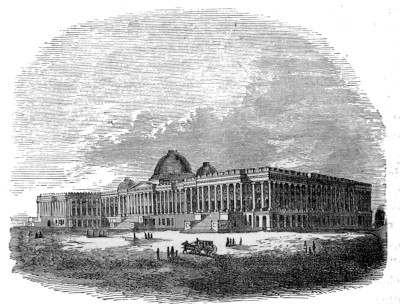
THE CAPITOL AT WASHINGTON.
On entering the rotunda, the first objects that strike the attention, are the paintings which adorn the walls. There are “The Declaration of Independence,” “The Surrender of Burgoyne,” “The Surrender of Cornwallis,” “Washington resigning his Commission,” “The Embarkation of the Pilgrims at Leyden,” “The Landing of Columbus,” “The Baptism of Pocohontas,” and “The Discovery of the Mississippi by De Soto.” Surrounding the rotunda, are a number of chambers, passages, committee-rooms, rooms for the president, members of the cabinet, &c. The senate-chamber is on the second floor of the north wing, of which it occupies about half, and is of a semicircular form, being seventy-five feet long, and forty-five high. A gallery for spectators, supported by iron or bronze pillars, surrounds the semicircle, and fronts the chair of the presiding officer, which stands in the middle of the chord of the semicircle. In the rear of the chair, and above it, is a gallery, supported by Ionic columns of the conglomerate or Potomac marble, in which sit the reporters, fronting the senators. The hall of representatives is on the second floor of the south wing, and is also semicircular, but much larger than the senate-chamber, being ninety-six feet long, and sixty high, and surrounded by twenty-four Corinthian columns of Potomac marble, with capitals of Italian marble. The galleries are similar in their arrangement to those of the senate-chamber. Over the chair of the speaker is a statue of Liberty, supported by an eagle with spread wings. In front of the chair, and immediately above the main entrance, is a figure representing History recording the events of the nation.