BITUMINOUS AND OTHER LAKES.
Reading edition
PITCH LAKE OF TRINIDAD.
Near Point la Braye, (Tar point,) the name assigned to it on account of its characteristic feature, in the island of Trinidad, is a lake which at the first view appears to be an expanse of still water, but which, on a nearer approach, is found to be an extensive plain of mineral pitch, with frequent crevices and chasms filled with water. On its being visited in the autumnal season, the singularity of the scene was so great, that it required some time for the spectators to recover themselves from their surprise, so as to examine it minutely. The surface of the lake was of an ash color, and not polished or smooth, so as to be slippery, but of such a consistence as to bear any weight. It was not adhesive, although it received in part the impression of the foot, and could be trodden without any tremulous motion, several head of cattle browsing on it in perfect security. In the summer season, however, the surface is much more yielding, and in a state approaching to fluidity, as is evidenced by pieces of wood and other substances, thrown upon it, having been found enveloped in it. Even large branches of trees, which were a foot 291above the level, had, in some way, become enveloped in the bituminous matter. The interstices, or chasms, are very numerous, ramifying and joining in every direction; and being filled with water in the wet season, present the only obstacle to walking over the surface. These cavities are in general deep in proportion to their width, and many of them unfathomable: the water they contain is uncontaminated by the pitch, and is the abode of a variety of fishes. The arrangement of the chasms is very singular, the sides invariably shelving from the surface, so as nearly to meet at the bottom, and then bulging out toward each other with a considerable degree of convexity. Several of them have been known to close up entirely, without leaving any mark or seam.
The pitch lake of Trinidad contains many islets covered with grass and shrubs, which are the haunts of birds of the most exquisite plumage. Its precise extent can not, any more than its depth, be readily ascertained, the line between it and the neighboring soil not being well defined; but its main body may be estimated at three miles in circumference. It is bounded on the north and west sides by the sea, on the south by a rocky eminence, and on the east by the usual argillaceous soil of the country.
MUD LAKE OF JAVA.
The following details relative to the volcanic springs of boiling mud in Java are extracted from the Penang Gazette.
Having received an account of a wonderful phenomenon in the plains of Grobogna, a party set off, from Solo, in September, 1814, to examine it. On approaching the place, they saw what at first appeared like the surf breaking over the rocks, with a heavy spray falling to the leeward. Alighting, they went to the “Bluddugs,” as the Javanese call them, which they found to be an elevated plain of mud, about two miles in circumference, in the center of which immense bodies of soft mud were thrown up to the hight of ten or fifteen feet, in the form of large bubbles, which bursting, emitted great volumes of dense white smoke. The largest bubbles, of which there were two, rose and burst some seven or eight times a minute, throwing up from one to three tuns of mud, the smell of the smoke from which was very offensive, like the washings of a gun-barrel. It was both difficult and dangerous to go near the large bubbles, as the surface, except where it had been hardened by the sun, was all a quagmire. They went, however, close to a small bubble, (the plain was full of them, of all sizes,) and observed it for some time. It appeared to heave and swell, and when the air within had raised it to some hight, it burst, and the mud fell down 292in concentric circles, and then remained quiet till again it was raised, again to burst; which was at intervals of from one to two minutes. The water drained from the mud was collected by the Javanese, and being exposed to the sun deposited crystals of salt.
Next morning the party rode to a place in the forest, to view a salt lake, a mud hillock, and various boiling pools. The lake was about half a mile in circumference, of dirty-looking water, boiling up all over in gurgling eddies; the water being cold, bitter and salt, with an offensive smell. The mud hillock, which was near, was about fifteen feet high, in the form of a cone, with a base of eighty, and a top of eight feet diameter. The top was open, and the interior, which was full of boiling and heaving mud, was found to be eleven fathoms deep. Every rise of the mud was attended by a rumbling noise from within; and the mud was more liquid than at the bluddugs, and unattended by smoke. Near the foot of this hillock was a small pool of water, like that of the lake, boiling violently; and some two hundred yards distant, two larger pools or springs of the same general description, the smell of which was very offensive, and the boiling of which could be heard at quite a distance, resembling the noise of a small waterfall. The water both of the bluddugs and of the lake, is used medicinally by the Javanese, and also, as stated above, for the making of salt, which is gathered in considerable quantities, and the government income from which adds not a little to the public revenues. The general cause of the phenomena here witnessed, is supposed, beyond all question, to be volcanic; the salt water being thrown up by this agency in a heated state, and thus mingling with the soil to produce the boiling and heaving mud above described.
SALT LAKE OF UTAH.
Before leaving the subject of lakes, springs, &c., we must not omit to mention the Great Salt lake of Utah territory, which has been gazed upon with interest by many an emigrant, passing with his family, as represented in the following cut, to his far western home. This lake lies in a region abounding with scenery of unrivaled magnificence and beauty. “Descend from the mountains,” says a late writer, “where you have the scenery and climate of Switzerland, to seek the sky of your choice among the many climates of Italy, and you may find, welling out of the same hills, the freezing springs of Mexico, and the hot springs of Iceland, both together coursing their way to the great salt sea in the plain below. The pages of Malte Brun provide me with a less truthful parallel to it, than those which describe the happy valley of Rasselas, or the continent of Balnibarbi. In the midst of this 293interesting region, the most remarkable object is the Great Salt lake: which, in the saltness of its waters, in the circumstance of its having no outlet, and being fed from another and smaller lake of fresh water, (with which it is connected by a stream which has appropriately been called the Jordan,) and in the rugged character of some portions of the surrounding region, bears a remarkable resemblance to the Dead sea of Palestine. Instead, however, of lying one thousand feet below, it is more than four thousand feet above the level of the sea; and its waters, being an almost pure solution of common salt, are free from the pungent and nauseous taste which characterizes those of the Dead sea. This lake is about seventy miles long, and thirty miles wide, and is so intensely salt that no living thing can exist in it; and by evaporation in hot weather, it leaves on its shores a thick incrustation of salt.
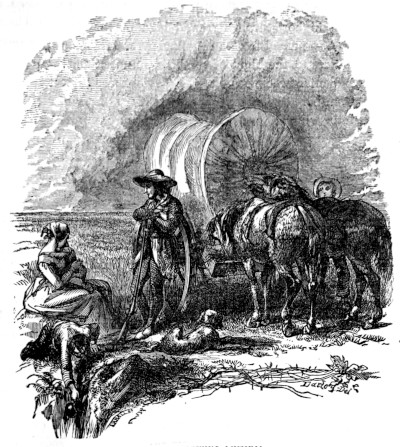
THE EMIGRANT FAMILY.
Some twenty-five miles south of this, and connected with it by the river Jordan, as mentioned above, is Utah lake, a body of fresh water, some thirty-five 294miles in length, which abounds with trout and other fish. And some seven hundred feet higher still, is Pyramid lake, on the slope of the Sierra Nevada mountains, so named from a singular pyramidal mount rising from its transparent waters to the hight of some six hundred feet; and walled in by almost perpendicular precipices, in some places three thousand feet high. Some distance from here, too, are the boiling springs, described by Fremont, the largest basin of which is several hundred feet in circumference, and has a circular space at one end some fifteen feet in diameter, entirely occupied with the boiling water. A pole sixteen feet in length, was entirely submerged on thrusting it down near the center; and the temperature of the water near the edge was two hundred and six degrees. In this vicinity also, are appearances similar to the mirages of the great deserts of the old world. In traveling over the salt deserts of the Fremont basin, his party saw themselves reflected in the air, probably, as Fremont himself suggests, from the saline particles floating in the atmosphere, and in some way affecting its refracting power. The entire region, is one of great wildness and grandeur.
ATMOSPHERICAL PHENOMENA.
METEORS.
From look to look, contagious through the crowd
The panic runs, and into wond’rous shapes
The appearance throws: armies in meet array,
Thronged with aerial spears and steeds of fire;
Till the long lines of full-extended war
In bleeding fight commixt, the sanguine flood
Rolls a broad slaughter o’er the plains of heaven.
As thus they scan the visionary scene,
On all sides swells the superstitious din.
Incontinent; and busy frenzy talks
Of blood and battle; cities overturned,
And late at night in swallowing earthquake sunk,
Or hideous wrapt in fierce ascending flame;
Of sallow famine, inundation, storm;
295Of pestilence, and every great distress;
Empires subversed, when ruling fate has struck
The unalterable hour: even nature’s self
Is deemed to totter on the brink of time.
Not so the man of philosophic eye,
And aspect sage; the waving brightness he
Curious surveys, inquisitive to know
The causes, and materials, yet unfixed,
Of this appearance beautiful and new.—Thomson.
The nature of those splendid phenomena of the heavens which are embraced under the general term meteors, can not be so well elucidated as by an extract from the travels of Messrs. Humboldt and Bonpland to the equinoctial regions of the new continent. The sublime wonders described by the former of these travelers were witnessed by them at Cumana, a city of Venezuela, in South America.
“The night of the eleventh of November, 1779, was cool and extremely beautiful. Toward the morning, from half after two, the most extraordinary luminous meteors were seen toward the east. M. Bonpland, who had risen to enjoy the freshness of the air in the gallery, perceived them first. Thousands of bolides (fire-balls) and falling stars, succeeded each other during four hours. Their direction was very regular, from north to south. They filled a space in the sky extending from the true east thirty degrees toward the north and south. In an amplitude of sixty degrees the meteors were seen to rise above the horizon at east-north-east, and at east to describe arcs more or less extended, falling toward the south, after having followed the direction of the meridian. Some of them attained a hight of forty degrees; and all exceeded twenty-five or thirty degrees. There was very little wind in the low regions of the atmosphere, and this blew from the east. No trace of clouds was to be seen. M. Bonpland relates, that from the beginning of the phenomenon, there was not a space in the firmament equal in extent to three diameters of the moon which was not filled at every instant with bolides and falling stars. The first were fewer in number, but as they were seen of different sizes, it was impossible to fix the limit between these two classes of phenomena. All these meteors left luminous traces from five to ten degrees in length, as often happens in the equinoctial regions. The phosphorescence of these traces, or luminous bands, lasted seven or eight seconds. Many of the falling stars had a very distinct nucleus, as large as the disk of Jupiter, from which darted sparks of vivid light. The bolides seemed to burst as by explosion; but the largest, those from one degree to one degree and fifteen minutes in diameter, disappeared without scintillation, leaving behind them phosphorescent bands (trabes) exceeding in breadth fifteen or 296twenty minutes, or sixtieth parts of a degree. The light of these meteors was white, and not reddish, which must be attributed, no doubt, to the absence of vapors, and the extreme transparency of the air. For the same reason, under the tropics, the stars of the first magnitude have, at their rising, a light evidently whiter than in Europe.
“Almost all the inhabitants of Cumana were witnesses of this phenomenon, and did not behold these bolides with indifference; the oldest among them remembered, that the great earthquakes of 1766 were preceded by similar phenomena. The fishermen in the suburbs asserted, that the fire-work had begun at one o’clock; and that, as they returned from fishing in the gulf, they had already perceived very small falling stars toward the east. They affirmed at the same time, that igneous meteors were extremely rare on those coasts after two in the morning.
“The phenomenon ceased by degrees after four o’clock, and the bolides and falling stars became less frequent; but we still distinguished some toward the north-east, by their whitish light, and the rapidity of their movement, a quarter of an hour after sunrise. This circumstance will appear less extraordinary, when I state that in full daylight, in 1788, the interior of the houses in the town of Popayan was highly illumined by an aerolite of immense magnitude. It passed over the town when the sun was shining clearly, about one o’clock. M. Bonpland and myself, during our second residence at Cumana, after having observed on the twenty-sixth of September, 1800, the immersion of the first satellite of Jupiter, succeeded in seeing the planet distinctly with the naked eye, eighteen minutes after the disk of the sun had appeared in the horizon. There was a very slight vapor in the east, but Jupiter appeared on an azure sky. These facts prove the extreme purity and transparency of the atmosphere under the torrid zone. The mass of diffused light is so much less, as the vapors are more perfectly dissolved. The same cause that weakens the diffusion of the solar light, diminishes the extinction of that which emanates either from a bolis, Jupiter, or the moon, seen on the second day after her conjunction.
“The researches of M. Chladni having singularly fixed the attention of the scientific world upon the bolides and falling stars, at my departure from Europe, we did not neglect during the course of our journey from Caraccas to the Rio Negro, to inquire everywhere, whether the meteors of the twelfth of November had been perceived. In the savage country, where the greater number of the inhabitants sleep out in the air, so extraordinary a phenomenon could not fail to be remarked, except when concealed by clouds from the eye of observation. The Capuchin missionary at San Fernando de Apura, a village situated amid the savannas of the province of Varinas, and the 297Franciscan monks stationed near the cataracts of the Orinoco, and at Maroa, on the banks of the Rio Negro, had seen numberless falling stars and bolides illumine the vault of heaven. Maroa is south-west of Cumana, and one hundred and seventy-four leagues’ distance. All these observers compared the phenomenon to a beautiful fire-work, which had lasted from three till six in the morning. Some of the monks had marked the day upon their ritual; others had noted it by the nearest festivals of the church. Unfortunately, none of them could recollect the direction of the meteors, or their apparent hight. From the position of the mountains and thick forest which surround the missions of the cataracts and the little village of Maroa, I presume that the bolides were still visible at twenty degrees above the horizon. On my arrival at the southern extremity of Spanish Guiana, at the little fort of San Carlos, I found a party of Portuguese, who had gone up the Rio Negro from the mission of St. Joseph of the Maravitains, and who assured me, that in that part of Brazil, the phenomenon had been perceived, at least as far as San Gabriel das Cachoeiras, consequently as far as the equator itself.
“I was powerfully struck at the immense hight which these bolides must have attained, to have been visible at the same time at Cumana, and on the frontiers of Brazil, in a line of two hundred and thirty leagues in length. But what was my astonishment, when at my return to Europe, I learned that the same phenomenon had been perceived, on an extent of the globe of sixty-four degrees of latitude, and ninety-one degrees of longitude; at the equator, in South America, at Labrador, and in Germany! I found accidentally, during my passage from Philadelphia to Bordeaux, in the memoirs of the Pennsylvanian society, the corresponding observations of Mr. Ellicott (latitude thirty degrees, forty-two minutes;) and, upon my return from Naples to Berlin, I read the account of the Moravian missionaries among the Esquimaux, in the library of Göttingen. Several philosophers had already discussed at this period the coincidence of the observation in the north with those at Cumana, which M. Bonpland and I had published in 1800.
“The following is a succinct enumeration of facts. First, the fiery meteors were seen in the east, and the east-north-east, to forty degrees of elevation, from two to six hours at Cumana, (latitude ten degrees, twenty-seven minutes, fifty-two seconds, longitude sixty-six degrees, thirty minutes;) at Porto Cabello, (latitude ten degrees, six minutes, fifty-two seconds, longitude sixty-seven degrees, five minutes;) and on the frontiers of Brazil, near the equator, in the longitude of seventy degrees west of the meridian of Paris. Secondly, in French Guiana, (latitude four degrees, fifty-six minutes, longitude fifty-four degrees, thirty-five minutes,) the northern part of the sky was seen all on fire. Innumerable falling stars traversed the heavens during an hour 298and a half, and diffused so vivid a light, that those meteors might be compared to the blazing sheaves shot out from fire-works. Thirdly, Mr. Ellicott, an astronomer in the United States, having terminated his trigonometric operations for the rectification of the limits on the Ohio, being, on the twelfth of November, in the gulf of Florida, in the latitude of twenty-five degrees, and longitude eighty-one degrees, fifty minutes, saw, in all parts of the sky, ‘as many meteors as stars, moving in all directions: some appeared to fall perpendicularly; and it was expected every minute that they would drop into the vessel.’ The same phenomenon was perceived upon the American continent as far as the latitude of thirty degrees, forty-two minutes. Fourthly, in Labrador, at Nain (latitude fifty-six degrees, fifty-five minutes) and Hoffenthal (latitude fifty-eight degrees, four minutes,) and in Greenland, at Lichtenau (latitude sixty-one degrees, five minutes) and New Herrnhutt, (latitude sixty-four degrees, fourteen minutes, longitude fifty-two degrees, twenty minutes,) the Esquimaux were frightened at the enormous quantity of bolides which fell during twilight toward all points of the firmament, some of them being a foot broad. Fifthly, in Germany, M. Zeissing, vicar of Itterstadt, near Weimar, (latitude fifty degrees, fifty-nine minutes, longitude nine degrees, one minute east,) perceived, on the twelfth of November, between the hours of six and seven in the morning, when it was half after two at Cumana, some falling stars, which shed a very white light. Soon after, toward the south and south-west, luminous rays appeared from four to six feet long: they were reddish, and resembled the luminous track of a sky-rocket. During the morning twilight, between the hours of seven and eight, the south-west part of the sky was seen, from time to time, strongly illuminated by white lightning, which ran in serpentine lines along the horizon. At night the cold increased, and the barometer rose.
“The distance from Weimar to the Rio Negro, is eighteen hundred sea leagues; and from Rio Negro to Herrnhutt, in Greenland, thirteen hundred leagues. Admitting that the same fiery meteors were seen at points so distant from each other, we must also admit, that their hight was at least four hundred and eleven leagues. Near Weimar, the appearance like sky-rockets was seen in the south and south-east; at Cumana, in the east and in the east-north-east. We may therefore conclude, that numberless aerolites must have fallen into the sea, between Africa and South America, to the west of the Cape Verde islands. But, since the direction of the bolides was not the same at Labrador and at Cumana, why were they not perceived in the latter place toward the north, as at Cayenne? I am inclined to think, that the Chayma Indians of Cumana did not see the same bolides as the Portuguese in Brazil, and the missionaries in Labrador; but, at the same time, it can 299not be doubted, and this fact appears to me very remarkable, that in the new world, between the meridians of forty-six degrees and eighty-two degrees, between the equator and sixty-four degrees north, at the same hour, an immense number of bolides and falling stars were perceived; and that those meteors had everywhere the same brilliancy, throughout a space of nine hundred and twenty-one thousand square leagues.
“The scientific men who have lately made such laborious researches on falling stars and their parallaxes, consider them as meteors belonging to the furthest limits of our atmosphere, between the region of the aurora borealis and that of the lightest clouds. Some have been seen, which had not more than fourteen thousand toises, or about five leagues of elevation. The highest do not appear to exceed thirty leagues. They are often more than a hundred feet in diameter; and their swiftness is such, that they dart, in a few seconds, over a space of two leagues. Some of these have been measured, the direction of which was almost perpendicularly upward, or forming an angle of fifty degrees with the vertical line. This extremely remarkable circumstance has led to the conclusion, that falling stars are aerolites, which, after having hovered about a long time in space, take fire on entering accidentally into our atmosphere, and fall toward the earth.
“Whatever may be the origin of these luminous meteors, it is difficult to conceive any instantaneous inflammation taking place in a region where there is less air than in the vacuum of our air-pumps; and where (twenty-five thousand toises high) the mercury in the barometer would not rise to twelve-thousandths of a line. We have ascertained the uniform mixture of atmospheric air to three-thousandths nearly, only to an elevation of three thousand toises: consequently, not beyond the last stratum of fleecy clouds. It might be admitted, that, in the first revolutions of the globe, gaseous substances which yet remain unknown to us, may have risen toward that region, through which the falling stars pass: but accurate experiments, made upon mixtures of gases which have not the same specific gravity, prove that we can not admit a superior stratum of the atmosphere entirely different from the inferior strata. Gaseous substances mix and penetrate each other with the least motion; and a uniformity of their mixture would have taken place in the lapse of ages, unless we suppose in them the effects of a repulsive action unexampled in those substances which we can subject to our observations. Further, if we admit the existence of a particular aerial fluid in the inaccessible region of luminous meteors, falling stars, bolides, and the aurora borealis, how can we conceive why the whole stratum of those fluids does not at once take fire, but that the gaseous emanations, like the clouds, occupy only limited spaces? How can we suppose an electrical explosion without 300some vapors collected together, capable of containing unequal charges of electricity, in air, the mean temperature of which is, perhaps, twenty-five degrees below the freezing-point of the centigrade thermometer, and the rarefaction of which is so considerable, that the compression of the electrical shock could scarcely disengage any heat? These difficulties would in great part, be removed, if the direction of the motion of falling stars allowed us to consider them as bodies with a solid nucleus, as cosmic phenomena (belonging to space beyond the limits of our atmosphere) and not as telluric phenomena (belonging to our planet only.)
“Supposing that the meteors of Cumana were only at the usual hight at which falling stars in general move, the same meteors were seen above the horizon in places more than three hundred and ten leagues distant from each other. Now, what an extraordinary disposition to incandescence must have reigned on the twelfth of November, in the higher regions of the atmosphere, to have furnished, during four hours, myriads of bolides and falling stars, visible at the equator, in Greenland, and in Germany.
“Mr. Benzenberg judiciously observes, that the same cause, which renders the phenomenon more frequent, has also an influence on the largeness of the meteors, and the intensity of their light. In Europe, the nights when there are the greatest number of falling stars, are those in which very bright ones are mixed with very small ones. The periodicalness of the phenomenon augments the interest which it excites. There are months, in which M. Brandes has reckoned in our temperate zone, only sixty or eighty falling stars in one night; and in other months their number has risen to two thousand. Whenever one is observed, which has the diameter of Sirius or of Jupiter, we are sure of seeing so brilliant a meteor succeeded by a great number of smaller meteors. If the falling stars be very frequent during one night, it is very probable that this frequency will continue during several weeks. It would seem that, in the higher regions of the atmosphere, near that extreme limit where the centrifugal force is balanced by gravity, there exists, at regular periods, a particular disposition for the production of bolides, falling stars, and the aurora borealis. Does the periodicalness of this great phenomenon depend upon the state of the atmosphere? or upon something which the atmosphere receives from without, while the earth advances in the ecliptic? Of all this we are still as ignorant as men were in the days of Anaxagoras.
“With respect to the falling stars themselves, it appears to me, from my own experience, that they are more frequent in the equinoctial regions than in the temperate zone; more frequent over the continents, and near certain coasts, than in the middle of the ocean. Do the radiation of the surface of 301the globe, and the electrical charge of the lower regions of the atmosphere, which varies according to the nature of the soil, and the positions of the continents and seas, exert their influence as far as those hights, where eternal winter reigns? The total absence even of the smallest clouds, at certain seasons, or above some barren plains destitute of vegetation, seems to prove, that this influence can be felt at least as far as five or six thousand toises high. A phenomenon analogous to that of the twelfth of November, was observed thirty years before, on the table-land of the Andes, in a country studded with volcanoes. At the city of Quito, there was seen, in one part of the sky, above the volcano of Gayambo, so great a number of falling stars, that the mountain was thought to be in flames. This singular sight lasted more than an hour. The people assembled in the plain of Exico, where a magnificent view presents itself of the highest summit of the Cordilleras. A procession was already on the point of setting out from the convent of St. Francis, when it was perceived that the blaze of the horizon was caused by fiery meteors, which ran along the skies in all directions, at the altitude of twelve or thirteen degrees.”
The bolides, or fire-balls, and falling stars, so striking an example of which is given above, are of all sizes, from a small shooting-star of the fifth magnitude, to a cone or cylinder of two or three miles in diameter. They differ in consistency as much as in dimensions, and in color as much as in either. Occasionally, they are a subtile, luminous and pellucid vapor; and sometimes a compact ball, or globe, as though the materials of which they are formed, were more condensed and concentrated. Not unfrequently they have been found to consist of both, and consequently to assume a comet-like appearance, with a nucleus or compact substance in the center, or toward the center, and a long, thin, pellucid or luminous main, or tail, sweeping on each side. They are sometimes of a pale white light; at others, of a deep igneous crimson; and, occasionally iridescent and vibratory. The rarer meteors appear frequently to vanish on a sudden, as though abruptly dissolved or extinguished in the atmospheric medium, their flight being accompanied by a hissing sound, and their disappearance by an explosion. The most compact of them, or the nuclei of those which are rarer, have often descended to the surface of the earth, and with a force sufficient to bury them many feet under the soil; generally exhibiting marks of imperfect fusion and considerable heat. The substance is, in these cases, for the greater part metallic; but the ore of which they consist is not anywhere to be found, in the same constituent proportions, in the bowels of the earth. Under this form the projected masses are denominated aerolites, or meteoric stones.
302It may not be uninteresting to preface a succinct account of the most surprising of these meteors, by a notice of the hypotheses which have been imagined concerning them; however justly the learned Humboldt may have concluded, in the words of the extracts given above, that we are still “as ignorant on this subject as men were in the days of Anaxagoras.” Sir J. Pringle contended, with other philosophers, that they are revolving bodies, or a kind of terrestrial planets. Doctor Halley conjectured them to consist of combustible vapors, accumulated and formed into concrete bodies on the outskirts, or extreme regions of the atmosphere, and to be suddenly set on fire by some unknown cause; an opinion which, with little difference, has been since entertained by Sir W. Hamilton and Dr. King. Dr. Blagdon regarded them altogether as electrical phenomena. M. Izarn believed them to consist of volcanic materials, propelled into the atmosphere in the course of explosions of great violence. M. Chladni supposed them to be formed of substances existing exteriorly to the atmosphere of the earth and other planets, which have never incorporated with them, and are found loose in the vast ocean of space, being there combined and inflamed by causes unknown to us. Lastly, another and rather wild hypothesis is, that the whole, or at least the more compact division of these meteors, are made up of materials thrown from immense volcanoes in the moon. This hypothesis, which was started by M. Olbers, in 1795, has been since very plausibly supported by the celebrated Laplace, but does not apply to the smaller and less substantial meteors, named shooting-stars. Hence these philosophers derive the latter phenomena from some other cause, as electricity, or terrestrial exhalations; and observe, in support of the distinction they find it necessary to make, that shooting-stars must be of a different nature from fire-balls, since they sometimes appear to ascend as well as to fall. This observation has been especially dwelt on by Messrs. Chladni and Benzenberg, both of them favorably noticed, as accurate observers, by Humboldt.
By far the most plausible and satisfactory theory, however, is one somewhat like that of Dr. Halley, which may be illustrated thus. If a stick of wood, after being covered over night in the hot ashes, so as to become in part or wholly charred, be taken out in the morning, and waved back and forth in the air, every one has noticed that it will send forth sparks by hundreds and thousands. Now the more modern theory as to these aerolites, or falling-stars, is, that they are thrown off from small, opaque, planetary bodies, revolving in space, which when they come within the atmosphere of the earth, are heated from their rapid motion through it, and throw off small heated portions, like the sparks from the waving brand. And this theory is confirmed by the fact, that, of late years, these meteoric showers 303have been annual, and always at about the same period of the year, as if the earth was then passing in that part of her orbit where she meets with the planetary bodies spoken of, and they come in contact with her atmosphere. In the volumes of the “American Journal of Science,” may be found abundant facts on this subject, and also the various theories started to account for the facts.
On the twenty-first of March, 1676, two hours after sunset, an extraordinary meteor was seen to pass over Italy. At Bononia, its greatest altitude in the south-south-east, was thirty-eight degrees; and at Sienna, fifty-eight degrees toward the north-north-east. In its course, which was from east-north-east to west-south-west, it passed over the Adriatic sea, as if coming from Dalmatia. It crossed all Italy, being nearly vertical to Rimini and Savigniano, on the one side, and to Leghorn on the other: its perpendicular altitude was at least thirty-eight miles. At all the places near its course it was heard to make a hissing noise as it passed, like that of artificial fireworks. In passing over Leghorn, it gave a very loud report, like that of a cannon; immediately after which another sort of sound was heard, like the rattling of a deeply loaded wagon passing over the stones, which continued for several seconds. The professor of mathematics at Bononia, calculated the apparent velocity of this surprising meteor at not less than one hundred and sixty miles in a minute of time, which is above ten times as swift as the diurnal rotation of the earth under the equinoctial, and not many times less than that with which the annual motion of the earth about the sun is performed. It there appeared larger than the moon in one diameter, and above half as large again in the other; which, with the given distance of the eye, made its real smaller diameter above half a mile, and the larger one in proportion. It is, therefore, not surprising, that so great a body, passing with such an amazing velocity through the air, however rarefied it may be in its upper regions, should occasion so loud a hissing noise as to be heard at such a distance. It finally went off to sea toward Corsica.
Two luminous meteors of great magnitude were noted at Leipsic within the space of six years. On the twenty-second of May, 1680, about three in the morning, the first of these was seen, to the great terror of the spectators, descending in the north, and leaving behind it a long white streak where it had passed. As the same phenomena was witnessed in the north-north-east at Haarburg, and also at Hamburg, Lubeck and Stralsund, all of which places are about a hundred and fifty English miles from Leipsic, it was concluded that this meteor was exceedingly high above the earth. The second meteor was still more terrific. On the ninth of July, 1686, at half past one in the morning, a fire-ball with a tail was observed in eight and a half degrees of 304Aquarius, and four degrees north, which continued nearly stationary for seven or eight minutes, with a diameter nearly equal to half the moon’s diameter. At first, its light was so great that the spectators could see to read by it; after which it gradually disappeared. This phenomenon was observed at the same time in several other places, more especially at Schlaitza, a town distant from Dantzic forty English miles toward the south, its altitude being about six degrees above the southern horizon. At Leipsic it was estimated to be distant not more than sixty English miles, and to be about twenty-four miles perpendicular above the horizon, so that it was at least thirty miles high in the air.
A very extraordinary meteor, which the common people called a flaming sword, was first seen at Leeds, in Yorkshire, on the eighteenth of May, 1710, at a quarter after ten at night. Its direction was from south to north: it was broad at one end, and small at the other; and was described by the spectators as resembling a trumpet, moving, with the broad end foremost. The light was so sudden and intense, that they were startled at seeing their own shadows, when neither sun nor moon shone upon them. This meteor was, in its course, seen not only in Yorkshire and Lancashire, but also in the counties of Nottingham and Derby, notwithstanding which, each of those who observed it, although so many miles distant from each other, fancied it fell within a few yards of him. In disappearing, it presented bright sparklings at the small end.
A blazing meteor was, on the nineteenth of March, 1719, seen in every part of England. In the metropolis, about a quarter after eight at night, a sudden powerful light was perceived in the west, far exceeding that of the moon, which then shone very bright. The long stream it gave out appeared to be branched about the middle; and the meteor, in its course, turned pear-fashioned, or tapering upward. At the lower end it came at length to be larger and spherical, although not so large as the full moon. Its color was whitish, with an eye of blue of a most vivid, dazzling luster, which seemed in brightness very nearly to resemble, if not to surpass, that of the body of the sun in a clear day. This brightness obliged the spectator to turn his eyes several times from it, as well when it was a stream, as when it was pear-fashioned and a globe. It seemed to move, in about half a minute or less, about the length of twenty degrees, and to disappear about as much above the horizon. Where it had passed, it left behind a track of a cloudy or faint reddish-yellow color, such as red-hot iron or glowing coals have: this continued more than a minute, seemed to sparkle, and kept its place without falling. This track was interrupted, or had a chasm toward its upper end, at about two-thirds of its length. No explosion was heard; but the place 305where the globe of light had been, continued for some time after it was extinct, of the same reddish-yellow color with the stream, and at first sparks seemed to issue from it, such as proceed from red-hot iron beaten out on an anvil.
It was agreed by all the spectators in the capital, that the splendor of this meteor was little inferior to that of the sun. Within doors the candles did not give out any light; and in the streets, not only all the stars disappeared, but the moon, then nine days old, and high near the meridian, the sky being very clear, was so far effaced as scarcely to be seen: it did not even cast a shade, where the beams of the meteor were intercepted by the houses; so that, for a few seconds of time, there was in every respect, a resemblance of perfect day.
The perpendicular hight of this surprising meteor was estimated at sixty-four geometrical miles; and it was computed to have run about three hundred of these miles in a minute. It was seen, not only in every part of Great Britain and Ireland, but likewise in Holland, in the western parts of Germany, in France and in Spain, nearly at the same instant of time. The accounts from Devonshire, Cornwall, and the neighboring counties, were unanimous in describing the wonderful noise which followed its explosion. It resembled the report of a large cannon, or rather of a broadside at some distance, which was soon followed by a rattling noise, as if many small arms had been promiscuously discharged. This tremendous sound was attended by an uncommon tremor of the air; and everywhere in those counties, not only the windows and doors of the houses were sensibly shaken, but, according to several of the reports, even the houses themselves, beyond the usual effect of cannon, however near.
On the eleventh of December, 1741, at seven minutes past one in the afternoon, a globe of fire, somewhat larger than the horizontal full moon, and as bright as the moon appears at any time when the sun is above the horizon, was seen at Peckham, in Surrey, in a south-south-east direction, moving toward the east with a continued equable motion, and leaving behind it a narrow streak of light, whiter than the globe itself, throughout its whole course. Toward the end it appeared less than at the beginning of its motion; and within three or four seconds suddenly vanished. Its apparent velocity was nearly equal to half the medium velocity of the ordinary meteors called falling or shooting stars; and its elevation, throughout the whole of its course, about twenty degrees above the horizon.
On the eighteenth of August, 1783, an uncommon meteor was seen in several parts of Great Britain, as well as on the continent. Its general appearance was that of a luminous ball, which, rising in the north-north-east, 306nearly of a globular form, became elliptical, and gradually assumed a tail as it ascended. In a certain part of its course it underwent a remarkable change, which might be compared to bursting, and which, it ought to be observed, has been since frequently noticed in the passage of the aerolites, or meteoric stones, particular mention of which will be made hereafter. After this it no longer proceeded as an entire mass, but was apparently divided into a great number, or cluster of balls, some larger than others, and all carrying a tail, or leaving a train behind. Under this form, it continued its course with a nearly equable motion, dropping or casting off sparks, and yielding a prodigious light, which illumined all objects to a surprising degree; until, having passed the east, and verging considerably to the southward, it gradually distended, and was at length lost to the sight. The time of its appearance was sixteen minutes past nine in the evening, mean time of the meridian of London, and it continued visible about half a minute.
This beautiful meteor having been seen in Shetland, and in the northern parts of Scotland, ascending from the north, and rising like the planet Mars, little doubt was entertained of its course having commenced beyond the furthest extremity of Great Britain, somewhere over the northern ocean. Having passed over Essex and the straits of Dover, it probably entered the continent not far from Dunkirk, where, as well as at Calais and Ostend, it was thought to be vertical. Still holding on its course to the southward, it was seen at Brussels, at Paris, and at Nuits in Burgundy; insomuch that there was sufficient proof of its having traversed thirteen or fourteen degrees of latitude, describing a track of at least one thousand miles over the surface of the earth; a length of course far exceeding the extent of what had been then ascertained of any similar phenomenon.
During the passage of this meteor over Brussels, the moon appeared quite red, but soon recovered its natural light. The results of several observations give it an elevation of more than fifty miles above the surface of the earth, in a region where the air is at least thirty thousand times rarer than here below. Notwithstanding this great elevation, the fact of a report having been heard some time after it disappeared, rests on the testimony of too many witnesses to be controverted. It was compared to the falling of some heavy body in a room above stairs, or to the discharge of one or more large cannon at a distance: this report was loudest in Lincolnshire and the adjacent counties, and also in the eastern parts of Kent.
Supposing the transverse diameter of this meteor to have subtended an angle of thirty minutes when it passed over the zenith, and that it was fifty miles high, it must have been almost half a mile across. The tail sometimes appeared ten or twelve times longer than the body; but most of this was 307train, and the real elongation behind seems seldom to have exceeded twice or thrice its transverse diameter; it consequently was between one and two miles in length. Now if the cubical contents be considered, for it appeared equally round and full in all directions, such an enormous mass must afford just matter of astonishment, when the extreme velocity with which it moved is considered. This velocity, agreeably to the observations of Sir William Herschel and several other astronomers, could not have been less than twenty miles in a second, exceeding that of sound above ninety times, and approaching toward that of the earth in her annual orbit. At such a rate it must have passed over the whole island of Great Britain in less than half a minute, and would, in the space of less than seven minutes, have traversed the whole diameter of the earth!
On the fourth of October, of the above year, 1783, two meteors were seen in England. The first, at three in the morning, on account of the early hour, was witnessed by but few spectators, who represented it as rising from the north to a small altitude, and then becoming stationary with a vibratory motion, and an illumination like daylight: it vanished in a few moments, leaving a train behind. This sort of tremulous appearance has been noticed in other meteors, as well as their continuing stationary for some time, either before they begin to shoot, or after their course is ended. The second of these meteors appeared at forty-three minutes past six in the evening, and was much smaller, and also of much shorter duration, than the one seen in August. It was first observed to the north, like a stream of fire, similar to that of the common shooting-stars, but large; and having proceeded some distance under this form, suddenly burst out into that intensely bright bluish light, peculiar to such meteors, which may be most aptly compared to the blue lights of India, or to some of the largest electrical sparks. The illumination was very great; and on that part of its course where it had been so bright, a dusky red streak or train was left, which remained visible about a minute, and was thought by some gradually to change its form. Except this train, the meteor had not any tail, but was nearly of a round body, or, perhaps, somewhat elliptical. After moving not less than ten degrees in this bright state, it became suddenly extinct, without any appearance of bursting or explosion.
AEROLITES.
These phenomena, otherwise entitled meteoric stones, have been ascertained, by recent observations, to be connected with the bolides, or fire-balls, described above. Scoriaceous masses have frequently been either actually 308seen to fall at the time of the disappearance of the latter, or have been found soon after on the surface of the earth. Most of the stones which have fallen from the atmosphere, have been preceded by the appearance of luminous bodies, or meteors. These meteors burst with an explosion, and then the shower of stones falls to the earth. Sometimes the stones continue luminous till they sink into the earth; but most commonly their luminousness disappears at the time of their explosion. These meteors move in a direction nearly horizontal, and seem to approach the earth before they explode.
The stony bodies, when found immediately after their descent, are always hot. They commonly bury themselves some depth under ground. Their size differs, from fragments of a very inconsiderable weight, to masses of several tuns. They usually approach the spherical form, and are always covered with a black crust; in many cases they smell strongly of sulphur. The black crust consists chiefly of oxyd of iron; and from several accurate analyses of these stones, the following important inferences have been drawn: that not any other bodies have as yet been discovered on our globe which contain the same ingredients; and that they have made us acquainted with a species of pyrites not formerly known, nor anywhere else to be found.
The ancients were not unacquainted with these meteoric stones, a shower of which is reported by Livy to have fallen at Rome under the consulate of Tullus Hostilius, and another under that of C. Martius and M. Torquatus. Pliny relates that a shower of iron (for thus he designates these stones) fell in Lucania, a year before the defeat of Crassus, and likewise speaks of a very large stone which fell near the river Negos, in Thrace. In the chronicle of Count Marcellin, there is an account of three immensely large stones having fallen in Thrace, in the year 452 before the advent of Christ.
To proceed to more modern and well authenticated instances of the fall of aerolites. On the seventh of November, 1492, a little before noon, a dreadful thunder-clap was heard at Ensisheim, in Alsace, instantly after which a child saw a huge stone fall on a field newly sown with wheat. On searching, it was found to have penetrated the earth about three feet, and weighed two hundred and sixty pounds, making its size equal to a cube of thirteen inches the side. All the contemporary writers agree in the reality of this phenomenon, observing that, if such a stone had before existed in a plowed land, it must have been known to the proprietor. The celebrated astronomer Gassendi relates an instance of an aerolite descent of which he was himself an eye-witness. On the twenty-seventh of November, 1627, the sky being clear, he saw a burning stone fall on Mont Vasir, in the south-east extremity of France, near Nice. While in the air, it seemed to be about four feet in 309diameter, was inclosed in a luminous circle of colors like a rainbow, and in its fall produced a sound like the discharge of cannon. It weighed fifty-nine pounds, was very hard, of a dull metallic color, and had a specific gravity considerably greater than that of marble. In the year 1672, two stones fell near Verona, in Italy, the one weighing three hundred, the other two hundred pounds. This phenomenon was witnessed in the evening, by three or four hundred persons. The stones fell, with a violent explosion, in a sloping direction, and in calm weather. They appeared to burn, and plowed up the ground. Paul Lucas, the traveler, relates that when he was at Larissa, a town of Greece, near the gulf of Salonica, a stone weighing seventy-two pounds, fell in the vicinity. It was observed to come from the northward, with a loud hissing noise, and seemed to be enveloped in a small cloud, which exploded when the stone fell. It looked like iron dross, and smelt of sulphur. In September, 1753, several stones fell in the province of Bresse, to the west of Geneva: one in particular fell at Pont de Vesle, and another at Liponas, places nine miles distant from each other. The sky was clear, and the weather warm. A loud noise, and a hissing sound, were heard at those two places, and for several miles round, on the fall of these stones, which exactly resembled each other, were of a darkish, dull color, very ponderous, and manifesting on their surface that they had suffered a violent degree of heat. The largest weighed about twenty pounds, and penetrated about six inches into the plowed ground; a circumstance which renders it highly improbable that they could have existed there before the explosion. This phenomenon has been described by the astronomer Delalande, whose strict inquiries on the spot enabled him to testify the truth of the circumstances he relates. In the year 1768, three stones were presented to the French Academy of Sciences, which had fallen in different parts of France; one at Luce, in the Maine; another at Aire, in Artois; and the third in Cotentin. They were all externally of the same identical appearance; and on the former of them a particular report was drawn up by Messrs. Fougeraux, Cadet and Lavoisier. This report states, that on the eighteenth of September, 1768, between four and five in the afternoon, there was seen, near the above village of Luce, a cloud in which a short explosion took place, followed by a hissing noise, but without any flame. The same sound was heard by several persons about ten miles from Luce; and, on looking up, they perceived an opaque body describe a curve in the air, and fall on a piece of green turf near the high road. They immediately ran to the spot, where they found a kind of stone, half-buried in the earth, extremely hot, and weighing about seven pounds and a half.
In the particular instance now to be cited, very distinct traces were left to 310show the progress of aerolites through the air. During the explosion of a meteor near Bordeaux, on the twentieth of August, 1789, a stone, in diameter about fifteen inches, fell through the roof of a cottage, and killed a herdsman and some cattle. Part of this stone is now in the Greville museum, and part in the museum of Bordeaux. On the twenty-fourth of July, 1790, between nine and ten at night, a shower of stones fell near Agen, in Guienne, near the south-west angle of France. First a luminous ball of fire was seen traversing the atmosphere with great rapidity, and leaving behind it a train of light which lasted about fifty seconds; soon after this a loud explosion was heard, and sparks were seen to fly off in all directions. This was soon after followed by the fall of stones, over a considerable extent of ground, and at various distances from each other. These were all alike in appearance, but of many different sizes, the greater number weighing about two ounces, but many a vast deal more. Some fell with a hissing noise, and entered the ground; but the smaller ones remained on the surface. The only damage done by this shower of stones was, that they broke the tiles of several houses, in falling on which they had not the sound of hard and compact substances, but of matter in a soft, half-melted state. Such as fell on straws adhered to them, and could not be readily separated; a manifest proof that they were in a state of fusion.
On the eighteenth of December, 1795, several persons near the house of Captain Topham, in Yorkshire, heard a loud noise in the air, followed by a hissing sound, and soon after felt a shock, as if a heavy body had fallen to the ground at a little distance from them. In reality, one of them saw a huge stone fall to the earth, at the distance of eight or nine yards from the place where he stood. When he first observed it, it was seven or eight yards above the ground; and in its fall it threw up the mold on every side, burying itself twenty-one inches in the earth. This stone on being dug up, was found to weigh fifty-six pounds. On the seventeenth of March, 1798, a body, burning with an intense light, passed over the vicinity of Ville Franche, on the Saone, near Lyons, accompanied by a hissing sound, and leaving behind a luminous track. This phenomenon exploded with a great noise, about twelve hundred feet from the ground, and one of the splinters, still luminous, having been observed to fall in a neighboring vineyard, was traced. It was about a foot in diameter, and had penetrated twenty inches into the ground. On the fourth of July, 1803, a ball of fire struck a public house at East Norton, in Oxfordshire. The chimney was thrown down, the roof partly torn off, the windows shattered to atoms, and the dairy, &c., converted into a heap of rubbish. It was of considerable magnitude, and, on coming in contact with the house, exploded with great noise, and a very oppressive 311sulphureous smell. Several fragments of stones were found on the spot, having a surface of a dark color, and varnished, as if in a state of fusion, with numerous globules of a whitish metal, combining sulphur and nickel. The indentures on these surfaces render it probable that the ball was soft when it descended; and it was obviously in a state of fusion, as the grass was burned where the fragments fell. The motion of the fire-ball, while in the air, was very rapid, and apparently parallel to the horizon.
The latest remarkable fall of aerolites in Europe, of which there is a distinct account, was in the vicinity of Laigle, in Normandy, early in the afternoon of the twenty-sixth of April, 1812. A fiery globe of a very brilliant splendor, which moved in the air with great rapidity, was followed in a few seconds by a violent explosion, which lasted five or six minutes, and was heard to the extent of more than thirty leagues in every direction. Three or four reports, like those of a cannon, were followed by a discharge resembling a fire of musketry, after which a dreadful rumbling was heard like the beating of a drum. The air was calm, and the sky serene, with the exception of a few clouds, such as are frequently observed. The noise proceeded from a small cloud of a rectangular form, the largest side being in a direction from east to west. It appeared motionless all the time the phenomenon lasted; but the vapor of which it was composed was projected momentarily from the different sides by the effect of the successive explosions. This cloud was about half a league to the north-north-east of the town of Laigle, and was at so great an elevation, that the inhabitants of two hamlets, a league distant from each other, saw it at the same time over their heads. In the whole canton over which this cloud hovered, a hissing noise, like that of a stone discharged from a sling, was heard; and a multitude of meteoric stones were seen to fall at the same time. The district in which they fell forms an elliptical extent of about two leagues and a half in length, and nearly one in breadth; the greatest dimension being in a direction from south-east to north-west, forming a declination of about twenty-two degrees. This direction, which the meteor must have followed, is exactly that of the magnetic meridian; which is a remarkable fact. The number of these stones was reckoned to exceed three thousand; and the largest of them weighed nearly twenty pounds. They were friable some days after their fall, and smelt strongly of sulphur. They subsequently acquired the degree of hardness common to this kind of stones.
While, in Europe, these phenomena thus strongly confirmed the long exploded idea of the vulgar, that many of the luminous meteors observed in the atmosphere, are masses of ignited matter, an account of one of precisely the same description was received from the East Indies. On the nineteenth 312of December, 1798, at eight in the evening, a large fire-ball, or luminous meteor, was seen at Benares, and at several places in its vicinity. It was attended by a loud rumbling noise; and, about the same time, the inhabitants of Krakhut, fourteen miles from Benares, saw the light, heard what resembled a loud thunder-clap, and, immediately after, the noise of heavy bodies falling around them. Next morning the mold in the fields was found to have been turned up in many spots; and unusual stones of various sizes, but of the same substances, were picked from the moist soil, generally at a depth of six inches. One stone fell through the roof of a hut, and buried itself in the earthen floor.
From these multiplied evidences it is proved that, in various parts of the world, luminous meteors have been seen moving through the air with surprising rapidity, in a direction more or less oblique, accompanied with a noise, commonly like the whizzing of cannon-balls, followed by explosion, and the fall of hard, stony, or semi-metallic masses in a heated state. The constant whizzing sound; the fact of stones being found, like each other, but unlike all others in the vicinity, at the spots toward which the luminous body, or its fragments, had been seen to move; the scattering or plowing up of the soil at those spots, always in proportion to the size of the stones; the concussion of the neighboring ground at the same time; and especially, the impinging of the stones on bodies somewhat above the earth, or lying loose on its surface; all these are circumstances perfectly well authenticated in these reports, proving that such meteors are usually inflamed hard masses, descending rapidly through the air to the earth.
AURORA BOREALIS AND AURORA AUSTRALIS.
These splendid meteors are generally considered as the result of a combination of the two powers of magnetism and electricity. When the light, or aurora, appears chiefly in the north part of the heavens, it is called the aurora borealis, or northern lights; and when chiefly in the south part, the aurora australis, or southern lights. Where the coruscation is more than ordinarily bright and streaming, which, however, seldom occurs in the north, it is denominated lumen boreale; and where these streams have assumed a decided curvature, like that of the rainbow, they are distinguished by the name of luminous arches.
The aurora is chiefly visible in the winter season, and in cold weather. It is usually of a reddish color, inclining to yellow, and sends out frequent coruscations of pale light, which seem to rise from the horizon in a pyramidal, undulating form, shooting with great velocity up to the zenith. It 313never appears near the equator; but of late years has frequently been seen toward the south pole. The aurora borealis has appeared at some periods more frequently than at others. This phenomenon was so rare in England, or so little regarded, that its appearance was not recorded in the English annals between a remarkable one observed on the fourteenth of November, 1554, and a very brilliant one on the sixth of March, 1716, and the two succeeding nights, but which was much strongest on the first night. Hence it may be inferred, that the state of either the air or earth, or perhaps of both, is not at all times fitted for its production.
The extent of these appearances is surprisingly great. The very brilliant one referred to above was visible from the west of Ireland to the confines of Russia, and the east of Poland, extending over, at the least, thirty degrees of longitude, and, from about the fiftieth degree of latitude, over almost all the northern part of Europe. In every place, it exhibited, at the same time, the same wonderful features. The elevation of these lights is equally surprising: an aurora borealis which appeared on the sixteenth of December, 1737, was ascertained, by means of thirty computations, to have an average hight from the earth of one hundred and seventy-five leagues, equal to four hundred and sixty-four English miles.
Captain Cook, in his first voyage round the world, observed that these coruscations are frequently visible in southern latitudes. On the sixteenth of September, 1770, he witnessed an appearance of this kind about ten o’clock at night, consisting of a dull, reddish light, and extending about twenty degrees above the horizon. Its extent was very different at different times, but it was never less than eight or ten points of the compass. Rays of light, of a brighter color, passed through and without it; and these rays vanished and were renewed nearly in the same time as those in the aurora borealis, but had little or no vibration. Its body bore south-south-east from the ship, and continued, without any diminution of its brightness, till twelve o’clock, when the observers retired. The ship was at this time within the tropic of Capricorn.
On the seventeenth of February, 1773, during his second voyage, Captain Cook speaks of a beautiful phenomenon that was observed in the heavens. “It consisted of long columns of a clear white light, shooting up from the horizon to the eastward, almost to the zenith, and spreading gradually over the whole southern parts of the sky. These columns even sometimes bent sideways at their upper extremity; and, although in most respects similar to the northern lights, (the aurora borealis of our hemisphere,) yet differed from them in being always of a whitish color; whereas ours assume various tints, especially those of a fiery and purple hue. The stars were sometimes 314hidden by, and sometimes faintly to be seen through the substance of these southern lights, aurora australis. The sky was generally clear when they appeared, and the air sharp and cold, the mercury in the thermometer standing at the freezing-point; the ship being then in fifty-eight degrees south.” On six different nights of the following month (March) the same phenomenon was observed.
LUMEN BOREALE, OR STREAMING LIGHTS.
On the eighth of October, 1726, uncommon streams of light were exhibited in every part of the heavens, about eight o’clock in the evening. They were seen throughout England, as well as in the southern parts of Europe. They were mostly pointed, and of different lengths, assuming the appearance of flaming spires or pyramids; some again were truncated, and reached but half-way; while others had their points reaching up to the zenith, or near it, where they formed a sort of canopy, or thin cloud, sometimes red, sometimes brownish, sometimes blazing as if on fire, and sometimes emitting streams all around it. This canopy was manifestly formed by the matter carried up by the streaming on all parts of the horizon. It sometimes seemed to ascend with a force, as if impelled by the impetus of some explosive agent below; and this forcible ascent of the streaming matter gave a motion to the canopy, and sometimes a gyration, like that of a whirlwind. This was manifestly caused by the streams striking the outer part of the canopy; but if they struck the canopy in the center, all was then confusion. The vapors between the spires, or pyramids, were of a blood-red color, which gave those parts of the atmosphere the appearance of blazing lances and bloody-colored pillars. There was also a strange commotion among the streams, as if some large cloud or other body was moving behind and disturbing them. In the northern and southern parts the streams were perpendicular to the horizon; but in the intermediate points they seemed to decline more or less in one way or the other, or rather to incline toward the meridian. Several persons declared, that in the time of the streaming, they heard a hissing, and in some places a crackling noise, like that which is reported to be often heard in earthquakes.
At Naples, on the sixteenth of December, 1737, early in the evening, a light was observed in the north, as if the air was on fire, and flashing. Its intenseness gradually increasing, about seven o’clock it spread to the westward. Its greatest hight was about sixty-five degrees. Its extremities were unequally jagged and scattered, and followed the course of the westerly wind; so that for a few hours it spread considerably wider, yet without ever 315extending to the zenith. About eight o’clock, a very regular arch, of a parabolic figure, was seen to rise gently to two degrees of rectangular elevation, and to twenty degrees of horizontal amplitude. At ten the intenseness of the color disappeared; and by midnight not any traces of this phenomenon were left. It was seen throughout Italy, as the subsequent accounts will show. At Padua, on the appearance of this extraordinary meteor, the air was calm, and the barometer remarkably high. At five in the afternoon a blackish zone, with its upper limb of a sky-color, appeared near the horizon; and above this zone was another, very luminous, resembling the dawn pretty far advanced. The highest zone was of a red, fiery color. A little after six o’clock, the upper parts of these zones emitted an abundance of red streamings, or rays; their vivid color being occasionally intermixed with whitish and dark spots. In a few seconds after, there issued from the west, a red and very bright column, which ascended to the third part of the heavens, and a little after became curved like a rainbow. At half past eight, almost instantaneously, the bright zone, from eight degrees west to fifty degrees east, became more vivid, and rose higher; and above this appeared another and larger one, of a red, fiery color, with several successive streamings tending upward, and exceeding sixty degrees of altitude; the western part having assumed the form of a thin cloud. At midnight these splendid lights disappeared entirely. At Bononia, this surprising meteor spread to such an extent as to occupy about one hundred and forty degrees of the heavens. Its light was so vivid that houses could be distinguished, at eight in the evening, at a very considerable distance; and these were so reddened, that many persons thought there was a fire in the neighborhood. At that time the aurora formed itself into a concave arch toward the horizon; and in half an hour, at its eastern limit, a pyramid was displayed, of a more intense color toward the north, from the center of which there shot up vertically a streak of light, between a white and a yellow color. A very dark, narrow cloud crossed the whole phenomenon, and terminated in the pyramid. At the upper part, a very considerable tract of the heavens was enlightened by a very vivid red light, which was interrupted by several streaks or columns of a bright yellowish light. These streamings shot up vertically, and parallel to each other, the narrow cloud seeming to serve them as a basis. Under the cloud there issued forth two tails of a whitish light, hanging downward on a basis of a weak red, and seeming to kindle and dart the light downward. A white streak, which passed across these two tails, and extended from one end of the phenomenon to the other, in a position almost parallel to the above-mentioned cloud, gave a splendid effect to the whole. This surprising and beautiful meteor disappeared a short 316time after nine o’clock; but an abundance of falling stars were afterward seen in the south.
Similar observations were made at Rome; but in Great Britain, where this phenomenon was likewise seen, different appearances were displayed. At Edinburgh, at six in the evening, the sky appeared to be in flames. An arch of red light reached from the west, over the zenith, to the east, its northern border being tinged with a color approaching to blue. This aurora did not first form in the north, as usually happens, and after forming an arch there, rise toward the zenith; neither did the light shiver, and spread itself, by sudden jerks, over the hemisphere, as is common, but it gradually and gently stole along the face of the heavens, till it had covered the whole hemisphere: this alarmed the vulgar, and was indeed a strange sight. At Rosehill, in Sussex, it appeared as a strong and very steady light, nearly of the color of red ocher. It did not dart or flash, but kept a steady course against the wind, which blew fresh from the south-west. It began in the north-north-west, in the form of a pillar of light, at a quarter past six in the evening: in about ten minutes a fourth part of it divided from the rest, and never joined again. In ten minutes more it described an arch, but did not join at the top; and at seven o’clock it formed a bow, disappearing soon after. It was lightest and reddest at the horizon, and gave as much light as a full moon.
LUMINOUS ARCHES.
In the month of March, 1774, a very beautiful luminous arch was seen at Buxton. It was white, inclining to yellow: and its breadth in the crown was apparently equal to that of the rainbow. As it approached the horizon, each leg of the arch became gradually broader. It was stationary and free from any sensible coruscations. Its direction was from north-east to south-west; and its crown or most elevated part, not far from the zenith. This phenomenon lasted about half an hour.
The grandest spectacle of this kind which appears to have been seen in Great Britain, was observed at Leeds, in Yorkshire, on the twelfth of April, 1783, between the hours of nine and ten at night. A broad arch of a bright pale yellow, and having an apparent breadth of about fifteen degrees, arose in the heavens, and passed considerably south of the zenith. Such was its varied density, that it appeared to consist of small columns of light, having a sensible motion. After about ten minutes, innumerable bright coruscations shot out at right angles from its northern edge, elongating themselves more and more till they had nearly reached the northern horizon. As they 317descended, their extremities were tipped with an elegant crimson, such as is produced by the electric spark in an exhausted tube. After some time this beautiful northern light ceased to shoot, and, forming a line of bright yellow clouds, which extended horizontally about the fourth of a circle, its greatest portion, which darted from this arch toward the north, as well as the cloudlike and more stationary aurora, became so dense as to hide the stars from view. The moon was eleven days old, and shone brightly during this scene, but did not eclipse the splendor of these coruscations. The wind was in the north, a little inclined to the east. A similar phenomenon was observed at Leeds on the twenty-sixth of the same month. From a mass or broad column of light in the west, issued three luminous arches, each of which made a different angle with the horizon. They had not been viewed many minutes when they were rendered invisible by a general blaze of aurora borealis, which possessed the space just before occupied by these arches.
IGNES FATUI, OR MOCK FIRES.
These meteors, denominated by the vulgar, Will-with-a-wisp, and Jack-with-a-lantern, and at sea or on the coast, mariner’s lights, or St. Helmo’sHelmo’s fires, are now considered as real exhalations from the earth, produced by gas, vapor, or some other attenuated substance, emanating from vegetable, animal or mineral materials, and combined with the matter of light or heat, or both. Instead of being dense or solid, they are uniformly rare and subtile; and, instead of originating in the loftiest regions of the atmosphere, or beyond its range, are generated for the greater part in low, marshy plains or valleys. To the fearful and superstitious, they are a source of as much terror as the nobler and sublimer meteors which have just been contemplated; and it is probable that they have occasionally been the source of real and extensive damage, when in a state of actual combustion, and that they have still more frequently seduced a timid and benighted traveler into dangerous bogs and quagmires.
In Italy, in the Bolognese territory, they are so frequent, in the morassy grounds, that they are to be seen every night, some of them affording as much light as a kindled torch, and others not being larger than the flame of a candle, but all of them so luminous as to shed a luster on the surrounding objects. They are constantly in motion, but this motion is various and uncertain. They sometimes rise and at other times sink, sometimes suddenly disappearing, and appearing again in an instant in some other place. They usually hover about six feet from the ground, differing both in figure and size, and spreading out and contracting themselves alternately. Sometimes 318they break to appearance into two parts, soon after uniting again in one body, and at intervals float like waves, letting fall portions of ignited matter, like sparks from a fire. They are more frequently observed in winter than in summer, and cast the strongest light in rainy and moist weather. They are most friendly to the banks of brooks and rivers, and to morasses; but they are likewise seen on elevated grounds, where they are, however, of a comparatively diminutive size.
In the month of March, 1728, a traveler being in a mountainous road, about ten miles south of Bononia, perceived, as he approached the river Riovedere, between eight and nine in the evening, a light shining very brightly on some stones which lay on the banks. It was elevated about two feet above them; its figure describing a parallelopiped, more than a foot in length, and about six inches high, its longest side lying parallel to the horizon. Its light was so strong that he could distinguish by it very plainly a part of a neighboring hedge, and the water in the river. On a near approach, it changed from a bright red to a yellowish color, and on drawing still nearer, became pale; but when the observer reached the spot it vanished. On his stepping back, he not only saw it again, but found that the further he receded, the stronger and more luminous it became. This light was afterward seen several times, both in spring and autumn, precisely at the same spot, and preserving the same shape.
On the twelfth of December, 1776, several very remarkable ignes fatui were observed on the road to Bromsgrove, five miles from Birmingham, in England, a little before daylight. A great many of these lights were playing in an adjacent field, in different directions; from some of which there suddenly sprang up bright branches of light, somewhat resembling the explosion of a rocket, filled with many brilliant stars, if, in the case of the latter, the discharge be supposed to be upward, or vertical, instead of taking the usual direction. The hedge, and the trees on each side, were strongly illuminated. This appearance continued a few seconds only, when the ignes fatui played as before. The spectator was not sufficiently near to observe whether the apparent explosions were attended with any report.
In the month of December, 1693, between the twenty-fourth and thirtieth, a fiery exhalation, without doubt generated in the same way with the meteors described above, set fire to sixteen ricks of hay, and two barns filled with corn and hay, at the village of Hartech, in Pembrokeshire. It had frequently been seen before, proceeding from the sea, and in these instances lasted for a fortnight or three weeks. It not only fired the hay, but poisoned the grass, for the extent of a mile, so as to induce a distemper among the cattle. It was a weak blue flame, easily extinguished, and did not in the least burn 319any of the men who interposed their endeavors to save the hay, although they ventured, not only close to it, but sometimes into it. All the damage sustained happened constantly in the night.
Belonging to this class of meteors is the draco volans, a fiery exhalation, frequent in marshy and cold countries. It is most common in summer; and, although principally seen playing near the banks of rivers, or in boggy places, still it sometimes mounts up to a considerable hight in the air, to the no small terror of the amazed beholders. Its appearance is that of an oblong (sometimes roundish) fiery body, with a long tail. It is entirely harmless, frequently sticking to the hands and clothes of the spectators, without doing them the least injury.
SPECTER OF THE BROCKEN.
This is one of those curious and interesting atmospheric phenomena, or deceptions, which proceed from one common cause, an irregularity in the tenuity of the atmospheric fluid. This fluid is commonly of an homogeneous or equable tenuity, and consequently suffers the rays of the sun to penetrate it without any obstruction or change; but is at times irregular, and composed of parts of bodies of a denser medium than its general texture and constitution. Under these circumstances, the fluent ray, if it do not enter the denser medium in a direct or perpendicular line, will be either reflected, or refracted, or both; and the object surveyed through it, will assume a new, and, not unfrequently, a grotesque or highly magnified appearance.
The specter of the Brocken is an aerial figure which is sometimes seen among the Hartz mountains in Hanover. The phenomenon has been witnessed by various travelers, and among them by M. Haue, from whose relation the following particulars are extracted. “Having ascended the Brocken [mountain] for the thirtieth time, I was at length so fortunate as to have the pleasure of seeing this phenomenon. The sun rose about four o’clock, and the atmosphere being quite serene toward the east, its rays could pass without any obstruction over the Heinrichshohe mountain. In the south-west, however, toward the mountain Achtermannshohe, a brisk west wind carried before it thin transparent vapors. About a quarter past four, I looked round, to see whether the atmosphere would permit me to have a free prospect to the south-west, when I observed, at a very great distance toward the Achtermannshohe, a human figure of monstrous size! A violent gust of wind having almost carried away my hat, I clapped my hand to it; and in moving my hand toward my head, the colossal figure did the same.
320“The pleasure which I felt at this discovery can hardly be described; for I had already walked many a weary step in the hope of seeing this shadowy image, without being able to gratify my curiosity. I immediately made another movement, by bending my body, and the colossal figure before me repeated it. I was desirous of doing the same once more, but my colossus had vanished. I remained in the same position, waiting to see whether it would return; and in a few minutes it again made its appearance on the Achtermannshohe. I then called the landlord of the neighboring inn, and having both taken the position which I had taken alone, we looked toward the Achtermannshohe, but did not perceive anything. We had not, however, stood long, when two such colossal figures were formed over the above eminence, [as represented in the cut,] which repeated their compliments by bending their bodies as we did, after which they vanished. We retained our position, kept our eyes fixed on the spot, and in a little time the two figures again stood before us, and were joined by a third, [that of a traveler who then came up and joined the party.] Every movement made by us, these figures imitated; but with this difference, that the phenomenon was sometimes weak and faint, sometimes strong and well defined.”
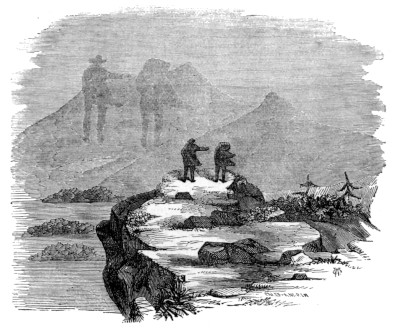
SPECTER OF THE BROCKEN.
In Clarke’s “Survey of the Lakes,” a phenomenon similar to that of the specter of the Brocken, is recorded to have been observed in the years 1743 321and 1744, on Souter-Fell, a mountain in Cumberland. It excited much conversation and alarm at the time, and exposed to great ridicule those who asserted they had witnessed it. It is, however, too well attested not to deserve a short notice here, and may be referred to the same causes by which the above aerial images on the Brocken mountain were produced. The relation is as follows. Souter-Fell is a mountain about half a mile in hight, inclosed on the north and west sides by precipitous rocks, but somewhat more open on the east, and easier of access. At Wilton Hall, within half a mile of this mountain, on a summer’s evening, in the year 1743, a farmer and his servant, sitting at the door, saw the figure of a man with a dog, pursuing some horses along Souter-Fell side, a place so steep that a horse could scarcely travel on it. They appeared to run at a very great pace, till they got out of sight at the lower end of the fell. On the following morning the farmer and his servant ascended the steep side of the mountain, in full expectation that they should find the man lying dead, being persuaded that the swiftness with which he ran must have killed him, and imagining also that they should pick up some of the shoes which they thought the horses must have lost, in galloping at so furious a rate. They were, however, disappointed in these expectations, as not the least vestige of either man or horses could be discovered, not so much, even, as the mark of a horse’s hoof on the turf.
On the twenty-third of June, of the following year, 1744, about half past seven in the evening, the same servant, then residing at Blakehills, at an equal distance from the mountain, being in a field in front of the farm-house, saw a troop of horsemen riding on Souter-Fell side in pretty close ranks, and at a brisk pace. Having observed them for some time, he called out his young master, who before the spot was pointed out to him, discovered the aerial troopers; and this phenomenon was shortly after witnessed by the whole of the family. The visionary horsemen appeared to come from the lowest part of Souter-Fell, and were visible at a place called Knott: they then moved in regular troops along the side of the fell, till they came opposite to Blakehills, when they went over the mountain. They thus described a kind of curvilinear path, and their first as well as their last appearance, was bounded by the foot of the mountain. Their pace was that of a regular swift walk, and they were seen for upward of two hours, when darkness intervened. Several troops were seen in succession, and frequently the last, or last but one in the troop, would quit his position, gallop to the front, and then observe the same pace with the others. The same change was visible to all the spectators; and the sight of this phenomenon was not confined to Blakehills, but was witnessed by the inhabitants of the cottages within a 322mile. It was attested before a magistrate by the two above-cited individuals in the month of July, 1745. Twenty-six persons are said in the attestation to have witnessed the march of these aerial travelers.
It should be remarked that these appearances were observed on the eve of the rebellion, when troops of horsemen might be privately exercising; and as the imitative powers of the specter of the Brocken demonstrate that the actions of human beings are sometimes pictured in the clouds, it seems highly probable, on a consideration of all the circumstances of this latter phenomenon on Souter-Fell, that certain thin vapors must have hovered round the summit of the mountain when the appearances were observed. It is also probable that these vapors may have been impressed with the shadowy forms which seem to “imitate humanity,” by a particular operation of the sun’s rays, united with some singular but unknown refractive combinations then taking place in the atmosphere.
THE MIRAGE.
This very curious phenomenon, which was remarked by M. Monge, one of the French savans belonging to the institute of Cairo, in the hot and sandy desert between Alexandria and that city, is described by him as resulting from an inverted image of the cerulean sky intermixed with the ground scenery, the neighboring villages appearing to be surrounded with a most beautiful sheet of water, and to exist, like islands, in its liquid expanse, tantalizing the eye by an unfaithful representation of what the thirsty traveler earnestly desires.
Doctor Clarke, in his interesting travels, introduces the following animated description of this phenomenon. “Here [at the village of Utko] we procured asses for our party, and, setting out for Rosetta, began to recross the desert, appearing like an ocean of sand, but flatter and firmer as to its surface, than before. The Arabs, uttering their harsh, guttural language, ran chattering by the side of our asses; until some of them calling out ‘Raschid!’ we perceived its domes and turrets, apparently upon the opposite side of an immense lake or sea, that covered all the intervening space between us and the city. Not having in my own mind, at the time, any doubt as to the certainty of its being water, and seeing the tall minarets and buildings of Rosetta, with all its groves of dates and sycamores, as perfectly reflected by it as by a mirror, insomuch that even the minutest detail of the architecture and of the trees might have been thence delineated, I applied to the Arabs to be informed in what manner we were to pass the water. Our interpreter, although a Greek, and therefore likely to have been informed of 323such a phenomenon, was as fully convinced as any of us, that we were drawing near to the water’s edge, and became indignant, when the Arabs maintained, that within an hour we should reach Rosetta, by crossing the sands in the direct line we then pursued, and that there was no water. ‘What!’ said he, giving way to his impatience, ‘do you suppose me an idiot, to be persuaded contrary to the evidence of my senses?’ The Arabs, smiling, soon pacified him, and completely astonished the whole party, by desiring us to look back at the desert we had already passed, where we beheld a precisely similar appearance. It was, in fact, the mirage, a prodigy to which all of us were then strangers, although it afterward became more familiar. Yet upon no future occasion did we ever behold this extraordinary illusion so marvelously displayed. The view of it afforded us ideas of the horrible despondency to which travelers must sometimes be exposed, who, in traversing the interminable desert, destitute of water, and perishing with thirst, have sometimes this deceitful prospect before their eyes.”
This appearance is often seen, when the sun shines, upon the extensive flat sand upon the shores of the Bristol channel, in Somersetshire, and probably on the sea-shore in other parts of England.
FATA MORGANA.
“As when a shepherd of the Hebride isles,
Placed far amid the melancholy main,
(Whether it be lone fancy him beguiles,
Or that aerial beings sometimes deign
To stand embodied to our senses plain,)
Sees on the naked hill, or valley low,
The whilst in ocean Phœbus dips his wain,
A vast assemblage moving to and fro;
Then all at once in air dissolves the wondrous show.”—Thomson.
These optical appearances of figures in the sea and air, in the Faro of Messina, are the great delight of the populace, who, whenever the vision is displayed, run about the streets shouting for joy, and calling on every one to partake of the glorious sight. To produce this pleasing deception, many circumstances must concur which are not known to exist in any other situation. The spectator must stand with his back to the east, in some elevated place behind the city, that he may command a view of the whole bay, beyond which the mountains of Messina rise like a wall, and darken the background of the picture. The winds must be hushed, the surface of the water quite smooth, the tide at its hight, and the waters pressed up by currents to a great elevation in the middle of the channel. All these events coinciding, as 324soon as the sun surmounts the eastern hills behind Reggio, (on the Calabrian coast opposite,) and rises high enough to form an angle of forty-five degrees on the water before the city, every object, existing or moving at Reggio, will be repeated a thousand-fold in this marine mirror, which, by its tremulous motion, is, as it were, cut into facets. Each image will pass rapidly off in succession, as the day advances, and the stream carries down the wave on which it appeared. Thus the parts of this moving picture will vanish in the twinkling of an eye. Sometimes the air is at this time so impregnated with vapors, and undisturbed by winds, as to reflect objects in a kind of aerial screen, rising about thirty feet above the level of the sea. In cloudy, heavy weather, they are drawn on the surface of the water, bordered with fine prismatic colors.
Swinburne, in his travels, cites Father Angelucci as having been the first to describe this phenomenon accurately. His relation is as follows. “On the fifteenth of August, 1643, as I stood at my window, I was surprised with a most wonderful and delectable vision. The sea which washes the Sicilian shore, swelled up, and became, for twelve miles in length, like a chain of dark mountains; while the waters near our Calabrian coast grew quite smooth, and in an instant appeared as one polished mirror, reclining against the aforesaid ridge. On this glass was depicted, in chiar-oscura, a string of several thousands of pilasters, all equal in altitude, distance and degree of light and shade. In a moment they lost half their hight, and bent into arcades, like Roman aqueducts. A long cornice was next formed on the top, and above it rose castles innumerable, all perfectly alike. These soon split into towers, which were shortly after lost in colonnades, then in windows, and at last ended in pines, cypresses, and other trees, even and similar. This was the Fata Morgana, which, for twenty-six years, I had thought a mere fable.”fable.”
ATMOSPHERICAL REFRACTION.
A surprising instance of atmospherical refraction occurred at Hastings, England, on the twenty-sixth of July, 1798. W. Latham, Esq., sitting in his dining-room, situated on the parade, close to the sea-shore, and nearly fronting the south, about five in the afternoon, had his attention suddenly drawn by a great number of people running down to the seaside. On inquiring the reason, he was informed that the coast of France was plainly to be distinguished by the naked eye. On going down to the shore, he was surprised to find that, even without the assistance of a telescope, he could very plainly see the cliffs on the opposite coast; which, at the nearest part, 325are between forty and fifty miles distant, and are not to be discerned, from that low situation, by the aid of the best glasses. They appeared to be only a few miles off, and seemed to extend for some leagues along the coast. Pursuing his walk along the shore to the eastward, close to the water’s edge, and conversing on the subject with the sailors and fishermen, they could not, at first, be persuaded of the reality of the appearance; but soon became so thoroughly convinced, by the cliffs gradually appearing more elevated, and approaching nearer as it were, that they pointed out and named to him the different places they had been accustomed to visit, such as, the Bay, the Old Head or Man, the Windmill, &c., at Boulogne; together with St. Vallery, and other places on the coast of Picardy. This they afterward confirmed, when they viewed them, thus refracted, through their telescopes, observing that the above places appeared as near as if they had been sailing, at a small distance, into the harbors. From the eastern cliff, which is of a very considerable hight, a most beautiful scene presented itself to Mr. Latham’s view, for there he could at once see Dungeness, Dover cliffs, and the French coast, all along from Calais, Boulogne, &c., to St. Vallery; and, as some of the fishermen affirmed, as far to the westward even as Dieppe. By the telescope, the French fishing-boats were plainly to be seen at anchor, and the different colors of the land on the hights, with the buildings, were perfectly discernible. This curious phenomenon continued in the highest splendor till half past eight o’clock, notwithstanding a black cloud for some time totally obscured the face of the sun, and then vanished gradually. So remarkable an instance of atmospherical refraction had not been before witnessed by the oldest inhabitant of Hastings. It was likewise observed at Winchelsea, and other places along the coast. The day was remarkably hot, without a breath of wind stirring.