BURIED CITIES.
Reading edition
THE YANAR, OR PERPETUAL FIRE.
Before passing on to the buried cities of Herculaneum and Pompeii, it may be as well to notice a singular phenomenon, supposed by some to be of volcanic origin, viz., the Yanar, or perpetual fire. Captain Beaufort, of the British navy, among the interesting details of his survey of Karamania, on the south coast of Asia Minor, describes this curious phenomenon; and from his account the following particulars are extracted, as supplementary to and connected with the details of volcanoes and their effects.
Having perceived during the night a small but steady light among the hills, he found that this was represented by the inhabitants as a yanar or volcanic light; and on the following morning curiosity led him to visit the spot. In the inner corner of a ruined building he came to a wall, so undermined as to leave an aperture of about three feet in diameter, and shaped like the mouth of an oven. From this aperture the flame issued, giving out an intense heat, but without producing any smoke on the wall; and although several small lumps of caked soot were detached from the neck of the opening, the walls were scarcely discolored. Trees, brushwood and weeds, grew close around this little crater; a small stream trickled down the hill in its vicinity; and the ground did not appear to feel the effect of its heat at more than a few yards’ distance. No volcanic productions were perceived near to it; but at a short distance, lower down on the side of the hill, was another hole or aperture, which had apparently been at some remote period the vent of a similar flame. It was asserted, however, by the guide, that, in the memory of the present race of inhabitants, there had been but one such volcanic opening, and that its size and appearance had been constantly the same. He added, that it was never accompanied by earthquakes or noises; and that it did not eject either stones, smoke or noxious vapors; but that its brilliant and perpetual flame could not be quenched by any quantity of water. At this flame, he observed, the shepherds were in the habit of cooking their food. This phenomenon appeared to Captain Beaufort to have existed for many ages, and he was persuaded that it is the spot to which Pliny alludes in the following passage: “Mount Chimera, near Phaselis, emits an 351unceasing flame, which burns day and night.” Within a short distance is the great mountain of Takhtalu, the naked summit of which rises, in an insulated peak, seventy-eight hundred feet above the level of the sea. In the month of August a few streaks of snow were discernible on the peak; but many of the distant mountains of the interior were completely white for nearly a fourth the way down their sides. It may hence be inferred, that the elevation of this part of Mount Taurus is not less than ten thousand feet, which is equal to that of Mount Etna.
Such a striking feature as this stupendous mountain, in a country inhabited by illiterate and credulous people, can not fail to have been the subject of numerous tales and traditions. Accordingly, the captain was informed by the peasants, that there is a perpetual flow of the purest water from the very apex; and that notwithstanding the snow, which was still lingering in the chasms, roses blew there all the year round. He was assured by the agha of Deliktash, that every autumn a midnight groan is heard to issue from the summit of the mountain, louder than the report of any cannon, but unaccompanied by fire or smoke. The agha professed his ignorance of the cause, but on being pressed for his opinion, gravely replied, that he believed it was an annual summons to the elect, to make the best of their way to Paradise. However amusing this theory may have been, it may possibly be true that such explosions take place. The mountain artillery heard by Lewis and Clarke, among the Rocky mountains, and similar phenomena which are said to have occurred in South America, seem to lend some probability to the account. The natives have also a tradition, that when Moses fled from Egypt, he took up his abode near this mountain, which was therefore named Moossa-Daghy, or the mountain of Moses. Between this story, and the Yanar, as it has been described above, may there not have been some fanciful connection? The site of this volcanic opening is at an inconsiderable distance from the mountain; and the flame issuing from the thicket which surrounds it, may have led to some confused association with the burning bush on Mount Horeb, of which we have the account in the book of Exodus.
POMPEII.
To every traveler through the southern part of Europe, Pompeii and Herculaneum are, of course, the objects of earliest attention and deepest interest. The tragic story of these buried towns is now familiar to most intelligent persons; while the vivid romance of Bulwer makes one feel as if he had known the inhabitants, and almost as though he had been a witness of the catastrophe. The story is recorded not more faithfully by the younger 352Pliny, in his celebrated letter to Tacitus, than it is plainly read in the material evidence, whose unexpected discovery, almost in our own day, has supplied both to the antiquarian and the geologist, most valued and truthful evidences; contemporary records, expounding to the antiquary an interesting chapter of human history, filled with the minutest details of personal interest, and to the geologist, the close of one and the commencement of another of those great cycles of change, whose history, strangely connected in this instance with the vicissitudes of his own race, engrosses his delighted attention.
A great and rich town, which, after sleeping eighteen centuries in its deep and dark grave, is again shone on by the sun, and stands among other cities as much a stranger to them as any one of its former inhabitants would be among men of the present day, is surely one of the wonders of the world; and such is Pompeii. The distance from Naples to Pompeii, is little more than ten English miles. Near the Torre dell’Annunziata, to the left, and amid hills planted with vineyards, the town itself, which, throwing off its shroud of ashes, came forth from its grave, breaks on the view. The buildings are without roofs, which are supposed to have been destroyed by the lava, or torn off by the hurricane which preceded it. The tracks of the wheels which anciently rolled over the pavement are still visible. An elevated path runs by the side of the houses, for foot-passengers; and, to enable them in rainy weather to pass more commodiously to the opposite side, large flat stones, three of which take up the width of the road, were laid at a distance from each other. As the carriages, in order to avoid these stones, were obliged to use the intermediate spaces, the tracks of the wheels are there most visible. The whole of the pavement is in good condition: it consists merely of considerable pieces of lava, which, however, are not cut as at present into squares, and may have been on that account the more durable.
The part which was first cleared, is supposed to have been the main street of Pompeii; but this is much to be doubted, as the houses on both sides, with the exception of a few, were evidently the habitations of common citizens, and were small and provided with booths. The street itself likewise is narrow: two carriages only could go abreast; and it is very uncertain whether it ran through the whole of the town; for, from the spot where the moderns discontinued digging, to that where they recommenced, and where the same street is supposed to have been again found, a wide tract is covered with vineyards, which may perhaps occupy the places of the most splendid streets and markets, still concealed underneath.
Among the objects which attract particular attention, is a booth in which 353liquors were sold; the marble table within which, bears the marks of the cups left by the drinkers. Next to this is a house, the threshold of which is inlaid with a salutation in black stone, as a token of hospitality. On entering the habitations, the visitor is struck by the strangeness of their construction. The middle of the house forms a square, something like the cross passages of a cloister, often surrounded by pillars: it is cleanly, and paved with party-colored mosaic, which has an agreeable effect. In the middle is a cooling well, and on each side a little chamber, about ten or twelve feet square, but lofty, and painted with a fine red or yellow. The floor is of mosaic; and the door is made generally to serve as a window, there being but one apartment which receives light through a thick blue glass. Many of these rooms are supposed to have been bed-chambers, because there is an elevated, broad step, on which the bed may have stood, and because some of the pictures appear most appropriate to a sleeping-room. Others are supposed to have been dressing-rooms, from the fact that on the walls a Venus is described decorated by the Graces, added to which, little flasks and boxes of various descriptions have been found in them. The larger of these apartments served for dining-rooms, and in some are suitable accommodations for cold and hot baths.
The manner in which a whole room was heated, is particularly curious. Against the usual wall a second was erected, standing at a little distance from the first. For this purpose large square tiles were taken, having, like modern tiles, a sort of hook, thus keeping the first wall as it were off from them: a hollow space was thus left all around, from the top to the bottom, into which pipes were introduced, that carried the warmth into the chamber, and as it were rendered the whole of the place one stove. The ancients were also attentive to avoid the vapor or smell from their lamps. In some houses there is a niche made in the wall for the lamp, with a little chimney in the form of a funnel, through which the smoke escaped. Opposite to the house-door the largest room is placed: it is properly a sort of hall, for it has only three walls, being quite open in the fore part. The side rooms have no connection with each other, but are divided off in little cells, the door of each leading to a fountain.
Most of the houses consist of one such square, surrounded by rooms. In a few, some decayed steps seem to have led to an upper story, which is no longer in existence. Some habitations, however, probably belonging to the richer and more fashionable, are far more spacious. In these, a first court is often connected with a second, and even with a third, by passages: in other respects their arrangements are similar to those above described. Many garlands of flowers and vine-branches, and many handsome pictures, 354are still to be seen on the walls. The guides were formerly permitted to sprinkle these pictures with fresh water, in the presence of travelers, and thus revive their former splendor for a moment: but this is now strictly forbidden; and, indeed, not without reason, since the frequent watering might at length totally rot away the wall.
One of the houses belonged to a statuary, whose workshop is still full of the vestiges of his art. Another appears to have been inhabited by a surgeon, whose profession is equally evident from the instruments discovered in his chamber. A large country-house near the gate, undoubtedly belonged to a very wealthy man, and would, in fact, still invite inhabitants within its walls. It is very extensive, stands against a hill, and has many stories. Its finely decorated rooms are unusually spacious; and it has airy terraces, from which you look down into a pretty garden, that has been now again planted with flowers. In the middle of this garden is a large fishpond, and near that an ascent from which, on two sides, six pillars descend. The hinder pillars are the highest, the middle somewhat lower, and the front the lowest: they appear, therefore, rather to have propped a sloping roof, than to have been destined for an arbor. A covered passage, resting on pillars, incloses the garden on three sides; it was painted, and probably served in rainy weather as an agreeable walk. Beneath is a fine arched cellar, which receives air and light by several openings from without; consequently its atmosphere is so pure, that in the hottest part of summer it is always refreshing. A number of amphoræ, or large wine-vessels, are to be seen here, still leaning against the wall, as the butler left them when he carried up the last goblet of wine for his master. Had the inhabitants of Pompeii preserved these vessels with stoppers, wine might still have been found in them; but as it was, the stream of ashes running in, of course forced out the wine. More than twenty human skeletons of fugitives, who thought to save themselves here under ground, but who must have experienced a tenfold more cruel death than those suffered who were in the open air, were found in this cellar.
The destiny of the Pompeians must have been dreadful. It was not a stream of fire that encompassed their abodes: they could then have sought refuge in flight. Neither did an earthquake swallow them up; sudden suffocation would then have spared them the pangs of a lingering death. But a rain of ashes buried them alive BY DEGREES! Hear the delineation of Pliny: “A darkness suddenly overspread the country; not like the darkness of a moonless night; but like that of a closed room, in which the light is of a sudden extinguished. Women screamed, children moaned, men cried. Here, children were anxiously calling their parents; and there, parents were 355seeking their children, or husbands their wives; all recognized each other only by their cries. The former lamented their own fate, and the latter that of those dearest to them. Many wished for death, from the fear of dying. Many called on the gods for assistance: others despaired of the existence of the gods, and thought this the last eternal night of the world. Actual dangers were magnified by unreal terrors. The earth continued to shake, and men, half-distracted, to reel about, exaggerating their own fears, and those of others, by terrifying predictions.”
Such is the frightful but true picture which Pliny gives us of the horrors of those who were, however, far from the extremity of their misery. But what must have been the feelings of the Pompeians, when the roaring of the mountain and the quaking of the earth, awaked them from their first sleep? They also attempted to escape the wrath of the gods; and, seizing the most valuable things they could lay their hands upon in the darkness and confusion, endeavored to seek their safety in flight. In this street, and in front of the house marked with the friendly salutation on its threshold, seven skeletons were found: the first carried a lamp, and the rest had still between the bones of their fingers something that they wished to save. On a sudden they were overtaken by the storm which descended from heaven, and buried in the grave thus made for them. Before the above mentioned country-house, was still a male skeleton, standing with a dish in his hand; and, as he wore on his finger one of those rings which were allowed to be worn by Roman knights only, he is supposed to have been the master of the house, who had just opened the back garden gate with the intent of flying, when the shower overwhelmed him. Several skeletons were found in the very posture in which they had breathed their last, without having been forced by the agonies of death to drop the things they had in their hands. This leads to a conjecture, that the thick mass of ashes must have come down all at once, in such immense quantities as instantly to cover them. It can not otherwise be imagined how the fugitives could all have been fixed, as it were by a charm, in their position; in which manner their destiny was the less dreadful, seeing that Death suddenly converted them into motionless statues, and thus was stripped of all the horrors with which the fears of the sufferers had clothed him in imagination. But what then must have been the pitiable condition of those who had taken refuge in the buildings and cellars! Buried in the thickest darkness, they were secluded from everything but lingering torment; and who can paint to himself without shuddering, a slow dissolution approaching, amid all the agonies of body and of mind? The soul recoils from the contemplation of such images.
To proceed now to the public edifices. The temple of Isis is still standing, 356with its Doric pillars, and its walls painted with emblems of the service of the deity, such as the hippopotamus, cocoa-blossom, ibis, &c. A view of it is given in the cut. The sacred vessels, lamps and tables of Isis, are still to be seen. From a little chapel within, a poisonous vapor is said to have formerly arisen, which the heathen priests may have used for every species of deception. This vapor is said to have increased after the violent eruption of Vesuvius; but it has not latterly given out the slightest smell. A small Grecian temple, of which only two pillars remain, had been probably already destroyed by an earthquake, which, in the reign of Titus, preceded the dreadful irruption of the volcano. On the opposite side of this temple there is still an edifice, called the quarters of the soldiers, because all sorts of arms, pictures of soldiers, and a skeleton in chains, were found there. By others it has been considered as the forum of Pompeii.
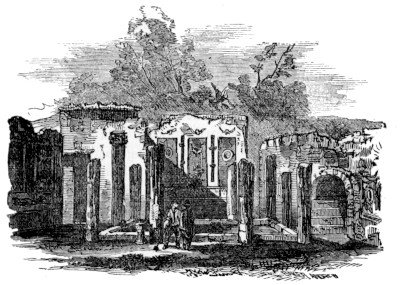
TEMPLE OF ISIS AT POMPEII.
Two theaters, the smaller one particularly, are in an excellent state of preservation. The structure of this one is such as was usually adopted by the ancients, and is better arranged than some of modern construction, as it affords the spectators commodious seats, a free view of the stage, and facility of hearing. Although sufficiently large to contain two thousand persons, the plebeians, standing in a broad gallery at the top, were quite as able to see all that was passing on the stage, as the magistrate in his marble balcony. In this gallery the arrangements for spreading the sail-cloth over the spectators are still visible. The stage itself is very broad, as it has no side walls; 357and appears less deep than it really is. A wall runs across it, and cuts off just as much room as is necessary for the accommodation of the performers. But this wall has three very broad doors; the middle one is distinguished by its hight, and the space behind it is still deeper than in front. If these doors, as may be conjectured, always stood open, the stage was in fact large, and afforded besides the advantage of being able to display a double scenery: if, for example, the scene in front was that of a street, there might have been behind a free prospect into the open field.
The cemetery lies before the gate of the high road. The tomb of the priestess Mammea is very remarkable: it was erected, according to the epitaph, by virtue of a decree of the decemvirs. In the midst of little boxes of stone, in square piles, and on a sort of altar, the family urns were placed in niches; and without these piles the broken masks are still to be seen. In front of the cemetery, by the road-side, is a beautiful seat, forming a semicircle, that will contain twenty or thirty persons. It was probably overshaded by trees eighteen hundred years ago; under which the women of Pompeii sat in the cool evenings, while their children played before them, and viewed the crowds which were passing through the gate.
To the above particulars from the pen of the elegant and lively Kotzebue, the following details, given by a later and accurate traveler, are subjoined. The entrance into Pompeii is by a quadrangular court; and this court is surrounded on every side by a colonnade which supports the roof of a gallery; and the latter leads to several small apartments, not unlike the cells of a prison. The columns are of brick, stuccoed over, and painted of a deep red: they are in hight from ten to twelve feet, are placed at about a like distance from each other, and are of the Doric order, fluted two-thirds from the top, and well proportioned. After a variety of conjectures relative to the purpose to which this building was applied, it has been ascertained that it was either a barrack for soldiers, (various pieces of armor having been found in some of the cells,) or the prætorium of the governor, where a body of military must have been stationed. Adjacent to it stood the theaters, the forum, and one or two temples, all connected by very neat and well-paved courts. The smaller of the theaters is to the right, and is called the covered theater, because it was so constructed, that by the means of canvas awnings, the spectators were defended from the sun and rain. A door through the wall leads to the different galleries, and to the open space in the center, resembling the pit of a modern theater. The interior is beautifully neat; and with the exception of the spoliation of the marble slabs, removed to the palace at Naples, with which the whole of the inside, not excepting the seats, had been covered, it is in excellent preservation. On each side are the seats 358for the magistrates; the orchestra, as in modern theaters, is in front of the stage; and the latter, with its brick wings, is very shallow. This theater was calculated to contain about two thousand spectators. From its level a staircase leads to an eminence on which several public buildings are situated. The most conspicuous of these is a small temple said to have been dedicated to Isis, and having a secret passage, perforated in two places, whence the priests are supposed to have delivered to the deluded multitude the oracles of that deity.
Within a paved court is an altar, of a round shape, on the one side, and on the other side a well. A cistern, with four apertures, was placed at a small distance, to facilitate the procuring of water. In this court, sacrifices and other holy rites are conjectured to have taken place, various utensils for sacrifice, such as lamps, tripods, &c., having been found, when the place was first excavated. One of the tripods is of the most admirable workmanship. On each of the three legs, a beautiful sphinx, with an unusual head-dress, is placed, probably in allusion to the hidden meanings of the oracles which were delivered in the above-mentioned temple. The hoop in which the basin for the coals was sunk, is elegantly decorated with rams’ heads connected by garlands of flowers; and within the basin, which is of baked earth, the very cinders left from the last sacrifice (nearly two thousand years ago) are seen as fresh as if they had been the remains of yesterday’s fire!
From the above court, you enter on a somewhat larger, with a stone pulpit in the center and stone seats near the walls. The spot, therefore, was either the auditory of a philosopher, or the place where the public orators pleaded in the presence of the people. Everything here is in the highest order and preservation.
The great amphitheater proudly rears its walls over every other edifice on the same elevated spot. It is a stupendous structure, and has twenty-four rows of seats, the circumference of the lowest of which is about seven hundred and fifty feet. It is estimated to have contained about thirty thousand spectators. The upper walls are much injured, having partially projected above ground long before the discovery of Pompeii.
A corn-field leads to the excavated upper end of the high street, which consists of a narrow road for carts, with foot-pavements on each side. The middle is paved with large blocks of marble, and the ruts of the wheels proclaim its antiquity, even at the time of its being overwhelmed. The foot-paths are elevated about a foot and a half from the level of the carriage-road. The houses on each side, whether shops or private buildings, have no claim to external elegance: they consist of a ground-floor only, and, with the exception of the door, have no opening toward the street. The windows of 359the private houses look into an inner square court, and are in general very high. The apartments themselves are, with the exception of one in each house, which probably served as a drawing-room, both low and diminutive. In point of decoration they are neat, and, in many instances, elegant: the floors generally consist of figured pavements, either in larger stones of various colors, regularly cut and systematically disposed, or are formed of a beautiful mosaic, with a fanciful border, and an animal or figure in the center. The geometrical lines and figures in the design of the borders, have an endless variety of the most pleasing shapes, to display the fertile imagination of the artists. Their tesselated pavements alone must convince us that the ancients were well skilled in geometry. The ground is usually white, and the ornaments black; but other colors are often employed with increased effect.
The walls of the apartments are equally (if not still more) deserving attention. They are painted, either in compartments, exhibiting some mythological or historical event, or simply colored over with a light ground, adorned with a border and perhaps an elegant little vignette, in the center or at equal distances. But few of the historical paintings now exist in Pompeii; for wherever a wall was found to contain a tolerable picture, it was removed and deposited in the museum at Naples. To effect this, the greatest care and ingenuity were required, so as to peel off, by the means of sawing pieces of wall, twenty and more square feet in extent, without destroying the picture. This, however, was not a modern invention; for, among the excavated remains of Stabiæ, the workmen came to an apartment containing paintings which had been separated by the ancients themselves from a wall, with the obvious intent of their being introduced in another place. This was, however, prevented by the ruin of the city; and the paintings, therefore, were found leaning against the wall of the apartment.
Another excavated portion of Pompeii is likewise part of a street, and, being perfectly in a line with the one already described, is conjectured to be a continuation, or rather the extremity of the latter; in which case Pompeii must have been a city of considerable importance, and its main street nearly a mile in length. The houses here, as in the other instance, are distributed into shops and private dwellings, some of the latter of which are distinguished by the remains of former internal elegance, such as tesselated pavements, painted walls, &c.: most of them have likewise an interior court, surrounded by apartments.
360
THE MUSEUM AT NAPLES.
The museum was formerly at Portici, but was removed to Naples some years ago and is now called the Musæo Borbonico. The best statues, busts, vases, and in short, whatever was supposed, from its materials or construction, to have a superior value, were packed in fifty-two chests, and conveyed from Portici to Palermo, at the time the court sought refuge in that city, on the French penetrating into the Neapolitan territory. What still remains, however, in the museum, has a high intrinsic value; since no one can behold, without the strongest emotions of admiration, the relics of the most transitory things, which for nearly eighteen hundred years, have braved the ravages of time. Here are to be seen bread, corn, dough which was about to be placed in the oven, soap which had been used for washing, figs, and even egg-shells perfectly white, and in as good a state as if the cook had broken them an hour before. Here a kitchen presents itself provided with everything requisite: trivets and pots stand on the hearth; stew-pans hang on the wall; skimmers and tongs are placed in the corner; and a metal mortar rests on the shaft of a pillar. Weights, hammers, scythes, and other utensils of husbandry, are here blended with helms and arms. Sacrificing bowls and knives; a number of well shaped glasses; large and small glass bottles; lamps; vases; decorations for furniture; a piece of cloth; nets; and even shoe soles; all sorts of female ornaments—necklaces, rings and ear-rings; a wooden chess-board, reduced, indeed, to a cinder: all these things are more or less injured by the fire; but still are distinguishable at first sight.
Every apartment of the museum is laid with the most charming antique floors, which are partly mosaic, from Pompeii, and partly marble, from Herculaneum. Statues, vases, busts, chandeliers, altars, tables of marble and bronze, are all in as good a state as if they had just come from the hands of the artist. The coins which have been collected are very numerous, and fill several cases. Medallions of marble, containing on each side a bas-relief, are suspended by fine chains from the ceiling of one of the apartments, and are within the reach of the hand, so as to be conveniently turned and examined.
Most of the pictures found at Herculaneum, Pompeii and Stabiæ, and now deposited in the museum, have been sawed from the walls of the edifices they adorned. These unique relics of ancient art form an extensive gallery of genuine antique pictures, the only one in the world, and may on that account alone, be considered as an invaluable treasure. They are placed in a range of apartments on the ground floor, and are suspended against the walls in plain frames. Their size varies from a foot square, to whole-length groups, nearly as large as life. Beside the injury they have sustained by having 361been exposed to the heat of burning cinders, they have been impaired by the modern varnish which was intended to protect them: it would, therefore, not be right to subject their coloring to the rigid rules of art; but the grouping of the Minotaur, of the Telephus, of the sitting Orestes, and of the Bacchus and Ariadne, is admirable. In their paintings, as well as in their sculptures, the ancients were influenced by that love of simplicity which distinguishes their works from those of the moderns, and the result is, that in them the chief merits of composition are combined, unity of subject, and unity of interest. When, again, it is considered that the paintings collected in the museum at Naples were taken from the provincial towns, it must be inferred, that those which were admitted in the chief seats of art corresponded in excellence with the Laocoön and the Apollo. Such, at least, was the judgment of the ancients themselves, and their taste is not to be disputed.
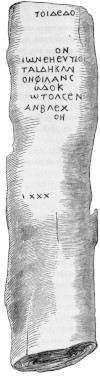
PAPYRI.
The museum at Naples excels all others in ancient bronze, a substance which, although dearer, more difficult to be wrought, more inviting to the rude grasp of avarice, and less beautiful than marble, forms the greater proportion of the statues. The larger of them had been originally composed of pieces connected by dove-tail joints; and these promiscuous fragments have been recompiled into new figures, as in the instance of the single horse made from four, in the center of the court-yard of the museum. Those fragments which had escaped fusion, were rent, inflated, or bruised, by the burning lava. In addition to these misfortunes, they have been made up unhappily; for the eye of an artist can sometimes detect two styles of art, evidently different, the large and the exquisite, soldered together in the same statue. The figures the most admired are, the drunken Faun, the sleeping Faun, the sitting 362Mercury, the Amazon adjusting her robe, and an Augustus and a Claudius, both of heroic size.
The most remarkable objects in the museum at Naples are the manuscripts, found in two chambers of a house at Herculaneum. Although they have been so frequently described, they must be seen, to furnish a correct idea of them. Before they are unrolled, they resemble sticks of charcoal, or cudgels reduced to the state of a cinder, and partly petrified. Their general appearance before they are unrolled may be seen on the previous page. In color they are black and chesnut-brown: and they are unfortunately so decayed, that under each of them, as they lie in glass cases, a quantity of dust and detached fragments may be perceived. Their characters are legible in a certain light only, by a gloss and relief which distinguishes the ink, or rather black paint, from the tinder. Cut, crushed, crumbled on the edge, and caked by the sap remaining in the leaves of the papyrus, they require in the operator great sagacity to meet the variety of injuries they have received; since, in gluing rashly the more delicate parts, he might reach the heart of a volume, while working at the outside. At first, it appeared almost impracticable ever to decipher a syllable of them; but to the industry and talents of man nothing is impossible, and his curiosity impels him to the most ingenious inventions.
HERCULANEUM.
This city was, together with Pompeii and Stabiæ, involved in the common ruin occasioned by the dreadful eruption of Vesuvius, in the reign of Titus, which has already been described in our previous pages.
It was situated on a point of land stretching into the gulf of Naples, about two miles distant from that city, near where the modern towns of Portici and Resini, and the royal palace, by which they are separated, now stand. The neck of land on which it was built, and which has since disappeared, formed a small harbor. Hence the appellation of Herculis Porticum, (the small haven of Hercules,) sometimes given to Herculaneum, and thence in all probability, the modern name of Portici.
The latter being situated immediately above some of the excavations of Herculaneum, the just fear of endangering its safety, by undermining it, is given as a principal reason why so little progress has been made in the Herculanean researches.
The discovery of Herculaneum is thus explained. At an inconsiderable distance from the royal palace of Portici, and close to the seaside, Prince 363Elbeuf, in the beginning of the last century, inhabited an elegant villa. To obtain a supply of water a well was dug, in the year 1730, through the deep crust of lava on which the mansion itself had been reared. The laborers, after having completely pierced through the lava, which was of considerable depth, came to a stratum of dry mud. This event precisely agrees with the tradition relative to Herculaneum, that it was in the first instance overwhelmed by a stratum of hot mud, which was immediately followed by a wide stream of lava. Whether this mud was thrown up from Vesuvius, or formed by torrents of rain, does not appear to have been decided. Within the stratum the workmen found three female statues, which were sent to Vienna.
It was not until some years after this, that the researches at Herculaneum were seriously and systematically pursued. By continuing Elbeuf’s well, the excavators at once came to the theater, and from that spot carried on their further subterraneous investigation. The condition of Herculaneum was at that time much more interesting, and more worthy the notice of the traveler, than it is at present. The object of its excavation having unfortunately been confined to the discovery of statues, paintings, and other curiosities, and not carried on with a view to lay open the city, and thus to ascertain the features of its buildings and streets, most of the latter were again filled up with rubbish as soon as they were divested of everything movable. The marble even was torn from the walls of the temples. Herculaneum may therefore be said to have been overwhelmed a second time by its modern discoverers; and the appearance it previously presented, can now only be ascertained from the accounts of those who saw it in a more perfect state. Agreeably to them, it must at that time have afforded a most interesting spectacle.
The theater was one of the most perfect specimens of ancient architecture. It had, from the floor upward, eighteen rows of seats, and above these, three other rows, which, being covered with a portico, seem to have been intended for the female part of the audience, to screen them from the rays of the sun. It was capable of containing between three and four thousand persons. Nearly the whole of its surface, as well as the arched walls which led to its seats, was cased with marble. The area, or pit, was floored with thick squares of giallo antico, a beautiful marble of a yellowish hue. On the top stood a group of four bronze horses, drawing a car, with a charioteer, all of exquisite workmanship. The pedestal of white marble is still to be seen in its place; but the group itself had been crushed and broken in pieces by the immense weight of lava which fell on it. The fragments having been collected, might easily have been brought together again, but having been carelessly thrown into a corner, a part of them were stolen, and another portion 364fused, and converted into busts of their Neapolitan majesties. At length, it was resolved to make the best use of what remained, that is, to convert the four horses into one, by taking a fore leg of one of them, a hinder leg of another, the head of a third, &c., and, where the breach was irremediable, to cast a new piece. To this contrivance the bronze horse now shown in the museum of Naples owes its existence; and, considering its patchwork origin, it still conveys a high idea of the skill of the ancient artist.
In the forum, which was contiguous to the theater, beside a number of inscriptions, columns, &c., two beautiful equestrian statues of the Balbi family were found. These were of white marble, and were deposited in the hall of the left wing of the palace at Portici. Adjoining to the forum stood the temple of Hercules, an elegant rotunda, the interior of which was decorated with a variety of paintings, such as Theseus returning from his Cretan adventure with the Minotaur, Telephus’s birth, Chiron, the centaur, instructing Achilles, &c. These were carefully separated from the walls, and are deposited in the museum at Naples.
The most important discovery, however, was that of a villa, at a small distance from the forum; not only on account of the peculiarity of its plan, but because the greater number of the works of art were dug out of its precinct; and more especially because it contained a library consisting of more than fifteen hundred volumes, which are likewise safely deposited in the museum, and which, were they legible, would form a great classic treasure. These have been mentioned in the account of the museum at Naples, which will be found on a previous page. The villa is conjectured to have belonged to one of the Balbi family. Although elegant, it was small, and consisted of a ground-floor only, like those of Pompeii. Beside a number of small closets round an interior hall, it contained a bathing-room, curiously fitted up with marble and water-pipes, and a chapel of a diminutive size, without any window or aperture for daylight, the walls of which were painted with serpents, and within which a bronze tripod, filled with cinders and ashes, was found standing on the floor. The apartment which contained the library was fitted up with wooden presses around the walls, about six feet in hight: a double row of presses stood insulated in the middle of the room, so as to admit a free passage on every side. The wood of which the presses had been made, was burned to a cinder, and gave way at the first touch; but the volumes, composed of a much more perishable substance, the Egyptian or Syracusan papyrus, were, although completely carbonized through the effect of the heat, still so far preserved as to admit of their removal to a similar set of modern presses, (provided, however, with glass doors,) in the museum.
365In the middle of the garden belonging to this villa, was a large basin, having its edges faced with stone, and the two narrow ends rounded off in a semicircular form. This piece of water was surrounded by beds or parterres of various shapes; and the garden was on every side inclosed by a covered walk supported by columns. Of these columns there were sixty-four, ten for each of the shorter, and twenty-two for each of the longer sides of the quadrangle: they were made of brick, neatly stuccoed over, exactly similar to those in the Pompeian barracks. Each pillar supported one end of a wooden beam, the other extremity of which rested on the garden wall, thus forming an arbor, in all probability planted with vines around the whole garden. Under this covered walk, several semicircular recesses, which appear to have served as bathing-places, were built. The spaces between the pillars were decorated with marble busts and bronze statues, alternately arranged. This garden was surrounded by a narrow ditch; and another covered walk, of a considerable length, led to a circular balcony, or platform, the ascent to which was by four steps, but which overhung the sea about fifteen feet. The floor of the balcony consisted of a very beautiful tesselated pavement. From this charming spot the prospect over the whole bay of Naples, including the mountains of Sorrento, the island of Capri, and Mount Posilipo, must have been delightful.
POMPEII.
Having thus given the accounts of Kotzebue, and also of an English tourist, as to Pompeii and Herculaneum, we will now add the narrative of our distinguished fellow-citizen, Professor Silliman, who passed over the same ground in 1851. All these views are given, because the subject is one of so much intrinsic interest, and because some objects are mentioned by each writer that are not by the others. Professor Silliman says: “We passed rapidly along through Portici, Resina, and Torre del Greco,[6] which form one long-continued street, lying over Herculaneum, a large city, whose entombed remains were far beneath our carriage wheels. Vesuvius was on our left, quiet and sublime. Clouds vailed its crater from our view, but its venerable sides were enveloped in the black drapery of its own lava floods. The currents have often flowed over the road on which we were traveling. Here and there, the lava had been cut through in the streets, and it protrudes in 366black, rocky masses, upon which many of the houses have been erected. Lava formed the walls of the houses, and the fences around the fields, and lava, only lava, was everywhere around us. After a short interval of cultivated fields, we arrived in Torre del Annunciata, in a street similar to those we had passed, and surrounded by a country in the highest state of cultivation, where every foot of the rich volcanic soil is made available. Farm-houses and villas appeared clustering around the eastern and southern foot of Vesuvius, and creeping up its sloping sides, so reckless are the people of past catastrophes, although Herculaneum reposes in its profound grave at the foot of the mountain, and the great sepulcher of Pompeii, with its funereal monuments, is in full view before them. They have also been very recently warned again, by the terrific eruption of February, 1850, which, bursting out back of Vesuvius, on the east, took an unwonted direction, thus giving another proof that no situation on or near the mountain is safe; but still the inhabitants repose in careless security.
“As we drove slowly onward, checking the horses from time to time, in order to realize the scenes around us, Antonio, from the coach-box, suddenly exclaimed, ‘There is Pompeii!’ We eagerly looked, and saw a low, green ridge of land, covered by grass and shrubs. It appeared as an extended mound, over which the traveler might have driven, as thousands have heedlessly done in centuries past, unconscious that a city of the dead slumbered beneath the hoofs of the horses. Only a few minutes elapsed, before standing erect in the carriage, we discerned the still naked heaps of pumice that have been thrown out during the excavations; and immediately after, in breathless silence, we were at the door of the house of Diomede! An elegant country-house, a Roman villa, just outside of the walls of the city, still stands, almost eighteen hundred years after the great catastrophe. Its columns are erect, its walls entire, and its open doors seem to invite the stranger to enter; but the family are not there, and silence reigns in the halls of Diomede!
“I never before felt as I did when I entered this deserted house—pensive, solemn, and in full sympathy with the tragical story. Sentinels still keep these doors; not the helmeted Roman, who, firm and unmoved, surveyed the storm of fire but yielded not to fear, preferring to die at his post,[7] but Neapolitans stationed there by the government to prevent invasion of the ruins. One there was, a veteran, whose snowy hair, and visage so deeply marked by time, made us almost feel as if he must have been present when the volcanic tempest raged, and had, Salathiel-like, come down to our time 367to relate the events of those dreadful days. But a garrulous guide, who spoke tolerable English, placed himself at the head of our party, and was our cicerone through an intensely interesting day. We mused for a few minutes in the vacant rooms of the house of Diomede, walked upon the still beautiful mosaic pavements and floors, passed through the dormitories, the triclinium, the impluvium, and the hall for conversation; observed the water-cistern, and the channels worn in the stone curb by the friction of the rope, and then descended to the vaults beneath, in which so many members of the family met their fate. This gallery is strongly arched with brick, and was used as a wine-cellar, as appears from twenty-five amphoræ still remaining there, and which were found filled with volcanic matter.
“On the twenty-fourth of August, in the year 79 of our own era, and not long after midday, Vesuvius broke the repose of untold ages, and resumed, with tragical energy, his ancient reign of fire, awakening the slumbering echoes of his power with terrible detonations and fearful earthquakes. A darkness that might be felt, shrouded in the profoundest gloom the midday sun, and ashes fell like snow upon the mountain, the plain, the bays of Naples and Baiæ, and far into the surrounding country. Rain from the condensed steam of the eruption deluged the whole district; torrents of fluid mud, formed by the ashes and water, swept over every obstruction, and filled to overflowing every depression of the surface. The terrified inhabitants, overwhelmed by superstitious fears, joined the droves of domestic animals, whose keener instincts had already impelled them to desert a district filled with sulphureous vapors, and vibrating with ominous and unwonted sounds, wandering, they knew not where, in search of some place where the frightful evidences of the wrath of the gods might be avoided.
“But the family of Diomede sought refuge from the falling pumice under the strong arch of the wine-cellar, strong enough to resist and sustain the load of falling materials, but not proof against the deluge of volcanic mud, whose unexpected inundation brought death to the mistress, her children, and fifteen female slaves. The record of the manner of their death is even now perfectly legible. The form of the mistress, with her back and head to the wall, with outstretched arms, is clearly delineated by the difference of color. Surrounding her are the impressions of the persons of seventeen others, various in stature, but all standing, save one infant in the arms. When these silent vaults were excavated, here stood the skeletons of these unfortunate people, the rich jewels of the mistress and of her daughter circling the bony fingers and wrists and neck. These we afterward saw in the museum at Naples, the left shoulder of the mother, as also the skull of the daughter, whose name, Julia, was engraved upon her bracelet. Equally 368strange and wonderful was it to see the cast of the bosom of this Roman matron, taken with lifelike precision, in the soft and fluid tufa. Her hand still grasped the purse, whose contents are also among the wonderful treasures of the same museum. Beyond the garden and the fish-pond, which are contiguous to the wine-cellar, there is a gateway where were found two skeletons, with valuable vessels and money; one hand held a rusted key, and the other a bag with coin and cameos, and vessels of silver and bronze were here. These are believed to have been the remains of the master Diomede and his servant. A wrapper contained eighty pieces of silver money, ten of gold, and some bronze. It appears highly probable that, having left the family in a place which was believed to be safe, they were engaged in transporting valuables to a place of deposit, when they were overtaken by the same deluge which destroyed their friends.
“The water-line to which the fluid magma rose in this quadrangular vaulted gallery, is still visible upon the walls, (some twelve to fifteen inches above the tallest head,) nearly even with several small apertures through which, as well as through the door, it probably flowed. It is not unlikely that this inundation was accompanied by torrents of carbonic acid and other noxious gases, so abundantly exhaled in more modern eruptions of Vesuvius, by which these refugees from the dangers above ground were perhaps so suddenly suffocated as to remain unmoved in the positions where they were found. The sudden death of the elder Pliny, who, his nephew says, was suffocated by a noxious exhalation upon the same occasion, and at no great distance from Pompeii, may, with much probability, be ascribed to the same cause.
“The facts now detailed clearly show that vast torrents of mud must have passed through the streets of Pompeii, since dry ashes and ejections of lapilli and pumice, unaided by water, could never have found their way into the interior of closed amphoræ, nor made perfect molds of the human form, nor left a level water-line upon the inner walls of close arched passages. The shower of materials which buried the city, was mainly composed of small pieces of white pumice and rounded lapilli of various colors, interspersed with some large projected masses of rock-bombs, such as Vesuvius has often thrown out in later times. These by their fall broke through the roofs, and at the places where they struck, depressed the mosaic pavements into a concave form, as we saw in several of the houses. A darker colored sand appears to have alternated with the pumice, and often forms a distinct and thick layer upon it. Numerous such alternations have been made out by the Neapolitan geologists, and we afterward saw the same order of stratification distinctly in another part of the town, where fresh excavations were 369going on. The fresh section here showed, that these loose materials fell much as snow falls in our northern climates when driven by the wind, being thicker in the angles than in the centers of the houses, and rising in curves corresponding to the elevations and depressions of the surface.
“The celebrated Appian way passed by the house of Diomede, and through Pompeii to Stabiæ. The road is now above ground, and is evidently as perfect as when Pompeii was buried. It is paved with large blocks of the ancient lava of Mount Somma, which, of course, proves the occurrence of early eruptions of the volcano, although at an unknown era. Deep ruts are worn by the wheels in the solid lava, which is as firm as trap, while the stones are strongly marked by the rust of the iron worn off from the wheel-tires. The furrows prove that the wheels were not more than four feet apart. This is proved also by the position of the stepping-stones for crossing the streets, which were so placed that the wheels passed between them. The stepping-stones were very large, and two and a half or three feet long, their longest diameter coinciding with the direction of the street; and they were laid so near to each other that the passengers could pass quite across the street from one side-walk to the opposite, without stepping down. There were side-walks in the principal streets, about three feet wide, and two feet above the pavement. The streets were paved with the same hard lava rock, and in many places it was worn into deep hollows by human feet, thus proving the high antiquity of the city. The street near the barracks is only thirteen feet wide. We passed through one street in which the pavement was in very bad order; the ruts were worn irregularly and very deep, the stones were tilted out of the proper level, and there, as sometimes happens in modern cities, the street commissioners had evidently not done their duty.
“The Appian way, near to Pompeii, but outside of the walls and immediately contiguous to them, is, as at Rome, bordered on both sides by tombs. and in general they are in good condition, having been preserved during seventeen centuries equally from injuries by the weather and by wanton violation. They are of marble, and their Latin inscriptions still commemorate their tenants. One tomb, constructed in the manner of the columbaria, is dedicated to the gladiators, and is decorated with bas-reliefs representing their combats. Near the tombs, and outside of the walls, we saw sheds for the horses of those who arrived after the gates of the city were closed. No stables have been discovered in the town, but skeletons of horses were found at this place, where there was a large tavern.
“Pompeii was first discovered in 1748. It lies about twelve miles south-east from Naples. The town was extremely compact, and appears to have 370been only three-fourths of a mile long by half a mile wide. The houses were joined together. Twenty streets, which are only fifteen feet wide, had been uncovered twenty years since. Although only one-third part of the city has been cleared of its covering, five or six hours were industriously employed by us, with our two guides, in visiting the most interesting private dwellings and the public buildings. We were indeed richly rewarded for our effort. Here we were, walking in the very streets and on the very pavements on which the ancient Romans trod; we were surveying the very houses in which they dwelt: we saw the vestibules, the impluvium (an interior and central receptacle for the rain-water from the roofs;) their triclinia, or dining-halls; their colonnades, surrounding an interior open area, in which they walked and conversed with their families and friends; the fish-ponds, also in an open area; the private marble baths; the kitchens and other arrangements for culinary purposes; the gardens in the rear of the houses, the halls and colonnades opening into the garden; the whole forming a domestic dominion secure from public inspection. All these arrangements were perfectly intelligible to us; and as we walked from house to house, it was not difficult to imagine that we were making calls, and that the people were not at home.
“Everywhere, even in the smaller houses, the floors were adorned with mosaic; many of the best designs have been sent to Naples, but, including what is still covered, much more remains in place, and not essentially injured. When it is considered that no melted lava flowed into Pompeii, but that it was covered solely by a volcanic shower of comminuted pumice and other pulverulent materials, which accumulated until the roofs were crushed inward by the weight, it will be easily understood that the mosaic floors may have remained for seventeen or eighteen hundred years, substantially uninjured. The mosaic of Pompeii is uncovered in many places, and when the dust is brushed away and the surface is wiped with a wet cloth, as was done for our gratification, all the original brightness and beauty of the figures shine forth, and in the finest patterns, the execution was in a high degree tasteful and elegant. At the door of the mansion of the edile Glaucus, which was one of the largest and best in the city, there was, in the vestibule and before entering the house, a very startling mosaic figure of a large and powerful dog, secured by a chain around his neck, but crouching and fierce, as if about to spring upon the visitor; and immediately before this vigilant sentinel, you read in large Roman letters, CAVE CANEM—beware of the dog! The inscription is preserved in the original place where we saw it, but the dog has been removed to the museum at Naples. It is still a perfect figure of a Roman dog.
“The frescoes of Pompeii and Herculaneum, have put us in possession of 371very perfect specimens of the skill of the Romans in the art of painting. The only examples of their pictorial talent previously known, were the comparatively imperfect decorations in the baths of Titus at Rome. In these buried cities nearly all the walls of the houses are frescoed, and among these, have been found many superb specimens of ancient art. Most of the best have been removed to the museum of Naples, but some of considerable merit still remain in place, and no doubt further excavations will show numerous others now unknown. The colors are somewhat faded, but are bright when wet. The copies in water-colors, sold at Naples, give very perfectly the idea of these frescoes, but with more brilliancy than is possessed by the original. Many of these figures are nude, although many are draped. We were particularly struck with the singularity of some of the figures on the walls, having shoes very much like our modern ones. As the great object of art is to present Nature in her forms of greatest purity and grace, these nude figures can not meet with more objections than their modern representatives. We saw nothing in Pompeii or Herculaneum, worthy of so much criticism in point of taste, as may be seen in almost any of the European galleries of modern painting. Titian’s Loves of the Gods in Blenheim palace, certainly surpass the ancients in this respect.
“An expected visit of the Duke d’Aumale (son of Louis Philippe, and allied by marriage to the royal family of Naples) has been made the occasion of an additional excavation, which is now being carried on by order of the king. We thought it rare good fortune, that we could stand by and see the moving of materials which had not been disturbed since the catastrophe. They are entirely unconsolidated, and are easily moved by the shovel. The accumulations did not appear to be more than ten feet above the tops of the houses, but if measured from the level of the streets, they might have been twenty feet in thickness. In it were distinctly visible the alternation of fine pumice, coarse pumice, lapilli and dark colored sand, before mentioned.
“We had the pleasure of seeing apartments that had been recently opened, and of going into several of them. In these, the pictures are fresh, and far less faded than in those that have been long exposed. In one of these houses, all the marble figures found around the impluvium, and colonnade, and fountain, have been allowed to remain intact, as the Romans left them, when they fled for their lives. Around the fountain in one of these houses, there were numerous grotesque jets formed of marble, in the shape of miniature bulls, ducks and dolphins, and associated with them was a Bacchus. A leaden tube which formerly conveyed water for the fountain, remains in place as it passed through the wall. We observed, as illustrating the condition of the art of working this metal among the Romans, that the pipe was not 372drawn nor cast, but was made by folding up a sheet into the tubular form, and closing the joint by a lap without solder. In this house was a large vaulted music room, the walls of which are nearly perfect. The object for which the room was constructed, was sufficiently indicated by figures of musical instruments, and of persons playing upon them. Columns were in general use in the better houses, around the included area, in the gardens, and in other places. In the best dwellings they are of polished marble, in many they are stuccoed. Some of the Roman houses, in their most perfect and uninjured condition, must have been very beautiful, although their accommodations were much more limited than those of modern times. The rooms, the dormitories especially, were much smaller, and the houses were low, and rarely rose above two stories. They were so constructed as to admit of the most perfect domestic seclusion: no eye could scrutinize the family privacy from the street, or from another house. Various names have been given to several of the larger and more beautiful houses in Pompeii, sometimes fanciful, but more frequently from some statue, mosaic, painting, or other distinctive work of art found in them, referring, as is sometimes supposed, to the owner. Thus we saw the houses of the Faun, of the Medusa, of the three Fountains, and those of Pansa, of Glaucus, of Sallust, and of Cicero. It is doubtful whether Cicero had a house at Pompeii, and still more doubtful whether the one called by his name had any connection with him. The three fountains in the house of that name, are decorated with modern sea-shells, such as now abound in the Mediterranean, and in a style of patterns still prevalent in Naples. The fountains in the two houses newly exposed were very elegant, and in perfect condition.
“The forum was large and handsome, and surrounded with double rows of columns for a covered colonnade. In connection with it, was a temple of Jupiter, and another opposite to it, of Venus, both decorated with massive monolithic columns. Half-dressed blocks of marble and portions of columns lie on the ground in the forum, where they were in process of preparation, to repair the injuries done to the building by the shocks of an earthquake, before the destructive eruption. Numerous dislocated and propped walls in the city bear testimony to the same event, which occurred in the year 63. Connected with the forum, was the basilica or hall of justice, a structure adorned with columns, and provided with an elevated tribune for the judges. Vaulted apartments beneath, were used as a prison, communicating by a circular opening in the crown of the arch, with the hall above. In this prison, which we entered, were found three skeletons of prisoners, ironed to the floor, doubtless waiting their examination at the time of the catastrophe, which so unexpectedly changed the venue of their trial to another bar! 373Many acres are inclosed by the various structures of the forum, whose very ruins, with their numerous columns, make a grand appearance. Among the ruins, are those of a temple to Esculapius, one for Hercules, and another for Fortune.
“Numerous monuments and inscriptions in Pompeii, indicate the Greek origin of the original colony, and the Egyptian customs and society which preceded the Roman dynasty. The temple of Isis still shows its sacrificial altar, and inscriptions in Egyptian characters cover the columns. Some of the largest and most beautiful of the silver vessels in the museum at Naples, were found in this temple. Curiously enough, as we entered these ancient precincts, in which the serpent was held sacred, a snake, reputed by the guide as venomous, crossing our path, was made a victim, which we offered on the altar.
“Beneath a superb portico in the street of the tombs, the skeletons of a female and several children were discovered; in the street near the temple of Isis, another skeleton was found at the depth of ten feet, and below it, a large collection of gold and silver medals in perfect preservation, chiefly of the reign of Domitian.
“The theaters, whose remains are distinct, are the comic, the tragic, and the amphitheater. They were lined with polished marble, and were, in every way, highly finished and elegant. Of the two former, the entire plan and the greater part of the structure are visible, and most of the seats are in place.
“The amphitheater was in a remote part of the city, near the eastern wall. It has undergone so little dilapidation, that it appears almost perfect. We approached it by ascending the ground until we were quite at the top, and we then descended by the stone seats, quite to the arena, which, by pacing, we found to be two hundred and forty feet by one hundred and twenty. From the arena we looked up over the entire circuit and elevation of the seats, which are almost perfectly preserved—thanks to the sepulture of seventeen hundred years. Had this amphitheater been in the midst of Naples, as the Coliseum was at Rome, it would, no doubt, have fared as ill at the hands of the architects. It was easy for us now to people it in imagination, with the thousands of Romans who have so often gazed and applauded from these seats, while blood, both brute and human, was flowing in the arena where we were standing. Such may have been the scenes when the tempest of fire broke forth, for the people of Pompeii are said to have been then engaged in the amphitheater.
“There are two buildings for public baths, which are well preserved; the bronze seats and braziers still remain in them. For men, there was a common 374bath, circular and large enough for entire immersion; it is of marble, and is now in good condition. The dome, or ceiling, has in part fallen in, but the portion over the bath is preserved. We measured the room and found it to be sixty feet by twenty. There was another bath for women, contiguous to this, but at a proper distance. This marble bath is quite perfect, and the room being entirely arched has been preserved uninjured. It is most interesting. There is a living fountain at one end, and there was an arrangement, whose object is even now quite apparent, for warming the room by hot air or steam. Here, in this ancient ladies’ bath, we dined upon our stores brought out from Naples. Intruding upon this retreat, once so sacred, we seated ourselves quite conveniently, on the side of the bath, in a fine frescoed room of sixty feet by sixteen. This was the most perfect building that we saw in Pompeii. In this vicinity, there is a living fountain still abundant, and the river Sarno runs at this moment beneath Pompeii. Through a wide opening we saw its copious and lively stream still flowing in its ancient channel, apparently undisturbed by volcanic and earthquake convulsions.
“The walls of Pompeii are still in good condition; they were three miles in circuit, from eighteen to twenty feet high, and twenty feet thick. Seven gates have been discovered; the gate of Herculaneum, of Vesuvius, of Capua, of Nola, of Sarno, of Stabiæ, and of the theaters. The sites of nine towers have been ascertained. We ascended the wall by stairs of stone, doubtless coeval with the wall itself: the view was imposing. Vesuvius rose above the desolated city, looking down upon its naked walls and roofless houses. The volcanic mound still covers two-thirds of the city, and nothing on its upper surface tells of what lies below. It were greatly to be desired, that an enlightened and energetic government, with adequate means, would uncover the entire city, with its numerous hidden works of art and materials of history.
“The baker’s shop, with his oven of arched and modern form, the tub of stone in which he wet his broom, and the hourglass-shaped mills of hard lava for grinding the grain, we saw all perfect. There were mills of two sizes: one small, such as could be turned by hand, as when ‘two women were grinding at the mill,’ and one much larger, and provided with square holes to receive the ends of levers, requiring, of course, much more force to turn them, and doubtless worked by men. The shops of the wine and oil merchants were provided with large amphoræ set in masonry under the counter, for storing those fluids, and numerous other arrangements for the convenience of the occupants were visible.
“In one house we saw a small circular window, in which part of the glass 375plate which originally filled it still remains. One other similar glass is said to have been found, although shutters were in general use for most of the windows. As there were no windows, as with us, opening upon the street, and all the doors and windows of the house opened upon private courts and gardens, there was in this mild and equable climate far less occasion for the use of glass than might seem at first requisite. That they understood the manufacture of glass, and how to color it, by the use of the oxyds of cobalt and copper, is abundantly proved by the remains of this ancient art now in the Borbonico museum, at Naples.
“One peculiarity in the construction of the Pompeian houses favors the removal and preservation of the frescoes. The walls upon which the pictures are painted are not solid, but the frescoed surface is supported by studs of masonry or iron, at a distance of some four or five inches in front of the brick walls. Security from dampness is thus obtained, and the task of removing the valued surface much simplified and facilitated. The declining sun found us still lingering on the seats of the amphitheater, at the remotest angle of the city wall, dwelling with delight upon these memorials of the past, and speculating upon the probability of renewed activity in Vesuvius, whose quiet blue cone rose over our right shoulders crowned with a soft cloud of vapor. It was late in the evening of this most interesting day when we reached the door of our hotel, long after darkness had hidden the landscape.
THE MUSEUM.
“The Musæo Borbonico (as it is now called) contains all the most choice and valued works of art and objects of interest which the excavations at Herculaneum and Pompeii have brought to light. To this we repaired on the day following our visit to Pompeii, to follow up our researches into the details of these most interesting discoveries. Here we saw the golden ornaments found upon the skeletons in the house of Diomede, as before mentioned, and many others also. One pair of bracelets weighed a pound each. As for the workmanship, all that was said of the Etruscan golden ornaments is substantially true of the Pompeian. The ladies of these cities were certainly well provided with costly jewelry, both of pure gold and of the same metal set with precious stones. There was one ribbon of wrought gold. Ring stones and brooches without number are preserved here, and among the cameos in agate, are the largest as well as the smallest and most exquisite of these elaborate works of art ever found. Many of the latter can be appreciated only when examined under a strong magnifier.
376“Utensils in earthen ware are abundant, but porcelain seems to have been unknown to the Romans. Blown and molded glass of various forms and colors, and designed for various uses, is also common. Pickle jars and olive jars, still retaining their preserved fruits in good condition, were found, and others contained cosmetics or colors. One elegant vase, of the color of lapis lazuli, has figures in white enamel cut on its sides, reminding us of the celebrated Portland vase. The Romans seldom employed iron for culinary purposes, but almost every vessel of this description was fashioned from bronze. A very extensive collection is found in this museum, reproducing nearly all our modern metallic vessels both of utility and ornament. They are generally elegant in form, and are often ornamented with artistic designs, especially in the attachment of the spouts, handles, feet or other prominent parts. They are generally also in a remarkable state of preservation, being for the most part merely covered by a thin coating of greenish rust, easily removed. Sometimes, however, they are corroded through and through with holes. Among the bronze vessels in the collection is one showing that the Romans were well acquainted with the modern device of a heater to keep liquids hot in a large vessel. It is quite on the model of the coffee urn of our day. They also employed, as is evident, steam and hot water to keep dishes hot; for there is a very pretty affair in bronze, like a shallow pan, to hold water, set on legs, with a fire beneath, and provided with valves for the escape of steam.
“Among the objects most frequently found in Pompeii are fishing-nets and tackle, showing the habits of the people in this particular to be similar to those of the modern towns of the same coast, although now Pompeii is a mile from the sea. The iron rings in the walls for fastening vessels were also found, and prove still more conclusively the accumulations in seventeen hundred years. Two vases were discovered in Pompeii full of water; in one it was tasteless and limpid, and in the other brown and alkaline. Among the things preserved in the buried cities were walnuts, chestnuts, almonds, dates, dried figs, prunes, corn, oil, peas, lentils, pies and hams. Papyri were found in large numbers, but the rolls were blackened, as were the timber and the corn, as vegetables are by inhumation in coal beds. Beside the pickles, and olives, and roe of fish, already mentioned, we saw in a glass globe, in this part of the museum, wheat, and barley also, blackened by age and dampness. The loaves of bread, bearing the baker’s stamp, which were found in the shop already named, are singularly perfect, showing distinctly the lines of quartering in which the loaf was designed to be cut.
“The works of art found in Herculaneum are in general much better than those from Pompeii, and every external sign proves it to have been a town 377of more refinement and wealth than its neighbor. Numerous statues in bronze and marble have been collected from these cities, and a large hall in the museum is devoted to their exhibition. Many are mythological, but busts and statues of the several emperors are also common. One bronze horse, considerably injured and corroded, has been found, and an admirable bronze Hercules. The candelabra were numerous and elegant. One we observed fitted to take apart for the convenience of traveling; its sliding rod drops into a case or sheath, and the tripod foot folds together as snugly as the wing of a bird. A very beautiful candelabrum, taken from the house of Diomede, has a basis formed of a small flat table of bronze standing upon feet. It is elegantly inlaid with silver in the form of a running vine and of leaves; some portions have been burnished, to give an idea of its original beauty. A perpendicular rod rises three feet in hight, and supports a cross upon which are suspended four lamps. All the parts are preserved; and were this tasteful candelabrum put in order and burnished, it would be a fine form for our modern artists to copy, who, indeed, often profit by ancient models.
“The Roman steelyards had a scale suspended so as to receive the thing to be weighed, and the weight slid, as with us, upon a graduated beam; in one the counterpoise is fashioned into an elegant female head. There is a collection of surgical instruments, some of them very similar to those used at the present day. Iron probes, iron teeth extractors, elevators for the operation of trepanning, a cauterizing iron, lancets, catheters, amputating instruments, spatulas and obstetric forceps. Along with these things are rolls of the apothecary, ready to be divided into pills. The articles of the toilet are abundant; pins of ivory in large numbers and great variety for the hair; combs, curling-tongs, boxes for perfumes and rouge, which is preserved in a small glass bottle; mirrors of metal, small, but sufficient for a lady’s face, and reflectors, to be used probably in a position to give seasonable notice of the approach of a visitor from the vestibule, similar to the arrangement now common in Holland and Germany. Numerous small objects attracted our attention, among which were the ivory dice, and tickets of bone or ivory for admission to the theater, marked and numbered. Musical instruments were common; among them numerous flutes or flageolets, prepared from bone. Numerous bronze penates, truly dii minores, often less than a finger’s length in hight, some partly finished, are to be seen in the museum at Naples.
“There is an apartment here, finished in the style of an ancient Roman house. This is in the extreme end of one of the long suites of rooms. The sky-blue panels have each, in the center, a female figure, volant or quiet; the upper part of the side walls, and of the dome, is divided into compartments, 378which are decorated by colored lines and forms of great beauty, the entire effect of which is charming. The eye delights to dwell upon them, and would never be tired, because the beauty, although exquisite, is simple and tasteful. We saw in the museum, as already mentioned, the helmet and skull of the Roman sentinel found at his post in the city gate at Pompeii, with his short sword by his side; there, too, was the complete armor of a Roman knight with a decorated and crested helmet, with figures embossed upon the breast-plate, and the coverings of the arms and limbs. We must not forget the iron stocks for punishment. A bar of iron or bronze of great weight had metallic projections standing upward, between which the feet were placed, and secured by a cross pin. It does not appear that the head was pinioned, as in modern times; but we could well understand how the feet of the apostles were rendered lame by confinement in the Roman stocks.
“The hall of ancient sculpture, chiefly from Pompeii and Herculaneum, with some figures from Rome, powerfully attracted our attention. These sculptures, usually of full size, and sometimes colossal, are very fine. Excellent, manly forms, and noble, elevated features of men, and of women, worthy of such companions, with great variety of characteristic attitude, and in general, in full costume, served to convey to us, as we may believe, a very perfect idea of the personal appearance of Roman citizens of that age. The family of Balbus found in Herculaneum, is particularly interesting. It is composed of the father, a noble figure, the mother, equally impressive, and sons and daughters worthy of such parentage. Their features are calm and mild. It is a most interesting group, and in perfect preservation. The moral and intellectual expression of the figures in these rooms—through a long series of apartments and a host of figures—is as various as that of living people.
“It is convenient to introduce here a notice of the Farnesian bull; for this inimitable piece of sculpture is in this place, although it was not found interred in Pompeii or Herculaneum, but buried among the ruins of the baths of Caracalla. A large bull, of perfect and beautiful form, is rearing upon his hind legs, as if about to bound away in his course; but this he is prevented from doing, as he is powerfully held by the horns and the nose by two resolute, athletic young men, one on each side, who have him in such durance that his massive neck is wrinkled in large folds, as he turns his head backward in his efforts to escape from their grasp. The cause of the struggle becomes apparent, when we glance at a fine female form recumbent, and see that her abundant tresses are interwoven with the strands of a rope which is noosed around the horns of the bull, and it flashes at once on the mind, that should the maddened animal escape from his keepers, she will be quickly 379torn in pieces. Her noble sons have, in a critical moment, sprung forward to her rescue, and are just able to arrest her impending fate. Filial love proves to be stronger than disapprobation of an imputed fault, for which their mother was to have been immolated by this horrible death. In such a crisis we are not careful to balance the moral question: we instinctively applaud the filial piety, and do not ask for the spirit of Brutus. This wonderful group was sculptured out of a single block of marble of nine feet eight inches by thirteen feet, by Appollonius and Tauriscus, two artists in Greece, from which country it was brought, to grace the baths of Caracalla. It is truly wonderful that such a ponderous mass, embracing so many figures, could be brought over seas, from a distant country, to Rome, and again be transported from that city to Naples, without injury, after being buried for fifteen centuries in the baths of Caracalla.
HERCULANEUM.
“The same eruption which destroyed Pompeii, Stabiæ, Oplontia and Teglanum, entombed Herculaneum also. Its site was, however, unknown, as well as that of the other buried towns; and the fatal event is only occasionally alluded to by the Roman writers. In the year 63, an earthquake had shattered these cities, a precursor of their coming doom. In 1711, a peasant, in digging a well, discovered, at twenty feet depth, pieces of colored marble. In 1713, the digging being continued, they struck down into a temple, and discovered the statues of Cleopatra and Hercules; and subsequent explorations disclosed the theater. Our time being very fully occupied with Pompeii on the day when we were there, we reserved to another opportunity a visit to Herculaneum. We descended quite conveniently down steps of stone, and arrived at the pit of the theater, seventy-nine feet below the level of the main street of Portici, and Torre del Greco. With a guide, we proceeded, by the light of candles and torches, until we came to this subterranean theater, which had been filled with volcanic materials. I do not call it lava, because there is every reason to believe that, like Pompeii, Herculaneum was buried by pumice, cinders, ashes, lapilli and sand. There has been much discussion on this subject; but had the buildings of Herculaneum been inclosed in heated lava, it is obvious that every fresco painting and marble would have been destroyed, and much more, the numerous papyri and other substances of an organic character, which have been found there. Now it happens that the frescoes of Herculaneum, so far as it has been uncovered, are not only of a higher character in respect of art than those in Pompeii, but also in better preservation. The solidity of the material 380enveloping Herculaneum is easily understood, when we remember that it has been for over seventeen hundred years under the enormous pressure of seventy or eighty feet of superincumbent rock. Since the catastrophe of August, A. D. 79, numerous flows of molten lava have passed over the site of Herculaneum; and these successive accumulations have amounted to the thickness just named. Add the effects of water, dissolving lime and silica, and infiltrating these materials among the loose pumice, and we see cause enough to account for the solidification of these loose materials. Moreover, no sluggish and semi-viscid lava (such as the Vesuvian lavas a short distance from their outlet always are) could ever have entered all the intricate passages of the theater and other buildings; while a fluid magma of volcanic mud would act in the same situation just as it is now found, like plaster of Paris in a mold.
“When we see with what labor and expense the excavations have been made in Herculaneum, and how difficult it is to dispose of the materials, which must be borne a long way through narrow passages like the galleries of a mine, and raised nearly one hundred feet to the surface, where a populous town forbids the accumulation of rubbish; we are the more easily reconciled to the suspension of the labor, and to the throwing of the fragments into cavities that had been previously excavated, and from which all interesting matters had been removed.
“Discoveries in Herculaneum have been very numerous, but are so similar to those made in Pompeii that it is unnecessary to go much into detail beyond what has been already mentioned. This city being, in fact, contemporary with Pompeii, we should, of course, expect to find great similarity. It would seem, however, to have been a grander city, and probably more populous. It has been computed that the theater would contain ten thousand people, which would imply a large population. Two temples were discovered, one of them one hundred and fifty feet by sixty. This contained a statue of Jupiter. Opposite to this was another building of two hundred and twenty-eight feet by one hundred and thirty-two, supposed to have been constructed for the courts of justice. It had a colonnade supporting a portico; its pavement was of marble, its walls were frescoed, and there were bronze statues standing between the forty-two columns that supported the roof.
“The theater is now the only public place that can be seen in Herculaneum, and the excavations have brought its form very distinctly into view. Its marble seats and the pit have been so far cleared, that we distinctly comprehend the design and plan. The galleries of access from the streets, and some of the rooms that were appendages of the theater, have been opened. 381It appears to have had two principal gates and seven entrances, called vomitories. Many statues, and mosaics, and frescoes, have been found in Herculaneum, and some of them, especially the statues, are of surpassing beauty. We were desirous to see the famed impression of a mask, and by holding a candle near to it the form could be distinctly seen. The impression is in concave, and is that of a strongly marked face of an adult; the copy is well defined, and corresponds perfectly with a molding made by soft aqueous materials, and not at all to one made by lava.
“The well, by which the light was originally let down upon the theater, of course attracted our attention. It is now enlarged into a pit of fifteen to twenty feet in diameter, and narrowed toward the bottom to the size of a common well; it descends far below the bottom of the theater, and, like other wells, contains water. A flood of light flows down through this orifice; and it is cheering to pass from the dark chambers of the theater, to look up again upon the light of heaven. The subterranean walk, aided by candles, of which each person carries one, is, however, far from being unpleasant. Steps are cut in the solid mass, all obstacles are cleared away, and although we find it cool and damp, it is not gloomy, but in a high degree solemn and impressive. We are walking in an ancient tomb—the tomb of a buried city—a city which was large and populous. It was active with pleasure and business long before our Saviour was on earth, and it was overwhelmed while some of his apostles were still alive. How different was our situation here and at Pompeii. In the latter city we walked the streets in open day and on the common level: here, we were deep down in a stony sepulcher; the mansions of the departed were all around us, but they were wrapped in solid rock. The rumbling of the carriages in the streets of another city, whose busy population was passing nearly one hundred feet above our heads, was loud and incessant. It was an earthquake from above, and we could easily understand how the earthquake from below should so readily propagate its vibrations through many miles, or hundreds of miles, of solid materials. Among the interesting places heretofore excavated, but now filled again, were the basilica, the market, the scholæ, a columbarium, and the so-called villa of Aristides, in which papyrus, bronzes, rare mosaics, and all things that attested to the wealth and taste of the proprietor, were found. In excavations made prior to 1728 they found the most splendid house of the ancients that had ever been seen by modern eyes.
“A great work on Herculaneum was published by royal authority, in the thirty-eight years intervening between 1754 and 1792, in nine folio volumes, including the pictures, lamps, bronzes and candelabra; seven hundred and thirty-eight pictures were named in the catalogue, and the other articles 382were proportionally numerous. The work was presented, by royal munificence, to the principal public libraries of Europe.
“Both Herculaneum and Pompeii were mentioned with commendation by Cicero. Both appear to have been favorite residences of the opulent Romans; both towns were in the first class of provincial cities, and Herculaneum especially was adorned by many villas. They had all the public establishments that were usual in Rome. Indeed, the entire circuit, from Cape Misenum around through the towns and villages of the bay of Baiæ, and onward through Naples to Herculaneum, and Pompeii, and Stabiæ, appears to have been within the range of Roman sumptuousness, and a cherished resort for rural retirement from the eternal city.
“The papyri of Pompeii are generally illegible, being penetrated by the pulverulent material, which, aided by water, had usurped the place of the vegetable matter, or assimilated it to coal; a portion of it was found to be soluble in naphtha. Those buried in Herculaneum were not penetrated by the enveloping matter; and the inscriptions, although black like tinder, could still be read, as writing can often be seen upon burnt paper. The papyri MSS. were generally written in Greek; a few are in Latin. There is much variety of chirography, and there are many erasures. Tickets were attached to the bundles, stating the title of the work. In a single villa in Herculaneum were found sixteen hundred and ninety-six rolls of papyrus, of the eighteen hundred thus far known. In 1819, four hundred and seven of the sixteen hundred and ninety-six had been unrolled, of which only eighty-eight were legible; twenty-four had been sent as presents to foreign princes; of the remaining twelve hundred and sixty-five, only from eighty to one hundred and twenty were in a state to promise any success, according to the chemical method at that time recommended by Sir Humphrey Davy. The titles of four hundred of those least injured, which have been read, although new are unimportant, music, rhetoric and cookery being the chief subjects. There are two volumes of Epicurus on Nature, and there are other works by that school. The rolls, in their coiled condition, were scarcely a span long, and two or three inches thick; they were made of pieces of Egyptian papyrus, glued together; some of the rolls were, when extended, forty or fifty feet long. The method found most successful for unrolling the papyri is to suspend them by silk cords in a glass case; and by attaching the delicate lining membrane of some species of bird to the back, with the aid of silken cords and regulated weights suspended by pulleys, gravity slowly unfolds the brittle tissue at a rate of almost inappreciable tardiness. We were permitted to see this curious process.
“A little further from Vesuvius than Pompeii, but in the same direction, 383was Stabiæ, which was covered at the same time with the other cities. The town of Castel del Mare is built over a portion of it. A part of Stabiæ was excavated, but has been covered again, so that at present there is nothing of it to be seen. Some manuscripts on papyrus were found there, as at Herculaneum, but very few skeletons have been discovered; it is probable that most of the inhabitants had time to make their escape. I have elsewhere alluded to the death of the elder Pliny, which happened here. As commander of the Roman fleet, he was stationed on the opposite side of the bay, at Cape Misenum; but the splendid outburst of Vesuvius, then novel, induced him, prompted by his humanity and by his zeal in natural science, to cross over with a few attendants; he approached too near, and was constrained to remain over night. Being corpulent and of an asthmatic habit, he was suffocated by the deadly gases exhaled in the volcanic tempest, which proved too much for his peculiar condition, and he died on the spot. The affecting and beautiful narrative written by his nephew, the younger Pliny, addressed to the historian Tacitus, is familiar to the readers of Roman literature, and can never be perused without a deep and painful interest.”
We would merely add, in closing this long but deeply interesting narrative of the buried cities, that it is supposed that about one-third of the entire city of Pompeii is now uncovered, including four principal streets, and all the important buildings of the ancient city. A long street, leading to the Stabian gate, is now being excavated; and in this street, one of the most remarkable discoveries has been made of any which have yet occurred; viz., that of the complete roofing of a house. As already stated, Pompeii, having been destroyed by falling ashes, and then covered with earth, had suffered the loss of the roofs of its houses. Indeed, some supposed they had been carried away by a whirlwind which they imagined must have preceded or attended the volcanic eruption. The little care used in clearing away the incumbent matter, had left us in the dark as to the construction of the ancient roofings. But quite recently, this discovery has been made of a complete roof of a house, formed of tiles, each about twelve inches square, with coping tiles running between them; and over the backbone, so to speak, of the construction, a cement was applied to make the roofing water-tight. So perfect is this roof, that it might have been constructed yesterday; and it would suit a modern English or American cottage as well as a Roman dwelling. The whole is now inclosed in a railing, and for the present will not probably be removed.