WONDERS OF ART.
Reading edition
THE PYRAMIDS OF EGYPT.
From the natural wonders of the desert, let us next pass to some of the wonders of art which attract the attention of the traveler in lands that once were as flourishing and powerful, as now they are degraded and depressed. Most of these monuments are, indeed, in ruins; but many of them still stand in all their original grandeur, and all are enduring and faithful witnesses to the wealth and greatness of nations that have now passed away forever.
The pyramids of Egypt are familiar, by name, to every intelligent reader, not to say to every child. The largest of these stupendous monuments, equally famous for their enormous size and their remote antiquity, are those of Djiza, or (as now spelled) Gizeh, so called from a village of that name, on the bank of the Nile, some three or four miles above Cairo. The three which perhaps most attract the attention of travelers, stand near each other, on the west side of the river, almost opposite Cairo, and not far from the site of the ancient Memphis. A view of them, and of the celebrated sphinx, which is spoken of hereafter, is given in the engraving on the next page. When seen from a distance, peering above the horizon, they display the fine distinct appearance so often remarked by travelers in the various objects seen through the clear, transparent atmosphere of the Egyptian climate. M. Savary, having approached to within three leagues of them, in the nighttime, while the full moon shone bright upon them, describes them as appearing to him, under this particular aspect, like two points of rock crowned by the clouds. On a nearer approach, their sloping and angular forms disguise their real hight, and lessen it to the eye; independently of which, as whatever is regular is great or small by comparison, and as these masses of stone eclipse in magnitude every surrounding object, at the same time that they are inferior to a mountain, to which alone the imagination can successfully compare them, a degree of surprise is excited on finding the first impression produced by a distant view so much diminished in drawing near to them. On attempting, however, to measure any one of these gigantic works of art by some known and determinate scale, it resumes its immensity to the mind; since, on drawing near to the opening, the persons who stand beneath it appear so small that they can scarcely be taken for men.
492
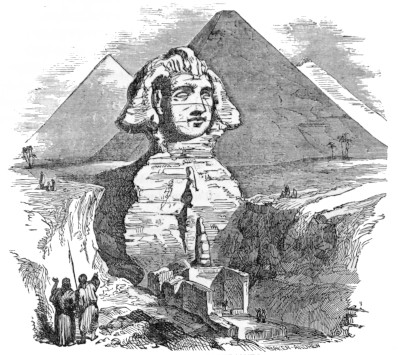
THE SPHINX AND PYRAMIDS.
The base of the great pyramid of Cheops, so named after a king of Egypt, is estimated by Denon at seven hundred and twenty feet, and its hight at four hundred and forty-eight feet, calculating the base by the mean proportion of the length of the stones, and the hight by the sum of that of each of the steps or stages. Its construction required so many years, and employed such a multitude of laborers, that the expenditure for garlic and onions alone, for their consumption, is said to have amounted to one thousand and sixty talents, or more than twelve hundred thousand dollars. Its interior is thus accurately described by the above traveler.
“The entrance of the first gallery is concealed by the general outer covering which invests the whole of the pyramid. It is, however, probable, that the attention of the earlier searchers was by some particular appearance directed to this spot. This gallery goes toward the center of the edifice, in a direction sloping downward to the base: it is sixty paces in length; and at the further end are two large blocks of granite, an obstacle which caused some uncertainty in the digging. A horizontal passage has been made for 493some distance into the mass of stone; but this undertaking was afterward abandoned.
“Returning to the extremity of the first gallery, and working upward by the side of the two granite blocks, you come to the beginning of the first sloping staircase, which proceeds in an oblique direction upward, for a hundred and twenty feet. You mount the steep and narrow gallery, helping your steps by notches cut in the ground, and by resting your hands against the sides. At the top of this gallery, which is formed of a calcareous stone cemented with mortar, you find a landing-place about fifteen feet square, within which, to the right of the entrance, is a perpendicular opening called the well. This appears, from its irregularity, to have been the result of a fruitless attempt at a search, and has a diameter of about two feet by eighteen inches. There were no means of descending it; but by throwing down a stone, it was ascertained that its perpendicular direction could not be very considerable. On a level with the landing is a horizontal gallery, a hundred and seventy feet in length, running directly toward the center of the pyramid; and at the extremity of this gallery is a small room, called the queen’s chamber. This is an oblong square of eighteen feet and two inches, by fifteen feet and eight inches; but the hight is uncertain, the floor having been turned up by the avidity of the searchers. One of the side walls has also been worked into, and the rubbish left on the spot. The roof, which is formed of a fine calcareous stone, very nearly brought together, has the form of an angle nearly equilateral, but contains neither ornament, hieroglyphic, nor the smallest trace of a sarcophagus. Whether it was intended to contain a body, is uncertain; but, in this case, the pyramid must have been built with a view of containing two bodies, and would not therefore have been closed at once. If the second tomb was really that of the queen, the two blocks of granite at the end of the first gallery, must have been finally reserved to close all the interior chambers of the pyramid.
“Returning again from the queen’s chamber to the landing-place, you ascend a few feet, and immediately find yourself at the bottom of a large and magnificent staircase, or rather inclined plane, one hundred and eighty feet in length, taking a direction upward, and still bearing toward the center of the edifice. It is six and a half feet in breadth, in which are to be included two parapets, each nineteen inches in diameter, and pierced every three and a half feet, by oblong holes twenty-two inches by three. The sarcophagus must have ascended this passage, and the series of holes must have been intended to receive a machine of some description, to assist in raising so heavy a mass as the sarcophagus up so steep an ascent.
“The side walls of this ascending gallery rise perpendicularly for twelve 494feet, and then form a sloping roof of an excessively high pitch, not by a regular angle, but by eight successive projections, each of them six feet in hight, rising above the other, and approaching nearer to the corresponding projection on the opposite side, till the roof is entirely shut in. The hight of this singularly contrived vault may be estimated at sixty feet from the part of the floor immediately beneath. The ascent of the staircase is facilitated by pretty regular but modern footings cut in the floor; and at the top is a small platform, in which is a thick block of granite, resembling an immense chest, imbedded in the solid building, and hollowed out so as to leave alternate projections and retirings, into which are let blocks of the same material, with corresponding grooves and projections, intended forever to conceal and protect the entrance to the principal chamber which is behind them. It must have required immense labor to construct this part of the edifice, and not less to have broken an opening through; so that the zeal of superstition has here been opposed to the eagerness of avarice, and the latter has prevailed. After mining through thirteen feet of solid granite, a door three feet and three inches square, has been discovered, which is the entrance to the principal chamber. This is a long square, sixteen feet by thirty-two, and eighteen in hight. The door is in the angle facing the gallery, corresponding to the door of the queen’s chamber, below. When it is said that the tomb is a single piece of granite, half-polished, and without cement, all that is remarkable in this strange monument, which exhibits such rigid simplicity in the midst of the utmost magnificence of human power, will have been described. The only broken part is an attempt at a search at one of the angles, and two small holes nearly round and breast high. Such is the interior of this immense edifice, in which the work of the hand of man appears to rival the gigantic forms of nature.”
To the above account by the accurate Denon, we subjoin the following pleasing one by the celebrated Dr. Clarke. The impression made by these monuments, when viewed at a distance, can never, he observes, be obliterated from his mind.
“By reflecting the sun’s rays, they appeared as white as snow, and of such surprising magnitude, that nothing we had previously conceived in our imagination had prepared us for the spectacle we beheld. The sight instantly convinced us that no power of description, no delineation, can convey ideas adequate to the effect produced in viewing these stupendous monuments. The formality of their structure is lost in their prodigious magnitude: the mind, elevated by wonder, feels at once the force of an axiom, which, however disputed, experience confirms—that in vastness, whatsoever be its nature, there dwells sublimity!
495“Having arrived at the bottom of a sandy slope, leading up to the principal pyramid, a band of Bedouin Arabs, who had assembled to receive us upon our landing, were much amused by the eagerness excited in our whole party, to prove who should first set his foot upon the summit of this artificial mountain. As we drew near its base, the effect of its prodigious magnitude, and the amazement caused in viewing the enormous masses used in its construction, affected every one of us; but it was an impression of awe and fear rather than of pleasure. In the observations of travelers who had recently preceded us, we had heard the pyramids described as huge objects which gave no satisfaction to the spectator, on account of their barbarous shape, and formal appearance: yet to us it appeared hardly possible that persons susceptible of any feeling of sublimity could behold them unmoved. With what amazement did we survey the vast surface that was presented to us, when we arrived at this stupendous monument, which seemed to reach the clouds? Here and there appeared some Arab guides upon the immense masses above us, like so many pigmies, waiting to show the way up to the summit. Now and then we thought we heard voices, and listened; but it was the wind in powerful gusts, sweeping the immense ranges of stone. Already some of our party had begun the ascent, and were pausing at the tremendous depth which they saw below. One of our military companions, after having surmounted the most difficult part of the undertaking, became giddy in consequence of looking down from the elevation he had attained; and being compelled to abandon the project, he hired an Arab to assist him in effecting his descent. The rest of us, more accustomed to the business of climbing hights, with many a halt for respiration, and many an exclamation of wonder, pursued our way toward the summit. The mode of ascent has been frequently described; and yet, from the questions which are often proposed to travelers, it does not appear to be generally understood. The reader may imagine himself to be upon a staircase, every step of which, to a man of middle stature, is nearly breast high; and the breadth of each step is equal to its hight; consequently, the footing is secure; and although a retrospect, in going up, be sometimes fearful to persons unaccustomed to look down from any considerable elevation, yet there is little danger of falling. In some places, indeed, where the stones are decayed, caution may be required; and an Arab guide is always necessary, to avoid a total interruption; but, upon the whole, the means of ascent are such that almost every one may accomplish it. Our progress was impeded by other causes. We carried with us a few instruments; such as our boat-compass, a thermometer, a telescope, &c.: these could not be trusted in the hands of Arabs, and they were liable to be broken every instant. At length we 496reached the topmost tier, to the great delight and satisfaction of all the party. Here we found a platform, thirty-two feet square, consisting of nine large stones, each of which might weigh about a tun; although they are much inferior in size to some of the stones used in the construction of this pyramid.
“The view from the summit of the pyramid amply fulfilled our expectations; nor do the accounts which have been given of it, as it appears at this season of the year, (in the month of August,) exaggerate the novelty and grandeur of the sight. All the region toward Cairo and the delta resembled a sea covered with innumerable islands. Forests of palm-trees were seen standing in the water; the inundation spreading over the land where they stood, so as to give them an appearance of growing in the flood. To the north, as far as the eye could reach, nothing could be discerned, but a watery surface thus diversified by plantations and by villages. To the south we saw the pyramids of Sakkara; and, upon the east of these, smaller monuments of the same kind, nearer to the Nile. An appearance of ruins might indeed be traced the whole way from the pyramids of Gizeh to those of Sakkara; as if they had been once connected, so as to constitute one vast cemetery. Beyond the pyramids of Sakkara we could perceive the distant mountains of the Said; and upon an eminence near the Libyan side of the Nile appeared a monastery of considerable size. Toward the west and south-west, the eye ranged over the great Libyan desert, extending to the utmost verge of the horizon, without a single object to interrupt the dreary horror of the landscape, except dark floating spots, caused by the shadows of passing clouds upon the sand.
“The stones of the platform upon the top, as well as most of the others used in constructing the decreasing ranges from the base upward, are of soft limestone. Those employed in the construction of the pyramids, are of the same nature as the calcareous rock on which they stand, and which was apparently cut away to form them. Herodotus says, however, that they were brought from the Arabian side of the Nile.
“The French attempted to open the smallest of the three principal pyramids; and having effected a very considerable chasm in one of its sides, have left this mark behind them, as an everlasting testimony of their curiosity and zeal. The landing of our army in Egypt put a stop to their labor. Had it not been for this circumstance, the interior of that mysterious monument would probably be now submitted to the inquiry which has long been an object among literary men.
“Having collected our party upon a soft platform before the entrance of the passage leading to the interior, and lighted a number of tapers, we all descended into the dark mouth of the larger pyramid. The impression made 497upon every one of us, in viewing the entrance, was this: that no set of men whatever could thus have opened a passage, by uncovering precisely the part of the pyramid where the entrance was concealed, unless they had been previously acquainted with its situation; and for these reasons. First, because its position is almost in the center of one of its planes, instead of being at the base. Secondly, that not a trace appears of those dilapidations which must have been the result of any search for a passage to the interior; such as now distinguish the labors of the French upon the smaller pyramid, which they attempted to open. The persons who undertook the work, actually opened the pyramid in the only point, over all its vast surface, where, from the appearance of the stones inclined to each other above the mouth of the passage, any admission to the interior seems to have been originally intended. So marvelously concealed as this was, are we to credit the legendary story of an Arabian writer, who, discoursing of the wonders of Egypt, attributed the opening of this pyramid to Almamon, a caliph of Babylon, about nine hundred and fifty years since?
“Proceeding down this passage, which may be compared to a chimney about a yard wide, we presently arrived at a very large mass of granite: this seems to have been placed on purpose to choke up the passage; but a way has been made round it, by which we were enabled to ascend into a second channel, sloping, in a contrary direction, toward the mouth of the first. Having ascended along this channel, to the distance of one hundred and ten feet, we came to a horizontal passage, leading to a chamber with an angular roof, in the interior of the pyramid. In this passage we found, upon our right hand, the mysterious well, which has been so often mentioned. Pliny makes the depth of it equal to one hundred and twenty-nine feet; but Greaves, in sounding it with a line, found the plummet rest at the depth of twenty feet.
“We threw down some stones, and observed that they rested at about the depth which Greaves has mentioned; but being at length provided with a stone nearly as large as the mouth of the well, and about fifty pounds in weight, we let this fall, listening attentively to the result from the spot where the other stones rested: we were agreeably surprised by hearing, after a length of time which must have equaled some seconds, a loud and distinct report, seeming to come from a spacious subterraneous apartment, accompanied by a splashing noise, as if the stone had been broken in pieces, and had fallen into a reservoir of water at an amazing depth. Thus does experience always tend to confirm the accounts left us by the ancients; for this exactly answers to the description given by Pliny of this well.
“After once more regaining the passage whence these ducts diverge, we 498examined the chamber at the end of it, mentioned by all who have described the interior of this building. Its roof is angular; that is to say, it is formed by the inclination of large masses of stone leaning toward each other, like the appearance presented by those masses which are above the entrance to the pyramid. Then quitting the passage altogether, we climbed the slippery and difficult ascent which leads to what is called the principal chamber. The workmanship, from its perfection, and its immense proportions, is truly astonishing. All about the spectator, as he proceeds, is full of majesty, and mystery, and wonder. Presently we entered that ‘glorious roome,’ as it is justly called by Greaves, where, ‘as within some consecrated oratory, art may seem to have contended with nature.’ It stands ‘in the very heart and center of the pyramid, equidistant from all its sides, and almost in the midst between the basis and the top. The floor, the sides, the roof of it, are all made of vast and exquisite tables of Thebaick marble.’ So nicely are these masses fitted to each other upon the sides of the chamber, that, having no cement between them, it is really impossible to force the blade of a knife within the joints. This has been often related before; but we actually tried the experiment, and found it to be true. There are only six ranges of stone from the floor to the roof, which is twenty feet high; and the length of the chamber is about twelve yards. It is also about six yards wide. The roof or ceiling consists of only nine pieces, of stupendous size and length, traversing the room from side to side, and lying, like enormous beams, across the top.”
Mr. Salt, the traveler, having paid a later visit to the principal pyramid, in company with a British officer, ascertained that the short descending passage at its entrance, which afterward ascends to the two chambers, is continued in a straight line through the base of the pyramid into the rock on which it stands. This new passage, a view of which is given in the cut below, after joining what was formerly called the well, is continued forward in a horizontal line, and terminates in a well, ten feet in depth, exactly beneath the apex of the pyramid, and at the depth of one hundred feet beneath its base. Mr. Salt’s companion likewise discovered an apartment immediately above the king’s chamber, exactly of the same size, and of the same fine workmanship, but only four feet in hight.
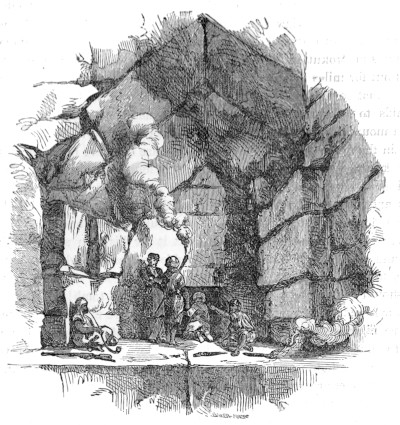
ENTRANCE TO ONE OF THE PYRAMIDS OF GIZEH.
The base of the pyramid of Cephrenes, the next in magnitude, of the pyramids of Gizeh, to that of Cheops, is estimated at six hundred and fifty-five feet, and its hight at three hundred and ninety-eight. The pyramid of Mycerinus has a base of two hundred and eighty feet, and an elevation of one hundred and sixty-two. But, as well suggested by Thompson, in his “Egypt Past and Present,” no mere detail of figures and statistics, can 499convey an idea of the size of these vast bodies as they impress us when we stand before them. “No idea,” he says, “can be given of the great pyramid, by the statement that it covers an area of nearly five hundred and fifty thousand square feet, measures seven hundred and fifty feet upon each of its four sides at the base, and is four hundred and sixty feet in hight, or that it would fill the whole length of Washington square in New York, and exceed its breadth by half, and would rise nearly two hundred feet higher than the spire of Trinity church. The mass of masonry is what impresses you. Eighty-five million cubic feet of solid masonry, gives you no very definite idea of the mass of stone here piled together with such mathematical precision that astronomical calculations could be based upon its angles and shadows. No, you must see the mass itself, not now smooth and polished, as when originally completed, but stripped of its outer casing, and showing tier on tier of huge stones squared and fitted at mathematical angles, and now forming a series of rude steps, each from two to four feet 500high, extending to the very top. That top is now a platform about thirty feet square; and the view from its elevation is unparalleled in the world! Before you is Cairo, with its lofty minarets, and its overhanging citadel, the mountains of Mokuttam skirting its rear; the green valley of the Nile is spread out for miles northward and southward; at your feet are the mounds of sand that cover the ancient Memphis; southward is the whole range of pyramids to Sakkara; behind you are fragments of other pyramids, the Libyan mountains, and the wide waste of the great desert. But the present is lost in the associations of the past. You are standing upon a monument that is known to have stood within a score of four thousand years; that was as old as are our associations of Plymouth rock, when Abraham came into Egypt, and journeyed to Memphis to enjoy the favor of the king. He looked with wondering eyes upon this self-same monument, and heard the then dim tradition of the tyrant, who, having built it for his own sepulcher by the sweat and blood of half a million of his subjects, was compelled to beg of his friends to bury him privately in some secret place, lest after his death, his body should be dragged by the people from the hated tomb!”
The pyramids of Sakkara, which are numerous, are interesting on account of the peculiarities of their structure. The largest of them is of an irregular form, the line of the terminating angle being sloped like a buttress reversed. Another, of a middling size, is composed of stages rising one above another. The smaller ones are greatly decayed; but the whole occupy an extent of two leagues. This multitude of pyramids scattered over the district of Sakkara, Denon observes, prove that this territory was the necropolis (city of the dead) to the south of Memphis, and that the village opposite to this, in which the pyramids of Gizeh are situated, was another necropolis, which formed the northern extremity of Memphis. The extent of that ancient city may thus be measured.
To these interesting accounts of this group of the pyramids, may be subjoined the graphic sketch of Bayard Taylor, who visited them so recently as 1851. “When we threw open the latticed blinds of our cabin, before sunrise the next morning, the extraordinary purity of the air gave rise to an amusing optical delusion on the part of my friend. ‘See that wall!’ said he, pointing to a space between two white houses; ‘what a brilliant color it is painted, and how those palms and these white houses are relieved against it!’ He was obliged to look twice before he perceived that what he had taken for a wall close at hand, was really the sky, and rested upon a far-off horizon. Our donkeys were in readiness on the bank, and taking Achmet with us, we rode off gayly among the mud hovels and under the date-trees of Gizeh, on our way to the pyramids. The rising sun shone redly upon them, as we 501rode out on the broad harvest land of the Nile. The black unctuous loam was still too moist from the inundation to be plowed, except in spots, here and there, but even where the water had scarce evaporated, millions of germs were pushing their slender blades up to the sunshine. In that prolific soil, the growth of grain is visible from day to day. The Fellahs were at work on all sides, preparing for planting, and the ungainly buffaloes drew their long plows slowly through the soil. Where freshly turned, the earth had a rich, soft luster, like dark-brown velvet, beside which the fields of young wheat, beans and lentils, glittered with the most brilliant green. The larks sang in the air and flocks of white pigeons clustered like blossoms on the tops of the sycamores. There, in November, it was the freshest and most animating picture of spring. The direct road to the pyramids was impassable, on account of the water, and we rode along the top of a dike, intersected by canals, to the edge of the Libyan desert, a distance of nearly ten miles. The ruptures in the dike obliged us occasionally to dismount, and at the last canal, which cuts off the advancing sands from the bounteous plain on the other side, our donkeys were made to swim, while we were carried across on the shoulders of two naked Arabs. They had run out in advance to meet us, hailing us with many English and French phrases, while half a dozen boys, with earthen bottles which they had just filled from the slimy canal, crowded after them, insisting, in very good English, that we should drink at once and take them with us to the pyramids.
“Our donkeys’ hoofs now sank deep in the Libyan sands, and we looked up to the great stone-piles of Cheops, Cephrenes and Mycerinus, not more than half a mile distant. Our sunrise view of the pyramids on leaving Gizeh, was sufficient, had I gone no further; and I approached them, without the violent emotion which sentimental travelers experience, but with a quiet feeling of the most perfect satisfaction. The form of the pyramid is so simple and complete, that nothing is left to the imagination. Those vast, yellowish-gray masses, whose feet are wrapped in the silent sand, and whose tops lean against the serene blue heaven, enter the mind and remain in the memory with no shock of surprise, no stir of unexpected admiration. The impression they give and leave, is calm, grand and enduring as themselves.
“The sun glared hot on the sand as we toiled up the ascent to the base of Cheops, whose sharp corners were now broken into zigzags by the layers of stone. As we dismounted in his shadow, at the foot of the path which leads up to the entrance, on the northern side, a dozen Arabs beset us. They belonged to the regular herd who have the pyramids in charge, and are so renowned for their impudence that it is customary to employ the janissary of some consulate in Cairo, as a protection. I took three of them and 502commenced the ascent, leaving Achmet and my friend below. Two boys followed us, with bottles of water. At first, the way seemed hazardous, for the stones were covered with sand and fragments which had fallen from above, but after we had mounted twenty courses, the hard, smooth blocks of granite formed broader and more secure steps. Two Arabs went before, one holding each of my hands, while the third shoved me up from the rear. The assistance thus rendered was not slight, for few of the stones are less than four feet in hight. The water-boys scampered up beside us with the agility of cats. We stopped a moment to take breath, at a sort of resting-place half-way up, an opening in the pyramid, communicating with the uppermost of the interior chambers. I had no sooner sat down on the nearest stone, than the Arabs stretched themselves at my feet and entertained me with most absurd mixture of flattery and menace. One, patting the calves of my legs, cried out, ‘Oh, what fine, strong legs! how fast they came up: nobody ever went up the pyramid so fast!’ while the others added, ‘Here you must give us backsheesh: everybody gives us a dollar here.’ My only answer was, to get up and begin climbing, and they did not cease pulling and pushing till they left me breathless on the summit. The whole ascent did not occupy more than ten minutes.
“The view from Cheops has been often described. I can not say that it increased my impression of the majesty and grandeur of the pyramid, for that was already complete. My eyes wandered off from the courses of granite, broadening away below my feet, to contemplate the glorious green of the Nile-plain, barred with palm-trees and divided by the gleaming flood of the ancient river; the minarets of Cairo; the purple walls of the far Arabian mountains; the pyramid groups of Sakkara and Dashoor, overlooking disinterred Memphis in the south; and the arid yellow waves of the Libyan desert, which rolled unbroken to the western sky. The clear, open heaven above, which seemed to radiate light from its entire concave, clasped in its embrace and harmonized the different features of this wonderful landscape. There was too much warmth and brilliance for desolation. Everything was alive and real; the pyramids were not ruins, and the dead Pharaohs, the worshipers of Athor and Apis, did not once enter my mind.
“My wild attendants did not long allow me to enjoy the view quietly. To escape from their importunities for backsheesh I gave them two piasters in copper coin, which instantly turned their flatteries into the most bitter complaints. It was insulting to give so little, and they preferred having none; if I would not give a dollar, I might take the money back. I took it without more ado, and put it into my pocket. This rather surprised them, and first one, and then another, came to me and begged to have it again, on 503his own private account. I threw the coins high into the air, and as they clattered down on the stones, there ensued such a scramble as would have sent any but Arabs over the edge of the pyramid. We then commenced the descent, two seizing my hands as before, and dragging me headlong after them. We went straight down the side, sliding and leaping from stone to stone without stopping to take breath, and reached the base in five or six minutes. I was so excited from the previous aggression of the Arabs, that I neither felt fatigue nor giddiness on the way up and down, and was not aware how violent had been my exertions. But when I touched the level sand, all my strength vanished in an instant. A black mist came over my eyes, and I sank down helpless and nearly insensible. I was scarcely able to speak, and it was an hour before I could sit upright on my donkey. I felt the pyramid in all my bones, and for two or three days afterward moved my joints with as much difficulty as a rheumatic patient.
“In returning, in about an hour and a half we reached the ruined pyramids of Abousir, where our path turned southward into the desert. After seeing Cheops and Cephrenes, these pyramids are only interesting on account of their dilapidated state and the peculiarity of their forms, some of their sides taking a more obtuse angle at half their hight. They are buried deep in the sand, which has so drifted toward the plain, that from the broad hollow lying between them and the group of Sakkara, more than a mile distant, every sign of vegetation is shut out. Vast, sloping causeways of masonry lead up to two of them, and a large mound, occupying the space between, suggests the idea that a temple formerly stood there. The whole of the desert promontory, which seemed to have been gradually blown out on the plain, from the hills in the rear, exhibits traces here and there of ruins beneath the surface. My friend and I, as we walked over the hot sand, before our panting donkeys, came instinctively to the same conclusion, that a large city must have once occupied the space between, and to the southward of the two groups of pyramids. It is not often that amateur antiquarians find such sudden and triumphant confirmation of their conjectures, as we did.
“On the way, Achmet had told us of a Frenchman who had been all summer digging in the sand, near Sakkara. After we had crawled into the subterranean dépôt of mummied ibises, and nearly choked ourselves with dust in trying to find a pot not broken open; and after one of our donkeymen went into a human mummy pit and brought out the feet and legs of some withered old Egyptian, we saw before us the residence of this Frenchman; a mud hut on a high sand-bank. It was an unfortunate building, for nearly all the front wall had tumbled down, revealing the contents of his kitchen. One or two Arabs loitered about, but a large number were employed at the 504end of a long trench which extended to the hills. Before reaching the house a number of deep pits barred our path, and the loose sand, stirred by our feet, slid back into the bottom, as if eager to hide the wonders they disclosed. Pavements, fresh as when first laid; basement-walls of white marble, steps, doorways, pedestals and fragments of pillars glittered in the sun, which, after the lapse of more than two thousand years, beheld them again. I slid down the side of the pit and walked in the streets of Memphis. The pavement of bitumen, which once covered the stone blocks, apparently to protect them and deaden the noise of horses and chariots, was entire in many places. Here a marble sphinx sat at the base of a temple, and stared abstractedly before her; there a sculptured cornice, with heavy moldings, leaned against the walls of the chamber into which it had fallen; and over all were scattered fragments of glazed and painted tiles and sculptured alabaster. The principal street was narrow, and was apparently occupied by private dwellings, but at its extremity were the basement-walls of a spacious edifice. All the pits opened on pavements and walls, so fresh and cleanly cut, that they seemed rather the foundations of a new city, laid yesterday, than the remains of one of the oldest capitals of the world.
“We approached the workmen, where we met the discoverer of Memphis, Mr. Auguste Mariette. On finding we were not Englishmen, (of whose visits he appeared to be rather shy,) he became very courteous and communicative. He apologized for the little he had to show us, since on account of the vandalism of the Arabs, he was obliged to cover up all his discoveries, after making his drawings and measurements. The Egyptian authorities are worse than apathetic, for they would not hesitate to burn the sphinxes for lime, and build barracks for filthy soldiers with the marble blocks. Besides this, the French influence at Cairo was then entirely overshadowed by that of England, and although M. Mariette was supported in his labors by the French academy, and a subscription headed by Louis Napoleon’s name, he was forced to be content with the simple permission to dig out these remarkable ruins and describe them. He could neither protect them nor remove the portable sculptures and inscriptions, and therefore preferred giving them again into the safe keeping of the sand. Here they will be secure from injury, until some more fortunate period, when, possibly, the lost Memphis may be entirely given to the world, as fresh as Pompeii, and far more grand and imposing.
“I asked M. Mariette what first induced him to dig for Memphis in that spot, since antiquarians had fixed upon the mounds near Mitrahenny (a village in the plain below, and about four miles distant,) as the former site of the city. He said that the tenor of an inscription which he found on one 505of the blocks quarried out of these mounds, induced him to believe that the principal part of the city lay to the westward, and therefore he commenced excavating in the nearest sand-hill in that direction. After sinking pits in various places he struck on an avenue of sphinxes, the clue to all his after discoveries. Following this, he came upon the remains of a temple, (probably the Serapeum, or temple of Serapis, mentioned by Strabo,) and afterward upon streets, colonnades, public and private edifices, and all other signs of a great city. The number of sphinxes alone, buried under these high sand-drifts, amounted to two thousand, and he had frequently uncovered twenty or thirty in a day. He estimated the entire number of statues, inscriptions and reliefs, at between four and five thousand. The most remarkable discovery was that of eight colossal statues, which were evidently the product of Grecian art. During thirteen months of assiduous labor, with but one assistant, he had made drawings of all these objects and forwarded them to Paris. In order to be near at hand, he had built an Arab house of unburnt bricks, the walls of which had just tumbled down for the third time. His workmen were then engaged in clearing away the sand from the dwelling of some old Memphian, and he intended spreading his roof over the massive walls, and making his residence in the exhumed city. The man’s appearance showed what he had undergone, and gave me an idea of the extraordinary zeal and patience required to make a successful antiquarian. His face was as brown as an Arab’s, his eyes severely inflamed, and his hands as rough as a bricklayer’s. His manner with the native workmen was admirable, and they labored with a hearty good-will which almost supplied the want of the needful implements. All they had were straw baskets, which they filled with a sort of rude shovel, and then handed up to be carried off on the heads of others.
“Strabo states that Memphis had a circumference of seventeen miles, and therefore both M. Mariette and the antiquarians are right. The mounds of Mitrahenny probably mark the eastern portion of the city, while its western limit extended beyond the pyramids of Sakkara, and included in its suburbs those of Abousir and Dashoor. The space explored by M. Mariette is about a mile and a half in length, and somewhat more than half a mile in breadth. He was then continuing his excavations westward, and had almost reached the first ridge of the Libyan hills, without finding the termination of the ruins. The magnitude of his discovery will be best known when his drawings and descriptions are given to the world. A few months after my visit, his labors were further rewarded by finding thirteen colossal sarcophagi of black marble, and he has recently added to his renown by discovering an entrance to the Sphinx. Yet at that time, the exhumation of the lost Memphis, 506second only in importance to that of Nineveh, was unknown in Europe, except to a few sarans in Paris, and the first intimation which some of my friends in Cairo and Alexandria had of it, was my own account of my visit, in the newspapers they received from America. But M. Mariette is a young man, and will yet see his name inscribed beside those of Burckhardt, Belzoni and Layard.
“We had still a long ride before us, and I took leave of Memphis and its discoverer, promising to revisit him on my return from Khartoum. As we passed the brick pyramid of Sakkara, which is built in four terraces of equal hight, the dark, grateful green of the palms and harvest-fields of the Nile appeared between two sand-hills, a genuine balm to our heated eyes. We rode through groves of the fragrant mimosa to a broad dike, the windings of which we were obliged to follow across the plain, as the soil was still wet and adhesive. It was too late to visit the beautiful pyramids of Dashoor, the first of which is more than three hundred feet in hight, and from a distance has almost as grand an effect as those of Gizeh. Our tired donkeys lagged slowly along to the palm-groves of Mitrahenny, where we saw mounds of earth, a few blocks of red granite and a colossal statue of Remeses II., (Sesostris,) which until now were supposed to be the only remains of Memphis. The statue lies on its face in a hole filled with water. The countenance is said to be very beautiful, but I could only see the top of Sesostris’s back, which bore a faint resemblance to a crocodile. Through fields of cotton in pod and beans in blossom, we rode to the Nile, dismissed our donkeys and their attendants, and lay down on some bundles of cornstalks to wait the arrival of our boat. But there had been a south wind all day, and we had ridden much faster than our men could tow. We sat till long after sunset before the stars and stripes, floating from the mizzen of the Cleopatra, turned the corner below Bedrasheyn. When, at last, we sat at our cabin-table, weary and hungry, we were ready to confess that the works of art produced by our cook, were more marvelous and interesting than Memphis and the pyramids.”
THE TOMBS AT SAKKARA.
The prediction of Taylor, quoted above, “that M. Mariette, though a young man, would yet see his name inscribed beside those of Burckhardt, Belzoni and Layard,” is in a fair way for fulfillment; for the finding of the wonderful tombs of Sakkara, and their magnificent sarcophagi, is, perhaps, the greatest discovery which has been made relative to the antiquities of Egypt, since the days of Belzoni himself. The tomb, a view of the entrance 507to which is given in the cut below, is situated in the desert near Sakkara, to the north-west of and near the pyramid, about four or five hours’ ride from Cairo, by way of Toura, where the Nile must be crossed. Monsieur Mariette, to whose knowledge and research this discovery is due, is employed by the French government. A passage in Strabo having led him to infer that a line of sphinxes led to the Serapeum, he commenced his search, under a firman from the viceroy of Egypt, about two years and a half since, in the moving sand-hills of Sakkara. He discovered the line of sphinxes, one of which had been found in 1832, by Signor Marucchi; but they not being in a straight direction, and turning abruptly at the entrance of the Serapeum, it was with difficulty they were traced. They were one hundred and forty in number, and sixteen feet apart. The whole avenue proved eleven hundred and twenty feet in length. At the termination were eleven Greek statues of Homer, Pindar, Solon, Lycurgus, Aristotle, and other poets, philosophers, and lawgivers of Greece. One sphinx, having the name of Apis inscribed 508upon it, was met with under a depth of sixty or seventy feet of sand: stone peacocks nine feet high, and colossal lions, were also found here. The tomb of Apis was now sought for, and discovered, after a whole year of labor, on the twelfth of November, 1851. From the avenue a mastaba, or bench, and passage two hundred and ninety feet long, leads to a pylon, the entrance of the great temple. The tomb runs from south to north, and the great gallery from east to west. This is about five hundred and twenty yards in length, and from four to five yards wide. The chambers are not formed throughout the whole length of the gallery, and some passages are altogether without them. The hieroglyphic inscriptions on the tomb are, in one instance, if not more, unfinished; and the doors erected at the entrance are too small to have allowed the passage of the sarcophagi, and must, therefore, have been built after the latter were introduced. The chambers are not opposite each other, but arranged alternately, in the usual manner of Egyptian places of sepulture. The appearance of this long gallery, when lighted up by numerous candles, receding in dim perspective into gloom—the massive sarcophagi, of polished granite, each in its chamber, looking tranquillity, is an imposing sight, as may be seen in the next following cut. They are of enormous size and weight: one, and that not the largest, has been estimated to weigh, including the lid, upward of sixty tuns. To have moved these and lowered them into their receptacles, which are some six feet below the floor of the gallery, in so confined a space, must have required a considerable amount of mechanical skill and power. In the walls are holes, apparently for the introduction of the ends of beams. The chambers may, however, have been filled with sand, the sarcophagus pushed in and gradually lowered by abstracting the sand. The under side of one of the sarcophagi is rounded, and it was kept steady by wooden blocks on each side. When these are removed it can be rocked by the hand. A groove, about two feet broad and two or three inches in depth, runs down the middle of the gallery. A wooden capstan was found near the tombs, and is supposed to have been used for moving the stones. The entrance is inclined. The tombs are excavated in a soft friable limestone, containing numerous small veins of gypsum, about half an inch in thickness. To prevent the roof from falling, it has been coated with flagstones, cemented to it by a gypseous cement; but, either by the hand of violence, or that of time, these have been detached, and have fallen to the ground, encumbering, and partially choking the galleries and rooms. The mortar, however, still adheres in several places to the walls, and projects where the joints of the stones have been. In one chamber is a self-sustained stone arch; another proof, if any were now necessary, that its construction was known to the ancients. This chamber 509contains a small sarcophagus, in which, probably, were the bones of a young bull. The bones of bulls have been found in several sarcophagi; but every one had been opened, and some heaped with stones; an eastern mark of contempt, probably the work of the Persians. At the entrance were numerous ex voto offerings of inscribed tablets inserted in small recesses in the walls. There are also inscriptions, in the Demotic character, on the outer doorway. In some chambers are large recesses to the right and left of the tomb, which in one instance contained a large granite tablet with hieroglyphics. The number of sarcophagi already discovered is twenty-five.
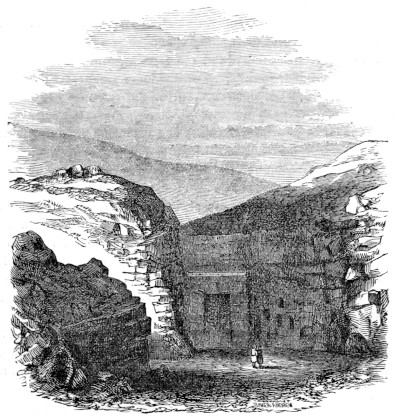
ENTRANCE TO THE TOMBS OF SAKKARA.
These tombs merit the visit of all antiquaries and travelers passing through Egypt; and M. Mariette’s work describing them is looked for with anxiety by all savans. To his kindness and courtesy, which, as well as his hospitality, are well known, the public are indebted for the greater portion of this information. Near to Sakkara, on the site of Memphis, Hekekyan Bey has been making excavations connected with the geological investigations of the Nile valley, instituted at the request of Mr. Leonard Horner and the Geological Society of London, by the viceroy, who has very recently received from the English government, through Mr. Murray, a letter of thanks for his liberal aid to the cause of science.
A view of the great gallery of these tombs, as it appears when lighted up, is given on the next page.
THE SPHINX.
Before passing to the pyramids and ruins of Meroë in Ethiopia, let us notice the celebrated Sphinx, which stands near the great pyramids of Gizeh, and the enormous bulk of which attracts the attention of every traveler. Of all the monuments of Egypt, this, in many respects, is the most mysterious and impressive. It is cut out of the solid rock, and by some is supposed to have been the sepulcher of Amasis. It is more than sixty feet from the ground to the crown of the head; more than a hundred feet around the forehead; and nearly one hundred and fifty feet in length. The nose has been shamefully mutilated. “Though its proportions are colossal, its outline,” says Denon, “is pure and graceful; the expression mild, gracious, and tranquil; the character is African; but the mouth, the lips of which are thick, has a softness and delicacy of execution truly admirable; it seems real life and flesh. Art must have been at a high pitch when this monument was executed; for, if the head is deficient in what is called style, that is, in the straight and bold lines which give expression to the figures under which the Greeks have designated their deities, yet sufficient 510justice has been rendered to the fine simplicity and character of nature displayed in this figure.”
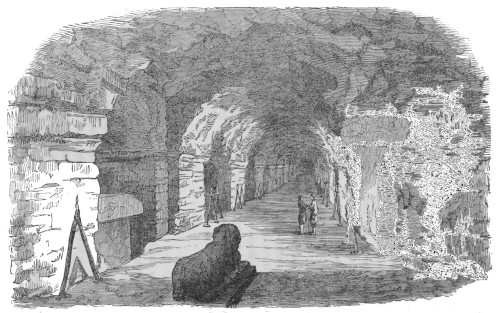
GREAT GALLERY OF THE TOMBS OF SAKKARA.
Thus far the description of Denon. But Taylor, who says of this monument that “there is nothing like it in the world,” adds, that “those travelers who pronounce its features to be negro in their character, are certainly very 511hasty in their conclusions. That it is an Egyptian head, is plainly evident, notwithstanding its mutilation. The type, however, is rather fuller and broader than is usual in Egyptian statues.” Who reared it, and for what purpose, and by what mighty enginery, is utterly unknown. But there it stands, “on the verge of the desert whose sands are heaped around it, and in advance of the three vast pyramids that form an immovable phalanx as if to guard it from destruction, looking out in unfathomable silence over the empty plain where once stood Memphis in the pride of the earlier Pharaohs, and where Cambyses battered down that pride with the recklessness of a barbarian invader. Once an altar stood before it, and a dromos of crouching lions and other figures formed a fit approach to the gigantic symbol of Egypt deified. But now the sands drift in perpetually to hide all but the head, whose sublime repose neither the war-club of the Persian, nor tho fury of the sirocco has ever disturbed.”
RUINS AND PYRAMIDS OF MEROËMEROË.
Passing up the Nile to its great fork in about latitude seventeen degrees, we come to the wonderful ruins and pyramids of Meroë, in Ethiopia. “The discovery of these ruins,” says the well known traveler last quoted, “is of comparatively recent date; and it is only within a very short time that their true place and character in Ethiopian history have been satisfactorily established. Hoskins, Cailliaud and Ferlini were the first to direct the attention of antiquarians to this quarter, and the later and more complete researches of Lepsius leave room for little more to be discovered concerning them. It is remarkable that both Bruce and Burckhardt, who traveled by land from Berber to Shendy, failed to see the ruins, which must have been visible from the road they followed. The former, in fact, speaks of the broken pedestals, carved stones and pottery which are scattered over the plain, and sagely says, ‘It is impossible to avoid risking a guess that this is the ancient city of Meroë;’ but he does not mention the groups of pyramids which are so conspicuous a feature in the landscape. Our path led over a plain covered with thorny shrubs at first, but afterward hard black gravel, and we had not gone more than a mile before the raïs pointed out the pyramids of the ancient Ethiopian city. I knew it only from its mention in history, and had never read any description of its remains; consequently I was surprised to see before me, in the vapory morning air, what appeared to be the ruins of pylæ and porticos, as grand and lofty as those of Karnak. Rising between us and the mountains, they had an imposing effect, and I approached them with excited anticipations. As advanced, however, and the morning 512vapors melted away, I found that they derived much of their apparent hight from the hill upon which they are built, and that, instead of being the shattered parts of one immense temple, they were a group of separate pyramids, standing amid the ruins of others which have been completely destroyed.
“We reached them after a walk of about four miles. They stand upon a narrow, crescent-shaped hill, which rises forty or fifty feet from the plain, presenting its convex front to the Nile, while toward the east its hollow curve embraces a small valley lying between it and the mountain range. Its ridge is crowned with a long line of pyramids, standing so close to each other that their bases almost meet, but presenting no regular plan or association, except in the direction of their faces. None of them retains its apex, and they are all more or less ruined, though two are perfect to within a few courses of the top. I climbed one of the highest, from which I could overlook the whole group, as well as another cluster, which crowned the summit of a low ridge at the foot of the mountains opposite. Of those among which I stood, there were sixteen, in different degrees of ruin, besides the shapeless stone-heaps of many more. They are all built of fine red sandstone, in regular courses of masonry, the spaces of which are not filled, or cased, as in the Egyptian pyramids, except at the corners, which are covered with a narrow hem or molding, in order to give a smooth outline. The stones are about eighteen inches high, and the recession of each course varies from two to four inches, so that the hight of the structure is always much greater than the breadth of the base. A peculiarity of these pyramids is, that the sides are not straight but curved lines, of different degrees of convexity, and the breadth of the courses of stone is adjusted with the utmost nicety, so as to produce this form. They are small, compared with the enormous piles of Gizeh and Dashoor, but singularly graceful and elegant in appearance. Not one of the group is more than seventy feet in hight, nor when complete could have exceeded one hundred. All, or nearly all, have a small chamber attached to the exterior, exactly against the center of their eastern sides, but no passage leading into the interior; and from the traces of Dr. Lepsius’s labors, by which I plainly saw that he had attempted in vain to find an entrance, it is evident that they are merely solid piles of masonry, and that, if they were intended tombs, the bodies were deposited in the outer chambers. Some of these chambers are entire, except the roof, and their walls are profusely sculptured with hieroglyphics, somewhat blurred and worn down, from the effect of the summer rains. Their entrances resembled the doorways of temples, on a miniature scale, and the central stones of two of them were sculptured with the sacred winged globe. I saw on the jamb of another, a figure of the god Horus. 513The chambers were quite small, and not high enough to allow me to stand upright. The sculptures have a very different character from those in the tombs of Thebes, and their resemblance to those of the Ptolemaic period was evident at the first glance. The only cartouches of monarchs which I found were so obliterated that I could not identify them; but the figure of one of the kings, grasping in one hand the hair of a group of captives, while with the other he lifts a sword to slay them, bears a striking resemblance to that of Ptolemy Euergetes, on the pylon of the temple at Edfou. Many of the stones in the vast heaps which lie scattered over the hills, are covered with sculptures. I found on some the winged globe and scarabeüs, while others retained the scroll or fillet which usually covers the sloping corners of a pylon. On the northern part of the hill I found several blocks of limestone, which exhibited a procession of sculptured figures brilliantly colored.
“The last structure on the southern extremity of the hill, is rather a tower than a pyramid, consisting of a high base or foundation, upon which is raised a square building, the corners presenting a very slight slope toward the top, which is covered with ruins, indicating that there was originally another and narrower story upon it. When complete, it must have borne considerable resemblance to the Assyrian towers, the remains of which are found at Nineveh. On this part of the hill there are many small detached chambers, all facing the east, and the remains of a large building. Here Lepsius appears to have expended most of his labors; and the heaps of stone and rubbish he has left behind him, prevent one from getting a very clear idea of the original disposition of the buildings. He has quarried one of the pyramids down to its base, without finding any chamber within or pit beneath it. My raïs, who was at a loss to comprehend the object of my visit, spoke of Lepsius as a great Frank astrologer, who had kept hundreds of the people at work for many days, and at last found in the earth a multitude of chickens and pigeons, all of solid gold. He then gave the people a great deal of backsheesh and went away, taking the golden fowls with him. The most interesting object he has revealed is a vaulted room, about twenty feet long, which the raïs pointed out as the place where the treasures were found. It is possible that he here referred to the discoveries made about twenty years ago by Ferlini, who excavated a great quantity of rings and other ornaments, Greek and Roman, as well as Ethiopian, which are now in the museum at Berlin. The ceiling of this vault is on the true principle of the arch, with a keystone in the center, which circumstance, as well as the character of the sculptures, would seem to fix the age of the pyramids at a little more than two thousand years. I took a sketch of this remarkable cluster of ruins from their northern end, and afterward another from the 514valley below, whence each pyramid appears distinct and separate, no one covering the other. The raïs and sailors were puzzled what to make of my inspection of the place, but finally concluded that I hoped to find a few golden pigeons, which the Frank astrologer had not carried away. I next visited the eastern group, which consists of ten pyramids, more or less dilapidated, and the ruined foundations of six or eight more. The largest, which I ascended, consists of thirty-five courses of stone, and is about fifty-three feet in hight, eight or ten feet of the apex having been hurled down. Each side of the apex is seventeen paces, or about forty-two feet long, and the angle of ascent is consequently much greater than in the pyramids of Egypt. On the slope of the hill are the substructions of two or three large buildings, of which sufficient remains to show the disposition of the chambers and the location of the doorways. Toward the south, near where the valley inclosed between the two groups opens upon the plain, are the remains of other pyramids and buildings, and some large, fortress-like ruins are seen on the summits of the mountains to the east. I would willingly have visited them, but the wind was blowing fresh, and the raïs was impatient to get back to his vessel. Many of the stones of the pyramids are covered with rude attempts at sculpturing camels and horses; no doubt by the Arabs, for they resemble a school-boy’s first drawings on a slate; straight sticks for legs, squares for bodies, and triangles for humps.
“Leaving the ruins to the company of the black goats that were browsing on the dry grass, growing in bunches at their eastern base, I walked to another group of pyramids, which lay a mile and a half to the south-west, toward the Nile. As we approached them, a herd of beautiful gray gazelles started from among the stones and bounded away into the desert. ‘These were the tents of the poor people,’ said the raïs, pointing to the pyramids; ‘the Frank found no golden pigeons here.’ They were, in fact, smaller and more dilapidated than the others. Some had plain burial chambers attached to their eastern sides, but the sculptures were few and insignificant. There were sixteen in all, more or less ruined. Scattering mounds, abounding with fragments of bricks and building stones, extended from these ruins nearly to the river’s bank, a distance of more than two miles; and the foundations of many other pyramids might be seen among them. The total number of pyramids in a partial state of preservation, (some being nearly perfect, while a few retained only two or three of the lower courses,) which I counted on the site of Meroë, was forty-two. Besides these, I noticed the traces of forty or fifty others, which had been wholly demolished. The entire number, however, of which Meroë could boast, in its prime, was one hundred and ninety-six. The mounds near the river, which cover an extent 515of between one and two miles, point out the site of the city, the capital of the old hierarchy of Meroë, and the pyramids are no doubt the tombs of its kings and priests. It is rather singular that the city has been so completely destroyed, as the principal spoilers of Egypt, the Persians, never penetrated into Ethiopia, and there is no evidence of the stones having been used to any extent by the Arabs, as building materials.
“The examination of Meroë has solved the doubtful question of an Ethiopian civilization anterior to that of Egypt. Hoskins and Cailliaud, who attributed a great antiquity to the ruins, were misled by the fact, discovered by Lepsius, that the Ethiopian monarchs adopted as their own, and placed upon their tombs the nomens of the earlier Pharaohs. It is now established beyond a doubt, that, so far from being the oldest, these are the latest remains of Egyptian art; their inferiority displays its decadence, and not the rude, original type, whence it sprang. Starting from Memphis, where not only the oldest Egyptian, but the oldest human records yet discovered, are found, the era of civilization becomes later, as you ascend the Nile. In Nubia, there are traces of Thothmes and Amunoph III., or about fifteen centuries before the Christian era; at Napata, the ancient capital of Ethiopia, we can not get beyond King Tirhaka, eight centuries later; while at Meroë, there is no evidence which can fix the date of the pyramids earlier than the first, or at furthest, the second century before Christ. Egypt, therefore, was not civilized from Ethiopia, but Ethiopia from Egypt. The sculptures at Meroë also establish the important fact that the ancient Ethiopians, though of a darker complexion than the Egyptians, (as they are in fact represented, in Egyptian sculpture,) were, like them, an offshoot of the great Caucasian race. Whether they were originally emigrants from northern India and the regions about Cashmere, as the Egyptians are supposed to have been, or, like the Beni Koreish at a later period, crossed over from the Arabian peninsula, is not so easily determined. The theory of Pococke and other scholars, based on the presumed antiquity of Meroë, that here was the first dawning on African soil of that earliest Indian civilization, which afterward culminated at Memphis and Thebes, is overthrown but we have what is of still greater significance, the knowledge that the highest civilization, in every age of the world, has been developed by the race to which we belong.
“I walked slowly back to the boat, over the desolate plain, striving to create from those shapeless piles of ruin the splendor of which they were once a part. The sun, and the wind, and the mountains, and the Nile, were what they had ever been; but where the kings and priests of Meroë walked in the pomp of their triumphal processions, a poor, submissive peasant knelt 516before me with a gourd full of goat’s milk; and if I had asked him when that plain had been inhabited, he would have answered me, like Chidhar, the prophet: ‘As thou seest it now, so has it been forever!’”forever!’”
PYRAMIDS AND RUINS OF MERAWE.
There are other pyramids and ruins in Ethiopia that would be worthy of extended notice, but that they are so far surpassed in number and magnificence by those already described. The principal of these are found at Merawe, the former capital of Darshygeea, to the north-west of Meroë, where the Nile, flowing south-west, reaches the frontier of Dongola. This Merawe must not be confounded with Meroë, the ruins of which have just been described. The identity of the sounds of the names, did, indeed, at first deceive antiquarians, who supposed the temples and pyramids in this neighborhood to have belonged to the capital of the old hierarchy of Meroë; but it is now satisfactorily established that they mark the site of Napata, the capital of Ethiopia up to the time of the Cæsars. It was the limit of the celebrated expedition of the Roman soldiers, under Petronius. Djebel Berkel, at whose base the principal remains are found, is in latitude eighteen degrees, thirty-five minutes, or thereabouts.
As the traveler already quoted, rose in the morning, to go over to the mountain and the ruins at its base, “I was,” says he, “enchanted with the picture which the shores presented. The air was filled with a light, silvery vapor, (a characteristic of sultry weather in Africa,) softening the deep, rich color of the landscape. The eastern bank was one bower of palms, standing motionless, in perfect groups, above the long, sloping banks of beans in blossom. Such grace and glory, such silence and repose, I thought I had never before seen in the vegetable world. Opposite, the ruined palaces of the old Shygheean kings, and the mud and stone hovels of modern Merawe, rose in picturesque piles above the river bank and below the red sandstone bluffs of the Nubian desert, which overhung them and poured the sand through deep rents and fissures upon their very roofs. The mosque, with a tall, circular minaret, stood embowered in a garden of date-palms, under one of the highest bluffs. Up the river, which stretched glittering into the distance, the forest of trees shut out the view of the desert, except Djebel Berkel, which stood high and grand above them; the morning painting its surface with red lights and purple shadows. Over the misty horizon of the river rose a single conical peak, far away. The sky was a pale, sleepy blue, and all that I saw seemed beautiful dream-pictures, everywhere grace, beauty, splendor of coloring, steeped in elysian repose. It is impossible to 517describe the glory of that passage across the river. It paid me for all the hardships of the desert.
“When we touched the other shore and mounted the little donkeys we had taken across with us, the ideal character of the scene disappeared, but left a reality picturesque and poetic enough. We rode under a cluster of ruined stone buildings, one of which occupied considerable space, rising pylon-like, to the hight of thirty feet. The shekh informed me that it had been the palace of a Shygheean king, before the Turks got possession of the country. It was wholly dilapidated, but a few Arab families were living in the stone dwellings which surround it. These clusters of shattered buildings extend for more than a mile along the river, and are all now known as Merawe. Our road led between fields of ripening wheat, rolling in green billows before the breeze, on one side, and on the other, not more than three yards distant, the naked sandstone walls of the desert, where a blade of grass never grew. Over the wheat, along the bank of the Nile, rose a long forest of palms, so thickly ranged that the eye could scarcely penetrate their dense, cool shade; while on the other hand the glaring sand-hills showed their burning shoulders above the bluffs. It was a most violent contrast, and yet, withal, there was a certain harmony in these opposite features. We now approached the mountain, which is between three and four miles from the town. It rises from out the sands of the Nubian desert, to the hight of five hundred feet, presenting a front completely perpendicular toward the river. It is inaccessible on all sides except the north, which in one place has an inclination of forty-five degrees. Its scarred and shattered walls of naked sandstone stand up stern and sublime in the midst of the hot and languid landscape. As we approached, a group of pyramids appeared on the brow of a sand-hill to the left, and I discerned at the base of the mountain several isolated pillars, the stone-piles of ruined pylons, and other remains of temples. The first we reached was at the south-eastern corner of the mountain. Amid heaps of sandstone blocks and disjointed segments of pillars, five columns of an exceedingly old form still point out the court of a temple, whose adyta are hewn within the mountain. They are not more than ten feet high and three in diameter, circular, and without capital or abacus, unless a larger block, rudely sculptured with the outlines of a Typhon-head, may be considered as such. The doorway is hurled down and defaced, but the cartouches of kings may still be traced on the fragments. There are three chambers in the rock, the walls of which are covered with sculptures, for the most part representing the Egyptian divinities. The temple was probably dedicated to Typhon, or the Evil Principle, as one of the columns is still faced with a caryatid of the short, plump, big-mouthed and bat-eared figure, which elsewhere 518represents him. Over the entrance is the sacred winged globe, and the ceiling shows the marks of brilliant coloring. The temple is not remarkable for its architecture, and can only be interesting in an antiquarian point of view. It bears some resemblance in its general style to the temple-palace of Goorneh, at Thebes.
“The eastern base of the mountain, which fronts the Nile, is strewn with hewn blocks, fragments of capitals, immense masses of dark bluish-gray granite, and other remains, which prove that a large and magnificent temple once stood there. The excavations made by Lepsius and others have uncovered the substructions sufficiently to show the general plan of two buildings. The main temple was at the north-eastern corner of the mountain, under the highest point of its perpendicular crags. The remains of its small propylons stand in advance, about two hundred yards from the rock, going toward which, you climb the mound formed by the ruins of a large pylon, at the foot of which are two colossal ram-headed sphinxes of blue granite, buried to their necks in the sand. Beyond this is a portico and pillared court, followed by other courts and labyrinths of chambers. Several large blocks of granite, all more or less broken and defaced, lie on the surface or half quarried from the rubbish. They are very finely polished and contain figures of kings, evidently arranged in genealogical order, each accompanied with his name. The shekh had a great deal to tell me of the Franks, who dug up all the place, and set the people to work at hauling away the lions and rams, which they carried off in ships. I looked in vain for the celebrated pedestal; it has probably become the spoil of Lepsius.
“It was now noon, and only the pyramids remained to be seen on that side of the river. The main group is about a third of a mile from the mountain, on the ridge of a sand-hill. There are six pyramids, nearly entire, and the foundations of others. They are almost precisely similar to those of the real Meroë, each having a small exterior chamber on the eastern side. Like the latter, they are built of sandstone blocks, only filled at the corners, which are covered with a hem or molding; the sides of two of them are convex. On all of them the last eight or ten courses next the top have been smoothed to follow the slope of the side. It was no doubt intended to finish them all in this manner. One of them has also the corner molding rounded, so as to form a scroll, like that on the cornice of many of the Egyptian temples. They are not more than fifty feet in hight, with very narrow bases. One of them, indeed, seems to be the connecting link between the pyramid and the obelisk. Nearer the river is an older pyramid, though no regular courses of stone are to be seen any longer. These sepulchral remains, however, are much inferior to those of Meroë. The oldest names 519found at Napata are those of Amenoph III. and Remeses II. (1630 B. C. and 1400 B. C.) both of whom subjected Nubia to their rule. The remains of Ethiopian art, however, go no further than King Tirkaka, 730 B. C.—the Ethiopian monarch, who, in the time of Hezekiah, marched into Palestine to meet Sennacherib, king of Assyria. Napata, therefore, occupies an intermediate place in history, between Thebes and Meroë, showing the gradual southward progress of Egyptian art and civilization. It is a curious fact that the old religion of Egypt should have been here met face to face, and overthrown, by Christianity, which, starting in the mountains of Abyssinia, followed the course of the Nile northward. In the sixth century of our era, Ethiopia and Nubia were converted to Christianity and remained thus until the fourteenth century, when they fell beneath the sword of Islam.
“The next morning, the shekh proposed going with me to the remains of a temple, half an hour distant, on the eastern bank of the river. After walking a mile and a half over the sands, which have here crowded the vegetation to the very water’s edge, we came to a broad mound of stones, broken bricks and pottery, with a foundation wall of heavy limestone blocks, along the western side. There were traces of doors and niches, and on the summit of the mound the pedestals of columns similar to those of El Berkel. From this place commenced a waste of ruins, extending for nearly two miles toward the north-west, while the breadth, from east to west, was about equal. For the most part, the buildings were entirely concealed by the sand, which was filled with fragments of pottery and glass, and with shining pebbles of jasper, agate and chalcedony. Half a mile further, we struck on another mound, of greater extent, though the buildings were entirely level with the earth. The foundations of pillars were abundant, and fragments of circular limestone blocks lay crumbling to pieces in the rubbish. The most interesting object was a mutilated figure of blue granite, of which only a huge pair of wings could be recognized. The shekh said that all the Frank travelers who came there broke off a piece and carried it away with them. I did not follow their example. Toward the river were many remains of crude brick walls, and the ground was strewn with pieces of excellent hard-burnt bricks. The sand evidently conceals many interesting objects. I saw in one place, where it had fallen in, the entrance to a chamber, wholly below the surface. The Arabs were at work in various parts of the plain, digging up the sand, which they filled in baskets and carried away on donkeys. The shekh said it contained salt, and was very good to make wheat grow, whence I inferred that the earth is nitrous. We walked for an hour or two over the ruins, finding everywhere the evidence that a large capital had once stood on the spot. The bits of water-jars which we 520picked up were frequently painted and glazed with much skill. The soil was in many places wholly composed of the debris of the former dwellings. This was, without doubt, the ancient Napata, of which Djebel Berkel was only the necropolis. Napata must have been one of the greatest cities of ancient Africa, after Thebes, Memphis and Carthage. I felt a peculiar interest in wandering over the site of that half-forgotten capital, whereof the ancient historians knew little more than we. That so little is said by them in relation to it is somewhat surprising, notwithstanding its distance from the Roman frontier.”
EGYPTIAN TEMPLES AND MONUMENTS.
Returning from Ethiopia to Egypt, we find not a few of its monuments and temples worthy of our notice as wonderful testimonies to the art and wealth of their ancient builders.
POMPEY’S PILLAR AND CLEOPATRA’S NEEDLE.
Passing out, toward the south, from modern Alexandria, one of the first objects that greets the eye of the traveler, is Pompey’s pillar, which rears its stupendous mass of polished granite in solitary grandeur, a monument of buried empires and of nations that have passed away. Though it now stands alone, it is supposed to have been but one of the four hundred stately columns of the Serapeum as it once stood in all its grandeur. “This pillar,” says Thompson, “is the one solitary monument of the old city upon its southern front, and answers to the one standing obelisk that is its solitary monument on the north. Of its origin, history is as silent as the mummy of Belzoni’s tomb; but there is no doubt that ‘Pompey’s pillar is really a misnomer;’ for the inscription ‘shows it to have been erected by Publius, the prefect of Egypt, in honor of Diocletian,’ who subdued a revolt at Alexandria by capturing the city, A. D. 296. But whether it was then first hewn from the quarry, or was transported from some decaying temple up the Nile, the Greek lettering does not inform us. If the latter, (which, considering the decline of art and the pilfering propensities of the Romans, is probable,) then this now lonely sentinel, an Egyptian column with a Greek inscription to a Roman emperor, has witnessed in turn the decay of Egypt, of Greece, and of Rome, upon the soil where it still disputes with Time the empire of the past. To the reader of Gibbon, it may seem strange that a monument should have been reared at Alexandria in honor of a conqueror, who, during a siege of eight months, wasted the city by the sword 521and by fire, and who, when it finally capitulated and implored his clemency, caused it to feel ‘the full extent of his severity,’ and destroyed ‘thousands of its citizens in a promiscuous slaughter.’ The fact may serve to show the worthlessness of such monuments as testimonials to character, or as expressions of public esteem. But whatever may be its history or its associations, one can not look upon this column without a feeling of astonishment and awe. Outside of the modern city walls and some six hundred yards to the south of them, away from the present homes of men, but on an eminence that overlooks the entire city, and in striking contrast with the meager, attenuated style of its present architecture, stands this stupendous column of red granite, ninety-nine feet in hight by thirty in circumference, its shaft an elegant monolith measuring seventy-three feet between the pedestal and the capital. It marks the site of an ancient stadium, and as some conjecture, of the gymnasium, which was surrounded with majestic porticos of granite.”
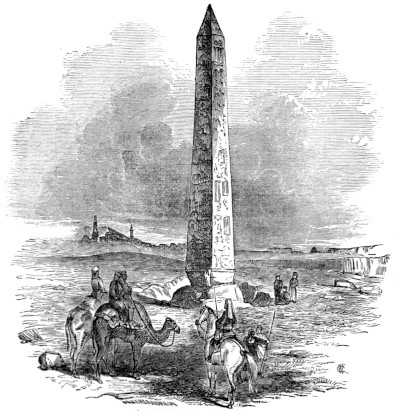
CLEOPATRA’S NEEDLE.
From Pompey’s pillar, to Cleopatra’s needles, is a distance of about a 522mile through the city in a north-easterly direction. “These obelisks,” says Thompson, “have no more relation to Cleopatra, than the pillar has to Pompey. Their hieroglyphics, according to Wilkinson and Lepsius, date back as far as the exodus from Egypt; and they were brought to Alexandria from the city of Heliopolis, or On, about a hundred miles to the south. Each ‘needle’ is a solid block of red granite, about seventy feet high, and nearly eight feet in diameter at the base. How such huge blocks were cut from the quarry, transported hundreds of miles, and erected upon their pedestals, is a mystery not solved by anything yet discovered of ancient mechanic arts. Only one of the obelisks is standing. The other was taken down to be transported to England, but now lies half buried in the mud and sand. On one side of the standing obelisk the hieroglyphics are distinctly legible, but on the northern or seaward side they are much defaced by the action of the weather. It stands upon the edge of the great harbor, in a line with the rock of Pharos that forms the extreme northern point of the horseshoe port.
“Besides the pillar and the needles nothing remains to testify the former splendor of Alexandria; a capital that once vied with Rome, containing a population equal to that of New York, (three hundred thousand freemen and as many slaves,) and that so late as the seventh century, according to the testimony of Amrou, its Saracenic conqueror, contained ‘four thousand palaces, four thousand baths, four hundred theaters, twelve thousand shops for the sale of vegetables, and forty thousand tributary Jews.’ A few ruins are pointed out, but these are fast disappearing with the ravages of time. Its name is the only memorial of its founder; and the long range of catacombs along the shore to the west of the city, the sole vestige of its ancient population. So rapid was the growth of the city, that at the commencement of the Christian era, it was ‘second only to Rome itself,’ and ‘comprehended a circumference of fifteen miles’ within its walls. It was a great seat of commerce. ‘Idleness was unknown. Either sex, and every age, was engaged in the pursuits of industry;’ the blowing of glass, the weaving of linen, manufacturing the papyrus, or conducting the lucrative trade of the port. Alexander, fresh from the conquest of Tyre, boasted that he would here build an emporium of commerce surpassing that which he had ruined, and thus would recreate in his own image the world he had destroyed. The site of Alexandria, more felicitous than that of Tyre, promised to realize his ambitious dream. Its gates ‘looked out on the gilded barges of the Nile, on fleets at sea under full sail, on a harbor that sheltered navies, and a light-house that was the mariner’s star, and the wonder of the world.’ But neither the felicity of its location, nor the enterprise of its Ptolemaic 523rulers, nor the wealth of its commerce, nor the learning that gathered to its schools the students of art, of philosophy, of medicine, of science, and of religion, could withstand the march of empire from Asia to Europe, nor the laws of trade that followed in its track.”
The present population of Alexandria is less than a hundred thousand; a mixture of all the oriental races, with many Europeans and Jews. In passing through its narrow and dirty streets, now occupied with a motley and poverty-stricken populace; in traversing the villages of hovels within its walls, where the Arab lies down with his sheep, his goat, his dog, and his donkey, all in the mud inclosure of a few feet square, which must be entered by stooping; and in climbing the huge mounds that are said to cover the ancient capital, it is difficult to realize that here once dwelt the hundred thousand Jews, for whom the seventy made their celebrated Greek version of the Old Testament; that here the eloquent Apollos was born, and the learned Athanasius conducted his theological controversies; that here Theodosius, by imperial edict, destroyed the temple of Serapis, and publicly established Christianity in place of the outcast divinities of the Egyptian Greeks; that here was a school to which the sages of Greece resorted for instruction in philosophy, science and letters, and where Jewish rabbins and Christian apologists vied with Greek dialecticians in the various pursuits of learning; and that here was a library of seven hundred thousand manuscript volumes, a British museum or a Smithsonian institute, boasting the originals or the duplicates of many of the most valuable works of the then current literature, and which, after the accidental destruction of a part of it in the insurrection against Julius Cæsar, and the willful destruction of another portion in the sanguinary religious wars under Theodosius, yet contained enough of written papyrus to heat for six months the four thousand baths of the city, under the summary decree of Omar: “If these writings of the Greeks agree with the book of God, they are useless, and need not be preserved; if they disagree, they are pernicious, and ought to be destroyed.” It is difficult amid such surroundings, to realize that here Cæsar and Antony dallied with the charms of Cleopatra. It is difficult to realize that where now bigotry, fanaticism and superstition hold sway over an ignorant and degraded people, were schools of theology, and learned fathers, and astute controversialists of the early Christian church; that here Christianity triumphed over paganism in popular tumults backed by imperial decrees; that here Mark preached the gospel of the kingdom where the Ethiopian eunuch had preceded him with the tidings of the great salvation. And yet that old Alexandria, which began to be in the fourth century before Christ, and of all whose palaces and temples and monuments only two columns are 524now standing, was the youngest of Egyptian cities, and was built by the conqueror of Egypt when Thebes, and Memphis, and the university city of Heliopolis, were already in their decline. Such is the antiquity that meets us at the threshold of the land of the Nile.
THE CATACOMBS OF ALEXANDRIA.
In connection with Alexandria, it is in place to speak of its cryptæ or catacombs, a range of primeval sepulchers, on which a prodigious amount of labor must have been bestowed. They are situated about half a league along the shore, to the westward of the modern city; and their intricacy is such, that formerly the guides would not enter them without a clew of thread, which they unwound as they went in, so that by following it on their return, they might secure their safe retreat. Dr. Clarke is very particular in his description of these subterranean abodes of the dead; and from his interesting narrative the following particulars have been gathered.
The original entrance to them is now closed, and is externally concealed from observation. The only place by which admittance to the interior is practicable, is a small aperture made through the soft and sandy rock, barely large enough to admit a person upon his hands and knees. Here, sometimes, the traveler has encountered jackals, escaping from the interior when alarmed by any person approaching; on which account, a gun or pistol used often to be discharged before entering, to prevent any sally of this kind. “Having passed this aperture,” says Dr. Clarke, “with lighted tapers, we arrived, by gradual descent, in a square chamber, almost filled with earth: to the right and left of this are smaller apartments, chiseled in the rock; each of these contains on either side of it, except that of the entrance, a soros for the reception of a mummy; but, owing to the accumulation of sand in all of them, this part of the catacombs can not be examined without great difficulty. Leaving the first chamber, we found a second of still larger dimensions, having four cryptæ with soroi, two on either side, and a fifth at its extremity toward the south-east. From hence, penetrating toward the west, we passed through another forced aperture, which conducted us into a square chamber, without any receptacles for dead bodies; thence, pursuing a south-western course, we persevered in effecting a passage, over heaps of sand, from one chamber to another, admiring everywhere the same extraordinary effects of labor and ingenuity, until we found ourselves bewildered with so many passages, that our clew of thread became of more importance than we at first believed it would prove to be. At last we reached the stately antechamber of the principal sepulcher, which had every appearance 525of being intended for a regal repository. It was of a circular form, surmounted by a beautiful dome, hewn out of the rock, with exquisite perfection, and the purest simplicity of workmanship. In a few of the chambers we observed pilasters, resembling, in their style of architecture, the Doric, with architraves, as in some of the most ancient sepulchers near Jerusalem; but they were all integral parts of the solid rock. The dome covering the circular chamber was without ornament; the entrance to it being from the north-west. Opposite to this entrance was a handsome square crypt with three soroi; and to the right and left were other cryptæ, similarly surrounded with places for the dead. Hereabouts we observed the remarkable symbol, sculptured in relief, of an orb with extending wings, evidently intended to represent the subterraneous sun, or sol inferus, as mentioned by Macrobius. We endeavored to penetrate further toward the south-west and south, and found that another complete wing of the vast fabric extended in those directions, but the labor of the research was excessive.
“The cryptæ upon the south-west side corresponded with those which we have described toward the north-east. In the middle, between the two, a long range of chambers extended from the central and circular shrine toward the north-west; and in this direction appears to have been the principal and original entrance. Proceeding toward it we came to a large room in the middle of the fabric, between the supposed Serapeum and the main outlet, or portal, toward the sea. Here the workmanship was very elaborate; and to the right and left were chambers, with receptacles ranged parallel to each other. Further on, in the same direction, is a passage with galleries and spacious apartments on either side; probably the chambers for embalming the dead, or those belonging to the priests, who constantly officiated in the Serapeum. In the front is a kind of vestibulum, or porch; but it is exceedingly difficult to ascertain precisely the nature of the excavation toward the main entrance, from the manner in which it is now choked with earth and rubbish. If this part were laid open, it is possible that something further would be known as to the design of the undertaking; and, at all events, one of the most curious of the antiquities of Egypt would then be exposed to the investigation it merits. Having passed about six hours in exploring, to the best of our ability, these gloomy mansions, we regained, by means of our clew, the aperture by which we had entered, and quitted them forever.”forever.”
526
BATHING IN THE EAST.
Before leaving Alexandria, it may be interesting to glance at the process and luxury of oriental bathing, so often described by travelers in Turkey and Egypt. The narrative is from Taylor, who, though deceived by his dragoman as to the excellence of the bath compared with others which he might have visited, gives us a vivid picture of the process the bather undergoes, and the full comfort that follows it. He says, “The bath to which he conducted us, he declared was the finest in Alexandria, the most superb in all the orient, but it did not at all accord with our ideas of eastern luxury. Moreover, the bath-keeper was his intimate friend, and would bathe us as no Christians were ever bathed before. One fact Ibrahim kept to himself, which was, that his intimate friend and he shared the spoils of our inexperience. We were conducted to a one-story building, of very unprepossessing exterior. As we entered the low, vaulted entrance, my ears were saluted with a dolorous, groaning sound, which I at first conjectured to proceed from the persons undergoing the operation, but which I afterward ascertained was made by a wheel turned by a buffalo, employed in raising water from the well. In a sort of basement hall, smelling of soap-suds, and with a large tank of dirty water in the center, we were received by the bath-keeper, who showed us into a room containing three low divans with pillows. Here we disrobed, and Ibrahim, who had procured a quantity of napkins, enveloped our heads in turbans and swathed our loins in a simple Adamite garment. Heavy wooden clogs were attached to our feet, and an animated bronze statue led the way through gloomy passages, sometimes hot and steamy, sometimes cold and soapy, and redolent of anything but the spicy odors of Araby the blest, to a small vaulted chamber, lighted by a few apertures in the ceiling. The moist heat was almost suffocating; hot water flowed over the stone floor, and the stone benches we sat upon were somewhat cooler than kitchen stoves. The bronze individual left us, and very soon, sweating at every pore, we began to think of the three Hebrews in the furnace. Our comfort was not increased by the groaning sound which we still heard, and by seeing, through a hole in the door, five or six naked figures lying motionless along the edge of a steaming vat, in the outer room. Presently our statue returned with a pair of coarse hair-gloves on his hands. He snatched off our turbans, and then, seizing one of my friends by the shoulder as if he had been a sheep, began a sort of rasping operation upon his back. This process, varied occasionally by a dash of scalding water, was extended to each of our three bodies, and we were then suffered to rest 527awhile. A course of soap-suds followed, which was softer and more pleasant in its effect, except when he took us by the hair, and holding back our heads, scrubbed our faces most lustily, as if there were no such things as eyes, noses and mouths. By this time we had reached such a salamandrine temperature that the final operation of a dozen pailfuls of hot water poured over the head, was really delightful. After a plunge in a seething tank, we were led back to our chamber and enveloped in loose muslin robes. Turbans were bound on our heads and we lay on the divans to recover from the languor of the bath. The change produced by our new costume was astonishing. The stout German became a Turkish mollah, the young Smyrniote a picturesque Persian, and I—I scarcely know what, but, as my friends assured me, a much better Moslem than Frank. Cups of black coffee and pipes of inferior tobacco completed the process, and in spite of the lack of cleanliness and superabundance of fleas, we went forth lighter in body, and filled with a calm content which nothing seemed able to disturb.”