GEOLOGICAL CHANGES OF THE EARTH.
Reading edition
There are more things in heaven and earth
Than are dreamt of in our philosophy.—Shakspeare.
The variety of fossil substances, many of them marine productions, which are found in mountains remote from the sea, are undeniable proofs that the earth’s surface has undergone considerable changes, some of which indicate an alteration of climate not easily to be explained. The remains of animals inhabiting hot countries, and the marine productions of hot climates, which are frequently found in high northern latitudes, lead to a suspicion that the earth’s axis was at a very remote period differently inclined from what it is at present. The tropics now extend twenty-three degrees and a half on each side the equator; but if they were extended to forty-five degrees, then the arctic circle and the tropics would coincide, and thence would arise inconceivable variations in the productions and phenomena of the earth. All this would form an amusing speculation to a person possessed of a terrestrial globe, who might tie a thread round it to represent the tropics at forty-five degrees of elevation.
By the gradual operation of the sea and of rivers, the face of the globe has, in the course of ages, undergone very material changes. The former has encroached in particular parts, and retired from others; and the mouths of large rivers, running through low countries, have often been variously modified, by a deposition and transfer of the matter washed down from the land. At Havre, the sea undermines the steep coast; while it recedes at Dunkirk, where the shore is flat. In Holland the Zuyder Zee was probably formed, in the middle ages, by continual irruptions of the sea, where only the small lake Flevo had before existed. The mouths of the Rhine have been considerably altered, as well in their dimensions as in their directions. The mud, as it is deposited by large rivers, generally causes a delta, or a triangular piece of land, to grow out into the sea. Thus the mouth of the Mississippi is said to have advanced above fifty miles since the discovery of America. The island called Sandy Hook, at the entrance of the harbor of New York, was formerly a peninsula attached to the main land. The old citizens of New Haven, Connecticut, point out places where once boats, and even small vessels, used to anchor, but which are now at quite a distance from the water and covered with the dwellings of the inhabitants. Most of 439the large rivers of the United States are more or less changing their banks, and the places of their channels, from year to year. The sea, within the space of forty years, has retired more than a mile from Rosetta, in Egypt; and the mouths of the Arno, and of the Rhone, consist in a great measure of new land.
The Javanese have a tradition, that in former times the islands of Sumatra, Java, Bali and Sumbawa, were united, and afterward separated into nine different parts. They add, that when three thousand rainy seasons shall have passed away, they will be united. In the Mediterranean, geological phenomena evince, that the island of Malta, and that of Gozo, its dependency, now separated by a wide channel, and the intermediate small island of Cumino, formed, together with the latter, a single island. By the encroachments of the sea, and the subsidence of some parts of the land, the islands of Scilly, the aboriginal inhabitants of which carried on a considerable trade in tin with the Phenicians, Greeks and Romans, are now little more than barren rocks, with small patches of earth interspersed in the hollows. Strabo describes the Phenicians as having been so jealous of their lucrative traffic with these islands, that they ran a vessel purposely on shore, and risked the lives of the crew, rather than have it made known to the Romans. The land within which these tin mines were worked, must now be sunk, and buried beneath the sea. On the shifting of the sands between the islands, walls and ruins are frequently seen; the difference of level, since these walls or fences were made, to prevent the encroachments of the sea, being estimated at sixteen feet. There is little doubt but that there must have been a subsidence of the land, followed by a sudden inundation. This, indeed, seems to be confirmed by tradition, there being a strong persuasion in the western parts of Cornwall, that there formerly existed a large country between the Land’s-end and the islands of Scilly, now laid many fathoms under water. Although there are no positive evidences of such an ancient connection between the main land and these islands, still it is extremely probable, that the cause of the inundation which destroyed the greater part of them, may have reached the Cornish shores, there being several proofs of a subsidence of the land in Mount’s bay. The principal anchoring place, which was called a lake, is now a haven, or open harbor; and the mount, from its Cornish name, signifying the gray rock in a wood, must have formerly stood in a wood, but is now at full tide half a mile in the sea.
Examples of a similar kind, relative to every known country, might be multiplied. One of the most considerable inundations to be met with in history, is that which happened in the reign of Henry I. and which overflowed the estates of Earl Goodwin, forming the banks called the Goodwin or 440Godwin sands. In the year 1546, a similar irruption of the sea destroyed a hundred thousand persons in the territory of Dort, in the United Provinces, and a still greater number round Dollart. In Friezland and Zealand more than three hundred villages were overwhelmed; and their remains are still visible, on a clear day, at the bottom of the water. The Baltic sea has, by slow degrees, covered a large part of Pomerania; and, among others, overwhelmed the famous port of Vineta. The Norwegian sea has formed several little islands from the main land, and still daily advances on the continent. The German sea has advanced on the shores of Holland, near Catt, to such a degree, that the ruins of an ancient citadel of the Romans, formerly built on that coast, are now under water. The country surrounding the isle of Ely was, in the time of Bede, about a thousand years ago, one of the most delightful and highly cultivated spots in Great Britain: it was overwhelmed, and remained for several centuries under the water, until at length, the sea, by a caprice similar to the one which had prompted its invasions, abandoned the earth, but without the latter being able to recover its primitive state, that of one of the most fertile valleys in the world.
On the other hand, the sea has in many instances, deserted the land; and by the deposition of its sediment in some places, and the accumulation of its sands in others, has also formed new lands. In this manner the isle of Oxney, near Romney marsh, was produced. In France, the town of Aigues Mortes, which was a seaport in the time of Louis IX., is now removed more than four miles from the sea. Psalmodi, also in that kingdom, was an island in the year 815, and is now upward of six miles within the land. In Italy, a considerable portion of land has been gained at the mouth of the river Arno; and Ravenna, which once stood by the sea-side, is now between four and five miles from it. Every part of Holland seems to be a conquest from the sea, and to have been rescued, in a manner, from its bosom. The industry of man, however, in the formation of dikes, is here to be brought into account; for the surface of the earth, in that country, is for the greater part below the surface of the sea.
Three-fifths of the surface of the globe are covered by the sea, the average depth of which has been estimated at from five to ten miles. Demonstrative proofs exist in Great Britain, and in various parts of the world, that great changes have taken place in the relative positions of the present continents with the ocean, which, in former ages, rolled its waves over the summits of our present elevated mountains. To illustrate this subject, and before these proofs are entered on, in the consideration of the geological phenomena named extraneous fossils, it will be proper to introduce the pleasing and truly philosophical view of the successive changes the earth has undergone, 441contained in Sir Richard Phillips’s Morning Walk to Kew. In passing near the banks of the Thames, Sir Richard was led, in two several places, to introduce the following observations and reflections on this highly curious and interesting subject. They apply the principles and facts of geology in a way in which they may be applied to any river, and indicate how much we are daily surrounded by the wonders of creation, the process of which, as Sir Richard observes, is never ceasing. In passing over the alluvial flat of Barnes common, he introduces the following thoughts, which are given in very nearly his own language.
“On this common, nature still appears to be in a primeval and unfinished state. The entire flat from the high ground to the Thames, is evidently a mere fresh-water formation, of comparatively modern date, created out of the rocky ruins which the rains, in a series of ages, have washed from the high grounds, and further augmented by the decay of local vegetation. The adjacent high lands, being elevated above the action of the fresh water, were no doubt marine formations, created by the flowing of the sea during the long period when the earth was last in its perihelion during our summer months; which was probably thousands of years since. The flat, or freshwater formation, on which I was walking, still only approaches its completion; and the desiccated soil has not yet fully defined the boundaries of the river. At spring-tides, particularly when the line of the moon’s apsides coincides with the syzygies, or when the ascending node is in the vernal equinox, or after heavy rains, the river still overflows its banks, and indicates its originally extended site under ordinary circumstances.
“The state of transition also appears in marshes, bogs and ponds, which, but for the interference of man, would, many ages ago, have been filled up with decayed forests and the remains of undisturbed vegetation. Rivers thus become agents of the never-ceasing creation, and a means of giving greater equality to the face of the land. The sea as it retired, either abruptly from some situations, or gradually from others, left dry land, consisting of downs and swelling hills, disposed in all the variety which would be consequential on a succession of floods and ebbs during several thousand years. These downs, acted upon by rain, were mechanically, or in solution, carried off by the water to the lowest levels, the elevations being thereby depressed, and the valleys proportionally raised. The low lands became, of course, the channels through which the rains returned to the sea, and the successive deposits on their sides, hardened by the wind and sun, have in five or six thousand years, created such tracts of alluvial soil, as those which now present themselves in contiguity with most rivers. The soil, thus assembled and compounded, is similar in its nature to the rocks and hills 442whence it was washed; but, having been so pulverized, and so divided by solution, it forms the finest medium for the secretion of all vegetable principles, and hence the banks of the rivers are the favorite residences of man. Should the channel constantly narrow itself more and more, till it becomes choked in its course, or at its outlet, then, for a time, lakes would be formed, which, in like manner, would narrow themselves and disappear. New channels would then be formed, or the rain would so diffuse itself over the surface, that the fall and the evaporation would balance each other.
“Such are the unceasing works of creation, constantly taking place on the exterior surface of the earth; where, though less evident to the senses and experience of man, matter apparently inert is in as progressive a state of change, from the operation of unceasing and immutable causes, as in the visible generations of the animal and vegetable kingdoms. Thus water, wind and heat, the energies of which never cease to be exerted, are constantly producing new combinations, changes and creations; which, if they accord with the harmony of the whole, are fit and ‘good;’ but, if discordant, are speedily re-organized or extinguished by contrary and opposing powers. In a word, whatever is, is fit; and whatever is not fit, is not, or soon ceases to be! Such seems to be the governing principle of Nature, the key of all her mysteries, the primary law of creation! All things are the proximate effects of a balance of immutable powers; those powers are results of a primordial cause; while that cause is inscrutable and incomprehensible to creatures possessing but a relative being, who live only in time and space, and who feel and act merely by the impulse of limited senses and powers.”
And, again, the same writer introduces the following apposite remarks on this very interesting subject.
“As I approached a sequestered mansion-house, and the other buildings connected with it, I crossed a corner of the meadow toward an angle formed by a rude inlet of the Thames, which was running smoothly toward the sea, at the rate of four miles an hour. The tide unites here with the ordinary current, and running a few miles above this place, exhibits twice a day the finely reduced edge of that physical balance-wheel, or oscillating fluid-pendulum, which creates the earth’s centrifugal power, and varies the center of its forces. In viewing the beautiful process of nature, presented by a majestic river, we cease to wonder that priestcraft has often succeeded in teaching nations to consider rivers of divine origin, and as proximate living emblems of omnipotence. Ignorance, whose constant error is to look only to the last term of every series of causes, and which charges impiety on all who venture to ascend one term higher, and atheism on all who dare to explore several terms, (though every series implies a first term,) would easily be persuaded 443by a crafty priesthood to consider a beneficent river as a tangible branch of the Godhead. But we now know that the waters which flow down a river, are but a portion of the rains and snows which, having fallen near its source, are returning to the ocean, there to rise again and re-perform the same circle of vapors, clouds, rains and rivers. What a process of fertilization, and how still more luxuriant would have been this vicinity, if man had not leveled the trees, and carried away the crops of vegetation. What a place of shelter would thus have been afforded to tribes of amphibiæ, whose accumulated remains often surprise geologists, though necessarily consequent on the fall of crops of vegetation on each other, near undisturbed banks of rivers. Happily, in Britain, our coal-pits, or mineralized forests, have supplied the place of our living woods; or man, regardless of the fitness of all the parts to the perfection of every natural result, might here, as in other long-peopled countries, ignorantly have thwarted the course of nature by cutting down the timber, which, acting on the electricity of the clouds, affects their destiny, and causes them to fall in fertilizing showers. Such has been the fate of all the countries famous in antiquity. Persia, Syria, Arabia, parts of Turkey, and the Barbary coast, have been rendered arid deserts by this inadvertency. The clouds from the Western ocean would long since have passed over England without disturbance from the conducting power of leaves of trees, or blades of grass, if our coal-works had not saved our natural conductors; while the Thames, the agent of so much abundance and of so much wealth, might, in that case, have become a shallow brook, like the once equally famed Jordan, Granicus, or Ilyssus.
“I now descended toward a rude space near the river, which appeared to be in the state in which the occasional overflowings and gradual retrocession of the river had left it. It was one of those wastes which the lord of the manor had not yet enabled some industrious cultivator to disguise; and in large tracts of which Great Britain still exhibits the surface of the earth in the pristine state in which it was left by the secondary causes that have given it form. The Thames, doubtless, in a remote age, covered the entire site; but it is the tendency of rivers to narrow themselves, by promoting prolific vegetable creations on their consequently increasing and encroaching banks, though the various degrees of fall produce every variety of currents, and, consequently, every variety of banks, in their devious course. In due time, the course of the river becomes choked where a flat succeeds a rapid, and the detained waters then form lakes in the interior. These lakes likewise generate encroaching banks, which finally fill up their basins, when new rivers are formed on higher levels. These in their turn, become interrupted, and repetitions of the former circle of causes produce one class of those 444elevations of land above the level of the sea, which have so much puzzled geologists. The only condition which a surface of dry land requires to increase and raise itself, is the absence of salt water, consequent on which is an accumulation of vegetable and animal remains. The Thames has not latterly been allowed to produce its natural effects, because for two thousand years the banks have been inhabited by man, who unable to appreciate the general laws by which the phenomena of the earth are produced, has sedulously kept open the course of the river, and prevented the formation of interior lakes. The Caspian sea, and all similar inland seas and lakes, were, for the most part, formed from the choking up of rivers which once constituted their outlets. If the course of nature be not interrupted by the misdirected industry of man, the gradual desiccation of all such collections of water will, in due time, produce land of higher levels on their sites. In like manner, the great lakes of North America, if the St. Lawrence be not sedulously kept open, will in the course of ages, be filled up by the gradual encroachment of their banks, and the raising of their bottoms with strata of vegetable and animal remains. New rivers would then flow over these increased elevations, and the ultimate effect would be to raise that part of the continent of North America several hundred feet above its present level. Even the very place on which I stand was, according to Webster, once a vast basin, extending from the Nore to near Reading, but now filled up with vegetable and animal remains; and the illustrious Cuvier has discovered a similar basin round the site of Paris. These once were Caspians, created by the choking and final disappearance of some mighty rivers; they have been filled up by gradual encroachments, and now the Thames and the Seine flow over them; but these, if left to themselves, will, in their turn, generate new lakes or basins, and the successive recurrence of a similar series of causes will continue to produce similar effects, till interrupted by superior causes.
“This situation was so sequestered, and therefore so favorable to contemplation, that I could not avoid indulging myself. What, then, are those superior causes, I exclaimed, which will interrupt this series of natural operations to which man is indebted for the enchanting visions of hill and dale, and for the elysium of beauty and plenty in which he finds himself? Alas! facts prove that all things are transitory, and that change of condition is the constant and necessary result of that motion which is the chief instrument of eternal causation, but which, in causing all phenomena, wears out existing organizations while it is generating new ones. In the motions of the earth as a planet, doubtless are to be discovered the superior causes which convert seas into continents, and continents into seas. These sublime changes are occasioned by the progress of the perihelion point of the earth’s 445orbit through the ecliptic, which passes from extreme northern to extreme southern declination, and vice versa, every ten thousand, four hundred and fifty years; and the maxima of the central forces in the perihelion occasion the waters to accumulate alternately upon either hemisphere. During ten thousand, four hundred and fifty years, the sea is therefore gradually retiring and encroaching in both hemispheres: hence all the varieties of marine appearances and accumulations of marine remains in particular situations; and hence the successions of layers or strata, one upon another, of marine and earthly remains. It is evident, from observation of those strata, that the periodical changes have occurred at least three times; or in other words, it appears that the site on which I now stand has been three times covered by the ocean, and three times has afforded an asylum for vegetables and animals! How sublime, how interesting, how affecting is such a contemplation! How transitory, therefore, must be the local arrangements of man, and how puerile the study of the science miscalled antiquities! How foolish the pride which vaunts itself on splendid buildings and costly mausoleums! How vain the ostentation of large estates, of extensive boundaries, and of great empires! All, all will, in due time, be swept away and defaced by the unsparing ocean; and, if recorded in the frail memorials of human science, will be spoken of like the lost Atlantis, and remembered only as a philosophical dream!”
Such are the speculations of Phillips, containing many things highly interesting and instructive; though, with our advanced knowledge of geology, we involuntarily smile at his “periods” of “ten thousand, four hundred and fifty years,” knowing, as we now do, that some of the great changes of which he speaks must have occupied the long ages of the earth’s chaotic state, before God, by his word, formed it again to life and order and beauty. The merest tyro in science now knows, that in the great facts of geology God as truly speaks by his works, as in the book of revelation he speaks by his word; and though we are far more liable to misunderstand and misinterpret the former than the latter, yet rightly understood there is no discrepancy between the two, but both speak the same language of truth. In the very structure of the earth itself, we have the evidence of the changes it has passed through. The wonderful wrecks of a former state of nature, preserved, like ancient medals or marbles in the ruins of an extinct empire, tell of the progress of the earth in past ages, and teach us that many of the changes which Phillips would refer to comparatively modern times, belong to a period far back of the creation of our first parents, when our planet, though existing, had not as yet been prepared for the habitation of mankind. We will not, however, dwell on these points; but merely allude to them, referring our readers to 446any of the elementary treatises on geology, where they may find the full details of facts, and also the various theories which reconcile these facts with the statements of the Mosaic history.
EXTRANEOUS FOSSILS.
The fossil remains of animals not now in existence, entombed and preserved in solid rocks, present us with durable monuments of the great changes which our planet has undergone in former ages. We are led to a period when the waters of the primitive ocean must have covered the summits of our highest mountains, and are irresistibly compelled to admit one of two conclusions: either that the sea has retired, and sunk beneath its former level; or that some power, operating from beneath, has lifted up the islands and continents, with all their hills and mountains, from the watery abyss to their present elevation above its surface.
The calcareous, or limestone mountains in Derbyshire, and at Craven, in Yorkshire, having an elevation of about two thousand feet above the present level of the sea, contain, in a greater or less abundance, and throughout their whole extent, fossil remains of zoophytes, shell-fish, and marine animals. No remains of vegetables have been found in the calcareous mountains of England; but, in the thick beds of shale and gritstone lying upon them, are found various vegetable impressions, and above these regular beds of coal, with strata, containing shells of fresh-water musselsmussels. In the earthy limestone of the upper strata are sometimes found fossil flat-fish, with the impression of the scales and bones quite distinct. The mountains of the Pyrenees are covered in the highest part, at Mont Perdu, with calcareous rocks, containing impressions of marine animals; and, even where the impressions are not visible in the limestone, it yields a fetid cadaverous odor, when dissolved in acids, owing, in all probability, to the animal matters it contains. Mont Perdu, which rises ten thousand five hundred feet, or about two miles above the level of the sea, is the highest situation in which any marine remains have been found in Europe. In the Andes they have been observed by Humboldt at the hight of fourteen thousand feet, more than two miles and a half. Lastly, in southern countries, in and under beds of clay-covering chalk, the bones of the elephant, and of the rhinoceros are frequently found.
These bones, as they have been brought from different parts of the world, have been examined with the utmost attention by the sagacious naturalist Cuvier. He has observed characteristic variations of structure, which prove that they belong to animals not now existing on our globe: nor have many 447of the various zoöphytes and shell-fish, found in calcareous rocks, been discovered in our present seas. From these very curious facts he makes the following deductions.
“These bones are buried, almost everywhere, in nearly similar beds: they are often blended with some other animals resembling those of the present day. The beds are generally loose, either sandy or marly; and always neighboring, more or less, to the surface. It is, then, probable that these bones have been enveloped by the last, or by one of the last, catastrophes of this globe. In a great number of places they are accompanied by the accumulated remains of marine animals; but in some places, which are less numerous, there are none of these remains: sometimes the sand or marl, which covers them, contains only fresh-water shells. No well authenticated account proves that they have been covered by regular beds of stone, filled with sea-shells; and, consequently, that the sea has remained on them undisturbed, for a long period. The catastrophe which covered them was, therefore, a great, but transient, inundation of the sea. This inundation did not rise above the high mountains; for we find no analogous deposits covering the bones, nor are the bones themselves there met with, not even in the high valleys, unless in some of the warmer parts of America. These bones are neither rolled nor joined in a skeleton, but scattered, and in part fractured. They have not, then, been brought from afar by inundation, but found by it in places where it has covered them, as might be expected, if the animals to which they belonged had dwelt in these places, and had there successively died. Before this catastrophe, these animals lived, therefore, in the climates in which we now dig up their bones: it was this catastrophe which destroyed them there; and, as we no longer find them, it is evident that it has annihilated those species. The northern parts of the globe, therefore, nourished formerly, species belonging to the genus elephant, hippopotamus, rhinoceros, and tapir, as well as to that of the mastodon; genera of which the four first have no longer any species existing, except in the torrid zone; and the last, none in any part.”
The researches of Dr. Buckland, connected with the kind of relics of which we are speaking, have given them additional interest, especially as connected with certain points of diluvial geology, and with their assemblage in caverns. In these caverns, the bones are usually found mixed with mud, stones and fragments; and circumstances seem to show that the animals resided in them for a great length of time. The celebrated Kirkdale cavern, in Yorkshire, discovered in 1821, contains the remains of the hyena, tiger, bear, wolf, fox, weasel, elephant, rhinoceros, hippopotamus, horse, ox, deer, hare, rabbit, rat, mouse, raven, pigeon, lark, thrush, and a species of duck. From the mode 448in which these remains were strewed over the bottom of the cavern, from the great proportion of hyenas’ teeth over those of other animals, and from the manner in which many of the bones were gnawed and fractured, Dr. Buckland infers that this cavern was the den of hyenas for a long succession of years; that they brought in as their prey, the animals whose remains are thus mixed with their own; and that this state of things was suddenly terminated by an irruption of turbid water into the cave, which buried the whole in the mud in which they are now intermingled. In other cases, the bones of other animals have been found, indicating the same general facts as to the existence of animals now no longer known in the same latitudes.
That every part of the dry land was once covered by the ocean, is a fact on which all geologists agree; and the discovery, noticed above, of the fossil remains of many genera of quadrupeds, once existing, but which have now disappeared from the earth, leads to another fact, not less interesting, and which is at the same time coincident with the oldest records or traditions of the human race, namely, that at the period when these great changes took place, man was not an inhabitant of the planet. These fossil remains, now about to be particularized, are among the most surprising of nature’s phenomena, and irresistibly lead to most interesting speculations respecting the past and future condition of the terrestrial globe.
FOSSIL CROCODILES.
The fossil remains of crocodiles have been collected in the neighborhood of Honfleur, on the coast of France, and were found in a bed of hard limestone, of a bluish gray color, which becomes nearly black when wet, and which is found along the shore on both sides of the mouth of the Seine, being in some places covered by the sea, and in others, above its level, even at high water. Remains of crocodiles have also been found in other parts of France; as at Angers and Mans. Some of these remains seem to show, that at least one of the fossil species above noticed is also found in other parts of France besides Honfleur.
The remains of crocodiles have been also found in different parts of England; but particularly on the coast of Dorsetshire, and of Yorkshire near Whitby, in the neighborhood of Bath, and near Newark in Nottinghamshire. Somersetshire, particularly in the neighborhood of Bath, the cliffs on the Dorsetshire, or southern coast, and on the Yorkshire, or northern coast, are the places in this island in which the remains of the animals of this tribe have been chiefly found. The matrix in which they are found is in general similar to that which has been already mentioned as containing the 449fossils of Honfleur, a blue limestone, becoming almost black when wet. This description exactly agrees with the limestone of Charmouth, Lime, &c., in Dorsetshire, on the opposite coast to that of France on which Honfleur is situated. At Whitby and Scarborough, where these fossils are also found, the stone is indeed somewhat darker than in the former places; but no difference is observable which can be regarded as offering any forcible opposition to the probability of the original identity of this stratum, which is observed on the northern coast of France, on the opposite southern English coast, and at the opposite northern extremity of the island. Some of these remains are also found in quarries of common coarse gray and whitish limestone. Instances of this kind of matrix, for these remains, are observable in the quarries between Bath and Bristol. The Rev. Mr. Hawker, of Woodchester, in Gloucestershire, formerly had in his possession, perhaps one of the handsomest specimens of the remains of the crocodile discovered in all England. It was found by him in the neighborhood of Bath, and contained a great part of the head and of the trunk of the animal.
LARGE FOSSIL ANIMAL OF MAESTRICHT.
The large animal, whose fossil remains are found in the quarries of Maestricht, has been deservedly a frequent object of admiration; and the beautiful appearance which its remains possess, in consequence of their excellent state of preservation, in a matrix which admits of their fair display, has occasioned every specimen of this fossil to be highly valued. The lower jaw of this animal, and some other specimens, which were presented by Dr. Peter Camper to the Royal Society, and which are now in the British museum, are among the most splendid and interesting fossils in existence. In 1770, the workmen having discovered part of an enormous head of an animal imbedded in the solid stone, in one of the subterraneous passages of the mountain, gave information to M. Hoffman, who, with the most zealous assiduity, labored until he had disengaged this astonishing fossil from its matrix. But when this was done, the fruits of his labors were wrested from him by an ecclesiastic, who claimed it as being proprietor of the land over the spot on which it was found. Hoffman defended his right in a court of justice; but through the influence employed against him, he was doomed not only to the loss of this inestimable fossil, but to the payment of heavy law expenses. But in time, justice, though tardy, at last arrived; the troops of the French republic secured this treasure, which was conveyed to the national museum.
The length of the cervical, dorsal and lumbar vertebrae, appears to have been about nine feet five inches, and that of the vertebræ of the tail about ten 450foot; adding to which the length of the head, which may be reckoned, considering the loss of the intermaxillary bones, at least at four feet, we may safely conclude the whole length of the skeleton of the animal to have approached very nearly to twenty-four feet. The head is a sixth of the whole length of the animal; a proportion approaching very near to that of the crocodile, but differing much from that of the monitor, the head of which animal forms hardly a twelfth part of the whole length. The tail must have been very strong, and its width, at its extremity, must have rendered it a most powerful oar, and have enabled the animal to have opposed the most agitated waters, as has been well remarked by naturalists who have examined it. From this circumstance, and from the other remains which accompany those of this animal, there can be no doubt of its having been an inhabitant of the ocean. Taking all these circumstances into consideration, M. Cuvier concludes, and certainly on fair, if not indisputable grounds, that this animal must have formed an intermediate genus between those animals of the lizard tribe which have an extensive and forked tongue, which include the monitors and the common lizards, and those which have a short tongue and the palate armed with teeth, which comprise the iguanas, marbres, and anolis. This genus, he thinks, could only have been allied to the crocodile by the general characters of the lizards.
FOSSIL REMAINS OF RUMINANTIA.
Among the fossils of the British empire, none are more calculated to excite astonishment than the enormous stags’ horns which have been dug up in different parts of Ireland. Their dimensions, as given by Dr. Molyneux, are as follows.
Feet. Inch.
From the extreme tip of each horn, 10 10
From the tip of the right horn to its root, 5 2
From the tip of one of the inner branches to the tip of the opposite branch, 3 7½
The length of one of the palms, within the branches, 2 5
The breadth of the same palm within the branches, 1 10½
The length of the right brow antler, 1 2
A similar pair, found ten feet under ground, in the county of Clare, was presented to Charles II. and placed in the horn-gallery, Hampton Court; but was afterward removed into the guard-room of the same palace. At Ballyward, near Ballyshannon; at Turvey, eight miles from Dublin; and at Portumery, near the river Shannon, in the county of Galway, similar horns have 451been found. In the common-hall of the Bishop of Armagh’s house, in Dublin, was a forehead, with two amazingly large beams of a pair of this kind of horns, which, from the magnitude of the beams, must have much exceeded in size those of which the dimensions are given above. Dr. Molyneux states, that in the last twenty years, thirty pair of these horns had been dug up by accident in the country: the observations, also, of several other persons, prove the great frequency with which these remains have been found in Ireland. Various opinions have been entertained respecting this animal and its existing prototype. This, however, does not appear to have been yet discovered; and these remains may, therefore, be regarded as having belonged to an animal now extinct.
FOSSIL REMAINS OF ELEPHANTS.
Numerous remains of elephants have been found in Italy; and, although a very considerable number of elephants were brought from Africa into that country, yet the vast extent through which these remains have been found, and the great probability that the Italians, particularly the Romans, would have known enough of the value of ivory, to have prevented them from committing the tusks to the earth, lead to the belief, that by far the greater number of these remains which have been dug up, have been deposited here, not by the hands of man, but by the changes that the surface of this globe has undergone, at very remote periods. The circumstances, indeed, under which many of these have been found, afford indubitable proof of this fact.
In France, where it is well known that living elephants have been much less frequent, at least in times of which we have any record, than either in Italy or Greece, their fossil remains have been found in a great number of places, and in situations which prove their deposition at a very remote period. The whole valley through which the Rhine passes, yields fragments of this animal, and perhaps more numerously on the side of Germany than on that of France. Not only in its course, but in the alluvia of the several streams which empty themselves into it, are these fossil remains also found. Thus Holland abounds with them, and even the most elevated parts of the Batavian kingdom are not exempt from them. Germany and Switzerland appear particularly to abound in these wonderful relics. The greater number found in these parts, is, perhaps, as is observed by M. Cuvier, not attributable to their greater abundance, but to the number of well-informed men, capable of making the necessary researches, and of reporting the interesting facts they discover. As in the banks of the Rhine, so in those of the Danube, these fossils abound. In the valley of Altmuhl is a grand deposit of these 452remains. The bones which have been found at Krembs, in Sweden; at Baden, near Vienna; in Moravia; in different parts of Hungary and of Transylvania; at the foot of the Hartz; in Hesse; at Hildesheim—all appear to be referable to this animal. So also are those which are found on the Elbe, the Oder, and the Vistula. Different parts of the British empire are not less productive of these remains. In London, Brentford, Harwich, Norwich, Gloucestershire, Staffordshire, Warwickshire, Salisbury, and, indeed, in several other parts of Great Britain, different remains of these animals have been found. When we add to those places which have been already enumerated, Scandinavia, Norway, Iceland, Russia, Siberia, Tunis, parts of North America, and Ibarra, in the northern part of Equador, it will appear that there is hardly a part in the known world, whose subterranean productions are known to us, in which these animal remains have not been discovered. M. Cuvier is satisfied, from the actual comparison of several skulls of the East-Indian and African elephants, that different specific characters exist in them respectively. In the Indian elephant, the top of the skull is raised in a kind of double pyramid; but in the African it is nearly rounded. In the Indian the forehead is concave, and in the African it is rather convex. Several other differences exist, not necessary to be here particularized, which seem to be fully sufficient to mark a difference of species. A cursory view is sufficient to enable us to determine that the ordinary fossil teeth of elephants are not those of the African species, and it may be further said, that the greater number of these teeth bear a close resemblance to those of the East-Indian species, showing, on their masticating surface, bands of an equal thickness through their whole length, and rudely crenulated. So great, indeed, is the resemblance, that Pallas, and most other writers, have considered the fossil elephant as being of the same species with the Asiatic. M. Cuvier, anxious to discover the degree of accordance of the fossil elephant’s skeleton with that of the living species, compared the fossil skull, found in Siberia by Messerschmidt, with those of the African and Asiatic elephants. The result of his comparison was, that in the fossil species the alveoli of the tusks are much longer; the zygomatic arch is of a different figure; the post-orbital apophysis of the frontal bone is longer, more pointed, and more crooked; and the tubercle of the os lachrymalis is considerably larger, and more projecting. To these peculiarities of the fossil skull, M. Cuvier thinks, may be added the parallelism of the molares. Comparing together the bones of the Asiatic and of the African elephant, he was able to discover some differences between them, as well as between those and some of the fossil bones which he possessed. These latter he found, in general, approached nearest to those of the Asiatic elephant. He concludes with supposing that 453the fossil remains are of a species differing more widely from the Asiatic elephant than the horse does from the ass, and therefore does not think it impossible but that it might have existed in a climate that would have destroyed the elephant of India.
It may, therefore, be assumed as certain, from the observations of M. Cuvier, that at least one species of elephants has existed, of which none are now known to be living; and, should the difference of structure which has been pointed out in some of the fossil teeth, be admitted as sufficient to designate a difference of species, it may be then said, that there exist the fossil remains of, at least, two species of elephants, which were different from those with which we are acquainted. From the preceding observations it appears, then, that the fossil elephantine remains, notwithstanding their resemblance in some respects to the bones of the Asiatic elephant, have belonged to one or more species, different from those which are now known. This circumstance agrees with the facts of the fossil remains of the tapir and rhinoceros, which appear to have differed materially from the living animals of the same genera. The remains of elephants obtained from Essex, Middlesex, Kent, and other parts of England, confirm the observation of Cuvier, that these remains are generally found in the looser and more superficial parts of the earth, and most frequently in the alluvia which fill the bottoms of the valleys, or which border the beds of rivers. They are generally found mingled with the bones of other quadrupeds of known genera, such as those of the rhinoceros, ox, horse, &c., and frequently, also, with the remains of marine animals.
FOSSIL REMAINS OF THE MASTODON.
We now come to the examination of one of the most stupendous animals known, either in a recent or a fossil state; one which, whether we contemplate its original mode of existence, or the period at which it lived, can not but fill our minds with astonishment. The first traces of this animal are sketched in a letter from Dr. Mather, of Boston, to Dr. Woodward, in 1712, and are transcribed from a work in manuscript, entitled Biblia Americana. In this work, teeth and bones of prodigious size, supposed to be human, are said to have been found near what is now Albany, in the state of New York. About the year 1740, numerous similar bones were found in Kentucky, on the Ohio, and were dispersed among the European virtuosi. Many bones of this animal were found, in 1799, in the state of New York, in a large plain, bounded on every side by immense mountains, in the vicinity of Newburg, situated on the Hudson or North river. These remains have also been 454found on the side of the Alleghany mountains, in the interior parts of Pennsylvania and Carolina, and in New Jersey, not far from Philadelphia. And quite lately (1854) the tusks of a mastodon, apparently of enormous size, were discovered protruding from the inclined side of a marshy declivity, a few miles from the city of Poughkeepsie. Measures were immediately taken to excavate the place and exhume the skeleton. We are informed that the work thus far has been remarkably successful, and the condition of the skeleton such as to promise the security of the most perfect specimen of the mastodon ever found. The location is extremely favorable. The excavation, which is prosecuted under the direction of Professor Morse, the discoverer of the magnetic telegraph, who resides at Poughkeepsie, has succeeded as far as the head and shoulders of the mammoth. The bones are partially petrified as far as the exhumation has extended, and this promises the recovery of the entire skeleton in a more perfect state than any yet discovered. If our information is correct, and it emanates from an entirely responsible source, an object of great interest will be added to the science and study of natural history.
From a careful attendance to every circumstance, M. Cuvier conceives we have a right to conclude, that this great mastodon, or animal of the Ohio, did not surpass the elephant in hight, but was a little longer in proportion, its limbs rather thicker, and its belly smaller. It seems to have very much resembled the elephant in its tusks, and, indeed, in the whole of its osteology; and it also appears to have had a trunk. But, notwithstanding its resemblance to the elephant, in so many particulars, the form and structure of the grinders are sufficiently different from those of the elephant, to demand its being placed in a distinct genus. From the later discoveries respecting this animal, M. Cuvier is also inclined to suppose that its food must have been similar to that of the hippopotamus and the boar, but preferring the roots and fleshy parts of vegetables; in the search of which species of food it would, of course, be led to such soft and marshy spots as it appears to have inhabited. It does not, however, appear to have been at all formed for swimming, or for living much in the waters, like the hippopotamus, but rather seems to have been entirely a terrestrial animal.
FOSSIL REMAINS OF THE RHINOCEROS.
There appear to be three living species of rhinoceros: 1. That of India, a unicorn, with a rugose coat, and with incisors, separated, by a space, from the grinders. 2. That of the Cape, a bicorn, the skin without rugæ, and having twenty eight grinders, and no incisors. 3. That of Sumatra, a bicorn, 455the skin but slightly rugose, thus far resembling that of the Cape, but having incisive teeth, like that of India. The fossil remains of the rhinoceros have been generally found in the same countries where the remains of elephants have been found; but they do not appear to have so generally excited attention; and, perhaps, but few of those who discovered them were able to determine to what animal they belonged. Thus a tooth of this animal is described by Grew merely as the tooth of a terrestrial animal; and the remains of this animal, found in the neighborhood of Canterbury, were supposed to have belonged to the hippopotamus. The first remains of this species, of which positive mention is made, were collected in England, in 1668, near Canterbury, in the course of digging a well. In 1751, a large number of bones of this kind were disinterred in the chain of the Hartz, and their form caused them at first to be taken for those of elephants; but the celebrated anatomist, Meckel, having compared one of the teeth found in this heap with the teeth of the living rhinoceros he had observed at Paris, proved, in an explicit manner, and by the same method which has yielded us such knowledge of lost species, that the bones found in the Hartz were the bones of the rhinoceros. Thence the path was clearly opened for all the paleontological researches on this kind of fossil. Twenty years after the discovery made on the slopes of the Hartz, a much more extraordinary discovery, of which Siberia was the scene, threw a truly striking light upon the question. A fossil rhinoceros, not reduced to bones alone, but entire, with its skin, was found in the month of December, 1771, on the borders of the Wiluji, a river which flows into the Lena, below Yakoutsk, in Siberia, in the forty-fourth degree of latitude. What characterized this individual, which was covered with hair, proves that the species to which it belonged, differing from that of warm countries, the only one we now know, was created to inhabit cold and temperate regions. Unfortunately, the skin of this precious animal has not been preserved. Since that time, constant attempts have been made to discover the bones of the rhinoceros, in a multitude of countries of northern Europe and Asia; and M. Cuvier, in his “Researches on Fossil Bones,” has given minute descriptions of them; but unfortunately, no individual as complete as that of Wiluji has since been discovered.
FOSSIL REMAINS OF THE SIBERIAN MAMMOTH.
It has been demonstrated by Cuvier, that this animal was of a different species from the mastodon, or American mammoth. Its bones have been found in the alluvial soil near London, Northampton, Gloucester, Harwich, Norwich, in Salisbury plain, and in other places in England; they also occur 456in the north of Ireland; and in Sweden, Iceland, Russia, Poland, Germany, France, Holland, and Hungary, the bones and teeth have been met with in abundance. Its teeth have also been found in North and South America, and abundantly in Asiatic Russia. Pallas says, that from the Don to the Tchutskoiness, there is scarcely a river that does not afford the remains of the mammoth, and that they are frequently imbedded in alluvial soil, containing marine productions. The skeletons, a view of one of which is given in the cut below, are seldom complete; but the following interesting narrative will show that, in one instance, the animal has been found in an entire state.
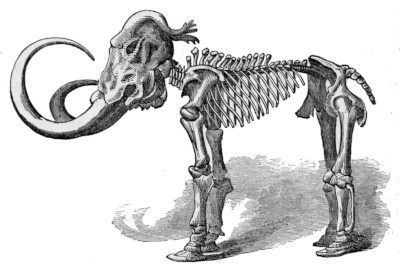
SKELETON OF THE SIBERIAN MAMMOTH.
In the year 1799, a Tungusian fisherman observed a strange shapeless mass projecting from an ice-bank, near the mouth of a river in the north of Siberia, the nature of which he did not understand, and which was so high in the bank as to be beyond his reach. The next year he observed the same object, which was then rather more disengaged from among the ice, but was still unable to conceive what it was. Toward the end of the following summer, 1801, he could distinctly see that it was the frozen carcass of a huge animal, the entire flank of which, and one of its tusks, had become disengaged from the ice. In consequence of the ice beginning to melt earlier, and to a greater degree than usual, in 1803, the fifth year of this discovery, the enormous carcass became entirely disengaged, and fell down from the ice-crag on a sand-bank forming part of the coast of the Arctic 457ocean. In the month of March of that year, the Tungusian carried away the two tusks, which he sold for fifty rubles, about thirty-eight dollars.
Two years afterward this animal still remained on the sand-bank, where it had fallen from the ice; but its body was then greatly mutilated. The peasants had taken away considerable quantities of its flesh to feed their dogs; and the wild animals, particularly the white bears, had also feasted on the carcass; yet the skeleton remained quite entire, except that one of the fore legs was gone. The entire spine, the pelvis, one shoulder-blade, and three legs, were still held together by their ligaments, and by some remains of the skin; and the other shoulder-blade was found at a short distance. The head remained, covered by the dried skin, and the pupil of the eyes was still distinguishable. The brain also remained within the skull, but a good deal shrunk and dried up; and one of the ears was in excellent preservation, still retaining a tuft of strong bristly hair. The upper lip was a good deal eaten away, and the under lip was entirely gone, so that the teeth were distinctly seen. The animal was a male, and had a long mane on its neck.
The skin was extremely thick and heavy, and as much of it remained as required the exertions of ten men to carry away, which they did with considerable difficulty. More than thirty pounds of the hair and bristles of this animal were gathered from the wet sand-bank, having been trampled into the sand by the white bears, while devouring the carcass. The hair was of three distinct kinds: one consisting of stiff black bristles, a foot or more in length; another of thinner bristles, or coarse flexible hair, of a reddish-brown color; and the third of coarse reddish-brown wool, which grew among the roots of the hair. These afford an undeniable proof that this animal had belonged to a race of elephants inhabiting a cold region, with which we are unacquainted, and by no means fitted to dwell in the torrid zone. It is also evident that this enormous animal must have been frozen up by the ice at the moment of its death.
FOSSIL SHELLS.
At whatever elevations these shells may have been found, and however remote from the parts of the globe now occupied by water, it is certain that they were once generated in the sea, by which they were deposited. The Altain chain of primitive mountains in Siberia is flanked on each side by a chain of hills inclosing marine shells. On a comparison of the forms, contexture and composition of these shells, as they have been found imbedded in rocks, not the slightest difference can be detected between several varieties of them and those which still inhabit the sea. At Touraine, in France, a 458hundred miles from the ocean, and about nine feet beneath the surface, a bed of fossil shells has been found nine leagues in length, and about twenty feet in thickness. Such beds are known to exist in every part of Europe; and in South America, according to Ulloa, they are very frequent.
Great Britain abounds in these fossil productions. In the cliffs of the isle of Sheppey, bordering on the Thames, several varieties of the crab, and lobsters nearly whole, have been found in a petrified state. Within the elevated lands in the vicinity of Reading, in Berkshire, an abundance of oyster-shells has been found, many of them entire, and having both their valves united. At Broughton, in Lincolnshire, there are two quarries abounding in fresh-water shells, which are found in a blue stone, supposed to have been formerly clay, and to have been gradually indurated. A bed of shells, twelve feet thick, and lying in a greenish sand, has been found about a mile from Reculver, in Kent. At Harwich, at the entrance of the river, a sandy cliff, fifty feet in hight, contains shells, of which there are no less than twenty-eight varieties. On digging a moorish pasture, in Northamptonshire, many snails and river shells were found; and these were the more abundant in proportion as the workmen proceeded to a greater depth. And, lastly, the petrifactions known by the name of belemnites, have been found in chalk pits, in different parts of the kingdom: they are usually cylindrical, or conical, and sometimes contain a hollow nucleus. They are supposed to constitute a species of nautilus, and very frequently occur in the coarser kinds of marble.
SUBTERRANEAN FORESTS.
In the year 1708, a breach made by the Thames, at an extraordinary high tide, inundated the marshes of Dagenham and Havering, in Essex. Such was the impetuous rush of the water, that a large passage or channel was torn up, three hundred feet in width, and in some parts twenty feet in depth. In this way, a great number of trees, that had been buried there many ages before, were exposed to view. With one exception, that of a large oak, having the greatest part of its bark, and some of its heads and roots in a perfect state, these trees bore a greater resemblance to alder than to any other description of wood. They were black and hard, and their fibers were extremely tough. No doubt was entertained of their having grown on the spot where they lay; and they were so numerous, that in many places they afforded steps to the passengers. They were imbedded in a black oozy soil, on the surface of which they lay prostrate, with a covering of grey mold.
In passing along the channel torn up by the water, vast numbers of the 459stumps of these subterraneous trees, remaining in the posture in which they grew, were to be seen, some with their roots running down, and others branching and spreading about in the earth, as is observed in growing trees. That they were the ruins, not of the deluge, but of a later age, has been inferred from the existence of a bed of shells, which lies across the highway, on the descent near Stifford bridge, leading to South Okendon. At a perpendicular depth of twenty feet beneath this bed of shells, and at the distance of nearly two hundred feet, in the bottom of the valley, runs a brook which empties itself into the Thames at Purfleet. This brook is known to ebb and flow with the Thames; and, consequently, if the bed of shells, as has been conjectured, was deposited in that place by an inundation of the Thames, it must have been such as to have drowned a vast proportion of the surrounding country, and have overtopped the trees near the river, in West Horrock, Dagenham, and the other marshes, overturning them in its progress. In support of this hypothesis, it should be remarked, that the bed of earth in which the trees grew, was entire and undisturbed, and consisted of a spongy, light, oozy soil, filled with the roots of reeds, of a specific gravity much less than that of the stratum above it.
The levels of Hatfield chase were, in the reign of Charles I., the largest chase of red deer in England. They contained about one hundred and eighty thousand acres of land, about one-half of which was yearly inundated; but being sold to one Vermuiden, a Dutchman, he contrived, at a great labor and expense, to dischase, drain, and reduce these lands to arable and pasture grounds not subject to be overflowed. In every part of the soil, in the bottom of the river Ouse even, and in that of the adventitious soil of all marsh land, together with the skirts of the Lincolnshire wold, vast multitudes of the roots and trunks of trees of different sizes are found. The roots are fixed in the soil, in their natural position, as thick as they could have grown; and near to them lie the trunks. Many of these trees appear to have been burned, and others to have been chopped and squared; and this in such places, and at such depths, as could never have been opened, since the destruction of the forest, until the time of the drainage. That this was the work of the Romans, who were the destroyers of all the woods and forests which are now found underground in the bottoms of moors and bogs, is evidenced by the coins and utensils, belonging to that nation, which have been collected, as well in these levels, as in other parts of Great Britain where these subterraneous forests have been discovered.
460
MOORS, MOSSES AND BOGS.
It having been reported in Lincolnshire, that a large extent of islets of moor, situated along its coast, and visible only at the lowest ebbs of the tide, was chiefly composed of decayed trees, Dr. de Serra, accompanied by Sir Joseph Banks, proceeded, in the month of September, 1796, to examine their nature and extent. They landed on one of the largest of these islets, when the ebbs were at the lowest, and found its exposed surface to be about ninety feet in length, and seventy-five in width. They were enabled to ascertain, that these islets consist almost entirely of roots, trunks, branches, and leaves of trees and shrubs, intermixed with leaves of aquatic plants. The remains of many of the trees were still standing on their roots; but the trunks of the greater part of them lay scattered on the ground, in every direction. The bark of the trees and roots appeared in general as fresh as when they were growing; in that of the birches particularly, many of which were found, even the thin silvery membranes of the outer skin were discernible. The timber of all kinds, on the contrary, was decomposed and soft, in the greater part of the trees; in some it was firm, especially about the knots. Sound pieces of timber had been often found by the country people. In general, the trunks, branches and roots of the decayed trees were considerably flattened; a phenomenon which has been observed in the surtarbrand, or fossil wood of Iceland, and also in that found near the lake of Thun, in Switzerland. The soil was chiefly composed of rotten leaves; and, on being thrown into water, many of these were taken out in a perfect state.
These islets extended about twelve miles in length, and one in breadth, opposite the shore of Sutton, at which place, on digging a well, a moor of the same nature was found under ground, at the depth of sixteen feet, and, consequently, very nearly on the same level with that which constitutes the islets. On boring in the fields belonging to the Royal Society, in the parish of Mablethorpe, to ascertain the cause of the subterraneous stratum of decayed vegetables, a similar moor was found. The appearance of these decayed vegetables was found exactly to agree with that of the moor which was thrown up in Blankney fen, and in other parts of the east fen of Lincolnshire, in making their embankments; barks, like those of the birch-tree, being there also abundantly found. This moor has been traced as far as Peterborough, sixty miles south of Sutton. On the north side, the moory islets extend as far as Grimsby, on the south of the mouth of the Humber: and it is a remarkable circumstance, that in the large tracts of low land which lie on the south banks of that river, a little above its mouth, there is 461a subterraneous stratum of decayed trees and shrubs, exactly resembling those observed at Sutton. At Axholme isle, a similar stratum extends over a tract of ten miles in length, by five in breadth. The roots there also stand in the places where they grew; while the trunks lie prostrate, amid the roots of aquatic plants and reeds. Little doubt can be entertained of the moory islets of Sutton being a part of this extensive subterraneous stratum, which, by some inroad of the sea, has been there stripped of its covering of soil. The identity of the levels; that of the species of trees; the roots of these affixed, in both, to the soil where they grew; and, above all, the flattened shape of the trunks, branches, and roots, found in the islets, which can only be accounted for by the heavy pressure of a superinduced stratum, are sufficient reasons for this opinion. Such a wide-spread assemblage of vegetable ruins, lying almost in the same level, and that level generally under the common mark of low water, naturally gives rise to reflections on the epoch of this destruction, and the agency by which it was effected.
The original catastrophe which buried this immense forest must have been of very ancient date; but it is to be suspected, that the inroad of the sea which uncovered the decayed trees of the islets of Sutton, is comparatively recent. The state of the leaves, and the timber, and also the tradition of the country people, concur to strengthen this suspicion. Leaves and other delicate parts of plants, though they may be long preserved in a subterraneous situation, can not remain uninjured when exposed to the action of the waves, and of the air. The inhabitants of Sutton believe that their parish church once stood on the spot where the islets now are, and was submerged by the inroads of the sea; that, at very low water, their ancestors could even discern its ruins; and that their present church was built to supply the place of that which was washed away. So many concomitant (though weak) testimonies, render their report to a certain degree deserving of credit, and lead to a supposition, that some of the stormy inundations of the North sea, which in these last centuries have washed away such large tracts of land on its shores, may have carried away a soil resting on clay, and have finally uncovered the trees of these moory islets.
Bogs and mosses are little more than lakes filled up with vegetable matter, usually of aquatic origin. They are to be found not only in Ireland and Scotland, but also in every northern country, more especially when thinly peopled. It should be remarked, that Ireland abounds in springs, which are mostly dry in summer; and that grass and weeds grow abundantly about these spots. In the winter these springs swell and run, softening and loosening all the earth about them. Now, that sward or surface of the earth which consists of the roots of grass, being lifted up, and made fuzzy or 462spongy by the water in the winter, is dried in the spring, and does not fall together, but withers in a tuft. The new grass which springs through it is again lifted during the following winter; and thus the spring is still more and more stopped, and the sward grows thicker and thicker, till at length it makes what is called a quaking bog. In proportion as it rises and becomes drier, and as the grass roots and other vegetables become more putrid, together with the mud and slime of the water, it acquires a blackness, and becomes what is called a turf bog. When the vegetables rot, it is considered that the saline particles are in general carried away by the water, in which they are dissolved; but that the oily or sulphureous particles remain and float on the water; and it is thus that the turf acquires its inflammability. The highest mountains of Ireland are, as well as the plains, covered with bogs, because they abound in springs, which, on account of a defective population, are not cleared; and thus they are overrun with bogs. In that country mosses also abound; and the particular kind which grows in bogs, is remarkable on this account, that a congeries of its threads, before it is decayed, constitutes the substance of the light spongy turf, which thus becomes so tough as not to yield to the spade. This curious substance, in the north of Ireland, is called old wives’ tow, and is not unlike flax. The turf hardens by degrees, but is still stringy when broken, and at length becomes the red turf employed as fuel.
The production of the quaking bogs is as follows. When a stream or spring runs through a flat, it becomes filled with weeds in summer, and trees fall across and dam it up. During the winter season the water stagnates more and more every year, until the whole flat is covered. A coarse kind of grass, peculiar to these bogs, springs up in tufts, the roots of which are consolidated, and which, in a few years, grow to the hight of several feet. In the winter the grass rots, and falls with its seed on the tufts, thus adding to their growth the ensuing spring. The tops of flags and grass are sometimes interwoven on the surface of the water, and gradually becoming thicker, cover its surface. On this covering herbs grow; and by the interweaving of their roots, it is rendered so strong as to bear a man. Some of these bogs sink, where a man stands, to a considerable depth, and rise before and behind: underneath, the water is clear. Even these in time become red bogs; but may easily be converted into meadow land, by clearing a trench for the passage of the water.
Sir Hans Sloane, in his account of the bogs of Ireland, published in the “Philosophical Transactions,” notices a curious fact, namely, that when the turf-diggers, after having dug out the earth proper to make turf or peat, reached the bottom, so as to come to the clayey or other soil, by draining off 463the water, they met with the roots of fir-trees, with their stumps standing upright, and their branches spread out on every side horizontally. This was evidently the place of the growth of these trees, the branches of the roots of which are in some parts matted, as is seen in the roots of trees closely planted. Large pieces of wood have been found, not only in clay-pits, but likewise in quarries or stone-pits, in the blocks of stone raised out of their strata or layers. The black spongy mold employed for peat smells strongly of bitumen, or petroleum, a great proportion of the oil of which is yielded by distillation; so that, singular as it may appear, not only oil, but a material which may be used for candles, may be extracted from these peat-bogs in large quantities; and it has even been proposed that this business should be carried on on a large scale, with a view to giving prosperity to the country. In several parts of Ireland a singular phenomenon has been observed: on horses trampling with their feet on a space of soft ground, a sudden appearance of light ensued. On the mold, which agreed in color, lightness, &c., with peat earth, being examined with a microscope, the light was found to proceed from an abundance of small, semi-transparent, whitish, live worms which lay in it.
The commissioners appointed by parliament to inquire into the nature and extent of the bogs of Ireland, and the practicability of draining them, represent them as occupying thousands of acres, indeed, many square miles. Their nature and constituent parts are described by them as consisting of an accumulation of vegetable matter, settling in successive generations on itself, and converted by the want of ventilation and motion to a stagnant pool, which first furnished the elements of life and increase to the plants covering its surface. The progress of the accumulation may be best conceived by imagining a basin, or concave reservoir, of a certain extent and depth, formed of clay, limestone, gravel, &c., through which the water, scantily but constantly supplied, can not obtain an issue. Undisturbed in this water, a surface of bog moss grows, decays and putrefies. To this a second generation succeeds; and this is followed by others, until, at length, the bulk rises considerably above the level of its bed, forming hillocks of various hights, shapes and dimensions. The surface of a bog is not level like a lake, but undulating; and it terminates somewhat abruptly, and almost perpendicularly. The average hight of the great bogs, above the level of high-water mark in Dublin harbor, is about two hundred and fifty feet. Many acres of these bogs have been reclaimed; and the practicability of draining and cultivating the greater proportion of them has been pointed out in the reports of the commissioners.
Perthshire, in North Britain, abounds in mosses, the contents of which are 464computed to exceed nine thousand acres. The greatest hight of the moss, above the clay on which it lies, is fourteen feet and a half. Its surface, when viewed at a distance, seems wholly covered with heath: but when closely examined, is found to be composed of small tufts of heath, intermixed with a variety of moss-plants. Here also are found innumerable trunks of trees, lying along close to their roots, the latter being still fixed in the clay, as in the natural state.
The irruption of what is called Solway moss has greatly attracted the public attention; for, although the cause of it is obvious, still the alteration it produced on the surface of the earth, was more considerable than any known in Great Britain, as resulting from a natural cause, since the destruction of Earl Goodwin’s estate. It happened in the year 1771, after severe rains which had in many places produced great inundations of the rivers. The following is a concise description of the spot where this event happened. Along the side of the river Esk, is a vale, about a mile in breadth, bounded on the south-east by the river, and on the north-west by a steep bank, about thirty feet in hight above the level of the vale. From the top of the bank the ground rises on an easy ascent for about a quarter of a mile, where it is terminated by the moss, which extends about two miles north and south, and about a mile and a half east and west, being bounded on the north-west by the river Sark. It is probable that the solid ground, from the top of the bank above the vale, was continued in the same direction under the moss, before its irruption, for a considerable space; for the moss, at the place where the irruption happened, was inclined toward the sloping ground. From the edge of the moss there was a gully or hollow, called by the country people the gap, and said to be thirty yards deep where it entered the vale: down this hollow ran a small rill of water, which was often dry in summer, not having any other supply but what filtered from the moss.
The irruption happened, at the head of this gap, on the night of the sixteenth of November, between the hours of ten and eleven, when all the neighboring rivers and brooks were prodigiously swollen by the rains. A large body of the moss was forced, partly by the great fall of rain, and partly by the springs beneath, into a small beck or burn, which runs within a few yards of its border to the south-east. By the united pressure of the water behind it, and of this beck, which was then very high, it was carried down a narrow glen between two banks about three hundred feet high, into a wide and spacious plain, over a part of which it spread with great rapidity. The moss continued for some time to send off considerable quantities of its substance, which, being borne along by the torrent, on the back of the first great body, kept it for many hours in perpetual motion, and drove it still further 465on. During the first night, at least four hundred acres of fine arable land were covered with moss from three to twelve or fifteen feet in depth. Several houses were destroyed, much corn lost, &c.; but all the inhabitants escaped. When the waters subsided, the moss also ceased to flow; but two pretty considerable streams continued to run from the heart of it, and carried away some pieces of mossy matter to the place where it burst. They then joined the beck, already mentioned, which with this addition, resumed its former channel, and with a little assistance from the people of the neighborhood, made its way to the Esk, through the midst of that body of moss which obstructed its course. Thus, in a great measure drained, the new moss fell several feet, and when the fair weather came on at the end of November, it settled in a firmer and more solid body on the lands it had overrun. By this inundation about eight hundred acres of arable ground were overflowed before the moss stopped, and the habitations of twenty-seven families destroyed.
Tradition has preserved the memory of a similar inundation in another part of North Britain. At Monteith a moss changed its course in one night, and covered a great extent of ground. There is also an account in the “Philosophical Transactions” of a moving moss near Churchtown, in Lancashire, which greatly alarmed the neighborhood, and was regarded as a miracle. The moss was observed to rise to a surprising hight, and soon after to sink as much beneath the level, moving slowly toward the south.
CORAL REEFS AND ISLANDS.
Coral belongs to the class of those surprising productions of nature, which are named zoöphytes, or plant-animals, on account of their filling up the intermediate space between the animal and vegetable kingdoms; and in treating of them this curious substance will be distinctly considered. In the mean time, the production of coral reefs and islands presents one of those geological changes, by which the earth’s surface has been modified, and has received a new accession from the sea.
The common foundation of the clusters of islands discovered by modern navigators in the Pacific ocean, as well as of those belonging to New South Wales, is evidently of coral structure, immense reefs of which shoot out in all directions. There is every reason to believe that the islands which are occasionally raised by the tremendous agency of subterraneous volcanoes, do not bear any proportion to those which are perpetually forming, by the silent but persevering efforts of the sea worms by which coral is produced. Banks of coral are found at all depths, and at all distances from the shore, entirely 466unconnected with the land, and detached from each other. By a quick progression, they grow up toward the surface; while the winds, heaping up the coral from deeper water, rapidly accelerate the formation of these banks into shoals and islands. They become gradually shallower; and when once the sea meets with resistance, the coral is quickly thrown up by the force of the waves breaking against the bank. These coral banks have been seen in all their stages: some in deep water; others with a few rocks appearing above the surface, just formed into islands without the least appearance of vegetation; and, lastly, others covered with soil and weeds.
The loose corals, rolled inward by the billows in large pieces, strike upon the grounds, and, the reflux being unable to carry them away, become a bar to the coagulated sand with which they are always intermixed. This sand, being easiest raised, is lodged at top; and when its accumulated mass is elevated by violent storms, and no longer within the reach of common waves, it becomes a resting-place to birds whom the search of prey draws thither. Their excrement, feathers, &c., augment the soil, and prepare it for the reception of accidental roots, branches and seeds cast up by the waves, or brought thither by birds. Thus islands are formed: the leaves and rotten branches, intermixing with the sand, produce in time a light black mold, in which trees and shrubs vegetate and thrive. Cocoa-nuts, which continue long in the sea without losing their vegetative powers, having been thrown on such islands, produce trees which are particularly adapted to all soils, whether sandy, rich or rocky. The violence of the waves, within the tropics, must generally be directed to two points, according to the monsoons. Hence the islands formed from coral banks must be long and narrow, and lie nearly in a meridional direction. Even supposing the banks to be round, as they seldom are when large, the sea meeting most resistance in the middle, must heave up the matter in greater quantities there, than toward the extremities; and, by the same rule, the ends will generally be open, or at least lowest. They will also commonly have soundings there, as the remains of the banks, not accumulated, will be under water. Where the coral banks are not exposed to the common monsoon, they will alter their direction, and become either round, or extended in the parallel, or of irregular forms, according to accidental circumstances.
Captain Flinders, in his voyage to the South Pacific, gives an account of an unbroken reef of coral, three hundred and fifty miles long, on the coast of New Holland; and he states, that between that country and New Guinea, the coral formations extend through a distance of seven hundred miles, interrupted by no intervals of more than thirty miles in length. He also gives us a lively and interesting description of a coral reef on the southern 467coast of New South Wales. On this reef he landed, and the water being very clear round the edges, a new creation, as it were, but imitative of the old, was presented to the view. Wheat sheaves, mushrooms, stags’ horns, cabbage leaves, and a variety of other forms, were glowing under water with vivid tints of every shade betwixt green, purple, brown and white; equaling in beauty, and excelling in grandeur, the most favorite parterre of the curious florist. These were different species of coral and fungus, growing, as it were, out of the solid rock, and each had its peculiar form and shade of coloring; but, whilst contemplating the richness of the scene, the destruction with which it was pregnant could not be forgotten. Different corals in a dead state, concreted into a solid mass of a dull white color, composed the stone of the reef. The negro heads were lumps which stood higher than the rest; and being generally dry, were blackened by the weather; but even in these the forms of the different corals and some shells were distinguishable. The edges of the reef, but particularly on the outside where the sea broke, were the lightest parts; within these were pools and holes containing live corals, sponges, sea-eggs and cucumbers; and many enormous cockles were scattered upon different parts of the reef. At low water, these cockles seem most commonly to lie half open, but frequently close with much noise, and the water within the shells then spouts up in a stream, three or four feet high: it is from this noise and the spouting of the water that they are discovered, for, in other respects, they are scarcely to be distinguished from the coral rock.
His description of a coral island which he afterward visited on the same coast, is truly philosophical and throws great light on these surprising productions of nature.
“This little island, or rather the surrounding reef, which is three or four miles long, affords shelter from the south-east winds. It is scarcely more than a mile in circumference, but appears to be increasing both in elevation and extent. At no very distant period of time, it was one of those banks produced by the washing up of sand and broken coral, of which most reefs afford instances, and those of Torres’ strait a great many. These banks are in different stages of progress: some, like this, are become islands, but not yet habitable; some are above high-water mark, but destitute of vegetation; whilst others are overflowed with every returning tide. It seems to me, that, when the animalcules which form the corals at the bottom of the ocean, cease to live, their structures adhere to each other, by virtue either of the glutinous remains within, or of some property in salt water; and the interstices being gradually filled up with sand and broken pieces of coral washed by the sea, which also adhere, a mass of rock is at length formed. 468Future races of these animalcules erect their habitations upon the rising bank, and die in their turn, to increase, but principally to elevate, this monument of their wonderful labors. The care taken to work perpendicularly in the early stages, marks a surprising instinct in these diminutive creatures. Their wall of coral is for the most part in situations where the winds are constant, and when it reaches the surface, it affords a shelter, to the leeward of which their infant colonies may be safely sent forth; and to this their instinctive foresight it seems to be owing, that the windward side of a reef exposed to the open sea, is generally, if not always, the highest part, and rises almost perpendicular, sometimes from the depth of two hundred, and perhaps many more fathoms. To be constantly covered with water, seems necessary to the existence of the animalcules, for they do not work, except in holes upon the reef, beyond low-water mark; but the coral sand and other broken remnants thrown up by the sea adhere to the rock, and form a solid mass with it, as high as the common tides reach. That elevation surpassed, the future remnants, being rarely covered, lose their adhesive property; and remaining in a loose state, form what is usually called a key upon the tops of the reef. The new bank is not long in being visited by sea-birds; salt plants take root upon it, and a soil begins to be formed; a cocoa-nut is thrown on shore; land birds visit it and deposit the seeds of shrubs and trees; every high tide, and still more every gale, adds something to the bank; the form of an island is gradually assumed, and last of all comes man to take possession. This island is well advanced in the above progressive state; having been many years, probably some ages, above the reach of the highest spring-tides, or the wash of the surf in the heaviest gales. I distinguished, however, in the rock which forms its basis, the sand, coral and shells formerly thrown up, in a more or less perfect state of cohesion; small pieces of wood, pumice-stone, and other extraneous bodies, which chance had mixed with the calcareous substances when the cohesion began, were inclosed in the rock, and, in some cases, were still separable from it without much force. The upper part of the island is a mixture of the same substances in a loose state, with a little vegetable soil, and is covered with the casuarina and a variety of other trees and shrubs, which give food to paroquets, pigeons, and some other birds; to whose ancestors it is probable the island was originally indebted for this vegetation.”
469