MOUNTAINS. (continued 3)
Reading edition
“The whole island, with its ample and towering mountains, is often shaken with awful throes, and creation here ‘groaneth and travaileth in pain.’ In July, 1840, a river of lava flowed out from Kilauea, and passing some miles under ground, burst out in the district of Puna, and inundated a portion of the country, sweeping down forests, carrying everything in its way before it, and as a river a mile wide, falling into the sea, and heating the waters of the ocean, making war upon its inhabitants, and by the united action of this volcanic flood and the sea, formed several huge, rough hills of sand and lava along the shore. And still later than the above date, a similar flood has been poured from the summit of Mauna Loa, flowing with terrific force for weeks, and thus elevating a portion of the region between Mauna Loa and Mauna KeaKea; and so extensive and splendid was this exhibition, that it could be seen from the missionary station at Hilo, a distance of about forty miles.
“After having spent some thirty hours on this king of all the volcanoes, we set out to return. And on our journey we passed over several large tracts of lava of different kinds, some smooth, vitreous and shining, some twisted and coiled like huge ropes, and some consisting of sharp, irregular, loose, rugged volcanic masses, of every form and size, from an ounce in weight to several tuns, thrown, I could not conceive how, into a chaos or field of the roughest surface, presenting a forbidding area of from one to forty square miles in extent; and though not precipitous, yet so horrid as to forbid a path, and to defy the approach of horses and cattle. In the crevices of the more solid lava are found the ohelo, which somewhat resembles the whortleberry, nourished by frequent showers and dew. At ten o’clock we halted for breakfast, and by the time the sun was setting had reached Waimea, thus completing our excursion to this vast volcano, which is truly one of the wonders of the world!”
THE PEAK OF DERBYSHIRE.
This peak consists of a chain of high mountains in the county of Derby, in England, and has been long celebrated, as well on account of its mineral productions, and natural curiosities in general, as of what are called its seven wonders. Six of these are natural, namely, Poole’s Hole, Elden Hole, the Peak Cavern, or the Devil’s Hole, Mam Tor, St. Ann’s Well, and the Ebbing 83and Flowing Well. Having described these, we shall add a more recent discovery, that of the Crystallized Cavern, which possesses an equal interest.
Poole’s Hole, lying about a mile to the westward of Buxton, is a vast cavern formed by nature in the limestone rock, and was, according to tradition, the residence of an outlaw, named Poole. The entrance is low and contracted, and the passage narrow; but this widening, at length, leads to a lofty and spacious cavern, from the roof of which stalactites or transparent crystals, formed by the constant dropping of water laden with calcareous matter, hang in spiral masses. Other portions of these petrifactions drop and attach themselves to the floor, rising in cones, and become what are termed stalagmites.
One of the dropping stalactites, of an immense size, called the Flitch of Bacon, occurs about the middle of the cavern, which here becomes very narrow, but soon spreads to a greater width, and continues large and lofty until the visitor reaches another surprisingly large mass of stalactite, to which the name of Mary Queen of Scots’ Pillar is given, from the tradition that this unfortunate queen once paid a visit to the cavern, and proceeded thus far into its recesses. As this pillar can not be passed without some difficulty, few persons venture beyond it; nor does it seem desirable, as, by proceeding thus far, a very competent idea of the cavern may be formed. The path hitherto is along the side, and at some hight from the bottom of the cavern; but to visit and examine the interior extremity, it becomes necessary to descend a few yards by very slippery and ill-formed steps. The path at the bottom is tolerably even and level for about sixty feet, when an almost perpendicular ascent commences, which leads to the extremity of the fissure, through the eye of St. Anthony’s Needle, a narrow strait, beyond which the steepness of the way is only to be surmounted by clambering over irregular masses of rock. The cavern terminates nearly three hundred feet beyond the Queen of Scots’ pillar. Toward the end is an aperture through a projecting rock, behind which a candle is generally placed, when any person has reached the extremity: when seen at that distance, it appears like a dim star. The visitor returns along the bottom of the cavern, beneath a considerable portion of the road by which he entered; and, by thus changing the path, has an opportunity better to ascertain the hight and width of the cavern in every part, and to view other accumulated petrifactions, some of which are of a prodigious size, and of an extraordinary form. In one part of this passage is a fine spring of transparent water; and a small stream, which becomes more considerable in rainy seasons, runs through the whole length of the cavern. Its sound, in passing through this spacious and lofty concavity, which resembles the interior of a Gothic 84cathedral, has a fine effect. To the right, in a small cavern called Poole’s chamber, is a curious echo.
The various masses of stalactical matter which are everywhere met with in this natural excavation, and which reflect innumerable rays from the lights carried by guides, are distinguished by the names of the objects they are fancied most to resemble. Thus we have Poole’s saddle, his turtle, and his woolsack; the lion, the lady’s toilet, the pillion, the bee-hive, &c. It should be noticed, however, that the forms are constantly varied by the percolation of the water through the roof and sides of the rock. The subterraneous passage is nearly a half a mile in length.
ELDEN HOLE.
Elden Hole is situated on the side of a gentle hill about a mile to the north-west of the village of Peak Forest. It is a deep chasm in the ground, surrounded by a wall, of uncemented stones, to prevent accidents. This fissure or cleft in the rock has been the subject of many exaggerated descriptions and superstitious reports, having been represented not only as unfathomable, but as teeming, at a certain depth, with so impure an air, that it could not be respired without immediate destruction. Mr. Lloyd, however, who descended it about seventy years ago, has proved the absurdity of these relations, in a paper, of which the following is a brief abstract, published in the Philosophical Transactions.
For the first sixty feet, he observes, he descended somewhat obliquely, the passage then becoming difficult from projecting crags. At the further depth of thirty feet, the inflection of his rope varied at least eighteen feet from the perpendicular. The breadth of the chink was here about nine feet, and the length eighteen; the sides being irregular, moss-grown, and wet. Within forty-two feet of the bottom, the rock opened on the east, and he swung till he reached the floor of a cave, one hundred and eighty-six feet only from the mouth, the light from which was sufficiently strong to permit the reading of any book. The interior of the chasm he describes as consisting of two parts, which communicate with each other by a small arched passage, the one resembling an oven, the other the dome of a glass-house. On the south side of the latter, was a small opening, about twelve feet in length, and four feet in hight, lined throughout with a kind of sparkling stalactite, of a fine deep yellow color, with petrifying drops hanging from the roof. Tracing the entrance he found a noble column, above ninety feet high, of the same kind of incrustation. As he proceeded to the north, he came to a large stone which was covered with the same substance; and beneath it he found a hole six feet in depth, uniformly lined with it. From 85the edge of this hole sprung up a rocky ascent, sloping, like a buttress, against the side of the cavern, and consisting of vast, solid, round masses of the same substance and color. Having climbed this ascent to the hight of about sixty feet, he obtained some fine pieces of stalactite, which hung from the craggy sides of the cavern. Descending with some difficulty and danger, he proceeded in the same direction, and soon came to another pile of incrustations of a brown color, above which he found a small cavern, opening into the side of the vault, which he now entered. Here he saw vast masses of stalactite, hanging like icicles from every part of the roof: several of these were four and five feet long, and thick as a man’s body. The sides of the largest cavern were chiefly lined with incrustations of three kinds, the first of which was a deep yellow stalactite; the second, a thin coating which resembled a pale stone-color varnish, and reflected the light of the candle with great splendor; and the third, a rough efflorescence, the shoot of which resembled a rose flower.
Some more recent visitors have thus stated the result of their observations and inquiries relative to Elden Hole. They describe the mouth of this chasm as opening horizontally, in a direction from north to south; its shape being nearly that of an irregular ellipse, about ninety feet in length, and twenty-seven in breadth at the widest part. The northern end is fringed with small trees; and moss and underwood grow out of the crevices on each side, to the depth of forty or fifty feet. As the fissure recedes from the surface, it gradually contracts; and at the depth of about seventy feet inclines considerably to the west, so as to prevent its course from being further traced. Notwithstanding the obstacles of the bushes and projecting masses of stone, it was sounded, and its depth found not to exceed two hundred and two feet, an estimate which corresponds with the assertion of three miners, who had descended in search of the bodies of individuals who were missing, and were supposed to have been robbed, murdered, and thrown into this frightful abyss.
PEAK CAVERN.
Peak cavern, also called the Devil’s Hole, is one of those magnificent, sublime, and extraordinary productions of nature, which constantly excite the wonder and admiration of their beholders. It has accordingly been considered one of the principal wonders of Derbyshire, and has been celebrated by several poets. It lies in the vicinity of Castleton, and is approached by a path at the side of a clear rivulet, leading to the fissure, or separation of the rock, at the extremity of which the cavern is situated. It would be difficult to imagine a scene more august than that which presents 86itself to the visitor at its entrance: on each side, the huge gray rocks rise almost perpendicularly, to the hight of nearly three hundred feet, or about seven times the hight of a modern house, and meeting each other at right or cross angles, form a deep gloomy recess. In front, it is overhung by a vast canopy of rock, assuming the appearance of a depressed arch, and extending, in width, one hundred and twenty feet, in hight forty-two, and in receding depth about ninety. After penetrating about ninety feet into the cavern, the roof becomes lower, and a gentle descent leads, by a detached rock, to the interior entrance of this tremendous hollow. Here the light of day, having gradually diminished, wholly disappears; and the visitor is provided with a torch to illumine his further progress.
The progress now becoming extremely confined, he is obliged to proceed, in a stooping posture, about twenty yards, when he reaches a spacious opening, named the Bellhouse, and is thence led to a small lake, called the First Water, about forty feet in length, but not more than two or three feet in depth. Over this he is conveyed in a boat to the interior of the cavern, beneath a massive vault of rock, which in some parts descends to within eighteen or twenty inches of the water. “We stood some time,” says M. de St. Fond, “on the brink of this lake; and the light of our dismal torches, which emitted a black smoke, reflecting our pale images from its bottom, we almost conceived we saw a troop of specters starting from an abyss to welcome us. The illusion was extremely striking.”
On landing, the visitor enters a spacious vacuity, two hundred and twenty feet in length, two hundred feet in breadth, and in some parts one hundred and twenty feet in hight, opening into the bosom of the rock; but, from the want of light, neither the distant sides nor the roof of this abyss, can be seen. In a passage at the inner extremity of this vast cave, the stream which flows through the whole length of the cavern, spreads into what is called the Second Water, and near its termination is a projecting pile of rocks, known by the appellation of Roger Rain’s House, from the incessant fall of water in large drops through the crevices of the roofs. Beyond this, opens another tremendous hollow, called the Chancel, where the rocks are much broken, and the sides covered with stalactical or petrified incrustations. Here the visitor is surprised by a vocal concert which bursts in discordant tones from the upper regions of the chasm. “Still,” observes a tourist, “this being unexpected, and issuing from a quarter where no object can be seen, in a place where all else is still as death, is calculated to impress the imagination with solemn ideas, and can seldom be heard without that emotion of awe and pleasure, astonishment and delight, which is one of the most interesting feelings of the mind.” At the conclusion of the strain, 87the choristers, who consist of eight or ten women and children, are seen ranged in the hollow of the rock, about fifty feet above the floor.
The path now leads to a place whimsically called the Devil’s Cellar and Half-way House, and thence, by three natural and regular arches, to a vast concavity, which, from its uniform bell-like appearance, is called Great Tom of Lincoln. When illuminated by a strong light, this concavity has a very pleasing effect; the symmetrical disposition of the rocks, the stream flowing beneath, and the spiracles in the roof, forming a very interesting picture. From this point the vault gradually descends, the passage contracts, and at length does not leave more than sufficient room for the current of the stream, which continues to flow through a subterraneous channel of several miles in extent, as is proved by the small stones brought into it after great rains, from the distant mines of the Peak Forest.
The entire length of this wonderful cavern is twenty-two hundred and fifty feet, or nearly half a mile; and its depth, from the surface of the Peak mountain, about six hundred and twenty feet. A curious effect is produced by the explosion of a small quantity of gunpowder, wedged into the rock in the interior of the cavern; for the sound appears to roll along the roof and sides, like a tremendous and continued peal of thunder. The effect of the light, on returning from these dark recesses, is particularly impressive; and the gradual illumination of the rocks, which becomes brighter as the entrance is approached, is said to exhibit one of the most interesting scenes that ever employed the pencil of an artist, or fixed the admiration of a spectator.
MAM TOR.
Mam Tor or the Shivering Mountain, is a huge precipice facing the east or south-east, chiefly composed of a peculiar kind of slate, which, although very hard before it is exposed to the air, very easily crumbles to dust on such exposure. Hence it is perpetually wasted by the action of the rain and snow; while the harder and larger masses of stone being thus loosened and disengaged, necessarily fall from their positions, and this with a rushing noise which is occasionally so loud as to be heard at Castleton, a distance of two miles. The valley beneath is overwhelmed with their fragments to the extent of half a mile. In many partsparts of the precipice, they produce, before their descent, a cavernous appearance, and even a romantic overhanging scenery, highly dangerous to be approached. It is affirmed by the most intelligent of the neighboring inhabitants, that this mountain chiefly wastes during violent storms of snow and rain; and Mr. Martin, who published an account of Mam Tor, in the Philosophical Transactions for 1729, affirms that the decay is not constantly the same. He not only surveyed it closely, 88but ascended the steepest part of the precipice, without tracing any other shivering in the mountain, beside that which was occasioned by the treading of his feet in the loose crumbled earth.
THE EBBING AND FLOWING WELL.
In the vicinity of Chapel-en-le-Frith is a steep hill, rising to the hight of more than a hundred feet, immediately beneath which this natural phenomenon lies. It is of an irregular form, but nearly approaching to a square, from two or three feet in depth, and about twenty feet in width.
Its ebbings and flowings are irregular, and dependent on the quantity of rain which falls in the different seasons of the year; when it begins to rise, the current can only be perceived by the slow movement of the blades of grass, or other light bodies floating on the surface; notwithstanding which, before the expiration of a minute, the water issues with a gurgling noise, in considerable quantities, from several small apertures on the south and west sides. The interval of time between the ebbing and flowing is not always alike: consequently the proportion of water it discharges at different periods, also varies. In the space of five minutes flowing, the water occasionally rises to the hight of six inches; and, after remaining a few seconds stationary, the well assumes its former quiescent state.
The cause of the intermittent flowing of this well may be satisfactorily explained, on the principle of the action of the siphon, and on the supposition of a natural one communicating with a cavity in the hill, where the water may be supposed to accumulate; but for the phenomenon of its ebbing, no satisfactory reason has been assigned. The opinion of a second siphon, (which is ingeniously advanced by one tourist,) that begins to act when the water rises, is inconsistent with the appearance of the well, and therefore can not be just.
ST. ANNE’S WELL.
This well, the usual resort of the company who frequent Buxton to drink the waters, has been classed among the wonders of the peak, on account of this singularity, that within five feet of the hot spring by which it is supplied, a cold one arises. This is not, however, the only well of the kind, since hot and cold springs rise near each other in many parts of England, and in other countries. The water is conveyed to the well, which is an elegant classical building, in the Grecian style, from the original spring, by a narrow passage, so close and well contrived as to prevent it from losing any considerable portion of its heat, and is received in a white marble bason. It is not so warm as the Bath water, its temperature being about eighty degrees of Fahrenheit.
89
THE CRYSTALLIZED CAVERN.
The crystallized cavern, the new wonder of the Derbyshire Peak, was discovered some years ago in the vicinity of the village of Bradwell. We extract the following particulars of this singular and beautiful natural excavation, from Hutchinson’s tour in the High Peak.
The entrance is rather terrific than grand; and the descent, for about thirty paces, very abrupt. The visitor has then to pass along the inclined way for nearly a quarter of a mile, the opening being so low that it is impossible to proceed, in particular parts, in an erect posture. The different crystallizations which now attract his attention on every side, soon make him forget the irksomeness of the road, and banish every idea of fatigue. New objects of curiosity crowd one on the other. In a place called the Music Chamber, the petrifactions take the semblance of the pipes of an organ; while in other parts, these stalactites are formed into elegant small colonnades, with as exact a symmetry as if they had been chiseled by the most skillful artist. Candles judiciously disposed within them, give an idea of the imaginary palaces of fairies, or of sylphs and genii, who have chosen this for their magnificent abode.
Still he has seen nothing comparable to what he is now to expect; for, at the distance of about a hundred paces further, by a rugged descent, he enters what is called the Grotto of Paradise. This heavenly spot, for it can not be compared to anything terrestrial, is, of itself, a beautiful crystallized cavern, about twelve feet high, and in length twenty feet, pointed at the top, similar to a Gothic arch, with a countless number of large stalactites hanging from the roof. Candles placed among them give some idea of its being lighted up with elegant glass chandeliers; while the sides are entirely incrusted, and brilliant in the extreme. The floor is checkered with black and white spar. It has, altogether, a most novel and elegant appearance. This glittering apartment would be left by the visitor with a certain degree of regret, did he not expect to see it again on his return.
Still continuing a route similar to the one he has passed, in the course of which his attention is occasionally arrested by the curiosities of the place, and by the gentle droppings of the water, which scarcely break the solemn silence of the scene, he at length reaches the Grotto of Calypso, and the extremity of the cavern, upward of two thousand feet from the entrance. To see this grotto to advantage, he has to ascend about six feet, into a recess. There, the beautiful appearance of the different crystallizations, some of them of an azure cast, and the echoes reverberating from side to side, make him fancy he has reached the secluded retreat of some mythological deity.
90Returning by the same path for a considerable distance, another cavern, which branches in a south-west direction from the one already explored, presents itself. The roads here are still more difficult of access, but the stalactites are certainly most beautiful. Many of them, more than a yard in length, are pendent from the roof, and the greater part do not exceed the dimension of the smallest reed. The top and sides of this cavern are remarkably smooth, particularly at the part called the Amphitheater. In general, the stone is of a very dark color, to which the transparent appearances before mentioned, with each a drop of water hanging at its extremity, form a fine contrast.
SPEEDWELL LEVEL.
In the Speedwell Level, or Navigation Mine, in the vicinity of Castleton, art has been combined with the subterraneous wonders of nature. Being provided with lights, the guide leads the visitor beneath an arched vault, by a flight of one hundred and six steps, to the sough or level, where a boat is ready for his reception, and is put in motion by pushing against pegs driven into the wall for that purpose. After proceeding about one-third of a mile through various caverns, the level bursts into a tremendous gulf, the roof and bottom of which are invisible, but across which the navigation has been carried, by throwing a strong arch over a part of the fissure where the rocks are least separated. Here, leaving the boat, and ascending a stage erected above the level, the attention of the visitor is directed to the dark recess of the abyss beneath his feet; and firm indeed must be his resolution, if he can contemplate the scene unmoved, and without an involuntary shudder. To the depth of ninety feet all is vacuity and gloom; but beyond that commences a pool of Stygian waters, not unaptly named the Bottomless Pit, the prodigious range of which may in some measure be conceived, by the circumstance of its having swallowed up more than forty thousand tuns of rubbish, made in blasting the rock, without any apparent diminution either of its depth or extent. The guides assert that the former has not been ascertained; but there is reason to believe that its actual depth in standing water is about three hundred and twenty feet. There can not, however, be a doubt but that this abyss has communications with others still more deeply situated in the bowels of the mountain, and into which the precipitated rubbish has found a passage. The superfluous water of the level falls through a water-gate into this profound caldron, with a noise like a rushing torrent.
This fissure is calculated to be about eight hundred feet beneath the surface of the mountain; and so great is its reach upward, that rockets of 91sufficient strength to ascend four hundred and fifty feet, have been fired without rendering the roof visible. The effect of a Bengal light discharged in this stupendous cavity, is extremely magnificent and interesting.
THE HIGH TOR.
This is one of the many sublime objects presented by Matlock dale, the beauties of which will be cursorily described, in proportion as these objects pass under our review.
In approaching the bath, which is nearly a mile to the south-west of the village of Matlock, a specimen of the scenery by which this charming vale is distinguished, presents itself. The entrance is through a rock, which has been blasted for the purpose of opening a convenient passage; and here a scene which blends the constituent principles of the picturesque, the beautiful and the sublime, opens suddenly on the view. Through the middle of a narrow plain flows the Derwent, overhung by a profusion of luxuriant beeches and other drooping trees. Toward the east are gently rising grounds, and on the west the huge mural banks of the vale stretch along, the white face of the rock of which they are composed occasionally displaying itself through the woody clothing of their sides and summits. This magnificent scenery is singularly contrasted by the manufactories and lodging-houses at the bottom of the vale.
To see this magic spot to the greatest advantage, it should be entered at its northern extremity, its beauties then succeeding each other in a proper gradation, and their grandeur and effect being rendered more impressive. The chief attention is now attracted to the High Tor, a grand and stupendous rock, which appears like a vast abrupt wall of limestone, and rises almost perpendicularly from the river, to the hight of upward of three hundred and fifty feet. The lower part of this majestic feature is shaded by yew-trees, elms, limes, and underwood of various foliage; but the upper part, for fifty or sixty yards, presents a rugged front of one broad mass of perpendicular rock. From its summit the vale is seen in all its grandeur, diversified by woods of various hues and species. The windings of the Derwent, the grayish-colored rocks, and the white fronts of the houses, embosomed amid groves of trees which sprout from every crevice of the precipices, give variety and animation to a scene of wonderful beauty.
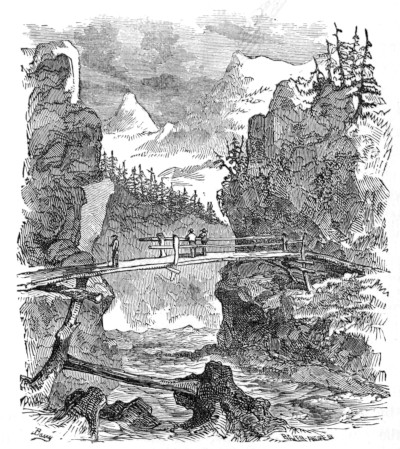
BRIDGE OVER THE WYE.
CHEE TOR.
In a romantic and deep hollow, near the little village of Wormhill, the river Wye flows beneath this stupendous mass of rock, which rises perpendicularly more than three hundred and sixty feet above its level. The 92channel of the river, which meanders at the base, is confined between huge rocks of limestone, having such a general correspondence of situation and form, as to render it probable that they were once united. In some parts they are partially covered with brushwood, nut-trees and mountain-ash; while in others, they are totally naked, precipitous and impending. The chasm runs in a direction so nearly circular, that the sublime Chee Tor, and its dependent masses of rock, are almost insulated by the river which rolls at their feet. Its length, as far as it possesses any considerable beauty, is between five and six hundred yards; a distance which presents several picturesque and interesting views, the general effect of the fine scenery being enhanced by the plantations on the neighboring hights, and by a spring which flows into the river near the bottom of a deep descent, as well as by a romantic bridge over the river itself, a representation of which may be seen in the cut above. Not far from here is the well known Masson hill, celebrated in Darwin’s “Loves of the Plants,” which is so high as to overlook the country to a vast extent, and compared with which even the High Tor 93seems considerably diminished in grandeur and sublimity; but this effect is partly compensated by the extent of the prospect, and the variety of objects it comprehends. The hight of this eminence is about seven hundred and fifty feet, the path to its summit having been carried, in a winding direction, through a grove. About half-way in the ascent is an alcove, from which an extensive view of a great part of Matlock dale may be seen, through a fine avenue formed for that purpose.
THE CUMBERLAND CAVERN.
To the west and north-west of the village of Matlock, are three apertures in the rock, respectively named the Cumberland, Smedley, and Rutland caverns. The former of these is well deserving of a short notice.
The entrance is partly artificial, to afford a greater facility to the visitor, who has to descend fifty-four steps. The cavern now opens on him in solitary grandeur. Huge masses of stone are piled on each other with a tremendous kind of carelessness, evidently produced by some violent concussion, though at an unknown period. He is conducted to a long and wide passage, the roof of which has all the regularity of a finished ceiling, and is bespangled by spars of various descriptions. From above, from beneath, and from the sides, the rays of the lights are reflected in every direction. In an adjacent compartment, rocks are heaped on rocks in terrible array, and assume a threatening aspect. Next is an apartment decorated with what, in the language of the country, is called the snow-fossil, a petrifaction which, both in figure and color, resembles snow, as it is drifted by the winter storm into the cavities of a rock. Near the extremity of the cavern are to be seen fishes petrified and fixed in the several strata which form the surrounding recess. One of these has its back jutting out of the side of the earth, as if it had been petrified in the act of swimming. In another branch of the cavern a well has been found of a considerable depth.
REYNARD’S HOLE.
After having proceeded about a mile in Dove dale, the romantic and sublime beauties of which will be hereafter noticed, by a route constantly diversified by new fantastic forms, and uncouth combinations of rock, the visitor is led to a mass of mural rock, bearing the above name, and perforated by nature into a grand arch, nearly approaching to the shape of the sharply pointed Gothic style of architecture, about forty-five feet in hight, and in width twenty. Having passed through this arch, a steep ascent leads to a natural cavern, called Reynard’s Hall, forty-five feet in length, fifteen in breadth, and in hight thirty. From the mouth of this cavern the scenery is 94singular, beautiful and impressive. The face of the rock which contains the arch, rises immediately in front, and would effectually prevent the eye from ranging beyond its mighty barrier, did not its center open into the above-mentioned arch, through which is seen a small part of the opposite side of the dale, consisting of a mass of gloomy wood, from the shade of which a huge detached rock, solitary, cragged, and pointed, starts out to a great hight, and forms an object truly sublime. This rock, which has received the name of Dove Dale Church, is pleasingly contrasted by the little pastoral river, Dove, and by its verdant turfy banks. A narrow opening at the extremity of the cavern is supposed to lead to other similar cavities in the rock; and on the left is a cavern, about forty feet in length, in breadth fourteen, and in hight twenty-six, called Reynard’s Kitchen, from the interior of which a pleasing view is presented of the upper part of the dale, its river and rocks.
After passing Reynard’s Hole, already described, the rocks rise more abruptly on either side, and appear in shapes more wild and irregular, but diversified and softened by shrubs.
Dove dale is nearly three miles in length; but from the sinuosity of its course, and its projecting precipices, the views are limited. Throughout the whole of this majestic feature of country, the river Dove flows, in the halcyon days of summer, with soft murmurs, innocently and transparently over its pebbly bed; but swells into rage during the winter months. Little tufts of shrubs and underwood form islands in miniature within its bed, which enlarge and swell the other objects. The scenery of this dale is distinguished from almost every other in the united kingdoms, by the rugged, dissimilar, and frequently grotesque and fanciful appearance of the rocks. To employ the words of a tourist here, “It is, perhaps, on the whole one of the most pleasing sceneries of the kind anywhere to be met with. It has something peculiarly characteristic. Its detached, perpendicular rocks stamp it with an image entirely its own, and for that reason it affords the greater pleasure. For it is in scenery as in life. We are most struck with the peculiarity of an original character, provided there be nothing offensiveoffensive
THOR’S HOUSE.
“Where Hamps and Manifold, their cliffs among,
Each in his flinty channel winds along,
With lucid lines the dusky moor divides,
Hurrying to intermix their sister tides,
Where still their silver-bosom’d nymphs abhor
The blood-smear’d mansion of gigantic Thor—
Erst fires volcanic in the marble womb
95Of cloud-wrapp’d Whetton rais’d the massy dome;
Rocks rear’d on rocks, in huge disjointed piles,
Form the tall turrets, and the lengthen’d aisles;
Broad pond’rous piers sustain the roof, and wide
Branch the vast rainbow ribs from side to side.
While from above, descends, in milky streams,
One scanty pencil of illusive beams,
Suspended crags, and gaping gulfs illumes,
And gilds the horrors of the deepen’d glooms.
Here oft the Naiads, as they chanc’d to stray
Near the dread Fane, on Thor’s returning day,
Saw from red altars streams of guiltless blood,
Stain their green reed-beds, and pollute their flood;
Heard dying babes in wicker prisons wail,
And shrieks of matrons thrill the affrighted gale;
While from dark caves infernal echoes mock,
And fiends triumphant shout from every rock!”—Darwin.
This spacious cavern is situated about two miles above Dove dale, near the village of Whetton; and tradition says the Druids here offered human sacrifices, inclosed in wicker idols, to Thor, the principal deity of the Saxons and Danes, in the ages of their idolatrous worship. Beneath is an extensive and romantic common, where the rivers Hamps and Manifold sink into the earth, and rise again in Islam gardens. These rivers merit a brief description. A wooden bridge has been thrown over an abyss in the rock, out of which the river Manifold bursts with surprising force, after having pursued a subterraneous course of five miles, from the point where it had engulfed itself in the earth, called Weston hill. At the further distance of twenty yards a similar phenomenon occurs; for here another fissure of a rock presents itself, whence the river Hamps throws its water into day. This river disappears at Leek-water Houses, a place between Leek and Ashbourn; thus pursuing a subterraneous course of seven miles, before it again emerges into light. On their emersion, the temperatures of the two rivers differ two degrees and a half, the Hamps being the coldest.
THE LOVERS’ LEAP.
The environs of Buxton abound in romantic sites, among the most striking of which is the dale named the Lovers’ Leap, on account of a vast precipice which forms one side of a narrow chasm, and from the summit of which a love-lorn female is said to have precipitated herself into the rocky gulf below. Each side of this beautiful dell is bounded by elevated rocks, the proximity of which is such, that for a considerable space there is scarcely room for the passage of the bubbling current of the Wye. Several of these rocks are perpendicular, and bare of vegetation; while others are covered 96with ivy, yew and ash-wood, with a craggy steep occasionally starting through the verdure. A circular road, extending in circumference about three miles, passes in view of the most romantic part of this dale, and forms a very agreeable walk or ride from Buxton. At the southern extremity the scenery assumes a milder character, the hollow taking the name of Mill dale, from a mill which is turned by the stream. In conjunction with a rude bridge, a mountainous path, and other rural objects, this forms a very picturesque view. Another fine scene is presented by a lofty rock, called Swallow Tor, which soars over a mass of wood, the river at its base foaming and roaring over broken masses of limestone.
THE MOORS.
Derbyshire is everywhere fruitful in natural curiosities, among the most striking of which may be reckoned the moors of Hope parish, inasmuch as they afford an extraordinary instance of the preservation of human bodies interred in them. In the year 1674, a grazier and his female servant, in crossing these moors on their way to Ireland, were lost in the snow, with which they were covered from January to May, and being then discovered, the bodies were so offensive that the coroner ordered them to be buried on the spot. After a lapse of twenty-nine years, when the ground was opened, they were in no way changed, the color of the skin being fair and natural, and the flesh as soft as that of persons newly dead. For twenty succeeding years they were occasionally exposed as a spectacle, but carefully covered after being viewed. They lay at the depth of about three feet, in a moist soil or moss. The minister of Hope parish was present in 1716, forty-two years after the accident, at a particular inspection of these bodies. On the stockings being drawn off, the man’s legs, which had not been uncovered before, were quite fair: the flesh, when pressed by the finger, pitted a little; and the joints played freely, without the least stiffness. Such parts of the clothing as the avidity of the country people, to possess so great a curiosity, had spared, were firm and good; and a piece of new serge, worn by the woman, did not appear to have undergone any sensible change.
OTHER ENGLISH CURIOSITIES.
Having thus brought to a conclusion our details relative to the wonders of the peak, and the various and interesting natural curiosities there to be found, we subjoin a brief notice of several others, which have, in England, attracted the notice of travelers.
Among the extraordinary caverns to be found in the mountains of the north of England, may be reckoned Yordas cave, in the vale of Kingsland, 97in Yorkshire, which contains a subterraneous cascade. Whethercot cave, not far from Ingleton, is divided by an arch of limestones, passing under which is seen a large cascade falling from a hight of more than sixty feet. The length of this cave is about one hundred and eighty feet, and the breadth ninety.
There are also in various parts of England many remarkable springs, of which some are impregnated either with salt, (as that of Droitwich, in Worcestershire,) or sulphur, (as the famous well of Wigan, in Lancashire,) or bituminous matter, (as that at Pitchford, in Shropshire.) Others have a petrifying quality, as that near Lutterworth, in Leicestershire, and a dropping well in the West Riding of Yorkshire. And, finally, some ebb and flow, as that of the peak described above, and Laywell near Torbay, whose waters rise and fall several times in an hour. To these we may add that remarkable fountain near Richard’s Castle, in Herefordshire, commonly called Bone Well, which is generally full of small bones, like those of frogs or fishes, though often cleared out. At a cliff near Wigan, in Lancashire, is the famous burning well: the water is cold, neither has it any smell; yet so strong a vapor of sulphur issues out with the stream, that upon applying a light to it, the top of the water is covered with a flame, like that of burning spirits, which lasts several hours, and emits such a heat that meat may be boiled over it.
MOUNTAINS OF GREAT BRITAIN.
The British isles present many mountains of a bold and imposing character: when contrasted, however, with those which have been already described, they must be considered as comparatively diminutive.
BEN NEVIS.
The loftiest of these mountains is Ben Nevis, in Scotland, its elevation above the level of the sea being forty-three hundred and eighty feet, or somewhat more than four-fifths of a mile. It terminates in a point, and elevates its rugged front far above all the neighboring mountains. It is of easy ascent; and at the perpendicular hight of fifteen hundred feet, the vale beneath presents a very agreeable prospect, the vista being beautified by a diversity of bushes, shrubs, and birch woods, besides many little verdant spots. The sea and the shore are also seen.
At the summit, the view extends at once across the island, eastward toward the German sea, and westward to the Atlantic ocean. Nature here appears on a majestic scale and the vastness of the prospect engages the 98whole attention, at the same time the objects in view are of no common dimensions. Just over the opening of the sound, at the south-west corner of Mull, Colonsay rises out of the sea like a shade of mist, at the distance of more than ninety miles. Shuna and Lismore appear like small spots of rich verdure, and, though nearly thirty miles distant, seem quite under the spectator. The low parts of Jura can not be discerned, nor any part of Isla; far less the coast of Ireland, as has been asserted. Such is, however, the wide extent of view, that it extends one hundred and seventy miles from the horizon of the sea at the Murray frith, on the north-east, to the island of Colonsay, on the south-west.
On the north-east side of Ben Nevis is an almost perpendicular precipice, certainly not less than fourteen hundred feet in depth; probably more, as it appears to exceed the third part of the entire hight of the mountain. A stranger is astonished at the sight of this dreadful rock, which has a quantity of snow lodged in its bosom throughout the whole year. The sound of a stone thrown over the cliff to the bottom, can not be heard when it falls, so that it is impossible to ascertain in that way the hight of the precipice.
SNOWDON.
This is the loftiest of the Welch mountains, its elevation above the level of the sea being thirty-seven hundred and twenty feet, or nearly three-quarters of a mile. It is accessible on one side only, its flanks being in every other quarter precipitous. Its aspect soon convinces the spectator that he is not to look to the Alps alone, or to the rocky regions of Altai, bordering on Siberia, for romantic scenes of wildness, confusion and disorder. Snowdon presents them in all their rude and native majesty.
In the ascent, a narrow path not more than nine feet in width, leads along the margin of a frightful precipice of nearly fifteen hundred feet in extent, so perpendicular that it can not be approached without terror; while to the north of the summit nearest to the one the most elevated, a semi-amphitheater of precipitous rocks, also of a great hight, is seen; and, behind this summit, another semicircle of equal depth and extent. The loftiest summit here appears to descend in the form of a sharp ridge, and beneath it another appears, which, on account of its color, is called the Black Rock. From the upper part of the valley, one of these summits presents a grand, vertical, and very elevated point.
The bottom of each of the amphitheaters of rocks, thirteen in number, is occupied by a small lake of a circular form, and very deep. The one known by the name of Llyn Glass is remarkable for its green hue, derived from its being impregnated with copper, several mines of which line its borders. 99Than this mountain, nothing in the Alps can be more arid and desert, those regions alone excepted which are too lofty to admit of vegetation. Here there is not a tree, not even a shrub; small patches of verdure, which sheep can scarcely reach, are alone to be seen. Its summit, or highest peak, is a flat of about eighteen feet only in circumference. Thence may be seen a part of Ireland, a part of Scotland, Cumberland, Lancashire, Cheshire, all North Wales, the isle of Man, and the Irish and British seas, with innumerable lakes; while the whole island of Anglesea is displayed so distinctly, that, its flat uncultivated plains, bounded by the rich Parys mountain in the vicinity of Holyhead, may be descried as on a map.
CADER IDRIS.
To the south of Dolgellau, Cader Idris towers above the subject mountains, which seem to retire, to allow its base more room to stand, and to afford to their sovereign a better display. It stands on a broad rocky base, with a gradual ascent to its brow, when the peaks elevate themselves in a manner at once abrupt, picturesque and distinct. The point emphatically named Cader, appears to the eye below to be little superior in hight to the saddle; but the third point, or apex, which has a name expressive of its sterility, is neither equal in hight, nor in beauty, to the other two. On its loftiest peak a stone pillar has lately been erected, for the purpose of a trigonometrical survey.
Cader Idris is the commencement of a chain of primitive mountains, and is computed to be twenty-eight hundred and fifty feet above the green of Dolgellau, and thirty-five hundred and fifty feet, or nearly three-fourths of a mile above the level of the sea. It has been conjectured that at some remote period it was a volcano of immense magnitude.
The tract to the south of Cader Idris, as far as Talylyn and Malwydd, is peculiarly grand. High and rugged mountains of every possible form, close in on all sides, while huge masses of rock hang over, or lie scattered in misshapen fragments by the side of the road. To add to the effect of this scene, the river Difi forms one continued cataract for five or six miles, overflowing with the innumerable tributary torrents which precipitate themselves from the highest summits of the surrounding rocks; while, to crown the whole, the shady head of Cader Idris towers, the majestic sentinel of the group.
PENMAN-MAWR.
The county of Caernarvon, in which this mountain is situated, claims precedency over every other in Wales, for the loftiness of its mountains, and 100the multitude of the eminences, which in a curved and indented chain, occupy nearly the whole of its extent.
In proceeding from Conway to Bangor, by a route at once picturesque and romantic, and amid a scenery which varies at every step, Penman-mawr discloses to the traveler its bulky head. It protrudes itself into the sea, and exhibits a fine contrast to the fertility which it interrupts, by a rude view of gray weather-beaten stones and precipices. The passage over the mountain was formerly terrific; but the road has been latterly widened and secured, near the verge of the precipice, by a small wall about five feet in hight. It forms the most sublime terrace in the British isles, winding round the mountain on the edge of the abrupt cliff; while the vast impending rocks above, the roaring of the waves at a great distance below, and the frequent howling of the wind, all unite to fill the mind with solemnity and awe.
SKIDDAW.
This English mountain, which has an elevation of thirty-five hundred and thirty feet, or nearly three-fourths of a mile above the level of the sea, is situated in Cumberland. It is more remarkable on account of the scenery over which it presides, and which exceeds in beauty whatever the imagination can paint, than for those bold projections and that rugged majesty which might be expected, but which will be here sought in vain. Except at such a distance as smooths the embossed work of all these rich fabrics, and where its double summit makes it a distinguished object to mark and characterize a scene, it may be considered as a tame and inanimate object.
WHARNSIDE.
In some of the maps of Yorkshire, the hight of this mountain is greatly exaggerated, its elevation above the sea not being more than twenty-five hundred feet, or nearly half a mile. As it is situated in the midst of a vast amphitheater of hills, the prospect it affords is diversified with pleasing objects. On its summit are four or five small lakes, two of which are about nine hundred feet in length, and nearly the same in breadth. A thin seam of coal also occurs near the top, and another is said to correspond with it on the summit of the lofty Colm hill, on the opposite side of Dent dale. Numerous caves and other natural curiosities abound here, as well as on Pennigent, about six miles to the eastward of Ingleborough. These latter mountains do not possess any particular interest.
101
STROMBOLI.
Stromboli is the principal of the cluster of small islands, lying to the north of Sicily, named the Lipari isles, the whole of which contain volcanoes. At a distance, its form appears to be that of an exact cone, but on a closer examination it is found to be a mountain having two summits of different hights, the sides of which have been torn and shattered by craters. The most elevated summit, inclining to the south-west, is, agreeably to Spallanzani, about a mile in hight.
In this volcanic mountain, the effects of a constantly active fire are everywhere visible, heaping up, destroying, changing, and overturning every instant what itself has produced, and incessantly varying in its operations. At the distance of one hundred miles, the flames it emits are visible, whence it has been aptly denominated the light-house of that part of the Mediterranean sea.
From the more elevated summit, all the inner part of the burning crater, and the mode of its eruption, may be seen. It is placed about half-way up, on the north-west side of the mountain, and has a diameter not exceeding two hundred and fifty feet. Burning stones are thrown up at regular intervals of seven or eight minutes, ascending in somewhat diverging rays. While a portion of them roll down toward the sea, the greater part fall back into the crater; and these being again cast out by a subsequent eruption, are thus tossed about until they are broken and reduced to ashes. The volcano, however, constantly supplies others, and seems inexhaustible in this species of productions. Spallanzani affirms that, in the more violent eruptions, the ejected matter rises to the hight of half a mile, or even higher, many of the ignited stones being thrown above the highest summit of the mountain.
The erupted stones, which appear black in the day-time, have at night a deep red color, and sparkle like fire-works. Each explosion is accompanied by flames or smoke, the latter resembling clouds, in the lower part black, in the upper white and shining, and separating into globular and irregular forms. In particularly high winds from the south or south-east, the smoke spreads over every part of the island. Spallanzani observed this volcano on a particular night, when the latter of these winds blew with great violence. The clear sky exhibited the appearance of a beautiful aurora borealis over that part of the mountain on which the volcano is situated, and which from time to time became more red and brilliant, in proportion as the ignited 102stones were thrown to a greater hight. The violence of the convulsions depends on that of the wind.
The present crater has burned for more than a century, without any apparent change having taken place in its situation. The side from which the showers of ignited matter fall into the sea, is almost perpendicular, about half a mile broad at the bottom, and a mile in length, terminating above in a point. In rolling down, the lava raises the fine sand like a cloud of dust. While this was observed by Spallanzani, the volcano suddenly made an eruption. Numerous pieces of lava of a dark red color, and enveloped in smoke, were ejected from the top of the precipice, and thrown high into the air. A part of them fell on the declivity, and rolled down, the smaller preceded by the greater; after a few bounds, dashing into the sea, giving out a sharp hissing sound. The more minute fragments, from their lightness, and the hindrance of the sand, rolled slowly down, and striking against each other, produced nearly the same sound as hail-stones falling on a roof. In a few minutes another explosion followed, without any sensible noise; and two minutes after a third eruption took place, with a much louder explosion than the first, and a far more copious ejection of lava. The eruptions, which were almost innumerable during the time Spallanzani remained there, all exhibited the same appearances.
On the night following the one above described, the volcano raged with still greater violence, and rapidly hurled to a great hight, thousands of red-hot stones, forming diverging rays in the air. Those which rolled down the precipice, produced a hail of streaming fire, which illuminated the steep descent. Independently of these ignited stones, there was in the air which hovered over the volcano, a vivid light, which was not extinguished when that was at rest. It was not properly flame, but real light reverberated by the atmosphere, impregnated by extraneous particles, and more especially by the ascending smoke. Besides varying in intensity, it appeared constantly in motion, ascending, descending, dilating and contracting, but always remaining perpendicular over the mouth of the volcano, which showed that it was occasioned by the conflagration within the crater. The detonations in the greater eruptions resembled the roaring of distant thunder, and in the lesser ones, the explosions of a mine. In the smallest they were scarcely audible. Each was some seconds later than the ejection.
Near the mouth of the volcano is a small cavern, a projection above which secures it from the entrance of the ignited stones. From this cavern Spallanzani was enabled to look down into the very bowels of the volcano. He describes the edges of the crater as of a circular form, and not more than three hundred and forty feet in circumference, the internal sides contracting 103as they descend, and assuming the shape of a truncated inverted cone. The crater itself, to a certain hight, is filled with a liquid red-hot matter, resembling melted brass. This is the fluid lava, which appears to be agitated by two distinct motions, the one intestine, whirling and tumultuous, and the other that by which it is impelled upward. This liquid matter is raised, sometimes with more, and sometimes with less rapidity, within the crater; and when it has reached within twenty-five or thirty feet of the upper edge, a sound is heard not unlike a short clap of thunder, while at the same moment a portion of the lava, separated into a thousand pieces, is thrown up with indescribable swiftness, accompanied by a copious eruption of smoke, ashes and sand. A few moments before the report, the superficies of the lava is inflated and covered with large bubbles, some of which are several feet in diameter; on the bursting of these the detonation and fiery shower take place. After the explosion, the lava within the crater sinks, but soon rises again as before, and new bubbles appear, which again burst and produce new explosions. When the lava sinks, it gives little or no sound; but when it rises, and particularly when it begins to be inflated with bubbles, it is accompanied by a noise similar, in proportion to the difference of magnitude, to that of liquor boiling vehemently in a caldron.
LIPARI.
This island, which has given name to the whole cluster, is deserving of notice on account of its celebrated “stoves.” They are the only vestiges of subterraneous conflagration now remaining, and lie to the west of the city, on the summit of a mountain of considerable elevation, called Monte della Stufe, the Mountain of Stoves. They consist of five excavations, in the form of grottos; but two of them have been abandoned on account of the great heat, an exposure to which might cause suffocation. Even the stones are so hot that they can not be touched; but still the heat varies, and experiences all the vicissitudes of volcanoes. The ground is not penetrated with hot vapors issuing from several apertures, as has been asserted. Spallanzani, however, found one from which a thin stream of smoke issued from time to time, with a strong sulphureous smell, indicating the remains of conflagration existing beneath.
It is impossible to fix the exact epoch at which the fires of Lipari were extinguished, or rather the period at which the eruptions ceased, for the existence of the former may be deduced from the hot springs and stoves. Dolomieu thinks the last eruptions are as old as the sixth century of the Christian era, and conjectures that they may have ceased since the fires 104found a new vent in Vulcano, since he does not entertain any doubt but that the two islands have a subterraneous communication. Of this the inhabitants of Lipari are so well convinced, that they are in the greatest agitation when Vulcano does not smoke, and when its passages are obstructed. They fear shocks and violent eruptions, suspecting even that the fires may again break out in their island. It is a fact that the earthquakes, which are very frequent, generally cease when the eruptions of Vulcano commence.
VULCANO.
This, which is the last of the Lipari isles, bears in every part the stamp of fire. It was the superstitious belief of the ancient inhabitants that Vulcan had here established his forges, there being constant fires during the night, and a thick smoke throughout the day. It consists of a mountain in the form of a truncated cone, which is, however, merely a case opening and exposing to view a second cone within, more exact than the other, and in which the mouth of the volcano is placed. The latter is thus enveloped on three sides by the ancient cone, and is open only on that side which is immediately washed by the sea.
The base of the interior cone is separated from the steep sides of the ancient crater by a circular valley, which terminates on one side at the junction of the two mountains, and on the other sinks into the sea. In this valley, light pumice-stones are blended with fragments of black, vitreous lava, and buried in ashes perfectly white. The blow of a hammer on these stones produces a loud hollow sound, which reëchoes in the neighboring caverns, and proves that the surface is nothing more than the arch of a vault covering an immense abyss. The sound varies according to the thickness of the crust, which must have considerable solidity to support the weight of the new mountain. This, according to Dolomieu, is higher and steeper than the cone which contains the crater of Etna, and its access still more difficult; its perpendicular hight, however, is not more than twenty-six hundred and forty feet, or half a mile. He represents the crater of Vulcano as the most magnificent he ever saw; and Spallanzani observes that, with the exception of that of Etna, he does not know of any more capacious and majestic. It exceeds a mile in circuit, has an oval mouth, and its greatest diameter is from the south-east to the west, while its depth is not more than a quarter of a mile. The bottom is flat, and from many places streams of smoke exhale, emitting a strong sulphureous vapor. This vast cavity is very regular, and as its entire contents are displayed to the eye, presents one of the grandest and most imposing spectacles in nature. On large stones being 105rolled down, the mountain reëchoes; and on their reaching the bottom, they appear to sink in fluid. Indeed, with the aid of a glass, two small lakes, supposed to be filled with melted sulphur, have been discovered. The declivity of the interior walls is so great, that, even when there is not any danger from fire, the descent is next to impossible. After considerable difficulty, however, this was accomplished by Spallanzani on the south-east side, the only one accessible. He found the bottom to be somewhat more than one-third of a mile in circumference, and of an oval form. The subterraneous noise was here much louder than on the summit, sounding like an impetuous river foaming beneath, or, rather, like a conflict of agitated waves meeting and clashing furiously together. The ground was likewise in some places perforated with apertures, from which hissing sounds issued, resembling those produced by the bellows of a furnace. It shook when pressed by the feet; and a large piece of lava, let fall five or six feet, produced a subterraneous echoing sound, which continued some time, and was loudest in the center. These circumstances, combined with its burning heat, and the strong stench of sulphur it emits, prove that the fires of the volcano are still active.
Its eruptions have been most considerable during the earthquakes which have desolated Sicily and a greater part of Italy. In the month of March, 1786, after subterraneous thunders and roarings, which were heard over all the islands, to the great terror of the inhabitants, and were accompanied by frequent concussions, the crater threw out a prodigious quantity of sand, mixed with immense volumes of smoke and fire. This eruption continued fifteen days, and so great was the quantity of sand ejected that the circumjacent places were entirely covered with it to a considerable hight. The lava did not flow at the time, at least over the edges of the crater; and indeed, such a current is not remembered by any living person.
THE HIMALAYA MOUNTAINS. BETWEEN INDIA AND THIBET.
“The great Himalayan snowy range,” says Mr. Fraser, “is only the high elevated crest of the mountainous tract that divides the plains of Hindoostan from those of Thibet, or Lesser Tartary. Far as they predominate over, and precipitously as they rear themselves above the rest, all the hills that appear in distant ranges, when viewed from the plains, are indeed only the roots and branches of this great stem; and, however difficult to trace, the connection can always be detected between each inferior mountain and some particular member of its great origin.
106“The horizontal depth of this mountainous tract, on that side which overlooks Hindoostan, is no doubt various; but, from the difficulty of the country, a traveler performs a journey of many days before he reaches the foot of the immediate snowy cliffs. The best observations and surveys do not authorize the allowance of more than an average depth of about sixty miles from the plains to the commencement of these, in that part of the country that forms the subject of this narrative. The breadth of the snowy zone itself in all probability varies still more; for huge masses advance in some places into the lower districts, and in others the crest recedes in long ravines, that are the beds of torrents, while behind they are clothed by a succession of the loftier cliffs. Every account we receive of a passage through them, (and this is no doubt found most commonly where the belt is narrowest,) gives a detail of many days’ journey through the deserts of snow and rocks; and it is to be inferred, that on the north-east side they advance to, and retreat from the low ground in an equally irregular manner. Indeed, some accounts would induce the belief, that long ranges, crowned with snow-clad peaks, project in various places from the great spine, and include habitable and milder districts; for, in all the routes of which we have accounts, that proceed, in various directions toward the Trans-Himalayan countries, hills covered with snow are occasionally mentioned as occurring, even after the great deserts are passed, and the grazing country entered. The breadth, then, of this crest of snow-clad rock itself, can not fairly be estimated at less than from seventy to eighty miles.
“The great snowy belt, although its loftiest crest is broken into numberless cliffs and ravines, nevertheless presents a barrier perfectly impracticable, except in those places where hollows that become the beds of rivers have in some degree intersected it, and facilitated approach to its more remote recesses, or courageous and attentive perseverance has here and there, discovered a dangerous and difficult path, by which a possibility exists of penetrating across the range. Few rivers hold their course wholly through it: indeed, in the upper part the Sutlej alone has been traced beyond this rocky barrier; and there is a path along its stream, from different parts of which roads diverge, that lead in various directions through the mountain. No reasonable doubt can now exist of the very long and extraordinary course which this river takes.
“Captain Webb of the Bengal establishment, was at one time employed on a survey of a province of Kumaoon. On the twenty-first day of June, his camp was eleven thousand, six hundred and eighty feet above Calcutta. The surface was covered with very rich vegetation as high as the knee; there were very extensive beds of strawberries in full flower; and plenty of 107currant-bushes in blossom all around, in a clear spot of rich black mold soil, surrounded by a noble forest of pine, oak and rhododendron. On the twenty-second of June he reached the top of Pilgoenta-Churhaee, (or ascent,) twelve thousand, six hundred and forty-two feet above Calcutta. He was prevented from distinguishing very distant objects by a dense fog; but there was not the smallest patch of snow near him; and the surface, a fat black mold through which the rock peeped, was covered with strawberry plants, (not yet in flower,) butter-cups, dandelions, and a profusion of other flowers. The shoulders of the hill above him, about four hundred and fifty feet more elevated, were covered with the same to the top; and above five hundred feet below was a forest of pine, rhododendron and birch. There was some snow seen below in deep hollows, but it dissolves in the course of the season. These facts led Captain Webb to infer, that the inferior limit of perpetual congelation on the Himalaya mountains is beyond thirteen thousand, five hundred feet, at least, above the level of Calcutta: and that the level of the table-land of Tartary, immediately bordering on their range, is very far elevated beyond eight thousand feet, the hight at which it has been estimated.
“On the night of the sixteenth of July, we slept at Bheemkeudar, near the source of the Coonoo and Bheem streams. There is no wood near this place, even in the very bottom of the valley, and we had left even the stunted birch at a considerable distance below; but there was a profusion of flowers, ferns, thistles, &c., and luxuriant pasturage. Captain Webb’s limit of wood is at least as high as twelve thousand to twelve thousand, three hundred feet. I would, therefore, presume the site of Bheemkeudar to be considerably above that level; say thirteen thousand to thirteen thousand, three hundred feet, above the level of Calcutta. From thence we ascended at first rather gradually, and then very rapidly, till we left all luxuriant vegetation, and entered the region of stripped and scattered and partially melting snow. From calculating the distance passed, and adverting to the elevation we had attained, I would presume that this was at least fifteen hundred feet above Bheemkeudar, or from fourteen thousand, five hundred, to fifteen thousand feet above Calcutta.
“We proceeded onward, ascending very rapidly, while vegetation decreased gradually to a mere green moss, with here and there a few snow-flowers starting through it; snow fast increasing, till at length we entered on what I presume was the perennial and unmelting snow, entirely beyond the line of vegetation, where the rock was bare even of lichens: and in this we ascended, as I think, about eight hundred feet; for, though Bamsooroo Ghat may not be so far above this line, we continued ascending, even after crossing 108that point, and I would incline to estimate this utmost extent of ascent at two thousand feet more, or nearly seventeen thousand feet above the level of Calcutta.
“Whilst proposing to consider the point of sixteen thousand to sixteen thousand, five hundred feet, as that of inferior congelation, I must observe that there was no feeling of frost in the air, and the snow was moist, though hard, chiefly through the influence of a thick mist, which, in fact, amounted to a very small drizzling rain, which fell around: all which would seem to indicate, that the true line of congelation had not there been attained; but we were surrounded by snow which evidently never melted. To a great depth below it extended all over the hills, very little broken, while on the valleys from whence the Coonoo and Bheem streams issue, at full two thousand feet below, it lay covering them and the surrounding mountains in an unbroken mass, many hundred feet thick. Thus, though it may seem contradictory, the line of perpetual congelation, in fact seems fixable at even below the point I have ventured to indicate, and, I presume, might, on these grounds, be placed somewhere between fifteen and sixteen thousand feet above the level of Calcutta.
“The result of all the considerations that arise out of the foregoing remarks is a belief, that the loftiest peaks of the Himalaya range will be found to fall considerably short of the hight attributed to them by Mr. Colebrooke; and that their loftiest peaks do not more than range from eighteen thousand to twenty-two or twenty-three thousand feet above the level of the sea.
“Having reached the top of an ascent, we looked down upon a very deep and dark glen, called Palia Gadh, which is the outlet to the waters of one of the most terrific and gloomy valleys I have ever seen. But it would not be easy to convey by any description a just idea of the peculiarly rugged and gloomy wildness of this glen: it looks like the ruins of nature, and appears, as it is said to be, completely impracticable and impenetrable. Little is to be seen except dark rock: wood only fringes the lower parts and the waters’ edge: perhaps the spots and streaks of snow, contrasting with the general blackness of the scene, highten the appearance of desolation. No living thing is seen; no motion is visible but that of the waters; no sound is heard but their roar. Such a spot is suited to engender superstition, and here it is accordingly found in full growth. Many wild traditions are preserved, and many extravagant stories related of it.
“The glen above described, is by far the most gloomy, savage scene we have yet met with. I regret that the weather did not permit a sketch of it to be attempted. Beyond this we could see nothing in the course of the 109river but rocky banks. The opposite side is particularly precipitous; yet along its face a road is carried, which is frequented as much as this, and leads to villages still farther up. By the time we had reached the village, the clouds which had lowered around and sunk down on the hills, began to burst with loud thunder and heavy rain. The noise was fearfully reverberated among the hills; and during the night more than once the sound was heard of fragments from the brows of the mountains, crashing down to the depths below with a terrific din. Our quarters were good. I slept in a temple, neat, clean and secure from the weather.”
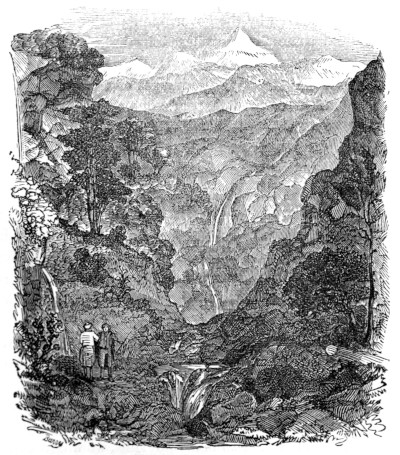
SOURCE OF THE JUMNA.
GUNGOTREE, THE SOURCE OF THE JUMNA, A BRANCH OF THE GANGES, IN THE HIMALAYA MOUNTAINS.
Gungotree, the source of the Jumna, represented in the cut below, the most sacred branch of the Ganges, ought to hold, and does hold the first rank among its holy places. Here all is mythological ground. Here Mahadeo sits enthroned in clouds and mist, amid rocks that defy the approach of living thing, and snows that make desolation more awful. Gods, goddesses and saints here continually adore him at mysterious distance, and 110you traverse their familiar haunts. But, although Gungotree be the most sacred, it is not the most frequented shrine, access to it being far more difficult than to Buddrinauth; and consequently to this latter, pilgrims flock in crowds, appalled at the remoteness and danger of the former place of worship. This may pretty fully account for the superior riches and splendor of Buddrinauth. Here are temples of considerable extent, priests and officials in abundance, who preserve an imposing exterior, and an appearance venerable from power and comparative magnificence, and consequently procure rich and ample offerings to keep up their comfortable dignity.
The temple of Bhadrinath, is situated on the west bank of the Alackunda, in a valley four miles long, and one mile in its greatest breadth. The east bank rises considerably higher than the west bank, and is on a level with the top of the temple. The position of the sanctuary is considered equidistant from two lofty mountains, which are designated by the names of the Nar and the Narayena Purvatas. The former is to the east, the latter to the west, and completely covered with snow from the summit to the base.
The temple of Bhadri-Nath has more beneficed lands attached to it than any sacred Hindoo establishment in this part of India. It is said to possess seven hundred villages in different parts of Gurwhal and Kumaoon: many of them have been conferred by the government; others have been given in pledge for loans; and some few, purchased by individuals, have been presented as religious offerings.
The annual ceremony of carrying the images of their gods to wash in the sacred stream of the Jumna, is, it appears, one of much solemnity among the inhabitants of the neighborhood; and the concourse of people that here assemble, are busily engaged, and continue to be fully occupied in doing honor to it. They dance to the sound of strange music, and intoxicate themselves with a sort of vile spirit, brewed from grain and particular roots, sometimes, it is said, sharpened by pepper. The dance is most grotesque and savage; a multitude of men taking hands sometimes in a circle, sometimes in a line, beating time with their feet, bend with one accord, first nearly to the earth with their faces, then backward, and then sidewise, with various wild contortions. These, and their uncouth dress of black and gray blankets, give a peculiar air of brutal ferocity to the assemblage. The men dance all day, and in the evening they are joined by the women, who mix indiscriminately with them, and keep up dancing and intoxication till the night is far advanced. They continue this frantic kind of worship for several days; and, in truth, it is much in unison with their general manners and habits, savage and inconsistent. At a place so sacred, the residence of so many Brahmins, and the resort of so many pilgrims, we might expect to find 111a strict attention to the forms of religion, and a scrupulous observance of the privations and austerities enjoined by it. So far, however, is this from the truth, that much is met with, shocking even to those Hindoos who are less bigoted.
“There were several points to be arranged,” says Mr. Fraser, “before we could set off for Gungotree, the source of the Jumna. I did not deem it proper to go unarmed; but agreed that only five men should be accoutered to attend us, and that I should myself carry my gun. But all these weapons of war were to be put aside before we got within sight of the holy spot, and deposited in a cave near it, under a guard. I also pledged myself that no use should be made of these instruments, nor any life sacrificed for the purpose of food, either by myself or by any of my people, after leaving the village, until we returned; moreover, that I would not even carry meat of any sort, dead or alive, along with me, but eat only rice and bread. As to the putting off my shoes, they did not even propose it to me, and it could not have been done; but I volunteered to put them off, when entering into the precincts of the temple and holier places, which pleased them greatly. All the Hindoos, including the Ghoorkhas, went from the village barefoot.
“Just at the end of the bridge there is an overhanging rock, under which worship is performed to Bhyram, and a black stone partly painted red, is the image of the god; and here not only were prayers and worship performed, but every one was obliged to bathe and eat bread baked by the Brahmins, as preparatory to the great and effectual ablutions at the holier Gungotree. This occupied a considerable time, as the party was numerous: in the mean time I took a very imperfect sketch of the scene, after which I bathed myself at the proper place, which is the junction of the two streams, while the Brahmin prayed over me. Among the ceremonies performed, he made me hold a tuft of grass while he prayed, which at the conclusion he directed me to throw into the eddy occasioned by the meeting of the two waters.
“By an unpleasant path we reached a step, or level spot on the first stage of the mountain, where, in a thick grove of fir-trees, is placed a small temple to Bhyram, a plain white building, built by order of Umur Sing T’happa, who gave a sum of money to repair the road, and erect places of worship here, and at Gungotree. Having paid our respects to Byramjee, we proceeded along the side of the hill on the right bank, north of the river, gradually ascending by a path equally difficult and dangerous as the first part of our ascent, but more fearful, as the precipice to the river, which rolls below us, increases in hight, and exceedingly toilsome from the nature of the ground over which it passes, and which consists wholly of sharp fragments 112from the cliffs above, with fallen trunks and broken branches of trees.
“The path increases in difficulty from the very irregular nature of the ground, as well as the steepness of the hill face across which it leads, ascending and descending as the small, though deep water-courses furrow the mountain side, in loose soil, formed of small fragments fallen from above, and which slip down, threatening to carry the traveler to the gulf below. The shapeless blocks of rock now more completely obstruct the way, and for hundreds of yards, at times, the passenger must clamber over these masses, heaped as they are one upon another, in monstrous confusion, and so uncertain and unsteady, that, huge though they are, they shake and move even under the burden of a man’s weight. So painful indeed is this track, that it might be conceived as meant to serve as a penance to the unfortunate pilgrims with bare feet, thus to prepare them for the special and conclusive act of piety they have in view, as the object of their journey to these extreme wilds.
“The spot which bears the name of Gungotree, is concealed by the roughness of the ground, and the masses of fallen rock, so as not to be seen till the traveler comes close upon it. The temple is situated precisely on the sacred stone on which Bhagirutte used to worship Mahadeo, and is a small building of a square shape for about twelve feet high, and rounding in, in the usual form of pagodas, to the top. It is quite plain, painted white, with red moldings, and surmounted with the usual melon-shaped ornaments of these buildings. From the eastern face of the square, which is turned nearly to the sacred source, there is a small projection covered with a stone roof, in which is the entrance facing the east, and just opposite this there is a small pagoda-shaped temple to Bhyramjee. The whole is surrounded by a wall of unhewn stone and lime, and the space this contains is paved with flat stones. In this space too, there is a comfortable but small house for the residence of the Brahmins who come to officiate. Without the inclosure there are two or three sheds constructed of wood, called dhurum sallahs, built for the accommodation of pilgrims who resort here; and there are many caves around formed by overhanging stones, which yield a shelter to those who can not find accommodation in the sheds.
“The scene in which this holy place is situated, is worthy of the mysterious sanctity attributed to it, and the reverence with which it is regarded. We have not here the confined gloominess of Bhyram Gattee: the actual dread which can not but be inspired by the precipices and torrents, and perils of the place, here gives way to a sensation of awe, imposing but not embarrassing, that might be compared to the dark and dangerous pass to the 113center of the ruins of a former world; for, most truly, there is little here that recalls the recollection of that which we seem to have quitted. The bare and peaked cliffs which shoot to the skies, yield not in ruggedness or elevation to any we have seen; their ruins lie in wild chaotic masses at their feet, and scantier wood imperfectly relieves their nakedness: even the dark pine more rarely roots itself in the deep chasms which time has worn. Thus on all sides is the prospect closed, except in front to the eastward; where, from behind a mass of bare spires, four huge, lofty, snowy peaks arise: these are the peaks of Roodroo-Himala. There could be no finer finishing, no grander close to such a scene, as is visible in the engraving.
“We approach it through a labyrinth of enormous shapeless masses of granite, which during ages have fallen from the cliffs above, that frown over the very temple, and in all probability will some day themselves descend in ruins and crush it. Around the inclosure, and among these masses, for some distance up the mountain, a few fine old pine-trees throw a dark shade and form a magnificent foreground; while the river runs impetuously in its shingly bed, and the stifled but fearful sound of the stones which it rolls along with it, crushing together, mixes with the roar of its waters.
“It is easy to write of rocks and wilds, of torrents and precipices; it is easy to tell of the awe such scenes inspire: this style and these descriptions are common and hackneyed. But it is not so simple, to many surely not very possible, to convey an adequate idea of the stern and rugged majesty of some scenes; to paint their lonely desertness, or describe the undefinable sensation of reverence and dread that steals over the mind while contemplating the death-like, ghastly calm that is shed over them: and when at such a moment we remember our homes, our friends, our firesides, and all social intercourse with our fellows, and feel our present solitude, and far distance from all these dear ties, how vain it is to strive at description! Surely such a scene is Gungotree. [See cut, page 109.] Nor is it, independently of the nature of the surrounding scenery, a spot which lightly calls forth powerful feelings. We were now in the center of the stupendous Himalaya, the loftiest and perhaps most rugged range of mountains in the world. We were at the acknowledged source of that noble river, which is equally an object of veneration and a source of fertility, plenty and opulence to Hindoostan; and we had now reached the holiest shrine of Hindoo worship which these holy hills contain. These are surely striking considerations, combining with the solemn grandeur of the place, to move the feelings strongly.
“The fortuitous circumstance of being the first European that ever penetrated to this spot, was no matter of boast, for no great danger had been 114braved, no extraordinary fatigues undergone; the road is now open to any other who chooses to attempt it; but it was a matter of satisfaction to myself. The first object of inquiry that naturally occurs to the traveler, after casting a glance over the general landscape, is the source of the river. Here, as at Jumnotree, you are told that no mortal has gone, or can go further toward its extreme origin than this spot; and the difficulty is indeed very apparent. I made a trial to gain a point about two furlongs beyond the temple, both for the purpose of observing the course of the river, and of seeing Gungotree in another point of view. But having with considerable difficulty made my way over the unsteady fragments for some hundred yards, at the risk of being precipitated into the stream, I was forced to turn back.
“The source is not more than five miles’ horizontal distance from the temple, and in a direction south-east, eighty-five degrees nearly; and beyond this place it is in all probability chiefly supplied by the melting of the great bosom of snow which terminates the valley, and which lies between the peaks of the great mountain above mentioned.
“This mountain, which is considered to be the loftiest and greatest of the snowy range in this quarter, and probably yields to none in the whole Himalaya, obtains the name of Roodroo Himala, and is held to be the throne or residence of Mahadeo himself. It is also indiscriminately called Pauch Purbut, from its five peaks, and Soomeroo Purbot, which is not to be confounded with the mountain so called near Bunderbouch; and sometimes the general appellation of Kylas is given, which literally signifies any snowy hill, but is applied to this mountain by way of preëminence. It has five principal peaks, called Roodroo Himala, Burrumpooree, Bissenpooree, Oodgurre Kanta and Soorga Rounee. These form a sort of semicircular hollow of very considerable extent, filled with eternal snow, from the gradual dissolution of the lower parts of which the principal part of the stream is generated: probably there may be smaller hollows beyond the point to the right above Gungotree, which also supply a portion.
“Within the temple there are three images; one, that of Kali; and the elevated stone shelf on which they were placed was wet and soiled with the offerings made; there was a peculiar smell, but I know not whence it proceeded. The place, as usual, was lighted by a small lamp: no daylight had admittance. Just below the temple, on the river side, grew three poplar trees, and a few small larches; above there are the remains of a fine old silver fir-tree, which overshadows some of the caves and sheds. The whole people also bathed, and contributed something to the priesthood; and it was a matter of serious importance, as well as of great joy to every one, that we had thus happily reached a place of such supereminent sanctity: such, 115indeed, that the act of bathing here is supposed to cleanse from every sin heretofore committed, and the difficulty of which is so great, that few, except professional devotees, ever attempt reaching the holy place.
“It is customary that those who have lost their father and mother, or either of these, shall be shaved at this spot; and it was curious to observe the whimsical changes produced by the operation, which numbers underwent. It appears also, that one chief ordinance was the going frequently round the holy temple; and we particularly observed that those who were noted as the greatest rogues were most forward in this pious exercise: one man, in particular, who had been a notorious thief, was unwearied in his perseverance.
“Well, indeed, do they say, that Seeva has made these recesses which he inhabits, inaccessible to all but those whom true devotion leads to his shrine. That man must have been indeed strongly impelled by devotion, ambition, or curiosity, who first explored the way to Gungotree. It were unavailing to inquire, and perhaps of little use, if known, to which of these motives we owe the enterprise; but patience, perseverance, and courage, must have been strongly united with it to lead him safely and successfully through those awful cliffs, that would bar the way to most men. Another omen of favor pointed out was, the increase of the river after bathing, as at Jumnotree; and it is singular enough, that during the time we remained here, I remarked several increases and decreases of the water, without any obvious causes; but these may fairly be referred to the effects of sudden changes of temperature occurring frequently among the hills, and acting on the body of snow that feeds the river.”
ASIATIC VOLCANOES.
Among the Asiatic burning mountains, a brief account of which we introduce after the above interesting notice of the grand Himalaya chain, those of Japan are both remarkable and numerous. On the summit of a mountain in the province of Figo, is a large cavern, formerly the mouth of a volcano, but the flame of which has ceased, probably for want of combustible matter. In the same province, near a religious structure called the Temple of the Jealous God of Aso, a perpetual flame issues from the top of a mountain. In the province of Tsickusen is another burning mountain, where was formerly a coal-pit, which having been set on fire by the carelessness of the workmen, has been burning ever since. Sometimes a black smoke, accompanied by a very disagreeable stench, is observed to issue from the summit of a famous mountain called Fesi, in the province of Seruga. This mountain is said to be nearly as high as the peak of Teneriffe, but in 116shape and beauty is supposed not to have an equal. Its top is covered with perpetual snow. Belonging to the Japanese cluster, and not far from Piranda, is a small rocky island, which has been burning and trembling for many centuries; and in another small island, opposite to Santzuma, is a volcano which has been burning at different intervals for many ages.
Captain Gore, when leaving Japan, passed by great quantities of pumice-stone, several pieces of which were taken up, and found to weigh from one ounce to three pounds. It was conjectured that these stones had been thrown into the sea by eruptions at various times, as many of them were covered by barnacles (small shells) and others were quite bare.
VOLCANIC MOUNTAINS OF KAMTSCHATKA.
There are three burning mountains of Kamtschatka, which for many years have thrown out a considerable smoke, but do not often burst into a flame. One of these is situated in the vicinity of Awatska; and another, named the volcano of Tolbatchiek, on a neck of land between the river Kamtschatka and the Tolbatchiek. In the beginning of the year 1739, the flames issued with such violence from the crater, as to reduce to ashes the forests on the neighboring mountains. This was succeeded by a cloud of smoke, which overspread and darkened the whole country, until it was dissipated by a shower of cinders, which covered the ground to the distance of thirty miles. The third volcano is on the top of the particular mountain of Kamtschatka, which is described as by far the highest in the peninsula. It rises from two rows of hills, somewhat in the form of a sugar-loaf, to a very great hight. It usually throws out ashes twice or thrice a year, sometimes in such quantities, that for three hundred versts, (one hundred and sixty-five English miles,) the earth is covered with them. In the year 1737, at the latter end of September, a conflagration, which lasted for a week, was so violent and terrific, that the mountain appeared, to those who were fishing at sea, like one red-hot rock; and the flames which burst through several openings, with a dreadful noise, resembled rivers of fire. From the inside of the mountains were heard thunderings, crackings, and blasts like those of the strongest bellows, shaking all the neighboring territory. During the night it was most terrible; but at length the conflagration ended by the mountain’s casting forth a prodigious quantity of cinders and ashes, among which were porous stones, and glass of various colors. When Captain Clarke sailed out of the harbor of St. Peter and St. Paul, in June, 1778, to the northward, an eruption of the first of these volcanoes was observed. A rumbling noise, resembling distant hollow thunder, was heard before daylight; and when the day broke, the decks and sides of the ships were 117covered with a fine dust, resembling emery, nearly an inch thick, the air at the same time being charged with this substance to such a degree, that toward the mountain, which is situated to the north of the harbor, the surrounding objects were not to be distinguished. About twelve o’clock, and during the afternoon, the explosions became louder, and were followed by showers of cinders, which were in general about the size of peas, though many were picked up on the deck larger than a hazel-nut. Along with the cinders fell several small stones which had not undergone any change from the action of fire.
VOLCANIC MOUNTAIN OF ALBAY.
The following details of the dreadful eruption of the volcano of Albay, in the island of Luconia, one of the Philippines, on the first of February, 1814, are from an eye-witness of the dreadful scenes it presented.
“During thirteen years the volcano of Albay had preserved a profound silence. It was no longer viewed with that distrust and horror with which volcanoes usually inspire those who inhabit the vicinity. Its extensive and spacious brow had been converted into highly cultivated and beautiful gardens. On the first day of January last, no person reflected, in the slightest degree, upon the damages and losses which so bad a neighbor had once occasioned. Previously to the former eruptions there had been heard certain subterraneous sounds, which were presages of them. But upon the present occasion we remarked nothing, except that on the last day of January we perceived some slight shocks. In the night the shocks increased. At two in the morning one was felt more violent than those hitherto experienced. It was repeated at four, and from that time they were almost continual until the eruption commenced.