WONDERS OF ART. (continued 2)
Reading edition
EGYPTIAN TEMPLES, MONUMENTS, &C.
The ruins of the temple of Hermopolis, or the great city of Mercury, which were thought wonderful till the later discoveries in Egypt threw them comparatively in the shade, give some idea of the great range and high perfection the arts had attained in that country. Many parts of these ruins have preserved their original position, without having been altered or deformed by the works of modern times, and have remained untouched for well nigh four thousand years. They are of freestone, of the fineness of marble, and have neither cement, nor any other means of union, except the perfect fitting of the respective parts. The colossal proportions of the edifice, evince the power the Egyptians possessed to raise such enormous masses. The portico is one hundred and twenty feet long, and its hight sixty feet. Not a spring of an arch remains, to throw light on the dimensions of the whole extent of the temple, or of the nave. The architecture is still richer than the Doric order of the Greeks. The shafts of the pillars represent fasciæ, or bundles; and the pedestal, the stem of the lotus. Under the roof between the two middle columns, are winged globes; and all the roofs are ornamented with a wreath of painted stars, of an aurora color on a blue ground.
The temple of Apollinopolis Magna is described by Denon as surpassing in extent, majesty, magnificence, and high preservation, whatever he had seen in Egypt, or elsewhere. This building is a long suite of pyramidal gates, of courts decorated with galleries, of porticos, and of covered naves, 528constructed, not with common stones, but with entire rocks. This superb edifice is situated on a rising ground, so as to overlook, not only its immediate vicinity, but the whole valley. On the right is the principal gate, placed between two huge mounds of buildings, on the walls of which are three orders of hieroglyphic figures, increasing in their gigantic dimensions, insomuch that the last have a length of twenty-five feet. The inner court is decorated with a gallery of columns, bearing two terraces, which come out at two gates, through which is the passage to the stairs, leading to the platform of the mounds. Behind the inner portico are several apartments, and the sanctuary of the temple. A wall of circumvallation is decorated both within and without with innumerable hieroglyphics, executed in a very finished and laborious style. This magnificent temple appears to have been dedicated to the evil genius, the figure of Typhon being represented in relief on the four sides of the plinth which surmounts each of the capitals. The entire frieze, and all the paintings within, are descriptive of Isis, defending herself against the attacks of that monster.
THE RUINS OF THEBES.
The ruins of the ancient city of Thebes, which Homer has characterized by the single expression of the city with a hundred gates, are of so immense an extent as to convince the spectator that fame has not exaggerated its size. For, as if the diameter of old Egypt was not sufficient to contain it, its monuments rest on two chains of contiguous mountains, while its tombs occupy the valleys toward the west, stretching off into the desert. The large temple on the eastern side is between two and three leagues distant from Medeenet Abou, where the most western temple is situated; and the modern village of Karnak is built on a small part of the site of a single temple, which is half a mile in circumference. Of the remains of this temple, Denon tells us, that “of the hundred columns of the portico alone, the smallest are seven feet and a half in diameter, and the largest twelve. The space occupied by the circumvallation of the temple contains lakes and mountains. In short, to be enabled to form a competent idea of so much magnificence, the reader ought to fancy what is before him to be a dream, as he who views the objects themselves rubs his eyes to know whether he is awake. The avenue leading from Karnak to Luxor, a space nearly half a league in extent, contains a constant succession of sphinxes and other chimerical figures to the right and left, together with fragments of stone walls, of small columns, and of statues.”
The village of Luxor, Denon describes “as also built on the side of the 529ruins of a temple, not so large as that of Karnak, but in a better state of preservation, the masses not having as yet fallen through time, and by the pressure of their own weight. The most colossal parts consist of fourteen columns of nearly eleven feet in diameter, and of two statues in granite, at the outer gate, buried up to the middle of the arms, and having in front of them the two largest and best preserved obelisks known. The French, when in Egypt, deemed their means insufficient, not to hew out, but merely to transport these two monuments, which are not more than a fragment of one of the numerous edifices of the astonishing city of Thebes. They are of rose-color granite, are still seventy feet above the ground, and to judge by the depth to which they are supposed to be covered with sand, are believed to be at least one hundred feet in hight. Their preservation is perfect, and the hieroglyphics with which they are covered being cut deep, and in relief at the bottom, show the bold hand of a master, and a beautiful finish. The chisels which could cut such hard materials must have been of an admirable temper; and the machines to drag such enormous blocks from the quarries, to transport them thither, and to set them upright, together with the time required for the labor, surpass all conception!” In speaking of the gate of the temple, which is now that of the village of Luxor, Denon remarks as follows. “Nothing can be more grand, and at the same time more simple, than the small number of objects of which this entrance is composed. No city whatever makes so proud a display at its approach as this wretched village, the population of which consists of two or three thousand souls, who have taken up their abode on the roofs and beneath the galleries of this temple, which has, nevertheless, the air of being in a manner uninhabited.”
The tombs of the kings of Thebes are grottos consisting of a regular double gallery supported by pillars, behind which is a row of chambers, often double. In proportion as the hight of these grottos increases, they become more richly decorated; and the spectator is soon convinced, by the magnificence both of the paintings and sculptures, and of the subjects they represent, that he is among the tombs of great men or heroes. Those which appear to have belonged to the ancient kings, are only distinguished from the others by the magnificence of the sarcophagi, and the mysterious solitude of their situation; the others immediately overlooking the great buildings in the city. The sculpture in all is incomparably more labored and more highly finished than that of the temples, and displays a high perfection of the art. The lines of the hieroglyphics have been cut with a firmness of touch, and a precision, of which marbles offer but few examples; and the figures have a particular elegance and correctness of contour. 530Small subjects taken from nature are introduced; and in these the groups of persons are given in perspective; and cut in deep relief, in simple and natural attitudes. Several of these subjects bear but little analogy to the spot in which they are immured; for bass-reliefs are seen representing games, such as rope-dancing, and asses taught to play tricks and rear on their hind legs, sculptured with all the traits of genuine nature and simplicity. The plan of these excavations is singular; and many are so vast and complicated, that they might be mistaken for labyrinths, or subterraneous temples. After passing the elegant apartments described above, long and gloomy galleries present themselves, winding backward and forward in numerous angles, and seeming to occupy a great extent of ground. They are melancholy, repulsive, and without any decoration; but open from time to time into other chambers covered with hieroglyphics, and branch out into narrow paths, leading to deep perpendicular pits. At the bottom of these pits are other adorned chambers; and lower still a new series of perpendicular pits and horizontal chambers, until at length, ascending a long flight of steps, the visitor reaches an open place on a level with the chambers he first entered.entered.
Thus far we have followed the brief outline given by Denon, and the earlier travelers. But our ideas of these wonderful ruins will become much more enlarged, as well as accurate, by perusing the descriptions of more recent tourists and explorers; such for example as Taylor and Thompson. The former, before beginning the recital of his visit, gives an outline of the topography of Thebes. “The course of the Nile,” he says, “is here nearly north, dividing the site of the ancient city into two almost equal parts. On approaching it from Kenneh, the mountain of Goorneh which abuts on the river, marks the commencement of the western division. This mountain, a range of naked limestone crags, terminating in a pyramidal peak, gradually recedes to the distance of three miles from the Nile, which it again approaches further south. Nearly the whole of the curve, which might be called the western wall of the city, is pierced with tombs, among which are those of the queens, and the grand priestly vaults of the Assasseef. The valley of the kings’ tombs lies deep in the heart of the range, seven or eight miles from the river. After passing the corner of the mountain, the first ruin on the western bank is that of the temple-palace of Goorneh. More than a mile further, at the base of the mountain, is the Memnonium, or temple of Remeses the Great, between which and the Nile the two Memnonian colossi are seated on the plain. Nearly two miles to the south of this is the great temple of Medeenet Abou, and the fragments of other edifices are met with, still further beyond. On the eastern bank, nearly opposite 531Goorneh, stands the temple of Karnak, about half a mile from the river. Eight miles eastward, at the foot of the Arabian mountains, is the small temple of Medamot, which, however, does not appear to have been included in the limits of Thebes. Luxor is directly on the bank of the Nile, a mile and a half south of Karnak, and the plain extends several miles beyond it, before reaching the isolated range, whose three conical peaks are the landmarks of Thebes to voyagers on the river. These distances convey an idea of the extent of the ancient city, but fail to represent the grand proportions of the landscape, so well fitted, in its simple and majestic outlines, to inclose the most wonderful structures the world has ever seen. The green expanse of the plain; the airy coloring of the mountains; the mild, solemn blue of the cloudless Egyptian sky: these are a part of Thebes, and inseparable from the remembrance of its ruins.
“At sunrise we crossed to the western bank and moored our boat opposite Goorneh. It is advisable to commence with the tombs, and close the inspection of that side with Medeenet Abou, reserving Karnak, the grandest of all for the last. The most unimportant objects in Thebes are full of interest when seen first, whereas Karnak, once seen, fills one’s thoughts to the exclusion of everything else. There are Arab guides for each bank, who are quite familiar with all the principal points, and who have a quiet and unobtrusive way of directing the traveler; and with one of them, we set off on a stirring gallop for the temple of Goorneh and the valley of the kings’ tombs, leaving Achmet to follow with our breakfast, and the Arab boys with their water bottles. The temple of Goorneh was built for the worship of Amun, the Theban Jupiter, by Osirei and his son, Remeses the Great, the supposed Sesostris, nearly fourteen hundred years before the Christian era. It is small, compared with the other ruins, but interesting from its rude and massive style, a remnant of the early period of Egyptian architecture. The two pylons in front of it are shattered down, and the dromos of sphinxes has entirely disappeared. The portico is supported by a single row of ten columns, which neither resemble each other, nor are separated by equal spaces. What is most singular, is the fact that notwithstanding this disproportion, which is also observable in the doorways, the general effect is harmonious. We tried to fathom the secret of this, and found no other explanation than in the lowness of the building, and the rough granite blocks of which it is built. One seeks no proportion in a natural temple of rock, or a cirque of Druid stones. All that the eye requires is rude strength, with a certain approach to order. The effect produced by this temple is of a similar character, barring its historical interest. Its dimensions are too small to be imposing, and I found, after 532passing it several times, that I valued it more as a feature in the landscape, than for its own sake.
“The sand and pebbles clattered under the hoofs of our horses, as we galloped up the gorge of Biban el Molook, the ‘gates of the kings.’ The sides are perpendicular cliffs of yellow rock, which increased in hight, the further we advanced, and at last terminated in a sort of basin, shut in by precipices several hundred feet in hight and broken into fantastic turrets, gables and pinnacles. The bottom is filled with huge heaps of sand and broken stones, left from the excavation of the tombs in the solid rock. There are twenty-one tombs in this valley, more than half of which are of great extent and richly adorned with paintings and sculptures. Some have been filled with sand or otherwise injured by the occasional rains which visit this region, while a few are too small and plain to need visiting. Sir Gardner Wilkinson has numbered them all in red chalk at the entrances, which is very convenient to those who use his work on Egypt as a guide. I visited ten of the principal tombs, to the great delight of the old guide, who complained that travelers are frequently satisfied with four or five. The general arrangement is the same in all, but they differ greatly in extent and in the character of their decoration.
“The first we entered was the celebrated tomb of Remeses I., discovered by Belzoni. From the narrow entrance, a precipitous staircase, the walls of which are covered with columns of hieroglyphics, descends to a depth of forty feet, where it strikes a horizontal passage leading to an oblong chamber, in which was formerly a deep pit, which Belzoni filled. This pit protected the entrance to the royal chamber, which was also carefully walled up. In the grace and freedom of the drawings, and the richness of their coloring, this tomb surpasses all others. The subjects represented are the victories of the monarch, while in the sepulchral chamber he is received into the presence of the gods. The limestone rock is covered with a fine coating of plaster, on which the figures were first drawn with red chalk, and afterward carefully finished in colors. The reds, yellows, greens and blues are very brilliant, but seem to have been employed at random, the gods having faces sometimes of one color, sometimes of another. In the furthest chamber, which was left unfinished, the subjects are only sketched in red chalk. Some of them have the loose and uncertain lines of a pupil’s hand, over which one sees the bold and rapid corrections of the master. Many of the figures are remarkable for their strength and freedom of outline. I was greatly interested in a procession of men, representing the different nations of the earth. The physical peculiarities of the Persian, the Jew and the Ethiopian are therein as distinctly marked as at the present day. The 533blacks are perfect counterparts of those I saw daily upon the Nile, and the noses of the Jews seem newly painted from originals in New York. The burial-vault, where Belzoni found the alabaster sarcophagus of the monarch, is a noble hall, thirty feet long by nearly twenty in breadth and hight, with four massive pillars forming a corridor on one side. In addition to the light of our torches, the Arabs kindled a large bonfire in the center, which brought out in strong relief the sepulchral figures on the ceiling, painted in white on a ground of dark indigo hue. The pillars and walls of the vault glowed with the vivid variety of their colors, and the general effect was unspeakably rich and gorgeous. This tomb has already fallen a prey to worse plunderers than the Medes and Persians. Belzoni carried off the sarcophagus, Champollion cut away the splendid jambs and architrave of the entrance to the lower chambers, and Lepsius has finished by splitting the pillars and appropriating their beautiful paintings for the museum at Berlin. At one spot, where the latter has totally ruined a fine doorway, some indignant Frenchman has written in red chalk, ‘Meurtre commis par Lepsius.’ In all the tombs of Thebes, wherever you see the most flagrant and shameless spoliations, the guide says, ‘Lepsius.’ Who can blame the Arabs for wantonly defacing these precious monuments, when such an example is set them by the vanity of European antiquarians?
“Bruce’s tomb, which extends for four hundred and twenty feet into the rock, is larger than Belzoni’s, but not so fresh and brilliant. The main entrance slopes with a very gradual descent, and has on each side a number of small chambers and niches, apparently for mummies. The illustrations in these chambers are somewhat defaced, but very curious, on account of the light which they throw upon the domestic life of the ancient Egyptians. They represent the slaughtering of oxen, the preparation of fowls for the table, the kneading and baking of bread and cakes, as well as the implements and utensils of the kitchen. In other places the field laborers are employed in leading the water of the Nile into canals, cutting dourra, threshing and carrying the grain into magazines. One room is filled with furniture, and the row of chairs around the base of the walls would not be out of place in the most elegant modern drawing-room. The illustrated catalogue of the London exhibition contains few richer and more graceful patterns. In a chamber nearer the royal vault, two old, blind minstrels are seen, playing the harp in the presence of the king, whence this is sometimes called the harper’s tomb. The pillars of the grand hall, like those of all the other tombs we visited, represent the monarch, after death, received into the presence of the gods, stately figures, with a calm and serious aspect, and lips, which, like those of the Sphinx, seemed closed upon some awful 534mystery. The absurdity of the coloring does not destroy this effect, and a blue-faced Isis, whose hard, black eyeball stares from a brilliant white socket, is not less impressive than the same figure, cut in sandstone or granite. The delicacy and precision of the hieroglyphics, sculptured in intaglio, filled me with astonishment. In the tomb of Amunoph III., which I visited the next day, they resembled the ciphers engraved upon seals in their exquisite sharpness and regularity. Only the principal tombs, however, are thus beautified. In others the figures are either simply painted, or apparently sunken in the plaster, while it was yet fresh, by prepared patterns. The latter method accounts for the exact resemblance of long processions of figures, which would otherwise require a most marvelous skill on the part of the artist. In some unfinished chambers I detected plainly the traces of these patterns, where the outlines of the figures were blunt, and the grain of the plaster bent, and not cut. The family likeness in the faces of the monarchs is also too striking, unfortunately, for us to accept them all as faithful portraits. They are all apparently of the same age, and their attributes do not materially differ. This was probably a flattery on the part of the artists, or the effect of a royal vanity, which required to be portrayed in the freshness of youth and the full vigor of body and mind. The first faces I learned to recognize were those of Remeses II., the supposed Sesostris, and Amunoph III.
“The tomb of Memnon, as it was called by the Romans, is the most elegant of all, in its proportions, and is as symmetrical as a Grecian temple. On the walls of the entrance are several inscriptions of Greek tourists, who visited it in the era of the Ptolemies, and spent their time in carving their names, like Americans nowadays. The huge granite sarcophagus in which the monarch’s mummy was deposited, is broken, as are those of the other tombs, with a single exception. This is the tomb of Osirei I., the grandfather of Sesostris, and the oldest in the valley. I visited it by crawling through a hole barely large enough to admit my body, after which I slid on my back down a passage nearly choked with sand, to another hole, opening into the burial chamber. Here no impious hand had defaced the walls, but the figures were as perfect and the coloring as brilliant as when first executed. In the center stood an immense sarcophagus, of a single block of red granite, and the massive lid, which had been thrown off, lay beside it. The dust in the bottom gave out that peculiar mummy odor perceptible in all the tombs, and in fact long after one has left them, for the clothes become saturated with it. The guide, delighted with having dragged me into that chamber, buried deep in the dumb heart of the mountain, said not a word, and from the awful stillness of the place and the phantasmagoric gleam of 535the wonderful figures on the walls, I could have imagined myself a neophyte, on the threshold of the Osirian mysteries. We then rode to the western valley, a still deeper and wider glen, containing tombs of the kings of the foreign dynasty of Atin-Re. We entered the two principal ones, but found the paintings rude and insignificant. There are many lateral passages and chambers, and in some places deep pits, along the edge of which we were obliged to crawl. In the last tomb a very long and steep staircase descends into the rock. As we were groping after the guide, I called to my friend to take care, as there was but a single step, after making a slip. The words were scarcely out of my mouth before I felt a tremendous thump, followed by a number of smaller ones, and found myself sitting in a heap of sand, at the bottom, some twenty or thirty feet below. Fortunately, I came off with but a few slight bruises.
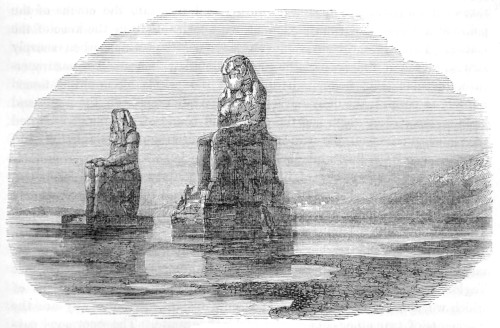
THE TWO COLOSSI.
“Returning to the temple of Goorneh, we took a path over the plain, through fields of wheat, lupines and lentils, to the two colossi, which we had already seen from a distance. These immense sitting figures, fifty-three feet above the plain, which has buried their pedestals, overlook the site of vanished Thebes and assert the grandeur of which they and Karnak are the most striking remains. They were erected by Amunoph III., and though the faces are totally disfigured, the full, round, beautiful proportions of the 536colossal arms, shoulders and thighs do not belie the marvelous sweetness of the features which we still see in his tomb. Except the head of Antinous, I know of no ancient portrait so beautiful as Amunoph. The long and luxuriant hair, flowing in a hundred ringlets, the soft grace of the forehead, the mild serenity of the eye, the fine thin lines of the nostrils, and the feminine tenderness of the full lips, triumph over the cramped rigidity of Egyptian sculpture, and charm you with the lightness and harmony of Greek art. In looking on that head, I can not help thinking that the subject overpowered the artist, and led him to the threshold of a truer art. Amunoph, or Memnon, was a poet in soul, and it was meet that his statue should salute the rising sun with a sound like that of a harp-string. Modern research has wholly annihilated this beautiful fable. Memnon now sounds at all hours of the day, and at the command of all travelers who will pay an Arab five piasters to climb up into his lap. We engaged one, who threw off his garments, hooked his fingers and toes into the cracks of the polished granite, and soon hailed us with ‘salaam’ from the knee of the statue. There is a certain stone on Memnon’s lap, which, when sharply struck, gives out a clear, metallic ring. Behind it is a small square aperture, invisible from below, where one of the priests no doubt stationed himself to perform the daily miracle. Our Arab rapped on the arms and body of the statue, which had the usual dead sound of stone, and rendered the musical ring of the sun-smitten block the more striking.” And Thompson tells us, that while he and his associates sat before it on their donkeys, they saw “a boy of fifteen, with a solitary rag round his waist, scrambling up the side of the statue, and presently he was completely hidden in its lap, just where the sly priest used to hide himself over night. Then striking with a hammer the hollow, sonorous stone, it emitted a sharp, clear sound, like the striking of brass,” though it was “not sunrise, but the middle of a scorching afternoon.” “An avenue of sphinxes,” continues Taylor, “once led from these colossi to a grand temple, the foundations of which we found about a quarter of a mile distant. On the way are the fragments of two other colossi, one of black granite. The enormous substructions of the temple and the pedestals of its columns, have been sufficiently excavated to show what a superb edifice has been lost to the world. A crowd of troublesome Arabs, thrusting upon our attention newly baked cinerary urns, newly roasted antique wheat, and images of all kinds fresh from the maker’s hand, disturbed our quiet examination of the ruins, and in order to escape their importunities, we rode to the Memnonium. This edifice, the temple-palace of Remeses the Great, is supposed to be the Memnonium, described by Strabo. It is built on a gentle rise of land at 537the foot of the mountain, and looks eastward to the Nile and Luxor. The grand stone pylon which stands at the entrance of its former avenue of sphinxes, has been half leveled by the fury of the Persian conquerors; and the colossal granite statue of Remeses, in the first court of the temple, now lies in enormous fragments around its pedestal. Mere dimensions give no idea of this immense mass, the weight of which, when entire, was nearly nine hundred tuns. How poor and trifling appear the modern statues which we call colossal, when measured with this, one of whose toes is a yard in length; and how futile the appliances of modern art, when directed to its transportation for a distance of one hundred and fifty miles! The architrave at each end of the court was upheld by four caryatides, thirty feet in hight. Though much defaced, they are still standing, but are dwarfed by the mighty limbs of Remeses. It is difficult to account for the means by which the colossus was broken. There are no marks of any instruments which could have forced such a mass asunder, and the only plausible conjecture I have heard is, that the stone must have been subjected to an intense heat and afterward to the action of water. The statue, in its sitting position, must have been nearly sixty feet in hight, and is the largest in the world, though not so high as the rock-hewn monoliths of Aboo-Simbel. The Turks and Arabs have cut several mill-stones out of its head, without any apparent diminution of its size. The Memnonium differs from the other temples of Egypt in being almost faultless in its symmetry, even when measured by the strictest rules of art. I know of nothing so exquisite as the central colonnade of its grand hall—a double row of pillars, forty-five feet in hight and twenty-three in circumference, crowned with capitals resembling the bell-shaped blossoms of the lotus. One must see them to comprehend how this simple form, whose expression is all sweetness and tenderness in the flower, softens and beautifies the solid majesty of the shaft. In spite of their colossal proportions, there is nothing massive or heavy in their aspect. The cup of the capital curves gently outward from the abacus on which the architrave rests, and seems the natural blossom of the columnar stem. On either side of this perfect colonnade are four rows of Osiride pillars, of smaller size, yet the variety of their form and proportions only enhances the harmony of the whole. This is one of those enigmas in architecture which puzzle one on his first acquaintance with Egyptian temples, and which he is often forced blindly to accept as new laws of art, because his feeling tells him they are true, and his reason can not satisfactorily demonstrate that they are false.
“We waited till the yellow rays of sunset fell on the capitals of the Memnonium, and they seemed, like the lotus flowers, to exhale a vapory light, 538before we rode home. All night we wandered in dreams through kingly vaults, with starry ceilings and illuminated walls; but on looking out of our windows at dawn, we saw the red saddle-cloths of our horses against the dark background of the palm grove, as they came down to the boat. No second nap was possible, after such a sight, and many minutes had not elapsed before we were tasting the cool morning air in the delight of a race up and down the shore. Our old guide, however, was on his donkey betimes, and called us off to our duty. We passed Goorneh, and ascended the eastern face of the mountain to the tombs of the priests and private citizens of Thebes. For miles along the mountain side, one sees nothing but heaps of sand and rubbish, with here and there an Arab hut, built against the face of a tomb, whose chambers serve as pigeon-houses and stalls for asses. The earth is filled with fragments of mummies, and the bandages in which they were wrapped; for even the sanctity of death itself, is here neither respected by the Arabs nor the Europeans whom they imitate. The first tomb we entered almost cured us of the desire to visit another. It was that called the Assasseef, built by a wealthy priest, and it is the largest in Thebes. Its outer court measures one hundred and three by seventy-six feet, and its passages extend between eight and nine hundred feet into the mountain. We groped our way between walls as black as ink, through long, labyrinthine suites of chambers, breathing a deathlike and oppressive odor. The stairways seemed to lead into the bowels of the earth, and on either hand yawned pits of uncertain depth. As we advanced, the ghostly vaults rumbled with a sound like thunder, and hundreds of noisome bats, scared by the light, dashed against the walls and dropped at our feet. We endured this for a little while, but on reaching the entrance to some darker and deeper mystery, were so surrounded by the animals, who struck their filthy wings against our faces, that not for ten kings’ tombs would we have gone a step further. My friend was on the point of vowing never to set his foot in another tomb, but I persuaded him to wait until we had seen that of Amunoph. I followed the guide, who enticed me by flattering promises into a great many snakelike holes, and when he was tired with crawling in the dust, sent one of our water-carriers in advance, who dragged me in and out by the heels.
“The temple of Medeenet Abou is almost concealed by the ruins of a Coptic village, among which it stands, and by which it is partially buried. The outer court, pylon, and main hall of the smaller temple, rise above the mounds and overlook the plain of Thebes, but scarcely satisfy the expectation of the traveler, as he approaches. You first enter an inclosure surrounded by a low stone wall, and standing in advance of the pylon. 539The rear wall, facing the entrance, contains two single pillars, with bell-shaped capitals, which rise above it and stand like guards before the doorway of the pylon. Here was another enigma for us. Who among modern architects would dare to plant two single pillars before a pyramidal gateway of solid masonry, and then inclose them in a plain wall, rising to half their hight? Yet here the symmetry of the shafts is not injured by the wall in which they stand, nor oppressed by the ponderous bulk of the pylon. On the contrary, the light columns and spreading capitals, like a tuft of wild roses hanging from the crevice of a rock, brighten the rude strength of the masses of stone with a gleam of singular loveliness. What would otherwise only impress you by its size, now endears itself to you by its beauty. Is this the effect of chance, or the result of a finer art than that which flourishes in our day? I will not pretend to determine, but I must confess that Egypt, in whose ruins I had expected to find only a sort of barbaric grandeur, has given me a new insight into that vital beauty which is the soul of true art. We devoted little time to the ruined court and sanctuaries which follow the pylon, and to the lodges of the main temple, standing beside them like watch-towers, three stories in hight. The majestic pylon of the great temple of Remeses III. rose behind them, out of heaps of pottery and unburnt bricks, and the colossal figure of the monarch in his car, borne by two horses into the midst of the routed enemy, attracted us from a distance. We followed the exterior wall of the temple, for its whole length of more than six hundred feet, reading the sculptured history of his conquests. The entire outer wall of the temple presents a series of gigantic cartoons, cut in the blocks of sandstone, of which it is built. Remeses is always the central figure, distinguished from subjects and foes, no less by his superior stature, than by the royal emblems which accompany him. Here we see heralds sounding the trumpet in advance of his car, while his troops pass in review before him; there, with a lion walking by his side, he sets out on his work of conquest. His soldiers storm a town, and we see them climbing the wall with ladders, while a desperate hand-to-hand conflict is going on below. In another place, he has alighted from his chariot and stands with his foot on the neck of a slaughtered king. Again, his vessels attack a hostile navy on the sea. One of the foreign craft becomes entangled and is capsized, yet while his spearmen hurl their weapons among the dismayed enemy, the sailors rescue those who are struggling in the flood. After we have passed through these strange and stirring pictures, we find the monarch reposing on his throne, while his soldiers deposit before him the hands of the slaughtered, and his scribes present to him lists of their numbers, and his generals lead to him long processions of fettered captives. 540Again, he is represented as offering a group of subject kings to Amun, the Theban Jupiter, who says to him: ‘Go, my cherished and chosen, make war on foreign nations, besiege their forts and carry off their people to live as captives.’ On the front wall, he holds in his grasp the hands of a dozen monarchs, while with the other hand he raises his sword to destroy them. Their faces express the very extreme of grief and misery, but he is cold and calm as fate itself. We slid down the piles of sand and entered by a side-door into the grand hall of the temple. Here, as at Dendera, a surprise awaited us. We stood on the pavement of a magnificent court, about one hundred and thirty feet square, around which ran a colonnade of pillars, eight feet square and forty feet high. On the western side is an inner row of circular columns, twenty-four feet in circumference, with capitals representing the papyrus blossom. The entire court, with its walls, pillars and doorways, is covered with splendid sculptures and traces of paint, and the ceiling is blue as the noonday sky, and studded with stars. Against each of the square columns facing the court once stood a colossal caryatid, upholding the architrave of another colonnade of granite shafts, nearly all of which have been thrown from their bases and lie shivered on the pavement. This court opens toward the pylon into another of similar dimensions, but buried almost to the capitals of its columns in heaps of rubbish. The character of the temple is totally different from that of every other in Egypt. Its hight is small in proportion to its great extent, and it therefore loses the airy lightness of the Memnonium and the impressive grandeur of Dendera. Its expression is that of a massive magnificence, if I may use such a doubtful compound: no single epithet suffices to describe it.”
The visit to this temple ended our traveler’s survey of the western division of Thebes, “two long days of such experience,” he remarks, “as the contemplation of a lifetime can not exhaust;” and at sunset they crossed over the Nile, to
LUXOR AND ITS TEMPLE.
The temple of Luxor is imbedded in the modern village, and only the front of the pylon, facing toward Karnak, and part of the grand central colonnade, are free from its hovels and their accessories. For this reason, though of much grander proportions than the Memnonium, its effect is less agreeable and impressive. “Its plan, however,” says Taylor, “is easily traced; and having been built by only two monarchs, Remeses the Great and Amunoph III., or, to use their more familiar titles, Sesostris and Memnon, it is less bewildering, in a historical point of view, to the unstudied tourist, than most of the other temples of Egypt. The sanctuary, which 541stands nearest the Nile, is still protected by the ancient stone quay, though the river has made rapid advances, and threatens finally to undermine Luxor as it has already undermined the temples of Antæopolis and Antinoë. I rode into what were once the sacred chambers, but the pillars and sculptures were covered with filth, and the Arabs had built in, around and upon them, like the clay nests of the cliff-sparrow. The peristyle of majestic Osiride pillars, in front of the portico, as well as the portico itself, are buried to half their depth, and so surrounded by hovels, that to get an idea of their arrangement you must make the tour of a number of hen-houses and asses’ stalls. The pillars are now employed as drying-posts for the buffalo dung which the Arabs use as fuel. Proceeding toward the entrance, the next court, which is tolerably free from incumbrances, contains a colonnade of two rows of lotus-crowned columns, twenty-eight feet in circumference. They still uphold their architraves of giant blocks of sandstone, and rising high above the miserable dwellings of the village, are visible from every part of the plain of Thebes. The English vice-consul occupies a house between two of these pillars. He gave us the agreeable news that the consul was endeavoring to persuade the pasha to have Karnak cleared of its rubbish and preserved from further spoliation. If I possessed despotic power, (and I then wished it for the first time,) I should certainly make despotic use of it, in tearing down some dozens of villages and setting some thousands of Copts and Fellahs at work in exhuming what their ancestors have mutilated and buried. The world can not spare these remains. Tear down Roman ruins if you will; level Cyclopean walls; build bridges with the stones of Gothic abbeys and feudal fortresses; but lay no hand on the glory and grandeur of Egypt! We ascended the great pylon of the temple, on the face of the towers of which the victories of Remeses are sculptured; but his colossi, solid figures of granite, which sit on either side of the entrance, have been much defaced. The lonely obelisk, which stands a little in advance, on the left hand, is more perfect than its Parisian mate. From this stately entrance, an avenue of colossal sphinxes once extended to the Ptolemaic pylon of Karnak, a distance of a mile and a half. The sphinxes have disappeared, and the modern Arab road leads over its site, through fields of waste grass.”
KARNAK AND ITS RUINS.
“And now we galloped forward, through a long procession of camels, donkeys, and desert Arabs armed with spears, toward Karnak, the greatest ruin in the world, the crowning triumph of Egyptian power and Egyptian art. Except a broken stone here and there protruding through the soil, the 542plain is as desolate as if it had never been conscious of a human dwelling; and only on reaching the vicinity of the mud hamlet of Karnak, can the traveler realize that he is in Thebes. Here the camel-path drops into a broad excavated avenue, lined with fragments of sphinxes and shaded by starveling acacias. As you advance, the sphinxes are better preserved and remain seated on their pedestals, but they have all been decapitated. Though of colossal proportions, they are seated so close to each other, that it must have required nearly two thousand to form the double row to Luxor. The avenue finally reaches a single pylon, of majestic proportions, built by one of the Ptolemies, and covered with profuse hieroglyphics. Passing through this, the sphinxes lead you to another pylon, followed by a pillared court and a temple built by the later Remesides. This, I thought, while my friend was measuring the girth of the pillars, is a good beginning for Karnak, but it is certainly much less than I expect. ‘Tāāl min hennee!’ (come this way!) called the guide, as if reading my mind, and led me up the heaps of rubbish to the roof and pointed to the north. Ah, there was Karnak! Had I been blind up to this time, or had the earth suddenly heaved out of her breast the remains of the glorious temple? From all parts of the plain of Thebes I had seen it in the distance—a huge propylon, a shattered portico, and an obelisk, rising above the palms. Whence this wilderness of ruins, spreading so far as to seem a city rather than a temple; pylon after pylon, tumbling into enormous cubes of stone, long colonnades, supporting fragments of Titanic roofs, obelisks of red granite, and endless walls and avenues, branching out to isolated portals? Yet they stood as silently amid the accumulated rubbish of nearly four thousand years, and the sunshine threw its yellow luster as serenely over the despoiled sanctuaries, as if it had never been otherwise since the world began. Figures are of no use, in describing a place like this, but since I must use them, I may say that the length of the ruins before us, from west to east, was twelve hundred feet, and that the total circumference of Karnak, including its numerous pylæ, or gateways, is a mile and a half.
“We mounted and rode with fast-beating hearts to the western or main entrance, facing the Nile. The two towers of the propylon (pyramidal masses of solid stone) are three hundred and twenty-nine feet in length, and the one which is least ruined, is nearly one hundred feet in hight. On each side of the sculptured portal connecting them, is a tablet left by the French army, recording the geographical position of the principal Egyptian temples. We passed through, and entered an open court, more than three hundred feet square, with a corridor of immense pillars on each side, connecting it with the towers of a second pylon, nearly as gigantic as the first. 543A colonnade of lofty shafts, leading through the center of the court, once united the two entrances, but they have all been hurled down, and lay as they fell, in long lines of disjointed blocks, except one, which holds its solitary lotus-bell against the sky. Two mutilated colossi of red granite still guard the doorway, whose lintel-stones are forty feet in length. Climbing over the huge fragments which have fallen from above and almost blocked up the passage, we looked down into the grand hall of the temple. I knew the dimensions of this hall, beforehand; I knew the number and size of the pillars, but I was no more prepared for the reality than those will be, who may read this account of it and afterward visit Karnak for themselves. It is the great good luck of travel that many things must be seen to be known. Nothing could have compensated for the loss of that overwhelming confusion of awe, astonishment, and delight, which came upon me like a flood. I looked down an avenue of twelve pillars, six on each side, each of which was thirty-six feet in circumference and nearly eighty feet in hight. Crushing as were these ponderous masses of sculptured stone, the spreading bell of the lotus-blossoms which crowned them, clothed them with an atmosphere of lightness and grace. In front, over the top of another pile of colossal blocks, two obelisks rose sharp and clear, with every emblem legible on their polished sides. On each side of the main aisle are seven other rows of columns, one hundred and twenty-two in all; each of which is about fifty feet high and twenty-seven in circumference. They have the Osiride form, without capitals, and do not range with the central shafts. In the efforts of the conquerors to overthrow them, two have been hurled from their places and thrown against the neighboring ones, where they still lean, as if weary with holding up the roof of massive sandstone. I walked alone through this hall, trying to bear the weight of its unutterable majesty and beauty. That I had been so oppressed by Dendera, seemed a weakness which I was resolved to conquer, and I finally succeeded in looking on Karnak with a calmness more commensurate with its sublime repose; but not by daylight. My next visit was at night, at the time of the full moon. There was a wan haze in the air, and a pale halo around the moon, on each side of which appeared two faint mock-moons. It was a ghostly light, and the fresh north wind, coming up the Nile, rustled solemnly in the palm-trees. We trotted silently to Karnak, and leaped our horses over the fragments until we reached the foot of the first obelisk. Here we dismounted and entered the grand hall of pillars. There was no sound in all the temple, and the guide, who seemed to comprehend my wish, moved behind me as softly as a shadow, and spoke not a word. It needs this illumination to comprehend Karnak. The unsightly rubbish has disappeared: 544the rents in the roof are atoned for by the moonlight they admit; the fragments shivered from the lips of the mighty capitals are only the crumpled edges of the flower; a maze of shadows hides the desolation of the courts, but every pillar and obelisk, pylon and propylon is glorified by the moonlight. The soul of Karnak is soothed and tranquillized. Its halls look upon you no longer with an aspect of pain and humiliation. Every stone seems to say: ‘I am not fallen, for I have defied the ages. I am a part of that grandeur which has never seen its peer, and I shall endure forever, for the world has need of me.’ I climbed to the roof, and sat looking down into the hushed and awful colonnades, till I was thoroughly penetrated with their august and sublime expression. I should probably have remained all night, an amateur colossus, with my hands on my knees, had not the silence been disturbed by two arrivals of romantic tourists, an Englishman and two Frenchmen. We exchanged salutations, and I mounted my restless mare again, touched her side with the stirrup, and sped back to Luxor. The guide galloped beside me, occasionally hurling his spear into the air and catching it as it fell, delighted with my readiness to indulge his desert whims. I found the captain and sailors all ready and my friend smoking his pipe on deck. In half an hour we had left Thebes.”
Such is a faint view of these ruins of forty centuries, the remains of that splendid city, Thebes, in comparison with which New York is but an infant to the mighty giant! “Yes, proud upstart of this nineteenth century,” says Thompson, “the so-called Empire city, commercial emporium of the west, great metropolis of the new world, if thy rivers should sweep over and bury thee, not all the stone of the Croton reservoir, and the city hall, and the Astor house, and of a hundred churches forsooth, would make one pile like Karnak; nor could any of these furnish a single stone for the lintels of its gates. Yet Karnak, which began to be in that other nineteenth century before Christ, is not yet a ruin! Its gateways stand; its grand hall stands, its columns nearly all unbroken, and not one spire of grass, or tuft of moss, or leaf of ivy, hides its speaking sculptures. Only the sand has covered them; and when this is removed, they are as fresh as yesterday.”
“Such is the skeleton of Thebes, as we can reconstruct it of such materials and from such localities as yet mark its site. But what was Thebes when, resting upon the Lybian mountains on the west and the Arabian on the east, with the Nile flowing through its center, it filled a circuit of twenty-five miles in a plain of twice that area, teeming with fertility! What was Thebes when she could pour forth twenty thousand chariots of war, and when the grand triumphal procession of priests, and 545officers of state, and soldiers, and captives, swept through these colossal avenues to grace the conqueror’s return! What was Thebes when, by the way of the Red sea, Arabia and the Indies poured all their commerce into her lap, and the Nile brought her the spoils of Ethiopia and of the great sea! What was Thebes when she possessed wealth, and mechanic arts, and physical force, to rear such monuments even in the midst of war, and sometimes more than one in the reign of a single monarch! What was Thebes, with all the arts and inventions of civilized life that are sculptured upon the tombs of her kings to mark the progress of their day; from building arches and bridges, to glass-blowing and porcelain manufactures, to the making of umbrellas, fans, chairs, and divans, fine linens, and all the appurtenances of a modern drawing-room! What was Thebes when all merchants resorted thither from Persia, from Ethiopia, from Lybia, and the Levant! What was Thebes when the artists and scholars of infant Greece and Rome went thither to school! Was not Egypt the mother of nations? Where is the art of Greece or Rome that was not tutored in Egypt; that has not simply graced Egyptian forms—nor always this? Where is the philosophy of Greece or Rome that was not borrowed from Egypt? Even the divine Plato, who only waited for the true Logos, learned at Egypt’s shrine. Egypt gave birth to art, gave birth to thought, before Greece and Rome were born. She was the grand repository of human power; the originator of all great forms of human development; the originator, the inventor, the great prototype of the world’s history, here laid up in her hieroglyphic archives. In all material things, yes, and in all great intellectual forms, in poetry, in art, in philosophy, in science, and in the religion of nature, this nineteenth century is but the recipient of the mighty past. Whatever she has of these, she but inherits through Rome and Greece from their old mother Egypt. What she has better than these, she has by gift divine, through that Christianity which purifies, enfranchises, and ennobles man, reforms society, and makes free the state. If she hold fast by this, she will become resplendent with a glory that Egypt never knew; but if she slight this, and sell her birthright for luxury and power, the meanest grave at Thebes would suffice to bury this nineteenth century with its boasted inventions.“
THEBES, AS SEEN IN HISTORY.
All the mere ruins of Thebes, however, immense and magnificent as they are, fail to give us true views of her greatness, till we go back to her origin, and trace up her history; and this is so graphically done by Thompson, in his “Egypt, Past and Present,” that we quote from it, what he so appropriately calls “Dissolving Views: Panorama of Karnak.” “In order,” he 546says, “to a complete view of Thebes, past and present, one should reproduce its sculptured story, and make it witness for itself. The temple of Karnak, in its several parts, marks the rise, the growth, the decline, and the fall of Egypt. This temple had a growth of twenty-five hundred years, from a small sanctuary to ‘a city of temples.’ Every principal era of the national history is represented in this stupendous pile; and as we go leisurely around it, and translate into our own language, or vivify into present actual scenes, the processions, the battles, the ceremonies, the religious offerings, and the state displays, sculptured on its walls and columns, and for the most part still legible, we behold all Egypt move before us as in a panorama, whose scenes and actors are instinct with life. This animated reproduction of the sculptures, which I attempted when on the ground, I would hope to convey to the reader by following in course the histories here written on the stone.
“I stood in Karnak, under the light of the full moon. It was an hour for silence, and we enjoined this upon each other, and gave ourselves to solitary musing. The cuckoo, that had wooed us with his note as we reposed under the great pillars in the sultry noon, had gone to nestle with his mate; and the myriad birds that by day had fluttered along the corridors, had hid themselves in the crevices of the capitals. Even the owl that hooted as we entered, was still. Only the moon was there, threading the avenues with silver footsteps, and holding her clear light that we might read the sculptured chronicles of kings. We sat down in the center of the grand avenue. Twelve majestic pillars, on either hand, towered along its length, and seemed, as of old, to support an arch of azure studded with stars. The dismantled towers of the grand entrance, whose bases stand like pyramids truncated to sustain the firmament, grew more gigantic in the shadow of the columns, while their once massive gates, uncovered by the hand of time, seemed only to have lifted up their heads to let the King of Glory in. In the avenue that crossed beside our seat, (one of twelve, having each ten columns of huge dimensions,) at either extremity, a column had fallen crosswise against its neighbor, carrying with it its fragment of the stone roof, and there it hung almost ethereal in the still moonlight, a symbol of the struggle between man and time. Under the corridors, darkness brooded over the fragments of sculptured stone; but beyond the other portal, the yet perfect obelisk stood in pensive majesty among its fallen mates, and from its clear, hard face projected in the moonbeams the symbols of the power that built these halls, and of the worship that sustained them. The spell of Egypt was complete. For two months I had lived under its deepening power. At length, in the sepulchers of its kings, and on the walls and pillars of its temples, I had seen the Egypt of forty centuries 547revived as in a panorama fresh from the artist’s pencil, and had lived in the Egypt that the Nile then watered, as in the so-called Egypt that it waters now. And here I had come to bid it farewell, to take a last look at its grave; and yet the witching moonlight made it live again. The breath of the south fanning the columns that in their fourth decade of centuries wear no ivied wreath of age, warmed their still grandeur into life, and with Memnon’s charm they sang to the moon the great epic of the past. As I listened, all art, all learning, all religion, all poetry, all history, all empire, and all time, swept through my wondering soul. Leaving my companions, I wandered over the fragments of columns and sphinxes and colossi, till, gaining a mound that half buries the front area of the temple, I clambered up the steps worn by age in its stupendous wall, and standing in their foremost tower, looked back on Karnak. But no change of place, nor sight of fallen columns and decaying walls, could break the spell. I had walked over the grave of Egypt, I had stumbled against the fragments of its sepulcher, yet Egypt stood before me.
“First came the second son of Ham, with a long retinue of camels and of servants, lured southward by the fertile valley of the Nile, till, where the mountains widen their embrace around the well-watered plain, he pitches his tent, and founds an infant city. Generations pass, and the son who in this plain inherits the patriarchal wealth and power, greedy of the patrimony of his brethren to the north, wages a fratricidal war, and seizing upon all Mizr or ‘the land of Ham,’ effaces from it the name of his ancestors, and, investing it with his own, gives Egypt (Copt or Gurt) a name and a power in the newly divided earth. Other generations pass, and the first king of Egypt comes with barbaric pomp, from the capital he has founded at the north, to visit his native Theba, the real ‘head’ or capital, and here offers to its divinity the rude shrine whose traces linger behind yonder obelisk. Ages roll on. The swelling Nile pours out increasing fatness on the land. The earth brings forth by handfuls. Fat-fleshed, well-favored cattle come up out of the river and feed in the meadow. There is great plenteousness for man and beast. But with all the plenty there is no waste. In every city huge granaries are built, and in these the grain is piled, as the sand of the sea, without measure. There is a strange wisdom near the throne of Pharaoh. Again, the east wind blows, and the scorching sands of the Arabian desert are heaped upon the fertile Nile. In the mountains of Ethiopia there is no rain. The river shrinks away. The plain of Thebes is dry. The people cry for bread, but the keys of the great storehouses are in the hand of the ruler of the land. They bring to him their money; they bring to him their cattle; they sell to him their land: they sell to him their 548very selves for bread. Again, the east wind ceases; the rains fall, the river rises; the desert retreats; the land revives. And now the great Pharaoh, whom the counsel of a captive Jew has made possessor of all the treasure and all the land of Egypt, moved by a religious sentiment but half enlightened, would make a votive offering to his god. A fleet of barges covers the bosom of the Nile, which with waving banners and gorgeous emblems and increasing music, have borne the monarch from his northern to his southern capital. With solemn pomp the procession of priests and soldiers and chief officers of state, with the uplifted monarch in the midst, files from the river to the rude sanctuary of Menes, which the skill of masons and of sculptors has already surrounded with columns of rich red granite, and chambers of polished stone, and with colossal statues of the king—the offering he brings to the divinity, whom he adores as the preserver of the land; and while the monarch bows before the god, the sound of trumpets, and the fragrance of incense, and the chanting of the priests, announce to the multitude that Amun accepts the gift, and will be henceforth worshiped in their temple. Osirtasen the Great passes away.
“The ages roll. A native Theban usurps the throne of the northern Pharaohs, and succeeds to the power they had consolidated through the counsel of the Hebrew, vouchsafed to them through fourscore years. But Joseph is dead; embalmed and coffined in a royal sarcophagus; and Amosis the usurper knows him not. Oppression fills the land, and falls most heavily upon the seed of Joseph. Another Theban Pharaoh mounts the throne, and to preserve the power that the wisdom of a Hebrew gave, determines to cut off the issue of the Hebrews from the land. Yet in his own house, even as a son, in all the learning of his schools, amid all the splendors of his court, is nurtured a young Hebrew who yet shall desolate the land that Joseph blessed. But just now this rising terror has fled into the desert, and the first Thothmes comes in peaceful pomp to offer to the divinity of Thebes the gigantic obelisks that bear his name. He plants them yonder in the area before the sanctuary of Osirtasen. The third Thothmes is on the throne. There is groaning throughout the land of Egypt; there is deep sorrow in the land of Goshen. The monarch would make his name immortal by the temples, the palaces, and the monuments he rears in every city, from the great sea to the cataracts of Nubia. He adorns his native capital upon its western bank with a new sanctuary added to the temple of his father, and with another temple inclosed with brick, that bear in hieroglyphics his own initials; and here at Karnak, he builds behind the sanctuary, a thousand feet from where I stand, the grand edifice of fifty columns that surpasses all the royal architecture yet seen in Thebes. In its 549adytum he enshrines a colossal figure of the deified hawk that he worships. He is the great architect of Egypt, and he will fill the land with the memorials of his reign. Heliopolis and Noph, Zoan and Sin, attest his grandeur. But the voice of another God now thunders in his ear. The exiled Hebrew has returned. The land is filled with plagues, frogs, lice, flies, blood, murrain, hail, locusts, darkness, death. The king has gone from Thebes to Zoan, his most northern seat, where these judgments overtake him. The land of Goshen, that had sweltered under his exactions, breathes more freely, and he lets the people go. But gathering his chariots of war in mad haste, he pursues them, and hems them in between the mountains and the sea. Eager for his prey, he plunges into the channel God has made for them, and the proud architect of Egypt returns not, even to occupy the gorgeous tomb he had prepared for himself at Thebes.
“The ages roll on, and a mighty conqueror sits on the throne of Egypt. With his myriad chariots he sweeps Ethiopia on the south, and Canaan on the north, and gathering all the forces of the Nile, he shakes Lebanon with his tread, and scatters the hosts of Syria on the plains of the Euphrates. And now there is an unwonted stir in Thebes. From all Egypt the priests and the great men are gathered to greet the conqueror’s return. In the distance, amid clouds of infantry, is seen the chariot of the king. Bound to his chariot wheels are the captive princes he has taken in his wars. Behind him are his son, and the royal scribe who bears the record of his victories. A long line of captives, bound about the necks with cords, follow in his train. The cortege moves from temple to temple through the city, till it reaches that of Karnak. Here, alighting from his chariot, the monarch enters the temple of Amunre, to present his captives and booty to the protecting deity of Thebes; then laying his captives on the block, with a ponderous club he dashes out their brains as a sacrifice to the god, and amid the acclamations of the people, is borne like a god to his own palace. And now the conqueror, reposing on his laurels, gives himself to the work of enriching the capital with new and more splendid edifices for the honor of its divinities, and the commemoration of his reign. From all Egypt are summoned the masons and sculptors, the painters and artificers and ‘cunning workmen;’ and the army that had stormed the hights of Lebanon now levies from the mountains of the Arabian desert their tribute of limestone and sandstone and granite of various hues, of syenite and porphyry and alabaster, to construct these temples, and to adorn these avenues. The grand hall of Karnak rises in its majestic proportions, a fit approach to the sanctuary of Amun. Its gates lift up their heads. Its tenfold avenues rear their massive, lofty, graceful pillars—each a single stone hewn into a 550rounded, swelling shaft, with a wreathed or flowered capital—and with their roof of solid stone, compose the portico that there in the moonlight, restored to its original perfection, stands confessed the wonder of the world. The chisel sculptures on its walls and columns the battle scenes of the king and his offerings to the god, and the name of Osirei passes into history. His son succeeds to his victories and to his glory. For, on the far off plains of Asia, the great Sesostris breaks the power of the Assyrian hosts, and leads their captive chiefs in chains. Babylon bows to Egypt. There is another day of exultation in the capital; but the pomp of the returning Osirei pales before the national ovation to his son. The priests, in their sacred vestments, go forth to meet him, bearing aloft the figures of his illustrious ancestors, from Menes to Osirei. The king, alighting from his chariot, mounts the triumphal car prepared for his reception, whose fiery steeds are led by liveried grooms. His fan-bearers wave the flabella over his head, and the priests and the chief men of the nation kneel in homage at his throne. And now the grand procession forms to enter the city. Trumpeters herald its approach, and bands of music, with choristers, form the van. In long line the priests and officers of state precede the monarch, bearing scepters, arms, and other insignia, and the cushioned steps of the throne. The statues of his ancestors head the royal column, and after these is borne a statue of the god upon men’s shoulders under a gilded canopy. The sacred bull, adorned with garlands, is led by members of the sacerdotal order. The monarch is attended by his scribes, who exhibit proudly the scroll of his achievements. Behind his car are dragged the captives, their chained hands uplifted for mercy, and their cries and lamentations mingling wildly with the bursts of music and the shouts of the multitude. These are followed by the spoils of war—oxen, chariots, horses, and sacks of gold; and beyond, a corps of infantry in close array, flanked by numerous chariots, bring up the rear. The vast throng sweep from temple to temple, and rend the air with acclamations. At length the divinity, that had been taken from its shrine to welcome the victor, is brought before its own adytum. Here the high-priest offers incense to the monarch, who, in turn, alights from his throne and burns incense to the god. And now the horrid sacrifice of war is made to the patron deity. The wretched captives are beaten in the presence of the king; their right hands are cut off, and being counted by the scribes, are retained as trophies: their persons are horribly mutilated; their heads are severed by the sword or mangled by the mace, and the gorgeous, barbarous scene is closed.
“There is peace in Egypt; and the king builds, on yonder western bank, the majestic and beautiful Memnonium, covers its walls with the story of 551his victories, and sets before its gate the stupendous statue of himself, the symbol of the grandeur and the power of Egypt, enthroned in a sublime and an immortal repose. He builds the vast area of Luxor, with its massive gates and towers, and before these plants colossal statues of himself and lofty obelisks, and lines with huge symbolic sculptures the avenue to Karnak. Here he lays up before the shrine of Amun, as depicted on the walls, a gorgeous barge overlaid with gold without, and with silver within, a tribute from the spoils of war. He enriches the walls of the grand hall by adding to the sculptured story of his father’s reign the battle scenes of his own, and before the portico constructs this area of a hundred thousand square feet, surrounded with its covered corridor, and adorned with sphinxes and a central avenue of tufted columns, and faced with these stupendous towers. He throws around the whole a massive wall, and Karnak stands complete in the glory of the great Remeses. Then follows the resplendent dynasty of all the Osirei and the Remeses, and Egypt culminates to its meridian splendor. Her schools rise with her temples, and the epic bard of Scio sings the ‘hundred gates of Thebes,’ while the priests and the philosophers of young Greece resort to the mother of mythology and of letters, and Grecian sculptors come to study the forms and creations of the mother of art. The king of Israel, whose fame for wisdom and for wealth is known in all the earth, wooes the daughter of the king of Egypt, and she whom ‘the sun had looked upon’ on the confines of Ethiopia, shines in the golden palace at Jerusalem, ‘beautiful as Tirzeh, and comely as the tents of Kedar.’
“But again the hosts of Egypt are marshaled for battle; again they sweep the borders of the north; again is heard the shout of victory; again Thebes is astir for the conqueror’s return. Now Shishak brings to the temple of Amun the treasures of the house of Jehovah at Jerusalem; the golden shields of Solomon, and the treasures of the palace he had built. Twelve hundred chariots, and sixty thousand horsemen, and footmen without number, swell the train of the victorious king. Nailing the heads of his wretched captives to the block of the executioner, he whets his sword to sacrifice them to the god; and the blood of Israel once more cries to God from the land of Egypt. From afar the voice of the prophet speaks the answer of Jehovah to that cry: ‘Behold, I am against Pharaoh king of Egypt, and will break his arms; and I will cause the sword to fall out of his hand. Howl ye; woe, woe the day! For the day is near, even the day of the Lord is near, a cloudy day. The sword shall come upon Egypt; and the pride of her power shall come down.’ Again a mighty host, sweeping from the north, hovers upon the plain of Thebes. The idols are moved in 552their temples, the cry of the people is in the streets. But it is not now the return of her victorious king that stirs the royal city. The great ram from the plains of Persia, pushing westward and southward, gores Egypt with his horns, overthrows her temples and her statues, treads Memnon and Remeses in the dust, drinks up the river and devours the valley. There is sorrow and groaning in the land of Egypt for a hundred years, when lo! again the dust of mighty hosts sweeps from the north. The he-goat from the west, moved with choler at the ram, that drinks up the great rivers, rushes upon him in the fury of his power, and casts him down and stamps upon him. The Persian conqueror of Thebes retires before the Macedonian conqueror of Persia. Greece, though a conqueror, pays homage to Egypt as her mistress. New cities are built; temples and monuments are restored. Upon the plain of Thebes, new works of art unite the sculptured records of the Ptolemies with the broken tablets of the Pharaohs. Karnak itself opens new portals, and revives its ancient splendor. Again the schools of Egypt are visited from Greece. And where Homer drank his inspiration, and Herodotus pored over the hieroglyphics, and the papyrus records, and the dim traditions of the then old world, Plato comes to ponder the great mysteries of the soul’s existence, and its relations to the infinite.
“But the doom of Egypt is not yet fulfilled. Her resurrection can not now come. The gigantic horn that sweeps the stars, trails the young Egypt of Alexander in the dust. Again she lifts her head and wooes her conqueror to repose awhile in the lap of luxury. Beauty usurps the dominion of power; and the golden barge of Cleopatra sweeps up the Nile with silken sails perfumed with sweetest odors, or moves with silver oars attuned to the soft melody of lutes. Rome adds her tamer art to the great majesty of Egypt, and restores yet further what the Persian had destroyed. Yet Egypt may not rise. A new power enters to possess the land. Under the Roman name, the religion that had visited the land with Abraham, with Joseph, and with Moses, comes to enshrine itself in these old temples, emptied of their gods and broken in their forms. The voice of prayer and praise to the God of Israel is heard in the temple built by their oppressor, and the name of the infant whom Egypt sheltered, is spoken with reverence and adoration in all her holy places. Yonder, in the furthest temple of this mighty pile, a Christian church assembles; there, in the court of Luxor, stands another Christian altar, while, across the river, the colonnade of Medeenet Abou encompasses the lesser columns of a Christian temple built within its folds. But the spirit of the old temple lingers in its form, and with it embraces the new. Again the liveried priests march through the corridors, bearing mysterious symbols, and chanting unknown strains. 553Again the pomp of state is blended with the pomp of worship, and the pictured saint but plasters over the sculptured deity. The religion and the empire of Rome are alike effete, and can give no life to Egypt. And now barbaric hordes from the east pour in upon the land, and sweep these both away. The sword of the Moslem, hacking the plastered walls, writes there in blood the forgotten truth, there is one God, though it add thereto the stupendous lie, that makes the other cardinal of his religion. The wild man of the desert pitches his tent upon the plain where Mizraim halted centuries before, or hides himself under the cover of broken tombs and temples. He hardly moves from his retreat, when the imperious Turk, his brother Moslem, proclaims himself master of Egypt and Arabia by the will of God. And now here sits the Arab on this luxurious plain, among these crumbling giants of the past, startled at his own shadow, without the spirit to fight either for himself against his tyrant, or for his country in that tyrant’s service. Here he sits, where Osirei and Remeses and Shishak have chronicled their names and deeds beside their own gigantic portraits. Here he sits, where moved in royal state the conqueror of Ethiopia, of Judah, of Syria, and of Babylon. Here he sits, where the fierce Cambyses dealt his retribution; where Alexander moved with a pomp that none but he could boast; where Cæsar followed in the train of mighty men—yet owned the greater might of woman. Here he sits—‘Il faut descendre,’ said my guide, who had tortured his Arabic gutturals into a rude French; ‘il faut descendre,’ (it is necessary to go down.) Il faut descendre, repeated I, as I looked over upon the tombs of the kings, all drear and ghostly in the moonlight; and looked where Memnon stood, and all was desolate; and looked toward Luxor, where the moonlight stole faintly through its broken towers; and turned and looked at Karnak, as the meridian moon now shone upon heaps of rubbish, and broken columns, and crumbling walls. Il faut descendre, IT MUST GO DOWN; and, turning to descend, I stumbled over an Arab hovel, plastered upon the very top of the tower of Sesostris, and heard the yelping of the dogs from the huts that bury the side temple of the conqueror of Babylon. The spell was broken; and Egypt was a dream. Riding back, amid barking dogs and shivering, shrinking Arabs, over the dusty plain to Luxor, I lay down upon the divan where, two months before, I had dreamed of Egypt, when, entering the Nile, I felt her resistless spell. But no dream of Egypt came. Egypt herself had vanished. As a dream when one awaketh, so, O Lord, when thou awakedst, thou didst despise her image.”
554
OTHER RUINS IN EGYPT, &C.
There are in Egypt and the valley of the Nile, numerous other ruins, relics and monuments of the mighty past, on which it would be most interesting and instructive to dwell, were they not overshadowed by the wonderful structures we have been considering. Some of these, however, ought not to be passed without notice.
THE TEMPLE OF DENDERA.
The temple of Dendera (formerly Tentyra) is on the western bank of the Nile, nearly opposite Kenneh. Passing from the latter place, the path of the traveler leads through a palm grove, where the lofty shafts of the date and the vaulted foliage of the doum-palm, blend in the most picturesque groupage, and in contrast with the lace-like texture of the flowering mimosa, and the cloudy boughs of a kind of gray cypress. Crossing the meadows to Dendera, leagues of rank grass roll away toward the desert in shining billows, while the wind wafts the rich and mingled odors of the various flowers on the traveler’s course. In the midst of this beautiful plain, rise the earthy mounds of Dendera; and the portico of the temple, almost buried beneath them, stands like a beacon, marking the boundary of the desert. “We galloped our animals along the dike,” says a late traveler, “and dismounted at a small pylon, which stands two or three hundred paces in front of the temple. The huge jambs of sandstone, covered with sharply cut hieroglyphics and figures of the Egyptian gods, and surmounted by a single block, bearing the mysterious winged globe and serpent, detained us but a moment, and we hurried down what was once the dromos of the temple, now represented by a double wall of unburnt bricks. The portico, more than a hundred feet in length, and supported by six columns, united by screens of masonry, no stone of which, or of the columns themselves, is unsculptured, is massive and imposing, but struck me as being too depressed to produce a very grand effect. What was my astonishment, on arriving at the entrance, to find that I had approached the temple on a level with half its hight, and that the pavement of the portico was as far below as the scrolls of its cornice were above me. The six columns I had seen, covered three other rows, of six each, all adorned with the most elaborate sculpture and exhibiting traces of the brilliant coloring which they once possessed. The entire temple, which is in an excellent state of preservation, except where the hand of the Coptic Christian has defaced its sculptures, was cleaned out by order of Mohammed Ali, and as all its chambers, as well as the roof of enormous sandstone blocks, are entire, it is considered one of the 555most complete relics of Egyptian art. I find my pen at fault, when I attempt to describe the impression produced by the splendid portico. The twenty-four columns, each of which is sixty feet in hight, and eight feet in diameter, crowded upon a surface of one hundred feet by seventy, are oppressive in their grandeur. The dim light, admitted through the half closed front, which faces the north, spreads a mysterious gloom around these mighty shafts, crowned with the fourfold visage of Athor, still rebuking the impious hands that have marred her solemn beauty. On the walls, between columns of hieroglyphics, and the cartouches of the Cæsars and the Ptolemies, appear the principal Egyptian deities, the rigid Osiris, the stately Isis and the hawk-headed Orus. Around the bases of the columns spring the leaves of the sacred lotus, and the dark-blue ceiling is spangled with stars, between the wings of the divine emblem. The sculptures are all in raised relief, and there is no stone in the temple without them. I can not explain to myself the unusual emotion I felt while contemplating this wonderful combination of a simple and sublime architectural style with the utmost elaboration of ornament. My blood pulsed fast and warm on my first view of the Roman forum, but in Dendera I was so saddened and oppressed, that I scarcely dared speak for fear of betraying an unmanly weakness. The portico opens into a hall, supported by six beautiful columns, of smaller proportions, and lighted by a square aperture in the solid roof. On either side are chambers connected with dim and lofty passages, and beyond is the sanctuary and various other apartments, which receive no light from without. We examined their sculptures by the aid of torches, and our Arab attendants kindled large fires of dry corn-stalks, which cast a strong red light on the walls. The temple is devoted to Athor, the Egyptian Venus, and her image is everywhere seen, receiving the homage of her worshipers. Even the dark staircase, leading to the roof, up which we climbed over heaps of sand and rubbish, is decorated throughout with processions of symbolical figures. The drawing has little of that grotesque stiffness which I expected to find in Egyptian sculptures, and the execution is so admirable in its gradations of light and shade, as to resemble, at a little distance, a monochromatic painting. The antiquarians view these remains with little interest, as they date from the comparatively recent era of the Ptolemies, at which time sculpture and architecture were on the decline. We, who had seen nothing else of the kind, were charmed with the grace and elegance of this sumptuous mode of decoration. Part of the temple was built by Cleopatra, whose portrait, with that of her son Cæsarion, may still be seen on the exterior wall. The face of the colossal figure has been nearly destroyed, but there is a smaller one, whose soft, voluptuous 556outline is still sufficient evidence of the justness of her renown. The profile is exquisitely beautiful. The forehead and nose approach the Greek standard, but the mouth is more roundly and delicately curved, and the chin and cheek are fuller. Were such an outline made plastic, were the blank face colored with a pale olive hue, through which should blush a faint, rosy tinge, lighted with bold black eyes and irradiated with the lightning of a passionate nature, it would even now ‘move the mighty hearts of captains and of kings.’ Besides the temple, there are also the remains of a chapel of Isis, with a pylon, erected by Augustus Cæsar, and a small temple, nearly whelmed in the sand, supposed to be one of the mammeisi, or lying-in houses of the goddess Athor, who was honored in this form, on account of having given birth to the third member of the divine triad.”
THE TEMPLES OF HERMONTIS AND OF ESNEH.
Passing up the Nile, on the same side of it, and nearly opposite Luxor and Karnak, is the village of Erment, the ancient Hermontis, which is still graced with a small temple to the goddess Reto. “The group of pillars in the outer court,” says Taylor, “charmed us by the richness and variety of their designs. No two capitals are of similar pattern, while in their combinations of the papyrus, the lotus and the palm-leaf, they harmonize one with another and as a whole. The abacus, between the capital and the architrave, is so high as almost to resemble a second shaft. In Karnak and the Memnonium it is narrow, and lifts the ponderous beam just enough to prevent its oppressing the lightness of the capital. I was so delighted with the pillars of Hermontis that I scarcely knew whether to call this peculiarity a grace or a defect. I have never seen it employed in modern architecture, and judge therefore that it has either been condemned by our rules or that our architects have not the skill and daring of the Egyptians. We reached Esneh the same night, but were obliged to remain all the next day in order to allow our sailors to bake their bread. We employed the time in visiting the temple, the only remnant of the ancient Latopolis, and the palace of Abbas Pasha, on the bank of the Nile. The portico of the temple, half buried in rubbish, like that of Dendera, which it resembles in design, is exceedingly beautiful. Each of its twenty-four columns is crowned with a different capital, so chaste and elegant in their execution that it is impossible to give any one the preference. The designs are mostly copied from the doum-palm, the date-palm, and the lotus, but the cane, the vine, and various water-plants are also introduced. The building dates from the time of the Ptolemies, and its sculptures are uninteresting. We devoted all our time 557to the study of the capitals, a labyrinth of beauty, in which we were soon entangled. The governor of Esneh, a most friendly and agreeable Arab, accompanied us through the temple, and pointed out all the fishes, birds and crocodiles he could find, to him the most interesting things in it.” The same day they also visited the rock tombs of El-Kab, the ancient Eleuthyas, which are among the most curious in Egypt. “There are a large number of these, but only two are worth visiting, on account of the light which they throw on the social life of the Egyptians. The owner of the tomb and his wife, a red man and a yellow woman, are here seen, receiving the delighted guests. Seats are given them, and each is presented with an aromatic flower, while the servants in the kitchen hasten to prepare savory dishes. In other compartments, all the most minute processes of agriculture are represented with wonderful fidelity. So little change has taken place in three thousand years, that they would answer, with scarcely a correction, as illustrations of the Fellah agriculture of modern Egypt.”
The northern part of Nubia abounds in Egyptian remains, such, for example, as the temples of Dabod, Kalabshee, Dakkeh, Dendoor, Sebooa, &c., &c.; and the whole valley of the Nile is filled with the ruins of cities whose names have hardly survived their overthrow. Noticing but two or three more of these ruins, we will then pass on to other themes.
ABYDOS, AND THE TEMPLE OF MEMNON.
Abydos was the reputed burial-place of Osiris, one of the most sacred gods of ancient Egypt. According to Strabo, it formerly held the next rank to Thebes, and judging from its ruins, Wilkinson thinks it yielded to few cities in upper Egypt in size and magnificence. Going toward it from Girgeh, says Thompson, “we came upon a mound of sand and dust, and broken bricks and pottery, strewed over with bleaching human bones, and ascending this for several rods, and to an elevation of about sixty feet, we came out upon the massive blocks of stone that form the roof of the old temple-palace of Memnon. Here, crawling upon our hands and knees, we got under the roof far enough to see that it covers two large halls supported by rows of massive columns, whose capitals are in the form of the lotus bud, still distinctly preserved. The walls, as far as could be seen, are covered with sculptures, among which the ibis frequently recurs; there are also ceremonial processions and battle scenes, such as are usually depicted in the sculptures of Egyptian temples. No doubt, if this temple should be excavated, it would be one of the most remarkable monuments in Egypt. It dates back nearly fourteen hundred years before Christ. The formation of the roof was peculiar. Large blocks of stone were laid endwise from one 558row of columns to the other, and then an arch was hollowed out of this solid masonry, still leaving a roof two feet in thickness at its center. The stones were so nicely adjusted, that they fitted closely without cement. The ceiling was studded with stars, and with sculptures beautifully colored. I have not seen in Egypt more exquisite workmanship. Yet the visitor is doomed to disappointment through the great difficulty of access to the temple, in consequence of the drifting in of the sand from the desert and the neighboring mountains. Near by is another temple, also inaccessible, the temple of Osiris, built by the great Remeses, and enriched with alabaster walls, some fragments of which may yet be found. The neighboring mountains are filled with tombs, some of which are nearly four thousand years old. Everything indicates that here was the site of a great city, a city of wealth, population and power, enriched with trophies of conquest and monuments of religion. But these buried temples alone remain, and the Arabs, who now squat in their rags upon the top of the splendid sanctuary of Osiris, have given to the place the expressive name of ‘The Buried.’”
THE TEMPLES OF ABOU SIMBEL.
Passing up the Nile to about latitude twenty-two degrees, on its west side, nearly up to the second cataract, we come to the temples of Abou Simbel. Reaching the bank of the river about midnight, the traveler we have so often quoted tells us: “As I was awakened from a deep sleep by the shock of the boat striking the shore, I saw a huge wall of rock before me, against which six enormous statues leaned as they looked from deep niches cut in its front. Their solemn faces were touched by the moon, which shone full on the cliff, and only their feet were wrapped in shadow. The lines of deep-cut hieroglyphics over the portal of this rocky temple were also filled with shadow, and painted legibly on the gray, moonlit rock. Below them yawned the door, a square of complete darkness. A little to the left, over a long drift of sand that sloped from the summit of the cliff nearly to the water’s edge, peered the mitered head of a statue of still more colossal proportions. I gazed on this broad, dim, and wonderful picture for a moment, so awed by its majesty that I did not ask myself where nor what it was. This is some grand Egyptian dream, was my first thought, and I closed my eyes for a few seconds, to see whether it would vanish. But it stood fast and silent as ever, and I knew it to be Abou Simbel. My servants all slept, and the raïs and boys noiselessly moored the boat to the shore, and then lay down and slept also. Still I lay, and the great statues looked solemnly down upon me, and the moon painted their kingly nomens and banners with yet darker distinctness on the gray rock. In the morning, I found that we lay at the 559foot of the smaller temple. I quietly waited for my cup of coffee, for the morning reality was infinitely less grand than my vision of the night. I then climbed to the door and entered. The interior is not large nor imposing, after one has seen the temples of Egypt. The exterior, however, is on such a colossal scale, that, notwithstanding the want of proportion in the different statues, the effect is very striking. The largest ones are about thirty-five feet high, and not identical, as are those of the great temple. One, who stands with one leg advanced, while he holds a sword with the handle pressed against his breast, is executed with much more spirit than is usually met with in statues of this period. The sculptures of the interior are interesting, and being of the time of Remeses the Great, whose history they illustrate, are executed with much skill and labor. The head of the goddess Athor, on the face of the columns in the hall, is much less beautiful than that of the same goddess at Dendera. It is, in fact, almost broad and distorted enough to represent the genius Typhon.
“The front of the great temple is not parallel to that of the other, nor does it face the river, which here flows in a north-east course. The line of the cliff is broken between the two, so that the figures of the great Remeses, seated on each side of the door, look to the east, the direction of the line of the face being nearly north. Through the gap in front, the sands have poured down from the desert behind, almost wholly filling up the space between the two cliffs; and though since the temple was first opened, in 1817, it has been cleared nearly to the base more than once, the rapid accumulation of sand has again almost closed the entrance. The southern colossus is only buried about half-way to the knee, but of the two northern ones there is little else to be seen except the heads. Obscured as is the effect of this grand front, it is still without parallel in the world. I had not thought it possible that in statues of such enormous magnitude there could be such singular beauty of expression. The face of Remeses, the same in each, is undoubtedly a portrait, as it resembles the faces of the statues in the interior, and those of the king in other places. Besides, there is an individuality in some of the features which is too marked to represent any general type of the Egyptian head. The fullness of the drooping eyelid, which yet does not cover the large, oblong Egyptian eye; the nose, at first slightly inclining to the aquiline, but curving to the round, broad nostrils; the generous breadth of the calm lips, and the placid, serene expression of the face, are worthy of the conqueror of Africa and the builder of Karnak and Medeenet Abou. The statue next the door, on the southern side, has been shivered to the throne on which it is seated, and the fragments are not to be seen, except a few which lie upon the knees. The great doorway of the 560temple is so choked up with sand, that I was obliged to creep in on my knees. The sun by this time had risen exactly to the only point where it can illumine the interior; and the rays, taking a more yellow hue from the rock and sand on which they fell, shone down the long drift between the double row of colossal statues, and lighted up the entrance to the second hall of the temple. I sat down in the sand, awed and half frightened by the singular appearance of the place. The sunshine, falling obliquely on the sands, struck a dim reflection against the sculptured roof, and even lighted up the furthest recesses of the grand hall sufficiently to show its imposing dimensions. Eight square pillars, four on either side of the central aisle, seem to uphold the roof, and on their inner sides, facing each other, are eight statues of the king. The features of all are preserved, and have something of the grace and serenity, though not the majesty, of the great statues outside. They look into each other’s eyes, with an eternal question on their fixed countenances, but none can give answer. There was something so stern and strange in these eight faces, that I felt a shudder of fear creep over me. The strong arms are all crossed on their breasts, and the hands hold various sacred and regal symbols, conspicuous among which is something resembling a flail, which one sees often in Egyptian sculpture. I thought of a marvelous story I once read, in which a genie, armed with a brazen flail, stands at the entrance of an enchanted castle, crushing with the stroke of his terrible weapon all who come to seek the treasure within. For a moment the childish faith in the supernatural was as strong as ever, and I looked at the gloomy entrance beyond, wishing to enter, but fearing the stony flails of the terrible Remesi on either hand. The faces were once partially colored, and the black eyeball, still remaining on the blank eye of stone, gives them an expression of stupor, of death in life, which accounted to me for the nervous shock I experienced on entering.