BITUMINOUS AND OTHER LAKES. (continued 2)
Reading edition
As another instance of this refracting power of the atmosphere, Dr. Vince, an English philosopher, was once looking through a telescope at a ship, which was so far off, that he could only see the upper parts of the masts. The hulk was entirely hidden by the bending of the water, but between himself and the ship he saw two perfect images of it in the air. These were of the same form and color as the real ship; but one of them was turned upside down. And when Captain Scoresby was in the polar sea with his ship, he was separated by the ice from that of his father for some time, and looked out for her every day with great anxiety. At length, one evening, to his utter astonishment, he saw her suspended in the air, in an inverted position, traced on the horizon in the clearest colors, and with the most distinct and perfect representation. He sailed in the direction in which he saw this visionary phenomenon, and actually found his father’s vessel by its indication. 326He was separated from the ship by immense masses of icebergs, and at such a distance that it was impossible to have seen her in her actual situation, or to have seen her at all, if her spectrum had not been thus raised several degrees above the horizon in the air by this most extraordinary refraction. It is by this bending of the rays of light that the images of people are often seen at a distance, and sometimes magnified to a gigantic size. We have given an account of such an appearance in the Hartz mountains, in Germany.
Another singular instance of the refracting power of the atmosphere, was witnessed within the present year, (1854,) by Mr. Elliott, the aeronaut, while ascending in his balloon from Petersburg, Virginia. After he had ascended about three thousand feet he discharged some five pounds of ballast, when he shot onward and upward with amazing rapidity till he began to approximate to the clouds. He then discharged about five pounds more of sand, the remainder of the bag, when he again darted upward among the clouds, which were so dense as to wholly exclude all terrestrial objects from his view, and of course he was lost to all observers below. These discharges were distinctly seen by persons watching him, and on the first occasion some one exclaimed that the balloon had burst. While among the clouds, it seemed to him as if he was in the midst of a large ground-glass globe, some two or three hundred feet in diameter, against the side of which opposite to the sun, the shadow of his balloon rested, some five or six times larger than the corporeal one. About half-way between him and the shadow, which seemed as if resting on the glass wall, another balloon was seen, of a size between the shadow and the real one, resting as if in a vacuum, which displayed every color of the original faithfully. He then saw another Elliott, clad and with features like himself, and seemingly self-like. He then extended his own fingers, when he was mimicked by his image; and whether he extended one finger or more, or whatever he did, this figure duplicated exactly. When he would cause his balloon to oscillate, this balloon would move exactly like his. When he threw out more ballast to elevate himself, this figure sank down instead of rising with him; and when he arose above the clouds into the rays of the unclouded sun, he left the mimic aeronaut below him.
In the rays of the sun above the clouds he found it so warm as to cause him to perspire freely, a state of heat never before experienced at this hight, nearly twenty-four thousand feet, where the air is very rarefied and generally very chilly. He then opened the valve for the purpose of descending, and as soon as he had sunk one or two thousand feet, which he ascertained by barometrical indications, he felt as if he had entered an ice-house, and a cold chill seized his whole person. Here he again met his mimic aerial voyager, 327whom he kept in company for some time, from philosophical motives. Whenever he moved sideways, this mum gentleman would move in the same direction. But when he moved up or down, the duplicate would move in a directly opposite way; and when he concluded to descend, the image moved upward until the tricolored flag was out of sight, when he could see the car and the aeronaut still standing in it as if in a basket attached to nothing. He continued to look until his head was Robespierred, and finally, piece by piece, his body, and, at last, his feet and basket, ascended out of his sight. Mr. Elliott said that he had been up a hundred and one times, but never had seen anything in the form of an illusion like this before.
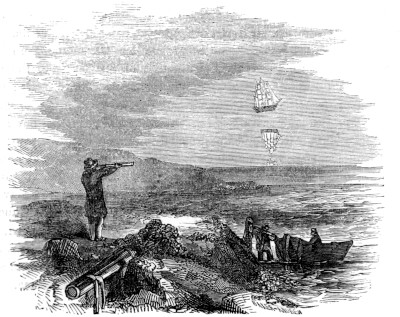
SHIP REFRACTED IN THE AIR.
But one of the most remarkable cases of atmospheric refraction of which we have any record, is that which occurred at New Haven, Connecticut, in the early settlement of the colony. The colonists had built a ship, and freighted her for England with a valuable cargo, with which she sailed from their harbor in the winter of 1647, having several of their principal men on board. They were obliged to cut their way through the ice to get out of the harbor; and the ship, never being heard of afterward, was supposed to have foundered at sea. No tidings arriving of the ship or of her fate, the colonists were deeply distressed, and “were very earnest in their prayers, both public 328and private, that God would in some way make manifest to them what had become of their friends.” In the following June, a violent thunder-storm arose out of the north-west, after which the atmosphere being very calm and serene, about an hour before sunset, a ship of the dimensions and form of the one they had lost, with all her canvas set and flags flying, appeared in the air, coming up the harbor, her sails filled as though by a fresh gale, and sailing against the wind, for the space of half an hour.
At length, as she came nearer, her maintop seemed to be blown off, though left hanging in the shrouds; then, her mizzen-top; then all her masting seemed blown away by the board; quickly after, her hulk careening, she overset, and seemed to sink and vanish in the clouds, and as these clouds passed away, the air where she was seen, was, as before, perfectly clear. The crowd of spectators could distinguish the appearance of the various parts of the ship, the principal rigging, and such proportions as made them satisfied that this was indeed their ship; and Mr. Davenport, the minister, declared, in public, that God, for the quieting of the hearts of the people, had given them this extraordinary exhibition and account of what he had done with their property and friends. But science gives us a more natural and less miraculous explanation of the matter, in the refracting power of the air when in certain states; and the probability is, that the ship, thus seen in the air, was some strange vessel (which they imagined looked like their own) coming up the harbor before the breeze, and then driven off and wrecked by the storm, which reached her after it had passed New Haven; or else that it was, indeed, their own ship, which after being driven about for months, was now coming back to her port, when she was thus caught in the tempest and destroyed. And as confirming this view of the matter, it may be added, in conclusion, that within the present century, it is said, a similar refraction of a ship in the air, has been witnessed in the same place.
PARHELIA, OR MOCK SUNS.
On the fifth of February, 1674, near Marienberg, in Prussia, the sky being everywhere serene, the sun, which was still some degrees above the horizon, was seen to lance out very long and reddish rays, forty or fifty degrees toward the zenith, notwithstanding it shone with great luster. Beneath this planet, toward the horizon, there hung a somewhat thin small cloud, at the inferior part of which there appeared a mock sun, of the same apparent size with the true sun, and of a reddish color. Soon after, the true sun descending gradually to the horizon, toward the said cloud, the spurious sun beneath it grew clearer and clearer, in so much that the reddish color in this apparent 329solar disk vanished, and it put on the genuine solar light, in proportion as it was approached by the genuine disk of the sun. The latter, at length, passed into the lower counterfeit sun, and thus remained alone. This phenomenon was considered the more wonderful, as it was perpendicularly under the sun, instead of being at its side, as parhelia usually are; not to mention the color, so different from that which is usual in mock suns, nor the great length of the tail cast up by the genuine sun, of a far more vivid and splendid light than parhelia commonly exhibit. This appearance was soon followed by an exceedingly intense frost, which lasted till the twenty-fifth of March, the whole bay being frozen up from the town of Dantzic to Hela in the Baltic sea.
On the twenty-eighth of August, 1698, about eight o’clock in the morning, there was seen at Sudbury, in Suffolk, England, the appearance of three suns, which were then extremely brilliant. Beneath a dark, watery cloud, in the east, nearly at its center, the true sun shone with such strong beams, that the spectators could not look at it; and on each side were the reflections. Much of the firmament was elsewhere of an azure color. The circles were not colored like the rainbow, but white; and there was also, at the same time, higher in the firmament, and toward the south, at a considerable distance from the other phenomena, the form of a half-moon, but apparently of double the size, with the horns turned upward. This appearance was, within, of a fiery red color, imitating that of the rainbow. These phenomena faded gradually, after having continued about two hours.
Two mock suns, an arc of a rainbow inverted, and a halo, were seen at Lyndon, in the county of Rutland, on the twenty-second of October, 1621, at eleven in the morning. There had been an aurora borealis the preceding night, with the wind at west-south-west. The two parhelia, or mock suns, were bright and distinct, and in the usual places, namely, in the two intersections of a strong and large portion of a halo, with an imaginary circle parallel to the horizon, passing through the true sun. Each parhelion had its tail of a white color, and in direct opposition to the true sun; that toward the east being some twenty or twenty-five degrees long, and that toward the west from ten to twelve degrees, both narrowest at the remote ends. The mock suns were evidently red toward the sun, but pale or whitish at the opposite sides, as was the halo also. Still higher in the heavens, was an arc of a curiously inverted rainbow, about the middle of the distance between the top of the halo and the vertex. This arc was as distinct in its colors as the common rainbow, and of the same breadth. The red color was on the convex, and the blue on the concave of the arc, which seemed to be about ninety degrees in length, its center being in or near the vertex. On the top 330of the halo was a kind of inverted bright arc. This phenomenon was seen on the following day, and, again, on the twenty-sixth. On the eleventh of the preceding month, September, a very splendid and remarkable aurora borealis, presenting truly unaccountable motions and removals, was witnessed in Rutlandshire, in Northamptonshire, and at Bath.
LUNAR RAINBOW.
This very rare phenomenon was witnessed at Glapwell Hall, in Derbyshire, England, on the twenty-fifth of December, 1710, about eight in the evening, with a remarkable and very unusual display of colors. The moon had passed her full about twenty-four hours, and the evening had been rainy; but the clouds were dispersed, and the moon then shone quite clear. This iris lunaris had all the colors of the solar iris, exceedingly beautiful and distinct, only faint in comparison with those which are seen in the day; as must necessarily have been the case, both from the different beams by which it was occasioned, and the disposition of the medium. What most surprised the observer was the largeness of the arc, which was not so much less than that of the sun, as the different dimensions of their bodies, and their respective distances from the earth, seemed to require; but the entireness and beauty of its colors furnished a charming spectacle.
CONCENTRIC RAINBOWS.
This extraordinary phenomenon, which is seen at sunrise on the Andes, in South America, was first witnessed by Ulloa and his companions in the wild heaths of Pambamarca, and is thus described by him. “At day-break the whole of the mountain was enveloped in dense clouds, which at sunrise were dissipated, leaving behind them vapors of so extreme a tenuity, as not to be distinguishable to the sight. At the side opposite to that where the sun rose on the mountain, and at the distance of about sixty yards from the spot where we were standing, the image of each of us was seen represented as if in a mirror, and three concentric rainbows, the last or most exterior colors of one of which touched the first of the following one, were centered on each head. Without the whole of them, and at an inconsiderable distance, was seen a fourth arc purely white. They were all perpendicular to the horizon; and in proportion as any one of us moved from one side to the other, he was accompanied by the phenomenon, which preserved the same order and disposition. What was, however, most remarkable, was this, that although six or seven persons were thus standing close together, 331each of us saw the phenomenon as it regarded himself, but did not perceive it in the others. This, adds Bouguer, is a kind of apotheosis, in which each of the spectators, seeing his head adorned with a glory formed of three or four concentric crowns of a very vivid color, each of them presenting varieties similar to those of the first rainbow, tranquilly enjoys the sensible pleasure of reflecting that the brilliant garland he can not discover in the others is destined for himself alone.”
A similar phenomenon is described by Mr. Hagarth, as having been seen by him in Wales, on the thirteenth of February, 1780. His relation is as follows. “In ascending, at Rhealt, the mountain which forms the eastern boundary of the vale of Clwyd, (in Denbighshire,) I observed a rare and curious phenomenon. In the road above me, I was struck with the peculiar appearance of a very white, shining cloud, which lay remarkably close to the ground. The sun was near setting, but shone extremely bright: I walked up to the cloud, and my shadow was projected into it, its superior part being surrounded, at some distance, by a circle of various colors, whose center appeared to be near the situation of the eye, and whose circumference extended to the shoulders. This circle was complete, except what the shadow of my body intercepted. It exhibited the most vivid colors, the red being outermost; and all of them appearing in the same order and proportion as they are presented to the view by the rainbow. It resembled very exactly what in pictures is termed a glory, surrounding the heads of saints; not indeed that it exhibited the luminous radiance that is painted close to the head, but an arch of concentric colors placed separately and distinctly from it. As I walked forward, this glory approached or retired, just as the inequality of the ground shortened or lengthened my shadow. The cloud being sometimes in a small valley below me, sometimes on the same level, or on higher ground, the variation of the shadow and glory became extremely striking and singular. To add to the beauty of the scene, there appeared, at a considerable distance to the right and left, the arches of a white, shining bow. These arches were in the form of, and broader than a rainbow; but were not completely joined into a semicircle above, on account of the shallowness of the cloud.”
THUNDER AND LIGHTNING.
To conceive justly of the nature of thunder and lightning, we have only to view the effects of a common electrical machine, and its apparatus, in an apartment. These experiments mimic the great, wonderful and terrific 332phenomena of nature. The stream, or spark, from the machine to the hand, represents the shaft of lightning from the clouds to the earth; and the snapping noise of the diminutive spark corresponds with the explosion produced by the lightning, which we call thunder. In what manner the clouds become electrified, and, in short, what is the nature of electricity itself, our present range of experiments so little qualify us to determine, that a century will perhaps elapse before a philosophical precision can be attained. At present we only know for certain that the electrical power displays itself merely on the surface of bodies; and whether it is a fluid per se, a vacuum restoring itself, or whatever its nature may be, the state of experimental knowledge does not enable us to determine.
The obvious analogy between lightning and electricity, had long been suspected, and was placed beyond a doubt by Franklin, who was the first to conceive the practicability of drawing down lightning from the clouds. Having found by previous experiments, that the electric fluid is attracted by points, he apprehended that lightning might likewise possess the same quality; although the effects of the latter would in that case surpass those of the former in an astonishing degree. Flashes of lightning, he likewise observed, are generally seen crooked and waving in the air; and the electric spark drawn from an irregular body at some distance, when it is drawn by an irregular body, or through a space in which the best conductors are disposed in an irregular manner, always exhibits the same appearance.
Lightning strikes the highest and most pointed objects in its way, in preference to others, as high hills, trees, spires, masts, &c.; and all pointed conductors receive and throw off the electric fluid more readily than those which are terminated by flat surfaces. Lightning is observed to take the best and readiest conductor; and this is also the case with electricity, in the discharge of the Leyden phial; whence Franklin inferred that, in a thunder-storm, it would be safer for a person to have his clothes wet than dry. Lightning burns, dissolves metals, rends some particular bodies, such as the roots and branches of trees, strikes persons with blindness, destroys animal life, deprives magnets of their virtue and reverses their poles; and these are well known properties of electricity. Lightning not only gives polarity to the magnetic needle, but to all bodies which have any portion of iron in them, as brick, &c.; and, by observing which way the poles of these bodies lie, the direction in which the stroke has passed may be known with the utmost certainty.
In order to demonstrate, by actual experiment, the identity of the electric fluid with the matter of lightning, Franklin contrived to bring lightning from the heavens by means of an electrical kite, which he raised on the 333approach of a thunder-storm; and, with the electricity thus obtained, charged phials, kindled spirits, and performed all other electrical experiments, as they are usually exhibited by an excited globe or tube. This happened in 1752, a month after the French electricians, pursuing the method which he had proposed, had verified the same theory; but without any knowledge on his part of what they had done. On the following year, he further discovered that the air is sometimes electrified positively, and sometimes negatively; and that in the course of one thunder-storm, the clouds change from positive to negative electricity several times. He was not long in perceiving that this important discovery was capable of being applied to practical use; and proposed a method, which he soon accomplished, of securing buildings from being damaged by lightning, by means of conductors, or lightning-rods, the use of which is now universally known.
From a number of judicious experiments made by him, Signor Beccaria concluded that the clouds serve as conductors to convey the electric fluid from those parts of the earth which are overloaded with it, to those where it is exhausted. The same cause by which a cloud is first raised, from vapors dispersed in atmosphere, draws to it those which are already formed, and still continues to form new ones, till the whole collected mass extends so far as to reach a part of the earth where there is a deficiency of the electric fluid, and where the electric matter will discharge itself on the earth. A channel of communication being thus produced, a fresh supply of electric matter is raised from the overloaded part, which continues to be conveyed by the medium of the clouds, till the equilibrium of the fluid is restored between the two places of the earth. He further observes that as the wind constantly blows from the place where the thunder-cloud proceeds, the sudden accumulation of such a prodigious quantity of vapors must displace the air, and repel it on all sides. Indeed, many observations of the descent of lightning confirm his theory of the mode of its ascent; for it often throws before it the parts of conducting bodies, and distributes them along the resisting medium through which it must force its passage; and on this principle the longest flashes of lightning seem to be produced, by its forcing in its way part of the vapors in the air. One of the chief reasons why the report of these flashes is so much protracted, is the vast length of the vacuum made by the passage of the electric matter; for although the air collapses the moment after it has passed, and the vibration, on which the sound depends, commences at the same moment, still, when the flash is directed toward the person who hears the report, the vibrations excited at the nearer end of the track will reach his ear much sooner than those from the remote end, and the sound will, without any echo or repercussion, continue till all the vibrations 334have successively reached him. The rattling noise of the thunder, which makes it seem as if it passed through arches or were variously broken, is probably owing to the sound being excited among clouds hanging over one another, and the agitated air passing irregularly between them.
Among other precautions pointed out by Franklin, he recommends to those who happen to be in the fields, at the time of a thunder-storm, to place themselves within a few yards of a tree, but not quite near it. Signor Beccaria, however, cautions persons not to depend on a higher, or, in all cases, a better conductor than their own body; since, according to his repeated observations, the lightning by no means descends in one undivided track, but bodies of various kinds conduct their share of it at the same time, in proportion to their quantity and conducting power. The late Earl of Stanhope, in his principles of electricity, observes that damage may be done by lightning, not only by the main stroke and lateral explosion, but likewise by what he calls the returning stroke; that is, by the sudden violent return of that part of the natural share of electricity of any conducting body, or any combination of conducting bodies, which had been gradually expelled from such body or bodies respectively, by the superinduced elastic electrical pressure of a thunder-cloud’s electrical atmospheres.
Among the awful phenomena of nature, none have excited more terror than thunder and lightning. It is recorded of several of the profligate Roman emperors, who had procured themselves to be deified, that when they heard the thunder, they tremblingly concealed themselves, acknowledging a divine power greater than their own; a Jupiter thundering in the heavens.
REMARKABLE THUNDER-STORMS.
A few instances in which the effects of these storms have been particularly characterized, will be both interesting and instructive.
That fermented liquors are apt to be soured and spoiled by thunder, is a fact well known; but that dried substances should be so acted on, is a still more remarkable phenomenon, and not so easy of explanation. It happened, however, some years ago, that in the immense granaries of Dantzic, the repositories of the corn, of Polish growth, intended for exportation, the wheat and rye, which were before dry and sweet, were, by the effect of a violent thunder-storm in the night, rendered clammy and stinking, insomuch that it required several weeks to sweeten them and render them fit for shipping.
The effects of a thunder-storm on a house and its furniture, at New Forge, Ireland, on the ninth of August, 1707, were very singular. It was observed 335that the day was, throughout, close, hot and sultry, with scarcely any wind, until toward evening, when a breeze came on with mizzling rain, which lasted about an hour. As the air darkened after sunset, several faint flashes of lightning were seen, and thunder-claps heard, as at a distance; but between ten and eleven o’clock they became, in their approach, very violent and terrible, progressively increasing in their intensity, and coming on with more frequency, until toward midnight. A flash of lightning, and a clap of thunder, louder and more dreadful than all the rest, came simultaneously, and shook and inflamed the whole house. The mistress being sensible, at that instant, of a strong sulphureous smell in her chamber, and feeling a thick, gross dust fall on her hands and face as she lay in bed, concluded that part of her house had been thrown down by the thunder, or set on fire by the lightning. The family being called up, and candles lighted, both the bed-chamber, and the kitchen beneath it, were found to be filled with smoke and dust. A looking-glass in the chamber had been broken with such violence, that not a piece of it was to be found of the size of half a crown: several of the pieces were stuck in the chamber-door, which was of oak, as well as on the other side of the room. The edges and corners of some of the pieces of broken glass were tinged of a light flame color, as if they had been heated by the fire. On the following morning it was found that the cornice of the chimney next the bed-chamber had been struck off, and a breach twenty inches in breadth, made in the wall. At this part there was seen on the wall a smutted scar or trace, as if left by the smoke of a candle, which pointed downward to another part of the wall, where a similar breach was made. Within the chamber, the boards on the back of a large hair trunk, filled with linen, were forced in, and two-thirds of the linen pierced or cut through, the cut appearing of a quadrangular figure. Several pieces of muslin and wearing apparel, which lay on the trunk, were dispersed about the room, not in any way singed or scorched, notwithstanding the hair on the back of the trunk, where the breach was made, was singed. In the kitchen, a cat was found dead, with its legs extended as in a moving posture, without any other sign of being hurt, except that the fur was singed a little about the rump.
In the parish of Samford Courtney, near Oakhampton, in Devon, on the seventh of October, 1811, about three in the afternoon, a sudden darkness came on. Several persons being in the church-porch, a great fire-ball fell among them, and threw them down in various directions, but without any one being hurt. The ringers in the belfry declared that they never knew the bells go so heavily, and were obliged to desist from ringing. Looking down from the belfry into the church, they perceived four fire-balls, which 336suddenly burst, and the church was filled with fire and smoke. One of the congregation received a blow in the neck, which caused him to bleed both at nose and mouth. He observed the fire and smoke to ascend to the tower, where a large beam, on which one of the bells was hung, was broken, and the gudgeon breaking, the bell fell to the floor. One of the pinnacles of the tower, next the town, was carried away, and several of the stones were found near a barn, at a considerable distance from the church.
On the fifteenth of December, 1754, a vast body of lightning fell on the great hulk at Plymouth. It burst out a mile or two to the westward of the hulk, and rushed toward it with incredible velocity. A portion of the derrick (a part of the apparatus which served to hoist in and fix the masts of the men-of-war) was cut out, of a diameter of at least eighteen inches, and about fifteen feet in length: this particular piece was in three or four places girt with iron hoops, about two inches broad, and half an inch thick, which were completely cut in two by the lightning, as if done by the nicest hand and instrument. The lightning was immediately succeeded by a dreadful peal of thunder, and that by a most violent shower of hail, the hailstones being as large as nutmegs, and for the greatest part of the same size and shape.
Among the many fatal accidents by lightning which have befallen ships, the following is a remarkable instance. In the year 1746, a Dutch ship lay in the road of Batavia, and was preparing to depart for Bengal. The afternoon was calm, and toward evening the sails were loosed, to take advantage of the wind which then constantly blows from the land. A black cloud gathered over the hills, and was brought by the wind toward the ship, which it had no sooner reached, than a clap of thunder burst from it, and the lightning set fire to the maintopsail: this being very dry, burned with great fury: and thus the rigging and mast were set on fire. An attempt was immediately made to cut away the mast, but this was prevented by the falling of the burnt rigging from the head of the mast. By degrees the fire communicated to the other masts, and obliged the crew to desert the ship, the hull of which afterward took fire, and burning down to the powder magazine, the upper part was blown into the air, and the lower part sunk where the ship was at anchor.
In crossing the Atlantic, in the month of November, 1749, the crew of an English ship observed a large ball of blue fire rolling on the water. It came down on them so fast, that before they could raise the main-tack, they observed the ball to rise almost perpendicularly, and within a few yards of the main chains: it went off with an explosion as if hundreds of cannon had been fired off simultaneously, and left behind it a great smell of brimstone. 337The maintopmast was shattered into a thousand pieces, and splints driven out of the mainmast which stuck in the main-deck. Five seamen were knocked down, and one of them greatly burnt, by the explosion. The fireball was apparently of the size of a large millstone, and came from the north-east.
The ingenious and indefatigable Professor Richman lost his life on the sixth of August, 1753, as he was observing, with M. Sokolow, engraver to the royal academy of St. Petersburgh, the effects of electricity on his gnomon, during a thunder-storm. It was ascertained that the lightning was more particularly directed into the professor’s apartment, by the means of his electrical apparatus, for M. Sokolow distinctly saw a globe of blue fire, as large as his clenched hand, jump from the rod of the right gnomon, toward the forehead of Professor Richman, who at that instant was about a foot distant from the rod, observing the electrical index. The globe of fire which struck the professor, was attended with a report as loud as that of a pistol. The nearest metal wire was broken in pieces, and its fragments thrown on M. Sokolow’s clothes, on which burnt marks of their dimensions were left. Half of the glass vessel was broken off, and the metallic filings it contained thrown about the room. Hence it is plain that the force of the lightning was collected on the right rod, which touched the filings of metal in the glass vessel. On examining the effects of the lightning in the professor’s chamber, the door-case was found split half through, and the door torn off, and thrown into the chamber. The lightning therefore seems to have continued its course along the chain conducted under the ceiling of the apartment. In a Latin treatise, published by M. Lomonosow, member of the royal academy of sciences of St. Petersburgh, several curious particulars are mentioned relative to this melancholy catastrophe. At the time of his death, Professor Richman had in his left coat-pocket seventy silver coins, called rubles, which were not in the least altered by the accident which befell him. His clock, which stood in the corner, of the next room, between an open window and the door, was stopped; and the ashes from the hearth thrown about the apartment. Many persons without doors declared that they actually saw the lightning shoot from the cloud to the professor’s apparatus at the top of his house. The author, in speaking of the phenomena of electricity, observes that he once saw during a storm of thunder and lightning, brushes of electrical fire, with a hissing noise, communicate between the iron rod of his apparatus and the sides of his window, and that these were three feet in length, and a foot in breadth.
Somewhat analogous to these movements of electricity, are those connected with the electric telegraph during the violent thunder-storms that so often 338take place in the summer season. When such storms are raging, and particularly when the lightning is abundant and near, not only is the operation of the telegraph entirely suspended, but sometimes the lightning itself passes with great violence over the wires, in some cases melting and destroying them, and in others passing by them as it does by the lightning-rod, and manifesting its violence chiefly at the point of their termination. In some instances, the wires have been instantly melted by the electric fluid, and in others the machinery of the offices injured or destroyed, while at other times persons have been struck, or dwellings set on fire by its power.
HAIL-STORMS.
On the seventeenth of July, 1666, a violent storm of hail fell on the English coast, in Norfolk and Suffolk. At North Yarmouth the hailstones were comparatively small; but at Snapebridge, one was taken up which measured a foot in circumference; at Seckford Hall, one which measured nine inches; and at Melton, one measuring eight inches. At Friston Hall, one of these hailstones, being put into a balance, weighed two ounces and a half. At Aldborough, it was affirmed that several of them were as large as turkeys’ eggs. A carter had his head broken by them through a stiff felt hat: in some places it bled, and in others tumors arose: the horses were so pelted that they hurried away his cart beyond all command. The hailstones were white, smooth without, and shining within.
On the twenty-fifth of May, 1686, the city of Lille, in Flanders, was visited by a tremendous hail-storm. The hailstones weighed from a quarter of a pound to a pound in weight, and even more. One was observed to contain in the center a dark brown matter, and being thrown into the fire, gave a very loud report. Others were transparent, and melted instantly before the fire. This storm passed over the city and citadel, leaving not a whole glass in the windows on the windward side. The trees were broken, and some beaten down, and partridges and hares killed in abundance.
In 1697, a horrid black cloud, attended with frequent lightnings and thunder, coming with a south-west wind out of Caernarvonshire, in Wales, and passing near Snowdon, was the precursor of a most tremendous hailstorm. In the part of Denbighshire bordering on the sea, all the windows on the weather side were broken by the hailstones discharged from this cloud, and the poultry and lambs, together with a large mastiff, killed. In the north part of Flintshire, several persons had their heads broken, and were grievously bruised in their limbs. The main body of this hail-storm fell on Lancashire, in a right line from Ormskirk to Blackburn, on the borders 339of Yorkshire. The breadth of the cloud was about two miles, within which compass it did incredible damage, killing all descriptions of fowl and small creatures, and scarcely leaving a whole pane of glass in any of the windows where it passed. What was still worse, it plowed up the earth, and cut off the blade of the green corn, so as utterly to destroy it, the hailstones burying themselves in the ground. These hailstones, some of which weighed five ounces, were of different forms, some round, others semi-spherical; some smooth, others embossed and crenulated, like the foot of a drinking-glass, the ice being very transparent and hard; but a snowy kernel was in the midst of most of them, if not of all. The force of their fall showed that they descended from a great hight. What was thought to be most extraordinary in this phenomenon was, that the vapor which disposed the aqueous parts thus to congeal, should have continued undispersed for so long a tract as upward of sixty miles, and should, during this extensive passage, have occasioned so extraordinary a coagulation and congelation of the watery clouds, as to increase the hailstones to so vast a bulk in so short a space as that of their fall.
On the fourth of May, 1767, at Hitchin, in Hertfordshire, after a violent thunder-storm, a black cloud suddenly arose in the south-west, about two o’clock in the afternoon, the wind then blowing strongly in the east, and was almost instantly followed by a shower of hail, several of the hailstones measuring from seven or eight to thirteen or fourteen inches in diameter. The extremity of the storm fell near Offley, where a young man was killed, and one of his eyes was beaten out of his head, his body being in every part covered with bruises. Another person, nearer to Offley, escaped with his life, but was much bruised. At a nobleman’s seat in the vicinity, seven thousand squares of glass were broken, and great damage was done to all the neighboring houses. The large hailstones fell in such immense quantities, that they tore up the ground, and split many large oaks and other trees, cutting down extensive fields of rye, and destroying several hundred acres of wheat, barley, &c. Their figures were various, some being oval, others round, others pointed, and others again flat.
HURRICANES.
The ruin and desolation accompanying a hurricane can scarcely be described. Like fire, its resistless force rapidly consumes everything in its track. It is generally preceded by an awful stillness of the elements, and a closeness and mistiness in the atmosphere, which make the sun appear red, and the stars of more than an ordinary magnitude. But a dreadful reverse 340succeeding, the sky is suddenly overcast and wild; the sea rises at once from a profound calm into mountains; the wind rages and roars like the noise of cannon; the rain descends in a deluge; a dismal obscurity envelops the earth with darkness; and the superior regions appear rent with lightning and thunder. The earth, on these occasions, often does, and always seems to tremble, while terror and consternation distract all nature: birds are carried from the woods into the ocean; and those whose element is the sea, fly for refuge to the land. The affrighted animals in the fields assemble together, and are almost suffocated by the impetuosity of the wind, in searching for shelter, which, when found, serves them only for destruction. The roofs of houses are carried to vast distances from their walls, which are beaten to the ground, burying their inmates beneath them. Large trees are torn up by the roots, and huge branches shivered off, and driven through the air in every direction, with immense velocity. Every tree and shrub that withstands the shock, is stripped of its boughs and foliage. Plants and grass are laid flat to the earth. Luxuriant spring is in a moment changed to dreary winter. This direful tragedy ended, when it happens in a town, the devastation is surveyed with accumulated horror: the harbor is covered with wrecks of boats and vessels; and the shore has not a vestige of its former state remaining. Mounds of rubbish and rafters in one place; heaps of earth and trunks of trees in another; deep gullies from torrents of water; and the dead and dying bodies of men, women and children, half-buried, and scattered about, where streets but a few hours before were, present to the miserable survivors a shocking conclusion of a spectacle, often followed by famine, and, when accompanied by an earthquake, by mortal diseases. Such is the true and terrific picture of a hurricane in the West Indies, as drawn by an actual observer.
On the Indian coast, hurricanes are both frequent and disastrous. On the second of October, 1746, the French squadron, commanded by Le Bourdonnai, being at anchor in Madras roads, a hurricane came on which in a few hours destroyed nearly the whole of the fleet, together with twenty other ships belonging to different nations. One of the French ships foundered in an instant, and only six of the crew were saved. On the thirtieth of December, 1760, during the siege of Pondicherry, a tremendous hurricane drove ashore and wrecked three British ships belonging to the besieging squadron: the crews were saved. On the twentieth of October of the following year, 1761, the British fleet, then lying in Madras roads, had to encounter a violent hurricane. The men-of-war put to sea, and were thus providentially saved; but all the vessels which still lay at anchor were lost, and scarcely a soul on board saved. On the twenty-ninth of October, 1768, another hurricane 341was, on the coast of Coromandel, fatal to the Chatham Indiaman, which neglected to put to sea.
In the West Indies, a tremendous hurricane on the twenty-first of October, 1817, was particularly severe at the island of St. Lucie. All the vessels in the port were entirely lost. The government-house was blown down, and all within its walls, comprising the governor, his lady and child, his staff, secretaries, servants, &c., amounting to about thirty persons, were buried in its ruins: not one survived the dreadful accident; and still more horrid to relate, the barracks of the officers and soldiers were demolished, and all within them (about two hundred persons) lost. All the estates on the island were reduced to a heap of ashes. At Dominica, nearly the whole of the town was inundated, with an immense destruction of property.
In Great Britain, a dreadful hurricane, commonly called the great storm, set in at ten at night on the twenty-sixth of November, 1703, and raged violently until seven the next morning. It extended its ravages to every part of the kingdom. In the capital, upward of two thousand stacks of chimneys were blown down. The lead on the tops of several churches was rolled up like skins of parchment. Many houses were leveled with the ground, and by the fall of the ruins, twenty-one persons were killed, and more than two hundred wounded. The ships in the Thames broke from their moorings: four hundred wherries were lost, and many barges sunk, with a great loss of lives. At sea the destruction was still greater: twelve ships of war, with upward of eighteen hundred men on board, were totally lost, together with many merchantmen.
THE MONSOONS.
The setting in of the monsoon, or tropical sea-wind, in the East Indies, is thus described by Forbes in his “Oriental Memoirs.” The scene was at Baroche, where the British army was encamped. “The shades of evening approached as we reached the ground, and just as the encampment was completed, the atmosphere grew suddenly dark, the heat became oppressive, and an unusual stillness presaged the immediate setting in of the monsoon. The whole appearance of nature resembled those solemn preludes to earthquakes and hurricanes in the West Indies, from which the east in general is providentially free. We were allowed very little time for conjecture; in a few minutes the heavy clouds burst over us. I had witnessed seventeen monsoons in India, but this exceeded them all in its awful appearance and dreadful effects. Encamped in a low situation, on the borders of a lake formed to collect the surrounding water, we found ourselves in a few hours 342in a liquid plain. The tent-pins giving way, in a loose soil, the tents fell down, and left the whole army exposed to the contending elements. It requires a lively imagination to conceive the situation of a hundred thousand human beings of every description, with more than two hundred thousand elephants, camels, horses and oxen, suddenly overwhelmed by this dreadful storm, in a strange country, without any knowledge of high or low ground; the whole being covered by an immense lake, and surrounded by thick darkness, which prevented our distinguishing a single object, except such as the vivid glare of lightning displayed in horrible forms. No language can describe the wreck of a large encampment thus instantaneously destroyed, and covered with water, and this amid the cries of old men and helpless women, terrified by the piercing shrieks of their expiring children, unable to afford them relief. During this dreadful night, more than two hundred persons and three thousand cattle perished, and the morning dawn exhibited a shocking spectacle.”
The south-west monsoon generally sets in very early in certain parts of India. “At Anjengo,” observes the above author, “it commences with great severity, and presents an awful spectacle; the inclement weather continues, with more or less violence, from May to October: during that period, the tempestuous ocean rolls from a black horizon, literally of ‘darkness visible,’ a series of floating mountains heaving under hoary summits, until they approach the shore, when their stupendous accumulations flow in successive surges, and break upon the beach; every ninth wave is observed to be generally more tremendous than the rest, and threatens to overwhelm the settlement. The noise of these billows equals that of the loudest cannon, and, with the thunder and lightning, so frequent in the rainy season, is truly awful. During the tedious monsoon I passed at Anjengo, I often stood upon the trembling sand-bank, to contemplate the solemn scene, and derive comfort from that sublime and omnipotent decree, ‘Hitherto shalt thou come, but no further; and here shall thy proud waves be stayed!’”
WHIRLWINDS AND WATERSPOUTS.
“The dreadful spout
Which shipmen do the hurricano call
Constring’d in mass by the almighty sun.”
Shakspeare (Troilus and Cressida.)
In number three hundred and two of the Monthly Magazine, Sir Richard Phillips, in describing a waterspout observed by him, points out the connection between those phenomena and hurricanes, and offers a very philosophical 343explanation of the formation of the former. It happened to him, he observes, on the twenty-seventh of June, 1817, about seven in the evening, to witness the formation, operation and extinction of what is called a waterspout. His attention was drawn to a sudden hurricane which nearly tore up the shrubs and vegetables in the western gardens, and filled the air with leaves and small collections of the recently cut grass. Very dark clouds had collected over the adjacent country, and some stormy rain, accompanied by several strokes of lightning, followed this hurricane of wind. The violence lasted a few minutes, and it was evident that a whirlwind agitated a variety of substances which had been raised into the air. The storm proceeded from west to east, that is, from Hampstead over Kentish-Town, toward Holloway. In about five minutes, in the direction of the latter place, a magnificent projection was visible from the clouds, somewhat like a tunnel, with the smallest part downward. It descended two-thirds of the distance from the clouds toward the earth, and evidently consisted of parts of clouds descending in a vortex, violently agitated like smoke from the chimney of a furnace recently supplied with fuel. It then shortened, and appeared to be drawn up toward the stratum of clouds, and finally drew itself into the cloud; but a small cone, or projecting thread, of varying size and length, continued for ten minutes. At the time, and for half an hour after, a severe storm of rain was visibly falling from the ruins of clouds connected with it, the extent being exactly defined by the breadth of Holloway, Highgate and Hornsey. About two hours after, it was found that one of the heaviest torrents of rain remembered by the inhabitants, had fallen around the foot of Highgate hill; and some persons having seen the projected cloud, an absolute belief existed that a waterspout had burst at the crossing of the new and old roads. On proceeding toward London, various accounts agreeing with the superstition or preconceived notions of the bystanders were given; and at one place it appeared that some haymakers were stacking hay from a wagon which stood between two ricks, and that the same whirlwind which passed over Kentish-Town, had passed over the loaded wagon with an impetus sufficient to carry it about twenty yards from its station, and to put the men on it and on the rick, in fear of their lives. Passing the road, it carried with it a stream of hay, and, nearly unroofing a shed on the other side, filled the air to a great hight with fragments of hay, leaves and boughs of trees, which resembled a vast flight of birds. A family in the vicinity beheld the descending cloud, or waterspout, pass over, and saw its train, which, at the time, they took to be a flight of birds. They afterward beheld the descending cloud draw itself upward, and they and other witnesses described it as a vast mass of smoke working about in agitation; to them it was nearly vertical in a 344northern direction; and to persons a quarter of a mile north, it was nearly vertical in a southern direction; and all agree that it drew itself up without rain, and was followed near the earth by the train of light bodies. It appeared also, on various testimony, to let itself down in a gradual and hesitating manner, beginning with a sort of knob in the cloud, and then descending lower, and curling and twisting about till it shortened, and gradually drew itself into the cloud.
The inferences which Sir Richard draws from what he saw and heard, are as follows. That the phenomenon called a waterspout is a mere collection of clouds, of the same rarity as the mass whence they are drawn. That the descent is a mechanical effect of the whirlwind, which creating a vacuum, or high degree of rarefaction, extending between the clouds and the earth, the clouds descend in it by their gravity, or by the pressure of the surrounding clouds or air. That the convolutions of the descending mass, and the sensible whirlwind felt at the earth, as well as the appearance of the commencement, increase and decrease of the mass, all demonstrate the whirl of the air to be the mechanical cause. That the same vortex, whirl or eddy of the air, which occasions the clouds to descend, occasions the loose bodies on the earth to ascend. That, if in this case the lower surface had been water, the same mechanical power would have raised a body of foam, vapor and water, toward the clouds. That, as soon as the vortex or whirl exhausts or dissipates itself, the phenomena terminate by the fall to the lower surface of the light bodies or water, and by the ascent of the cloud. That when water constitutes the light body of the lower surface, it is probable that the aqueous vapor of the cloud, by coalescing with it, may occasion the clouds to condense, and fall at that point, as through a siphon. That if the descending cloud be highly electrified, and the vortex pass over a conducting body, as a church steeple, it is probable it may be condensed by an electrical concussion, and fall at that spot, discharging whatever has been taken up from the lower surface, and producing the strange phenomena of showers of frogs, fish, &c. And, lastly, it appears certain, that the action of the air on the mass of clouds, pressing toward the mouth of the vortex as to a funnel, (which, in this case, it exactly represented,) occasioned such a condensation as to augment the simultaneous fall of rain to a prodigy.
In the month of July, 1800, a waterspout was seen rapidly to approach a ship navigating between the Lipari islands. It had the appearance of a viscid fluid, tapering in its descent, and proceeding from the cloud to join the sea. It moved at the rate of about two miles an hour, with a loud sound of rain, passing the stern of the ship, and wetting the after part of the 345mainsail. It was thence concluded that waterspouts are not continuous columns of water, which has been confirmed by subsequent observations.
In November, 1801, about twenty miles from Trieste, in the Adriatic sea, a waterspout was seen eight miles to the southward: round its lower extremity was a mist, twelve feet high, nearly of the form of an Ionian capital, with very large volutes, the spout resting obliquely on its crown. At some distance from this spout, the sea began to be agitated, and a mist rose to the hight of about four feet: a projection then descended from the black cloud which was impending, and met the ascending mist about twenty feet above the sea, the last ten yards of the distance being described with great rapidity. A cloud of a light color appeared to ascend in this cloud like quicksilver in a glass tube. The first spout then snapped at about one-third of its hight, the inferior part subsiding gradually, and the superior curling upward. Several other projections from the cloud, appeared with corresponding agitations of the water below, but not always in spouts vertically under them: seven spouts in all were formed, and two other projections reabsorbed. Some of the spouts were not only oblique, but curved, the ascending cloud moving most rapidly in those which were vertical. They lasted from three to five minutes, and their dissipation was not attended with any fall of rain. For some days before the weather had been very rainy, with a south-east wind, but not any rain had fallen on the day of observation.
In some cases, however, the waterspout at sea, is a continuous column of water, carried upward from the surface of the waves, and possibly meeting with water brought down from the clouds and condensed by the force of the revolving hurricane. Such waterspouts are now and then seen on the ocean, having an appearance like that represented in the cut on the next page. And as the wind blows first this way, and then that, they often writhe and bend, from one point to another, while the sea below, and all around, is agitated and covered with foam. Woe to that vessel that comes within the reach of one of these mighty phenomena. It would be crushed and sunk like a leaf on the waters. The usual defense at sea is to fire a cannon-shot into the whirling waterspout, which commonly breaks and dispels it, and causes the water to fall in a tremendous cataract or shower.
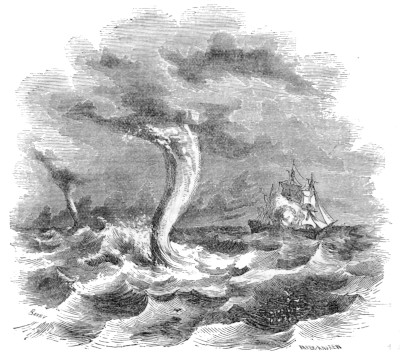
WATERSPOUT ON THE OCEAN.
Waterspouts, however, are not confined to the ocean. They are occasionally witnessed on the great fresh-water lakes of our own country, as they have been on the inland seas of other parts of the globe. Several of these remarkable phenomena were seen in 1854, on Lake Ontario, two of which were visible at Sodus point. They were dense, cone-shaped columns, and formed a continuous line from the earth to the clouds. One of them, the largest, which was nearly thirty feet in diameter, was precipitated against the 346bluffs, and broke with a deafening noise upon the rocks below, causing so great a commotion of the waters that a large quantity of logs and lumber were torn from their moorings and washed far out into the lake. The smaller of the two pursued its terrific and onward course as far as the eye could reach, filling the beholders with wonder and astonishment, and awakening such a feeling of grandeur and sublimity that they stood almost mute and statue-like, until the sound of this gigantic column of water died far away in the distance. A portion of the pier of the light-house was swept away by the elements, and considerable damage was done to the light-house. There was a severe storm out on the lake, and several schooners, brigs, &c., came scudding in, under bare poles, seeking security from the tempestuous billows without, upon the placid bosom of the harbor. The velocity and power of the whirlwind which caused these waterspouts, were very great. As it passed on westward in its furious course, it is said that in a town in Ohio, a grove of oak-trees was almost entirely blown down by it. The trunk of one of these trees, on being measured, was found to be about three feet in diameter. Assuming, however, that its diameter was but two and a half 347feet, it would require to break it, a force of one hundred and forty-nine thousand pounds. The surface of the tree exposed to the action of the wind, was about one thousand square feet, which would give a pressure by the wind of one hundred and forty-seven pounds to the square foot, or a velocity of not less than one hundred and seventy-one miles per hour, which is nearly one-fourth the velocity of a cannon-ball just leaving the cannon. Allowing the hight of the hurricane or whirlwind to have been sixty feet, the whole force exerted, at one time, along its track, was equal to more than half the steam power of the globe!
These corresponding phenomena of whirlwinds have been occasionally productive of much mischief, as the following brief narratives will show. On the thirtieth of October, 1669, about six in the evening, the wind being then westwardly, a formidable whirlwind, scarcely of the breadth of sixty yards, and which spent itself in about seven minutes, arose at Ashly, in Northamptonshire, England. Its first assault was on a milkmaid, whose pail and hat were taken from off her head, and the former carried many scores of yards from her, where it lay undiscovered for some days. It next stormed a farmyard, where it blew a wagon body off the axletrees, breaking in pieces the latter, and the wheels, three of which, thus shattered, were blown over a wall. Another wagon, which did not, like the former, lie across the passage of the wind, was driven with great speed against the side of the farm-house. A branch of an ash-tree, so large that two stout men could scarcely lift it, was blown over a house without damaging it, although torn from a tree one hundred yards distant. A slate was carried nearly two hundred yards, and forced against a window, the iron bar of which it bent. Several houses were stripped; and in one instance, this powerful gust, or stream of air, forced open a door, breaking the latch; whence it passed through the entry, and, forcing open the dairy door, overturned the milk-pans, and blew out three panes of glass. It next ascended to the chambers, and blew out nine other panes. Lastly, it blew a gate-post, fixed two feet and a half in the ground, out of the earth, and carried it many yards into the fields.
On the thirtieth of October, 1731, at one in the morning, a very sudden and terrific whirlwind, having a breadth of two hundred yards, was experienced at Cerne-Abbas, in Dorsetshire. From the south-west side of the town, it passed to the north-east, crossing the center, and unroofing the houses in its progress. It rooted up trees, broke others in the middle, of at least a foot square, and carried the tops a considerable distance. A sign-post, five feet by four, was broken off six feet in the pole, and carried across a street forty feet in breadth, over a house opposite. The pinnacles and battlements of one side of the church-tower were thrown down, and the leads 348and timber of the north aisle broken in by their fall. A short time before, the air was remarkably calm. It was estimated that this sudden and terrible gust did not last more than two minutes.
About the middle of August, 1741, at ten in the morning, several peasants being on a heath near Holkham, in Norfolk, perceived, about a quarter of a mile from them, a wind like a whirlwind approach them gradually, in a straight line from east to west. It passed through the field where they were plowing, and tore up the stubble and grass in the plowed ground, for two miles in length, to the breadth of thirty yards. In reaching an inclosure at the top of a rising ground, it appeared like a great flash or ball of fire, emitting smoke, and accompanied by a noise similar to that of carts passing over a stony ground. Both before and after the wind passed, there was a strong smell of sulphur; and the noise was heard long after the smoke had been perceived. This fiery whirlwind moved so slowly forward, that it was nearly ten minutes in proceeding from the inclosure to a farm-house in the vicinity, where it did much mischief.
SOUNDS AND ECHOES.
Sound is propagated successively from the sounding body to the places which are nearest to it, then to those more distant, &c. Every observer knows that when a gun is fired at a considerable distance from him, he perceives the flash a certain time before he hears the report; and the same thing is true with respect to the stroke of a hammer, or of a hatchet, the fall of a stone, or, in short, any visible action which produces a sound or sounds. In general, sound travels through the air at the rate of eleven hundred and forty-two feet in a second, or about thirteen miles in a minute. This is the case with all kinds of sounds; the softest whisper flying as fast as the loudest thunder. Sound, like light, after it has been reflected from several places, may be collected into one point as a focus, where it will be more audible than in any other part; and on this principle whispering galleries are constructed. The particulars relative to the celebrated whispering gallery in the dome of St. Paul’s church, London, will be comprehended in the description of that noble edifice.
An echo is the reflection of sound striking against a surface adapted to the purpose, as the side of a house, a brick wall, hill, &c., and returning back again to the ear, at distinct intervals of time. If a person stand about sixty-five or seventy feet from such a surfacea surface, and perpendicularly to it, and speak, the sound will strike against the wall, and be reflected back, so that he will hear it as it goes to the wall, and again on its return. If a bell 349situated in the same way be struck, and an observer stand between the bell and the reflecting surface, he will hear the sound going to the wall, and also on its return. Lastly, if the sound strike the wall obliquely, it will go off obliquely, so that a person who stands in a direct line between the bell and the wall will not hear the echo. According to the greater or less distance from the speaker, a reflecting object will return the echo of several, or of fewer syllables; for all the syllables must be uttered before the echo of the first syllable reaches the ear, to prevent the confusion which would otherwise ensue. In a moderate way of speaking, about three and a half syllables are pronounced in one second, or seven syllables in two seconds: therefore, when an echo repeats seven syllables, the reflecting object is eleven hundred and forty-two feet distant; for sound travels at the rate of eleven hundred and forty-two feet per second, and the distance from the speaker to the reflecting object, and again from the latter to the former, is twice eleven hundred and forty-two feet. When the echo returns fourteen syllables, the reflecting object must be twenty-two hundred and eighty-four feet distant, and so on.
The most remarkable echo recorded, is at the palace of a nobleman, within two miles of Milan, in Italy. The building is of some length in front, and has two wings jutting forward; so that it wants only one side of an oblong figure. About one hundred paces before the mansion, a small brook glides gently; and over this brook is a bridge forming a communication between the mansion and the garden. A pistol having been fired at this spot, fifty-six reiterations of the report were heard. The first twenty were distinct; but in proportion as the sound died away, and was answered at a greater distance, the repetitions were so doubled that they could scarcely be counted, the principal sound appearing to be saluted in its passage by reports on either side at the same time. A pistol of a larger caliber having been afterward discharged, and consequently with a louder report, sixty distinct reiterations were counted. From this example it follows, that the further the reflecting surface is, the greater number of syllables the echo will repeat; but that the sound will be enfeebled nearly in the same proportion, until at length the syllables can not be distinctly heard. On the other hand, when the reflecting object is too near, the repetition of the sound reaches the ear, whilst the perception of the original sound still continues, in which case an indistinct resounding is heard, as may be observed in empty rooms, passages, &c. In such places, several reflections from the walls to the hearer, as also from one wall to the other, and then to the hearer, clash with each other, and increase the indistinctness of the sound.
350