SUBTERRANEAN WONDERS.
Reading edition
THE GROTTA DEL CANE.
“Give me, ye powers, the wondrous scenes to show,
Concealed in darkness in the caves below.”
Among the various subterranean wonders of the world, which are worthy of special notice, we would first mention the “Grotta del Cane.” This name has been given to a small cavern between Naples and Pozzuoli, on this account, that if a dog be brought into it, and his nose held to the ground, a difficulty of respiration instantly ensues, and he loses all sensation and even life, if he be not speedily removed into purer air. There are other grottos endowed with the same deleterious quality, especially in volcanic countries; and the pestiferous vapors they exhale, are quickly fatal both to animals and man, though they do not offer to the eye the slightest indication of their presence. These vapors are, however, for the greater part temporary; while that of the Grotta del Cane is perpetual, and seems to have produced its deadly effects even in the time of Pliny. A man standing erect within, does not suffer from it, the mephitic vapor rising to a small hight only from the ground. It may, therefore, be entered without danger.
The smoke of a torch extinguished in this vapor, or gas, sinks downward, assumes a whitish color, and passes out at the bottom of the door. The reason of this is, that the fumes which proceed from the torch mix more readily with the gas than with the atmospherical air. It has been supposed, that the mischievous effects of the vapor were the result of the air being deprived of its elasticity; but it has been clearly demonstrated by M. Adolphus 132Murray, that they are solely to be attributed to the existence of carbonic acid gas.
The person who is the keeper, or guide, at the grotto, and who shows to strangers the experiment of the dog for a gratuity, takes the animal, when he is half dead and panting, into the open air, and then proceeds to throw him into the neighboring lake of Agnano, thus insinuating that this short immersion in the water is necessary to his complete restoration. This, however, is a mere trick, to render the experiment more specious, and to obtain a handsome present from the credulous, the atmospherical air alone sufficing for that purpose.
The celebrated naturalist, the Abbe Spallanzani, projected a regular series of experiments on the mephitic vapor of this grotto, from a persuasion that they would tend to throw a new light on physiology and natural philosophy. Being, however, prevented from undertaking this, by his duties as a professor, his friend, the Abbe Breislak, who resided near the spot, engaged in the task; and the following is an abstract of his learned memoir on this subject.
It is well known, the abbe observes, that the mephitic vapor occupies the floor of a small grotto near the lake Agnano, a place highly interesting to naturalists from the phenomena its environs present, and the hills within which it is included. This grotto is situated on the south-east side of the lake, at a little distance from it. Its length is about twelve feet, and its breadth from four to five. It appears to have been originally a small excavation, made for the purpose of obtaining pozzuolana, an earth which, being applied as mortar, becomes a powerful cement. In the sides of the grotto, among the earthy volcanic matters, are found pieces of lava, of the same kind with those which are met with scattered near the lake.
The abbe is persuaded that, if new excavations were to be made in the vicinity of the grotto, at a level with its floor, or a little lower, the same mephitic vapor would be found; and thinks it would be curious to ascertain the limits of its extent. It would also be advantageous to physical observations, if the grotto were to be somewhat enlarged, and its floor reduced to a level horizontal plane, by sinking it two or three feet, and surrounding it by a low wall, with steps at the entrance. In its present state it is extremely inconvenient for experiments, and the inclination of the ground toward the door causes a great part of the vapor, from the effect of its specific gravity, to make its way out close to the ground.
When the narrow limits of this place are considered, and the small quantity of the vapor which has rendered it so celebrated, there can not be any doubt but that it has undergone considerable changes; since it does not 133appear probable that Pliny refers to the present confined vapor only, when, in enumerating many places from which a deadly air exhaled, he mentions the territory of Pozzuoli. The internal fermentations by which it is caused, are certainly much diminished in the vicinity of the lake Agnano. The water near its banks is no longer seen to bubble up, from the disengagement of a gas, as it appears from accounts, not of very remote antiquity, to have done. The borders of the lake were attentively examined by the abbe, when its waters were at the highest, and after heavy rains; but he could never discover a single bubble of air. A number of aquatic insects which sport on the surface, may at first sight occasion some deception; but a slight observation soon detects the error. If, therefore, we do not suppose those authors who have described the ebullition of the water near the banks of the lake Agnano to have been deceived, it must at least be confessed, that this phenomenon has now ceased. The quantity of the sulphureous vapors which rise in the contiguous stoves, called the stoves of St. Germano, must likewise be greatly diminished from what it anciently was: for, adjoining to the present stoves, we still find the remains of a spacious ancient fabric, with tubes of terra cotta inserted in the walls, which, by their direction, show for what purpose they were intended. It appears certain, that this was a building in which, by the means of pipes properly disposed, the vapors of the place were introduced into different rooms for the use of patients. To these ruins, however, the vapors no longer extend; so that, if this edifice had remained entire, it could not have been employed for the purpose for which it was intended. The veins of pyrites which produced the more ancient conflagrations of the Phlegrean fields, between Naples and Cuma, and which, in some places, are entirely consumed, approach their total extinction. We will now proceed to the experiments within the grotto.
The object of the first was to determine the hight of the mephitic vapor at the center of the grotto, that is, at the intersection of the line of its greatest length with that of its greatest breadth. The hight varies according to the different dispositions and temperatures of the atmosphere, the diversity of winds, and the accidental variations which take place in the internal fermentations by which the vapor is produced. It may, however, be estimated at a mean, at nearly nine English inches.
The second set of experiments regarded the degree of heat on entering into the mephitis: it was slightly sensible in the feet and lower part of the legs; notwithstanding which, on taking out of the vapor several substances which had remained in it for a long time, such as stones, leaves, the carcasses of animals, &c., the abbe found that these were of the same temperature with the atmospheric air. Feeling in his body a slight degree of heat, 134which he could not perceive in the substances removed from the mephitic vapor, he was led by comparison to conclude, that the temperature of the latter was the same with the atmospherical air, agreeably to the principles of Dr. Crauford. He was, however, mistaken; for in subsequent experiments, he found a very distinct degree of heat. He was now provided with a thermometer, his former one having been broken, and, having suspended it at the aperture of the grotto, three feet above the surface of the vapor, found the mercury to stand at from sixty-two to sixty-four degrees of Fahrenheit; but, on placing the ball on the ground so as to immerse it in the vapor, the mercury rose to eighty, and even eighty-two degrees. That the substances taken out of the mephitis did not exhibit this diversity of temperature, was, he thinks, owing to the quantity of humidity with which they are always loaded, and which produces on their surface a constant evaporation. He was the more particular in repeating these experiments, because the naturalists who had, before him, made similar ones in the Grotta del Cane, had not observed the vapor to produce any effect on the mercury in the thermometer.
Thirdly. He repeated for his own satisfaction, the usual experiments made by naturalists, with the tincture of turnsole, lime-water, the crystallizations of alkalies, the absorption of water, and the acidulous taste communicated to it; which prove, beyond all doubt, the existence of fixed air, or carbonic acid gas, in the vapor of the grotto. He ascertained that it was not formed of fixed air alone, as might have been conjectured; but that the relative quantities of the different gases which compose its mephitic air, are as follows: in one hundred parts there are ten of vital air, or oxygen gas; forty of fixed air, or carbonic acid gas; and fifty of phlogisticated air, or azotic gas.
Fourthly. The phenomena of magnetism and electricity were investigated by the abbe in this grotto. With respect to the former, there was not any new appearance: the magnetic needle, being placed on the ground, and consequently immersed in the mephitis, rested in the direction of its meridian, and, at the approach of a magnetized bar, exhibited the usual effects of attraction and repulsion, in proportion as either pole was presented. As to the latter, electricity, it was impossible to make the experiments within the mephitis, not because this kind of air is a conductor of the electric fluid, as has been imagined, but because the humidity by which it is constantly accompanied, disperses the electric matter; and this, not being collected in a conductor, can not be rendered sensible. He attempted several times to fire inflammable gas, with electric sparks, in the mephitic vapor, by means of the conductor of the electrophus; but, notwithstanding his utmost 135endeavors to animate the electricity, he could never obtain a single spark, the non-conductor becoming a conductor the moment it entered into the mephitis, on account of the humidity which adhered to its surface.
Fifthly. His latest experiments were directed to the theory of the combustion of bodies. He first endeavored to ascertain whether those spontaneous inflammations that result from the mixture of concentrated acids with essential oils, could be obtained within the grotto. He placed on the ground a small vessel, in such a situation that the mephitis rose six inches above its edges, employing oil of turpentine, and the vitriolic and nitrous acids: the same inflammation, accompanied by a lively flame, followed, as would have taken place in the open atmospheric air. The dense smoke which always accompanies these inflammations, being attracted by the humidity of the mephitis, presented its undulations to the eye, and formed a very pleasing object. As he had put a considerable quantity of acid in the vessel, he repeatedly poured in a little of the oil, and the flame appeared in the mouth of the vessel fifteen times successively. The oxygenous principle contained in the acids, and with which the nitrous acid principally abounds, undoubtedly contributed to the production and duration of this flame, though enveloped in an atmosphere inimical to inflammation.
The abbe had, in the district of Latera, observed that in a mephitis of hydrogenous sulphurated or hepatic gas a slow combustion of phosphorus took place, with the same resplendence as in the atmospheric air. On the present occasion, his first experiment, in the mephitis of Agnano, was made with common phosphoric matches, five of which he broke, holding them to the ground, and consequently immersed in the mephitis. They produced a short and transient flame, which became extinguished the moment it was communicated to the wick of a candle. His second experiment was as follows: he placed on the ground, within the grotto, a long table, in such a manner that one extremity was without the mephitis, while the other, and four-fifths of its length, were immersed in it. Along this table he laid a train of gunpowder, beginning from the end without the mephitis; and, at the other end, which was immersed in it to the depth of seven inches, he placed, adjoining to the gunpowder, a cylinder of phosphorus, eight lines in length. The gunpowder, without the mephitis, being fired, the combustion was soon communicated to the other extremity of the train, and to the phosphorus, which took fire with decrepitation, burned rapidly with a bright flame, slightly colored with yellow and green, and left on the wood a black mark, as of charcoal. The combustion lasted nearly two minutes, when the whole phosphoric matter was consumed.
In succeeding experiments not any alteration was perceptible in the flame, 136or manner of burning, of the lighted phosphorus, either at the moment of its entrance into the mephitis, or during its continuance in it. When suddenly withdrawn, it ignited gunpowder equally well. Hence the abbe deduces, that the mephitic gas of Grotta del Cane, however it may be utterly unfit for the respiration of animals, and for the inflammation of common combustible substances, readily allows that of phosphorus, which not only burns in it, but emits, as usual, luminous sparks.
GROTTO OF ANTIPAROS.
GROTTO OF ANTIPAROS.
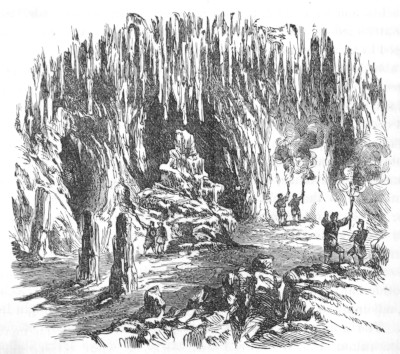
Antiparos, one of the Cyclades, is situated in the Egean sea, or Grecian archipelago. It is a small island, about sixteen miles in circumference, and lies two miles to the west of the celebrated Paros, from which circumstance it derives its name, anti in the Greek language signifying opposite to. Its singular and most interesting grotto, though so inferior in size to the cavern in Kentucky of which we shall soon speak, has attracted the attention of an infinite number of travelers. The entrance to this superb grotto is on the side of a rock, and is a large arch, formed of craggy stones, overhung with 137brambles and creeping plants, which bestow on it a gloominess at once awful and agreeable. Having proceeded about thirty paces within it, the traveler enters a low, narrow alley, surrounded on every side by stones, which, by the light of torches, glitter like diamonds; the whole being covered and lined throughout with small crystals, which give by their different reflections, a variety of colors. At the end of this alley or passage, having a rope tied round his waist, he is led to the brink of an awful precipice, and is thence lowered into a deep abyss, the gloom pervading which makes him regret the “alley of diamonds” he has just quitted. He has not yet, however, reached the grotto, but is led forward about forty paces, beneath a roof of rugged rocks, amid a scene of terrible darkness, and at a vast depth from the surface of the earth, to the brink of another precipice, much deeper and more awful than the former.
Having descended this precipice, which is not accomplished without considerable difficulty, the traveler enters a passage, the grandeur and beauty of which can be but imperfectly described. It is one hundred and twenty feet in length, about nine feet high, and in width seven, with a bottom of a fine green glossy marble. The walls and arched roof are as smooth and polished as if they had been wrought by art, and are composed of a fine glittering red and white granite, supported at intervals by columns of a deep blood-red shining porphyry, which, by the reflection of the lights, presents an appearance inconceivably grand. At the extremity of this passage is a sloping wall, formed of a single mass of purple marble, studded with sprigs of rock crystal, which, from the glow of the purple behind, appear like a continued range of amethysts.
Another slanting passage, filled with petrifactions, representing the figures of snakes and other animals, and having toward its extremity two pillars of beautiful yellow marble, which seem to support the roof, leads to the last precipice, which is descended by means of a ladder. The traveler, who has descended to the depth of nearly fifteen hundred feet beneath the surface, now enters the magnificent grotto, to procure a sight of which he has endured so much fatigue. It is in width three hundred and sixty feet; in length three hundred and forty; and in most places one hundred and eighty in hight. By the aid of torch-light, he finds himself beneath an immense and finely vaulted arch, overspread with icicles of white shining marble, many of them ten feet in length, and of a proportionate thickness. Among these are suspended a thousand festoons of leaves and flowers, of the same substance, but so glittering as to dazzle the sight. The sides are planted with petrifactions, also of white marble, representing trees; these rise in rows one above the other, and often inclose the points of the icicles. From 138them also hang festoons, tied as it were one to another, in great abundance; and in some places rivers of marble seem to wind through them. In short, these petrifactions, the result of the dripping of water for a long series of ages, nicely resemble trees and brooks turned to marble. The floor is paved with crystals of different colors, such as red, blue, green and yellow, projecting from it, and rendering it rugged and uneven. These are again interspersed with icicles of white marble, which have apparently fallen from the roof, and are there fixed. To these the guides fasten their torches; and the glare of splendor and beauty which results from such an illumination, may be better conceived than described.
To the above description we subjoin an extract from the one given by Dr. Clarke, a learned traveler, who visited this celebrated grotto.
“The mode of descent is by ropes, which, on the different declivities, are either held by the guides, or are joined to a cable which is fastened at the entrance around a stalactite pillar. In this manner, we were conducted, first down one declivity, and then down another, until we entered the spacious chambers of this truly enchanted grotto. The roof, the floor, the sides, of a whole series of magnificent caverns, were entirely invested with a dazzling incrustation as white as snow. Columns, some of which were five and twenty feet in length, pended in fine icicle forms above our heads: fortunately some of them are so far above the reach of the numerous travelers, who during many ages, have visited this place, that no one has been able to injure or remove them. Others extended from the roof to the floor, with diameters equal to that of the mast of a first-rate ship of the line. The incrustations of the floor, caused by falling drops from the stalactites above, had grown up into dendritic and vegetable forms, which first suggested to Tournefort the strange notion of his having here discovered the vegetation of stones. Vegetation itself has been considered as a species of crystallization; and as the process of crystallization is so surprisingly manifested by several phenomena in this grotto, some analogy may perhaps be allowed to exist between the plant and the stone; but it can not be said, that a principle of life existing in the former has been imparted to the latter. The last chamber into which we descended surprised us more by the grandeur of its exhibition than any other. Probably there are many other chambers below this, yet unexplored, for no attempt has been made to penetrate further: and, if this be true, the new caverns, when opened, would appear in perfect splendor, unsullied, in any part of them, by the smoke of torches, or by the hands of intruders.”
139
CAVERNS IN GERMANY AND HUNGARY, CONTAINING FOSSIL BONES.
Among the most remarkable of these caverns are those of Gaylenreuth, on the confines of Bayreuth. The opening to these, which is about seven feet and a half high, is at the foot of a rock of limestone of considerable magnitude, and in its eastern side. Immediately beyond the opening is a magnificent grotto, of about three hundred feet in circumference, which has been naturally divided by the form of the roof into four caves. The first is about twenty-five feet long and wide, and varies in hight from nine to eighteen feet, the roof being formed into irregular arches. Beyond this is the second cave, about twenty-eight feet long, and of nearly the same width and hight with the former.
A low and very rugged passage, the roof of which is formed of projecting pieces of rocks, leads to the third grotto, the opening into which is a hole three feet high, and four feet wide. This grotto is more regular in its form, and is about thirty feet in diameter, and nearly round; its hight is from five to six feet. It is very richly and fantastically adorned by the varying forms of its stalactitic hangings. The floor is also covered with a wet and slippery glazing, in which several teeth and jaws appear to have been fixed.
From this grotto commences the descent to the inferior caverns. Within only about five or six feet an opening in the floor is seen, which is partly vaulted over by a projecting piece of rock. The descent is about twenty feet. This cavern is about thirty feet in hight, about fifteen feet in width, and nearly circular; the sides, roof and floor, displaying the remains of animals. The rock itself is thickly beset with teeth and bones, and the floor is covered with a loose earth, the evident result of animal decomposition, and in which numerous bones are imbedded.
A gradual descent leads to another grotto, which, with its passage, is forty feet in length, and twenty feet in hight. Its sides and top are beautifully adorned with stalactites. Nearly twenty feet further is a frightful gulf, the opening of which is about fifteen feet in diameter; and, upon descending about twenty feet, another grotto, about the same diameter with the former, but forty feet in hight, is seen. Here the bones are dispersed about; and the floor, which is formed of animal earth, has great numbers of them imbedded in it. The bones which are here found, seem to be of different animals; but in this, as well as in the former caverns, perfect and unbroken bones are very seldom found. Sometimes a tooth is seen projecting from 140the solid rock, through the stalactitic covering, showing that many of these wonderful remains may here be concealed. A specimen of this kind has been preserved, and is rendered particularly interesting, by the first molar tooth of the lower jaw, with its enamel quite perfect, rising through the stalactitic mass which invests the bone. In this cavern the stalactites begin to be of a larger size, and of a more columnar form.
Passing on through a narrow opening in the rock, a small cave, seven feet long, and five feet high, is discovered; another narrow opening leads to another small cave; from which a sloping descent leads to a cave twenty-five feet in hight, and about half as much in its diameter, in which is a truncated columnar stalactite, eight feet in circumference.
A narrow and most difficult passage, twenty feet in length, leads from this cavern to another, twenty-five feet in hight, which is everywhere beset with teeth, bones and stalactitic projections. This cavern is suddenly contracted, so as to form a vestibule of six feet wide, ten long, and nine high, terminating in an opening close to the floor, only three feet wide and two high, through which it is necessary to writhe, with the body on the ground. This leads into a small cave, eight feet high and wide, which is the passage into a grotto, twenty-eight feet high, and about forty-three feet long and wide. Here the prodigious quantity of animal earth, the vast number of teeth, jaws and other bones, and the heavy grouping of the stalactites, produce so dismal an appearance, as to become a perfect model of a temple for a god of the dead. Here hundreds of cart-loads of bony remains might be removed, pockets might be filled with fossil teeth, and animal earth was found to reach to the utmost depth to which the workmen dug. A piece of stalactite, being here broken down, was found to contain pieces of bones within it, the remnants of which were left imbedded in the rock. From this principal cave is a very narrow passage, terminating in the last cave, which is about six feet in width, fifteen in hight, and the same in length. In this cave were no animal remains, and the floor was the naked rock.
Thus far only can these natural sepulchers be traced; but there is every reason to suppose, that these animal remains are disposed through a greater part of this rock. Whence this immense quantity of the remains of carnivorous animals could have been collected, is a question which naturally arises; but the difficulty of answering it appears to be almost insurmountable.
141
THE MAMMOTH CAVE.
THE MAMMOTH CAVE.
For one of the earliest accounts of this stupendous cavern, which is unparalleled in the entire history of subterranean wonders, we are indebted to Dr. Nahum Ward, who published it in a monthly magazine, in October, 1816. It is in what was formerly Warren, but now Edmonson county, in the state of Kentucky, about ten miles from the great Louisville and Nashville turnpike. The territory is not mountainous but broken, differing in this respect from the vicinity of most other caverns of the same general kind. Not far from the entrance, a hotel is now kept for the accommodation of 142visitors, as the cave is quite a fashionable resort for travelers during the summer season. Perhaps we shall best gain correct ideas of this wonderful cavern, which is almost a world in itself, having its own seas, mountains, lakes, rivers, &c., by reading first the account given by Dr. Ward, and then that of a visitor who explored it in 1854.
Dr. Ward, provided with guides, two large lamps, a compass and refreshments, descended a pit forty feet in depth, and one hundred and twenty in circumference; having a spring of fine water at the bottom, and conducting to the entrance of the cavern. The opening, which is to the north, is from forty to fifty feet high, and about thirty in width. It narrows shortly after, but again expands to a width of thirty or forty feet, and a hight of twenty, continuing these dimensions for about a mile, to the first hoppers,[2] where a manufactory of saltpeter had recently been established. Thence to the second of these hoppers, two miles from the entrance, it is forty feet in width, and sixty in hight. Throughout nearly the whole of the distance handsome walls had been made by the manufacturers, of the loose limestone. The road was hard, and as smooth as a flag pavement. In every passage which the doctor traversed, the sides of the cavern were perpendicular, and the arches, which have bid defiance even to earthquakes, were regular. In 1802, when the heavy shocks of earthquakes came on which were so severely felt in this part of Kentucky, the workmen stationed at the second hoppers, heard about five minutes before each shock, a heavy rumbling noise issue from the cave, like a strong wind. When that ceased, the rocks cracked, and the whole appeared to be going in a moment to final destruction. However, no one was injured, although large portions of rock fell in different parts of the cavern.
In advancing into the cavern, the avenue leads from the second hoppers, west, one mile; and thence, south-west, to the chief area or city, which is six miles from the entrance. This avenue, throughout its whole extent from the above station to the cross-roads, or chief area, is from sixty to one hundred feet in hight, of a similar width, and nearly on a level, the floor or bottom being covered with loose limestone and saltpeter earth. “When,” observes the doctor, “I reached this immense area (called the chief city) which contains upward of eight acres, without a single pillar to support the arch, which is entire over the whole, I was struck dumb with astonishment. Nothing can be more sublime and grand than this place, of which but a faint idea can be conveyed, covered with one solid arch at least one hundred feet high, and to all appearance entire.”
143Having entered the area, the doctor perceived five large avenues leading from it, from sixty to one hundred feet in width, and about forty in hight. The stone walls are arched, and were from forty to eighty feet perpendicular in hight before the commencement of the arch.
In exploring these avenues, the precaution was taken to cut arrows, pointing to the mouth of the cave, on the stones beneath the feet, to prevent any difficulty in the return. The first which was traversed, took a southerly direction for more than two miles; when a second was taken, which led first east, and then north, for more than two miles further. These windings at length brought the party, by another avenue, to the chief city again, after having traversed different avenues for more than five miles. Having reposed for a few moments on slabs of limestone near the center of this gloomy area, and refreshed themselves and trimmed their lamps, they departed a second time, through an avenue almost north, parallel with the one leading from the chief city to the mouth of the cavern; and, having proceeded upward of two miles, came to the second city. This is covered with a single arch, nearly two hundred feet high in the center, and is very similar to the chief city, except in the number of its avenues, which are two only. They crossed it, over a very considerable rise in the center, and descended through an avenue which bore to the east, to the distance of nearly a mile, when they came to a third area, or city, about one hundred feet square, and fifty in hight, which had a pure and delightful stream of water issuing from the side of a wall about thirty feet high, and which fell on a broken surface of stone, and was afterward entirely lost to view.
Having passed a few yards beyond this beautiful sheet of water, so as to reach the end of the avenue, the party returned about one hundred yards, and passing over a considerable mass of stone, entered another, but smaller avenue to the right, which carried them south, through a third, of an uncommonly black hue, somewhat more than a mile; when they ascended a very steep hill about sixty yards, which conducted them to within the walls of the fourth city. It is not inferior to the second, having an arch which covers at least six acres. In this last avenue, the extremity of which can not be less than four miles from the chief city, and ten from the mouth of the cavern, are upward of twenty large piles of saltpeter earth on the one side, and broken limestone heaped up on the other, evidently the work of human hands.
From the course of his needle, the doctor expected that this avenue would have led circuitously to the chief city; but was much disappointed when he reached the extremity, a few hundred yards’ distance from the fourth city. In retracing his steps, not having paid a due attention to mark the entrances 144of the different avenues, he was greatly bewildered, and once completely lost himself for nearly fifteen or twenty minutes. Thus, faint and wearied, he did not reach the chief area till ten at night; but was still determined to explore the cavern so long as his light should last. Having entered the fifth and last avenue from the chief area, and proceeded south-east about nine hundred yards, he came to the fifth area, the arch of which covers upward of four acres of level ground, strewed with limestone, and having fire-beds of an uncommon size, surrounded with brands of cane, interspersed. Another avenue on the opposite side, led to one of still greater capacity, the walls or sides of which were more perfect than any that had been noticed, running almost due south for nearly a mile and a half, and being very level and straight, with an elegant arch. While the doctor was employed, at the extremity of this avenue, in sketching a plan of the cave, one of his guides, who had strayed to a distance, called on him to follow. Leaving the other guide, he was led to a vertical passage, which opened into a chamber at least eighteen hundred feet in circumference, and the center of the arch of which was one hundred and fifty feet in hight.
It was past midnight when he entered this chamber of eternal darkness; and when he reflected on the different avenues through which he had passed since he had penetrated the cave at eight in the morning, and now found himself buried several miles in the dark recesses of this awful cavern—the grave, perhaps, of thousands of human beings—he felt a shivering horror. The avenue, or passage, which led from it was as large as any he had entered; and it is uncertain how far he might have traveled had his lights not failed him. All those who have any knowledge of this cave, he observes, conjecture that Green river, a stream navigable several hundred miles, passes over three of its branches.
After a lapse of nearly an hour, he descended by what is called the “passage of the chimney,” and joined the other guide. Thence returning to the chief area or city, where the lamps were trimmed for the last time, he entered the spacious avenue which led to the second hoppers. Here he met with various curiosities, such as spars, petrifactions, &c.; and these he brought away, together with a mummy which was found at the second hoppers. He reached the mouth of the cave about three in the morning, nearly exhausted with nineteen hours of constant fatigue. He nearly fainted on leaving it, and on inhaling the vapid air of the atmosphere, after having so long breathed the pure air occasioned by the niter of the cave. His pulse beat stronger when in the cave, but not so quick as when on the surface.
Here the doctor observes that he has hardly described half the cave, not 145having named the avenues between its mouth and the second hoppers. This part of his narrative is of equal interest with what has been already given. He states that there is a passage in the main avenue, upward of nine hundred feet from the entrance, like that of a trap-door. By sliding aside a large flat stone, you can descend sixteen or eighteen feet in a very narrow defile, where the passage comes on a level, and winds about in such a manner, as to pass under the main passage without having any communication with it, at length opening into the main cave by two large passages just beyond the second hoppers. This is called the “glauber-salt room,” from salts of that kind being found there. Next come the sick room, the bat-room, and the flint-room, together with a winding avenue, which, branching off at the second hoppers, runs west and south-west for more than two miles. It is called the “haunted chamber,” from the echo within: its arch is very beautifully incrusted with limestone spar; and in many places the columns of spar are truly elegant, extending from the ceiling to the floor. Near the center of this arch is a dome, apparently fifty feet high, hung in rich drapery, festooned in the most fanciful manner for six or eight feet from the hangings, and in colors the most rich and brilliant. By the reflection of one or two lights, the columns of spar and the stalactites have a very romantic appearance. Of this spar, a large elevation, called “Wilkin’s arm-chair,” has been formed in the center of the avenue and encircled with many smaller ones. The columns of the spar, fluted and studded with knobs of spar and stalactites; the drapery of the various colors superbly festooned and hung in the most graceful manner, these are shown with the greatest brilliancy by the reflection of the lamps.
In the vicinity of the haunted chamber, the sound of a cataract was heard; and at the extremity of the avenue was a reservoir of water, very clear and grateful to the taste, having, apparently, neither inlet nor outlet. Here the air, as in many other parts of the cave, was pure and delightful. Not far from the reservoir, an avenue presented itself, within which were several columns of the most brilliant spar, sixty or seventy feet in hight, and almost perpendicular, standing in basins of water; which, as well as the columns, were of surpassing splendor and beauty.
So far we have followed the brief and general account of Dr. Ward. Turning now to other accounts, we find that the cave extends for miles under the earth, and that the end of it has never yet been reached by any explorer. The air is not only pure, but delightful and exhilarating, and has been highly recommended for diseases of the lungs, so much so, that quite a number of small houses have been built within to accommodate consumptive persons, who at times have resided there with benefit. The 146temperature there is uniformly the same, being in both winter and summer, from fifty-five degrees to fifty-nine degrees Fahrenheit. Combustion is perfect in all parts of the cave, and decomposition is nowhere observable. No reptiles, of any description, have ever been seen within it. The loudest thunder can not be heard a quarter of a mile within, and the only sound is the roar of the waterfalls, of which there are some seven or eight.
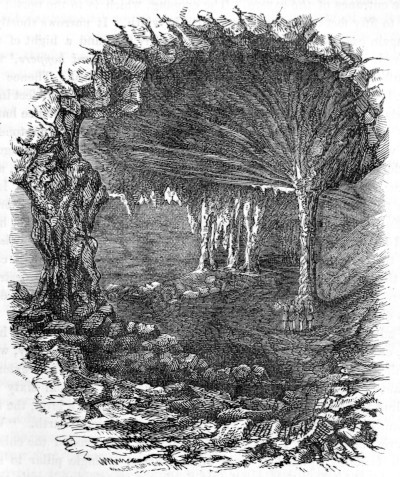
The entire cave, so far as explored, contains two hundred and fifty or more avenues, nearly fifty domes, twenty-two pits and three rivers. Many of the avenues contain large and magnificent stalagmite columns, extending from the floor to the ceiling, and some of very grotesque and fanciful shape. Graceful stalactites may likewise be seen pendant from the ceilings, as uniform and regular as if they were cut by the hand of man. The engraving gives a view of one of those avenues where the stalagmites and stalactites abound in great profusion. In another part of this avenue, in what is called the Gothic Chapel, these stalactic formations are still more striking, very much resembling a monkish cathedral. In the Fairy Grotto, the formations likewise assume a great many fanciful shapes.
Passing now to the second account of a visit to the cave, to which we have already alluded, we find the visitor saying, that the cave is every way so wonderful, that it is impossible to give more than a faint idea of its magnificence and splendor. “As in exploring the cave,” he continues, “there are three rivers to cross and a great deal of climbing over rocks and crawling through narrow places, ladies adopt the Bloomer costume from necessity, and gentlemen are provided with dresses according to their fancy, so that a party starting out for a trip through the cave, present a most grotesque and comical appearance. On arriving at the mouth, the visitor is provided with a lamp, and makes an abrupt, though comparatively easy descent of some seventy or eighty feet. Here he enters a dark avenue, about five rods wide, called the Narrows, and soon finds himself far beyond where daylight ever shone. At the distance of about six hundred yards from the mouth, this avenue expands and forms a large circular room, called the Rotunda, or Great Vestibule. The guide stops here, and ignites a light, a compound of sulphur, saltpeter and antimony, prepared for illuminating the various points of special interest through the cave. This forms a most brilliant light, and reveals a room some two or three hundred feet wide, and forty-seven feet high. The view revealed by this first illumination is most imposing and sublime. I told my guide that he was certainly right in his ideas about describing the cave. As he saw me getting my paper and pencil ready at the mouth, he began laughing very significantly, and said, ‘Writin ’bout the cave aint no use, sir. Most everybody that goes in writes, but they gin’ally 147throws it away when they comes out. Writin don’t do no good. If anybody wants to know ’bout the cave, they must come and see it.’ Although I had barely commenced my journey through it, I told my guide that I could heartily subscribe to the whole of his speech on this subject.
“And right here, in the great vestibule, I will stop to say a few words about my guide. There are four guides to the cave, all of whom are said to be entirely familiar with it, and to give the most perfect satisfaction to visitors. At all events, I was entirely satisfied with ‘Alfred,’ with whom I made four different journeys through the cave, traveling under ground through various avenues more than fifty miles. Alfred formerly belonged to Miss Mary Croghan, whose elopement from a boarding-school on Staten Island about a dozen years ago, with Captain Shinley, created so great a sensation in New York and elsewhere. After she went to England, she gave Alfred to some of her relatives, and he belonged to Dr. Croghan at the time of his death, who was the owner of the cave. By the terms of Dr. Croghan’s will, Alfred and his wife and children will be free in about eighteen months. He is now drawing wages for his services, which, with the liberal presents he receives from visitors, will enable him to make a very fine start in the world. Alfred has evidently been a great pet, as he learned to read when very small; and he astonishes visitors by his use of scientific terms, and his knowledge of chemistry and geology. He has now been a guide to the cave about sixteen years; has visited it with a great many scientific men; has most of the standard works on geology, and is altogether an interesting character. He sees persons from all parts of the union, and understands all the excitements at the north, from that created by Uncle Tom’s Cabin, down to the Forrest divorce trial. He was anxious to buy Uncle Tom’s Cabin, and was told that he had better buy a Bible. So he paid four dollars and a half for a Bible, and bought Uncle Tom too. I can not do less than recommend all my friends who may visit the cave, to try and secure Alfred for a guide.
“Leaving the vestibule and passing the Kentucky cliffs, so called from their likeness to the cliffs in Kentucky river, we come to what is very appropriately named the Church and Galleries. At various points upon the route thus far, we have seen the leaching vats and other remains of the saltpeter works that were erected in the cave nearly fifty years ago. The manufacture of saltpeter was carried on quite extensively in the cave for several years, and the guide says the saltpeter was manufactured here with which the powder was made which was used in the battle of New Orleans. There is a very plain cart-path through this part of the cave, and we saw the tracks of oxen which were made forty-seven years ago. The church is the point in 148the cave where the miners assembled for worship. The rude pulpit or stand from which the preacher addressed his congregation, still remains. But besides this there is a natural pulpit and galleries which are easily ascended by steps in the wall, from which sermons are now frequently preached to visitors, for whom seats are provided. When illuminated, this church is more awfully imposing and solemn, than any temple built by human hands. The cave is more than one hundred feet wide, its massive rocky walls about fifteen feet high, and stretching away in each direction until lost in the most impenetrable darkness. For myself, I could not understand how any man would consent to lift his puny voice where God speaks so impressively. But there is a difference in tastes, and many, I doubt not, are persuaded against their own will to gratify the strong desire of the visitors to hear preaching in the cave. Going on from this point we pass the Grand Arch, a natural arch sixty-six feet high, and about seventy yards wide, and one hundred and fifty yards long; and some distance beyond are shown the Giant’s Coffin. This is a huge rock, so formed that the top of it is a fine representation of a coffin. The shape is almost precisely that of a modern metallic coffin. This rock lies exactly east and west, by the compass, and is fifty-seven and a half feet long.
“Here we left the broad main cave in which we had thus far been traveling, and which stretched on indefinitely before us, and turned off into a narrow, circuitous, irregular avenue, and wandered indefinitely. Clambering over rocks, going down precipitous steeps, passing a great variety of rooms, lofty domes, intricate labyrinths, pits from seventy-five to one hundred and seventy-five feet deep, and a great many other points, all appropriately and often very significantly named, we at length came to Gorin’s Dome, so called from the name of its discoverer, by far the most imposing I had yet seen. Coming to the end of a narrow avenue, the guide directed me to look through an opening in the wall, a kind of window, and our lamps revealed hights above and depths below, that seemed interminable! He then kindled one of the lights that I have already described, and placing it upon a board, thrust it through the opening and told me to look, first below and then above. The view was utterly indescribable and almost overpowering. The opening was not more than thirty feet in circumference, and I have already forgotten the hight and depth as given me by the guide. But I felt for hours and still feel the tremblings of those emotions that thrilled through my whole frame as I peered into those abysmal depths, and looked up into those giddy hights. None but Jehovah could build such a dome.
“I can not undertake to give the details of our route from avenue to avenue, nor mention the various points of interest that we passed. We were 149at length in a vast open space; the guide took our lamps, and going a short distance from us, told us to look up, and we at once discovered that we were in the far-famed Star Chamber. The cave here is some twenty or thirty yards wide, and about sixty or seventy feet high, and in a dim light the arch above presents the appearance of the sky in a very starry night. On looking up you see innumerable stars, and as you gaze for a long time the sky seems to be very distant, the stars increase in number, and it seems quite as if you were really looking through an opening in the cave into the heavens. Our guide Alfred was with Professor Silliman when he examined this arch by the aid of a Drummond light, to discover the cause of this appearance, and found that it was crystals embedded in the wall. After we had satisfied ourselves with viewing this artificial sky, Alfred took all our lamps and going into a cave below us, by the shadows from his lamps gave us a representation of clouds passing over the sky, obscuring the stars, thunder-clouds rolling over and the stars appearing again, and other interesting illusions. After this he went still deeper in the cave below us, leaving us in the most pitchy darkness. We were so deep in the bowels of the earth that the loudest thunder has never been heard there, and the silence and darkness were awfully impressive. Suddenly we saw in the direction in which our guide had disappeared, a light like the rising of the moon, which grew larger and larger, until Alfred emerged through some opening from the regions below, and appeared in the distance in the same cave in which we were standing.
“After leaving this chamber, which was more beautiful than any we had entered, we made our way to the Gothic Gallery. This avenue was unlike anything we had yet seen. It is some four or five rods wide and three-quarters of a mile long, the path over which we walked being much more level than the most of those we had walked over, and much of the wall over our heads looking almost as smooth as if it had been plastered. In this avenue we visited the Haunted Chamber, so called from the fact that two mummies were discovered here many years ago; Vulcan’s Forge, so called from being very dark, and a formation resembling cinders; and near its end the Gothic Gallery. This room has a great variety of stalactite and stalagmite formations, many of which have formed solid massive pillars. As we approached the Chapel, our guide made us all stay behind, while he went ahead, taking all our lamps with him; and when we went forward at his call, we found each of our lamps hung upon some one of these pillars, and illuminating a room, compared with which Taylor’s saloon on Broadway, or the most gorgeous saloon New York can boast, is simplicity itself. These formations are a wonderful curiosity. They are of a very light color, are 150nearly as hard as granite, and are said to be formed by the drippings of lime water. They are in a great variety of shapes, to which a great many fanciful names have been given, such as the Pulpit, the Devil’s Arm-Chair, the Pillars of Hercules, &c.
“I had intended in this letter to speak of the chief points of interest in what is called the short route through the cave; that is, the portion of the cave that is visited without crossing either of the rivers. I made two visits on this side of the rivers, the first time traveling about six miles, and the second time traveling ten miles and a half. But I am the more willing to pass by the Bandit’s Hall, Mammoth Dome, Persico Avenue, Crockett’s Dome, Snowball Arch, Bunyan’s Way, and other places of special interest, with a mere mention of their names, from the fact that it is so entirely impossible to describe them. Some of these are but rarely visited, and it costs no little effort to reach them. But however narrow the fissures in the rocks through which we squeezed, however steep and slippery the ascent, however long the distance we had to crawl on our hands and knees, we were always more than paid for our pains.
“Omitting, then, any detailed account of what is called the short route, I pass to a notice of the long route, to which most of our time was given. In taking this we entered the cave as before, passed through the great vestibule, and on for a mile or two through the main branch, over the same route we had already traveled. It seems impossible to realize that this is a cave, it is so high, so wide, so vast. Several of our company remarked this fact. We seemed rather to be in some deep, dark ravine or mountain gorge, wandering by the light of our dim lamps, in some night that was utterly rayless and starless. We at length reached the Bottomless Pit, where we entered upon a path that was new to us. This pit is a deep, dark, fearful chasm, and received its name before anything like bottom had been found. It has now been measured to the depth of one hundred and seventy-five feet, and there may be fissures in the rock descending indefinitely below. Near this pit, we passed over an artificial bridge, and entered the Valley of Humility, through which we made our way, stooping and crawling, until we reached what is the most comical and laughable point in the cave, which is most appropriately named the Winding Way, or Fat Man’s Misery. This is an exceedingly circuitous opening in the rock, about eighteen inches wide, and between three and four hundred feet long. At the entrance of this way, the fissure through which we pass is not more than about two feet deep, and the ceiling above us is so high that we could stand erect without difficulty; but in advancing, the fissure becomes deeper, the rocks on either hand are higher and higher, and the ceiling above becomes lower and lower, and it seems to 151be, indeed, not only fat, but tall men’s misery. It is a most laughable sight to see a party edging their way through this zigzag path; a path that gives every indication of having been washed and worn by the action of the water for innumerable years. Our party was a decidedly lean one, so that we did not, like many others, have the amusement of seeing some one of aldermanic proportions squeeze and worry his way through. Finally, however, we got through, and came into a large open space, which our guide called Great Relief, and a relief it was, sure enough. Passing on, we entered a large, roomy avenue called River Hall, where we were shown the high-water mark in the cave; where, in times of freshets, the river rises fifty-seven feet, perpendicularly, above low-water mark in the cave. We turned aside from this hall into a large room, to witness a great curiosity called the Bacon Chamber. Here the formations overhead are such as to make the room look remarkably like a large smoke-house filled with hams; and near by we were shown a smooth circular excavation in the wall above us, which was pointed out as the kettle for boiling these hams, now turned bottom upward. Returning to the Hall, we went forward, passing several points of interest, until we came to a pure and beautiful body of water called Lake Lethe, upon which we embarked in a small boat provided for the purpose. We were now all on the look-out for the eyeless fish that are found in the waters of the cave, and were so fortunate as to catch in a small net, first, what was called a clawfish, having legs like a lobster, but eyeless and apparently bloodless, being almost precisely the color of potato sprouts that have grown in the spring in a dark cellar. Afterward we caught a very small fish of the same color, and having no eyes. Where the eyes should grow, the flesh was smooth and just like the rest of the body. Whatever our doubts might have been before, we here had ocular demonstration that the fish in these waters, which are never illumined except by lamplight, are entirely without sight.
“Leaving Lake Lethe, we entered a most grand and imposing avenue, with lofty rocky walls towering about two hundred and fifty feet high, called the Great Walk. This leads to the Echo River, one of the greatest of these subterranean wonders. We sailed down this river a distance of three-quarters of a mile, and such a sail! Where on the earth or under the earth, could another such a sail be taken? The water was cold, clear and pure, and in color remarkably like the Niagara, as it plunges over the falls. At many places we could see the bottom, and in others it seemed of very great depth. It flowed in placid stillness, unrippled by a single breeze, between, above and beneath walls of massive and eternal rock. Now the channel was deep, narrow and tortuous, and now it spread out into a broad, pellucid stream. Now the massive ceiling above us was high, and smooth, and 152beautifully arched; and now it was so rough, broken and low, that we had to stoop as we sat in our boat, in order to pass under it. We did not pass rapidly down this stream. None of us were in a hurry. We seemed scarcely to belong to this driving, go-ahead world. Now a shout echoed wildly and magnificently through the rocky chambers; and now we sat entranced while one of our company, a splendid musician, sang some beautiful song, never as beautiful as now, when it echoed and reëchoed along these walls, and died away in the darkness that our dim lamps could not penetrate. This river, too, is most appropriately named. The echoes are most perfect and beautiful. We experimented in a great variety of ways, singing alone and in concert, shouting, whistling, clapping our hands, and finally, the whole company sung Ortonville. But there was one thing more impressive than all these, and that was silence! We sat in our boat as quietly as possible, no one speaking or moving for some time; and the stillness and the darkness by which we were surrounded, were solemn and awful beyond all description. We were deep in the bowels of the earth, I know not how many feet below its surface, but so low that no ray of light from the sun had ever penetrated its depths, and no voice of loudest thunder had ever waked an echo there. The silence was perfect, save the sound of breathing which each one tried to suppress, and the throbbing of our hearts that
‘Still like muffled drums were beating,
Funeral marches to the grave.’
“God spoke in that stillness with a voice such as I had never heard before. I had never before so realized how awfully impressive were darkness and silence. I had entirely new ideas of the awful solitude of that period when the ‘earth was without form and void, and darkness was upon the face of the deep.’
“On getting beyond this river, we entered a region of avenues of incredible if not of interminable length, which have been discovered within the last twelve or fifteen years. One of the first of these is called Silliman Avenue, in honor of Professor Silliman, who has made very thorough explorations of the cave. This avenue is a mile and a half long, about three rods wide, and has various interesting features which I have not time to notice. At the termination of this avenue, the cave widens into a large room, several rods wide, and some fifty or sixty feet high, which is called Ole Bull’s concert-room, from the fact that this musician gave a free concert there to the visitors who were at the cave at the time of his visit.
“Beyond this room, we entered an avenue two miles long, called the Pass of El Gor. This is an exceedingly rocky and uneven avenue, leading, by a 153most circuitous path up and down great piles of rock, along a most rugged and desolate way, near deep holes and fissures in the rocks, until at length we come to a fine sulphur spring called Hebe’s Spring, which we found very refreshing. Here, through a narrow opening in the rocks, we climb a ladder eighteen feet high, and find a scene that abundantly compensates for the rough walk we have taken to reach it. On reaching the top of this ladder, we find ourselves in Martha’s Vineyard. Here is a vast room, the sides of which are covered over with a formation resembling grapes. They hang on the wall above, plump, round and perfect in form, and in the greatest profusion. They are so solid and hard that it is difficult to break off any of the clusters, and are said to be formed by the drippings of the water through the rocks. Near the head of the ladder there is a fine representation of a vine, of solid rock, running along the wall; and apparently connected with this vine, there are seemingly cart-loads of these rocky grapes. Our guide illumined the vineyard with one of his Bengal lights, and the view was magnificent.
“Going on from this point through Elindo’s Avenue and Washington’s Hall, we reached another of the remarkable rooms of the cave, called the Snowball Room. The cave is here about a hundred feet wide, ten or fifteen feet high, and the ceiling quite even and beautifully arched. Nature has here played most fantastic tricks. I know of no way so good to describe this room, as to say that its walls and ceiling overhead look like the end of some building that a score of school-boys have completely covered over with snowballs. We examined these formations for some time with our lamps, and then Alfred gave us the benefit of an illumination. But of its appearance when thus lighted up, I will attempt no description.
“We were now about seven miles from the mouth of the cave; and with appetites sharpened by our long walk, we sat down to the dinner which our host had sent along for us. It was a magnificent dining-saloon in which we were seated. Taylor’s saloon on Broadway is splendid, and has dazzled and bewildered multitudes, when they first entered it; but neither Taylor, nor prince, nor potentate, ever built a room so gorgeous as that in which we were seated. None but the God who built the skies, and bent and decorated the arch above us, could build another comparable to it.
“The Snowball Room is at the entrance of an avenue more extensive and beautiful than any other in the cave. This is called Cleveland’s Cabinet, and is altogether indescribable. It is about five rods wide and two miles long! Think of its dimensions a moment! About as long as Broadway from the Battery to Union Square, and with walls, not of brick, granite and marble, shaped and graven by art and man’s device, but with walls and 154ceiling above covered all over with the exquisite and beautiful workmanship of its divine builder.
“We passed slowly through this cabinet, two miles long, the guide conducting us from point to point of remarkable interest, and all the way along showing us new and strange developments. We went to Mary’s Bower, Virginia’s Festoons, Saint Cecelia’s Grotto, Flora’s Garden, where were roses and lilies, rosettes and wreaths, as perfect as though they had been chiseled there by the most accomplished sculptor. The formation on the wall in which these various flowers and other beautiful things are developed, is gypsum of the most snowy whiteness; and our guide said it was in three separate layers, and that the forming process was constantly going on, the inner layers crowding off the outer. The floor was covered with tuns of these layers, which had been crowded off, and which visitors are at liberty to carry off as specimens, while they are strictly prohibited from breaking anything from the walls. But still it is with the utmost difficulty that the guides can preserve some of the most beautiful views in the cave from the destruction of vandal visitors. This part of the cave is less beautiful than formerly, having become a good deal smoked by the lamps of the thousands of visitors who have examined it. But our guide took us into an avenue immediately under this, which is but rarely visited, and conducted us to a most enchanting spot called Egeria’s Grotto. Here the formations were as pure, and beautiful and white, as if fresh from the hand of their Maker. Here were formations, not only of the purest white, but of other most exquisite coloring. We remained a long time in this grotto, examining its various wonders, and deemed ourselves very fortunate in seeing it, as from this we could better understand how Cleveland’s Cabinet above us appeared during the long ages that intervened before it was polluted by the presence of man. Another beautiful grotto was perfectly brilliant and gorgeous, and looked as though its rough walls were a solid mass of diamonds. The most gorgeous and brilliant room ever built in the palace of an earthly monarch, is tameness itself compared with this diamond grotto.
“Emerging again into Cleveland’s Cabinet, we passed on to its termination, where we ascended the Rocky Mountains, a vast pile of loose, broken rocks, one hundred and sixty feet high, which have apparently dropped down from the cave above, leaving a vast vaulted opening in the cave above, to indicate the place from which they have fallen. Beyond these mountains, the cave branches in three directions. We took the branch leading to Croghan’s Hall, the remotest point in the cave that has yet been visited, and nine miles from its mouth. On the right of this room there is a deep, awful pit, into which we threw stones, as we had into many others, and heard 155them roll and bound from rock to rock, down a distance of one hundred and eighty-five feet. The water from some point below us runs over these rocks, and flows off, no mortal knows where. This hall contains large, massive pillars, elaborately carved and ornamented by the Invisible Architect, stalactites and stalagmites of various beautiful forms, and its walls are festooned with that rich drapery which no art can imitate, and which only decks the grottos, bowers and halls of this wonderful cave.
“After refreshing ourselves here from a pleasant spring, we started on our nine-mile tramp for the mouth of the cave, taking only a hurried glance of the varied objects of interest as we passed them. We, however, sailed very leisurely down Echo River, or the Jordan, as it is also called. We again had solos and choruses, and drank in rich delights from this enchanting sail. When we reached Lethe, some of our party determined to send their clothes across in our boat and swim over. They accordingly plunged in very boldly, but hurried out in the quickest time possible; and the chattering of teeth, shivering, leaping and running to get warm again, seemed more befitting a bath in February, than in one of the hottest days in August.
“I had now made four different visits to the cave, traveling, according to the reckoning of my guide, about fifty-four miles. Very few visitors explore it as thoroughly, and yet I had not gone over one-third of the space that has already been explored. The guide says that two hundred and fifty different avenues are already known, measuring the distance of one hundred and sixty-five miles. The temperature of the cave is uniformly about fifty-five degrees, and its bracing, invigorating character may be judged from the fact that ladies, some of them quite delicate, are constantly taking this ‘long route,’ traveling a greater number of miles than most men would think of going on foot above ground.
“We felt but little fatigue from our rough, clambering walk of some twenty miles, until we emerged from the cave, and came in contact with outer air. After breathing the air of the cave from eight A. M. till five P. M., the atmosphere seemed very impure. We could smell every tree, and plant, and old log; and the air was so sultry and sickening, that we had to rest awhile at the mouth before starting for the hotel, some fifty rods distant.
“I have thus attempted to redeem my promise in regard to writing you from the cave. I had no thought of writing at so great length. If the cave were possessed of mind and sensibility, I would take off my hat to it, and feelingly ask its pardon for the great injustice I have done it in these letters. But as it is, I will only say that I have over and over again assented to the truthfulness and justice of my guide Alfred’s idea of all descriptions of the 156cave: ‘Writin don’t do no good. If anybody wants to know how the cave looks, they must come and see it.’ And I can not conceive of any journey for this purpose so long and toilsome, that those making it would not be abundantly compensated for their pains, by a view of this wonderful work of a wonder-working God.”
Still another visitor, writing to a friend in Europe, says of this wonderful cave, “I had heard and read descriptions of it, long since; but the half, the quarter, was not told. Its vastness, its lofty arches, its immense reach into the bosom of the solid earth, fill me with astonishment. It is, like Mont Blanc, Chimborazo, and the falls of Niagara, one of God’s mightiest works. Shall I compare it with anything of a similar description, which you have seen on the other side of the Atlantic? with the grotto of Neptune, or that of the Sibyl, at Tivoli, or with any of Virgil’s poetic Italian machinery? No comparison can be instituted. I speak, as you are aware, from personal knowledge. You, seated on the opposite bank of the Arno, have seen me clamber up, from the noisy waters below, to the entrance of the far-famed grotto of Neptune, which I leisurely explored. In point of capaciousness, that grotto has little more to boast of than the cellar of a large hotel, and, like that, was, as I think, excavated by human hands. That of the Tiburtine Sibyl is still more limited in its dimensions. Indeed, every cavern which I have ever seen, if placed along side of this, would dwindle into insignificance.”
The same writer says, “I can not refrain from giving you an account of an incident that happened in this cave last spring. A wedding party went to the cave to spend the honeymoon. While there, they went to visit those beautiful portions of the cave which lie beyond the river ‘Jordan.’ In order to do this, a person has to sail down the river nearly a mile before reaching the avenue which leads off from the river on the opposite side, for there is no shore, or landing-place, between the point above on this side, where you come to the river, and that below on the other; for the river fills the whole width of one avenue of the cave, and is several feet deep where the side walls descend into the water. This party had descended the river, visited the cave beyond, and had again embarked on the water for their return homeward. After they had ascended the river about half-way, some of the party, who were in a high glee, got into a romp and overturned the boat. Their lights were all extinguished, their matches wet, the boat filled with water and sunk immediately; and there they were, in ‘the blackness of darkness,’ up to their chins in water. No doubt, they would all have been lost, had it not been for the guide’s great presence of mind. He charged them to remain perfectly still; for, if they moved a single step, they might 157get out of their depth in water; and swimming would not avail them, for they could not see where to swim to. He knew that, if they could bear the coldness of the water any length of time, they would be safe; for another guide would be sent from the cave house, to see what had become of them. And in this perilous condition, up to their mouths in water, in the midst of darkness ‘more than night,’ four miles under ground, they remained for upward of five hours; at the end of which time, another guide came to their relief. Matthew, or Mat, the guide who rescued them, told me that, when he got to where they were, his fellow-guide, Stephen, (the Columbus of the cave,) was swimming around the rest of the party, cheering them, and directing his movements, while swimming, by the sound of their voices, which were raised, one and all, in prayer and supplication for deliverance!”
In conclusion it may be interesting to state, that Colonel Croghan, to whose family the Mammoth cave belongs, was a resident of Louisville, Kentucky. He went to Europe some twenty years ago, and found himself frequently questioned of the wonders of the Mammoth cave, a place he had never visited, and of which he had heard but little at home, though living within ninety miles of it. He went there on his return, and the idea struck him to purchase it, and make it a family inheritance. In fifteen minutes’ bargaining he bought it for ten thousand dollars, and shortly after he was offered one hundred thousand dollars for his purchase. In his will he tied it up in such a way that it must remain in his family for two generations, thus appending its celebrity to his name. There are nineteen hundred acres in the estate, though the cave probably runs under the property of a great number of other land owners. For fear of those who might dig down and establish an entrance to the cave on their own property, (a man’s farm extending up to the zenith and down to the nadir,) great vigilance is exercised to prevent such subterranean surveys and measurements as would enable one to sink a shaft with any certainty. The cave extends ten or twelve miles in several directions, and there is probably many a back-woodsman sitting in his hut within ten miles of the cave, quite unconscious that the most fashionable ladies and gentlemen of Europe and America are walking without leave under his potatoes and corn.
THE GREAT CAVERN OF GUACHARO.
Passing from the Mammoth cave in North America, let us next notice the great cavern of Guacharo in South America, as described in the narrative of Humboldt, which is abridged in the account that follows.
“In a country where the people are fond of the marvelous, a cavern that 158gives birth to a river, and which is inhabited by thousands of nocturnal birds, the fat of which is used to dress the food of the inhabitants, is a ceaseless topic of conversation and discussion. Scarcely has a stranger arrived at Cumana, when he is told of the stone of Araya for the eyes; of the laborer of Arenas who suckled his child; and of the cavern of Guacharo, which is said to be several leagues in length; till he is tired of hearing of them.
“The Cueva del Guacharo is pierced in the vertical profile of a rock. The entrance is toward the south, and forms a vault eighty feet broad, and seventy-two feet high. The rock, that surmounts the grotto, is covered with trees of gigantic hight. The mammee-tree, and the genipa with large and shining leaves, raise their branches vertically toward the sky; while those of the courbaril and the erythrina form, as they extend themselves, a thick vault of verdure. Plants of the family of pothos with succulent stems, oxalises, and orchideæ of a singular structure, rise in the driest cliffs of the rocks; while creeping plants, waving in the winds, are interwoven in festoons before the opening of the cavern. We distinguished in these festoons a bignonia of a violet blue, the purple dolichos, and for the first time that magnificent olandra, the orange flower of which has a fleshy tube more than four inches long. The entrances of grottos, like the view of cascades, derive their principal charm from the situation, more or less majestic, in which they are placed, and which in some sort determines the character of the landscape. What a contrast between the Cueva of Caripe, and those caverns of the north crowned with oaks and gloomy larch-trees!
“But this luxury of vegetation embellishes not only the outside of the vault, it appears even in the vestibule of the grotto. One sees with astonishment plantain-leaved heliconias eighteen feet high, the praga palm-tree, and arborescent arums, follow the banks of the river even to those subterranean places. The vegetation continues in the cave of Caripe, as in the deep crevices of the Andes, half excluded from the light of day; and does not disappear, till, advancing into the interior, we reach thirty or forty paces from the entrance. We measured the way by means of a cord; and we went on about four hundred and thirty feet, without being obliged to light our torches.
“Daylight penetrates into this region, because the grotto forms but one single channel, which keeps the same direction from south-east to north-west. Where the light begins to fail, are heard from afar the hoarse sounds of the nocturnal birds, sounds which the natives think belong exclusively to those subterraneous places. The guacharo is of the size of our fowls, has the mouth of the goatsuckers and procnias, and the port of those vultures, the 159crooked beak of which is surrounded with stiff silky hairs. It forms a new genus, very different from the goatsucker by the force of its voice, by the considerable strength of its beak, containing a double tooth, and by its feet without the membranes that unite the anterior phalanxes of the claws. In its manners it has analogies both to the goatsuckers and the alpine crow. The plumage of the guacharo is of a dark bluish-gray, mixed with small streaks and specks of black. It is difficult to form an idea of the horrible noise occasioned by thousands of these birds in the dark part of the cavern, and which can only be compared to the croaking of our crows, which, in the pine forests of the north, live in society, and construct their nests upon trees, the tops of which touch each other. The shrill and piercing cries of the guacharoes strike upon the vaults of the rocks, and are repeated by the echo in the depth of the cavern. The Indians showed us the nests of these birds, by fixing torches to the end of a long pole. These nests were fifty or sixty feet high above our heads, in holes in the shape of funnels, with which the roof of the grotto is pierced like a sieve. The noise increased as we advanced, and the birds were affrighted by the light of the torches of copal. When this noise ceased around us, we heard at a distance the plaintive cries of the birds roosting in other ramifications of the cavern. It seemed as if these bands answered each other alternately.
“The Indians enter into the Cueva del Guacharo once a year, near midsummer, armed with poles, by means of which they destroy the greater part of the nests. At this season several thousands of birds are killed; and the old ones, to defend their brood, hover around the heads of the savage Indians, uttering terrible cries, which would appall any heart but that of man in an untutored state.
“We followed, as we continued our progress through the cavern, the banks of the small river which issued from it, and is from twenty-eight to thirty feet wide. We walked on the banks, as far as the hills formed of calcareous incrustations permitted us. When the torrent wound among very high masses of stalactites, we were often obliged to descend into its bed, which is only two feet in depth. We learned with surprise, that this subterraneous rivulet is the origin of the river Caripe, which, at a few leagues’ distance, after having joined the small river of Santa Maria, is navigable for canoes. It enters into the river Areo under the name of Canno de Terezen. We found on the banks of the subterraneous rivulet a great quantity of palm-tree wood, the remains of trunks, on which the Indians climb to reach the nests hanging to the roofs of the cavern. The rings, formed by the vestiges of the old footstalks of the leaves, furnish as it were the footsteps of a ladder perpendicularly placed.
160“The grotto of Caripe preserves the same direction, the same breadth, and its primitive hight of sixty or seventy feet, to the distance of fourteen hundred and fifty-eight feet, accurately measured. I have never seen a cavern in either continent, of so uniform and regular a construction. We had great difficulty in persuading the Indians to pass beyond the outer part of the grotto, the only part which they annually visit to collect the fat. The whole authority of the priests was necessary, to induce them to advance as far as the spot where the soil rises abruptly at an inclination of sixty degrees, and where the torrent forms a small subterraneous cascade.[3] The natives connect mystic ideas with this cave, inhabited by nocturnal birds; they believe, that the souls of their ancestors sojourn in the deep recesses of the cavern. ‘Man,’ say they, ‘should avoid places which are enlightened neither by the sun nor by the moon.’ To go and join the guacharoes, is to rejoin their fathers, is to die. The magicians and the poisoners perform their nocturnal tricks at the entrance of the cavern, to conjure the chief of the evil spirits.
“At the point where the river forms the subterraneous cascade, a hill covered with vegetation, which is opposite the opening of the grotto, presents itself in a very picturesque manner. It appears at the extremity of a straight passage, two hundred and forty toises in length. The stalactites, which descend from the vault, and which resemble columns suspended in the air, display themselves on a back-ground of verdure. The opening of the cavern appeared singularly contracted, when we saw it about the middle of the day, illumined by the vivid light reflected at once from the sky, the plants, and the rocks. The distant light of day formed somewhat of a magical contrast with the darkness that surrounded us in those vast caverns. We climbed, not without some difficulty, the small hill, whence the subterraneous rivulet descends. We saw that the grotto was perceptibly contracted, retaining only forty feet in its hight; and that it continued stretching to the northeast, without deviating from its primitive direction, which is parallel to that of the great valley of Caripe.
“The missionaries, with all their authority, could not prevail on the Indians to penetrate farther into the cavern. As the vault grew lower, the cries of the guacharoes became more shrill. We were obliged to yield to the pusillanimity of our guides, and trace back our steps. We followed the course of the torrent to go out of the cavern. Before our eyes were dazzled with the light of day, we saw without the grotto, the water of the river 161sparkling amid the foliage of the trees that concealed it. It was like a picture placed in the distance, and to which the mouth of the cavern served as a frame. Having at length reached the entrance, and seated ourselves on the bank of the rivulet, we rested after our fatigues. We were glad to be beyond the hoarse cries of the birds, and to leave a place where darkness does not offer even the charms of silence and tranquillity.”
FINGAL’S CAVE, OR GRAND STAFFA CAVERN.
Staffa, about seven miles north-north-east of Jona, and equidistant westward from the shores of Mull, about one mile in length, and half a mile in breadth, is noted for the basaltic pillars which support the major part of the island, and for the magnificent spectacle afforded by the cave of Fingal, one of the most splendid works of nature.
Notwithstanding the contiguity of this wonderful island to Mull and Iona, and the numerous vessels which navigate these seas, it was unknown to the world in general, and even to most of the neighboring islanders, until near the close of the last century, when Sir Joseph Banks, then on his voyage to Iceland, in consequence of information received in the sound of Iona, from some gentlemen of Mull, was induced to sail thither. It is, indeed, slightly mentioned by Buchanan; but assuredly it was not equally dead to fame at the time the Norwegians had sway in these parts, for from them it derives its name of Staffa.
The basaltic pillars stand in natural colonnades, mostly above fifty feet high, in the south-western part, upon a firm basis of solid unshapen rock: above these, the stratum, which reaches to the soil of the island, varies in thickness, in proportion to the distribution of the surface into hill and valley. The pillars are of three, four and more sides; but the number of those with five and six exceeds that of the others; one of seven sides measured by Sir Joseph, was four feet and five inches in diameter.
On the west side of Staffa is a small bay, the spot where boats usually land. In this neighborhood occurs the first group of pillars: they are small, and instead of being placed upright, are recumbent on their sides, and form a segment of a circle. Further on is a small cave, above which pillars again are seen, of somewhat larger dimensions, which incline in all directions; in one place in particular, a small mass of them much resembles the ribs of a ship. Beyond the cave is the first continued range of pillars, larger than the former, and opposite to them is a small island called Bhuachaile, 162(pronounced Boo-sha-’lay,) or the Herdsman’s isle, separated from the main by a channel not many fathoms wide. The whole of this islet is composed of pillars without any strata above them; they are small, but by much the neatest formed of any in this quarter.
The first division of this islet, for at high tide it is divided into two parts, makes a kind of cone, the pillars converging together toward the center. On the other side the pillars are in general recumbent; and in the front, next the main, the beautiful manner in which they are joined is visible from their even extremities: all these have their transverse sections exact, and their surfaces smooth; but with the larger pillars the reverse is the case, and they are cracked in all directions.
The main island opposite the Boo-sha-’lay, and thence toward the north-west, is entirely supported by ranges of pillars, pretty erect, which, although not apparently tall, from their not being uncovered to the base, are of large diameter; at their feet is an irregular pavement, made by the upper sides of such as have been broken off. This extends as far under the water as the eye can reach.
In proceeding along the shore, the superb cavern of Fingal appears, for such is the denomination given it by the Highlanders, to whom it is known. It is supported on each side by ranges of columns, and is roofed by the bottoms of such as have been broken away. From the interstices of the roof a yellow stalactitic matter has exuded, which precisely defines the different angles; and, varying the color, tends to augment the elegance of its appearance. What adds to the grandeur of the scene, the whole cave is lighted from without, in such a manner, that the furthest extremity is plainly distinguished; while the air within, being constantly in motion, owing to the flux and reflux of the tides, is perfectly dry and wholesome, and entirely exempt from the damp vapors to which natural caverns are generally subject. The following are its dimensions:
Feet. In.
Length of the cave from the rock without, 371 6
Length of the cave from the pitch of the arch, 250 0
Breadth of the cave at the mouth, 53 7
Breadth of the cave at the further end, 20 0
Hight of the arch at the mouth, 117 6
Hight of the arch at the end, 70 0
Hight of an outside pillar, 39 6
Hight of one at the north-west corner, 54 0
Depth of water at the mouth, 18 0
Depth of water at the extremity, 9 0
163The cave runs to the rock in the direction, by compass, north-north-east.
The mind can hardly form an idea more magnificent than such a space. And, indeed, speaking of the general aspect of Staffa, Sir Joseph is led, by his enthusiasm, to make the following reflections: “Compared to this, what are the cathedrals or the palaces built by man! mere models or playthings, imitations as diminutive as his works will always be, when compared to those of Nature. Where is now the boast of the architect! regularity, the only part in which he fancied himself to exceed his mistress, Nature, is here found in her possession, and here it has been left undescribed for ages. Is not this the school where the art was originally studied? And what has been added to this by the whole Grecian school? A capital to ornament the column of Nature, of which they could execute a model only; and for that very capital they were obliged to a bush of acanthus. How amply does Nature repay those who study her wonderful works.”
Such were his feelings, and in this way did he moralize, when proceeding along shore, and treading as it were on another Giant’s Causeway, he arrived at the mouth of the cave.
To the north-west are found the highest range of pillars. Here they are bare to their base, and the stratum beneath is visible, as it rises several feet above the water. The surface of it is rough, with frequent large pieces of stone sticking in it, as if half immersed. The base, when broken, appears to be composed of many heterogenous parts, and much resembles lava. Many of the floating stones are of a similar substance with the pillars, a coarse kind of basalt, less beautiful than that of the Giant’s Causeway: the color is a dirty brown. The whole of this stratum dips gradually to the south-east.
The thickness of the stratum of lava-like matter below the pillars, the hight of the pillars, and the thickness of the superincumbent stratum, at three different places westward of the mouth of the cave, beginning with the corner pillar of the cave, are described as follows by Sir Joseph Banks:
Feet. In. Feet. In. Feet. In.
Stratum below, 11 0 17 1 19 8
Hight of pillars, 54 0 50 0 55 1
Stratum above, 61 6 51 1 54 7
The stratum above the columns is uniformly the same, consisting of numberless small pillars, bending and inclining in all directions, sometimes so irregularly, that the stones can only be said to have an inclination to assume a columnar form; in others more regularly; but never breaking into, or disturbing the stratum of large pillars, whose tops keep everywhere an uniform line. On the opposite side of the island is a cavern, called Oua-na-scarve, 164or the Cormorant’s cave; here the stratum under the pillars is lifted up very high, and the pillars are considerably less than at the north-west side. Beyond, a bay cuts deep into the island, rendering it not more than a quarter of a mile across. On the sides of this bay, especially beyond a little valley, which almost divides the island, are two stages of small pillars, with a stratum between, exactly resembling that above, formed of innumerable little pillars shaken out of their places, and leaning in all directions. Beyond this, the pillars totally cease. The rock is of a dark-brown stone, without regularity, from the bay along the south-east end of the island; beyond which, a disposition to columnar formation is again manifested, extending from the west side, but in an irregular manner, to the bending pillars first described.
OTHER GROTTOS AND CAVERNS.
There are few countries which have not to boast of a variety of natural excavations; and these have, from their extent, structure, and the curious phenomena they exhibit, in the formation of petrifactions, &c., been at all times objects of popular attention. Among those particularly deserving of notice are the following.
The volcanic country bordering on Rome, is peculiarly diversified by natural cavities of great extent and coolness; on which last account it is related by Seneca, that the Romans were accustomed to erect seats in their vicinity, to enjoy their refreshing chillness in the summer season. He gives a particular account of two such grottos belonging to the villa of Vatia; and it was in a place of this kind that Tiberius was nearly destroyed while at supper. Its roof suddenly gave way, and buried several of his attendants in its ruins; which so alarmed the others, that they fled and abandoned the emperor, with the exception of Sejanus, who, stooping on his hands and knees, and covering the body of Tiberius with his own, received all the stones which fell at that part from the roof, insomuch that, although he himself sustained considerable injury, the emperor escaped unhurt.
The grottos of the Cevennes mountains, in lower Languedoc, are both numerous and extensive. The principal one is not to be explored without much precaution, and without a safe guide. The entrance, which is low and narrow, leads to a spacious amphitheater, the petrifactions hanging from the roof of which have a most splendid effect by the light of torches. Hence the visitor has to descend to several chambers, one of which is named the Chamber of the Winds; another, of Echo; another, of the Cascade; another, again, of the Statue, &c.; on account of their exhibiting these different phenomena. 165In the grotto of Valori, at a small distance, the different natural curiosities which are to be found at every step, may be viewed at leisure, and without apprehension, as the visitor never loses sight of the light at the entrance, and is, therefore, not under any dread of not returning in safety. Here he is gratified by a view of the most singular petrifactions, representing flowers, fruits, bee-hives, and, in short, a variety of objects, in many of which the resemblance is nearly as accurate as if they had been sculptured.
In a wood, about five leagues from Besançon, in the province of France called Franche Comte, an opening, formed by two masses of rock, leads to a cavern more than nine hundred feet beneath the level of the country. It is in width sixty feet, and eighty feet high at the entrance, and exhibits inside an oval cavity of one hundred and thirty-five feet in breadth, and one hundred and sixty-eight in length. To the right of the entrance is a deep and narrow opening, bordered with festoons of ice, which, distilling in successive drops on the bottom of the cavern, form a mass of about thirty feet in diameter. A similar one, but somewhat smaller, produced by the water which drips in less abundance from the imperceptible fissures in the roof, is seen on the left. The ground of the cavern is perfectly smooth, and covered with ice eighteen inches thick; but the top, on the outside, is a dry and stony soil, covered with trees, and on a level with the rest of the wood. The cold within this cavern is so great, that, however warm the external atmosphere may be when it is visited, it is impossible to remain in it for any length of time.