WAS H. P. BLAVATSKY A PLAGIARIST? by Henry T. Edge, B. A. (Cantab.), a Pupil under H. P. Blavatsky
Reading edition
THIS article, written by an old pupil under H. P. Blavatsky, and voicing the feelings of other students, is a vindication of the memory of that great teacher against certain charges brought against her. The charges are many and mutually inconsistent; so that if brought together they would confute each other and the various critics might be left to settle their own quarrel. Thus H. P. Blavatsky is accused both of inventing her teachings, and also of plagiarizing them from other people; her works are said to be at once a stale rehash, and a new fad. But, as any one of these charges may appear alone and thus gain a plausibility it would not otherwise have had, it is both the desire and the duty of those who uphold the truth about H. P. Blavatsky to show up the absurdity of the attacks.
The particular charge in question just now is that of unoriginality. It has been based on a quotation from the Introduction to H. P. Blavatsky's great work, The Secret Doctrine, which is as follows:
I may repeat what I have stated all along, and which I now clothe in the words of Montaigne: Gentlemen, "I have here made only a nosegay of culled flowers, and have brought nothing of my own but the string that ties them."
The attempt to construe this into a charge of plagiarism signifies the wish to depreciate H. P. Blavatsky's writings, as being so stale and unoriginal that it is not worth while reading them. But, if this were so, why did the critics deign to notice them at all, instead of suffering them to sink into the rapid and perfect oblivion which awaits all works that are actually open to such a charge? Evidently there was a desire to prejudice the mind of the inquirer, so that he would be deterred from reading the works for himself and thus forming his own opinion. In short, the arguments of these critics, not resting upon fact, would have been disproved by such a reading; and therefore they have preferred to rest their statements upon mere assertion.
Of course the genuine truth-seeker will always derive his opinion from his own investigations; and if he finds anywhere the help and knowledge for which he is seeking, he will not hesitate to accept it from any doubts as to the popularity of the author. Rather he will base his opinion of the author upon his or her works. But as the conditions of life render it necessary for us to a great extent to be dependent upon the judgments of professional literary people, it is possible for any prejudice that may exist in that quarter to inflict much injustice by lending the weight of authority to false representations. We may find, for instance, some standard work, having great influence and repute, treating of H. P. Blavatsky and Theosophy in a way that would lead one to think the writers had studied these subjects; whereas the contrary is the case, and the apparently scholarly treatise is actually a misrepresentation of fact, amounting to throwing dust in the eyes of the inquirer.
The inquirer, the sincere seeker for knowledge, is therefore referred to The Secret Doctrine itself, where he may ascertain what the author really does say in her Preface and Introduction and where he may study the actual teachings she thus introduces. Her attitude is both plain and frank; there should be no difficulty in understanding it, and its sincerity is apparent to anyone who has studied the book enough to see whether or not the writer has justified her claims. In the Preface we read:
These truths are in no sense put forward as a revelation; nor does the author claim the position of a revealer of mystic lore now made public for the first time in the world's history. For what is contained in this work is to be found scattered throughout thousands of volumes embodying the scriptures of the great Asiatic and early European religions, hidden under glyph and symbol, and hitherto left unnoticed because of this veil.
Here the charge of having invented a new system is met by the express affirmation that the materials are gleaned from ancient sources; while the charge of unoriginality is rendered pointless. A plagiarist is one who gives out the teachings of others as his own, and the charge of unoriginality is not usually brought against writers who set out with the deliberate and announced intention of quoting and expounding other writers. As H. P. Blavatsky herself says, in the very passage from which the words of the critic were selected, it would be as reasonable to charge Renan with having plagiarized his Life of Jesus from the Gospels, or Max Müller his Sacred Books of the East from the Indian philosophical writings.
And what shall be said of the insinuation that The Secret Doctrine is merely a compost, a stale and profitless rehash? That it is equally absurd. A nosegay is not a mere heap of flowers, nor does a heap of stones make a temple. The riddle of ancient knowledge is not solved by merely collecting the scattered fragments. Anyone may bring together a lot of colored threads, but only a weaver and artist can make them into a beautiful and symmetrical fabric. The question is, What has H. P. Blavatsky made of her studies of the world's mystic lore? What use has she made of her quotations and references? Has she succeeded any better than other writers who have delved in the same soil? Is The Secret Doctrine really but one more of those numerous compilations that find a speedy and eternal tomb on dusty shelves?
On consulting the Preface we find that the author has made the claim that she has been able to weave the tangled threads into a symmetrical whole, to put the various fragments in their right places, and to apply a key that will unlock mysteries. In proof of her claim she refers the reader to the book itself. This is the only test she demands; surely not an unreasonable one!
It is written in the service of humanity, and by humanity and the future generations it must be judged. Its author recognizes no inferior court of appeal.—Preface.
Other authors who have compiled voluminous works on ancient lore have signally failed to render them profitable to the student. They have either been mere compilers having no definite purpose other than the production of a learned book, or they have been overruled by some theory or fad which they have sought to prove. But H. P. Blavatsky has pointed out the real clues and for the first time made sense of what was chaotic. To quote her words again:
What is now attempted is to gather the oldest tenets together and to make of them one harmonious and unbroken whole. The sole advantage which the writer has over her predecessors is that she need not resort to personal speculations and theories. For this work is a partial statement of what she herself has been taught by more advanced students, supplemented, in a few details only, by the results of her own study and observation.
It is not easy to see how a plainer and franker statement could have been made. The indebtedness to other sources is freely admitted; and, as the reader can see, all references to sources are fully given in the text. The author mentions her own teachers, but not for the purpose of lending a fictitious authority to her statements. For these statements do not need any such support, consisting, as they do, of appeals to reason, to the weight of testimony, and to accepted authorities in the different branches of learning. The reference to her teachers was made simply in modest and honorable disclaim of credit which the writer felt was due to others. As to the teachings thus received and thus transmitted by her, they are to be judged on their merits, and should neither be accepted or rejected on any other principle. Information is information, however gained; and a man lost in a forest, who has actually been conducted out of it, does not need any testimonials to the trustworthiness of his guide. If The Secret Doctrine can really solve problems, answer questions, and remove doubts, that fact alone is sufficient for the genuine truth-seeker; and the author's statement as to the source of her knowledge will be taken for what it was intended for—a due acknowledgement of gratitude and indebtedness.
If H. P. Blavatsky's work is of the kind which these critics wish to make it out to be, surely the student may be trusted to find out that fact for himself; but if it is not of this kind, then the statement that it is, is a misrepresentation—founded possibly on ignorance, but in any case unworthy of a scholar. She claims that she has pointed out many things that have hitherto escaped the attention of scholars. And this is a statement which can only be tested by investigation; anyone presuming to affirm or deny it without such investigation is either a simpleton or a bigot. The pointing out of truths is not an act of dogmatism, since the person to whom they are pointed out is left perfectly free to use his own judgment (if he has any) as to whether that which he has been shown is true or not, whether it is what he was looking for or not.
H. P. Blavatsky did not write for recognition, but she has succeeded in the object for which she did write—that of arousing thought, calling attention. She desired to startle the world of thought; and this she has certainly done; for her opponents cannot let her alone. Moreover a kind of acknowledgement is to be found in the large and increasing number of facts, denied in her day but since admitted by scholars. It is true that for these revised views credit is not given to their originator; but that must be left to posterity when time shall have obliterated selfishness and ignorance. The question of originality may be settled by calling H. P. Blavatsky a pioneer. The lands into which she has led us are indeed ancient and many a foot has trod them of yore; yet to the modern world they were virgin forests.
But one word remains to be said. Fortunately for the credit due to Theosophy and its first promulgator in this age, H. P. Blavatsky's writings do not constitute the whole of her work. She has left behind her the Universal Brotherhood and Theosophical Society, an organization which embodies many teachings which could never be communicated by books alone. This means that her work is in hands that will take care that she gets the credit to which she is entitled, and that the real Theosophical work is of a kind that can only be done by Theosophists, and so can not be plagiarized. And even the clues given in her writings will prove inadequate unless taken in connexion with an application of Theosophy in the student's daily life; for she took good care to show the inseparable connexion between knowledge and conduct. Thus those who try to use The Secret Doctrine as a mine from which they may dig out something that they can use to their own private advantage are more likely to serve the author's cause than their own; for the only use that can be made of half-truths is to point the way to the missing halves.
Lomaland Photo. and Engraving Dept.
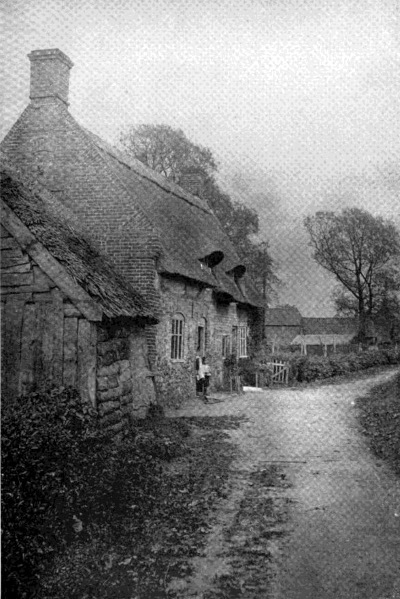
A FARMHOUSE ON THE NORFOLK BROADS, ENGLAND A district to the west of Great Yarmouth watered by three rivers with many open spaces called "broads," roads and long narrow lanes, all of water. Many birds—water-fowl—nest and feed amongst the sedges; pure white swans sail about with majestic dignity and grace, some carrying their cygnets on the back, between the raised wings.
Lomaland Photo. and Engraving Dept.
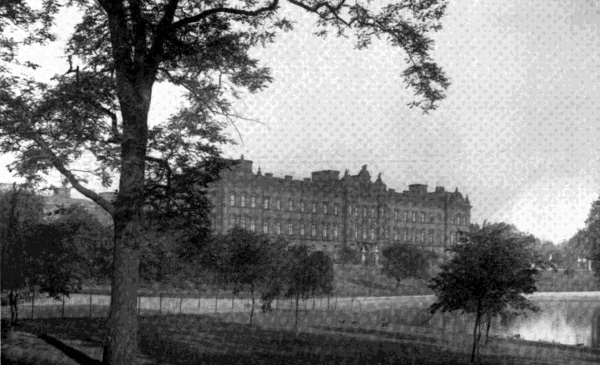
BUCKINGHAM PALACE, LONDON: THE LONDON RESIDENCE OF THE BRITISH SOVEREIGN