GLIMPSES OF SCANDINAVIAN MYTHOLOGY: by Per Fernholm, M. E., Royal Institute of Technology (Stockholm)
Reading edition

WHEN the fragments still left of Scandinavian mythology, scattered in the Icelandic sagas and tales, are carefully put together, they give a grand picture of the history of Earth and Man from the first dawn of the present great Day of evolution. Clear and scientific in the broad outlines, they will some day surely prove a gold-mine of useful knowledge for future researches into the past. Nor do they stop with the history of the past and its blending with the present, but go farther and picture the destruction of life as we know it in a purifying fire, and show how a new earth arises from the sea, whereon a new and lasting Golden Age will be enjoyed by Gods and men.
When Earth had assumed its shape and was ready to receive living beings, the Creative Wisdom permeated the elements and in the ensuing fermentation the cow Audumla appeared. Licking the salt rocks she liberated from the life-germs of the various elements a great and beautiful being endowed with a divine spirit. He became the father of the Gods who rule and protect the world of Man in this cycle.
Drops of venom from the Fount of Frost grew to another being, the giant Ymer, who nourished by Audumla's milk brought into being various giants, some good, but many evil and horrible. Among the good are the wise Mimer, the guardian of the Fount of Wisdom at one of the three roots of the world-tree, Yggdrasil; and the three Norns, Urd, Verdande and Skuld—Urd, the Norn of the Present, being the guardian of the Fount of Life at another of Yggdrasil's roots.
Odin knew his mighty task as chief ruler of human life in this cycle. But he was not yet perfect and felt himself lacking in strength; therefore he went to Mimer to drink from the Fount of Wisdom. None, not even the Gods, can, however, win this precious drink without proving his worthiness, and here at the very outset we meet with the great example of self-sacrifice. Odin gave up himself to his greater Self, remained for "nine days and nights" in Yggdrasil without food or drink, looking inward to the roots of things, listening to the mystic song out of the depth. Purified and prepared, he was allowed to drink from the water of Wisdom and learned from Mimer nine wonderful and potent songs. And Odin grew henceforth rapidly in knowledge and creative power.
Presiding over the Gods and the various hierarchies in Nature he then began to make Earth a fitting habitation for man. That done, Odin visited Midgard with his two brothers, Höner and Lodur, and there on the shore they found two trees, "powerless and without destiny." Lodur loosened them from their connexion with earth, giving them power to move and act from inner impulses, and made them images of the Gods; Höner endowed them with a human Ego, having consciousness and will; and finally Odin gave them the most precious gift, the spirit.
In the childhood of the Earth men long lived in a golden age of unbroken peace, knowing of no evil. But there came a time when two beings among the giants, both adopted by the Gods as members of the Asgard family, appeared among men tempting them to evil things, the man Loke, and the woman Gullveig (the golden way, or stream), Gullveig being the worse. To strengthen the good in human hearts, enlighten them and prepare them for coming days of strife, the Gods sent to Midgard as Teacher Heimdall, the Shining One, the God of the pure and most sacred fire. He brought with him many things not before seen in Midgard, and as the ruler of the people he instructed them in cultivating the soil, in sowing the seed he had brought, and in preparing bread; in carving and forging, spinning and weaving, cutting runes and reading. He taught them how to tame animals for domestic use, to build houses and to form families and communities; also the use of weapons in protection against animals. And further he informed them of the rules laid down by the Norns for a righteous life, and of the names and functions of the Gods. He showed them how to build altars and temples for worship, and brought to them the pure and undefiled fire produced by friction, the only one worthy of burning in the shrine of the Gods; and then he taught them the sacred songs that ever since have sounded from the lips of men in praise of divine powers.
But even now Gullveig began her wanderings among men and secretly taught them runes and songs which counteracted Heimdall's teachings. When the Gods became aware of this, they had her burned; but her heart was proof against fire. Loke found it, and swallowing it he brought into the world the monster-wolf Fenris, which feeds on all the evil thoughts and feelings among men.
Gullveig soon incarnated again and continued her ways unrecognized for a long period. When discovered she was burned a second time, Loke again finding her heart and giving life to the giantess of pestilence, Leikin. The same thing happened a third time, and then was born the Midgard-Snake, destined to grow rapidly and finally to encircle the whole earth.
While Gullveig spread ruin in human life, Loke caused enmity and strife among the powers of nature and even among the Gods. Many were the resulting wars in Asgard, besides the constant warfare against the giants; and always they were followed by wars in Midgard. At last the Gods were divided to such a degree that Odin, rather than cause the death of many of his nearest kin, left Asgard and the guidance of humanity in the care of the Vaner Gods, who otherwise presided over the regular course of the processes of Nature. When the giants learned this they thought it a fit time to gain supremacy not only over Midgard but even over Asgard itself. Odin knew this in good time, through his power of prevision, and he issued from his retreat "far in the East" to warn the Vaner Gods and offer them assistance. The fearful resulting war united the Gods once more, after which Odin was freely offered the high seat in Asgard, where, purified and perfected by experience and adversity he now rules with wisdom until the last day of the cycle.
Heimdall "died" in Midgard before the golden age was over, and he was followed by his son Sköld-Borgar. His son, Halfdan, became the first king, and led the people in all the battles that followed in the new age, while constantly overshadowed by the Gods. On the other side the chief was Od-Svipdag, a most heroic and valiant champion. War after war raged, one of them being so frightful that a new generation had to grow up before new armies could be collected.
Svipdag is a most remarkable character, who journeys to the Underworld and obtains the "avenging sword" which nothing can resist, not even the hammer of Thor. The fate of the world seems to depend on his mind, when at the critical moment his love for the Goddess Fröja turns his steps to Asgard, in order to make peace with the Gods. He then lives mostly in Asgard with Fröja and is sent by the Gods on many difficult journeys, even to the Underworld to find whether Balder, the God of purity, who had died when strife came into the world, could not return from his safe retreat near the Fount of Wisdom.
The great Ice period is described as coming in Halfdan's days, the people being obliged to leave the Northern countries for more southern climes. But when the ice at last receded they went back step by step northward, fighting continual battles. Halfdan at last dies by Svipdag's sword, and is followed by his brave son, Hadding. And thus we reach the present age, which is depicted as one of supreme darkness. Seldom nowadays the Gods appear before men, for they are few who by a righteous and sincere life keep the link unbroken with the regions in the crown of Yggdrasil. The evil is increasing all the time; men have forgotten their divine birth, and they prostitute their divine powers. Yet above the veil of darkness the Gods rule as ever, helping wherever there is an opportunity; while elves and dwarfs and all the other nature sprites continue to fulfil their duties in the economy of nature, although no longer seen by men.
Much is said about the process of death. Man is made up of six principles, and death is a purification whereby the higher and purer elements, after passing through the second death, go to the bliss of the presence of the Gods. If man in life has developed his "inner body" by noble living, then he passes easily through the trials and the judgment of the Gods. If not, then he is held down by the demons of passion and lust and meets torture and suffering.
Of Reincarnation there is little in the form of direct statement, probably partly because carefully removed in Christian times, and partly because it forms an integral part of the whole conception of life found in all ancient sagas. Some of the heroes are, however, named in more than one incarnation, showing the same soul in different garments. The noblest and the worst reincarnate almost immediately; for others some time has first to elapse.
In the efflorescence of time the hour will at length arrive for Ragnarök, the great purifying battle and fire, when evil will be destroyed in the final war between good and evil. The Gods assemble with their faithful, Odin leading, majestic, calm and wiser than ever, knowing that he and most of the Gods will have to buy the victory with their lives. The different groups on both sides are pictured with matchless boldness and vividness, and we see how each has to meet his fate. Odin is killed by the Fenris Wolf; Thor kills the Midgard Snake, but falls dead from its venom. The giants who have possessed themselves of the "avenging sword" use it in the battle, but at the same moment their fate is sealed. For this sword was so forged that if swung by a giant it would destroy the giant world.
At the close of the fearful battle the very foundations of the earth seem to tremble. Fires rise towards heaven, and amid flame and smoke and destruction—the Gods still living—Odin's sons Vidar and Vale, and Thor's sons Magne and Mode, ride to the Underworld, to Balder's peaceful land, where neither death nor destruction are.
And the old earth finally sinks into the sea, dissolved into slag and ashes. The flames die. The air is purified by the fire, the sky is bluer than ever. From the sea arises a new earth, covered with luxuriant vegetation. It is the regions of the Underworld near the Founts of Wisdom and Life, the lands of Mimer and Urd, that now appear. Those founts, so long nearly dry, again flow copiously, and Yggdrasil is fresh and green. The days of golden life return to Gods and men. Balder assumes full sway, and the new earth is peopled from the two races who have been spared for that purpose, living in purity unstained along with Balder during the age of darkness. Even animals have been spared in the same way and enjoy the new Day. It is the happy Day of Balder the Pure and Righteous.
But even this is not the final scene, according to the Northern mythology. A mightier Being than even Balder will come after him, descending upon a still higher and more purified earth. It is the unnamed God whose servant Urd is, One whose spirit blendeth with all living things by virtue of the Fount of Wisdom—an omnipotent God, a God bringing highest peace, who will then "establish a worship that will endure forevermore."
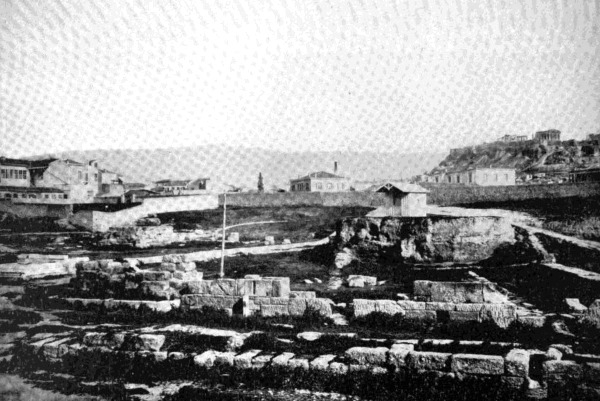
Lomaland Photo. and Engraving Dept.
RUINS OF THE DIPYLON GATE OF ANCIENT ATHENS
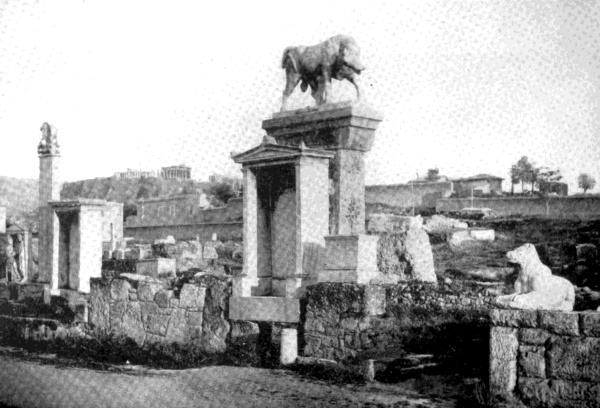
Lomaland Photo. and Engraving Dept.
ANCIENT ATHENIAN TOMBS ALONG THE SACRED WAY