PHOTOGRAPHY AND THE INVISIBLE: by Philip A. Malpas
Reading edition
IF a spectrum be thrown on a blackboard with a lantern, in a dark room, one end will be violet and the other red, to the ordinary eye. If a plain photographic sensitized plate is placed against the blackboard so as to receive the spectrum on its central portion during a suitable exposure and is then developed, fixed, and replaced in its original position, the result shown is remarkable. At the red end the plate is unaffected; the orange and yellow and green are scarcely recorded; the blue and violet are well represented, but the part of the plate most affected is that beyond the visible violet far into the "darkness" of the blackboard.
Here is a sensitive surface or substance which can "see," as though brilliantly lighted, a surface which to the ordinary eye is invisible, but, on the other hand, has some difficulty in seeing the red and yellow, which the eye can see quite plainly. Needless to remark that this is why a true red or yellow light is "safe" for ordinary plates and for dark-rooms. On the other hand it would be possible to have a dark-room which would be to the plate a very light room indeed, being filled with these invisible rays beyond the violet end of the spectrum.
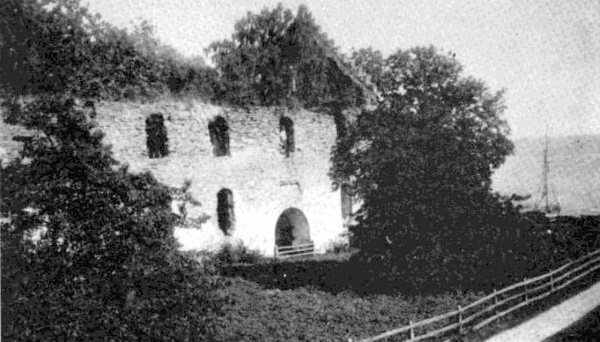
Lomaland Photo. and Engraving Dept.
VISINGSBORG CASTLE, VISINGSÖ, SWEDEN
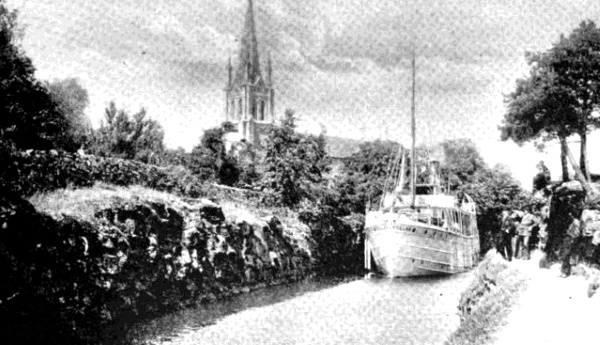
Lomaland Photo. and Engraving Dept.
THE CANAL, TROLLHÄTTAN, SWEDEN
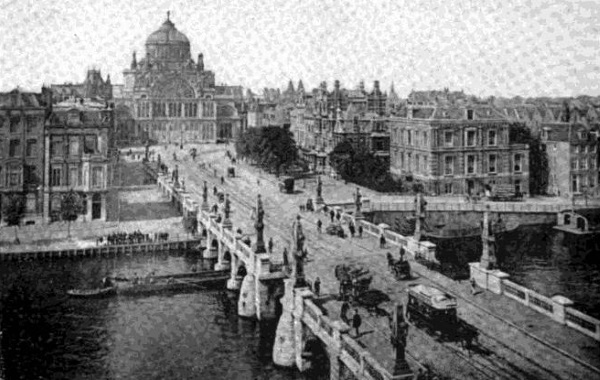
Lomaland Photo. and Engraving Dept.
HIGH SLUICE AND PALACE OF INDUSTRY, AMSTERDAM, HOLLAND (At Amsterdam a stone arch bridge is called a sluice)
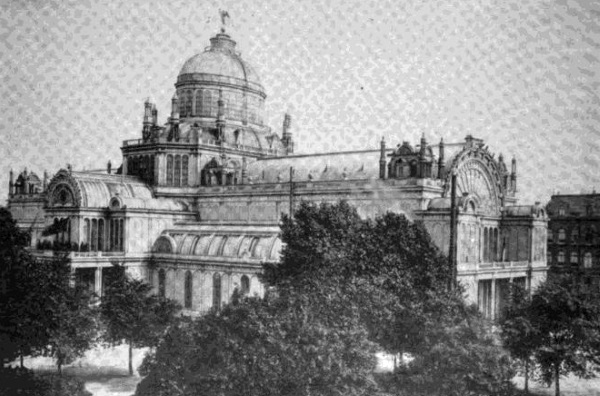
Lomaland Photo. and Engraving Dept.
PALACE OF INDUSTRY, AMSTERDAM
And yet there are some eyes which can plainly distinguish the fact that a substance or surface is giving off these powerful rays, invisible to less sensitive eyes. Perhaps this is one of the thousands of little forerunner facts which testify to the increase of sensibility prophesied by H. P. Blavatsky for this present century.
Now if a solution of one per cent of sulphate of quinine, one centimeter thick, is used in a glass cell before a lens or plate it may delay the exposure by perhaps six times the normal time, thus showing that of our photographs taken under ordinary conditions on ordinary plates we have been accustomed to accepting as true pictures reproductions of the invisible, although much of that invisible coincides with the visible, since these rays are emitted by so many substances.
But a false standard has been established unconsciously in our minds. Where blue skies should be, we are content to see a pure white in a photograph. Where reds and yellows abound we expect altogether too dark a representation, as with grass and green trees.
The quinine light-filter (aesculine, extracted from the horse-chestnut, serves as well) absorbs or is largely opaque to these rays and such a filter is much used now with specially sensitized plates to allow the colors to be reproduced in monochrome in truer relation. A yellow filter will also absorb some of the visible blue. The glass of the lens too is responsible for the absorption of a proportion of these rays. By an action not yet understood the dyeing of plates with certain dyes renders the silver in them far more sensitive to the various colors in the green, yellow, and red of the spectrum.
Is it not probable that silver has the power of sensing these rays so keenly, while the human eye, for reasons best known to the human mind, has had and lost that power, but may be now beginning to regain it? Such a recovery is not made without strain and natures that can begin to sense these invisible rays must either strengthen and purify themselves to the utmost degree possible or suffer what dry leaves suffer in the flames, a burning out of the particles that are not tuned to withstand the red fire that burns them. Hence the theosophical reason for purity and strength, first, last, and all the time, in preparation for the burning fiery flames of added sensitiveness which come and have come quite soon enough for us to prepare against rather than seek.
Knowing what is now known of the efficacy of light in curing certain affections, especially the violet and blue light, is it too early to suggest that much of the power of quinine is due to the body being saturated with this "colorless" dye and so cutting off light which the constituents of the body are not strong enough to bear without their balancing power being impaired, and so leaving the battlefield at the mercy of inimical fever forces?
Tropical travelers are warned not so much to use quinine after attack, but to saturate the body (with minute doses) commencing several days before entering the dangerous zone.
In spite of endless fraud and humbug and "fake" photography, it has long been suspected that the invisible can be photographed. As shown, we have never been doing anything else in our photography except photographing much of the invisible. Without saying that it has or has not been done, we may well ask if it is really so difficult to imagine that much of what inhabits the "seeming void" may be made visible to the lunar surface of the plate?
Professor Wood's experiments on the lines of photography by invisible rays are of absorbing interest. Not only has he made interesting photographs of objects by means of the invisible violet rays, but also by means of the invisible rays below the red end of the spectrum. And he shows one very interesting result of photographing Chinese white by these ultra-violet rays—as though the pigment were a pure black! This illustrates the fact long known to photo-engravers' artists that Chinese white is a bad white to use except in a mixed tint. The Chinese white cuts off so much of this invisible chemically-active "white" as to appear gray even to an ordinary plate's "lunar eye."
Another startling result is that by the ultra-violet light a man's shadow may entirely disappear when he is photographed in sunlight. One wonders if the strange Eastern "superstitions" as to shadows and men without shadows do not have a real scientific basis. Perhaps R. L. Stevenson's little child who rose so early that his "naughty little shadow had stayed at home ... and was fast asleep in bed," could tell us.