POETRY AND CRITICISM: by Kenneth Morris
Reading edition
I

MATTHEW ARNOLD will have it that the function of Poetry is the Criticism of Life; and the work of a poet will be important, according to him, only in so far as it throws light on human life and character. But in the work of all poets there is a kind of cream that may be skimmed off (provided that there is a cream, and that it was not all sky-blue wretchedness from the first); and when it has been so skimmed, one may say that the poetry is the cream, and the criticism of life the skim-milk. "Such and such a lyric, by so and so," says your poet or poetry-lover, "is of equal value with Hamlet or the Odyssey, all three being absolute in their beauty." "Gammon!" says your man of the world in letters; "there is the criticism of life to be thought of. How shall ten lines be equal to ten thousand?" Which is right? The second will get all the votes; which is no great argument, perhaps. The epic took longer in the writing; but one never knows what may lie behind the lyric. The didactic or philosophic poem, the work full of this criticism, will influence the thought of the world; and if thinking is to be the judge, it will win unquestionably. But the lyric will be singing itself through thousands of minds, in the sunshine, in the mines, over the washtub, heaven knows where: without noise, it will shed its brightness through a million eyes, its sweetness on a million tempers, its clearness and magic on a million imaginations. To the writer of the most perfect lyric, I am not sure that we do not owe as much gratitude as to the writer of the greatest epic or drama: I am almost positive that we owe him more than to the best writer of criticism of life; though it be a dozen lines against a dozen volumes.
Most of the English-writing poets have been also, and many of them mainly, philosophers; writing their thought in verse form, and perhaps sprinkling it from the spice-box of pure poetry, and perhaps not. Often and often we find stories or philosophic disquisitions in verse, that might have been told as well in prose; although it has been said rather wisely that nothing should have verse form that could be told honorably without metre. There is a class of idea that journeys leisurely and step by step through the mind; this should be reserved for prose. There are other classes that have the sweep and charge of cavalry, and you build epics and all heroic poetry of them; others that soar singing like the skylark, or that wander from bloom to bloom droning out a magical and honey-laden monody, secrets of a learning incomprehensible to the minds of men. These will be the right stuff for your pure lyrics, these bees and birds in the golden regions west of thought. Their revelations are more esoteric than philosophy; they home to deeper places.
But one cannot deal with all poetry or all life in one article; and it is the intention here to consider narrative poetry alone. Narrative poetry, when it is anything more than a ballad, is epic: and epic is heroic poetry; not by any convention, I believe, but in accordance with deep-seated law. There is room for nothing personal or limited here; for no dissection of personal characteristics, no consideration or criticism of problems of exterior life. Those things all belong to prose; poetry proclaims the actions and perceptions of the soul. Heroic or epic poetry tells of the soul as hero, warrior, redeemer; as Sigurd going out against Fafnir, Arthur ferried in a dark barge to The Island of the Apples; as Satan unconquered in the lake of flame; as Christ on Golgotha, or Prometheus on Caucasus. It has to show forth the glory, the indomitableness, the magnanimity of the soul, dwelling in those lofty regions and letting who will come to it for general strength and inspiration. It is the Mountain; it will not descend from itself for any Mohammed. For this reason is its aloofness, its tendency to concern itself with periods apparently in the far past, but really in the eternal. That atmosphere all narrative poetry must retain, under penalty of sinking into berhymed or bemetred prose; or into the ballad—which, indeed, can be good, at its best, but not supremely good. Yet how many stories there are, beautifully written in verse, which are neither epic in spirit nor ballad in form; which are, if the truth should be told, novels strayed from their proper fold of prose, valley wanderers by no means at home on the mountain.
One thinks, for example, of such a work as Mrs. Browning's Aurora Leigh. If she had only written it in prose! With that faultlessness of expression, that delicate insight and unerring justness of criticism which mark it, it would have become a classic; we should have said, "Why, this is a prose poem, a literary treasure among novels." But being in verse, it remains, however beautiful, only versified prose; and it is to be feared that we neglect it; to be feared, but hardly to be wondered at. If she had only written it in prose!
Or one thinks of nearly all Tennyson's narrative poetry. The aim, one feels, was nearly always criticism of life, the life of all these myriads of personalities; not poetry, which is the illumination of the hidden life of the soul. It was for this reason that Idylls of the King, although flaming up here and there with such poetry as has not been excelled in any known literature, perhaps—yet fails as a whole to be a great poem. The Nineteenth Century was too insistent, and the troubles and problems of the day. Milton, dealing with matters beyond the crystalline and the brink of time, achieved the epic; but even Milton, coming down to Eden, heaven, and the familiar things of dogmatic theology, attained only to be ... Well, well, all honor to him; he deserves that all that should be lost and forgotten. Poetry and personality cannot be blended; they are a veritable God and Mammon.
Then there are those charming stories of Tennyson's: Dora, Enoch Arden, Almer's Field, The Princess. He dignified them all with his own high gift of style; stamped on every line his own noble and melodious manner; adorned them all richly, and with consummate taste, with the best color of English rural life. Yet they remain essentially of the nature of prose; and we should not have been lured into thinking them poetry, but for the wonderful genius with which Tennyson handled them. The matter is the matter of the novel; and the style—what a wonderful style it is!—is rather the polished style that reflects light, the style of prose, than the white-hot luminosity of the genuine epic.
Let us take, for example, The Princess, perhaps the most romantic and beautiful of this series, the one it takes the greatest temerity to speak of as not really poetic. Its aim is to throw light on, or to consider, or discuss, a certain present-day problem, that of the "emancipation of women"; and who shall say that that might not be done in prose? Is poetry to throw no light on our modern problems, or on contemporary problems, then? Turn to your Milton for an answer:
Dare ye for this adjure the civil sword To force our consciences that Christ set free, And ride us with a classic hierarchy Taught ye by mere A. S. and Rutherford? Men whose life, learning, faith, and pure intent Would have been held in high esteem with Paul Must now be named and printed heretics By shallow Edwards and Scotch What-d'ye-call! But we do hope to find out all your tricks.
Poetry? By heaven, yes! And on a contemporary problem? Look at the title of it: "On the New Forcers of Conscience under the Long Parliament"; and the date given, too; 1646. But does he discuss? Does he consider? Indeed he does not. He flames forth from the standpoint of the soul; he is still God's Warrior, and you dare not mention truce to him. So those prosaic names, that "mere A. S. and Rutherford," "shallow Edwards," and above all the ridiculous "Scotch What-d'ye-call," become flaming and terrible poetic utterances on his lips; he blasts with them the fools that dare stand up against the liberty and supremacy of the soul. But suppose, instead of this terse, burning sonnet so entirely free from the atmosphere of argumentation, he had written a long story designed to thrash the matter out from the standpoint of pure reason? Some one might do so; and the work might be one of great value; but it would not be poetic; it could not be Miltonic; it would be a novel with a purpose, not an epic poem.
There are problems and problems; those which poetry may specifically handle, are, I think, the same yesterday, today and forever. Who is to hinder her handling what problems she likes; will you set down rules for her? Heaven forbid! it were more profitable to build a fence about the cuckoo. But the fact remains that she will touch these, and will not touch those others. Charm you never so wisely, she will not come from her own ground. For all your birdlime of earnestness, of enthusiasm, of excellent purpose, it is some masquerading jackdaw you will have captured, not the Bird of Paradise; unless it is the trees of Paradise you have limed. Poetry hardly deals with any historic period, old or new; she leaves those to the historians, and has a period of her own, which is eternal. What then, you say, of those "New Forcers of Conscience in the Long Parliament?" This! that that parliament is so long that it has been sitting any time this two thousand years, and is sitting now, in all our towns and villages. "New Presbyter is but old Priest writ large"; A. S. and Rutherford, Shallow Edwards and Scotch What-d'ye-call—they all preach in a thousand pulpits every Sunday. For they are prototypal figures, and plot and persecute wherever there is bigotry or ecclesiastical dominance. Against them, and, so far as one has been able to discover, against them only, does poetry ever come forth armed, enangered, utterly ruthless. It is she that has pity and pardon for the Magdalene and the publican; but a whip of bitter small chords for those that have made her Father's house into a den of thieves. Do you doubt it? Then find some passage where anger is expressed, not in rhetoric, not in mere fustian bombast, but with the sublime music and undertone, the ring of genuine poetry; perhaps an anger without mercy, a declaration of utter war; and see whether it is not directed always against this same ecclesiasticism.
But we set out to discuss the epic; and here we have wandered off to consider a sonnet with particular gusto; a grave digression, surely? I think not. You shall not judge a poem's right to the epic name by its length. This little sonnet is an epic too, with Milton on Pegasus for hero; and A. S., Rutherford, Edwards, and What-d'ye-call for four-headed Chimaera. I think the very archaeus of the epic is the eternal battle of the world; and that all epics have their root in that, and are great and regal in proportion to their nearness, inwardly and spiritually speaking, to it. Tennyson knew it when he set out to write in his Idylls of the King a record of the Soul at war with sense; only perhaps he knew it too personally and consciously; and lost the grand epic symbolism in his quest after actual criticism of life.
II
But to return to The Princess. Here, the objective is not to set forth eternal verity, but to discuss, perhaps throw light on, a problem of our own day; a social, in a sense, rather than a spiritual problem. What figure can stand for the battling soul, and what for the principle of evil? There are epic places in the Idylls of the King, where this symbolism stands forth majestically, and style and glory correspond. We have the story of that "last, dim battle in the west" and the passing of Arthur thereafter; clean, antique, touched with the infinite and with eternity; therein, if you will, is the epic atmosphere. But here it is the benevolent, thoughtful Tennyson that is speaking, troubled by the evils that he sees around him; not Tennyson the great Bard on fire with ultimate and secret truth. You see, there was the duality there; and both sides of it are honorable, to be revered and loved. If criticism has a work to perform in discriminating between the two, she does no dishonor to the thinker in separating him from the poet. We have to ask what there is in this work, The Princess, that might entitle it to be considered poetry, in the highest sense.
The style? Style is there, undoubtedly. Every line has been molded, heightened, shaped, polished, chiseled. But let us compare it with the style of poetry, and we shall see the difference. Here is one of the most fiery passages; one in which you can feel that the invitation was to the supreme, super-personal compassion to enter in:
"O brother, you have known the pangs we felt, What heats of indignation when we heard Of those that iron-cramp'd their women's feet; Of lands in which at the altar the poor bride Gives her harsh groom for bridal-gift a scourge; Of living hearts that crack within the fire Where smoulder their dead despots; and of those— Mothers—that, all prophetic pity, fling Their pretty maids in the running flood, and swoops The vulture, beak and talon, at the heart Made for all noble motion; and I saw That equal baseness lived in sleeker times With smoother men: the old leaven leaven'd all: Millions of throats would bawl for civil rights, No woman named: therefore I set my face Against all men, and lived but for mine own. Far from all men I built a fold for them."
So speaks the princess of the story; profusely, if with great dignity; bitterly, but argumentatively: it is a heightened, an exalted prose style; but it has not taken that leap into infinity which is the mark of the poetic grand manner. For a contrast, consider this; the work of another Victorian bard; one not greater than Tennyson, but here with his poet's blue mantle upon him, robed with the infinite. He, too, is smitten with compassion for certain women; and the flame leaps up from the blow in this wise:
Here, down between the dusty trees, At this lank edge of haggard wood, Women with labour-loosened knees, With gaunt backs bowed by servitude, Stop, shift their loads, and pray, and fare Forth with souls easier for the prayer.
* * * * *
God of this grievous people, wrought After the likeness of their race, By faces like thine own besought, Thine own blind helpless eyeless face, I too, that have nor tongue nor knee For prayer, I have a word to thee. It was for this then, that thy speech Was blown about the world in flame, And men's souls shot up out of reach Of fear or lust or thwarting shame— That thy faith over souls should pass As sea-winds burning the young grass? It was for this, that prayers like these Should spend themselves about thy feet. And with hard overlaboured knees Kneeling, these slaves of men should beat Bosoms too lean to suckle sons, And fruitless as their orisons?
It is the first and the last verses quoted that count; and I think much might be learned from a careful comparison of them with the passage from The Princess. Tennyson has made a catalog, in the manner of prose, of the sorrows of women; his mind traveling with passion, but with a certain artistic, conscious discrimination, from China, India, Arabia, to the hustings of Victorian England (for it is that, in reality). The style of prose we say; well, the style of rhetoric: picture by picture has been chosen with a view to make the case strong, to impress who should hear it. "Ida's answer ... Oration-like," says Tennyson, knowing well what he was writing. Swinburne, in the supreme manner of poetry, has burned upon our vision that solemn, terrible picture, bare, unornate, unforgetable, of the women at the wayside crucifix; "slaves of men" beating "bosoms too lean to suckle sons": and with the picture there is that impression of augustness, that sense as of the presence of a great avenging angel, or perhaps, of the majesty of the Law. The attitude of the Princess Ida towards the evils that she condemns, is one of personal protest; she dwells on the same plane as they do, albeit in the brighter regions of it; she is a human personality, and speaks with a human and quite personal voice. But the anger of Swinburne here, the condemnation that he deals out, is not personal: the words are such as might be spoken by a god from his throne. They come from a loftier place than the thing condemned occupies, as though they were a sentence passed from the tribunal against whose decrees there is no appeal. So they are indeed. For this is Poetry, which is the voice of the Soul; and the Soul is deific, sovereign, aloof; and it does look down and pass sentence on the things of this world—a sentence damnatory or compassionate, but based on the evidence of direct vision and certitude, never on argument and the weighing up of pros and cons.
Look at those last lines again; with what sure intensity the whole tragedy is revealed! Compassion, in her own manner loftily disdainful, we might almost say, is suddenly focused; nine-tenths of the story are left untold, but the one-tenth that remains has the whole cry, the whole tragedy in it of a world blighted by lies: it is "dowered with the hate of hate, the scorn of scorn," and, mirabile dictu, with the "love of love," or compassion, in a breath.
We get that same strange glorious blending of compassion and scorn—pride or scorn, one does not know what to call it; it is neither of those things in reality, but rather the native accent of divinity in the voice of the soul—we hear that same majestic blending of compassion and haughtiness pre-eminently in a line from the Purgatorio which Arnold justly gives as one of the most perfect examples of the Grand Manner of poetry, the highest style than can be impressed on written or chanted words; the line: Che drizza voi che il mondo fece torti, "Which straightens you whom the world made crooked." We see here, I think, as in the passage from Swinburne, the same impatience of words and details; the same godlike aloofness; the same pity too compressed, too burning and intense, to reveal itself fully or tenderly: the feeling has passed beyond the limits of the power of tenderness, we might say, to be tender: it is such a super-passional passion of tenderness, suppressed, governed, boiling, that it must be stern, swift, momentary—or nothing. Is it not the very naked voice of the august divinity hidden within us?—the greatest fashion that can be burned and infused into the brute stuff of language; because ringing with the dominance of that hidden Master? It bears the mark of compassion, because compassion is the inevitable attitude of the soul outward from itself; and it bears the stamp of sublime titanism—that thing that would be scorn, were it bitter and hostile, and that would be mere majesty, might it remain passive and in repose—because the soul is a god, and knows itself to be a god, and breathes out the atmosphere of godhood. Here it is in Milton, again:
His form had not yet lost All her original brightness, nor appeared Less than archangel ruined:
and of course, it is Milton and Dante who are the supreme masters in modern literature of the Grand Manner; as poets, the greatest of the poets.
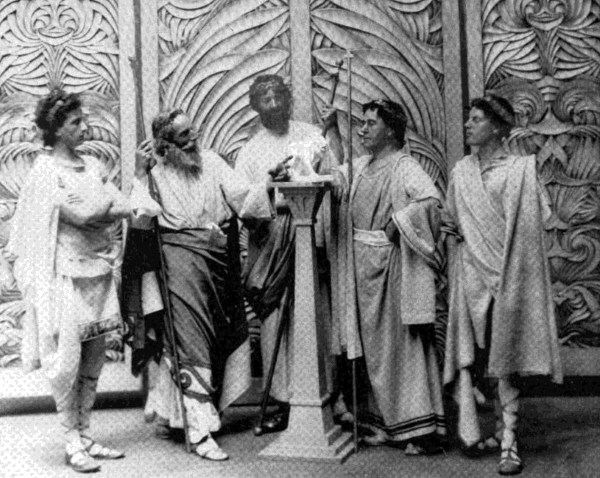
Copyright by Katherine Tingley, 1911 Lomaland Photo. and Engraving Dept.
PHEIDIAS, EURIPIDES, AND ARISTON GROUP IN "THE AROMA OF ATHENS"
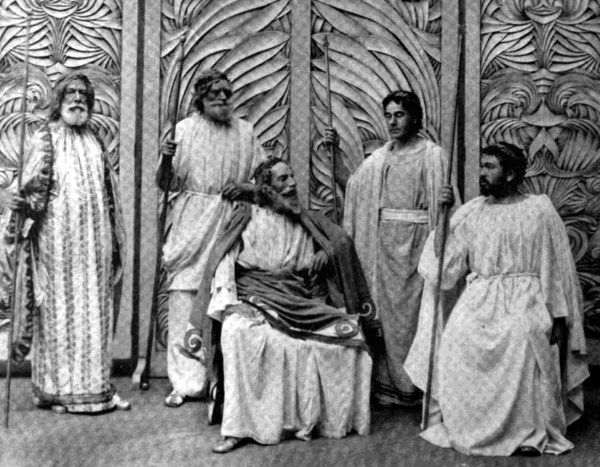
Copyright by Katherine Tingley, 1911 Lomaland Photo. and Engraving Dept.
KRITON, THUKYDIDES, PHEIDIAS, ARISTON, AND HIPPONIKOS (READING FROM LEFT TO RIGHT) "THE AROMA OF ATHENS"
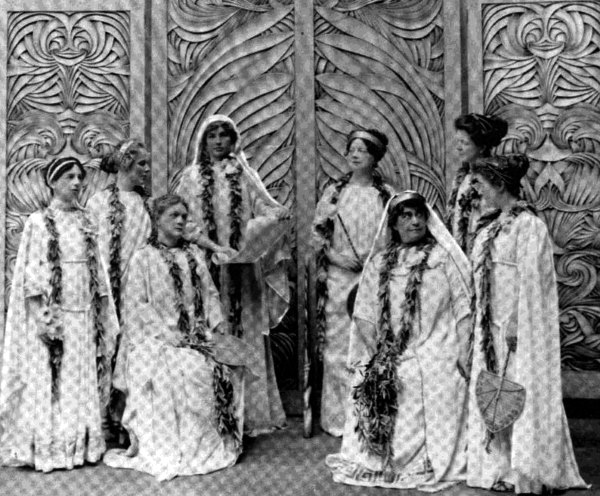
Copyright by Katherine Tingley, 1911 Lomaland Photo. and Engraving Dept.
HIPPARETE, PERIKTIONE, POTONE, ASPASIA, AGATHOKLEIA, DIOTIMA, DEINOMACHE, AND MYRTO (READING FROM LEFT TO RIGHT) "THE AROMA OF ATHENS"
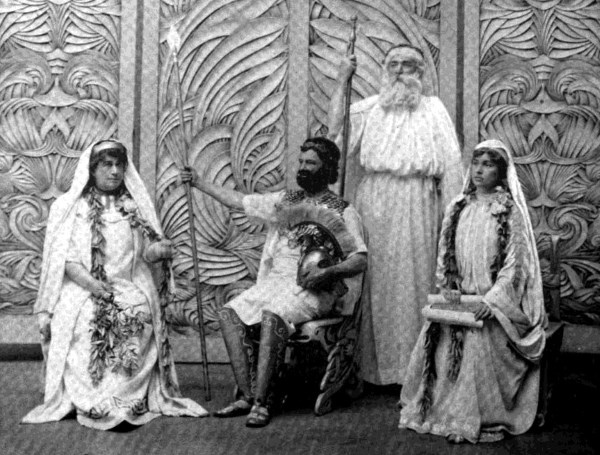
Copyright by Katherine Tingley, 1911 Lomaland Photo. and Engraving Dept.
DIOTIMA, PERIKLES, AND ASPASIA, SEATED "THE AROMA OF ATHENS"
Now it will be said that there is compassion in the passage quoted from The Princess; and undoubtedly there is; but is not the effort all to manifest it, to make it plain to every one that it is there, to lead it from picture to picture that will feed and excite it? We may say that it is a voice from below upward, an inspiration; it has the style and atmosphere of a great endeavor of the personal self towards the soul: whereas in the other cases, it is the comment and utterance of the soul itself. There, there is no effort to manifest compassion; the effort is all to suppress and control it. The effort is like the metal walls of a bomb, without which the explosive would only fizzle and waste. The poet—Swinburne, Milton, or Dante—had no doubt of his dynamite; it was too mighty, too awesome a thing; all he must do is to make the bomb walls strong, strong, strong. So, in reading, we get the effect, and are blown up—to the altitudes of consciousness. Tennyson, being also a poet, and therefore knowing the nature of dynamite; but writing here, not poetry, but mere criticism of life in the guise of poetry, puts what he can, out of his memory, of dynamite into his work: infuses what he may of the atmosphere of compassion into it. Swinburne and Dante and Milton have a Niagara to deal with, and they must make the channel of it as small as they may; they must dam it as well as they can, or heaven knows where they and the world would be swept to—mere incoherence and blind fury perhaps, or silence. Tennyson (in this case) has to deal with an irrigation scheme, and must make his channels as wide and deep as he can, and coax the waters of the world into them. Then, too, see how he deals with that other quality. He knew well enough that it is integral in the Grand Manner of Poetry, and he will weave it in here, if he may. So we have:
Far from all men I built a fold for them:
* * * * *
And prospered; till a rout of saucy boys Brake on us at our books.
There is no doubt what quality that is; scorn, indignation, separateness, bitterness, hostility. It is a personal imitation of loftiness, the compassionate element has quite vanished from it; there is all the difference in the world between it and the fierce pity of—
these slaves of men should beat Bosoms too lean to suckle sons, And fruitless as their orisons:
or the sudden stern mercy implied in—
la Montagna Che drizza voi che il mondo fece torti:
or the serene, august luminance of compassion shining through—
His form had not yet lost All her original brightness.
Or, since the compassion is out of it, we might compare it with those many lines from Milton that convey only the sense of the grandeur, without the compassion, of the soul; lines such as these:
An old and haughty nation, proud in arms;
or:
Standing on earth, not rapt above the pole, More safe I sing with mortal voice, unchanged To hoarse or mute, though fallen on evil days, On evil days though fallen, and evil tongues, In darkness, and with dangers compassed round;
or:
Let such bethink them, if the sleepy drench Of that forgetful lake benumb not still, That in our proper motion we ascend Up to our native seat; descent and fall To us are adverse:
—these speak of the majesty of the soul; but the other only of the bitterness of the personality.
But you will say, Tennyson was putting words into the mouth of a very human, limited personality; and so the piece is more artistic as it is, and would be inappropriate otherwise. These are the words she actually would have said. True. The personality does speak in prose. Prose is the language of personality; and no doubt it was first invented when first the souls rayed out personalities from themselves; no doubt poetry is the older, as it is the more august. So the style used in The Princess is suitable, well-chosen, artistic; it fits the subject admirably; which proves that the subject is essentially a prose one. For prose—history, philosophy, criticism—examines and criticises life from without; but poetry illumines it from within. Prose considers and passes judgment on the external, the seeming, the current: Poetry dwells within the holy of holies and her whole burden is the story of the Soul.
If she looks outward at all—and she does that too, at times—it is from her own standpoint, and in the eternal manner. She does not then criticise; her tones do not mince nor falter. The bardic schools had a law, that the office of the Bard was solely to extol what was noble; there were other orders, not sacred like the bardic, whose business was to satirize or to amuse. One can see that such a law must have come from a time when that one force which, as was said above, alone can move poetry to anger absolute, was not in evidence: for, except that they must fight that force, that old law holds for the bards now. So poetry, looking down into this world, criticises no one and nothing. She exalts whom she will; she mantles humanity with godhood: and whom she will—the antihumanists, the plotters against the freedom and beauty of the soul—she thunders upon.
Swinburne, looking at the roadside crucifix ghastly in its deification of decay and death, criticises that—nay, scourges the idea it symbolizes, the soul-fettering dogmatism; pours on it the hate of hate, the scorn of scorn, if you like—but it is because the awful vision of the real Crucified burns up before him; the tragedy of the ages, the enslaved, thwarted, hindered, persecuted Soul of Man. Dante beholds the severe mercy of the Great Law, "that straightens us, whom the world has made crooked." Milton, vainly endeavoring to be orthodox, to write within the limits of the dogmas, justifying the ways of his strange deity, and holding up Satan for our abhorrence, gives way to the great spirit of the Poet within him time and again; and shows, time and again, the sublime pathos of the Soul, Unchanged, though fallen on evil days. Nay, but they do not tell of these things; they make them live; they are revelations shown before us; so that our own eyes have seen, and the universe has undergone transfiguration, and ourselves. For Poetry is no little thing, no mere refinement. It is magic; it is the life of the Gods; it is the secret and spiritual nature of things. Without it, this Universe like a rotten bough, would break off from the Tree of Life. Without it, there would be no Tree of Life. It is the living sap, the greenness, the subtle vigor, and the beauty of the Tree.