LIGHT PHYSICAL AND METAPHYSICAL: by H. Coryn, M. D., M. R. C. S.
Reading edition

A METAL is fixed and crystallized light, said H. P. Blavatsky—and was laughed at. Light was not then, nor is it yet, substantive, but a mode of motion—of the ether and of matter. The days when it was substantive and corpuscular, the days of Newton, had gone by.
But there are several indications of their return—with additions, the additions warranting H. P. Blavatsky's definition of a metal.
A crystal of metal consists of molecules, and they of the still smaller atoms. Each atom, in its turn, is made of the still smaller electrons or corpuscles. If these either are light, or are made of even smaller bodies which are, the definition is justified. This is the suggestion, or contention, of Professor Bragg, developed at a recent lecture delivered before the English Royal Institution.
Light is regarded as a spreading etheric pulsation, waves in ether. We have it as the visible seven colors from red up to violet, and beyond visibility as the ultra-violet. Still higher etheric pulses, according to the usual theory, are the x-rays. Professor Bragg applies his new corpuscular theory to the last alone, though he suggests that it also includes the ultra-violet rays—in which case it must include all the rest. He thinks the x-rays corpuscular because of a certain behavior; but the ultra-violet rays have the same behavior—and no one doubts their continuity with the lower rays down to—and far below—the red. What is the behavior on which the argument rests?
The term x-rays or kathode rays, as popularly used, covers three kinds of emanation in the tube or from radium. The first and grossest ingredient is ordinary matter, whirling atoms of the element helium. The next and finer, the intermediate, is electrons, corpuscles. The third and finest is x-rays proper, hitherto considered as merely etheric pulses. Professor Bragg calls them gamma rays, restricting the other term, x-rays, for other rays of properties so nearly the same that he includes them in the same argument.
When gamma (or x-) rays fall on an atom of matter they cause it to discharge one or more of its electrons or corpuscles, the intermediate of the three emanations popularly included under the term x-rays. In this connexion they are called beta rays.
The professor points out that when gamma (or x-) rays produce this discharge from an atom
the beta rays to a large degree continue the line of motion of the gamma rays, as if the latter pushed them out of the atoms; and, lastly, that the number of the beta rays depends on the intensity of the gamma rays.
The gamma ray, entering an atom, pushes out a corpuscle, a beta ray, and takes its place. It behaves, in fact, as if it were itself a corpuscle, and the word ray is not well descriptive either of it or the beta. Nor can it be a mere ether-pulse. The professor suggests that it is a corpuscle, an electron, which has had the ordinary negative charge of electricity proper to electrons neutralized by a positive. Then he proceeds:
Many insist that my neutral corpuscle is too material, and that something more ethereal is wanted, for it appears that ultra-violet light possesses many of the properties of x- and gamma rays.... They propose therefore a quasi-corpuscular theory of light, gamma and x- rays being included.... The light corpuscle which is proposed is a perfectly new postulate. It is to move with the velocity of light ... and to be capable of replacing and being replaced by an electron which possesses the same energy but moves at a slower rate, and, of course, it has to do all that the old light waves did. The whole situation is most remarkable and puzzling.
So at this rate matter consists of molecules, as before; which consist of atoms, as before; which consist of electrons, as before—but may also in part or altogether consist of still more ethereal corpuscles which are light.
It is but a step to the suggestion that the electrons consist of light corpuscles, standing to them as they stand to the positive or negative atom of matter. Then metals will be crystallized light.
But whence the light corpuscles? How did they manage to get born in space? An answer to this question means a step-over from science into metaphysics. If and when we have reached the last line of matter we must begin to consider consciousness.
Intellectual light, spiritual light—we think we are using only metaphors in those phrases. Possibly we are not. Physical light may be the last stage of higher lights. If physical light is divine thought-energy appealing to our sense, it may have passed down through higher stages at which it appeals only to mind and heart and spirit.
If we think of Cosmic Spirit as pulsing its will and thought into that passive and uniform essence which will afterwards become active and differentiated matter, condensing and precipitating it into centers for evolutionary work, we must surmise that it is these intensely conscious centers that will subsequently be suns. Science would say that this condensation would already involve the liberation of heat, that the new center must at once be hot. But that is only true of condensing matter as we know it, matter which already contains latent energy. But the kind of matter we are considering now is what will become matter, has no possessions nor qualities till these are conferred on it by divine ideation and will. A sun at its first stage would be luminous only to a spiritual cognition—that is, it would be charged with, and radiating, divine ideation. At the very first it would not be even that; it would be but a receiving center—for divine thought and will.
But at last would come its first heart-beat, so to speak. Some of the aggregated substance would be pulsed out to the surface charged with accumulated energy, dissipated as corpuscular light. And now it would fall within the range of human vision. It is illuminating not only to sense but to mind; for it contains mind; and not only to mind but to spirit; for that also it contains.
Theosophy teaches that the sun's envelopes do not contain the terrestrial elements in their terrestrial condition. It is their antetypes that are alone there, transient, in perpetual aggregation on the inner side of the envelope (towards the solar nucleus), in disintegration as light on the outer. And this light, charged with divine ideation—septenary—has the power on earth of building elements like to, but lower down than, those found in the sun's envelopes—and of destroying them. The planets owe the elements they have to the formative power in the solar light; rather say the keynotes of the elements they have, according to which keynotes the elementary matter aggregates. Besides that every molecule is crystallized and fixed light, it contains as its soul some of that light in its highest or first state. And so has every cell, every compound of cells, every living thing. If we had another kind of spectroscope we could find their antetypes too on the sun. Every cell and molecule contains latent what in man has begun to manifest—that self-consciousness which is a direct reflection of the absolute Self-consciousness of that point or center which is everywhere and whose circumference nowhere because the universe has a limit nowhere. That self, latent or manifest, has in man and molecule its first or highest embodiment in a layer or envelope of light in its first or highest condition. As we say, Âtman is enshrined in Buddhi.
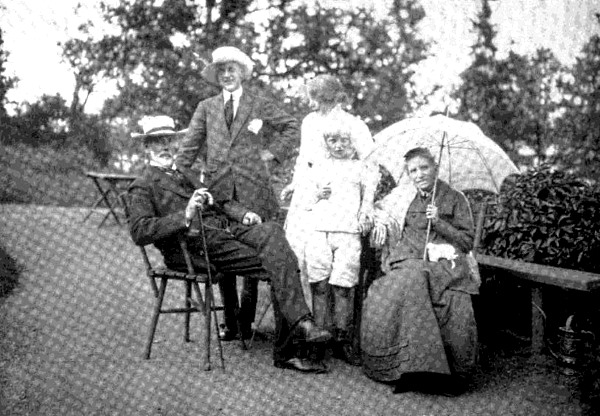
Lomaland Photo. and Engraving Dept.
A FAMILY GROUP: JULIUS KRONBERG, THE FAMOUS ARTIST MADAME SCHOLANDER, HIS MOTHER-IN-LAW, A WELL-KNOWN SWEDISH THEOSOPHIST AND MR. KRONBERG'S CHILDREN. STOCKHOLM, SWEDEN
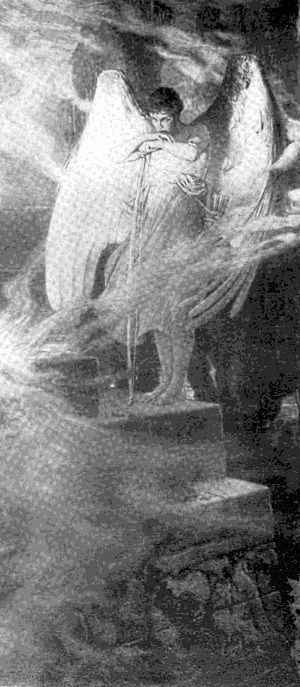
Lomaland Photo. and Engraving Dept.
"EROS": PAINTING BY JULIUS KRONBERG