THE TEMPLE OF THESEUS, ATHENS: by R.
Reading edition
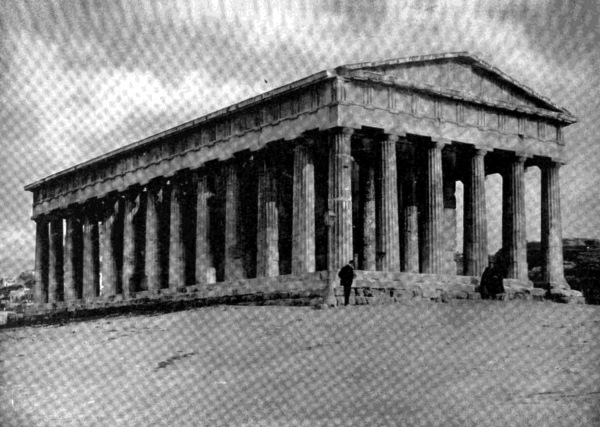
THE Theseion, the so-called Temple of Theseus, in Athens, belongs to the second period of classical Greek architecture, which may be considered to have flourished between b. c. 470 and 338, the dates of the Persian war and the Macedonian supremacy. It is one of the most beautiful examples of the Doric order, and is more perfect than any other building we have of ancient Greece. It probably owes its excellent preservation to the fact that it was turned into a Christian church during the Middle Ages. It is made of the famous white Pentelic marble, which has changed, by lapse of time, to a lovely golden yellow hue. It greatly resembles the Parthenon, but covers a little less than half the area, and is not so exquisitely proportioned. The Theseion was erected a few years before the Parthenon, probably about b. c. 460. It is one hundred and four feet long by forty-five wide, and the columns are nineteen feet high. Like most of the finest Grecian buildings it does not depend upon mere size for impressiveness. From the remains of sculpture still existing the following subjects have been ascertained: The achievements of Theseus (whence the name); The Labors of Hercules; and the battle of the Athenians, the Lapithae, and the Centaurs. Fifty of the metopes (the squares into which the frieze is divided) were never adorned with sculpture, but were probably painted, for the Doric Temples are now known to have been painted both externally and internally. The groups in the pediments (the uppermost triangular portions) are entirely lost.
Lomaland Photo. and Engraving Dept.
TEMPLE OF THESEUS, ATHENS, GREECE
Lomaland Photo. and Engraving Dept.
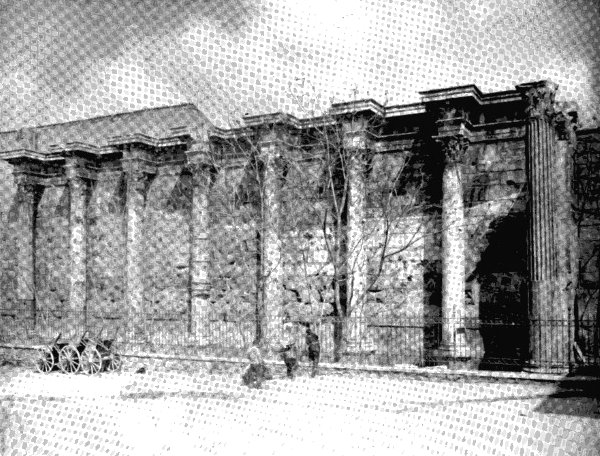
STOA, GYMNASIUM OF HADRIAN, ATHENS