BOOK REVIEWS: "Commentary upon the Maya-Tzental Perez Codex" (William E. Gates) by C. J. Ryan
Reading edition
THE Peabody Museum of American Archaeology and Ethnology at Harvard University recently published a new Paper (Vol. VI, No. 1) on the subject of Central American hieroglyph writing. The Paper is entitled "Commentary upon the Maya-Tzental Perez Codex, with a concluding Note upon the Linguistic Problem of the Maya Glyphs." Professor Wm. E. Gates, International Theosophical Headquarters, Point Loma, the author, has been a member of the Theosophical Society for about twenty-five years, beginning the serious study of Theosophy during H. P. Blavatsky's lifetime. Later, an ardent supporter of William Q. Judge, he is now one of the most active workers at Point Loma under the direction of Katherine Tingley. Professor Gates has applied himself largely to the historical and ethnological side of H. P. Blavatsky's teachings, and, by a careful study of her Secret Doctrine and other works, he has been able to bring to the problem of ancient American culture a fund of information and many valuable clues not familiar to the average student of archaeology. Professor F. W. Putnam of the Peabody Museum, Harvard, in his prefatory note to the Commentary, says:
The Museum is fortunate in adding to its collaborators Mr. William E. Gates, of Point Loma, California, who for more than ten years has been an earnest student of American hieroglyphs. From his life-long studies in linguistics in connexion with his research in "the motifs of civilizations and cultures" he comes well-equipped to take up the difficult and all-absorbing study of American hieroglyphic writing. Mr. Gates has materially advanced this study by his reproduction of the glyphs in type. These type-forms he has used first in his reproduction of the Codex Perez, and now in this Commentary they are used for the first time in printing. This important aid to the study will be highly appreciated by all students of American hieroglyphs, as it will greatly facilitate the presentation of the results of future research.
The Harvard Papers are taken by the principal Universities and learned societies throughout the world. The Commentary on the Perez Codex and the reproduction of it have been printed by the Aryan Press at Point Loma and are fine examples of the highest class of printing.
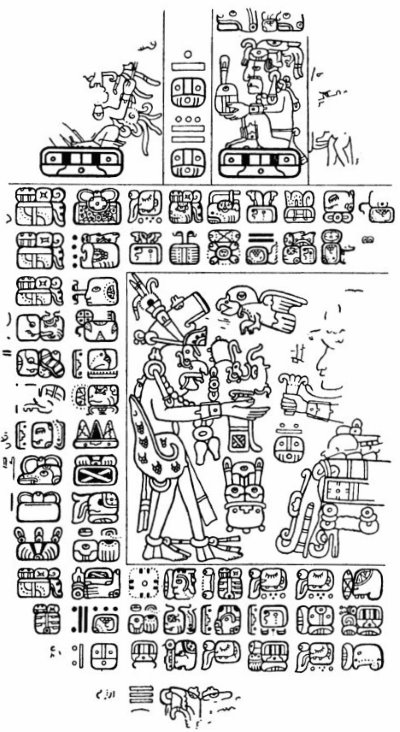
A PAGE OF THE MAYA-TZENTAL PEREZ CODEX FROM CENTRAL AMERICA
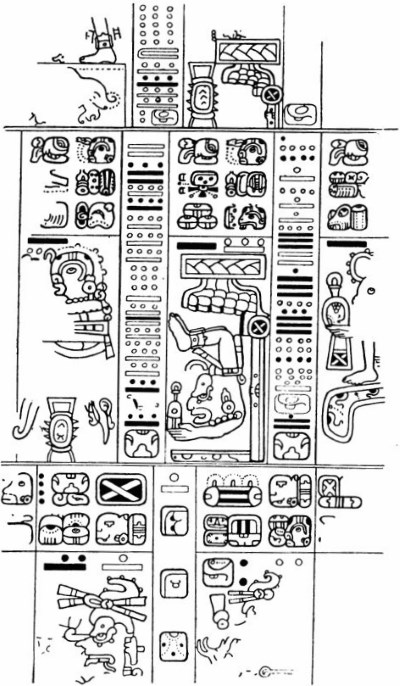
PEREZ CODEX: PAGE 17
The Perez Codex itself, of which Professor Gates' Commentary treats, and of which he has just issued a new, definitive edition, redrawn, colored as in the original and slightly restored, is a Central American manuscript on specially coated "maguey" paper, of unknown antiquity. It was discovered about fifty years ago in a forgotten chimney corner of the Bibliothèque Impériale, Paris, black with dust and without record of its antecedents. It is but a fragment, but fortunately the twenty-two remaining pages contain several chapters complete. The artistic quality of the work is of a high order; the coloring is most harmonious and the drawing of the hieroglyphs firm and refined. The human figures in the accompanying illustrations are conventionalized in certain grotesque though evidently intentional ways, but they have character and a real dignity, and admirably fit the spaces alloted to them. As an example of decorative art the manuscript must take high rank. It irresistibly reminds one of the best Egyptian Papyri. Professor Gates says:
And when, ... one advances to an appreciation of the work in its bearings as a whole, one has to acknowledge himself facing the production of craftsmen who had the inheritance of not only generations, but ages of training. Such a combination of complete mastery in composition, perfect control of definite and fixed forms, and hand technique, can grow up from barbarism in no few hundred years.... Had we nothing but the Perez Codex and Stela P at Copan, the merits of their execution alone, weighed simply in comparison with observed history elsewhere, would prove that we have to do not with the traces of an ephemeral, but with the remains of a wide-spread, settled race and civilization, worthy to be ranked with or beyond even such as the Roman, in its endurance, development and influence in the world, and the beginnings of whose culture are still totally unknown. As to the Codex before us, we can only imagine what the beauty, especially of the pages we now come to discuss, must have been when the whole was fresh and perfect.
But, alas, no one can yet read the meaning of this and the two other Maya Codices that have escaped the destructive hands of the over-zealous Spanish missionaries who saw nothing in such things but hindrances to the spreading of the "True Faith," yet at the time of the Conquest they could be read easily by the cultured natives, and the language is still spoken! Though it seems almost incredible, there is no living person known who can decipher any of the hieroglyphs on the manuscripts or the hundreds of stone monuments except a few calendar signs and other signs of little consequence. We are indebted to Don Diego Landa, second bishop of Yucatan, for the destruction of all the manuscripts he could find, but it is to him also that we owe some gratitude for preserving the meaning of the hieroglyphs of the days and the months and a few other signs, which he inserted in his book. The little he has given us is not enough to help much; we may have to await the discovery of some "Rosetta Stone" like that which opened the lost secret of the Egyptian sacred writings to Champollion. In Professor Gates' words:
Up to date our knowledge of the meanings of the glyphs is still to all intents and purposes limited to the direct tradition we have through Landa, and the deductions immediately involved in these. We know the day and month signs, the numbers, including 0 and 20, four units of the archaic calendar count (the day, tun, katun and cycle), the cardinal point signs, the negative particle. We have not fully solved the uinal or month sign, which seems to be chuen on the monuments and a cauac, or chuen, in the manuscripts. We are able to identify what must be regarded as metaphysical or esoteric applications of certain glyphs in certain places, such as the face numerals. But every one of these points is either deducible directly by necessary mathematical calculation, or else from the names of certain signs given by Landa in his day and month list, and then found in other combinations, such as yax, kin, etc. That we have as many of the points as we have, and still cannot form from them the key—that we cannot read the glyphs—is a constant wonder; but a fact nevertheless.
A large portion of the Commentary is devoted to a highly technical, detailed and closely-reasoned examination and analysis of the glyphs and illustrations in the Codex, of interest chiefly to specialists, but a considerable space is given to some general conclusions on language which are highly significant to students of Theosophy.
There is one point from which this question of American origins, at least of American place in human society and civilization, can be studied in its broader lines, even with what materials we have. It is that of language in general. From one point of view language is man himself, and it certainly is civilization. Without it man is not man, a Self-expressing and social being.... It is the constant effort of the conscious self to formulate thought. It is the use of the energy of creation, of objectivation, a veritable many-colored rainbow bridge between the inner or higher man and the outer or lower worlds. And it is not only the expression of Man as man, but in its varied forms it is the inevitable and living expression of each man or body of men at any and every point of time. Itself boundless as an ocean, it is in its infinite forms and streams and colors and sounds, the faithful and exact exponent both of the sources and channels by which it has come, and of the banks in which it is held, racial, national or individual.... Every word or form comes to us with the thought-impress of every man or nation that has used or molded it before us. We must take it as it comes, but we give it something of ourselves as we pass it on. If our intellectual and spiritual thought is aflame, whether as nation or individual, we may purify it, energize it, give it power to form and arrange the atoms around it—and we have a new literature, a new and beneficent, creative social vehicle of intercourse, mutual understanding, and human unification....
It is evident that the criterion of the perfectness of any language is not to be found in a comparison of its forms or methods with those of any other, but in its fitness as a vehicle for the expression of deeper life, of the best and greatest that is in those who use it, and above all in its ability to react and stimulate newer and yet greater mental and spiritual activity and expression. The force behind man, demanding expression through him, and him only, into the human life of all, is infinite—of necessity infinite. There is no limit, nor ever has been any limit, to what man may bring down into the dignifying, broadening and enriching of human life and evolution, save in his own ability to comprehend, express, and live it. And the brightness and cleanness of the tools whereby he formulates his thought, as well as the worthiness and fitness of the substance and the forms into which he shapes it for others to see, are the essentials of his craft....
There is one great broad line that divides the nations and civilizations of the earth, past and present, in all their arts of expression. We may call it that of the ideographic as against the literal. It controls the inner form of language and of languages; it manifests in the passage of thought from man to man; it determines whether the writing of the people shall be hieroglyphic or alphabetic; it gives both life and form to the ideals of their art. It is a distinction that was clearly recognized by Wilhelm von Humboldt, when he laid down that the incorporative characteristic essential to all the American languages is the result of the exaltation of the imaginative over the ratiocinative elements of mind.
Ideographic writing directs the mind of the reader by means of a picture or a symbol directly to the idea existing in the mind of the one who uses it; while alphabetic or literal writing is simply the written expression of the sound, and only indirectly expresses the idea.
Passing on from the culture of ancient America with its ideographs, the writer draws attention to the great transition of thought, as indicated by language, that took place in Central Asia probably, the supposed seat of the Aryan beginnings after the destruction of Atlantis and the general break-up of the former civilizations. He says:
I believe ... that coincident with a new and universal world-epoch, as wide in its cultural scope as the difference between the ideographic and literal, there was finally formed a totally new vehicle for the use of human thought, the inflectional, literal, alphabetic. That this vehicle was perfected into some great speech, the direct ancestor of Sanskrit, into the forms of which were concentrated all the old power of the ancient hieroglyphs and their underlying concepts. For Sanskrit, while the oldest is also the mightiest of Aryan grammars; and no one who has studied its forms, or heard its speech from educated native mouths, can call it anything but concentrated spiritual power. That the force which went on the one hand into the Sanskrit forms, was on the other perpetuated on into the special genius of Chinese, in which, as we know it, we have a retarded survival, not of course of outer form so much as of method and essence. And in Tibetan, in spite of all that is said to the contrary, I suspect that we have a derivative, not from either Chinese or Sanskrit as we know them, but by a medial line from a common point.
Many students feel convinced that once we solve the problem of the Maya-Tzental manuscripts and carved inscriptions, which undoubtedly relate to enormous periods of time, we shall have conclusive evidences of the civilization and destruction of Atlantis. Several illuminating quotations from H. P. Blavatsky's Secret Doctrine are given by Professor Gates, and in his last paragraph he sums up the results of his long application to the study of ancient American and other languages, in which he has been so notably helped by the teachings of Theosophy, in these words:
And I am convinced that the widest door there is to be opened to this past of the human race, is that of the Maya glyphs. The narrow limitations of our mental horizon as to the greatness and dignity of man, of his past, and of human evolution, were set back widely by Egypt and what she has had to show, and again by the Sanskrit; but the walls are still there, and advances, however rapid, are but gradual. With the reading of America I believe the walls themselves will fall, and a new conception of past history will come.