The Universal Brotherhood and Theosophical Society
Reading edition
Established for the Benefit of the People of the Earth and all Creatures
OBJECTS
THIS BROTHERHOOD is part of a great and universal movement which has been active in all ages.
This Organization declares that Brotherhood is a fact in Nature. Its principal purpose is to teach Brotherhood, demonstrate that it is a fact in Nature, and make it a living power in the life of humanity.
Its subsidiary purpose is to study ancient and modern religions, science, philosophy and art; to investigate the laws of Nature and the divine powers in man.

H. P. BLAVATSKY, FOUNDRESS AND TEACHER
The present Theosophical Movement was inaugurated by Helena Petrovna Blavatsky in New York in 1875. The original name was "The Theosophical Society." Associated with her were William Q. Judge and others. Madame Blavatsky for a time preferred not to hold any outer official position except that of Corresponding Secretary. But later, in 1888, she dissolved a Center in France and cancelled its by-laws, which action was afterwards formally ratified by the Executive Council of the Society. Referring to this she wrote in her English magazine as follows:
This settles the question of the actual right of the Corresponding Secretary—one of the founders—to interfere in such exceptional cases when the welfare and reputation of the Theosophical Society are at stake. In no other, except such a case, would the undersigned have consented or taken upon herself the right of interfering.
Later she assumed the Presidency of the British Section of the Theosophical Society. Further, in response to the statement published by a then prominent member in India that Madame Blavatsky is "loyal to the Theosophical Society and to Adyar," Madame Blavatsky wrote:
It is pure nonsense to say that "H. P. B. ... is loyal to the Theosophical Society and to Adyar"(!?). H. P. B. is loyal to death to the Theosophical cause and those Great Teachers whose philosophy can alone bind the whole of Humanity into one Brotherhood.... The degree of her sympathies with the Theosophical Society and Adyar depends upon the degree of the loyalty of that Society to the CAUSE. Let it break away from the original lines and show disloyalty in its policy to the cause and the original program of the Society, and H. P. B., calling the T. S. disloyal, will shake it off like dust from her feet.
All true students know that Madame Blavatsky held the highest authority, the only real authority which comes of wisdom and power, the authority of Teacher and Leader, the real head, heart, and inspiration of the whole Theosophical Movement. It was through her that the teachings of Theosophy were given to the world, and without her the Theosophical Movement could not have been.
BRANCH SOCIETIES IN EUROPE AND INDIA
In 1878 Madame Blavatsky left the United States, first visiting Great Britain and then India, in both of which countries she founded branch societies. The parent body in New York became later the Aryan Theosophical Society and HAS ALWAYS HAD ITS HEADQUARTERS IN AMERICA; and of this, William Q. Judge was President until his death in 1896.
To one who accepts the teachings of Theosophy it is plain to see that although Theosophy is of no nationality or country but for all, yet it has a peculiar relationship with America. Not only was the United States the birthplace of the Theosophical Society, and the home of the Parent Body up to the present time, but H. P. Blavatsky, the Foundress of the Society, although a Russian by birth, became an American citizen; William Q. Judge, of Irish parentage and birth, also became an American citizen; and Katherine Tingley is American born. America therefore not only has played a unique part in the history of the present Theosophical Movement, but it is plain to see that its destiny is closely interwoven with that of Theosophy; and by America is meant not only the United States or even the North American continent, but also the South American continent, and, as repeatedly declared by Madame Blavatsky, it is in this great Western Hemisphere as a whole, North and South, that the next great Race of humanity is to be born.
ENEMIES OF PROGRESS
While the main object of the Society from the first was to establish a nucleus of Universal Brotherhood, there were some, we regret to state, who joined the Society from far different motives. Many were wholly sincere in their interest and efforts to benefit the human race, but as in other societies, so in this, there were a few who entered its ranks seeking an opportunity to gratify their ambition and love of power. Still others, in their carping egotism thought that they knew more than their Teacher, H. P. Blavatsky, and were jealous of that Teacher, and later of the one whom she left as her successor and Teacher in her place.
Thus it was that there were attacks from the very first against the teachings of Theosophy, but more than all against the one who brought again these teachings to the world—Madame H. P. Blavatsky—and on handing the guidance of the Theosophical Movement on to her successors they too have been subject to similar attacks from the forces of evil, whose very existence is threatened by the spread of the teachings of Theosophy, which are the teachings of truth.
Madame Blavatsky's mission was in part to tear down the materialism of the age on one hand, and dogmatic domination on the other, and this made for her many bitter enemies. It was not long before enmity and unbrotherliness met her on every side, and these culminated in a plan to overthrow the influence of Theosophy and discredit her before the world. It was in India, in 1884, that this plan unfolded. Two ingrates, (French people, man and wife) who had been befriended by Madame Blavatsky when they were starving and ragged, and who later attempted to blackmail some of the members of the Society, and confessed themselves to be bribe-takers, liars, and forgers, associated themselves with the Christian College of Madras, India, and sought to destroy Madame Blavatsky and her work. It was afterwards discovered—admitted by the missionaries themselves, and published in the Madras Mail—that these missionaries had agreed to pay a large sum of money to the above-referred-to people for letters of Madame Blavatsky. These letters, as was afterwards proven, were gross forgeries.
At the same time the Psychical Research Society sent out as its agent a young man who had just left college, to investigate and make a report. This young man, wholly inexperienced, had all his traveling expenses paid on his long trip of sight-seeing, and no doubt felt that he must make some report to warrant the large outlay for his expenses, and in order to earn his salary. The whole source of this young man's information, on which he based his report, was the testimony of the two people above referred to, who later confessed their fraud. Furthermore, the young man published as his own a drawing made by William Q. Judge of something that the young man had no possibility of seeing, as it did not exist in that state when the young man arrived in India. Nevertheless, the Psychical Research Society accepted the young man's unsupported testimony, without asking for any answer from Madame Blavatsky, nor did they ask her friends, but made their report solely on the testimony of two perjured ingrates, and of a young man, who appropriated the work of another as his own.
MADAME BLAVATSKY FOUNDS THE ESOTERIC SCHOOL HER LIFE-LONG TRUST IN WILLIAM Q. JUDGE
In 1888, H. P. Blavatsky, then in London, on the suggestion and at the request of her Colleague, William Q. Judge, founded the Esoteric School of Theosophy, a body for students, of which H. P. Blavatsky wrote that it was "the heart of the Theosophical Movement," and of which she appointed William Q. Judge as her sole representative in America. Further, writing officially to the Convention of the American Societies held in Chicago, 1888, she wrote as follows:
To William Q. Judge, General Secretary of the American Section of the Theosophical Society:
My dearest Brother and Co-Founder of the Theosophical Society:
In addressing to you this letter, which I request you to read to the Convention summoned for April 22nd, I must first present my hearty congratulations and most cordial good wishes to the Society and yourself—the heart and soul of that body in America. We were several to call it to life in 1875. Since then you have remained alone to preserve that life through good and evil report. It is to you chiefly, if not entirely, that the Theosophical Society owes its existence in 1888. Let me thank you for it, for the first, and perhaps for the last time publicly, and from the bottom of my heart, which beats only for the cause you represent so well and serve so faithfully. I ask you also to remember that on this important occasion, my voice is but the feeble echo of other more sacred voices, and the transmitter of the approval of Those whose presence is alive in more than one true Theosophical heart, and lives, as I know, pre-eminently in yours.
This regard that Madame Blavatsky had for her Colleague William Q. Judge continued undiminished until her death in 1891, when he became her successor.
THE TRUE AND THE COUNTERFEIT
In giving even such a brief sketch as the present necessarily is of the objects and history of the Theosophical Society, it is nevertheless due to all honest and fair-minded people that an explanation should be given why there are small bodies of people here and there which are labeled Theosophical but which are in no way endorsed or recognized by the Universal Brotherhood and Theosophical Society. These small bodies have sprung up from year to year in different parts of the world, and though in the aggregate their efforts and influence have been weak, they have nevertheless been more or less successful in misleading honest minds from the truth. It becomes a duty therefore to call attention to these matters and to give warning lest others be misled. In other words a distinction must be drawn between the true and the counterfeit.
Madame Blavatsky, in 1889, writing in her Theosophical magazine published in London, said that the purpose of the magazine was not only to promulgate Theosophy, but also and as a consequence of such promulgation, "to bring to light the hidden things of darkness." She further says:
As to the "weak-minded Theosophists"—if any—they can take care of themselves in the way they please. If the "false prophets of theosophy" are to be left untouched, the true prophets will be very soon—as they have already been—confused with the false. It is high time to winnow our corn and cast away the chaff. The Theosophical Society is becoming enormous in its numbers, and if the false prophets, the pretenders, or even the weak-minded dupes, are left alone, then the Society threatens to become very soon a fanatical body split into three hundred sects—like Protestantism—each hating the other, and all bent on destroying the truth by monstrous exaggerations and idiotic schemes and shams. We do not believe in allowing the presence of sham elements in Theosophy, because of the fear, forsooth, that if even "a false element in the faith" is ridiculed, the latter is "apt to shake the confidence" in the whole.
... What true Christians shall see their co-religionists making fools of themselves, or disgracing their faith, and still abstain from rebuking them publicly as privately, for fear lest this false element should throw out of Christianity the rest of the believers.
The wise man courts truth; the fool, flattery.
However it may be, let rather our ranks be made thinner, than the Theosophical Society go on being made a spectacle to the world through the exaggerations of some fanatics, and the attempt of various charlatans to profit by a ready-made program. These, by disfiguring and adapting Occultism to their own filthy and immoral ends, bring disgrace upon the whole movement.—Lucifer, Vol. iv, pp. 2 & 3.
THE DUTY OF A THEOSOPHIST
In regard to the above it should be remembered that Madame Blavatsky wrote this in 1889 and had in view certain people who were advocating immoral teachings and practices in the sacred name of Theosophy, and it shows clearly what she would have done and what would be a Theosophical duty should ever a similar occasion arise. Thanks to the safe-guarding of the Theosophical Movement by the Constitution of the Universal Brotherhood and Theosophical Society, such cannot ever arise in the Society itself, but just as there is no legal means of preventing anyone from calling himself a Christian however much his life may depart from the teachings and ideals of the Teacher whose name he so dishonors, so there is no means of preventing unworthy people from using the sacred name of Theosophy and giving out teachings or advocating practices which are absolutely contrary to the teachings of Theosophy as given first by our Teacher, H. P. Blavatsky, and later by her successors, William Q. Judge and Katherine Tingley.
It is a matter of great regret that we have to refer to these things, but although unpleasant it is nevertheless a duty. It is for the above-named reasons and to forestall misconception on the part of the public that we make mention here of those enemies to true Theosophy who sprang up not only outside but within the ranks of the Society. H. P. Blavatsky had her enemies and those who sought to discredit her not only before the public but before her own students; and so too William Q. Judge had his, and Katherine Tingley has hers also. In fact, was there ever a Teacher who came to do good and help humanity who was not maligned and persecuted?
WILLIAM Q. JUDGE ELECTED PRESIDENT FOR LIFE
In 1893 there openly began what had been going on beneath the surface for some time, a bitter attack ostensibly against William Q. Judge, but in reality also against H. P. Blavatsky. This bitter attack threatened to disrupt the whole Society and to thwart the main purpose of its existence, which was to further the cause of Universal Brotherhood. Finally the American members decided to take action, and at the annual convention of the Society held in Boston in 1895, by a vote of 191 delegates to 10, re-asserted the principles of Theosophy as laid down by H. P. Blavatsky, and elected William Q. Judge president for life. Similar action was almost immediately taken by members in Europe, Australia, and other countries, in each case William Q. Judge being elected president for life. In this action the great majority of the active members throughout the world concurred, and thus the Society was relieved of those who had joined it for other purposes than the furtherance of Universal Brotherhood, the carrying out of the Society's other objects, and the spiritual freedom and upliftment of Humanity. A few of these in order to curry favor with the public and attract a following, continued among themselves to use the name of Theosophy, but it should be understood that they are not connected with the Theosophical Movement.
KATHERINE TINGLEY SUCCEEDS WILLIAM Q. JUDGE
One year later, in March 1896, William Q. Judge died, leaving as his successor Katherine Tingley, who for several years had been associated with him in the work of the Society. This Teacher not only began immediately to put into actual practice the ideals of Theosophy as had been the hope and aim of both H. P. Blavatsky and William Q. Judge, and for which they had laid the foundations, thus honoring and illustrating the work of her illustrious predecessors, but she also struck a new keynote, introducing new and broader plans for uplifting humanity. For each of the Teachers, while continuing the work and building upon the foundations of his predecessor, adds a new link, and has his own distinctive work to do, and teachings to give, belonging to his own time and position.
No sooner had Katherine Tingley begun her work as successor, than further attacks, some most insidious, from the same source as those made against H. P. Blavatsky and William Q. Judge, as well as from other sources, were inaugurated against her. Most prominent among those thus attacking Katherine Tingley were some referred to by Madame Blavatsky in the article above-quoted (pp. 79-80), who by their own actions had removed themselves from the ranks of the Society. There were also a few others who still remained in the Society who had not joined hands with the disintegrators at the time the latter were repudiated in 1895. These now thought it to their personal advantage to oppose the Leader and sought to gain control of the Society and use it for political purposes. These ambitious agitators, seeking to exploit the Society for their own ends, used every means to overthrow Katherine Tingley, realizing that she was the greatest obstacle to the accomplishment of their desires, for if she could be removed they expected to gain control. They worked day and night, stooping almost to any means to carry out their projects. Yet it seemed that by these very acts, i. e., the more they attacked, the more were honest and earnest members attracted to the ranks of the Society under Katherine Tingley's leadership.
KATHERINE TINGLEY GIVES SOCIETY NEW CONSTITUTION SOCIETY MERGES INTO BROADER FIELD OF WORK
To eliminate these menacing features and to safeguard the work of the Theosophical Movement for all time, Katherine Tingley presented to a number of the oldest members gathered at her home in New York on the night of January 13th, 1898, a new Constitution which she had formulated for the more permanent and broader work of the Theosophical Movement, opening up a wider field of endeavor than had heretofore been possible to students of Theosophy. One month later, at the Convention of the Society, held in Chicago, February 18th, 1898, this Constitution was accepted by an almost unanimous vote, and the Theosophical Society merged itself into the Universal Brotherhood and Theosophical Society. In this new step forward, she had the heartiest co-operation and support of the vast majority of the members throughout the world. Only a few were unable to accept the wider opportunity now afforded them and removed themselves from the ranks, seeking other fields in which to exploit their ambitious plans. The members were truly greatly relieved that the Constitution of the Society made it virtually impossible for agitators to remain members. The Society in order to fulfil its great mission must necessarily be unsectarian and non-political, and any attempts to use it for political purposes would be subversive of its high aims and have always been discouraged by our Leaders. As the years went on, it appeared that there were still a few not yet prepared to co-operate fully in the broader interests of the Society, and these finally dropped out.
THEOSOPHY IN PRACTICE
It is of interest here to quote our Teacher's own words regarding this time. In an article published in the Metropolitan Magazine, New York, October, 1909, she says:
Later, I found myself the successor of William Q. Judge, and I began my heart work, the inspiration of which is partly due to him.
In all my writings and associations with the members of the Theosophical Society, I emphasized the necessity of putting Theosophy into daily practice, and in such a way that it would continuously demonstrate that it was the redeeming power of man. More familiarity with the organization and its workers brought home to me the fact that there was a certain number of students who had in the early days begun the wrong way to study Theosophy, and that it was becoming in their lives a death-like sleep. I noticed that those who followed this line of action were always alarmed at my humanitarian tendencies. Whenever I reminded them that they were building a colossal egotism instead of a power to do good, they subtly opposed me. As I insisted on the practical life of theosophy, they opposed still more. They later exerted personal influence which affected certain members throughout the world. It was this condition which then menaced the Theosophical Movement, and which forced me to the point of taking such action as would fully protect the pure teachings of Theosophy and make possible a broader path for unselfish students to follow. Thus the faithful members of the Theosophical Movement would be able to exemplify the charge which Helena Petrovna Blavatsky gave to her pupils, as follows:
"Real Theosophy is altruism, and we cannot repeat it too often. It is brotherly love, mutual help, unswerving devotion to truth. If once men do but realize that in these alone can true happiness be found, and never in wealth, possession or any selfish gratification, then the dark cloud will roll away, and a new humanity will be born upon the earth. Then the Golden Age will be there indeed."
Here we find William Q. Judge accentuating the same spirit, the practical Theosophical life:
"The power to know does not come from book-study alone, nor from mere philosophy, but mostly from the actual practice of altruism in deed, word, and thought; for that practice purifies the covers of the soul and permits the divine light to shine down into the brain-mind."
THE PARTING OF THE WAYS
On February 18, 1898, at the Convention of the Theosophical Society in America, held at Chicago, Ill., the Society resolved, through its delegates from all parts of the world, to enter a larger arena, to widen its scope and to further protect the teachings of Theosophy. Amid most intense enthusiasm the Theosophical Society was expanded into the Universal Brotherhood and Theosophical Society, and I found myself recognized as its leader and official head. The Theosophical Society in Europe also resolved to merge itself into the Universal Brotherhood and Theosophical Society, and the example was quickly followed by Theosophical Societies in other parts of the world. The expansion of the original Theosophical Society, which Madame Blavatsky founded and which William Q. Judge so ably sustained, now called the Universal Brotherhood and Theosophical Society, gave birth to a new life, and the membership trebled the first year, and ever since that time a rapid increase has followed.
KATHERINE TINGLEY'S PRACTICAL HUMANITARIAN WORK UNITED STATES GOVERNMENT GIVES ASSISTANCE
In 1898 Katherine Tingley established the International Brotherhood League, the department of the Universal Brotherhood and Theosophical Society for practical humanitarian work, and under its auspices rendered aid to thousands of soldiers at Montauk after the close of the Spanish-American War. Later she took a relief expedition into Cuba, the United States Government affording her free transportation for physicians, nurses, and supplies. Thus began her work in Cuba, which has resulted in the establishment of Râja Yoga Colleges at Santiago de Cuba, Santa Clara, and Pinar del Rio, and now in preparation at San Juan on the site of the famous battlefield which Katherine Tingley has recently purchased.
In these Colleges, besides the world-famous Râja Yoga College at Point Loma, a great educational work is being carried on in which are being taught the highest ideals of patriotism and national life in addition to the development of character and the upbuilding of pure-minded and self-reliant manhood and womanhood to the end that each pupil may be prepared to take an honorable self-reliant position in the world's work. Other school sites acquired by Mrs. Katherine Tingley are in the New Forest, England, and also on the Island of Visingsö, Sweden.
INTERNATIONAL HEADQUARTERS AT POINT LOMA, CALIFORNIA
In 1900 the Headquarters of the Universal Brotherhood and Theosophical Society were moved from New York to Point Loma, California, which is now the International Center of the Theosophical Movement. This Organization is unsectarian and non-political; none of its officers or workers receives any salary or financial recompense.
In her article in The Metropolitan Magazine above referred to, Katherine Tingley further says:
The knowledge that Point Loma was to be the World-center of the Universal Brotherhood and Theosophical Society, which has for its supreme object the elevation of the race, created great enthusiasm among its members throughout the world. The further fact that the government of the Universal Brotherhood and Theosophical Society rests entirely with the leader and official head, who holds her office for life and who has the privilege of appointing her successor, gave me the power to carry out some of the plans I had long cherished. Among these was the erecting of the great Homestead Building. This I carefully designed that it might not stand apart from the beautiful nature about it, but in a sense harmonize with the sky, the distant mountains, the broad blue Pacific, and the glorious light of the sun.
So it has been from the first, so that the practical work of Theosophy began at Point Loma under the most favorable circumstances. No one dominated by selfish aims and ambitions was invited to take part in this pioneer work. Although there were scores of workers from various parts of the world uniting their efforts with mine for the upbuilding of this world-center, yet there was no disharmony. Each took the duty allotted him and worked trustingly and cheerfully. Many of the world's ways these workers gladly left behind them. They seemed reborn with an enthusiasm that knew no defeat. The work was done for the love of it, and this is the secret of a large part of the success that has come to the Theosophical Movement.
Not long after the establishment of the International Theosophical Headquarters at Point Loma, it was plain to see that the Society was advancing along all lines by leaps and bounds. Letters of inquiry were pouring in from different countries, which led to my establishing the Theosophical Propaganda Bureau. This is one of the greatest factors we have in disseminating our teachings. The International Brotherhood League then opened its offices and has ever been active in its special humanitarian work, being the directing power which has sustained the several Râja Yoga schools and academies, now in Pinar del Rio, Santa Clara, and Santiago de Cuba, from the beginning. The Aryan Theosophical Press has yearly enlarged its facilities in answer to the demands made upon it through the publication of Theosophical literature, which includes The Theosophical Path and several other publications. There is the Isis Conservatory of Music and Drama, the Department of Arts and Crafts, the Industrial Department, including Forestry, Agriculture, Roadbuilding, Photo-engraving, Chemical laboratory, Landscape-gardening, and many other crafts.
DO NOT FAIL TO PROFIT BY THE FOLLOWING
Constantly the question is asked, what is theosophy, what does it really teach? Each year the life and work of H. P. Blavatsky and the high ideals and pure morality of her teachings are more clearly vindicated. Each year the position taken by William Q. Judge and Katherine Tingley in regard to their predecessor, H. P. Blavatsky, is better understood, and their own lives and work are seen to be actuated by the same high ideals for the uplifting of the human race. Each year more and more people are coming to realize that not all that goes under the name of Theosophy is rightly so called, but that there is a counterfeit Theosophy as well as the true, and that there is need of discrimination, lest many be misled.
"THEOSOPHIST IS WHO THEOSOPHY DOES"
From the earliest days of the present Theosophical Movement has it been necessary to make this distinction, but there is one unfailing test expressed in the words of H. P. Blavatsky: "Theosophist is who Theosophy does." In the past many have been attracted to the ranks of the Society through motives other than those which lead, not only to the study of Theosophy, the Wisdom-Religion, but to the making of it a factor of purification of their daily lives; some seeking admission from motives of ambition or other self-interest, some for mere entertainment or for the acquirement of so-called "occult" powers—thinking they could gain the knowledge without the practice of Theosophy, the first step of which is altruism; and some from mere curiosity, hoping to find in Theosophy a new fad. The presence of such pseudo-Theosophists in the ranks has at times necessitated drastic action, and on one or two occasions reorganization of the whole Society in order that it might be held to its original high ideals and the lines on which it was founded. And though the Universal Brotherhood and Theosophical Society is not for saints, the demand is made upon all who are in its ranks that there shall be a constant effort to live up to its high ideals of purity and altruistic endeavor, that there shall be practice and not mere theory, and that both by word and deed the lives of the members shall be an example to all men and especially to the young.
In certain cases as before referred to, those who have been removed from the ranks of the Society have with their associates formed small centers of their own, using the name Theosophy and to some extent the writings of Madame Blavatsky. This has caused confusion in the minds of some who look at things merely superficially, accepting the professions of people without regard to their motives or lives; and hence it is necessary from time to time to clear the air, as it were, and, sweeping away the veneer of mere profession, show the facts as they really are.
Counterfeits exist in many departments of life and thought, and especially in matters relating to religion and the deeper teachings of life. Hence, in order that people who are honestly seeking the truth may not be misled, we deem it important to state that the Universal Brotherhood and Theosophical Society is not responsible for, nor is it affiliated with, nor does it endorse, any other society which, while calling itself Theosophical, is not connected with the International Theosophical Headquarters at Point Loma, California. Having a knowledge of Theosophy, the ancient Wisdom-Religion, we deem it as a sacred trust and responsibility to maintain its pure teachings, free from the vagaries, additions, or misrepresentations of ambitious self-styled Theosophists and would-be teachers. The test of a Theosophist is not in profession, but in action, and in a noble and virtuous life. The motto of the Society is "There is no religion higher than Truth." This was adopted by Madame Blavatsky, but it is to be deeply regretted that there are no legal means to prevent the use of this motto in connexion with counterfeit Theosophy, by people professing to be Theosophists, but who would not be recognized as such by Madame Blavatsky.
It is a regrettable fact that many people use the name of Theosophy and of our Organization for self-interest, as also that of H. P. Blavatsky, the Foundress, and even the Society's motto, to attract attention to themselves and to gain public support. This they do in private and public speech and in publications. Without being in any way connected with the Universal Brotherhood and Theosophical Society, in many cases they permit it to be inferred that they are, thus misleading the public, and honest inquirers are hence led away from the original truths of Theosophy.
The Universal Brotherhood and Theosophical Society welcomes to membership all who truly love their fellow men and desire the eradication of the evils caused by the barriers of race, creed, caste, or color, which have so long impeded human progress; to all sincere lovers of truth and to all who aspire to higher and better things than the mere pleasures and interests of a worldly life, and are prepared to do all in their power to make Brotherhood a living energy in the life of humanity, its various departments offer unlimited opportunities.
The whole work of the Organization is under the direction of the Leader and Official Head, Katherine Tingley, as outlined in the Constitution.
OBJECTS OF THE INTERNATIONAL BROTHERHOOD LEAGUE
1. To help men and women to realize the nobility of their calling and their true position in life.
2. To educate children of all nations on the broadest lines of Universal Brotherhood and to prepare destitute and homeless children to become workers for humanity.
3. To ameliorate the condition of unfortunate women, and assist them to a higher life.
4. To assist those who are or have been in prisons to establish themselves in honorable positions in life.
5. To abolish capital punishment.
6. To bring about a better understanding between so-called savage and civilized races, by promoting a closer and more sympathetic relationship between them.
7. To relieve human suffering resulting from flood, famine, war, and other calamities; and, generally, to extend aid, help, and comfort to suffering humanity throughout the world.
Joseph H. Fussell Secretary
Universal Brotherhood and Theosophical Society.
International Headquarters Point Loma, California.
BOOK LIST
OF WORKS ON THEOSOPHY, OCCULTISM, RELIGION, PHILOSOPHY, SCIENCE, AND ART
PUBLISHED OR FOR SALE BY
THE THEOSOPHICAL PUBLISHING COMPANY
INTERNATIONAL THEOSOPHICAL HEADQUARTERS POINT LOMA, CALIFORNIA, U. S. A.
The office of the Theosophical Publishing Company is at Point Loma, California
It has no other office and no branches
FOREIGN AGENCIES
THE UNITED KINGDOM—Theosophical Book Co., 18 Bartlett's Buildings, Holborn Circus, London, e. c., England
GERMANY—J. Th. Heller, Vestnertorgraben 13, Nürnberg
SWEDEN—Universella Broderskapets Förlag, Barnhusgatan, 10, Stockholm
HOLLAND—Louis F. Schudel, Hollandia-Drukkerij, Baarn
AUSTRALIA—Willans and Williams, 16 Carrington St., Wynyard Sq., Sydney, N. S. W.
CUBA—H. S. Turner, Apartado 127; or Heredia, Baja, 10, Santiago de Cuba
MEXICO—Samuel L. Herrera, Calle de la Independencia, 55 altos, Vera Cruz, V. C.
Address by Katherine Tingley at San Diego Opera House, March, 1902 $ .15
An Appeal to Public Conscience: an Address delivered by Katherine Tingley at Isis Theater, San Diego, July 22, 1906. Published by the Woman's Theosophical Propaganda League, Point Loma .05
Astral Intoxication, and Other Papers (W. Q. Judge) .03
Bhagavad Gîtâ (recension by W. Q. Judge). The pearl of the scriptures of the East. American edition; pocket size; morocco, gilt edges 1.00
Concentration, Culture of (W. Q. Judge) .15
Devachan; or the Heavenworld (H. Coryn) .05
Echoes from the Orient; a broad Outline of Theosophical Doctrines. Written for the newspaper reading public. (W. Q. Judge) Sm. 8vo, cloth .50
Paper .25
Epitome of Theosophical Teachings, An (W. Q. Judge); 40 pages .15
Freemasonry and Jesuitry, The Pith and Marrow of the Closing and Coming Century and Related Position of, (Rameses) .15
8 copies for $1.00; per hundred, $10.00
Katherine Tingley, Humanity's Friend; A Visit to Katherine Tingley (by John Hubert Greusel); A Study of Râja Yoga at Point Loma (Reprint from the San Francisco Chronicle, Jan. 6, 1907). The above three comprised in a pamphlet of 50 pages, published by the Woman's Theosophical Propaganda League, Point Loma .15
Hypnotism: Hypnotism, by W. Q. Judge (Reprint from The Path, vol. viii, p. 335); Why Does Katherine Tingley Oppose Hypnotism? by a Student (Reprint from New Century Path, Oct. 28, 1906); Evils of Hypnotism, by Lydia Ross, M. D. .15
Incidents in the History of the Theosophical Movement; by Joseph H. Fussell. 24 pages, royal 8vo. .15
Isis Unveiled, by H. P. Blavatsky. 2 vols, royal 8vo, about 1500 pages; cloth; with portrait of the author. Point Loma Edition, with a preface. Postpaid 4.00
Key to Theosophy, The: by H. P. Blavatsky. Point Loma Edition, with Glossary and exhaustive Index. Portraits of H. P. Blavatsky and William Q. Judge. 8vo., cloth, 400 pages. Postpaid 2.25
Life at Point Loma, The: Some Notes by Katherine Tingley. (Reprinted from the Los Angeles Saturday Post, December, 1902) .15
Light on the Path (M. C.), with Comments, and a short chapter on Karma. Authoritative rules for treading the path of a higher life. Point Loma Edition, pocket size edition of this classic, leather .75
Embossed paper .25
Mysteries of the Heart Doctrine, The. Prepared by Katherine Tingley and her pupils. Square 8vo, cloth 2.00
Paper 1.00
A Series of 8 Pamphlets, comprising the different Articles in above, paper, each .25
Nightmare Tales (H. P. Blavatsky). Illustrated by R. Machell. A collection of the weirdest tales ever written down. Cloth .60
Paper .35
The Plough and the Cross. A story of New Ireland; by William Patrick O'Ryan. 12mo, 378 pages. Illustrated. Cloth 1.00
Secret Doctrine, The. The Synthesis of Science, Religion, and Philosophy, by H. P. Blavatsky. Point Loma Edition; with Index. Two vols., royal 8vo, about 1500 pages; cloth. Postage prepaid 10.00
Reprinted from the original edition of 1888, as issued by H. P. Blavatsky
Some of the Errors of Christian Science. Criticism by H. P. Blavatsky and W. Q. Judge .15
Voice of the Silence, The. (For the daily use of disciples.) Translated and annotated by H. P. Blavatsky. Pocket size, leather .75
Yoga Aphorisms (translated by W. Q. Judge), pocket size, leather .75
GREEK SYMPOSIA, as performed by students of the Isis League of Music and Drama, under direction of Katherine Tingley. (Fully protected by copyright.) 1 The Wisdom of Hypatia. 2 A Promise. Each .15
NEW CENTURY SERIES. The Pith and Marrow of Some Sacred Writings.
Ten Pamphlets; Scripts, each .25
Subscription (Series of 10 Pamphlets) 1.50
Script 1—Contents: The Relation of Universal Brotherhood to Christianity—No Man can Serve Two Masters—In this Place is a Greater Thing
Script 2—Contents: A Vision of Judgment—The Great Victory—Co-Heirs with Christ—The "Woes" of the Prophets—Fragment: from Bhagavad Gîtâ—Jesus the Man
Script 3—Contents: Lesson of Israel's History—Man's Divinity and Perfectibility—The Man Born Blind—The Everlasting Covenant—Burden of the Lord
Script 4—Contents: Reincarnation in the Bible—The Money-Changers in the Temple—The Mysteries of the Kingdom of Heaven—The Heart Doctrine—The Temple of God
Script 5—Contents: Egypt and Prehistoric America—Theoretical and Practical Theosophy—Death, One of the Crowning Victories of Human Life—Reliance on the Law—Led by the Spirit of God
Script 6—Contents: Education Through Illusion to Truth—Astronomy in the Light of Ancient Wisdom—Occultism and Magic—Resurrection
Script 7—Contents: Theosophy and Islâm, a word concerning Sufism—Archaeology in the Light of Theosophy—Man, a Spiritual Builder
Script 8—Contents: The Sun of Righteousness—Cant about the Classics
Script 9—Contents: Traces of the Wisdom-Religion in Zoroastrianism, Mithraism, and their modern representative, Parseeism—The Druses of Mount Lebanon
Script 10—Contents: The Religions of China
Script 11—(Supplementary Number) Contents: Druidism—Druidism and its Connexion with Ireland
OCCULTISM, STUDIES IN (H. P. Blavatsky). Pocket size, 6 vols. cloth; each .35
Per set of six vols. 1.50
Vol. 1. Practical Occultism. Occultism vs. the Occult Arts. The Blessing of Publicity
Vol. 2. Hypnotism. Black Magic in Science. Signs of the Times
Vol. 3. Psychic and Noetic Action
Vol. 4. Kosmic Mind. The Dual Aspect of Wisdom
Vol. 5. The Esoteric Character of the Gospels
Vol. 6. Astral Bodies; The Constitution of the Inner Man
THEOSOPHICAL MANUALS. Elementary Handbooks for Students.
16mo, price, each, paper 25c; cloth .35
No. 1 Elementary Theosophy
No. 2 The Seven Principles of Man
No. 3 Karma
No. 4 Reincarnation
No. 5 Man After Death
No. 6 Kâmaloka and Devachan
No. 7 Teachers and Their Disciples
No. 8 The Doctrine of Cycles
No. 9 Psychism, Ghostology, and the Astral Plane
No. 10 The Astral Light
No. 11 Psychometry, Clairvoyance, and Thought-Transference
No. 12 The Angel and the Demon (2 vols., 35c each)
No. 13 The Flame and the Clay
No. 14 On God and Prayer
No. 15 Theosophy: the Mother of Religions
No. 16 From Crypt to Pronaos; an Essay on the Rise and Fall of Dogma
No. 17 Earth: Its Parentage, its Rounds and its Races
No. 18 Sons of the Firemist: a Study of Man
THE PATH SERIES. Specially adapted for Inquirers in Theosophy.
Already Published:
No. 1 The Purpose of the Universal Brotherhood and Theosophical Society .05
No. 2 Theosophy Generally Stated (W. Q. Judge) .05
Reprinted from Official Report, World's Parliament of Religions, Chicago, 1893
No. 3 Mislaid Mysteries (Herbert Coryn, m. d.) .05
No. 4 Theosophy and its Counterfeits .05
No. 5 Some Perverted Presentations of Theosophy (H. T. Edge, b.a.) .05
Thirty Copies of above Path Series, $1.00; one hundred copies, $3.00
MISCELLANEOUS. Souvenir Postal Cards of the Theosophical Headquarters. Two for 5c; postage 1c. extra; 50 copies, postpaid, $1.00; 100 copies, postpaid, $1.50
Lomaland. An Album of Views and Quotations; 10½ × 13½ in. (postage 6c. extra) .50
Reproductions of Famous Paintings by R. Machell. The Path—Parsifal—The Prodigal—The Bard—The Light of the Coming Day—'Twixt Priest and Profligate—The Hour of Despair—The Dweller on the Threshold. Size of photographs, 8 × 6 in., approximate. Price, unmounted, 50c; mounted .75
Path Magazine, The—Vol. ix ('94-95); Vol. x ('95-96); each 2.00
Path Magazine, The—Index to Vols. I to VIII; cloth .50
Path Magazine, The—Back Numbers; each .20
Searchlight, No. 6—Full Report of Great Debate on Theosophy and Christianity held at Fisher Opera House, San Diego, Cal., September and October, 1901. 72 pages. Special number issued to the public .15
Searchlight, No. 7 .15
Searchlight, Vol. II, No. 1 .15
Universal Brotherhood Path }
Universal Brotherhood Magazine } Back numbers .20
Vols. xiii (1898-9), xiv (1899-00), xv (1900-01), xvi (1901-2), each 2.00
LOTUS GROUP LITERATURE
Introduced under the direction of Katherine Tingley
No. 1 The Little Builders, and their Voyage to Rangi (R. N.) .50
No. 2 The Coming of the King (Machell); cloth, .35
Lotus Song Book. Fifty original songs with copyrighted music; boards .50
Lotus Song: "The Sun Temple," with music .15
FRENCH
Théosophie Élémentaire .05
Les Mystères de la Doctrine du Cœur (1re Section) .50
SPANISH
Ecos del Oriente (W. Q. Judge) .50
Epítome de las Enseñanzas Teosóficas (W. Q. Judge). 40 páginas .25
La Teosofía Explicada .05
La Teosofía y sus Falsificaciones. Para uso de investigadores .05
30 copies $1.00; 100 copies $3.00
La Vida en Point Loma (Notas por Katherine Tingley). .15
Libros Teosóficos Elementales para uso de los Estudiantes 16mo, precios cada uno, en papel 25c; en tela .35
Núm. 1 Teosofía Elemental Núm. 2 La Constitución Septenaria del Hombre Núm. 3 Karma Núm. 4 Reencarnación Núm. 5 El Hombre después la Muerte Núm. 6 Kâmaloka y Devachán Núm. 7 Los Maestros y sus Discípulos Núm. 8 La Doctrina de los Ciclos Núm. 9 Psiquismo, Fantasmalogía, y el Plano Astral Núm. 10 La Luz Astral Núm. 11 Psicomancia, Clairvoyancia, y Telepatía
Núm. 12 El Angel y el Demonio (dos tomos, cada uno 35c) Núm. 13 La Llama y el Barro Núm. 14 Sobre Dios y las Oraciones Núm. 15 Teosofía, la Madre de las Religiones Núm. 16 Desde la Cripta á Pronaos: un Ensayo sobre la Elevación y Decadencia del Dogma Núm. 17 La Tierra Núm. 18 Los Hijos de la Neblina Ardiente: un Estudio del Hombre
Order above from the Theosophical Publishing Company, Point Loma, California. The following in other languages may be procured by writing direct to the respective Foreign Agencies (see first page) for Book List and prices.
GERMAN
An ihren Früchten sollt Ihr sie erkennen—Wer ist ein Theosoph?—Was Theosophie über manche Punkte lehrt und was sie weder lehrt noch billigt Ausbildung der Konzentration (von William Q. Judge). Das Leben zu Point Loma (Katherine Tingley). Schön Illustriert. (Recommended) Die Bhagavad-Gîtâ (nach der englischen Ausgabe von William Q. Judge). Die Wissenschaft des Lebens und die Kunst zu leben Echos aus dem Orient (von William Q. Judge). Studien über die Bhagavad Gîtâ (William Q. Judge). Theosophie Erklärt Rückblick und Ausblick auf die theosophische Bewegung Wahrheit ist mächtig und muss obsiegen! Postkarten mit Ansichten von Point Loma
Theosophische Handbücher:
No. 1 Elementare Theosophie No. 2 Die Sieben Prinzipien des Menschen No. 3 Karma No. 4 Reinkarnation
No. 5 Der Mensch nach dem Tode No. 6 Kâmaloka und Devachan No. 7 Lehrer und ihre Jünger No. 8 Die Theorie der Zyklen u. s. w.
DUTCH
Die Bhagavad-Gîtâ: Het Boek van Yoga; with Glossary. Bound in morocco or paper De Kleine Bouwers en Hun Reis naar Rangi; een Geschiedenis voor Kinderen door R. N. (met illustraties van R. Machell) De Oceaan der Theosophie (door William Q. Judge) De Ridders van Keizer Arthur—Een Verhaal voor Kinderen, door Ceinnyd Morus Drie Opstellen over Theosophie. In verband met Vraagstukken van den Dag Echo's uit het Oosten; een algemeene schets der Theosophische Leeringen door William Q. Judge (Occultus) Het Leven te Point Loma, Enkele Aanteekeningen door Katherine Tingley Hoogere en Lagere Psychologie. Enkele Aanteekeningen door Katherine Tingley (met Portret en Illustratie) H. P. Blavatsky En William Q. Judge, De Stichters en Leiders der Theosophische Beweging (Leerling). pp. 42 Katherine Tingley, de Autocraat (De Geheimen van de Leer van het Hart) Licht op het Pad (door M. C.) Bound in morocco or paper Pit en Merg, uit sommige Heilige Geschriften, 1e Serie Inhoud: Theosophie en Christendom. "Niemand kan twee heeren dienen." Iets Meerders dan de Tempel. Een Gezicht des Oordeels. De Mensch Jezus Pit en Merg van de Eindigende en Komende Eeuw, en de daarmede in betrekking staande positie van Vrijmetselarij en Jesuitisme, door Rameses
Theosophical Manuals, Series No. 1
No. 1 In den Voorhof No. 2 Een heilig Leerstuk No. 3 Verloren kennis weergevonden No. 4 Een Sleutel tot Moderne Raadselen No. 5 Het Mysterie van den Dood
No. 6 "Hemel" en "Hel" No. 7 Leeraren en hun Leerlingen No. 8 Een Universeele Wet No. 9 Dwaalwegen (Hypnotisme, Clairvoyance, Spiritisme) No. 10 De Ziel der Wereld
Theosophical Manuals, Series No. 2
No. 1 Psychometrie, Clairvoyance, en Gedachten-Overbrenging
SWEDISH
Den Hemliga Läran, 2 band (H. P. Blavatsky) Nyckel till Teosofien (H. P. Blavatsky) Astral Berusning, Devachan, m. m. (William Q. Judge) Brev, som hjälpt mig (William Q. Judge) Den Cykliska Lagen, m. m. (William Q. Judge) Dolda Vinkar i den Hemliga Läran, m. m. (William Q. Judge) Dödsstraffet i Teosofisk Belysning. m. m. (William Q. Judge) Reinkarnationsläran i Bibeln, Om Karma, m. m. (William Q. Judge) Studier över Bhagavad-Gîtâ (William Q. Judge) Teosofiens Ocean (William Q. Judge) Vetenskapen och Teosofien, m. m. (William Q. Judge) Övning i Koncentration (William Q. Judge) Hemligheterna i Hjärtats Lära (Katherine Tingley och hennes lärjungar) En Intervju med Katherine Tingley (Greusel) Katherine Tingley, af M. F. N. (levnadsteckning) Existenslinjer och Utvecklingsnormer (Oscar Ljungström) Kan ett T. S. sakna morallag? (Protest möte) Teosofi och Kristendom, Genmäle till Prof. Pfannenstill (Dr. G. Zander och F. Kellberg) Asiens Ljus (Edwin Arnold) Bhagavad Gîtâ, Hängivandets bok Den Teosofiska Institutionen (Baker) Frimureri och Jesuitvälde (Rameses) Ljus på Vägen Lotusblad, för barn Lotussångbok, ord och musik Râja Yoga, Om Själens Utveckling Skillnaden mellan Teosofi och Spiritism Stjärnan, Sago- och Poemsamling, för barn Teosofiens Innebörd Tystnadens Röst Visingsö (Karling)
Teosofiska Handböcker Enkelt och lättfattligt skrivna framställningar av Teosofiska läror Klotband. Pris för varje bok, kronor 2.00
Nr 1 Elementär Teosofi Nr 2 Människans Sju Principer Nr 3 Karma Nr 4 Reinkarnation Nr 5 Människan efter Döden Nr 6 Kâmaloka och Devachan Nr 7 Lärare och deras Lärjungar Nr 8 Läran om Cykler Nr 9 Psykiska Fenomen och Astral-planet Nr 10 Astral-ljuset Nr 11 Psykometri, Clairvoyance och Tankeöverföring
Nr 12 Ängeln och Demonen (2 delar à kronor 2.00) Nr 13 Anden och Stoftet Nr 14 Om Gud och Bönen Nr 15 Teosofien, Religionernas Moder Nr 16 Från Crypt till Pronaos. En essay över dogmernas uppkomst och förfall Nr 17 Jorden: Dess härkomst, dess runder och raser Nr 18 Eldtöcknets Söner. En studie över människan
PERIODICALS
INTERNATIONAL THEOSOPHICAL CHRONICLE. Illustrated. Monthly.
Yearly subscription, postpaid 1.00
The Theosophical Book Co., 18 Bartlett's Buildings, Holborn Circus, London
DEN TEOSOFISKA VÄGEN. Illustrated. Monthly. Yearly subscription, postpaid 1.50
Universella Broderskapets Förlag, Barnhusgatan 10, Stockholm 1, Sweden
DER THEOSOPHISCHE PFAD. Illustrated. Monthly. Yearly subscription, postpaid 1.50
J. Th. Heller, Vestnertorgraben 13, Nürnberg, Germany
HET THEOSOPHISCH PAD. Illustrated. Monthly. Yearly subscription, postpaid .75
A. Goud, Steentilstraat 40, Groningen, Holland
EL SENDERO TEOSÓFICO. Illustrated. Monthly. Yearly subscription, postpaid 1.50
El Sendero Teosófico, Point Loma, California
RAJA YOGA MESSENGER. Illustrated. Monthly. Yearly subscription .50
Unsectarian publication for Young Folk, conducted by a staff of pupils of the Râja Yoga School at Lomaland.
Address: Master Albert G. Spalding, Business Manager, Râja Yoga Messenger, Point Loma, California.
Subscriptions to the above five Magazines may be secured also through The Theosophical Publishing Co., Point Loma, California, U. S. A.
Neither the Editors of the above publications, nor the officers of The Universal Brotherhood and Theosophical Society, or of any of its departments, receive salaries or other remuneration. All profits arising from the business of the Theosophical Publishing Co., are devoted to Humanitarian work. All who assist in that work are directly helping that cause.
THE PATH The Theosophical Path An International Magazine Unsectarian and nonpolitical Monthly Illustrated Devoted to the Brotherhood of Humanity, the promulgation of Theosophy, the study of ancient & modern Ethics, Philosophy, Science and Art, and to the uplifting and purification of Home and National Life Edited by Katherine Tingley International Theosophical Headquarters, Point Loma, California, U.S.A.
Man ought to be ever striving to help the divine evolution of Ideas, by becoming to the best of his ability a CO-WORKER WITH NATURE in the cyclic task. The ever unknowable and incognizable Kârana alone, the Causeless Cause of all causes, should have its shrine and altar on the holy and ever untrodden ground of our heart—invisible, intangible, unmentioned, save through "the still small voice" of our spiritual consciousness. Those who worship before it, should to do so in the silence and the sanctified solitude of their Souls;[3] making their spirit the sole mediator between them and the Universal Spirit, their good actions the only priests, and their sinful intentions the only visible and objective sacrificial victims to the Presence.—H. P. Blavatsky, in The Secret Doctrine, vol. 1, page 280
The Theosophical Path
MONTHLY ILLUSTRATED
EDITED BY KATHERINE TINGLEY
NEW CENTURY CORPORATION, POINT LOMA, CALIFORNIA, U. S. A.
Application for entry as second class matter at the Post Office at Point Loma, California, pending. Copyright, 1911, by Katherine Tingley
COMMUNICATIONS
Communications for the Editor should be addressed to "Katherine Tingley, Editor, The Theosophical Path, Point Loma, Cal." To the Business Management, including subscriptions, address the "New Century Corporation, Point Loma, California."
MANUSCRIPTS
The Editor cannot undertake to return manuscripts; none will be considered unless accompanied by the author's name and marked with the number of words. The Editor is responsible only for views expressed in unsigned articles.
SUBSCRIPTION
By the year, postpaid, in the United States, Canada, Cuba, Mexico, Porto Rico, Hawaii, and the Philippines, Two Dollars; other countries in the Postal Union, Two Dollars and Fifty Cents, payable in advance; single copy, Twenty Cents.
REMITTANCES
All remittances to the New Century Corporation must be made payable to "Clark Thurston, Manager," Point Loma, California.
Vol. I No. 2
August 1911
CONTENTS
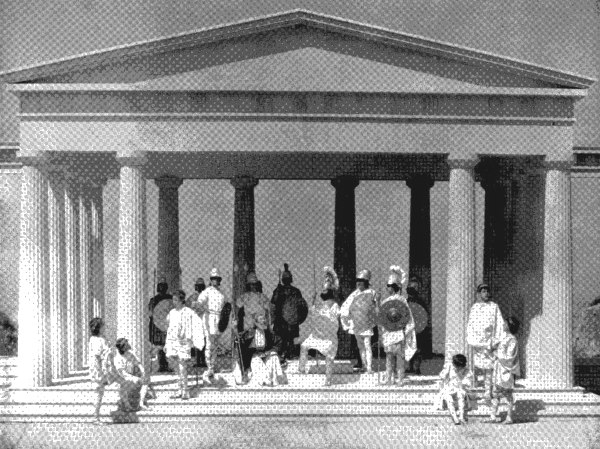
Scene from The Aroma of AthensFrontispiece
Theosophy and Modern Scientific Discoveriesby Charles J. Ryan87
The Bridges of Paris (illustrated)by G. K.96
Old Brynhyfryd Garden (verse)by Kenneth Morris97
Misused Powersby R. W. Machell98
Is Education Wasted?by H. T. Edge. b. a. (Cantab.)102
The Temple of Theseus, Athens (illustrated)by R.106
Stoa, Gymnasium of Hadrian, Athens (illustration)facing107
Recent Admissions by Archaeologistsby a Student107
Monument of De Lesseps, Port Said (illustration)facing110
Great Names in Art. Sculptures from the Albert Memorial (illustrated)by an Art Student111
The Two Fairylands: A Study in the Literature of Wonderby Kenneth Morris115
Light Physical and Metaphysicalby H. Coryn, m. d., m. r. c. s.122
Eros: Painting by Julius Kronberg (illustrated)by R. W. Machell125
Tempting Counterfeits vs. Realityby Lydia Ross, m. d.126
Life and Teachings of Pythagorasby F. S. Darrow, a. m., ph. d. (Harv.)130
Photography and the Invisibleby Philip A. Malpas142
Visingsborg Castle, Visingsö, The Canal, Trollhättan, Sweden (illustrations)facing142
High Sluice and the Palace of Industry, Amsterdam (illustrations)facing143
Heredity and Biologyby H. T. Edge. b. a. (Cantab.)145
Incorrodible Bronzeby Travers148
Scientific Oddmentsby the Busy Bee149
Linnaeus and the Divining-Rodcontributed by P. F.154
Lomaland Cañons (illustrated)by W. J. Renshaw155
Notices158
Copyright by Katherine Tingley, 1911Lomaland Photo. and Engraving Dept.
SCENE FROM "THE AROMA OF ATHENS," A GREEK DRAMA GIVEN AT POINT LOMA IN APRIL, 1911, BY KATHERINE TINGLEY AND STUDENTS AT THE INTERNATIONAL THEOSOPHICAL HEADQUARTERS CENTRAL FIGURES ARE: PHEIDIAS SEATED, PERIKLES STANDING
The Theosophical Path
KATHERINE TINGLEY, EDITOR
VOL. I
NO. 2
AUGUST, 1911
I produced the golden key of Pre-existence only at a dead lift, when no other method could satisfy me touching the ways of God, that by this hypothesis I might keep my heart from sinking.—Henry More