THE TOWER OF LONDON AND THE HOUSES OF PARLIAMENT: by Carolus
Reading edition

THE Tower of London and the Houses of Parliament, Westminster, are the most striking and important buildings that stand on the banks of the Thames in London. Both are on the north side of the river, but are at a considerable distance from each other.
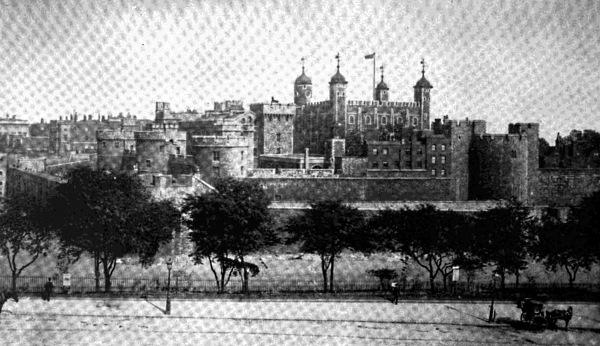
The Tower is one of the few early Norman castles which have come down to us in a fairly perfect condition. Tradition says a fortress was built by Julius Caesar on the site, but the nucleus of the present building was begun in 1078 by William the Conqueror. This was the White Tower, the highest building with the four turrets shown in our illustration. It was completed by William Rufus, who also built the famous "Traitor's Gate," through which the unfortunate victims of Royal displeasure were rowed in from the river. Many additions were afterwards made, and the building and courts now cover thirteen acres surrounded by a moat. The Tower was closely identified with many of the most tragic events in English history for at least five hundred years after its erection, and if its walls could speak the tale of horror could hardly be surpassed by the record of any other medieval building. In the Chapel of St. Peter-in-Chains, lie the bodies of Queen Anne Boleyn and her brother, Queen Catherine Howard, the Earl of Essex, the Duke of Monmouth, Bishop Fisher, More, and many other great personages who suffered death in the Tower. It was a short road from the Traitor's Gate, through the Bloody Tower, to this chapel. Many State prisoners have spent weary years of incarceration in the Tower; Sir Walter Raleigh, one of the greatest and noblest, was confined here for thirteen years.
The Tower of London was occasionally the residence of the earlier sovereigns of England, but its main purpose was the defense of the city. In these days of powerful weapons it would be useless as a fortress, but it is still a military post and headquarters, and contains a large collection of armor. The Jewel Room, in which the Royal Regalia are kept, and the rooms where distinguished prisoners were confined, attract many visitors.
Lomaland Photo. and Engraving Dept.
THE TOWER OF LONDON
Lomaland Photo. and Engraving Dept.
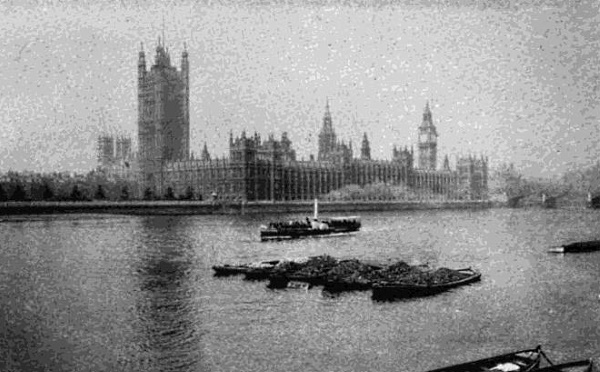
HOUSES OF PARLIAMENT, LONDON VIEW FROM THE RIVER
Lomaland Photo. and Engraving Dept.
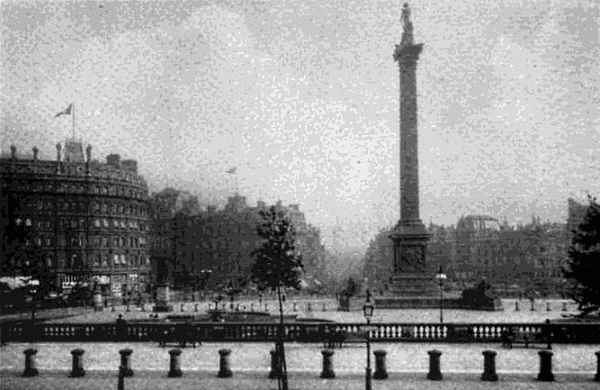
TRAFALGAR SQUARE, LONDON TAKEN FROM THE NATIONAL GALLERY
The Houses of Parliament at Westminster are—with the exception of Westminster Hall, built by William Rufus—quite modern, and have no gloomy associations such as those of the Tower. The building covers about eight acres and the façade overlooking the Thames is nine hundred feet long. The tall tower on the left in the illustration is the Victoria Tower; it is supported upon four pointed arches sixty feet in height, and the highest point is three hundred and forty feet above the ground. The central tower is three hundred feet high, and the picturesque Clock Tower, on the right, is three hundred and twenty feet high. During the evening sittings of the Houses a lamp is kept burning near the top of the Clock Tower, which is extinguished when the debates are over. The building consists mainly of the House of Peers and the House of Commons, with the connected apartments and offices, the whole forming one structure. Just above the river, along the front of the palace runs the Terrace, a broad paved walk where the members of Parliament can stroll in the fresh air and yet be within sound of the division bell.
The towers of Westminster Abbey are visible to the left of the Victoria Tower, and a small portion of Westminster Bridge is seen at the extreme right.
Not far from the Houses of Parliament is Trafalgar Square, which is probably more familiar to the general public than any spot in London, for it is the meeting-place of so many important thoroughfares. Our illustration is taken from the steps of the National Gallery of Pictures. The fluted Corinthian Column erected to Admiral Nelson dominates the scene. The colossal bronze statue of the hero is elevated one hundred and seventy-six feet in the air and, needless to say, the artistic workmanship is above criticism, for no one can distinguish any detail at that height! The bronze lions at the base are by Sir Edwin Landseer, and possess considerable dignity. At the far end of the street to the left of the Nelson Monument (Parliament Street) the faint outline of the Clock Tower of the Houses of Parliament can just be distinguished. At the top of this street, not far from the Nelson Monument, stands the fine antique equestrian statue of Charles I, one of the few outdoor monuments that are creditable to the British metropolis. A few steps to the left of Trafalgar Square as shown in the plate is the new Charing Cross; the original one was destroyed by the Puritan Parliament.