IRISH SCENES: by Fred J. Dick, M. Inst. C. E., M. Inst. C. E. I.
Reading edition
TO the archaeologist, the geologist, the folk-lorist, and the lover of nature in all her aspects, perhaps no area of similar extent is more replete with interest than that of Ireland. As to fairies, the county Sligo folk will tell you they have more of them to the square yard than can be found in a square mile of the county Kerry. Folk-lorists will doubtless pass upon this claim intelligently, when they wear the right sort of spectacles. Fairies aside, however, hardly a square mile of the country lacks some ruin of great antiquity.
Nearly two thousand years have elapsed since Baile Atha Cliath Duibhlinne (the town of the hurdle-ford on the black river), now Dublin, began to share with Tara the honor of being chief city. Dublin, therefore, has no known history that could be called really ancient; for in the light of the Theosophical teachings and records, two thousand years is merely modern. Tara, on the other hand, was a center of national life and government so ancient as to be probably coeval with Brugh na Boinne. Which means they were there "before the flood," or in other words, long before Poseidon went down, some eleven or twelve thousand years ago.
The fact that the city of Tara was set on a hill, suggests the idea that there may have been a time, once, when cities having certain high functions to fulfil, were usually set on hills.
In correspondence with the withdrawal of the higher influences of the Tuatha de Danaans from visible participation in Irish life, and the reign of the Formorians and their heirs, leading Ireland in common with other places to descent through dark ages, it was fitting that regal and poetic Tara should fade, and Dublin rise with its distilleries, breweries, and vivisection halls, and with many of its folk within hospitals, poor-houses, and insane asylums—in accentuation of the modern spirit. That such conditions are, in point of fact, unnecessary, can easily be deduced from the study of certain small races who have not wholly forgotten some essential principles in the art of living.
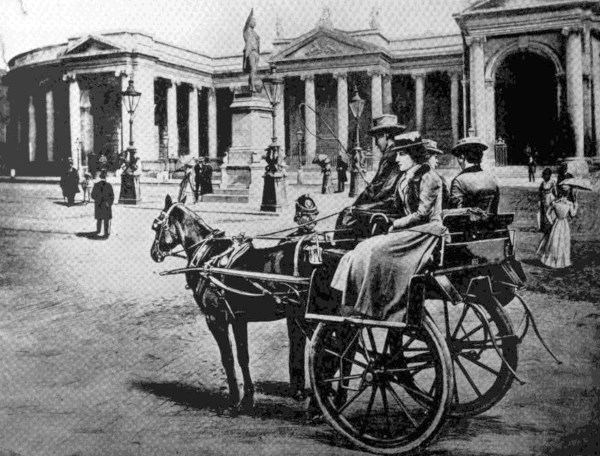
Nevertheless, Dublin, equally with other parts of Ireland, has its bright side. Much of its social life is vivacious, artistic, and literary in high degree, surpassing many cities in these respects. This city began to assume its present appearance in the eighteenth century, when Sackville street, as then named, was built. It is one of the finest streets in Europe. The munificent grants of the Irish parliament enabled many handsome public buildings to be constructed, as well as hospitals, harbors, canals, etc. Among the finest of the public edifices is that of the old houses of parliament, now occupied as a bank.
The first meeting of the Irish parliament within the part of this structure then completed, took place in 1731; but entire legislative independence was only reached in 1782. Eighteen years later, owing to some rather meretricious influences, the parliament voted away its rights; and the Union occurred in 1800. The building, which took many years to complete, possesses majesty in design combined with simplicity in arrangement, and has few rivals. Constructed of Portland stone, the style is chastely classic, owing nothing to extraneous embellishment—the mere outline producing a harmonious effect. The principal front is formed by an Ionic colonnade, raised on a flight of steps, and ranged round three sides of a spacious quadrangle. In the central part a portico projects, formed of four Ionic columns, sustaining a tympanum with the royal arms, while the apex is adorned with a colossal statue—Hibernia—with others representing Fidelity and Commerce on the western and eastern points. From the outer ends of these colonnades the building sweeps eastward and westward in circular form, the walls, unpierced by openings, standing behind rows of Corinthian columns, and having the interspaces tastefully indented by niches. Over the eastern portico are statues of Fortitude, Justice, and Liberty. The original designer of this noble edifice is unknown. The House of Lords has been left practically untouched to this day, save that the Speaker's chair is now in the Royal Irish Academy.
On the opposite side of College Green is the extensive Corinthian façade of Trinity College; and passing a short way towards Sackville (now O'Connell) street, one reaches the Carlisle Bridge, from which can be seen another magnificent building called the Custom House (though so immense as to accommodate many government offices), as well as the Four Courts and other massive structures, so numerous as to give the impression of a people possessing energy, taste, and industry. Since the early years of the nineteenth century, however, there have been no fine buildings added, if we except the splendid pile of the Science and Art Museums and Library in Kildare street.
The environs of Dublin, within a dozen miles or so, possess singular charm and variety; and on Sundays the good folk keep the jaunting-cars busy throughout the regions from Delgany, Powerscourt and the Dublin mountains, to Leixlip, Howth and Malahide. Not many know that Malahide Castle contains an altar-piece from the oratory of Mary Queen of Scots, at Holyrood, for which Charles II gave two thousand pounds sterling. Among the valuable paintings in this Castle is a portrait of Charles I by Vandyke.
There is a territory within almost equally easy reach of Dublin, whose loveliness excels anything of the kind in Ireland except possibly the Blackwater in county Waterford. It is the Boyne valley between Slane and Beauparc. Everyone in Dublin admits it lovely—but no one has seen it!
In the north and west of Ireland the scenery is frequently wild and stern. Of this character is Fairhead on the Antrim Coast, the Robogdium Promontorium of Ptolemy the geographer, where on one's northward journey is obtained the first glimpse of the remarkable columnar basalt formation met with in profusion in the Giant's Causeway region. One of the basaltic pillars forming the stupendous natural colonnade over six hundred feet high at Fairhead, is a rectangular prism 33 feet by 36 on the sides, and 319 feet in height, and is the largest basaltic pillar known.
Further along this coast is the rope-bridge at Carrick-a-Rede, which sways in the wind as you walk over it, while the Atlantic waves boil in the appalling chasm beneath; and woe to you, if overcome by terror you attempt to lean on the thin hand-line.
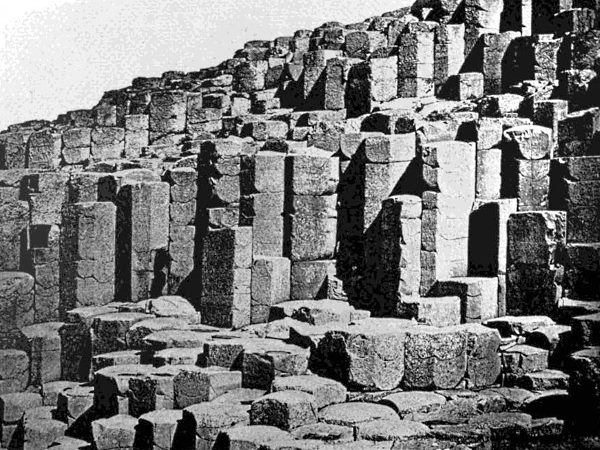
The coast scenery in the vicinity of the Giant's Causeway is grandly impressive, as seen from a boat. The promontory called the Pleaskin, consisting of terrace upon terrace of columnar basalt, and the succession of extraordinary rock groups such as the Sea Gulls, the King and his Nobles, the Nursing Child, the Priest and his Flock, the Chimney Rock, the Giant's Organ, and finally the Causeway itself, form astonishing instances of nature's sportfulness.
The pillars in the Causeway number about forty thousand, and are composed mainly of irregular hexagonal prisms varying from fifteen to twenty-six inches in diameter, but all fitting together compactly. Among other features of the place is the Giant's Amphitheatre, which is exactly semi-circular, with the slopes at the same angle all round; while around the uppermost part runs a row of columns eighty feet high. As a German writer, Kahl, continues:
Then comes a broad rounded projection, like an immense bench, for the accommodation of the giant guests of Finn MacCumhal; then again a row of columns sixty feet high, and then again a gigantic bench, and so down to the bottom, where the water is enclosed by a circle of black boulder stones, like the limits of the arena.
Lomaland Photo. and Engraving Dept.
THE OLD HOUSES OF PARLIAMENT—NOW THE BANK OF IRELAND; COLLEGE GREEN, DUBLIN
Lomaland Photo. and Engraving Dept.
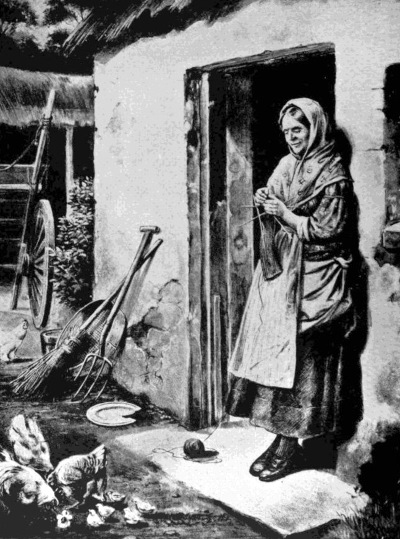
AN IRISH PEASANT WOMAN
Lomaland Photo. and Engraving Dept.
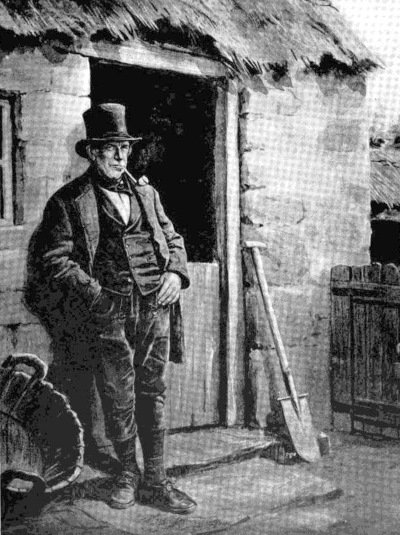
AN IRISH FARMER
Lomaland Photo. and Engraving Dept.
PART OF THE GIANTS' CAUSEWAY, ANTRIM, IRELAND
We should have to go back to the era when the Bamian statues were carved out of the living rock (see The Secret Doctrine, ii, 388) to find giants tall enough to occupy this amphitheater gracefully.
The convulsion which lowered the Giants' Causeway, with its substratum of ocher, below the upper tier level of the Pleaskin, produced the landslide at the Giants' Organ, and submerged the continuous land connexion with Staffa, must have belonged to far pre-Atlantean times (the Atlantean continental system proper having ended nearly a million years ago), and be referable to the Secondary Age, when there really were giants somewhat approaching the size suggested. It must have been far back in Lemurian times, for the sinking and transformation of the Lemurian continental systems began in the vicinity of Norway, and ended at Atlantean Lankâ, of which Ceylon was the northern highland.
There are traditions of enormous giants in many parts of Ireland. Thus the rope-bridge chasm above mentioned, is said to have been cut by a stroke of Finn MacCumhal's sword, a feat that would have been difficult for even a Lemurian giant. The legends in Kerry express, by similar exaggeration, the size and strength of a former giant race.
This reminds us that the Raphaim (phantoms), Nephilim (fallen ones), and Gibborim (mighty ones) of the Bible refer to the First and Second semi-ethereal Races, the Third (Lemurian), and the Fourth (Atlantean) respectively.
But in order to grasp this subject intelligently, the reader may be referred to those volumes which it will be more and more the principal business of the scholars, archaeologists, and scientific men of the twentieth century to study, interpret and vindicate (vindication is already in full stride), namely, The Secret Doctrine, written by H. P. Blavatsky.

True glory consists in doing that which deserves to be written, in writing what deserves to be read, and in so living as to make the world happier for our living in it.—Pliny