Chapter I · THE GODLINGS OF NATURE.
Reading edition
Ἐν μὲν γαῖαν ἐτεύξ’ ἐν δ’ οὐρανὸν, ἐν δὲ θάλασσαν
ἠέλιόν τ’ ἀκάμαντα σελήνην τε πλήθουσαν,
ἐν δὲ τὰ τείρεα πάντα, τά τ’ οὐρανὸς ἐστεφάνωται
Πληϊάδασ θ’ Ὑάδας τε, τό τε σθένος Ὠρίωνος
Ἄρκτον θ’, ἣν καὶ ἄμαξαν ἐπίκλησιν καλέουσιν,
ἣτ αὐτοῦ στρέφαται καί τ’ Ὠρίωνα δοκεύει,
οἴη δ’ ἄμμορος ἐστι λοετρῶν Ὠκεανοῖο.
Iliad, xviii. 483–88.
Among all the great religions of the world there is none more catholic, more assimilative than the mass of beliefs which go to make up what is popularly known as Hinduism. To what was probably its original form—a nature worship in a large degree introduced by the Aryan missionaries—has been added an enormous amount of demonolatry, fetishism and kindred forms of primitive religion, much of which has been adopted from races which it is convenient to describe as aboriginal or autochthonous.
The Deva.
The general term for these great gods of Hinduism is Deva, or “the shining ones.” Of these even the survivors have in the course of the development of the religious belief of the people suffered serious change. Modern Vaishnavism has little left of the original conception of the solar deity who in the Rig Veda strides in three steps through the seven regions of the universe, and envelops all things in the dust of his beams. To his cult has, in modern times, been added the erotic cycle of myths which centre round Krishna and Râdhâ and Rukminî. The successive Avatâras or incarnations mark the progressive development of the cultus which has absorbed in succession the totemistic or fetish worship of the tortoise, the boar, the fish and the man-lion. In the same way Rudra-Siva has annexed various faiths, many of which are probably of local origin, such as the worship of the bull and the linga. Durgâ-Devî, again, most likely is indebted to the same sources for the blood sacrifices which she loves in her forms of Kâlî, Bhawânî, Chandikâ or Bhairavî. A still later development is that of the foul mysteries of the Tantra and the Sâktis.
The Deotâ.
Godlings Pure and Impure.
These godlings fall into two well marked classes—the “pure” and the “impure.” The former are, as a rule, served by priests of the Brâhman castes or one of the ascetic orders: their offerings are such things as are pure food to the Hindu—cakes of wheaten flour, particularly those which have been still further purified by intermixture with clarified butter (ghî), the most valued product of the sacred cow, washed rice (akshata) and sweetmeats. They are very generally worshipped on a Sunday, and the officiating high-caste priest accepts the offerings. The offerings to the “impure” godlings contain articles such as pork and spirits, which are abomination to the orthodox Hindu. In the Central Indian hills their priest is the Baiga, who rules the ghosts and demons of the village and is always drawn from one of the Drâvidian tribes. In the plain country the priest is a non-Aryan Chamâr, Dusâdh, or even a sweeper or a Muhammadan Dafâli or drummer. No respectable Hindu will, it is needless to say, partake of a share of the food consecrated (prasâd) to a hedge deity of this class. Much of the worship consists in offering of blood. But the jungle man or the village menial of the plains can seldom, except in an hour of grievous need, afford an expensive animal victim, and it is only when the village shrine has come under the patronage of the official priests of the orthodox faith, that the altar of the goddess reeks with gore, like those of the Devîs of Bindhâchal or Devî Pâtan.
Sûraj Nârâyan, the Sun Godling.
The first and greatest of the “pure” godlings is Sûrya or Sûraj Nârâyan, the Sun godling. He is thus regarded as Nârâyana or Vishnu occupying the sun. A curiously primitive legend represents his father-in-law, Viswakarma, as placing the deity on his lathe and trimming away one-eighth of his effulgence, leaving only his feet. Out of the blazing fragments he welded the weapons of the gods. Sûrya was one of the great deities of the Vedic pantheon: he is called Prajapati or “lord of creatures:” he was the son of Dyaus, or the bright sky. Ushas, the dawn, was his wife, and he moves through the sky drawn by seven ruddy mares. His worship was perhaps originally connected with that of fire, but it is easy to understand how, under a tropical sky, the Indian peasant came to look on him as the lord of life and death, the bringer of plenty or of famine. If one interpretation of the rite be correct, the Holî festival is intended as a means of propitiating sunshine. He is now, however, like Helios in the Homeric mythology, looked on as only a godling, not a god, and even as a hero who had once lived and reigned on earth.
Village Worship of Sûraj Nârâyan.
Another famous centre of Sun-worship was Multân, where, as we have seen, a temple dedicated to him has been discovered, and where the tribes of the Bâlas and Kâthis were devoted to him. The worship continued till the idol was destroyed by orders of Aurangzeb.
Sun-worship among the non-Aryan Races.
The Aheriyas, a tribe of jungle-livers and thieves in the Central Duâb of the Ganges and Jumna, have adopted as their mythical ancestor Priyavrata, who being dissatisfied that only half the earth was at one time illuminated by the rays of the sun, followed him seven times round the earth in his flaming car, resolved to turn night into day. But he was stopped by Brahma, and the wheels of his chariot formed the seven oceans which divide the seven continents of the world.
In the lower ranges of the Himâlaya Sun-worship is conducted in the months of December and January and when eclipses occur. The principal observances are the eating of a meal without salt at each passage of the sun into a new sign of zodiac, and eating meals on other days only when the sun has risen.
Sun-worship in the Domestic Ritual.
Moon-worship.
There are also many explanations to account for the spots in the moon. In Western lands the moon is inhabited by a man with a bundle of sticks on his back; but it is not clear of what offence this was the punishment. Dante says he is Cain; Chaucer says he was a thief, and gives him a thorn-bush to carry; Shakespeare gives him thorns to carry, but provides him with a dog as a companion. In Ireland children are taught that he picked faggots on a Sunday and is punished as a Sabbath-breaker. In India the creature in the moon is usually a hare, and hence the moon is called Sasadhara, “he that is marked like a hare.” According to one legend the moon became enamoured of Ahalyâ, the wife of the Rishi Gautama, and visited her in the absence of her husband. He returned, and finding the guilty pair together, cursed his wife, who was turned into a stone; then he threw his shoe at the moon, which left a black mark, and this remains to this day. The scene of this event has been localized at Gondar in the Karnâl District. By another variant of the legend it was Vrihaspati, the Guru or religious adviser of the gods, who found the moon with his wife. The holy man was just returning from his bath in the Ganges, and he threw his dripping loin-cloth at the moon, which produced the spots. In Upper India, again, little children are taught to call the moon Mâmû or “maternal uncle,” and the dark spots are said to represent an old woman who sits there working her spinning-wheel.
The moon has one special function in connection with disease. One of his titles is Oshadhipati or “lord of the medicinal plants.” Hence comes the idea that roots and simples, and in particular those that are to be used for any magical or mystic purpose, should be collected by moonlight. Thus in Shakespeare Jessica says,—
“In such a night Medea gathered the enchanted herbs
That did renew old Aeson.”
“Sow peason and beans, in the wane of the moon.
Who soweth them sooner, he soweth too soon;
That they with the planet may rest and arise,
And flourish, with bearing most plentiful wise.”
The same rule applies all over Northern India, and the phases of the moon exercise an important influence on all agricultural operations.
Horace speaks of rustic Phidyle,—
“Coelo supinas si tuleris manus,
Eclipses and the Fire Sacrifice.
In India, however, this earlier explanation of the phenomena of eclipses flourishes in full vigour. The eclipse demon, Râhu, whose name means “the looser” or “the seizer,” was one of the Asuras or demons. When the gods produced the Amrita, or nectar, from the churned ocean, he disguised himself like one of them and drank a portion of it. The sun and moon detected his fraud and informed Vishnu, who severed the head and two of the arms of Râhu from the trunk. The portion of nectar which he had drunk secured his immortality; the head and tail were transferred to the solar sphere, the head wreaking its vengeance on the sun and moon by occasionally swallowing them, while the tail, under the name of Ketu, gave birth to a numerous progeny of comets and fiery meteors. By another legend Ketu was turned into the demon Sainhikeya and the Arunah Ketavah or “Red apparitions,” which often appear in the older folk-lore.
In connection with this rite of fire-walking they have another function in which a ladder is made of wooden sword-blades, up which the priest is compelled to climb, resting the soles of his feet on the edges of the weapons. When he reaches the top he decapitates a white cock which is tied to the summit of the ladder. This kind of victim is, as we have already seen, appropriate to propitiate the Sun godling, and there can be little doubt that the main object of this form of symbolical magic is to appease the deities which control the rain and harvests.
Eclipse Observances.
Food is particularly liable to this form of pollution. The wise housewife, when an eclipse is announced, takes a leaf of the Tulasî or sacred basil, and sprinkling Ganges water on it, puts the leaf in the jars containing the drinking water for the use of the family and the cooked food, and thus keeps them pure while the eclipse is going on. Confectioners, who are obliged to keep large quantities of cooked food ready, relieve themselves and their customers from the taboo by keeping some of the sacred Kusa or Dûb grass in their vessels when an eclipse is expected. A pregnant woman will do no work during an eclipse, as otherwise she believes that her child would be deformed, and the deformity is supposed to bear some relation to the work which is being done by her at the time. Thus, if she were to sew anything, the baby would have a hole in its flesh, generally near the ear; if she cut anything, the child would have a hare-lip. On the same principle the horns of pregnant cattle are smeared with red paint during an eclipse, because red is a colour abhorred by demons. While the eclipse is going on, drinking water, eating food, and all household business, as well as the worship of the gods, are all prohibited. No respectable Hindu will at such a time sleep on a bedstead or lie down to rest, and he will give alms in barley or copper coins to relieve the pain of the suffering luminaries.
Of course, the time of an eclipse is most inauspicious for the commencement of any important business. Here again the learned Aubrey confirms the current Hindu belief. “According to the rules of astrology,” he says, “it is not good to undertake any business of importance in the new moon or at an eclipse.”
Star-worship.
The worship of the other constellations is much less important than those of the greater luminaries which we have been discussing. The Hindu names nine constellations, known as Nava-graha, “the nine seizers,” specially in reference to Râhu, which grips the sun and moon in eclipses, and more generally in the astrological sense of influencing the destinies of men. These nine stars are the sun (Sûrya), the moon (Soma, Chandra), the ascending and descending nodes (Râhu, Ketu), and the five planets—Mercury (Budha), Venus (Sukra), Mars (Mangala, Angâraka), Jupiter (Vrihaspati), and Saturn (Sani). This group of nine stars is worshipped at marriages and other important religious rites. Of the signs of the Zodiac (râsi-chakra) the rural Hindu knows little more than the names—Mesha (Aries), Vrisha (Taurus), Mithuna (Gemini), Karka (Cancer), Sinha (Leo), Kanya (Virgo), Tula (Libra), Vrischika (Scorpio), Dhanu (Sagittarius), Makara (Capricornus), Kumbha (Aquarius), and Mîna (Pisces). Practically the only direct influence they exercise over his life is that from the opening Râsi or sign in which he is born the first letter of the secret name which he bears is selected. Still less concern has he with the asterisms or Nakshatra, a word which has been variously interpreted to mean “coming or ascending,” “night guardians,” or “undecaying.” As already stated, they are said to have been the twenty-seven daughters of the Rishi Daksha, and wives of Soma or the moon. The usual enumeration gives twenty-eight, and they are vaguely supposed to represent certain stars or constellations, but the identification of these is very uncertain. One list, with some of the corresponding stars, gives Sravishthâ or Dhanishthâ (Delphinus), Sata-bhishaj (Aquarius), Pûrva Bhâdrapadâ, Uttara Bhâdrapadâ, Revatî, Asvinî (Aries), Bharanî (Musca), Krittikâ (the Pleiades), Rohinî (Aldebaran), Mriga-siras (Orion), Ârdrâ, Punarvasû, Pushya, Âsleshâ, Maghâ (Leo), Pûrvâ-Phalgunî, Uttara Phalgunî, Hasta (Corvus), Chitrâ (Spica Virginis), Svâtî (Arcturus), Visâkha (Libra), Anurâdhâ, Jyeshthâ, Mûla, Pûrva Âshâdhâ, Uttara Âshâdhâ, Abhijit (Lyra), and Sravana. These are used only in calculating the marriage horoscope, and the only one of them with which the fairly well-to-do rustic has much concern is with the unlucky Mûla. Should by an evil chance his son be born in this asterism, he has to undergo a most elaborate rite of purification.
Others stars have their legends. The Riksha or constellation of the Great Bear represents the seven deified Rishis—Gautama, Bhâradwaja, Viswamitra, Jamadagni, Vashishtha, Kasyapa and Atri. Dhruva, the Pole Star, was the grandson of Manu Swayambhuva, and was driven from his home by his step-mother. He, though a Kshatriya, joined the company of the Rishis and was finally raised to the skies as Grahadhâra, “the pivot of the plants.” So Canopus is the Rishi Agastya who was perhaps one of the early Aryan missionaries to Southern India and won a place in heaven by his piety. Orion is Mrigasiras, the head of Brahma in the form of a stag which was struck off by Siva when the deity attempted violence to his own daughter Sandhyâ, the twilight. Krittikâ or the Pleiades represent the six nurses of Kârttikeya, the god of war.
Part of the purificatory rite for a woman after her delivery is to bring her out at night and let her look at the stars, while her husband stands over her with a bludgeon to guard her from the assaults of demons. One interesting survival of the old mythology is that in Upper India women are fond of teaching their children that the stars are kine and the moon their shepherd, an idea which has formed the basis of much of the speculations of a school of comparative mythology now almost completely discredited.
The Rainbow.
There is much curious folk-lore about the rainbow. By most Hindus it is called the Dhanus or bow of Râma Chandra, and by Muhammadans the bow of Bâba Âdam or father Adam. In the Panjâb it is often known as the swing of Bîbî Bâî, the wife of the Saint Sakhi Sarwar. The Persians call it the bow of Rustam or of Shaitân or Satan, or Shamsher-i-’Ali—“the sword of ’Ali.” In Sanskrit it is Rohitam, the invisible bow of Indra. In the hills it is called Panihârin or the female water-bearer.
The Milky Way.
So with the Milky Way, of which an early name is Nâgavithi or the path of the snake. The Persians call it Kahkashân, the dragging of a bundle of straw through the sky. The Hindu calls it Akâsh Gangâ or the heavenly Ganges, Bhagwân kî kachahrî or the Court of God, Swarga-duâri or the door of Paradise; while to the Panjâbi it is known as Bera dâ ghâs or the path of Noah’s Ark. In Celtic legend it is the road along which Gwydion pursued his erring wife.
Earth-worship.
Worship of Mother Earth.
Throughout Northern India the belief in the sanctity of the earth is universal. The dying man is laid on the earth at the moment of dissolution, and so is the mother at the time of parturition. In the case of the dying there is perhaps another influence at work in this precaution, the idea that the soul must not be barred by roof or wall, and allowed to wing its course unimpeded to the place reserved for it.
In the eastern districts of the North-Western Provinces there is a regular rite common to all the inferior castes that a few days before a wedding the women go in procession to the village clay-pit and fetch from there the sacred earth (matmangara), which is used in making the marriage altar and the fireplace on which the wedding feast is cooked. There are various elements in the ritual which point to a very primitive origin. Thus, one part of the proceedings is that a Chamâr, one of the non-Aryan castes, leads the procession, beating his drum the whole time to scare demons. When the earth has been collected the drum is worshipped and smeared with red lead. There can be little doubt that the drum was one of the very primitive fetishes of the aboriginal races. One, and perhaps about the most primitive, form of it is the Damaru or drum shaped like an hour-glass which accompanies Siva, and next to this comes the Mândar, the sides of which are formed out of earthenware, and which is the first stage in the development of a musical instrument from a vessel covered with some substance which resounds when beaten. This latter form of drum is the national musical instrument of the Central Indian Gonds and their brethren. The Chamâr, again, digs the earth with an affectation of secrecy, which, as we shall see, is indispensable in rites of this class. The mother of the bride or bridegroom veils herself with her sheet, and the digger passes the earth over his left shoulder to a virgin who stands behind him and receives it in a corner of her robe.
Earth-worship among the Drâvidians.
Secrecy in Worship of Mother Earth.
We shall meet other instances in which secrecy is an essential element in these rural rites. This condition prevails almost universally. Notable, too, is the rule by which married women are excluded from a share in offerings to the Earth goddess.
Thunder and Lightning.
As is natural, thunder and lightning are considered ill-omened. In the old mythology lightning (vidyut) was one of the weapons of the Maruts, and Parjanya was the deity who wielded the thunderbolt. Many legends tell that the soul of the first man came to earth in the form of the lightning. Thus Yama was the first man born of the thunderbolt, and he first trod the path of death and became regent of the dead. Many are the devices to scare the lightning demon. “During a thunderstorm it was a Greek custom to put out the fire, and hiss and cheep with the lips. The reason for the custom was explained by the Pythagoreans to be that by acting thus you scared the spirits in Tartarus, who were doubtless supposed to make the thunder and lightning. Similarly some of the Australian blacks, who attribute thunder to the agency of demons, and are much afraid of it, believe that they can dispel it by chanting some particular words and breathing hard; and it is a German superstition that the danger from a thunderstorm can be averted by putting out the fire. During a thunderstorm the Sakai of the Malay Peninsula run out of their houses and brandish their weapons to drive away the demons; and the Esthonians in Russia fasten scythes, edge upwards, over the door, that the demons, fleeing from the thundering god, may cut their feet if they try to seek shelter in the house. Sometimes the Esthonians, for a similar purpose, take all the edged tools in the house and throw them out into the yard. It is said that when the thunder is over, spots of blood are often found on the scythes and knives, showing that the demons have been wounded by them.
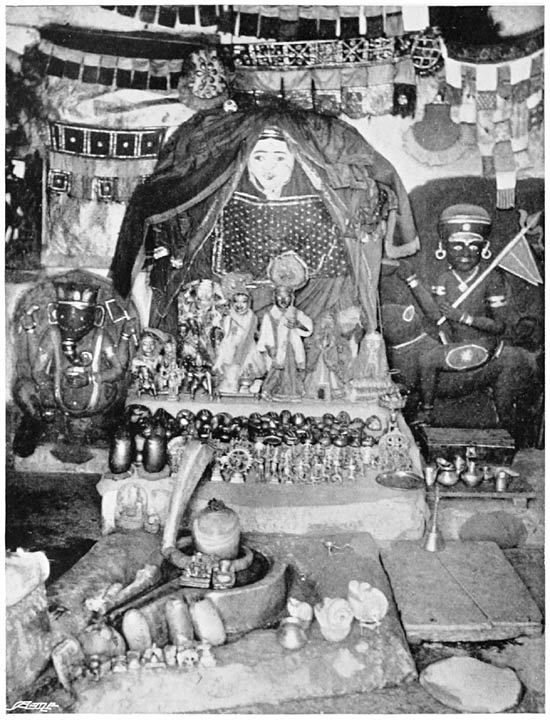
IMAGE OF GANGA MÂÎ.
Earthquakes.
River-worship.
High on the list of benevolent deities of Northern India are the great rivers, especially the Ganges and the Jumnâ, which are known respectively as Gangâ Mâî or “Mother Ganges” and Jumnâ jî or “Lady Jumnâ.”
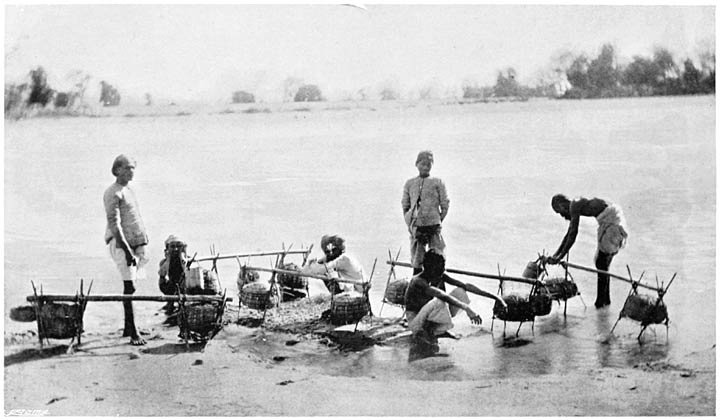
GANGES WATER BEARERS.
But it is by bathing in the sacred stream at the full moon, during eclipses, and on special festivals that the greatest efficacy is assured. On these occasions an opportunity is taken for making oblations to the sainted dead whose ashes have been consigned to her waters. Bathing is throughout India regarded as one of the chief means of religious advancement. The idea rests on a metaphor—as the body is cleansed from physical pollution, so the soul is purified from sin. The stock case of the merit of this religious bathing is that of King Trisanku, “he who had committed the three deadly sins,” who is also known as Satyavrata. The legend appears in various forms. By one story he tried to win his way to heaven by a great sacrifice which his priest, Vasishtha, declined to perform. He then applied to Visvamitra, the rival Levite, who agreed to assist him. He was opposed by the sons of Vasishtha, whom he consumed to ashes. Finally, Trisanku was admitted to heaven, but he was forced by the angry saint to hang for ever with his head downwards. By another account he committed the deadly sins of running away with the wife of a citizen, offending his father, and killing in a time of famine Kâmadhenu, the wondrous cow of Vashishtha. By another story he killed a cow and a Brâhman and married his step-mother. At any rate he and the wicked Râja Vena were the types of violent sinners in the early legends; possibly they represent a revolt against the pretensions of the Brâhmans. At length the sage Visvamitra took pity upon him, and having collected water from all the sacred places in the world, washed him clean of his offences.
Springs Connected with the Ganges.
Sacred River Junctions.
Ill-omened Streams.
But all rivers are not beneficent. Worst of all is the dread Vaitaranî, the river of death, which is localized in Orissa and pours its stream of ordure and blood on the confines of the realm of Yama. Woe to the wretch who in that dread hour lacks the aid of the Brâhman and the holy cow to help him to the other shore. The name of one stream is accursed in the ears of all Hindus, the hateful Karamnâsa, which flows for part of its course through the Mirzapur District. Even to touch it destroys the merit of works of piety, for such is the popular interpretation of its name. No plausible reason for the evil reputation of this particular stream has been suggested except that it may have been in early times the frontier between the invading Aryans and the aborigines, and possibly the scene of a campaign in which the latter were victorious. The Karamâ tree is, however, the totem of the Drâvidian Kharwârs and Mânjhis, who live along its banks, and it is perhaps possible that this may be the real origin of the name, and that its association with good works (karma) was an afterthought.
Origin of River-worship.
The two great rivers of Upper India were, again, associated with that land of fable and mystery, the snowy range which was the home of the gods and the refuge of countless saints and mystics, who in its solitudes worked out the enigma of the world for the modern Hindu. They ended in the great ocean, the final home of the ashes of the sainted dead. Even the partially Hinduised Drâvidian tribes of the Vindhyan Plateau bring the bones of their dead relations to mingle with those of the congregation of the faithful, who have found their final rest in its waters since the world was young. The Ganges and the streams which swell its flood thus come to be associated with the deepest beliefs of the race, and it is hard to exaggerate its influence as a bond of union between the nondescript entities which go to make up modern Hinduism.
Another variety of these demons of water is the Nâga and his wife the Nâgin, of whom we shall hear more in connection with snake-worship. In the Sikandar, a tributary of the Son, is a deep water-hole where no one dares to go. The water is said to reach down as far as Pâtâla, or the infernal regions. Here live the Nâga and the Nâgin. In the middle of the river is a tree of the Kuâlo variety, and when ghosts trouble the neighbourhood an experienced Ojha or sorcerer is called, who bores holes in the bark of the tree and there shuts up the noxious ghosts, which then come under the rule of the Nâga and Nâgin, who are the supreme rulers of the ghostly band.
Another Mirzapur river, the Karsa, is infested by a Deo, or demon, known as Jata Rohini, or “Rohini of the matted locks.” He is worshipped by the Baiga priest to ensure abundant rain and harvests and to keep off disease. The Baiga catches a fish which he presents to the Deo, but if any one but a Baiga dares to drink there, the water bubbles up and the demon sweeps him away.
In India, also, dangerous creatures of this kind abound. There is in Mirzapur a famous water-hole, known as Barewa. A herdsman was once grazing his buffaloes near the place, when the waters rose in anger and carried off him and his cattle. Nowadays the drowned buffaloes have taken the shape of a dangerous demon known as Bhainsâsura, or the buffalo demon, who now in company with the Nâga and the Nâgin lives in this place, and no one dares to fish there until he has propitiated the demons with the offering of a fowl, eggs, and a goat. Another kind of water demon attacks fishermen; it appears in the form of a turban which fixes itself to his hook and increases in length as he tries to drag it to the shore.
Many of these demons, such as the Nâga and Nâgin, have kingdoms and palaces stored with treasure under the water, and there they entice young men and maidens, who occasionally come back to their mortal kindred and tell them of the wonders which they have seen. These are akin to Morgan la Fay of the Orlando Innamorato, La Motte Fouqué’s Undine, and they often merge into the mermaid of the Swan Maiden type of tale, who marries a mortal lover and leaves him at last because in his folly he breaks some taboo which is a condition of the permanence of their love.
Floods and Drowning People.
Floods are, as we have seen, regarded as produced by demoniacal agency. In the Panjâb, when a village is in danger of floods, the headman makes an offering of a cocoa-nut and a rupee to the flood demon. As in many other places the cocoa-nut represents the head of a human victim, which in olden times was the proper offering. He holds the offering in his hand and stands in the water. When the flood rises high enough to wash the offering from his hand, it is believed that the waters will abate. Some people throw seven handfuls of boiled wheat and sugar into the stream and distribute the remainder among the persons present. Some take a male buffalo, a horse, or a ram, and after boring the right ear of the victim, throw it into the water. If the victim be a horse, it should be saddled before it is offered. A short time ago, when the town and temples at Hardwâr were in imminent danger during the Gohna flood, the Brâhmans poured vessels of milk, rice and flowers into the waters of Mother Ganges and prayed to her to spare them.
Khwâja Khizr, the God of Water.
But besides these water spirits and local river gods, the Hindus have a special god of water, Khwâja Khizr, whose Muhammadan title has been Hinduised into Râja Kidâr, or as he is called in Bengal, Kâwaj or Pîr Badr. This is a good instance of a fact, which will be separately discussed elsewhere, that the Hindus are always ready to annex the deities and beliefs of other races.
The Folk-lore of Wells.
In this connection some of the folk-lore of wells may be mentioned. The digging of a well is a duty requiring infinite care and caution. The work should begin on Sunday, and on the previous Saturday night little bowls of water are placed round the proposed site, and the one which dries up least marks the best site for the well, which reminds us of the fleece of Gideon. The circumference is then marked and they commence to dig, leaving the central lump of earth intact. They cut out this clod of earth last and in the Panjâb call it Khwâjajî, perhaps after Khwâja Khizr, the water god, worship it and feed Brâhmans. If it breaks it is a bad omen, and a new site will be selected a week afterwards. Further east when a man intends to sink a well he inquires from the Pandit an auspicious moment for commencing the work. When that hour comes he worships Gaurî, Ganesa, Sesha Nâga, the world serpent, the earth, the spade and the nine planets. Then facing in the direction in which, according to the directions of the Pandit, Sesha Nâga is supposed to be lying at the time, he cuts five clods with the spade. When the workmen reach the point at which the wooden well-curb has to be fixed, the owner smears the curb in five places with red powder, and tying Dûb grass and a sacred thread to it, lowers it into its place. A fire sacrifice is done, and Brâhmans are fed. When the well is ready, cow-dung, milk, cow urine, butter and Ganges water, leaves of the sacred Tulasî and honey are thrown in before the water is used.
Sacred Wells.
Hot Springs.
Waterfalls.
Sacred Lakes.
The Lake of the Fairy Gifts.
In the Chânda District of the Central Provinces is the lake of Taroba or Tadala, which is connected with an interesting series of folk-lore legends. A marriage procession was once passing the place, and, finding no water, a strange old man suggested that the bride and bridegroom should join in digging for a spring. They laughingly consented, and after removing a little earth a clear fountain gushed forth. As they were all drinking with delight the waters rose, and spreading over the land, overwhelmed the married pair. “But fairy hands soon constructed a temple in the depths, where the spirits of the drowned are supposed to dwell. Afterwards, on the lake side, a palm tree grew up, which appeared only during the day, sinking into the earth at twilight. One day a rash pilgrim seated himself on the tree and was borne into the skies, where the flames of the sun consumed him.” This part of the story reads like a genuine solar myth. “The palm tree then shrivelled away into dust, and in its place appeared an image of the spirit of the lake, which is worshipped under the name of Taroba, or ‘the palm-tree deity.’ Formerly, at the call of pilgrims, all necessary vessels rose from the lake, and after being washed were returned to the waters. But an evil-minded man at last took those he had received to his house, and from that day the mystic provision wholly ceased.”
The Shâhgarh Lake.
Other Sacred Tanks.
Mountain-worship; the Himâlaya.
Mountain-worship among the Drâvidians.
Respect Paid to the Vindhya and Kaimûr Ranges.
These two ranges, says the legend, are an offshoot from the Himâlaya. When Râma was building the bridge across the strait to Lanka, he sent his followers to Himâlaya to collect materials. They returned with a mighty burden, but meanwhile the hero had completed his task; so he ordered them to throw down their loads, and where the stones fell these ranges were produced. In the same way the Maniparvata at Ajudhya is said to have been dropped by Sugrîva, the monkey king of Kishkindhya, and the Irichh hills at Jhânsi are described to have been formed in the same way.
Other Famous Hills.
The Spirits of the Air.
Bhîmsen, a Weather Godling.
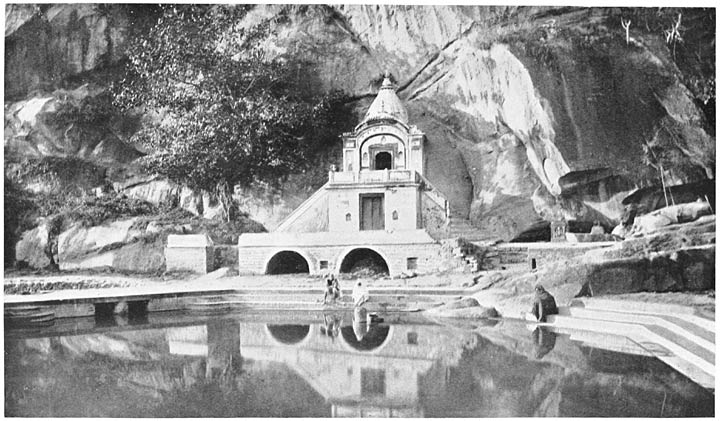
TANK OF BHÎMSEN, HARDWÂR.
Demoniacal Control of the Weather.
Rain-making and Nudity.
Rites Special to Women.
There can be little doubt that rites of this kind largely prevail in India, but, as might naturally be expected, they are very carefully concealed, and it is extremely difficult to obtain precise information about them.
Other Rites to bring Rain.
The song of Alha and Udal, which describes the struggle between the Hindus and the early Muhammadan invaders, is sung in Oudh to procure rain. In the Hills smart showers are attributed to the number of marriages going on at the time in the plains. The bride and bridegroom, as we shall see in the legend of Dulha Deo, are particularly exposed to the demoniacal influence of the weather. In the Eastern Districts of the North-Western Provinces the people will not kill wolves, as they say that wherever there falls a drop of a wolf’s blood the rain will be deficient.
Devices to Cause Rain to Cease.
In England when rain is in excess the little children sing, “Rain! Rain! Go away! Come again on a Saturday!”
Rain-clouds are supposed also to be under the influence of the Evil Eye, and will blow over without giving rain if the malicious glance falls upon them. Hence, when rain is needed, if any one runs out of a house bareheaded while it is raining, he is ordered in at once, or he is told to put on his cap or turban, for a bareheaded man is apt to wish involuntarily that the rain may cease, and thus injure his neighbours.
Everywhere it is believed that the Banya or cornchandler, who is interested in high prices, buries some water in an earthen pot in order to stop the rain.
Hail and Whirlwind.
The hail and the whirlwind are, like most of the natural phenomena which we have been discussing, attributed to demoniacal agency. The Maruts who ride on the whirlwind and direct the storm hold a prominent place in the Veda, where they are represented as the friends and allies of Indra. Another famous tempest demon was Trinâvartta, who assumed the form of a whirlwind and carried off the infant Krishna, but was killed by the child.
In Muzaffarnagar, when hail begins they pray at once to two noted demons, Ismâîl Jogi and Nonâ Chamârin, and ring a bell in a Saiva temple to scare the demon.
Among the Mirzapur Korwas, when a dust-storm comes, the women thrust the house broom, which, as we shall see, is a demon scarer, into the thatch, so that it may not be blown away. The Pankas in the same way make their women hold the thatch and throw the rice mortar and the flour-mill pivot into the courtyard. The wind is ashamed of being defeated by the power of women and ceases to blow.