Chapter III · THE GODLINGS OF DISEASE.
Reading edition
Καὶ γὰρ τοῖσι κακὸν χρυσόθρονος Ἄρτεμις ὦρσεν
Χωσαμένη ὃ οἰ οὔτι θαλύσια γουνῶ ἀλωῆς
Οἰνεὺς ῥέξ.
Iliad ix. 533–535.
We now come to consider a class of rural godlings, the deities who control disease.
The Demoniacal Theory of Disease.
It is a commonplace of folk-lore and the beliefs of all savage races that disease and death are not the result of natural causes, but are the work of devils and demons, witchcraft, the Evil Eye, and so forth. It is not difficult to understand the basis on which beliefs of this class depend. There are certain varieties of disease, such as hysteria, dementia, epilepsy, convulsions, the delirium of fever, which in the rural mind indicate the actual working of an evil spirit which has attacked the patient. There are, again, others, such as cholera, which are so sudden and unexpected, so irregular in their appearances, so capricious in the victims which they select, that they naturally suggest the idea that they are caused by demons. Even to this day the belief in the origin of disease from spirit possession is still common in rural England. Fits, the falling sickness, ague, cramp, warts, are all believed to be caused by a spirit entering the body of the patient. Hence comes the idea that the spirit which is working the mischief can be scared by a charm or by the exorcism of a sorcerer. They say to the ague, “Ague! farewell till we meet in hell,” and to the cramp, “Cramp! be thou faultless, as Our Lady was when she bore Jesus.”
So among the jungle tribes of Mirzapur, the Korwas believe that all disease is caused by the displeasure of the Deohâr, or the collective village godlings. These deities sometimes become displeased for no apparent reason, sometimes because their accustomed worship is neglected, and sometimes through the malignity of some witch. The special diseases which are attributed to the displeasure of these godlings are fever, diarrhœa and cough. If small-pox comes of its own accord in the ordinary form, it is harmless, but a more dangerous variety is attributed to the anger of the local deities. Cholera and fever are regarded as generally the work of some special Bhût or angry ghost. The Kharwârs believe that disease is due to the Baiga not having paid proper attention to Râja Chandol and the other tutelary godlings of the village. The Pankas think that disease comes in various ways—sometimes through ghosts or witches, sometimes because the godlings and deceased ancestors were not suitably propitiated. All these people believe that in the blazing days of the Indian summer the goddess Devî flies through the air and strikes any child which wears a red garment. The result is the symptoms which less imaginative people call sunstroke. Instances of similar beliefs drawn from the superstitions of the lower races all over the country might be almost indefinitely extended. Even in our own prayers for the sick we pray the Father “to renew whatsoever has been decayed by the fraud and malice of the Devil, or by the carnal will and frailness” of the patient.
From ideas of this kind the next stage is the actual impersonation of the deity who brings disease, and hence the troop of disease godlings which are worshipped all over India, and to whose propitiation much of the thoughts of the peasant are devoted.
Sîtalâ, the Goddess of Small-pox.
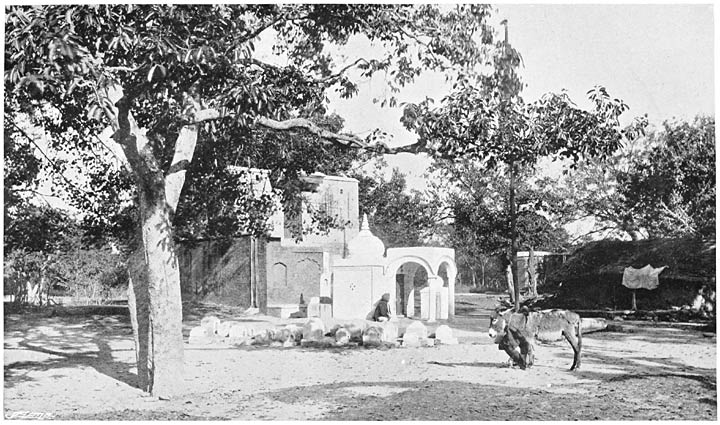
SHRINE OF SÎTALÂ AND DISEASE GODLINGS.
Two special shrines of Sîtalâ in Upper India may be specially referred to. That at Kankhal near Hardwâr has a curious legend, which admirably illustrates the catholicity of Hinduism. Here the local Sîtalâ has the special title of Turkin, or “the Muhammadan lady.” There was once a princess born to one of the Mughal Emperors, who, according to the traditions of the dynasty, when many of the chief ladies of the harem were of Hindu birth, had a warm sympathy for her ancestral faith. So she made a pilgrimage to Hardwâr, and thence set off to visit the holy shrines situated in the upper course of the Ganges. When she reached the holy land of Badarinâth, the god himself appeared to her in a dream, and warned her that she being a Musalmân, her intrusion into his domains would probably encourage the attacks of the infidel. So he ordered her to return and take up her abode in Kankhal, where as a reward for her piety she should after her death become the guardian goddess of children and be deified as a manifestation of Sîtalâ. So after her death a temple was erected on the site of her tomb, and she receives the homage of multitudes of pilgrims. There is another noted shrine of Sîtalâ at Râêwala, in the Dehra Dûn District. She is a Satî, Gândharî, the wife of Dhritarâshtra, the mother of Duryodhana. When Dhritarâshtra, through the force of his divine absorption, was consumed with fire at Sapta-srota, near Hardwâr, Gândharî also jumped into the fire and became Satî with her husband. Then, in recognition of her piety, the gods blessed her with the boon that in the Iron Age she should become the guardian deity of children and the goddess of small-pox in particular. Another noted Sîtalâ in this part of the country is the deity known as Ujalî Mâtâ, or “the White Mother,” who has a shrine in the Muzaffarnagar District. Here vast crowds assemble, and women make vows at her temple for the boon of sons, and when a child is born they take it there and perform their vow by making the necessary offering to the goddess. One peculiarity of the worship of the Kankhal goddess and of Ujalî Mâtâ is that calves are released at her shrine. This can hardly be anything else but a survival of the rite of cattle slaughter, and this is one of many indications that the worship of Sîtalâ is a most primitive cult, and probably of indigenous origin.
Like so many deities of this class Sîtalâ is on the way to promotion to the higher heaven. In some places she is identified with Kâlikâ Bhavânî, and one list of the seven small-pox sisters gives their names as Sîtalâ, Phûlmatî, Chamariyâ, Durgâ Kâlî, Mahâ Kâlî, and Bhadrâ Kâlî. This has obviously passed through the mill of Brâhmanism. Of these, Chamariyâ is doubtless allied to Châmar, who is a vaguely described low-caste deity, worshipped in the North-Western Provinces. Some say he is the ghost of a Chamâr, or worker in leather, who died an untimely death. Chamariyâ is said to be the eldest and Phûlmatî the youngest sister of Sîtalâ. She, by the common account, takes her name from the pustules (phûl) of the disease. She brings the malady in its mildest form, and the worst variety is the work of Sîtalâ in person. She lives in the Nîm tree, and hence a patient suffering from the disease is fanned with its leaves. A very bad form of confluent small-pox is the work of Chamariyâ, who must be propitiated with the offering of a pig through a Chamâr or other low-caste priest. The influence of Kâlî in her threefold form is chiefly felt in connection with other pustular diseases besides small-pox. Earthenware images of elephants are placed at her shrine, and her offerings consist of cakes, sweetmeats, pigs, goats, sheep, and black fowls. Bhadrâ Kâlî is the least formidable of all. The only person who has influence over Kâlî is the Ojha, or sorcerer, who, when cholera and similar epidemics prevail, collects a subscription and performs a regular expiatory service.
Connection of Sîtalâ with Human Sacrifice.
In her form as household goddess, Sîtalâ is often known as Thandî, or “the cool one,” and her habitation is in the house behind the water-pots, in the cold, damp place where the water drips. Here she is worshipped by the house-mother, but only cold food or cold water is offered to her.
Small-pox Worship in Bengal.
In Bengal the divine force antagonistic to Sîtalâ is Shashthî, “goddess of the sixth,” who is regarded as the special guardian of children. The worship of Shashthî rests on a physiological fact, which has only recently been applied to explain this special form of worship. The most fatal disease of Indian children is a form of infantile lock-jaw, which is caused by the use of a coarse, blunt instrument, such as a sickle, for severing the umbilical cord. This disease usually makes its appearance between the sixth and twelfth day of the life of the child, and hence we have the formal rites of purification from the birth pollution performed as the Chhathî on the sixth and the Barahî on the twelfth day after delivery.
The special Tirhût observance of the Jur Sîtal or “smallpox fever” feast will be more conveniently considered in connection with other usages of the same kind.
Mâtangî Saktî and Masân.
Mâtangî Saktî, again, appears in at least eight forms—Raukâ Devî, Ghraukâ Devî, Melâ Devî, Mandlâ Devî, Sîtalâ Devî, Durgâ Devî and Sankarâ Devî, a collection of names which indicates the extraordinary mixture of beliefs, some of them importations from the regular mythology, but others obscure and local manifestations of the deity, out of which this worship has been developed. She is described as having ears as large as a winnowing fan, projecting teeth, a hideous face with a wide open mouth. Her vehicle is the ass, an animal very often found in association with shrines of Sîtalâ. She carries a broom and winnowing fan with which she sifts mankind, and in one hand a pitcher and ewer. This fan and broom are, as we shall see later on, most powerful fetishes. All this is sheer mythology at its lowest stage, and represents the grouping of various local fetish beliefs on the original household worship.
Journey forbidden during an Epidemic of Small-pox.
Observances during Small-pox Epidemics.
Minor Disease Godlings.
Hardaul Lâla, the Cholera Godling.
After this tragedy it happened that the daughter of the Princess Kanjâvatî, sister of Jhajhâr and Hardaur, was about to be married. Her mother, according to the ordinary rule of family etiquette, sent an invitation to Jhajhâr Sinh to attend the wedding. He refused with the mocking taunt that she would be wise to invite her favourite brother Hardaur. Thereupon, she in despair went to his cenotaph and lamented his wretched end. Hardaur from below answered her cries, and promised to attend the wedding and make all the necessary arrangements. The ghost kept his promise, and arranged the marriage ceremony as befitted the honour of his house.
Subsequently he is said to have visited the bedside of the Emperor Akbar at midnight, and besought him to issue an order that platforms should be erected in his name, and honour be paid to him in every village of the Empire, promising that if he were duly propitiated, no wedding should ever be marred with storm or rain, and that no one who before eating presented a share of his meal to him, should ever want for bread. Akbar, it is said, complied with these requests, and since then the ghost of Hardaul has been worshipped in nearly every village in Northern India. But here, as in many of these legends, the chronology is hopeless. Akbar died in 1605 A.D., and the murder of Hardaul is fixed in 1627.
He is chiefly honoured at weddings, and in the month of Baisâkh (May), when the women, particularly those of the lower classes, visit his shrine and eat the offerings presented to him. The shrine is always erected outside the hamlet, and is decorated with flags. On the day but one before the arrival of a wedding procession, the women of the family worship Hardaul, and invite him to the ceremony. If any signs of a storm appear, he is propitiated with songs, one of the best known of which runs thus—
Lâla! Thy shrine is in every hamlet!
Thy name throughout the land!
Lord of the Bundela land!
May God increase thy fame!
Or in the local patois—
Gânwân chauntra,
Lâla desan nâm:
Bundelê des kê Raiya,
Râû kê.
Tumhârî jay rakhê
Bhagwân!
Exorcism of the Cholera Demon.
Cholera caused by Witchcraft.
An extraordinary case was recently reported from the Dehra Ismâîl Khân District. There had been a good deal of sickness in the village, and the people spread a report that this was due to the fact that a woman, who had died some seven months previously, had been chewing her funeral sheet. The relatives were asked to allow the body to be examined, which was done, and it was found that owing to the subsidence of the ground through rain, some earth had fallen into the mouth of the corpse. A copper coin was placed in the mouth as a viaticum, and a fowl killed and laid on the body, which was again interred. The same result is very often believed to follow from burying persons of the sweeper caste in the usual extended position, instead of a sitting posture or with the face downwards. A sweeper being one of the aboriginal or casteless tribes is believed to have something uncanny about him. Recently in Muzaffarnagar, a corpse buried in the unorthodox way was disinterred by force, and the matter finally came before the courts.
The Demon of Cattle Disease.
The murrain demon is expelled in the same way as that of the cholera, and removed by the agency of the scapegoat. In the western part of the North-Western Provinces you will often notice wisps of straw tied round the trunks of acacia trees, which, as we shall see, possess mystic powers, as a means to bar disease.
Kâsi Dâs, according to the last census, has 172,000 worshippers in the eastern districts of the North-Western Provinces.
Other Cholera Godlings.
Exorcism of Disease.
The practice of exorcising these demons of disease has been elaborated into something like a science. Disease, according to the general belief of the rural population, can be removed by a species of magic, usually of the variety known as “sympathetic,” and it can be transferred from the sufferer to some one else. The special incantations for disease are in the hands of low-caste sorcerers or magicians. Among the more primitive races, such as those of Drâvidian origin in Central India, this is the business of the Baiga, or aboriginal devil priest. But even here there is a differentiation of function, and though the Baiga is usually considered competent to deal with the cases of persons possessed of evil spirits, it is only special persons who can undertake the regular exorcism. This is among the lower tribes of Hindus the business of the Syâna, “the cunning man,” the Sokha (Sanskrit sukskma, “the subtile one”), or the Ojha, which is a corruption of the Sanskrit Upâdhyâya or “teacher.”
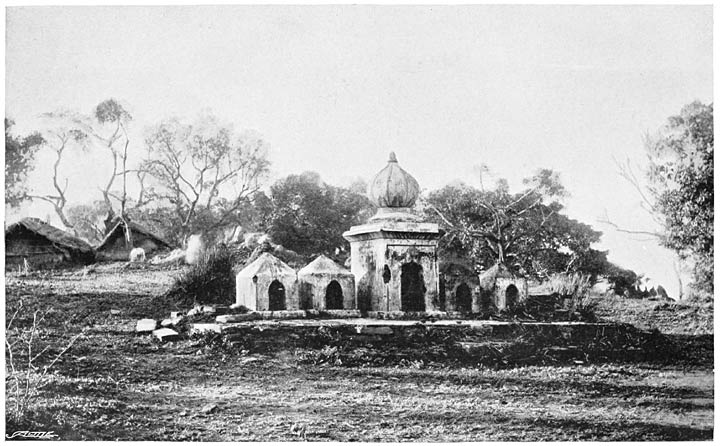
SHRINES OF GODLINGS OF DISEASE.
Like Æsculapius, Paieon, and even Apollo himself, the successful magician and healer gradually develops into a god. All over the country there are, as we have seen, the shrines of saints who won the reverence of the people by the cures wrought at their tombs. The great deified healer in Behâr and the eastern Districts of the North-Western Provinces is Sokha Bâba, who, according to the last census, had thirteen thousand special worshippers. He is said to have been a Brâhman who was killed by a snake, and now possesses the power of inflicting snake-bite on those who do not propitiate him.
Exorcisers are both professional and non-professional. “Non-professional exorcisers are generally persons who get naturally improved by a guardian spirit (deva), and a few of them learn the art of exorcism from a Guru or teacher. Most of the professional exorcisers learn from a Guru. The first study is begun on a lunar or on a solar eclipse day. On such a day the teacher after bathing, and without wiping his body, or his head or hair, puts on dry clothes, and goes to the village godling’s temple. The candidate then spreads a white cloth before the god, and on one side of the cloth makes a heap of rice, and on another a heap of Urad (phaseolus radiatus), sprinkles red lead on the heaps, and breaks a cocoanut in front of the idol. The Guru then teaches him the incantation (mantra), which he commits to memory. An ochre-coloured flag is then tied to a staff in front of the temple, and the teacher and candidate come home.
“After this, on the first new moon which falls on a Saturday, the teacher and the candidate go together out of the village to a place previously marked out by them on the boundary. A servant accompanies them, who carries a bag of Urad, oil, seven earthen lamps, lemons, cocoanuts, and red powder. After coming to the spot, the teacher and the candidate bathe, and then the teacher goes to the village temple, and sits praying for the safety of the candidate. The candidate, who has been already instructed as to what should be done, then starts for the boundary of the next village, accompanied by the servant. On reaching the village boundary, he picks up seven pebbles, sets them in a line on the road, and after lighting a lamp near them, he worships them with flowers, red powder, and Urad. Incense is then burnt, and a cocoanut is broken near the pebble which represents Vetâla and his lieutenants, and a second cocoanut is broken for the village godling.” Here the cocoanut is symbolical of a sacrifice which was probably originally of a human victim.
“When this is over, he goes to a river, well, or other bathing place, and bathes, and without wiping his body or putting on dry clothes, proceeds to the boundary of the next village. There he repeats the same process as he did before, and then goes to the boundary of a third village. In this manner he goes to seven villages and repeats the same process. All this while he keeps on repeating incantations. After finishing his worship at the seventh village, the candidate returns to his village, and going to the temple, sees his teacher and tells him what he has done.
“In this manner, having worshipped and propitiated the Vetâlas of seven villages, he becomes an exorcist. After having been able to exercise these powers, he must observe certain rules. Thus, on every eclipse day he must go to a sea-shore or a river bank, bathe in cold water, and while standing in the water repeat incantations a number of times. After bathing daily he must neither wring his head hair, nor wipe his body dry. While he is taking his meals, he should leave off if he hears a woman in her monthly sickness speak or if a lamp be extinguished.
Few rural exorcisers go through this elaborate ritual, the object of which it is not difficult to understand. The candidate wishes to get the Vetâla or local demon of the village into his power and to make him work his will. So he provides himself with a number of articles which, as we shall see, are known for their influence over the spirits of evil, such as the Urad pulse, lamps, cocoanuts, etc. The careful rule of bathing, the precautions against personal impurity, the worship done at the shrine of the village godling by the teacher, are all intended to guard him in the hour of danger. The common village “wise man” contents himself with learning a few charms of the hocus pocus variety, and a cure in some difficult case of devil possession secures his reputation as a healer.
Methods of Rural Exorcism.
All these devices of Mantras or spells, Kavâchas or amulets, Nyâsas or mentally assigning various parts of the body to the protection of tutelary presiding deities, and Mudras or intertwining of the fingers with a mystic meaning, spring from the corrupt fountain head of the Tantras, the bible of Sâktism. But these are the speciality of the higher class of professional exorciser, who is very generally a Brâhman, and do not concern us here.
A few examples of the formulæ used by the village “cunning man” may be given here. Thus in Mirzapur when a person is known to be under the influence of a witch the Ojha recites a spell, which runs—“Bind the evil eye; bind the fist; bind the spell; bind the curse; bind the ghost and the churel; bind the witch’s hands and feet. Who can bind her? The teacher can bind her. I, the disciple of the teacher, can bind her. Go, witch, to wherever thy shrine may be; sit there and leave the afflicted person.” In these spells Hanumân, the monkey godling, is often invoked. Thus—“I salute the command of my teacher. Hanumân, the hero, is the hero of heroes. He has in his quiver nine lâkhs of arrows. He is sometimes on the right, sometimes on the left, and sometimes in the front. I serve thee, powerful master. May not this man’s body be crippled. I see the cremation ground in the two worlds and outside them. If in my body or in the body of this man any ill arise, then I call on the influence of Hanumân. My piety, the power of the teacher, this charm is true because it comes from the Almighty.” In the same way two great witches, Lonâ Chamârin and Ismâîl the Jogi are often invoked. The Musalmân calls on Sulaimân, the lord Solomon, who is a leader of demons and a controller of evil spirits, for which there is ample authority in the Qurân.
When the Ojha is called in to identify the demon which has beset a patient, he begins by ascertaining whether it is a local ghost or an outsider which has attacked him on a journey. Then he calls for some cloves, and muttering a charm over them, ties them to the bedstead on which the sick man lies. Then the patient is told to name the ghost which has possessed him, and he generally names one of his dead relations, or the ghost of a hill, a tree or a burial ground. Then the Ojha suggests an appropriate offering, which when bestowed and food given to Brâhmans, the patient ought in all decency to recover. If he does not, the Ojha asserts that the right ghost has not been named, and the whole process is gone through again, if necessary funds are forthcoming.
The Baiga of Mirzapur, who very often combines the function of an Ojha with his own legitimate business of managing the local ghosts, works in very much the same way. He takes some barley in a sieve, which as we shall see is a very powerful fetish, and shakes it until only a few grains are left in the interstices. Then he marks down the intruding ghost by counting the grains, and recommends the sacrifice of a fowl or a goat, or the offering of some liquor, most of which he usually consumes himself. If his patient die, he gets out of the difficulty by saying—“Such and such a powerful Bhût carried him off. What can a poor man, such as I am, do?” If a tiger or a bear kills a man, the Baiga tells his friends that such and such a Bhût was offended because no attention was paid to him, and in revenge entered into the animal which killed the deceased, the obvious moral being that in future more regular offerings should be made through the Baiga.
Exorcism by Dancing.
Flagellation.
Treatment of Sorcerers.
Appointment of Ojhas.
The mode of succession to the dignity of an Ojha varies in different places. In Mirzapur the son is usually educated by his father, and taught the various spells and modes of incantation. But this is not always the case; and here at the present time the institution is in a transition stage. South of the Son we have the Baiga, who usually acts as an Ojha also; and he is invariably drawn from the aboriginal races. Further north he is known as Nâya (Sanskrit nâyaka) or “leader.” Further north, again, as we leave the hilly country and enter the completely Brâhmanized Gangetic valley, he changes into the regular Ojha, who is always a low-class Brâhman.
In Hoshangâbâd the son usually succeeds his father, but a Bhomka does not necessarily marry into a Bhomka family, nor does it follow that “once a Bhomka, always a Bhomka.” On the contrary, the position seems to be the result of the special favour of the godling of the particular village in which he lives; and if the whole of the residents emigrate in a body, then the godling of the new village site will have to be consulted afresh as to the servant whom he chooses to attend upon him.
It marks perhaps some approximation to Hinduism that the priest, when inspired by the god, wears a thread made of the hair of a bullock’s tail, unless this is based on the common use of thread or hair as a scarer of demons, or is some token or fetish peculiar to the race. At the same time the non-Brâhmanic character of the worship is proved by the fact that the priest, when in a state of ecstasy, cannot bear the presence of a cow, or Brâhman. “The god,” they say, “would leave their heads if either of these came near.”
On one occasion, when Sir C. A. Elliott saw the process of exorcism, the men did not actually revolve when “the god came on his head.” He covered his head up well in a cloth, leaving space for the god to approach, and in this state he twisted and turned himself rapidly, and soon sat down exhausted. We shall see elsewhere that the head is one of the chief spirit entries, and the top of the head is left uncovered in order to let the spirit make its way through the sutures of the skull. Then from the pit of his stomach he uttered words which the bystanders interpreted to direct a certain line of conduct for the sick man to pursue. “But perhaps the occasion was not a fair test, as the Parihâr strongly objected to the presence of an unbeliever, on the pretence that the god would be afraid to come before so great an official.” This has always been the standing difficulty in Europeans obtaining a practical knowledge of the details of rural sorcery, and when a performance of the kind is specially arranged, it will usually be found that the officiant performs the introductory rites with comparative success, but as it comes to the crucial point he breaks down, just as the ecstatic crisis should have commenced. This is always attributed to the presence of an unbeliever, however interested and sympathetic. The same result usually happens at spiritualistic séances, when anyone with even an elementary knowledge of physics or mechanics happens to be one of the audience.
Fraud in Exorcism.
Disease Charms.
Next to the services of the professional exorciser for the purpose of preventing or curing disease, comes the use of special charms for this purpose. There is a large native literature dealing with this branch of science. As a rule most native patients undergo a course of this treatment before they visit our hospitals, and the result of European medical science is hence occasionally disappointing. One favourite talisman of this kind is the magic square, which consists in an arrangement of certain numbers in a special way. For instance, in order to cure barrenness, it is a good plan to write a series of numbers which added up make 73 both ways on a piece of bread, and with it feed a black dog, which is the attendant of Bhairon, a giver of offspring. To cure a tumour a figure in the form of a cross is drawn with three cyphers in the centre and one at each of the four ends. This is prepared on a Sunday and tied round the left arm. Another has a series of numbers aggregating 15 every way. This is engraved on copper and tied round a child’s neck to keep off the Evil Eye. In the case of cattle disease, some gibberish, which pretends to be Arabic or Sanskrit, appealing for the aid of Lonâ Chamârin or Ismâîl Jogi, with a series of mystic numbers, is written on a piece of tile. This is hung on a rope over the village cattle path, and a ploughshare is buried at the entrance to make the charm more powerful. When cattle are attacked with worms, the owner fills a clean earthen pot with water drawn from the well with one hand; he then mutters a blessing, and with some sacred Dâbh grass sprinkles a little water seven times along the back of the animal.
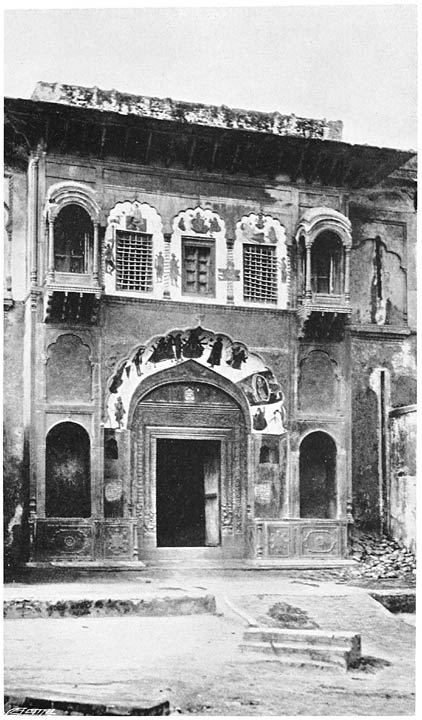
HOUSE PROTECTED AGAINST THE EVIL EYE.
The number of these charms is legion. Many of them merge into the special preservatives against the Evil Eye, which will be discussed later on. Thus the bâzâr merchant writes the words Râm! Râm! several times near his door, or he makes a representation of the sun and moon, or a rude image of Ganesa, the godling of good luck, or draws the mystical Swâstika. A house of a banker at Kankhal which I recently examined bore a whole gallery of pictures round it. There were Siva and Pârvatî on an ox with their son Mârkandeya; Yamarâja, the deity of death, with a servant waving a fan over his head; Krishna with his spouse Râdhâ: Hanumân, the monkey godling; the Ganges riding on a fish, with Bhâgîratha, who brought her down from heaven; Bhîshma, the hero of the Mahâbhârata; Arjuna representing the Pândavas; the saints Uddalaka and Nârada Muni; Ganesa with his two maidservants; and Brahma and Vishnu riding on Sesha Nâga, the great serpent. Beneath these was an inscription invoking Râma, Lakshmana, the Ganges and Hanumân.
Rag Offerings.
Another explanation is that the hanging of the rags is done with the object of transferring a disease to some one else. Professor Rhys suggests that a distinction is to be drawn between the rags hung on trees or near a well and the pins, which are so commonly thrown into the water itself. It is noteworthy that in some cases the pins are replaced by buttons, or even by copper coins. The rags, on the other hand, he thinks may be vehicles of the disease. To this Mr. Hartland objects—“If this opinion were correct, one would expect to find both ceremonies performed by the same patient at the same well; he would throw in the pin and also place the rag on the bush, or wherever its proper place might be. The performance of both ceremonies is, however, I think, exceptional. Where the pin or button is dropped into the well, the patient does not trouble about the rag, and vice versâ.”
He goes on to say that “the curious detail mentioned by Mrs. Evans in reference to the rags tied on the bushes at St. Elian’s well—namely, that they must be tied with wool—points to a still further degradation of the rite in the case we are now examining. Probably at one time rags were used and simply tied to the sacred tree with wool. What may have been the reason for using wool remains to be discovered. But it is easy to see how, if the reason were lost, the wool might be looked on as the essential condition of the due performance of the ceremony, and so continue after the disuse of the rags.”
In reference to this it may be noted that there is some reason to believe that the sheep was a sacred animal. In Western India high-caste Hindus wear blankets after bathing. The Kunbis use a mixture of sheep’s milk with lime juice and opium as a cure for diarrhœa. The Parheyas of Bengal used to wash their houses with sheep’s dung to scare spirits. And the use of woollen clothes in certain rites is prescribed in the current ritual.
Mr. Hartland is inclined to think that the rags represent entire articles of clothing which were at an earlier time deposited, and on the analogy of the habit of the witch of getting hold of some part of the body, such as nail-cuttings and so on, by which she may get the owner into her power, the rags were meant to connect the worshipper with the deity. “In like manner my shirt or stocking, or a rag to represent it, placed upon a sacred bush or thrust into a sacred well, my name written on the walls of a temple, a stone or pellet from my hand cast upon a sacred image or a sacred cairn, is thenceforth in constant contact with divinity; and the effluence of divinity, reaching and involving it, will reach and involve me. In this way I may be permanently united with the god.”
It is quite possible that some or all of the ideas thus given may have resulted in the present practice in India.
Disease Transference.
One morning, in a village near Agra, I came by chance on two old women fiercely quarrelling. On making inquiries, I found that one of them had placed some small-pox crusts from her child on her neighbour’s threshold. The people agreed that this was a wicked act, as it displayed special animus against a particular person. If they had been placed on the cross-road, and any one had been unlucky enough to touch them and contract the disease, it would not have mattered much—that was the will of God.
Scapegoats.
This brings us to the regular scapegoat. At shrines of Sîtalâ, the small-pox goddess, sweepers bring round a small pig. Contributions are called for from the worshippers, and when the value of the animal is made up, it is driven by the people into the jungle, pursued by an excited crowd, who believe that the creature has taken the disease with it.
Demons Scared by Noise.
This incidentally leads to the consideration of the principle that evil spirits are scared by noise. In the first place this appears largely to account for the use of bells in religious worship. The tolling of the bells keeps off the evil spirits which throng round any place where the worship of the regular gods is being performed. Milton speaks of—
“The bellman’s drowsy charm;
Another fact which adds to the efficacy of bells for this purpose, is that they are made of metal, which, as we shall see elsewhere, is a well-known scarer of demons.
Disease Scapegoats.
So, in Central India the Gonds in November assemble at the shrine of Gansyâm Deo to worship him. Sacrifices of fowls and spirits, or a pig, occasionally, according to the size of the village, are offered, and Gansyâm Deo is said to descend on the head of one of the worshippers, who is suddenly seized with a kind of fit, and after staggering about for a while, rushes off into the wildest jungles, where the popular theory is that, if not pursued and brought back, he would inevitably die of starvation, and become a raving lunatic. As it is, after being brought back by one or two men, he does not recover his senses for one or two days. The idea is that one man is thus singled out as a scapegoat for the sins of the rest of the village.
In the same part of the country the same rite is performed after a death, on the analogy of the other instances, which have been already quoted. When a man dies, his relations assemble at the end of the year in which the death occurred, and the nearest male relative dances naked (another instance of the nudity charm, to which reference has been already made) with a drawn sword in his hand, to the music of a drum, in which he is assisted by others for a whole day and night. The following day a buffalo is brought and made intoxicated with Bhang or Indian hemp, and spirits, and beaten to death with sticks, stones and weapons.