Chapter V · WORSHIP OF THE MALEVOLENT DEAD.
Reading edition
Πρώτη δὲ ψυχὴ Ἐλπήνορος ἦλθεν ἐταίρου,
Οὐ γάρ πω ἐτέθαπτο ὑπὸ χθονὸς εὐρυοδείης.
Odyssey, xi. 51, 52.
These deified ghosts and saints whom we have been discussing, though occasionally touchy and sensitive to insult or disrespect, are, as a rule, benevolent. But there is another class of beings at whose feet the rustic lies in grievous and perpetual bondage. These are the malevolent dead.
Spirits of the Dead Hostile.
It is not difficult to understand why the spirits of the dead should be regarded as hostile. A stranger is, in the belief of all primitive people, synonymous with an enemy; and the spirit of the departed having abandoned his own and joined some other and invisible tribe, whose domains lie outside the world of sense, is sure to be considered inimical to the survivors left on earth. As we have already seen, even the usually kindly spirit of the departed household dead requires propitiation and resents neglect; much more those of a different tribe or family.
This conception of the state of the soul after death may be illustrated by the savage theory of dreams.
Savage Theory of Dreams.
Many savages believe that the evidence of dreams is sufficient to prove that the soul moves about during sleep, and that the dream is the record of its experiences in hunting, dancing, visiting friends, and so on.
The Separable Soul.
On this principle Hindus are very cautious about awaking a sleeping friend, lest his soul may happen to be absent at the time, and in Bombay it is considered most reprehensible to play jokes on a sleeping person, such as painting the face in fantastic colours, or giving moustaches to a sleeping woman. The absent soul may not be able to find its own body, the appearance of which has been thus changed, and may depart altogether, leaving the body a corpse.
The rustic Hindu firmly believes that in the absence of a man’s proper soul in a dream his body is occupied by some strange and consequently malignant ghost. Hence come the nightmare and evil dreams. Thus the Korwas of Mirzapur believe that a Bhûtin or dangerous female ghost named Reiyâ besets them at night under the orders of some witch, and attacks people’s joints with the rheumatism. The Majhwârs believe that the Râkshasa attacks them in dreams. He comes in the shape of an old man with enormous teeth, brown of colour, with black, entangled hair, and sometimes swallows his victims. It is fear of him that brings the fever, and he can be exorcised only by the Baiga with an offering of rice and pulse. The Dâno also comes in dreams, squeezes a man’s throat, and stops his breath. The Bhuiyârs have adopted from the Hindu mythology Jam or Yama as one of their dream ghosts. He sits on his victim’s breast in sleep, and it is impossible to shake him off or make an alarm. Sometimes these night ghosts come as tigers, wolves, or bears, and hunt a man down in his sleep.
The same is the case with looking into other people’s mirrors, because you may chance leave behind your reflection, which is part of your soul. As we have seen, this is the basis of much of the theory of water spirits, which lurk in water holes and seize the reflection of anyone who looks into them. The Sunni Muhammadans in Bombay cover up all the looking-glasses in a house when a person is sick, as the soul, which is just then on the prowl, may be absorbed, and leave its owner a corpse.
Lastly, the same theory accounts for the disinclination which rustics have to being painted or photographed. Some of the soul goes out in the image and does not return. There is a rest-house on the Asthbhuja Hill at Mirzapur which was many years ago presented to the Europeans of the station by a wealthy banker. He was overpersuaded to allow his picture to be painted, and fell into a lingering consumption, of which he soon after died.
The Bhût.
The general term for these spirits is Bhût, in Sanskrit Bhûta, which means “formed” or “created.” In the earlier Hindu writings the word is applied to the powers of Nature, and even to deities. Siva himself is called Bhûtîsvara, or “Lord of spirits,” and, under the name of Bhûtîsvara Mahâdeva, has a shrine at Mathura. But as the Greek Dæmon acquired a less respectable meaning in the later ages of the history of the nation, so Bhût has now come to imply a malignant evil spirit.
But Bhût is a general term which includes many grades of evil spirits which it is necessary to distinguish. We shall first, however, deal with certain characters common to Bhûts in general.
Shrines to Persons Accidentally Killed.
Many of these shrines to persons who have died by an untimely death are known by special names, which indicate the character of the accident. We shall meet again with the Baghaut, or shrine, to a man killed by a tiger. We have also Bijaliya Bîr, the man who was killed by lightning, Târ Bîr, a man who fell from a Târ or toddy tree, and Nâgiya Bîr, a person killed by a snake. General Cunningham mentions shrines of this kind; one to an elephant driver who was killed by a fall from a tree, another to a Brâhman who was killed by a cow, a third to a Kashmîri lady who had only one leg and died in her flight from Delhi to Oudh of exhaustion on the journey.
Second Marriage and Bhûts.
So in Northern India, people who marry again after the death of the first wife wear what is known as the Saukan Maura, or second wife’s crown. This is a little silver amulet, generally with an image of Devî engraved on it. This is hung round the husband’s neck, and all presents made to the second wife are first dedicated to it. The idea is that the new wife recognizes the superiority of her predecessor, and thus appeases her malignity. The illness or death of the second wife or of her husband soon after marriage is attributed to the jealousy of the ghost of the first wife, which has not been suitably propitiated.
Food of Bhûts.
Posture of Bhûts.
Tests of Bhûts.
Spirit Lovers.
Many denizens of the spirit land have connection with mortals. We have the cycle of folk-tales known as that of the Swan maidens.
Urvasî came and lived with Parûravas until he broke the curiosity taboo. We shall see instances where Indra gives one of his fairies to a mortal lover, and spirits like the Incubi and Succubi of European folk-lore can be brought down by incantation.
Spirit Entries: The Head.
Spirits enter and leave the body in various ways. They often use the head in this way, and in particular the tenth aperture of the body, one of the skull sutures, known as Brahma-randhra. This is the reason why the skull is broken at cremation to open the “crevice of Brahma,” as this orifice is called.
The Mouth.
As might have been expected, Bhûts are very fond of entering by the mouth. Hence arise much of the mouth-washing which is part of the daily ritual of the Hindu, and many of the elaborate precautions which he takes at meals. This will be referred to again in connection with the Evil Eye.
Yawning.
Sneezing.
The Hands and Feet.
The Ears.
And so with the ears, which are believed to communicate direct with the brain, and are kept by the rustic carefully muffled up on chilly mornings. Hence the custom of Kanchhedan, or ear-piercing, which is in Northern India about the only survival of the world-wide rite of mutilation when males attain puberty, and of wearing ear-rings and similar ornaments, which is habitual with all classes of Hindus, and specialized among the Kanphata Jogis, who take their name from this practice.
Varieties of Bhûts.
The Pret.
The Hindu notion of the state of the soul between death and the performance of the prescribed funeral rites agrees exactly with that of the older European races. They wandered about in a state of unhappy restlessness, and were not suffered to mix with the other dead. The term Pret or Preta, which simply means “deceased” or “departed,” represents the soul during this time. It wanders round its original home, and, like the Bâlakhilyas, who surround the chariot of the sun, is no larger than a man’s thumb. The stages of his progress, according to the best authorities, are that up to the performance of the ten Pindas the dead man remains a Preta, through the Nârâyanabali rite he becomes a Pisâcha, and by the Sapindikarana he reaches the dignity of the Pitri or sainted dead. The term Preta is, however, sometimes applied to the spirit of a deformed or crippled person, or one defective in some limb or organ, or of a child who dies prematurely owing to the omission of the prescribed ceremonies during the formation of the embryo. Here it may be noted that there are indications in India of the belief which is common among savages, that young children, apparently in consequence of their incomplete protection from the birth impurity, are under a taboo. Thus in India a child is regarded as a Bhût until the birth hair is cut. Some of the jungle tribes believe that it is unnecessary to protect a child from evil spirits until it begins to eat grain, because up to that time it is nothing more than a Bhût itself. Under the old ritual a child under two years of age was not burnt, but buried, and no offering of water was made to it. We are familiar with the same idea in England regarding unbaptized children, whose spirits are supposed to be responsible for the noise of Gabriel’s Hounds in the sky, really caused by the bean geese in their southern flight.
The Pisâcha.
The Râkshasa.
The Râkshasa again, a word that means “the harmer” or “the destroyer,” is of the ogre-vampire type. He goes about at night, haunts cemeteries, disturbs sacrifices and devout men, animates dead bodies, even devouring human beings, in which capacity he is known as Kravyâda, or carnivorous, and is generally hostile to the human race. He is emphatically a devourer of human flesh, and eats carrion. He is often represented in the folk-tales as having a pretty daughter, who protects the hero when he ventures perchance into the abode of the monster. Her father comes in, and with the cry of “Manush gandha,” which is equivalent to the “Fee! fo! fum! I smell the blood of an Englishman!” of the Western tale, searches about, but fails to find him. When Hanumân entered the city of Lanka in the form of a cat, to reconnoitre, he saw that the Râkshasas who slept in the house “were of every shape and form. Some of them disgusted the eye, while some were beautiful to look on. Some had long arms and frightful shapes; some were very fat and some were very lean; some were dwarf and some were prodigiously tall. Some had only one eye, and others had only one ear. Some had monstrous bellies, hanging breasts, long projecting teeth, and crooked thighs; whilst others were exceedingly beautiful to behold and clothed in great splendour. Some had the heads of serpents, some the heads of asses, some of horses, and some of elephants.” The leader of them was Râvana, who is said to have been once a Brâhman and to have been turned into a Râkshasa, “with twenty arms, copper-coloured eyes, and bright teeth like the young moon. His form was as a thick cloud or as a mountain, or the god of death with open mouth.”
The Râkshasa is the great Deus ex machinâ of folk-lore. He can change into almost any form he pleases, his breath is a roaring wind; he can lengthen his arms to eighty miles; he can smell out human beings like Giant Blunderbore. He can carry a man leagues through the air; if his head be cut off, it grows again. He is the Eastern type of the monster dragon which is subdued by St. George, Siegmund, Siegfried, or Beowulf.
Power of Lengthening Themselves.
Night Spirits.
Râkshasas as Builders.
Such is also the case with another class of demons, the Asuras, a word which means “spiritual” or “superhuman,” who were the rivals of the gods. In Mirzapur the ancient embankment at the Karsota tank is considered to be their work. Once upon a time two of these demons vowed that whoever first succeeded in building a fort should be the conqueror, and that his defeated rival should lose his life. So they set to work in the evening, one on the Bijaygarh Hill, and the other on the opposite peak of Kundakot, about twelve miles distant. The demon of Bijaygarh, having lost his tools in the dark, struck a light to search for them. His adversary seeing the light, and imagining that the sun was rising and his rival’s work completed, fled precipitously. The Bijaygarh fort was completed during the night and stands to the present day, while on Kundakot you see only a few enormous blocks of stone which was all the vanquished Asura had time to collect. The tales of demons interfering with the construction of buildings are common in European folk-lore.
Modern Râkshasas.
Young men who are obliged to travel at night have reason to be cautious of the Râkshasî, as well as of the Churel, with whom she is occasionally identified. She takes the form of a lovely woman and lures her victims to destruction.
Brâhman Ghosts.
The Deo.
The Bîr.
The Dâno.
The Daitya.
At midnight the Daitya shows himself in his tree in a flash of fire and smoke, and sometimes flies off to another tree a short distance off.
The Headless Horseman.
At the present time the most dreaded of these creatures is, perhaps, the Headless Horseman, who is popularly known as Dûnd, or “truncated.”
The Dûnd makes occasional incursions throughout the country. He was in the neighbourhood of Agra in 1882, and some twelve years after appeared in Mirzapur. On both occasions the news of his arrival caused considerable alarm. Every one shut up their houses at sunset, and no one on any consideration would answer a call from outside after nightfall. It was shrewdly suspected at the time that this rumour was spread by some professional burglar who made a harvest while the scare lasted.
Somewhat akin to the Dûnd is the spectral Râja of Bûndi who occasionally appears in the neighbourhood of Sahâranpur. Some years ago a Brâhman astrologer heard some one calling him from outside one night. When he answered the summons he was told that the Râja of Bûndi wanted to have his horoscope examined and was then encamped near the town. The Pandit proceeded to the place with the guide and saw a splendid encampment, and the Râja in his royal robes sitting in a tent ornamented with pearls. When he saw him the unfortunate astrologer knew that he was a Râkshasa, and he was the more convinced of this when he examined his horoscope and found that he was fated to live for ever. He told the Râja that his life would be long and prosperous, and after receiving three gold coins as his fee went home more dead than alive. Next morning he went to the place, but could find no sign of the camp, and when he looked in his box the coins were found to have disappeared.
The Ghostly Army.
Closely connected with this are the numerous legends of the Ghostly Army. Thus, at Faizâbâd, the country people point out a portion of the Queen’s highway along which they will not pass at night. They say that after dark the road is thronged with troops of headless horsemen, the dead of the army of Prince Sayyid Sâlâr. The great host moves on with a noiseless tread; the ghostly horses make no sound; and no words of command are shouted to the headless squadrons. Another version comes from Ajmer. There for some time past a troop of four or five hundred horsemen, armed and dressed in green, issue from a valley in the neighbourhood of the city, and after riding about for some time, mysteriously disappear. They are believed to be the escort of the Imâm Husain, whose tragical fate is commemorated at the Muharram.
Masân.
Tola.
Airi.
The companions of Airi are fairies, who, like the Churel, have their feet turned backwards. He is accompanied by two litter-bearers and a pack of hounds with bells round their necks. Whoever hears their bark is certain to meet with calamity. Airi is much given to expectoration, and his saliva is so venomous that it wounds those on whom it falls. Incantations must be used and the affected part rubbed with the branch of a tree. If this be not done at once, the injured man dies, and in any case he must abstain from rich food for several days. We shall meet again with the magical power of spittle. Here it may be noted that in Western folk-lore it confers the power of seeing spirits.
“The revels usually last for about ten nights, and until they are ended, a lamp is kept burning at the shrine of the god. Those possessed dye a yard of cloth in red ochre and bind it round their heads, and carry a wallet in which they place the alms they receive. While in this state they bathe twice, and eat but once in the twenty-four hours. They allow no one to touch them, as they consider other men unclean, and no one but themselves is permitted to touch the trident and stones in Airi’s temple, at least as long as the festival lasts. The offerings, goats, milk, etc., are consumed by the worshippers. The kid is marked on the forehead with red, and rice and water are thrown over him. If he shakes himself to get rid of it, the god has accepted the offering, whereupon his head is severed with a knife. If he does not shake himself, or bleats, it is a sign that the offering is not accepted, and the victim escapes.”
Hill Demons.
Birth Fiends.
The Parî and Jinn.
The Ghoul.
The Baghaut.
I myself came across a singular instance of this some time ago. I was asking a Baiga of the Chero tribe what he could do in this way, but I found him singularly reticent on the subject. I asked the Superintendent of the Dudhi Estate, who was with me, to explain the reason. “Well,” he answered, “when I came here first many years ago, a noted Baiga came to me and proposed to do some witchcraft to protect me from tigers, which were very numerous in the neighbourhood at the time. I told him that I could look after myself, and advised him to do the same. That night a tiger seized the wretched Baiga while he was on his way home, and all that was found of him were some scraps of cloth and pieces of bone. Since then I notice that the Baigas of these parts do not talk so loudly of their power of managing tigers when I am present.”
The Churel.
She generally, however, assumes the form of a beautiful young woman and seduces youths at night, especially those who are good-looking. She carries them off to some kingdom of her own, and if they venture to eat the food offered to them there, she keeps them till they lose their manly beauty and then sends them back to the world grey-haired old men, who, like Rip Van Winkle, find all their friends dead long ago.
Eating Food in Spirit Land.
The Churel superstition appears in other forms. Thus, the Korwas of Mirzapur say that if a woman dies in the delivery-room, she becomes a Churel, but they do not know, or do not care to say, what finally becomes of her. The Patâris and Majhwârs think that if a woman dies within the period of pregnancy or uncleanness, she becomes a Churel. She appears in the form of a pretty little girl in white clothes, and seduces them away to the mountains, until the Baiga is called in to sacrifice a goat and release her victim. The Bhuiyârs go further and say that little baby girls who die before they are twenty days old become Churels. They live in stones in the mountains and cause pain to men. The remedy is for the afflicted one to put some rice and barley on his head, turn round two or three times, and shake off the grain in the direction of the jungle, when she releases her victim. The idea seems to be that with these holy grains, which are scarers of demons, the evil influence is dispersed. But she continues to visit him, and requires propitiation. Among these people the Churel has been very generally enrolled among the regular village godlings and resides with them in the common village shrine, where she receives her share of the periodical offerings. Any one who sees a Churel is liable to be attacked by a wasting disease, and, as in the case of the Dûnd, to answer her night summons brings death.
Modes of Repelling the Churel.
There are fortunately various remedies which are effective in preventing a woman who dies under these circumstances from becoming a Churel. One way is that practised by the Majhwârs of Mirzapur, which resembles that for laying the evil spirit of a sweeper, to which reference has been made already. They do not cremate the body, but bury it, fill the grave with thorns and pile heavy stones above to keep down the ghost.
In the Hills the place where a pregnant woman died is carefully scraped and the earth removed. The spot is then sown with mustard, which is sprinkled along the road traversed by the corpse on its way to the burial ground. The reason given for this is twofold. First, the mustard blossoms in the world of the dead, and its sweet smell pleases the spirit and keeps her content, so that she does not long to revisit her earthly home; secondly, the Churel rises from her grave at nightfall and seeks to return to her friends; she sees the minute grains of the mustard scattered abroad and stoops to pick it up, and while so engaged cock-crow comes, she is unable to visit her home, and must return to her grave. This is another instance of the rule that evil spirits move about only at night.
Counting.
The Couvade.
In connection with this subject of parturition impurity, the very remarkable custom of the Couvade may be referred to here. This is the rule by which at the birth of a child the father is treated as an invalid, instead of or in addition to the mother:—
When Chineses go to bed,
And lie in in their ladies’ stead.
It is curious that in India itself so few actual instances of the Couvade have been discovered. This, however, as Mr. Hartland shows, is not unusual, and the Couvade is not found in the lowest stage of savagery. But that the custom once generally prevailed is quite certain, and in Northern India, at least, it seems to have been masked by special birth ceremonies of great stringency and elaborate detail, but of distinctly later date than the very primitive usage with which we are now concerned.
Various Birth Ceremonies.
Places Infested by Bhûts: Burial Places.
There are, of course, certain places which are particularly infested by Bhûts. To begin with, they naturally infest the neighbourhood of burial places and cremation grounds. This idea is found all over the world. Virgil says:—
Moerim, saepe animas imis excire sepulcris,
Atque satas alio vidi traducere messes;
and Shakespeare in the “Midsummer Night’s Dream,”—
Now it is the time of night
That graves all gaping wide,
Every one lets forth its sprite,
In the church-way paths to glide.
Deserts.
Owls and Bats.
Sedit in adverso nocturnus culmine bubo,
Funereosque graves edidit ore sonos.
Ghosts and Burial Grounds.
Mutilation.
Ghosts of Old Ruins.
Mine and Cave Spirits.
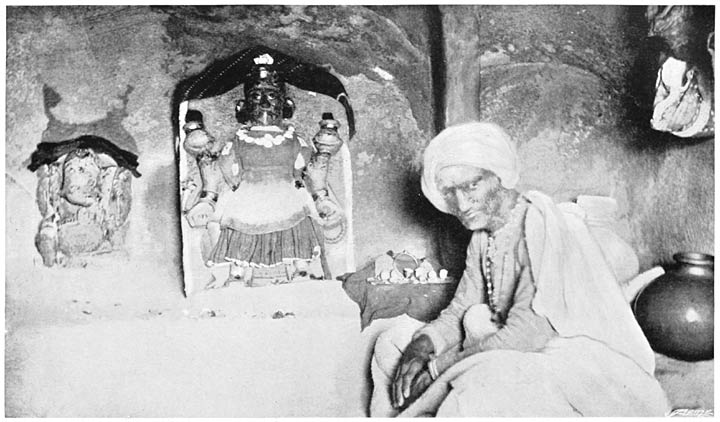
CAVE TEMPLE OF ANNAPÛRNA.
Cave Deities.
Bhûts Treasure Guardians.
Fairy Gifts.
Underground Treasure.
Ghosts of Roads.
Ghosts of Empty Houses.
Bhûts particularly infest ancient empty houses. If a house be unoccupied for any time, a Bhût is sure to take up his quarters there. Such houses abound everywhere. The old Fort of Agori on the Son is said to have been abandoned on account of the malignancy of its Bhûts. Not long ago a merchant built a splendid house in the Mirzapur Bâzâr, and was obliged to abandon it for the same reason. The Collector’s house at Sahâranpur is haunted by a young English lady; there is one in the Jhânsi cantonment, where a Bhût, in the form of a Faqîr, dressed in white clothes, appears at night. Fortunately he is of a kindly disposition.
Ghosts of Flowers.
The Hearth.
For the same reason great care is taken of the ashes, which must be removed with caution and not allowed to fall on the ground. We have seen that it is used to identify the spirits of the returning dead, and ashes blown over by a holy man are used to expel the Evil Eye. In Bombay a person excommunicated from caste is re-admitted on swallowing ashes given him by the religious teacher of the caste.
Ghosts of Filthy Places.
The House Roof.
Lastly comes the house roof. We have already seen that the Drâvidian tribes will not allow their women to touch the thatch during a whirlwind. So, most people particularly object to people standing on their roof, and in a special degree to a buffalo getting upon it. It is on the roof, too, that the old shoe or black pot or painted tile is always kept to scare the Bhûts which use it as a perch.
END OF VOL. I.
LONDON: PRINTED BY GILBERT AND RIVINGTON, LD., ST. JOHN’S HOUSE, CLERKENWELL ROAD, E.C.