Chapter IV · THE WORSHIP OF THE SAINTED DEAD.
Reading edition
Ἄιψσα δ’ ἴκοντο κατ’ ἀσφοδελὸν λειμῶνα
Ἔνθα τε ναίουσι ψυχαὶ, ἔιδωλα καμόντων.
Odyssey, xxiv. 12, 14.
Ancestor-worship: its Origin.
Among the Aryans and Drâvidians.
Thus, on the tenth day after a death in the family, the Ghasiyas of Mirzapur, about the most degraded of the Drâvidian tribes, feed the brotherhood, and at the door of the cook-house spread flour or ashes a cubit square on the ground. They light a lamp there and cover both the square and the light with a basket. Then the son of the dead man goes a little distance in the direction in which the corpse had been carried out, and calls out his name loudly two or three times. He invites him to come and sit on the shrine which his descendants have prepared for him, and to consume the offerings which they are ready to present. It is said that if the deceased died in any ordinary way and not by the attack of a Bhût, he often calls from the burying ground and says, “I am coming!” After calling his father’s spirit two or three times, the son returns to the house and examines the flour or ashes, and if the deceased did not die by the attack of a Bhût, the mark of his spirit is found on the flour or ashes in the shape of the footprint of a rat or a weasel. When this is observed, the son takes a white fowl and sacrifices it with a knife near the cook-house, calling to the spirit of his father—“Come and accept the offering which is ready for you!” Some of them strangle the fowl with their hands, and before killing it sprinkle a little grain before it, saying—“If you are really the spirit of my father, you will accept the grain!” Then he goes on to his father’s spirit—“Accept the offering, sit in the corner and bless your offspring!” If the fowl eats the grain, there is great rejoicing, as it implies that the spirit has quietly taken up its residence in the house. If the fowl does not eat, it is supposed that some sorcerer or enemy has detained the spirit with the ultimate object of releasing it some time or other on its own family, with whom it is presumably displeased because they have taken no care to propitiate it. If the soul does not answer from the burial ground, or if there is no mark on the square of ashes, it is assumed that he has fallen into the hands of some Bhût or Pret, who has shut him up in the hollow stalk of a bamboo, or buried him in the earth; in any case there is a risk that he may return, and the rite is still performed as a precautionary measure.
Among the Kharwârs the holiest part of the house is the south room, where it is supposed that the Devatâ pitri or sainted dead reside. They worship the spirits of the dead in the month of Sâwan (August) near the house-fire. The house-master offers up one or two black fowls and some cakes and makes a burnt offering with butter and molasses. Then he calls out—“Whatever ghosts of the holy dead or evil spirits may be in my family, accept this offering and keep the field and house free from trouble!” Many of the Kharwârs are now coming more completely under Brâhmanical influence, and these worship the Pitri at weddings in the courtyard. The house-master offers some balls of rice boiled in milk, and a Brâhman standing by mutters some texts. They are now so advanced as to do the annual service for the repose of the sainted spirits at the Pitripaksha or fortnight of the dead in the month of Kuâr (August).
Spirits Mortal.
Ancestors Re-born in Children.
The Srâddha.
The orthodox Hindu, besides the usual Srâddha, in connection with his daily worship, offers the Tarpana or water oblation to the sainted dead. The object of the annual Srâddha is, as is well known, to accelerate the progress (gati) of the soul through the various stages of bliss, known as Sâlokya, Sâmîpya and Sârûpya, and by its performance at Gaya the wearied soul passes into Vaikuntha, or the paradise of Vishnu.
Degradation of Ancestor-worship.
A curious example of the popular form of ancestor-worship is given by General Sleeman:—“Râma Chandra, the Pandit, said that villages which had been held by old Gond proprietors were more liable than others to visitation from local ghosts, that it was easy to say what village was or was not haunted, but often exceedingly difficult to say to whom the ghost belonged. This once discovered, the nearest surviving relation was, of course, expected to take steps to put him to rest. But,” said he, “it is wrong to suppose that the ghost of an old proprietor must be always doing mischief. He is often the best friend of the cultivators, and of the present proprietor too, if he treats him with proper respect; for he will not allow the people of any other village to encroach upon the boundaries with impunity, and they will be saved all expense and annoyance of a reference to the judicial tribunals for the settlement of boundary disputes. It will not cost much to conciliate these spirits, and the money is generally well laid out.”
Worship of Worthies.
The Sâdhu.
It would be out of place to give here any of the details of the numerous sects which have been founded in this way to commemorate the life and teaching of some eminent saint. The remarkable point about this movement is that the leaders of these sects are not always or even constantly drawn from the priestly classes. Thus the Charandâsis, who are Krishna worshippers, take their name from Charan Dâs, a Dhûsar, who are usually classed as Banyas, but claim to be Brâhmans; Jhambajî, the founder of the Bishnois, was a Râjput; Kabîr, whoever he may have been, was brought up by a family of Muhammadan weavers at Benares; Nâmdeo was a cotton carder; Râê Dâs is said to have been a Chamâr; Dâdu was a cotton cleaner; many of them are half Muhammadans, as the Chhaju-panthis and Shamsis. It is difficult to estimate highly enough the result of this feeling of toleration and catholicism on the progress of modern Hinduism.
Miracle-working Tombs.
Hindu saints of the same class are so directly imbued with the divine afflatus that they need not the purifying influence of fire, and are buried, not cremated. Their Samâdhi or final resting-place is usually represented by a pile of earth, or a tomb or tumulus of a conical or circular form. Others, again, like some of the Gusâîns, are after death enclosed in a box of stone and consigned to the waters of the Ganges. These shrines are generally occupied by a disciple or actual descendant of the saint, and there vows and prayers are made and offerings presented.
The Satî.
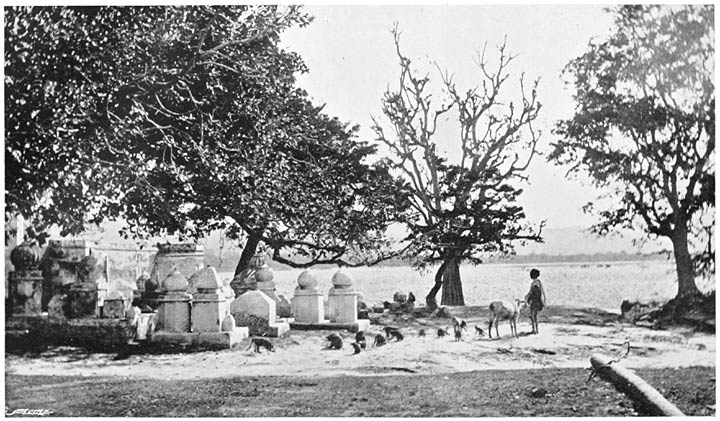
SATÎ SHRINES.
The Satî and the Pitri.
The connection between the special worship of the Satî and that of the Pitri or sainted dead will have been remarked. In many places the Satî represents the company of the venerated ancestors and is regarded as the guardian mother of the village, and in many of the rustic shrines of this class the same connection with the Pitri is shown in another interesting way. The snake is, as we shall see, regarded as a type of the household deity, which is often one of the deified ancestors, and so, in the Satî shrine we often see a snake delineated in the act of rising out of the masonry, as if it were the guardian mother snake arising to receive the devotion of her descendants.
The arrangements for the cremation varied in different places. In Western India she sat in a specially built grass hut, and keeping her husband’s head in her lap, supported it with her right hand, while she kindled the hut with a torch held in her left hand. Nowadays in Nepâl the husband and the Satî are made to lie side by side on the pyre. The woman’s right hand is put under the husband’s neck, and round her face are placed all kinds of inflammable substances. Three long poles of undried wood are laid over the bodies—one over the legs, the second over the chest, and the third over the neck. Three men on either side press down the poles till the woman is burnt to death. There have been cases in which the wretched victim tried to escape, and was dragged back by force to her death.
Modern Saints.
Deification in Modern Times.
A few examples of modern deification may be given to illustrate this phase of the popular faith. Thus, one Gauhar Shâh was quite recently canonized at Meerut because he delivered a prophecy that a windmill belonging to a certain Mr. Smith would soon cease to work. The fulfilment of his prediction was considered ample evidence of his sanctity, and the question was put beyond the possibility of doubt when, just before his death, the holy man directed his disciples to remove him from an inn, which immediately fell down. Another saint of the same place is said to have given five years of his life to the notorious Begam Samru, who died in 1836, in all the odour of sanctity.
Shaikh Bûrhan.
Salîm Chishti.
The power of conferring male offspring has made the reputation of many saints of this class, like the famous Salîm Chishti of Fatehpur Sîkri, whose prayers were efficacious in procuring an heir for the Emperor Akbar. Up to the present day childless women visit his shrine and hang rags on the delicate marble traceries of his tomb to mark their vows.
Deification of Noted Persons.
Besides this sainthood which is based on sanctity of life and approved thaumaturgic powers, the right of deification is conferred on persons who have been eminent or notorious in their lives, or who have died in some extraordinary or notorious way. All or nearly all the deified saints of Northern India may be grouped under one or other of these categories.
Harshu Pânrê.
Harshu is now worshipped as a Brahm with the fire sacrifice and offerings of Brâhmanical cords and sweetmeats. If any one obtains his desires through his intercession, he makes an offering of a golden sacred cord and a silken waist-string, and feeds Brâhmans in his honour. Harshu’s speciality is exorcising evil spirits which attack people and cause disease. Such spirits are usually of low caste and cannot withstand the influence of this deified Brâhman.
Ratan Pânrê.
Mahenî.
At the last census of the North-Western Provinces over four hundred thousand people recorded themselves as worshippers of various forms of the Brahm or malignant Brâhman ghost. Most of these are Râjputs, who were probably the most violent oppressors of Brâhmans in the olden days.
Nâhar Khân.
Gangânâth and Bholanâth.
Bhairwanand.
Vyâsa.
Vâlmîki.
Various Saints.
The same form of worship largely prevails in the Panjâb. Among other worthies we find Syâmji, a Chauhân Râja who is said to have given his head to Krishna and Arjuna on condition that he should be allowed to witness the fight between the Kauravas and Pândavas; Dhanwantari, the physician of the gods; Drona Achârya, the teacher of military science to the heroes of the great war. The Kumhârs or potters worship Prajapati, the active creator of the universe; and the Kâyasth scribes adore Chitragupta, who keeps the register of the deeds of men, which will be opened at the last day. This is quite irrespective of a horde of tutelary saints, who are adored by various tribes of handicraftsmen.
Deified Robbers.
Râja Lâkhan.
Râja Chandol.
Another deity of the same race is Râja Chandol, who is said to have been a jungle Râja of the Bhuiyâr tribe. He was attacked by his neighbour the Râja of Nagar, who overcame him and cut off his head. Meanwhile the conqueror forgot his patron deity, and his temple was overturned and the image buried in the earth. One day a goldsmith who was passing by the place heard a voice from beneath the ground saying that if he dug there he would find the idol. He did so, and, digging up the image, which was of gold, cut it up and sold it. But his whole household came to ruin, and then the Râja of Nagar restored the temple, and the Kols remembered Râja Chandol and have venerated him ever since.
Belâ.
The goddess Belâ was the sister of Lakhana Deva, whose story has been already told. Once, the story goes, Siva went to pay a visit to Hastinapura, and the bell of his bull Nandi disturbed the brothers Arjuna and Bhîma, who, thinking the god a wandering beggar, drove him out of the palace. Then he cursed the Râjput race that among them should be born two fatal women, who should work the ruin of their power. So first was born Draupadî, who caused the war of the Mahâbhârata, and after her Belâ, to whom was due the unhappy warfare which paved the way to the Musalmân invasion. Belâ now has a famous temple at Belaun on the banks of the Ganges in Bulandshahr.
Jokhaiya.
Jokhaiya, who had by the same enumeration eighty-seven thousand worshippers, was a Bhangi or sweeper, who is said to have been killed in the war between Prithivî Râja of Delhi and Jaychand of Kanauj. He has a noted shrine at Paindhat in the Mainpuri District, where a sweeper for a small fee will kill a pig and let its blood drop on his shrine.
Ramâsa Pîr.
So, the godling invoked by the Pindhâri women when their husbands went on marauding expeditions, was Ramâsa Pîr. He was a well-known warrior killed in a battle at Ranuja, near Pushkar. Saturday is his day for prayer, on which occasions small images of horses in clay or stone are offered at his shrine. The figure of a man on horseback, stamped in gold or silver, representing the godling, was found on the necks of many of the Pindhâris killed in the great campaign of 1817–18. It was worn by them as an amulet. He is now known as Deva Dharma Râja, which is one of the titles of Yama, the god of death, and Yudhisthira, his putative son.
Râê Sinh.
The Pîrs and Sayyids.
In many of these shrines the actual or pretended relics of the deceased worthy are exhibited. Under the shadow of the Fort of Chunâr is the shrine of Shâh Qâsim Sulaimâni, of whom mention has been already made. The guardian of the shrine shows to pilgrims the turban of the saint, who was deified about three hundred years ago, and the conical cap of his supposed preceptor, the eminent Pîr Jahâniya Jahângasht; but, as in many such cases, the chronology is hopeless.
The Panj Pîr.
Caste Saints.
Domestic Worship of the Pîr.
Muhammadan domestic worship is largely concerned with the propitiation of the household Pîr. In almost every house is a dreaded spot where, as the Russian peasant keeps his holy image, is the abode or corner of the Pîr, and the owner erects a little shelf, lights a lamp every Thursday night, and hangs up garlands of flowers. Shaikh Saddu, of whom we shall see more later on, is the women’s favourite Pîr, especially with those who wish to gain an undue ascendency over their husbands. When a woman wishes to have a private entertainment of her own, she pretends to be “shadow smitten,” that is that the shadow of some Pîr, usually Shaikh Saddu, has fallen upon her, and her husband is bound to give an entertainment, known as a Baithak or “session,” for the purpose of exorcising him, to which no male is allowed admittance. At these rites of the Bona Dea, it is believed that the Pîr enters the woman’s head and that she becomes possessed, and in that state of frenzy can answer any question put to her. All her female neighbours, accordingly, assemble to have their fortunes told by the Pîr, and when they are satisfied they exorcise him with music and singing.
The Pachpiriyas.
In Behâr, again, the five saints are Ghâzi Miyân, Hathîla, Parihâr, Sahjâ Mâî and ’Ajab Sâlâr, and with them are associated Aminâ Satî, Langra Târ, who is represented by a piece of crooked wire, and Sobarna Tîr, the bank of the Sobarna river. Here we reach an atmosphere of the crudest fetishism. A little further west Sânwar or Kunwar Dhîr, of whom nothing certain is known, is joined with them, and has numerous worshippers in the Gorakhpur and Benares Divisions.
The Pânch Pîr and the Pândavas.
As a matter of fact, the system of worship does not materially differ from the cultus of the degraded indigenous godlings, such as Kârê Gôrê Deo, Bûrhê Bâba, Jokhaiya, and their kindred. The priests of the faith are drawn from the Dafâli or Musalmân drummer caste, who go about from house to house reciting the tale of Ghâzi Miyân and his martyrdom, with a number of wild legends which have in course of time been adopted in connection with him. An iron bar wrapped in red cloth and adorned with flowers represents Ghâzi Miyân, which is taken from door to door, drums are beaten and petty offerings of grain collected from the villagers. Low caste Hindus, like Pâsis and Chamârs, worship them in the form of five wooden pegs fixed in the courtyard of the house. The Barwârs, a degraded criminal tribe in Oudh, build in their houses an altar in the shape of a tomb, at which yearly in August the head of the family sacrifices in the name of the Pîrs a fowl and offers some thin cakes, which he makes over to a Muhammadan beggar who goes about from house to house beating a drum.
Ghâzi Miyân.
The whole worship centres round Ghâzi Miyân. His real name was Sayyid Sâlâr Masaud, and he was nephew of Sultân Mahmûd of Ghazni. He was born in 1015 A.D., was leader of one of the early invasions of Oudh, and is claimed as one of the first martyrs of Islâm in India. He was killed in battle with the Hindus of Bahrâich in 1034 A.D. Close to the battle-field was a tank with an image of the sun on its banks, a shrine sacred in the eyes of all Hindus. Masaud, whenever he passed it, was wont to say that he wished to have this spot for a dwelling-place, and would, if it so pleased God, through the power of the spiritual sun, destroy the worship of the material. He was, it is said, buried by some of his followers in the place which he had chosen for his resting-place, and tradition avers that his head rests on the image of the sun, the worship of which he had given his life to destroy.
Sakhi Sarwar.
The Sultâni sect, in large numbers, under the guidance of conductors known as Bharai, make pilgrimages to the tomb. Near it are two dead trees, said to have sprung from the pegs which were used to tether Kakkî, the saint’s mare. The walls are hung with small pillows of various degrees of ornamentation. Persons who suffer from ophthalmia vow gold or silver eyes for their recovery. They vow to shave the hair of an expected child at the temple, and its weight in gold or silver is presented to the saint. Some childless parents vow to him their first child, and on its birth take it to the temple with a cord round its neck. There are numbers of sacred pigeons attached to the shrine, which are supported by an allowance realized from certain dedicated villages. The marks of ’Ali’s fingers and the print of his foot are still shown to the devout in consideration of a fee to the guardians, and a visit is considered peculiarly efficacious for the cure of demoniacal possession, exhibiting itself in the form of epilepsy or hysteria.
Besides the shrine at Nigâha, there are numerous other shrines of the saint, of which the most celebrated are those connected with the annual fair at Dhonkal in Gujrânwâla, the Jhanda fair at Peshâwar, and the Kadmon fair at Anârkali, near Lahore. At Dhonkal there is a magic well which was produced by the saint, the water of which is much in request. At Anârkali a class of musicians, called Dholis, take young children, who are presented at the tomb, and dance about with them. In the neighbourhood of Delhi he is not held in so much respect, but shrines in his honour are common, vows and pilgrimages to him are frequent, and Brâhmans tie threads on the wrists of their clients on a fixed day in his name. Under the name of Lâkhdâta he has become the patron deity of athletes, and especially of wrestlers.
In the central districts of the Panjâb, his shrine, an unpretending little edifice, is to be seen outside nearly every hamlet. “The shrine is a hollow plastered brick cube, eight or ten feet in each direction, covered with a dome some ten or twelve feet high and with low minarets or pillars at the four corners, and a doorway in front, opening out generally on a plastered brick platform. Facing the doorway inside are two or three niches for lamps, but otherwise the shrine is perfectly empty. The saint is especially worshipped on Thursdays, when the shrine is swept, and at night lamps are lit inside it. The guardians of the shrine are Musalmâns of the Bharai clan, who go round on Thursdays beating drums and collecting offerings. These offerings, which are generally in small change or small handfuls of grain or cotton, are mainly presented by women. Another method of pleasing the saint is by vowing a Rôt; the Rôt is made by placing dough to the extent vowed on a hot piece of earth, where a fire has been burning, and distributing it when it is baked. He is also worshipped by sleeping on the ground instead of on a bed. Wrestling matches are also held in his honour, and the offerings made to the performers go towards keeping up the shrine at Nigâha. A true worshipper of Sultân will not sell milk on Thursday; he will consume it himself or give it away.”
Sarwar is essentially a saint of the Jâts, and he is also revered by Gûjars and Jhînwars, and women even of the Khatri and Brâhman castes adore him. He has, according to the last returns, over four hundred thousand worshippers in the Panjâb, and eight thousand in the North-Western Provinces.
Gûga Pîr.
Gûga and Snake-worship.
But it is in his function as one of the Snake kings that Gûga is specially worshipped. When he is duly propitiated he can save from snake-bite, and cause those who neglect him to be bitten. His shrine is often found in association with that of Nara Sinha, the man-lion incarnation of Vishnu, and of Gorakhnâth, the famous ascetic, whose disciple he is said to have been. He is adored by Hindus and Muhammadans alike, and by all castes, by Râjputs and Jâts, as well as by Chamârs and Chûhras. Even the Brâhman looks on him with respect. “Which is greater,” says the proverb, “Râma or Gûga?” and the reply is, “Be who may the greater, shall I get myself bitten by a snake?” in other words, “Though Râma may be the greater, between ourselves, I dare not say so for fear of offending Gûga.”
He is represented on horseback, with his mother trying to detain him as he descends to the infernal regions. He holds as a mark of dignity a long staff in his hands, and over him two snakes meet, one being coiled round his staff. Both the Hindu and Muhammadan Faqîrs take the offerings devoted to him, and carry his Chharî or standard, covered with peacocks’ feathers, from house to house in the month of August. As is the case with godlings of this class all over India, it is significant of the association of his worship with some early non-Aryan beliefs that the village scavenger is considered to be entitled to a share of the offerings presented at his shrine.
According to the last census Gûga had thirty-five thousand worshippers in the Panjâb and one hundred and twenty-three thousand in the North-Western Provinces.
Worship of Tejajî.
Worship of Bâba Farîd Shakkarganj.
The Emperor, it is said, tried to humble him when he came to Delhi, but he answered in the famous proverb—Delhî dûr ast—“Delhi is far away,” the Oriental equivalent to Rob Roy’s “It is a far cry to Lochow.”
He comes in direct succession to some of the worthies to whom reference has been already made. To Khwâja Muîn-ud-dîn Chishti succeeded Khwâja Qutb-ud-dîn Bakhtyâr Kâki, and Bâba Farîd followed him. They were the founders of the Chishtiya order of Faqîrs.
In the Western districts of the North-Western Provinces the first-fruits of the sugar-cane crop are dedicated to him.
Minor Saints.
Of the minor saints the number is legion, and only a few instances can be given. At Makanpur in the Cawnpur District is the tomb of Zinda Shâh Madâr, who gives his name to the class of Musalmân Faqîrs, known as Madâri. He is said to have been a native of Halab or Aleppo, and to have come to this place in 1415 A.D., when he expelled a famous demon named Makan Deo, after whom the place was named. Low class Hindus and Musalmâns worship him because he is supposed to save them from snakes and scorpions, and the Kahâr bearers, as they go through jungle at night, call out Dam Madâr! The saint is said to have had the power of restraining his breath, whence his name. In the holy of holies of his shrine no woman is allowed to enter, no lights are lighted, no hymns are chanted and no food is cooked.
’Abdul Qâdir Jilâni, who is said to take his name from Jil, a village near Bâghdâd, is another noted saint. He is also known as Pîr-i-Dastgîr, Pîr-i-’Azam, Ghaus-ul-’Azam, and was born in 1078 A.D., and died at Bâghdâd. Some say that he is identical with Mîrân Sâhib, who is worshipped all over Northern India. He is said to have been a magician, and to have subdued to his service a Jinn named Zain Khân, whom he treated with great cruelty. One day the Jinn surprised his master in a state of uncleanness and slew him, but even then he was unable to escape from the influence of this arch-magician, who rules him in the world of spirits. Mîrân Sâhib is said to be buried at Ajmer, but he has Dargâhs at Amroha, in the Morâdâbâd District, at Benares and at Bûndi. By another account the tomb at Amroha is that of Shaikh Saddu or Sadr-ud-dîn, who was once a crier of the mosque, and near his are pointed out the tombs of his mother Ghâziyâ or Asê and of Zain Khân, the Jinn. The saint of Jalesar, Hazrat Pîr Zari, is also known as Mîrân Sâhib, and he is by some identified with the Amroha worthy. In Karnâl he is said to have led the Sayyid army against the Râja of Tharwa, and had his head carried off by a cannon ball during the battle. He did not mind this, and went on fighting. Then a woman in one of the Râja’s villages said—“Who is fighting without his head?” upon which the body said—“Haq! Haq!” “The Lord! the Lord!” and fell down dead, calling out—“What? Are not these villages upside down yet?” upon which every village in the Râja’s territory was turned upside down and everyone killed except a Brâhman girl, the paramour of the Râja. Their ruins remain to authenticate the story. Now the saint and his sister’s son, Sayyid Kabîr, are jointly worshipped. We shall meet this headless hero again in the case of the Dûnd, and it will be remembered that a similar legend is told of Ghâzi Miyân.
Villages Overturned.
Bû ’Ali gave the Pânipat people a charm which dispelled all the flies from the town, but they grumbled and said that they rather liked flies; so he brought them back a thousandfold. He was buried first at Karnâl, but the Pânipat people claimed his body, and opened his grave, whereupon he sat up and looked at them till they became ashamed. They then took away some bricks for the foundation of a shrine; but when they got to Pânipat and opened the box, they found his body in it; so he is now buried in both places, and there is a shrine erected over the place where he used to ride on the wall.
Malâmat Shâh.
Miyân Ahmad.
Shaikh Saddû.
These wonder-working shrines belong to Hindu as well as Musalmân saints. In the Etah District is the tomb of Kalyân Bhârati, a Hindu ascetic. He was buried alive at his own request about four hundred years ago. Before his death he announced that exactly six months after he was dead the arch of his tomb would crack, and so it happened. Now a mound of earth in the centre is supposed to mark the head of the saint. The virtue of his shrine is such that if any one take a false oath within its precincts he will die at once. The tomb is hence largely used for the settlement of disputes, and many a wearied district officer longs that there were more such places throughout the land.
Shrines Which Cure Disease.
Sayyid Yûsuf.
Wonder-working Tombs.
There are other tombs which present special peculiarities. Thus, not long since crowds of people assembled at Khetwadi, in Bombay, to see a shrine erected by some sweepers to Zâhir Pîr, which at intervals seemed to oscillate from its foundations. At Anjar in Sindh are the tombs of a noted outlaw named Jaisar Pîr and his wife Turî Khatrânî, who were originally buried apart, but their tombs are gradually approaching, and it is believed that at their meeting the world will be destroyed. So there is a wall at Gurdâspur which a Faqîr saw being built, and asked the master-mason if he considered it to be firm. The mason said that he believed it to be substantial, whereupon the holy man touched it and made it shake, and it has gone on shaking ever since. At Faizâbâd is the tomb of a saint, and some time ago the metal top of one of the pinnacles took to shaking, and the weaver population were so impressed that they levied a tax on the community for its repair. At Jhanjhâna is the tomb of Sayyid Mahmûd, who was buried next to one of his disciples. But the latter is too modest to place himself on an equality with his master, so his tomb, however much it is repaired, always sinks to a lower level than that of his preceptor. At Bârabanki is the tomb of the saint Shaikh Ahmad Abdul-haq, who thought he could acquire some useful information by keeping company with the dead. So he got himself buried alive, and after six months his grave opened of its own accord and he was taken out half dead.
The Nine-yard Tombs.
Shrines with Images or Relics.
As is only natural, shrines which have been discovered in this way at the outset rest under a certain degree of suspicion, and have to make their reputation by works of healing and similar miracles. If they fail to do so they sink into disrepute. Such was the case with a very promising shrine, supposed to be that of the saint Ashraf ’Ali, whose bones were found accidentally not long ago at Ahraura in the Mirzapur District. It enjoyed considerable reputation for a time, but failing to maintain its character, was finally discredited and abandoned.
Continuous respect is naturally accorded to ancient saints and local godlings, who have long since established their claim to recognition by a series of exhibitions of their thaumaturgic virtues. But the competition is so keen and the pecuniary value of a successful institution of this kind so considerable, that the claims of any interloper must be well tested and approved before it establishes its position and succeeds in attracting pilgrims.
The Curing of Barrenness.
In another form of the charm the Khândh priest takes the woman to the confluence of two streams, sprinkles water over her to purify her from the dangerous influence of the spirit and makes an offering to the god of births.
Some special influence has been in many lands considered to attach to a person who has been publicly executed, and to the appliances used by the hangman.
A rite carried out with the same object rests on a sort of symbolic magic indicating fertility. Along the roads may often be seen trees almost destroyed by a noxious creeper known as the Akâsh Bel. Women in hope of offspring often transplant this from one tree to another, and are thus a decided nuisance to a district officer with a taste for arboriculture.
But the most approved plan is to visit a shrine with a reputation for healing this class of malady. There the patient is given a cocoanut, which is a magic substance, a fruit, or even a barley-corn from the holy of holies. Mr. Hartland has recently made an elaborate study of this subject, and he points out the principle on which the eating of such substances produced the desired effect. “Whether from an analogy between the normal act of impregnation and that of eating and drinking, or because savages had learnt that at least one mode of operating effectively on the organism, for purposes alike of injury and healing, was by drugs taken through the mouth, this was the favourite method of supernatural impregnation.”
Some holy men, it must be admitted, do not escape the tongue of slander for their doings in this department of their business.
Harmless Saints and Godlings.
Most of these saints and godlings whom we have been considering, are comparatively harmless, and even benevolent. Such is nearly always the case with the ghosts of the European dead, who are constantly deified. Perhaps because the Sâhib is such a curiously incomprehensible personage to the rustic, he is believed to retain his powers in the other world. But it is a remarkable and unconscious tribute to the foreign ruler that his ghost should be beneficent.
The gardener in charge of the station cemetery in Mirzapur some time ago informed me that he constantly sees the ghosts of the ladies and gentlemen buried there coming out for a walk in the hot summer nights, and that they never harm him.
But with ordinary graves it is necessary to be cautious. As appears in the cycle of tales which turn on the magic ointment which enables the possessor to see the beings of the other world, spirits hate being watched. The spirit, for instance, often announces its wishes. When the Emperor Tughlaq began to build the tomb of the Saint Bahâwal Haq, a voice was heard from below, saying, “You are treading on my body.” Another site was chosen at a short distance, and the voice said, “You are treading on my knees.” He went a little further, and the voice said, “You are treading on my toes.” So he had to go to the other end of the fort, and as the voice was not heard there, the tomb was built. If you visit an old tomb, it is well to clap your hands, as the ghost sometimes revisits its resting-place, and if discovered in déshabille, is likely to resent the intrusion in a very disagreeable manner. So it is very dangerous to pollute a tomb or insult its occupant in any way, and instances have occurred of cases of epilepsy and hysteria, which were attributed to the neglect of these precautions.
Thus, there is nothing permanent, no established rule of faith in the popular belief of the rustic. Discredited saints and shrines are always passing into contempt and oblivion; new worthies are being constantly canonized. The worst part of the matter is that there is no official controller of the right to deification, no Advocatus Diaboli to dispute the claims of the candidate to celestial honours. At the same time the system, though often discredited by fraud, admirably illustrates the elastic character of the popular creed. Hinduism would hardly be so congenial to the minds of the masses, if some rigid supervising agency disputed the right of any tribe to worship its hero, of any village to canonize its local worthy. The steady popularity of the system, for the present at least, shows that it satisfactorily provides for the religious wants of the people.