Chapter II · THE HEROIC AND VILLAGE GODLINGS.
Reading edition
Arma procul currusque virum miratur inanes.
Stant terrâ defixæ hastæ, passimque soluti
Per campum pascuntur equi.
Æneid, vi. 652–654.
The Heroic Godlings.
Next to these deities which have been classed as the godlings of nature, come those which have a special local worship of their own. The number of these godlings is immense, and their functions and attributes so varied, that it is extremely difficult to classify them on any intelligible principle. Some of them are pure village godlings, of whom the last Census has unearthed an enormous number all through Northern India. Some of them, like Hanumân or Bhîmsen, are survivals in a somewhat debased form of the second-rate deities or heroes of the older mythology. Some have risen to the rank, or are gradually being elevated to the status, of national deities. Some are in all probability the local gods of the degraded races, whom we may tentatively assume to be autochthonous. Many of these have almost certainly been absorbed into Brâhmanism at a comparatively recent period. Some are in process of elevation to the orthodox pantheon. But it will require a much more detailed analysis of the national faith than the existing materials permit, before it will be possible to make a final classification of this mob of deities on anything approaching a definite principle.
The deities of the heroic class are as a rule benignant, and are generally worshipped by most Hindus. Those that have been definitely promoted into the respectable divine cabinet, like Hanumân, have Brâhmans or members of the ascetic orders as their priests, and their images, if not exactly admitted into the holy of holies of the greater shrines, are still allotted a respectable position in the neighbourhood, and receive a share in the offerings of the faithful.
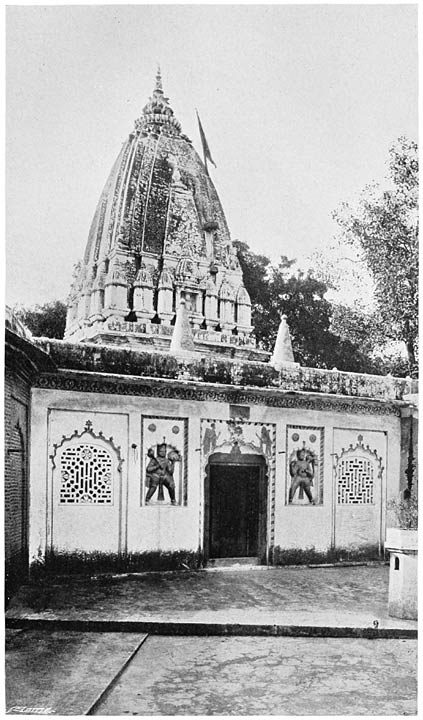
HANUMÂN AS A WARDEN.
Hanumân.
First among the heroic godlings is Hanumân, “He of the large jaws,” or, as he is generally called, Mahâbîr, the “great hero,” the celebrated monkey chief of the Râmâyana, who assisted Râma in his campaign against the giant Râvana to recover Sîtâ. Hardly any event in his mythology, thanks to the genius of Tulasî Dâs, the great Hindi poet of Hindustân, is more familiar to the Hindu peasant than this. It forms the favourite subject of dramatic representation at the annual festival of the Dasahra. There Hanumân, in fitting attire, marches along the stage at the head of his army of bears and monkeys, and the play ends with the destruction of Râvana, whose great body, formed of wickerwork and paper, is blown up with fireworks, amid the delighted enthusiasm of the excited audience.
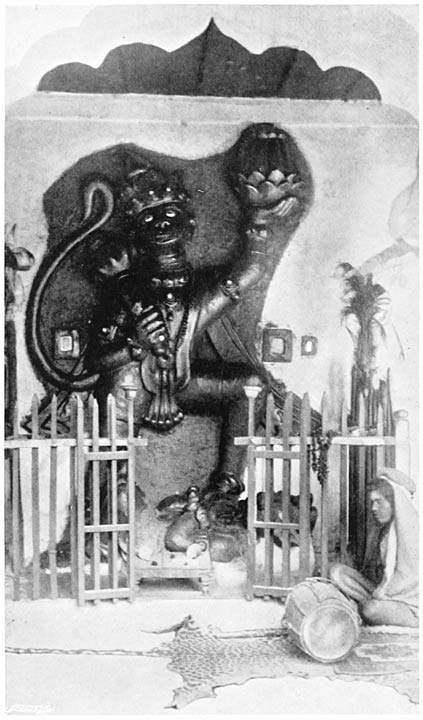
HANUMÂN AND HIS PRIEST.
Hanumân as a Village Godling.
On the same principle he is, with Hindu wrestlers, their patron deity, his place among Musalmâns being taken by ’Ali. Their aid is invoked at the commencement of all athletic exercises, and at each wrestling school a platform is erected in their honour. Tuesday is sacred to Mahâbîr and Friday to ’Ali. Hindu wrestlers on Mahâbîr’s day bathe in a river in the morning, and after bathing dress in clean clothes. Then taking a jar of water, some incense, sweets, and red or white flowers, they repair to the wrestling school, bow down before the platform and smear it with cow-dung or earth. After this the sweets are offered to Mahâbîr and verses are recited in his honour. Then they do the exercise five times and bow before the platform. When the service is over they smear their bodies with the incense, which is supposed to give them strength and courage. Care is taken that no woman sees the athletes exercising, lest she should cast the Evil Eye upon them.
One special haunt of the monkey deity is what is known as the Bandarpûnchh or “monkey tail” peak in the Himâlayas. They say that every year in the spring a single monkey comes from Hardwâr to this peak and remains there twelve months, when he makes way for his successor.
The respect paid to the monkey does not need much illustration. The ordinary monkey of the plains (Macacus Rhesus) is a most troublesome, mischievous beast, and does enormous mischief to crops, while in cities he is little short of a pest. But his life is protected by a most effective sanction, and no one dares to injure him.
The worship of Hanumân appears, if the Census returns are to be trusted, to be much more popular in the North-West Provinces than in the Panjâb. In the former his devotees numbered about a million, and in the latter less than ten thousand persons. But the figures are probably open to question, as he is often worshipped in association with other deities.
Worship of Bhîmsen.
Pillar-worship of Bhîmsen.
Worship of Bhîshma.
In about the same rank as Bhîmsen is Bhîshma, “the terrible one,” another hero of the Mahâbhârata. To the Hindu nowadays he is chiefly known by the tragic circumstances of his death. He was covered all over by the innumerable arrows discharged at him by Arjuna, and when he fell from his chariot he was upheld from the ground by the arrows and lay as on a couch of darts. This Sara-sayya or “arrow-bed” of Bhîshma is probably the origin of the Kantaka-sayya or “thorn-couch” of some modern Bairâgis, who lie and sleep on a couch studded with nails. He wished to marry the maiden Satyavatî, but he gave her up to his father Sântanu, and Bhîshma elected to live a single life, so that his sons might not claim the throne from his step-brethren. Hence, as he died childless and left no descendant to perform his funeral rites, he is worshipped with libations of water on the Bhîshma Ashtamî, or 23rd of the month of Mâgh; but this ceremony hardly extends beyond Bengal.
In Upper India five days in the month of Kârttik (November-December) are sacred to him. This is a woman’s festival. They send lamps to a Brâhman’s house, whose wife during these five days must sleep on the ground, on a spot covered with cow-dung, close to the lamps, which it is her duty to keep alight. The lamps are filled with sesamum oil, and red wicks wound round sticks of the sesamum plant rest in the lamp saucers. A walnut, an âonla (the fruit of the emblic myrobolon), a lotus-seed, and two copper coins are placed in each lamp. Each evening the women come and prostrate themselves before the lamps or walk round them. They bathe on each day of the feast before sunrise, and are allowed only one meal in the day, consisting of sugar-cane, sweet potatoes and other roots, with meal made of amarinth seed, millet and buckwheat cakes, to which the rich add sugar, dry ginger, and butter. They drink only milk. Of course the Brâhman gets a share of these good things, to which the rich contribute in addition a lamp-saucer made of silver, with a golden wick, clothes, and money. At the early morning bath of the last day five lighted lamps made of dough are placed, one at the entrance of the town or village, others at the four cross-roads, under the Pîpal or sacred fig tree, at a temple of Siva, and at a pond. This last is put in a small raft made of the leaves of the sugar-cane, and floated on the water. A little grain is placed beside each lamp. After the lamps handed over to the Brâhman have burnt away or gone out, the black from the wicks is rubbed on the eyes and fingers of the worshippers, and their toe-nails are anointed with the remainder of the oil. All the articles used in the worship are well-known scarers of demons, and there can be little doubt that the rite is intended to conciliate Bhîshma in his character of a guardian deity, and induce him to ward off evil spirits from the household of the worshipper.
The worship of the heroes of the Mahâbhârata does not prevail widely, unless we have a survival of it in the worship of the Pânch Pîr. At the last Census in the North-Western Provinces less than four thousand persons declared themselves worshippers of the Pândavas. The number in the Panjâb is even smaller.
Worship of the Local Godlings.
Village Shrines.
The shrine of the regular village godling, the Grâmadevatâ or Ganwdevatâ, is generally a small square building of brick masonry, with a bulbous head and perhaps an iron spike as a finial. A red flag hung on an adjoining tree, often a pîpal, or some other sacred fig, or a nîm, marks the position of the shrine. In the interior lamps are occasionally lighted, fire sacrifices (homa) made and petty offerings presented. If a victim is offered, its head is cut off outside the shrine and perhaps a few drops of blood allowed to fall on the inner platform, which is the seat of the godling. These shrines never contain a special image, such as are found in the temples of the higher gods. There may be a few carved stones lying about, the relics of some dismantled temple, but these are seldom identified with any special deity, and villagers will rub a projecting knob on one of them with a little vermilion and oil as an act of worship.
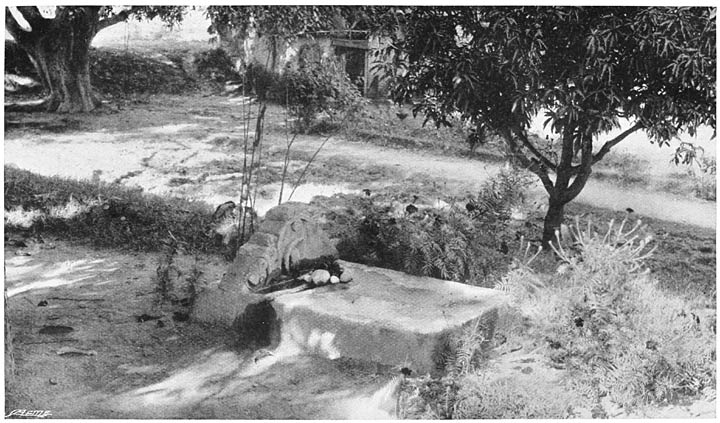
A VILLAGE SHRINE.
To the east of the North-Western Provinces the village shrines are much less substantial erections. In the Gangetic valley, where the population has been completely Hinduized, the shrine of the collective village deities, known as the Deohâr, consists of a pile of stones, some of which may be the fragments of a temple of the olden days, collected under some ancient, sacred tree. The shrine is the store-house of anything in the way of a curious stone to be found in the village, water-worn pebbles or boulders, anything with eccentric veining or marking. Here have been occasionally found celts and stone hatchets, relics of an age anterior to the general use of iron. In the same way in some European countries the celt or stone arrow-head is worn as an amulet.
The non-Brâhmanic character of the worship is still further marked by the fact that no special direction from the homestead is prescribed in selecting the site for the shrine. No orthodox Hindu temple can be built south of the village site, as this quarter is regarded as the realm of Yama, the god of death; here vagrant evil spirits prowl and consume or defile the offerings made to the greater gods. In the more Hinduized jungle villages some attempt is occasionally made to conform to this rule, and sometimes, as in the case of the more respectable Hindu shrines, the door faces the east. But this rule is not universal, and the site of the shrine is often selected under some suitable tree, whatever may be its position as regards the homestead, and it very often commemorates some half-forgotten tragedy, where a man was carried off by a tiger or slain or murdered, where he fell from a tree or was drowned in a watercourse. Here some sort of shrine is generally erected with the object of appeasing the angry spirit of the dead man.
These shrines have no idol, no bell to scare vagrant ghosts and awake the godling to partake of the offerings or listen to the prayers of his votaries. If he is believed to be absent or asleep, a drum is beaten to awaken or recall him, and this answers the additional purpose of scaring off intruding spirits, who are always hungry and on the watch to appropriate the offerings of the faithful. Here are also none of the sacrificial vessels, brazen lamps and cups, which are largely used in respectable fanes for waving a light before the deity as part of the service, or for cooling the idol with libations of water, and the instrument used for sacrificing the victim is only the ordinary axe which the dweller in the jungle always carries.
There is one special implement which is very commonly found in the village shrines of the hill country south of the Ganges. This is an iron chain with a heavy knob at the end, to which a strap, like a Scotch tawse, is often attached. The chain is ordinarily three and a half feet long, the tawse two feet, and the total weight is about seven pounds. This is known as the Gurda; it hangs from the roof of the shrine, and is believed to be directly under the influence of the deity, so that it is very difficult to procure a specimen. The Baiga priest, when his services are required for the exorcism of a disease ghost, thrashes himself on the back and loins with his chain, until he works himself up to the proper degree of religious ecstasy.
Identification of the Local Godling.
But it is with the local godlings that the founder of a new settlement has most concern. The speciality of this class of godlings is that they frequent only particular places. Each has his separate jurisdiction, which includes generally one or sometimes a group of villages. This idea has doubtless promoted the rooted disinclination of the Hindu to leave his home and come into the domain of a fresh set of godlings with whom he has no acquaintance, who have never received due propitiation from him or his forefathers, and who are hence in all probability inimical to him. But people to whom the local godling of their village has shown his hostility by bringing affliction upon them for their neglect of his service, can usually escape from his malignity by leaving his district. This habit of emigration to escape the malignity of the offended godling doubtless accounts for many of the sites of deserted villages, which are scattered all over the country. We say that they were abandoned on account of a great famine or a severe epidemic, but to the native mind these afflictions are the work of the local deity, who could have warded them off had he been so disposed. Hence when a settlement is being founded it is a matter of prime necessity that the local godling or group of godlings should be brought under proper control and carefully identified, so as to ensure the safety and prosperity of the settlement. The next and final stage is the establishment of a suitable shrine and the appointment of a competent priest.
In the Eastern Districts of the North-Western Provinces a more elaborate process is carried out, which admirably illustrates the special form of local worship now under consideration. When the site of a new settlement is selected, an Ojha is called in to identify and mark down the deities of the place. He begins by beating a drum round the place for some time, which is intended to scare vagrant, outsider ghosts and to call together the local deities. All the people assemble, and two men, known as the Mattiwâh and the Pattiwâh, “the earth man” and “the leaf man,” who represent the gods of the soil and of the trees, soon become filled with the spirit and are found to be possessed by the local deities. They dance and shout for some time in a state of religious frenzy, and their disconnected ejaculations are interpreted by the Ojha, who suddenly rushes upon them, grasps with his hands at the spirits which are supposed to be circling round them, and finally pours through their hands some grains of sesamum, which is received in a perforated piece of the wood of the Gûlar or sacred fig-tree. The whole is immediately plastered up with a mixture of clay and cow-dung, and the wood is carefully buried on the site selected for the Deohâr or local shrine. By this process the deities are supposed to be fastened up in the sacred wood and to be unable to do any mischief, provided that the usual periodical offerings are made in their honour.
This system does not seem to prevail among the Drâvidian races of the Vindhyan plateau. Some time ago I discussed the matter with Hannu Baiga, the chief priest of the Bhuiyas beyond the Son, and he was pleased to express his unqualified approval of the arrangement. Indeed, he promised to adopt it himself, but unfortunately Hannu, who was a mine of information on the religion and demonology of his people, died before he could apply this test to the local deities of his parish. His wife has died also, and I understand that he is known to be the head of all the Bhûts or malignant ghosts of the neighbourhood, while his wife rules all the Churels who infest that part of the country.
At the same time, to an ordinary Baiga the plan would hardly be as comfortable as the present arrangement. It would not suit him to have the local ghosts brought under any control, because he makes his living by doing the periodical services to propitiate them. Nowadays he believes fully in the influence of the magic circle and of spirituous liquor as ghost scarers. Both these principles will be discussed elsewhere. So he is supposed once a year at least, or oftener in case of pestilence or other trouble, to perambulate all round the village boundary, sprinkling a line of spirits as he walks. The idea is to form a magic circle impervious to strange and, in the nature of the case, necessarily malignant ghosts, who might wish to intrude from outside; and to control the resident local deities, and prevent them from contracting evil habits of mischief by wandering beyond their prescribed domains.
The worst about this ritual is that the Baiga is apt to be very deliberate in his movements, and to drink the liquor on the road and to spoil the symmetry of the circle during his fits of intoxication. I know of one disreputable shepherd who was upwards of a fortnight getting round an ordinary sized village, and the levy on his parishioners to pay the wine bill was, as may easily be imagined, a very serious matter, to say nothing of several calamities, which occurred to the inhabitants in their unprotected state owing to his negligence. At present the feeling in his parish is very strong against him, and his constituents are thinking of removing him, particularly as he has only one eye. This is a very dangerous deformity in ordinary people, but in a Baiga, who is invested with religious functions, it is most objectionable, and likely to detract from his efficiency.
The same custom prevails among the Kols and kindred races in Mirzapur, who make the bride and bridegroom carry it out as an omen of their success or failure in life. By carefully packing and pressing down the grain, any chance of an evil augury is easily avoided. We shall see later on that measuring the grain is a favourite device intended to save it from the depredations of evil-minded ghosts.
Worship of Dwâra Gusâîn.
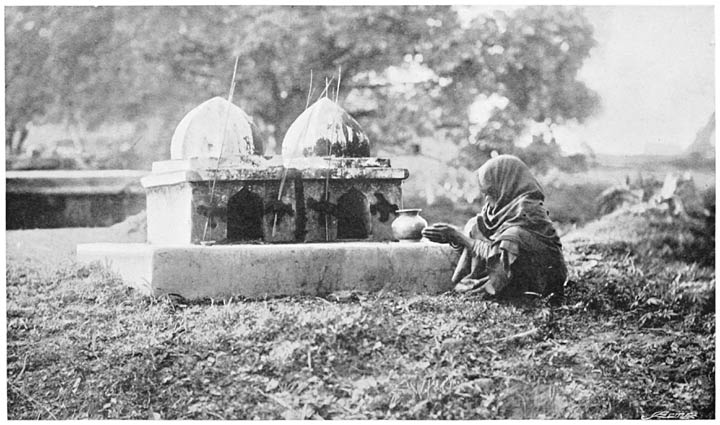
SHRINE OF BHÛMIYA WITH SWÂSTIKA.
Worship of Bhûmiya.
One of the most characteristic of the benevolent village godlings is Bhûmiya—“the godling of the land or soil” (bhûmi). He is very commonly known as Khetpâl or Kshetrapâla, “the protector of the fields”; Khera or “the homestead mound”; Zamîndâr or “the landowner”; and in the hills Sâim or Sâyam, “the black one” (Sanskrit syâma). In the neighbourhood of Delhi he is a male godling; in Oudh Bhûmiyâ is a goddess and is called Bhûmiyâ Rânî or “soil queen.” She is worshipped by spreading flat cakes and sweetmeats on the ground, which having been exposed some time to the sun, are eventually consumed by the worshipper and his family. The rite obviously implies the close connection between the fertility of the soil and sunshine.
No less than eighty-five thousand persons declared themselves, at the last census, to be worshippers of Bhûmiya in the North-Western Provinces, while in the Panjâb they numbered only one hundred and sixty-three.
Worship of Bhairon.
In his Saiva form he is often called Svâsva, or “he who rides on a dog,” and this vehicle of his marks him down at once as an offshoot from the village Bhairon, because all through Upper India the favourite method of conciliating Bhairon is to feed a black dog until he is surfeited.
He has, according to the last census, only five thousand followers in the Panjâb, as compared with one hundred and and seventy-five thousand in the North-Western Provinces.
Worship of Ganesa.
On pretty much the same stage as these warden godlings whom we have been considering is Ganesa, whose name means “lord of the Ganas” or inferior deities, especially those in attendance on Siva. He is represented as a short, fat man, of a yellow colour, with a protuberant belly, four hands, and the head of an elephant with a single tusk. Pârvatî is said to have formed him from the scurf of her body, and so proud was she of her offspring that she showed him to the ill-omened Sani, who when he looked at him reduced his head to ashes. Brahma advised her to replace the head with the first she could find, and the first she found was that of an elephant. Another story says that Ganesa’s head was that of the elephant of Indra, and that one of his tusks was broken off by the axe of Parasurâma. Ganesa is the god of learning, the patron of undertakings and the remover of obstacles. Hence he is worshipped at marriages, and his quaint figure stands over the house door and the entrance of the greater temples. But there can be little doubt that he, too, is an importation from the indigenous mythology. His elephant head and the rat as his vehicle suggest that his worship arose from the primitive animal cultus.
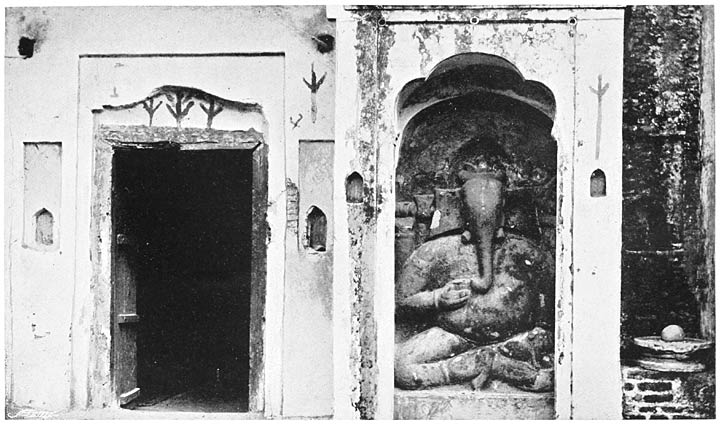
GANESA.
The Worship of the Great Mothers.
We have already met instances of this mother-worship in the case of Gangâ Mâî, “Mother Ganges,” and Dhartî Mâtâ, “the Earth Mother.” We shall meet it again in Sîtalâ Mâtâ, “the small-pox Mother.”
We shall meet later on with the ghost of the unpurified mother, the Churel, which is based on a different but cognate association of ideas. Akin to this, again, is the worship of the Satî, or model wife, to which we shall refer again, and that of the Châran women of Gujarât, who were obliged to immolate themselves to prevent outrage from the Kolis and other freebooters.
Mother-worship in Gujarât.
Mother-worship in Upper India.
The Jungle Mothers.
Other Mother Goddesses.
On the sacred plain of Kurukshetra there once stood a fort, known as Chakravyûha, and to the moderns as Chakâbu Kâ Qila, from which to the present day immense ancient bricks are occasionally dug. Popular belief ascribes great efficacy to these bricks, and in cases of protracted labour, one of them is soaked in water, which is given to the patient to drink. Sometimes an image of the fort, which is in the form of a labyrinth or maze, is drawn on a dish, which is first shown to the mother and then washed in water, which is administered to the woman. All through Nepâl and the neighbouring districts, the local rupee, which is covered with Saiva emblems, is used in the same way, and Akbar’s square rupee, known as the Châryârî, because it bears the names of the four companions (Châr-Yâr) of the Prophet, is credited with the same power. There are numerous Mantras or mystic formulæ which are used for the same purpose.
Worship of Gansâm Deo.
Worship of Dântan Deo and Lalitâ.
To the east of the Mirzapur District, there is a projecting mass of rock, which, looked at from a particular place, bears a rude resemblance to a hideous, grinning skull, with enormous teeth. This has come to be known as Dântan Deo or “the deity of the teeth,” and is carefully propitiated by people when they are sick or in trouble. Akin to this deity is Lalitâ, who is worshipped to the west of the Province. She is the sister of Kâlî, and brings bad dreams. Her speciality is her long teeth, and she has sometimes a curious way of blowing up or inflating the bodies of people who do not pay her due respect.
Worship of Dûlha Deo, the Bridegroom Godling.
Another great godling of the Drâvidian races is Dûlha Deo, “the bridegroom godling.” In his worship we have an echo of some great tragedy, which still exercises a profound influence over the minds of the people.
The bridegroom on his way to fetch the bride, is, by established Hindu custom, treated with special reverence, and this unfortunate bridegroom, whose name is forgotten, is said to have been killed by lightning in the midst of his marriage rejoicings, and he and his horse were turned into stone. In fact, like Ganymede or Hylas, he was carried off by the envy or cruel love of the merciless divine powers.
He is now one of the chief household deities of the Drâvidian people. Flowers are offered to him on the last day of Phâlgun (February), and at marriages a goat. Among some of the Gond tribes he has the first place, and is identified with Pharsipen, the god of war. In the native States of Rîwa and Sarguja, even Brâhmans worship him, and his symbol or fetish is the battle-axe, the national weapon of the Drâvidian races, fastened to a tree. In Mirzapur he is pre-eminently the marriage godling. In the marriage season he is worshipped in the family cook-room, and at weddings oil and turmeric are offered to him. When two or three children in the same hamlet are being married at the same time, there is a great offering made of a red goat and cakes; and to mark the benevolent character of the deity as a household godling, the women, contrary to the usual rule, are allowed a share of the meat. This purely domestic worship is not done by the Baiga or devil priest, but by the Tikâit or eldest son of the family. He is specially the tribal god of the Ghasiyas, who pour a little spirits in the cook-room in honour of him and of deceased relatives. The songs in his honour lay special stress on the delicacies which the house-mother prepares for his entertainment. Among the Kharwârs, when the newly married pair come home, he is worshipped near the family hearth. A goat is fed on rice and pulse, and its head is cut off with an axe, the worshipper folding his hands and saying, “Take it, Dûlha Deo!”
On the day when this worship is performed, the ashes of the fireplace are carefully removed with the hands, a broom is not used, and special precautions are taken that none of the ashes fall on the ground.
General Sleeman gives the legend of Dûlha Deo in another form.