BOOK III. (continued 2)
Thomas Taylor translation
In consequence of these previous considerations then, we must call the fifth theorem a composite, and a composite, both with respect to the datum, and the object of investigation; and this the institutor of the elements exhibiting, divides this theorem, being one, and gives a separate position to the data, and the things to be investigated, for he says that the angles at the base of an isosceles triangle are equal; and again, that the equal sides being produced, the angles under the base are equal. For we must not think that there are two theorems, but one; and that this is a composite, both according to the data, and thing sought: and that each of these composites is perfect and true. Hence, conversion also is true in each. For if the angles at the base are equal, the triangle is isosceles: but if those under the base are equal, the equal right lines are produced, and the triangle is isosceles. But the institutor of the elements converts the equality of the angles at the base; but not the equality of those under the base, though this is likewise true; the reason of which we shall shortly explain. But we shall now, in the first place, enquire on what account he demonstrates that the angles under the base are equal. For he never employs this in the construction or demonstration of other problems or theorems. It may be doubted, therefore, why, since it is useless, it was requisite to insert it in the present theorem? To this we must reply, that though it is never employed in the elements, yet it is most useful for the destruction of objections, and the solution of oppositions to theorems[10]. But it is artificial, and belongs to science to prepare solutions of things resisting its propositions, and to provide subsidies of answers; that not only true demonstrations may be fabricated from things previously demonstrated, but that from hence confutations of error may be produced. And from this geometrical order, you will likewise receive a rhetorical emolument. For he who can effect this in the discourses of rhetoric, who can foresee the oppositions to his following heads, and previous to their delivery, can first of all prepare solutions of them to others, he, indeed, will fabricate in a wonderful manner, a most excellent mode of disputation. The institutor of the elements, therefore, teaching us this in reality, previous to the theorems by which we solve opposing objections, employing such as are now exhibited, at the same time demonstrates, that the angles under the base of an isosceles triangle, are equal, and thus prepares a confutation of the falsehood such objections contain. But that from the present theorem we may solve the objections urged in the seventh and ninth propositions, will be perspicuous as we proceed. Hence, it appears, why Euclid does not convert the latter part of this theorem in the sixth, because it does not produce a principal utility, but confers to our advantage, accidentally, with respect to the whole of science.
But if any one should desire us without producing the equal right lines, to prove the angles at the base of an isosceles triangle equal, (for it is not requisite to demonstrate the equality of these, by those under the base) by transposing, in a manner, the construction, and fabricating those constructions within, which are made without the isosceles triangle, we may exhibit the thing proposed.
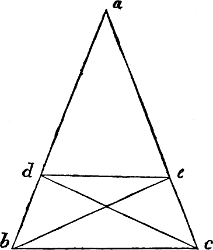
Thus let a b c be an isosceles triangle, and in the side a b, take any point d, and from a c, take a e, equal to a d, and draw the lines b e, d c, d e. Because, therefore, a b is equal to a c, and a d to a e, and the angle a is common, b e also shall be equal to c d, and the remaining angles to the remaining angles. Hence, the angle a b e, is equal to the angle a c d. Again, because d b is equal to e c, and b e to d c, and the angle d b e to e c d; hence, the base, since it is common to both, is equal to itself, and all are equal to all. The angle, e d b, therefore, is equal to the angle d e c: and the angle d e b, is equal to the angle e d c. Hence, since the angle e d b, is equal to the angle d e c, from which the equal angles d e b, e d c, are taken, the remaining angles b d c, c e b are equal. But the sides also b d, d c, are equal to the sides c e, e b, each to each, and the base b c is common. All, therefore, are equal to all. Hence, the remaining angles also, subtending equal sides, are equal. The angle, therefore, d b c, is equal to the angle e c b. For the angle d b c, subtends the line d c: but the angle e c b, the line e b. The angles, therefore, at the base of an isosceles triangle, are equal, the equal right lines not being produced.
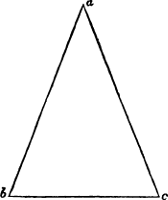
But Pappus demonstrates this yet shorter, without any addition in the following manner. Let a b c be an isosceles triangle, having a b, equal to a c. We must conceive, therefore, this one triangle as if it was two, and reason thus. Because a b is equal to a c, and a c to a b, the two sides a b, a c, are equal to the two a c, a b, and the angle b a c, is equal to the angle c a b, (for it is the same.) All, therefore, are equal to all. The base b c, to the base c b. But the triangle a b c, to the triangle a c b; and the angle a b c, to the angle a c b, and the angle a c b, to the angle a b c. For they subtend equal sides, i.e. a b, a c. The angles, therefore, at the base of an isosceles triangle, are equal. And it seems that Pappus invented this mode of demonstration, when he considered that the institutor of the elements also, in the fourth theorem, when he had united two triangles, and had made them mutually coincide, thus forming one of two, by this means observed their equality throughout. In like manner it is possible, that we also, by an assumption contemplating two triangles in one, may demonstrate the equality of the angles at the base. Thanks, therefore are to be given to the ancient Thales for the invention of this theorem, as well as a multitude of others. For he, first, is said to have perceived and affirmed, that the angles at the base of every isosceles triangle are equal: and after the manner of the ancients, to have called them similar. But still more deserving of praise are those moderns, who have yet more universally demonstrated (among which number is Geminus) that equal right lines falling from one point, on a line of similar parts, form equal angles. For Geminus using this theorem, shews, that there are only three lines, and not more of similar parts, the right, the circular, and the cylindric helix; and this is properly universal, to which this symptom first agrees, just as the possession of two sides greater than the third, is shewn to be essentially inherent in every triangle. It is not, therefore, the property universally of every isosceles, though it belongs to every one, to possess angles at the base equal: but of equal right lines falling on a line of similar parts. For to subtend equal angles, is in these primarily inherent.
PROPOSITION VI. Theorem III.
If two angles of a triangle be equal to each other, the sides also which subtend the equal angles, shall be equal to one another.
The present theorem exhibits these two properties of theorems, conversion, and a deduction to an impossibility. For it is converted, indeed, in the preceding theorem, but its certainty is evinced by a deduction to an impossibility. It is requisite, therefore, to speak of each, whatever belongs to the present treatise. One kind of conversion then, among geometricians, is denominated principally and properly, when the conclusions and hypotheses alternately receive theorems; so that the conclusion of the former becomes hypothesis in the latter; and hypothesis is inferred as the conclusion. As that the angles at the base of an isosceles triangle are equal. For here the isosceles triangle is the hypothesis: but the conclusion, the equality of the angles at the base. And that where the angles at the base are equal, the triangles are isosceles, which the present 6th theorem affirms. For here the equality of the angles at the base is the hypothesis; but the conclusion, the equality of the sides subtending the equal angles. But another kind of conversion, is alone according to a certain mutation of composites. For if the theorem be composite, beginning from many hypotheses, and ending in one conclusion, by receiving the conclusion, and one or more of the hypotheses, we infer some one of the other hypotheses as a conclusion. And after this manner the eighth theorem is the converse of the fourth. For the one says, that equal bases subtend equal sides and angles: but the other, that equal sides being placed on equal bases, contain equal angles. Of which the predication concerning equal bases in the latter proposition, is the conclusion of the former: but the predication concerning the position of equal sides, is one of the previously assumed hypotheses in the former theorem; and the comprehension of equal angles is another hypothesis which this fourth proposition contains. In consequence therefore of these two conversions, the one which is called the principle, is uniform and determinate: but the other is various, advancing into a great number of theorems, and not converting in one, but in many, on account of the multitude of hypotheses, in composite theorems. But oftentimes in that which begins from two hypotheses, there is one which is converted, when the hypotheses are not all determinate, but some of them indeterminate.
It is here, however, requisite to observe, that many false and improper conversions take place. As that every sexangular is a triangular number[11]. For the converse is not also true, that every triangular number is sexangular. But the reason of this is, because the one is more common, but the other more particular. And one is alone predicated totally[12] of the other. But things in which, that which is primary, is inherent, and according to which it is received, in these, conversion also follows. And these observations, indeed, were not unknown to those mathematicians, the familiars of Menæchmus, and Amphinomus. But of theorems receiving conversion, some are usually called precedents, but others converse. For when supposing a certain genus, they demonstrate some symptom of its nature, they call this a precedent theorem. But when on the contrary, they make the hypothesis a symptom, and the conclusion a genus, they denominate the theorem to which this happens converse. As for instance, the theorem which says, every isosceles triangle has the angles at the base equal, is a precedent. For that is subjoined which precedes by nature. I mean the genus itself, or the isosceles triangle. But that which says, every triangle possessing two equal angles, has likewise the sides subtending those equal angles equal, and is isosceles, is a converse theorem. For it changes the subject, and its passion, supposing the latter, and from this exhibiting the former. And thus much concerning geometrical conversions.
But deductions to an impossibility, entirely end in an evident impossible, the contrary of which is confessed by all. It happens, however, that some of them end in such things as are opposed to Axioms, or Petitions, or Hypotheses; but others in things contradicting prior demonstrations. For the present sixth theorem shews that which happens to be impossible, because it destroys the common conception, affirming that the whole is greater than its part. But the eighth theorem falls, indeed, on an impossible, yet not on that endued with a power of destroying a common conception, but that exhibited by the seventh theorem. For what the seventh denies, this affirming exhibits to such as do not admit the object of investigation. But every deduction to an impossibility, which being received, opposes the thing sought, and on this hypothesis advances, until it falls upon the explored absurdity, and by this means destroys the hypothesis, corroborates that which was investigated from the first. But it is requisite to know, that all mathematical proofs are either from principles, or to principles, as Porphyry in a certain place affirms. And the proofs from principles, are two-fold. For they either emanate from common conceptions, and things self-evident: or from things previously exhibited. But proofs to principles are endued with a power of either establishing or destroying principles. And those, endued with a power of establishing principles, are called resolutions; and to these compositions are opposed. For it is possible that we may proceed in an orderly method from those principles to the object of investigation; and this is nothing else than composition. But those possessing a power of destroying principles, are called deductions to an impossibility. For it is the business of this mode to destroy some of the concessions, and objects of investigation. And in this, also, there is a certain ratiocination, though not the same as in resolution. For in deductions to an impossibility, complexion is according to the second mode of hypothetical reasonings. As if in triangles possessing equal angles, the sides subtending the equal angles are unequal; and the whole is equal to its part: but this is impossible. In triangles, therefore, possessing two equal angles, the sides subtending the equal angles are equal. And thus much concerning what is called by geometricians, deduction to an impossibility.
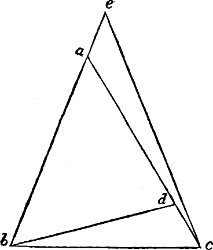
But the institutor of the elements uses conversion in the present proposition, for he receives the conclusion of the fifth as a datum, and adds its hypothesis as an object of enquiry: but he employs deduction to an impossibility, in the construction and demonstration. But if any should rise up, and assert that it is not necessary by taking a part from a c equal to a b, to make the ablation at the point c, but at the point a, upon this hypothesis, we shall fall into the same impossibility. For let a b be equal to a d, and having produced b a, let a e be placed equal to d c. The whole b e, therefore, is equal to the whole a c.
Let e c be connected. Because, therefore, a c is equal to b e, but b c is common, the two are equal to the two, and the angle at the point b, is equal to the angle a c b. For so it was established in the hypothesis. All, therefore, are equal to all, by the fourth theorem. Hence, the triangle e b c, is equal to the triangle a b c, the whole to the part, which is impossible. But because this also is manifest, it remains that we exhibit the rest of the conversion. For the institutor of the Elements converts the whole sixth theorem from a part of the fifth. But it is requisite to adjoin the remaining conversion. This, then, he receives as an hypothesis, that the angles at the base of a certain triangle are equal: but he shews that the triangle is isosceles.
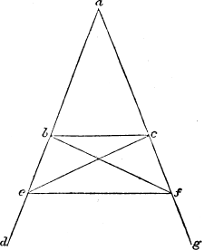
Let a c b, therefore, be a triangle, and let a b, a c, be produced to the points d g, and let the angles under the base be equal. I say that the triangle a b c, is isosceles. For let there be assumed in the line a d, the point e, and let b e be taken equal to c f; and connect the lines e c, b f, e f. Because, therefore b e is equal to c f, but b c is common, the two will be equal to the two. And the angle e b c, is equal to the angle f c b; for they are under the base. All, therefore, are equal to all, by the fourth theorem. Hence the base e c, is equal to the base f b, and the angle b e c, to the angle c f b; and the angle c b f, to the angle b c e: for they subtend equal sides. But the whole angle e b c, was equal to the whole f c b, of which the angle f b c, is equal to the angle e c b. The remainder, therefore, e b f, is equal to the remainder f c e. But b e is equal to c f, and b f to c e, and they contain equal angles. All, therefore, are equal to all. Hence, also, the angle b e f, is equal to the angle c f e. Wherefore, the side a e, is equal to the side a f (for it is shewn by the sixth) of which b e, is equal to c f. The remainder, therefore, a b, is equal to the remainder a c. And hence, the triangle a b c, is isosceles. It is, therefore, as well isosceles, if it possesses angles at the base equal: as if the sides being produced it has the angles under the base equal. Why then did not the institutor of the Elements convert the remaining part? Shall we say it was because the equality of the angles under the base in the fifth theorem, was exhibited for the sake of solving other doubts. But that proving the triangle to be isosceles, from the equality of the angles under the base, neither confers to a principal demonstration, nor to the solution of things investigated, the truth of which is confirmed in the following theorems, and that from the equality of the angles under the base, he is enabled to demonstrate that the triangle is isosceles? For if every right line, standing upon a right line, and forming two angles, makes them equal to two right; when the angles under the base are equal, those upon the base will be equal. And these being equal, the sides subtending them shall be equal. Euclid, therefore, having used this in the whole elementary institution, was enabled to conclude, that when the angles under the base are equal, the triangle is isosceles. Indeed he requires this also, for the demonstration of certain theorems: For shortly a theorem will appear, evincing, that if a right line standing on a right line, forms angles, it will either make two right, or angles equal to two right. And the theorems, indeed, preceding this, require no such conversion; but those which follow, are indigent of this, and establish their credibility from the present theorem.
PROPOSITION VII. Theorem IV.
[13]Upon the same right line, two right lines cannot be constituted equal to two other right lines each to each, drawn to different points, to the same parts, and having the same extremes with the two right lines first drawn.
The present theorem possesses a rare property, which is not frequently found in propositions producing science. For to be formed by negation, and not by affirmation, is not their sufficiently distinguishing property. Indeed, the propositions, as well of geometrical as of arithmetical theorems, are for the most part affirmations. But the reason of this is, (as Aristotle says) because, an affirmative universal, especially agrees with sciences, as more proper, and not indigent of negation: but a universal negative requires affirmation, in order to produce evidence; for from negatives alone, there is neither demonstration nor reasoning. Hence, demonstrative sciences exhibit a multitude of affirmations, but rarely employ negative conclusions. However, the proposition of this theorem is full of admirable diligence, and is bound with every addition, by which it is rendered so certain and indubitable, that it cannot be confuted and overturned by the efforts of opposing calumniators. For in the first place, the particle upon the same right line, is assumed, lest we should exhibit upon another, two right lines equal each to each, and employ the proposition for the purpose of circumvention. In the second place, he does not say upon what right line, to constitute two right lines simply equal to two (for this is possible) but each to each. For what wonderful thing is it, that he should take both equal to both, who extends one of the constituted lines, and contracts the other? But each to each, (says he) is impossible. In the third place, he adds the particle, to different points. For what, if some one, when he has formed two lines equal to the first two, each to each, should connect these with those in the same point, which joins the subject right lines in the vertex; and should constitute these? For the extremes of equal right lines perfectly coincide. In the fourth place, he adds the particle to the same parts[14]. For what if one subject right line being given, we should place two of the right lines on one side, and the other two on the opposite side, so that this common right line should be the basis of the two triangles with opposite vertexes? Lest, therefore, we should form an erroneous figure, and charge our deception on the institutor of the Elements, he adds the particle to the same parts. In the fifth place, he subjoins, having the same extremes with the two right lines first drawn. For it is possible to constitute upon the same right line, two right lines equal to two, each to each, drawn to different points, and to the same parts, by employing the whole right line, and constructing upon it, these two right lines; but then the lines last drawn, will not have the same extremes with those constituted at first. For if we conceive in a quadrangle two diagonals drawn on one of its sides, two lines shall be equal to two; a side and diameter to its parallel side, and the other diameter. But in this case the equal right lines will not have the same extremes. For neither the parallel sides, nor the diameters, will mutually possess the same extremes; and yet they will be equal. These distinctions, therefore, being preserved, the truth of the proposition, and the certainty of the reasoning, is evinced.
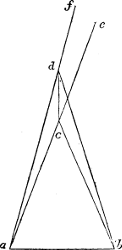
But perhaps, some, notwithstanding all these terms producing science, will dare to object, that these hypotheses being admitted, it is possible to effect what the geometrician affirms to be impossible. For let there be a right line a b, and upon this two lines a d, d b, equal to two a c, c b, and let the former be external to the latter, being drawn to different points d c, and terminated in the same extremes a and b. Let a c too, be equal to a d: but b c to b d. This objection, then, we shall confute, by connecting the line d c, and producing the lines a c, and a d, to the points e f. For these being constructed, it is manifest that the triangle a c d is isosceles, a d, being equal to a c, from hypothesis; and the angles under the base e c d, f d c are equal. The angle f d c, therefore, is greater than the angle b d c. Much more then is the angle b c d greater than the angle b d c. But again, because the line d b, is equal to the line b c, the angles also at the base are equal, i.e. the angle b c d, to the angle b d c. The same angle, therefore, is both greater and equal, which is impossible. And this is what we said in our exposition of the fifth theorem, that though the equality of the angles under the base, was not useful to the demonstrations of the following theorems, yet it procured the greatest utility in the solution of objections. For in the present instance we have confuted the objection, by inferring that, because a c, and a d, are equal, the angles e c d, and f d c, are also equal. In a similar manner in other theorems, it will appear to be peculiarly useful for the solution of doubts[15].
But if any one should say that there may be constituted upon the right line a b, right lines b d, b c, equal to the right lines a c, a d, of which b c may be equal to a c, but b d to a d; and that in this case they will be drawn to different points a and b, to the same parts, and will have the same extremes with a c, and a d, viz. c, and d, what shall we reply to this assertion? Shall we say that it is requisite to constitute the first lines, upon the right line a b, and their equals upon the same right line? For this is what the institutor of the Elements affirms in the proposition. But here, a c, and a d, are not constituted upon the right line a b, but only on one of its points. Hence, the lines a c, c b, and a d, d b, which stand on the right line a b, are different from the right lines, which were placed in the beginning, and to which they ought to be constituted equal. Though at the same time it is necessary that the right lines constituted upon a b, should be equal to those constituted upon a b. And thus much may suffice for objections against the present question, But that the present theorem is exhibited by the institutor of the elements, by a deduction to an impossibility, and that this impossible opposes the common conception, affirming that the whole is greater than its part; and that the same thing cannot be both greater and equal, is sufficiently manifest. But this theorem seems to have been assumed for the sake of the eighth theorem. For it confers to its demonstration, and is neither simply an element, nor elementary: since it does not extend its utility to a multitude. And hence, we find it very rarely employed by the geometrician.
PROPOSITION VIII. Theorem V.
If two triangles have two sides equal to two, each to each, and have the base equal to the base: then the angles contained by the equal right lines, shall be equal to each other.
This eighth theorem is the converse of the fourth: but it is not assumed according to a principal conversion. For it does not make the whole of its hypothesis a conclusion; and the whole conclusion an hypothesis. But connecting together some part of the hypothesis of the fourth theorem, and some part of the objects of enquiry, it exhibits one of the data which it contains. For the equality of two sides to two, is in each an hypothesis; but the equality of base to base, is, in the fourth, an object of investigation, but in the present a datum; and the equality of angle to angle, is, in the former, a datum, but in the latter, an object of enquiry. Hence, a change alone of data, and objects of investigation, produces conversion. But if any one desires to learn the cause why this theorem is placed in the order of the eighth proposition, and not immediately after the fourth, as its converse, in the same manner as the sixth after the fifth, of which it is the converse, since many converted propositions follow their precedents, and are exhibited after them without any intervening medium, to this we must reply, that the eighth, indeed, is indigent of the seventh proposition. For its truth is evinced by a deduction to an impossibility, but the nature of an impossible becomes known from the seventh. And, this again, in its demonstration, is indigent of the fifth. Hence, the seventh and fifth theorems were necessarily assumed, previous to the present. But because the converse to the fifth obtained a demonstration easy, and from things first, it was very properly placed after the fifth, on account of its alliance with that theorem; and because, since it is shewn by a deduction to an impossibility, it confutes that which is impossible from common conceptions, and not as the eighth from another theorem. For things opposing common conceptions, are more evident for the purpose of confutation than such as contradict theorems: since these are assumed by demonstration, but the knowledge of axioms is better than demonstration. But the institutor of the elements exhibits what is now proposed from the previously demonstrated seventh theorem.
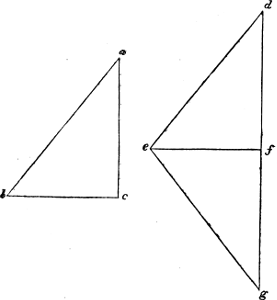
But the familiars of Philo assert, that they can demonstrate this theorem, without being indigent of any other. For let there be conceived (say they) two triangles, a b c, d e f, having two sides equal to two, and the base b c equal to the base e f. Likewise let the bases coincide with each other; and let the two triangles a b c, d e f, be so placed in the same plane, that their vertices may be opposite, and so that e f g may be the equal substitute of a b c. And let e g be equal to d e, but f g to d f. Hence, f g will either be placed in a right line with d f, or not in a right line. And if not in a right line, it will either make with it an angle according to the internal part, or according to the external. Let it first be placed in a right line. Because, therefore, d e is equal to e g, and d f g is one line, the triangle d e g, is isosceles, and the angle at the point d, is equal to the angle at the point g. But if it does not lie in a right line, it will make an angle inward; and in this case let d g be connected.
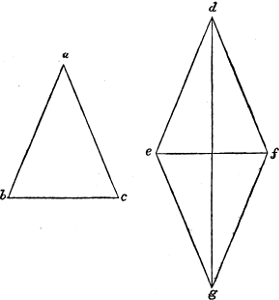
cause, therefore e d, e g, are equal, and the base is d g, the angle e d g also, is equal to the angle e g d. Again, because d f is equal to f g, and the base is d g, the angle, also, f d g, is equal to the angle f g d. But the angle e d g was also equal to the angle e g d. Hence, the whole e d f, is equal to the whole f g e, which was required to be demonstrated. But in the third place, let f g make an angle with d f, externally, and let the right line d g be connected.
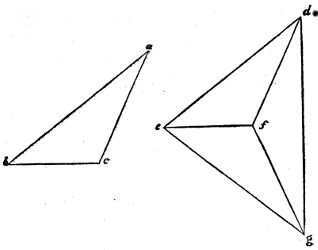
Because, therefore d e, e g, are equal, and the base is d g, the angles e d g, d g e, are equal. Again, because d f, f g, are equal, and the base is d g, the angle f d g, is equal to the angle f g d. But the whole angles e d g, d g e, were mutually equal. Hence, the remaining angles e d f, f g e, will be equal to each other. And thus the thing proposed is invented according to any position of the right line f g, and we may demonstrate the theorem, without employing the seventh proposition.
Is, then (say they), the seventh proposition introduced in vain by the institutor of the elements? For if we only assume it on account of the eighth, but the eighth may be exhibited without it, does not the seventh appear entirely useless? To these enquiries we must reply in the words of our predecessors, that the seventh theorem, being demonstrated, is of the greatest utility to such as are skilled in astronomical concerns, when they discourse concerning the eclipses of the sun and moon. For, employing this theorem, they shew that three consequent eclipses, distant from each other by an equal space, cannot subsist. I say, in such a manner, that the second may be distant from the first by as great a space of time as the third from the second. For example, if the second is produced after the first, when six months and twenty days are elapsed; the third, will by no means be produced after the second, by the same, but by either a greater or less interval of time. But that this is the case may be demonstrated by the seventh theorem. And the institutor of the elements has not only exhibited the present as conferring to astronomy, but a multitude of other theorems and problems. For to what other end shall we say that the last problem of the fourth book was proposed, by which we are taught how to inscribe the side of a figure of fifteen angles in a circle, than for its relation to astronomy? For those who describe in a circle a quindecangle passing through the poles, will, by this means, obtain the distance of the poles of the equator from the poles of the zodiac. Since they are distant from each other by the side of a quindecangle. The institutor of the elements, therefore, appears by regarding astronomy, to have previously exhibited many things preparative to our advancement in that science. But when, at the same time, he saw that this seventh theorem is exhibited from the fifth, and proves the eighth without any variety, he assigned it the present place. The addition of Philo is, indeed, beautiful, but is not sufficiently adapted by its variety of cases to an elementary institution. And thus much in reply to the present question.
But if any one should doubt why he does not add so much in the eighth as in the fourth theorem, I mean, that the triangles and the remaining angles are equal; we must say, that because the equality of the vertical angle is demonstrated, it follows, that all are equal to all, by the fourth theorem. It was therefore alone necessary to demonstrate this by itself, but to assume all the rest as consequents. But it seems that the equality of the vertical angles causes the equality of the bases, and of the sides comprehending those angles. For when the bases are unequal, the same angles will not remain, though the containing equal sides are supposed, but while the base becomes less, the angle is at the same time diminished, and while that increases, the angle also receives a correspondent increase. Nor while the same bases remain, but the sides become unequal, will the angle remain; but while they are diminished, it will be increased; and while they are increased, it will be diminished: for angles, and their containing sides, suffer a contrary passion. Thus, if upon the same base, you conceive the sides descending to the lower part, you will diminish the sides, but increase the angle which they comprehend, and enlarge their distance from each other. But if you conceive the sides to be elevated, and to receive an addition as they rise, you will diminish the angle which they contain: for they will coincide the longer, when their vertex is more remote from the base. We may therefore certainly affirm that the identity of the basis and equality of the sides, in a triangle, determine the equality of its angle.
PROPOSITION IX. Problem IV.
To bisect a given rectilineal angle.
Our author mingles theorems with problems, and connects problems with theorems, and through both completes the whole of his elementary institution, comparing as well subjects as the symptoms subsisting about subjects themselves. Since, therefore, he had shewn in the preceding propositions, both in one triangle, from the equality of the sides, the consequent equality of the angles, and the contrary: and in a similar manner in two triangles, with this exception, that the mode of conversion in one and two triangles is different, he now passes to problems, and orders us to bisect a rectilineal angle. And it is manifest, that the angle here is given according to form: for it is called right-lined, and not of any kind whatever. Indeed, we cannot bisect every angle by the elementary institution; since it is doubtful whether every triangle can be bisected. For, perhaps, you may doubt whether it is possible to bisect a cornicular angle. But the ratio of the section is also distinguished in this problem, and this again not in vain. For to divide an angle in any given ratio, transcends the present construction: as, for example, into three, four, or five equal parts. Indeed, to trisect a right angle is possible, by employing a few of the propositions which are afterwards delivered[16]: but this cannot be effected in an acute angle, without passing on to other lines of a mixt species.[17] And this is manifested by the geometricians who propose to trisect a given rectilineal angle. For Nichomedes, indeed, from conchoidal lines, the origin, order, and symptoms of which, he delivers, as he was the inventor of their properties, trisects every right-lined angle. But others effect this from the quadrantal lines of Hippias and Nichomedes, by employing mixt quadrantal lines. Others, again, being incited from the Helices of Archimedes, divide a given rectilineal angle, in a given ratio. But the consideration of these, because difficult to learners, we shall for the present omit; as it will, perhaps, be more convenient to examine this in the third book[18], where the institutor of the Elements bisects a given circumference. For there the same mode of enquiry presents itself with respect not only to bisection, but also trisection; and the ancients endeavoured, by employing the same lines, to divide every circumference into three equal parts. With great propriety, therefore, he who only mentions a right line and a circumference, alone bisects a right angle and a circumference. But conceiving that the species composed from these, through mixture, are difficult to explain and enumerate, without a curious examination, he omits all such enquiries as involve mixt lines in their consideration, and proposes to investigate in first and simple forms alone, such things as can either be produced or considered from these. And such, indeed, is the proposition of the present problem, to bisect a given right lined angle. For in the construction of this he uses one petition, and the first and third problem: but in the demonstration he employs the eighth theorem alone. Since problems entirely require demonstration (as we have already observed[19]) and through this they obtain a power of producing science. But perhaps, some may oppose the geometrician, by asserting that an equilateral triangle may be constituted by him, not having its vertex within the two right lines, but either upon, or external to each; and that this may be manifested by the elements. For let there be an angle b a c, which it is required to bisect.
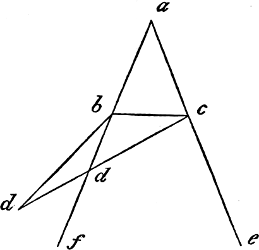
Then let b a be taken equal to a c, and let b c be connected, and upon it, let an equilateral triangle b c d be constructed. This point d, therefore, is either within the right lines a b, a c, or upon a b, or a c, or external to both. Now the institutor of the Elements assumes them within; and hence, those who oppose the demonstration, will say the point is either placed on one of the right lines, or external to both. Let the point d then be placed on the line a b, so that the triangle b c d may be equilateral: d b, therefore, is equal to d c, and the angles at the base c b d, b c d, are equal. Hence, the whole, b c e, is greater than the angle c b d. Again, because a b, c a, are equal, the triangle a b c, is isosceles, and the angles under the base b c, will be equal. The angle, therefore, b c e, is equal to the angle c b d. But it was also greater, which is impossible. Hence, the vertex of the equilateral triangle cannot be in the right line a b d. In like manner we may shew that it cannot be in the right line a c e. Let it therefore, if possible be placed externally. Because, then b d is equal to c d, the angles at the base are equal, viz. b c d, and c b d. Hence, the angle b c d, is greater than the angle c b f. Much more, therefore, is the angle b c e, greater than c b f: but it is also equal, because these angles are under the base b c, of an isosceles triangle a b c, and this is impossible. Hence, the point cannot fall in these parts external to the two right lines; and it may be similarly shewn that this is impossible in other parts. Here too you may again observe, that we destroy objections by using the second part of the fifth proposition, that the angles under the base of an isosceles triangle are equal. And this is what we have previously observed, that many things opposing science, are shewn to be debile, and easy of confutation, by the assistance of this theorem; and that such is the utility it affords to geometry.
But if any one should say that there is no place under the base, and yet that it is requisite to constitute the equilateral triangle at the same parts, in which the lines b a, a c, are situated; it will be necessary that the lines which are constituted should either coincide with b a, a c, if they also are equal to the base c b: or that they should fall external to them, if they are less than the base b c: or within, if b a, a c, are greater than b c.
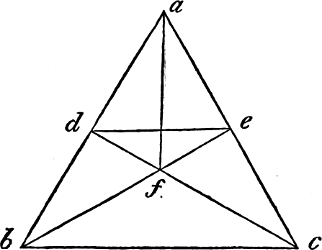
Let them, in the first place, coincide, and let b a c be anequilateral triangle, and let there be taken in the side a b, the point d, and make a e in the side a c, equal to a d, and connect the lines d e, b e, c d, a f. Because, therefore, a b is equal to a c, and a d to a e, the two b a, a e, are equal to the two c a, a d, and they comprehend the same angle. Hence, they are all equal to all, and the angle d b e, is equal to the angle e c d. But d b is also equal to e c, and b e to c d. All, therefore, are equal to all. Hence, the angle d e b, is equal to the angle e d c: for they subtend equal sides. And d f is equal to e f, (by the sixth.) Because, therefore, a e is equal to a d, and a f is common, and the base d f, is equal to the base e f, the angle d a e is bisected, which was required to be done.
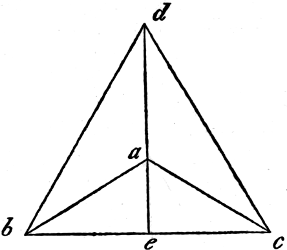
But if the sides of the equilateral triangle fall external to the right lines b a, a c, let them be b d, d c, and having connected d a, let it be produced to the point e. Because, therefore b d, d c, are equal, but d a is common, and the bases b a, a c, are equal, the angle, also, b d a, (by the eighth) is equal to the angle c d a. Again, b d, d c, are equal, and d e is common, and they contain equal angles as we have shewn, the base also b e, is equal (by the fourth) to the base e c. Because, therefore, a b is equal to a c, and a e is common, the angle, also b a e, is equal to the angle c a e, which was to be shewn.
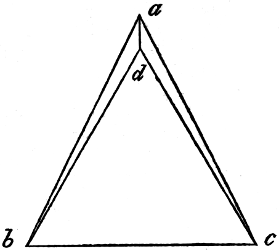
But if the sides of the equilateral triangle fall within the right lines a b, a c, as b d, d c, let again a d be connected. Because, therefore, b a, is equal to a c, and a d is common, but the base b d, is equal to the base c d, hence, the angle b a d (by the eighth) is equal to c a d. The angle, therefore, at the point a, is bisected, in whatever manner the equilateral triangle may be constituted. And having thus summarily spoken concerning these, we shall now proceed to the following theorems, only adding, that the given angle may be given in a four-fold respect. In position, as when we say to this right line, and to this point to place an angle: for after this manner it is given. But in form, as when we call the angle right, or acute, obtuse, right-lined, or mixed. And in proportion, as when we call it double, or triple, greater, or less. And lastly, in magnitude, as when we call it the third part of a right angle. But the present angle is only given in form.
PROPOSITION X. Problem V.
To bisect a given finite right line.
This, also, is a problem which supposes a finite right line, since we cannot terminate a line on both sides infinite. But the section of a line infinite on one side only, wherever the point is assumed, is made in unequal parts. For that part of the section which takes place on the infinite side, is necessarily greater than the remainder, because finite. Hence, the line required to be bisected, must be necessarily both ways finite. But perhaps, some excited by this problem, may think, that the doctrine of a line, not being composed from impartibles, is only previously received by geometricians as an hypothesis. For if it consists from impartibles, it either becomes finite, and receives its completion from odd, or from even parts. But if from such as are odd, it will appear that an impartible also may be cut, while a right line is bisected. And if from such as are even, the section will be unequal, because, one part, as composed from more impartibles, will be greater than the remainder. It is therefore impossible to bisect a given right line, if magnitude consists from impartibles. But if it be not composed from impartibles, it may be divided in infinitum. It appears, therefore, (say they) to be received by common consent, and to be a geometrical principle, that magnitude is among the number of things infinitely divisible. Against these we reply in the words of Geminus, that geometricians previously receive according to a common conception, that continued quantity is divisible. For we call that continuous, which is composed from conjoined parts, and this it is in every respect possible to divide. But that continued quantity may be infinitely divided, they do not previously assume, but demonstrate from proper principles. For when they shew that incommensurability is found in magnitudes, and that all are not commensurable with each other, what else can we say they evince by this means, except this, that every magnitude may be divided into parts always divisible, and that we can never arrive at an impartible, by the most unwearied analysis, since this minimum would be the common measure of all magnitudes? This then is demonstrable, but that which says, every thing continuous is divisible, is an axiom. Hence, since a finite line also is continuous, it is divisible. And from this conception the institutor of the Elements cuts a finite right line into equal parts, but not as pre-assuming, that it is divisible in infinitum. For to be merely divisible, and to be infinitely divisible is not the same.
But the discourse of Xenocrates inferring indivisible lines, is confuted by this problem. For if it be a line, it is either right, and may be bisected; or circular, and it is greater than a certain right line; (since every circular has a certain right line less than itself); or it is mixt, and on this account is the more divisible, since composed from simple divisible lines. But this must be deferred to some posterior speculation. However, the geometrician bisects a finite right line, employing in the construction the first and ninth propositions; but using in the demonstration the fourth alone; for by the angles he shews the equality of the bases. But Apollonius Pergæus bisects a given finite right line after the following manner.
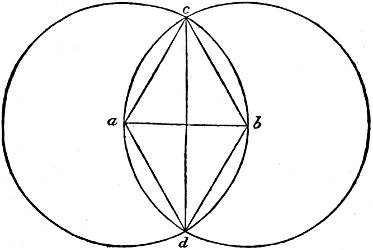
Let there be (says he) a finite right line a b, which we are required to bisect, and with the centre a, but interval a b, let a circle be described. And again, with the centre b, but interval b a, let another circle be described, and let the right line c d, connect the common sections of the circles; this shall bisect the right line a b. For let the equal lines d a, d b, c a, c b, be connected; these being equal, because each is equal to a b. But c d is common, and d a is equal to d b on the same account. Hence the angle a c d, is equal to the angle b c d; and so (by the fourth) a b is bisected. Such then, according to Apollonius, is the demonstration of this problem, assumed, also, from an equilateral triangle; but instead of exhibiting the bisection of the line, from the bisection of the angle at the point c, it shews this from the equality of the bases. The demonstration, therefore, of the institutor of the Elements, is much better, since it is both more simple, and emanates from principles.
PROPOSITION XI. Problem VI.
To raise a right line at right angles, to a given right line, from a given point in that line.
Whether we receive a right line on both sides finite, or on both sides infinite, or on one side infinite but on the other finite, and a point in it, the construction of the present problem will conveniently succeed to the geometrician. For though the given point should be on the extremity of the right line, by producing it we can accomplish our purpose. But it is manifest that the point in the present problem is given in position, since it can only be placed in position in a right line. But the right line is given according to form; since its magnitude is not distinguished either by proportion or position. Hence, the institutor of the Elements, employing the first and third problem, together with the eighth proposition, and the tenth definition, exhibits the thing proposed. But if any placing the point on the extremity of the right line, should ask us without producing the line, to erect upon this a right line at right angles, we can likewise shew that this is possible to be effected.
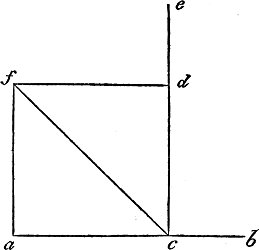
For let there be a right line a b, and a given point in it a, and let there be assumed in the line a b, any point c, and from this (as the present element teaches us) let a right line c e be erected at right angles to a b. Then from c e, let c d be taken equal to a c, and let the angle at the point c be bisected by the line c f, and at the point d let a right line be erected at right angles, coinciding with f c in f; and lastly from the point f, to the point a, let f a be connected. I say that the angle at the point a is right. For since d c is equal to c a, but c f is common, and contains equal angles, (for the angle at the point c was bisected) hence, d f is equal to f a, and all in like manner (by the fourth) are equal to all. The angle, therefore, at the point a, is equal to the angle at d. But the angle at the point d is right; and so consequently is the angle at a. And thus the thing required is effected. But the institutor of the Elements was not indigent of any such artifice: for he commands us to raise a line at right angles, but not at one right. It is requisite, therefore, not to receive the point in the extremity of the right line, because the perpendicular line forms angles with its subject right line, but not one angle alone.
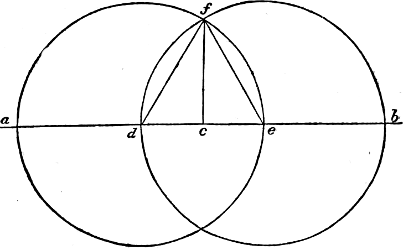
But Apollonius raises a perpendicular as follows. Let the given right line, says he, be a b, and a given point in it c, but let there be assumed in a c any point d, and from c b, take away c e, equal to c d. Then with the centre d, but interval d e, let a circle be described; and again with the centre e, but interval e d, let another circle be described, and let a right line be drawn from f to c. I say that f c is a perpendicular. For if f d, f e, are connected, they shall be equal. But d c, c e, are equal, and f c is common. Hence, also, the angles at the point c (by the eighth) are equal. They are therefore right. And here, is it not again obvious, that this demonstration is more various than that of Euclid, and requires the description of circles, that by this means an equilateral triangle may be described upon d e, and the problem exhibited? For all the rest are common to the demonstrations. But the demonstration by a semicircle is not worthy to be remembered, since it supposes many things which are afterwards exhibited, and entirely falls from the order of an elementary institution.
PROPOSITION XII. Problem VII.
Upon a given infinite[20] right line, and from a given point which is not in that line, to let fall a perpendicular.
Oenopides first investigated this problem, believing it useful for astrological purposes. But he calls a perpendicular, after the manner of the ancients, a gnomon, because a gnomon, also, is at right angles to the horizon, but the same line is at right angles with a perpendicular, from which it differs only in habitude, since, as he observes a gnomon has the same subject with a perpendicular. But again, a perpendicular is two-fold, that is, it is either plane or solid. Hence, when the point from which the perpendicular right line is drawn, is in the same plane, the perpendicular is called plane; but when the point is on high, and external to the subject plane, it is called solid. And the plane perpendicular, indeed, is drawn to a right line: but the solid to a plane. Hence, it is necessary, that this last should not only form right angles, with one right line, but with all right lines in the same plane. For the perpendicular is let fall on a plane. In the present problem, therefore, the institutor of the Elements proposes to let fall a plane perpendicular. For the deduction is proposed to a right line, and the discourse proceeds, so far as all are supposed to be in the same plane. Hence, in the line at right angles we do not require infinity, because the point is supposed to be in that right line. But in the present problem, respecting a perpendicular, he supposes the given right line infinite, because the point from which the perpendicular is to be drawn is placed external to the right line. For if it was not infinite, the point might be received externally, and yet in a direct position, so that the protracted right line would fall upon it, and the problem not succeed. Hence, he places the right line infinite, so that the point may be received at either of its parts; and that no place may be left, in which it can be in the same direction with the given right line, unless it is in the line, and has not an external position. And on this account the right line to which the perpendicular is to be drawn is considered as infinite.
But in what manner infinite can subsist, is a matter well worthy our contemplation. For it is manifest that a right line existing infinite, a plane also will be infinite, and this in energy, if the thing proposed by Euclid be true. That among sensible particulars, therefore, there can be no magnitude infinite, according to any distance, both the dæmoniacal Aristotle, and those who received their philosophy from him, have abundantly shewn. For neither that which is moved circularly, nor any other simple body can be infinite; since the place of each is limited. But neither in separate and impartible reasons is an infinite of this kind possible. For if they neither contain dimension, nor magnitude, much less can they contain infinite magnitude. It remains, therefore, that infinite can alone subsist in the phantasy, which at the same time the phantasy does not comprehend. For as soon as it understands, it induces form and bound to that which is understood, stops the transit of the phantasm by its intellection, pursues its progress, and infolds it in its shadowy embrace. The phantasy, therefore, is not infinite by intellection, but rather by advancing infinitely about that which is understood; and calling whatever it leaves innumerable, and incomprehensible by intelligence, infinite. For as the sight by not seeing understands darkness; so the phantasy by not understanding perceives infinite. Hence it pursues the progress of the infinite, because it is endued with an impartible power, capable of perpetually advancing: but it understands as if stopping in its progression, because infinite surpasses its comprehension. For it calls that infinite, which it leaves as unable to pass over in its pursuit. On this account when we place a given infinite line in the phantasy, in the same manner as we establish all other geometrical species, viz. triangles, circles, angles, lines, and all of this kind, we must not wonder how a line is infinite in energy, and how advancing infinitely, it applies itself to finite intellections. But cogitation, in which reasons and demonstrations reside, does not use infinite for the purpose of science, since infinite is by no means perceptible by science, but receiving it from hypothesis, it employs finite alone in its demonstrations, and assumes infinite not for the sake of infinite, but of that which is bounded and finite. For if we should grant to cogitation, that the given point, neither lies in a right line with the given finite right line, nor yet is so distant from it, that no part of the right line is subjected to the point, we shall no longer require an infinite line. That cogitation, therefore, when employing a right line, may use it without controversy and reproof, she supposes it to be infinite; and employs the infinity of the phantasy, as the foundation of infinite generation. And thus much may suffice for the present concerning the nature of infinite.
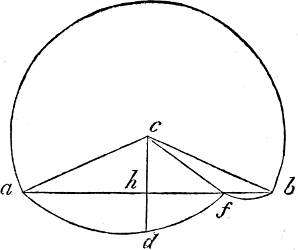
But it is now requisite that we should consider the objections which are urged against the construction of this problem. Let there be received, say they, an infinite right line a b, and let the given point be c, from which it is required to let fall a perpendicular, and let d be a point on the other side, according to the geometrician. But the circle which cuts the right line a b, in the points a and b, will cut it also in f, and will have a situation according to the figure. In answer to this, we must say, that it affirms an impossible case. For let the right line a b be bisected in h, and let c h be connected, and produced to the circumference, to the point d, and let c a, c b, c f, be connected. Because, therefore, these lines are from the centre, and a h, is equal to h b, but c h is common, all are equal to all. Hence c h forms right angles at the point h. Again, because c a, c b, are equal, they form equal angles at the points a and b. But c a also, is equal to c f, on which account the angle c a f, is equal to the angle c f a. In like manner the angle c b f is equal to the angle c f b. Because, therefore, the angles at the points a and b, are equal, the angle, also, c f a, is equal to the angle c f b, and they are successive, and consequently right. But each of the angles at the point h is right. Hence, c h is equal to c f. But c f is also equal to c d, since they are from the centre. Therefore c h is equal to c d, which is impossible. Hence, the circle does not cut the right line in any other points than a and b.
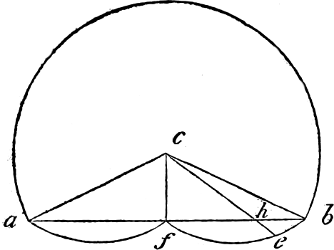
But if any one should say, that he who describes a circle will bisect a b in f, we can again shew that this is impossible. For let all be described as before, and let the right line f b, be bisected in the point h. Because, therefore, a f, f b, are equal, but c f common, and the base c a, is equal to the base c b, all are equal to all. Hence, the angles at the point f are right. Again, because f h is equal to h b, and c h being connected, is common, and the base c f is equal to the base c b, for they are from the centre, the angles at the point h, are right; for they are equal and successive. Because, therefore, each of the angles c f h, c h f, is right, c f is equal to c h. But c f is equal to c e, for they are from the centre, and hence c h is not unequal to c e, which is impossible.
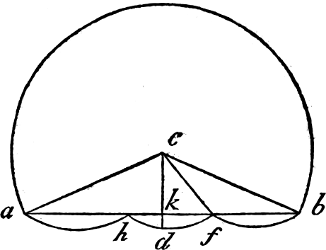
It now remains that we run over the third objection. For the circle which is described (say they) will cut the right line in the points a, b, and in the points f, h. We therefore bisecting the right line a b in the point k, and connecting the lines c a, c f, c k, c b, can shew that this is impossible. For since k a, k b, are equal, and c k is common, and the bases c a, c b, are equal, hence the angles at the points a and b are equal, and those at the point k right. But each of the lines is equal to c f; and hence, the angles at the point f, are right; for they are equal, because successive. Therefore, c f is equal to c k: for they subtend right angles. But c f is equal to c d, since they are from the centre; and hence, c d is equal to c k, which is impossible. Hence then, it is impossible that the circle which is described should cut the line a b in one, two, or in more points than a b. And such are the objections against the present problem.
But there are also cases of the construction of this problem, which are to be distinguished from the objections. For case is not the same with objection; since the former shews the same thing differently, but the latter leads the objection to an inconvenience. But other expositors, not distinguishing these from one another, bring all into the same, so that it is uncertain, whether they enunciate to us in their writings, cases, or objections. We therefore distinguishing these, having enumerated the objections, shall now describe the cases of the problem.
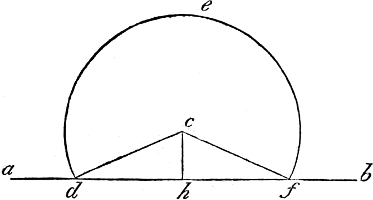
Let there be then an infinite right line a b, and a given point c. Now it may be said that there is no farther place in the other part of the perpendicular right line, but in that only where the point c lies. Taking, therefore, in the right line a b a point d, with the centre c, and interval c d, let us describe the circumference of a circle d e f, and bisecting d f in h, let us connect the lines c d, c h, c f. Because, therefore, d h is equal to h f, but c h is common, and c d is equal to c f, (for they are from the centre,) hence, the successive angles at the point h, are equal. They are, therefore, right. And hence, c h is a perpendicular to d f.
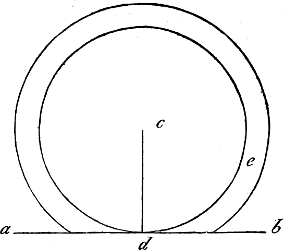
But if any one should also say that the described circle does not cut the right line a b, but touch it as the circle d e, by taking the point e externally, and using the centre c, and interval c e, as in the preceding, we shall obtain the object of our enquiry. And thus much we have said concerning the cases of the problem, for the sake of exercising the attention of the reader.
But if we are desirous of adding contemplation likewise to these two problems, a right line erected at right angles, seems to imitate a life tending on high from inferior concerns, ascending purely, and without contamination, and abiding inflexibly with regard to natures subordinate to its own. But a perpendicular is the image of a life perpendicularly descending, and the least of all replete with generative infinity. For a right angle is the symbol of an energy inflexible, and restrained in the comprehension of equality, bound, and finite. From whence, indeed, Timæus also calls the other circle in the divine soul, possessing the reasons of sensible natures, right; for in our souls it is bent with flexions of every kind, and suffers various contortions and perturbations from the unceasing whirls of generation: but among wholes it resides immaculate, uncontaminated, firm, and indeclinable, prior to sensible forms. But if likewise an infinite right line is the symbol of the whole of generation, which is moved infinitely and indeterminately, and besides this, of matter itself, which is deprived of bound and form: and if a point placed externally bears an image of an essence impartible, and separate from material natures, doubtless the deduced perpendicular will imitate that life which proceeds into generation with an undefiled progress from unity, and an impartible essence. But if a perpendicular cannot be shewn without circles, this also will be the symbol of an inflexibility inherent in life, through the medium of intellect. For life, indeed, since it subsists by itself as motion, is indeterminate: but it becomes terminated, and is filled with a pure and immaculate power, by participating and adhering to the circulations of intellect.
PROPOSITION XIII. Theorem VI.
When a right line standing upon a right line forms angles, it either forms two right, or angles equal to two right.
Euclid again passes on to theorems, consequent to things exhibited by problems. For after a perpendicular had been drawn to a right line, and a right line erected at right angles, it remained, to enquire if it should not be a perpendicular, what angles it would form, and how it would be affected to the line upon which it stands. This then he proves universally, that every right line standing upon a certain line, and forming angles, either forms two right, if its state be indeclinable, firm, and never verging: or angles equal to two right, if it declines in one part, but is more distant from its subject line, in the other part. For as much as it takes away from a right angle by its declination in one part, so much it adds by its distance in the other. But it is requisite to take notice, that in this proposition also, the Geometrician employs diligent care. For he does not simply say that every right line, standing upon a right line, forms either two right angles, or angles equal to two right, but he adds, if it forms angles. For what if standing on the extremity of a right line, it should form one angle, will it happen that this may be equal to two right? This certainly is impossible. Since every rectilineal angle is less than two right, as also every solid angle is less than four right. Hence, though you should receive that which appears to be the greatest of all obtuse angles, this also will increase, as that which does not yet receive the measure of two right angles. It is requisite, therefore, that the right line should stand in such a manner, that it may form angles. And these observations regard the productive diligence of science.
But what does he mean by adding the particle, either two right, or equal to two right? For when he has constituted two right, he forms angles equal to two right; since right angles are equal to each other. Shall we say that one of the equal angles is also common, but that the other of the equals is only proper? But we are accustomed when both proper and common is verified, to express every particular from that which is proper, but when we cannot effect this, we are content with that which is common for the explication of the subject concerns. This then, the equality of the successive angles, is common to right angles, but is not predicated of these alone: but this, that they are right, is peculiar to their equality. Hence, the assertion, equal to two right, alone signifies the inequality of the angles. For in these it is alone verified, but by no means in such as are equal. And this also the institutor of the Elements divides in opposition to two right. For since it is predicated by itself, it has a power of signifying that the angles on each side are unequal. But through these observations we may also perceive, that equality is the measure and bound of inequality. For though the increase and decrease of an obtuse and acute angle is indeterminate and infinite, yet it is said to receive limitation, and bound from a right angle; and each of them, indeed, separately, recedes from a similitude to the right; but both, according to one harmonizing union, are reduced to its bound. But as they can by no means perfectly equal the simplicity of a right angle, they receive an equality to it when doubled, the duad being the exemplar of their infinity, as of itself endued with an infinite nature. And this seems to procure a manifest image of the progression of primary causes; and of their abiding according to one boundary, in a manner perpetually the same, about the infinity of generation. For how could otherwise generation, which participates of the more and the less, and is carried in indefinite whirls, agree with intelligibles, and be equalled with them in a certain respect, unless by participating their natures, whilst they advance with prolific powers, and only multiply themselves in their progressions? For things which abide in their own simplicity and impartibility, are entirely separated from generable natures. And thus much is assumed from the present theorem, and applied to the knowledge of universals.
PROPOSITION XIV. Theorem VI.
If to any right line, and at a point in it, two right lines being placed in a consequent order, and not towards the same parts, make the successive angles equal to two right, those right lines shall be in a direct position to each other.
The present theorem is the converse of the foregoing: for such as are converse are always consequent to preceding theorems. Since, therefore, the former had constituted a right line upon a right line, and had shewn that it made the successive angles either two right, or equal to two right; in the present theorem he receives the equality of the angles to two right, which are formed at some right line, but he shews that it is one right line which produces their equality. Hence, that which was a datum in the former, is in the present theorem an object of enquiry; and is shewn by a deduction to an impossibility. For after this manner the converse of theorems ought to be exhibited; but in problems they should receive principal demonstrations. But in this theorem we may also perceive the greatest and most admirable diligence of this proposition producing science. For in the first place, after he had said, if to any right line, he adds, and at a point in it; for what if the two extremes of the right line existing, one of the right lines should be drawn from the one extreme, but the other from the remaining one, and should form angles at the right line, equal to two right, would they on this account have a direct position? And how can this take place in lines drawn from different points of the right line? It is on this account also, that he adds, and at a point in it, since he is willing that both should be in the same point. But in the second place, because it is possible that the right lines which are drawn, may be at the same point, and not consequent (since we may receive infinite right lines placed at the same point) he adds the particle, in a consequent order. And in the third place, because the word consequent may be considered as well at the same parts as on both sides: but because it is impossible that lines which are consequent at the same parts should be mutually in a direct position, this indeed he explains, but affords us an opportunity of considering that consequent right lines are to be received in position on both sides; since these also can be shewn to be in a right line.
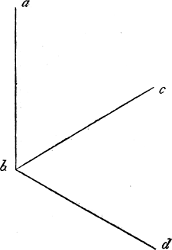
Let there be placed at the right line a b, and at a point in it b, towards the same parts, two right lines b c, b d, these, therefore, shall be consequent to each other. For no other right line is situated between them. But those things are successive, between which there is nothing similar. Thus we call the columns consequent, between which there is no other column: for though the air intervenes, yet nothing of the same kind is situated in the middle. Because, therefore, they lie towards the same parts, they are by no means in a direct position, although they form two angles equal to two right; I mean the angles at the point b. For nothing hinders but that the angle a b d, may contain in itself, one right, and a third part of a right angle: and that the angle a b c, may be two thirds of a right angle. And thus much concerning the proposition.
But one petition is employed in the construction, viz. the second, which begs to produce a right line straight forwards, as in the demonstration he uses the preceding theorem, and two axioms; i.e. the one which says, things equal to the same, are equal to one another; and also the one which affirms, that if from equal things equals are taken away, the remainders shall be equal. But at the collection of the impossibility, he employs the axiom, which says, the whole is greater than its part. For it is equal one common angle being taken away, which is impossible. But that it is possible to the same right line, and at a point in it, two right lines in a consequent position, and yet, towards the same parts, may form angles belonging to that one right line, equal to two right, we may shew with Porphyry, as follows. Let there be a certain right line a b, and any point in it c, and let c d be raised at right angles to a b, and let the angle d c b be bisected, by the line c e. Then from the point e, to the line a b, let there be drawn the perpendicular e b, and let e b be produced, and place f b equal to e b, and connect c f. Because, therefore, e b is equal to b f, but b c is common, and they contain equal angles (for they are right), hence, the base e c, is equal to the base c f. All, therefore, are equal to all. Hence, the angle e c b, is equal to the angle f c b. But the angle e c b is the half of a right angle: because the right angle d c b was bisected by the line e c.
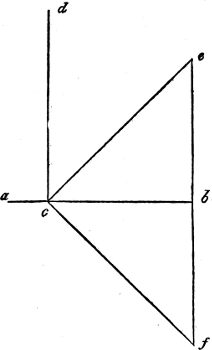
Hence, also the angle f c b, is the half of one right. The angle, therefore, d c f, is equal to one right, and the half of a right angle. But the angle d c e, also, is the half of a right angle. Hence to the right line c d, and to a point in it c, two right lines are consequently placed towards the same parts, viz. c e and c f, forming angles equal to two right, c e causing the half of a right angle, and c f one and a half. Lest, therefore, we should enquire after things impossible to be effected, viz. how the right lines c e, c f, forming angles at the right line d c, equal to two right, can be in a direct position to one another, the Geometrician adds the particle not towards the same parts. It is requisite, therefore, that the right lines which form angles equal to two right, should be placed on both sides of the right line, being raised, indeed, from one point, but drawn to different parts of the right line.
PROPOSITION XV. Theorem VIII.
If two right lines cut one another, they will form the angles at the vertex equal.
We must call successive angles different from such as are vertical. For these last originate from the section of two right lines: but the former from the mere dissection of the one by the other. Thus, if a right line remaining itself without section, but cutting another in its extremity, forms two angles, we denominate these successive angles. But if the two right lines mutually cut each other, they form vertical angles. And they are so called, because they have their vertices conjoined in the same point. But their vertices are the points, at which the planes, while they are contracted, form angles. This, therefore, is what the present theorem evinces, that when two right lines mutually cut each other, the vertical angles are equal. And it was first invented (according to Eudemus) by Thales: but was thought worthy of a demonstration producing science by the institutor of the Elements. But it is not exhibited from all the particulars requisite to a perfect proposition. For construction is wanting in the present theorem: but demonstration, which must be necessarily inherent, depends on the thirteenth theorem. But he uses two axioms, one of which is, that things equal to the same, are equal among themselves: and the other, if from equal things equals are taken away, the remainders will be equal. The theorem, indeed, of Euclid, is manifest, but another such is converted to the present theorem. If to any right line, and at a point in it, two right lines, not assumed towards the same parts, make the vertical angles equal, those right lines shall be in a direct position to each other.
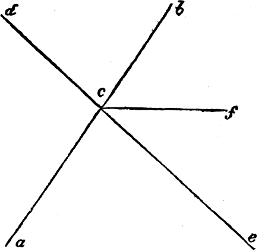
For let there be a certain right line a b, and any point in it c, and at the point c, let two right lines c d, c e, not towards the same parts be assumed, forming equal angles a c d, b c e. I say that c d, c e, are in a right line. For since the right line c d, insists upon the right line a b, it forms angles equal to two right, i.e. d c a, d c b. But the angle d c a, is equal to the angle b c e. Therefore, the angles d c b, b c e, are equal to two right. Because, therefore, to a certain right line b c, and at a point in it c, two consequent right lines c d, c e, not placed towards the same parts, form the successive angles equal to two right, those right lines c d, c e, are in a direct position to each other. The converse, therefore, to the present theorem, is exhibited. But the Geometrician seems to have neglected this, because it is easy to evince its truth, by the same method of deduction to an impossibility as we employed in exhibiting the fourteenth proposition. For the same things being supposed, I say that the right line c d, is in a direct position to c e. For if it be not, let c f be taken in a right line with c d. Because, therefore, two right lines a b, d f, intersect each other, they will form the angles at the vertex equal. Hence, the angles a c d, b c f, are equal. But a c d, b c e, were also equal. The angle, therefore, b c e, is equal to the angle b c f, the greater to the less, which is impossible. Hence, no other right line, besides c d, is in a direct position to c e. The right lines, therefore, c d, c e, are in a direct position to each other, the angles at the vertex being supposed equal. Since then, there is the same demonstration which was pre-assumed in the fourteenth theorem, would it not have been superfluous to have produced this conversion? But for the sake of exercise, we have proved it as well by a deduction to an impossible, as by an ostensive method. However, this fifteenth theorem seems to rest upon the similitude of the parts of right lines, and their situation in their extremities. Because lines with these conditions, and mutually cutting each other, must necessarily possess similar inclinations on both sides to each other. Since circumferences, and universally non-right lines cutting one another, do not necessarily form the vertical angles equal, but sometimes equal, and sometimes unequal. For if two equal circles cut each other through the centres, or even not through the centres, they will form the lunular angles at the vertex equal: but not likewise the remaining angles, viz. those on both sides concave, and on both sides convex, but the one will be greater than the other. But in right lines, the situation in the extremities, causes the distance of one segment, to be equal to the distance of another.
COROLLARY.
From hence it is manifest that if two right lines cut each other, they will make four angles equal to four right.
Corollary is one of the geometrical appellations, but it has a two-fold signification. For they denominate corollaries, whatever theorems are proved together with the demonstrations of others, becoming as it were the unexpected gain and emolument of the investigator: and likewise, whatever is the object of enquiry, but is indigent of invention, and is neither investigated for the sake of generation alone, nor of simple contemplation. For that the angles at the bases of isosceles triangles are equal, it is requisite to contemplate, and the knowledge of things in existence is of this kind. But to bisect an angle, or constitute a triangle, to cut off, or place an equal right line, all these demand that something may be performed. And again, to find the centre of a given circle, or two commensurable magnitudes being given to find their greatest common measure, with every thing of this kind, are, after a manner, situated between problems and theorems. For neither is the origin of objects of enquiry inherent in these, nor contemplation alone, but invention. Since it is requisite to place the object of enquiry conspicuously and before our eyes. Such then are whatever corollaries Euclid wrote, for he constructed a book of corollaries. But we must now omit to speak of corollaries of this kind. However, such as occur in the elementary institution, appear at the same time with the demonstrations of other things, but they themselves are not principally investigated, as is evident in that which is proposed at present. For the design of the proposition is to enquire whether if two right lines mutually cutting each other, the angles at the vertex are equal. But whilst this is evinced, it is at the same time demonstrated, that the four angles which are formed, are equal to four right.
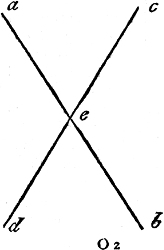
For when we say let there be two right lines, a b, c d, cutting each other in the point e: because a e stands upon c d, it makes the successive angles equal to two right. And again, because b e stands upon c d, it also makes the successive angles equal to two right; then together with the object of enquiry we demonstrate, that the angles about the point e, are equal to four right. A corollary, therefore, is a theorem, unexpectedly emerging from the demonstration of another problem, or theorem. For we seem to fall upon corollaries, as it were, by a certain chance; and they offer themselves to our inspection, without being proposed, or investigated by us. Hence, we assimilate these also to gains. And perhaps those skilled in mathematical concerns, have imposed on them this appellation, shewing the vulgar, who rejoice in apparent gain, that these are the true gifts of divinity, and true gains, and not the objects of their sordid estimation. For this indeed produces that faculty resident in our nature, and adds the prolific power of science, to principal enquiries, manifesting the copious riches of theorems. And such is the property of corollaries.
But they are to be divided in the first place, according to sciences. For of corollaries, some are geometrical, but others arithmetical. Thus the present corollary is geometrical: but that which is added at the end of the second theorem of the seventh book of the arithmetical elements, is arithmetical. But afterwards they must be divided according to the principal objects of enquiry. For some things are consequent to problems, but others to theorems. Thus, the present is consequent to a theorem: but that which is placed in the second of the seventh book, is consequent to a problem. But in the third place, they must be divided according to their ostensions. For some are exhibited, together with ostensive methods, but others together with deductions to an impossible. Thus the present is shewn by a direct ostension: but that which is at the same time exhibited in the first of the third book, appears, together with a deduction to an impossible. But corollaries may also be divided in many other modes, but these may suffice our present purpose. The present corollary, however, teaching us that the place about one point is distributed into angles equal to four right, is subservient to that admirable theorem, which shews that the following three multangles about one point, can alone fill place, viz. the equilateral triangle, the quadrangle, and an equilateral, and equiangular sexangle. But the equilateral triangle must be six times assumed; since six two-thirds, form four right angles. But the sexangle must be three times formed; for every sexangular angle is equal to one right, and a third part of a right. And a quadrangle must be four times assumed: for every quadrangular angle is right. Hence, six equilateral triangles conjoined according to their angles, fill four right angles, as also three sexangles, and four quadrangles. But all other multangles, however composed, according to angles, are either deficient from four right, or exceed four right angles[21]; while these alone, according to the aforesaid numbers, are equal to four right. And this theorem is Pythagoric. But by the present corollary, if even more than two right lines should cut each other in one point, as for instance, three or four, or any other number, all the angles which they form, may be shewn to be equal to four right. For they will vindicate to themselves the place of four right angles. But it is manifest that the angles always become double to the number of right lines. And thus two right lines intersecting each other, there will be four angles equal to four right: but from the intersection of three lines, there will be six angles; and from four, eight, and so on, in infinitum. For the multitude of the right lines is always doubled: but the angles increase according to multitude, and are diminished according to magnitude, because it is the same four right angles, which is perpetually divided.
PROPOSITION XVI. Theorem IX.
In every triangle having one side produced, the external angle is greater than either of the internal and opposite angles.
Those who enunciated this proposition, and at the same time omitted the particle, having one side produced, perhaps afforded an occasion of objection to many others, as well as to Philip, (according to the narration of the mechanist Heron.) But such as were desirous of entirely removing this calumny, enunciated the theorem, with the proposed addition, corresponding with the general manner of the geometrician. For in the fifth theorem, being desirous to shew, that the angles under the base of an isosceles triangle are equal, he adds, when the equal right lines are produced, the angles under the base are equal. Hence we infer, that though this proposition might be defective and imperfect it various copies, yet it was perfect and written entire, by the institutor of the Elements. What then does the proposition assert? That in every triangle, if you produce one of its sides, you will find the angle constituted external to the triangle, greater than either of the internal and opposite angles. For a little after, this angle will be shewn equal to both, but it is proved to be greater than either in the present; and he necessarily compares it with the opposite angles, and not with the successive angle. For to this last it may be both equal and less: but it is greater than either of the former. Thus, if this triangle should be right angled, and you conceive one of the sides comprehending the right angle to be produced, the external will be equal to the successive angle. But if it should happen to be obtuse-angled, the internal angle may be greater than the external; and it is on this account that he does not compare the external with the successive angle, but with the opposite angles. For of the angles within a triangle, the successive angle borders on the external, but the two others are opposite. Hence, the external angle is greater than either of the successive, but may not exceed the successive angle to which it is proximate. But some conjoining these two theorems, I mean the present, and the following, enunciate the proposition thus. In every triangle having one side produced, the external angle is greater than either of the internal and opposite angles; and any two of the internal angles, are less than two right. But there is occasion for the connection of these theorems, because the geometrician himself, a little after, enunciates the proposition after this manner, in equal angles, for he says: In any triangle having one of its sides produced, the external angle is equal to the two interior, and opposite angles; and the three internal angles of a triangle, are equal to two right. Hence, they think it proper in the present similar case, to connect the objects of investigation, and to make the proposition a composite. But if the datum be enunciated with this addition, it also will be a composite, (since it is requisite to understand two things, viz. the subject triangle, and one side produced:) and if the datum be given without this, it will be a composite in capacity, but simple in energy; for this must be received at the same time as a datum; since while we suppose an external angle, we must pre-suppose the side as produced.
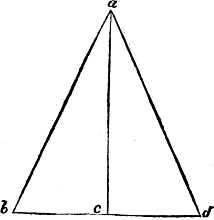
But we may assume from the present theorem, that it is impossible from the same point, for three equal right lines to fall on the same right line. Thus let there be drawn from one point a, three equal right lines, a b, a c, a d, to the right line b d. Because, therefore, a b is equal to a c, the angles at the base are equal. Hence, the angle a b c, is equal to the angle a c b. Again, because a b is equal to a d, the angle a b d, is equal to the angle a d b. But the angle a b c, was equal to the angle a c b. Hence, the angle a c b, is equal to the angle a d b, the external, to the internal and opposite, which is impossible. From the same point therefore, to the same right line, three equal right lines cannot be drawn. But by the present theorem, we can also demonstrate, that if a right line falling on two right lines, makes the external angle equal to the internal and opposite, those right lines will by no means make a triangle, nor coincide, because the same thing would be both greater and equal, which is impossible.
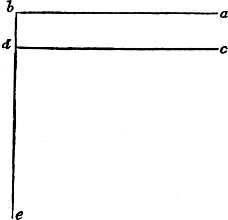
Thus for example, let a b, c d, be right lines, and let the right line e b falling on them make the equal angles a b d, c d e, the right lines a b, c d, will not coincide. For if they coincide, the equal angles remaining, the angle c d e, will be equal to the angle a b d. And since it is external, it will be greater than the internal and opposite angle. Hence, it is necessary, if they coincide, that the angles remain no longer equal, but that the angle at the point d, be augmented. For whether a b remaining immoveable, we conceive that c d is moved towards it, so as to coincide in the point c, we shall produce a greater distance in the angle c d e; since c d approaches to a b, in the same proportion as it recedes from d e. Or whether c d, abiding, we conceive that a b is moved towards it, in a similar manner, we shall by this means diminish the angle a b d; for it is at the same time carried towards c d, and to b d. Or whether we conceive both of them tending to each other, we shall find that a b by tending to c d, contracts the angle a b e; and that c d, by receding from d e, on account of the motion to the line a b, increases the angle c d e. Hence, it is necessary, if it be a triangle, and if the right lines a b, c d, coincide, that the external angle must be also greater than the internal and opposite angle. For either the internal angle remaining, the external is increased, or the external abiding, the internal is diminished, or the internal is contracted, and the external is more dilated. But the cause of these consequences is the motion of the right lines, the one tending to those parts, where it diminishes the internal angle, but the other to the parts where it increases the external. And from this the reader should consider, how the origin of things produces the true causes of enquiries, which we have previously surveyed.