BOOK IV. (continued 2)
Thomas Taylor translation
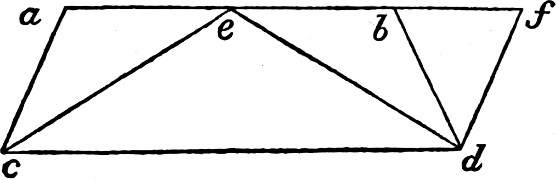
Hence, the parallelogram a c d f, is double of the triangle e c d; and so the quadrilateral figure a b c d, is less than double of the triangle.
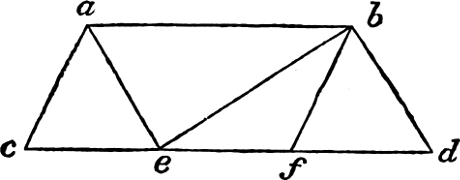
Again, let the triangle have the base a b, and draw b f, parallel to a c. The parallelogram, therefore, a b f c, is double of the triangle. And hence, the quadrilateral figure, a b c d, is more than double of the triangle. This being shewn; we affirm, that when there is a quadrilateral figure, whose two opposite sides only, are parallel, if one of the parallel sides is bisected, and right lines are drawn from it to the other side, the quadrilateral figure, is either more or less than double of the triangle resulting from such a construction. But if one of the sides by which the parallel lines are conjoined, is bisected, and certain right lines are drawn from it to the remaining side, the quadrilateral figure, will be perfectly double of the triangle which is produced. And this may be shewn as follows. Let there be a quadrilateral figure a b c d, and let the side a d, be parallel to the side b c, and bisect d c, in the point e, and connect the right lines a e, e b, and produce b e, till it coincides with a d, in some point, as f. Because, therefore, the angles at the point e, are equal, for they are vertical; likewise, because the angle f d e, is equal to the angle b c e, the side also f e, will be equal to the side e b, and the triangle d e f, will be equal to the triangle b c e. Let the common triangle a d e, be added.
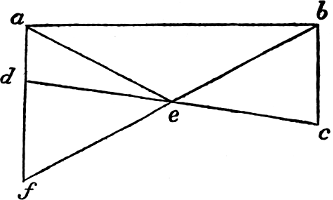
The whole triangle, therefore, a e f, is equal to the two triangles a d e, b c e. But the triangle a e f, is equal to the triangle a e b: for they are upon equal bases, b e, e f, and between the same parallels, if a line parallel to b f, is drawn[43]. Hence, the triangle a e b, is equal to the triangles a d e, b c e, and the quadrilateral figure a b c d, is double of the triangle a e b, which was to be shewn. After the same manner, we may shew, that if the side a b, is bisected, and certain right lines are drawn from it, to the side e d, the quadrilateral figure will be double of the triangle formed by such a construction. If, therefore, one of the sides by which the parallel lines are conjoined is bisected, and from it certain right lines are drawn to the remaining side, the quadrilateral figure shall be double of the triangle. And these things are demonstrated for the sake of geometrical exercise. Let us now proceed to the subsequent propositions.
PROPOSITION XLII. Problem XI.
To construct a parallelogram equal to a given triangle, in a given rectilineal angle[44].
****
PROPOSITION XLIII. Theorem XXXII.
The complements of parallelograms, situated about the diameter of every parallelogram, are equal to each other.
The beginning of this commentary is wanting.
****
that parallelograms are not mutually conjoined according to one point, and that the complements are not quadrilateral; it is requisite that placing this also as a case, we should regard the same accident.
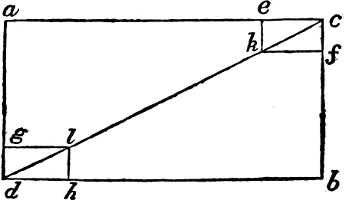
For let there be a parallelogram a b, having the parallelograms c k, d l, about the same diameter, and let a certain right line k l, which is a part of the diameter intervene between them. Again, therefore, you may say the same, viz. that the triangle a c d, is equal to the triangle b c d, and the triangle e c k, to the triangle k c f; and likewise the triangle d g l, to the triangle d h l. The remaining figure, therefore, a g l k e, of five sides, is equal to the remaining five-sided figure b f k l h. But these were the complements. Again, if the parallelograms are neither conjoined according to a point, nor distant from each other, but mutually cut each other, on this hypothesis also, the demonstration will be the same.
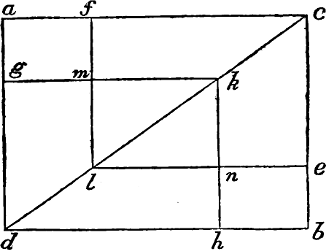
For let there be a parallelogram a b, and a diameter c d, and let parallelograms be constructed about it, one of which is e c f l, but the other, by which this also is intersected, d g k h. I say that the complements f g, e h, are equal. For since the whole triangle d g k, is equal to the whole triangle d h k, but a part of it also, the triangle k l m, is equal to the triangle k l n; (since l k is a parallelogram); hence the remaining trapezium d l n h, is equal to the remaining trapezium d l m g. But the triangle a d c, is equal to the triangle b c d, and the triangle f c l, in the parallelogram e f, to the triangle e c l, and the trapezium d g m l, to the trapezium d h n l. The remaining quadrilateral figure, therefore g f, is not unequal to the remaining quadrilateral figure e h. And hence, the theorem is exhibited according to all its cases. But there are three only, and neither more nor less. For the parallelograms consisting about the same diameter, either cut each other or touch each other, according to a point, or are distant from each other by a certain part of the diameter.
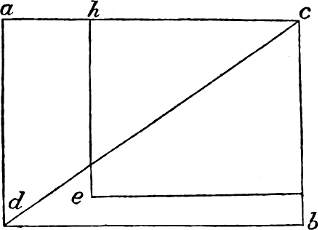
But the institutor of the Elements assumes the appellation of complements, from the thing itself, so far as these also, besides two parallelograms, fill up the whole: and on this account, it was not of itself thought worthy of being remembered in the definitions. For, indeed, variety is requisite to its declaration, such as the knowledge of a parallelogram, and what those parallelograms are, which are about the diameter of the whole parallelogram; since, when these are explained, this likewise becomes known. But those parallelograms are about the same diameter, which have a part of the whole diameter for their own: and those which have not this condition, are by no means about the same diameter. For when the diameter of the whole parallelogram is cut by the sides of an internal parallelogram, then this parallelogram is not about the same diameter with the whole parallelogram. As for example, in the parallelogram a b, let the diameter c d, cut the side e h, of the parallelogram c e. The parallelogram, therefore, e c, is not about the same diameter with the parallelogram c d.
PROPOSITION XLIV. Problem XII.
To a given right line, to apply a parallelogram equal to a given triangle, in an angle which is equal to a given right lined angle.
According to the Familiars of Eudemus, the inventions respecting the application, excess, and defect of spaces, is ancient, and belongs to the Pythagoric muse. But junior mathematicians receiving names from these, transferred them to the lines which are called conic, because one of these they denominate a parabola, but the other an hyperbola, and the third an ellipsis[45]; since, indeed these ancient and divine men, in the plane description of spaces on a terminated right line, regarded the things indicated by these appellations. For when a right line being proposed, you adapt a given space to the whole right line, then that space is said to be applied; but when you make the longitude of the space greater than that of the right line, then the space is said to exceed; but when less, so that some part of the right line is external to the described space, then the space is said to be deficient. And after this manner, Euclid, in the sixth book, mentions both excess and defect. But in the present problem he requires application, wishing to apply to a given right line a parallelogram equal to a given triangle; that we may not only have the construction of a parallelogram equal to a given triangle, but also an application to a determinate right line. As for example, a triangle being given, having an area of twelve feet, but a right line being proposed, whose length is four feet, we may apply to the right line a parallelogram equal to the triangle, if when we assume the whole length of four feet, we find how many feet the breadth ought to contain, that the parallelogram may become equal to the triangle. When, therefore, we have discovered that the breadth is three feet, and have multiplied the length with the breadth, the proposed angle being right, we shall obtain the desired space. And such is the verb to apply, formerly delivered by the Pythagoreans. But there are three things given in the present problem; one, the right line to which it is to be so applied, that it may become the whole side of that space; but the other is the triangle to which that which is applied ought to be equal; and the third is the angle to which it is requisite that the angle of the space should be equal. And here it is again perspicuous, that when the angle is right, the space which is applied, is either a quadrangle, or an oblong; but when it is either acute or obtuse, the space is either a rhombus, or rhomboides. Besides, this too is manifest, that the right line ought to be finite; since this cannot be accomplished on an infinite line. At the same time, therefore, as he says, to apply to a given right line, he indicates that the right line must be necessarily finite. But he uses in the construction of the present problem, the construction of a parallelogram equal to a given triangle; since, as we have observed, application is not the same with construction. For the latter, indeed, constructs both the whole space, and all the sides; but the former, when it has one side given, constitutes on this the space, because it is neither deficient, nor exceeds according to this extension, but uses this one side which comprehends the area. But you may perhaps say, why does he use theorems, when he shews triangles equal to triangles; but problems, when he shews triangles equal to parallelograms? We reply, it is because equality spontaneously arises in things of the same species; but requires origin, and fabrication, in things of a dissimilar species, on account of the mutation subsisting according to species, since it is by itself difficult of invention.
PROPOSITION XLV. Problem XIII.
To construct a parallelogram equal to a given right-lined figure, in a given rectilineal angle.
The present is more universal than the two problems, in which he invented as well the construction, as the application of parallelograms equal to a given triangle. For whether a triangle, or a quadrangle, or any other quadrilateral figure is given, we may construct a parallelogram equal to it, by the present theorem; since every right-lined figure, as we have previously observed[46], may be essentially resolved into triangles, and we have delivered a method of discovering the multitude of triangles. When, therefore, we have resolved a given rectangle into triangles, and have constructed a parallelogram equal to one of them, and have applied to a given right line, parallelograms equal to the rest; then, by assuming that to which we have made the first application, we shall have a parallelogram composed from these parallelograms, equal to the right-lined figure composed from those triangles, and the thing desired, will be accomplished. Hence, though such a rectangle should be a figure of ten sides, yet, by resolving it into eight triangles, and constructing a parallelogram equal to one of them, and seven times applying parallelograms equal to the rest, we shall obtain the object of investigation. But, as it appears to me, the ancients being incited by this problem, sought how to describe a quadrangle equal to a circle. For if a parallelogram can be found equal to any right-lined figure, it deserves to be enquired whether right-lined figures also, can be shewn equal to such as are curve-lined. And Archimedes shews that every circle is equal to a right-angled triangle, one of whose radii is equal to one of the sides which are about the right angle of the triangle; but whose ambit is equal to the base. However, of this elsewhere: let us now proceed to the consequent propositions.
PROPOSITION XLVI. Problem XIV.
To describe a quadrangle from a given right line.
Euclid requires this problem, most particularly, in the construction of the following theorem. But he appears to have been desirous to deliver the origin of the two best rectilineal figures, viz. the equilateral triangle, and the quadrangle; because these right lined figures are required in the constitution of the mundane figures, and particularly of those four, to which origin and dissolution belong. For the icosaedron and the octaedron, and the pyramid, are composed from equilateral triangles; but the cube from quadrangles. And on this account, as it appears to me, he has principally constructed the former, but described the latter. For he has discovered appellations adapted to these figures: since the equilateral triangle, so far as its composition is various, requires construction; but the quadrangle, so far as it originates from one side, requires description. For we cannot produce a triangle in the same manner as a quadrangle, by multiplying the number of a given right line into itself; but when we have conjoined right lines produced by other means, with the extremities of the given right line, we construct from these one equilateral triangle: and the description of circles, profits in discovering that point from which it is requisite to connect right lines, to the extremes of the proposed right line. But these observations are indeed perspicuous.
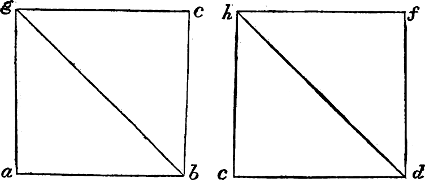
It may, however, be shewn, that the right lines, from which quadrangles are described, being equal, the quadrangles also shall be equal. For let the right lines a b, c d, be equal, and from a b, describe the quadrangle a b c g, but from c d, the quadrangle c d h f, and connect the right lines g b, h d. Because, therefore, the right lines a b, c d, are equal, a g, h c, are also equal; and they comprehend equal angles, and the base g b, is equal to the base h d, and the triangle a b g, to the triangle c d h; and the doubles of these are equal. Hence the quadrangle a c, is not unequal to the quadrangle c f. But the converse of this also is true. For if the quadrangles are equal, the right lines, also, from which they are described, will be equal. Thus let the quadrangles a f, c g, be equal, and let them be so placed, that the side a b, may be in a right line with the side b c.
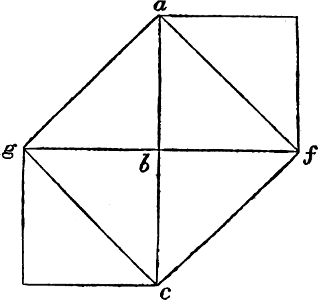
Since therefore, the angles are right, the right line also f b, will be in a direct position, with the right line b g. Let the right lines f c, a g, a f, c g, be connected. Because, therefore, the quadrangle a f, is equal to the quadrangle c g; the triangle, also, a f b, is equal to the triangle c b g. Let the common triangle b c f, be added. The whole triangle, therefore, a c f, is equal to the whole triangle c f g.
Hence, a g is parallel to f c. Again, because, as well a f g, as the angle c g b, is the half of a right angle, a f, is parallel to c g. The right line, therefore, a f, is equal to the right line c g, since they are the opposite sides of a parallelogram. Because, therefore, there are two triangles, a b f, b c g, which have the alternate angles equal, since a f, c g, are parallel; likewise one side a f, equal to the side c g, the side, also, a b, shall be equal to the side b c, and the side b f, to the side b g. And thus it is shewn, that the quadrangles a f, c g, being equal, the sides, also, from which they are described are equal.
PROPOSITION XLVII. Theorem XXXIII.
In right angled triangles, the quadrangle, which is described from the side subtending the right angle, is equal to the quadrangles which are described from the sides comprehending the right angle.
If we attend to the historians of antiquity, we shall find them referring the present theorem to Pythagoras, and asserting that he sacrificed an ox or its invention. For my own part, I admire those who first investigated the truth of this theorem: but I possess a greater admiration for the elementary institutor, not only because he establishes its truth by evident demonstration, but likewise, because he persuades us by scientific reasons, which cannot be confuted of a theorem more universal than this in his sixth book[47]. For in that he shews universally, that in right-angled triangles, the figure described from the side subtending the right angle, is equal to the figures described from the sides comprehending the right angle, when they are similar to the former figure, and are similarly described. For every quadrangle is similar to every quadrangle; but all right-lined figures similar to each other, are not quadrangles: since in triangles, and other multangles, similitude is inherent. Hence, the reason which demonstrates that the figure described from the side subtending the right angle, whether it is quadrangular, or of some other form, is equal to the figures subsisting about the right angle, similar to the former, and similarly described; exhibits something more universal, and which possesses a greater power of producing science, than the reason exhibits, affirming a quadrangle alone, equal to quadrangles. For in the former case, it becomes manifest by an universal ostension, that the rectitude of the angle affords to the figure described from its subtending side, equality, to all the figures, subsisting about its comprehending sides, similar to the former, and similarly described: just as obtuseness is the cause of excess; but acuteness of diminution. But how this theorem is evinced, will be perspicuous, when we comment on it in the sixth book.
But let us now consider the truth of the present theorem, only adding this, that universal ought not to be shewn here, by him who has taught nothing concerning the similitude of right-lined figures, and the doctrine of proportion: for many things which are here exhibited more particularly, are in that theorem shewn more universally by the same method. The institutor of the Elements, therefore, shews the thing proposed in the present, from the common contemplation of parallelograms. But since right-angled triangles are two-fold, i.e. either isosceles, or scalene; in isosceles triangles, we shall never find numbers corresponding with the sides: for there is no quadrangular number, exactly double of another quadrangular number; since the square from the septenary is double of the square from the quinary, by a deficience of unity. But in scalene triangles it is possible, that numbers may be assumed, so as evidently to evince, that the square from the side subtending the right angle, is equal to the squares from the sides subsisting about the right angle. And of this kind is the triangle in the republic, whose right angle is contained by the ternary, and quaternary, but is subtended by the quinary. The quadrangle, therefore, from the quinary, is equal to the quadrangles from the other numbers: for this is twenty-five; but the quadrangle from the ternary is nine, and from the quaternary sixteen. And thus what we have asserted is perspicuous in numbers.
But there are delivered certain methods of inventing triangles of this kind, one of which they refer to Plato, but the other to Pythagoras, as originating from odd numbers. For Pythagoras places a given odd number, as the least of the sides about the right angle, and when he has received the quadrangle produced from this number, and diminished it by unity, he places the half of the remainder, as the greatest of the sides about the right angle; and when he has added unity to this, he produces the remaining side which subtends the right angle. Thus for example, when he has assumed the ternary, and has produced from it a quadrangular number, and from this number nine, has taken unity, he assumes the half of eight, that is four, and to this again he adds unity, and makes five; and thus discovers a right-angled triangle, having one of its sides of three, but the other of four, and the other of five units. But the Platonic method originates from even numbers. For when he has assumed a given even number, he places it as one of the sides about the right angle, and when he has divided this into half, and has produced a quadrangular number from the half, when he has added unity to this quadrangle, he forms the subtending side, but when he has taken unity from the quadrangle, he forms the remaining side about the right angle. Thus for example, when he has assumed the number four, and has multiplied the half of this into itself, and produced four, when he takes away unity he forms the number three, but when he adds unity, he produces the number five; and thus he has the same triangle effected, as by the Pythagoric method. For the square from the number five, is equal to the squares from the numbers three, and four. And thus much for the digression of the present narration. But as the demonstration of the elementary institutor is perspicuous, I do not think, that any thing should be added, because it would be superfluous; but we should be content with what is written. For those who have added any thing more, as the familiars of Hero and Pappus, have been obliged to assume in an affair of no difficulty, some of the propositions of the sixth book; and the cause which regards this affair. We shall therefore pass on to the following theorem.
PROPOSITION LXVIII. Theorem XXXIV.
If the quadrangle described from one side of a triangle, is equal to the quadrangles described from the other two sides of the triangle: then the angle comprehended by the remaining two sides of the triangle, is right.
This theorem is the converse of the preceding, and the whole is converted to the whole. For if the triangle is rectangular, the quadrangle which is described, from the side subtending the right angle, is equal to the quadrangles described from the other sides: and if the square from this, is equal to the squares from the other sides, the triangle is rectangular, because it has the angle right, which is comprehended by the remaining sides. And the demonstration of the Elementary institutor is indeed conspicuous.
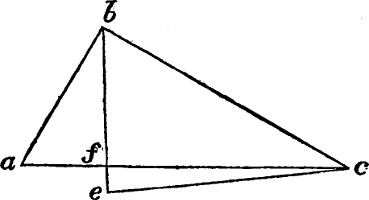
But when there is a triangle a b c, having the quadrangle, which is described from the side a c, equal to the quadrangles from the sides a b, b c, since in the triangle, a right line from the point b, is raised at right angles to the side b c, if it should be said, that the right line must be raised at right angles, to other parts, and not at those to which the elementary institutor raises it, we assert that this is an impossibility. For it can neither fall within, nor without the triangle; and can be no other than a b. For if possible, let it fall as b e. Because, therefore, the angle e b c, is right, the angle c f b, is doubtless acute; and hence, the remaining angle a f b, will be obtuse. The side, therefore, a b, is greater than the side b f. Let a line b e, be placed equal to a b, and connect e c. Because, therefore, the angle e b c, is right, the quadrangle described from the side e c, is equal to the quadrangles from the sides e b, b c. But e b is equal to b a. The quadrangle, therefore, from the side e c, is equal to the quadrangles from the sides a b, b c. But the quadrangle from the side a c, was also equal to the same. Hence, the quadrangle from the side e c, is equal to that which is described from the side a c; and so e c is equal to a c. Two right lines, therefore, b e, e c, are equal to the two b a, a c, each to each, and are constructed upon the right line b c, which is impossible. And hence, the line raised at right angles, does not fall within the right line a b.
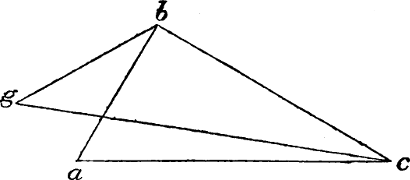
But neither can it fall without, towards other parts of the right line a b. For if possible, let it fall as b g, and let b g be equal to a b, and connect c g. Because, therefore, the angle g b c, is right, the quadrangle described from the side g c, is equal to the quadrangles from the sides b g, b c. But the quadrangle also, from the side a c, was equal to the quadrangles from the sides a b, b c, but a b is equal to g b; and so g c is equal to a c. But the right line g b, also, is equal to the right line b a, upon one right line b c, which is impossible. Hence, the right line which is raised from the point b, at right angles to b c, neither falls within, nor without the side a b; and therefore falls upon it. And so the objection is dissolved. But the institutor of the Elements, thus far completes his first book, in which he has delivered many species of conversions; (for he often converts the whole of theorems to the whole, and wholes to parts, and parts to parts) and has invented a great variety of problems; (for he has delivered the sections, positions, constructions, and applications of lines and angles). He likewise touches upon that mathematical place which is called admirable; and sufficiently brings local theorems into our remembrance. Besides, he unfolds the elementary institution of universal and particular theorems, and indicates the difference of indeterminate, and determinate problems; all which, attending him in his progress, we have orderly explained. Lastly, he refers the whole book to one purpose, I mean the elementary institution, of the contemplation respecting the more simple rectilineal figures; and finally, he investigates their constructions, and considers their essential properties. But we, indeed, shall give thanks to the gods, should we be able to comment on the other books, in a similar manner. In the mean time, if other cares should prevent the execution of our design, it is my opinion, that such as are studious of these contemplations, ought to expound the other books, after the same mode; by investigating that which is every where difficult, and pertinent to the subject, and capable of an easy division. For, indeed, the commentaries which are circulated at the present period, are replete with great and various confusion, because, at the same time, they neither infer any assignation of cause, nor dialectic judgment, nor philosophic contemplation.
END OF THE COMMENTARIES.
THE
HISTORY
OF THE
RESTORATION OF THE PLATONIC THEOLOGY.
By the latter Platonists.