BOOK IV.
Thomas Taylor translation
Whatever can be said in an elementary institution, concerning the origin and equality of triangles, we may learn from the preceding discourse. But after this, the narration of Euclid is concerning quadrilateral figures, and he particularly teaches us concerning parallelograms, together with the contemplation of these delivering the doctrine of trapeziums. For a quadrilateral figure, (as we have formerly observed in our discourse on hypotheses,) is divided into parallelogram and trapezium; and a parallelogram into other certain species, and in like manner a trapezium. But because a parallelogram, on account of its participation of equality, possesses disposition and order, but a trapezium has neither the same, nor a similar order; Euclid’s principal discourse, is with propriety, concerning parallelograms, but he also contemplates together with these a trapezium. For from the section of parallelograms, the origin of trapeziums will appear, as will be manifest as we proceed. But because again, it is not possible that any thing can be said of the construction or equality of parallelograms, without the consideration of parallels, (for as it is manifest from the very name, that is, a parallelogram, which is circumscribed by parallel right lines in an opposite position,) hence, he necessarily assumes from parallels the beginning of his doctrine, but having advanced a little from these, he enters on the doctrine of parallelograms, employing one middle theorem, between the elementary institution of each, because he appears to contemplate a certain symptom inherent in parallels: but he delivers the first origin of a parallelogram. For such is the proposition, which says, that right lines which join equal and parallel right lines towards the same parts, are themselves equal and parallel. For in this theorem, indeed, a certain accident to equal and parallel right lines is considered: but from the connection a parallelogram appears, having its sides opposite and parallel. And from hence it is manifest that the discourse concerning parallels, was necessarily pre-assumed. But three things are to be assumed, essentially inherent in parallels, which they essentially express, and are converted with them, not only the three together, but every one separately assumed from the rest. Of these, one is, that when a right line cuts parallel lines, the alternate angles are equal; but the second, that when a right line cuts parallel lines, the internal angles are equal to two right; and the third, that in consequence of a right line cutting parallel lines, the external is equal to the internal and opposite angle. For when any one of these symptoms is demonstrated, we have sufficient authority to affirm that the right lines are parallel. But other mathematicians, also, have been accustomed to discourse after this manner concerning lines, delivering the symptoms of every species. For Apollonius, in each of the conical lines, shews what a symptom is, as also Nicomedes in his Treatise on Conchoids, and Hippias in his Quadratics, and Perseus in his Spirals. Since after their origin, that which is essentially inherent in these lines, and according to what it is inherent, being assumed, distinguishes a constructed form from all others. After the same manner, therefore, the institutor of the Elements, first of all investigates, the symptoms of parallels.
PROPOSITION XXVII. Theorem XVIII.
If a right line falling upon two right lines, makes the alternate angles equal to each other, those right lines shall be parallel to each other.
In the present theorem it was not pre-assumed as evident that the right lines are in one plane, but this ought rather to be previously admitted in all theorems which are considered in a plane. This, however, is added, because it does not universally follow, that when the alternate angles are equal, the right lines will be parallel, unless they are in the same plane. For nothing hinders, but that a right line falling on right lines disposed in the shape of the letter X, one of which is situated in one plane, but the other in a different one, may make the alternate angles equal; and yet the right lines thus disposed will not be parallel. It was pre-assumed[27], therefore, that in a treatise on planes, we conceive every thing described in one and the same plane: and on this account, he does not require this addition in the present proposition. But it is requisite to know that the geometrician considers the particle alternate, in a two-fold respect, sometimes, indeed, according to a certain situation, but sometimes according to a certain consequence of proportions. And according to this last signification, the particle alternate is used in the fifth book, and in such as are arithmetical: but agreeable to the former, both in this, and in all the other books concerning parallel right lines, and that which falls upon these. For he calls the angles alternate, which are not formed at the same parts, and are not successive to each other, which are distinct, indeed, from the incident line, but both of them exist within parallels, and differ in this, that the one has an upward, but the other a downward position.
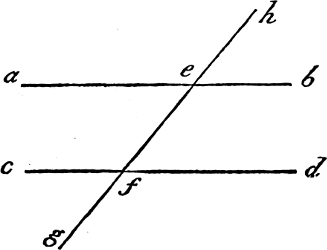
I say, for example, that when a right line e f, falls on the right lines a b, and c d, he calls the angles a e f, d f e, and also the angles c f e, b e f, alternate, or altern, because they have an alternate, or changed order, according to their position. But this too must be known, that from such a situation of right lines, all the symptoms become by division, six; three of which the geometrician alone receives; and three he omits. For we either assume the angles at the same parts, or not at the same. And if at the same parts, either both within the right lines, which shews them to be parallels; or both without, or one without, and the other within. And if not at the same parts, again, after the same manner, they are either both without the right lines, cutting the lines it is necessary to receive; or within; or one within, and the other without. But what we have said will become manifest by the same description as above. For let there be certain right lines a b, c d, and let a right line e f, fall upon them, and let it be produced to the points h and g. If then you assume angles at the same parts, you will either place them both within, as b e f, and e f d, or as a e f, and e f c; or both without, as h e b, and d f g, or as h e a, and c f g; or one within, and the other without, as h e b, and e f d, or as g f d, and f e b, or as h e a, and e f c, or as g f c, and a e f: for these last are received in a quadruple respect. But if you assume the angles not at the same parts, you will either place both within, as a e f, and e f d, or as c f e, and f e b; or both without, as a e h, and d f g, or as h e b, and c f g; or one within, and the other without, and this again in a quadruple respect. For they will either be the angles a e h, and e f d; or h e b, and e f c; or g f c and f e b; or g f d, and f e a. And besides these, there is no other assumption.
As, therefore, angles are assumed according to six modes, the geometrician combines three assumptions alone; and these consequent symptoms, are naturally adapted to express parallels. But of these three assumptions, one belongs to those angles which are not at the same parts, viz. to those which are only assumed within; and these he calls alternate, so that those, which are both external, and those, one of which is external, but the other internal, are omitted: but two of these assumptions belong to angles at the same parts, to those, indeed, which are both internal, which he says are equal to two right, and to those, one of which is internal, but the other external, which he says are equal, leaving indeed one assumption which supposes both the angles to be external. We therefore affirm that the same things will be consequent to the three omitted hypotheses. Thus, in the preceding figure, let both the external angles h e b, d f g, be at the same parts, I say that these are equal to two right angles. For the angle d f e, is equal to the angle h e b, and the angle b e f, to the angle d f g. But if the angles b e f, e f d, are equal to two right, the angles d f g, h e b, are equal to two right. Let again the angles a e h, e f d, not be towards the same parts, of which the one is within, but the other external, I say that these also are equal to two right angles. For if the angle a e h, is equal to the angle b e f, but the angles b e f, and e f d, are equal to two right, the angles, also, a e h, and e f d, are equal to two right. Again, let them not be at the same parts, but both without the right lines as a e h, d f g. I say that these are equal to one another. For if the angles a e h, and b e f, are equal to each other, but the angle d f g, is equal to the angle b e f, hence the angle a e h, is not unequal to the angle d f g. If, therefore, the things assumed by the geometrician, in three hypotheses are verified, all the same follow in the remaining three as indisputably true. Besides this too is to be observed, that in such as the geometrician receives these, according to two assumptions, the angles are supposed equal to each other, but when according to one assumption, equal to two right: but in these last on the contrary, according to two assumptions, they are supposed equal to two right angles, but according to one equal to each other. For since all the assumptions are six, it happens, indeed, from three, that the angles are equal to two right, but from the other three, that they are equal to each other. Hence, those which are omitted are not undeservedly contrary to the assumptions which are reckoned worthy of relation. But the geometrician appears to have chosen such hypotheses as either abound in affirmation, or are more simple, and, on this account of those angles which are not at the same parts, he assumed alone the internal, which he calls alternate: but of those at the same parts, he assumes as well the internal, as well as one internal and the other external, but he avoids the rest, either because they are more declared by negation, or because they are more various. However, whether this or some other be the cause, the number of the consequents to those hypotheses is from hence sufficiently manifest.
PROPOSITION XXVIII. Theorem XIX.
If a right line falling upon two right lines, makes the external equal to the internal angle, placed opposite, and at the same parts, or makes the angles internally situated, and at the same parts equal to two right, those right lines shall be parallel to each other.
The preceding theorem receiving the angles, not at the same parts, but situated within right lines, shews that the right lines are parallel among themselves: but the present theorem proposes the two remaining hypotheses, of which one separates the angles according to the particles without and within, but the other supposes them both within, and exhibits the same conclusion. But it may seem, perhaps, that the institutor of the Elements has inconveniently distributed the theorems. For it was necessary either to receive three hypotheses in a divided manner, and to make three theorems; or to collect all into one theorem, as Æneas Hierapolites does, who wrote a compendium of the Elements; or willing to divide them into two, to make an orderly division, and to assume the hypotheses separately, which contain equal angles, and separately that in which the angles are equal to two right. But in the present propositions, in one theorem he supposes the alternate angles equal, but in the other, the external to the internal, and the internal angles situated at the same parts equal to two right. What then is the cause of this division? Does he regard the equality of the angles to each other, or to two right, and on this account does not separate the proposed theorems from each other; or does he respect the angles being received at the same, or not at the same parts? For the preceding theorem does not respect angles at the same parts, since such as these are alternate: but the present regards such as are situated at the same parts, as is perspicuous from the proposition. But how the institutor of the Elements shews, that from the internal angles being equal to two right, the right lines are parallel, appears from his writings on this subject. Ptolemy, however, in the theorems in which he proposes to demonstrate that right lines produced from angles less than two right, coincide at the same parts, in which the angles less than two right are situated, shewing before all his theorems, that from the internal angles being equal to two right, the right lines are parallel, proves it in the following manner.
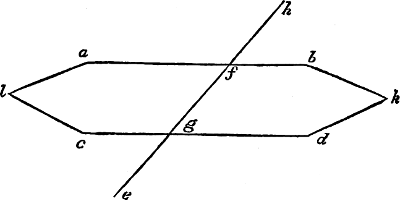
Let there be two right lines a b, c d, and let a certain right line e g f h, so cut them, that it may make the angles b f g, and f g d, equal to two right, I say that those right lines are parallel, that is, will never coincide. For if it be possible, let them coincide while the right lines b f, g d, are produced in the point k. Because, therefore, the right line e f, stands upon the right line a b, it makes the angles a f e, b f e, equal to two right. In like manner because f g stands upon c d, it makes the angles c g f, d g f, equal to two right. Hence, the four angles b f e, a f e, c g f, d g f, are equal to four right, two of which b f g, f g d, are supposed equal to two right. The remainders, therefore, a f g, c g f, are equal to two right. If then the right lines f b, g d, when produced, coincide, the internal angles being equal to two right, f a, and g c, also, shall coincide when produced: for the angles a f g, c g f, are also equal to two right. Either therefore the right lines shall coincide in both parts, or in neither, since these, as well as the former, are equal to two right. Let the right lines then f a, g c, coincide in the point l. But if this be admitted two right lines l a f k, l c g k, will comprehend space, which is impossible. It is not therefore possible, that the internal angles being equal to two right, the right lines can coincide. They are therefore parallel.
PROPOSITION XXIX. Theorem XX.
A right line falling upon parallel right lines, makes the alternate angles equal to each other; and the external equal to the internal angle, oppositely situated, and at the same parts; and the internal angles at the same parts equal to two right.
The present theorem is converted in both the preceding. For that which is the object of investigation, in each of them, forms the hypothesis: but what are data in the preceding, he proposes to shew in the present. And this difference of converse theorems is not to be passed over in silence. I mean that every thing which is converted, is either converted as one to one, as the sixth proposition to the fifth; or as one to a many, as the present to the preceding; or as many to one, as will shortly be manifest[28]. But in the present theorem, the institutor of the Elements first employs the petition, which says: If a right line falling upon two right lines, makes the angles situated internally, and at the same parts less than two right, those right lines whilst they are infinitely produced, will coincide at those parts in which the angles less than two right are situated. But in our exposition of things prior to theorems[29], we have asserted, that this petition is not allowed by all to be indemonstrably evident. For how can this be the case when its converse is delivered among the theorems as demonstrable? For the theorem which says that the two internal angles of every triangle are less than two right, is the converse of this petition. Besides, the perpetual inclination of right lines, more and more, while they are produced, is not a certain sign of coincidence, because other lines are found perpetually inclining, and never coinciding, as we have already observed. Formerly, therefore, some, when they had pre-ordained this as a theorem, considered that which is assumed by the institutor of the Elements as a petition, to be worthy of demonstration. But this seems to be shewn by Ptolemy himself, in a book entitled: That right lines which are produced from less than two right angles, coincide. And this he proves by pre-assuming many things, which as far as to the present theorem, are already demonstrated by the elementary institutor; and he supposes that all are true (lest we should also superadd another confusion) and that this, as a small assumption, may be exhibited from the preceding. But this also is one of the things previously exhibited, which says, that the right lines produced from two angles equal to two right, will never coincide. I say, therefore, that the converse also is true, which says, that right lines being parallel, if they are cut by one right line, the angles situated internally, and at the same parts, shall be equal to two right angles.
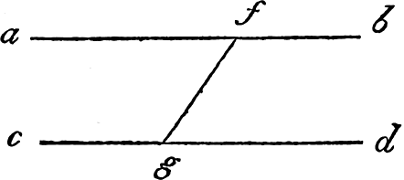
For it is necessary that a line cutting parallels, should either make the angles internally situated, and towards the same parts, equal to two right, or less, or greater than two right. Let the lines then, a b, c d, be parallel, and let the right line, g f, fall upon them, I say that it will not make the angles internal, and at the same parts greater than two right. For if the angles a f g, c g f, are greater than two right, the remainders b f g, d g f, are less than two right. But the same are also greater than two right. For a f, and c g, are not more parallel than f b, and g d. Hence, if the line which falls upon a f, c g, makes the internal angles greater than two right, that also which falls upon f b, g d, will make the internal greater than two right. But they are also less than two right (since the four, a f g, c g f, b f g, d g f, are equal to four right) which is impossible. In like manner we may plainly shew, that the right line which falls upon parallels, does not make the angles internal, and at the same parts, less than two right. But if it makes them neither greater nor less than two right, it remains that the incident line must make the angles internal, and at the same parts equal to two right. This then being previously shewn, the thing proposed, is doubtless demonstrated. For I say, that if a right line falling upon two right lines, makes the angles situated internally, and at the same parts, less than two right, if those right lines are produced they will coincide at those parts in which the angles less than two right are situated. For let them not coincide. But if they are non-coincident at those parts in which the angles less than two right are situated, much more will they be non-coincident at the other parts, in which the angles greater than two right are situated. Hence, the right lines will be non-coincident at both parts; and if this be true, they will be parallel. But it was shewn that the right line which falls on parallels, makes the angles internal and at the same parts equal to two right. The same, therefore, are both equal to, and less than two right, which is impossible.
Ptolemy having previously shewn this, and proceeding to the thing proposed, wishes to add something more accurate, and to shew that if a right line falling upon two right lines, makes the angles internal, and at the same parts, less than two right, the lines are not only coincident as has been shewn, but likewise that their coincidence takes place at those parts, in which the angles less than two right, and not at those in which the angles greater than two right are situated.
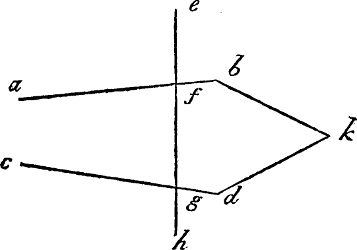
For let there be two right lines a b, c d, and let a right line e f g h, falling upon them make the angles a f g, and c g f, less than two right. The remainders, therefore, are greater than two right; and thus it is shewn that the right lines coincide. But if they coincide, they will either coincide at the points a and c, or at the points b and d. Let them coincide at the points b and d in the point k. Because, therefore, the angles a f g, and c g f, are less than two right, but the angles a f g, b f g, are equal to two right, by taking away the common angle a f g, the angle c g f, will be less than the angle b f g. The external angle, therefore, of the triangle g f k, is less than the internal and opposite angle, which is impossible. Hence then, they do not coincide at these parts. But they do coincide; and consequently they will be coincident at the other parts, in which the angles less than two right are situated. And thus far Ptolemy.
But it is necessary to scrutinize this demonstration, lest perhaps there should be any perverse and captious reasoning in the assumed hypotheses, in those, I say, in which he affirms, that a right line cutting non-coincident right lines, by forming four internal angles, forms the angles at the same parts on each side, either equal to two right, or greater, or less than two right. For the division is not perfect; since nothing hinders our calling those lines non-coincident, which are produced from angles less than two right, denominating, indeed, the two angles at the same parts, greater than two right, but the two at the remaining parts less than two right and not admitting in these, one and the same proportion. But the division being imperfect, the thing proposed is by no means demonstrated. Besides this, also, is not to be passed over in silence against his demonstration, that he does not essentially shew that which is impossible. For it is not because a certain right line cutting parallels, makes the angles at the same parts on each side, greater or less than two right, that an absurdity on this account follows these hypotheses. Nevertheless, because the four angles within the lines which are cut, are equal to four right, on this account each of these hypotheses is impossible; since, if parallel right lines are not assumed, yet, when the same hypotheses are assumed, the same consequences will be the result. And such are our animadversions against the demonstration of Ptolemy: for the imbecility of his demonstration appears from what has been said.
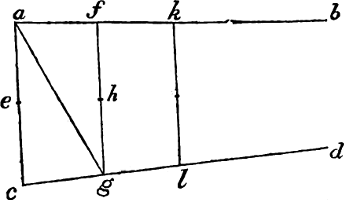
Let us now consider those, who say it is impossible that lines produced from angles less than two right, should coincide. For when they have assumed two right lines a b, c d, and a right line a c, falling upon them, and making the two internal angles less than two right, they say it is possible that the right lines a b, c d, may be shewn to be non-coincident. For let a c be bisected in e, and cut off from a b, a part a f, equal to a e: but from c d, a part c g, equal to e c. It is manifest, therefore, that the right lines a f, c g, will not coincide in the points f and g. For if they coincide, these two in the triangle will be equal to a c, which is impossible. Let again f g be connected, and bisected in h, and cut off equal parts. These, therefore, will not coincide on the same account, and this will be the case, in infinitum, by connecting the non-coincident points; and bisecting the connecting line, and by cutting from the right lines, lines equal to the halves of the connecting lines; for by this means they say, that the right lines a b, c d, will never coincide. To such as these we reply, that they indeed affirm that which is true, but not so much as they imagine. For it is not true that the point of coincidence is simply determined by this means, nor is it true that the lines by no means coincide. Thus, when the angles b a c, and d c a, are determined, the lines a b, and c d, will not coincide in the points f and g, yet nothing hinders their coinciding in the points k and l, though f k and g l should be equal to f h, and h g. For when a k and c l coincide, the angles k f h, l g h, will not remain the same, and a certain part of the right line f g, will be left external to the right lines a k and c l; and so again the two lines f k, and g l, are so much greater than the base, as the interior parts of the right line f g, which they intercept. Besides this also is to be said to such as affirm the non-coincidence of lines extended from angles less than two right, that they destroy what they are unwilling to destroy. For let the same description be given. Whether, therefore, is it possible, or impossible to connect a right line from the point a, to the point g? For if it be impossible, besides destroying the fifth petition, they also destroy that which says, that a right line may be drawn from every point to every point: but if possible let it be connected. Because, therefore, the angles f a c, g c a, are less than two right, it is manifest that the angles also, g a c, g c a, are much less than two right. The right lines, therefore, a g, c g, will coincide in the point g, being produced from angles less than two right. Hence, it is not possible to affirm indeterminately, that lines produced from angles less than two right, will not coincide. It is however manifest, that some right lines produced from angles less than two right will coincide, though the present discourse seems to investigate this in all. For it may be said, that when the diminution of two right lines is indefinite, the lines will remain non-coincident according to such a diminution: but will coincide according to another less than this. But he who desires to behold a demonstration of this affair, must be informed that it is requisite for this purpose to pre-assume such an axiom as is employed by Aristotle[30] in proving the world to be finite, viz. If from one point two right lines forming an angle are produced in infinitum, the distance of the lines infinitely produced will exceed every finite magnitude. For he shews that when infinite right lines are produced from the centre to the circumference, the interval also contained between them will be infinite: since, if it be only finite, it is possible that the distance may be increased; and on this account the right lines will not be infinite. Right lines, therefore, infinitely produced, are distant from each other by an interval greater than every finite magnitude.
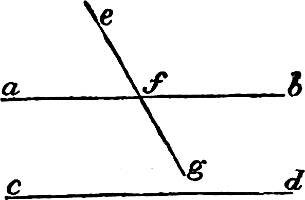
This being pre-supposed, I say that if any right line cuts the one of parallel right lines, it will also cut the other. For let a b and c d be parallels, and let the right line e f g cut a b. I say that it will also cut c d. For since there are two right lines, which are produced infinitely from the point f, viz. b f, and f g, they shall have a distance greater than every magnitude. Hence, they shall exceed the quantity of the interval contained between the parallel lines. Since, therefore, their distance from each other is greater than that of the parallels, f g shall cut c d. But this being demonstrated, we can exhibit the thing proposed in a consequent order. For let there be two right lines a b, c d, and let a right line e f, fall upon them, making the angles b e f, d f e, less than two right.
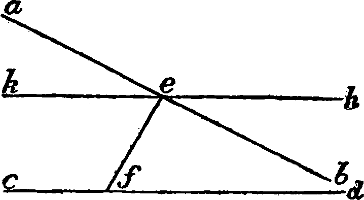
I say that the right lines will coincide in those parts, in which the angles less than two right are situated. For since the angles b e f, d f e, are less than two right, let the angle h e b, be equal to the excess of two right angles above these angles, and produce h e, to the point k. Because, therefore, a right line e f, falls upon the right lines h k, c d, and makes the internal angles equal to two right, viz. the angles h e f, d f e, the right lines h k, c d, are parallel; and a b cuts k h. It will therefore also cut c d, by the assumption previously exhibited. Hence, the right lines a b, c d, will coincide in those parts, in which the angles less than two right are situated. And on this account the thing proposed, is evinced[31].
PROPOSITION XXX. Theorem XXI.
Right lines parallel to the same right line, are parallel to each other.
The geometrician in these discourses which are conversant with relation, is accustomed to shew identity permeating through all quantities, having the same relation to the same. Thus among the axioms also he says, things equal to the same, are equal to each other: and in the following books he says, things similar to the same, are similar to each other, and things having the same proportion to the same, have the same proportion to each other. After this manner, therefore, he now also demonstrates, that right lines parallel to the same, are parallel to each other. But it happens that this is not true in all respects. For quantities double of the same, are not also double of each other: nor are those which are sesquialter of the same, sesquialter likewise to each other, but it appears to take place in those alone, which are univocally converted in equality, similitude, identity, and parallel position. For that which is parallel to a parallel, is itself also parallel. As that which is equal to an equal, is itself equal; and that which is similar to a similar, is itself similar. For the relation of parallels to each other, is similitude of position. He affirms, therefore, and shews, in the present theorem, that lines parallel to the same, are entirely so related, that they are also parallel to each other. And he also exhibits the parallels with an external position, and likewise a medium, to which these have a similar relation, that what he asserts may become manifest from a common conception. For if they coincide with each other on either side, and coincide with that which is situated in the middle, they will no longer be parallel to it.
But it is possible that he who changes the position may shew the same thing, and by the same methods which the geometrician employs in exhibiting his proposition.
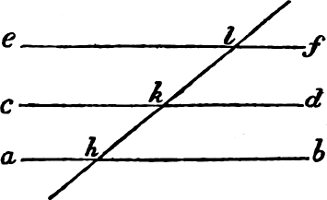
For instance, he assumes both c d, and e f, parallel to a b, both of them situated above, and a b being beneath, and not in the middle. For a right line h k l, falling upon them, makes each of the angles h k d, k l f, equal to a h k, because they are alternate; and on this account it makes the angles h k d, k l f, equal to each other. The right lines, therefore, c d, e f, are parallel. But if any one should say that a h, h b, are parallel to c d, and are therefore parallel to each other, we reply that a h, h b, are parts of one parallel, and are not two parallel lines. For parallels are conceived to be infinitely produced, but a h, when produced, falls upon h b. It is therefore the same with h b, and not a different line. Hence, all the parts of a parallel, are parallel both to the right line, to which the whole was parallel, and to its parts. As for example, a h is as well parallel to k d, as h b, to c k. For if they are infinitely produced, they will never coincide. And these remarks must be considered as not foreign from the purpose, both on account of sophistical importunities, and the juvenile habits of mathematical auditors. For the vulgar rejoice to find captious reasonings of this kind, and to procure vain molestation to the possessors of science. But it is not requisite to convert the present theorem, and to shew that lines parallel to each other, are also parallel to the same. For if we again suppose one line parallel to some other, the remainder also of these shall be parallel to it, and they will be parallel to the same, and we shall again return to the same proposition.
PROPOSITION XXXI. Problem X.
Through a given point to draw a right line parallel to a given right line.
It is requisite that we should not only learn the essential accidents of parallels, in the discourses of the elementary institutor, but also that we should relate their origin, and know how one right line becomes parallel to another: for origin every where renders the essence of subjects more known to us. And this the institutor of the Elements effects by the present problem. For having received a point and a right line, he draws through that point a line parallel to a right line. But we ought to pre-assume as necessary, that the point should entirely be placed external to the right line: for we must not place it in the right line, because it is said, through a given point; since no other, besides the given line, can be that which is drawn parallel through the point. Since, therefore, the point and the right line is divided, it indicates that the point is to be received external to the right line, which he manifests in a perpendicular by addition, commanding, upon a given infinite right line, and from a given point which is not in it, to let fall a perpendicular. One thing, therefore, which is common to both these problems, is, the external position of the point: but the other, that from the same point two perpendiculars cannot be let fall to the same right line, and that through the same point, two lines cannot be drawn parallel to the same right line. Hence, the institutor of the Elements commands in the singular number to draw a right line, in the former problem, a perpendicular, but in the present a parallel. And, that indeed, has been shewn, but this is manifest, from what is previously demonstrated. For if through the same point two parallels are drawn to the same right line, they would be parallel to each other, and coincide in the given point, which is impossible. But it is requisite to observe the differences of these two propositions, from a given point, and through a given point. For sometimes the point is the beginning of the right line which is drawn, and on this account the deduction is made from it: but sometimes the point is in the drawn right line, and on this account the drawing is made through the point. For the particle through, was not asserted, because the right line cuts a given point, but because it coincides with it, and terminates its own interval, in respect of that right line, by the distance of the point and the right line. Since as much as the given point is distant from the given right line, so much also is the interval of the parallel between itself and the right line.
PROPOSITION XXXII. Theorem XXII.
One side of every triangle being produced, the external angle of the triangle is equal to the two internal and opposite angles; and the three internal angles of a triangle are equal to two right angles.
As much as was deficient in the sixteenth and seventeenth theorem, so much Euclid adds in the present. For we not only learn by this theorem that the external angle of a triangle is greater than either of the internal and opposite angles, but likewise how much it is greater; since as it is equal to both, it is greater than either of the remaining angles. Nor do we alone know from this theorem, that any two angles of a triangle, are less than two right, but by how much they are less: for they are deficient by the remaining third. The former, therefore, were more indefinite theorems: but this brings with it, on both sides, a boundary to science. We must not, however, call them on his account superfluous: for they are of the greatest utility in many demonstrations; and the present is proved by their assistance. And besides this, it is necessary that our knowledge, proceeding from the imperfect to the perfect, should pass from indeterminate apprehensions, to determinate and certain propositions. But the institutor of the Elements, by drawing a parallel externally, exhibits each of the objects of investigation. It is, however, possible that the same thing may be shewn without drawing the parallel externally; and this, by only changing the order of the things exhibited. For Euclid first shews, that the external angle is equal to the internal and opposite, and from this he proves the remainder. But we shall demonstrate this by a contrary mode of proceeding.
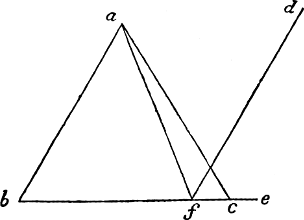
Let there be then a triangle a b c, and let the side b c be produced to the point e. Then take a point f in b c, and connect a f, and through the point f, let f d be drawn parallel to a b. Because, therefore, f d is parallel to a b, and a right line a f, falls upon these parallels, as also a right line b c, hence, the alternate angles are equal, and the external is equal to the internal angle. The whole, therefore, a f c, is equal to f a b, added to a b f. In like manner we may shew by drawing a parallel, that the angle a f b, is equal to the angles f a c, a c f. The two, therefore, a f b, a f c, are equal to the three angles of the triangle: and hence, the three angles of a triangle are equal to two right, viz. to a f b, added to a f c. But a c f, a c e, are also equal to two right angles. Let, therefore, the common angle a c f, be taken away; and then the remaining external angle will be equal to the internal and opposite angles. And after this manner may the present theorem be exhibited.
But Eudemus, the Peripatetic, ascribes the invention of this theorem to the Pythagoreans, I mean that every triangle has its internal angles equal to two right, and says that they demonstrate it in the following manner.
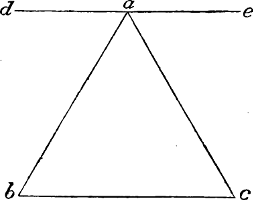
Let there be a triangle a b c, and let there be drawn through the point a, a line d e, parallel to b c. Because, therefore, the right lines d e, b c, are parallel, the alternate angles are equal. Hence, the angle d a b, is equal to the angle a b c; and the angle e a c, to the angle a c b. Let the common angle b a c, be added. The angles, therefore, d a b, b a c, c a e, that is, the angles d a b, b a e, and that is two right, are equal to the three angles of the triangle. And such is the demonstration of the Pythagoreans.
But it is here requisite to deliver such theorems as are converse to the present theorem of the elementary institutor. For two are converted to one, since this is a composite, both, according to the object of enquiry, and the datum: for the datum is two-fold, viz. the triangle, and one of its sides produced; and in like manner the object of enquiry. For one part says, that the external angle is equal to the internal and opposite angles: but the other, that the three internal angles are equal to two right. If therefore, we suppose that the external is equal to the internal and opposite angles, we may shew that one side is produced, and that the right line externally situated, is in a direct position with one of the sides of the triangle: but if the three internal angles are equal to two right, we may shew that the given figure is a triangle. And so the whole object of enquiry, is converse to the whole datum.
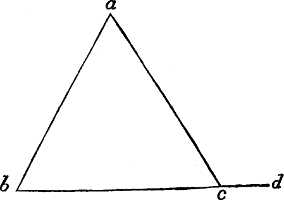
Let there be then a triangle a b c, and let the external angle a c d, be equal to the internal and opposite angles, I say that the side b c, is produced to the point d, and that b c d, is one right line. For since the angle a c d, is equal to the internal and opposite angles, let the common angle a c b be added. The angles, therefore, a c d, a c b, are equal to the three angles of the triangle a b c. But the three angles of the triangle a b c, are equal to two right. And hence, the angles a c d, a c b, are equal to two right. But if two right lines being consequently placed, and not at the same parts to any right line, and at a point in it, make the successive angles equal to two right, those right lines shall be in a direct position to each other. The right line, therefore, b c, is in a direct position to c d.
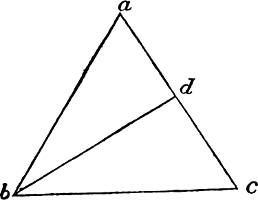
Let there be again, a certain right lined figure a b c, having three angles alone equal to two right, viz. a, b, and c, I say that the figure is a triangle, and that a c, is one right line. For let the right line b d be connected. Because, therefore, the three angles of each of the triangles a b d, b d c, are equal to two right, of which the angles of the figure a b c, are equal to two right, the remainders a d b, c d b, are equal to two right, and they are placed about a right line b d. Hence d c, is in the same direction with d a; and so the side a c, is one right line. In like manner we may shew that the side a b, and the side b c, are each of them one right line. And consequently the figure a b c, is a triangle. If then a figure having internal angles equal to two right, is right-lined, it is perfectly a triangle: but it does not follow that a figure is a triangle merely because it has internal angles equal to two right. For you will find a figure constructed from circumferences, having its internal angles equal to two right.
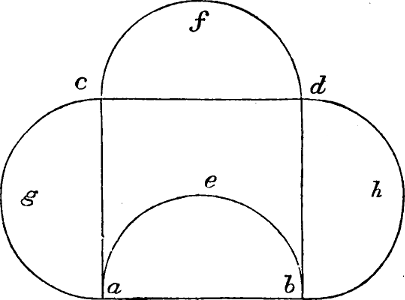
For let there be a quadrangle a b c d, and upon the side a b, let a semicircle a e b, be internally described: but upon the other sides, let the semicircles be externally described, as f, g, h. The figure, therefore, which is comprehended by the semicircles, has two angles g a e, e b h, equal to two right, viz. to c a b, d b a. For this was shewn in the petitions[32], and these angles alone are in this figure. There is, therefore, a certain figure not a triangle, which has its internal angles equal to two right. And thus much may suffice concerning converse theorems.
But as we have discovered that the three angles of every triangle are equal to two right, we ought to determine a certain method, by which we may find how many angles, of all other multangles, are equal to so many right angles; as for instance, of a quadrangle, quinquangle, and of all consequent multilateral figures. In the first place, therefore, it must be known, that every right-lined figure may be resolved into triangles, since a triangle is the principle of the constitution of all things, which Plato also asserts in the Timæus, when he teaches us that the rectitude of a plane basis is composed from triangles. But every figure is resolved into triangles less in number, by the binary, than its proper sides. If a quadrilateral figure, into two triangles: if a figure of five sides, into three: if of six sides, into four. For two triangles composed together, immediately form a quadrilateral figure. But the number of composite triangles by which the first constituted figure differs from its sides, is the measure of difference to the rest. Hence, every multilateral figure possesses more sides, by the binary, than the triangles into which it may be dissolved. But every triangle has been shewn to contain angles equal to two right. And hence, if the number of the angles be made double to that of the composite triangles, it will afford a multitude of right angles, to which the angles of every multangle will be equal. On this account every quadrilateral figure has angles equal to four right, since it is composed from two triangles: but every figure of five sides has angles equal to six right; and after the same manner of the rest in a consequent order. This one thing, therefore, is to be assumed from the present theorem, concerning all multangular and right-lined figures.
But there is another consequent to this, which is summarily as follows. In every right-lined figure, each of its sides being at the same time produced, the angles externally constituted are equal to four right. For it is requisite, indeed, that the successive right angles should be double of the multitude of the sides; because, in each they are constituted equal to two right. But the right angles equal to the internal angles being taken away, the remaining external angles are equal to four right. As for example, if the figure is a triangle, while every one of its sides is produced, at the same time internal and external angles are constructed equal to six right angles, of which the internal angles are equal to two right, but the remaining external angles to four right. But if the figure be quadrilateral, the angles are in all eight, since they are double of the sides, of which the internal are equal to four right, and the external to the four remaining angles, and the consequences will be similar in infinitum. But after these observations we may also collect, that by this theorem every angle of an equilateral triangle is two thirds of a right angle; but that an isosceles triangle, when the vertical angle is right, has each of its remaining angles the half of one right, as a semiquadrangle; and that a scalene triangle, when it is the half of an equilateral triangle, formed by a perpendicular drawn from any angle to its opposite side, has one angle right, but the other (which likewise belonged to the equilateral triangle) two thirds of a right angle, and the remainder by a necessary consequence, a third part of a right angle. For it is requisite that the three should be equal to two right. But I do not conceive that these remarks are foreign from our purpose, since they prepare us for the doctrine of Timæus. This also must be observed, that the possession of internal angles equal to two right is inherent essentially, and answering to the predication according to what, in a triangle. And on this account, Aristotle in his Treatise on Demonstration[33], employs this as an example, considering it according to what. As therefore to be terminated, is essentially and primarily inherent in every figure, so likewise the possession of internal angles equal to two right, is essentially and primarily inherent in a triangle, though not in every figure. And the truth of this theorem seems to present itself to us according to common conceptions. For if we conceive a right line, and two right lines standing on its extremities, and inclining to each other, so as to form a triangle, we shall find that in proportion to their inclination they diminish the right angles, which they form with the right line. Hence, obtaining as much angular quantity, by their inclination at the vertex, as they take away from the base, they necessarily form three angles equal to two right.
PROPOSITION XXXIII. Theorem XXIII.
The right lines which join equal and parallel right lines at the same parts, are themselves also equal and parallel.
The present theorem is, as it were, the confine of the consideration of parallels and parallelograms: for it seems to declare a certain symptom of parallel right lines, and delivers the latent origin of parallelograms. For a parallelogram is formed, as well from those equal and parallel right lines, which are drawn in the beginning, as from those which conjoin them, and which are in like manner shewn to be equal and parallel. Hence, the proposition which immediately follows the present, contemplates the properties essentially inherent in these spaces, in a parallelogram as it were already constructed. And these things are indeed manifest. But it is requisite to consider the diligence which this preposition contains. In the first place, indeed, that it is not sufficient, that the lines which are conjoined should be equal: for the lines which connect equals, are not entirely equal, unless they are also parallel. For a triangle being isosceles, and a point being assumed in one of the equal sides, and through this a line being drawn parallel to the basis, equal lines shall indeed conjoin parallels to the basis, and the basis itself, yet these parallels shall not also be equal; and the sides will not be parallel, because they coincide at the vertex of the triangle.
In the second place, he considers that the subject right lines being parallel, is not sufficient to constitute the equality of the lines which conjoin them. For this is evident from the preceding construction of the isosceles triangle; since the drawn right line, and the basis, are parallel, and yet the lines which connect them are not parallel, because they are parts of the sides of the isosceles triangle. The parallel position, therefore, of the lines which are conjoined, is requisite to the equality of the connecting lines: but the equality of the latter is necessary to the parallel position of the former. On this account the institutor of the Elements assumes each, in those which are conjoined, for the purpose of exhibiting, that the connecting lines are as well equal, as parallel to one another. But in the third place, he intimates, that right lines being supposed both equal and parallel, their connecting lines will not be universally equal and parallel. For unless we make the conjunctions at the same parts as in this case, the connecting lines cannot be parallel (since they will cut each other), so they may be sometimes equal, and sometimes not.
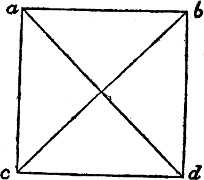
For if you assume a quadrangle, or oblong, as a b c d, and connect the right lines a d, b c, the diameters are indeed equal, but not parallel, and they conjoin the equal and parallel opposite sides of the aforesaid spaces. But if the figure be a Rhombus, or a Rhomboides, the diameters of these, are not only non-parallels, but also unequal.
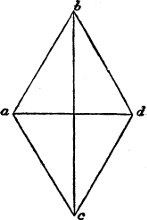
For since a b, is equal to c d, but a c is common, and the angle b a c, is unequal to the angle a c d, the bases also are unequal. The institutor of the Elements, therefore, very properly considered, that the lines which conjoin equal and parallel lines, ought to make the conjunction at the same parts, lest a c, b d, being supposed equal and parallel, we should assume a d, b c, as the connecting lines, and not a b, and c d. For he shews that these latter are equal and parallel: but that the former are, indeed, never parallel, but equal, as we have observed in a quadrangle and oblong, but never in a rhombus and rhomboides; as the opposite to this has been proved to be true, because they are unequal, on account of the inequality of the angles internal, and situated at the same parts.
PROPOSITION XXXIV. Theorem XXIV.
The opposite sides and angles of parallelogrammic spaces are equal to each other and they are bisected by the diameter.
As from the preceding theorem, he had assumed a parallelogram already constructed, he now contemplates its primarily inherent properties, and such things as express its peculiar constitution. But these are the following: that the sides and angles which are opposite, are equal, and that the spaces themselves are bisected by the diameter. For that part of the proposition relates to the spaces, which says: and they are bisected by the diameter. So that the area itself, is that whole which is bisected, and not the angles through which the diameter passes. These three properties then, are essentially inherent in parallelograms, the equality of the opposite sides and angles, and the bisection of the spaces by the diameter. And you may observe that the properties of parallelograms are investigated from all these, viz. from the sides, from the angles, and from the areas. But as there are four kinds of parallelograms, which Euclid defines in the hypotheses[34], viz. a quadrangle, oblong, rhombus, and rhomboides, it deserves to be remarked, that if we divide these four into rectangles, and non-rectangles, we shall find, that not only the diameters bisect these spaces, but that the diameters themselves, are, indeed, in rectangles equal, but in non-rectangles unequal, as was observed in the preceding theorem. But if we divide them into equilateral, and non-equilateral, we shall again find that in the equilateral figures, not only the spaces are bisected by the diameters, but likewise the angles through which they are drawn: but in non-equilaterals this is never the case. For in a quadrangle, and a rhombus, the diameters bisect the angles, and not the spaces only: but in an oblong, and a rhomboides, they alone bisect the spaces.
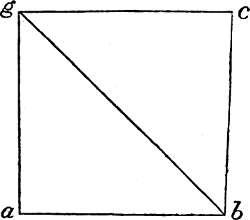
For let there be a quadrangle, or a rhombus, g c a b, and a diameter g b. Because, therefore, the sides g c, c b, are equal to the sides g a, a b (for they are equilateral), and the angles g c b, g a b, are equal (for they are opposite), and the basis also is common, hence, all are equal to all; and on this account the angles c g a, a b c, are bisected.
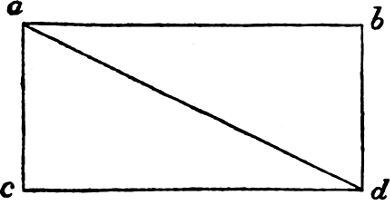
Again, let there be an oblong, or rhomboides given. If, therefore, the angle b a c, and the angle c d b, is bisected by the diameter, but the angle c a d, is equal to the angle a d b, the angle also, b a d, will be equal to the angle a d b. Hence, the side also, a b, will be equal to the side b d. But they are unequal; and consequently the angle b a c, is not bisected by the diameter, nor its equal the angle c d b. That I may therefore comprehend the whole in a few words, in a quadrangle the diameters are equal, on account of the rectitude of the angles, and the angles are bisected by the diameters, on account of the equality of the sides, and the areas are bisected by the diagonal, on account of the common property of parallelograms: but in an oblong, the diameters are indeed equal, because it is a rectangle, but the angles are not bisected by the diameters, because it is not equilateral, though the division of spaces into equal parts, is also inherent in this figure, so far as it is a parallelogram: but in a rhombus the diameters are unequal, because it is not a rectangle, but the spaces are not only bisected by these, because it is a parallelogram, but the angles also, because it is equilateral; and in the remaining figure, i.e. a rhomboides, the diameters are unequal, because it is not a rectangle, and the angles are cut by these into unequal parts, because it is not equilateral, and the spaces alone situated at each part of the diagonals, are equal, because it is a parallelogram. And thus much concerning observations of this kind, which exhibit the diversity found in the four divisions of parallelograms.
But we must not pass over in silence, the artificial consequence appearing in this theorem, that of theorems, some are universals, but others non-universals. But we shall speak concerning each of these, when we divide the object of investigation, which has, indeed, one part universal, but the other non-universal. For though every theorem may seem to be universal, and every thing exhibited by the elementary institutor may appear to be of this kind (as in the present he may not only seem to assert, that in all parallelograms universally, the opposite sides and angles are equal, but likewise that each is bisected by the diameter), yet we must say that some things are universally exhibited, but others not universally. For it is customary to call the universal which affirms the truth concerning every thing of which it is predicated, differently from that universal, comprehending all things in which the same symptom is inherent. Thus it is universal, that every isosceles triangle has three angles equal to two right, because it is true of all isosceles triangles: and it is universal that every triangle has three angles equal to two right, because it comprehends all things, in which this is essentially inherent. On which account we affirm that the possession of three angles equal to two right, is to be primarily manifested of a triangle. According to this signification, therefore, of theorems, calling some universal, but others non-universal, we must affirm that the present theorem, has, indeed, one of its objects of investigation universal, but the other non-universal. For the possession of opposite sides and angles that are equal, is a universal, since it is alone inherent in parallelograms: but that the diameter bisects the space, is not universal, because it does not comprehend all things in which this symptom is beheld; for this is inherent in a circle and ellipsis. And it appears, indeed, that primary conceptions of such like concerns, are more particular, but that in their progress they comprehend the whole. For when the ancients had contemplated that a diameter bisects an ellipsis, circle, and parallelogram, they afterwards surveyed that which was common in these. But we are deceived (says Aristotle[35]) when a non-universal is exhibited as universal, because that common something in which the symptom is primarily inherent, is nameless. For we cannot say what that is, which is common to numbers and magnitudes, motions and sounds; and it is likewise difficult to express what is common to an ellipsis, circle, and parallelogram. For one of these figures is right-lined, but the other circular, and the third mixt; and on this account we conceive that he exhibits universally, who demonstrates that a diameter bisects every parallelogram, because we do not at the same time perceive that common something, on account of which, this is true. This then in parallelograms, is not an universal of this kind, on account of the aforesaid cause; but the proposition is universal, which asserts, that every parallelogram has its opposite sides and angles equal. For if any figure is supposed, having its opposite sides and angles equal, it may be shewn to be a parallelogram. Thus let such a figure be a b c d[36], and its diameter a d. Because, therefore, the sides a b, b d, are equal to the sides a c, c d, and the angles comprehended by them are equal, and the base common, all will be equal to all. The angle, therefore, b a d, is equal to the angle a d c, and the angle a d b, to the angle c a d. Hence, a b, is parallel to c d, and a c to b d. And on this account the figure a b c d, is a parallelogram. And thus much may suffice for observations of this kind.
But the institutor of the Elements seems to have composed the name of parallelograms, by taking an occasion from the preceding theorem. For when he had shewn that right lines, which conjoin equal and parallel right lines at the same parts, were themselves also equal and parallel, it is evident that he pronounces as well the opposite sides which conjoin, as those which are conjoined, to be parallel: but that he very properly calls the figure which is contained by parallels, a parallelogram, in the same manner as he denominates that which is comprehended by right lines rectilineal. And it is evident that the institutor of the Elements places a parallelogram among quadrilateral figures. But it is worthy our observation and enquiry, whether every right-lined figure, which is composed from equal sides, since it is equilateral and equiangular, is to be called a parallelogram. For a figure of this kind also, has its opposite sides equal and parallel, as likewise the opposite angles equal. As for example, a sexangle, and an octangle, and a decangle.
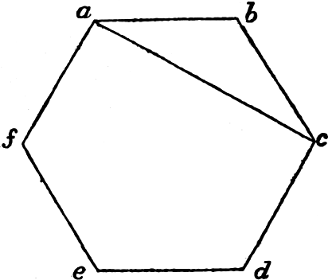
Thus, if you conceive a sexangle a b c d e f, and connect a right line a c, you may shew that a f is parallel to c d. For the angle at the point b, is one right, and the third part of a right angle; and this is true of every angle of a sexangle, since it is equiangular. Besides the side a b, is equal to the side b c, for it is placed equilateral. Each of the angles, therefore, b a c, b c a, is a third part of a right angle. Hence, the angles f a c, a c d, are right angles. And on this account a f, is parallel to c d. In like manner we may shew that the other opposite sides are parallel, and the same may be evinced in an octangle, and in the remaining figures of this kind. If, therefore, that is a parallelogram which is comprehended by parallels oppositely situated, a parallelogram will likewise subsist among non-quadrilateral figures. But it appears that with the institutor of the Elements a parallelogram is quadrilateral. And this is particularly perspicuous in that theorem, in which he says, that a parallelogram which has the same base with a triangle, and is between the same parallels, is double of the triangle: for this is alone true in quadrilateral figures.
PROPOSITION XXXV. Theorem XXV.
Parallelograms which are upon the same base, and between the same parallels, are equal to each other.
As we have said that of theorems, some are universal, but others particular, and as dividing these we have subjoined, that some are also simple, but others composite, and have shewn the nature of each, so according to another distinction, we assert that some of these are local, but others non-local. But I call those local, to which the same symptom happens in a certain place; and I denominate the place of a line or a superficies, that situation, which produces one and the same symptom. For of local theorems some are constructed in lines, but others in superficies. And because of lines, some are plane, but others solid, the plane being those of which there is a simple conception in a plane, as of a right line: but the solid those whose origin appears from a certain section of a solid figure, as of cylindric, spiric, and conic lines, I should say, that of the local theorems which are constructed in lines, some have a plane, but others a solid place. The present theorem, therefore, is both local, and local in lines, and a plane. For the whole space which lies between the parallels, is the place of the parallelograms constructed upon the same base; and which the institutor of the Elements shews to be equal to each other. But of those local theorems which are called solid, let the following be an example[37]. The parallelograms which are inscribed within the asymptotes and the hyperbola, are equal: for it is evident that the hyperbola is a solid line.
But Chrysippus, as we are informed by Geminus, assimilates theorems of this kind to ideas. For as ideas comprehend the origin of infinites, in terminated limits, so in these also there is a comprehension of infinites, in terminated places, and by this boundary equality appears, since the altitude of the parallels remaining the same, if infinite parallelograms are conceived upon the same base, they may all be shewn to be equal to each other. The present, therefore, is with the institutor of the Elements, the first local theorem. And he appears, when, agreeable to an elementary mode, he had distinguished theorems by a variety, according to all possible divisions, with great propriety not to have omitted, considering their idea of this kind. Nevertheless, as his discourse, for the present, is concerning right lines, he delivers local plane theorems in right lines: but in the third book, as he treats concerning things which may be contemplated of circles, and their symptoms, he likewise teaches the particulars, which are constructed in circumferences belonging to local, and at the same time, plane theorems. And such, among these, is the theorem, which says, that angles in the same segment, are equal to one another. Also this which asserts, that the angles in a semicircle are right. For if infinite angles are constructed in a circumference, the same base remaining, they are all shewn to be equal; but if that which is comprehended by the base and the circumference, is a semicircle, they are all shewn to be right. And these, indeed, correspond in proportion to triangles and parallelograms upon the same base, and between the same parallels. And such is the species of theorems called local, by the ancient mathematicians.
But perhaps it may seem perfectly worthy of admiration, to such as are unskilled in contemplations of this kind, that parallelograms constructed upon the same base, and between the same parallels, should be equal to each other. For it may be asked, how is this possible, since the longitude of the spaces, constructed on the same base, increases in infinitum? Since as much as we produce the parallels, by so much we may also increase the longitudes of the parallelograms. But some one may not improperly enquire how, while this takes place, the equality of the spaces remains. For if the breadth is the same (since the base is one), but the length is greater, will not the space also be greater? The present theorem, therefore, and that which follows concerning triangles, are among the number of mathematical theorems, which are denominated admirable. For mathematicians in theorems, as the Stoics in arguments, have established a place, which is called admirable, and they place the present among theorems of this kind. The vulgar, therefore, are immediately astonished, when they hear that the multiplication of length does not destroy the equality of spaces on the same base. We must nevertheless assert, that equality and inequality possess the greatest power in increasing or diminishing the spaces of angles. For in proportion as we make angles unequal, in such proportion we diminish the space, if the length and breadth remain the same. Hence, the increase of length is necessary, that we may preserve equality. Thus, for example, let there be a parallelogram a b c d, and let the side a c be produced in infinitum, and let it be a right-angled parallelogram; and lastly, on the base b d, construct another parallelogram b e f d.
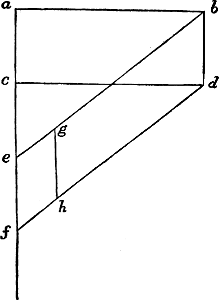
That the length, therefore, is increased is evident: for the side b e, is greater than the side a b, since the angle at the point a, is right. But this necessarily takes place, as the angles of the parallelogram b e f d, are unequal, and some of them are acute, but others obtuse: and this happens, because the side b e, approaches after a manner to the side b d, and contracts the space. For let b g be taken equal to a b, and through g, draw g h parallel to b d. The length, therefore, of the parallelogram b d g h, is equal to the length of the parallelogram a b c d, and the breadth is the same, and yet one space is less than the other; for it is less than b e f d. Hence, the inequality of angles diminishes the area, but the increment of length adding as much as the inequality of angles takes away, preserves the equality of the spaces. But the boundary of the increase of length, is the place of the parallel lines. For when both the parallelograms are rectangular, and have an equal ambit, the quadrangle is shewn to be greater than the oblong[38]: but when they are both equilateral, and have consequently an equal ambit, that which is rectangular, is shewn to be greater than that which is non-rectangular[39]. For the rectitude of angles, and the equality of sides, possesses universal power in the augmentation of spaces. It is on this account that a quadrangle is the greatest of all figures with an equal ambit, and a rhomboides the least. And these observations we shall demonstrate in another place[40]: for they more properly belong to the hypotheses of the second book.
But with respect to the present theorem, it is requisite to know, that when Euclid calls parallelograms equal, he means the spaces, and not the sides: for he now discourses of areas. And we must likewise observe, that he first mentions trapeziums in the demonstration of this theorem: from whence also it is manifest, that he does not improperly teach us concerning a trapezium, in the definitions, when he informs us that it is indeed of a quadrilateral species, but is not a parallelogram. For the figure which has not its opposite sides and angles equal, falls from the order of parallelograms. The institutor of the Elements, therefore, as he had chosen a more difficult case, demonstrates the thing proposed. But if any one should say, let the parallelograms a b c d, and b d c e, be upon the same base d b, so that the side c d may be the diameter of the parallelogram a b, we can shew that according to this position they are equal. For the triangle b c d, is the half of each parallelogram: because c d is the diameter of a b, but c b of d e; and diameters bisect parallelograms.
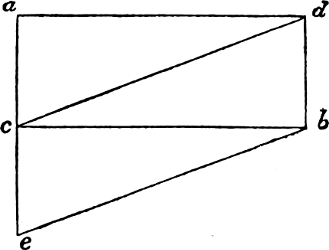
Hence, a b is equal to the parallelogram d e. Again, if any one should suppose that the side a c, of the parallelogram a b, is cut by the side d c, and that the parallelograms are situated as a d b e, b d c f, we can shew that these also are equal.
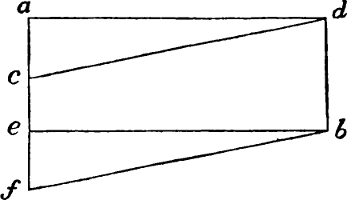
For since the side a e, is equal to the side c f (each because opposite being equal to d b), let the common right line c e be taken away. Hence, a c is equal to e f. But a d, also, is equal to e b, and the angle c a d, to the angle f e b. For a d is parallel to e b; and hence, the base c d, is equal to the base f b, and the whole triangle a d c, is equal to the whole triangle e b f. Let the common trapezium c b, be added. The whole, therefore, a b, is not unequal to the whole d f. And here you may observe that these are the only three cases. For the side d c, either cuts the side e b, according to the position of the elementary institutor; or it falls on the point c, as in the penultimate description: or it cuts the line a e, according to the present supposition. And thus the theorem is shewn to be true according to all its cases. Lastly, as there is a two-fold difference of trapeziums, and one kind has neither of its opposite sides parallel, but the other has one side parallel to one, this latter species of trapeziums is alone employed by the geometrician throughout the elements, and in the present description: for c e is parallel to d b.
PROPOSITION XXXVI. Theorem XXVI.
Parallelograms which are upon equal bases, and between the same parallels, are equal to each other.
The preceding theorem assumed, indeed, the same bases, but this receives them equal, and different from each other. But it is common to both, to suppose the parallelograms between the same parallels. It is requisite, therefore, that they should neither fall within, nor without their subject parallel lines. For parallelograms are said to be between the same parallels, when their bases and opposite sides are adapted to the same parallels. As to the rest, the institutor of the Elements, as he had assumed the bases entirely separate, exhibits the theorem. But nothing hinders our receiving them with this hypothesis, so that they may have a common part. For let a b, c d, be parallelograms upon equal bases e b, f d, having a common part, and constructed between the same parallels, I say that they are equal.
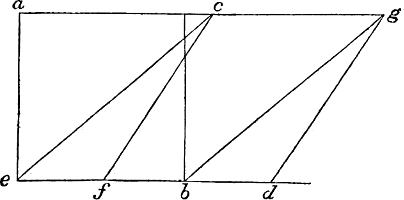
Let the lines e c, b g, be connected. Because, therefore, e f, is equal to b d (for the base e b, was supposed equal to the base f d), but the side c f, is equal to the side d g, and the angle c f e, is equal to the angle g d b, and hence, c e is equal to b g. But it is also parallel to it. Hence, c b is a parallelogram, and has the same base with each of the parallelograms a b, c d, and is between the same parallels. The parallelogram, therefore, a b, is equal to the parallelogram c d.
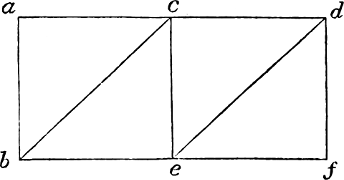
But if any one should suppose that the bases of the parallelograms have neither a common part, nor are separate from each other, but (which is the only remaining hypothesis) that they touch each other in one point, as in the parallelograms a e, e d, we must say that the base b e is equal to the base e f, and to the side c d. Hence, also, the right line c b, is equal to the right line d e, and is parallel to it. For the lines which join equal and parallel lines, are themselves also equal and parallel. Hence, b d is a parallelogram, and is upon the same base, and between the same parallels, with the parallelograms c b, d e. The parallelograms, therefore, c b, d e, are equal. But according to the first conception of a theorem, we may divide the constructions by asserting that the bases have either a common part, or touch each other, or are distant from each other. It is however possible, that though they may touch each other, as b e, e f, yet the whole parallelogram d e may be supposed external to the side c e; or one side of the parallelogram c f, may be the diameter of the parallelogram a e; or the side c e, may cut the side a c; or the side a c, being produced beyond a, the side c e, may fall as the diameter of the parallelogram increased towards a, when the side d f becomes the same as a line drawn from a to f, or the side c e, may cut the side a c, produced beyond a; or the side a c, may be still farther produced beyond a, so that the side c e may fall beyond the point, to which a c was extended in the preceding case, and the side d f, may cut the line produced beyond a[41]. * * *
PROPOSITION XXXVII. Theorem XXVII.
Triangles which are upon the same base, and between the same parallels, are equal to each other.
The beginning of this Commentary is wanting.
***
* * for those being equal, the spaces are unequal; and when these are unequal, those are shewn to be equal. And this is the case with Chorographers, when they reason concerning the magnitudes of cities, from their ambits. But formerly, certain persons deceived their partners, in the distribution of their possessions, deluding them by an excess of ambit, so as to make them believe that they received a greater portion of land, when they received a greater ambit; and that they were gainers, by changing spaces into areas of less ambit. [42]Thus two isosceles triangles being proposed, one of which has each of its equal sides, containing five parts, but the base six: and the other has each of its equal sides five parts, but the base eight; and let these parts be, for instance, cubits, or digits, these triangles will very much deceive the ignorant in their choice. For the ambit of the one is eighteen, and of the other sixteen measures. But a geometrician is not ignorant that the spaces are equal, though the ambits are unequal; since the area of each is twelve measures. For if you draw a perpendicular from the vertex, you will bisect the bases, and cause the half of the one to be three but of the other four measures: but the perpendicular on the contrary, will be there equal to four, but here equal to three; since it is requisite that the square from the quinary, should be equal to the squares from the perpendicular, and the half of the base. But if the base of the one is equal to three, the perpendicular must be four; and if the base of the other is equal to four, its perpendicular must be three. When, therefore, you have multiplied the half of the base with the perpendicular, you will have a space equal to the triangle: but this is the same in each, whether you multiply the quaternary with the ternary, or the ternary with the quaternary. And we have made these observations for the purpose of shewing that the equality of spaces is not to be entirely received from the ambits. Nor should we wonder, that though triangles upon the same base, may be infinitely increased between the same parallels, according to the remaining sides, yet the equality of the spaces immutably remains. But those triangles are said to be between the same parallels, which have their bases upon one of the parallel lines, and fix their vertices on the remainder; and whose vertices being connected, form one right line, parallel to the bases on the same right line.
PROPOSITION XXXVIII. Theorem XXVII.
Triangles which are upon equal bases, and between the same parallels, are equal to each other.
The present theorem also is local, because it corresponds in proportion with parallelograms, and supposes the situation of triangles upon equal bases. But Euclid seems, to me, to have delivered one demonstration by the first proposition of the sixth book of these four theorems, two of which are exhibited in parallelograms, and two in triangles: and two of which are on the same base, and the other two on equal bases. But that Euclid has performed this is unknown to the vulgar. For after he had shewn that triangles and parallelograms, which are under the same altitude, have the same proportion to each other as their bases, nothing demonstrates all these four theorems more universally, from proportion, than this theorem: since to possess the same altitude, is nothing else than being constituted between the same parallels. For all figures between the same parallels, are under the same altitude, and the contrary: since the altitude is the perpendicular, which extends itself from one parallel to the rest. In that proposition, therefore, it is shewn by proportion, that triangles and parallelograms, under the same altitude, that is, situated between the same parallels, are to each other as their bases, and so when the bases are equal, the spaces are equal; and when those are double, these will be double; and when the bases have any other proportion, the spaces also will have to each other the same proportion. But for the present, because it is not proper that he should use proportion, who has not yet explained its nature, he is content with equality and identity alone: for the identity of bases is collected from equality. Hence, these four theorems are comprehended in that one; not only because he shews by one demonstration, whatever are contained in these four, but likewise, because he adds what was wanting to their perfection, viz. identity of proportion, though the bases are unequal. But that this theorem, also, has many cases, and that it is possible that the bases of the triangles may be assumed, either having the same part as in parallelograms; or possessing no common part, but touching each other according to one point; or entirely separate, so that a line may intervene between them, is manifest, even to such as are endued with slender capacities. And this too is evident, that according to all cases, however the bases or vertices may be situated, the same method of proceeding must be adopted as in parallelograms; viz. parallels to the sides must be drawn, and produced both ways, and the equality of the triangles exhibited.
PROPOSITION XXXIX. Theorem XXXIX.
Equal triangles, which are upon the same base, and at the same parts, are between the same parallels.
When it was proposed to exhibit equality to us, then it was requisite to make four theorems, receiving two in parallelograms, but the other two in triangles, situated either upon the same, or upon equal bases. But now by conversion, we neglect the theorems which are converse in parallelograms, and esteem such as are converse in triangles worthy of relation. And the reason of this is, because the mode of demonstration in parallelograms, is the same indifferently, by a deduction to an impossibility, and the construction is similar. But we are content when we have exhibited the way in more simple figures, I mean triangles, to leave to the more curious the same mode of reasoning in the rest: since it is easy, at the same time, to perceive that there is the same method in these. For when we assume equal parallelograms, upon the same base, or upon equal bases, we must say that they are also between the same parallels. For if they are not, either one of them falls within, when the parallels which are in the other are produced; or without. But which ever case is assumed, when we receive it and its parallels, we may exhibit the same consequences as in triangles, I mean that the whole will be equal to its part: but this is impossible. It is however manifest, that the institutor of the Elements very properly adds the particle, and at the same parts. For it is possible that equal triangles, may be assumed upon the same base, one, indeed, at these parts, but the other at different parts, and yet these will not be entirely between the same parallels: for neither will they be contained under the same altitude. And on this account he added the particle.
But since a parallel may be drawn in a two-fold respect, according to an absurd hypothesis, i.e. either within or without, Euclid draws it within: but we can exhibit the same consequences, by drawing it without. For let the equal triangles a b c, d b c, be upon base, and at the same parts, I say that they are between the same parallels, and that the right line connected at their vertices, is parallel to the base. Let the right line a d be connected. But if this is not parallel, let the line, external to this, i.e. a e be parallel, and let b d be produced to the point e, and connect e c.
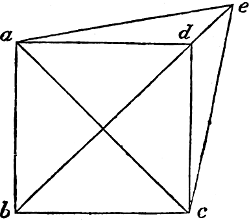
The triangle, therefore, a b c, is equal to the triangle e b c, the whole to the part. But this is impossible; and hence, the parallel line does not fall external to a d. But it is shewn by the institutor of the Elements, that neither does it fall within: and hence a d, is parallel to b c. Hence too, equal triangles, which are at the same parts, and upon the same base are parallel to each other. And thus the remaining part of the deduction to an impossibility is demonstrated. But it is worthy of observation, that since the conversion of theorems is triple (for either the whole is converted to the whole, as we have noticed, in the eighteenth and nineteenth theorems; or the whole to the part, as the sixth and fifth; or the part to the part, as the eighth and the fourth: for the whole is not a datum, in the one, and an object of investigation in the other: nor is the object of investigation, a datum, but a part) these triangular theorems appear to be of this kind. For, that the triangles are equal, is an object of investigation in the preceding; but this is not a datum alone in these, because it assumes, besides this, a part of that which was hypothesis in those. For to stand upon the same, or upon equal bases, is a datum in these, as well as in those, except that in these hypotheses he adds something which was neither an object of investigation, nor a datum in these; since the particle at the same parts, is over and above extrinsically assumed.
PROPOSITION XL. Theorem XXX.
Equal triangles which are upon equal bases, and at the same parts, are between the same parallels.
There is the same mode of conversion too in the present theorem, and a similar demonstration; and that part of the deduction to an impossibility, which is omitted by the institutor of the Elements, is demonstrated after the same manner, and there is no occasion for repetition. But since these three conditions are in the aforesaid propositions, situation upon equal, or on the same bases; position between the same parallels; and equality of triangles and parallelograms, it is manifest that we may variously convert, by always connecting two, and leaving one. For we either supposed the bases the same, or equal, and triangles and parallelograms between the same parallels, and thus we form four theorems; or we consider the triangles and parallelograms equal, and the bases the same, or equal, and thus we produce another four, two of which the elementary institutor omits, viz. those which respect parallelograms, but the other two relative to triangles, he exhibits; or lastly, when we have assumed them equal, and between the same parallels, we prove the remainder, that they are either upon the same, or upon equal bases, and produce another four, which the institutor of the Elements entirely neglects. For there is the same demonstration in these, except that two of these four are not essentially true. Thus, equal parallelograms or triangles, between the same parallels, are not necessarily upon the same base: but all this is true in these hypotheses, that they are upon the same or equal bases; but the other does not entirely follow the assumed hypotheses. Hence, as all these theorems are ten, the geometrician speaks of six, and neglects four, lest he should labour in vain, by repetition, since the demonstration is the same. For it may be shewn in triangles, that if they are equal, and between the same parallels, they will either be upon the same, or upon equal bases. For let it be denied, and if possible, let the triangles a b c, d e f, have these conditions, upon unequal bases b c, e f.
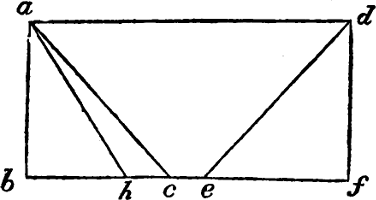
Let too, b c, be the greater, and cut off b h, equal to e f, and connect a h. Because, therefore, the triangles a b h, d e f, are upon equal bases, b h, e f, and between the same parallels, they are equal. But the triangles also, a b c, d e f, are supposed equal. Hence, the triangles a b c, a b h, are equal, which is impossible. The bases, therefore, of the triangles a b c, d e f, are not unequal. And the mode of demonstration will be the same in parallelograms. Since, therefore, the ostensive method is the same, and the impossibility the same, viz. that the whole is equal to its parts, it is not improperly omitted by the elementary institutor. And thus we have shewn, that there are necessarily ten theorems, and have enumerated what are omitted, and shewn the reason of their omission. But let us now pass to the following propositions.
PROPOSITION XLI. Theorem XXXI.
If a parallelogram has the same base with a triangle, and is between the same parallels, the parallelogram shall be double the triangle.
The present theorem also is local, but it mingles the constructions of triangles and parallelograms, situated under the same altitude. As, therefore, we have separately surveyed parallelograms and triangles, so when we assume each of them in conjunction, and with the same condition, we contemplate their proportion to each other. In the former, therefore, an equality of proportion is apparent, since all upon the same bases, and between the same parallels, have a mutual equality, whether they are triangles, or parallelograms. But in these latter, the first of unequal proportions, I mean the duple, is exhibited: for he demonstrates that a parallelogram is double of a triangle, on the same base, and possessing the same altitude. But the elementary institutor shews the thing proposed, by supposing the vertex of the triangle external to the parallelogram. We can, however, demonstrate the consequence, by assuming the line which is parallel to their common base, in the other side of the parallelogram: for these are two cases of the theorem. Since in consequence of the two having the same base, it is necessary that the vertex of the triangle should either be within, or without the parallelogram. Let there be, therefore, a parallelogram a b e d, and a triangle e c d, and let a point c be placed between the points a and b, and connect the right line a d.
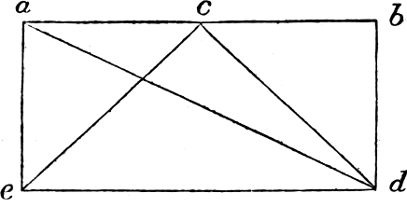
Because, therefore, the parallelogram is double of the triangle e c d, but the triangle a d c, is equal to the triangle e d c, hence, the parallelogram is double of the triangle e c d. And hence it is evident that a parallelogram is double of a triangle on the same base. But if the bases are equal, we can shew the same by drawing the diameters of the parallelograms: for if the triangles are equal, the parallelogram which is double of the one, will also be double of the other. But triangles are equal, on account of the equality of bases, and the identity of altitude. The geometrician, therefore, very properly omits this, for the demonstration is the same: since they will either have the same part, or they will be conjoined in one point only, or they will be separate from each other. But in whatever manner they may receive this variety, there is one demonstration according to all the cases.
We can likewise demonstrate the converse propositions to this theorem, after the same manner. One of which is: If a parallelogram is double of a triangle, and they have the same or equal bases, and are at the same parts, they shall be between the same parallels. For if they are not the whole shall be equal to the part, and the same proportion shall prevail: since it is necessary that the vertex of the triangle should either fall within, or external to the parallels. But in either case, the same impossibility will be the result, by drawing a parallel to the base, through the vertex of the triangle. But the second converse theorem is: If a parallelogram is double of a triangle, and both are between the same parallels, they will either be situated upon one base, or upon equal bases. For if they are upon unequal bases, since we have assumed the figures to be equal, we may shew that the whole will be equal to its part. Hence, all these theorems end in this common impossible: and on this account, the institutor of the Elements leaves us to investigate the variety they contain, as he himself, has contracted his speculation to such as are more simple, and of a more primary nature. However, as we have recognized these observations, let us see for the sake of exercise, by not assuming a parallelogram, but a trapezium, two of whose sides only are parallel (because it has the same base with the triangle, while it is situated between the same parallels), let us, I say, consider what proportion it possesses to the triangle. That it has not, therefore, a duple proportion is evident: for if it had a duple ratio, it would be a parallelogram, since it is a quadrilateral figure. But I say that it is either greater than double or less; for since the two sides are parallel, one is greater, but the other less; because if equal, the sides conjoining them will be parallel. If, therefore, the triangle has its greater side for the base, the quadrilateral figure will be less than double of the triangle: but if the lesser side, it will be more than double. For let a b c d, be a quadrilateral figure, and let the side a b, be less than the side c d, and produce the side a b, in infinitum, and let the triangle e c d have the same base with the quadrilateral figure, that is c d; and lastly, through d, draw d f, parallel to a c.