BOOK III.
Thomas Taylor translation
Concerning Petitions and Axioms.
[1]Since the principles of geometry are triply divided into Hypotheses, Petitions, and Axioms, the difference between these we have explained in the preceding books. But we now intend to discourse more accurately of petition and axiom, as especially necessary to our present design. For hypotheses, which are also called definitions, we have already explained. It is common, therefore, as well to axioms as to petitions, to require no demonstration, and no geometrical faith: but to be received as manifest, and to become the principles of the rest. But they differ mutually from each other, in the same manner in which we have distinguished theorems from problems. For as in theorems we propose to perceive and know that which follows a subject; but in problems we are ordered to compare and do something: in the same manner also in axioms, we must receive whatever is manifest of itself, and easily apprehended by our untaught conceptions; but in petitions we must receive whatever is easy to be done and compared, (since in admitting these, thought is not fatigued) and whatever requires no variety, and no kind of construction. Hence evident and indemonstrable cognition, and unconstructed assumption, distinguish petitions from axioms. Just as demonstrative cognition, and an assumption of things sought, together with construction, separates theorems from problems. For it is every where requisite, that principles in simplicity, indemonstrability, and self-evidence, should excel things posterior to principles. For universally (says Speusippus) of the things which cogitation pursues, some of its energies it produces without a various progression, prepares them for future enquiry, and has a more evident apprehension of these than of visible objects: but others which it is not able immediately to follow, by a transition proceeding from their nature, these it endeavours by consequence to pursue. Thus for example, to draw a right line from one point to another, it receives as evident, and easy to be done. For since in this case the line is composed from the indeclinable flux of a point, and at the same time advances in an orderly progression, because it no where more or less declines, it necessarily falls in another point. Again, if one extremity of a right line abiding, the other is moved about it, it will describe a circle without any labour. But if any one wishes to describe a helix of one revolution, it requires a more various operation. For it is generated by various motions. Likewise if any one wishes to construct an equilateral triangle, he will require a certain method for its construction. For the geometrical intellect says, when I understand a right line, which abides according to one of its extremities, but is moved about it according to the other, and at the same time conceive a point, which is moved in the line from the abiding extreme, I have described a helix of one revolution. For when at the same time both the extremity of the right line, which describes the circle, and the point which is moved in the right line, arrive at the same point, and coincide, they produce for me such a helix. And again, when I describe equal circles, and draw right lines from the common section to the centre of the circles, and a right line from one centre to the other, I shall have an equilateral triangle. The production of these, therefore, is very remote from a simple apprehension, and primary notion. For we are content to pursue the progressions of their origin. Hence it happens that these are compared with greater ease or difficulty, and are exhibited with many or fewer mediums, according to the habit of those who enter on this undertaking: but that they require demonstration and construction, on account of the property of the things sought, which wants the evidence of petitions and axioms.
Petition, therefore, and axiom, are simple and easy to be apprehended. But petition, indeed, commands us to fabricate, and provide a certain matter, in order to the assignation of the symptom, which possesses an easy and simple apprehension: but axiom pronounces a certain essential accident, of itself known to the hearers. As that fire is hot, or any other of those manifest truths, he who doubts of which, we consider as either wanting sense or punishment. Hence, petition and axiom are of the same genus; but they differ in the above-mentioned manner. For each is an indemonstrable principle, but this after one mode, and that after another, as we have already observed. But some think that all these should be called petitions, in the same manner as all problems, things sought. For Archimedes beginning his book of Equiponderants, we desire it may be granted (says he) that things equally heavy, from equal lengths, will equally ponderate; though some would rather chuse to call this an axiom. But others call all these axioms, in the same manner as they denominate every thing a theorem, which requires demonstration. For, according to the same proportion, as it seems they pass from proper names to such as are common. Nevertheless, as a problem differs from a theorem, so petition from axiom: though both these last are indemonstrable, and the former require demonstration. And the one, indeed, is assumed as easy to be done, but the other is granted as easy to be known by the common consent of all men. After this manner, therefore, Geminus distinguishes petitions from axioms.
But others will perhaps say, that petitions are indeed proper to the geometrical matter: but that axioms are common to the universal theory, which is conversant about the how-much, and the how-many. For the geometrician knows that which requires that all right angles are equal, and that every finite right line may be produced straight forwards: but that which says, things equal to one and the same are equal to each other, is a common conception, which not only the arithmetician employs, but every one endued with science, accommodating that which is common to his own particular matter. But Aristotle (as we have before observed[2]) says, that petition, since it is demonstrable, is not granted by the hearer, yet is received as a principle: but that axiom is of itself indemonstrable, and that this is confessed by all, according to habit, though some, for the sake of disputation, have doubted its evidence. Since then, there are these three differences, according to the first, which by operating, and knowledge only distinguishes petition from axiom, it is manifest that which says all right angles are mutually equal, is not a petition. Nor the fifth, which says, if a right line falling on two right lines makes the internal angles towards the same parts less than two right, those right lines infinitely produced, shall coincide towards the parts in which the angles less than two right subsist. For these are neither assumed in construction, nor do they command any thing to be done: but they exhibit a certain symptom, inherent in right angles, and in right lines, departing from angles less than two right. But, according to the second difference, that will not be an axiom which says, that two right lines cannot comprehend space, which some at present consider as an axiom. For this is proper to the geometric matter, as likewise that which affirms that all right angles are equal. But according to the third difference, which is Aristotelic, all those which produce their own credibility by a certain demonstration, are petitions; but whatever are indemonstrable, are axioms. Apollonius, therefore, in vain endeavours to deliver the demonstrations of axioms: for Geminus very properly observes, that some have attempted demonstrations of indemonstrables, and have endeavoured from more unknown mediums, to prove things manifest to all, into which error Apollonius has fallen, who wishes to prove the axiom true, which says, that things equal to one, and the same, are equal to each other: but that others assume in the place of indemonstrables, things requiring demonstration. As is the case with Euclid himself, in the fourth and fifth petition. For some say, that this last, as ambiguous, requires demonstration. Indeed, is it not ridiculous, that theorems should be assigned as indemonstrable, the converse of which are demonstrable? For that the internal angles of coincident right lines are less than two right, Euclid himself shews in the theorem, which says, that two angles of every triangle, however taken, are less than two right: besides, it may be perspicuously shewn, that not every thing equal to a right angle is a right angle. Hence, says Geminus, the converse of these are not to be granted indemonstrable. It seems therefore, according to the ordination of this man, that there are, indeed, three petitions: but that the other two, and the converse of these, require demonstrating science: and that in the axioms, the one which says, that two right lines cannot comprehend space, is superfluously added, since its credibility must be derived from demonstration. And thus much concerning the difference of petitions and axioms. Again, of axioms, some are proper to arithmetic, but others to geometry; and others are common to both: for that which says, every number is measured by unity, is an arithmetical axiom. But that which says equal right lines agree amongst themselves, as also this which affirms that every magnitude is divisible in infinitum, are geometrical axioms: but the one which says that things equal to the same, are mutually equal, and all of this kind are common to both. However, it must be observed, that each science uses such as the last, according to its proper subject; as geometry in magnitudes, but arithmetic in numbers. In like manner of petitions, some are peculiar to particular sciences, but others are common to all. For you must call the petition which requires to be granted, that a number may be divided into the least parts, peculiar to arithmetic: but this, that every finite straight line may be produced straight forwards, peculiar to geometry; and the one which desires us to grant, that quantity may be infinitely increased, common to both; for this passion is equally found to reside in number and magnitude.
PETITIONS or POSTULATES.
I.
Let it be granted that a straight line may be drawn from any one point to any other point.
II.
That a terminated straight line may be produced to any length in a straight line.
III.
And that a circle may be described from any centre, at any distance from that centre.
According to the opinion of Geminus, these three are necessarily placed among petitions, as well on account of their facility, as because they command us to do something. For this, to draw a right line from every point, to every point, follows the definition, which says, that a line is the flux of a point, and a right line an indeclinable and inflexible flow. If then we conceive a point to be moved with an uninclined, and the shortest motion, we shall fall upon another point, and the first petition will be produced, and we shall understand nothing various or difficult. But if when the right line itself is terminated by a point, we conceive its extremity moved with the shortest indeclinable motion, the second petition will arise from an easy and simple apprehension. But if we again imagine that the terminated right line abides according to its other extreme, but that it moves about that which abides according to the rest, the third petition will be produced; for the centre is the point which abides, but the interval the right line. Since the distance of the centre, from all parts of the circumference, is always equal to the quantity of this interval. But if any one should doubt how we apply motion in geometrical concerns, which have an immoveable existence; and how we can move impartibles, (since this is impossible) we request him to call to mind what we have demonstrated in the beginning of these Commentaries. I mean that the reasons of things subsisting in the phantasy, describe there all the images of cogitation, of which cogitation itself possesses the reason: for an intellect of this kind is an unwritten, ultimate, and passive tablet. Hence, it receives forms from another, accompanied with motion; but we must not understand a corporeal but imaginative motion, and must by no means admit that impartibles are moved with corporeal motions, but that they suffer imaginative progressions. For intellect, though impartible, is moved, yet not according to place, and the phantasy has a proper motion according to the impartible which it contains: but we only regarding corporeal motions, neglect those which are made in things destitute of interval. Impartibles, therefore, are pure from corporeal place, and external motions: but another species of motion, and another place congenial to such motions, is considered in their progressions. For, indeed, we should say, that a point also has position in the phantasy, and should not enquire how an impartible can abide, which is at the same time moved elsewhere, and comprehended by place. Since the place of things, with dimension, possesses itself dimension; but the place of impartibles is destitute of all dimension. The proper species therefore of geometrical concerns, are different from the things they produce; and the motion of bodies is different from that of the forms in the phantasy; and the place of partible is different from that of impartible natures; and it is requisite, by distinguishing these, neither to confound nor disturb the essences of things. But it appears that the first of these three petitions declares to us in images, how the things which are, are contained in their own impartible causes, and are terminated by their immaterial bound; and that previous to their constitution, they are on all sides comprehended in their indivisible embrace: for the points existing, a right line is drawn from the one to the other, is terminated by, and received between them. But the second indicates how the things which are by possessing proper causes proceed to all things, preserving in them a continuation not derived from the natures into which they proceed; but that through a cause of infinite power, they endeavour to permeate every where, with a never-failing progression. And the third petition shadows forth the manner in which these progressions return again to their proper principles: for the convolution of a point producing a circle, by moving about an abiding point, imitates a circular regression. But it is requisite to know, that every line cannot be infinitely produced, for the circle and cissoid, and all such as describe figure, are incapable of this property; as likewise some which produce no figure. For the helix of one revolution cannot be infinitely produced, since it is constituted between two points; nor any other lines similarly formed. But neither is it possible to extend every line from every point, to every point; for every line cannot subsist between all points: and thus much for the three first petitions; let us now proceed to the rest.
IV.
All right angles are equal to each other.
If the present petition is considered by us as manifest, and as requiring no demonstration, it is not a petition according to the opinion of Geminus, but an axiom; for it affirms a certain essential accident of right angles, not commanding us to perform any thing according to a simple conception. But neither is it a petition according to the division of Aristotle: for petition, according to his opinion, requires some demonstration. But if we should say it is demonstrable, and enquire after its demonstration, yet according to the opinion of Geminus, it ought not to be placed among petitions. The equality, therefore, of right angles, appears from our common conceptions; for since a right angle has the relation of unity or bound to the infinite increase and decrease of the angles on each side, it is equal with respect to every right angle, since we constitute the first right angle after this manner, by a right line making angles on each side of the right line on which it stands equal to each other; but if it be requisite to produce a linear demonstration of this, let there be two right angles, one a b c, the other d e f.
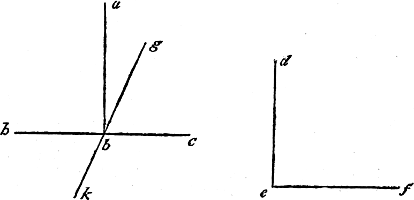
I say that they are equal; for if they are not equal, one of them must be greater, suppose the angle at b. If then the line d e be adapted to the line a b, the line e f shall fall within. Let it fall as b g, and let the line b c be produced to h; because, then a b c is a right angle, a b h also shall be a right angle, and they shall be mutually equal to each other, from the tenth Definition: the angle a b h therefore, is greater than the angle a b g. Let again the line g b be produced to k, because, therefore a b g is a right angle, the successive angle a b k shall be a right one, and consequently equal to a b g. Hence, the angle a b h, shall be less than the angle a b g; but it was also greater, which is impossible: but this has been shewn by other expositors, and requires no great consideration. But Pappus very properly admonishes us, that the converse of this Petition is not true; I mean, that every thing equal to a right angle, is a right angle; though if it be rectilinear, it is without doubt a right angle. But a curvilinear angle may also be exhibited equal to one that is right: for let there be conceived two equal right lines, a b, and b c, making the angle at the point b, right;
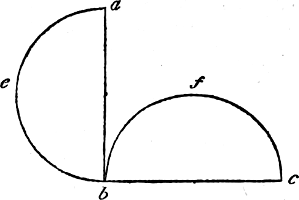
and on them let the semicircles a e b, b f c, with a proper centre and interval be described; because, therefore, the semicircles are equal, they shall have a mutual congruence, and the angle e b a, is equal to the angle f b c, and a b f is common: the whole right angle, therefore, is equal to the lunular, i.e. to e b f, and yet the lunular is not a right angle. In the same manner, if the angle a b c should be obtuse or acute, a lunular angle may be shewn equal to it (for this is that genus of curvilinear angles which agrees with such as are rectilinear), only this is to be observed, that in a right and obtuse angle, it is requisite to add the middle angle, which is contained by the line a b, and the circumference b f; but in an acute angle to take this away: for the right line c b, in these cases, cuts the circumference b e. The truth of which, will be evident from the following figures:
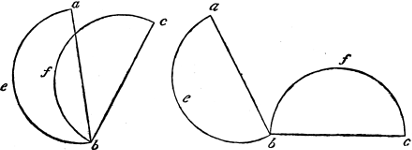
And hence, it appears, that all right angles are mutually equal to each other, and that not every thing equal to a right angle, is consequently a right angle: for if it be not rectilinear, how can it be called right. But it is also manifest from this Petition, that angular rectitude is allied to equality, in the same manner as acuteness and obtuseness are related to inequality. For rectitude and equality, as also similitude, are of the same co-ordination, (for each exists under bound): but acuteness and obtuseness, as also dissimilitude, are of the same series with inequality. For they are all produced from bound and infinite. Hence some, regarding the quantity of angles, say, that a right angle is equal to a right: but others, considering their quality, affirm that one is similar to another. For similitude in qualities is the same as equality in quantities.
V.
If a right line falling upon two right lines, makes the internal angles towards the same part less than two right, those right lines, if infinitely produced, shall coincide in that part, in which the angles less than two right, are placed.
This ought to be entirely blotted out from the number of Petitions, for it is a theorem including many doubts, which Ptolemy in one of his books proposes to solve; but it requires in its demonstration both many definitions and theorems; and Euclid also exhibits its converse as a theorem. But perhaps some, from an erroneous conception, may think that this should be placed among the petitions, as that which produces credibility of itself, respecting the inclination of right lines, on account of the diminution of two right angles. To such as these, Geminus rightly answers, that from the authors of this science, we learn not entirely to give credit to imaginative probabilities, for the purpose of accomplishing geometrical reasons: for it is similar (says Aristotle) to require demonstrations from a rhetorician, and patiently listen to a geometrician, disputing from probability. And Simmeas in the Phædo of Plato, says, “I know that those who demonstrate from appearances, are vain.” Hence, in the present instance, it is true and necessary that right lines should incline, while right angles are diminished: but this, that the inclining lines, while they are more produced, should at length coincide, is probable, but not necessary, unless some reason demonstrates that this is true in right lines: for there are certain lines infinitely inclining, and never coinciding, and though this appears incredible and admirable, yet it is true, and has been observed in other forms of a line. Is it therefore possible that this can be accomplished in right lines which takes place in others? For before we procure conviction of this, from demonstration, the properties exhibited in other lines molest the phantasy by the contrary images they produce. But if the reasons doubting against the coincidence of lines are very strong, ought we not much more to expel this improbable and irrational supposition from our doctrine? And thus it appears that a demonstration is to be sought for of the present theorem, and that it is foreign from the property of Petitions: but how it is to be demonstrated, and by what reasons the objections urged against it are to be removed, we shall shew in our comment on the proposition, where it is used by the institutor of the elements as manifest. For then it will be necessary to exhibit its evidence, since it does not present itself to our view with indemonstrable clearness, but becomes manifest through the medium of demonstration alone.
AXIOMS.
I.
Things which are equal to the same, are equal to one another.
II.
If equals be added to equals, the wholes are equal.
III.
If equals be taken from equals, the remainders are equal.
IV.
If equals are added to unequals, the wholes are unequal.
V.
If equals be taken from unequals, the remainders are unequal.
VI.
Things which are double of the same, are equal to one another.
VII.
Things which are halves of the same, are equal to one another.
VIII.
Things which coincide with each other, are mutually equal.
IX.
The whole is greater than its part.
X.
Two right lines cannot comprehend space.
These are the things which, according to the opinion of all men, are called indemonstrable axioms, so far as their certainty is admitted by all, and no one disputes their evidence. For propositions also are often simply called axioms, of whatever kind they may be, whether they are immediately proper, or require some declaration; and the Stoics, indeed, are accustomed to call every simple enunciative speech an axiom: and when they write on dialectic arts, they say that they discourse on axioms. But some, distinguishing more accurately axioms from other propositions, give this appellation to a proposition immediate, and producing credibility of itself, on account of its evidence: as also Aristotle and geometricians themselves affirm. For, according to the opinion of these, an axiom is the same as a common conception. By no means, therefore, must we praise Apollonius the geometrician, who writ (as it appears) demonstrations of axioms, because he performs the very opposite to Euclid: for he, indeed, enumerates that which is demonstrable among Petitions; but Apollonius endeavours to find out demonstrations of indemonstrables. But these naturally differ from each other, and the genus of the sciences is different: I mean of the things which take place about immediate propositions, which are entirely subject to our knowledge, on account of their evidence; and of things which use demonstrations, which receive principles from them; and which, when received, they orderly employ in their proper conclusions. But that the demonstration of the first axiom, which Apollonius persuades himself he has invented, possesses a medium, not more known, but more dubious than the conclusion may be known by any one from a slight inspection. For let (says he) a be equal to b, and b to c, I say that a also is equal to c.
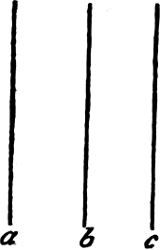
For since a is equal to b, it occupies the same place as b. And because b is equal to c, it occupies the same place as c; and so a occupies the same place as c, they are therefore equal. Now in this demonstration it is requisite that two things must be previously assumed; one, that things occupying the same place, are mutually equal; but the other, that things occupying the same place, with the same thing, mutually occupy the same place: but these are evidently more obscure than the present axiom. For it is proper to enquire how are things, which fill the same place equal, according to the whole, or according to a part; or according to a figure of speech: hence we must by no means admit a transition to place,[3] which is more unknown than the natures it contains; for the invention of its essence is difficult and ambiguous. That we may avoid prolixity, therefore, all axioms are to be delivered as things immediate and self-manifest, since they are of themselves known and credible; for he who brings demonstration to things the most manifest, does not confirm their truth, but diminishes the evidence we possess in the untaught and innate conceptions of the soul: but this is to be received concerning axioms, as a judgment of their peculiarity; and that all of them are of the common kind of the mathematical sciences; and that each of them is said to be verified, not only in magnitudes, but also in numbers, and motions, and times: and this indeed is necessary. For equal and unequal, the whole and part, and the more and the less, are common to discreet and continued quantities. The contemplation, therefore, which is conversant with times and motions, numbers and magnitudes, requires all these, as things evident by their own intrinsic light; and in all of them both that is true, which says, things equal to the same, are equal to one another; as likewise each of the axioms we have assumed: but as they exist in common, each science uses them according to its proper matter, and one indeed, as in magnitudes; but another, as in numbers; and another, as in times; and after this manner in each science, the conclusions become peculiar and apposite, though the axioms are common. Besides, it is likewise requisite not to contract the number of these to the least, as is done by Heron, who only establishes three axioms; for this also is an axiom, the whole is greater than its part, and the geometrician every where assumes this in his demonstrations; as also, that things which mutually coincide, are equal; for this is employed with advantage in the solution of the fourth Proposition. Nor is it proper to join some with others, of which some are proper to the geometric matter, as that two right lines cannot comprehend space, (since axioms are, as we have said, of a common kind); but others are consequent to things established, as that which says, things double of the same, are equal. For this is consequent to the axiom, affirming, that if to equals you add equals, the wholes are equal, since things equal to the half, because they assume the half, become double to the same, and mutually equal, on account of an equal addition: and according to this reason, not only the doubles, but also the triples, and all multiples of the same quantity will appear equal. But with these axioms, Pappus says, that certain others are to be classed, as if unequals are added to equals, the excess of the whole, will be equal to the excess of the adjuncts. And on the contrary, if equals are added to unequals, the excess of the wholes is equal to the excess or difference of the unequals themselves. And these also are manifest from themselves, yet they may be made manifest as follows.
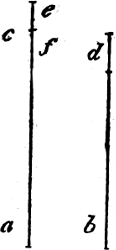
Let a be equal to b, and add to each the unequals c d, but let c be greater than d by e, and the remainder be f; because, therefore, a is equal to b, and also f to d; a f will be equal to b d. For if equals are added to equals, the wholes are equals: a c, therefore, exceeds b d, by e only, by which alone c exceeds d. Again, c and d are unequals, to which, let the equals a and b be added, and let e be the excess of c, above d, and the remainder be f; because, therefore, a is equal to b, and f to d a f will be equal to b d; the whole, therefore, a c, will exceed b d, by e only, by which c also exceeds d. These, therefore, are consequent to the aforesaid axioms, and are, not undeservedly, in many copies, omitted. But whatever others he adds to these, have been previously assumed by definitions, to which they are consequent. As for example: that all the parts of a plane and a right line mutually agree; for things placed in their extremities, possess a nature of this kind; and that a point divides a line, but a line a superficies, and a superficies a solid. For all things are divided by the natures by which they are proximately bounded; and that infinite subsists in magnitudes, by addition and diminution, but according to capacity only, in both these respects: for every thing continuous may be infinitely divided and increased. But, as we have summarily spoken concerning these, it remains that we consider things consequent to principles; for thus far principles extend themselves. But of those who oppose geometry, some very much doubt concerning principles, endeavouring to shew that the terms have no subsistence, whose arguments, indeed, are known in common, who endeavour to take away all science, and, like hostile foes from a foreign region, demolish the fruits and fecundity of philosophy, as is the case with the Pyrrhonian philosophers; but others only propose to themselves the subversion of geometrical principles, as the Epicureans. Others, again, admitting the principles, affirm, that things consequent to the principles cannot be demonstrated, unless something else is granted, which was not previously assumed in the principles. Zeno exercised this mode of contradiction, who was a Sidonian by birth, but of the Epicurean sect, against whom Possidonius wrote an entire book, exhibiting the whole of his imbecile opinion; and thus much may suffice for the difference of opinions concerning principles. We shall shortly consider the troublesome objection of Zeno: but now, after we have briefly resumed the consideration of theorems and problems, their difference, and the divisions they receive, we shall proceed, to an exposition of the things exhibited by the institutor of the elements, gathering the more beautiful observations upon the propositions found in the writings of the antients, and contracting the infinite prolixity of their discourses; but delivering such things as are more artificial, and full of methods producing science, dwelling more on an accurate treatise of things than on the variety of cases and assumptions, to which young men, for the most part, eagerly incline.
PROPOSITION I. Problem.
Upon a given terminated right line to describe an equilateral triangle.
Since all science is two-fold, and one is conversant about immediate propositions, but another about things, which are exhibited and provided from the propositions, and universally about the consequents to principles; this, again, divides itself in geometrical discourses, into the solution of problems, and the invention of theorems. And problems, indeed, geometry denominates things in which it proposes to procure, manifest, and fabricate that, which, in a certain respect, has no existence; but it calls theorems, things in which it appoints to perceive, know, and demonstrate that which either exists, or does not exist. For problems command us to undertake the origin, positions, applications, descriptions, inscriptions, circumscriptions, coaptations, and contacts of figures, and every thing of this kind: but theorems endeavour to procure our assent to symptoms, and things essentially inherent in the subjects of geometry, and to convince by demonstrations. For geometry discourses concerning every object of enquiry, which is possible to be effected, referring some things to problems, but others to theorems; since it enquires concerning the what, in a two-fold respect: for it either seeks for the reason and intelligence of the thing; or for intelligence, and the essence of the subject. I say, for example, as when it requires what a line of similar parts may be: for in an enquiry of this kind, it either desires to find the definition of such a line, as, that a line of similar parts is that which has all its parts agreeing with all; or to receive the species of lines of similar parts, as that it is either right, or circular, or a cylindric helix. Besides, prior to this, it enquires, by itself, concerning the if, and this especially in its determinations, agitating, whether the object of its enquiry is possible or impossible, what place it possesses, and in how many ways. It likewise seeks concerning the what kind; for when it considers the essential accidents of a triangle, circle, and parallels, it is manifest, that in such cases it seeks after the what kind; but many have thought that geometry very little contemplated the cause, and the why. And of this opinion is Amphinomus, led by the decisions of Aristotle: but (says Geminus) an enquiry into these may be found in geometry. For does it not belong to geometry to enquire for what cause infinite equilateral multangles may be inscribed in circles, but to describe solid equilateral and equiangular multangles, and constructed from similar planes, in spheres, is impossible? To whom does an investigation of this kind belong, except to a geometrician? When, therefore, to geometricians the syllogism is by an impossibility, they alone desire to find the symptom; but when by a principal demonstration, then again if the demonstrations are in that which is particular or partial, the cause is not yet manifest; but if in that which is universal, and in all similars, the why becomes immediately manifest: and thus much concerning objects of enquiry.
But every problem and theorem which receives its completion from its own perfect parts, ought to possess in itself all the following parts: proposition, exposition, determination, construction, demonstration, and conclusion. But of these, proposition informs us what the object of enquiry is from a given datum; for a perfect proposition is composed from both; but exposition receiving the datum essentially, prepares for the question. Again, determination separately explains the thing sought for according to the what; but construction adds to the datum what is wanting to the investigation of the thing sought; and demonstration skilfully collects the proposition from the concessions. But the epilogue, or conclusion, is again converted to the proposition, by confirming that which is exhibited. And so many, indeed, are all the parts of problems and theorems; but proposition, demonstration, and conclusion, are especially necessary, and exist in all; for it is requisite that the thing sought for should be previously known; and that this should be shewn by proper mediums, and that what is exhibited should be concluded; and it is not possible that any one of these three can be wanting; but the rest are, indeed, received in many places; but in many, because they produce no utility, are omitted. For determination and exposition are not found in the problem, which says, to construct an isosceles triangle, which will have each of the angles at the base double of the other; but construction has frequently no subsistence in many theorems, the demonstration being sufficient to exhibit the thing proposed from the data, without any addition. When, therefore, shall we say that exposition fails, when no datum is given in a proposition? Because, though proposition, for the most part, is divided into datum, and the thing sought for, yet this is not always the case; but sometimes the thing sought for, alone affirms that which it is requisite to know or effect, as in the aforesaid problem; for it does not previously say from what datum it is requisite to construct an isosceles triangle, which shall have each of the angles at the base, double of the remaining one; but that it is required to effect this. And here, indeed, the admission of the proposition takes place from things previously known; for we must know the meaning of the terms isosceles, equal and double (since this, as Aristotle observes, is the property of all ratiocinative discipline[4]), yet nothing is subjected to us as in other problems, as in that which says, to bisect a given terminated right line. For here the right line is given, but we are ordered to divide it into two parts; and the datum is separately determined from the object of enquiry. When, therefore, a proposition has both of these, then also determination and exposition are found; but when the datum is deficient, these also fail, since exposition and determination belong to the datum: for this will be the same with the proposition. Indeed, what else do we say, when determining in the aforesaid problem, unless that it is requisite to find an isosceles of this kind? But such was the proposition: if then the proposition has neither this datum, nor thing sought, exposition will, indeed, be silent, because there is no datum; but determination will be neglected, lest it should become the same with the proposition: but you may find many other problems of this kind, especially in arithmetic, and in the tenth book of these Elements, as, to find a medium comprehending two right lines commensurable in power, and every thing of this kind.
But every datum may be given in these four modes, either in position, or proportion, in magnitude or form; for a point, indeed, is given in position only, but a line and the rest in all the four. Thus, when we say, to bisect a given rectilineal angle, we declare the species of the angle given, as that it is right lined, lest we should also seek to bisect a curvilinear angle by the same methods. But when we say, from the greater of two unequal right lines, to cut off a part equal to the less, the lines are given in magnitude; for the less and the more, finite and infinite, are the proper predications of magnitude. But when we say, that if four magnitudes are proportional, they shall be also alternately proportional, the same proportion is given in the four magnitudes: but when it is requisite, from a given point to place a right line equal to a given right line, then the point is given in position. From whence, since position may be various, construction also receives variety; for the point is given either without the right line, or in the right line, and in the extremity, or without the extremity of the right line. Since, therefore, a datum has a four-fold acceptation, it is manifest, that exposition also is four-fold; but sometimes it connects two or three modes. Again, we find that demonstration sometimes possesses things proper to demonstration, exhibiting the thing sought for from mediate definitions; for this is the perfection of demonstration, but that sometimes it argues from certain signs. And it ought not to be concealed, that geometrical discourses have every where that which is necessary, on account of the subject matter, but are not every where perfected by demonstrative methods. For when, because the external angle of a triangle is equal to the two internal and opposite ones, it is shewn, that the three internal angles of the triangle are equal to two right, how is this demonstration from the cause? And is not a sign the medium in this case? For the external angle not yet existing, since the internal angles exist, they are equal to two right, since it is a triangle, though the side is not produced; but when, by a description of circles, the triangle, which is constituted, is shewn to be equilateral, the apprehension takes place from the cause. For we say, that the similitude and equality of the circles is the cause of the triangle’s equality with respect to its sides.
But geometrical discourses are likewise accustomed to make the conclusion, in a certain respect, two-fold. And this, when they exhibit things agreeable to the data, and reason universally, recurring from a particular conclusion to that which is universal; for when they do not use the property of the subjects, but placing the data before our eyes, describe an angle or right line, they think that which is concluded in this, is to be concluded in every thing similar: they pass on therefore to universal, lest we should think that the conclusion is particular. But their transition is effected in the best manner, since they employ, in demonstration, the things placed, not considered as such, but considered as similar to others: for it is not because such a particular angle is proposed that they effect a bipartite section, but because it is rectilineal only. But quantity, is indeed, proper to the proposed angle; but rectilineal is common to all right lines: let then the given angle be a right one. If therefore, we receive rectitude in the demonstration, we cannot pass to every species of right lines; but if we do not subjoin its rectitude, or being right angled, but alone consider its being rectilineal, the discourse may be adapted to all right lined angles; and all that we have previously observed we may contemplate in this first problem. For that it is a problem, is evident, since it commands us to construct an equilateral triangle: but proposition in this, consists from a datum and thing sought. For a terminated right line is given, but it is enquired how an equilateral triangle may be constructed upon it, and the datum indeed precedes, but the thing sought follows; so that we may say, by conjoining the two, if there be a terminated right line, it is possible to construct upon it an equilateral triangle; for a triangle cannot be constructed without the existence of a right line, since it is comprehended by right lines; nor upon an unlimited line, for an angle cannot be constructed unless it is made on one point, but in an infinite line there can be no extremity or bounding point. But after proposition, exposition follows, as, let there be given a terminated right line. And here we may see that exposition alone pronounces the datum, but by no means subjoins the thing sought; but after this we shall find determination: it is required upon the given terminated right line to construct an equilateral triangle; and here we may observe that determination is in a certain respect, the cause of attention, for it makes us more attentive to the demonstration, by pronouncing the thing sought, as exposition causes us to be more docile, by placing the datum before our eyes. Again, after determination, construction follows, from one extremity of the right line, as a centre, but with the remainder as an interval, let a circle be described. And again, with the other extremity, as a centre, and with the same interval, let a circle be described; and from the common point of the sections of the circles, to the extremities of the right line, let right lines be continued. And here we may observe, that Petitions are used in the construction, this for one, from every point to every point, to draw a right line; and also this, with every centre and interval to describe a circle; for universally Petitions are the sources of utility to constructions, but Axioms to demonstrations; demonstration therefore follows, because, then each extremity of the given right line is the centre of the circle surrounding it, the right line which reaches to the common section is equal to the given right line; hence, because the other extremity of the right line is the centre of its containing circle, the right line reaching to the common section of the circles, is also equal to the given line. And the admonition of these, is derived from the definition of the circle, which says, that all lines from the centre to the circumference are equal. Each of these lines, therefore, is equal to the same; but things equal to the same, are equal among themselves, by the first axiom. The three right lines, therefore, are mutually equal; hence, upon this given right line an equilateral triangle is constructed; and this, indeed, is the first conclusion which follows the exposition. But after this, that universal one; upon a given right line, therefore an equilateral triangle is constructed: for whether you make the line double of the one now proposed, or triple; or receive any one greater or less, the same constructions and demonstrations will accord. But to these he adds the particle which was required to be done, shewing from hence, that the conclusion is problematical; for in theorems, he adds the particle which was required to be shewn; the former announcing the production of something, but this the ostension and invention of a thing required. He therefore subjoins this to the conclusions, for the purpose of shewing that every part of the proposition is accomplished by this means, uniting the end with the beginning, and imitating intellect convolved, and again returning to its principle. But he does not always add the same, but sometimes the particle which was required to be done, and sometimes the particle which was required to be shewn, on account of the difference between problems and theorems: and thus, in this one problem, we have exercised and made perspicuous all this variety of considerations. But the reader ought to make a similar enquiry in the rest; investigating what propositions receive these leading properties, and in what they are omitted. Likewise in how many ways a datum is given, and from what principles we receive either constructions or demonstrations; for a perspicacious contemplation of these affords no small exercise and meditation of geometrical discourses.
But here it is necessary that we should briefly determine the nature of assumption, case, corollary, instance, (ενϛασις) and induction. They say therefore that assumption is often predicated of every proposition assumed in the construction of another proposition, affirming at the same time that the demonstration of such a proposition is composed from so many assumptions. But assumption, properly considered by those who are conversant in geometry, is a proposition indigent of credibility; for when either in construction or demonstration we assume any thing which has not been exhibited, but requires a reason for its admission, then that which is assumed, as of itself ambiguous, being considered as worthy of enquiry, we call an assumption; and this differs from Petition and Axiom, because it is demonstrable, but they are assumed without demonstration, for the purpose of giving credibility to others. But the best aid in the invention of assumptions, is an aptitude of cogitation; for we may see many naturally acute in solutions, and discovering them without any method, as was the case with our Cratistus, who was adapted to the investigation of a thing sought from the first and shortest methods possible; and had a natural promptitude for invention; but there are nevertheless certain most excellent methods delivered, one which reduces the thing sought, by resolution to its explored principle, which, as they say, Plato delivered to Leodamas, and from which he is reported to have been the inventor of many things in geometry: but the second is that which has a power of division; because it distributes the proposed genus into articles, but affords an occasion of demonstration, by an ablation of other things from the proposed construction. And this likewise is praised by Plato, as that which affords assistance to all sciences; but the third is that which by a deduction to an impossibility, does not of itself shew the thing sought, but confutes its opposite, and discovers the truth by accident; and thus far is the contemplation of assumption extended. But case enunciates different modes of construction, and the mutation of position, points, or lines, superficies, or solids being transposed; and in fine, all its variety is beheld about description: hence, it is also called case, because it is the transposition of construction. Again, Corollary is affirmed, indeed, of certain problems, as the Corollaries which are ascribed to Euclid; but Corollary is properly predicated, when, from the things demonstrated, a certain unexpected theorem appears, which on this account they have denominated Corollary, as a certain gain, exceeding the intention of demonstrative science; but instance impedes the whole passage of the discourse, either opposing the construction or the demonstration: and here it is not necessary, that as he who proposes a case, ought to shew the proposition true; so he who proposes an instance: but it is requisite to destroy the instance, and convict its employer of falsehood. Lastly, induction is a transition from one problem or theorem to another, which being known or compared, the thing proposed is also perspicuous. For example: when the duplication of the cube is investigated, geometricians transfer the question into another to which this is consequent, i.e. the invention of two mean proportionals, and afterwards they enquire how between two given right lines two means may be found. But Hippocrates Chius is reported to have been the first inventor of geometrical induction; who also made a quadrangle equal to a lunula, and invented many other things in geometry, and excelled all in his ingenuity respecting appellations; and thus much for these.
But let us return to the proposed problem: that an equilateral triangle, therefore, is the best among triangles, and is particularly allied to a circle, having all lines from the centre to the circumference equal, and one simple line for its external bound, is manifest to every one; but the partial comprehension of two circles in this problem, seems to exhibit in images how things which depart from principles, receive from them perfection, identity, and equality. For after this manner, things moving in a right line, roll round in a circle, on account of continual generation; and souls themselves, since they are indued with transitive intellections, resemble by restitutions and circumvolutions, the stable energy of intellect. The zoogonic or vivific fountain of souls too, is said to be contained by two intellects. If, therefore, a circle is an image of the essence of intellect, but a triangle of the first soul, on account of the equality and similitude of angles and sides; this is very properly exhibited by circles, since an equilateral triangle is included in their comprehension. But if also every soul proceeds from intellect, and to this finally returns and participates intellect in a two-fold respect; on this account also it will be proper that a triangle, since it is the symbol of the triple essence of souls, should receive its origin comprehended by two circles. But speculations of this kind, as from bright images in the mirror of phantasy, recall into our memory the nature of things. And here, because some object to the constitution of an equilateral triangle, thinking by this means to overthrow the whole of geometry, let us briefly answer and confute them. Zeno then, whom we have mentioned before, says, that if any one admits the principles of geometry, yet he will not obtain from common consent, things consequent to the principles, while this is not admitted, that there are not the same segments of two right lines: for unless this is given an equilateral triangle cannot be constructed. For let there be (says he) a right line a b, upon which an equilateral triangle is to be constructed.
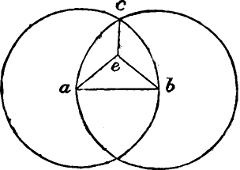
But let circles be described, and from their common section let the right lines c e a, c e b, be extended, having the common segment c e. It will therefore happen, that the lines extended from the common section, will be equal to the given line a b, and yet the sides of the triangle will not be also equal, but two will be less than the remainder, that is, than a b. And so this not being constituted, neither can the rest be constructed. Can then (says Zeno) the rest follow, though the principles are given, unless this also is previously received, that there are no common segments either of circles or of right lines? Against this objection then, we must affirm in the first place, that it was in a certain respect previously understood, that two right lines have no common segment. For the definition of a right line comprehends this property, since that is a right line which is equally situated between its bounding points; and the equality of the interval between the points to the right line, causes that which joins the points to be one, and the shortest line; so that if any one adapts it to another line, according to one of its parts, it must also agree with the line according to its remaining part; for since it is constituted in its extremities, because it is the shortest line, it is necessary that the whole should fall on the whole. But again, this was manifestly received in the Petitions: for the Petition which says, that a terminated right line may be produced straight forwards, perspicuously shews that the produced line ought to be one, and produced by one motion;
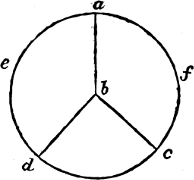
but if any one is desirous to receive a demonstration of this assumption, let, if possible, a b be the common segment of a c and a d, and with the centre b, and interval b d, let the circle a c d be described; because therefore the right line a b c, is drawn through the centre, a f c is a semicircle; and because the right line a b d likewise is drawn through the centre, a e d is a semicircle. The semicircles, therefore, a f c, a e d, are equal to each other, which is impossible. But against this demonstration Zeno will perhaps say, that it is likewise requisite to demonstrate that the diameter bisects the circle, because we previously assume that there is not a common segment of two circumferences. Thus too we take for granted, that one circumference coincides with another, or if it does not coincide, that it either falls externally or internally. But nothing hinders (he will say) that the whole may not coincide with the whole, but according to some part. But to this Possidonius rightly answers, who laughs at the acute Epicurean, as if conscious that though the circumferences do not coincide according to a part, yet the demonstration will succeed; for according to that part in which they do not coincide, the one will fall within, and the other without, and the same absurdities will follow when right lines are extended from the centre to the external circumference; for those from the centre will be equal, as well the greater which is drawn to the external, as the less which is extended to the internal circle: either therefore the whole will coincide with the whole, and they will be equal; or coinciding according to a part, it will alternately vary according to the remainder, or no part will coincide with no part; and in this case it either falls within or without: but of this, enough. But Zeno also condemns the following demonstration of this particular:
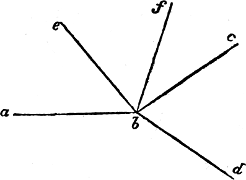
Let a b be the common segment of two right lines a c, a d, and let be b e erected at right angles to a c, the angle e b c, therefore, is a right one. Hence, if the angle e b d is also right, they shall be equal, which is impossible; but if not, let b f be erected at right angles to a d. The angle f b a, therefore, is right; but the angle e b a was also right; and they are therefore mutually equal, which is impossible. This is the demonstration which Zeno opposes, as assuming that which is to be exhibited afterwards; I mean from a given point to raise a right line, at right angles, to a given right line. However, Possidonius observes, that indeed, a demonstration of this kind is never to be introduced into elementary institutions; but that Zeno calumniates Geometricians using their own as a flagitious demonstration; though there is some reason in their conduct. For there are right lines existing at right angles; since any two right lines are capable of forming a right angle; and this is previously assumed in our definition of a right angle. For we alone constitute a right angle from such an inclination; and it may perhaps be this which we have erected. Indeed, Epicurus himself, and all other philosophers admit, that not only many things possible may be supposed, but likewise many of an impossible matter, for the purpose of contemplating something consequent; and thus much concerning an equilateral triangle.
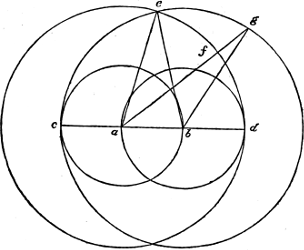
But it is requisite to construct other triangles, and in the first place an isosceles. Let a b, therefore, be a right line, upon which it is required to construct an isosceles triangle. Describe circles as in the construction of an equilateral triangle, and produce the line a b on each side to the points c d; the line c b, therefore, is equal to a d. Again, with the centre b, and interval c b, let the circle c e be described; and with the centre a, and the interval d a, the circle d e; and from the point e, in which the circles intersect each other, to the points a and b, let the lines e a, e b, be extended. Because therefore, e a is equal to a d; but e b to b c, and a d is equal to b c, e a will also be equal to e b; but they are also greater than a b. The triangle a b e, therefore, is isosceles, which it was required to constitute. But let it be ordered to construct a scalene triangle upon the given right line a b. Describe circles with centres and intervals, as before, and let there be taken in the circumference of the circle, whose centre is a, the point f, and let the right line a f be extended and produced to the point g; and likewise let the right line g b be extended. Because, therefore, a is a centre, a f is equal to a d; and hence, a g is greater than a d, that is, than g b. But b also is a centre, g b, therefore, is equal to c b; and hence, g b is greater than b a: but g a is greater than g b; the three lines therefore g b, b a, a g, are unequal; and hence, the triangle a b g is scalene. Hence too, three triangles are constructed; but these things are commonly known: however, this is beautiful in these triangles, that the equilateral existing on all sides equal, is constructed by one mode alone; but the isosceles, endued with equality in two sides only, has a two-fold construction: for the given right line is either less than both the equal ones (according to our present construction), or it is greater than both; but the scalene being unequal in all its sides, receives a triple construction; for the given right line is either the greatest of the three, or the least; or greater than the one, and less than the other; and indeed, it is proper to be exercised in each supposition, either by enlarging or contracting; but to us, what is already delivered, is sufficient. Let us now contemplate problems universally, some of which are produced simply, but others manifoldly, and others according to infinite modes. But (as Amphinomus observes) those which are simply constructed are ordinate: but those which receive a manifold composition, and are constructed according to number, are middle; and those which are varied in infinite ways, are inordinate. The manner, therefore, in which problems are constructed, simply or manifoldly, becomes manifest in the preceding triangles; for the equilateral is constituted simply; but of the other two, the one receives a two-fold, and the other a triple construction. But problems of the following kind, may take place in infinite modes; I mean to divide a given right line in three proportional parts; for if it be divided in a duple ratio, and the deficient quadrangular form, resulting from the less, be applied to the greater, it will be divided into three equal parts; but if the greater segment be more than double of the less, as for instance, triple, and a deficient quadrangular form, equal to that which results from the less, be applied to the greater, the line will be divided into three unequal parts. Because, therefore it may be divided into two parts, in infinite ways, the greater of which is either double or triple, (for multiplex proportion proceeds in infinitum), hence, it may be divided into three parts, according to infinite variations.
But it is requisite to know, that problem also is manifoldly predicated; for whatever is proposed may be called a problem, whether it is proposed for the sake of learning or operating. But in mathematical disciplines, that is properly called a problem, which is proposed for the purpose of contemplative energy. Since that which is performed in these, has contemplation for its end; and often, indeed, certain things, impossible to be executed, are called problems: but more properly that which is possible to be done, and neither exceeds, nor is deficient, is allotted an appellation of this kind; and the problem exceeds, which says, to construct an equilateral triangle, having its vertical angle two thirds of one right; for this is superfluous, and is added in vain: since it is a property inherent in every equilateral triangle. But of those which exceed, whatever are redundant with incongruous and non-existent symptoms, are called impossibles; but whatever are redundant with accidents, are called greater problems. But a defective problem (which is also called a less problem) is that which requires some addition, that it may be reduced from inordination into order and scientific bound, as if any one should say, to constitute an isosceles triangle: for this is mutilated and indeterminate, and requires some one who may subjoin, what kind of an isosceles triangle, whether that which has its base greater than either of the equal sides; or that which has it less. Likewise, whether that which has the vertical angle double of each at the base, as a semiquadrangle; or that which has each of the angles at the base double of the vertical angle; or that which possesses these angles according to some other proportion, as triple or quadruple: for it is possible that it may be varied in infinite modes. From hence, therefore, it is manifest, that such things as are properly denominated problems, ought to avoid indetermination, and not to be of the number of things capable of infinite variation; though such as these are also called problems, through an equivocation of the word problem. The first problem, therefore, of these elements, excels the rest in the manner we have explained; for it neither exceeds, nor is deficient; it is neither constructed in a variety, nor according to infinite modes; and such ought to be the conditions of that which is to be the element of the rest.
PROPOSITION II. Problem II.
To a given point to place a right line equal to a given right line.
Of problems, as well as of theorems, some are without case, but others possess a multitude of cases. Whatever, therefore, have the same power acceding to many descriptions, and when their positions are changed, preserve the same mode of demonstration, these are said to have case; but such as proceed according to one position only, and one construction, are without case; for simply, case, appears about the construction both of theorems and problems. The second problem, therefore, has many cases; but a point is given in it in position, since it can only be given in this manner; but a right line, both in form and position, (for it is not simply line, but of such a kind.) For it is here enquired, how to a given point to place a right line equal to a given right line. But it is manifest that the point is entirely in the subject plane, in which the right line exists, and not in one more elevated. For in all problems and theorems respecting planes, we must conceive that one plane is subjected. But if any one should doubt how a line is to be placed equal to a given right line, for what if the given line be infinite? Since the present datum pertains both to finite and infinite: for every datum signifies that which is proposed and supposed by us for the sake of investigation. But this Euclid himself declares sometimes, saying, upon a given terminated right line to construct an equilateral triangle; but at other times, upon a given infinite right line to let fall a perpendicular. In answer then to this doubt, we must say, that when he orders us to place the line equal to a given right line, at a given point, he sufficiently evinces that the given line is finite; for every thing placed at a point, is terminated according to that point. Hence, the line equal to that which is given, must have a much prior termination. At the same time, therefore, in which he says to a given point, he terminates both the given right line, and its equal which is investigated.
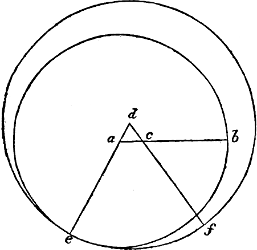
But that the cases of the present problem are formed from the various position of a point, is manifest. For the given point is either placed external to, or in the given right line; and if in it, it will either be one of its extremities, or it will be situated within the extremes; and if external, it will either have a lateral position, so that a line drawn from it to the extremity of the given line will form an angle, or a direct position; so that if the line were produced, it would coincide with the external point. But the geometrician, indeed, considers the point as external, and receives it according to a lateral position; however, for the sake of exercise, all the positions are to be assumed, the more difficult of which we shall exhibit. For let there be given a right line a b, and a given point c, which lies between its extremes, and let there be constituted according to the doctrine of the elements, an equilateral triangle upon the right line a c, and let d c, d a, be produced; then, with the centre a, and the interval a b, let the circle b e be described. And again, with the centre d, but with the interval d e, let the circle d f be designed. Because, therefore, a is the centre, b a is equal to a e; and hence, d e is equal to d f, the parts of which, d a, d c, are equal: for the triangle d a c was established as equilateral. The remainder, therefore, a e, is equal to c f; but a e, as it was shewn, is equal to a b, and hence, c f is equal to a b. To a given point, therefore, c, a right line c f is placed equal to a b. With respect to the position of the point then, so many cases arise. But there are many more with respect to the constitution of the equilateral triangle, the extension of its sides, and the description of circles.
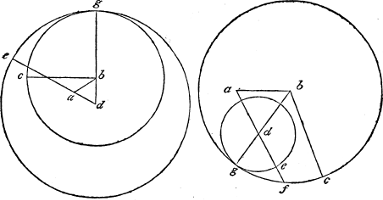
For let there be assumed, as in this element, a point a, and a right line b c, but let b a be extended. The equilateral triangle, therefore, will not be constituted on b a, with its vertex above (because there is no place for it), but beneath; let it, therefore, be a d b; a d, therefore, is either equal to b c, or greater or less. If then it be equal that which was required is performed. But if less with the centre b, and the interval b c, let a circle be described, and let a d, d b be produced to the points e and g; and with the centre d, but the interval d g, let a circle g a be designed. Because, therefore, d g is equal to d e, for they are drawn from the centre; and likewise because a d is equal to d b, for the triangle is equilateral, the remainder a e is equal to the remainder b g. But b g is also equal to b c, for they proceed from the centre; and hence, a e is equal to b c, which was required to be done.
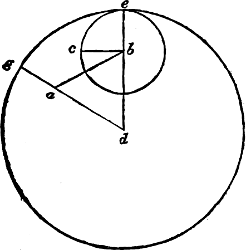
But if a d is greater than b c (for this is the last case), then with the centre b, and the interval b c, let a circle e c be described. The line d b, therefore, shall cut the circle e c. Again, with the centre d, and interval d e, let the circle e g be described. Because therefore, d is the centre of the circle g e, g d is equal to d e. But d a was also equal to d b; the remainder, therefore, a g is equal to the remainder b e. But b e is equal to b c, for both proceed from the centre. Hence, a g is equal to b c; and it is placed at the point a, as was required to be done. And though there are many other cases, the description of the above is sufficient for our present purpose. For from these it is possible for the more curious to exercise themselves in the rest. But formerly some destroying the construction and variety of this problem, reasoned thus.
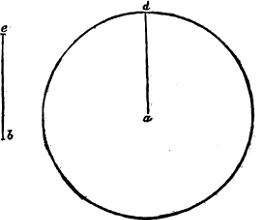
Let a be a given point, but b e a given right line, and with the centre a, but with an interval equal to b e, let a circle d e be described. Then let a certain right line a d be extended from the point a to the circumference; and this shall be equal to b e: for the magnitude of the line from the centre, was equal to that of b e: and so that is done which was required. But he who thus reasons, begs, in the very beginning. For when he says with the centre a, but interval b e describe a circle e d, he receives, in a certain manner, a line equal to b e, placed at the extremity a; and preserving the Petition, he makes one extremity of the interval a centre, but with the other describes a circle: however, in this case, the centre is in one place, but the interval in another. We by no means, therefore, approve this method of demonstration.
PROPOSITION III. Problem III.
Two unequal right lines being given, from the greater to cut off a part equal to the less.
This third problem, likewise, has a variety of cases. For the given unequal right lines are either mutually distant from each other, as with the institutor of the elements, or they are united according to one extreme; or the one cuts the other according to one of its extremities, and this in a two-fold manner. For either the greater cuts the less, or the less the greater. But if they are united according to one extreme, the demonstration is manifest. For employing the common extremity as a centre, and the lesser of the lines for an interval, you will describe a circle, and cut off from the greater, a part equal to the less; since as much as the circle intercepts within itself, will be equal to the less. But if the one cuts the other according to its extreme, either the greater will cut the greater, or the contrary. And if they mutually cut each other, they will either be mutually cut into equal parts, or into unequal; or the one will be cut into equal, and the other into unequal parts, and this in a two-fold respect. For all these present us with an admirable variety of exercise, some of which, out of a many, we shall exhibit.
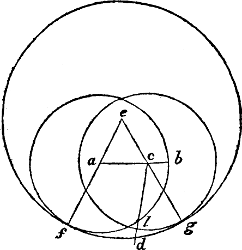
Let there be given the unequal right lines a b, c d, the greater of which is c d, and let it cut a b in one of its extremities c; then with the centre a, but interval a b, let a circle b f be described, and let an equilateral triangle a e c be constructed upon a c, and produce e a, e c. Again, with the centre e, but interval e f, let the circle g f be described; and with the centre c, and interval c g, the circle g l. Because therefore, e f is equal to e g (for the centre is e) of which e a is equal to e c, the remainder a f, shall be equal to the remainder c g. But a f is likewise equal to a b; for the centre is a. Hence, c g will be equal to a b, and this is equal to c l, for the centre is the point c: a b, therefore, is equal to c l, which was required to be done.
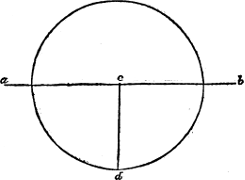
But let c d be less than a b, and let it cut a b according to its extremity c; either, therefore, it will cut it in the middle, or not in the middle. Let it in the first place cut it in the middle; c d, therefore, is either the half of a b, and a c is equal to c d, or it is less than half. And in this case with the centre c, and interval c d, describe a circle, and you will cut off from a b a part equal to c d: Or it is greater than half;
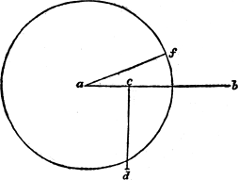
and then at the point a, placing a f, equal to c d, and describing a circle with the centre a, and interval a f, you will cut off from a b a part equal to a f, that is to c d. But if c d does not cut a b in the middle, c d shall either be its half, or greater than the half, or less.
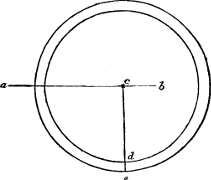
If therefore c d is the half, or less than the half of a b, employing c as a centre, and c d as an interval, you will cut off from a b, a part equal to e d, as was required to be done. But if c d is greater than the half, again at the point a[5] placing a f equal to c d, you will accomplish the same.
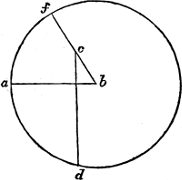
For with the centre a, but interval a f, you will describe a circle, cutting off from a b a line equal to a f, that is, to c d. But if they mutually intersect, as c d, a b, then with the centre b, but interval b a, describe the circle a f, and let b c be extended to the point f. Because therefore, b f, c d, are the two unequal right lines, and c d cuts b f, according to its extremity, it is possible from c d to make a line equal to b f; for this has been shewn in the first case of this problem. It is therefore possible, that a line equal to a b may be cut off from c d; for a b and b f are mutually equal. Having, therefore, received these cases from division, we have endeavoured to exhibit their variety. But the demonstration of the elementary institutor is admirable, since it accords with all the preceding constructions. And it is possible, in every position, at the extremity of the greater, to place a line equal to the less, and using the same extreme as a centre, and placing the interval to describe a circle, which shall cut off from the greater, a line equal to the less, whether they mutually intersect, or one cuts the other, or they are constituted in a still different position.
PROPOSITION IV. Theorem I.
If two triangles have two sides equal each to each; and have likewise the angles equal; which are comprehended by the equal sides; then they shall have their bases equal; and the two triangles shall be equal; and the remaining angles opposite to the equal sides shall be equal.
This is the first theorem in the institution of the elements, for all those which preceded were problems. The first, indeed, treating concerning the origin of triangles: but the second and third proposing to procure one right line equal to another. And of these the one produced an equal from an unequal line, but the other discovered an equal line by an ablation from one unequal. Since, therefore, equality, which is the first symptom in quantity, is to be constructed by us in a triangle and right line, it is delivered in the following theorem. For how can he who has not previously constructed triangles, and procured their origin, be learned in their essential accidents, and in the equality of angles and sides which they contain? How can he receive sides equal to sides, and right lines to other right lines, who has neither problematically investigated these, nor fabricated the invention of equal right lines? For if he should say it may happen before they are fabricated, that if two triangles have this for a symptom, they shall likewise have this particular symptom; would it not, in this case, be easy to object to him, that we by no means know whether a triangle can be constructed? And should it be afterwards inferred, that if there are two triangles, they may have two sides equal to two sides, may we not also doubt this, whether it is possible that right lines may be mutually equal? And this particularly in geometrical forms, in which inequality not entirely existing, equality is likewise inherent. For we must learn that the cornicular is always unequal to an acute angle, and the same is true of the semicircular angle, and the transition from the greater to the less does not entirely take place through that which is equal. The institutor of the elements, therefore, first of all removing these objections, delivers also the construction of triangles (for it is common to three forms) and the origin of equal right lines, in a two-fold order. For he produces the one, not yet existing: but he acquires the other by an ablation from an unequal line. But after these he very properly subjoins the theorem, by which it is shewn how triangles having two sides equal to two, each to each, and the angles comprehended by the equal sides equal, have also the base equal to the base, the area equal to the area, and the remaining angles to the remaining angles. For there are three particulars exhibited in these triangles: but two data. Hence, the equality of the two sides is given, or two equal sides (and it is manifestly given in proportion) and the equality of the angle contained by the equal sides: but three particulars are investigated, the equality of base to base, of triangle to triangle, and of the remaining angles. But because it is possible that triangles may have two sides equal to two, and yet the theorem not be true, because the one is not equal to the other, but both together, on this account he adds in the data, that the sides are equal not simply, but one to the other. For if one of the triangles should have one of its sides of three units, but the other of four; and again, if the sides of the other triangle are respectively two, and five units, the angle comprehended by these being right, the two sides of the one triangle, will, indeed, taken together, be equal to the two sides of the other, or to seven units, yet the two triangles will not be equal. For the area of the one is six units[6], but of the other five. And the reason of this is, because the sides are not equal each to each. Hence, many, not observing this in the division of land, when they have received a greater, have thought just the same as if they had received an equal field; and this because both the sides containing one field, have been together equal to both the sides containing the other field. It is requisite, therefore, to receive the one equal to the other, and to mark wherever the institutor of the elements subjoins this, because he does not add it without occasion. For discoursing on the equality of equal angles, he adds the particle comprehended by equal sides, lest by speaking indeterminately we should assume some one of the angles at the bases. Besides, when in triangles no side is previously named, we must conceive the base to be the side opposite to our sight; but when two are previously received, the remaining side is necessarily the base. Hence, here too, the institutor of the elements having previously assumed two sides equal to two, calls the remainder the bases of the triangles. But a triangle is then said to be equal to a triangle, when their areas are equal. For it is possible, that though the ambits are equal, yet the areas may be unequal, on account of the inequality of angles. But I call the area, the space intercepted by the sides of the triangle: as also I denominate the ambit, the line composed from the three triangular sides. Each, therefore, is different, and it is requisite, indeed, that besides the equality of the ambits, according to each side, the angles should also be equal, if also area ought to be equal to area. But it happens in certain triangles, that though the areas are equal, yet the ambits are unequal; and that the ambits being equal, the areas are unequal. For if there be two isosceles triangles, each of whose equal sides contains five units, but the base of the one is eight, and of the other six units; he who is ignorant of geometry, will say that the greater triangle is that whose base contains eight units. For the whole ambit will be eighteen. But the geometrician will say, that the area of each triangle contains twelve units, and this he will demonstrate, by drawing in each triangle a perpendicular from the vertex, and multiplying this with either part of the segments of the base[7]. But it happens (as I have said) that though the ambits are equal, the spaces are unequal. Hence, certain persons formerly fraudulently deceived their partners in the division of fields, on account of the equality according to ambit, receiving a larger field. But one base is said to be equal to another, and one right line to another, when their extremes conjoined make the whole coincide with the whole. For every right line, indeed, agrees with every right line; but equal right lines mutually coincide according to their extremes. Again, one right-lined angle is said to be equal to another, when one of the comprehending sides of one angle being placed upon one of the other, the remaining side also coincides with the remainder: but when one of the remaining sides falls external to the other, the greater angle is that whose side falls externally; and the less whose side falls within. For there, indeed, the one contains, but in this case it is contained.
But we must assume the equality of angles according to the convenience of sides in right lines, and in all of the same species, as in lunulars and systroides[8], and figures on both sides convex; because, it is possible that they may be equal, and yet the sides not mutually coincide. For a right angle is equal to a certain lunular angle, and yet it is not possible that right lines can coincide with circumferences. Besides, this also must be previously understood, that the angles are said to subtend the opposite sides. For every triangular angle is contained by two sides of the triangle, but is subtended by the remaining side. Hence, the geometrician, when he says that the angles are equal, adds, which are opposite to the equal sides, lest we should conceive it of no consequence whatever angle is received, and should think that he denominated any other two angles of the triangles equal, but we must call those equal which subtend equal sides. For equal sides mutually subtend equal angles. And such are the considerations necessary to the declaration of the present theorem.
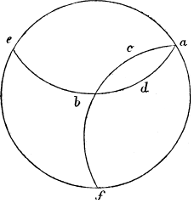
But against the objection of our adversary[9], this must be previously assumed, that two right lines cannot comprehend space. For this the geometrician receives as evident. For if (says he) the extremes of the bases mutually coincide, the bases also shall coincide: but if not two right lines, will comprehend space. From whence, therefore, is the impossibility of this derived? Let there then be two right lines comprehending space a c b, a d b, and let them be infinitely produced. Then with the centre b, and interval a b, let a circle a e f be described. Because, therefore, the line a c b f is a diameter, a c f is the half of the circumference. Again, because the line a d b e is a diameter, a e, likewise, is one half of the circumference. Hence, a e, and a c f are equal to the circumference, which is impossible. Two right lines therefore, cannot comprehend space; which the institutor of the elements knowing said, in the first Petition, from every point, to every point, to draw a right line, because one right line is always capable of uniting two points, but this is impossible for two right lines to effect. Many circumferences, indeed, may conjoin two points, both in the same, and in contrary parts: for by this means the extremities of a diameter conjoin two circumferences, but only one right line. But it is possible that both within and without semicircles, infinite circumferences conjoining given points may be described. And the reason of this is, because a right line is the least of lines, having the same extremes. But there is every where one minimum, and this always becomes the measure of the infinity of others. As therefore a right line; since it is one, becomes the measure of the infinity of right-lined angles (for by this we discover their quantity) so likewise a right line procures us the greatest utility in the mensuration of such as are non-rectilineal. And thus much may suffice concerning these.
But that the whole demonstration of the present theorem depends on common conceptions, rising as it were spontaneously, and emerging from the evidence of hypotheses, is manifest to every one. For since two sides are equal to two sides, each to each, they will mutually coincide. But since the angles contained by the equal sides are equal, they also shall mutually coincide. And when angle is placed on angle, and sides on sides, so as to touch, in every part, the extremities of the sides beneath shall also coincide. But if these, then base, shall agree with base. And if three with three, the whole triangle shall accord with the whole triangle, and all shall be equal to all. Hence, therefore, equality considered in things of the same species, appears to be the cause of the whole demonstration. For here are two axioms endued with a power of containing the whole method of the proposed theorem. One, indeed, affirming, that things which mutually coincide, are equal; and this is simply true, requiring no limitation, and is employed by the institutor of the elements both in the base, and in the space, and in the other angles. For these, says he, are equal, because they mutually coincide. But the other affirming that things which are equal mutually coincide. This, however, is not true in all, but in those of a similar species. But I call things similar in species, such as a right line when compared with a right line, one circumference with another of the same circle, and the angles comprehended by similar lines endued with a similar position. But of these, I say, that such as are equal, mutually coincide: so that in short, the whole demonstration is of this kind. These equals, therefore, are given, viz. two sides equal to two sides, and the angles which they comprehend, and these accord among themselves. But if these mutually coincide, the base also shall agree with the base, and all coincide with all. And if these accord, they are also equal. If then these are equal, it may at the same time be shewn that all are equal to all. And this appears to be the first mode of knowing triangles on all sides equal. And thus much concerning the whole demonstration.
But Carpus, the mechanist, who, in an astrological treatise, discourses of problems and theorems, says, “that they must not be passed over in silence, since they opportunely present themselves for investigation;” and lastly, entering on their distinction, he observes, “that the problematical genus precedes theorems in order. For in problems (says he) the invention of subjects is investigated prior to symptoms. Likewise, a problematical proposition is simple, and requires no artificial intelligence. For this commands us to accomplish something evident, as to construct an equilateral triangle, or from two given unequal right lines, to cut off from the greater a part equal to the less. For what is there in these difficult and obscure. But he affirms that the proposition of a theorem is difficult, and requires the most accurate power, and a judgment productive of science, that it may appear neither to exceed, nor to be deficient from truth; such, indeed, as the present, which is the first of theorems. Add too, that in problems, there is one common way invented by resolution, by proceeding according to which, we can happily accomplish our purpose. For after this manner the more easy kind of problems are investigated. But the treatise of theorems is so very difficult, that even to our time (says he) no one has been able to deliver any common method of their invention. Hence, on account of facility also, the problematical genus is more simple. But these being distinguished, it is on this account (says he) that in the elementary institution problems precede theorems, and from these the institution of the elements begins; and the first theorem is in order the fourth, not because the fourth is exhibited from the preceding, but because it is necessary they should precede as being problems, and this a theorem, though it should require none of the antecedent propositions for its demonstration. For the present theorem entirely employs common conceptions; and in a certain respect receives the same triangle in a different position. Since coincidence, and its consequent equality possess a sensible and manifest apprehension. But such being the demonstration of the first theorem, problems with great propriety precede, because they are universally allotted the primary place.” And perhaps, indeed, problems antecede theorems in order; and particularly among those who ascend to contemplation from the arts, which are conversant with sensible particulars: but theorems excel problems in dignity of nature. And it appears, that all geometry, so far as it conjoins itself with a variety of arts, energizes problematically: but so far as it coheres to the first science, it proceeds theorematically from problems to theorems, from things secondary to such as are first, and from things which more regard the arts, to such as are endued with a greater power of producing science. It is, therefore, vain to accuse Geminus, for affirming that theorems are prior to problems. For Carpus assigns a precedency to problems, according to order: but Geminus to theorems, according to a more perfect dignity. But of this fourth theorem, we have already observed, that in a certain respect it is indigent of the preceding problems, in which we learn the origin of triangles, and the invention of equality. But we now add, that since it is the most simple and principle of theorems (for it is naturally, as I may say, exhibited from primary conceptions alone), but demonstrates a certain symptom appearing about triangles, having two sides equal to two, each to each, and the two angles equal contained by the equal sides, it is with great propriety placed the first after problems, in which things subject to this symptom, and the data themselves are constructed.
PROPOSITION V. Theorem II.
The angles at the base of an isosceles triangle are mutually equal; and the equal right lines being produced, the angles under the base shall be mutually equal.
Of theorems some are simple, but others composite. I call those simple, which, both according to hypotheses and conclusions, are indivisible, possessing one datum, and one object of investigation. Thus for example, if the institutor of the elements had said, every isosceles triangle has the angles at the base equal, it would have been a simple theorem. But theorems are composite, which are composed from many particulars, either having composite hypotheses, or conclusions from a simple hypothesis, or both. And of these, some are complex, but others incomplex. The incomplex are such composites as cannot be divided into simple theorems, as the fourth proposition. For in this, both the datum is a composite, and its consequent, yet it is impossible that the datum can be divided into things simple, and become theorems. For if a triangle has its sides alone equal, or the angle at the vertex, the same consequences will not ensue. But the complex are such as may be divided into things simple, as the theorem which says, triangles and parallelograms of the same altitude, have the same proportion as their bases. For it is possible to say by division, that triangles of the same altitude, have the same proportion as their bases, and in parallelograms after a similar manner. But of all composites, some are composed according to the conclusion, being excited from the same hypothesis: but others have their conclusion according to hypotheses, and infer the same conclusion in all: and others, lastly, are composed both according to the conclusion, and according to hypotheses. Composition, therefore, in the present case, is according to the conclusion, for there are three particulars concluded in this theorem, that the bases are equal, that the triangles are equal, and that the remaining angles, under the base, are equal to the remaining angles. But composition, according to hypothesis, is found in the common theorem of triangles and parallelograms of the same altitude. And according to both, in the theorem that the diameters both of circles and ellipses, bisect as well the spaces as the lines containing the spaces. But of complex theorems, some are universal: but others conclude that which is universal from particulars. For if we should say that a diameter divides a circle, ellipsis, and parallelograms, we receive, indeed, every part of the complex, not universally, but we make that universal which is composed from all. But if we should say, that in a circle, all lines passing through the centre, mutually bisect each other, and make equal angles of all the segments, we should affirm a universal. For in an ellipsis all the angles of the segments are not equal, but those only which are formed by the diameter. But these compositions are entirely fabricated, for the sake of geometrical brevity and resolutions. For many things incomposite are not resolved, but composites alone afford convenience to a resolution tending to principles.