BOOK III. (continued 3)
Thomas Taylor translation
PROPOSITION XVII. Theorem X.
The two angles of every triangle, taken all possible ways, are less than two right.
In the present theorem he shews indeterminately, that any two angles of a triangle, are less than two right, but in the following theorems he determines how much they are less, and that they are deficient by the remaining angle of the triangle: for its three angles are equal to two right; and on this account the two remaining angles are less than two right. And, indeed, the demonstration of the elementary institutor proceeds in a manifest order; for it uses the preceding theorem. But if is necessary, as in the last proposition, by regarding the origin of triangles, to find the cause of the present symptom. Let then the right lines a b, c d, be at right angles to b d.
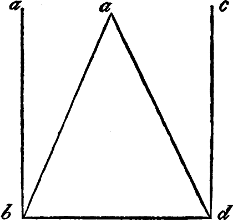
If these lines then are to form a triangle, it is requisite they should incline to each other. But their inclination diminishes the internal angles, on which account they become less than two right: for they were right before their inclination. In like manner, if we conceive right lines standing at right angles, on the side a b, the same consequences will ensue respecting the inclination of the right lines; and the angles at the points a, b, will be less than two right; and so of the other side. This then is the cause of the proposition, and not the external angle being greater than either of the internal, and opposite angles: since it is not necessary that the side should be produced, nor that any angle should be constituted external to the triangle; but it is necessary that any two of the internal angles should be less than two right. Hence, it is necessary, as I have said, that the cause of this theorem should be the inclination of the right lines diminishing the angles at the base. But as the institutor of the elements exhibits the object of enquiry, by the external angle, we may accomplish this, without producing any one of the sides.
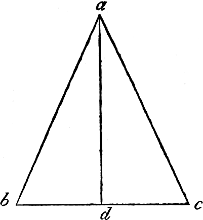
Thus let there be a triangle a b c, and let there be taken in the side b c, any point d, and let a d be connected. Because, therefore, one side of the triangle a b d, is produced, viz. b d, the external angle a d c, is greater than the internal a b d. Again, because one side of the triangle a d c is produced, viz. c d, the external angle a d b, is greater than the internal a c d. But the angles about the right line a d, are equal to two right, by the thirteenth of this. Hence, the angles a b c, a c b, are less than two right. In like manner, we may shew, that the angles b a c, and b c a, are less than two right, by taking a point in the side a c, and by connecting the point b with the assumed point. And again, we may affirm, that the angles c a b, a b c, are less than two right, by taking a point in the side a b, and by connecting a right line, from the point c, and the received point. And thus the thing proposed, is exhibited by the same theorem, without producing any side of the triangle. Hence, it is possible, that by this, the theorem may be proved, which asserts, that from the same point, two perpendiculars cannot be drawn, to one right line. For let there be drawn, if possible, from the point a, two perpendiculars a b, a c, to the right line b c. Then the angles a b c, a c b, are right. But because a b c is a triangle, two of its angles are less than two right. The angles, therefore, a b c, a c b, are less than two right. But they are also equal to two right, because they are perpendiculars, which is impossible. Hence, from the same point, to the same right line, two perpendiculars cannot be drawn.
PROPOSITION XVIII. Theorem XI.
The greater side of every triangle, subtends the greater angle.
That the equality of the sides in every triangle, forms the equality of the angles which they subtend, and that in like manner the equality of the angles shews the equality of their subtending sides, we learn from the fifth and sixth theorems. But that the equality of those angles, which are subtended by the sides, follows the inequality of the sides, and the contrary we now learn by the present eighteenth and nineteenth theorems. For the one shews that the greater angle is contained under the greater side, but the other, that the greater side subtends the greater angle; because these are mutually converted, but the same symptoms are contemplated in things contrary, as in the fifth and sixth theorems. But it is manifest, that we proportionally assume the greater and less side, in scalene triangles, that we distinguish the greatest, middle, and least, and the angles in a similar manner: but in isosceles triangles, the greater and less, simply assumed, are sufficient; for there is one side which is unequal to two, because it is either greater or less, as these theorems cannot take place in equilateral triangles. And here you may observe, that the theorems which exhibit the equality of angles or sides, agree with equilateral and isosceles triangles: but these which exhibit inequality to such as are isosceles and scalene. But the cause of this is, because of triangles, some are produced from equality alone, others from inequality alone, and others from the conjunction of both, which are partly constituted from equality, and partly through inequality. And some are allied to bound, others to infinity, and others are generated from the mixture of both. Hence the ternary permeates through all geometrical forms, as through lines, angles, and figures; and among figures, through such as are trilateral, quadrilateral, and all the rest in a consequent order. But bound, likewise, must be considered as inherent in geometrical forms, as well through similitude, as equality; and infinite, both by dissimilitude, and inequality; and that which is mixt, sometimes from the junction of similitudes, and dissimilitudes, and sometimes from the union of equalities, and inequalities. But the reason of this also, is because geometrical forms regard both quantity and quality. And we have assigned these, because, when we have determined these two, it will be manifest to us, that when the institutor of the Elements says, of every triangle, he does not also speak of the equilateral, but of that which has a greater and less side: for it is necessary to consider the object of enquiry, as consequent to the preceding datum; and that the triangle which has a greater and less side, contains a greater angle, under the greater side.
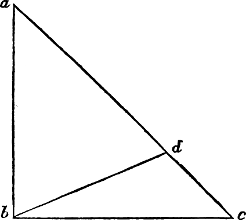
But because the geometrician, when in the construction he receives the triangle a b c, and the side a c, greater than the side a b, in order that he may shew, that the angle at the point b is greater than at the point c, from the side a c, he cuts off a right line a d, equal to the side a b: on this account it may be said that it is necessary to make the ablation at the point c, let us therefore exhibit the thing proposed upon this hypothesis, according to Porphyry, as follows. Let d c be equal to a b, and produce a b to the point e, and place b e equal to d a. The whole, therefore, a e, is equal to the whole a c. Connect e c.
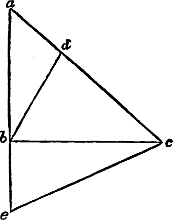
Because, therefore, a e is equal to a c, the angle, also, a e c, is equal to the angle a c e, (by the fifth). Hence, the angle a e c is greater than the angle a c b. But the angle, also, a b c is greater than the angle a e c; because one side of the triangle c b e is produced, viz. b e, and so the angle a b c, since it is external, is greater than the internal and opposite angle. Much more, therefore, is the angle a b c, greater than the angle a c b, which was to be shewn. And such are the geometrical exhibitions of the present theorem.
But it is manifest that the cause of this symptom is the amplification, or diminution according to magnitude, of the side subtending the angle. For when it is greater, it more amplifies the angle; but when less, at the same time it diminishes, and gives a greater contraction to the angle. And this takes place on account of the right line being situated in its extremities: for through its being placed in its extremities, it changes likewise the magnitudes of the angles, according to the increase and decrease which it receives. And this we affirm in one triangle, since it is possible that the same angle may be subtended by a greater or less right line; and that the same right line may subtend a greater and less angle.
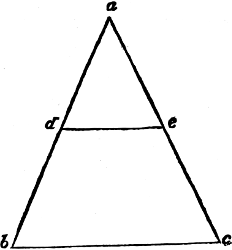
For let the triangle happen to be an isosceles one, a b c, and let there be taken in the side a b, a point a, and let a e be taken equal to a d, and connect d e. The right lines therefore, d e, b c, subtend the angle at the point a, of which the one is greater, but the other less. And in the same manner infinite right lines, greater and less subtending the angle a.
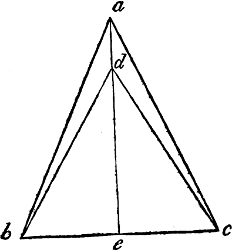
Again, let the triangle a b c, be isosceles, and let b c be less than b a, a c, and construct upon b c, an equilateral triangle b d c, and connect a d, and produce it to e. Because, therefore, the angle b d e, of the triangle a b d, is external, it is greater than the angle b a d. In like manner the angle c d e, is greater than the angle c a d. The whole, therefore, b d c, is greater than the whole b a c, and the same right line subtends both, viz. the greater and the less angle. But it is shewn, that likewise greater and less right lines subtend the same angle. But in one and the same triangle, one right line subtends one angle, and the greater always the greater, and the less always the less, the cause of which we have contemplated.
PROPOSITION XIX. Theorem XII.
The greater side of every triangle subtends the greater angle.
This is the converse of the preceding theorem; and the datum, as well as the object of enquiry, is simple in each. Add too, that what was conclusion there, is hypothesis here: and what was hypothesis there is conclusion in this. But the former precedes, because it has the inequality of the sides given; and this follows, because it supposes unequal angles. For sides, indeed, seem to contain right-lined figures, but the angles appear to be contained; and the mode of demonstration in the former is ostensive, but in this it concludes the thing proposed by a deduction to an impossibility. The geometrician, therefore, by division, reasons concerning that which is impossible: for the angles being unequal, I say, (says he) that the sides also subtending the unequal angles are unequal; and the greater subtends the greater given angle. For if that which subtends the greater angle is not greater, it is either equal, or less. But if it be equal, the angles also which they subtend, are equal by the fifth. But if less, the angle also which it subtends, is less by the preceding: for it was shewn that the greater side subtends the greater angle, and the less the lesser. But the angles have a contrary position; and hence, the one side is greater than the other.
But it is possible that we may exhibit the thing proposed, without this division. For if the angle of a triangle be bisected, and the right line drawn to the base, cutting the angle, divides it into unequal parts, the sides containing that angle will be unequal, and the greater will be that which coincides with the greater segment of the base, but the less that which coincides with the lesser.
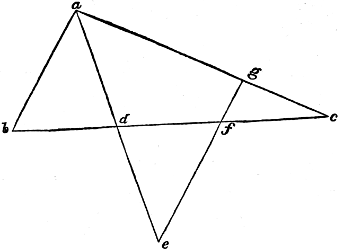
Let there be a triangle a b c, and let the angle at a be bisected, by the right line a d, and let a d cut the base b c, into unequal parts, and let c d be greater than b d. I say that the side a c is greater than the side a b. Produce a d to the point e, and place d e equal to a d. And because d c is greater than d b, place d f equal to b d, and connect e f, and produce it to the point g. Because, therefore, a d is equal to d e, and b d to d f, the two are equal to the two, and they comprehend equal angles at the vertex. Hence, the base b a, is equal to the base e f, and all, therefore, are equal to all. On this account also the angle d e f, is equal to the angle d a b. But this is not unequal to d a g. Hence, the side a g, is equal to the side e g, by the sixth. The side, therefore, a c, is greater than the side e f. But the side f e, is equal to the side a b; and hence, the side a c, is greater than the side a b, which was to be demonstrated.
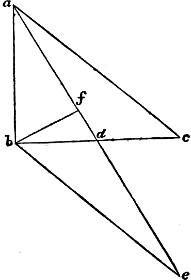
This being pre-assumed, we can shew that the greater side subtends the greater angle. Let there be a triangle a b c, having the angle at the point b, greater than the angle at the point c. I say that the side a c, is greater than the side a b. Let b c be bisected in the point d, and connect a d, and draw d e, equal to a d, and connect b e. Because, therefore, b d, is equal to d c, and a d, to d e, the two are equal to the two, and they comprehend equal angles at the vertex. Hence, the base b e, is equal to the base a c, and all are equal to all. Hence too, the angle d b e, is equal to the angle at the point c, but less than the angle a b d. The angle, therefore a b e, is bisected by the right line b f. Hence, e f, is greater than f a. Because, therefore, the angle at the point b, of the triangle a b e, is bisected by the right line b f, and e f is greater than f a, it follows from what has been previously shewn, that the side b e, is greater than the side b a. But b e has been shewn to be equal to a c. The side, therefore, a c, is greater than the side a b; and the object of enquiry is exhibited. And it is manifest that the institutor of the Elements, avoiding a variety of demonstration, refrains from this mode of demonstrating, and employs a method of proof, which leads from division to an impossibility, because he was willing to fabricate the converse to the preceding, without any intervening medium. For the eighth theorem, indeed, which is the converse of the fourth, brings great disturbance, because it makes conversion difficult to be known. For it is more excellent to exhibit converse theorems, by preserving the continuity through an impossible, than to destroy the continuity by a principal demonstration. And hence, Euclid shews almost all converse theorems by a deduction to an impossibility.
PROPOSITION XX. Theorem XIII.
Two sides of every triangle, however taken, are greater than the remaining one.
The Epicureans oppose the present theorem, asserting that it is manifest even to an ass; and that it requires no demonstration: and besides this, that it is alike the employment of the ignorant, to consider things manifest as worthy of proof, and to assent to such as are of themselves manifest and unknown; for he who confounds these, seems to be ignorant of the difference between demonstrable and indemonstrable. But that the present theorem is known even to an ass, they evince from hence, that grass being placed in one extremity of the sides, the ass seeking his food, wanders over one side, and not over two. Against these we reply, that the present theorem is indeed manifest to sense, but not to reason producing science: for this is the case in a variety of concerns. Thus for example, we are indubitably certain from sense, that fire warms, but it is the business of science to convince us how it warms; whether by an incorporeal power, or by corporeal sections; whether by spherical, or pyramidal particles. Again, that we are moved is evident to sense, but it is difficult to assign a rational cause how we are moved; whether over an impartible, or over an interval: but how can we run through infinite, since every magnitude is divisible in infinitum? Let, therefore, the present theorem, that the two sides of a triangle are greater than the remainder, be manifest to sense, yet it belongs to science to inform us how this is effected. And thus much may suffice against the Epicureans.
But it is requisite to relate the other demonstrations of the present theorem, such as Heron, and the familiars of Porphyry have fabricated, without producing the right line, after the manner of Euclid.
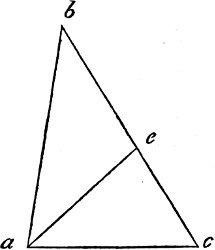
Let there be a triangle a b c, it is requisite, therefore, to shew, that that the sides a b, a c, are greater than the side b c. Bisect the angle at a, by the right line a e. Because, therefore, the angle a e c, is external to the triangle a b e, it is greater than the angle b a e. But the angle b a e, was placed equal to the angle e a c. The angle, therefore, a e c, is greater than the angle e a c. Hence, the side also a c, is greater than the side c e. And for the same reason the side a b, is greater than the side b e. For the angle a e b is external to the triangle a e c, and is greater than the angle c a e; that is than the angle e a b. And on this account the side a b, is greater than the side b e. The sides, therefore, a b, a c, are greater than the whole side b c. And the like may be shewn of the other sides.
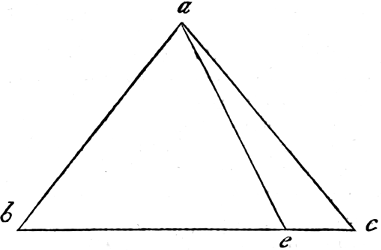
Let there again be a triangle a b c. If therefore the triangle a b c, be equilateral, two sides will be doubtless greater than the remaining one: for when there are three equal quantities, any two are double of the remainder. But if it be isosceles, it will have a base either less, or greater than each of the equal sides. If therefore the base be less, the two sides are given greater than the remainder. But if the base be greater, let it be b c, and cut off from it a part equal to either of the sides, which let be b e, and connect a e. Because, therefore, the angle a e c, is external to the triangle a e b, it is greater than the angle b a e. On the same account the angle a e b, is greater than the angle c a e. Hence, the angles about the point e, are greater than the whole angle about the point a, of which b e a is equal to b a e, since a b is equal to b e. The remainder, therefore, a e c, is greater than the remainder c a e. Hence, the side a c, is greater than the side c e. But the side a b, was also equal to the side b e. The sides, therefore, a b, a c, are greater than the side b c.
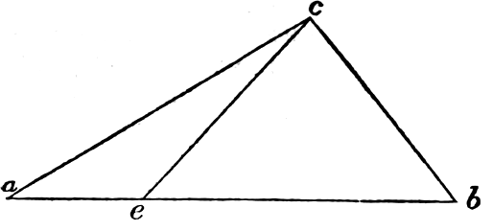
But if the triangle a b c, be scalene, let the greatest side be a b, the middle a c, and the least c b. The greatest side, therefore, assumed with either of the others, exceeds the remainder: for by itself it is greater than either. But if we are desirous of shewing that the sides a c, c b, are greater than the greatest side a b, we must employ the same construction as in the isosceles triangle, cutting off from the greater side, a part equal to one of the other sides, and connecting the line c e, and using the external angles of the triangles.
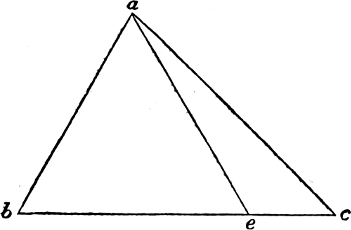
Let there be again any triangle a b c. I say that the sides a b, a c, are greater than the side b c. For if they are not greater, they are either equal or less. Let them be equal, and cut off b e, equal to a b. The remainder, therefore, e c, is equal to a c. Because then, a b, b e, are equal, they subtend equal angles; and this is likewise true of a c, e c, because they are equal. Hence, the angles at the point e, are equal to the angles at the point a, which is impossible. Again let the sides a b, a c, be less than b c, and cut off b d, equal to a b, and e c to a c.
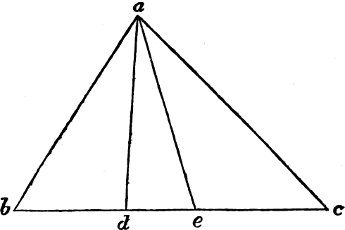
Because, therefore, a b is equal to b d, the angle b d a, is not unequal to the angle b a d. And because a c is equal to c e, the angle c e a, is equal to the angle e a c. Hence, the two angles b d a, c e a, are equal to the two b a d, and e a c. Again, because the angle b d a is external to the triangle a d c, it is greater than the angle e a c: for it is greater than c a d. By a similar reason also, because the angle c e a, is external to the triangle a b e, it is greater than the angle b a d: for it is greater than the angle b a e. Hence, the angles b d a, c e a, are greater than the two b a d, e a c. But they were also equal to them, which is impossible. The sides, therefore, a b, a c, are neither equal to, nor less than the side b c, but greater. And the like may be exhibited in others.
PROPOSITION XXIV. Theorem XIV.
If upon one side of a triangle, two right lines beginning from the extremities, are internally constituted, the constituted right lines will be less than the other sides of the triangle, but they will contain a greater angle.
That which is expressed by the proposition, is, indeed, manifest; and the demonstration adopted by the elementary institutor, is evident; and the theorem is consequent to the first principles, since it depends on two theorems, the one previously exhibited, and the sixteenth. For in order to shew, that the lines internally constituted, are less than the external, the theorem is required, which says, the two sides of every triangle, are greater than the remaining one: but for the purpose of confirming that the angle comprehended by them is greater than that comprehended by the external sides, that theorem procures the greatest utility, which says, the external angle of every triangle, is greater than the internal and opposite angle. But you will receive at the same time, conviction of geometrical diligence, and a commemoration of things admirable in the mathematical disciplines, if we shall shew that it is possible within a certain triangle, upon one of its sides, not upon the whole, but upon some one of its parts, to constitute two right lines greater than the external right lines[22]; and again, others comprehending a less angle, and comprehended in the angle made by the external lines. For this being exhibited, it will at the same time be manifest, that the institutor of the Elements necessarily adds, that the internally constituted lines must begin from the extremities of the common basis; and must be constituted upon one whole side, and not upon any one of its parts: but likewise, as I have said, one of the admirable things which geometry contains, will be manifest. For is it not, indeed, admirable, that the lines constituted upon the whole side, should be less than the external sides: but that those constituted upon a part should be greater? Let there be then a right angled triangle a b c, having the angle at the point b right, and take in the side b c, any point d, and connect a d. Hence, a d is greater than a b.
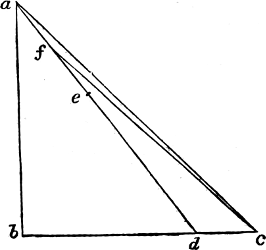
Take from a d, a part equal to a b, which let be d e, and bisect e a, in the point f, and connect f c. Because, therefore, a f c is a triangle, the lines a f, f c, are greater than a c. But a f is equal to f e. The right lines therefore, f e, f c, are greater than a c. But d e is equal to a b. Hence, the right lines f c, f d, are greater than the right lines a b, a c, and they are internally constituted.
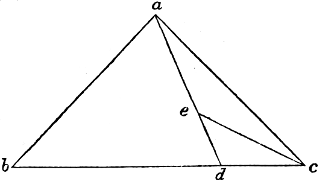
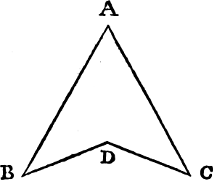
Let there be again an isosceles triangle a b c, having the base b c, greater than either of the equal sides. Then from b c, cut off b d, equal to a b, and connect a d, and take in a d, any point e, and connect e c. Because, therefore, a b, is equal to b d, the angle b a d, is also equal to the angle b d a. And because the angle b d a is external to the triangle e d c, it is greater than the internal and opposite d e c. Hence, the angle b a d, is greater than the angle d e c. Much more, therefore, is the angle b a c, greater than the angle d e c; and b a c is contained by the external lines, but d e c by internal lines. Within a triangle, therefore, right lines d e, e c, comprehending a lesser angle, are constituted within the angle comprehended by the external lines; and the thing proposed is shewn without employing the parallel lines of expositors. Hence, it is necessary that the constituted right lines should begin from the extremities of the basis: for those which are constituted upon any one of its parts, are shewn to be sometimes greater than the external lines, and to comprehend a lesser angle. But when they are constituted in this manner, beginning from the extremities, the species of triangles, called (ἀκιδοειδῆ) or, similar to the point of a spear[23], presents itself to our view; and is one of the admirable things contained in geometry, viz. to find a quadrilateral triangle. As for example, the triangle A B C. For it is contained by the four sides B A, A C, B D, D C; but it has three angles, one at B, the other at A, and the other at C. And hence, the present figure is a quadrilateral triangle.
PROPOSITION XXII. Problem VIII.
To construct a triangle from three right lines, which are equal to three given right lines. But it is requisite that two of the lines must be greater than the remaining one, in whatever manner they may be taken.
We again pass to problems, and Euclid commands us to construct a triangle from three proposed right lines, two of which are greater than the remaining one, equal to given right lines. Because he knew this in the first place, that it was impossible to construct a triangle from those same lines, which had already received the declared position: but that this was possible to be effected from their equals. In the next place, he knew it was necessary that two of the right lines about to complete the triangle, should be greater than the remaining one: for the two sides of every triangle are greater than the remaining one, however assumed, as we have shewn. On this account he adds, that it is necessary the first right lines remaining, to construct a triangle from three equal to them: but that it is requisite, any two, however taken, should be greater than the remainder, or there will not be a triangle from three lines equal to the given right lines. But by this means he also destroys all the objections which are urged against the construction, and which may be perfectly dissolved by this addition. Hence, the present problem ranks among things determined, and not among such as are indetermined: For of problems as well as of theorems, some are indeterminate, but others without termination. Thus if we should simply say, from three right lines which are equal to three given right lines, to construct a triangle, the problem is indeterminate and impossible. But if we add, two of which, however assumed, are greater than the remainder, the problem is determined and possible. For as the division of theorems takes place, according to true and false, so that of problems according to a possible and impossible enunciation. But that the objections which are urged against the construction, may be from hence dissolved, we shall learn from a little inspection: for we shall follow the words of the geometrician. Let there be three right lines, a b c, of which any two, however taken, are greater than the third, and let it be required to accomplish the thing proposed. Let there be placed a certain right line d e, on one part finite, as at the point d: and on the other part infinite. Then place d f equal to a, but f g to b: and g h to c.
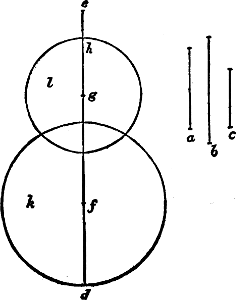
And from the centre f, but interval f d, let a circle k be described. Again, with the centre g, but interval g h, let the circle l be designed; and the circles will intersect each other. For this is assumed by the institutor of the Elements. But it may be asked how this takes place? For perhaps they either only touch each other, or they do not even touch. Since it is necessary that they should suffer some one of three cases, I mean that they should either intersect or touch, or be distant from each other. I say, therefore, that they necessarily intersect each other. For let them in the first place, touch each other.
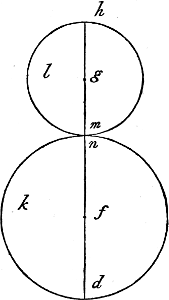
Because, therefore, the point f is the centre of the circle k, d f is equal to f n. And because the point g is the centre of the circle l, h g is equal to g m. The two, therefore, d f, g h, are equal to one, viz. to f g. But they were placed greater than one, as also a, together with c, is greater than b. They are therefore equal to it, and at the same time greater, which is impossible. Again, if it be possible, let the circles be distant from each other, as k and l.
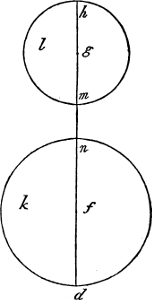
Because, therefore, the point f, is the centre of the circle k, d f, is equal to f n. And because the point g, is the centre of the circle l, h g is equal to g m. The whole, therefore, f g, is greater than the two, d f, h g: for f g, exceeds d f, g h, by n m. But it was supposed that d f, h g, were greater than f g, in the same manner as a and c are greater than b. For d f was placed equal to a, but f g, to b, and h g to c. It is necessary, therefore, that the circles k l, should intersect each other. Hence, the institutor of the Elements very properly receives them cutting one another: since of the three right lines, he supposes two greater than the third, however, they may be assumed, but neither equal to, nor less than one. But it is necessary that when the circles touch, two of the lines should be equal to the third; and that when they are distant from each other, two should be greater than the remainder.
PROPOSITION XXIII. Problem IX.
On a given right line, and at a given point in it, to constitute an angle equal to a given right lined angle.
This also is a problem, whose invention according to Eudemus is rather the gain of Oenopides than of Euclid: but it requires the construction of an angle, on a given right line; and at a given point in it equal to another right lined angle. This, then, Euclid necessarily adds, that the given angle must be rectilineal; because it is impossible that an angle can be construed on a right line equal to every angle. For it has been shewn[24] that there are only two curve-lined angles equal to right-lined angles, viz. the angle of a lunular figure, which we have proved equal to every right-lined angle; and the angle of that figure similar to an axe[25], which is equal to two thirds of a right angle. But a lunular figure of this kind, which is called (πελεκοειδὲς) Pelecoides, is formed from two circles cutting each other through their centres. However, the construction of an angle on a certain right line, causes the constituted angle to become determinate, and not indifferent in species, but forms it either right-lined, or mixt. But since no mixt can be equal to a right-lined angle, it is manifest that this must be perfectly rectilineal. The institutor of the Elements, therefore, simply using the present problem, and constructing a triangle from three right lines, equal to three given lines, accomplishes the thing proposed. But you may receive a more exquisite construction of the triangle, by the following method.
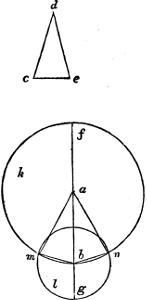
Let there be a given right line a b, and a given point in it a, and a given right-lined angle c d e. It is required, therefore, to accomplish the problem. Connect c e, and produce a b on both sides to the points f, g. Then place f a, equal to c d, and d e to a b, and b g to e c. And with the centre a, but interval a f, describe the circle k. And again, as in the preceding, with the centre b, but interval b g, describe the circle l. The circles, therefore, will cut each other, as we have shewn in the last proposition. Let them cut each other in the points m, n, and from these points draw right lines to the centres as in the figure. Because, therefore, f a, is equal to a m, and a n, but c d, is equal to f a; a m, and a n, will be each equal to c d. Again, because b g is equal to b m, and b n, but g b is not unequal to c e; b m, and b n, will be also equal to c e. But a b is equal to d e. The two therefore, a b, a m, are not unequal to the two d e, d c, and the base b m, is equal to the base c e. Hence, the angle m a b, is equal to the angle at the point d. And again, the two n a, a b, are equal to the two c d, d e, and the base n b, is equal to the base c e. The angle, therefore, n a b, is equal to the angle c d e, and the thing proposed is doubly accomplished: for we have not only constituted one, but two angles, equal to the given angle, on each side of the right line a b; so that in whatever part we may desire the construction to be made, it will be indubitable, and without contradiction. And this we have added to the construction of the elementary institutor.
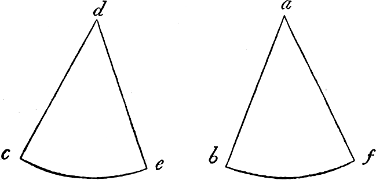
But we cannot praise the method of Apollonius, because it requires the assistance of the third book. For he receives any angle c d e, and a right line a b, and with the centre d, but interval c d, he describes a circumference c e. In like manner with the centre a, but interval a b, he describes a circumference b f; and intercepting a circumference c e, equal to b f, he connects the right line a f, and affirms that the angles a and d, insisting on equal circumferences, are equal. But it is necessary to pre-assume that a b is equal to c d, in order that the circles may be also equal. We therefore think that a demonstration of this kind requiring posterior propositions, is foreign from an elementary institution; and we give the preference to that of the geometrician, as consequent to principles.
PROPOSITION XXIV. Theorem XV.
If two triangles have two sides equal to two, each to each, but the one angle contained by the equal right lines greater than the other: they shall also have the base of the one greater than the base of the other.
Euclid again passes on to theorems, and speaks concerning inequality in two triangles, in a manner similar to his discourse concerning equality. For supposing two triangles, having two sides equal to two, each to each, he sometimes places the vertical angle equal in each, and sometimes unequal; and he proceeds in a similar manner with respect to the base. Besides this, he demonstrates that the equality of the bases is consequent to the equality of the vertical angle, and that the equality of the vertical angles, is consequent to the equality of the bases: but he now shews that the inequality of the one, follows the inequality of the other. The present theorem, therefore, is opposite to the fourth: for that, indeed, supposes the vertical angles of the triangles equal, but this supposes them unequal. And that demonstrates the equality of their bases; but this proves them unequal, in the same manner as their angles. It precedes, however, the following theorem: for that deduces its proof of inequality from the bases to the angles subtending the bases: but this, on the contrary, reasons from the angles to the bases, which are under the angles. Hence it is, after this manner, the converse of its consequent proposition, but opposite to the eighth theorem. For the one from the equality of the bases, demonstrates the equality of the vertical angles, but the other from the inequality of the bases, shews that the vertical angles are unequal. It is, however, common to these four (two of which are conversant with equality, I mean the fourth, and the eighth, but two about inequality, the present and the following; and two begin from angles, viz. the fourth, and the object of investigation in the present, but two from bases, viz. the eighth, and the following proposition); it is common, I say, to all these four, as well to the fourth and the eighth, as to the twenty-fourth and twenty-fifth, to have two sides equal to two, each to each. For these being unequal, all enquiry is superfluous, and subject to deception. And thus much for a universal speculation concerning the present theorem.
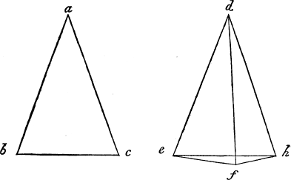
But let us now consider the construction of the elementary institutor, and add to it where deficient. For Euclid receiving two triangles, a b c, d e f, having the sides a b, a c, equal to the sides d e, d f, each to each, and the angle at the point a, being greater than the angle at the point d, and willing to shew that the base b c, is greater than the base e f, on the right line e d, and at a point in it d, constitutes an angle e d h, equal to the angle at the point a. For the angle at the point a, is greater than the angle at the point d, and he connects d h, equal to a c. The right line, therefore, e h, produced to the point h, either falls above, or upon, or beneath the line e f. The institutor of the Elements, indeed, considers it as lying above the line. But let it be upon the right line. Again, therefore, we may exhibit the same.
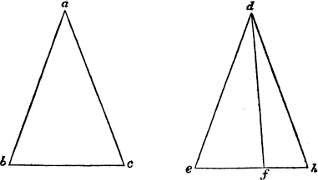
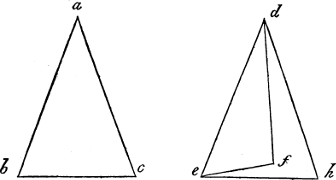
For the two a b, a c, are equal to the two d e, d h, and they contain equal angles. Hence, the base b c, is equal to the base e h. But e h is greater than e f; and on this account b c is greater than e f. Again, let it be placed beneath e f. Connecting, therefore, e h, we must say, that since a b, a c, are equal to d e, d h, and they comprehend equal angles, b c is also equal to e h. Because, therefore, within the triangle d e h, two right lines d f, f e, are constructed on the side d e, they are less than the external sides. But d h, is equal to d f: for it is equal to a c. Hence h e is greater than e f. But h e is equal to b c. And therefore, b c is greater than e f. The theorem, therefore, is exhibited according to every position.
Why then, as is the fourth theorem, he at the same time demonstrated that the areas of triangles are equal, does he not add in the present, that besides the inequality of the bases, the areas also are unequal? Against this doubt we must say, that there is not the same proportion in equal, as in unequal angles and bases. For when the angles and bases are equal, the equality also of the triangles follows: but when they are unequal, it is not necessary that the inequality of the areas should be consequent; since the triangles may as well be equal, as unequal; and that may be greater, and likewise less, which contains the greater angle, and the greater base. On this account, therefore, the institutor of the Elements leaves the comparison of the triangles; to which we may add, that the contemplation of these, requires the doctrine of parallels.
But if it be requisite, that anticipating things which are afterwards exhibited, we at present make a comparison of areas, we must say, that if the angles a, d, are equal to two right, the triangles may be shewn to be equal: but when they are greater than two right, the lesser triangle will be that which contains the greater angle; and when they are less than two right, this will be the case with the greater triangle.
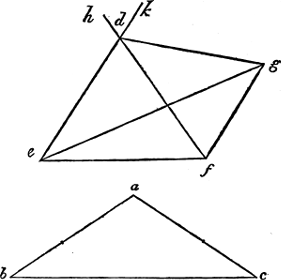
For let the construction in the element be given, and produce e d, f d, to the points k, h; and let us suppose the angles b a c, e d f, equal to two right. Because, therefore, the angle b a c, is equal to the angle e d g, the angles e d g, e d f, are equal to two right. But the angles e d g, k d g, are also equal to two right. Let the common angle e d g be taken away, and the remainder e d f, will be equal to the remainder k d g. But e d f is equal to h d k; for they are vertical angles. Hence, the angle k d g, is equal to the angle h d k. And because the angle g d h, is external to the triangle g d f, it is equal to the two internal and opposite angles at the points g and f. But these angles are equal to each other, because d g is equal to d f. Hence, the angle g d h, is double of the angle at the point g, and of the angle at the point f. The angle, therefore, at the point g, is equal to the angle g d k, and they are alternate; and consequently d e is parallel to f g. The triangles, therefore, g d e, f d e, are upon the same base d e, and between the same parallels d e, g f; and are consequently equal. But the triangle g d e, is equal to the triangle a b c; and so the triangle d e f, is not unequal to the triangle a b c. And here you may observe, that we require three theorems belonging to the doctrine of parallels; one, indeed, affirming, that the external angle of every triangle is equal to the two internal and opposite angles: but the other, that if a right line falling upon two right lines, makes the alternate angles equal, the right lines are parallel; and the third, that triangles constituted upon the same base, and between the same parallels, are equal, which the institutor of the Elements also knowing, omits the comparison of triangles.
But let the angles b a c, e d f, be greater than two right, and let the same things be constructed. Because, therefore, the angles b a c, e d f, i.e. the angles e d g, e d f, are greater than two right; but the angles e d g, g d k, are equal to two right, by taking away the common angle e d g, the angle e d f, is greater than the angle g d k. Hence, the angle g d h, is more than double of the angle g d k; and so the angle g d k, is less than the angle at the point g.
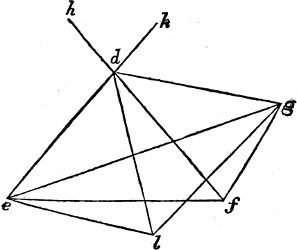
Let g d k be placed equal to d g l, and let e l, and d l, be connected: g l, therefore, is parallel to d e; and hence, the triangles g d e, l d e, are equal. But the triangle l d e, is less than the triangle f d e. The triangle, therefore, g d e, is less than the triangle f d e. But the triangle g d e, is equal to the triangle a b c; and hence, the triangle a b c, is less than the triangle f d e, viz. is less than the triangle which contains the greater angle.
In the third place, let the unequal angles be less than two right, and let the same things be constructed. Because, therefore, the angles e d g, g d k, are equal to two right, by taking away the common angle e d g, the whole g d h, is less than double of g d k. But it is double also of the angle at the point g. Hence, the angle g d k, is greater than the angle at the point g. Let the angle d g l, be placed equal to the angle g d k, and let g l coincide with e l, in the point l, and connect d l. Hence, g l is parallel to d e; and consequently the triangles g d e, l d e, are equal to each other. But the triangle l d e, is greater than the triangle f d e; and the triangle g d e, is equal to the triangle a b c. Hence, the triangle a b c, is greater than the triangle d f e.
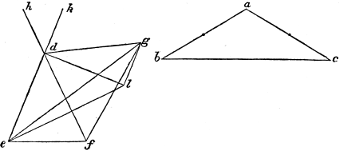
It is shewn, therefore, that the triangle a b c, is both equal to, and is also greater and less than the triangle d e f, the angles at the points a and d, being either equal to, or greater or less than two right. And thus, all the hypotheses may be accomplished. For what if the angle at the point a, should be one right, and the half of a right angle, but the angle at the point b, the half of one right, would not those two angles be equal to two right? But what if the angle at the point a, should be one right, and the half of a right, but the angle at the point b, two thirds of one right, would they not be greater than two right angles? And lastly, if the angle at the point a, should be one right, and the half of a right angle, but the angle at the point b, a third part of a right angle, would they not be less than two right, and the angle a be greater than the angle d? All these comparisons, therefore, are produced by the assistance of parallels; and hence, they are necessarily not found in the present elementary institution.
PROPOSITION XXV. Theorem XVI.
If two triangles have two sides equal to two, each to each, but have the base of the one greater than the base of the other; they shall likewise have the angle contained by the equal sides in the one, greater than the angle contained by the equal sides in the other.
The present theorem is the opposite to the eighth, but the converse of the preceding. For the institutor of the Elements produces theorems concerning the equality and inequality of angles and bases, according to conjunction; in each of the conjunctions, receiving some as precedents, but others as converse. And in such as are precedent indeed, he employs direct ostensions: but in such as are converse, he uses deductions to an impossibility. After this manner he proceeds in some particular triangle, sometimes from the equality of the sides which it contains, shewing the consequent equality of the angles which they subtend: but sometimes from their inequality evincing inequality. And again, on the contrary, affirming that equality of sides is consequent to equality of angles, but inequality to inequality. However, that we may proceed to the thing proposed, we refer those who are desirous of learning how the geometrician shews when this is manifest, to his books on this subject. But we shall briefly relate the demonstrations which others produce of this proposition; and in the first place, that which Menelaus Alexandrinus invented and delivered.
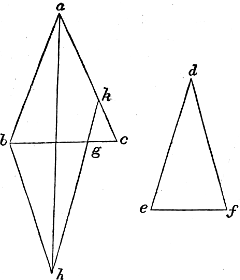
Let there be two triangles a b c, d e f, having the two sides a b, a c, equal to the two d e, d f, each to each, and the base b c, greater than the base e f, I say that the angle at the point a, is greater than the angle at the point d. For let there be cut from the base b c, a line b g, equal to the base e f, and construct at the point b, an angle g b h, equal to the angle d e f, and place b h equal to d e. Lastly, connect h g, and produce it to the point k, and connect a h. Because, therefore, b g is equal to e f, but b h to e d, the two are equal to the two, and they contain equal angles. Hence, g h is equal to d f, and the angle b h g, is not unequal to the angle e d f. And because g h is equal to d f, but d f to a c, g h, also, is equal to a c. Hence h k is greater than a c, and consequently is much greater than a k. The angle, therefore, k a h, is greater than the angle k h a. Again, because b h, is equal to a b, for it is equal to d e, the angle b h a, is equal to the angle b a h. Hence, the whole angle b h k, is less than the whole, b a c, but is shewn to be equal to the angle at the point d. The angle, therefore, b a c, is greater than the angle at the point d. And such is the demonstration of Menelaus.
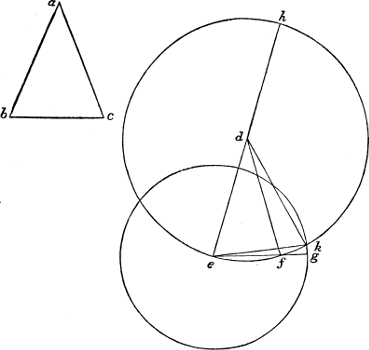
But Heron, the mechanist, shews the same thing, in the following manner, without leading to an impossibility, as is the case with the demonstration of Euclid. Let there be two triangles a b c, d e f, with the same hypotheses as above. And because b c is greater than e f, let e f be produced, and place e g equal to b c; and in like manner extend d e, and place d h equal to d f. The circle, therefore, which is described with the centre d, and interval d f, will pass also through the point h. Let it be described as f k h. And because a c, a b, are together greater than b c, but these are equal to e h, and b c is equal to g e, hence the circle which is described with the centre e, but interval e g, will cut e h. Let it cut e h, as the circle g k, and connect from the common section of the circles to the centres, the right lines k d, k e. Because, therefore, the point d, is the centre of the circle h k f, d k is equal to d h, i.e. to a c. Again, because the point e, is the centre of the circle g k, the line e k, is equal to e g, i.e. to b c. Hence, since the two a b, a c, are equal to the two d e, d k, and the base b c, is equal to the base e k, the angle, also, b a c, is equal to the angle e d k. And thus the angle b a c, is greater than the angle f d e.
PROPOSITION XV. Theorem XVII.
If two triangles have two angles equal to two, each to each, and one side equal to one side, either that which is adjacent to the equal angles, or that which subtends one of the equal angles: then they shall have the remaining sides equal to the remaining sides, each to each, and the remaining angle equal to the remaining angle.
It is necessary, that he who wishes to compare triangles with each other, according to sides, angles, and areas, should either, by receiving the sides alone equal, enquire after the equality of angles; or by assuming the angles alone equal, investigate the equality of the sides; or by mingling the angles and sides, scrutinize the equality of angles and sides. Since, therefore, Euclid alone receives the angles equal, he could not likewise shew that the sides of the triangles are equal. For the least triangles are equiangular with the greatest, though at the same time they are excelled by them, both according to sides and comprehended space: but the angles of the former are separately equal to the angles of the latter. However, as he supposes the sides alone to be equal, he demonstrates that all are equal, by the eighth theorem, in which there are two triangles having two sides equal to two, each to each, and the base to the base, and these are shewn to be equiangular, and to possess a power of comprehending equal spaces. And the institutor of the Elements omits this addition, as necessarily following from the fourth, and requiring no demonstration. But when receiving sides and angles, he ought to receive either one side equal to one, and one angle equal to one; or one side, and two angles of the triangles, equal to two; or on the contrary, one angle and two sides; or one angle and three sides; or one side and three angles; or more than one side, and more than one angle. But when he had received one angle, and one side, he could by no means shew the thing proposed. I mean, the equality of the rest. For it is possible that two triangles which are equal, according to one side only, and one angle, may be entirely unequal as to the rest.
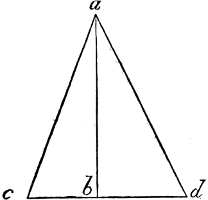
Thus let there be a right line a b, perpendicularly erected upon the right line c d, but let b d be greater than b c, and connect a c, a d. In these triangles, therefore, there is one common side, and one angle equal to one, but all the rest are unequal. But it is lawful to receive one side, and two angles, and to prove the rest equal, and this he performs by the present theorem: though again, to suppose one side, and three equal angles, is superfluous; since from the equality of two alone, the equality of the rest is exhibited. Again, receiving one angle, and two equal sides, he demonstrates that the rest are equal in the fourth theorem. But it is superfluous to receive one angle, and three equal sides: for two equals being alone assumed, conclude the equality of the rest. Besides, it is superfluous to assume two sides, and two equal angles; or two sides, and three equal angles; or two angles and three sides; or three angles and three sides. For the consequents to fewer hypotheses attend likewise a greater multitude, while the hypotheses are received with proper conditions. Hence, three hypotheses requiring demonstration, present themselves to our view, one, which alone receives three sides; and another which assumes one side, and two angles, which the geometrician now proposes; and a third, the opposite to this. On this account, we have only these three theorems, concerning the equality of triangles, which are conversant in sides and angles; since all the other hypotheses are either invalid for the purpose of shewing the object of enquiry; or they are valid indeed, but superfluous, because the same things may be readily procured by fewer hypotheses. As, therefore, when he assumed two sides equal to two, and one angle equal to one, he did not, indeed, assume every angle, but (as it was proposed by him) that contained by equal right lines, in the same manner when he assumes two angles equal to two, and one side to one, he does not assume any side, but either that which is adjacent to the equal angles, or that which subtends one of the equal angles. For neither is it possible in the fourth theorem, by assuming any equal angle, nor in the present by assuming any side, to shew the equality of the rest.
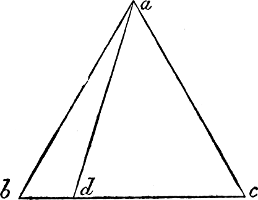
Thus for example, an equilateral triangle a b c, being given, let the side b c be divided into unequal parts, by the line a d. Hence, there will be formed two triangles, having two sides a b, a d, equal to the two a c, a d, and one angle at the point b, equal to one angle at the point c, but the remaining sides will not also be equal, as for instance, the side b d, to the side d c: for they are unequal. But neither are the remaining angles equal: the reason of which is, because we receive an angle equal to an angle, but not the angle which is contained by equal sides. After the same manner, indeed, the present theorem also will appear dubious, unless we assume, according to the aforesaid condition, an equal side subtending one of the equal angles, or adjacent to the equal angles.
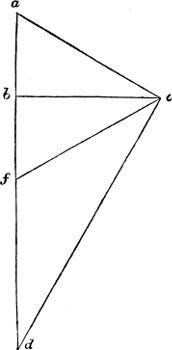
For let there be a right angled triangle a b c, having the angle at the point b right, and the side b c, greater than the side b a, and let there be constructed on the right line b c, and at a point in it c, an angle b c d, equal to the angle b a c, and let b d, c d, produced, coincide in the point d. There are two triangles, therefore a b c, b c d, having one side b c common, and two angles equal to two, viz. a b c, to c b d (for they are right), and b a c to b c d, according to construction. Hence, as it appears the triangles are equal, and yet it may be shewn that the triangle b d c, is greater than the triangle a b c. But the reason of this is, because in the triangle a b c, we assume the common side b c, subtending one of the equal angles, viz. the angle at the point a: but in the triangle b c d, we assume the equal side, adjacent to the equal angles. It was requisite, therefore, in each, either to subtend one of the equal angles, or to be adjacent to the equal angles. But not observing this, we affirmed that triangle to be equal, which is necessarily greater: for is not the triangle b c d, greater than the triangle a b c? To be convinced of this, let there be constructed on the right line b c, and at a given point in it c, an angle f c b, equal to the angle a c b: for the angle b c d, as well as the angle at the point a, is greater than the angle a c b. Because, therefore, there are two triangles, a b c, b c f, having two angles a b c, b c a, equal to two c b f, b c f, each to each, and one side common, adjacent to the equal angles, viz. b c, the triangles are equal. But the triangle b c d is greater than the triangle b c f, and consequently it is also greater than the triangle a b c. But it was formerly shewn to be equal, on account of the assumption of any side: And thus much the diligence of Porphyry has supplied us on the present occasion. But Eudemus, in his Geometrical Narrations, refers the present theorem to Thales. For he says it is necessary to use this theorem in determining the distance of ships at sea, according to the method employed by Thales in this investigation. But from the preceding division we may briefly assume all the contemplation concerning the equality of triangles, and are enabled to relate the causes of things omitted, confuting those hypotheses, as either false, or superfluous. And thus far we determine the limits of the first section of the elementary institutor, because he forms the constructions and comparisons of triangles, according to equal and unequal. And by construction, indeed, he delivers their essence: but by comparison, their identity and diversity. For there are three things which are conversant about being, essence, same, and different[26], as well in quantities, as in qualities, according to the propriety of subjects. From these, therefore, as images it may be shewn, that every thing is the same with itself, and differs from itself, on account of the multitude which it contains; and that all things are the same with one another, and different from themselves. For both, in every triangle, and in more triangles than one, equality and inequality has been found to reside.