Note 17 — BOOK III. (continued 2)
Thomas Taylor translation
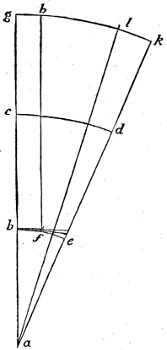
The method of dividing an angle in any given ratio, by means of a right line and circle only, seems to have been entirely unknown to the ancients, as well as to the moderns. However, the author of this translation presumes he has discovered the means of solving this arduous problem; and that such as admit the truth of his demonstration respecting the quadrature of the circle in page 56 of his Dissertation, vol. I. of this work, must necessarily subscribe to the following method of dividing an angle in any required proportion. Let there be an acute angle given g a k, which it is required to divide in the ratio of the right line a c to c g. Bisect a c in b, and from the centre a, with the radius a b, describe the arch b e, and with a radius equal to a c, describe an arch touching b e, in the point b. Likewise with a radius double to a c, describe another tangent arch at the point b, and with a radius equal to a g, a tangent arch at the same point, according to the figure; and lastly, let the arches c d, g k, from the centre a be drawn. Then ½ of the arch b e, shall be equal to ¼ of c d, and to ⅛ of the arch similarly placed, described with a radius the double of a c, as is well known. Bisect then b e in f, and make each of its two next tangent arches at b, equal to b f, which is easily done, from what has been already observed; and through the points of equality describe a circle, this (by the theorem in page 56, of our Dissertation), shall cut off some part of the tangent arch described with the radius a g, equal to b f, or the fourth part of c d. Hence, a part in the arch g k, may be easily taken equal to c d, which let be g l, and drawing the right line a l, the angle g a l, shall be to l a k, as a c to e g, which was required to be done.
The same construction will serve for the division of a right angle in any given ratio, as is evident; and if the given angle be obtuse, the problem may be solved by a two-fold operation, that is, by bisecting the obtuse angle, and dividing either of the equal sections in the given ratio; for when this is effected, the whole angle may be easily divided in the same proportion. Hence, too, a right line may be speedily obtained equal to a given arch of a circle.