Part VII
Rosa Newmarch translation
I 1888
WITH December, 1887, began a new and last period in the life of Tchaikovsky, during which he realised his wildest dreams of fame, and attained to such prosperity and universal honour as rarely fall to the lot of an artist during his lifetime. Distrustful and modest (from an excess of pride), he was now in a perpetual state of wonder and delight to find himself far more appreciated in Russia and abroad than he had ever hoped in the past. Physically neither better nor worse than in former years, possessing the unlimited affections of those whom he loved in return,—he was, to all appearance, an example of mortal happiness, yet in reality he was less happy than before.
Those menacing blows of fate—like the opening of Beethoven’s Fifth Symphony—had sounded, although muffled and distant, even on the day of Tchaikovsky’s first concert (March 5th); while that intangible and groundless sense of bitterness—that “touch of gall,” as he himself calls it—was present even in that triumphant moment when he found himself master of the orchestra and all its tempestuous elements, as though prophetic of those sufferings which overshadowed the last years of his life. At the time he did not understand this vague warning; afterwards, when it came back to him, he realised it had been a friendly caution, not to continue the chase for fame; not to take up occupations that went against his nature, nor to spend his strength upon the attainment of things which would come of themselves; finally, to cling to his true vocation, lest disappointment should await him in the new path he had elected to follow. In February he wrote to Nadejda von Meck: “New and powerful impressions continually await me. Probably my fame will increase, but would it not be better to stay at home and work? God knows! I can say this: I regret the time when I was left in peace in the solitude of the country.” And this regret grew keener, as his weariness grew more intolerable. The more he accustomed his temperament to unsuitable occupations, the further he advanced his reputation, the more complete was his disenchantment with the prize. Radiant and glittering as it had appeared from afar, seen closer, it proved insignificant and tarnished. Hence the profound disillusionment, “the insane depression,” the something “hopeless and final” which make so dark a background to the picture of his brilliant success at home and abroad.
Tchaikovsky left Russia on December 15th (27th) and arrived in Berlin two days later. Here he was to meet Herr N—— who was acting as his concert agent during this tour. He had no sooner settled in his hotel than, picking up a newspaper, his eye fell upon a paragraph to the effect that: “To-day, December 29th, the Russian composer Tchaikovsky arrives in Berlin. To-morrow his numerous friends (?) and admirers (?) will meet to celebrate his arrival by a luncheon at the —— restaurant, at one o’clock. Punctual attendance is requested.” “No words could describe my horror and indignation,” wrote Tchaikovsky. “At that moment I could cheerfully have murdered Herr N——. I went out to breakfast at a café in the Passage, and afterwards to the Museum, walking in fear and trembling lest I should meet Herr N—— or some of my numerous friends and admirers.”
TCHAIKOVSKY IN 1888 (From a photograph by Reitlinger, Paris)

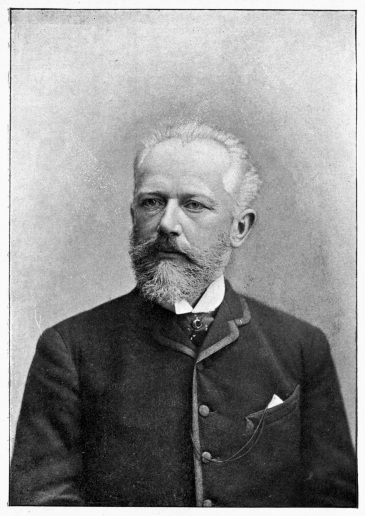
The following morning the dreaded interview with his agent took place. Tchaikovsky found him not altogether unsympathetic, but during the entire tour he realised that he was dealing with a very peculiar and eccentric man, whom he never really understood.
To Modeste Tchaikovsky.
“Leipzig, December 21st, 1887 (January 2nd, 1888).
“I have made acquaintance with Scharwenka and a number of other people. I also met Artôt.[121] Everyone was astonished to see me with N——, who follows me like my own shadow. At three o’clock I left for Leipzig, luckily without N—— for once, and was met by Brodsky, Siloti, and two of my admirers. I had supper with Brodsky. There was a Christmas-tree. His wife and sister-in-law are charming—really good Russian women. All the time the tears were in my eyes. Next day I took a walk (it was New Year’s Day), and went back to dine with Siloti at Brodsky’s. He was just trying a new trio by Brahms. The composer himself was at the piano. Brahms is a handsome man, rather short and stout.[122] He was very friendly to me. Then we sat down to table. Brahms enjoys a good drink. Grieg, fascinating and sympathetic, was there too.[123] In the evening I went to the Gewandhaus, when Joachim and Hausmann played the new Double Concerto of Brahms for violin and ‘cello, and the composer himself conducted. I sat in the Directors’ box, and made acquaintance with such numbers of people that I could not keep pace with them all. The Directors informed me that my rehearsal was fixed for the next day. What I suffered during the evening—in fact the whole time—cannot be described. If Brodsky and Siloti had not been there, I think I should have died. I spent a terrible night. The rehearsal took place early this morning. I was formally introduced to the orchestra by Carl Reinecke. I made a little speech in German. The rehearsal went well in the end. Brahms was there, and yesterday and to-day we have been a good deal together. We are ill at ease, because we do not really like each other, but he takes great pains to be kind to me. Grieg is charming. Dined with Siloti. Quartet concert at night. The new trio of Brahms. Home-sick. Very tired.
“You cannot imagine a finer room than at the Gewandhaus. It is the best concert-room I ever saw in my life.”
To P. I. Jurgenson.
“Leipzig, December 24th, 1887 (January 5th, 1888).
“Yesterday the public rehearsal took place. I was very nervous, but my success was unusually flattering.... To-night, however, all may be reversed, for it is by no means certain that I shall not make a fool of myself. I have seen a good deal of Brahms. He is by no means a total abstainer, but he is very pleasant, and not so vain as I expected. But it is Grieg who has altogether won my heart. He is most taking and sympathetic, and his wife equally so. Reinecke is very amiable. At the first rehearsal he introduced me to the band, and I made the following speech: ‘Gentlemen, I cannot speak German, but I am proud to have to do with such a ... such a ... that is to say ... I am proud ... I cannot.’ The band is splendid; I could not have believed that our musicians—good as they are—were still so far behind a first-rate German orchestra.”
“December 25th (January 6th).
“The concert has gone off well. The reception of the Suite was good, but not to be compared with that at the public rehearsal, when the audience consisted almost entirely of students and musicians. After the concert I went to a banquet arranged in my honour by Reinecke. He related much that was interesting about Schumann and, generally speaking, I felt very much at ease with him. Afterwards I had to go on to a fête given by the Russian students, and I did not get home until very late. Now I am just off to a Tchaikovsky Festival held by the Liszt-Verein. It begins at 11 a.m.”
The Press notices upon Tchaikovsky’s début in Leipzig as conductor and composer were numerous and lengthy. Keeping in view the importance of this occasion, and the influence it exercised on his future career, it has been thought well to give some extracts from the most interesting of these criticisms, which will be found in the Appendix.[124]
At the Tchaikovsky Festival given by the Liszt-Verein, his Quartet, op. 11, Trio, and some of his smaller compositions were included in the programme. The following day the composer returned to Berlin, where he arranged with the Directors of the Philharmonic Society to give a concert of his works on February 8th. He then left for Hamburg in the company of Adolf Brodsky, where the latter was to take part in a concert conducted by Hans von Bülow. As Tchaikovsky had the prospect of a few days’ leisure, he decided to spend them in Lübeck, whence he wrote to his brother Modeste on December 30th, 1887 (January 11th 1888):—
“What joy! I do so enjoy finding myself in a strange town, in a capital hotel, with the prospect of five peaceful days before me! I arrived in Hamburg with Brodsky at 6 a.m. The rehearsal for Bülow’s concert began at ten o’clock. Bülow was delighted to see me. He has altered and aged. He seems, too, calmer, more subdued, and softer in manner.... I went to the concert in the evening. Bülow conducted with inspiration, especially the ‘Eroica.’ I came on here to-day. It is very pleasant. What a blessing to be silent! To feel that no one will be coming, that I shall not be dragged out anywhere!”
To Modeste Tchaikovsky.
“January 1st (13th), 1888.
“ ... At last January (old style) has come. Now at any rate I can reckon four months to my return to Russia. I went to the theatre yesterday. Barnay was the star in Othello. He is sometimes astounding, quite a genius, but what an agonising play! Iago is too revolting—such beings do not exist.”
On January 1st, 1888, a piece of good fortune fell to Tchaikovsky’s lot. Thanks to the efforts of Vsievolojsky, Director of the Imperial Opera, the Emperor bestowed upon him a life pension of 3,000 roubles (£300) per annum.
To Modeste Tchaikovsky.
“Hamburg, January 10th (22nd), 1888.
“On my appearance I was enthusiastically received by the orchestra, and their applause was supported by the public, which was not the case in Leipzig. I conducted without agitation, but towards the end I grew so tired I was afraid I could not hold out. Sapellnikov[125] played splendidly. After the concert there was a large party at the house of Bernuth, the Director of the Philharmonic. About a hundred guests were present, all in full-dress. After a long speech from Bernuth, I replied in German, which created a furore. Then we began to eat and drink. Yesterday was terrible; I cannot describe how I was torn to pieces, nor how exhausted I felt afterwards. In the evening there was a gala in my honour, at which my compositions were exclusively performed. The Press was very favourable.
“After the soirée followed a fearful night of it, in company with many musicians, critics, and amateurs, admirers of my music. I feel befogged. To-day I start for Berlin. Bülow is very amiable.”
The programme of the concert at which Tchaikovsky made his first appearance in Hamburg was as follows: Tchaikovsky’s Serenade for strings, Pianoforte Concerto in B♭ minor (Sapellnikov), the Theme and Variations from his Third Suite, and Haydn’s “Oxford” Symphony.[126]
Between the Hamburg and Berlin concerts Tchaikovsky was anxious for a little repose, and decided to spend a few days at Magdeburg. On the one day spent in Berlin en passant he heard, for the first time, a work by Richard Strauss. “Bülow has taken him up just now,” he wrote to his brother, “as formerly he took up Brahms and others. To my mind such an astounding lack of talent, united to such pretentiousness, never before existed.”
Tchaikovsky now began to receive invitations from many musical centres to conduct his own works. Colonne had engaged him for two concerts in Paris on March 11th and 18th. Several other offers, including Weimar and the Dresden Philharmonic, had to be refused because the dates did not fit in with his plans.
On the advice of Bülow, Wolf, and other friends he decided to alter the programme of the forthcoming concert at Berlin, for which he had put down his Francesca da Rimini. “Perhaps they are right,” he says in a letter to his brother. “The taste of the German public is quite different to ours. Now I understand why Brahms is idolised here, although my opinion of him has not changed. Had I known this sooner, perhaps I, too, might have learnt to compose in a different way. Remind me later to tell you about my acquaintance with the venerable Ave-Lallemant,[127] which touched me profoundly.
“Sapellnikov made quite a sensation in Hamburg. He really has a great talent. He is also a charming and good-hearted young man.”
To V. Napravnik.
“Magdeburg, January, 12th (24th), 1888.
“The newspapers have published long articles about me. They ‘slate’ me a good deal, but pay me far more attention than our own Press. Their views are sometimes funny. A critic, speaking of the variations in the Third Suite, says that one describes a sitting of the Holy Synod and another a dynamite explosion.”
To Modeste Tchaikovsky.
“Leipzig, January 20th (February 1st), 1888.
“ ... How shall I describe all I am experiencing just now? Continual home-sickness, some well-nigh intolerable hours, and a few very pleasant moments. I intended to spend a few quiet days here, instead of which I am whirled along in a stream of gaiety: dinners, visits, concerts, suppers, the theatre, etc. My sole comfort is the society of Siloti, Brodsky (I am quite in love with his wife and sister-in-law), and Grieg and his wife. But besides these, every day I make new and sympathetic acquaintances. I take Sapellnikov with me wherever I go, and have introduced him to many people in the musical world. Wherever he plays he creates a sensation. I am more and more convinced of his superb talent.... I went to a Quartet Concert, at which I heard a quartet by an exceedingly gifted Italian, Busoni. I quickly made friends with him. At an evening given by Brodsky I was charmed with a new sonata by Grieg. Grieg and his wife are so quaint, sympathetic, interesting, and original that I could not describe them in a letter. I regard Grieg as very highly gifted. To-day I dine with him at Brodsky’s. To-night is the extra concert in aid of the funds for the Mendelssohn Memorial, and to-morrow the public rehearsal of the Gewandhaus Concert, at which Rubinstein’s symphony will be given. Afterwards I am giving a dinner to my friends at a restaurant, and start for Berlin at five o’clock. How tired I am!”
“January 23rd (February 4th).
“ ... to-day I got rid of N——. We parted in peace, but my purse was lighter by five hundred marks in consequence. I do not regret it in the least; I would have given a good deal more to see the last of this gentleman.”
To Modeste Tchaikovsky.
“Berlin, January 23rd (February 4th).
“ ... I have made great progress in my conducting.... Wolf gave a large dinner-party at my desire, in order that all the great lights here might hear Sapellnikov. All the critics were there. Sapellnikov created a furore. For the last three weeks we have been inseparable. I have grown so fond of him, and he so attached and good to me—just as though he were a near relation. Since Kotek’s days I have never cared for anyone so much. It is impossible to imagine anyone more sympathetic, gentle, kindly; more delicate-minded and distinguished. On his return I beg you not only to be friendly to him, but to introduce him to all our relatives. I consider him—and I am not alone in my opinion—a future genius as regards the piano. Yesterday Bock had a party. Artôt was there. I was inexpressibly glad to see her again; we made friends at once, without a word as to the past. Her husband, Padilla, embraced me heartily. To-morrow she gives a dinner. As an elderly woman she is just as fascinating as twenty years ago.”
To N. F. von Meck.
“Leipzig, January 30th (February 11th), 1888.
“My dear Friend,—My concert in Berlin was a great success.[128] I had a splendid orchestra to deal with and musicians who were in sympathy with me from the very first rehearsal. The programme was as follows:—
“(1) Overture, Romeo and Juliet; (2) Pianoforte Concerto, played by Siloti; (3) Introduction and Fugue from the First Suite; (4) Andante from the First Quartet; (5) Songs, sung by Fräulein Friede; (6) Overture, “1812.”
“The public gave me a most enthusiastic reception. Of course, all this is very pleasant, but at the same time I feel so worn out I hardly know how I am to get through all that lies before me.... Can you recognise in this Russian musician, touring all over Europe, the man who, a few years ago, fled from life and society, and lived in solitude abroad, or in the country?
“A real triumphal festival awaits me in Prague. The programme of my week’s visit there is already arranged, and has been sent to me. It includes any number of ovations and receptions. The idea is to give my concert there a certain patriotic and anti-German character. This puts me in an awkward position, because I have been received in a very friendly way in Germany.”
In spite of the applause of the public and the flattering notices in the Press, Tchaikovsky’s visit made less impression in Berlin than in Leipzig and Hamburg. Whereas in the latter towns his concerts were the great events of the day, in the capital the début of a Russian composer passed comparatively unnoticed amid a thousand other interests. A brief entry in his diary on January 28th about “a bucket of cold water” seems to point to a certain disillusionment as to the character of his reception in Berlin. Possibly he had heard rumours that the concert-room had been liberally “papered,” and in this way a certain amount of artificial enthusiasm spread through the audience.
In any case, it was Leipzig, rather than Berlin, that showed the greater interest in Tchaikovsky during this tour, and he was glad to return there for a few days before leaving Germany. “I have come back to Leipzig,” he wrote to a relative on January 30th (February 11th), 1888, “as I had promised to be present at the concert given in my honour by the Liszt-Verein. The concert could not come off, so yesterday, at my request, Wagner’s Meistersinger was performed at the theatre instead. I had never heard this opera. Early this morning I was awakened by the strains of the Russian hymn. An orchestra was serenading me. They played for nearly an hour under my windows, and the whole hotel ran out to see and hear.”
The marvellous performance of Meistersinger under Nikisch, and the touching ovation in the form of a serenade, were the closing events of Tchaikovsky’s first concert tour in Germany. In Bohemia and France far more brilliant receptions awaited him, but these were of quite a different nature.
II
On January 31st (February 12th) Tchaikovsky, accompanied by Siloti, arrived at the frontiers of Bohemia. The triumphal character of the reception which awaited him was soon made apparent by the extraordinary attentions of the railway officials. At one of the last stations before Prague, a deputation of members of various societies had assembled to welcome him. At Prague a representative of the “Russian Club” awaited him on the platform, having come expressly from Vienna to pay him this compliment. He presented Tchaikovsky with an address in Russian. This was followed by a speech in Czech, delivered by Dr. Strakaty, the representative of the “Umclecká Beseda,”[129] after which children presented him with flowers, and he was hailed with prolonged cries of “Slava!” (Hurrah!). The carriage which awaited him, and the suite of rooms at the Hotel de Saxe, were provided for him at the expense of the Artists’ Club.
In the evening he was invited to hear Verdi’s Otello, and a box was reserved for him at the Opera House. Rieger, “the leader of the Czech people,” was the first to greet the guest, after which followed many of the most prominent men in Bohemia.
The following day Tchaikovsky received a visit from Dvořák, and the two composers quickly made friends with each other.
ALEXANDER SILOTI PETER ILICH TCHAIKOVSKY
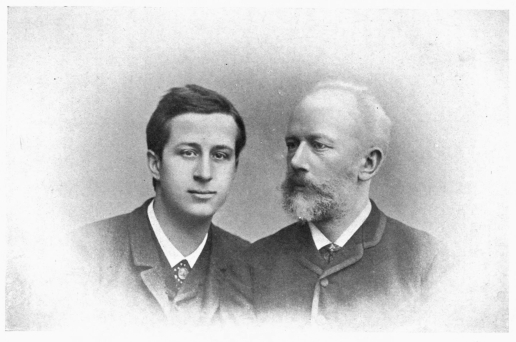
It is impossible to give in detail the programme drawn up for each day of the composer’s visit to Prague. He made an almost royal progress to all the chief places of interest. On one occasion, entering the “Rathaus” while a session was being held, the entire body of members rose to greet him. One evening he was serenaded by the famous Choral Union “Hlahol.” He listened to the songs from his balcony, and afterwards came down to thank the singers in person. An offer, made in the course of his speech, to compose something expressly for the Society was received with loud cheering. On February 6th (18th) he was invited to the Students’ Union and presented to the students. In his diary he speaks of this as “a very solemn and touching ceremony.” Accompanied by cries of “Slava!” and “Na Sdrava!” he was next led off to the public rehearsal of the concert. The evening wound up with a brilliant soirée at the Town Club (Meschtschanska Beseda).
The first concert itself took place on February 7th (19th), in the “Rudolfinum.” The programme consisted entirely of Tchaikovsky’s music, and included: (1) Overture, Romeo and Juliet; (2) Concerto for Pianoforte (B♭ minor), played by Siloti; (3) Elégie from the Third Suite; (4) Violin Concerto, played by Halir; (5), Overture, “1812.” Of all these works the last-named excited the greatest applause. Tchaikovsky sums up his impressions as follows: “Undoubtedly it was the most eventful day of my life. I have become so attached to these good Bohemians ... and with good reason! Heavens, what enthusiasm! Such as I have never known, but in my own dear Russia!”
Two days later, on February 9th (21st), the second concert was given in the foyer of the Opera House. This time the programme comprised: (1) Serenade for strings; (2) Variations from the Third Suite; (3) Pianoforte Solos (Siloti); (4) Overture, “1812.” The ovations were even more hearty, and the gifts more costly, than at the first concert. “An overwhelming success,” says Tchaikovsky in his diary. “A moment of absolute bliss. But only one moment.”
On the evening of February 10th (22nd), sped by farewell addresses, and smothered in flowers, the composer took leave of the festive city of Prague.
Although the chief object of Tchaikovsky’s tour was to make his works more widely known in Europe, and to carry them beyond the confines of his native land, he combined with this aim—although in a lesser degree—the desire to see for himself the extent of his reputation and to reap some profit by it. Distrustful and modest as he was, he made no great demands in this respect, and even the appreciation he received in Germany quite surpassed his expectations. The honour done him in Prague far outstripped his wildest dreams. These ten days were the culminating point of Tchaikovsky’s fame during his lifetime. Allowing that nine-tenths of the ovations lavished on him were really intended for Russia, even then, he could not fail to be flattered that he was the chosen recipient of the sympathy of the Czechs for the Russians, since it proved that he was already famous as a composer. It was flattering, too, to feel that he was honoured by a nation which could be regarded as one of the most musical in the world. It pleased him that Prague—the first place to recognise the genius of Mozart—should pay him honour, thus uniting his fate with that of the illustrious German. It touched Tchaikovsky deeply to feel that those who gave him one “moment of absolute happiness” were descendants of the same race which, long ago, had given a portion of joy to him who was his teacher and model, both as man and as musician. This strange coincidence was the most flattering event of his life—the highest honour to which he had ever ventured to aspire.
Simultaneously with this climax of his renown, came one of the bitterest experiences of his life. The Russian Press did not give a line to this triumph of a native composer in Prague. He felt this to be a profound injury, which surprised and mortified him the more, because all these triumphs in his life were regarded as important events even by the Czechs themselves. It was most painful to realise that Russia, for whom the greater part of these honours were intended, knew nothing whatever about them; that on account of the attitude of the Press towards him, personally, this warm sympathy, meant for his countrymen as a whole, would never be known to them, nor evoke any response.
Quite another kind of ovation awaited Tchaikovsky in Paris. Here, too, his success surpassed his expectations; but the sympathy of the French capital differed as widely in character from that which was shown him in Prague as the Czechs differ from the French in their musical tastes and their relations towards the Russians. There is no country in which music is better loved, or more widely understood, than in Bohemia. Nor is there any other nation which feels such appreciation for all that is Russian; not merely as a matter of passing fashion, but on account of actual kinship between the Eastern and Western Slav. In Bohemia, therefore, both as a musician and a native of Russia, Tchaikovsky had been received with a warmth and sincerity hardly to be expected from France. It is true a little political feeling influenced his reception in Paris; it was just the beginning of the Franco-Russian rapprochement, so that everything Russian was the fashion of the hour. Many French people, who were not in the least musical, regarded it as their duty to express some appreciation of Tchaikovsky—simply because he was a Russian. All this, like the French sympathy itself, had no solid foundation of national affinity, but merely sprang from an ephemeral political combination. The enthusiastic, explosive, but fleeting, craze of the French for all that was Russian showed itself in hats à la Kronstadt, in shouting the Russian national anthem simultaneously with the “Marseillaise,” in ovations to the clown Durov, and in a “patronising” interest for our art and literature—as species of curiosities—rather than in the hearty relations of two countries drawn together by true affinity of aims and sympathies. Naturally the festivities of Kronstadt, Toulon, and Paris led to no real appreciation of Poushkin, Gogol, Ostrovsky, Glinka, Dargomijsky, or Serov, only, at the utmost, to a phase of fashion, thanks to which Tolstoi and Dostoievsky found a certain superficial vogue, without being understood in their fullest value. Tchaikovsky was also a modern, and this lent a kind of brilliance to his reception in Paris; but it was purely external.... It may truly be said that all Prague welcomed the composer; whereas in Paris only the musicians and amateurs, a few newspapers in favour of the Franco-Russian alliance, and that crowd which is always in pursuit of novelty, were interested in Tchaikovsky’s visit.
Time has proved the respective value of these ovations. Although it is now fifteen years since Tchaikovsky visited Prague, his operas still hold their own in the repertory of the theatre, and his symphonic music is still as well known there and as much loved as in Russia. In Paris, on the contrary, not only are his works rarely given, either on the stage or in the concert-room, but his name—although it has gained in renown all over Europe—is not considered worthy of inclusion among those which adorn the programmes of the Conservatoire concerts. And yet those who are at the head of this institution are the same men who honoured him in 1888. Is not this a proof of that hidden but smouldering antipathy which the French really feel for the Russian spirit—that spirit which Tchaikovsky shares in common with his great predecessors in music, and with the representatives of all that Russia has produced of lofty and imperishable worth?
Tchaikovsky arrived in Paris on February 12th (24th), and went almost straight from the station to the rehearsal of his Serenade for strings, which—conducted by the composer—was to be played by Colonne’s orchestra at a soirée given by M. N. Benardaky.
N. Benardaky had married one of the three sisters Leibrock, operatic artists well known to the Russian public. He had a fine house in Paris, frequented by the élite of the artistic world. As a wealthy patron of art—and as a fellow-countryman—he inaugurated the festivities in Tchaikovsky’s honour by this musical evening.
Over three hundred guests were present, and, besides his Serenade for strings, Tchaikovsky conducted the Andante from his Quartet and presided at the piano. The composer was grateful to his kindly host for the unexpected and—according to Parisian custom—absolutely indispensable réclame which this entertainment conferred upon him. To ensure the success of the evening, and in return for the service done him, Tchaikovsky felt himself obliged to run from rehearsal to rehearsal, from musician to musician. To appear as a conductor before this assemblage of amateurs—more distinguished for vanity than for love of art—and to earn their languid approval, seemed to him flattering and important. But when we reflect what far greater trouble and fatigue this entailed upon him than his appearance before the Gewandhaus audience—whose opinion was really of weight and value—we cannot but regret the waste of energy and the lowering of the artist’s dignity. When we think of him, exhausted and out of humour, amid this crowd of fashionably attired strangers, who to-morrow would be “consecrating” the success of the latest chansonette singer, or the newest dance of a Loie Fuller—we cannot but rebel against fate, who took him from his rural quiet, from the surroundings to which he was attached, in which—sound in body and mind—it was his pleasure to plan some new composition in undisturbed solitude. Thank God, my brother comforted himself with the belief that it was necessary to suffer this martyrdom cheerfully, and that he did not live to realise that it was indeed useless, for nowhere did he make a greater sacrifice for popularity’s sake with smaller results than in Paris.
Those musicians who had been absent during Tchaikovsky’s visit to Paris in 1886 now made his acquaintance for the first time. All of them, including Gounod, Massenet, Thomé and others, received him with great cordiality and consideration. The sole exception was Reyer, the composer of Salammbô, whose indifference was the less hurtful to Tchaikovsky because he did not esteem him greatly as a musician. Of the virtuosi with whom he now became acquainted, Paderewski made the most impression upon him.
Among the brilliant Parisian gatherings held in Tchaikovsky’s honour must be mentioned the memorable evening at Colonne’s; the soirée given by the aristocratic amateur, Baroness Tresderne, at whose house in the Place Vendôme Wagner’s Trilogy had been heard for the first time in Paris (“Marchionesses, duchesses—bored,” is Tchaikovsky’s laconic entry in his diary the day after this entertainment); the fête at the Russian Embassy; a reception at Madame Pauline Viardot’s; and an entertainment arranged by the Figaro.
Tchaikovsky made two public appearances in the double capacity of composer and conductor; both these were at the Châtelet concerts. At the first, half the programme was devoted to his works, including the Serenade for strings, Fantasia for pianoforte (Louis Diemer), Songs (Madame Conneau), pieces for violoncello (Brandoukov), and Theme and Variations from the Third Suite.
On ascending to the conductor’s desk he was received with a storm of applause, intended as much for his nationality as for his personality. Of his orchestral works, the Valse from the Serenade won most success, and had to be repeated in order to satisfy the audience.
The second concert, which took place a week later, consisted almost exclusively of Tchaikovsky’s works. The Variations from the Third Suite, the Elégie, and Valse from the Serenade, and the pieces for violoncello were repeated; to which were added the Violin Concerto (Marsick) and Francesca da Rimini. The applause was as vociferous as on the first occasion, although comparatively little of it fell to the lot of Francesca.
As long as they dealt with the private performances in the houses of Benardaky, Colonne, Madame Tresderne, or at the Figaro, the representatives of the Paris Press spoke with enthusiasm of the composer, of his works, and his nationality. After the public concerts, however, there was a sudden change of tone, and their fervour waned. It seemed they had most of them studied Cui’s book, La Musique en Russie, to good purpose, for, without quoting their source of information, they discovered that Tchaikovsky “was not so Russian as people imagined,” that he did not display “much audacity or a strong originality,” wherein lay the chief charm of the great Slavs: Borodin, Cui, Rimsky-Korsakov, Liadov, etc.
The Western cosmopolitanism of Tchaikovsky’s works was made a subject of reproach. “The German dominates and absorbs the Slav,” says one critic, who had looked for “impressions exotiques” at the Châtelet—perhaps for something in the style of the music of Dahomey, which had created such a sensation at the Jardin d’Acclimatation.
The remaining critics, who had not read Cui’s book, disapproved of the length of Tchaikovsky’s works, and held up to him as models, Saint-Saëns and other modern French composers. His own sense of disappointment appears in a letter addressed to P. Jurgenson towards the end of his visit:—
“I have expended a great deal of money, and even more health and strength,” he writes.[130] “In return I have gained some celebrity, but every hour I ask myself—Why? Is it worth while? And I come to the conclusion it is far better to live quietly without fame.”
From Paris Tchaikovsky crossed to England.
“The journey to London was terrible,” he wrote to Nadejda von Meck. “Our train was brought to a standstill in the open country in consequence of a snowstorm. On the steamer it was alarming, for the storm was so severe that every moment we dreaded some catastrophe.”
Tchaikovsky only spent four days in London. No one welcomed him, no one paid him special attention, or worried him with invitations. Except for a complimentary dinner given to him by Berger, the Secretary of the Philharmonic Society, he spent his time alone, or in the society of the violinist Ondricek and his wife. Yet, in spite of appearances, his visit to London had brilliant results for his future reputation. Next to Russia and America his music at present is nowhere more popular than in England.
He conducted the Serenade for strings and the Variations from the Third Suite. “The success was great,” he wrote, in the letter quoted above. “The Serenade pleased most, and I was recalled three times, which means a good deal from the reserved London public. The Variations were not so much liked, but all the same they elicited hearty applause.”
The leading London papers mostly gave Tchaikovsky the credit of a signal success. The Musical Times only regretted that he had not chosen some more serious work for his début before the London public. “The Russian composer was received with signs of unanimous approbation,” said the Times, while the Daily Chronicle felt convinced that Tchaikovsky must have been fully satisfied with the extraordinarily warm welcome accorded him by the Londoners.
“Thus ended the torments, fears, agitations, and—to speak the truth—the joys of my first concert tour abroad.” In these words Tchaikovsky concludes his letter to N. F. von Meck, from which the above extracts have been quoted.
III
After a long journey—six nights in the train—Tchaikovsky reached Tiflis on March 26th (April 7th), 1888. Here he stayed with his brother Hyppolite, whom he had not seen for two years. About the end of April he travelled north to take possession of the country house at Frolovskoe, which had been prepared for him during his absence by his servant Alexis. He describes it as a highly picturesque spot, lying on a wooded hill on the way from Moscow to Klin. It was simpler and not so well furnished as Maidanovo. There was no park planted with lime trees, there were no marble vases; but its unpretentiousness was an added recommendation in Tchaikovsky’s eyes. Here he could be alone, free from summer excursionists, to enjoy the little garden (with its charming pool and tiny islet) fringed by the forest, behind which the view opened out upon a distant stretch of country—upon that homely, unassuming landscape of Central Russia which Tchaikovsky preferred to all the sublimities of Switzerland, the Caucasus, and Italy. Had not the forest been gradually exterminated, he would never have quitted Frolovskoe, for although he only lived there for three years, he became greatly attached to the place. A month before his death, travelling from Klin to Moscow, he said, looking out at the churchyard of Frolovskoe: “I should like to be buried there.”
To Modeste Tchaikovsky.
“Klin, May 15th (27th), 1888.
“I am in love with Frolovskoe. The neighbourhood is a paradise after Maidanovo. It is, indeed, so beautiful that when I go out for half an hour’s walk in the morning, I feel compelled to extend it to two hours.... I have not yet begun to work, excepting at some corrections. To speak frankly, I feel as yet no impulse for creative work. What does this mean? Have I written myself out? No ideas, no inclination? Still I am hoping gradually to collect material for a symphony.
“To-day we were to have sown seeds and planted flowers in the beds in front of the house. I was looking forward to it with such pleasure, but the rain has hindered us. By the time you arrive all our seeds will be in.”
TCHAIKOVSKY’S HOUSE AT FROLOVSKOE
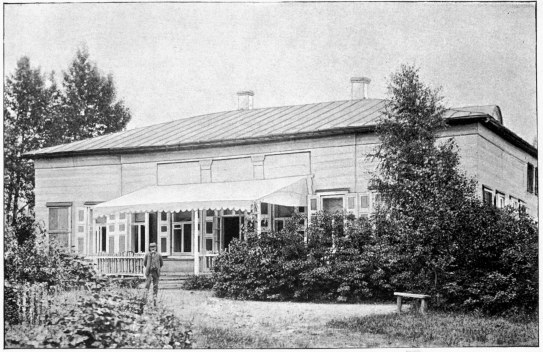
To the Grand Duke Constantine Constantinovich.
“Frolovskoe, May 30th (June 11th), 1888.
“Your Highness,—I am very glad you were not offended by my remarks, and thank you most heartily for your explanations in reference to them.[131] In matters of versification I am only an amateur, but have long wished to become thoroughly acquainted with the subject. So far, I have only reached the stage of inquiry. Many questions interest me to which no one seems able to give a clear and decided reply. For instance, when I read Joukovsky’s translation of the Odyssey, or his Undine, or Gniedich’s version of the Iliad, I suffer under the intolerable monotony of the Russian hexameter as compared with the Latin (I do not know the Greek), which has strength, beauty, and variety. I know that the fault lies in the fact that we do not use the spondee, but I cannot understand why this should be. To my mind we ought to employ it. Another question that greatly occupies me is why, as compared with Russian poetry, German verse should be less severe in the matter of regular rhythm and metre. When I read Goethe I am astonished at his audacity as regards metrical feet, the cæsura, etc., which he carries so far that, to an unpractised ear, many of his verses scarcely seem like verse. At the same time, the ear is only taken by surprise—not offended. Were a Russian poet to do the same, one would be conscious of a certain lameness. Is it in consequence of the peculiar qualities of our language, or because tradition allows greater freedom to the Germans than to us? I do not know if I express myself correctly; I only state that, as regards regularity, refinement, and euphony, much more is expected from the Russian than from the German poet. I should be glad to find some explanation of this....”
To N. F. von Meck.
“Frolovskoe, June 1st (13th), 1888.
“.... Just now I am busy with flowers and flower-growing. I should like to have as many flowers as possible in my garden, but I have very little knowledge or experience. I am not lacking in zeal, and have indeed taken cold from pottering about in the damp. Now, thank goodness, it is warmer weather; I am glad of it, for you, for myself, and for my dear flowers, for I have sown a quantity, and the cold nights made me anxious for them....”
To N. F. von Meck.
“Frolovskoe, June 10th (22nd), 1888.
“.... Now I shall work my hardest. I am dreadfully anxious to prove not only to others, but also to myself, that I am not yet played out as a composer.... Have I already told you that I intend to write a symphony? The beginning was difficult; now, however, inspiration seems to have come. We shall see!”
To the Grand Duke Constantine Constantinovich.
“Frolovskoe, June 11th (23rd), 1888.
“Your Imperial Highness,—I am the more glad to hear your favourable verdict upon my songs, because I was afraid you would think them weak.... I composed them at a time when my state of mind was anything but promising for good work. At the same time, I did not wish to postpone the setting of your words, as I had informed you long ago of my intention with regard to them....
“I am not at all astonished that you should write beautiful verses without being an adept in the science of versification. Several of our poets—Plestcheiev for one—have told me the same. All the same, I think it would be better if some of our gifted Russian poets were more interested in the technique of their art. ‘I am sick of four iambic feet,’ said Poushkin, and I would add that sometimes his readers get weary of it too. To discover new metres and rare rhythmic combinations must be very interesting. Were I a poet, I should certainly try to write in varied rhythms like the Germans....”
To N. F. von Meck.
“Frolovskoe, June 22nd (July 4th), 1888.
“ ... Lately I have been in frequent correspondence with the Grand Duke Constantine Constantinovich, who sent me his poem, ‘St. Sebastian,’ with the request that I would say what I thought of it. On the whole I liked it, but I criticised a few details very freely. He was pleased with this, but defended himself, and thus a brisk exchange of letters has taken place. He is not only gifted, but surprisingly modest, devoted to art, and ambitious to excel in it rather than in the service. He is also an excellent musician—in fact, a rare and sympathetic nature.
“It is well that the political horizon is clearer, and if it be true that the German Emperor is to visit Russia, we may say with some certainty that the horrors of war will not break out for many years to come....”
Diary.
“June 27th (July 9th), 1888.
“It seems to me letters are not perfectly sincere—I am judging by myself. No matter to whom I am writing, I am always conscious of the effect of my letter, not only upon the person to whom it is addressed, but upon any chance reader. Consequently I embroider. I often take pains to make the tone of a letter simple and sincere—at least to make it appear so. But apart from letters written at the moment when I am worked upon, I am never quite myself in my correspondence. These letters are to me a source of repentance, and often of agonising regret. When I read the correspondence of great men, published after their death, I am always disturbed by a vague sense of insincerity and falsehood.
“I will go on with the record of my musical predilections which I began some time ago. What are my feelings towards the Russian composers?
Glinka.
“An unheard-of and astonishing apparition in the world of art. A dilettante who played the violin and the piano a little; who concocted a few insipid quadrilles and fantasias upon Italian airs; who tried his hand at more serious musical forms (songs, quartets, sextets, etc.), but accomplished nothing which rose superior to the jejune taste of the thirties; suddenly, in his thirty-fourth year, creates an opera, which for inspiration, originality, and irreproachable technique, is worthy to stand beside all that is loftiest and most profound in musical art! We are still more astonished when we reflect that the composer of this work is the author of the Memoirs published some twenty years later. The latter give one the impression of a nice, kind, commonplace man, with not much to say for himself. Like a nightmare, the questions continually haunt me: How could such colossal artistic force be united to such emptiness? and how came this average amateur to catch up in a single stride such men as Mozart and Beethoven? Yes, for he has overtaken them. One may say this without exaggeration of the composer of the ‘Slavsia.’ This question may be answered by those who are better fitted than myself to penetrate the mysteries of the artistic spirit which makes its habitation in such fragile and apparently unpromising shrines. I can only say no one loves and appreciates Glinka more than I do. I am no indiscriminate worshipper of Russlan; on the contrary, I am disposed to prefer A Life for the Tsar, although Russlan may perhaps be of greater musical worth. But the elemental force is more perceptible in his earlier opera; the ‘Slavsia’ is overwhelming and gigantic. For this he employed no model. Neither Glück nor Mozart composed anything similar. Astounding, inconceivable! Kamarinskaya is also a work of remarkable inspiration. Without intending to compose anything beyond a simple, humorous trifle, he has left us a little masterpiece, every bar of which is the outcome of enormous creative power. Half a century has passed since then, and many Russian symphonic works have been composed; we may even speak of a symphonic school. Well? The germ of all this lies in Kamarinskaya, as the oak tree lies in the acorn. For long years to come Russian composers will drink at this source, for it will need much time and much strength to exhaust its wealth of inspiration. Yes! Glinka was a true creative genius!”
To N. F. Von Meck.
“Frolovskoe, July 17th (29th), 1888.
“.... My name-day was a great interruption to my work, for my visitors arrived the day before and only left yesterday evening. My guests were Laroche and his wife, Jurgenson, Albrecht, Siloti, and Zet,[132] who arrived quite unexpectedly from Petersburg. The last named (who has been highly recommended to me) has been my concert agent since May.... He is a great admirer of my work, and cares less to make money out of his position than to forward my interests in Europe and America....”
At this time Tchaikovsky received an offer from an American impresario offering him a three months’ concert tour at a fee of 25,000 dollars. The sum appeared to the Russian composer fabulous in its amount. “Should this really come off,” he says, “I could realise my long-cherished wish to become a landowner.”
Diary.
“July 13th (25th), 1888.
“Dargomijsky? Certainly he was a gifted man. But never was the type of amateur musician more strikingly realised than in him. Glinka, too, was a dilettante, but his immense inspiration served him as a defence from amateurishness. Except for his fatal Memoirs, we should not have realised his dilettantism. It is another matter with Dargomijsky: his amateurishness lies in his creative work, in his very forms themselves. To possess an average talent, to be weak in technique and yet to pose as an innovator—is pure amateurishness. When, at the close of his life, Dargomijsky composed The Stone Guest, he seriously believed he had overturned the old foundations and erected something new and colossal in their place. A piteous error; I saw him in this last period of his life, and in view of his suffering condition (he had a heart disease) there could be no question of a discussion. But I have never come in contact with anything more antipathetic and false than this unsuccessful attempt to drag truth into this sphere of art, in which everything is based upon falsehood, and “truth,” in the everyday sense of the word, is not required at all. Dargomijsky was no master (he had not a tenth part of Glinka’s mastership). He possessed a certain originality and piquancy. He was most successful in curiosities. But artistic beauty does not lie in this direction, as so many of us think.
“I might speak personally of Dargomijsky (I frequently saw him in Moscow at the time of his success there), but I prefer not to recall my acquaintance. He was very cutting and unjust in his judgments (when he raged against the brothers Rubinstein, for instance), but was pleased to talk of himself in a tone of self-laudation. During his fatal illness he became far more kindly disposed, and showed much cordial feeling to his younger colleagues. I will only keep this memory of him. Unexpectedly he showed me great sympathy (in respect of my opera The Voyevode).[133] Apparently he did not believe the report that I had hissed at the first performance of his Esmeralda in Moscow.”
To N. F. von Meck.
“Frolovskoe, July 25th (August 6th), 1888.
“ ... The real summer weather has not lasted long, but how I enjoyed it! My flowers, which I feared would die, have nearly all recovered, and some have blossomed luxuriantly. I cannot tell you what a pleasure it has been to watch them grow and to see daily—even hourly—new blossoms coming out. Now I have as many as I want. When I am quite old, and past composing, I shall devote myself to growing flowers. I have been working with good results, and half the symphony is orchestrated. My age—although not very advanced—begins to tell. I get very tired now, and can no longer play or read at night as I used. Lately I miss the chance of a game of vint[134] in the evenings; it is the one thing that rests and distracts me.”
To N. F. von Meck.
“Frolovskoe, August 14th (26th), 1888.
“Again I am not feeling well ... but I am so glad to have finished the Symphony (No. 5) that I can forget all physical ailments. I have made no settled plans for the winter. There is a prospect of a tour in Scandinavia and also in America. But nothing is decided as to the first, and the second seems so fantastic that I can hardly give it a serious thought. I have promised to conduct at Dresden, Berlin, and Prague.... In November I am to conduct a whole series of my works in Petersburg (at the Philharmonic), including the new Symphony. They also want me in Tiflis, but I do not know if it will come off.”
IV 1888-1889
The winter season 1888-1889 opened with much arduous work and personal anxiety. Tchaikovsky’s niece, Vera, the second daughter of his sister Alexandra Davidov, was in a dying condition, and his old friend Hubert was suffering from a terrible form of intermittent fever. One gleam of joy shone through the darkness. His Moscow friends, Taneiev in particular, were delighted with the Fifth Symphony, a work which had filled Tchaikovsky himself with gloomy misgivings. At this time he was engaged in an active correspondence upon music and poetry with the Grand Duke Constantine.
To the Grand Duke Constantinovich.
“Frolovskoe, September 21st(October 3rd), 1888.
“ ... Fet[135] is quite right in asserting, as you say he does, that ‘all which has no connection with the leading idea should be cast aside, even though it is beautiful and melodious.’ But we must not deduce from this that only what is terse can be highly artistic; therefore, to my mind, Fet’s rule that an exemplary lyric must not exceed a certain limit is entirely wrong. All depends upon the nature of the leading idea and the poet who expresses it. Of two equally inspired poets, or composers, one, by reason of his artistic temperament, will show greater breadth of treatment, more complexity in the development of the leading idea, and a greater inclination for luxuriant and varied elaboration; while the other will express himself concisely. All that is good, but superfluous, we call ‘padding.’ Can we say we find this padding in Beethoven’s works? I think most decidedly we do not. On the contrary, it is astonishing how equal, how significant and forceful, this giant among musicians always remains, and how well he understands the art of curbing his vast inspiration, and never loses sight of balanced and traditional form. In his last quartets, which were long regarded as the productions of an insane and deaf man, there seems to be some padding, until we have studied them thoroughly. But ask someone who is well acquainted with these works, a member of a quartet who plays them frequently, if there is anything superfluous in the C♯ minor Quartet. Unless he is an old-fashioned musician, brought up upon Haydn, he would be horrified at the idea of abbreviating or cutting any portion of it. In speaking of Beethoven I was not merely thinking of his latest period. Could anyone show me a bar in the Eroica, which is very lengthy, that could be called superfluous, or any portion that could really be omitted as padding? So everything that is long is not too long; many words do not necessarily mean empty verbiage, and terseness is not, as Fet asserts, the essential condition of beautiful form. Beethoven, who in the first movement of the Eroica has built up a superb edifice out of an endless series of varied and ever new architectural beauties upon so simple and seemingly poor a subject, knows on occasion how to surprise us by the terseness and exiguity of his forms. Do you remember the Andante of the Pianoforte Concerto in B flat? I know nothing more inspired than this short movement; I go cold and pale every time I hear it.
“Of course, the classical beauty of Beethoven’s predecessors, and their art of keeping within bounds, is of the greatest value. It must be owned, however, that Haydn had no occasion to limit himself, for he had not an inexhaustible wealth of material at command. As to Mozart, had he lived another twenty years, and seen the beginning of our century, he would certainly have sought to express his prodigal inspiration in forms less strictly classical than those with which he had to content himself.
“While defending Beethoven from the charge of long-windedness, I confess that the post-Beethoven music offers many examples of prolixity which is often carried so far as to become mere padding. That inspired musician who expresses himself with such breadth, majesty, force, and even brusqueness, has much in common with Michael Angelo. Just as the Abbé Bernini has flooded Rome with his statues, in which he strives to imitate the style of Michael Angelo, without possessing his genius, and makes a caricature of what is really powerful in his model, so Beethoven’s musical style has been copied over and over again. Is not Brahms in reality a caricature of Beethoven? Is not this pretension to profundity and power detestable, because the content which is poured into the Beethoven mould is not really of any value? Even in the case of Wagner (who certainly has genius), wherever he oversteps the limits it is the spirit of Beethoven which prompts him.
“As regards your humble servant, I have suffered all my life from my incapacity to grasp form in general. I have fought against this innate weakness, not—I am proud to say—without good results; yet I shall go to my grave without having produced anything really perfect in form. There is frequently padding in my works; to an experienced eye the stitches show in my seams, but I cannot help it. As to Manfred, I may tell you—without any desire to pose as being modest—that this is a repulsive work, and I hate it, with the exception of the first movement. I intend shortly, with the consent of my publisher, to destroy the remaining three movements and make a symphonic poem out of this long-winded symphony. I am sure my Manfred would then please the public. I enjoyed writing the first movement, whereas the others were the outcome of strenuous effort, in consequence of which—as far as I remember—I felt quite ill for a time. I should not think of being offended at what your Highness says about Manfred. You are quite right and even too indulgent.”
To the Grand Duke Constantine Constantinovich.
“Frolovskoe, October 2nd (14th), 1888.
“Your Imperial Highness,—Just returned from Moscow, where I have seen my poor friend Hubert laid in his grave, and still depressed by my painful experiences, I hasten to answer your letter.... Your Highness must bear in mind that although one art stands in close relationship to the other, at the same time each has its peculiarities. As such we must regard the “verbal repetitions” which are only possible to a limited extent in literature, but are a necessity in music. Beethoven never repeats an entire movement without a special reason, and, in doing so, rarely fails to introduce something new; but he has recourse to this characteristic method in his instrumental music, knowing that his idea will only be understood after many statements. I cannot understand why your Highness should object to the constant repetition of the subject in the Scherzo of the Ninth Symphony. I always want to hear it over and over again. It is so divinely beautiful, strong, original, and significant! It is quite another matter with the prolixity and repetitions of Schubert, who, with all his genius, constantly harps upon his central idea—as in the Andante of the C major Symphony. Beethoven develops his first idea fully, in its entirety, before repeating it; Schubert seems too indolent to elaborate his first idea, and—perhaps from his unusual wealth of thematic material—hurries on the beginning to arrive at something else. It seems as though the stress of his inexhaustible inspiration hindered him from the careful elaboration of the theme, in all its depth and delicacy of workmanship.
“God grant I may be in Petersburg to hear the performance of Mozart’s Requiem in the Marble Palace. I hope your Highness will permit me to be present at this concert. The Requiem is one of the most divine creations, and we can but pity those who are unable to appreciate it.
“As regards Brahms, I cannot at all agree with your Highness. In the music of this master (it is impossible to deny his mastery) there is something dry and cold which repulses me. He has very little melodic invention. He never speaks out his musical ideas to the end. Scarcely do we hear an enjoyable melody, than it is engulfed in a whirlpool of unimportant harmonic progressions and modulations, as though the special aim of the composer was to be unintelligible. He excites and irritates our musical senses without wishing to satisfy them, and seems ashamed to speak the language which goes straight to the heart. His depth is not real: c’est voulu. He has set before himself, once and for all, the aim of trying to be profound, but he has only attained to an appearance of profundity. The gulf is void. It is impossible to say that the music of Brahms is weak and insignificant. His style is invariably lofty. He does not strive after mere external effects. He is never trivial. All he does is serious and noble, but he lacks the chief thing—beauty. Brahms commands our respect. We must bow before the original purity of his aspirations. We must admire his firm and proud attitude in the face of triumphant Wagnerism; but to love him is impossible. I, at least, in spite of much effort, have not arrived at it. I will own that certain early works (the Sextet in B♭) please me far more than those of a later period, especially the symphonies, which seem to me indescribably long and colourless.... Many Brahms lovers (Bülow, among others) predicted that some day I should see clearer, and learn to appreciate beauties which do not as yet appeal to me. This is not unlikely, for there have been such cases. I do not know the German Requiem well. I will get it and study it. Who knows?—perhaps my views on Brahms may undergo a complete revolution.”
To Ippolitov-Ivanov.
“October 27th (November 8th), 1888.
“I cannot possibly give you any definite news as to my journey to Tiflis. It will be two or three weeks, at the earliest, before I know when I shall have to go abroad.... I only know that I will come to Tiflis, even if I am dying. As to my fee, we will not speak of it. Before I take anything from you, something must be there. Let us see how the concert succeeds, and then we can settle how much you shall give me as ‘a tip.’ If it is not a success, I shall accept nothing.”
To N. F. von Meck.
“Frolovskoe, October 27th (November 8th), 1888.
“Now we are having sharp frosts, without snow, and fine, sunny days. It depresses me to think that I must soon leave my quiet home, my regular life, and daily constitutionals. Three days hence I go to Petersburg, where my concert takes place on November 5th (17th). On the 12th (24th) I take part in the Musical Society’s concert, and leave for Prague the next day to attend the rehearsals for Eugene Oniegin. I have been working very hard lately. The orchestration of the Hamlet overture is now finished. I have made innumerable corrections in the Symphony, and have been preparing everything I have to conduct at the forthcoming concerts.
“I hope to spend December here, for I have to return direct from Prague in order to conduct the new Symphony in Moscow, and then I shall hasten to my harbour of refuge.”
The Philharmonic concert in St. Petersburg was apparently a great success, but the Press notices of the new Symphony (No. 5) were far from satisfactory. On November 12th (24th) Tchaikovsky conducted it once more at the Musical Society, and on this occasion the fantasia-overture Hamlet was heard for the first time. Both works were well received by the public.
V
On this occasion Prague received Tchaikovsky less hospitably than on his first visit. “The rehearsal,” he wrote to Nadejda von Meck, “took place the very day I arrived. Last year, if you remember, I conducted two grand patriotic concerts, without a fee. To show their gratitude for my having come to the performance of the opera here, the management of the Prague Theatre organised a concert, of which I was to receive half the profits. But they chose such a bad day, and arranged everything so stupidly, that the concert only realised three hundred florins. After being received like a prince last year, when the enthusiasm which greeted me almost amounted to a frenzy, I felt somewhat hurt at this meagre offering on the part of the Prague public. I therefore declined the money, and made it over to the Musicians’ Pension Fund. This was soon made public, and the Theatre Direction was overwhelmed with reproaches. The whole Press took up the matter, and thanks to this, the performance of Oniegin, which I conducted the evening before last, gave rise to a series of enthusiastic ovations. Yesterday I left Prague, crowned with laurels; but, alas! my laurel wreaths were all I carried away. I do not know how to look after my pecuniary interests.”
The success of Oniegin in Prague was extraordinary, and the opera has kept its place in the repertory up to the present time.
Amid the chorus of praise, in which both the public and the Press united, one voice was especially valued by Tchaikovsky—that of his famous colleague, Anton Dvořák.
A. Dvořák to P. Tchaikovsky.
“Prague, January 2nd (14th), 1889.
“Dear Friend,—When you were lately with us in Prague I promised to write to you on the subject of your opera Oniegin. I am now moved to do so, not only in answer to your request, but also by my own impulse to express all I felt on hearing your work. I confess with joy that your opera made a profound impression on me—the kind of impression I expect to receive from a genuine work of art, and I do not hesitate to tell you that not one of your compositions has given me such pleasure as Oniegin.
“It is a wonderful creation, full of glowing emotion and poetry, and finely elaborated in all its details; in short, this music is captivating, and penetrates our hearts so deeply that we cannot forget it. Whenever I go to hear it I feel myself transported into another world.
“I congratulate both you and ourselves upon this work. God grant you may give us many another like it.
“I embrace you, and remain your sincerely devoted
“Anton Dvořák.”
On his way home from Prague to Vienna, Tchaikovsky heard of the death of his niece, Vera Rimsky-Korsakov, née Davidov. Although he had long since given up all hope of her recovery, this news affected him deeply.
From Prague he returned to Frolovskoe for a short time. On December 10th (22nd) he conducted his new works at a Symphony Concert in Moscow. These included the new Symphony (No. 5, E minor) and the second Pianoforte Concerto, with Sapellnikov as soloist; both works achieved great success.
December 17th (29th) found him again in Petersburg, where, at the fourth of Belaiev’s “Russian Symphony Concerts,” he conducted his Tempest overture, and on the following day was present at a performance of the Oprichnik given by the pupils of the Petersburg Conservatoire. Tchaikovsky was interested to renew his impressions of this work, and to prove whether his prejudice against it was well founded. In spite of a very good performance, his opinion of the opera remained unaltered.
The next work which Tchaikovsky took in hand after his return from Prague was the music of the ballet, The Sleeping Beauty, the programme of which had been prepared by Vsievolojsky, Director of the Imperial Opera. Tchaikovsky was charmed with the subject and the proposed mounting of the work, and retired to Frolovskoe late in December, in order to devote himself to the task.
In view of the great popularity to which his Fifth Symphony has since attained, it is interesting to read the composer’s own judgment of the work, recorded within a few weeks of its first performance. Writing to Nadejda von Meck, in December, 1888, he says:—
“ ... After two performances of my new Symphony in Petersburg, and one in Prague, I have come to the conclusion that it is a failure. There is something repellent, something superfluous, patchy, and insincere, which the public instinctively recognises. It was obvious to me that the ovations I received were prompted more by my earlier work, and that the Symphony itself did not really please the audience. The consciousness of this brings me a sharp twinge of self-dissatisfaction. Am I really played out, as they say? Can I merely repeat and ring the changes on my earlier idiom? Last night I looked through our Symphony (No. 4). What a difference! How immeasurably superior it is! It is very, very sad!”
Such attacks of pessimism as to his creative powers were often, as we have already seen, the forerunner of a new tide of inspiration. This was now the case. Since Eugene Oniegin Tchaikovsky had never worked at anything with the ease and enthusiasm which inspired him in the first four tableaux of this ballet, The Sleeping Beauty, the sketch of which was completely finished by January 18th (30th).
The monotony of these six weeks’ work was relieved by news of the success of the Fifth Symphony in Moscow, and also by the kindness of his friend, Peter Jurgenson, who surprised him at Christmas with a beautiful and valuable gift—the complete edition of Mozart’s works. These he commissioned Alexis to present to his master, together with a tiny Christmas-tree.
On January 24th (February 5th), 1889, Tchaikovsky started on his second concert tour abroad. He experienced “the usual feelings of home-sickness,” and began to anticipate the joy of his return. He remained three days in Berlin, and arrived in Cologne on January 29th (February 10th), where he was to make his first appearance as composer and conductor, with his Third Suite (in G), at a so-called “Gürzenich” concert.
To M. Tchaikovsky.
“Cologne, January 30th (February 11th), 1889.
“ ... To-day was my first rehearsal. It went very well, and the orchestra is excellent, so that the three hours passed very pleasantly, excepting for the agitation at the start. Hardly had I got back to my hotel before I was seized with home-sickness and a wild longing for April 8th....”
Tchaikovsky made his début at Cologne on January 31st (February 12th). He thus describes his impressions to Glazounov:—
“I arrived shortly before the first of the three rehearsals. One hardly expects to find a first-class orchestra in a town of secondary importance, and I was convinced it would only be a very poor one. The local conductor, Wüllner, has, however, worked with such care and energy that he has succeeded in organising a magnificent orchestra, which filled me with astonishment and admiration from the very opening of my Third Suite. Twenty first violins! And such violins! The wind, too, is admirable. They read the Scherzo, which is particularly difficult, as if they were playing it for the tenth time. With such an orchestra and three rehearsals, it was easy to achieve an admirable performance. The concert-hall is also excellent; the audience equally so, and not so stupidly conservative as in many German towns. The success was great, and when I was recalled the musicians greeted me with a fanfare.
“Early on February 1st (13th),” the letter continues, “I started for Frankfort. Here the orchestra is equally large and excellent. The violins did not seem to me quite as good as those in Cologne, although they consist mostly of leaders from the neighbouring towns—so I was told—who come here to play at the great concerts. There are twelve ‘cellos. One of them, Kossmann, the celebrated virtuoso, was once professor at Moscow. My Overture “1812” was in the programme. At the first rehearsal, however, the managers of the concert took fright at the noisy Finale, and timidly requested me to choose another piece. Since, however, I had no other piece at hand, they decided to confine themselves to the Suite. The success here was as great as it was unexpected, for the Frankfort public is very classical, and I am regarded in Germany as a notorious revolutionary.”
Of those in Frankfort whose society Tchaikovsky most enjoyed, he mentions in his diary the family of the celebrated music publisher, pianist, and composer, Otto Neitzel, and Ivan Knorr, Professor at the Frankfort Conservatoire, besides the ‘cellist Kossmann.
Tchaikovsky reached Dresden on February 4th (16th). Here disappointment awaited him. The orchestra proved to be only “third-rate,” to use his own words, and the work he had to rehearse made even greater technical demands than the Third Suite; it was his favourite composition—the Fourth Symphony. The Dresdner Zeitung spoke of “a very poor rendering of several passages, the result of insufficient rehearsal.” The concert took place on February 8th (20th). The first Pianoforte Concerto (Emil Sauer) was included in the programme. According to Tchaikovsky’s account, “the first movement pleased the audience a little, the Andante pleased better, the Scherzo still more, while the Finale had a real success. The musicians honoured me with a fanfare. Sauer played incomparably.”
To P. Jurgenson.
“Dresden, February 5th (17th) 1889.
“Dear Friend,—I had forgotten to answer you about Paris. Please remember that it is impossible to give a concert there unless support is guaranteed by the French. I hear that Slaviansky, Bessel, and others want to have a finger in the pie. I have not the least wish to associate myself with them. You can simply say that, without a guarantee, we are not in a position to undertake anything.[136] Heavens, how tired I am, and how bored by all this!
“ ... I expect soon to hear decisively from Klindworth and Dvořák. A letter to hand from Massenet. He accepts with enthusiasm, but begs to keep the date open for the present, as it depends on the fate of his new opera.”
To N. F. von Meck.
“Berlin, February 11th (23rd), 1889.
“After an exhausting tour I arrived here yesterday. In one week I had three concerts and nine rehearsals. I cannot conceive whence I draw strength for all this. Either these fresh exertions will prove injurious, or this feverish activity will be an antidote to my troubles, which are chiefly the result of the constant sitting my work entails. There is no medium; I must return to Russia ‘either with my shield or upon it.’ I am inclined to think that, in spite of hard moments and the continual self-conflict, all this is good for me.”
To A. Glazounov.
“Berlin, February 15th (27th), 1889.
“ ... If my whole tour consisted only of concerts and rehearsals, it would be very pleasant. Unhappily, however, I am overwhelmed with invitations to dinners and suppers.... I much regret that the Russian papers have said nothing as to my victorious campaign. What can I do? I have no friends on the Russian Press. Even if I had, I should never manage to advertise myself. My Press notices abroad are curious: some find fault, others flatter; but all testify to the fact that Germans know very little about Russian music. There are exceptions, of course. In Cologne and in other towns I came across people who took great interest in Russian music and were well acquainted with it. In most instances Borodin’s E flat Symphony is well known. Borodin seems to be a special favourite in Germany (although they only care for this symphony). Many people ask for information about you. They know you are still very young, but are amazed when I tell them you were only fifteen when you wrote your Symphony in E flat, which has become very well known since its performance at the festival. Klindworth intends to produce a Russian work at his concert in Berlin. I recommended him Rimsky-Korsakov’s Caprice Espagnol and your Stenka Razin.”
To P. Jurgenson.
“Leipzig, February 17th (March 1st), 1889.
“Klindworth says that I am an ‘excellent conductor.’ First-rate, isn’t it?
“Klindworth is prepared to appear next season at our concerts for anything we like to offer. He will give a Wagner programme. Dvořák promises to conduct a whole concert; but he cannot travel alone, and brings his wife, so he asks a higher fee. Never mind. In the spring it would be well to get out an advertisement with such names as Massenet, Dvořák, Klindworth. I shall make an attempt to invite Brahms. That would be grand!
“When in Berlin, Artôt and dear Hugo Bock were my great comfort.”
To N. F. von Meck.
“Geneva, February 21st (March 5th), 1889.
“I am engaged to give a concert of my own compositions here. It takes place on Saturday, March 9th. The orchestra is very small, only third-rate. Had I known, I never would have come, but the theatrical Director (he is no musician) probably believes that the quality and number of an orchestra are of no importance to a wandering musician. How I shall get through with this small provincial band, I really do not know. However, I must confess that they showed great zeal at yesterday’s rehearsal....”
After all, this concert was a success. The room was crowded, and the Russian colony presented Tchaikovsky with a gilt laurel-wreath.
On February 27th (March 11th) Tchaikovsky arrived in Hamburg. Brahms was at his hotel, occupying the room next his own. Peter Ilich felt greatly flattered on learning that the famous German composer was staying a day longer on purpose to hear the rehearsal of his Fifth Symphony. Tchaikovsky was very well received by the orchestra. Brahms remained in the room until the end of the rehearsal. Afterwards, at luncheon, he gave his opinion of the work “very frankly and simply.” It had pleased him on the whole, with the exception of the Finale. Not unnaturally, the composer of this movement felt “deeply hurt” for the moment; but happily the injury was not incurable, as we shall see. Tchaikovsky took this opportunity to invite Brahms to conduct one of the Symphony Concerts in Moscow, but the latter declined. Nevertheless Tchaikovsky’s personal liking for the composer of the German Requiem was increased, although his opinion of his compositions was not changed. Tchaikovsky played no part in the conflict between Brahms and Wagner, which divided all musical Germany into two hostile camps. Brahms’s personality as man and artist, his purity and loftiness of aim, and his earnestness of purpose won his sympathy. Wagner’s personality and tendencies were antipathetic to him; but while the inspired music of the latter found an echo in his heart, the works of Brahms left him cold.
At the second rehearsal all went “excellently,” and at the third Tchaikovsky observed that the Symphony pleased the musicians. At the public rehearsal “there was real enthusiasm,” and although the demonstration at the concert on March 3rd (15th) was less noisy, the success of the Symphony was no less assured.
The pleasant impressions of the evening were slightly marred by the absence—on account of illness—of Ave-Lallemant, to whom the Symphony is dedicated.
To V. Davidov.
“Hanover March 5th (17th), 1889.
“ ... The concert at Hamburg has taken place, and I may congratulate myself on a great success. The Fifth Symphony was magnificently played, and I like it far better now, after having held a bad opinion of it for some time. Unfortunately the Russian Press continues to ignore me. With the exception of my nearest and dearest, no one will ever hear of my successes. In the daily papers here one reads long telegrams about the Wagner performances in Russia. Certainly I am not a second Wagner, but it would be desirable for Russia to learn how I have been received in Germany.”
To M. Tchaikovsky.
“ ... Success is very pleasant at the time, but when there is neither rehearsal nor concert, I immediately relapse into my usual state of depression and boredom. Only one concert remains, the one in London, but not for another month. How on earth shall I kill time till then? Possibly I may go straight to Paris. Rushing about there ought to drive away ennui. How one wastes time!”
The three days’ visit to Hanover only differed from Tchaikovsky’s sojourn in other towns in that he missed the only thing that could help him to conquer his chronic home-sickness—concerts and rehearsals.
“Curious fact,” he remarks in his diary, “I seek solitude, and suffer when I have found it.” In this state of fluctuation between bad and worse Tchaikovsky had spent his time since he left Russia; but the worst was reserved for Hanover, where he experienced “extreme loneliness.”
On March 8th (20th) he arrived in Paris, and remained there until the 30th (April 11th).
As his present visit to the French capital was not undertaken in a public capacity, it was neither so brilliant, nor so fatiguing, as that of the previous year. At the same time he came in contact with many people and received a number of invitations. On March 19th (31st) he was present at one of Colonne’s concerts, when three numbers from his Third Suite were played.
During this holiday in Paris Tchaikovsky had only two aims in view: to secure Massenet for one of the Moscow Symphony Concerts and to use his influence in favour of Sapellnikov, whose gifts as a pianist he valued very highly.
To P. Jurgenson.
“March 21st (April 2nd), 1889.
“I have seen Massenet several times; he is very much flattered and prepared to come. The spring will suit him best. I have engaged Paderewski, who has had a colossal success in Paris. He is not inferior to D’Albert, and one of the very first pianists of the day.
“The Third Suite had a splendid success at Colonne’s concert.”
To Modeste Tchaikovsky.
“Paris, April 7th (19th), 1889.
“Modi,—Vassia[137] played to Colonne yesterday evening. After the Chopin Polonaise Colonne was astonished, and said he would engage him next year and do ‘les choses en grand.’ ... Vassia has made a furore.”
To V. Davidov.
“London, 1889.
“ ... The evening before I left Paris I went to Madame Viardot’s. I heard an opera which she composed twenty years ago to a libretto by Tourgeniev.[138] The singers were her two daughters and her pupils, among whom was a Russian, who danced a national dance to the delight of all the spectators. I have seen the celebrated Eiffel Tower quite near. It is very fine.... I very much enjoyed hearing the finest of Berlioz’s works, La Damnation de Faust. I am very fond of this masterpiece, and wish you knew it. Lalo’s opera, Le Roi d’Ys, also pleased me very much. It has been decided that I shall compose an opera to a French book, La Courtisane.[139] I have made acquaintance with a number of the younger French composers;[140] they are all the most rabid Wagnerites. But Wagnerism sits so badly on the French! With them it takes the form of a childishness which they pursue in order to appear earnest.”
To the same.
“London, March 30th (April 11th), 1889.
“ ... Before all else, let me inform you that I have made acquaintance with London fog. Last year I enjoyed the fog daily, but I never dreamt of anything like the one we had to-day. When I went to rehearsal this morning it was rather foggy, as it often is in Petersburg. But when at midday I left St. James’s Hall with Sapellnikov and went into the street, it was actually night—as dark as a moonless, autumn night at home. It made a great impression upon us both. I felt as though I were sitting in a subterranean dungeon. Now at 4 p.m. it is rather lighter, but still gloomy. It is extraordinary that this should happen half-way through April. Even the Londoners are astonished and annoyed.
“Ah, Bob, how glad I shall be to get back to Frolovskoe! I think I shall never leave it again.
“The rehearsal went off very well to-day; the orchestra here is very fine. Sapellnikov has not played yet. To-morrow he will certainly make a sensation among the musicians....”
At the London Philharmonic Tchaikovsky conducted his first Pianoforte Concerto (with Sapellnikov as soloist) and the Suite No. 1. Both works had a brilliant success. This was evident from the opinions of the Press, although the lion’s share of praise fell to the lot of Sapellnikov. The Musical Times regretted that one of Tchaikovsky’s symphonies had not been given instead of the Suite, and considered this work was not sufficiently characteristic to give a just idea of the composer’s talent.
Tchaikovsky left London very early on the morning of March 31st (April 12th), and arrived at Marseilles on the following day, where he embarked for Batoum by the Messageries Maritimes.
To Modeste Tchaikovsky.
“Constantinople, April 8th (20th), 1889.
“ ... We left Marseilles a week ago. The ship is a good one, the food excellent. It was sometimes very rough. Between Syra and Smyrna there was quite a storm, to which I cannot look back without horror. Both these places pleased me very much. I got to know two Russians on board: a lad of fourteen, Volodya Sklifassovsky (son of the celebrated surgeon), and Hermanovich, a student at the Moscow University, who was travelling with him. Both were charming beings, with whom I made fast friends. They were going to Odessa—I to Batoum. We spent the whole of the evening together in the town, but slept on board. I shall miss them very much....”
When Tchaikovsky parted from his new friends he returned to his cabin and “cried bitterly,” as though he had some premonition that he should never again see this lovable and highly gifted boy on earth. Volodya Sklifassovsky died in January, 1890.
To N. F. von Meck.
“Tiflis, April 20th (May 2nd), 1889.
“ ... A glorious land, the Caucasus! How indescribably beautiful is the valley of the Rion, for instance, with its rich vegetation, through which runs the railway from Batoum to this place! Imagine, my dear, a wide valley, shut in on either side by rocks and mountains of fantastic form, in which flourish rhododendrons and other spring flowers, besides an abundance of trees, putting forth their fresh green foliage; and, added to this, the noisy, winding, brimming waters of the Rion.... In Tiflis, too, it is wonderful just now; all the fruit trees are in blossom. The weather is so clear that all the distant snow-peaks are visible, and the air is full of the feeling of spring, fragrant and life-giving. After the London fog it seems so beautiful, I can find no words to express it....”
By May 7th (19th) Tchaikovsky was back in Moscow. The following letter throws some light on the musical life of that town.
To Anatol Tchaikovsky.
“Moscow, May 12th (24th), 1889.
“ ... All were glad to see me again. Since my return I have attended the committee meetings of the Musical Society every day. There is a great accumulation of business. A coup d’état has taken place in the Conservatoire. Taneiev has resigned the direction, and Safonov is prepared to take his place, on condition that Karl Albrecht gives up the post of inspector. I backed Karl persistently and energetically, and finally declared that I would retire from the Board of Direction if he were allowed to leave without any decoration for long service....”
From Moscow Tchaikovsky went to Petersburg for a few days, returning to Frolovskoe, where he remained for the next four months.
The summer of 1889 passed in peaceful monotony. Tchaikovsky was engaged in composing and orchestrating his ballet, The Sleeping Beauty.... The little parties he occasionally gave—when Jurgenson, Mme. A. Hubert, and Siloti were his usual guests—were the sole “events” of this period of his life. But no account of this summer—uneventful as it was—would be complete without some mention of Legoshin’s[141] daughter, a child of three. Tchaikovsky was altogether fascinated by her prettiness, her clear, bell-like voice, her charming ways, and clever little head. He would spend hours romping with the child, listening to her chatter, and even acting as nursemaid.
At this time Tchaikovsky’s correspondence had not decreased, but many of his business letters are not forthcoming, and those of a more private nature which date from this summer are for the most part short and uninteresting.
To Edward Napravnik.
“Klin, July 9th (21st), 1889.
“ ... You have not forgotten your promise to conduct one of the concerts of the Moscow Musical Society, dear friend?...
“Now for the programme. It rests entirely with you both as regards the choice of music and of the soloists.... We beg you to lay aside your modesty, and to include at least two important works of your own. I implore you most emphatically not to do any of my compositions. As I am arranging this concert, it would be most unseemly were the conductor I engaged to perform any work of mine. I would not on any account have it suspected that I was looking after my own interests. But people would be sure to put this interpretation upon the matter, if the conductor invited for the occasion were to include any of my music in the programme. I think Dvořák will only bring forward his own works, so I will ask you as a Russo-Bohemian to give us something of Smetana’s, Vishergrad, or Moldava....”
To N. F. von Meck.
“Frolovskoe, July 25th (August 6th), 1889.
“ ... My ballet will be published in November or December. Siloti is making the pianoforte arrangement. I think, dear friend, that it will be one of my best works. The subject is so poetical, so grateful for musical setting, that I have worked at it with all that enthusiasm and goodwill upon which the value of a composition so much depends. The instrumentation gives me far more trouble than it used to do; consequently the work goes slowly, but perhaps all the better. Many of my earlier compositions show traces of hurry and lack of due reflection.”
VI 1889-1890
At the close of September, 1889, Tchaikovsky went to Moscow, where very complicated business in connection with the Russian Musical Society awaited his attention. For each symphony concert during the forthcoming season a different conductor was to be engaged.[142] Besides this, he had to superintend the rehearsals for Eugene Oniegin. This opera was to be newly and sumptuously remounted on September 18th (30th), when the composer had undertaken to conduct his own work.
From Moscow Tchaikovsky went to Petersburg for a few days, to attend a meeting of the committee appointed to arrange the Jubilee Festival for Anton Rubinstein. Tchaikovsky had undertaken to compose two works for this occasion.
While he was in Petersburg, Alexis prepared the new quarters in Moscow, which he had taken for the whole winter.
The lack of society in the evening, and the heavy duties which awaited him in connection with the Musical Society, were Tchaikovsky’s sole reasons for wintering in Moscow rather than in the neighbourhood of Klin.
During the summer the idea of trying town life once more seemed to attract him, and he spoke with enthusiasm of his new apartment, and took the greatest interest in getting it ready; but, as the day of departure drew near, he felt less and less inclined to leave his country home.
Two circumstances contributed to make the first days after his arrival in Moscow depressing: first, he greatly missed the society of Laroche, who had gone to live in Petersburg; and, secondly, his friend, the ‘cellist Fitzenhagen, was on his death-bed.
His winter quarters were small, but comfortable. The work to which he looked forward with most apprehension was the direction of the two festival concerts for Rubinstein’s jubilee. For two and a half years he had been conducting his own compositions, but had comparatively little experience of other music. Therefore these long and heavy programmes, including as they did several of Rubinstein’s own works, filled him with anxious foreboding.
To N. F. von Meck.
“Moscow, October 12th (24th), 1889.
“I am very glad you are at home, and I envy you. By nature I incline very, very much to the kind of life you lead. I long to live completely away from society, as you do, but during recent years circumstances have made it impossible for me to live as I please. I consider it my duty, while I have strength for it, to fight against my destiny and not to desert my fellow-creatures so long as they have need of me....
“But, good God, what I have to get through this winter! It frightens me to think of all that lies before me, here and in Petersburg. Directly the season is over I shall go to Italy for a rest. I have not been there since 1882.”
To Modeste Tchaikovsky.
“October 16th (28th), 1889.
“Just think: I have heard from Tchekov.[143] He wants to dedicate his new stories to me. I have been to thank him. I am very proud and pleased.”
Tchaikovsky first became acquainted with Tchekov’s works in 1887. His enthusiasm was such that he felt impelled to write to the author, expressing his delight at having come across a talent so fresh and original. His first personal acquaintance with his literary favourite probably dated from the autumn of the same year. At any rate, they had known each other previous to 1889.
To the Grand Duke Constantine Constantinovich.[144]
“Moscow, October 29th (November 10th), 1889.
“Your Imperial Highness,—I feel a certain pride in knowing that your admirable poem is partly the outcome of my letter to you last year. I cannot think why you should fancy that the idea of your poem does not please me. On the contrary, I like it very much. I cannot say that I have sufficient love and forbearance in my own nature always to love ‘the hand that chastises.’ Very often I want to parry the blows, and play the rebellious child in my turn. Nevertheless, I cannot but incline before the strength of mind and lofty views of such rare natures as Spinoza, or Tolstoi, who make no distinction between good and bad men, and take the same attitude towards every manifestation of human wickedness that you have expressed in your poem. I have never read Spinoza, so I speak of him from hearsay; but as regards Tolstoi, I have read and re-read him, and consider him the greatest writer in the world, past or present. His writings awake in me—apart from any powerful artistic impression—a peculiar emotion. I do not feel so deeply touched when he describes anything really emotional, such as death, suffering, separation, etc., so much as by the most ordinary, prosaic events. For instance, I remember that when reading the chapter in which Dolokhov plays cards with Rastov and wins, I burst into tears. Why should a scene in which two characters are acting in an unworthy manner affect me in this degree? The reason is simple enough. Tolstoi surveys the people he describes from such a height that they seem to him poor, insignificant pigmies who, in their blindness, injure each other in an aimless, purposeless way—and he pities them. Tolstoi has no malice; he loves and pities all his characters equally, and all their actions are the result of their own limitations and naïve egotism, their helplessness and insignificance. Therefore he never punishes his heroes for their ill_doings, as Dickens does (who is a great favourite of mine), because he never depicts anyone as absolutely bad, only blind people, as it were. His humanity is far above the sentimental humanity of Dickens; it almost attains to that view of human wickedness which is expressed in the words of Christ: ‘they know not what they do.’
“Is not your Highness’s poem an echo of this lofty feeling of humanity which so dominates me, and how can I therefore fail to admire the fundamental idea of your verses?
“The news that the Emperor has deigned to inquire after me gives me great pleasure. How am I to understand the Emperor’s question about little pieces? If it is an indirect incitement to compose something in this style, I will take the first opportunity of doing so. I should immensely like to compose a great symphony, which should be, as it were, the crown of my creative work, and dedicate it to the Tsar. I have long since had a vague plan of such a work in my mind, but many favourable circumstances must combine before I can realise my idea. I hope I shall not die before I have carried out this project. At present I am entirely absorbed in the concerts here and the preparations for Rubinstein’s jubilee.”
In the same year in which my brother began to study with Zaremba, in 1861 (or perhaps the previous year—I cannot remember for certain), he took Anatol and myself to an amateur performance in aid of some charity, given in the house of Prince Bieloselsky. Anton Rubinstein, already at the height of his fame, was among the audience. Peter Ilich pointed him out to me for the first time, and I still remember the excitement, rapture and reverence with which the future pupil gazed on his future teacher. He entirely forgot the play, while his eyes followed his “divinity,” with the rapt gaze of a lover for the unattainable beauty of his fancy. During the intervals he stood as near to him as possible, strove to catch the sound of his voice, and envied the fortunate mortals who ventured to shake hands with him.